


Abstract
The interest in the Airbnb phenomenon is represented in the fast growth of publications indexed in the Web of Science (WoS) since the research inception of this topic in 2010. However, there are no studies that analyze the incidence of this phenomenon from a bibliometric approach using WoS. Therefore, this paper aims to quantify the incidence and composition of the Airbnb phenomenon through bibliometrics taken it as a data source. To achieve this aim, the WoS statistical instruments and the bibliometric tool VOSviewer are used. The results obtained, such as the number of articles and citations per year, the main categories of these articles, the nationalities of the authors, the most productive institutions, the sources and authors in terms of publications, and the H-Core of the most cited articles, are presented. Finally, concept maps are exposed, representing the relatedness of co-authorship and co-citation among authors, as well as the co-occurrence of the keywords in the articles analyzed. Satisfaction, trust, and innovation appear as the main research lines. This paper can be useful for academics and professionals, giving them a holistic overview of the topic, identifying new research areas, or as an objective manner to literary review approaches.
1. Introduction
In the autumn of 2007, Brian Chesky and Joe Gebbia were looking for extra money to help to pay their rent in San Francisco, when they suddenly thought of acquiring three inflatable mattresses to rent them per night. They named that idea as “Airbed and Breakfast”, creating a website to advertise. In February 2008, Nathan Blecharczyk, a technical architect who graduated in Harvard, joined Brian and Joe, founding Airbnb. Four years later, its web already had more than 100,000 properties advertised (houses, apartments, and villas, mostly) as holiday rentals in 192 countries worldwide [1]. The latest available data raises the number of these available properties to over six million [2].
The popularization of the use of the Internet led to the spring of several Peer-to-Peer (P2P) platforms enabling, as intermediaries, to connect millions of buyers and sellers around the world [3]. This sharing economy activity of which Airbnb is a part of is also called collaborative consumption. Although the first appearance of this term is attributed to Felson and Spaeth [4], with a previous different meaning, is later highlighted by Algar [5], Botsman and Rodgers [6], Belk [7] and Hamari, Sjöklint, and Ukkonen [8] who define the term as “Peer-to-peer based activity of obtaining, giving, or sharing the access to goods and services, coordinated through community-based online services”.
The appearance of Airbnb as a collaborative consumption phenomenon has meant a real disruptive innovation in the tourist accommodation sector [9]. Authors such as Zervas, Proserpio, and Byers [10] highlight the hotel sector threats from this phenomenon. The expansion of the P2P referred above, as well as certain advantages over conventional accommodation, such as better value-for-money, or the search for a more “local” experience [11], are the causes of the increase of holiday rentals as a global phenomenon.
Although there are bibliometric studies regarding the tourist accommodation sector and sharing economy, this is an introductory approach to the phenomenon of Airbnb from a bibliometric perspective, after ten years of studies indexed in the Web of Science (WoS). This paper presents a widespread analysis that can be useful for researchers, giving them a holistic overview of the topic, a systematic and objective manner to literary review approaches that attempt the subjectivity bias of the reviewer [12] or a way to identify new research areas. It can also be suitable for professionals dedicated to holiday rentals and/or other types of accommodation, reflecting current findings in the topic and/or possible future research trends in the sector. This information can later be used as a method to update, develop, or optimize their business.
The structure followed is based on a literary review of Airbnb’s phenomenon. First are introduced the main bibliometrics contributions in the Airbnb phenomenon—in which innovation, consumer trust, and satisfaction appear as main research lines, and in the field of tourist accommodation. Next, the methodology is detailed, using the statistical instruments available in the WoS, as well as the VOSviewer bibliometric tool. Finally, the results obtained are shown and analyzed, with the main conclusions attained.
2. Literature Review
A double perspective is employed. First, looking at the most notable studies that deal with the Airbnb phenomenon. Second, the different types of bibliometrics are defined and classified, performing additional analysis referred to the field of tourism and tourist accommodation.
2.1. Web of Science Studies Regarding Airbnb Phenomenon
The publications of Caulfield [13] and Hempel [1] mean the beginning of the Airbnb phenomenon research, considered only the part indexed in the WoS. Both authors briefly describe the new business model, as well as its accelerated success. Subsequently, the work of Anders and Konrad [14] is a milestone, in which the role of Airbnb as a recipient of a successful investment group is mentioned; furthermore, Desai [15], describes this platform as one of the new online exchange service businesses emerging together with several P2P developments. These first studies reflect one of the main research lines of the topic, as the essential innovative business model that the company had been bringing to the markets.
However, it is not until the publication of Möhlmann’s [16] study on the consumers’ choice determinants towards sharing economy services, and Guttentag’s paper [9], about the disruptive innovation that the appearance of the Airbnb phenomenon involved in the tourist accommodation sector that the publication of works in this regard begins to happen abundantly; this evolved with different perspectives such as another main research line as the consumers’ trust, demonstrating a special influence of the owner’s photos regarding this issue, especially correlated with the price [17]. Additionally, other subjects appear as storytelling advertising in social networks in the acquisition of this new type of service [18], and the problem of gentrification [19], consisting of the progressive displacement of original residents of the neighborhoods saturated by holiday rentals due to the rise in prices of residential rents caused by the increase in the demand produced by tourism.
Subsequently, works highlight the threat represented to the hotel sector by holiday rentals [10], as well as studies referring to the differences in prices [20] between both types of accommodation, or regarding the type of tourist experience that these offer as more “local” in the case of Airbnb [21]. Furthermore, several papers are related to urban impact [22,23]. Models for estimating prices of stays in the properties offered in Airbnb through their valuation determinants can be found in [24,25]. Finally, the most recent studies analyzed are again related to the consumers’ casual factors that make them choose or discard this type of accommodation [26,27], mainly related to the satisfaction of the consumer in which positive factors, such as local authenticity [26] and interaction with the host [26,27] or negative as noise [27], are highlighted. Lastly, there are the ones that link the influence of political competition at the municipal level in legislative changes, such as Hong and Lee [28].
2.2. Bibliometrics: Concept and Precedents in the Tourist Accommodation Sector
Bibliometrics can be defined as the research field that studies bibliographic material through the use of quantitative methods [29,30], providing general perspectives on a series of documents [31], as well as relevant evaluations about the importance of a specific discipline or an interesting field of research [32,33]. This method has also been described as the study of the relations between “cited” and “citing” literature thanks to the pioneering studies of Garfield [34] through the Science Citation Index (SCI), according to Benckendorff and Zehrer [35].
Analyzing the tourism and accommodation sector, there are different approaches outlining a bibliometric study. Some delimit their research field to a specific country, as in the case of Evren and Kozak [36] for articles published in Turkey; López Bonilla, Granados Perea, and López Bonilla [37] for Spanish authors; or Benckendorff and Shu [38] for Australia and New Zealand, while other works focus on the study of institutions such as universities [39] or journals [40,41]. Other contributions delimit their research field to a specific category, as in the cases of Mulet Forteza, Genovart Balaguer, Mauleon Mendez, and Merigó [42] for “Hospitality, Leisure, Sports and Tourism”, or specific search terms such as “sustainable tourism” adding different additional concepts such as “islands” or “mountains” [43], and delimit their analysis at a certain period [44].
Finally, although there are bibliometric studies in the field of a sharing economy such as those of Cheng [45] which states a precedent in the analysis of articles related to the Airbnb business model from the individual (or micro) level, as well as from the meso-level, concerning legislative aspects; Mello da Silveira, Petrini, and Matte Zanardo dos Santos [46] referring to research trends related to the phenomenon, and highlighting a 68% increase in sharing economy and collaborative consumption literature from February 2015 to February 2016; and later Ertz and Leblanc Proulx [47], in which the literature that relates the concepts of collaborative economy and sustainability is developed, also reflecting an emerging interest on the topic, according to the literature review analyzed, no studies have been found regarding the bibliographic impact of the Airbnb phenomenon. So, this paper could be an inroad covering this research gap.
3. Data and Methodology
This study employs the Clarivate Analytics’ Web of Science (WoS) as data source. It is widely considered as the most important reference for bibliometric analysis [48]. The methodology used is based on the analysis of the bibliometric incidence of the Airbnb phenomenon; therefore, at the beginning of 2020, a basic search is made using only the term “Airbnb” as a topic to quantify the results (Table 1). This criterion was used as is the default way of searching for this database.

Table 1.
Search results.
The original basic search (663 items) is classified using different types of publications; refining later into 482 articles which are the collection obtained to acquire the results in the present study. Proceedings papers, book chapters, and other types of results were discarded, to focus on a uniform set of data. Due to the current appearance of the subject of study, a criterion of quantifying all available information since there are records for this topic (2010, in this case) is used. For that reason, this paper presents some articles included in the study, that were not published in scientific journals, from FORBES and FORTUNE business magazines and ten edited books. It must be added that there was no language restriction in the search made. Even though almost all the articles found were written in English, some exceptions were in Spanish (16), Portuguese (eight), German and Polish (two each), Croatian, Korean, Slovenian, and Turkish (one each).
Additionally, this work is based on the concept of “citation classics” [49], in which the importance of an article is valued according to its absolute number of citations. The use of H-Classic [50] methodology is discarded in this case, as it rejects the analysis of the articles that are below the H-Index [51] of the search, that is, different papers are ordered by their citations, from highest to lowest, so that the number of the position occupied by the article is equal to its number of citations. In this particular situation, the use of this criterion would imply the reduction of the articles under analysis to 33 (H-Index, Table 1) due to the short history (ten years only) of research on the Airbnb phenomenon. This collection of articles is the so-called H-Core, according to the term introduced by Rousseau [52].
Using the statistical and classification tools provided by WoS, are presented the results obtained regarding the number of articles and citations per year, categories of these articles and sources in which they are published, main nationalities of the authors, most cited articles (H-Core), and more productive authors, establishing a criterion of authors with at least three published articles, regardless of the authorship order. Additionally, this study uses the VOSviewer tool [53] for the creation of co-authorship, co-citation, and keyword co-occurrence networks.
4. Results and Discussion
Figure 1 shows the number of articles published per year and its cumulative growth. Although Airbnb was founded in 2008 [2], it is in 2010 that the first article published in WoS indexed sources appears. However, it is not until 2015 when there is a sharp growth in publications, starting a future trend. In 2019, almost half (46%) of the total articles analyzed were published, meaning a real exponential tendency.
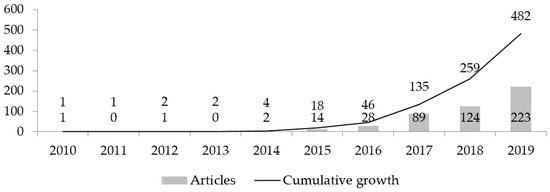
Figure 1.
Articles per year and cumulative growth.
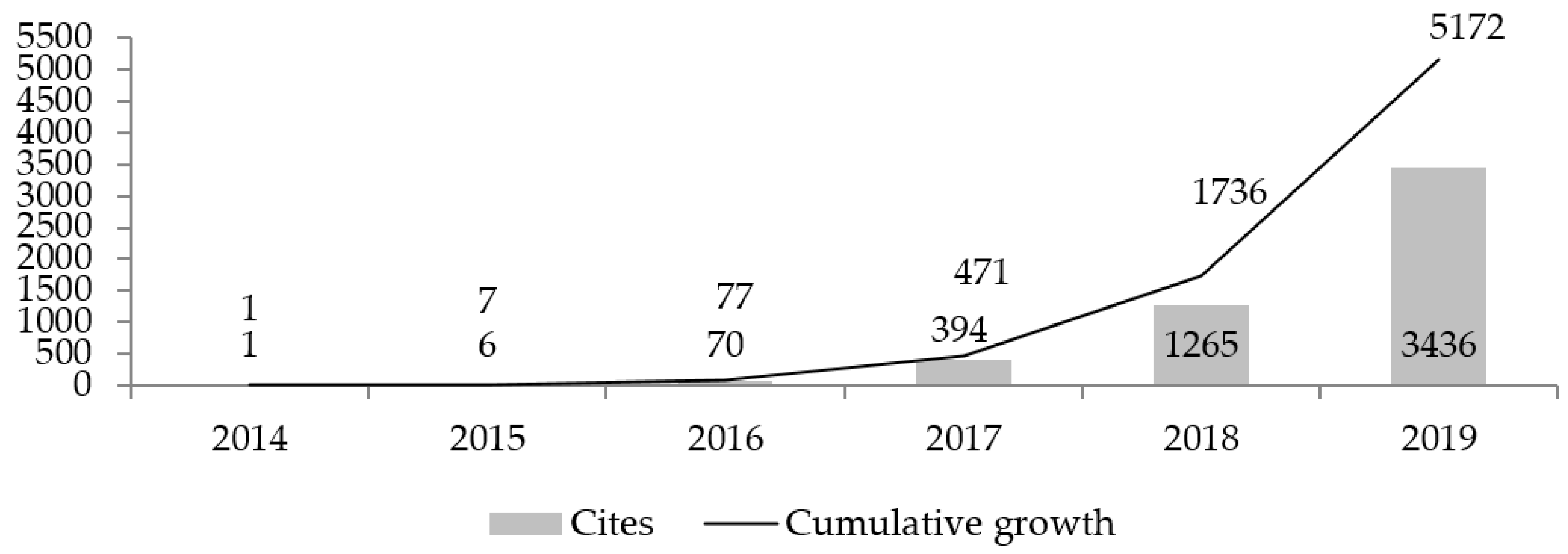
Regarding citations, it is in 2015 when the Airbnb phenomenon begins to show a growing interest (Figure 2), as there has been only one citation before that year. The cumulative growth of citations presents a substantially more pronounced increase than the published articles as it is shown in Figure 1: 738.85% versus 26.77%, respectively, from 2015 to 2019. It should be clarified that this difference is expected due to the “virality” that allows the citation of multiple articles within another. Despite that, Figure 2 still graphically highlights the moment of expansion in the Airbnb phenomenon interest that is being currently experienced.
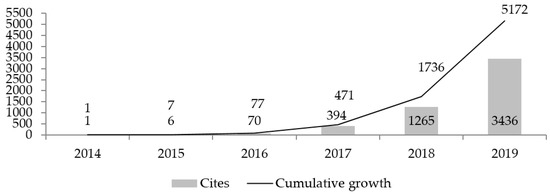
Figure 2.
Citations per year and cumulative growth.
Analyzing the categories that the WoS uses to classify the contents, Table 2 collects the results obtained for the 482 articles under study. It should be emphasized that WoS can classify the same article into various categories.
Table 2.
The 15 most used categories by the Web of Science (WoS) to classify the articles analyzed.
A majority of articles related to “Hospitality, leisure, sports and tourism” (Table 2) stand out. Many studies highlight the threat posed by the phenomenon of Airbnb to the hotel sector [10,11], although other studies conclude that both accommodations are not in direct competition [54]. The categories of Management, Business, and Economics are shown as a relevant secondary macro-area of categories of the articles analyzed. Many of them mention to a large extent the revolution that has meant the massive use of the sharing economy [55,56].
Finally, the categories of Environmental studies; and additionally, Geography, Law, Urban studies, and Sociology engulf most of the publications. These types of studies have as their main base the phenomenon impact on the cities, either from the spatial distribution of the holiday rentals [22]; or from the perspective of the aforementioned gentrification [19]. Furthermore, some studies centered in the legal problems of the sharing economy [57] stand out.
Table 3 shows the 15 most repeated nationalities among the authors in the articles analyzed. As in Table 2, they are not exclusive categories, as the same article may have authors with different nationalities. After the United States (with 123 articles) and England (with 56), appears Spain, with 55 articles: the latter is a country in which the tourism sector is a key factor in its economy. Australia, China, Germany, and Canada also stand out in the following positions with 47, 43, 25, and 23 articles, respectively. Along the list can be observed other eminently tourist countries such as Italy (ninth place), Portugal (twelfth position), and France (fourteenth position).
Table 3.
The 15 most repeated authors’ nationalities of the articles analyzed.
Regarding institutions with at least four publications referred to the articles under study (Table 4), high fragmentation of production can be highlighted as the main feature. The existence of an institution that leads the focus of the research regarding the phenomenon of Airbnb is not observed. In spite of that, the roles of the Polytechnic University of Hong Kong (15 contributions) together with that of Boston and State University System Florida (10 contributions each), followed by California State University System, Curtin, Denver, and London (with 9 contributions each), are noteworthy.
Table 4.
Institutions with at least four publications referred to the articles analyzed.
Table 5 shows all sources with at least four of the articles under analysis. Except for “Collaborative Economy and Tourism: Perspectives, Politics, Policies, and Prospects” [58] which is an edited book, and FORBES (business magazine), all the remaining sources are scientific journals. The ones related to the hospitality, tourism, and urban studies categories stand out.
Table 5.
Sources with at least four publications referred to the articles analyzed.
The H-Core of the study, that is, the 33 most cited articles under analysis, is presented in Table 6. Again, the idea that the Airbnb phenomenon begins to generate interest from 2015 is reinforced, especially thanks to the disruptive innovation in the tourist accommodation sector vindicated by Guttentag [9]: a paper that holds the first place regarding the number of citations (388, Table 6). In the following articles, there are, among others, some of the topics previously referred to in the analysis of Table 2: sharing economy—Martin [55] with 266 citations (Table 6) and Möhlmann [16] with 217, the role that the trust in the host has in the Airbnb profile [17] with 250 citations, as well as the threat to the hotel sector—Zervas et al. [10] with 251 citations, urban impact—Gutiérrez et al. [22] with 106 citations, and, finally, the determining factors of the consumer’s satisfaction that configure the daily rate in holiday rentals using Airbnb as a data source ([24], 87 citations). The results obtained can also be divided into two groups: articles which are specifically about Airbnb (Table 6, rank 1, 3, 4, 5, 7, 8, 9, 10, 11, 12, 14, 15, 19, 23, 24, 25, 26, 28, 33) and those that treat Airbnb as a secondary topic, mainly used as an example to illustrate “sharing economy” or “collaborative consumption” activities (Table 6, rank 2, 6, 13, 16, 17, 18, 20, 21, 22, 27, 29, 30, 31, 32). The first group is bigger than the second one and additionally collects more citations (2014 versus 911).
Table 6.
H-Core of the articles analyzed.
Table 7 presents the most productive authors regarding articles under study, following a criterion of a minimum of four publications per author. Due to the limited period of the analysis, there is no elevated number of publications per author (seven references for Guttentag). A citation per year column is added to display more representative information. Almost all the first articles of the authors presented are from 2017 or 2018.
Table 7.
Most productive authors and total citations of them.
In Figure 3, and using VOSviewer, an analysis is presented about the co-authorship of the articles selected, that is, the degree of relationship among those who share authorship within the works under study. A full counting method is used for this, in which the authorship weight of a link is not fractionalized by the co-authorship of the documents. To obtain a significant sample, it is filtered by a minimum of authors who have made at least three articles—and not four, as in the previous criterion—and, in addition, it is considered that these authors have been cited at least ten times within WoS, obtaining 34 of them that fulfil those conditions, displaying as a total link strength representation (Figure 3). A low level of the relationship among them is highlighted. Only noteworthy, are the three groups of three members each formed by Mody et al. (in the line of comparing Airbnb and hotel accommodations), Xie et al. (consumer’s satisfaction, valuations and perceptions), and Lee et al. (consumer behaviour and social media). Figure 3 also shows six pairs of authors, in which Airbnb’s valuation determinants (Günter and Önder) and the study of online reviews and ratings (Schukert and Law) highlights.
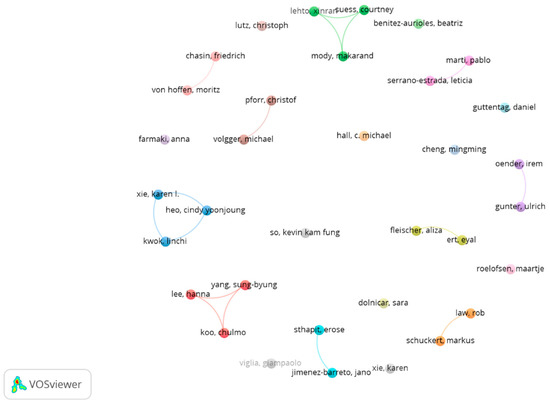
Figure 3.
Co-authorship among authors with at least three articles and ten citations.
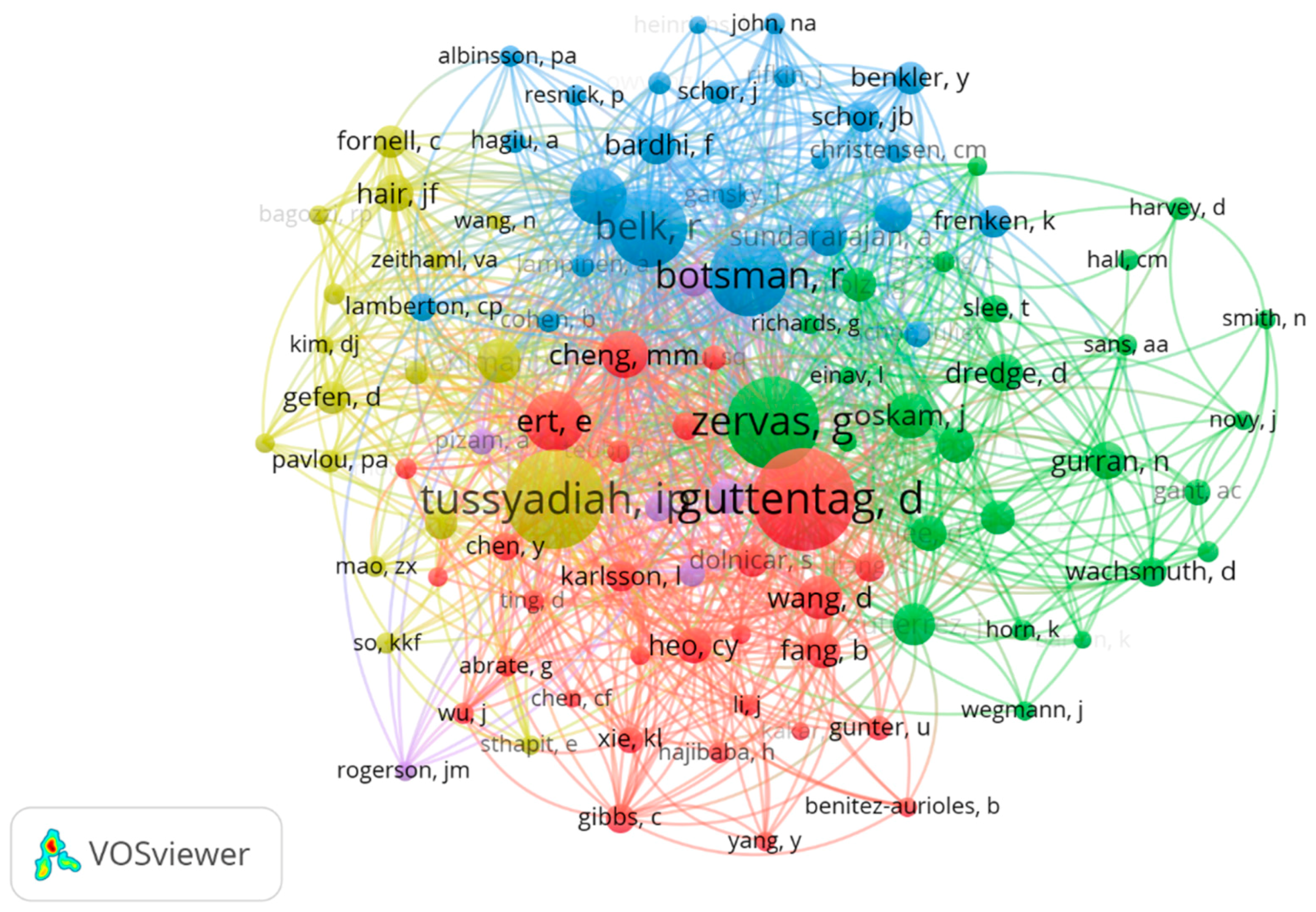
The co-citation analysis is shown in Figure 4. In this case, the relatedness of all authors who have been cited together on twenty occasions—to obtain an easy handling sample—at least, is also reflected through a full counting method, and previously excluding non-author items such as Airbnb, Price Waterhouse Coopers (PWC), Airdna, and Organisation for Economic Co-operation and Development (OECD). Once this is done, 105 authors in total are obtained, among which Guttentag, Tussyadiah, Belk, Bostman, and Zervas highlight. It can be observed that similarities with the study of sustainability in collaborative economy by Ertz and Leblanc Proulx [47] exist. Both studies present Belk and Bostman as one of the main pair of authors, as they represent the inception of sharing economy and collaborative consumption in the decade of the 10s with [6,7], respectively. On the contrary, the present study shows the more middlemost importance of Guttentag, Zervas, and Tussyadiah than Ertz and Leblanc Proulx [47], reflecting a peripherical position in its co-citation analysis, reflecting an increasing relevance of these authors for the 2018–2019 period.
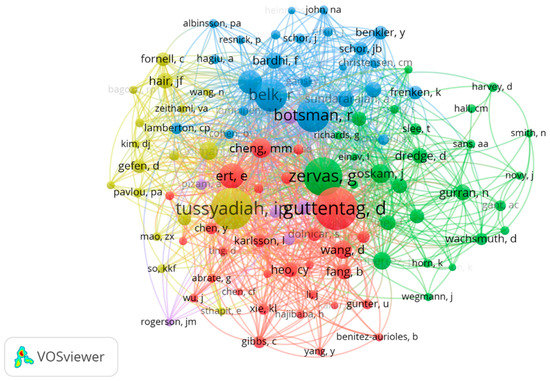
Figure 4.
Co-citation among authors cited on 20 occasions at least.
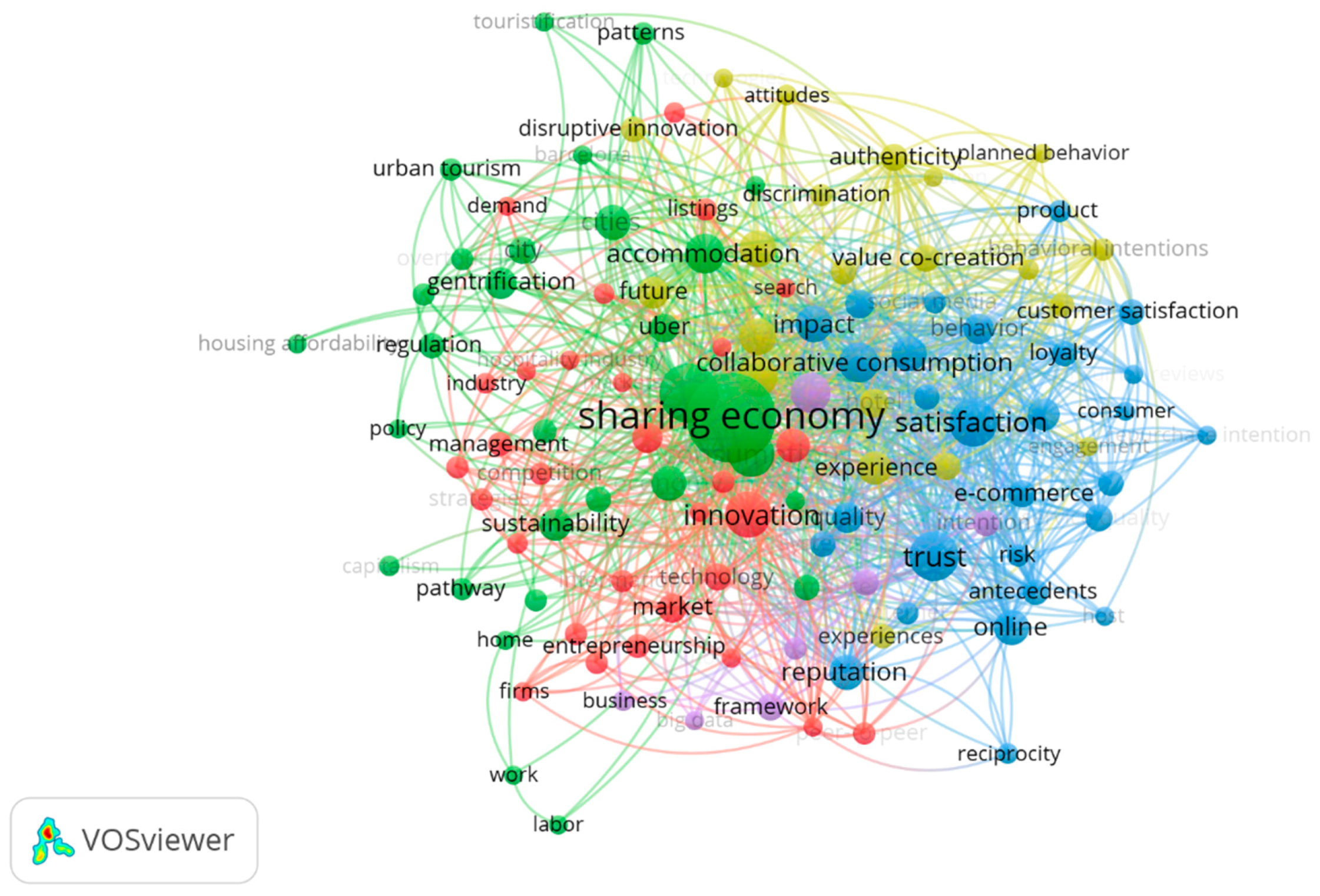
Finally, Figure 5 analyses the co-occurrence of all the keywords included in the articles under study, excluding “Airbnb” in order to avoid redundant factors and present a more informative figure. The selection criterion is based on those keywords that have been repeated on six occasions at least, obtaining a total of 116 of them, as shown in Figure 5. “Sharing economy” stands out as the most prominent keyword in the article analyzed. Secondly, terms such as “innovation”, “satisfaction”, and “trust” occupy prominent positions in the keyword listing and can be highlighted as main research lines.
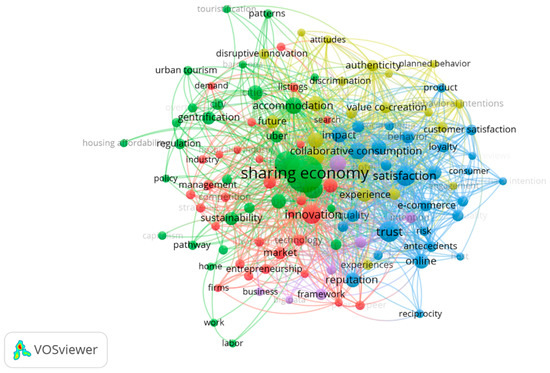
Figure 5.
Co-occurrence of keywords repeated on five occasions at least.
The five clusters automatically generated by the VOSviewer are represented by colors and separate the word groups into different topics: in green, those referring mainly to the sharing economy, collaborative housing, sustainability, regulation and urban tourism; in blue, satisfaction, consumer’s trust, and comparative advantages over the hotel sector; in yellow, what is related to the attitudes, motivations and perceptions of the Airbnb users, in red, what refers to the novelty and innovation of this business model and finally an additional little cluster in violet, regarding business, price, and valuation determinants analysis through big data techniques in the line of [24]. This keywords aggrupation keeps similarities with the co-citation analysis regarding sharing economy by Cheng [45], as both studies present clusters related to “consumption”, “trust”, and “innovation”.
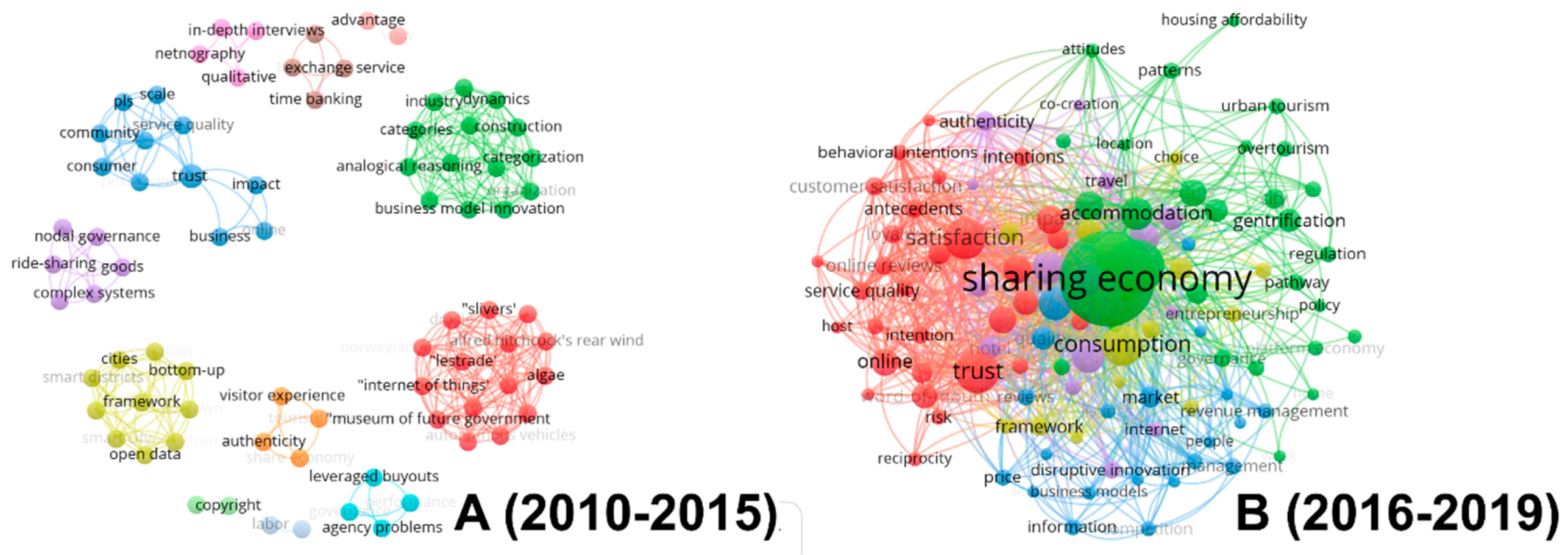
In a dynamic analysis, a comparison of two keyword co-occurrence networks for the 2010–2015 and 2016–2019 periods, respectively, and following the same criteria as in Figure 5, is presented in Figure 6. An equal part division in five years periods cannot be possible due to VOSviewer restriction regarding a minimum number of keywords. In the 18 articles collection obtained for the first period (A, Figure 6) can only be possible a maximum of one keyword co-occurrence. With a total of 78 keywords obtained, 13 differentiated clusters have been found. “Trust” keyword appears as the more preeminent one, keeping its importance along the present analysis. Several topics in A period (Figure 6) are very different to the analyzed “time banking”, “ride-sharing”, or “Internet of Things”. On the contrary, Figure 6B shows the 110 keywords obtained with the criterion that has been repeated on six occasions at least for the 2016–2019 period, keeping the main similarities in terms of keywords and clusters with Figure 5, showing that the last years are the more representative and influential of the total period of analysis.
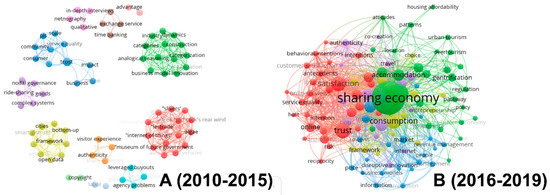
Figure 6.
Co-occurrence of keywords comparison periods, (A) (2010–2015) and (B) (2016–2019).
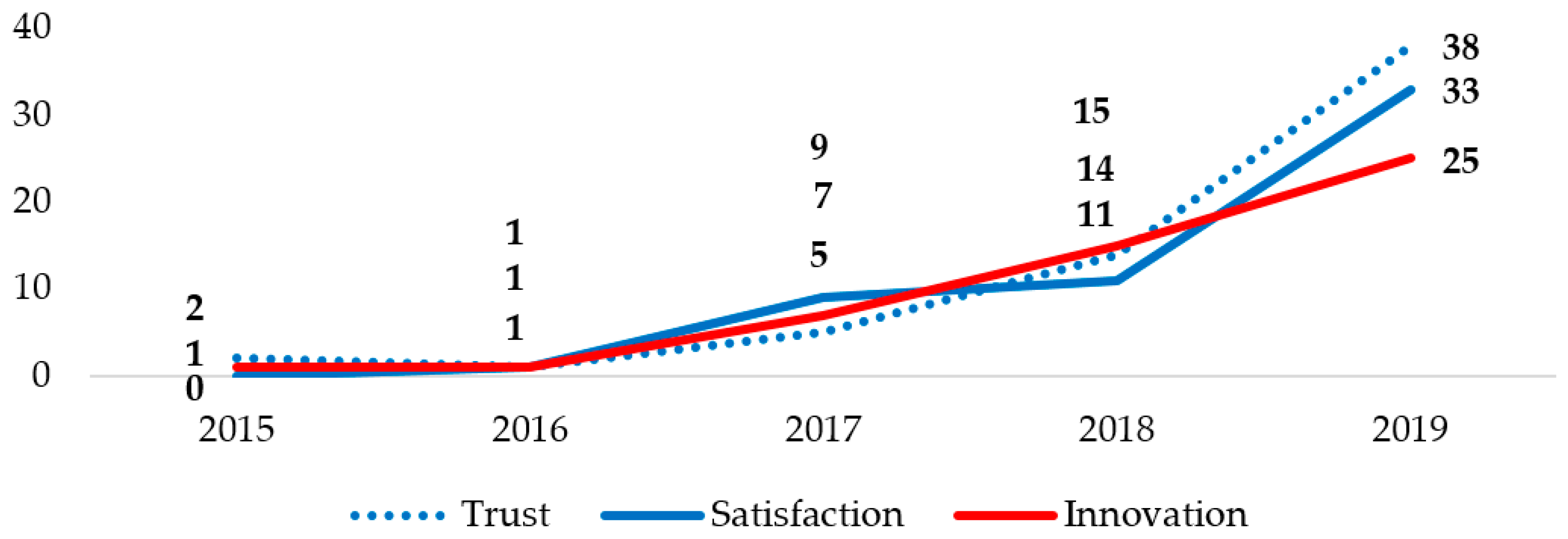
Following the dynamic analysis, the trend evolution of the main research line keywords is presented in Figure 7. The “sharing economy” term is discarded for its excessive use as it would consequently significatively distort the line graph. Not one of the keywords appears before 2015 (Figure 7), so the current keyword map (Figure 5) started to configure its shape from 2015. This idea is reinforced with an A and B co-occurrence networks comparison in Figure 6. Figure 7 presents these keywords with similar increase trends; however, trust and satisfaction gained importance in the last year of the analysis.
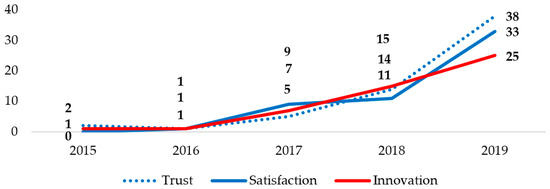
Figure 7.
Main research lines trends time evolution.
5. Conclusions
These first ten years of publications related to Airbnb in the WoS present this firm as a phenomenon that has not only experienced fast growth since its inception (482 articles and 5172 citations for the 2010–2019 period), but that has originated a trend for new research that will remain in the future. The first works scarcely appear from 2010, two years after the start of the company’s foundation. However, it is not until 2015 when the articles begin to be cited and experimented a significant evolution, both in bibliographic production and in citations, of 26.77% and 738.85%, respectively. Similar trends in prominent cumulative growth of documents published can also be observed in the Ertz and Leblanc Proulx [47] collaborative economy analysis. This bibliometric approach to Airbnb is clearly in an introductory stage, using the simile part of the product life cycle [59], as almost the half of the total collection obtained was published in the last year analyzed, and, additionally most-cited authors are for articles mainly published in the 2017–2018 period.
Tourism, hospitality, economics, urban studies, and sustainability stand out as the main perspectives from which the analyzed articles are approached. Most cited articles are referring to the Airbnb phenomenon itself. Articles that treat Airbnb as a secondary topic, used as an example to illustrate other activities, have significatively fewer citations. Among the most recurrent topics are the threats that Airbnb poses to the hotel sector, the analysis of the paradigm shift that the sharing economy has brought about thanks to the innovative P2P online platforms, as well as the difficulties to legally define this new type of collaborative consumption. Additionally, they highlighted issues such as urban impact and sustainability, and, finally, related to the latter, the problem of the gentrification of cities (especially in neighborhoods with greater tourist pressure).
Regarding the nationality of the authors, the main conclusion drawn is that the majority originate from the United States and the United Kingdom and after these, Spain occupies a prominent third place. The effect of language bias produced when using the WoS as a database can be a determining factor in this classification in which English-speaking countries predominate. Besides, it is worth mentioning that the United States is not the only the country where Airbnb comes from, but it is also where its implementation is greater, with 660,000 properties included [60].
The co-citation and co-occurrence of keywords presents relevant similarities with Ertz and Leblanc Proulx [47] and Cheng [45], respectively. Regarding keyword co-occurrence, “sharing economy” appears to be the most common concept used (significatively more repeated than others in the same line, such as “collaborative consumption”) as it is the keyword that embodies the Airbnb phenomenon itself. However, excluding the last, main research line keywords founded are, in first place, “trust”, related mainly with reputation generated online thanks to the comments of holiday rentals’ clients, or hosts behaviors and photos in their Airbnb profiles. Second, comes “satisfaction”, associated with the added value perceived by the client which makes this type of business successful as a more local and closer “city experience” experimented in this accommodation compared to hotels. Finally, “innovation”, that personifies a total paradigm shift in the accommodation sector, appears as the third keyword in importance, losing relevance as time goes by, compared to the first two keywords. With the passing of years, Airbnb, from the first years of “disruptive innovation” [9] has become a standard in the hospitality sector.
In a deeper analysis of the co-occurrence keywords maps, it can be found that its current structure had been forming from 2016 to 2019, in a relatively short period. In this actual keyword network, some items appear as possible future research lines such as “determinants” (of valuation), “behavior” or the “sustainability” of the current situation of the accommodation sector.
The information and conclusions extracted in this work, compiling ten years of studies in the “Airbnb” topic, can be taken as a “starting point” for academics and researchers of this phenomenon, in an unbiased way to approach the issue, given the certainty that no important study, in terms of citations, was left behind and forgotten. The present study can also give a holistic overview of the matter, as well as a presentation of the main trends that academia is working for, obtaining an idea of possible future tendencies of the area, or creating new ones.
The latter is also especially interesting for professionals dedicated to the hospitality and holiday rentals’ sector, as the present work reflects the importance of the trust in the host, closely related with the photos in their Airbnb profiles [17], or the main factors that clients base their satisfaction on, mainly associated with home benefits, local authenticity [26], cost savings, and familiarity [16]; Furthermore, showing current and possible future research trends is relevant information in order to adapt and improve business management for potential changes in the sector.
Finally, the main limitation of the present study that can be highlighted is the use of a single source for its elaboration (WoS). That is why, along future research lines, it may be suggested to extend the analysis to other databases such as SCOPUS or Google Scholar or a similar subject of study such as “Booking.com”, “Expedia”, or “HomeAway”, as well as to continue analyzing the bibliometric evolution of the Airbnb phenomenon in the future.
Author Contributions
Study conception and design, J.M.N.-T., L.C.-y-L.-d.-R. and M.Á.S.-S.; data collection, analysis and interpretation of results M.Á.S.-S.; manuscript preparation writing—review and editing, M.Á.S.-S., J.M.N.-T. and L.C.-y-L.-d.-R. All authors have read and agreed to the published version of the manuscript.
Funding
This research received no external funding.
Conflicts of Interest
The authors declare no conflict of interest.
References
- Hempel, J. Airbnb: More Than a Place to Crash. Fortune 2012, 165, 81–82. [Google Scholar]
- Airbnb. About us. Available online: https://press.atairbnb.com/about-us/ (accessed on 5 May 2019).
- Gwin, C.R. International Comparisons of Real Estate E–nformation on the Internet. J. Real Estate 2004, 26, 1–24. [Google Scholar]
- Felson, M.; Spaeth, J.L. Community structure and collaborative consumption: A routine activity approach. Am. Behav. Sci. 1978, 21, 614–624. [Google Scholar] [CrossRef]
- Algar, R. Collaborative consumption. Leis. Rep. 2007, 4, 72–83. [Google Scholar]
- Botsman, R.; Rogers, R. What’s Mine is Yours: The Rise of Collaborative Consumption; Harper Business: New York, NY, USA, 2010. [Google Scholar]
- Belk, R. You are what you can access: Sharing and collaborative consumption online. J. Bus. Res. 2014, 67, 1595–1600. [Google Scholar] [CrossRef]
- Hamari, J.; Sjöklint, M.; Ukkonen, A. The sharing economy: Why people participate in collaborative consumption. J. Assoc. Inf. Sci. Technol. 2016, 67, 2047–2059. [Google Scholar] [CrossRef]
- Guttentag, D. Airbnb: Disruptive innovation and the rise of an informal tourism accommodation sector. Curr. Issues Tour. 2015, 18, 1192–1217. [Google Scholar] [CrossRef]
- Zervas, G.; Proserpio, D.; Byers, J.W. The Rise of the Sharing Economy: Estimating the Impact of Airbnb on the Hotel Industry. J. Mark. Res. 2017, 54, 687–705. [Google Scholar] [CrossRef]
- Lu, L.; Tabari, S. Impact of Airbnb on Customers’ Behavior In the UK Hotel Industry. Tour. Anal. 2019, 24, 13–26. [Google Scholar] [CrossRef]
- Collins, J.A.; Fauser, B.C. Balancing the strengths of systematic and narrative reviews. Hum. Reprod. Update 2005, 11, 103–104. [Google Scholar] [CrossRef]
- Caulfield, B. The Startup Next Door. Forbes 2010, 186, 42–45. [Google Scholar]
- Anders, G.; Konrad, A. The Innovation Factory. Forbes 2014, 193, 70. [Google Scholar]
- Desai, D.R. The New Steam: On Digitization, Decentralization, and Disruption. Hastings Law J. 2014, 65, 1469–1482. [Google Scholar]
- Möhlmann, M. Collaborative consumption: Determinants of satisfaction and the likelihood of using a sharing economy option again. J. Consum. Behav. 2015, 14, 193–207. [Google Scholar] [CrossRef]
- Ert, E.; Fleischer, A.; Magen, N. Trust and reputation in the sharing economy: The role of personal photos in Airbnb. Tour. Manag. 2016, 55, 62–73. [Google Scholar] [CrossRef]
- Pera, R.; Viglia, G. Exploring how video digital storytelling builds relationship experiences. Psychol. Mark. 2016, 33, 1142–1150. [Google Scholar] [CrossRef]
- Cócola-Gant, A. Holiday Rentals: The New Gentrification Battlefront. Sociol. Res. Online 2016, 21, 1–9. [Google Scholar] [CrossRef]
- Xie, K.L.; Kwok, L. The effects of Airbnb’s price positioning on hotel performance. Int. J. Hosp. Manag. 2017, 67, 174–184. [Google Scholar] [CrossRef]
- Mody, M.A.; Suess, C.; Lehto, X. The accommodation experiencescape: A comparative assessment of hotels and Airbnb. Int. J. Contemp. Hosp. Manag. 2017, 29, 2377–2404. [Google Scholar] [CrossRef]
- Gutiérrez-Puebla, J.; García-Palomares, J.C.; Romanillos, G.; Salas-Olmedo, M.H. The eruption of Airbnb in tourist cities: Comparing spatial patterns of hotels and peer-to-peer accommodation in Barcelona. Tour. Manag. 2017, 62, 278–291. [Google Scholar] [CrossRef]
- Gurran, N.; Phibbs, P. When tourists move in: How should urban planners respond to Airbnb. J. Am. Plan. Assoc. 2017, 83, 80–92. [Google Scholar] [CrossRef]
- Wang, D.; Nicolau, J.L. Price determinants of sharing economy based accommodation rental: A study of listings from 33 cities on Airbnb.com. Int. J. Hosp. Manag. 2017, 62, 120–131. [Google Scholar] [CrossRef]
- Gibbs, C.; Guttentag, D.G.; Morton, J.; Goodwill, A. Pricing in the sharing economy: A hedonic pricing model applied to Airbnb listings. J. Travel Tour. Mark. 2018, 35, 46–56. [Google Scholar] [CrossRef]
- Guttentag, D.; Smith, S.; Potwarka, L.; Havitz, M. Why tourists choose Airbnb: A motivation-based segmentation study. J. Travel Res. 2018, 57, 342–359. [Google Scholar] [CrossRef]
- Cheng, M.; Jin, X. What do Airbnb users care about? An analysis of online review comments. Int. J. Hosp. Manag. 2019, 76, 58–70. [Google Scholar] [CrossRef]
- Hong, S.; Lee, S. Adaptive governance, status quo bias, and political competition: Why the sharing economy is welcome in some cities but not in others. Gov. Inf. Q. 2018, 35, 283–290. [Google Scholar] [CrossRef]
- Broadus, R. Toward a definition of “bibliometrics”. Scientometrics 1987, 12, 373–379. [Google Scholar] [CrossRef]
- Pritchard, A. Statistical bibliography or bibliometrics. J. Doc. 1969, 25, 348–349. [Google Scholar]
- Laengle, S.; Merigó, J.M.; Miranda, J.; Słowiński, R.; Bomze, I.; Borgonovo, E.; Dyson, R.G.; Oliveira, J.F.; Teunter, R. Forty years of the European Journal of Operational Research: A bibliometric overview. Eur. J. Oper. Res. 2017, 262, 803–816. [Google Scholar] [CrossRef]
- López-Muñoz, F.; Vieta, E.; Rubio, G.; García-García, P.; Alamo, C. Bipolar disorder as an emerging pathology in the scientific literature: A bibliometric approach. J. Affect. Disord. 2006, 92, 161–170. [Google Scholar] [CrossRef]
- López-Muñoz, F.; Shen, W.W.; Shinfuku, N.; Pae, C.U.; Castle, D.J.; Álamo, C. A bibliometric study on second-generation antipsychotic drugs in the Asia–Pacific region. J. Exp. Clin. Med. 2014, 6, 111–117. [Google Scholar] [CrossRef]
- Garfield, E. Citation analysis as a tool in journal evaluation. Science 1972, 178, 471–479. [Google Scholar] [CrossRef] [PubMed]
- Benckendorff, P.; Zehrer, A. A network analysis of tourism research. Ann. Tour. Res. 2013, 43, 121–149. [Google Scholar] [CrossRef]
- Evren, S.; Kozak, N. Bibliometric analysis of tourism and hospitality related articles published in Turkey. Anatolia 2014, 25, 61–80. [Google Scholar] [CrossRef]
- López-Bonilla, J.M.; Granados-Perea, C.; López-Bonilla, L.M. Autores prolíficos líderes en la investigación turística Española. Transinformação 2018, 30, 39–50. [Google Scholar]
- Benckendorff, P.; Shu, M.L. Research impact benchmarks for tourism, hospitality and events scholars in Australia and New Zealand. J. Hosp. Tour. Manag. 2019, 38, 184–190. [Google Scholar] [CrossRef]
- Mulet-Forteza, C.; Mauleón-Méndez, E.; Merigó, J.M.; Genovart-Balaguer, J. Leading universities in tourism and hospitality research: A bibliometric overview. In International Conference on Modelling and Simulation in Management Sciences; Springer: Cham, Switzerland, 2018; pp. 142–152. [Google Scholar]
- Mauleon-Mendez, E.; Genovart-Balaguer, J.; Merigo, J.; Mulet-Forteza, C. Sustainable Tourism Research Towards Twenty-Five Years of the Journal of Sustainable Tourism. Adv. Hosp. Tour. Res. Ahtr. 2018, 6, 23–46. [Google Scholar] [CrossRef]
- Mulet-Forteza, C.; Martorell-Cunill, O.; Merigó, J.M.; Genovart-Balaguer, J.; Mauleon-Mendez, E. Twenty five years of the Journal of Travel & Tourism Marketing: A bibliometric ranking. J. Travel Tour. Mark. 2018, 35, 1201–1221. [Google Scholar] [CrossRef]
- Mulet-Forteza, C.; Genovart-Balaguer, J.; Mauleon-Mendez, E.; Merigó, J.M. A bibliometric research in the tourism, leisure and hospitality fields. J. Bus. Res. 2018, 101, 819–827. [Google Scholar] [CrossRef]
- Sánchez-Cañizares, S.; Castillo-Canalejo, A.; Cabeza-Ramírez, L. Sustainable tourism in sensitive areas: Bibliometric characterisation and content analysis of specialised literature. Sustainability 2018, 10, 1525. [Google Scholar] [CrossRef]
- Shen, Y.; Morrison, A.M.; Wu, B.; Park, J.; Li, C.; Li, M. Where in the world? A geographic analysis of a decade of research in tourism, hospitality, and leisure journals. J. Hosp. Tour. Res. 2018, 42, 171–200. [Google Scholar] [CrossRef]
- Cheng, M. Sharing economy: A review and agenda for future research. Int. J. Hosp. Manag. 2016, 57, 60–70. [Google Scholar] [CrossRef]
- Mello-da-Silveira, L.M.; Petrini, M.; Matte-Zanardo-dos-Santos, A.C. Economia compartilhada e consumo colaborativo: O que estamos pesquisando. Rege-Rev. Gestão 2016, 23, 298–305. [Google Scholar] [CrossRef]
- Ertz, M.; Leblanc-Proulx, S. Sustainability in the collaborative economy: A bibliometric analysis reveals emerging interest. J. Clean. Prod. 2018, 196, 1074–1085. [Google Scholar] [CrossRef]
- Van-Leeuwen, T. The application of bibliometric analyses in the evaluation of social science research. Who benefits from it, and why it is still feasible. Scientometrics 2006, 66, 133–154. [Google Scholar] [CrossRef]
- Garfield, E. Introducing citation classics-human side of scientific reports. Curr. Comments 1977, 1, 5–7. [Google Scholar]
- Martínez, M.A.; Herrera, M.; López-Gijón, J.; Herrera-Viedma, E. H-Classics: Characterizing the concept of citation classics through H-index. Scientometrics 2014, 93, 1971–1983. [Google Scholar] [CrossRef]
- Hirsch, J.E. An index to quantify an individual’s scientific research output. Proc. Natl. Acad. Sci. USA 2005, 102, 16569–16572. [Google Scholar] [CrossRef]
- Rousseau, R. New developments related to the Hirsch index. E Prints Libr. Inf. Sci. preprint.
- Van-Eck, N.; Waltman, L. Software survey: VOSviewer, a computer program for bibliometric mapping. Scientometrics 2010, 84, 523–538. [Google Scholar] [CrossRef]
- Heo, C.Y.; Blal, I.; Choi, M. What is happening in Paris? Airbnb, hotels, and the Parisian market: A case study. Tour. Manag. 2019, 70, 78–88. [Google Scholar] [CrossRef]
- Martin, C.J. The sharing economy: A pathway to sustainability or a nightmarish form of neoliberal capitalism. Ecol. Econ. 2016, 121, 149–159. [Google Scholar] [CrossRef]
- Cockayne, D.G. Sharing and neoliberal discourse: The economic function of sharing in the digital on-demand economy. Geoforum 2016, 77, 73–82. [Google Scholar] [CrossRef]
- Miller, S.R. First principles for regulating the sharing economy. Harv. J. Legis. 2016, 53, 147–202. [Google Scholar] [CrossRef]
- Dredge, D.; Gyimóthy, S. Collaborative Economy and Tourism: Perspectives, Politics, Policies, and Prospects; Springer: Cham, Switzerland, 2017. [Google Scholar]
- Polli, R.; Cook, V. Validity of the product life cycle. J. Bus. 1969, 42, 385–400. [Google Scholar] [CrossRef]
- Statista. Countries with the most Airbnb listings as of August 2017. Available online: https://www.statista.com/statistics/742786/countries-with-the-most-airbnb-listings/ (accessed on 12 May 2019).


© 2020 by the authors. Licensee MDPI, Basel, Switzerland. This article is an open access article distributed under the terms and conditions of the Creative Commons Attribution (CC BY) license (http://creativecommons.org/licenses/by/4.0/).