


Abstract
Smart-grid rooftop solar electricity (SG rooftop PV) is an alternative sustainable energy resource. This research was conducted in the Central Highlands of Vietnam (CHV) in light of the different levels of retail electricity pricing, the sunshine duration, and the implementation of a feed-in-tariff system, in order to calculate the financial indicators (FIs) of SG rooftop PV, which would supply investors, companies supplying SG rooftop PV, and policymakers with useful information. The FI values were calculated based on the net present value, the payback period, and the internal return rate. The results show that the electricity retail price level affects the FI of SG rooftop PV. SG rooftop PV is installed to satisfy higher electricity consumption levels, which attracts a higher retail electricity price. As a result of the greater benefits, especially if SG rooftop PV is installed and the highest level of electricity (exceeds 400 kWh) is used to satisfy domestic consumption, users will recoup their investment in only four years and after that will enjoy free electricity. All the FI values derived from this research show that people in the CHV can derive benefits from installing SG rooftop PV.
1. Introduction
Conventional resources account for the majority of energy consumed by people throughout the world. According to the World Energy Council, expenditure on power from conventional resources accounted for over 85% of the total power generation during the period 2005–2015 [1,2]. However, there are many constraints in using fossil-fuel resources. Firstly, these will be exhausted in the future due to the rapidly increasing energy demand [3], and Shafiee and Topal (2009) forecasted that crude oil stocks would be exhausted in around 35 years from 2005, with natural gas stocks being exhausted in 37 years, whereas coal stocks would be exhausted in 107 years. Therefore, after 2042, coal will be the only fossil fuel available up to 2112 [4]. Moreover, fossil fuel burning is one of the major sources of emissions causing global warming and climate change [5] and entails risks for people’s health [6]. Therefore, many countries have conducted research on alternative energy resources to replace conventional fuels [7]. Over 90% of Vietnam’s electricity is currently generated from hydropower, coal, and gas, with hydropower occupying 37.6% of total electricity generation [8]. Hydropower dams have given people many benefits, including electricity supply, control of floods, and land irrigation. However, dam construction can threaten ecosystems [9,10], and there are some negative effects on society and the environment. In particular, local people must uproot themselves from the areas in which dams are constructed [11,12,13]. In Vietnam, the construction of hydropower dams has necessitated the appropriation of 133,930 hectares of land and the relocation of over 200,000 people, involving the evacuation of 44,557 homes [14]. The generation capacity of hydropower energy also entails a loss of forests, and deforestation can reduce river discharge and decrease power-generating capacity [15]. Moreover, the power demand is growing rapidly, and by the year 2035, energy demand in a business-as-usual scenario in Vietnam will be nearly 2.5 times higher than it was in 2015 [16]. Therefore, electricity shortages are likely to happen, particularly in the hot season, especially from 2020 onwards [17].
Smart-grid rooftop solar electricity (SG rooftop PV) is an enticing alternative power resource for households [18]. SG rooftop PV can also help to inject extra photovoltaic power into the national electricity grid. This supplementary electricity is significant, especially during hot and sunny periods when energy demand is highest due to air conditioning use [19]. The levelized cost of electricity (LCOE) from renewable resources, regarding which solar PV remarkably fell by 77% from 2010 to 2018, leads to increased competition with fossil-fire resources [20]. Therefore, solar PV capacity has significantly increased worldwide, with the solar PV capacity reaching at least 627 GW, and at least 114.9 GW of solar PV systems were mounted and installed at the end of 2019. The additional capacity in The European Union reached 16 GW, followed by the United States of America with 13.3 GW. Japan, Vietnam, Australia, Ukraine, and Korea have been the top five countries in solar PV development; with the additional capacity in 2019, their capacity values were 7 GW, 4.8 GW, 3.7 GW, 3.5 GW, and 3.1 GW, respectively [21]. Due to the increasing power generation from solar PV, voltage limit problems occur. Therefore, vast arrays of studies on control systems for power flow optimization have been conducted [22,23,24,25,26]. Various reports related to solar PV’s energy economics investigated customers’ attitudes and willingness to pay for rooftop PV or economic efficiencies of the systems [27,28,29].
As mentioned above, Vietnam has also been one of the areas with a high solar PV capacity installation. The development of solar power generation facilities is particularly appropriate for Vietnam, especially in the Central Highlands and Southern areas [30]. The total sunshine duration in the Central Highlands is from 2000 to 2600 h per year [31], and 1 kWp of solar energy will generate at least 2000 kWh electricity per year. The Vietnamese Government has therefore adopted a policy of encouraging the development of solar energy as well as wind and biomass energy, and solar power has the second-highest price in the feed-in-tariff (FIT) system after electricity from the direct combustion of biomass [16]. Additionally, the government is also encouraging the construction of solar farms, and users of rooftop solar panels can sell electricity to the grid at the same FIT price as that paid to solar farms, 9.35 US cents per kWh, with the duration of the current FIT being 20 years [32]. On 31 January 2019, the Vietnamese Ministry of Finance enacted a preferential policy relating to installing under-50-kWp rooftop solar projects. Based on this policy, rooftop-solar-generated electricity is not subject to the levy of a special consumption tax, and the personal income tax and VAT rates are zero if the investment income is less than 100 million VND, with a personal income tax rate of 0.5% and a VAT rate of 1% if the investment income is greater than 100 million VND. Further, rooftop solar power projects with a capacity of less than 50 kWp are exempted from the need for an electricity operation license [33].
SG rooftop PV is common in Vietnam because it is cheaper than off-grid systems, and users do not have to replace the battery every two to five years. It is also easy to use in the Central Highlands because over 95% of households in this area have grid electricity in their houses [34]. Moreover, rooftop solar is considered as self-consumption electricity that helps decrease the dependence on the national grid [35].
Until 30 April 2020, Vietnam had 27,631 rooftop solar electricity projects installed with a total capacity of 562.79 MWp. However, the number of installed projects is still modest compared with the actual potential [36], since the total number of households in the country was 26,870,079 [37] and other activities have appropriated rooftops for SG rooftop PV installation, including companies, schools, hospitals, and markets.
In Vietnam, the retail electricity price for residential consumption is divided into six different levels: 0–50 kWh, 50–100 kWh, 101–200 kWh, 201–300 kWh, 301–400 kWh, and more than 400 kWh. The price increases with the level of electricity consumed, so consumers who use more electricity have to pay a higher price than those who use less electricity. Therefore, households that can generate power by installing a rooftop solar power system can reduce the amount that they pay every month for electricity not only by reducing the amount of power they consume from the grid but also by bringing themselves into a lower consumption band, attracting a lower price for the electricity they purchase. To assess the potential benefits of installing rooftop solar panels, three indicators, the net present value, the payback period, and the internal rate of return, were determined [38].
- ➢
- The net present value (NPV) illustrates all cash flow in the future of one project. The investors will accept projects more if the NPV is greater than zero.
- ➢
- The payback period (PBP) shows the period of time that the income of one project will cover the initial investment cost. A project with a longer PBP is usually associated with a higher risk to investors, so a shorter PBP is preferable.
- ➢
- The internal rate of return (IRR) is the discount rate that renders the NPV equal to zero. A project will be accepted if the IRR is higher than the expected interest rate.
Based on a recent literature review, there has been no research mentioning the effect of electricity retail price levels in Vietnam on these financial indicators of SG rooftop PV. In addition, we propose policy implications by using a part of the survey’s information to install SG rooftop PV conducted in the Central Highlands of Vietnam. Thus, analysis in this first report will be useful information for many groups of stakeholders:
- ▪
- Firstly, electricity consumers who intend to install rooftop solar panels on their house need to understand the benefit of rooftop solar generation, in particular, how many years it will take for them to recoup their investment and whether their investment over the project lifetime will match the return by way of the interest they would generate by depositing their money in a bank.
- ▪
- Secondly, companies that supply SG rooftop solar systems can use their research findings to advise people who are considering installing smart rooftop solar power systems to generate electricity for their own consumption and selling any excess generated to the grid through the FIT.
- ▪
- Finally, policymakers can use the findings relating to SG rooftop solar power to adjust the electricity retail price during different periods.
In fact, all residents are affected by the same price of electricity level consumption whether they operate entirely during the day or the night. However, SG rooftop PV can generate electricity only during the day. Therefore, this research focuses only on the customers who install SG rooftop PV to sell all electricity to the grid or consume all electricity during the day for specific fields such as individual business households or families whose production and business activities mainly occur during the day.
2. Literature Review
Geographical Location of the Central Highlands of Vietnam
There are five provinces in the Central Highlands of Vietnam, namely, Gialai, Kontum, Daklak, Daknong, and Lamdong, which account for 16.5% of the area and approximately 6.1% of the population of Vietnam [39]. As mentioned above, the area has a high annual sunshine duration, which is suitable for exploiting solar energy.
Financial support from governments toward the power generated from rooftop solar electricity systems
Net-metering (NM) and net-billing (NB) are two types of support that many countries have applied with respect to the excess electricity from rooftop PV. NM calculates the net electricity consumption from the national grid and the rooftop PV (in kWh), while NB separately calculates the power from these two components [40].
The excess power from rooftop PV that feeds the grid may not lead to any compensation from the government. For example, through the Pilot project in Thailand’s 100 MW rooftop PV in 2016, the government encouraged self-consumption, and there was no payment for any excess electricity load in the national grid [35].
Recently, the Vietnamese government has changed the way it deals with electricity generated from rooftop PV. In 2017, the Vietnamese Government assigned the Electricity Power Corporation of Vietnam (EVN) the task of buying electricity from SG rooftop PV based on a net-metering policy [32]. However, since 20 March 2019, the EVN has bought electricity from independent SG rooftop PV based on a net-billing policy [41].
Smart grid definition
A smart grid (SG) is known as a smart power/electrical grid, future grid, intelligent grid, or inter grid and is an expansion to the electricity grid of the 20th century. Conventional power grids are usually used to transfer electricity to a vast number of users from a few central generators. By comparison, the SG makes use of two-way power and information to build an integrated and distributed advanced energy supply network [42].
In Vietnam, the government enacted SG development in 2012 with Decision 1670/QĐ-TTg, October 2012, which encourages investment into renewable energy and SG. SG allows two-way power. Therefore, customers can sell excess electricity from their renewable energy resources to the grid and buy electricity from the grid [43].
Smart-grid rooftop solar electricity systems
SG rooftop P-V can be installed on the roofs of houses, offices, or other commercial or industrial buildings. In contrast to other solar electricity systems, SG rooftop PV offers a bidirectional exchange. Power can be directed either to the customer from the power utility or in the opposite direction when the customer’s system generates more electricity than the customer consumes. SG rooftop PV helps the solar electricity system to operate stably and smoothly in the following ways [44]:
- −
- When the capacity generated by the system is less than the customer’s needs, the inverter will withdraw the power required from the grid.
- −
- When the capacity generated by the system is equal to the customer’s needs, the power generated from the rooftop solar electricity system will be used to meet the customer’s requirements.
- −
- When the capacity generated by the system is greater than the customer’s needs, the surplus power will be sent to the grid.
The process of assessing the relationship between power generation and the customer’s needs, and the direction of the flow of electricity, occurs constantly and automatically without the need for the user’s intervention. In Vietnam, since 1 July 2019, the surplus electricity from domestic solar power systems and the power required from the grid has been measured with a two-way meter. However, customers can sell electricity to the EVN at the FIT price of 9.35 USD/1 kWh independently of the electricity that they buy from the grid. Based on the recent Decision No. 02/2019/QD-TTg, the prime minister of Vietnam has replaced the former net-metering mechanism with a two-way calculation. The electricity from SG rooftop PV that people sell to the grid and the electricity purchased from the grid in times of high consumption when their solar power system cannot provide enough electricity to cover their consumption are calculated independently. Moreover, if they so wish, users can sell all the electricity generated by the system to the grid [41]. In this research, the data was estimated based on two cases: customers who sell all the electricity generated to the EVN and those who use all the electricity themselves.
Smart grid solar rooftop systems are highly appropriate for the Central Highlands because 95.17% of households in this area are already connected to the electricity grid [34]. The advantages of SG rooftop PV are a lower cost of installation and the fact that customers do not have to replace the battery every two to five years. Unused solar power can be sold to the EVN at a reasonable price. However, when power outages occur on the grid, the system stops supplying power to the grid to maintain the system’s safety.
Economics of a solar power (PV) system
The basic economics of the PV system is related both to the efficiency and the optics. In markets, a PV system is often sold by cost per square meter or cost per watt, which may be generated under the peak form of solar lights (cost per watt peak (Wp)), 1 kWp = 1000 Wp. In other words, Wp is used to predict the electricity generated and to evaluate the performances of the PV system in an optimum sun condition [45]. For example, rooftop PV with 1 kWp will generate a maximum of 1 kWh for one hour in an optimum sun condition. Therefore, if the optimum sun is 5 h per day, then 1 kWp will produce up to 5 kWh power.
The equation to change the square meter and cost per watt peak is as follows:
where is solar conversion efficiency.
For example, a PV module with a 12% efficiency at $400/m2 will cost $3.33/Wp [45].
3. Methodology
The three most common FI values that help investors to decide on investing in a project are the NPV, IRR, and PBP [38,46]. This paper’s methodology was focused on calculating the NPV, IRR, and PBP of the rooftop solar system to help people decide whether to sell or use all their electricity output from SG rooftop PV at each certain level of electricity consumption. In addition, this study used the information from the survey to install SG rooftop solar power to propose the policy implication for the discussion.
3.1. NPV
The NPV is the present valuation of all cash flows in the future, and the NPV is calculated in order to make investment decisions. The following formula is used to calculate NPV:
where Bt is the benefit at year t, Ct is the cost at year t, R is the discount rate, and n is the project lifetime.
If NPV > 0, the investment is acceptable because the discounted benefit is higher than the discounted cost, and the project will produce a surplus over the investment. If NPV < 0, the investment is not acceptable because the discounted benefit is lower than the discounted cost, and the project will produce a loss from the investment.
If NPV = 0, the acceptance of the project will depend on the investors’ decision.
3.2. IRR
The IRR is the discount rate that renders the NPV equal to zero. Thus, an investor will earn a return on investment if the IRR is exceeded when the project operates.
The following formula is used to calculate IRR:
If IRR is greater than or equal to the cost of capital, the project is acceptable; if IRR is less than the cost of capital, it is not.
To calculate IRR, the Microsoft Excel function, IRR (value, [guess]), was used in this study, and the values obtained were incorporated in column Bt − Ct with guess being the option validity (since this was unknown, the guess was assumed to be 10%).
3.3. PBP
PBP is the amount of time that a project will require to recoup the investment in it from the income it generates. PBP, unlike NPV and IRR, does not take into account the value of money over time.
A project with a longer PBP is usually associated with a higher risk to the investor.
3.4. Cost
The cost of rooftop solar power includes the installation cost, taxes, and fees:
where C0 is the cost of investment.
Ct = C0 + tax + fees
In cases where people sell the electricity output to the grid, the rooftop solar energy is not subject to the levy of a special consumption tax and a personal income tax, and VAT rates are zero if the investment income is less than 100 million VND, with a personal income tax rate of 0.5% and a VAT of 1% if the investment income is greater than 100 million VND (equivalent to USD 4244). Further, rooftop solar power projects with a capacity of less than 50 kWp (<1 MW) are exempted from the requirement for an electricity operation license [33].
According to Vietnam’s Ministry of Finance Circular 302/2016/TT-BTC, there is no excise fee on investments with an income below 100 million VND. The fee on projects where the income per year is between 100 and 299.999 million VND (between USD 4244 and USD 12,732.8) is 299,999 VND (equivalent to USD 12.37). On an income of 300–499,999 million VND (between USD 12,732.9 and USD 21,221.4), the fee is 500,000 VND (equivalent to USD 21.22); for an income of 500–1000 million VND (between USD 21,221.5 and USD 42,443), the fee is VND 1,000,000 (equivalent to USD 42.44) [47].
If all the electricity generated is used by the consumers themselves, they will not have to pay tax or other fees on the electricity generated value. Further, the maintenance cost will be zero during the guarantee period of 12 years [48] or more. The lifetime of a rooftop solar system is around 25 years, the lifetime of the inverter is around 10 years and the expected maintenance cost after the guarantee period was also assumed to be zero.
3.5. Benefit
The benefit is the electricity that is extracted from the system. If all the power output is used to meet one’s own electricity needs, the benefit is based on the retail electricity price. If users sell the electricity output to the grid, the benefit calculation is based on the FIT price of 9.35 US cents per kWh.
The sunshine hours in the Central Highlands range from 2000 to 2600 h per year, with the sunshine duration being different among years and months. Table 1 shows the sunshine duration in the Daklak Province [49], located in the middle of the area known as the Central Highlands [39].

Table 1.
The duration of sunshine in Daklak Province, in the Central Highlands [49].
In this study, a low sunshine duration of 2000 h per year was chosen when generating the data used in the analysis to ensure that the output power assumed for SG systems would be commensurate with the least favorable climatic conditions. Based on that assumption, the benefits of rooftop solar energy in the Central Highlands were calculated as follows:
The hours of sunshine per month are at least 2000/12 = 166 h, so 1 kWp of solar electricity will generate at least 166 kWh of electricity per month
On the assumption that the power output will reduce over time, from 100% to 90% in the first 10 years and from 90% to 80% for the last 15 years [48], the percentage of photovoltaic capacity (Bt) in this research was calculated based on 90% of the maximum electricity generation capacity for the first 10 years and 80% of the maximum for the final 15 years.
* Discount rate
The discount rate for the NPV calculation in this study was based on the highest deposit interest rate at commercial banks in Vietnam in January 2019, 8.6% [50].
* Retail electricity price
In Vietnam, the electricity price is different among residential, commercial, and industrial consumers. This study refers only to domestic electricity users, so the retail price in Table 2 was relevant to residential (household) users [51,52,53].
Table 2.
Retail electricity price for domestic consumption (exclusive of 10% VAT).
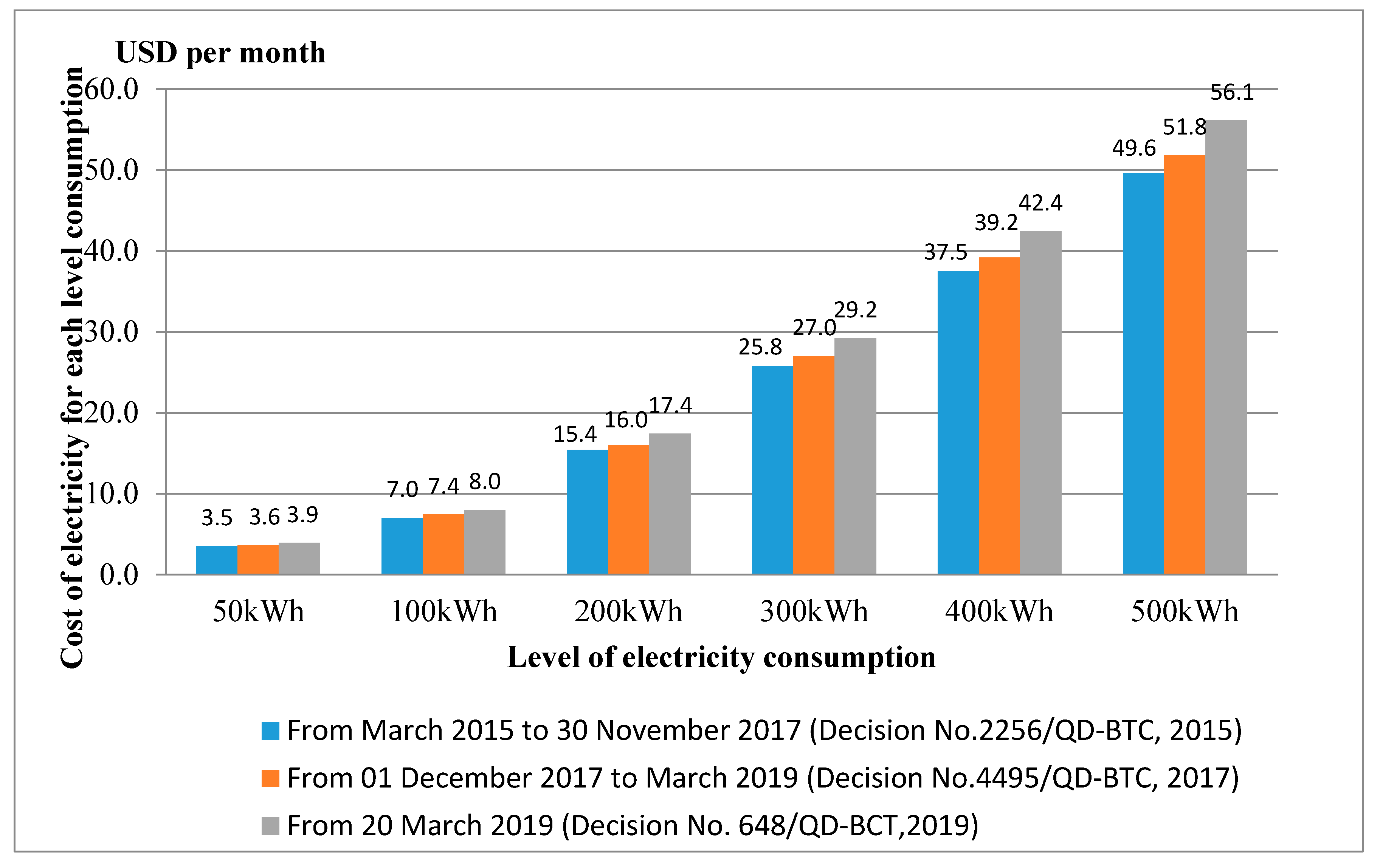
The cost of electricity to households is based on the level of electricity consumed. The amount paid every month for electricity is shown in Figure 1.
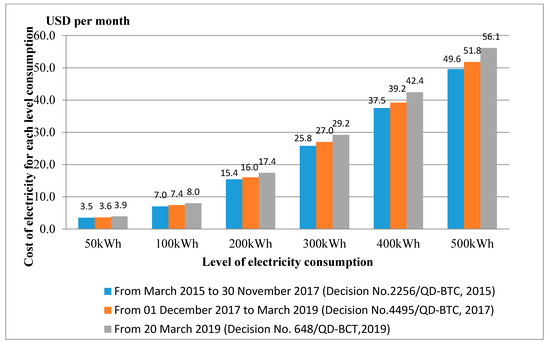
Figure 1.
Cost of electricity for each level of electricity consumption. Note: All decisions made by the Vietnamese Ministry of Finance.
3.6. Survey to Suggest Policies Implication
In this study, a part of the survey results on the intention to install SG rooftop solar power was used to suggest policy implications. The authors surveyed a sample of 300 household heads in the Central Highlands from May to July 2019. None of the households who answered the questionnaire had installed SG rooftop solar systems on their houses, although their houses’ roofs were suitable for the installation of such a system. The survey consists of two parts. Part 1 contains questions related to factors affecting the intention to install the system, a question of a binary dependent variable, and one question about the household’s suggestion for promoting SG development rooftop solar power. Part 2 covers demographic information about the households. However, in this study, only the results regarding the household’s suggestions for SG rooftop solar promotion and the levels of electricity consumption were applied. Questions and answers were as follows:
- (1)
- Would you recommend that the Vietnamese Government enhance SG rooftop solar power besides the 9.35 US cent FIT?
- ➢
- Support 10% of the installation cost
- ➢
- Support 20% of the installation cost
- ➢
- Support 30% of the installation cost
- ➢
- Recommend that commercial banks give preferential rate loans
- ➢
- Give a 5 million VND bonus to people who install the system
Other - (2)
- Level of electricity consumption?
- □
- Level 1: 0–50 kWh
- □
- Level 2: 51–100 kWh
- □
- Level 3: 101–200 kWh
- □
- Level 4: 201–300 kWh
- □
- Level 5: 301–400 kWh
- □
- Level 6: Over 400 kWh (500 kWh is used for the calculation in this study)
Estimating the kWp rooftop solar energy capacity appropriate for each level of electricity consumption
As mentioned above, a sunshine duration of 2000 h per year was applied in deriving the data for this study. On that basis, the electricity output from a 1 kWp rooftop solar power system would be 2000 kWh per year (equivalent to 166.67 kWh per month). The kWp rooftop solar energy appropriate for each level of electricity consumption was therefore calculated as follows:
The cost of installing the system was based on the price quoted for high-quality household SG rooftop PVs by companies who supply them in Vietnam. The lifetime of an inverter is only 10 years, and the inverter would thus need to be replaced during the lifetime of the SG rooftop PV. The cost of replacing the inverter was, therefore, taken into consideration. A breakdown of the cost of the SG rooftop PV and the inverter is shown in Table 3.
Table 3.
Price converted to USD.
The quoted installation cost of a rooftop solar system in Vietnam ranged between USD 850 and over 1200 per kWp. In this research, the cost of USD 1200 per kWp was adopted. This high initial level of cost for the system and inverter was adopted to ensure that, in establishing the economic performance of SG rooftop PV, households could be expected to choose high-quality equipment and to replace the inverter every 10 years. Based on Equation (5), the monthly cost of electricity and the kWp of an SG rooftop PV system appropriate for each level of electricity consumption, as well as the installation cost including the cost of replacing the inverter, are illustrated in Table 4 for each level of electricity consumption shown in Figure 1.
Table 4.
The size (kWp) of rooftop solar energy systems appropriate for each level of electricity consumption.
4. Results
As SG rooftop PV generates power only during the day, the calculations in this section are true only for the residents who sell all the electricity to the grid or use all the electricity during the day.
The NPV, IRR, and PBP are estimated for each level of electricity consumption, where all electricity output is used for domestic consumption.
When all the electricity output from a rooftop solar power system is used to satisfy domestic consumption, as shown in Table 4, the kWp of the rooftop solar power system can be estimated based on the level of electricity consumption, and the cost of electricity will represent the benefit derived from the system. In this scenario, the consumer does not have to pay tax. However, the inverter will have a maximum life of 10 years, so the cost will be enhanced by the cost of the inverter (the NB value where there is no battery) every 10 years. On that basis, the cost-benefit analysis for the first level of electricity consumption (50 kWh) is shown in Table 5, where the capacity of the system installed is 0.3 kWp, with an installation cost of USD 360, the cost of electricity is USD 3.9 per month, and the cost of replacing the inverter every 10 years is USD 111. The NPV, IRR, and PBP appear in Table 6.
Table 5.
Cost-benefit analysis for an SG rooftop PV system appropriate for Level 1 electricity consumption.
Table 6.
FI values of SG rooftop PV appropriate for each level of electricity consumption.
As mentioned above, the efficiency of a rooftop solar power system decreases over time. Therefore, the benefit (Bt) every year for the first 10 years can be estimated based on 90% of the cost of electricity every month multiplied by 12, with the same calculation incorporating a figure of 80% for the last 15 years.
Bt (level 1-first ten years) = 3.9 × 2 × 90% = USD 42.12 per year
Bt (level 1-last 15 years) = 3.9 × 12 × 80% = USD 37.44 per year
This calculation is based on the lifetime of a rooftop solar system of around 25 years, with the expectation that the maintenance cost both during and after the guarantee period will be zero. The inverter will be replaced in Year 10 and Year 20 of the system.
Based on the estimate in Table 5, the economic efficiency of a 0.3 kWp rooftop solar system appropriate for the first level of electricity consumption (50 kWp) with a discount rate of 8.6% is as follows:
To determine the payback period, as can be seen from Table 5, the accumulated Bt − Ct is greater than zero in the 12th year of the project, which means that the initial investment can be recouped after the first 11 years of operating the system.
The IRR was calculated using Microsoft Excel’s IRR (value, [guess]) function based on the values in column Bt − Ct of Table 5, with a guess based on the option validity (since this was unknown, guess was assumed to be 10%). From that calculation, the IRR is 9.04% per year.
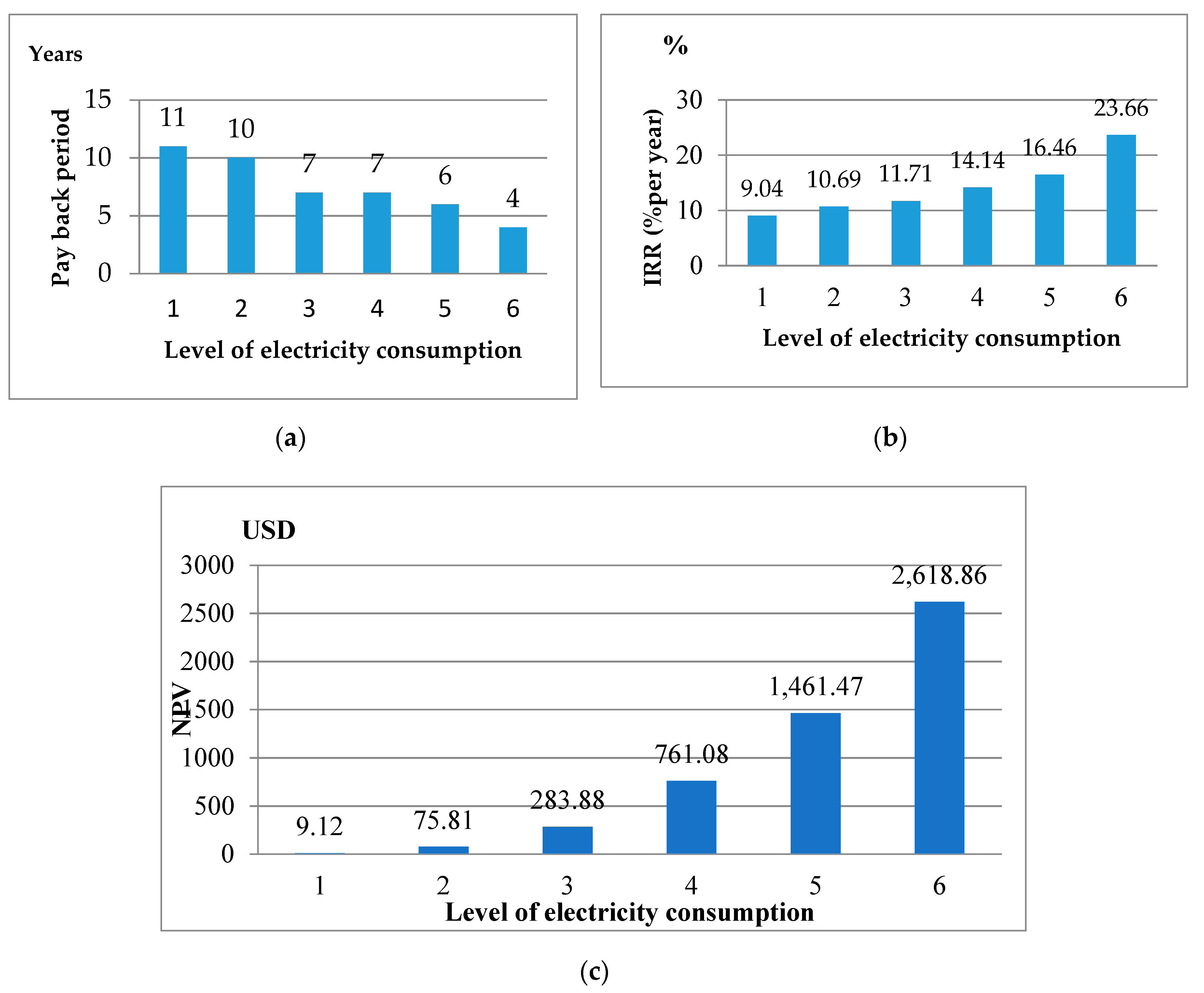
The same calculations were conducted for other levels of electricity consumption, and the resulting FIs are shown in Table 6 and illustrated in Figure 2a–c.
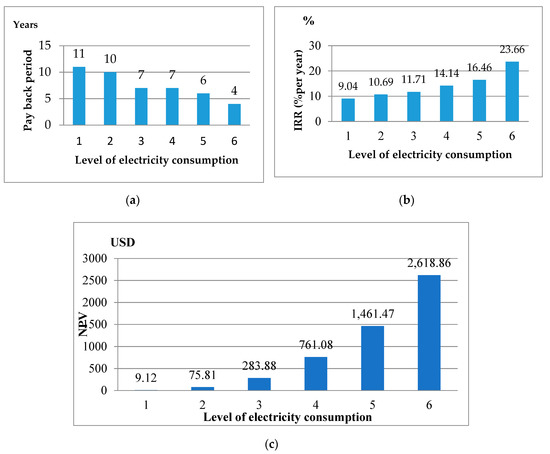
Figure 2.
FI values of SG rooftop PV appropriate for each level of electricity consumption in the case where all electricity output is used for domestic consumption: (a) PBP, (b) IRR, and (c) NPV.
It is therefore clear that people should invest in SG rooftop PV at all six levels of electricity consumption because the NPV is greater than zero and the IRR is greater than the discount rate. Moreover, the higher kWp required to satisfy higher levels of electricity consumption will bring more benefits than those accruing to consumers using less electricity. An SG solar power system with a capacity of 3.33 kWp has a PBP of only four years, while that of a system appropriate for the first level of electricity consumption is 11 years. The IRR increases from 9.04% to 23.66% between Levels 1 and 6, and the NPV also increases from USD 9.12 to USD 2618.86, respectively.
These scenarios assume that all the electricity generated is used for domestic consumption, and the electricity price level has a significant effect on the economic efficiency of SG rooftop solar power systems.
FIs for each level of electricity consumption based on the sale of power at the FIT price.
According to Decision No. 02/2019/QD/TTg, made by the Prime Minister of Vietnam, the electricity generated from solar power cells can be sold independently to the grid. If it is assumed that all the electricity generated from a rooftop solar power system is sold to the grid, the Bt is the revenue that people derive by selling the electricity output to the grid at the FIT price of 9.35 US cents per kWh.
In this scenario, similar to the case in which all the electricity generated is used for domestic consumption, the lifetime of a rooftop solar system was taken to be 25 years, and the maintenance cost was assumed to be zero, but in this case, people have to pay both tax and an excise fee. Thus, the cost per year is as follows:
where C0 is the total cost of investment.
Ct = C0 + Tax + Fee
However, only when the revenue from the power output (Bt) exceeds 100 million VND (equivalent to USD 4244) per year will people have to pay a 0.5% personal income tax and a 1% VAT [33] and, as noted above, an excise fee each year (USD 12.37 for revenue from USD 4244 to USD 12,732.8 per year, USD 21.22 for revenue from USD 12,732.9 to USD 21,221.4 per year, and USD 42.44 for revenue from USD 21,221.5 to USD 42,443).
The Bt, Ct, NPV, IRR, and PBP for a 3.3 kWp solar system appropriate for Level-6 electricity consumption (500 kWh), the capacity of which is 3.33 kWp, as well as the installation cost, USD 3960, with an electricity cost per month of USD 56.1, were then calculated. The same assumptions used in the first case were made regarding the efficiency of the system (i.e., 90% in the first 10 years and 80% for the last 15 years [48]. The inverter would also need to be replaced in Year 10 at a cost of USD 885 for Level-6 electricity consumption. Therefore, the benefit each year for the first 10 years was estimated at 500 kWh multiplied by the FIT price of 9.35 US cents (or USD 0.0935) per kWh) multiplied by 12 and then multiplied by 90%, for the first 10 years, and by 80%, for the last 15 years, as shown below:
Bt (level 6-FIT-first 10 years) = 500 × 0.0935 × 12 × 90% = USD 504.9 per year
Bt (level 6-FIT-last 15 years) = 500 × 0.0935 × 12 × 80% = USD 448.8 per year
The benefit per year in this situation is still well under the threshold of USD 4244 per year and would, therefore, attract no personal income tax, VAT [33], or excise fee. The calculation is illustrated in Table 7.
Table 7.
Cost-benefit analysis of an SG rooftop PV system appropriate for Level-6 electricity consumption, where all electricity output is sold to the grid.
In a scenario where all the electricity output is sold to the grid at the FIT price of 9.35 US cents per kWh, the economic efficiency indices for a 3.33 kWp rooftop solar system appropriate for Level-6 electricity consumption (500 kWp) with a discount rate of 8.6% is as follows:
To determine the PBP, as shown in Table 7, the accumulated Bt − Ct exceeds zero in the eighth year of the project, which means that the investment in the system is recouped after the first seven years of the system’s operation. Further, based on Microsoft Excel’s IRR function, the IRR is 11.60% per year. Similar calculations for all six levels of electricity consumption are shown in Table 8.
Table 8.
FI values for SG rooftop solar PV, where all electricity is sold to the grid.
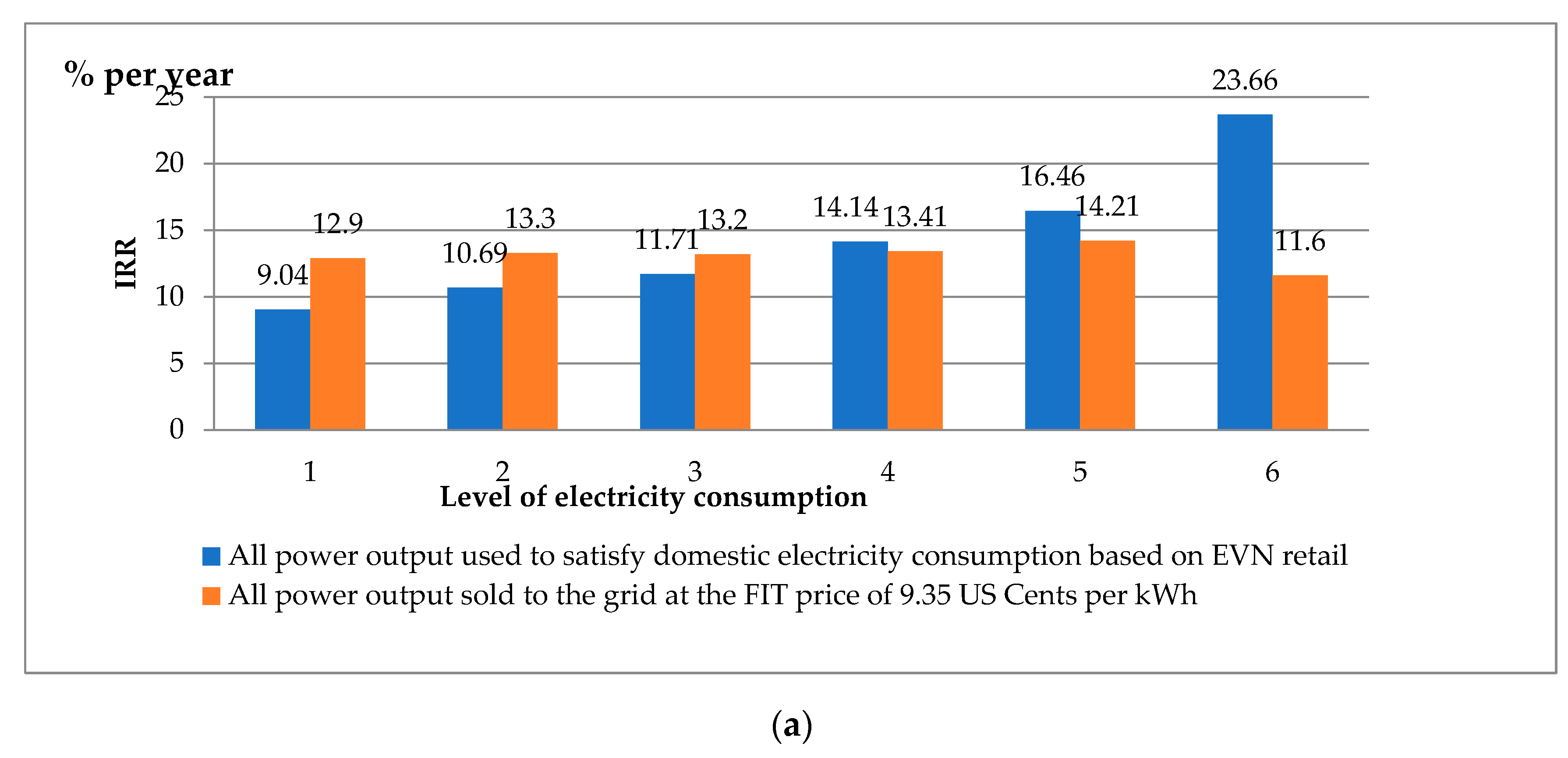
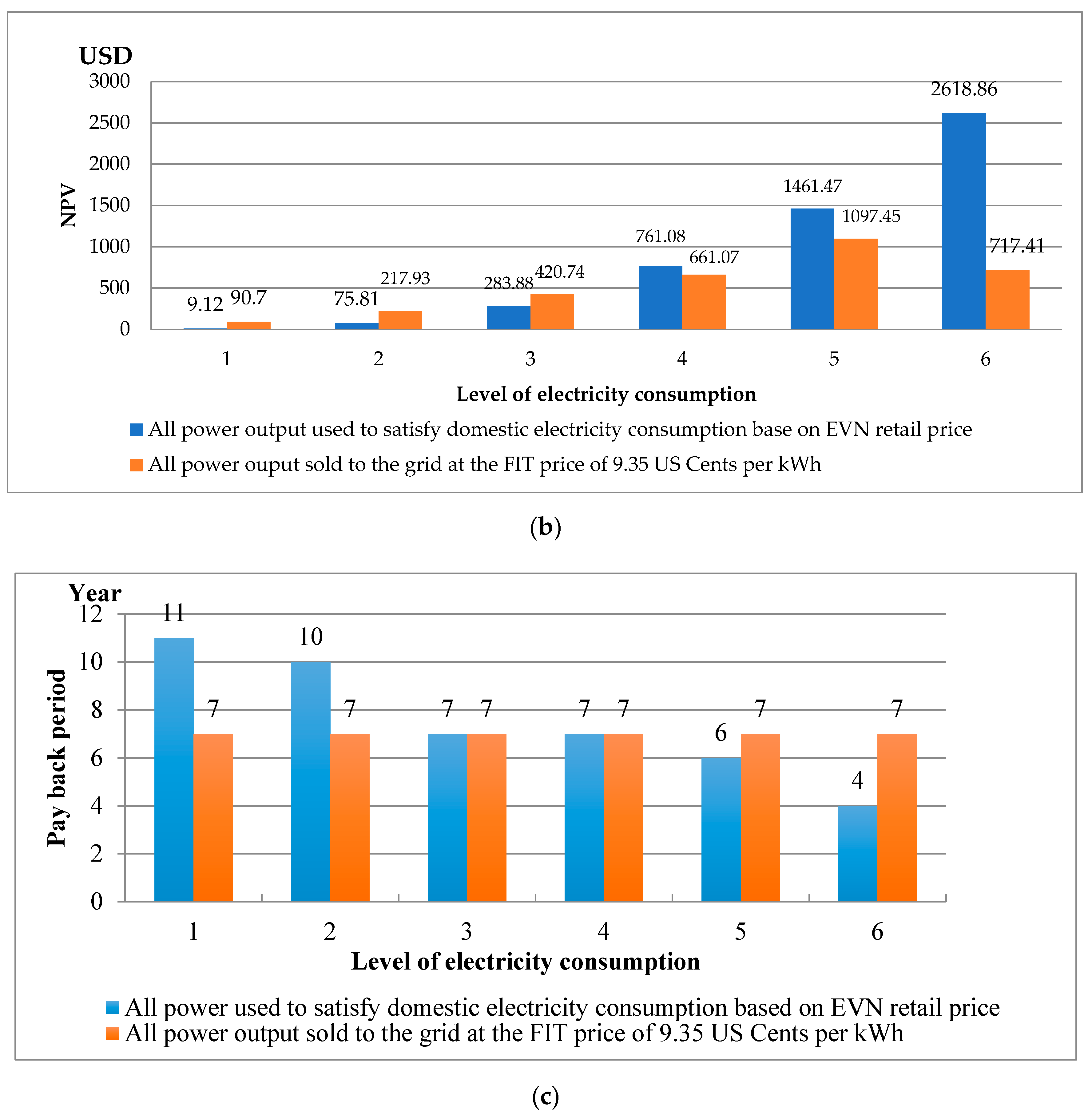
The indicators in Table 8 show that the installation of rooftop solar power systems appropriate for every level of electricity consumption, with all the electricity output being sold to the grid, will produce a benefit at all levels. However, the highest level (Level 6) entails the lowest IRR. These indicators are compared in Figure 3a–c.
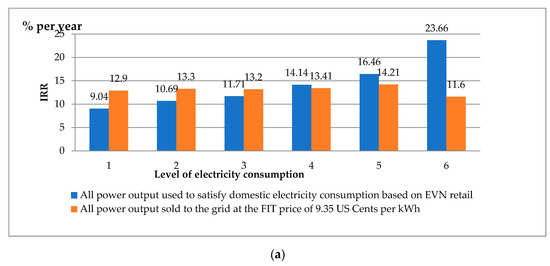
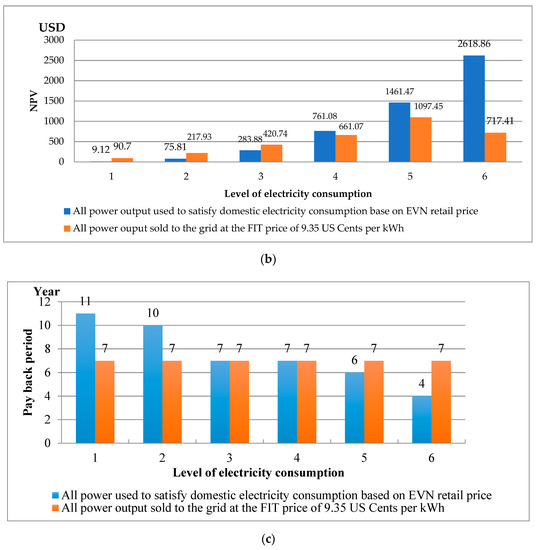
Figure 3.
FI comparison between the case in which all electricity output is used for domestic consumption vs. the case in which all electricity output is sold to the grid: (a) IRR, (b) NPV, and (c) PBP.
It can be seen that there are differences in the SG rooftop solar FI between using the power output to satisfy domestic consumption and selling it to the grid, among the six levels of electricity consumption. At Levels 1 and 2, the retail price of electricity is lower than that at higher levels, so people who install SG rooftop solar power systems and sell all the electricity generated will derive more benefit than those who consume all of the electricity. The benefit of the two scenarios is nearly the same at Levels 3 and 4, but at Levels 5 and 6, people gain a greater benefit by using all the electricity generated to satisfy their consumption since this will bring much greater benefit than at lower levels of consumption. This is particularly so at Level 6, where the retail electricity price is highest. Households that consume electricity at Level 6 who install an SG rooftop solar power system will recoup their investment with only a four-year PBP, with an NPV of around three times that derived from the sale of electricity to the EVN. Moreover, the IRR, when all power generated is used for domestic consumption, is also highest at Level 6.
The consumption-based level of the retail price of electricity in Vietnam, therefore, benefits those who install rooftop solar systems and use higher levels of electricity, since they will derive better economic efficiency from such a system, especially when the system generates more than 400 kWh of electricity per month. However, if consumers who depend on the grid for electricity consumption use more electricity in the hot season, this will threaten the safety of the electricity sector. According to the EVN (2018), in April, May, June, and July 2018, the number of customers who used more than 400 kWh of electricity increased to around 600,000 per month, compared to 385,000 customers in March of that year [54]. When electricity demand increases suddenly in the summer months, this can lead to the overloading of the grid in some areas, which represents a hazardous situation for the electricity grid [55]. Moreover, electricity generation in Vietnam fluctuates depending on the season because the electricity from hydropower accounts for a very high percentage of the total electricity generated. This means that the electric supply is not stable, and fluctuations and power outages frequently occur in the dry summer season [56]. Recently, this issue has always been resolved every year, and the System Average Interruption Duration Index (SAIDI), which demonstrates the median yearly period of power cuts for each power buyer, decreased significantly from 2281 to 1651 min from 2015 to 2016. The System Average Interruption Frequency Index (SAIFI), which indicates the mean quantity of electricity outages suffered per buyer in a year, also fell from 13.36 times per buyer in 2015 to 10.6 times per buyer in 2016 [8,57]. However, there is still instability in Vietnam’s electricity delivery and consumption because the 500 kV electricity line, which underlies the main electricity network of the country, has to convey an enormous volume of electricity from the north to the south of Vietnam. This is because the major hydropower plants are located mostly in the northwest of Vietnam, and the major coal-fired plants are located close to the coal mines in the northeast of the country with only gas turbines located in the south [58]. Therefore, the installation of rooftop solar systems is the best means by which people can combat an unstable electricity supply in the hot season.
Finally, a survey relating to customers’ intentions to install SG rooftop solar systems was conducted, as mentioned in the methodology section. Out of the 300 households who responded, 99 (33%) wanted to install a rooftop system, whereas 201 households (67%) did not want to do so for various reasons—for example, they could not afford the capital cost of installing such a system. All 300 households consume electricity from Level 2 to Level 6, and among these, a total of 68.7% consume at Level 3 or Level 4. Based on the analysis of this paper, SG rooftop solar electricity is more beneficial with a high level of electricity consumption (Level 3–6). Lastly, 10.3% and 4.7% of customers used electricity at Levels 5 and 6, respectively (Table 9).
Table 9.
Level of electricity consumption and recommended forms of support from the Vietnamese Government.
This report is useful if, as a result of it, the right government incentive can be applied to the right customer and it helps them to use an alternative energy resource, reduce power shortages in the hot season, and guarantees national energy security. All of the respondents agreed that they would be willing to install SG rooftop PV and would encourage other people to do so if there were suitable support from the government and if the forms of support set out in Table 9 were recommended. The largest group of households (39.3%) suggested that 30% of the initial costs should be provided by the government, with 27% suggesting that the government should arrange finance through preferential loans from commercial banks. Other methods of encouraging the installation of SG rooftop PV suggested by the remainder included staggering initial payments over a period of 3–5 years, with interest being payable, supporting 50% of the initial cost, and providing better information about SG rooftop solar electricity systems.
5. Discussion
The findings show that, at all levels of electricity consumption, installing an SG rooftop solar system is beneficial. At Levels 1, 2, and 3, domestic consumption is less profitable than if it is sold to the grid, and vice versa. With the other three levels, the levels of electricity price are increasing significantly, so installing SG rooftop PV, for those who use all of their electricity, will be more beneficial than it would be for those selling it to the grid.
Although the results show that people will obtain a profit from their investment in rooftop solar electricity systems, the initial cost of rooftop solar systems still presents a barrier for ordinary people. The Vietnamese Government should therefore provide incentives to encourage people to use renewable energy by installing SG solar rooftop electricity systems. The Vietnamese government revenue comes from many sources, such as taxes, fees, the income of national companies, the income from national resources, and foreign aid. This revenue has been used for many purposes, and renewable energy development is one of them.
At present, the only incentive offered by the Vietnamese Government is the FIT price (9.35 US cents per kWp). However, increases in the retail electricity price following Decision No 648/QD-BTC of 20 March 2019 may encourage people to find alternative sources of electricity. Nevertheless, to enhance the development of renewable resources, for instance, through the installation of rooftop solar panels by domestic users, the researchers suggest that the government of Vietnam should apply some of the following incentives.
- •
- Exempting people from tax (VAT) when people install SG, off-grid, or hybrid PV systems and when they sell electricity to the grid.
- •
- Providing preferential interest rate loans for green energy, where the interest rate is lower than that it is with other loans.
- •
- Providing a monetary gift (e.g., 5 million VND) when people choose to install a rooftop solar system on their house.
- •
- Supporting 10–30% of the initial cost of installation of domestic rooftop solar systems as well as similar support to companies who install such systems in the same way that the Indian government has been doing in their PV rooftop program [59].
On 27 March 2019, the EVN held a “Seminar on Promotion of Roof-Top Solar Energy in Vietnam” in Hanoi [60]. The participants in the seminar included the World Bank, Bank aus Verantwortung, the Japan International Cooperation Agency, Agence Francaise de Development, Green Innovation, the Development Centre of Vietnam, the SolarBK of Vietnam, the Amplus Solar of India, the Korea Electricity Power Corporation, experts in the energy industry, and members of the EVN’s Board of Directors. During the seminar, the EVN proposed various means of encouragement for the installation of rooftop solar power systems in areas with a high potential for generating solar energy. Firstly, the EVN suggested that the Vietnamese Government should support part of the initial cost incurred by households in installing rooftop solar electricity systems. Secondly, the Ministry of Industry and Trade was requested to promulgate a new circular relating to the FIT arrangements to replace Circular 16, which is related to the net-metering mechanism [61], to make it clear that the EVN can sign electricity contracts with customers based on Decision 02/2019/QD-TTG. Moreover, the EVN requested banks, investors, producers, international organizations, and domestic organizations to participate in the rooftop solar energy market. The hope was expressed that support from all stakeholders in the Vietnamese electricity market would be forthcoming in the future.
The authors’ opinion about the Vietnamese Government subsidies would be based on the opinion of people in the Central Highlands. Therefore, in the long-term development of energy in Vietnam, the Vietnamese government should consider those suggestions set out in Table 9 and adjust their policies to encourage people to install SG rooftop PV as an alternative power source to minimize hazards for the electricity grid, which results from high levels of consumption in the hot season in Vietnam.
6. Conclusions
In conclusion, all the FI values derived in this research show that the residents of the Central Highlands of Vietnam can derive benefits from installing SG rooftop PV, whether they sell all the electricity output to the grid or whether they use the power output to satisfy their domestic demand during the day. Based on the different levels of the retail electricity price applied to different levels of electricity consumption, SG rooftop PV brings the following benefits to households in the area:
- ➢
- The IRR is higher than the discount rate (8.6%) and ranges from 9.04% to 23.66% (Figure 3a). Therefore, a higher interest rate will result when a rooftop solar system is installed compared to depositing into commercial banks.
- ➢
- The NPV is greater than zero and ranges from USD 9.07 to USD 2618.86 (Figure 3b). This means that an SG rooftop PV system will bring more profit to its installers, especially at high levels of electricity consumption.
- ➢
- The PBP ranges from 4 to 11 years (Figure 3c). This means that investments will show a return between 4 and 11 years if the system is installed. Notably, PBP is shorter for higher-level consumers of electricity. The number is only four years if all the electricity generated is used to satisfy their domestic consumption at the highest power consumption level.
The differential level of the retail electricity price renders higher levels of electricity consumption proportionately more expensive than lower levels. However, if people install SG rooftop PV to satisfy higher levels of electricity consumption, they will derive more benefit from the power output of the system. In particular, when people’s electricity load is at Level 6 (401 to 500 kWh), and they install an SG rooftop PV, they will enjoy free electricity after four years of installation.
Based on the survey, 68.7% of people of the sample consumed electricity at Levels 3 and 4. Those using electricity at Levels 5 and 6 occupied 10.3% and 4.7%, respectively. Some methods are suggested to encourage SG rooftop PV development, including initial costs from the government, staggering initial payments over a period of 3–5 years, with interest being payable, supporting 50% of the initial cost, and providing better information about SG rooftop solar electricity systems (Table 9).
Although this research is useful for investors, the companies providing SG rooftop PV, and policymakers, it still has some limitations. Firstly, this study calculated the FI values of SG rooftop PV for only one customer group (people using residential solar PV). Therefore, the subsidies mentioned here are applicable only for that group. Moreover, the study only considered two cases: those using all the electricity generated for their own consumption in a given day and those selling all the electricity generated to the grid. Future research should study other cases, where a part of the power output during the day is sold to the grid, while during times of higher consumption, for example, during the evening, only some electricity is bought from the grid.
Author Contributions
Conceptualization, T.T.L.; Formal analysis, S.J.; Funding acquisition, D.A.; Investigation, S.J. and D.A.; Methodology, T.T.L. and K.T.; Project administration, K.T.; Resources, M.S.C. and T.H.; Software, M.S.C.; Supervision, S.J., K.T., and L.D.N.; Validation, S.J.; Writing—original draft, T.T.L.; Writing—review and editing, M.S.C., D.A., K.T., and L.D.N. All authors have read and agreed to the published version of the manuscript.
Funding
This manuscript is funded by a research grant of the Ph.D. program of Sustainable Energy Management—Prince of Songkla University (No. TEH-AC 048/2018).
Acknowledgments
The authors are most grateful for the supporting grants from the Prince of Songkla University (PSU) Graduate School and Interdisciplinary Graduate School of Energy Systems. The authors also give many thanks to the native-English-speaking editors from the Research and Development Office (RDO), Prince of Songkla University, who edited the English for this manuscript.
Conflicts of Interest
The authors declare that there is no conflict of interest.
References
- World Energy Resources. Available online: https://www.worldenergy.org/wp-content/uploads/2016/10/World-Energy-Resources-Full-report-2016.10.03.pdf (accessed on 15 October 2017).
- Chowdhury, M.S.; Rahman, K.S.; Chowdhury, T.; Nuthammachot, N.; Techato, K.; Akhtaruzzaman, M.; Tiong, S.K.; Sopian, K.; Amin, N. An overview of solar photovoltaic panels’ end-of-life material recycling. Energy Strategy Rev. 2020, 27, 100431. [Google Scholar] [CrossRef]
- Ellabban, O.; Abu-Rub, H.; Blaabjerg, F. Renewable energy resources: Current status, future prospects and their enabling technology. Renew. Sustain. Energy Rev. 2014, 39, 748–764. [Google Scholar] [CrossRef]
- Shafiee, S.; Topal, E. When will fossil fuel reserves be diminished? Energy Policy 2009, 37, 181–189. [Google Scholar] [CrossRef]
- Tang, X. Depletion of fossil fuels and anthropogenic climate change—A review. Energy Policy 2013, 52, 797–809. [Google Scholar] [CrossRef]
- McMichael, A.J.; Woodruff, R.E.; Hales, S. Climate change and human health: Present and future risks. Lancet 2006, 367, 859–869. [Google Scholar] [CrossRef]
- Dincer, I. Renewable energy and sustainable development: A crucial review. Renew. Sustain. Energy Rev. 2000, 4, 157–175. [Google Scholar] [CrossRef]
- EVN Vietnam Electricity Annual Report 2017. Available online: https://en.evn.com.vn/userfile/User/huongbtt/files/2018/2/AnnualReport2017.pdf (accessed on 10 August 2018).
- Han, S.S.; Vu, K.T. Land Acquisition in Transitional Hanoi, Vietnam. Urban Stud. 2008, 45, 1097–1117. [Google Scholar] [CrossRef]
- Manyari, W.V.; de Carvalho, O.A. Environmental considerations in energy planning for the Amazon region: Downstream effects of dams. Energy Policy 2007, 35, 6526–6534. [Google Scholar] [CrossRef]
- Lerer, L.B.; Scudder, T. Health impacts of large dams. Environ. Impact Assess. Rev. 1999, 19, 113–123. [Google Scholar] [CrossRef]
- Tilt, B.; Braun, Y.; He, D. Social impacts of large dam projects: A comparison of international case studies and implications for best practice. J. Environ. Manag. 2009, 90, S249–S257. [Google Scholar] [CrossRef]
- Scudder, T. The World Commission on Dams and the Need for a New Development Paradigm. Int. J. Water Resour. Dev. 2001, 17, 329–341. [Google Scholar] [CrossRef]
- Bui, T.M.H.; Schreinemachers, P. Resettling Farm Households in Northwestern Vietnam: Livelihood Change and Adaptation. Int. J. Water Resour. Dev. 2011, 27, 1–17. [Google Scholar] [CrossRef]
- Stickler, C.M.; Coe, M.T.; Costa, M.H.; Nepstad, D.C.; McGrath, D.G.; Dias, L.C.P.; Rodrigues, H.O.; Soares-Filho, B.S. Dependence of hydropower energy generation on forests in the Amazon Basin at local and regional scales. Proc. Natl. Acad. Sci. USA 2013, 110, 9601–9606. [Google Scholar] [CrossRef]
- Vietnam Energy Outlook Report. Available online: https://ens.dk/sites/ens.dk/files/Globalcooperation/Official_docs/Vietnam/vietnam-energy-outlook-report-2017-eng.pdf (accessed on 18 October 2018).
- Sustainable Development and Environmental Protection in Vietnam. Available online: http://nangluongvietnam.vn/news/vn/bao-ton-nang-luong/phat-trien-nang-luong-ben-vung-va-bao-ve-moi-truong-tai-viet-nam.html (accessed on 24 March 2019).
- Dondariya, C.; Porwal, D.; Awasthi, A.; Shukla, A.K.; Sudhakar, K.; Murali, M.M.; Bhimte, A. Performance simulation of grid-connected rooftop solar PV system for small households: A case study of Ujjain. India. Energy Reports 2018, 4, 546–553. [Google Scholar] [CrossRef]
- Lau, K.Y.; Muhamad, N.A.; Arief, Y.Z.; Tan, C.W.; Yatim, A.H.M. Grid-connected photovoltaic systems for Malaysian residential sector: Effects of component costs, feed-in tariffs, and carbon taxes. Energy 2016, 102, 65–82. [Google Scholar] [CrossRef]
- IRENA. Future of Solar PV-Deployment, Investment, Technology, Grid Integration and Socio-Economic Aspects (A Global Energy Transformation: Paper); International Renewable Energy Agency: Abu Dhab, UAE, 2019; pp. 1–88. [Google Scholar]
- Snapshot of Global PV Markets 2019. Available online: www.Iea-Pvps.Org (accessed on 18 June 2020).
- Wang, Y.; Zhao, T.; Ju, C.; Xu, Y.; Wang, P. Two-Level Distributed Volt/Var Control Using Aggregated PV Inverters in Distribution Networks. IEEE Trans. Power Deliv. 2020, 35, 1844–1855. [Google Scholar] [CrossRef]
- Wang, Y.; Syed, M.H.; Guillo-Sansano, E.; Xu, Y.; Burt, G.M. Inverter-Based Voltage Control of Distribution Networks: A Three-Level Coordinated Method and Power Hardware-in-the-Loop Validation. IEEE Trans. Sustain. Energy 2019, 11, 2380–2391. [Google Scholar] [CrossRef]
- Peng, Q.; Low, S.H. Distributed optimal power flow algorithm for radial networks, I: Balanced single phase case. IEEE Trans. Smart Grid 2018, 9, 111–121. [Google Scholar] [CrossRef]
- Zhang, Y.; Xu, Y.; Yang, H.; Dong, Z.Y. Voltage regulation-oriented co-planning of distributed generation and battery storage in active distribution networks. Int. J. Electr. Power Energy Syst. 2019, 105, 79–88. [Google Scholar] [CrossRef]
- Baker, K.; Bernstein, A.; Dall Anese, E.; Zhao, C. Network-Cognizant Voltage Droop Control for Distribution Grids. IEEE Trans. Power Syst. 2018, 33, 2098–2108. [Google Scholar] [CrossRef]
- Sun, P.-C.; Wang, H.-M.; Huang, H.-L.; Ho, C.-W. Consumer attitude and purchase intention toward rooftop photovoltaic installation: The roles of personal trait, psychological benefit, and government incentives. Energy Environ. 2018, 31, 21–39. [Google Scholar] [CrossRef]
- Shih, L.H.; Chou, T.Y. Customer concerns about uncertainty and willingness to pay in leasing\nsolar power systems. Int. J. Environ. Sci. Technol. 2011, 8, 523–532. [Google Scholar] [CrossRef]
- Sahouane, N.; Dabou, R.; Ziane, A.; Neçaibia, A.; Bouraiou, A.; Rouabhia, A.; Mohammed, B. Energy and economic efficiency performance assessment of a 28 kWp photovoltaic grid-connected system under desertic weather conditions in Algerian Sahara. Renew. Energy 2019, 143, 1318–1330. [Google Scholar] [CrossRef]
- Polo, J.; Bernardos, A.; Navarro, A.A.; Fernandez-Peruchena, C.M.; Ramírez, L.; Guisado, M.V.; Martínez, S. Solar resources and power potential mapping in Vietnam using satellite-derived and GIS-based information. Energy Convers. Manag. 2015, 98, 348–358. [Google Scholar] [CrossRef]
- Solar Potential in the Central Highlands of Vietnam. Available online: https://www.evn.com.vn/c3/evn-va-khach-hang/Tin-nang-luong-tai-tao-141-17.aspx (accessed on 23 March 2019).
- Decision No. 11 /2017/QD-TTg On the Support mechanisms for the Development of Solar Power Projects in Vietnam. Available online: http://vanban.chinhphu.vn/portal/page/portal/chinhphu/hethongvanban?class_id=1&_page=1&mode=detail&document_id=189336 (accessed on 15 October 2017).
- Instruction No. 1534/BTC-CST Preferential Policy toward under 50 kWp Rooftop Solar Project. Available online: https://thuvienphapluat.vn/cong-van/Tai-chinh-nha-nuoc/Cong-van-1534-BTC-CST-2019-chinh-sach-uu-dai-doi-voi-du-an-dien-mat-troi-duoi-50kW-410737.aspx (accessed on 19 April 2019).
- Vietnam Power Report 2015. Available online: www.fpts.com.vn (accessed on 20 May 2017).
- Tongsopit, S.; Junlakarn, S.; Wibulpolprasert, W.; Chaianong, A.; Kokchang, P.; Hoang, N.V. The economics of solar PV self-consumption in Thailand. Renew. Energy 2019, 138, 395–408. [Google Scholar] [CrossRef]
- More than 27,600 Rooftop Solar PV Projects Have Been Installed across the Country. Available online: https://www.evn.com.vn/d6/news/Hon-27600-cong-trinh-dien-mat-troi-mai-nha-da-duoc-lap-dat-tren-ca-nuoc-141-191-25537.aspx (accessed on 20 March 2019).
- GSO. Population and Housing Census at 0 Hour April 1st 2019; Statistis publishing: Hanoi, Vietnam, 2019; pp. 1–129. [Google Scholar]
- Abraham, A. Project Planning and Management: An Aspect of Development; Anchor Academic Publishing: Hamburg, Germany, 2014. [Google Scholar]
- Government Vietnam Goverment Portal. Available online: http://www.chinhphu.vn/portal/page/portal/chinhphu/Sitemap (accessed on 20 March 2019).
- Dufo-López, R.; Bernal-Agustín, J.L. A comparative assessment of net metering and net billing policies. Study cases for Spain. Energy 2015, 84, 684–694. [Google Scholar] [CrossRef]
- Decision No. 02/2019/QD-TTg Ajusted and Added Some Term of the Decision No. 11/2017/QD-TTg of the Government for Solar Energy Development. Available online: http://vanban.chinhphu.vn/portal/page/portal/chinhphu/hethongvanban?class_id=1&mode=detail&document_id=195869 (accessed on 20 March 2019).
- Fang, X.; Misra, S.; Xue, G.; Yang, D. Smart grid-The new and improved power grid: A survey. IEEE Commun. Surv. Tutor. 2012, 14, 944–980. [Google Scholar] [CrossRef]
- Decision No. 1670/QĐ-TTg. Available online: http://vanban.chinhphu.vn/portal/page/portal/chinhphu/hethongvanban?class_id=2&_page=1&mode=detail&document_id=164399 (accessed on 18 May 2020).
- Okay, F.Y.; Ozdemir, S. A fog computing based smart grid model. In Proceedings of the 2016 international symposium on networks, computers and communications (ISNCC), Yasmine Hammamet, Tunisia, 11–13 May 2016; pp. 1–6. [Google Scholar] [CrossRef]
- Smestad, G.P. The basic economics of photovoltaics. Opt. InfoBase Conf. Pap. 2011. [Google Scholar] [CrossRef]
- Paramasivan, C.; Subramanian, T. Financial Management; New Age International Limited Publishers: Delhi, India; Periyar University: Salem Tamil Nadu, India, 2007; pp. 1–280. [Google Scholar]
- Circular 302/2016/TT-BTC Guideline of Excise. Available online: http://vbpl.vn/botaichinh/Pages/vbpq-van-ban-goc.aspx?ItemID=118657 (accessed on 19 April 2019).
- BKSolar. Brochure of BigK Product; Irex Energy Joint Stock Company: Hanoi, Vietnam, 2018; pp. 5–6. [Google Scholar]
- Statistic office of Daklak. Yearbook Statistics of Daklak Province, Vietnam; Statistic Publishing: Hanoi, Vietnam, 2019; pp. 1–422. [Google Scholar]
- The Comparative Bank Interest Rate in Vietnam in January 2019. Available online: https://vietnambiz.vn/so-sanh-lai-suat-ngan-hang-thang-12019-lai-suat-tiet-kiem-tai-ngan-hang-nao-cao-nhat-115884.htm (accessed on 2 March 2019).
- Decision No. 648/QD-BCT Adjusted the Average Retail Price and the Selling Price of Electricity. Available online: https://www.evn.com.vn/d6/news/Quyet-dinh-so-648QD-BCT-ngay-2032019-ve-dieu-chinh-muc-gia-ban-le-dien-binh-quan-va-quy-dinh-gia-ban-dien-9-130-23316.aspx (accessed on 22 March 2019).
- Decision No. 2256/TQD-BCT The Regulation of Electricity Price. Available online: https://www.evn.com.vn/d6/news/Quyet-dinh-cua-Bo-Cong-Thuong-ve-gia-ban-dien-tu-163--9-134-14889.aspx (accessed on 18 March 2017).
- Decision 4495/QD-BCT Electricity Retail Price from 1 December 2017. Available online: https://www.evn.com.vn/d6/news/Quyet-dinh-4495QD-BTC-quy-dinh-ve-gia-ban-dien-tu-ngay-1122017-6-12-20990.aspx (accessed on 22 March 2019).
- EVN Electricity Bill Would Increase in the Hot and Sunny Months. Available online: https://www.evn.com.vn/d6/news/Hoa-don-tien-dien-se-tang-cao-trong-cac-thang-nang-nong-6-14-21947.aspx (accessed on 23 May 2019).
- MOIT Electricity Demand Increases in the Hot Seasons. Available online: http://moit.gov.vn/tin-chi-tiet/-/chi-tiet/nang-nong-dien-rong-keo-dai-dan-đen-tieu-thu-đien-tang-vot-evn-tiep-tuc-khuyen-cao-triet-đe-tiet-kiem-đien-11996-23.html (accessed on 24 May 2019).
- Lerch, E. Stability Study and Modernization Roadmap for Expanding Vietnamese Power System. Power Technol. 2014, 118, 1–4. [Google Scholar]
- EVN Vietnam Electricity Annual Report 2016. Available online: https://www.evn.com.vn/userfile/files/2017/3/AnnualReport2016.pdf (accessed on 10 August 2018).
- Hai, N.S.; Huu, N.T. Operational Problems and Chalenges in Power System of Vietnam. In Proceedings of the 2011 EPU-CRIS International Conference on Science and Technology, Hanoi, Vietnam, 30 November 2011; IEEE Xplore: New York, NY, USA, 2011; pp. 1–5. [Google Scholar]
- MNRE National Solar Mission-Grid Connected Solar Rooftop Program in India. Available online: https://solarrooftop.gov.in/notification/Notification-24012017.pdf (accessed on 29 March 2019).
- EVN Seminar on Promoting Rooftop Solar Energy in Vietnam. Available online: https://evn.com.vn/d6/news/Tai-lieu-Hoi-thao-Thuc-day-phat-trien-dien-mat-troi-ap-mai-tai-Viet-Nam-ngay-2722019-141-170-23168.aspx (accessed on 25 March 2019).
- Circular 16/2017/TT-BCT Regulation of Project Development and Electricity Sale Contract Apply for Rooftop Solar Energy Project. Available online: http://vbpl.vn/bocongthuong/pages/vbpq-timkiem.aspx?dvid=218&IsVietNamese=True&SearchIn=Title1,Title&type=0&s=0&Keyword=thôngtư16&stemp=1&TimTrong1=VBPQFulltext&TimTrong1=Title&order=VBPQNgayBanHanh&TypeOfOrder=False&LoaiVanBan=22 (accessed on 25 March 2019).
Publisher’s Note: MDPI stays neutral with regard to jurisdictional claims in published maps and institutional affiliations. |
© 2020 by the authors. Licensee MDPI, Basel, Switzerland. This article is an open access article distributed under the terms and conditions of the Creative Commons Attribution (CC BY) license (http://creativecommons.org/licenses/by/4.0/).