


Abstract
In recent years, shared mobility services have had a growing presence in cities all over the world. Developing methodologies to measure and evaluate the impacts of shared mobility has therefore become of critical importance for city authorities. This paper conducts a thorough review of the different types of methods that can be used for this evaluation and suggests a classification of them. The pros and cons of each method are also discussed. The added value of the paper is twofold; first, we provide a systematic recording of the state of the art and the state of the practice regarding the evaluation of the impacts of shared mobility, from the perspective of city authorities, reflecting on their role, needs, and expectations. Second, by identifying the existing gaps in the literature, we highlight the specific needs for research and practice in this field that can help society figure out the role of urban shared mobility.
1. Introduction
In a continuously urbanized world, the complexity of urban dwellers’ needs is also growing. Cities all over the world are facing different challenges and need to develop new solutions to fulfil their citizens’ changing needs, while striving towards the goals of the 2030 Agenda for Sustainable Development, and especially “Sustainable Development Goal 11: to make cities and human settlements inclusive, safe, resilient and sustainable” [1]. On top of that, currently, according to the United Nations, “due to COVID-19, an unprecedented health, economic, and social crisis is threatening lives and livelihoods, making the achievement of the Goals even more challenging” [2]. With more than 90% of COVID-19 cases located in urban areas, cities have been urgently forced to come up with novel approaches in order to survive the tempest [2].
Over the past years, shared mobility services have had a growing presence in cities all over the world; this phenomenon is being facilitated by the increasing adoption of information and communications technology (ICT), which is translated into the wide use of smartphones, social media, and digital platforms [3]. In the aftermath of the pandemic, therefore, it is more important than ever for cities to be able to understand and assess the impacts of shared mobility, as this will help them place shared mobility in the bigger picture of making a plan towards an efficient, sustainable, resilient, and people-oriented urban transport system. In this context, the research presented herein aims at providing a comprehensive and structured critical review of the state of the art and state of the practice of evaluation methods that can be used by cities to assess the impacts of shared mobility. We have reviewed academic literature as well as so-called grey literature—reports, white papers, news articles, blogs, and websites—due to the fact that there is no large volume of research yet focusing on the youngest members of the shared mobility family, such as dockless systems, transportation network companies (TNCs) and e-scooters. The objective of this paper is hence to provide a valid description of the key dimensions of heterogeneity within research and practice on the topic of the evaluation of the impacts of shared mobility and to provide the basis for the future development and application of methods to support cities in their decisions.
As places where people, ideas, and resources are gathered, cities are at the forefront of the transition towards a sustainable future. They also often act as incubators for innovation and they are increasingly embracing novel technologies [4,5]. A crucial component for the success of this transition is certainly the urban transport system. Environmental pollution, traffic congestion, parking difficulties, long commuting times, and loss of public space are only a few of the urban mobility-related challenges [6,7]. Urban mobility has been experiencing an era of transition as well, moving towards a personalized, intelligent future that is expected to bring together three main mobility trends—shared mobility, electric mobility, and autonomous mobility [8,9].
The growth of shared mobility is part of the overall booming trend of the so-called sharing economy, which has been flourishing significantly in a growing number of cities during the last decade, and has gathered a lot of attention from academics in different fields (e.g., see [10,11,12,13]), practitioners, as well as the media. According to the Financial Times, we are entering an era in which consumers will value access over ownership and experiences over assets [14]. The concept of shared mobility refers to providing access to a destination, instead of owning the vehicle that takes you to that destination [15].
It can take several different forms, varying from sharing the time available for using a vehicle to sharing a ride with other commuters in the same vehicle. From car sharing and bike sharing, services that date back several years ago, to the disruptive introduction in the 2010s of transportation network companies (TNCs) and most recently to the emergence of shared micromobility, reflected in the influx of e-scooters in numerous cities around the globe, shared mobility presents a plethora of options for people to travel in urban areas. Several studies exist that focus on the impacts of shared mobility, examining them under the lens of all three pillars of sustainable development—environment, economy, and society. Developing metrics, models, and methodologies to measure and evaluate this wide range of impacts is of major importance for cities because it is essential to understand them to be able to guide public policy development [16,17].
City authorities have thus important decisions to make. They have to decide whether the introduction of a shared mobility service will be beneficial for their city and, in cases in which some potential drawbacks are expected (or estimated), they must find if the positive impacts that are foreseen are strong enough to outweigh the negative ones [18]. As the spectrum of available shared mobility options continues to grow, boosted by the private sector’s innovations, the public sector should respond with policies and guidelines that aim at the maximization of benefits that these new shared services can bring to the city and the citizens [19].
In 2020, after a sharp decrease in ridership that has been reported by most shared mobility service providers during the initial period of local lockdowns and social-distancing measures implemented due to COVID-19, shared modes are now being considered by many cities as a strong ally in supporting urban mobility in the post-pandemic era that lies ahead. More and more cities worldwide are trying to give additional space to active modes of transport, in an attempt to relieve pressure and avoid crowded situations in public transit, encouraging this way for people to walk and cycle more while being able to maintain a physical distance from one another.
The remainder of the paper is structured as follows. Initially, an overview of the existing shared mobility modes and services is presented, together with some insights regarding their evolution and growth trends. The impacts of shared mobility are then introduced and categorized into different groups. The next section discusses the role of city authorities and the key challenges they face when considering the introduction of a new shared mode/service in their territory. This is followed by a presentation of the state of the art and the state of the practice in methods that are found in the literature for the evaluation of the impacts of shared mobility, with a critical view, discussing the strong points but also the drawbacks and/or the issues which require further research. The paper ends with general conclusions and perspectives for future work.
2. Shared Mobility: Modes/Services and Evolution
There is a large variety of modes and services falling into the wide category of shared mobility. Figure 1 presents the seven main categories of shared mobility according to the literature—car sharing, bike sharing, ride sharing, on-demand ride services, (shared) micromobility, alternative transit services, and courier network services.
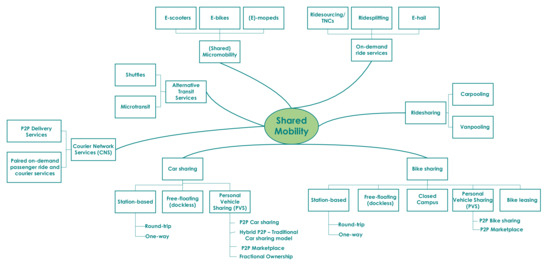
Figure 1.
Shared mobility modes and services (Based on: [15,19]). P2P: peer-to-peer.
2.1. Car Sharing
Car sharing programs have a long history, especially in Europe, where they first appeared around the 1950s in Switzerland, with the United States (U.S.) and Asia following a few decades later. Nowadays, car sharing services have approximately 32 million users and can be found in almost 50 countries around the globe (2018 data) [20]. A sharp increasing trend was noticed after 2012, especially in Asian markets [20]. Various car sharing models exist, having started from the station-based round-trip model and having evolved into many alternative schemes—one-way, free-floating, and personal vehicle sharing (which can be further divided into peer-to-peer (P2P), hybrid P2P—traditional model, P2P marketplace, and fractional ownership) [19].
2.2. Bike Sharing
Bike sharing systems began in Amsterdam, the Netherlands, in 1965, with a program known as “white bikes”. Several bicycles, painted white, were offered to the public to use for free but the program stopped shortly afterwards, due to problems related to theft and vandalism [21,22]. From the era of the so-called “first-generation” of bike sharing until now, a huge evolution has taken place in the field, reaching the present “fourth-generation” of bike sharing—highly flexible dockless systems, operated using ICT, global positioning system (GPS) devices, and smartphones, which have revolutionized bike sharing markets in recent years [21,22]. As of 2018, more than 1600 public bike sharing systems existed all over the world, from only 17 in 2005, with over 18 million bicycles [19]. In addition to the distinction between docked and dockless (free-floating), bike sharing systems can also be offered on a closed campus (e.g., see [23]), as personal vehicle sharing systems (P2P/marketplace), or as bike-lease systems (e.g., see the Dutch Swapfiets system, [22]).
2.3. Ridesharing
Ridesharing enables people who are heading to the same destination or to destinations located close to one another, and whose starting points are also adjacent, to share the ride there [19]. Although once again not a modern invention, it has met with growing popularity during the last decade, due to the increasing use of online platforms and as part of the overall trend of the sharing economy [24]. In the U.S., carpooling was first introduced as a regulation policy to decrease fuel consumption during World War II. Its use peaked in the 1970s, with approximately 20% of all commute trips being performed by carpool. Nowadays, carpooling is a very popular mode of transport for work commuters in the U.S., coming second only to single-occupancy vehicles [25]. Vanpooling uses larger vehicles, typically for up to 15 people, and the users can share the trip costs and sometimes also the driving time [15].
2.4. On-Demand Ride Services
On-demand ride services use digital platforms and applications to connect drivers with passengers. This category can be further divided into ridesourcing, or as it is most often called, transportation network companies (TNCs), ridesplitting, and e-hail services. The difference with ridesharing (described above) is that in the case of ridesourcing, drivers do not just happen to go the same destination as the passengers and decide to combine the ride. Rather, they head to whichever locations the passengers demand, as if they were taxi drivers. Ride sourcing has displayed a fast and massive growth during the last decade and thus has provided triggers for intense debates over its impacts on future urban development [19,26,27]. The e-hail services were introduced by taxi operators as a response to TNCs. With e-hail, a passenger can call a taxi through an application very similar to the ridesourcing ones. Nevertheless, the price in this case is fixed and depends on the local taxi charges; it is not demand-driven, as in the case of TNCs [19]. Ridesplitting can be considered a combination of ridesourcing and carpooling; it works with different passengers whose origin and destination happen to be similar locations, and therefore they decide to share a ridesourcing ride to save on the fee. Usually the passengers in this case have to walk to a pick-up point some meters away, where they meet the driver and their fellow travelers [27].
2.5. Micromobility
Micromobility is a term that has been increasingly used since 2017, when the first shared e-scooters appeared in cities (in this paper the term e-scooters refers to standing e-scooters, whereas other e-scooters are referred to as e-mopeds). Micromobility services are advocated mostly by the younger generations, who use different options in the way they travel, compared to their antecedents [28], and who are naturally more physically skilled in the use of these vehicles. Despite its explosive popularity in cities all over the world, there is not yet a clear consensus among researchers on what exactly comprises micromobility. According to some definitions, “shared micromobility is the shared use of a bicycle, scooter, or other low-speed modes” (see [29]). Other researchers consider that one should not include bike sharing in the category of micromobility, as it has a much longer history in cities all over the world, therefore it should form a separate category of its own. This is the approach we follow in this article, adopting the following definition—“Microvehicle refers to the class of tiny vehicles such as e-bikes and e-scooters, excluding solely human-powered vehicles like pedal-only bikes. Micromobility refers to the travel mode category that uses microvehicles” [30].
In 2018, 45 million trips were made using shared e-scooters and e-bikes in the U.S., surpassing bike sharing trips (36.5 million) for the first time [31], whereas in Europe the number of current e-scooter users has reached 20 million [28]. From March 2020, micromobility services worldwide have experienced a considerable drop in ridership, in line with the general decline in demand that the measures taken by governments to fight the COVID-19 pandemic had initially brought to all modes of shared mobility. Nevertheless, they are expected to have a key role, together with bike sharing, in the post-pandemic mobility era, as more and more cities introduce new bike corridors, as well as discussing strategies and legislation to support active transport and relieve pressure from public transit networks.
2.6. Alternative Transit Services
Alternative transit services can either refer to microtransit or shuttle services, which operate simultaneously and often complementary to public transport options, but they can have some flexibility in terms of itinerary (time and/or route). They can operate on a demand-responsive basis and/or on more fixed-route connections [19]. Alternative transit services can also include informal shared paratransit services that are met in the developing world such as amaphela in South Africa [32], danfos in Nigeria [33], tro tros in Ghana [34], wins in Thailand [35] or the post-Soviet minibuses, known as marshrutkas, in Georgia [36].
2.7. Courier Network Services
A shared service that has seen significant growth recently is courier network services (CNS). CNS operate on the same basis as TNCs, using a digital platform that connects supply and demand. In this case, instead of passengers, drivers can connect to consigners and agree to deliver one or more packages to the consignees. The couriers can use their personal vehicles (cars/motorcycles) or bicycles to perform the transfer, and sometimes CNS and TNC services can co-exist in the same ride. As we have seen with car sharing and bike sharing, P2P services have started to evolve in this category as well [19]. The present paper focuses on passenger transport; therefore, we are not going to elaborate further on the role and impacts of CNS, remaining aware that an intriguing dimension for forthcoming research would be to expand the present research stream to shared freight and logistics.
3. Categorizing the Impacts of Shared Mobility
Before discussing the available methods and approaches with which the impacts of shared mobility can be evaluated, it is important to have a comprehensive understanding of what the term “impacts” entails in an urban context, as it can refer to numerous different things.
A number of studies have dealt with the ways by which shared mobility can affect a city, and the volume of literature is being continuously enriched with the launch of new shared modes like shared e-bikes and e-scooters. The impacts of the more recent ones have been investigated, as expected, to a more limited degree so far, in comparison with more established shared modes that have been operating for decades already, such as car sharing, ridesharing, and traditional docked bike sharing. Even regarding the same modes/services, there are differences in the number of existing studies, depending on the type of business model. For instance, station-based round trip car sharing has been studied for a longer time than free-floating car sharing, which is a more recent variation. The same holds for station-based and free-floating bike sharing, respectively. The boosted popularity of on-demand ride services has led to several researchers start looking at their impact on different aspects of the urban realm.
It should be kept in mind that although there is much evidence in the literature that shared mobility has the strong potential to bring numerous benefits and positive effects to cities, it is also clear from the research performed so far that shared mobility is not and should not be treated as a panacea or some kind of silver bullet to all the urban challenges discussed in Section 1 of this paper. Some studies have found that the introduction of a shared mobility mode/service has resulted in fact in some undesirable consequences, such as additional vehicle kilometers traveled and traffic jams, leading to a rise in emissions, in cities where TNCs began their operations (e.g., see [37,38,39]). In addition, there have been cases where the introduction of a new shared mobility system has been proven unsuccessful in an area and it ceased operation shortly after its implementation (e.g., see [40]). Therefore, potential rebound effects should not be overlooked.
As the focus of this paper is not to provide a detailed review of the literature regarding the impacts themselves, but rather to provide thorough insights on the ways by which these impacts can be evaluated, in the following paragraphs we are going to summarize the key areas of impact by placing them in what we consider to be the six main categories, namely, environment, travel behavior, built environment, society, traffic conditions, and economy. From these broad categories, the highest number of studies and reports belongs to the categories of environment and travel behavior. The main categories of impacts and the key areas that belong to each of them are illustrated in Figure 2.
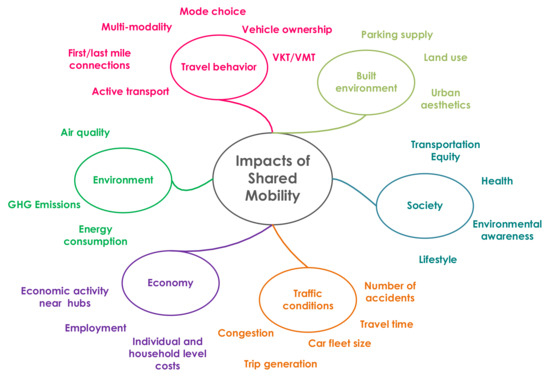
Figure 2.
Main categories and key areas of impacts of shared mobility. VKT/VMT: vehicle kilometers traveled/vehicle miles traveled.
3.1. Impact on the Environment
The impact of shared mobility on the environment is undoubtedly crucial, as minimizing the environmental impact of transportation in general has a central role in ensuring a sustainable future for cities. Investigating this can be viewed as part of the overall research stream that calls for the decarbonization of cities and searches for new ways of achieving this goal. Some studies have looked into the impact of shared mobility on CO2/greenhouse gas (GHG) emissions [41,42,43], energy consumption [44,45], air quality [46], and noise pollution [47,48]. Although the majority of studies examine the impact on the environment of mainly car sharing, bike sharing, ride sharing, and more recently ride sourcing schemes or a combination of those, the environmental impact of novel shared mobility services, such as e-scooters [49,50] and e-bikes [51], has only recently started to be addressed.
3.2. Impact on Travel Behavior and the Built Environment
Regarding the impact of shared mobility on travel behavior, there are studies that examine how mode choice is affected when shared modes become an available option and whether a modal shift is observed and towards which mode(s) [22,52,53,54]. Other research has investigated the role of shared mobility in first- and last-mile connectivity with the urban public transport network [55,56,57,58]. The impact on vehicle ownership, which can be reflected in the willingness of shared mobility users to skip or postpone a car purchase or to stop using/sell a car they already own has also been documented by several researchers, and so has the impact on the vehicle kilometers traveled/vehicle miles traveled (VKT/VMT) [43,45,59,60,61]. Other researchers have looked into the impacts and potential synergies of shared mobility with the promotion of active and multi-modal transport [48,56,62,63,64]. As for the impact on the built environment, three main themes have been the topic of research so far—the potential impacts on parking supply [65], land use, and urban aesthetics [66,67].
3.3. Impact on the Economy
The use of shared mobility can impact the economy in various ways; it can lead to cost savings on an individual and household level because passengers share vehicles and rides, and it can also reduce the need for vehicle ownership, leading to more savings and thus allowing citizens to have a larger amount of money available for other goods and services. This way, it can also have an impact on the overall economic activity of the area near the shared mobility hubs. Furthermore, shared mobility, and especially TNCs and CNS, influence the employment levels of an area, with the recruitment of drivers in an on-demand basis [44,66].
3.4. Impact on Traffic Conditions and Transportation Equity
The impact of shared modes of transport on traffic conditions can be further subdivided into the impacts on congestion [42], trip generation [68], car fleet size, travel time [69], and the impact on safety, which is usually reflected on the number of accidents [48]. In terms of the societal impact of shared mobility, an important component is the impact on transportation equity [65]. Some studies are also starting to look at the effect on transportation equity of the newest members of the shared mobility family—[26], dockless bike sharing [21] and dockless shared e-bikes and e-scooters [70]. Other researchers have investigated the impact that shared mobility can have on the health of citizens [44,70], on their lifestyle, as well as on the creation of environmental awareness [71,72].
3.5. Impact of Shared (Autonomous) Electric Vehicles (S(A)EVs)
As mentioned in the introduction of this paper, in addition to shared mobility, the other two major trends that are expected to have an increasingly essential role in urban mobility in the years to come, especially when combined with shared mobility, are electric and autonomous vehicles. There is a growing segment of the recent literature that focuses on the impacts of this specific component of shared mobility—shared electric vehicles (SEVs); shared autonomous vehicles (SAVs); and the combination of the two, shared autonomous electric vehicles (SAEVs). These vehicles can be part of car sharing, ride sharing, on-demand ride services, and/or alternative transit service fleets.
There are studies that investigate the impacts of SAVs, SEVs, and/or SAEVs on all the categories discussed on this section: the environment [73,74,75,76,77], travel behavior [76,78,79,80], the built environment [77,81], society [82,83], traffic conditions [84,85,86,87], and the economy [88]. For a comprehensive review of existing up-to-date work regarding the impacts of shared autonomous vehicle services, see Narayanan et al. [89].
4. The Role of City Authorities
City authorities’ initiatives can help in enhancing shared mobility’s use and acceptance among citizens [90]. City authorities can support shared mobility, for instance by providing designated on-street parking spots for car sharing vehicles and by establishing agreements with car sharing service providers regarding public off-street parking. Moreover, when offering support, the authorities should also make decisions on additional issues such as the integration of shared mobility with the existing urban transportation system [91].
Research on shared mobility can assist local authorities and decision-makers in obtaining a more concrete idea of the impacts of shared modes, and in trying to enhance the positive impacts and limit the negative ones. Differences in service models, local circumstances, data collection, and data analysis methods can nevertheless lead to inconsistencies, especially when the data availability is limited, and the analysis is performed on an aggregate level [48]. Therefore, according to Shaheen and Cohen [48], “it can be challenging to provide a comprehensive and unbiased picture”.
Bondorová and Archer [47] emphasize that when the impact assessments of shared mobility are performed by shared mobility providers themselves or by companies that have been employed by them to do so, the results have to be interpreted carefully because they often lack independence and they also might not provide thorough information about their methodological approach. Some of the most independent and comprehensive evaluations that have taken place so far have cities in the U.S. as their focus, and therefore their findings are not necessarily representative of the situation in European cities [47].
One of the very few attempts so far—to the best of our knowledge—for the development of a tool to contribute to the better understanding of shared mobility services and their impact and to support city authorities in defining suitable policies to maximize the benefits involved was undertaken by the Shared-Use Mobility Center in the U.S. This organization has published the beta version of an online tool called the Shared Mobility Benefits Calculator. The Shared Mobility Benefits Calculator was launched as a tool to estimate the emissions benefits from deploying various modes of shared mobility and its developers claim that it can be used to set and monitor goals towards reducing congestion, household transportation costs, and carbon emissions from personal vehicles. The tool is based only on U.S. cities, and it includes cities with more than 100,000 residents [92].
It appears that local authorities in many cities are not well prepared to manage and regulate such disruptive services [93]. The extremely fast adoption rates of shared e-scooters in urban contexts around the world has highlighted the lack of regulatory frameworks for emerging mobility modes. The response of cities to the trend of shared micromobility varies a lot, from complete prohibition in some cases to total openness in others, with many in-between solutions as well [28].
Cities all over the world are facing dilemmas related to how best to deal with shared mobility, and how it can be part of their strategies for tackling the changing, complex urban challenges related to mobility and land use. This is currently more urgent than ever, for reasons related to the achievement of the UN Sustainable Development Goals and the aftermath of the COVID-19 pandemic, as discussed in Section 1. There is thus an undeniably increased interest in implementing shared modes in cities, initiated by new companies appearing on the market to offer such mobility services, but often also by the wishes of the travelers themselves who experience similar services elsewhere. Cities have to make sure that the introduction of new shared modes will indeed fit the needs of the city and citizens, and not the other way around.
Many cities are thus facing challenges in understanding whether shared mobility would be able to effectively bring any substantial benefit to their territories, and how the existing urban transport system would react when demand for the new mode(s) starts to grow. The difficulty in forecasting and evaluating the impacts of shared mobility can create stress for the decision-makers and can lead to the introduction of blurred policies to avoid “staying behind”. Therefore, there is a clear need to provide the right methods and tools to support them in their decisions.
5. Discussion of the Available Methods for the Evaluation of Shared Mobility by City Authorities
A general observation that can be derived from our literature review is that there is a large, heterogeneous pool of different approaches that researchers have used to try to evaluate the impacts of shared mobility, but a considerable percentage of the existing studies are case-specific and exploratory, and they should therefore be carefully interpreted when trying to scale up or transfer their results. Moreover, the scope of this work is to look at the evaluation process from a city perspective, in the direction of assisting the decision-makers in the challenging process of deciding on the most suitable method or combination of methods to apply to assess the impacts of shared mobility.
In that sense, we are not interested in offering a classification of all the variations of the methods that have ever been used by academics, researchers and practitioners to evaluate shared mobility’s perks and pitfalls. We classify the main categories of options that can be used to evaluate the impact of shared mobility in a clear format that is meaningful not only to academics and researchers but also to city authorities and decision-makers—the people who often face the difficult decisions regarding the implementation of shared mobility programs.
We divided the evaluation methods which, according to our views, are the most relevant ones that can be of interest to cities into several main categories, and then separated these categories into two groups, based on the time frame in which they can be employed—those that can be used before the introduction of a new shared mobility mode/service to a city (ex-ante evaluation) and those that can be used after the new mode/service has been implemented (ex-post evaluation). That being said, several cities choose to run pilots, which entail short, try-out periods for the implementation of a shared mode, to witness whether the new service provided will have a positive impact on the city, in a relatively more “safe” environment, with lower risks involved due to the temporary nature of the pilot.
Figure 3 illustrates the main categories of evaluation methods, classified based on the time frame in which they can be used, in line with the distinction described above. It can be noticed in Figure 3 that some of the categories appear in both time frames, as they can be employed either for the ex-ante or the ex-post evaluation of the impacts of shared mobility. A discussion of each one of the categories mentioned in the diagram follows below.
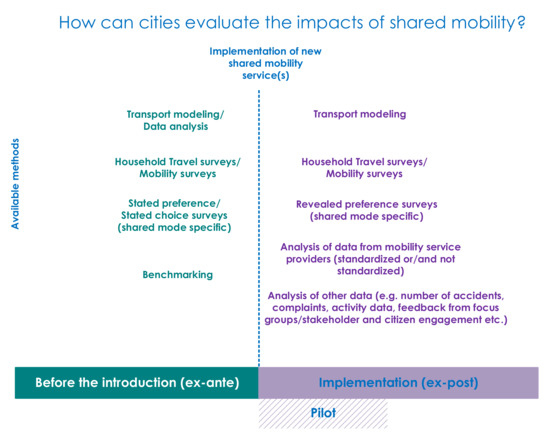
Figure 3.
Classification of the main methods available for the evaluation of the impacts of shared mobility.
5.1. Ex-Ante Evaluation
5.1.1. Stated Preference/Stated Choice Surveys
Stated preference (SP) or stated choice (SC) surveys have been widely employed for decades in transport and other fields to identify behavioral responses to situations of choice which have not yet been revealed in the market [94]. They help to identify individual preferences without requiring excessive cognitive effort by the respondents. This has made SP surveys one of the most effective and widespread ways to study behavioral decisions [95]. SP surveys can be valuable in collecting information about new policies, for instance, the introduction of a new transport mode or a road pricing scheme [96]. This type of survey usually includes questions related to socio-demographic characteristics of the respondents, followed by questions aiming at selecting information about the travel patterns and possibly frequently repeated origin-destination (OD) pairs. Then, they request responses to questions corresponding to hypothetical situations which involve a transport option, not yet available when the survey is conducted, with “what would you do if…?/what would be your choice?” type of questions.
After the information is collected upon completion of the SP survey, some first conclusions regarding the expected attitudes of the participants towards the new transport option in question can be drawn by performing a simple descriptive statistical analysis to come up with the percentages of people that are likely to embrace/reject the new service. The data gathered can then be used by researchers as an input to different types of more sophisticated modeling techniques—which usually belong to the family of discrete choice modeling—to reveal more complex, hidden interactions among the examined variables. Examples of such models that have already been used to analyze SP survey data in the field of shared mobility are mixed logit models [97], mixed nested logit models [53], and ordered probit models [78,98].
SP surveys can be used to examine the impact that shared modes/services are expected to have on the travel behavior of citizens. More specifically, the willingness-to-use shared modes can be estimated (e.g., see [80]) as well as the modal shift patterns between shared modes and private cars, public transport, and/or cycling (e.g., see [97]). In addition, SP survey data can be used to examine which characteristics of a shared mode are considered valuable for potential users and would therefore be vital for its adoption (such as convenient access to the shared vehicles, parking availability, etc.) (e.g., see [53,97]). The impact on car ownership [98] and the adoption rates of shared vehicles can also be estimated using the SP data under different pricing scenarios [78].
One of the important strengths of SP surveys is the fact that the options of modes or services are not limited to the available ones at the time that the survey is conducted, but the designers of the survey have the freedom to be creative and investigate many different potential scenarios if they wish. Because of this, it is possible to gather a larger volume of information, compared to surveys that focus only on existing options [99] (as in the case of revealed preference surveys [99], which we describe in Section 5.2.1).
However, as all survey-based studies exploring the sphere of human behavior, the SP approach is subject to certain limitations, mostly concerning self-reported and self-selection bias, which should be considered when interpreting their results to avoid validity issues. Self-selection bias can occur in cases when many of the people who agree to participate in a survey about a particular mode, bike-sharing for instance, could be cyclist enthusiasts, which could lead to a biased outcome in favor of bike sharing, which may not necessarily reflect the perceptions of the majority of the community that the survey sample is supposed to represent [70]. Self-reported bias can arise because people sometimes do not provide fully accurate information regarding their travel behavior; e.g., in terms of the extent or frequency of travel, the exact times and days that a commute took place, etc. [48]. In SP surveys there is also the possibility of the existence of hypothetical bias. This bias refers to the tendency of respondents to report a willingness-to-pay that exceeds what they actually pay using their own money in real-life experiments [100]. Cautious design and implementation of the survey contributes to reducing the risk of occurrence of some of the aforementioned biases, but some others are intrinsic and thus more difficult to eliminate [99]. For these reasons, the use of such an instrument has to be carefully considered, making sure that it is possible to control for the sources of error and preferably combining it with revealed preference (RP) data if available (see Section 5.2.1).
5.1.2. Benchmarking
Compared to SP surveys, which have been around for decades already, the concept of benchmarking is more recent. Camp [101] defined benchmarking as ‘‘the search for industry best practices that lead to superior performance”. In the context of city planning, benchmarking is “a systematic and continuous method that consists of identifying, learning and implementing the most effective practices and capacities from other cities in order for one’s own city to improve its actions” [102,103]. Focusing on urban transport, benchmarking has proven to be able to enhance and improve performance through learning from other cities with superior performance [104].
In the context of shared mobility, benchmarking studies can be conducted to help avoid duplicative research, to reduce overall costs, as well as to accelerate improvements to the urban transportation system. The approach usually comprises three steps—a literature review, interviews and meetings with experts in selected cities, and synthesis of the information. Typically, the cities are selected based on factors such as the size and scale of their shared mobility systems and the existence of policies relevant to the city that is interested in implementing the shared mobility programs [105].
Benchmarking appears to still have room to deploy its full potential in exploring the pros and cons of shared mobility, as not many examples of applications of comprehensive benchmarking studies focusing on shared mobility have been found in the literature. In practice, a common phenomenon in European cities that are involved in different EU-funded projects in the wider area of sustainable mobility is the creation of networks to exchange experiences and lessons learned and try to improve their urban mobility systems by studying the successes (and failures) of their counterparts. This can be seen as a kind of benchmarking, without necessarily being classified officially as such.
Some examples of the aforementioned networks in Europe include the POLIS network, the CIVITAS Forum Network, and the networks of the URBACT program. The POLIS network connects local and regional authorities across Europe, which can then work together to promote sustainable mobility through the development of innovative technologies and policies [106]. The CIVITAS Forum Network “is a platform for the exchange of knowledge, ideas and best practice among European cities regarding sustainable urban transport policies” [107]. The URBACT program is a European Territorial Cooperation program with the objective of “enabling cities to work together and develop integrated solutions to common urban challenges, by networking, learning from one another’s experiences, drawing lessons and identifying good practices to improve urban policies.” Within the URBACT there are networks focusing on different types of urban challenges, such as urban mobility (the current networks focusing on urban mobility are RiConnect, Space4People, and Thriving Streets) [108].
However, before applying benchmarking or being engaged in any kind of process that involves comparing the performance of their urban mobility system with that of others, cities should also be aware of some limitations, first and foremost the one resulting from the nature of the method itself—studying the impact of transport services on different geographical contexts can involve crucial differences in issues, ranging from existing regulations, legislation, and policies to socio-demographic indicators, density of neighborhoods, living conditions, citizens’ behavior, traditions, and culture, to name just a few.
5.2. Ex-Post Evaluation
5.2.1. Revealed Preference Surveys
Revealed preference (RP) surveys investigate choices that have already been made by individuals prior to the time that the survey is being conducted. In the field of transportation, the revealed information can include origin, destination, transport mode, trip purpose, etc. In contrast with the stated preference surveys described previously, the examined scenarios in this case are existing and not hypothetical [109]. RP surveys can be addressed to users or non-users of a shared mobility service. The objective is to obtain a better understanding of travel behavior and the motivational factors influencing it. As with SP surveys, different types of choice models can be applied to the collected data, which can lead to in-depth conclusions, e.g., binomial logit models [42], multinomial logit models [55], and mixed nested logit models [53].
In the case of SP surveys, the selection of questions, as mentioned earlier, can be done with higher flexibility as the questions refer to hypothetical situations, whereas in RP surveys there is less control over that, as the available modes/services is the major decisive factor that defines the type of information that can be collected [99]. In the context of shared mobility, RP surveys can be used to examine changes in mobility patterns, modal shift dynamics, as well as the influential factors concerning different shared modes/services (e.g., see [22,91,110]). Furthermore, the impact on public transport ridership and kilometers traveled can be estimated through the use of RP data (e.g., see [27]), as well as the impact on car ownership (e.g., see [42]). The resulting effects of shared mobility on VKT (e.g., see [59,61]) and on CO2 emissions (e.g., see [43]) can also be examined using an RP survey, as can the impact on first-/last-mile trips (e.g., see [55]).
It should be taken into account that, falling into the category of self-reported studies, RP surveys are also subject to similar biases and limitations as the ones already discussed for SP surveys. Moreover, when RP surveys are addressed to users of a shared mode, there is also the risk that the younger generations as well as those with a higher income are overrepresented in the survey, as the average user of shared mobility tends to have these attributes, and thus the survey results can fail to include vital input from large parts of the population who do not have the aforementioned characteristics [70]. Notwithstanding these limitations, for the foreseeable future, surveys are anticipated to maintain their essential role in assessing the causal factors related to travel behavior changes that result from shared mobility [48].
The combined use of a survey before the introduction of a new transport mode and a survey after the introduction is often called a “before-and-after” survey. This term can refer either to a stated preference and a revealed preference survey (e.g., see [53]), or to two household/mobility travel surveys conducted at two different periods in time (e.g., see [70]).
5.2.2. Analysis of Data from Shared Mobility Service Providers
In addition to self-reported data collected by the survey-based methods discussed above, high-quality data made available by mobility service providers can be analyzed and interpreted by city authorities. This has great potential in the evaluation process of the impacts of shared mobility, as it can contribute to the elimination of some of the limitations of survey-based methods. There are ongoing discussions in cities worldwide about whether shared mobility service providers should be required to provide city authorities with mobility data and in which format (standardized or not) these data should be presented.
Regarding standardized data, there are two key data specifications that many cities currently require to be employed by mobility service providers operating in their territory: the General Bikeshare Feed Specification (GBFS) introduced in 2015 by the North American Bikeshare Association, and the more recent Mobility Data Specification (MDS) created by the Los Angeles Department of Transportation in 2018. They are both based on the use of application programming interfaces (APIs) [111]. More than 80 cities and public agencies around the world are currently using the MDS, mostly cities in the U.S., and very recently some cities in Europe including Zurich, Helsinki, and Lisbon [112].
Data specifications aim to provide a standardized way for municipalities/regulatory agencies to receive, compare, and analyze data from mobility service providers. However, when it comes to using a mobility data specification, there are some challenges involved. The introduction of the MDS has fueled an ongoing debate about the privacy of users. A growing body of research demonstrates that anonymous mobility data can potentially still be used to re-identify specific individuals and activities [113,114] and therefore, for cities in Europe for instance, compliance with the General Data Protection Regulation (GDPR) should be thoroughly considered before proceeding in implementing a data specification.
Another question that arises is whether city authorities have the ability and knowledge to store and analyze the data (computer, personnel, etc.), once they receive them, or whether they need to hire “intermediary bodies” to deal with the analysis on their behalf and present them directly with the results. Some start-up/mobility data companies have already expressed interest in acting as the “middle-man” in such cases. Other reasons for not supporting data-sharing can include real and perceived competition, privacy and ethics, the regulatory environment, cybersecurity, interoperability, and liability [115].
If obtained, data from shared mobility service providers can be used in various ways. For example, by combining pick-up and drop-off data from ride-hailing providers with information on traffic flow, pedestrians flow, and parking, cities would be able to dynamically manage and regulate the use of street curbs and pavements to limit dwell times and alleviate congestion [115]. In addition, by being able to analyze data from bike sharing providers and shared micromobility providers, city authorities can become aware of which public transport stations attract more users of shared bikes and shared microvehicles, and this would allow them to identify potential promising locations for multimodal mobility hubs and would also magnify the potential of mobility-as-a-service (MaaS) applications [116].
Another way that data from bike sharing and shared micromobility service providers can be used is to reveal areas within the city that have increased safety risks, due to the co-existence of a high-frequency bus corridor and many e-scooter trips, for instance. Developing new infrastructure solutions in these areas to ensure the safety and comfort of riders can then be considered by the city authorities [116]. The city authorities, by having access to the data, would also be able to see whether shared vehicles are being deployed equitably across neighborhoods. If they are not, the decision-makers can then plan new policies in collaboration with the shared mobility service providers, to promote transportation equity in the city by increasing the availability of shared vehicles in areas where underprivileged communities reside. In the case of free-floating systems, in particular, data from shared mobility providers can help city authorities monitor the safety and comfort of vulnerable street users, by checking if dockless bikes and e-scooters are parked in safe and suitable parking areas and not blocking sidewalks or bike paths, for example [112].
5.2.3. Analysis of Other Data Sources
There are also some cases in which other types of data (i.e., not coming from mobility service providers) can be analyzed, with methods that do not belong to any of the main categories of this classification, that nevertheless provide interesting insights on the impacts of shared mobility and that can be used by cities in their assessment strategies. Some examples of analyses of “other data” are presented below.
A before-and-after analysis was conducted by Amatuni et al. [41] to explore the impact of car sharing on GHG emissions, in which they compared the overall emissions caused by mobility of the same group of people before and after they started using car sharing. They did not base their calculations on self-reported data; instead, they used the life-cycle emission factors for all transport modes and the number of kilometers traveled by the participants with each of them for a whole year.
Gössling [117] used content analysis of news items which he accessed online, including material published in newspapers, TV, and radio websites, to examine what happened after an e-scooter shared service started operating in ten large cities across the world. Local media reports before and after the e-scooters kicked-off in these cities were analyzed and interpreted qualitatively to see whether new policies for e-scooters were required. Other types of qualitative methods (semi-structured interviews and focus groups) were used by Jain et al. [71] to understand potential changes in the way people choose to live and travel when car sharing becomes an option. A similar approach comprising interviews with policymakers, experts, researchers, and operators and focus groups with drivers was applied by Mohamed et al. [93], focusing on a ride splitting service in London.
5.3. Both Ex-Ante and Ex-Post Evaluation
5.3.1. Household Travel Surveys/Mobility Surveys
Household travel surveys (HTS) are a major instrument for gathering information on passenger travel demand that is critical for regional transport planning. Such surveys can take place on a country or a city/regional level on a regular basis (every 1, 2, or sometimes more years), although there are also several cases worldwide in which the HTS does not occur at specific, pre-decided times [118]. Mobility surveys refer to a similar concept; they are more generic surveys aiming to capture the “overall mobility picture” of an area, with questions that can include but are not restricted to shared mobility. They differ from household surveys only in the fact that they can be realized with a sample unrelated to the household as a unit (they can be posted on social media and ask for the participation of every interested person, for example, or be distributed to specific communities, e.g., students and employees of a university).
The difference between these surveys and the SP and RP surveys discussed above is that these are structured towards gathering information around a specific transport intervention (e.g., the introduction of a new shared mobility service), whereas the household travel surveys and the mobility surveys help in characterizing mobility patterns, of which the shared mobility service is just one part, not the main focus of the whole survey. This is the reason they are placed on both the sides of the diagram in Figure 3; they can be conducted at any time, irrespectively of the operation or non-operation of a shared mobility mode.
Household travel surveys have already been used to investigate the awareness of citizens regarding shared mobility options and the market potential of specific services [64]. This type of survey usually asks participants to keep a so-called travel diary, which is a recording of all the mobility-related activities of every member of one’s household for 24 h. The data sets can include person-, trip-, household-, and vehicle-level data. They are normally not static surveys but they can be revised to include newly established modes, for instance, when they appear to gaining acceptance among citizens [119]. Household surveys can be used on a before-and-after basis, with a few years difference in between, to measure the effect of the introduction of a shared service on the transit use and VMT of the area [70]. It should be noted that the risks and biases related to self-reported studies discussed for the SP and RP surveys can also be present in the case of household and mobility surveys.
5.3.2. Transport Modeling
Transport models are used to support policy and investment decisions in the field of mobility. Although often the subject of criticism, they have supported such decisions for several decades now, ever since the 4-step (4 stages) travel demand model was introduced in the U.S. in the 1950s. This, now considered the traditional model, divides a city into zones and generates transport demand between those zones per mode based on land use and impedances for traveling between each pair of zones [120]. The model can estimate the flows of cars and people in their corresponding networks using the traffic assignment procedure and therefore it is specifically well-suited to test new infrastructure projects such as the construction of new road and rail corridors. Despite not being particularly suitable for modeling more demand-responsive modes such as taxis, this did not initially pose significant limitations to the analysis, as these modes used to account only for a small share of the total urban mobility demand. The aggregated nature of the model, treating vehicles and people as flows between OD pairs, as well as its focus on stable commuter trips, makes this approach less flexible for testing mobility innovations.
With the recent growth of shared mobility modal share in cities, a new need has emerged—the need for models that can provide more realistic estimations of the impacts that shared mobility can have on traffic and travel behavior [121]. In recent years, several academic papers have reported on efforts to use disaggregate (micro) models to describe the functioning of one-way car sharing [122,123], bike sharing [124], and TNCs [69,125,126]. In the meantime, a switch to the topic of vehicle automation has led to a shift in the models employed, even though many of the models can still be used to assess dynamic ridesharing [73,127,128,129]. These models can describe the supply of demand-responsive systems in a realistic way because they model each vehicle specifically and use matching to one particular client. This is especially important because routes are not established at the outset. The demand at one period of time will thus displace the supply to other areas of a city, which leads to a different supply in the next period of time [121].
One of the strengths of this agent-based modeling approach is that different scenarios of transport system management can be tested, allowing researchers to assess how they can impact different performance indicators such as mode choice, the average waiting time for a vehicle, GHG emissions, and energy consumption [87,130]. Agent-based models can also benefit from the pervasiveness of detailed data on travel behavior that can now be collected through smartphones, passively or actively, which makes modeling more realistic [131]. A disadvantage of these models is that their use by planners and decision-makers is still limited. In the case of the 4-step models, there is a fairly significant number of cities around the world that maintain them and use them in-house to support their decisions, whereas in the case of the more recent micro approaches, the majority of modeling applications are carried out by consultancy companies or academic departments. The gap between model detail/complexity and usage for planning is still to be tackled [132].
6. Conclusions
In the present paper, we conducted a critical review of the different methods that can be used by city authorities to evaluate the impacts of shared mobility and suggested a classification of them based on the nature of the method and on the time frame in which it can be applied (ex-ante or/and ex-post with respect to the introduction of a shared mobility mode/service). We discussed the strengths as well as the weaknesses of each method from a critical perspective and reflected on the role of city authorities in the evaluation process. Before doing so, we identified and mapped the main categories of impacts of shared mobility and the key areas of each one of them. We observed that the majority of studies and reports focus on the impact of shared mobility on the environment and travel behavior, whereas other types of impact such as the effect on transportation equity have not yet been sufficiently studied. From the literature review, it was also clear that the impacts of the more established shared mobility modes such as station-based car sharing and bike sharing have been studied more, compared to newer entries into the shared mobility family such as the e-scooters and e-bikes.
We can conclude that there is a large pool of different methods that have been developed by academics and researchers aiming to assess how shared mobility affects a city. These methods vary greatly—some of them, such as survey-based methods (SP and RP surveys, household/mobility surveys) have already been around for decades in transport-related research, whereas others, such as the analysis of data from shared mobility service providers, have recently gained more attention and their potential has been magnified by the continuous technological progress in our era. We also detected variations in terms of the geography of the methods. Using data from shared mobility service providers in a standardized format started in the U.S. and is more widely used in cities there. Some cities in Europe have started exploring the possibilities that such a method holds for them, but there are still issues related to personal data protection that need to be considered before wider implementation can become a realistic scenario.
This work opens interesting pathways for academics and researchers, as it provides them with a map and classification of the existing main evaluation methods for shared mobility, describes the pros and cons of each one, and includes information about what types of impacts one can evaluate with each method. At the same time, it identifies and sheds light on a critical gap in the existing literature, which is the lack of a comprehensive, multi-perspective evaluation framework that can be applied to assess the full range of impacts that urban shared mobility entails. It is noteworthy that none of the existing methods for the evaluation of shared mobility that have been classified and discussed herein is flawless, for different reasons. From our study, it is clear that future research in the field of shared mobility should focus on exploring efficient ways to use these evaluation methods to design frameworks that utilize the strengths of each method, while minimizing the weaknesses. Some attempts in this direction have already begun to be developed in recent years, with most being U.S.-based initiatives with a focus only on American cities. These initiatives tend to estimate mainly the environmental impacts of shared mobility, reflected in GHG emissions, although the spectrum of impacts is much broader, as discussed above.
In addition to academics and researchers, this paper can also be useful for practitioners—city authorities, planners, and decision-makers. We explained earlier that currently cities all over the world are struggling in navigating their citizens’ needs in a new era of urban transport characterized by electrification, automation, the declining importance of vehicle ownership, and the growing role of ICT innovations—all this amidst a global pandemic which poses additional challenges and unprecedented restrictions for transport planners and decision-makers. The gathering and classification of existing approaches on the evaluation of the impacts of shared mobility that this paper helps policymakers not only to obtain a better understanding of all the available options concerning when it is possible to use each mode of transport, but most importantly it helps them to realize what the actual practical output would be and how it can support decision-making. It does this by providing information on the types of data that need to be collected for each method to be implemented and by explaining clearly what they can get from applying the method, by giving specific examples of what can be measured. At the same time, by discussing the drawbacks of each method, it highlights the importance of having realistic expectations when performing the evaluation.
In addition to the aforementioned common urban challenges, the literature review we performed showed that each city also has unique challenges to consider; for instance, some cities with low population density may have several neighborhoods that are being underserved by public transport and therefore they may want to explore how shared modes such as car sharing and ride hailing can enhance the accessibility of those areas. In the case of more dense cities, authorities may be more focused on relieving the pressure put on the road networks by exploring the role of bike sharing and e-scooter sharing in the city center. Selecting evaluation methods with outputs that suit the actual needs of the city is very important and can lead city authorities to make better-informed decisions. Finally, this study contributes to the ongoing societal discussions about the role of shared mobility in the current era of urban transition, and can help in raising public awareness about the increasing importance of evaluating the impacts of shared mobility.
Author Contributions
Conceptualization, A.R. and G.H.d.A.C.; methodology, A.R. and G.H.d.A.C.; validation, A.R. and G.H.d.A.C.; formal analysis, A.R. and G.H.d.A.C.; writing—original draft preparation, A.R. and G.H.d.A.C.; writing—review and editing, G.H.d.A.C.; visualization, A.R. and G.H.d.A.C. supervision, G.H.d.A.C.; project administration, G.H.d.A.C.; funding acquisition, G.H.d.A.C. All authors have read and agreed to the published version of the manuscript.
Funding
The research is part of the SuSMo (Sustainable Urban Shared Mobility) Project, funded by the EIT Climate—KIC.
Conflicts of Interest
The authors declare no conflict of interest.
References
- Nations, U. The World’s Cities in 2018. Available online: https://www.un.org/en/events/citiesday/assets/pdf/the_worlds_cities_in_2018_data_booklet.pdf (accessed on 23 October 2020).
- United Nations. The Sustainable Development Goals Report. 2020. Available online: https://unstats.un.org/sdgs/report/2020/ (accessed on 23 October 2020).
- Di Bartolo, C.; Bosetti, S.; De Stasio, C.; Malgieri, P. Cities towards Mobility 2.0: Connect, Share and Go! Smart Choices for Cities. Available online: https://civitas.eu/content/civitas-policy-note-smart-choices-cities-cities-towards-mobility-20-connect-share-and-go-en (accessed on 23 October 2020).
- Appio, P.F.; Lima, M.; Paroutis, S. Technological Forecasting & Social Change Understanding Smart Cities: Innovation ecosystems, technological advancements, and societal challenges. Technol. Forecast. Soc. Chang. 2019, 142, 1–14. [Google Scholar] [CrossRef]
- Florida, R.; Adler, P.; Mellander, C. The city as innovation machine. Reg. Stud. 2017, 51, 86–96. [Google Scholar] [CrossRef]
- Rodrigue, J.-P. The Geography of Transport Systems, 5th ed.; Routledge: New York, NY, USA, 2020. [Google Scholar]
- Alberti, V.; Alonso Raposo, M.; Attardo, C.; Auteri, D.; Barranco, R.; Batista e Silva, F.; Benczur, P.; Bertoldi, P.; Bono, F.; Bussolari, I.; et al. The Future of Cities–Opportunities, Challenges and the Way Forward; EUR 29752 EN; Vandecasteele, I., Baranzelli, C., Siragusa, A., Aurambout, J.P., Eds.; Publications Office of the European Union: Luxembourg, 2019. [Google Scholar]
- Dupray, V.; Otto, P.; Yakovlev, A. The Future of Mobility: Autonomous, Electric and Shared. Available online: https://www.ipsos.com/en/future-mobility-autonomous-electric-and-shared (accessed on 23 October 2020).
- Fulton, L.; Mason, J.; Meroux, D. Three Revolutions in Urban: How to Achieve the Full Potential of Vehicle Electrification, Automation and Shared Mobility in Urban Transportation Systems around the World by 2050. Available online: https://trid.trb.org/view/1466512 (accessed on 23 October 2020).
- Hofmann, S.; Sæbø, Ø.; Braccini, A.M.; Za, S. The public sector’s roles in the sharing economy and the implications for public values. Gov. Inf. Q. 2019, 36, 101399. [Google Scholar] [CrossRef]
- Hossain, M. Sharing economy: A comprehensive literature review. Int. J. Hosp. Manag. 2020, 87. [Google Scholar] [CrossRef]
- Mont, O.; Palgan, Y.V.; Bradley, K.; Zvolska, L. A decade of the sharing economy: Concepts, users, business and governance perspectives. J. Clean. Prod. 2020, 269, 122215. [Google Scholar] [CrossRef] [PubMed]
- Rutkowska-Gurak, A.; Adamska, A. Sharing economy and the city. Int. J. Manag. Econ. 2019, 55, 346–368. [Google Scholar] [CrossRef]
- Masters, B. Winners and Losers in the Sharing Economy. Financial Times. 28 December 2017. Available online: https://www.ft.com/content/c97eaa72-eaf8-11e7-bd17-521324c81e23 (accessed on 23 October 2020).
- Soares Machado, C.A.; de Hue, N.P.M.S.; Berssaneti, F.T.; Quintanilha, J.A. An overview of shared mobility. Sustainability 2018, 10, 4342. [Google Scholar] [CrossRef]
- Shaheen, S.; Chan, N. Mobility and the Sharing Economy: Potential to Overcome First-and Last-Mile Public Transit Connections. Available online: https://escholarship.org/uc/item/8042k3d7 (accessed on 23 October 2020).
- Shaheen, S.; Cohen, A.; Zohdy, I. Shared Mobility: Current Practices and Guiding Principles. Available online: https://ops.fhwa.dot.gov/publications/fhwahop16022/index.htm (accessed on 23 October 2020).
- Sprei, F. Disrupting mobility. Energy Res. Soc. Sci. 2018, 37, 238–242. [Google Scholar] [CrossRef]
- Shaheen, S.; Cohen, A.; Chan, N.; Bansal, A. Sharing Strategies: Carsharing, Shared Micromobility (Bikesharing and Scooter Sharing), Transportation Network Companies, Microtransit, and Other Innovative Mobility Modes; Elsevier Inc.: Amsterdam, The Netherlands, 2020; ISBN 9780128151679. [Google Scholar]
- Shaheen, S.; Adam, C. Innovative Mobility: Carsharing Outlook; Carsharing Market Overview, Analysis, and Trends Spring. 2020. Available online: https://escholarship.org/uc/item/61q03282 (accessed on 23 October 2020).
- Chen, Z.; van Lierop, D.; Ettema, D. Dockless bike-sharing systems: What are the implications? Transp. Rev. 2020, 40, 333–353. [Google Scholar] [CrossRef]
- Ma, X.; Yuan, Y.; Van Oort, N.; Hoogendoorn, S. Bike-sharing systems’ impact on modal shift: A case study in Delft, the Netherlands. J. Clean. Prod. 2020, 259, 120846. [Google Scholar] [CrossRef]
- Guo, T.; Yang, J.; He, L.; Tang, K. Emerging Technologies and Methods in Shared Mobility Systems Layout Optimization of Campus Bike-Sharing Parking Spots. J. Adv. Transp. 2020, 2020. [Google Scholar] [CrossRef]
- Montero, J.J. Regulating Transport Platforms: The Case of Carpooling in Europe. In The Governance of Smart Transportation Systems; Finger, M., Audouin, M., Eds.; Springer: Berlin/Heidelberg, Germany, 2019; pp. 13–25. [Google Scholar]
- Benita, F. Carpool to work: Determinants at the county-level in the United States. J. Transp. Geogr. 2020, 87, 102791. [Google Scholar] [CrossRef]
- Jin, S.T.; Kong, H.; Wu, R.; Sui, D.Z. Ridesourcing, the sharing economy, and the future of cities. Cities 2018, 76, 96–104. [Google Scholar] [CrossRef]
- Rayle, L.; Dai, D.; Chan, N.; Cervero, R.; Shaheen, S. Just a better taxi? A survey-based comparison of taxis, transit, and ridesourcing services in San Francisco. Transp. Policy 2016, 45, 168–178. [Google Scholar] [CrossRef]
- Twisse, F. The Rise of Micromobility. Available online: https://www.eltis.org/resources/case-studies/rise-micromobility (accessed on 5 August 2020).
- Shaheen, S.A.; Cohen, A.P. Shared Micromoblity Policy Toolkit: Docked and Dockless Bike and Scooter Sharing; UC Berkeley Transportation Sustainability Research Center. 2019. Available online: https://escholarship.org/uc/item/00k897b5 (accessed on 23 October 2020).
- Chang, A.Y.J.; Miranda-Moreno, L.; Clewlow, R.; Sun, L. TREND OR FAD? Deciphering the Enablers of Micromobility in the U.S.; SAE International: Warrendale, PA, USA, 2019. [Google Scholar]
- NACTO. Shared Micromobility in the U.S. 2018. Available online: https://nacto.org/shared-micromobility-2018/ (accessed on 23 October 2020).
- Rink, B. Capturing amaphela: Negotiating township politics through shared mobility. Geoforum 2020. [Google Scholar] [CrossRef]
- Xiao, A.H. “Oyinbo, Wole!”: Urban Rhythms and Mobile Encounters in the Lagos Transport Systems. Urban Forum 2019, 30, 133–151. [Google Scholar] [CrossRef]
- Dumedah, G.; Eshun, G. The case of Paratransit-‘Trotro’ service data as a credible location addressing of road networks in Ghana. J. Transp. Geogr. 2020, 84, 102688. [Google Scholar] [CrossRef]
- Phun, V.K.; Kato, H.; Chalermpong, S. Paratransit as a connective mode for mass transit systems in Asian developing cities: Case of Bangkok in the era of ride-hailing services. Transp. Policy 2019, 75, 27–35. [Google Scholar] [CrossRef]
- Sgibnev, W.; Rekhviashvili, L. Marschrutkas: Digitalisation, sustainability and mobility justice in a low-tech mobility sector. Transp. Res. Part A Policy Pract. 2020, 138, 342–352. [Google Scholar] [CrossRef]
- Erhardt, G.D.; Roy, S.; Cooper, D.; Sana, B.; Chen, M.; Castiglione, J. Do transportation network companies decrease or increase congestion? Sci. Adv. 2019, 5, eaau2670. [Google Scholar] [CrossRef]
- Henao, A.; Marshall, W.E. The impact of ride-hailing on vehicle miles traveled. Transportation 2019, 46, 2173–2194. [Google Scholar] [CrossRef]
- Oviedo, D.; Granada, I.; Perez-Jaramillo, D. Ridesourcing and Travel Demand: Potential Effects of Transportation Network Companies in Bogotá. Sustainability 2020, 12, 1732. [Google Scholar] [CrossRef]
- Sun, F.; Chen, P.; Jiao, J. Promoting public bike-sharing: A lesson from the unsuccessful Pronto system. Transp. Res. Part D Transp. Environ. 2018, 63, 533–547. [Google Scholar] [CrossRef]
- Amatuni, L.; Ottelin, J.; Steubing, B.; Mogollón, J.M. Does car sharing reduce greenhouse gas emissions? Assessing the modal shift and lifetime shift rebound effects from a life cycle perspective. J. Clean. Prod. 2020, 266. [Google Scholar] [CrossRef]
- Hui, Y.; Wang, Y.; Sun, Q.; Tang, L. The Impact of Car-Sharing on the Willingness to Postpone a Car Purchase: A Case Study in Hangzhou, China. J. Adv. Transp. 2019, 2019. [Google Scholar] [CrossRef]
- Nijland, H.; van Meerkerk, J. Mobility and environmental impacts of car sharing in the Netherlands. Environ. Innov. Soc. Transit. 2017, 23, 84–91. [Google Scholar] [CrossRef]
- Qiu, L.Y.; He, L.Y. Bike sharing and the economy, the environment, and health-related externalities. Sustainability 2018, 10, 1145. [Google Scholar] [CrossRef]
- Wenzel, T.; Rames, C.; Kontou, E.; Henao, A. Travel and energy implications of ridesourcing service in Austin, Texas. Transp. Res. Part D Transp. Environ. 2019, 70, 18–34. [Google Scholar] [CrossRef]
- Hulkkonen, M.; Mielonen, T.; Prisle, N.L. The atmospheric impacts of initiatives advancing shifts towards low-emission mobility: A scoping review. Sci. Total Environ. 2020, 713, 136133. [Google Scholar] [CrossRef]
- Bondorová, B.; Archer, G. Does Sharing Cars Really Reduce Car Use? 2017. Available online: https://www.transportenvironment.org/sites/te/files/publications/Does-sharing-cars-really-reduce-car-use-June%202017.pdf (accessed on 23 October 2020).
- Cohen, A.; Shaheen, S. Planning for Shared Mobility; UC Berkeley Recent Works; American Planning Association: Chicago, IL, USA, 2018; ISBN 978-1-61190-186-3. Available online: https://www.planning.org/publications/report/9107556/ (accessed on 23 October 2020).
- Moreau, H.; de Jamblinne de Meux, L.; Zeller, V.; D’Ans, P.; Ruwet, C.; Achten, W.M.J. Dockless e-scooter: A green solution for mobility? Comparative case study between dockless e-scooters, displaced transport, and personal e-scooters. Sustainability 2020, 12, 1803. [Google Scholar] [CrossRef]
- Severengiz, S.; Finke, S.; Schelte, N.; Forrister, H. Assessing the Environmental Impact of Novel Mobility Services using Shared Electric Scooters as an Example. Procedia Manuf. 2020, 43, 80–87. [Google Scholar] [CrossRef]
- McQueen, M.; MacArthur, J.; Cherry, C. The E-Bike Potential: Estimating regional e-bike impacts on greenhouse gas emissions. Transp. Res. Part D Transp. Environ. 2020, 87, 102482. [Google Scholar] [CrossRef]
- Campbell, K.B.; Brakewood, C. Sharing riders: How bikesharing impacts bus ridership in New York City. Transp. Res. Part A 2017, 100, 264–282. [Google Scholar] [CrossRef]
- Li, W.; Kamargianni, M. Steering short-term demand for car-sharing: A mode choice and policy impact analysis by trip distance. Transportation 2019, 47, 2233–2265. [Google Scholar] [CrossRef]
- Winter, K.; Oded, K.; Karel, M.; Van Arem, B. A Stated-Choice Experiment on Mode Choice in an Era of Free-Floating Carsharing and Shared Autonomous Vehicles. In Proceedings of the Transportation Research Board 96th Annual Meeting, Washington, DC, USA, 8–12 January 2017. [Google Scholar]
- Fan, A.; Chen, X.; Wan, T. How Have Travelers Changed Mode Choices for First/Last Mile Trips after the Introduction of Bicycle-Sharing Systems: An Empirical Study in Beijing, China. J. Adv. Transp. 2019, 2019. [Google Scholar] [CrossRef]
- Griffin, G.P.; Sener, I.N. Planning for bike share connectivity to rail transit. J. Public Transp. 2016, 19, 1. [Google Scholar] [CrossRef]
- Shaheen, S.; Nelson, C. Mobility and the Sharing Economy: Potential to Facilitate the First- and Last-Mile Public Transit Connections. Built Environ. 2016, 42, 573–588. [Google Scholar] [CrossRef]
- Zhao, R.; Yang, L.; Liang, X.; Guo, Y.; Lu, Y.; Zhang, Y.; Ren, X. Last-mile travel mode choice: Data-mining hybrid with multiple attribute decision making. Sustainability 2019, 11, 6733. [Google Scholar] [CrossRef]
- Bekka, A.; Louvet, N.; Adoue, F. Impact of a ridesourcing service on car ownership and resulting effects on vehicle kilometers travelled in the Paris Region. Case Stud. Transp. Policy 2020, 8, 1010–1018. [Google Scholar] [CrossRef]
- Cervero, R.; Golub, A.; Nee, B. City CarShare: Longer-Term Travel Demand and Car Ownership Impacts. Transp. Res. Rec. J. Transp. Res. Board 2007, 1992, 70–80. [Google Scholar] [CrossRef]
- Tirachini, A.; Chaniotakis, E.; Abouelela, M.; Antoniou, C. The sustainability of shared mobility: Can a platform for shared rides reduce motorized traffic in cities? Transp. Res. Part C Emerg. Technol. 2020, 117, 102707. [Google Scholar] [CrossRef]
- Hu, S.; Chen, P.; Lin, H.; Xie, C.; Chen, X. Promoting carsharing attractiveness and efficiency: An exploratory analysis. Transp. Res. Part D Transp. Environ. 2018, 65, 229–243. [Google Scholar] [CrossRef]
- Meng, L.; Somenahalli, S.; Berry, S. Policy implementation of multi-modal (shared) mobility: Review of a supply-demand value proposition canvas. Transp. Rev. 2020, 40, 670–684. [Google Scholar] [CrossRef]
- Nobis, C. Carsharing as Key Contribution to Multimodal and Sustainable Mobility Behavior: Carsharing in Germany. Transp. Res. Rec. J. Transp. Res. Board 2006, 1986, 86–97. [Google Scholar] [CrossRef]
- ITF. Transition to Shared Mobility. 2017. Available online: https://www.itf-oecd.org/sites/default/files/docs/transition-shared-mobility.pdf (accessed on 23 October 2020).
- Back, C.; Baree, J.; Fontus, N.; McClellan, K.; Osher, D.; Tyrie, A. Shared Mobility & Urban Design. Available online: http://www.planhillsborough.org/urban-design-for-shared-mobility/ (accessed on 23 October 2020).
- Shaheen, S.; Cohen, A. Impacts of Shared Mobility. ITS Berkeley Policy Brief. 2018. [Google Scholar] [CrossRef]
- Noland, R.B.; Smart, M.J.; Guo, Z. Bikeshare trip generation in New York City. Transp. Res. Part A Policy Pract. 2016, 94, 164–181. [Google Scholar] [CrossRef]
- Martinez, L.M.; Correia, G.H.A.; Viegas, J.M. An agent-based simulation model to assess the impacts of introducing a shared-taxi system: An application to Lisbon (Portugal). J. Adv. Transp. 2014, 49, 475–495. [Google Scholar] [CrossRef]
- Fitch, D.; Mohiuddin, H.; Handy, S.; Fitch, D.; Mohiuddin, H.; Handy, S. UC Office of the President Investigating the Influence of Dockless Electric Bike-Share on Travel Behavior, Attitudes, Health, and Equity. Available online: https://www.ucits.org/research-project/2020-05/ (accessed on 23 October 2020).
- Jain, T.; Johnson, M.; Rose, G. Exploring the process of travel behaviour change and mobility trajectories associated with car share adoption. Travel Behav. Soc. 2020, 18, 117–131. [Google Scholar] [CrossRef]
- Sopjani, L.; Stier, J.J.; Hesselgren, M.; Ritzén, S. Shared mobility services versus private car: Implications of changes in everyday life. J. Clean. Prod. 2020, 259. [Google Scholar] [CrossRef]
- Fagnant, D.J.; Kockelman, K.M. Dynamic ride-sharing and fleet sizing for a system of shared autonomous vehicles in Austin, Texas. Transportation 2018, 45, 143–158. [Google Scholar] [CrossRef]
- Greenblatt, J.B.; Shaheen, S. Automated Vehicles, On-Demand Mobility, and Environmental Impacts. Curr. Sustain. Energy Rep. 2015, 2, 74–81. [Google Scholar] [CrossRef]
- Moorthy, A.; de Kleine, R.; Keoleian, G.; Good, J.; Lewis, G. Shared autonomous vehicles as a sustainable solution to the last mile problem: A case study of Ann Arbor-Detroit area. SAE Int. J. Passeng. Cars Electron. Electr. Syst. 2017, 10, 328–336. [Google Scholar] [CrossRef]
- Mounce, R.; Nelson, J.D. On the potential for one-way electric vehicle car-sharing in future mobility systems. Transp. Res. Part A Policy Pract. 2019, 120, 17–30. [Google Scholar] [CrossRef]
- Vleugel, J.M.; Bal, F. More space and improved living conditions in cities with autonomous vehicles. Int. J. Des. Nat. Ecodyn. 2017, 12, 505–515. [Google Scholar] [CrossRef]
- Bansal, P.; Kockelman, K.M.; Singh, A. Assessing public opinions of and interest in new vehicle technologies: An Austin perspective. Transp. Res. Part C Emerg. Technol. 2016, 67, 1–14. [Google Scholar] [CrossRef]
- De Correia, G.H.A.; Looff, E.; van Cranenburgh, S.; Snelder, M.; van Arem, B. On the impact of vehicle automation on the value of travel time while performing work and leisure activities in a car: Theoretical insights and results from a stated preference survey. Transp. Res. Part A Policy Pract. 2019, 119, 359–382. [Google Scholar] [CrossRef]
- Moreno, A.T.; Michalski, A.; Llorca, C.; Moeckel, R. Shared Autonomous Vehicles Effect on Vehicle-Km Traveled and Average Trip Duration. J. Adv. Transp. 2018, 2018, 8969353. [Google Scholar] [CrossRef]
- Soteropoulos, A.; Berger, M.; Ciari, F. Impacts of automated vehicles on travel behaviour and land use: An international review of modelling studies. Transp. Rev. 2019, 39, 29–49. [Google Scholar] [CrossRef]
- Guo, Y.; Chen, Z.; Stuart, A.; Li, X.; Zhang, Y. A systematic overview of transportation equity in terms of accessibility, traffic emissions, and safety outcomes: From conventional to emerging technologies. Transp. Res. Interdiscip. Perspect. 2020, 4, 100091. [Google Scholar] [CrossRef]
- Rojas-Rueda, D.; Nieuwenhuijsen, M.J.; Khreis, H.; Frumkin, H. Autonomous vehicles and public health. Annu. Rev. Public Health 2019, 41, 329–345. [Google Scholar] [CrossRef]
- Alazzawi, S.; Hummel, M.; Kordt, P.; Sickenberger, T.; Wieseotte, C.; Wohak, O. Simulating the Impact of Shared, Autonomous Vehicles on Urban Mobility—A Case Study of Milan. EPiC Ser. Eng. 2018, 2, 94–110. [Google Scholar] [CrossRef]
- Dia, H.; Javanshour, F. Autonomous Shared Mobility-On-Demand: Melbourne Pilot Simulation Study. Transp. Res. Procedia 2017, 22, 285–296. [Google Scholar] [CrossRef]
- Overtoom, I.; Correia, G.; Huang, Y.; Verbraeck, A. Assessing the impacts of shared autonomous vehicles on congestion and curb use: A traffic simulation study in The Hague, Netherlands. Int. J. Transp. Sci. Technol. 2020, 9, 195–206. [Google Scholar] [CrossRef]
- Wang, S.; de Correia, G.H.A.; Lin, H.X. Exploring the Performance of Different On-Demand Transit Services Provided by a Fleet of Shared Automated Vehicles: An Agent-Based Model. J. Adv. Transp. 2019, 2019, 1–16. [Google Scholar] [CrossRef]
- Adler, M.W.; Peer, S.; Sinozic, T. Autonomous, connected, electric shared vehicles (ACES) and public finance: An explorative analysis. Transp. Res. Interdiscip. Perspect. 2019, 2, 100038. [Google Scholar] [CrossRef]
- Narayanan, S.; Chaniotakis, E.; Antoniou, C. Shared autonomous vehicle services: A comprehensive review. Transp. Res. Part C Emerg. Technol. 2020, 111, 255–293. [Google Scholar] [CrossRef]
- Europe, S.C.C. Why Cities Should Prepare a Shared Mobility Plan for the Future. Available online: https://eu-smartcities.eu/news/why-cities-should-prepare-shared-mobility-plan-future (accessed on 5 August 2020).
- Firnkorn, J. Triangulation of two methods measuring the impacts of a free-floating carsharing system in Germany. Transp. Res. Part A Policy Pract. 2012, 46, 1654–1672. [Google Scholar] [CrossRef]
- Shared-Use Mobility Center Shared Mobility Benefits Calculator-Methodology. Available online: https://learn.sharedusemobilitycenter.org/wp-content/uploads/Shared-Mobility-Benefits-Calculator-Method.pdf (accessed on 23 October 2020).
- Mohamed, M.J.; Rye, T.; Fonzone, A. Operational and policy implications of ridesourcing services: A case of Uber in London, UK. Case Stud. Transp. Policy 2019, 7, 823–836. [Google Scholar] [CrossRef]
- Hensher, D.A. Stated preference analysis of travel choices: The state of practice. Transportation 1994, 21, 107–133. [Google Scholar] [CrossRef]
- Cherchi, E.; Hensher, D.A. Workshop synthesis: Stated preference surveys and experimental design, an audit of the journey so far and future research perspectives. Transp. Res. Procedia 2015, 11, 154–164. [Google Scholar] [CrossRef]
- Kolyvas, A. Stated Preference Survey for Proposed Tramway Relying on Nicosia Bus Priority Master Plan Results Nicosia Bus Priority Master Plan-Objectives. 2017. Available online: https://www.interregeurope.eu/fileadmin/user_upload/tx_tevprojects/library/file_1500356176.pdf (accessed on 23 October 2020).
- Papu Carrone, A.; Hoening, V.M.; Jensen, A.F.; Mabit, S.E.; Rich, J. Understanding car sharing preferences and mode substitution patterns: A stated preference experiment. Transp. Policy 2020. [Google Scholar] [CrossRef]
- Menon, N.; Barbour, N.; Zhang, Y.; Rawoof, P.; Mannering, F. Shared autonomous vehicles and their potential impacts on household vehicle ownership: An exploratory empirical assessment. Int. J. Sustain. Transp. 2019, 13, 111–122. [Google Scholar] [CrossRef]
- Cascetta, E. Transportation Systems Engineering: Theory and Methods Applied Optimization; Originally Published by Kluwer Academic Publishers; Springer Science+Business Media: Berlin/Heidelberg, Germany, 2001; ISBN 9781475768756. [Google Scholar]
- Loomis, J. What’s to know about hypothetical bias in stated preference valuation studies? J. Econ. Surv. 2011, 25, 363–370. [Google Scholar] [CrossRef]
- Camp, R.C. Benchmarking: The Search for Industry Best Practices That Lead to Superior Performance; ASQ Quality Press: Milwaukee, WI, USA, 1989; ISBN 9781563273520. [Google Scholar]
- Luque-Marínez, T.; Muñoz-Leiva, F. City benchmarking: A methodological proposal referring specifically to Granada. Cities 2005, 22, 411–423. [Google Scholar] [CrossRef]
- Zope, R.; Vasudevan, N.; Arkatkar, S.S.; Joshi, G. Benchmarking: A tool for evaluation and monitoring sustainability of urban transport system in metropolitan cities of India. Sustain. Cities Soc. 2019, 45, 48–58. [Google Scholar] [CrossRef]
- Henning, T.; Essakali, M.D.; Oh, J.E. A Framework for Urban Transport Benchmarking. Available online: https://openknowledge.worldbank.org/handle/10986/12847 (accessed on 23 October 2020).
- Feigon, S.; Frisbie, T.; Halls, C.; Murphy, C. Shared Use Mobility: European Experience and Lessons Learned. 2018. Available online: https://international.fhwa.dot.gov/sum/fhwapl18026.pdf (accessed on 23 October 2020).
- POLIS. POLIS Network. Available online: https://www.polisnetwork.eu/who-we-are/about-polis/ (accessed on 25 September 2020).
- CIVITAS. CIVITAS Forum Network. Available online: https://civitas.eu/cities (accessed on 25 September 2020).
- URBACT. URBACT Programme. Available online: https://urbact.eu/ (accessed on 25 September 2020).
- Dell’olio, L.; Ibeas, A.; de Oña, J.; de Oña, R. Designing a Survey for Public Transport Users. Public Transp. Qual. Serv. 2018, 49–61. [Google Scholar] [CrossRef]
- Baptista, P.; Melo, S.; Rolim, C. Energy, Environmental and Mobility Impacts of Car-sharing Systems. Empirical Results from Lisbon, Portugal. Procedia Soc. Behav. Sci. 2014, 111, 28–37. [Google Scholar] [CrossRef]
- Clewlow, R. A Practical Guide to Mobility Data Sharing. Forbes, 28 August 2019. Available online: https://www.forbes.com/sites/reginaclewlow/2019/08/28/a-practical-guide-to-mobility-data-sharing/?sh=33d6e3c7199c (accessed on 23 October 2020).
- GitHub Mobility Data Specification (MDS). Available online: https://github.com/openmobilityfoundation/mobility-data-specification (accessed on 5 August 2020).
- Kondor, D.; Hashemain, B.; De Montjoye, Y.-A.; Ratti, C. Towards Matching User Mobility Traces in Large-Scale Datasets. IEEE Trans. Big Data 2018, 6, 714–726. [Google Scholar] [CrossRef]
- Rocher, L.; Hendrickx, J.M.; de Montjoye, Y.A. Estimating the success of re-identifications in incomplete datasets using generative models. Nat. Commun. 2019, 10, 3069. [Google Scholar] [CrossRef]
- Chitkara, A.; Deloison, T.; Kelkar, M.; Pandey, P.; Pankratz, D. Enabling Data-Sharing: Emerging Principles for Transforming Urban Mobility. Available online: https://www.wbcsd.org/Programs/Cities-and-Mobility/Transforming-Mobility/Transforming-Urban-Mobility/Resources/Enabling-data-sharing-Emerging-principles-for-transforming-urban-mobility (accessed on 23 October 2020).
- Zipper, D. Why the Urban Mobility Data Debate Matters to Public Transportation. Available online: https://urbanmobilitydaily.com/why-the-urban-mobility-data-debate-matters/ (accessed on 23 October 2020).
- Gössling, S. Integrating e-scooters in urban transportation: Problems, policies, and the prospect of system change. Transp. Res. Part D Transp. Environ. 2020, 79, 102230. [Google Scholar] [CrossRef]
- Warnke, P.; Koschatzky, K.; Som, O.; Stahlecker, T.; Nabitz, L.; Braungardt, S.; Cuhls, K.; Dönitz, E.; Güth, S.; Plötz, P.; et al. Opening Up the Innovation System Framework Towards New Actors and Institutions. Innov. Syst. Policy Anal. 2016, 49, 2010–2012. [Google Scholar]
- Jiao, J.; Bischak, C.; Hyden, S. The impact of shared mobility on trip generation behavior in the US: Findings from the 2017 National Household Travel Survey. Travel Behav. Soc. 2020, 19, 1–7. [Google Scholar] [CrossRef]
- De Ortúzar, J.D.; Willumsen, L.G. Modelling Transport, 4th ed.; de Ortuzar, J.D., Willumsen, L., Eds.; Wiley: Chichester, UK, 2011; ISBN 9780470760390. [Google Scholar]
- Jorge, D.; Correia, G. Carsharing systems demand estimation and defined operations: A literature review. Eur. J. Transp. Infrastruct. Res. 2013, 13, 201–220. [Google Scholar] [CrossRef]
- Ciari, F.; Balac, M.; Axhausen, K.W. Modeling Carsharing with the Agent-Based Simulation MATSim: State of the Art, Applications, and Future Developments. Transp. Res. Rec. J. Transp. Res. Board 2016, 2564, 14–20. [Google Scholar] [CrossRef]
- Lopes, M.M.; Martínez, L.M.; de Almeida Correia, G.H.; Moura, F. Insights into carsharing demand dynamics: Outputs of an agent-based model application to Lisbon, Portugal. Int. J. Sustain. Transp. 2017, 11, 148–159. [Google Scholar] [CrossRef]
- Lu, M.; An, K.; Hsu, S.-C.; Zhu, R. Considering user behavior in free-floating bike sharing system design: A data-informed spatial agent-based model. Sustain. Cities Soc. 2019, 49, 101567. [Google Scholar] [CrossRef]
- Alonso-Mora, J.; Samaranayake, S.; Wallar, A.; Frazzoli, E.; Rus, D. On-demand high-capacity ride-sharing via dynamic trip-vehicle assignment. Proc. Natl. Acad. Sci. USA 2017, 114, 462–467. [Google Scholar] [CrossRef]
- Gurumurthy, K.M.; Kockelman, K.M.; Simoni, M.D. Benefits and Costs of Ride-Sharing in Shared Automated Vehicles across Austin, Texas: Opportunities for Congestion Pricing. Transp. Res. Rec. J. Transp. Res. Board 2019, 2673, 548–556. [Google Scholar] [CrossRef]
- Boesch, P.M.; Ciari, F. Agent-based simulation of autonomous cars. Proc. Am. Control Conf. 2015, 2015, 2588–2592. [Google Scholar] [CrossRef]
- International Transport Forum Urban Mobility System Upgrade: How Shared Self-Driving Cars Could Change City Traffic. Available online: https://www.itf-oecd.org/sites/default/files/docs/15cpb_self-drivingcars.pdf (accessed on 23 October 2020).
- Altshuler, T.; Altshuler, Y.; Katoshevski, R.; Shiftan, Y. Modeling and Prediction of Ride-Sharing Utilization Dynamics. J. Adv. Transp. 2019, 2019, 6125798. [Google Scholar] [CrossRef]
- Vasconcelos, A.S.; Martinez, L.M.; Correia, G.H.A.; Guimarães, D.C.; Farias, T.L. Environmental and financial impacts of adopting alternative vehicle technologies and relocation strategies in station-based one-way carsharing: An application in the city of Lisbon, Portugal. Transp. Res. Part D Transp. Environ. 2017, 57, 350–362. [Google Scholar] [CrossRef]
- Djavadian, S.; Chow, J.Y.J. Agent-based day-to-day adjustment process to evaluate dynamic flexible transport service policies. Transp. B Transp. Dyn. 2017, 5, 281–306. [Google Scholar] [CrossRef]
- Te Brömmelstroet, M. Equip the warrior instead of manning the equipment. J. Transp. Land Use 2010, 3, 25–41. [Google Scholar]
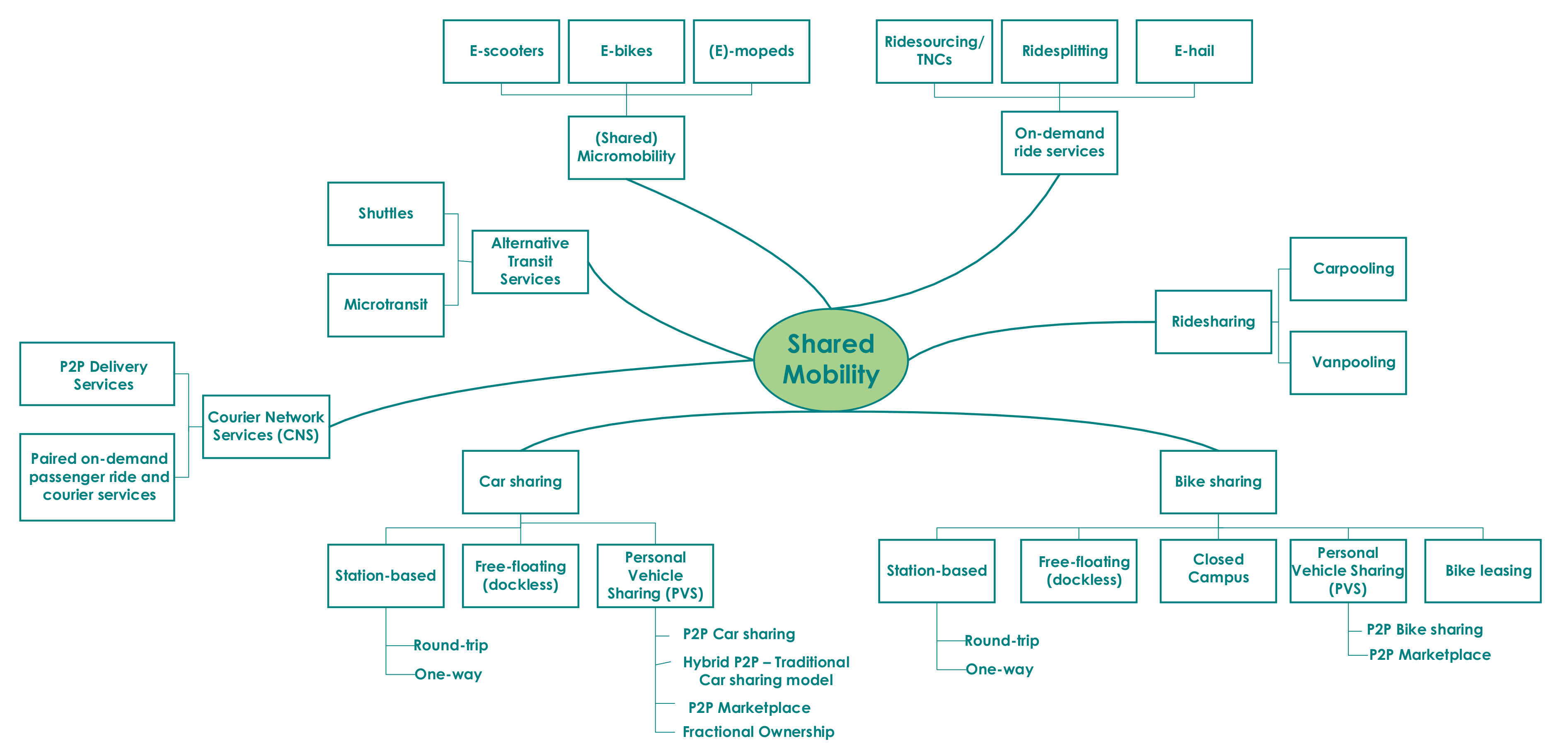
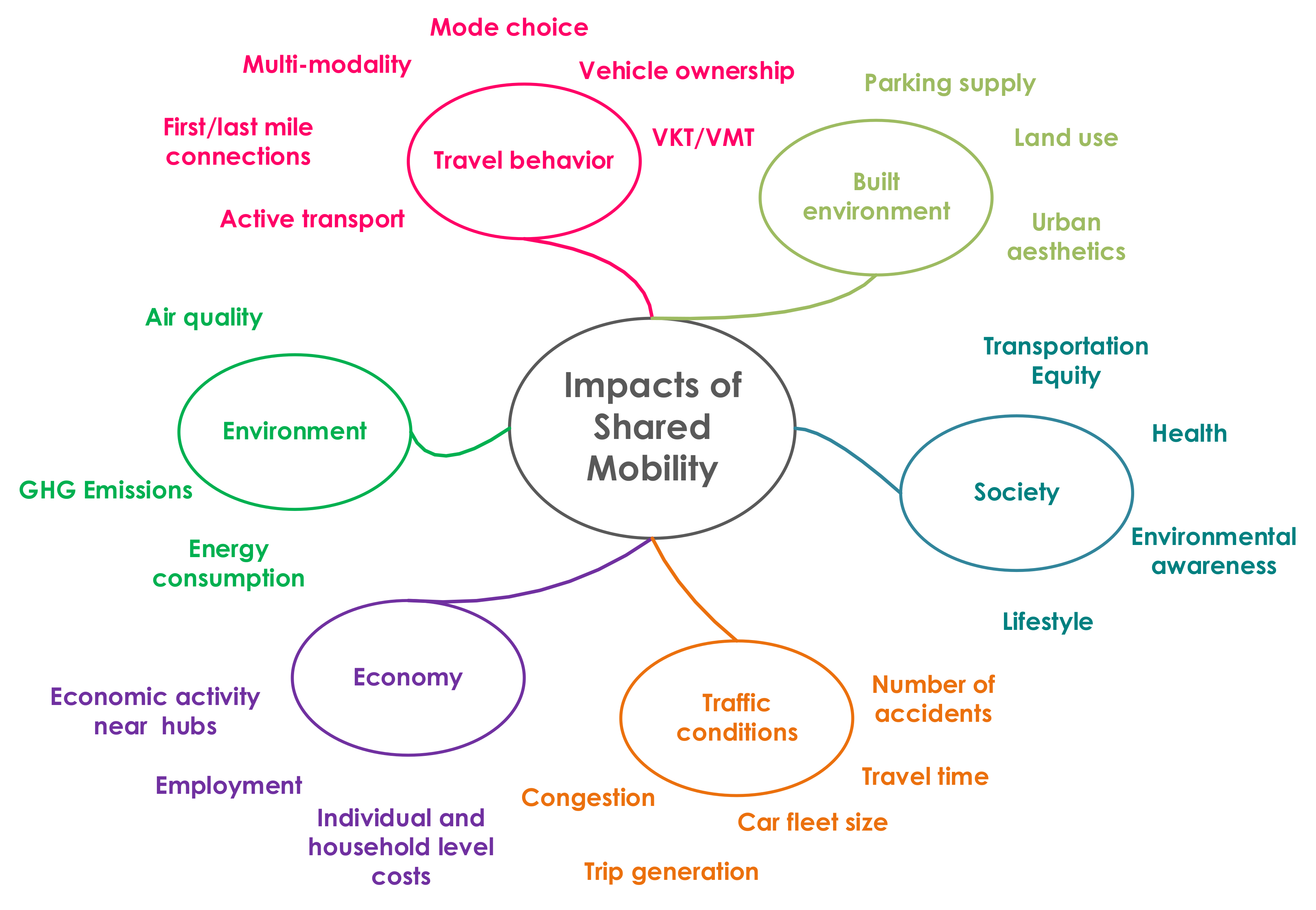
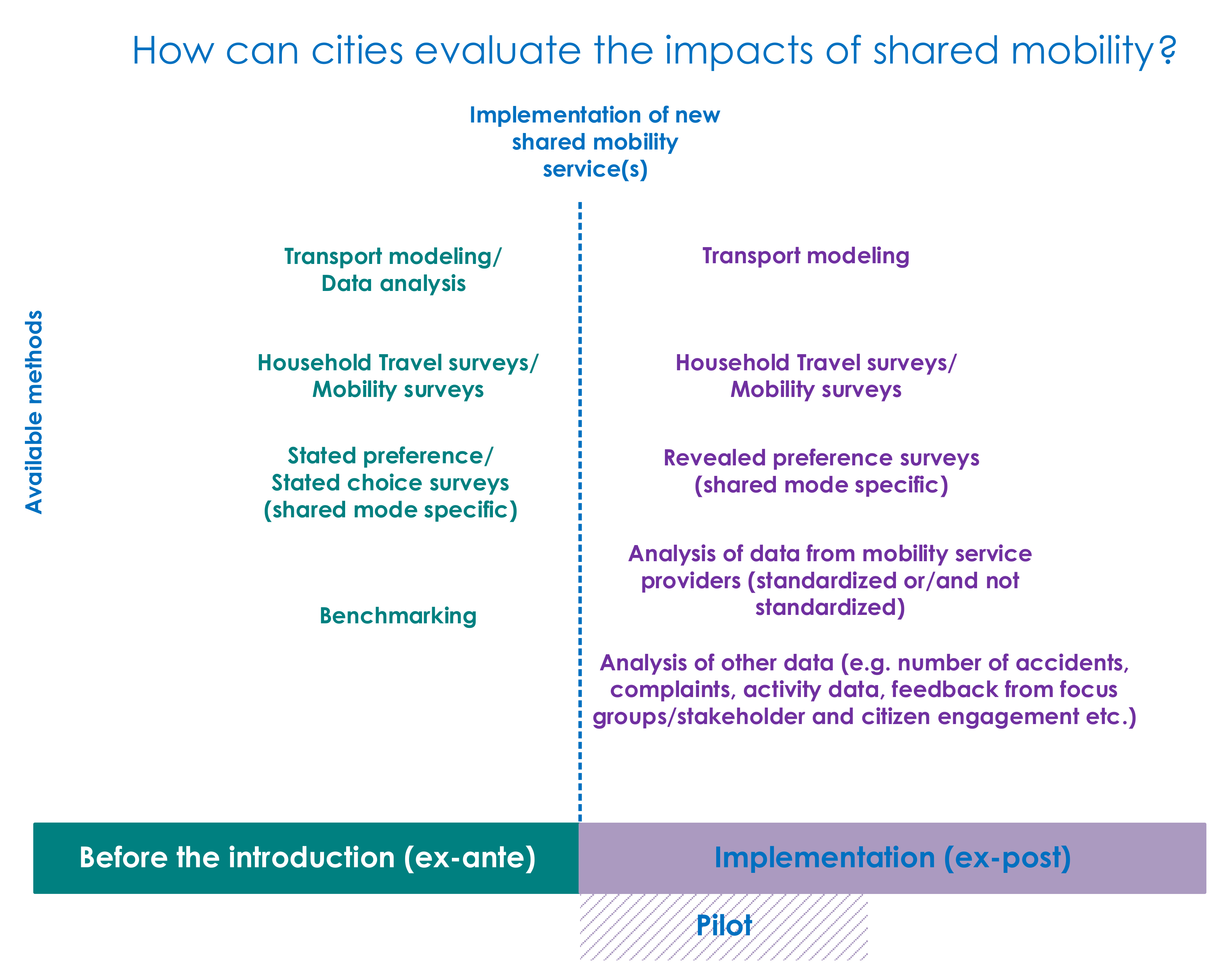
Publisher’s Note: MDPI stays neutral with regard to jurisdictional claims in published maps and institutional affiliations. |
© 2020 by the authors. Licensee MDPI, Basel, Switzerland. This article is an open access article distributed under the terms and conditions of the Creative Commons Attribution (CC BY) license (http://creativecommons.org/licenses/by/4.0/).