


Abstract
The harmonized balance between work and family is tough to reach in modern industrial societies because of increasing demands at work and in family settings. Previous studies analyzed work–family culture and its relationship with employees’ job performance without focusing on specific industries. Paralleled with the Sustainable Developments Goals (SDGs), this study aims to analyze the relationship between work–family culture and employees’ job performance in selected industries in Malaysia. This study surveyed 336 employees working in four industries in Peninsular Malaysia, and data were collected using a self-reported questionnaire. The collected data were analyzed using two statistical analyses, i.e., descriptive and inferential statistic multiple linear regression by assisting statistical software, namely SPSS version 26. This study found that organizational time demands, and managerial support have a significant positive relationship with employees’ job performance. Moreover, the career consequences variable does not have a significant effect on employees’ job performance. Therefore, the results provided valuable insights into the work–family culture among employees with family responsibilities. Applied implications for managers are suggested to give full support to the employees while juggling their family matters. This study also contributes to the existing work–family culture literature. After a thorough analysis of this field, the researcher believed that other factors might significantly affect employees’ job performance, such as religiosity, working environment, and integrity in the organizations.
1. Introduction
Malaysia, in 2030, is aiming for the Sustainable Developments Goals (SDG2030). The 2030 Agenda for Sustainable Development serves as the collective blueprint to achieve a better and more sustainable future for all humankind. The new Goals are unique in that they call for action by all countries (poor, rich, and middle-income countries) to promote prosperity while protecting the planet. SDGs recognize that ending poverty must go hand-in-hand with strategies that build economic growth and the Goals address a range of social needs including education, health, social protection, and job opportunities while tackling climate change and environmental protection. The Goals are a challenge to become serious about delivering an integrated and balanced social, economic, and environmental agenda. There are 17 indicators in SDG2030, such as no poverty, zero hunger, gender equality, and clear water and sanitation by 2030 all around Malaysia.
Hence, in order to achieve the Goals, this study attempts to clear the view for Malaysia in completing the 8th goal in SDG 2030, which focuses on promoting sustained, inclusive, and sustainable economic growth, and supporting full and productive employment and decent work, as well as ensuring the healthy lives in Malaysia at the optimum level and promote well-being for all ages. The 8th goal of SDG2030 indicates achieving full and productive employment and decent work despite gender to protect labor rights, and promote safety and a good workplace for employees’ well-being [1,2]. Hence, this study aims to investigate the factors in a work–family culture that will affect employees’ performances while juggling work and family responsibilities.
Productive employment is defined as employment yielding sufficient returns of labor to permit the worker and their dependents to consume above the poverty line [3]. Thus, it is undeniable that jobs are the key element of economic and social development [4]. However, even though productive employment and inclusive growth are widespread in development policies. Rammelt, Leung, and Gebru [5] found thsat productive employment is still more widespread as an endeavor than a reality. It is proven that the quality of available jobs is a matter of concern rather than payment issues and job security, similar to what Europe experienced [6]. To relate, the quality of available jobs is undoubtedly closely related to workers’ satisfaction.
Nair and Subash [7] found that job satisfaction and quality of work–family need to be addressed positively to keep the workers motivated to contribute to organizational effectiveness and growth. Furthermore, job satisfaction speaks for the fact that the workers like or dislike their job. Gragnano, Simbula, and Miglioretti [8] found that job satisfaction is also consistently correlated with employees’ job performance and work–family balance. Therefore, work–family balance has an impact on work engagement, both directly and through individual perceptions of organizational support for work–family balance. It is worth noting that employees were said to provide productive employment when they practiced a culture of support for work–family balance—which is here referring to work–family culture. Andreassi and Thompson [9] defined work–family culture as the “shared assumptions, beliefs, and values regarding the extent to which an organization supports and values the integration of employees’ work and family lives”.
Thus, it can be concluded that work–family culture is among the associated factors or contributors to achieving the 8th goal of SDG2030. It is to achieve full and productive employment and decent work despite gender, protect labor rights, and promote a safe, sound workplace for the employees’ well-being. Žnidaršic and Bernik [10] found that the organization’s work–family balance policies and practices (which represent the work–family culture), such as support from the leader, co-workers, and family-friendly policies and practices, have a positive impact on the individual’s work–family balance. Therefore, work–family balance leads to increased work engagement, and the individual’s perception of the organization’s work–family balance support leads to increased work engagement. Thus, it is understood that, ultimately, such an organization is providing productive employment as targeted by the 8th goal of SDG2030.
As focused on by the Government regarding employee productivity, several factors may decrease employee performance. The issues may arise from the external or internal perspectives of the organizations, or they may also come from the personal traits of the particular individuals. Previous studies have proposed many factors that may or may not affect the quality of employees’ job performance [11]. The results were inconsistent based on the various cultural backgrounds, the diversity of the samples’ characteristics, different types of the industry environment, and many other related factors. Therefore, this study aims to investigate the impact of work–family culture on employees’ job performance among Malaysia’s unique diverse cultures and races, and with different industries and working backgrounds. Of these, the current study aims to analyze the relationship between work–family culture and employees’ job performance in selected industries in Malaysia. This paper’s structure describes work–family culture and employees’ job performance in achieving SDGs in Section 1. Following, in Section 2, this study reviews several previous studies that focus on employees’ job performance and work–family cultures, as well as developing a research framework and hypotheses. Section 3 presents the methodological approach, which consists of research design, population and sample, sample determination, data collection, and data analysis. Results of the study are reported in Section 4 and Discussion follows in Section 5. Finally, Section 6 concludes the study, discusses the policy implication of the current study, provides a recommendation for future research, and elaborates on the limitations that exist in this study.
2. Literature Review
2.1. Job Performance
Many factors may affect employees’ performance, from the firm or environmental, job-related, or employee-related factors [12]. Employees’ job performance is a major concern no matter what industry the organization is in because it is proven that a good performer will directly or indirectly affect organization performance. Previous studies suggested various factors that might affect employees’ job performance. These consist of motivation and work experiences [13], motivation, organizational climate, and time management [14], employee integrity, job environment, and management support [12], leadership style, employee motivation, and discipline [15].
Organizations that focus on and meet the needs for a work–life balance beneficial to employees indirectly contribute to increased productivity, improved employees’ job performance, and employee retention [16,17]. Work–family culture, work–life balance, and work–life or family conflict are evergreen issues in the career world. As these matters are inseparable, organizations must consider them, because it can also cost employees’ job performance. The situation at home, including family matters, will affect employees’ performance [18], but how far do the employees have to separate family issues while working? In most situations, employees will undoubtedly involve working time with family matters because both families and work are their obligations. Therefore, the researchers focused on work–family culture, which has three sub-dimensions: managerial support, organizational time demands, and career consequences. The purpose of these studies was to investigate the significant relationship between support from management, the time spent for organizations, and the effect of their career path on employees’ performance.
2.2. Work–Family Culture
While people keep moving forward in drastic global development, various challenges arise. Employees have to endure dual-career couples or dual-earner families where both spouses earn money, or in other cases, workers who are unmarried and stay with their parents have to fulfill their duty as a child. Still, at the same time, they have to carry the responsibilities included in their job descriptions.
The responsibilities at work demand employees to spend more than half of the 24 h of a day, and some even spend more time at their workplaces to make sure all tasks given have been fulfilled and completed. Even if several supporting pieces of evidence proved that reducing working hours by one hour per week impacts most self-reported performance [19], the working hours are still at their peak. This situation will eventually harm and create an imbalance between work and life culture. The balance between work and family time is crucial. Employees who can manage and maintain their time, and balance the involvement between work and life will experience better quality of life and positive family time [20]. Marescaux, Rofcanin, Las Heras, Ilies, and Bosch [21] proved that employee intrinsic motivation is the highest when both the employees and organization agree on strongly exhibiting family-supportive behaviors.
The organization should ensure that its employees are well-developed with the appropriate support for empowerment and well-planned team activities to acquire the needed competencies. Hence, the employees may adequately carry out the assigned tasks, and participate in decision-making and other processes relevant to their level in the organization to create a harmonious working relationship among members, and to drive organizational performance [22].
The employees need moral support from the higher level of management, and hence, management support is a crucial part of work and family balance. Mukanzi and Senaji [23] stated that managerial support can moderate the issue both in work and family culture, and family and work conflict. Baker and Kim [24] stated that emotional support from the management team can significantly impact employees’ work and quality of life. However, these studies contradicted Wassem [25], who suggested that managerial support has an insignificant impact on employees’ performance.
Both employees and organizations have to play a role in supporting a good quality work–family culture and in reducing work–family conflict. In contrast, some previous studies have mentioned that a non-supportive work–family culture in a working organization can negatively affect individuals. For instance, emotional fatigue that ultimately leads to stress and disturbs one’s psychological well-being, will eventually affect work performance (e.g., Campos-Garcia et al., [26]; Kalliath et al., [27]; Krishnan et al., [28]; Thevanes and Mangaleswaran [29]; AlAzzam et al., [30]; Jabeen et al., [31]).
Work–family balance can be achieved with support from both parties, family, and organization; it tends to be neglected by organizational research, resulting in the effect of congruence versus incongruence concerning work–family integration preferences and the corresponding supplies at work [32]. The time demands from organizations and support from the management team may reduce the work–family conflict [33]; therefore, these three studied variables are crucial in conveying this study.
The career consequence reflects how organizations support the option taken by the employee to switch to a less demanding job for family reasons. Ke and Deng [34] agreed that organizations that practice family-friendly human resources have a significant positive effect on employees’ job performance. While organizations’ time demands focus on how employees mix working and family matters, are employees generally allowed to talk about family matters while at work? Moreover, the employee believes in staying at the same organization due to feeling satisfied with the organization’s demands [35].
2.3. Research Framework and Hypotheses
This study analyzes work–family culture’s direct effect (managerial support, organizational time demands, and career consequences) on employees’ job performance. The research framework in this study can be seen in Figure 1 below:
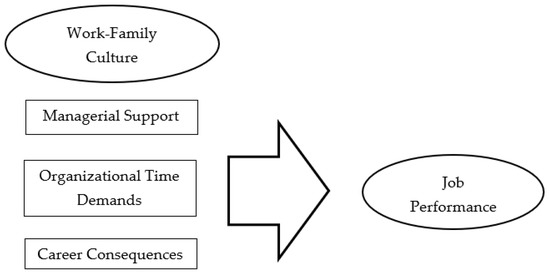
Figure 1.
Research Framework.
Based on the previous studies of literature searched, this study has identified the following hypotheses that need to be investigated:
- H1:
- Managerial support positively affects employees’ job performance.
- H2:
- Organizational time demands positively affect employees’ job performance.
- H3:
- Career consequences positively affect employees’ job performance.
3. Materials and Methods
This study uses primary data which are commonly used in a quantitative method. It means the researchers obtained first-hand information on the variables of interest to fulfill the specific purpose of this study. The individual employee acts as a unit of analysis. The data can be obtained through face-to-face interviews, telephone interviews, and observation methods through videotaping or audio recording. The data were collected using questionnaires distributed to 336 respondents using a simple random sampling method.
This study will cover the area of peninsular Malaysia, including Terengganu, Johor, Pulau Pinang, and Selangor. These selected regions are aiming to represent Malaysia’s east, south, north, and west Peninsular, respectively. There are many industries in Malaysia, however, this study focuses on four industries with the highest number of employees, such as manufacturing, accommodation, food and beverage, education, and human health and social work activities. These industries were approached by sending a permission letter to the human resources department, and the researchers sent the self-administered survey to the employees.
The survey sets were divided into three parts: Part A, Part B, and Part C. Part A required respondents to fulfill their basic backgrounds such as age, religion, and current position. Part B was about instruments related to employees’ performance. The last section, Part C, investigated work–family culture. This study uses measurements from Suliman (2001) involving nineteen items. This self-administered questionnaire examines six factors of employees’ performance: work skills, understanding of work duties, qualities of work, the quantity of work, work enthusiasm, and readiness to innovate. The work–family culture instruments are adopted from Thompson, Beauvais, and Lyness [36] which consist of fourteen items with three dimensions, namely, managerial support, organizational time demands, and career consequences. The data were analyzed by using two types of statistics, namely, descriptive statistics (e.g., frequency, percentage, mean, and standard deviation) and inferential statistics (e.g., exploratory factor analysis, correlation and multiple linear regression by assisting statistical software, namely SPSS version 26). The descriptive statistics analysis is conducted to identify the distribution of respondents who participated in this study. For the inferential statistics, the exploratory factor analysis (EFA) is employed to discover the factor structure of a measure and to examine its internal reliability. EFA is a statistical method used to uncover the underlying structure of a relatively large set of variables. EFA is a technique within factor analysis whose overarching goal is to identify the underlying relationships between measured variables [37]. In addition, the correlation matrix and multiple linear regression are used to examine the relationship among the studied variables.
4. Results
4.1. Demographic Profile of Respondents
This section reports the results of the demographic profile of respondents. Table 1 displays that the research included 37 (27.8%) male and 96 (72.2%) female employees from Terengganu, Pulau Pinang, Johor, and Selangor states, representing each east, north, south, and west Peninsular Malaysia, respectively. The ages ranged from 19 to 59. The majority of participants were married, 84 (63.16%), 47 were single, and 2 were divorced. A large number of respondents were Malays (84.96%), others were Chinese (7.52%), Indian (5%), and others (5%). Regarding industry, 39 respondents were in the manufacturing industry, where 25 persons were in accommodation and food and beverages, 47 in education, and 22 in public administration.

Table 1.
Result of Demography Profile of Respondents.
4.2. Exploratory Factor Analysis for Studied Variables
Table 2 displays the results of exploratory factor analysis of independent variables. The results show three components rotated by factor analysis: managerial support, organizational time demands, and career consequences. However, item A_3, i.e., To turn down a promotion or transfer for family-related reasons will seriously hurt one’s career progress, has dropped due to the low factor loadings. This organization shows the high factor loading in managerial support and organizational time demands (redundant factor loading). Therefore, this item is omitted. Meanwhile, all factor loadings of each item are higher than 0.5 for each variable. Besides, the (Kaiser–Meyer–Olkin) KMO and Bartlett’s Test of 0.880 indicated that the sample size of this study is adequate for the exploratory factor analysis. Additionally, the result of Bartlett’s Test of Sphericity is significant and it implies that there are strong relationships between the item in the respective variables.
Table 2.
Result of Exploratory factor analysis for Work–family Culture.
Table 3 presents the result of the exploratory factor analysis of the dependent variable. The result shows that only one component in employees’ job performance is rotated by factor analysis, comprising only one factor included. However, item JP_4: I have sufficient know-how to carry out my work proficiently, and JP_16: I search for fresh new ways of resolving problems when doing my job, indicated redundant factor loadings. Therefore, these items are dropped. Meanwhile, all other factor loadings of each item are higher than 0.50 for each variable.
Table 3.
Result of Exploratory Factor Analysis for Employees’ Job Performance.
The results of the normality test are shown in Table 4. The test statistics of skewness (−0.071) and kurtosis (−0.873) are between −1 and +1, and those imply that the data are considered normally distributed [38]. Moreover, the Kolmogorov–Smirnov result shows the lower bound of the true significance with a p-value of 0.200, more than 0.05. It indicates enough evidence to state the data are normally distributed. Data are reduced to 336 after removing outliers by the normality test.
Table 4.
Results of Normality Testing.
The reliability test results for studied variables can be seen in Table 5. All variables show the Cronbach’s Alpha exceeding 0.8, respectively, which are organizational time demands (0.833), managerial supports (0.878), career consequences (0.843), and employees’ job performance (0.899). It indicates the high internal consistency, which means that the items in the variable are highly correlated. Regarding internal consistency, nearly all item-total correlations in the respective variable are higher than 0.3, indicating good internal consistency.
Table 5.
Results of the reliability of the studied variables.
4.3. Level of Work–Family Culture (WFC) and Employees’ Job Performance
This section presents the results of descriptive statistics using mean and standard deviation to identify the level of WFC dimensions (e.g., organizational time demands, managerial supports, and career consequences) and employees’ job performance. Table 6 displays the results of the descriptive statistics and level of organizational time demand, managerial support, and career consequences. The results indicate the level of organizational time demand categorized as medium with a mean value of 3.33 and a standard deviation of 1.47. The managerial support mean value is 4.82 and 1.38 for standard deviation. Thus, it could be concluded that managerial support is high. The career consequences mean value is 4.50, and the standard deviation is 1.29, reflecting a high level.
Table 6.
Results of the level of organizational time demand, managerial support, and career consequences.
4.4. The Correlation Result of Studied Variables
This section reports the correlation result of the studied variables. Table 7 displays the results of the correlations matrix for all studied variables. This study used three dimensions for measuring work-life culture: organizational time demand, managerial support, career consequences, along with employees’ job performance, assigned as dependent variables. The results of the correlation matrix showed that work–family culture had a positive and significant correlation with employees’ job performance, i.e., organizational time demand (r = 0.304), managerial support (r = 0.438), and career consequences (r = 0.526) at the level of p < 0.01.
Table 7.
The results of correlation of all studied variables.
Table 8 shows the results of regression analysis of the organizational time demands, managerial supports, and career consequences on employees’ job performance. The Durbin–Watson of 1.744 is in the range of 0 and 4, indicating that the residuals are not correlated. Besides, the variance inflation factor (VIF) for each variable is less than 5, implying no multicollinearity problems among variables in these regression models. Additionally, the ANOVA test of linear regression is significant at 0.05 (F = 48.244), showing that the regression line is a good measure in predicting the organizational time demands, managerial supports and career consequences towards employees’ job performance. Since all the requirements for these tests are fulfilled, then, the regression model is good to be performed. Besides, the R square of 0.304, indicates that around 30.4% of employees’ job performance can be explained by organizational time demands, managerial supports, and career consequences while about 69.6% of employees’ job performances can be explained by other factors.
Table 8.
Testing of Hypotheses.
The organizational time demands show the highest beta of 0.306 and are significant towards employees’ job performances (t = 10.299, p < 0.01). This implies that there is a significant and positive impact of organizational time demands on employees’ job performance. Meanwhile, there are also significant results between managerial supports and employees’ job performances (β = 0.046, t = 2.048, p < 0.05). It indicates that managerial supports positively affect employees’ job performance. Furthermore, there are insignificant results of career consequences towards employees’ job performance (t = −1.229, p > 0.05). This means that career consequences negatively affect employees’ job performance.
5. Discussion
This study adopted three dimensions for measuring work-life culture: organizational time demand, managerial support, career consequences, with employees’ job performance as the dependent variable. The results of the correlation matrix showed that work–family culture had a positive and significant correlation with employees’ job performance. Employee job performance is crucial for the organization because high-performance culture can certainly reduce employee absenteeism and promote a faster work effect with good quality. The high performance will support the organization with benefits. However, the employee needs to be supported by the management to be more productive and to produce a higher performance. The first hypothesis of this study was that managerial support has a significant result on employees’ job performance. This result was supported by Setianto et al. [39] and Chen et al. [40] who stated that management support had a significant positive effect on employees’ job performance.
The second hypothesis of this study was organizational time demands. This issue is one of the major problems in individual life today, and will be even more so in the future, with balancing work along with family responsibilities and duties. Hence, the flexible working hours arrangement appears to be a helpful solution to organizational time demands. This study proved that organizational time demands does have a significant and positive impact on job performance. The result parallels the studies by Ramakrishnan and Arokiasamy [41] and Adebayo Idowu [42], where organization time demands impacts performance. Employers and human resources managers must recognize the benefits of flexible working hours to ensure that employees do not work too hard, lowering their efficiency and, as a result, increasing employee turnover and job stress.
The last hypothesis of this study was career consequences, which portray the insignificant result of career consequences towards employees’ job performance. The result contradicts several studies in the field where career consequence and development were seen as a significant impact on employees’ job performance [43,44,45] and [46]. The difference in the result is believed to be because the employee in the selected research area was focusing more on support from the employer and the time demanded from the employee to complete each task given.
The work–family culture results, as a whole, show similarity with some previous studies by Kumar, Jauhari, Rastogi, and Sivakuamr, [47] and Mukanzi and Senaji, [23] while also contrasting to Wassem [25], who shows the insignificant relationship between work–family culture and employees’ job performance. Even though the setting origin instruments are varied from the unit analysis background, due to globalization, as most countries are now becoming one, the resulting pattern reflects similar polarity with previous research. Career consequences are not an impact on employees’ job performances, and it might be due to the employee feeling at ease about their future career endeavors.
With the current situation of the COVID-19 pandemic, there has been much abrupt change in working style. Remote work has become normalized, and work and family matters are inseparable. Hence, this hybrid manner of working required more understanding and tolerance from both employees and organizations. Organizations can help assist their employees by applying several options such as flexibility hour policies with employee honesty to complete all duties and responsibilities given within the deadline. This is one reflection of managerial support for a work-life balance culture.
6. Conclusions
In conclusion, this study has identified the factor structure of work–family culture and employees’ job performance. Work–family culture consists of organizational time demands (5 items), managerial support (8 items), career consequences (6 items) and employees’ job performance (17 items). Additionally, the level of managerial support, career consequences, and job performance were categorized as high. Furthermore, the level of organizational time demand was categorized as medium. In addition, organizational time demands and managerial support have a significant positive effect on employees’ job performance. Therefore, the results of this study hope to give a solution and help both employees and organizations find the right balance between these two main responsibilities in employees’ life, which are work, as well as family. Moreover, this study contributes to the body of knowledge in providing which components in work–family culture have the largest implications for employees’ performance. This study has focused on three factors in work–family culture balance, involving the organizational time demands, managerial support, and career support, which will bring a huge effect in balancing the two major roles of the employee.
Flexible hours are one of the best options which the employer can offer to help with time demands by the organization. The most important thing expected by employees are their performance and output. Therefore, as long as all the tasks and job descriptions have been fulfilled, time should not be an issue for employees and employers. For future studies, the researchers suggest looking at other factors which might impact employees’ job performance, such as motivation, rewards, or leadership style. Except for the methods used in this paper, some of the most representative computational intelligence algorithms can be used to solve the problems, such as monarch butterfly optimization (MBO) [48], earthworm optimization algorithm (EWA) [49], elephant herding optimization (EHO) [50], moth search (MS) algorithm [51], slime mold algorithm (SMA) [52], hunger games search (HGS) [53], Runge–Kutta optimizer (RUN) [54], colony predation algorithm (CPA) [55], and Harris hawks optimization (HHO) [56]. The respondent’s scope can also be widened to other industries and countries as the performances not only matter for these four selected industries and countries. This study is limited by focusing on employees in selected industries in Peninsular Malaysia only. A more in-depth study of the respondents has covered all employees in all industries with various backgrounds of races, religions, and working cultures [57].
Author Contributions
Conceptualization, N.A.A.b.A.R., K.O. and J.S.; methodology, N.A.A.b.A.R., K.O., J.S. and A.u.H.; software, J.S. and A.u.H.; validation, K.O., H.M. and F.H.; formal analysis, J.S., K.O. and A.u.H.; investigation, N.A.A.b.A.R., K.O. and J.S.; resources, N.A.A.b.A.R., H.M. and F.H.; data curation, K.O., H.M., F.H. and J.S.; writing—original draft preparation, N.A.A.b.A.R. and K.O.; writing—review and editing, K.O., J.S., A.u.H., H.M. and F.H.; supervision, K.O.; project administration, K.O.; funding acquisition, K.O. All authors have read and agreed to the published version of the manuscript.
Funding
This research received no external funding.
Institutional Review Board Statement
This study was conducted according to the guidelines of the Declaration of Helsinki and approved by the Institutional Review Board (or Ethics Committee) of Universiti Malaysia Terengganu (UMT) Research Ethics Committee (No. UMT/JKEPM/2020/46 and 18 May 2020).
Informed Consent Statement
Informed consent was obtained from all subjects involved in the study.
Data Availability Statement
Not applicable.
Acknowledgments
We would like to thank Universiti Malaysia Terengganu which supported this research and publication. We also would like to thank the individuals and organizations who generously shared their time and experience for the purposes of this project.
Conflicts of Interest
The authors declare no conflict of interest.
References
- Kot, S.; Brzeziński, S. Market Orientation Factors in Sustainable Development and Corporate Social Responsibility. Asian J. Appl. Sci. 2015, 8, 101–112. [Google Scholar] [CrossRef]
- Andjarwati, T.; Budiarti, E.; Audah, A.K.; Khouri, S.; Rebilas, R. The impact of green human resource management to gain enterprise sustainability. Pol. J. Manag. Stud. 2019, 20, 93–103. [Google Scholar] [CrossRef]
- Ripley, M.; Hartrich, S. Measuring Productive Employment: A ‘How To’ Note; International Labour Organization: Genève, Switzerland, 2017; pp. 1–3. [Google Scholar]
- Kot, S. Knowledge and understanding of corporate social responsibility. J. Adv. Res. L. Econ. 2014, 5, 109–119. [Google Scholar]
- Rammelt, C.F.; Leung, M.; Gebru, K.M. The Exclusive Nature of Inclusive Productive Employment in the Rural Areas of Northern Ethiopia. Work. Employ. Soc. 2018, 32, 1044–1060. [Google Scholar] [CrossRef]
- Georgescu, M.-A.; Herman, E. Productive Employment for Inclusive and Sustainable Development in European Union Countries: A Multivariate Analysis. Sustainability 2019, 11, 1771. [Google Scholar] [CrossRef]
- Nair, P.R.; Subash, T. Quality of Work Life and Job Satisfaction: A Comparative Study. Int. J. Bus. Manag. Invent. ISSN 2019, 8, 15–21. [Google Scholar]
- Gragnano, A.; Simbula, S.; Miglioretti, M. Work–Life Balance: Weighing the Importance of Work–Family and Work–Health Balance. Int. J. Environ. Res. Public Health 2020, 17, 907. [Google Scholar] [CrossRef]
- Andreassi, J.K.; Thompson, C.A. Work-Family Culture: Current Research and Future Directions. Handb. Work Fam. Integr. Res. Theory Best Pract. 2008, 2005, 331–351. [Google Scholar] [CrossRef]
- Žnidaršič, J.; Bernik, M. Impact of work-family balance results on employee work engagement within the organization: The case of Slovenia. PLoS ONE 2021, 16, e0245078. [Google Scholar] [CrossRef]
- Saeed, R.; Mussawar, S.; Lodhi, R.N.; Iqbal, A.; Nayab, H.H.; Yaseen, S. Factors Affecting the Performance of Employees at Work Place in the Banking Sector of Pakistan. Middle-East J. Sci. Res. 2013, 17, 1200–1208. [Google Scholar] [CrossRef]
- Diamantidis, A.; Chatzoglou, P. Factors affecting employee performance: An empirical approach. Int. J. Prod. Perform. Manag. 2019, 68, 171–193. [Google Scholar] [CrossRef]
- Rozi, A.; Sunarsi, D. The Influence of Motivation and Work Experience on Employee Performance at PT. Yamaha Saka Motor in South Tangerang. J. Off. 2019, 5, 65. [Google Scholar] [CrossRef]
- Rahim, N.A.A.B.A.; Omar, K.; Kamaruddin, S.N.A.A. Integrity and employee job performance. J. Crit. Rev. 2020, 7, 517–521. [Google Scholar] [CrossRef]
- Pawirosumarto, S.; Sarjana, P.K.; Muchtar, M. Factors affecting employee performance of PT.Kiyokuni Indonesia. Int. J. Law Manag. 2017, 59, 602–614. [Google Scholar] [CrossRef]
- Haque, A.; Ahmed, A.A. Striving for Work-Life Balance at Entry Level Jobs: Challenges to Develop Professionalism in Bangladesh. Asian Bus. Rev. 2016, 6, 97–104. [Google Scholar] [CrossRef]
- Tambe, S. Work-life Balance and Gender Bias: A Contrarian View Work-life Balance and Gender Bias: A Contrarian View. Int. Res. J. Bus. Manag. 2017, 10, 14–16. [Google Scholar]
- Bataineh, K.A. Impact of work-life balance, happiness at work, on employee performance. Int. Bus. Res. 2019, 12, 99–112. [Google Scholar] [CrossRef]
- Bray, J.; Hinde, J.M.; Kaiser, D.J.; Mills, M.J.; Karuntzos, G.T.; Genadek, K.R.; Kelly, E.L.; Kossek, E.E.; Hurtado, D.A. Effects of a Flexibility/Support Intervention on Work Performance: Evidence from the Work, Family, and Health Network. Am. J. Health Promot. 2018, 32, 963–970. [Google Scholar] [CrossRef]
- Ramos, H.M.; Francis, F.; Philipp, R.V. Work life balance and quality of life among employees in Malaysia. Int. J. Happiness Dev. 2015, 2, 38–51. [Google Scholar] [CrossRef]
- Marescaux, E.; Rofcanin, Y.; Heras, M.L.; Ilies, R.; Bosch, M.J. When employees and supervisors (do not) see eye to eye on family supportive supervisor behaviours: The role of segmentation desire and work-family culture. J. Vocat. Behav. 2020, 121, 103471. [Google Scholar] [CrossRef]
- Obiekwe, O.; Zeb-Obipi, I.; Ejo-Orusa, H. Organizational Family Culture and Employee Involvement in Nigeria Workplaces: An Empirical Analysis. IIARD Int. J. Econ. Bus. Manag. 2019, 5, 23–39. [Google Scholar]
- Mukanzi, C.M.; Senaji, T.A. Work–Family Conflict and Employee Commitment: The Moderating Effect of Perceived Managerial Support. SAGE Open 2017, 7, 1–12. [Google Scholar] [CrossRef]
- Baker, M.A.; Kim, K. Dealing with customer incivility: The effects of managerial support on employee psychological well-being and quality-of-life. Int. J. Hosp. Manag. 2019, 87, 102503. [Google Scholar] [CrossRef]
- Wassem, M.; Baig, S.A.; Abrar, M.; Hashim, M.; Zia-Ur-Rehman, M.; Awan, U.; Amjad, F.; Nawab, Y. Impact of Capacity Building and Managerial Support on Employees’ Performance: The Moderating Role of Employees’ Retention. SAGE Open 2019, 9, 1–13. [Google Scholar] [CrossRef]
- Campos-Garcia, X.; Guevara, R.; Idrovo-Carlier, S. The effect of family supportive supervisor behaviors and work-family culture on turnover intention and work-family conflict. Manag. Sci. Lett. 2021, 11, 2377–2390. [Google Scholar] [CrossRef]
- Kalliath, P.; Kalliath, T.; Chan, X.W.; Chan, C. Linking Work–Family Enrichment to Job Satisfaction through Job Well-Being and Family Support: A Moderated Mediation Analysis of Social Workers across India. Br. J. Soc. Work 2018, 49, 1–22. [Google Scholar] [CrossRef]
- Krishnan, R.; Loon, K.W. The Effects of Job Satisfaction and Work-Life Balance on Employee Task Performance. Int. J. Acad. Res. Bus. Soc. Sci. 2018, 8, 652–663. [Google Scholar] [CrossRef]
- Thevanes, N.; Mangaleswaran, T. Relationship between Work-Life Balance and Job Performance of Employees. J. Bus. Manag. 2018, 20, 11–16. [Google Scholar] [CrossRef]
- Alazzam, M.; AbuAlRub, R.F.; Nazzal, A.H. The Relationship Between Work-Family Conflict and Job Satisfaction Among Hospital Nurses. Nurs. Forum 2017, 52, 278–288. [Google Scholar] [CrossRef]
- Jabeen, F.; Friesen, H.L.; Ghoudi, K. Quality of Work Life of Emirati Women and Its Influence on Job Satisfaction and Turnover Intention: Evidence from the UAE. J. Organ. Chang. Manag. 2017, 31, 352–370. [Google Scholar] [CrossRef]
- Liu, P.; Wang, X.; Li, A.; Zhou, L. Predicting Work–Family Balance: A New Perspective on Person–Environment Fit. Front. Psychol. 2019, 10, 1804. [Google Scholar] [CrossRef] [PubMed]
- Ghislieri, C.; Gatti, P.; Molino, M.; Cortese, C.G. Work–family conflict and enrichment in nurses: Between job demands, perceived organisational support and work–family backlash. J. Nurs. Manag. 2017, 25, 65–75. [Google Scholar] [CrossRef] [PubMed]
- Ke, J.; Deng, X. Family-Friendly Human Resource Practice, Organizational Commitment, and Job Performance among Employees: The Mediating Role of Workplace Spirituality. J. Hum. Resour. Sustain. Stud. 2018, 6, 81–91. [Google Scholar] [CrossRef][Green Version]
- Nasurdin, A.M.; Tan, C.L.; Khan, S.N. The Relation between Turnover Intention, High Performance Work Practices (HPWPs), and Organisational Commitment: A Study among Private Hospital Nurses in Malaysia. Asian Acad. Manag. J. 2018, 23, 23–51. [Google Scholar] [CrossRef]
- Thompson, C.A.; Beauvais, L.L.; Lyness, K.S. When Work–Family Benefits Are Not Enough: The Influence of Work–Family Culture on Benefit Utilization, Organizational Attachment, and Work–Family Conflict. J. Vocat. Behav. 1999, 54, 392–415. [Google Scholar] [CrossRef]
- Norris, M.; Lecavalier, L. Evaluating the Use of Exploratory Factor Analysis in Developmental Disability Psychological Research. J. Autism Dev. Disord. 2010, 40, 8–20. [Google Scholar] [CrossRef] [PubMed]
- Chua, Y.P. Basic Statistical Research, 2nd ed.; Mc Graw Hill Sdn Bhd.: Kuala Lumpur, Malaysia, 2012. [Google Scholar]
- Setianto, F.; Widjajanti, M.; Utoyo, T.; Suyono, J.; Elisabeth, D.R. The Mediating Role of Knowledge Sharing in Relationship between Organizational Culture and Employee Performance. In Proceedings of the International Conference on Industrial Engineering and Operations Management, Harare, Zimbabwe, 7–10 December 2020; Volume 59, pp. 2718–2729. [Google Scholar]
- Chen, T.; Hao, S.; Ding, K.; Feng, X.; Li, G.; Liang, X. The impact of organizational support on employee performance. Empl. Relat. 2020, 42, 166–179. [Google Scholar] [CrossRef]
- Ramakrishnan, S.; Arokiasamy, L. Flexible working arrangements in Malaysia; A study of employee’s performance on white collar employees. Glob. Bus. Manag. Res. 2019, 11, 551–559. [Google Scholar]
- Idowu, S.A. Role of Flexible Working Hours’ Arrangement on Employee Job Performance and Retention in Manufacturing Industries in Agbara, Nigeria. Economic Insights–Trends and Challenges. 2020. Available online: http://repository.elizadeuniversity.edu.ng/jspui/handle/20.500.12398/1130 (accessed on 25 December 2021).
- Saleem, S.; Amin, S. The Impact of Organizational Support for Career Development and Supervisory Support on Employee Performance: An Empirical Study from Pakistani Academic Sector. Eur. J. Bus. Manag. 2013, 5, 194–207. [Google Scholar]
- Manggis, I.W.; Yuesti, A.; Sapta, I.K.S. The Effect of Career Development and Organizational Culture to Employee Performance with Motivation of Work as Intervening Variable in Cooperation in Denpasar Village. Int. J. Contemp. Res. Rev. 2018, 9, 20901–20916. [Google Scholar] [CrossRef]
- Ali, Z.; Mahmood, B.; Mehreen, A. Linking succession planning to employee performance: The mediating roles of career development and performance appraisal. Aust. J. Career Dev. 2019, 28, 112–121. [Google Scholar] [CrossRef]
- Agung, A.A.P.; Widnyana, I.W. The Effect of Career Development and Servant Leadership on Employee Performance with Work Motivation as an Intervening Variable in the Employment Agency and Human Resources Development Denpasar City. Int. J. Contemp. Res. Rev. 2020, 11, 21741–21751. [Google Scholar] [CrossRef]
- Kumar, M.; Jauhari, H.; Rastogi, A.; Sivakumar, S. Managerial support for development and turnover intention: Roles of organizational support, work engagement and job satisfaction. J. Organ. Chang. Manag. 2018, 26, 1071–1090. [Google Scholar] [CrossRef]
- Feng, Y.; Deb, S.; Wang, G.-G.; Alavi, A.H. Monarch butterfly optimization: A comprehensive review. Expert Syst. Appl. 2021, 168, 114418. [Google Scholar] [CrossRef]
- Wang, G.G.; Deb, S.; Coelho, L.D.S. Earthworm optimisation algorithm: A bio-inspired metaheuristic algorithm for global optimisation problems. Int. J. Bio-Inspired Comput. 2018, 12, 1–22. [Google Scholar] [CrossRef]
- Wang, G.G.; Deb, S.; Coelho, L.D.S. Elephant Herding Optimization. In Proceedings of the 2015 3rd International Symposium on Computational and Business Intelligence (ISCBI), Bali, Indonesia, 7–9 December 2015; pp. 1–5. [Google Scholar]
- Wang, G.-G. Moth search algorithm: A bio-inspired metaheuristic algorithm for global optimization problems. Memetic Comput. 2018, 10, 151–164. [Google Scholar] [CrossRef]
- Li, S.; Chen, H.; Wang, M.; Heidari, A.A.; Mirjalili, S. Slime mould algorithm: A new method for stochastic optimization. Future Gener. Comput. Syst. 2020, 111, 300–323. [Google Scholar] [CrossRef]
- Yang, Y.; Chen, H.; Heidari, A.A.; Gandomi, A.H. Hunger games search: Visions, conception, implementation, deep analysis, perspectives, and towards performance shifts. Expert Syst. Appl. 2021, 177, 114864. [Google Scholar] [CrossRef]
- Ahmadianfar, I.; Heidari, A.A.; Gandomi, A.H.; Chu, X.; Chen, H. RUN beyond the metaphor: An efficient optimization algorithm based on Runge Kutta method. Expert Syst. Appl. 2021, 181, 115079. [Google Scholar] [CrossRef]
- Tu, J.; Chen, H.; Wang, M.; Gandomi, A.H. The Colony Predation Algorithm. J. Bionic Eng. 2021, 18, 674–710. [Google Scholar] [CrossRef]
- Chen, H.; Heidari, A.A.; Chen, H.; Wang, M.; Pan, Z.; Gandomi, A.H. Multi-population differential evolution-assisted Harris hawks optimization: Framework and case studies. Futur. Gener. Comput. Syst. 2020, 111, 175–198. [Google Scholar] [CrossRef]
- Ibrahim, R.Z.A.R.; Saputra, J.; Ali, S.N.M.; Dagang, M.M.; Bakar, A.A. Organizational justice and job satisfaction among Malaysian workers. Opcion 2019, 35, 494–513. [Google Scholar]
Publisher’s Note: MDPI stays neutral with regard to jurisdictional claims in published maps and institutional affiliations. |
© 2022 by the authors. Licensee MDPI, Basel, Switzerland. This article is an open access article distributed under the terms and conditions of the Creative Commons Attribution (CC BY) license (https://creativecommons.org/licenses/by/4.0/).