


Abstract
In the process of migration, the migrant goes through certain stages and a series of transformations that leave their mark on their individuality over time. These unavoidable processes, adaptation, assimilation, and eventually integration, as well as numerous other factors, lead to changes in identity. The concept addressed in the paper, which supports the understanding of the process of change, is that of acculturation. Acculturation is the process by which an individual acquires and adapts to a new cultural environment as a result of being placed in a new culture. The theoretical approach led to an objective understanding of the process of identity change in a given context. Symbolic interactionism theory aims to reveal the internal mechanisms of identity formation by overcoming the opposition between the individual and the collective, and ethno-linguistic identity theory posits that when faced with alternative courses of action, individuals will choose the one that will enhance their self-presentation. The aim of this article is to examine identity-level changes in migrants who have undergone the processes of adaptation, assimilation, and integration in the country of migration from a psychosocial perspective. In order to achieve this aim, an interview with 30 Romanians who emigrated abroad was conducted. Based on a conceptual and methodological framework, the present article carried out a thematic analysis in which the most significant changes in mentality, thinking, self-esteem, principles of life, culture, attitude and behavior, identity place/space, etc. were highlighted through concrete quotes from the interviews with the migrants, all of which were explained through the identity-migration theory.
Keywords:
international migration; migrant; acculturation; processes; factors; identity change; place identity 1. Introduction
The phenomenon of migration has always existed and has undergone changes over time in terms of content, scope, and forms of manifestation. Migration has mainly been economically motivated, but also a means of withdrawing from threats. Migration has been seen as a demographic problem, with the population or depopulation of certain territories. In other cases, migration is seen as a “balancing instrument”,” both economically and demographically. Migration is a complex phenomenon consisting of the movement of people from one territorial area to another, followed by a change in residence and/or employment in the area of arrival. It covers a wide range of population movements, the reasons for this movement and the legal status of migrants, which determines how long they can stay in a host country and under what conditions [1].
International migration plays an important role in contemporary social transformations. It is a result of global change, but also a force for future change, both in sending and receiving countries, at the individual and collective level. The phenomenon of migration constitutes a simultaneous change in physical and socio-cultural space, which involves not only movement from one community to another, but also the destruction of structural attachments in the area of departure, reorganization of the national system of destination, and cultural assimilation of the receiving environment [2].
International migration is a factor of social change as a result of population movement, integration, and adaptation in the receiving area; through reorientation in the new social environment in terms of work, professional, social, and community relations; and through the redistribution of roles and family relations. Migration affects the whole system of family and group, formal and informal, professional and cultural, ethnic and political relations of mobile people, while structuring new patterns of appreciation and behavior, value orientation, and social participation. Migration is followed by a whole chain of socio-cultural restructuring and reorientation [3].
Migration is also a factor of social change in close correlation with social mobility, which expresses the change in status of an individual or group of individuals under a complex of economic, technological, organizational, social, etc. factors [4]. Changes are felt in social structure and composition, insofar as they are socially mobile and insofar as they involve movements in social space, i.e., shifts from one social position to another. Change occurs at the level of all the elements involved in migration. Whether this change occurs as a result of population movements or in well-established and entrenched systems as a result of individual or group reactions, change occurs as a natural condition and normality of life that characterizes social reality. Every individual or group is marked by social reality, inducing certain changes at distinct levels.
In discussing the changes that occur in the migration process, it is necessary to mention the concept of acculturation, which explains to a large extent the changes that occur in the migrant. Acculturation is the process of cultural and psychological change that follows intercultural contact [5]. Acculturation involves changes in self-identity resulting from the possibility to accommodate an old and a new culture [6]. Cultural changes include alterations in a group’s customs, and in their economic and political life. Psychological changes include alterations in individuals’ attitudes toward the acculturation process, their cultural identities, and their social behaviors in relation to the groups in contact [7]. Thus, acculturation has been defined by cultural change that results from continuous, firsthand contact between two distinct cultural groups, noting that acculturation refers to changes in an individual whose cultural group is collectively experiencing acculturation [8].
2. Conceptual Delimitations: Individual Identity Changes as a Result of Migration
As originally defined, acculturation encompasses all cultural changes, whether such changes occur at the societal or individual level. According to Berry (1990), these changes correspond to modes of acculturation that can be understood as the outcome of two decisions: (1) whether the appreciation of the original cultural identity is valued or not and (2) whether identification with the other cultural group is desired. Assimilation results from the willingness to identify with the other group while relinquishing membership in the first culture. Separation refers to a preference for the first culture and a rejection of the other cultural identity. Integration results from an interest in adopting both identities, whereas marginalization consists of a rejection of both cultures [9].
In a more general context, identity changes are noticeable with the integration in the country of migration, through adaptation to the new social environment, acceptance of reference models from other environments/social groups, integration and assimilation into another professional group or work group, learning another language, new social relationships, acceptance and appropriation of other norms, and rules and principles of life.
The theory of symbolic interactionism explains how these changes occur. This theory identifies a number of concepts that highlight the relationship between the individual and other social and cultural segments [10]. Some of these are social action, interaction, social situations, social roles, symbols, meanings, rules, etc. Social action is at the heart of symbolic interactionism, along with the meanings attributed to the acts undertaken and their outcomes. Social action is the result of transactions or exchanges of meaning, and from these transactions or exchanges result habitual modes of action, habits, rituals, and standardized routines of rules, i.e., social institutions [11].
People act and interact in the social environment; they take on certain social roles and construct their own symbolic spaces to which they attach certain meanings on the basis of which they relate to the physical environment. Based on these aspects, symbolic interactionism looks at the way in which society shapes the individual through the individual’s acquisition and appropriation of accepted social symbols and meanings. Symbolic interactionism refers to a paradigm, or rather a style of sociological research, that is characterized by an emphasis on the symbolic aspects of social interaction relations [12]. Interactionism involves understanding the relationships between certain socio-cultural structures and the individual who internalizes them and then expresses them through specific identity patterns. As regards symbolic interactionism’s analysis of identity, it argues that identity is developed through a dynamic relationship with other identities, within a context that is psychologically, socially, culturally, and historically determined. Symbolic interactionism aims to reveal the internal mechanisms of identity formation by overcoming the opposition between the individual and the collective.
In a more specific framework, emphasizing ethno-linguistic identity, the acculturation of members of different ethnic groups should follow patterns of identification molded after linguistic changes accruing from such contact. The acculturation should eventually result in patterns of joint or exclusive identification to first and/or second language groups. Ethno-linguistic identity theory posits further that when confronted with alternative courses of action, individuals will choose the one that will enhance his/her self presentation, given the context [13].
2.1. Migrant and Identity Change
This article analyzes the important changes in the migrant as a result of the act of migration, namely, changes at the identity level, from a psycho–social perspective. Such changes are evident on several levels: origins in the past (birth, own history, descent), present situation (name, group position, power), specific value systems and behaviors (traits, motivations, interests, attitudes), and own potentialities (skills, results, activities) [14].
Peter Berger and Thomas Luckmann, in “The Social Construction of Reality”,” stated that the individual is not born but becomes a member of a society. The social self is constituted in everyday experience that requires typical and self-typical mechanisms. The starting point of his becoming is the internalization of the meanings established by predecessors and of symbolic universes with a legitimizing function. Identity is defined objectively with the installation in another world and can only be appropriated subjectively together with this world [15].
The individual constructs and reconstructs his or her own identity, depending on the environment and the group to which he or she belongs. He can be considered an active member in the construction of social identity. Identity is constituted as a result of the individual’s interaction with society, within an internalized symbolic universe with varying legitimacies from one individual to another. Identity is an active interaction, and it is not possible to conceive of a timeless “identity in waiting” and temporal “continuity” movement; identity dynamics integrate this complexity [16].
A migrant’s personal identity is produced in relation to other individuals, who constitute his or her own universe: Nothing is more collective than personal identity. As a result of this interaction, there is an exchange of information, opinions, views, and beliefs between individuals, all of which influence the migrant’s identity. Identity change occurs with the decision to go abroad and is noticeable throughout the migration flow. In this respect, certain factors are identified, which are detected using statistical, sociological, and demographic methods: the influence on the migrant of the costs of the separation from the place of origin and the life he or she normally leads, the degree of isolation in the destination society and the relations he or she still has with the country of origin, the extent to which migrants are accompanied by family members or close relations, the influence exerted by the place of origin and the destination, the migrant’s communication with the country of origin and the perception he or she conveys to his or her fellow citizens, and the volume and importance of migration for the receiving and sending countries. Identity is a phenomenon that emerges in the process of dialectics individual/society. On the other hand, identity types are simple social products, relatively stable elements of objective social reality [17].
Thus, through the process of migration, the individual experiences losses and separations: loss of the place of birth, of friends, relatives, of the whole world—animate and inanimate—with which he or she was accustomed; loss, often, of the mother tongue—whose internalization contributed essentially to the construction of his or her explicit memory and the more mature part of the self; and loss of the socio-cultural space, which is decisive for the formation of identity. The emigrant initially loses the sense of natural belonging to the more or less wide circle of his peers [18].
All these losses are compensated for to some extent by the possibilities and opportunities in the country of migration. However, in order to enjoy them, the migrant must go through several stages of adaptation, assimilation, and integration. Thus, how and how long it takes for emigration to be overcome and to become either a stimulus or a brake on development depends on how much inner stability and how many resources are left at the disposal of the individual in the country of migration to be able to cope with the cultural transition with its structural transformations. How the new immigrant is received in the new society is also important. Thus, the interaction, specificity, diversity, and dynamics of migration imply the assumption of multiple identities, subject to various processes and influences, which change in relation to changes in the receiving society. The process of integration is a prerequisite for the multiplication and change of individual identities.
2.2. Integration Process in the Destination Area
Any individual who has experienced migration can undergo identity changes. These changes are noticeable with the integration in the country of migration, through adaptation to the new social environment, acceptance of reference models from other environments/social groups, integration and assimilation into another professional group or work group, learning another language, new social relations, acceptance and assimilation of other norms, and rules and principles of life. The integration option implies some maintenance of the cultural integrity of the group (i.e., some reaction or resistance to change) as well as the move to become an integral part of a larger societal framework. The methods of integration in a particular group depend on its objectives and those of the global society that includes it [19].
There is a sense of social organization and a desire to integrate. Man, because of his desire to integrate, is involved in diversified activities: the integration of the individual means shaping his freedom of action in accordance with the actions, requirements, norms, and values of the integrating collective [20]. Integration implies a dynamic interaction between the integrating system and the integrating system, during which multiple transformations take place. In specific terms, for the immigrant, integration consists of knowledge of the language of the host country, access to the education system and labor market of that country, opportunities for increased professional mobility through higher education and professional qualifications, equality before the law, cultural and religious freedom, and respect for the laws and traditions of the country in which they live. At the same time, for the host society, integration of migrants requires tolerance and openness; agreement to receive migrants; understanding of the advantages and challenges of multicultural societies; provision of unrestricted access to information on the benefits of integration; tolerance and intercultural dialogue; respect for and understanding of the condition, traditions, and culture of migrants; respect for migrants’ rights [21].
2.3. Adaptation and Assimilation to Integration
Adaptation to the new society is the first step towards integration. From the perspective of the migration phenomenon, the adaptation process refers to the ability of the migrant subject to fit into the pre-existing structures of the receiving society (i.e., adapting to the rules and values that exist in the receiving society, as well as learning the mechanisms of his or her new economic, political, social, cultural, and, above all, political–institutional environment). Part of the argument for adaptation in the process of migration is that individuals who decide to migrate evaluate all available options to adapt to hazards and choose the ones that best suit their situation [22].
Adaptation, which has a strong psycho-social component, does not necessarily imply reciprocity between the migrant and the host society, as in most cases it is a one-way process, i.e., the migrant’s own adaptation reaction triggered by changes in the new social environment. The need to change one’s way of life, the change of job, social pressures, changes in professional status, changes in lifestyle, in fact anything that forces us to face the unknown, can trigger the adaptation reaction [23].
The difficulties faced by migrants slow down the integration process. Many more difficulties are felt when the migrant’s background is to a greater extent different from the receiving environment. Migrants leaving their countries of origin to go to the host countries, especially those from rural areas, find it difficult to get used to the activities and way of life in the country of migration, to get used to a new style of eating and dressing, to mix with a fast-paced and often even dangerous civilization, and to get used to the pace of life of a community that is different from that of their country of origin. In this way, migrants break contact with an environment from which they retain certain habits, certain ways of thinking, feeling, and acting, and follow certain steps necessary for integration into the destination environment. The function of integration is intertwined with the function of maintaining cultural patterns (existence and perpetuation of norms and values), the function of adaptation (control of relations in relation to the environment and internal components), and the function of goal attainment (dependence on the internalization of cultural patterns into personality components or disposition-needs) [24].
There is a close interdependence between society and personality. Norms, values, and roles, as components of society, become through internalization disposition-needs or subjective transpositions of their counterparts in society: Cultural models are internalized; they become an integrated part of the personality structure of the agent. These attitudes of value are genuine disposition-needs of the personality. Only by virtue of the internalization of institutionalized values does a genuine motivational integration of behavior into the social structure take place [25].
In the host society, it is accepted that the way in which the individual integrates involves a reciprocal influence determined, on the one hand, by the immigrant’s insertion into the native group and, on the other, by the actions that the immigrant exerts on the community: The emphasis is on maintaining cultural pluralism within a unified social group, a process that for the immigrant means an effort to adapt in order to conform to the norms in certain areas, at the same time as an effort to preserve cultural differences in other areas [26].
An important stage through which the migrant passes once he enters the environment of the country of migration is assimilation, which involves the effective appropriation and cultivation of the relations, norms, and values of the integrating environment. The novelty that assimilation causes is not felt at the level of the group, but at the level of the individual who restructures a large part of his or her previous field of experience [27]. Assimilation can occur through the absorption of a non-dominant group into an established dominant group, or it can be through the merger of several groups to form a new society, as in the “melting pot” concept. Practically, it is a form of integration into a social or national group by losing or transforming one’s own characteristic features [28].
There are different types of assimilation: cultural, which occurs when a group loses its characteristic cultural features and adopts the essential ones of the dominant group—it involves changes at the level of behavior, sometimes of beliefs, values, and attitudes, including those of other minority groups; marital or racial—genetic interbreeding that alters original traits, and involves inter-group bonding and reproduction; and structural—progressive but complete acceptance of members of an ethnic group within the primary and secondary social relations of the minority group. The process of assimilation is marked, in the first phase, by action to meet primary needs (employment, housing) and, in the second phase, by the adoption of social and cultural elements (language, customs, food). Finally, there is the abandonment of original practices and customs in favor of majority norms. To reinforce the mentioned, we recall the model of metaphorical assimilation called “melting pot”. According to this concept, migration occurs selectively [29].
3. Materials, Methods, and Results
International migration is a complex, multi-criteria phenomenon that can have different meanings, but also different scopes and data estimation methods, depending on the knowledge and research objectives pursued. For this reason, the magnitude of the phenomenon has been reported in different sources, ranging from media, to complex research, to national strategies. The National Strategy for Romanians Abroad for the period 2017–2021 provides information on a much broader concept, which includes “Romanians living in diaspora communities as well as those living in historical/traditional communities in countries neighboring Romania. [30].
The present research is a qualitative study that starts from an analysis of the concepts of acculturation and identity and continues with the analysis of the processes of adaptation, assimilation, and integration, following the changes that occur in self-image and self-esteem, mentality, perceptions and principles, lifestyle, and cultural and civilizational elements, and changes in the place/space of identity among Romanian ethnic migrants.
3.1. Research Method
The field research used semi-structured, face-to-face, individual interviews as the main method of data collection. Through the interviews we aimed to obtain, through questions and answers, verbal information from selected migrants in order to verify the working hypothesis. Through this type of interview, pre-established themes were addressed prior to the initiation of the research, and the sequence of questions was random, using the interview guide as a research tool [31]. The analysis of the interviews was based on a thematic analysis, which aimed to break down the singularity of the discourse and to cut across what, from one interview to another, refers to the same theme, in order to maintain thematic coherence throughout the corpus of interviews [32].
This study was applied on a sample of 30 people who emigrated abroad, 6 male and 24 female, aged between 20 and 56 years old, with residence/former residence in Romania, Suceava county (rural and urban environment). The selection of interviewees was random, looking for diversity in terms of country of migration, level of education, and occupation/job. In addition, people between 20 and 56 years old were chosen to see what the impact of migration is on both very young people, who have a much higher degree of adaptability, and those at an older age, for whom adaptation and integration in some cases is more difficult. The choice of subjects remains a serious problem: different cases can generate different conclusions, even if they can be replicated [33].
It was intended to have a balance between female and male interviewees, but as a limitation of the study, we can mention that we had more refusals from male interviewees in carrying out the research; as a result, we chose a larger number of female interviewees. The interviews took place in Romania (Suceava county), with Romanian ethnic migrants in different countries, and the interviews were conducted in Romanian. We made a selection from the interviews conducted, highlighting the most relevant information about individual identity changes. The subjects interviewed can be found in Table 1.

Table 1.
Research sample.
The aim of the research is to analyze changes in the identity of migrants who have undergone the processes of adaptation, assimilation, and integration in the country of migration from a psycho-social perspective. Research objectives: O1. Identify changes in self-image and self-esteem; O2. Identify changes in mentality, perceptions, and principles; O3. Identify changes in lifestyle; O4. Identify changes in cultural and civilization elements; O5. Identify changes in place/space of identity.
In this research we started from the following working hypothesis: The migrant, once arrived in the country of migration, goes through a series of processes (adaptation, assimilation, integration) in which identity changes occur. On the basis of this hypothesis, we established the following working questions: (1) What psycho-social changes may occur at the migrant level? (2) How do migrants experience these changes? (3) How do migrants relate to these changes? (4) How are the migrant’s social relations in the country of origin affected? (5) How do they feel about the place/space of the country of migration?
In the present research, pre-established themes were identified in view of conducting the analysis of the interviews. The selection of these themes was based on an analysis grid from a larger study, an interview-based analysis conducted on the same subjects. The aim of this research was to identify changes in the identity of people who have emigrated abroad and the repercussions of these changes on the family and community of origin. The analysis grid should, as far as possible, be ranked into main and secondary themes, so as to break down the information as much as possible, separate factual elements from elements of meaning, and thus minimize uncontrolled interpretations. The analysis of the results can only be done in close correlation with the methods and means used in the action, which implies studying them and retaining the most effective ones [34]. Pre-Established Themes for Cross-Cutting Analysis of Interviews can be found in Table 2.
Table 2.
Interviews topics.
The interviews were recorded with the consent of the interviewees and transcribed for better fidelity and preservation of the information. The pre-established themes were outlined with the interview guide, a tool used to conduct the interviews. The study was approved by the institution represented.
3.2. Results
3.2.1. Explanatory Dimensions of Identity Change through Identity–Migration Theory
Migrants’ identity changes are considered “normal” given that migrants belong to a new social environment with a new culture and civilization, have different social/existential landmarks, have different social relations and a different group of belonging, learn new work strategies, and adopt a new way of relating to society and to their own “self”. The changes in the migrant are triggered when entering the new environment, where migrants go through the processes of adaptation, assimilation, and integration and the stages of identity change. The factors underlying individual changes are material (money earned, possibilities, opportunities), psycho-social (impact with the new social environment when adapting and integrating), socio-human (relationships in the host society), professional (new profession or trade performed and learned), cultural (learning the language, customs, and cultural elements), etc.
Identity–migration theory highlights three types of migrant: ”Migrant I” is the migrant who, on entering the country of migration, tends to meet basic physiological, safety, and environmental needs by seeking employment, housing, and new social relations in which to find support (acquaintances, church, etc.). “Migrant II” is the migrant who, through the stages of adaptation, integration, and assimilation, seeks to meet his or her social, knowledge, and self-esteem needs. At this stage the migrant integrates and joins a new social group, learns new cultural elements, and gets involved in the process of getting to know the new environment, culture, and civilization. “Migrant III” is the one who has gone through the process of identity change with a change in mentality, principles of life, perceptions, norms and values, social and national representation, involvement in the new social and professional life, etc.
All these changes are reflected in a series of identity dimensions: Individual identity—by changing mentality, self-esteem, life principles, perceptions and values, lifestyle, self-image and perception, image and perception of family and home community, image and perception of life, or job/profession; social identity—by changing the group of belonging, by moving away from the reference group, by changing the relationship with family and home community, by changing attitudes and behavior in society; national identity—by detachment from the feeling of patriotism and change in attitude and reaction to one’s own nationality and to the country; cultural identity—by changing attitude toward traditions and national culture, by changing some cultural and religious elements (or even religion); family identity—by changing family roles and responsibilities and change of family functionality; and spatial identity—changes are noted with regard to feelings of identity and identity space, for many of them “home” being in the country of migration.
Identity–migration theory emphasizes that identity change is a “filter” for the representation of both the family and community of origin and the migration community. In the absence of identity change, opportunities, possibilities, and material resources function as factors guiding behavior and return migration does not create particular problems. Therefore, if the original identity of the migrant is to be preserved as much as possible, institutions as well as civil society have the role of preserving identity data [35].
Identity shifts are more noticeable in migrants’ decisions when they either decide to stay in the country of migration, decide to return, or are forced by certain situational factors to return, in this case speaking of a “pseudo-return”. It can be argued that these migrants have an “external” identity, as it is marked by the migration experience, and identity changes are more evident upon return to family and community. In this case the need for social reintegration arises, and in the absence of specific reintegration programs, migrants tend to return to the country of migration. For reintegration, a particular role is played by the church and the institutions in charge: On the one hand, the church, which comes with certain opportunities to support and develop spirituality and religion, lived through this creative problem-solving capacity [36], but also other institutions abroad, all of which have the role of limiting identity change, directly influencing identity dimensions; and on the other hand, the church and institutions in the country have an important role in reintegrating migrants into the family and community. In the absence of the involvement of the reference institutions in the lives of migrants, or the non-involvement of migrants in the activities carried out by them, identity changes definitely occur, with consequences at the individual and collective level. The discussed aspects are represented in Figure 1 [37].
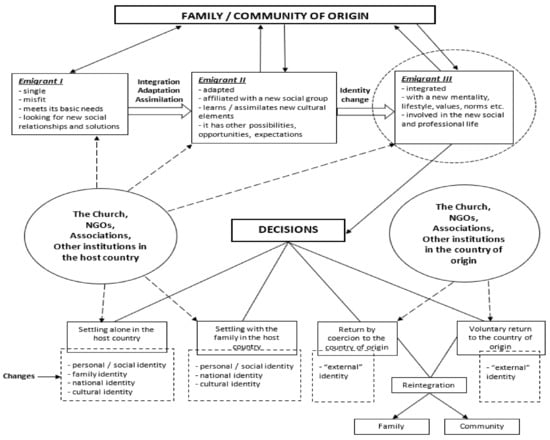
Figure 1.
Migrant identity change, decision-making, and involvement of reference institutions.
3.2.2. Interview Survey: “Individual Identity Changes Due to Migration”
The changes identified in the migrants interviewed were at several levels: mentality, thinking, self-esteem, life principles, perceptions and values, self-image and self-perception, cultural and religious, attitude and behavior, relationships and relations with others, changes in external image, etc. With reference to these, we can note that migrants’ identity orientations are not ‘“fixed ’data,” because they do not derive solely from status characteristics, but from life experiences and enduring states of mind [38].
- Self-esteem
Self-esteem is closely related to self-image, the relationship being between the self-perceived self—the self-concept—and the ideal (or desired) self, i.e., how a person would like to look in many ways [39]. Migrants may have high self-esteem or low self-esteem. The level of self-esteem strongly affects performance in all activities: Low self-esteem increases the risk of failure, leading to an even more gloomy view of oneself. Migrants’ self-esteem can change depending on their ability to self-motivate and stimulate themselves, but also on the conditions of the social environment in the country of migration: on the work done and its conditions, on employers’ assessments and evaluations, on the evaluations of the social group to which they belong, on the perception and reactions of the locals, etc.
- Mentality
In the new social environment, migrants experience aspects of life that are different from those in the country of origin, they interact with people with different perspectives and ways of thinking, they get to know new places and adopt a different lifestyle, and they have different possibilities and opportunities. All of this has a great influence on the mindset of the migrant, which is a set of beliefs and representations that determine the behavior and attitudes of individuals towards a given situation, a solidified system of reactions and responses to experience [40]. Mentalities have a very complex structure, with numerous and heterogeneous elements comprising a system of accepted ideas about social reality, an ethical system about relations between people, a set of customs, conventions and rules that are spontaneously observed, and a system of operational criteria that guide judgments in relation to the events and circumstances of social existence. The changing social environment, new social relations, culture, and civilization influence the mentality of migrants. Education, age, and material status also have a major influence. It has been argued that in many cases the change in mentality is not due to the migration experience itself, but to the education, age, or material status of the person who has worked or traveled abroad [41]. The changed mentality of migrants influences their actions and relations with their families, the community of origin, and the community of destination. Through the newly formed mentalities, migrants act to improve particular situations.
- Migrants’ behavior and attitudes
Emigration abroad has a significant and lasting influence on migrants’ behavior and attitudes. Once the adaptation period in the host country is over, migrants’ behavior tends to be closer to that of the natives. In particular, the following features are characteristic:
- -
- The language of origin is gradually replaced by the language of the country of migration, including in family communities. In addition, almost all immigrants opt to educate their children in the language of the country of migration;
- -
- The number of mixed marriages is increasing, speeding up the integration process;
- -
- The birth rate of ethnic foreigners who remain permanently in the country of adoption tends, in the long term, to approach that of the natives;
- -
- The cultural practices of the country of migration (including gastronomy, consumption patterns, culinary tastes, and even social and protocol practices) are also adopted by immigrants. However, there is also a phenomenon known as acculturation. This is the result of direct and continuous contact between individuals and groups belonging to different cultures [42].
- Lifestyle
Migrants, once they arrive in the country of migration, aim to achieve their desired goal, often linked to the economic situation. Contact with a different social environment over a period of time can lead to a change in lifestyle.
Individuals’ lifestyles show how they live their daily lives within a society; they show the differences and similarities between the ways in which individuals view reality and relate to others, and how they express their personality and identity. Lifestyle is also related to the individual’s culture. Two of the characteristics of culture are universality and particularity. It also refers to an individual’s lifestyle when he or she has alternatives to choose from and the possibility to do so. Thus, the choice of lifestyle by the migrant is determined by the society in which he or she finds himself or herself, the position he or she occupies in the society, the possibilities and opportunities, and personal choices and expressions. Lifestyles develop and are maintained at the intersection of social and cultural structures and the actions and initiatives of individuals and they are a means of expressing one’s own identities, a method of distinction [43].
- Place/space of identity
Identity place refers to that concrete space shared by social actors, whereby they are recognized as such by those outside the place and have a sense of belonging to that place, being socially recognized by others as belonging to that place. In this way, it is social identity that gives us the comfort of belonging to the community, and at the same time draws boundaries between “us” and “others” or between “ours” and “outsiders” [44].
3.2.3. Analysis Structured on Specific Themes
The analysis of the interviews are carried out in a mixed thematic analysis based on specific themes. The analysis of the interviews can be found in Table 3.
Table 3.
The analysed interviews.
4. Discussion
Migration is a factor of social change in close correlation with social mobility. Changes are felt in social structure and composition, to the extent that they are socially mobile and to the extent that they involve movements in social space, i.e., shifts from one social position to another. Change occurs in all the elements involved in migration. Whether this change occurs as a result of population movements, or whether it occurs in well-established and entrenched systems as a result of individual or group reactions, it appears as a natural and normal condition of life that characterizes social reality.
In terms of the changes identified in the migrants in the study of the article, both positive and negative self-image changes were identified. Positive changes were identified in migrants who had a positive self-image and felt an increase in self-esteem due to changes in their personal and professional development. In the country of migration they were appreciated, valued, and motivated in their activities and developed professionally. Negative changes were also identified as a result of being offended, labeled, marginalized, and exploited through work and inadequately paid.
Changes in mentality, perceptions and principles were identified through migrants learning and learning about different aspects of life and interacting with a new environment in which they learned from the rules of the country of migration, and their behavior and thinking. Changes were identified in the perception of the family, in relation to marriage between two people of different nationalities. They formed a different image of the world, of others, of themselves; they formed a different view of life in general—some became more critical, others more optimistic.
Changes in lifestyle were identified. Some of the migrants related their lifestyle to their income level and way of living, so they took on many aspects of their lifestyle and aspired to a higher standard of living. Changes in behavior and decisions were observed as a result of better living through the adoption of patterns of behavior and education, ways of relating and relating to others, and family reunification and permanent settlement abroad. Negative changes were also observed in terms of work performed, where some were marginalized, labeled, offended, and even exploited.
Changes in cultural and civilizational elements were identified. Migrants had picked up from other cultures, been in contact with people of other nationalities, and appropriated the language of the country of migration to a greater or lesser extent. Some of them had gotten involved in various activities in relation to other Romanians and representatives of Romanians in order to preserve the culture and traditions of the country of origin.
Changes in identity place/space were identified. The majority of migrants answered that “home” is abroad: some because they settled there alone or with their family, forming a space of identity, others because they felt “at home” there due to the fact that they no longer had a space of their own in the country. Few migrants said that “home” was in their country of origin and that they wanted to return.
All of these changes were discussed through the lens of identity–migration theory, which emphasizes that identity change is a “filter”, both for the representation of the family and community of origin and the migration community. Identity shifts are more evident in migrants’ decisions when they either decide to stay in the country of origin, decide to return, or are forced by certain situational factors to return.
5. Conclusions
In the context of the impact of migration on migrants, the study shows that migrants undergo changes in their identity—changes that are understood and accepted beforehand, but also changes of which they are not fully aware. These changes are beneficial for them as individuals, but also at a family and collective level, but negative changes were also identified that may subsequently lead to personal, relational, family, etc. problems. The exploration of the levels of change (self-image and self-esteem, mentality, perceptions and principles, lifestyle, cultural and civilizational elements, place/identity space) was carried out in a specific framework, on the basis of more in-depth exploration through an interview (interview guide). The questions were clear and concise, and the interviewees understood the subject matter each time.
The impact of migration on migrants and their families is felt in two ways:
- In a positive sense
Through individual changes in the country of migration, some of the emigrants had improved their material and financial situation, improved their relationships with family and others, formed new social areas and professional and entrepreneurial interests, and upon their return home, with a new mentality, a new vision, and with the accumulation from the country of migration, they came back with new innovations and developments. On return, migrants brought high professional knowledge, modern practices, and a range of human capital that could support local development [49]. The migrant can be used as a key player, as a leader who can bring ideas, strategies, and plans, which, in agreement with the members of the community, can become real and profitable projects.
Positive social identity is based to a large extent on favorable comparisons that can be made between the in-group and some relevant out-groups: The in-group must be perceived as positively differentiated or distinct from the relevant out-groups [50].
- In a negative sense
The changes produced at an individual level as a result of negative experiences that some of the migrants had had in the country of migration (labeling, humiliation, lack of moral and physical support, loneliness, not knowing the language, cultural maladjustments, etc.) can be identified at the level of self-esteem, self-confidence, and in the change in image and perception, both of the events experienced and of the place/space of emigration, and of life in general. Negative changes were also observed in terms of relationships and family. With the emigration of a family member abroad, the expectations and experiences of the partner left behind were often different, which could lead to conflicts and differences on many issues. Some families had broken up as a result of the tensions caused by the migration of a member abroad and the children left behind were deprived of the presence, affection, and full involvement of the parent who had gone abroad.
When social identity is unsatisfactory, individuals will strive either to leave their existing group and join some more positively distinct group and/or to make their existing group more positively distinct. Membership of a group is a sufficient condition for intergroup discrimination because the social self has a profound impact on individual attitudes, perception, and behavior, even if the behavior is not monitored and deviations are unlikely to be punished. Experiences and knowledge derived from group membership are internalized as part of the individual’s self-concept [51].
Limitations of the study:
More interviews were conducted with female migrants than male migrants, due to repeated refusals by the latter; migrants were randomly identified according to their decision to return for a period or permanently to the country.
Funding
This research received no external funding.
Institutional Review Board Statement
Not applicable.
Informed Consent Statement
Not applicable.
Conflicts of Interest
The author declares no conflict of interest.
References
- World Health Organization. International Migration, Health and Human Rights; Publication Series Issue No.4; World Health Organization: Geneva, Switzerland, 2003; p. 9. ISBN 92 4 156253 6. [Google Scholar]
- Albu, A.; Roşu-Hamzescu, I. Migraţia Internaţională a Forţei de Muncă; Editura Ştiinţifică şi Enciclopedică: Bucureşti, Romania, 1978; p. 11. [Google Scholar]
- Drăguţ, A. Migraţia Internaţională şi Problemele Dezvoltării; Editura Politică: Bucureşti, Romania, 1981; p. 29. [Google Scholar]
- Vasile, V.; și Zaman, G. (coord.) Migraţia Fortei de Muncă şi Dezvoltarea Durabilă a României; Editura Expert: Bucureşti, Romania, 2005; p. 109. [Google Scholar]
- Berry, J.W. Conceptual Approaches to Acculturation. In Acculturation: Advances in Theory, Measurement and Applied Research; Chun, K., Balls-Organista, P., Marin, G., Eds.; APA Press: Washington, DC, USA, 2003; pp. 17–37. [Google Scholar]
- Panicacci, A. Do the languages migrants use in private and emotional domains define their cultural belonging more than the passport they have? Int. J. Intercult. Relat. 2019, 69, 87–101. [Google Scholar] [CrossRef]
- Phinney, J. Ethnic identity and acculturation. In Acculturation: Advances in Theory, Measurement, and Applied Research; Chun, K., Organista, P., Marin, G., Eds.; American Psychological Association: Washington, DC, USA, 2003; pp. 63–81. [Google Scholar]
- Bery, J. Acculturation and adaptation in a new society. Int. Migr. 1992, 30, 69–85. [Google Scholar] [CrossRef]
- Berry, J.W. Psychology of acculturation. In Cross-Cultural: Perspectives Nebraska Symposium on Motivation; Berman, J.J., Ed.; University of Nebraska Press: Lincoln, NE, USA, 1990; Volume 37, p. 34. [Google Scholar]
- Zamfir, C.; și Vlăsceanu, L. (coord.) Dicţionar de Sociologie; Editura Babel: Bucureşti, România, 1998; p. 351. [Google Scholar]
- Vlăsceanu, L. Metodologia Cercetării Sociologice. Orientări şi Probleme; Editura Ştiinţifică şi Enciclopedică: Bucureşti, Romania, 1982; p. 101. [Google Scholar]
- Boudon, R. (coord.) Tratat de Sociologie; Editura Humanitas: Bucureşti, Romania, 1997; p. 25. [Google Scholar]
- Clément, R.; Noels, K.A. Towards a situated approach to ethnolinguistic identity: The effects of status on individuals and groups. J. Lang. Soc. Psychol. 1992, 11, 206. [Google Scholar] [CrossRef]
- Muchielli, A. L’identité; Presses Universitaires de France: Paris, France, 1986; p. 47. [Google Scholar]
- Berger, P.; Luckmann, T. Construirea Socială a Realităţii; Butucelea, A., trad.; Editura Art: București, Romania, 2008; p. 181. [Google Scholar]
- Costalat-Founeau, A.-M. Identité Sociale et Dynamique Représentationnelle; Presses Universitaires de Rennes: Rennes, France, 1997; p. 18. [Google Scholar]
- Berger, P.; Luckmann, T. The Social Construction of Reality; Penguin Books Ltd., Registered Offices: Harmondsworth, UK, 1966; p. 233. [Google Scholar]
- Brundl, P.; Kogan, I. Copilăria dincolo de Traumă şi Străinătate; Feruglio, A.M., trad.; Editura Fundaţia Generaţia—EFG: Bucureşti, Romania, 2006; p. 193. [Google Scholar]
- Sandu, D. Integrare socială. Analiză comparativă partial. In Revista Viitorul Social; Universitatea din București: București, Romania, 1972; p. 657. [Google Scholar]
- Neamțu, G. (coord.) Enciclopedia Asistenței Sociale; Editura Polirom: Iași, Romania, 2016; p. 478. [Google Scholar]
- Constantin, D.-L. (coord.) Fenomenul Migraţionist din Perspectiva Aderării României la Uniunea Europeană; Institutul European din România: Bucureşti, Romania, 2004; p. 39. [Google Scholar]
- Vinke, K.; Bergmann, J.; Blocher, J.; Upadhyay, H.; Hoffmann, R. Migration as Adaptation? Migr. Stud. J. Board 2020, 8, 626–634. [Google Scholar] [CrossRef]
- Radu, R. Psihosociologia Schimbării; Editura ASE: Bucureşti, Romania, 2005; p. 113. [Google Scholar]
- Jucan, D. Identitate şi Societate. Editura Eikon: Cluj-Napoca, Romania, 2005; pp. 64–65. [Google Scholar]
- Parsons, T. The Social System; The Free Press: Glencoe, IL, USA, 1951; p. 72. [Google Scholar]
- Chelcea, S. (coord.) Memorie Socială Şi Identitate Naţională; Editura I.N.I.: Bucureşti, Romania, 1998; p. 11. [Google Scholar]
- Buzărnescu, Ș.; Lazăr, T. Integrare. In Enciclopedia Asistenței Sociale; Neamțu, G., coord.; Editura Polirom: Iași, Romania, 2016; p. 479. [Google Scholar]
- Abdullah, D. Imigrația și procesele de integrare sistemică și socială. Rev. Sfera Politicii 2017, 25, 59–127. [Google Scholar]
- Zubenschi, E. Teoriile Sociologice ale Migrației; CSIE Working Papers, 2018. p. 52. Available online: https://csei.ase.md/wp/files/issue10/WP_ISSUE_10_ZUBE.pdf (accessed on 23 May 2022).
- Ministerul pentru Românii de Pretutindeni. Strategia Națională Pentru Românii de Pretutindeni Pentru Perioada 2017–2021; Ministerul pentru Românii de Pretutindeni: Bucureşti, Romania, 2017; p. 19.
- Chelcea, S. Metodologia Cercetării Sociologice. Metode Cantitative şi Calitative; Editura Economică: Bucureşti, Romania, 2007; p. 296. [Google Scholar]
- Singly, F.; Blanchet, A.; Gotman, A.; Kaufmann, J.-C. Ancheta şi Metodele Ei: Chestionarul, Interviul de Producere a Datelor, Interviul Comprehensiv; Editura Polirom: Iaşi, Romania, 1998; p. 182. [Google Scholar]
- Dușa, A. Elemente de Analiză Comparativă; Editura Tritonic: București, Romania, 2014; p. 24. [Google Scholar]
- Mărginean, I. Proiectarea Cercetării Sociologice; Editura Polirom: Iași, Romania, 2000; p. 207. [Google Scholar]
- Cormoș, V.C. Migrație și Identitate; Editura Universității ”Ștefan cel Mare” din Suceava: Suceava, Romania, 2011; p. 270. [Google Scholar]
- Casteel, A. Pillars of Salt: Pastoral Care with Adolescents with a Migration Experience. Religions 2022, 13, 184. [Google Scholar] [CrossRef]
- Cormoș, V.C. Schimbări Identitare în Lumea Migrației Internaționale; Editura Lumen: Iași, Romania, 2015; p. 272. [Google Scholar]
- Sandu, D. Lumile Sociale ale Migraţiei Româneşti în Străinătate; Editura Polirom: Iaşi, Romania, 2010; p. 171. [Google Scholar]
- Ilut, P. Sinele şi Cunoaşterea Lui; Ed. Polirom: Iaşi, Romania, 2000; p. 23. [Google Scholar]
- Fulga, G. Schimbare Socială şi Cultură Politică; Editura Economică: Bucureşti, Romania, 2000; p. 201. [Google Scholar]
- Sandu, D. (coord.) Locuirea Temporară în Străinătate. Migraţia Economică a Românilor: 1990–2006; Fundaţia Pentru o Societate Deschisă: Bucureşti, Romania, 2006; p. 57. [Google Scholar]
- Rusu, V. Migraţia Forţei de Muncă în Europa; Editura Arvin Press: Bucureşti, Romania, 2003; p. 32. [Google Scholar]
- Vasile, M. Stiluri de Viață în România Postcomunistă; Editura Lumen: Iași, Romania, 2010; p. 24. [Google Scholar]
- Corneliu, D. Cărăruia Varului Neatins: Însemnări, Eseuri și Stadii de Psihologie Socială Clinică, Etnografie Românească și Sociologia Vieții Cotidiene Rurale; Editura Lumen: Iași, Romania, 2012. [Google Scholar]
- Comşa, M. Stiluri de Viaţă în România; Editura Presa Universitară Clujeană: Cluj-Napoca, Romania, 2006; p. 125. [Google Scholar]
- Dahlberg, L.; Siapera, E. (Eds.) Radical Democracy and the Internet; Palgrave MacMillan: London, UK, 2007; p. 63. [Google Scholar]
- Mocrei-Rebrean, L. Psychology of Dwelling and Visual Appropriations—An Anthropological Application. Sustainability 2022, 14, 82. [Google Scholar] [CrossRef]
- La Barbera, M.C. (Ed.) Identity and Migration în Europe: Multidisciplinary Perspectives; Springer: Berlin/Heidelberg, Germany, 2015; p. 4. [Google Scholar]
- Călin, R.; Umbreş, R.G. Efectele Migraţiei Asupra Tinerilor; Editura Lumen: Iaşi, Romania, 2006; p. 42. [Google Scholar]
- Tajfel, H.; Turner, J.C. The Social Identity Theory of Intergroup Behavior. In Political Psychology: Key Readings, Key Readings in Social Psychology; Jost, J.T., Sidanius, J., Eds.; Psychology Press: New York, NY, USA, 2004; p. 284. [Google Scholar]
- Sackmann, S.; Klaus, N. Social Identity. In International Management; University BwMunich: Neubiberg, Germany, 2015; Volume 6, p. 39. [Google Scholar] [CrossRef]
Publisher’s Note: MDPI stays neutral with regard to jurisdictional claims in published maps and institutional affiliations. |
© 2022 by the author. Licensee MDPI, Basel, Switzerland. This article is an open access article distributed under the terms and conditions of the Creative Commons Attribution (CC BY) license (https://creativecommons.org/licenses/by/4.0/).