


Abstract
(1) Background: The acquisition of Information and Communication Technologies (ICTs) skills and competencies has become enormously important in regard to the effective management of studies or schooling. The questions that guided this study were: What are future teachers’ perceptions regarding the use of new technologies in teaching/learning? What are their opinions of the personal competencies necessary to appropriately make use of ICTs? The purpose of this study was to discover the opinions of future teachers—current master’s degree students—regarding the use of ICTs in teaching/learning, as well as the personal competencies involved in their best use, such as self-efficacy, creative intelligence, and emotional intelligence. (2) Methods: Three focus groups were conducted, comprising 27 graduate students. The participants were asked about their knowledge of ICTs, how they had acquired this knowledge, their attitudes when faced with a new tool, whether they considered themselves to be creative, and whether they considered themselves to be emotionally competent. (3) Results: The data analyzed revealed different opinions on the use of new technologies for innovation, as well as other factors involved in academic or professional performance. Three themes were extracted: Training experiences and ICT skills; Feelings experienced when confronted with an ICT tool; and Task-oriented personal competencies. The identification of these three themes enabled us to extract eight sub-themes. (4) Conclusions: Professionals’ evident lack of knowledge and training regarding ICTs makes it necessary to promote ICTs’ importance and to propose training programs directed at future teachers so they can improve their competencies, and thus, become better able to prepare their students, which, in turn, would allow the students to master these new technologies and make adequate use of them.
1. Introduction
In recent years, competencies and skills regarding the use of information and communication technologies (ICTs) have become very important, not only for people as individuals, but for society in general, demonstrating the importance of the role of ICTs in the management of both school and work [1]. Thus, the acquisition of skills and competencies regarding the use of technology is becoming increasingly relevant for effective use in these areas. Competence in ICTs may be affected as a consequence of the continual digital evolution, as their adequate use may depend on many factors, among which are sociodemographic characteristics, access, or interest in learning [2,3].
Accordingly, it should be mentioned that ICTs strongly impact education, where both teachers and students have been immersed in technological experiences, thereby leading to a new stage in the education system, where teaching and learning take place [4,5]. Sustainable development includes social wellbeing, which depends largely on education. The best technologies in the field of education facilitate student accessibility, personalized teaching, effective learning, monitoring each student’s progress, etc. That is, improving education and adequately preparing future generations [6].
Furthermore, ICT innovation has acquired a fundamental role at all levels of the education system. Both online teaching and digital platforms can help improve the quality of teaching, making teaching more creative and learning more significant, especially during the pandemic, when it became possible to continue working and teaching from home [7]. Furthermore, in order for students to be well prepared for tomorrow’s work environment, schools must take an active role in equipping students with technological literacy and enabling them to fully master technology. This is one of education’s high-priority goals, according to international educational standards [8]. Thus, digital literacy and the teacher’s capacity for innovation are fundamental [9]. Therefore, future teachers must have the opportunity to experience and observe how digital technologies are used in teaching/learning in order to satisfy those needs [10]. This study seeks to investigate the perception of future teachers—today’s university students in training—about the use of new technologies in the teaching/learning process and about the personal competencies that promote an optimal use of technology.
1.1. ICT in Teaching Practice
ICT training of teachers, as well as students, has become fundamental to creating an education focused on improving student performance. Adequate use of ICT tools is important to the sustainability of education [11]. Therefore, teacher training must go beyond learning basic digital competencies and find strategies for including their interpretative and creative potential. Most teacher training is basic, and prioritizes coping with classroom teaching. Teachers, therefore, perceive that their training regarding the use of ICTs in their classrooms has been insufficient. Furthermore, they feel that the inclusion of new methodological approaches is not adequately promoted [12,13].
Teachers’ improvement in ICT competencies is an indispensable requirement in education, so the need for integral training is obvious [14]. Moreover, ICT literacy has become a basic competence for teachers who must be able to prepare their students to master new technologies [15]. The Technological Pedagogical Content Knowledge model [16] emphasises the importance of addressing technology knowledge, content, and pedagogy together. Thus, a successful classroom teaching practice will be one in which the teacher knows how to use technology and how to teach it. Teachers who are skilled in all three domains (technology, content knowledge, and pedagogy) have a different level of expertise in teaching a given subject than a technology expert (e.g., a computer scientist), a content expert in a particular discipline (e.g., science), or a pedagogical expert (e.g., an experienced teacher).
Although they are aware of the benefits of ICTs in their daily lives, students may use them improperly [17], generating antisocial and risk behaviors such as cyberbullying, or facilitating substance use by buying substances online [18,19,20,21,22,23].
Alternately, there is inequality in the use of the ICTs. Even today, there is a digital gap between those who have and those who do not have access to ICTs [24,25]. Because the proportion of electronic devices has been increasing in schools, many schools must face an inequality in the acquisition of digital resources, which impedes the learning of digital competencies and skills [26,27]. However, this gap is not only related to the possibility for accessing ICTs, as described above; it also has to do with personal factors related to ICT use and integration in the classroom by teachers. In this sense, in relation to the stages of integrating technology into classroom teaching, there are a series of stages that teachers go through in order to apply ICT in the classroom [28]: (1) The teacher knows that a particular technology exists but has not used it; (2) The teacher learns the basics but does not feel self-effective and confident in its use; (3) The teacher begins to use the technology and think of novel situations for using it; (4) The teacher gains confidence through use; (5) The teacher thinks it is useful; (6) The teacher uses the technology effectively to achieve instructional goals. Therefore, for teachers to use technology in schools, it is necessary to not only have it available, but to also have a set of personal attitudes and competencies.
1.2. Personal Competencies of Teachers and Their Relationship with the Use of ICT in Education
Self-efficacy is indispensable for facing new technological challenges. In general, self-efficacy is a personal competency that enables one to cope with stressful situations or perform a given task [29]. Therefore, those who have low self-efficacy may lack initiative or interest in acquiring the ICT competencies essential for learning and improving their performance, thereby reducing their use [30]. On the contrary, high self-efficacy involves stronger self-confidence when ICTs must be used in teaching. Thus, the more often teachers use ICTs, the stronger their self-efficacy regarding their use will be [31].
Teachers with a strong sense of self-efficacy are confident that they can influence the motivation of their students, and thereby, their performances [32,33]. Similarly, a teacher’s sense of self-efficacy can also be a determinant of their job performance, commitment, and satisfaction [34].
Therefore, if future teachers’ beliefs about their self-efficacy in teaching are positive, it is more likely that their future performance will be competent [30]. Thus, stronger self-efficacy can lead to feeling motivated and to an increase use of ICTs. The acceptance model of technology shows that teacher self-efficacy largely determines the possibility for their using ICTs in class. Specifically, teachers’ beliefs about their own digital competencies, how easy they think access is, their use in education, and their perceived usefulness are directly involved in the use of ICTs in teaching [35].
Another variable related to the successful use of ICTs is the creativity of teachers’ personalities. Creativity and activities for the promotion of creativity have become a subject of interest in different fields (organizational, artistic, family, education, etc.). In education, creativity is highlighted due to its influence in developing individual cognitive skills, being essential to solving everyday problems. Creativity can be studied in different areas of the arts and sciences (music, dance, painting, sculpture, literature, mathematics, physics, etc.) [36] or in daily life [37]. In this sense, teachers reject the notion that creativity is synonymous only with art, music, or other related activities. They believe that creativity can be part of all educational subjects [38] and that technology can be used to encourage it [39]. However, it seems that creativity regarding the use of technology is not as present as it is in art or daily activities [40], so its study is important, especially for teachers.
Creativity is a complex phenomenon, and therefore, must be evaluated in many dimensions. Among them, personality emerges as the most significant. Creative personality refers to personality traits related to creative skills and achievement [41]. People with a creative personality are characterized by having strong initiative, interest, energy, and enthusiasm, making it easier for them to consolidate creative awareness, thereby leading to innovative behavior [42,43]. These characteristics favor individuals strengthening creative awareness and generating innovative behaviors [44]. For example, Loveless et al. [39] indicated that student teachers are interested in the pursuit of creativity in the design and evaluation of personal projects through the use of ICT and their personal creativity. In order to be able to adapt to the fast pace of life, with its constant changes and technological innovations, it is necessary for people to manifest traits of a creative personality and to use them in many areas, such as education [45]. In fact, the creative personality in teachers and its stimulation among students has come to the forefront of education and teaching services [46,47].
Predispositions related to personality and emotions cause people to cope with everyday situations differently. It has been demonstrated that emotional intelligence is associated with coping strategies that promote well being, decrease psychological distress, and control negative emotions [48,49,50]. That is, emotional intelligence, which refers to self-perceptions and dispositions related to emotions, can help cope satisfactorily with stressful situations. In this sense, in order to achieve educational excellence, teachers must be able to successfully manage the accumulation of emotions and work-related stress. Those with higher levels of emotional intelligence are better able to cope with emotionally charged and highly stressful work situations [51]. In addition, the use of technology in teaching can be challenging, arousing teachers’ negative feelings towards their jobs. Effectively managing these emotions is vital to maintaining performance, and equally influences teachers’ sense of self-efficacy, promoting positive work behaviour [52].
Related to the above, the application of technology in the classroom for less experienced teachers requires the provision of resources, guidance, stimulation, and transition time [53]. Thus, the reliance on technology experienced during the pandemic posed a significant challenge for many teachers, who experienced this change as a burden [54]. Teachers who are forced to use equipment and technology with which they are not comfortable experience high pedagogical stress. For most teachers, the pandemic led to increased stress, anxiety, frustration, depression, and loneliness [55], all of which have serious consequences for psychological well being [56]. Conversely, the pandemic can also be seen as an opportunity for growth, a challenge rather than a threat, where effective coping involves the effective use of emotional strategies [57,58,59]. Thus, sudden changes, such as the use of technology in education, could be dealt with effectively by those with high emotional intelligence.
On this basis, the following research questions were proposed: What are future teachers’ perceptions regarding the use of new technologies in teaching/learning? What are their opinions of the personal competencies necessary for the appropriate use of ICTs?
Therefore, the objective of this study was to inquire into the opinions of future teachers—today master’s degree students—on the use of ICTs in the process of teaching/learning, as well as the personal competencies involved in their optimal use, such as self-efficacy, creative intelligence, and emotional intelligence.
2. Materials and Methods
2.1. Design
The present study is a descriptive qualitative study. Descriptive qualitative design uses a naturalistic perspective to understand a phenomenon in a natural context, and emphasises the exploration of the meanings ascribed by the individuals involved [60]. Such an approach offers a rich description of a phenomenon about which little is known [61]. The purpose of the descriptive qualitative study is to gain knowledge of experiences, events, and interactions with phenomena from an insider’s point of view [60]. The use of a descriptive qualitative design allowed us to obtain rich descriptions about the opinions of master’s degree students on the use of ICTs in teaching/learning and their individual competencies regarding self-efficacy, creativity, and emotional intelligence.
Twenty-seven master’s degree students were selected and distributed into three focus groups for in-depth exploration of the narrative of master’s degree students. Focus group methods are used in qualitative research when it is observed that group interaction can be beneficial [62], achieving more useful results that can generate a rich understanding of the experiences and beliefs of the participants, which could not be obtained from individual interviews [63]. Focus groups also make it possible to capture attitudes, feelings, norms, experiences, and reactions from participants, thereby increasing positive group dynamics and interaction [64]. Focus groups are usually presented as conversations in which the participants talk about a specific theme in a socially organized situation, where different points of view can be considered [65]. This study used intentional sampling, in which the researchers selected the participants in the focus groups based on their education level (i.e., master’s degree students) and area of study (i.e., education), as well as its context [66]. Intentional sampling was also homogeneous, concentrating on individuals who shared similar characteristics with regard to work and university education [67].
The purpose of the focus groups analyzed in this study was to compare different opinions on the use of new technologies for innovation, and other factors involved in academic and/or professional performance. To meet this objective, thematic analysis was used to explore the narratives, distributing the discourse into smaller content units, as a useful method for identifying, analyzing, and reporting patterns across the data [68].
2.2. Focus Group Recruitment
Participaron un total de 27 alumnos de máster de la Universidad de Almería, con edades comprendidas entre los 22 y los 49 años, presentando una media de edad de 28.55 años (SD = 6.36). Distribution by sex was 10.8% (n = 4) men and 89.2% (n = 23) women with a mean age of 28.6 (SD = 6.88) and 28.50 (SD = 1.95), respectively. The sample was distributed in three focus groups, which were held in a one-and-a-half-hour videoconference, since classes were being taught online due to the health situation derived from COVID-19 (see Table 1).

Table 1.
Sample Characteristics.
2.3. Data Collection
The focus groups were formed using a semi-structured question guide, related to training and knowledge of ICTs, participants’ use of ICTs, their own attitudes toward the use of the ICTs, and questions related to self-efficacy, motivation, creative personality, and emotional intelligence related to ICTs. A brief ad hoc questionnaire was also prepared to collect sociodemographic information (age, sex, education). The study was approved by the University of Almería Bioethics Committee (Ref: UALBIO2020/046). The participants gave their oral consent to participate at the beginning of each session of the focus group. The focus groups were video and audio recorded on the master’s degree virtual platform, collected verbatim by the researchers.
Saturation was evaluated by the extent of progress in the subject matter, and the relevance of the subject related to the data analyzed. In all three focus groups, 98% of the most relevant themes were covered, therefore, the configuration of the code book was stabilized with three focus groups and no change was made after that. In this study, over half (69%) of the codes were developed in the first focus group, in the second focus group, 91%, and in the third group, 98% of the codes were developed. Therefore, a homogeneous sample, properly defined study objectives, and the focus group semi-structured interview guideline may have contributed to reaching data saturation in the focus groups set up, and could, therefore, be achieved with a small sample [69].
In addition, a semi-structured theme guide was prepared to direct the focus groups. However, it should be mentioned that the moderator encouraged participant discussion.
2.4. Data Analysis
The focus groups were videorecorded on a virtual blackboard platform for master’s degree content where the students in the focus group were enrolled, and transcribed by a member of the team (AMM).
Data analysis followed the six-step thematic analysis approach by Braun & Clarke [70]: (1) Familiarization with data, (2) Coding, (3) Generating initial themes, (4) Reviewing themes, (5) Defining and naming themes, and (6) Writing up. When the focus groups had been transcribed, the codes were independently generated in parallel by three members of the research group in a cyclical iterative process of organizing the data into significant themes, then a unanimous agreement was reached by the whole team to demonstrate consistency in the study. After that, broader patterns of meaning shared throughout the data were identified, making sense of the ideas which, in the beginning, seemed imprecise in the transcription. During this process, the themes were checked to see if they captured the coded data adequately within the research question and then to see whether the themes represented the dataset [71]. Finally, the themes were determined, giving each of the themes selected informative and attractive names, symbolizing the ideas and experiences most mentioned by the participants [72].
The analytical functions of the transcriptions were performed using ATLAS.ti qualitative software [73]. Finally, the team organized the data in categories and themes representing the main findings.
Data triangulation was initially carried out between two researchers in the team. Agreement was then checked with a third researcher. Finally, initial results were sent to participants to check agreement with the data.
2.5. Rigour
To ensure rigour, the criteria of Lincoln and Guba [74] were followed. These four criteria are described in detail below. 1. Credibility: Two researchers with expertise in qualitative research analysed the data independently. The results were then triangulated between all members of the research team and the participants. 2. Transferability: To ensure the transferability of this study, the participants’ experience and the context of the participants was described in detail. 3. Dependability: to ensure the dependability of the research, the researchers described in detail the methodology followed at each stage of the study. Confirmability: to ensure the confirmability of the results, the results were returned to the participants for further information if deemed necessary. Thus, the summary narratives support confirmability.
3. Results
Three themes were extracted (Training experiences and ICT skills, Feelings experienced when confronted with an ICT tool, and Task-oriented personal competencies), which allowed for the extraction of eight sub-themes (ICT Training and knowledge, Use of the ICTs, Attitudes toward the use of ICTs, Communication, Creative Personality, Self-efficacy with the use of ICTs, Motivation and Emotional intelligence) allowing inquiry into the opinions of master’s degree students on the use of ICTs in teaching/learning and their individual competencies regarding self-efficacy, creativity, and emotional intelligence (see Figure 1).
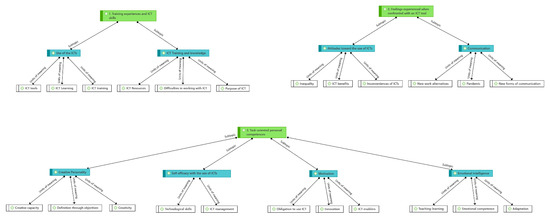
Figure 1.
Summary of themes, subthemes and units of meaning.
3.1. Training Experiences and ICT Skills
This main theme covers factors related to students’ ICT training and their use of ICT, as well as opinions on the benefits of ICT, and even the disadvantages it can cause to teaching.
3.1.1. ICT Training and Knowledge
Several ICT tools, such as Word, PowerPoint, ClassDojo, Google Drive, Google Documents, Moodle, Google Forms, Canvas, Genialy, and Prezzi are currently used in study and work environments.
“The one I always use is Google, especially Google Documents and Moodle. This year, because of COVID, I took a course in remote teaching for teachers and they taught us to use this application, Moodle. The truth is that it is very good, because, as you said, it can be used in either work or study environments. Both for the youngest children and for adolescents, and then on the job.” Participant 3, Group 1.
“I use Class Dojo with my students, and especially Google Classroom to assign homework and to stay in contact with their parents as well, because, the truth is, that is super useful. And in the end, we were using it from our cell phones, and then you don’t have to be at the computer the whole time, and you are connected 24 h a day. And it’s true that at first, I wasn’t very familiar with Google Classroom and I had to learn by investigating, because I have no training in any of that. But it is true that the others, maybe even most of them, are not used to the networks either, and are immersed in the end, and they needed tutorials on how to use it.” Participant 2, Group 2.
Most of the participants said that they had known the tools mentioned above from surfing the Internet on their own, to acquire information on tools that could help them with the activities they needed to carry out. Therefore, most of them stated the importance of learning about new ICT tools that are useful at work as well as study.
“I at least, see that you don’t know but you get into it and you learn superfast. Maybe the times, age or generation also.” Participant 1, Group 3.
“I learned rather by searching for what I wanted on the internet. Rather getting by on my own, because I never signed up for a course or had anybody to teach me.” Participant 5, Group 2.
Others, however, said they had found out about some tools in training courses and their formal education.
“The training I had in ICTs was basically at the university and at the academy where I went to prepare for the state exams.” Participant 6, Group 2.
“Well, my training, now I’ve signed up for two courses in new technologies precisely because the school asked us to.” Participant 8, Group 1.
3.1.2. Use of the ICTs
From a teaching perspective, they alluded to the lack of technological resources to facilitate their work in the classroom, expressing the scarcity of material that would enable them to work with ICTs.
“Many schools are not prepared yet. Or not all the students have a computer or a tablet.” Participant 1, Group 1.
“I think that also depends a lot on the type of ICT resources you know. A lot of schools do not have ICT resources. And I, for example, was in a classroom supporting interaction. We did not have a computer there. The computer we had was really old. I couldn’t enter applications. When you work with children with needs, it really helps. But if you really don’t have the means, you can’t use it either.” Participant 8, Group 3.
On the other hand, they mention that the applications most used are social networks, such as Instagram, Facebook or Twitter, as well as WhatsApp or Gmail, and that they could not get along without them in their daily lives.
“Yes. Social networks, Gmail, YouTube, Google…” Participant 3, Group 2.
“I use social networks more, like Facebook, Instagram…” Participant 2, Group 1.
3.2. Feelings Experienced When Confronted with an ICT Tool
In this main theme, the sensations experienced by students when they are confronted with an ICT tool are collected, as well as their opinions when faced with a new form of online communication.
3.2.1. Attitudes toward the Use of ICTs
The participants in the three focus groups said that ICTs had many advantages for both work and study, since they provided them with useful tools that could be applied in everyday life.
“Yes, I think so. I have an example that I don’t know who I was talking to the other day, that was imagining what the Master’s Thesis we have to do now would be like if we couldn’t search on the internet. We would have to go to a library, we would have to … In other words, I don’t know how they worked on the Master’s Thesis before, because it is a load of work searching in journals, in books in… I can’t even imagine it.” Participant 1, Group 2.
“But also, to know resources, because now you go on Instagram and you follow five teachers and they give you a bunch of ideas for working on millions of things, resources… especially resources. For me, the resources are very important. Not just the applications or any of that, but learning resources, whether you use them or not. But you have them.” Participant 3. Group 1.
However, the participants also commented that there are many disadvantages to using ICTs, not only attributed to their improper use, but also to inequalities.
“I have the feeling that sometimes the fact that you have an application or a resource, that, puts us in contact with the parents so quickly or so easily, for example, … Sometimes it goes overboard and it seems like the parents or parents’ representative, or mothers can contact you any time, or you become a slave of WhatsApp at the weekend. That is, it’s like we have gone a little beyond the limit, with that facility we have, we abuse that resource a little.” Participant 4, Group 2.
“We don’t realize it, because we all have internet at home and we are all on a middle sociocultural level, of the digital gap that exists and of the inequalities that these circumstances, for example, on the level of COVID, have generated in many schools, and the job circumstances of many families. Well, because not everybody has Internet at home, because no… So I understand that is one of the problems of everything depending on the ICT, Internet, the technologies.” Participant 8, Group 3.
3.2.2. Communication
Starting with the pandemic, they admit that their way of communicating with their surroundings, family, or friends has changed drastically, since communication has gone online. In some cases, they also admit that during the pandemic, ICTs enabled them to carry out administrative procedures simply and without having to be there in person.
“Our way of living with others has changed. And that involves communication, everything, the way we are with others.” Participant 6, Group 2.
“Man, it’s true that during the pandemic and so forth, the ICTs even solved procedures that should have been done in person. Now that everything is digitalized, everything is easier.” Participant 3, Group 3.
3.3. Task-Oriented Personal Competences
The third theme corresponds to a set of personal competencies which, in addition to being closely related to each other, are considered by future teachers to be intervening variables in the process of task performance and interest in tasks.
3.3.1. Creative Personality
When we asked them to define themselves with an adjective, most focused on what they are like in the academic environment. Among the adjectives they used to define themselves were: constant, perfectionist, resolved, committed, and demanding in performing a task.
“Being positive, I would say that I am also a very responsible person. And I always comply with all my obligations, and what is not an obligation too. Because I am rather committed, as A7 said before. And being negative, I think I am very anxious. Everything makes me nervous. I want everything fast, I want everything now, and that’s no how things are.” Participant 2, Group 1.
“Positively, I would say that I am responsible with my things. I always try to keep up with everything. And negatively, I am a little negative. I always think that something could go wrong.” Participant 4, Group 3.
Concerning their creative ability, most of them said they were creative, especially when they were interested in a task.
“I think everybody has different abilities. And each one has things that they do better than others. In particular, I consider myself creative in the subjects I like the most. In what I think I like and can give more to. Yes, I do think so. Now with what I don’t understand, what I don’t know, it’s really hard for me.” Participant 7, Group 1.
“I think so. At least I like creativity very much. Apart from the ICTs, handiwork too. Drawing, all kinds of crafts… So, yes, I think so.” Participant 3, Group 2.
3.3.2. Self-Efficacy with the Use of ICTs
In spite of being aware of the benefits of ICTs and of their usefulness, most of them did not feel that they managed them well, and even felt overcome when they had to face a new digital tool.
“Yes, the truth is that it does overwhelm me a little. It’s not that I don’t think I am capable, but maybe that it’s going to take me such a long time.” Participant 4, Group 2.
“I’m overwhelmed before I start.” Participant 8, Group 3.
However, some of the members of the focus groups talked about the skills they had in managing new technologies, and even mentioned feeling motivated and interested when they were faced with a new tool.
“I think I’m good at it. For example, if I don’t know how to do something, I investigate and I learn it right away. Like it’s something that always attracted me… I don’t know if that is because my father is a computer technician or whatever, I don’t know. I always like to try new things and investigate and all that.” Participant 5, Group 1.
“Yes, well, I’ve always been very curious, digitally speaking. And when I am faced with some tool or something I don’t know, I feel motivated to know how to do it, in fact, at a graduation they asked me, ‘Could you make a video?’ And I said, ‘I don’t know, but I can try.’ And in everything related to the ICTs, I’ve always felt like, on the contrary, super motivated to see how you do it, like that. And I always try to discover new programs, more complicated, and so on. And that is a little in contrast to the other girls, because I just always have a good time discovering new digital tools.” Participant 3, Group 2.
3.3.3. Motivation
There are several reasons that participants use new technologies, among them, they mention that they save time, help them to innovate in their work, and above all, they said that during the pandemic, they were motivated to be able to communicate with their surroundings.
“The time it saves. It’s not the same doing it all by hand as doing it, say, on some platform.” Participant 5, Group 1.
“Me too. I think it makes life easier.” Participant 2, Group 1.
“And also, to try to innovate a little in what you are doing. That is, try to look for something new.” Participant 7, Group 2.
Although they said that sometimes it was not just being motivated that inspired them to use these tools, but also that they were required to when something was assigned to them.
“At first, I thought that you start using them a little because you have to, then you start to like it, then you start seeing that they’re good, that you can improve… But I think there is a mixture of a little of everything.” Participant 2, Group 1.
“In the end, a little the obligation that we have to look for it, we have to do something and, well, I just do it, and that’s that. So then do I like it and so forth? Yes, but because I got up and wanted to learn such and such application, sincerely no.” Participant 2, Group 2.
3.3.4. Emotional Intelligence
Most of the participants felt emotionally competent during the months of lockdown due to the pandemic. They did not feel bad and knew how to adapt to the new situation, largely thanks to the availability of ICT resources.
“I think I was okay. In the end I entertained myself with one thing or another, I don’t know. I kept my mind occupied. It’s hard for me to be alone. But thanks to technology I can stay in touch with my friends, family and colleagues at all times.” Participant 6, Group 1.
“In my case, I think that I know to manage those emotions, I think that I do, that I am in good command of them. Or that at least I have learned to master them but because I had no other choice. Many times, to calm my anguish, I would turn on my mobile or computer, to connect with the world, see what was happening out there or distract myself.” Participant 8, Group 2.
Teachers in training also indicated having a high capacity for adaptation and high emotional competence to successfully face the technological changes caused by the pandemic.
“Although everything happened very quickly, the truth is that I got down to work from the beginning. I didn’t have time to get frustrated or stressed, so I coped with all the technological changes at work and in life in general. best I knew how. Quite successfully, I think.” Participant 3, Group 3.
When asked about future proposals or recommendations they could make to improve teaching/learning, most of them said that working on emotional intelligence in the classroom is fundamental to teaching/learning. Working on emotions with the students was essential for them. And they also emphasized continued teacher training, especially in the area of technology.
“Making emotional intelligence important too. That I, for example, when I have done practice teaching in many places, there are schools where it is not worked on at all. And that is also a shame. That is, I think that it is essential to know how to manage your emotions and understand them to be able to live with others.” Participant 3, Group 1.
“I think so too, that you have to combine the new technologies with real life. There is a lot missing. So, I think that it would be ideal or suitable, to combine it with each one’s needs. In addition, as teachers we need to be better prepared, to be prepared in the career and to receive continuous training to always be up to date” Participant 8, Group 1.
Lastly, a word cloud was created with the most popular terms found after analysis of the three focus groups. Figure 2 shows how the size of each concept that appears in the word cloud represents the importance of each key word, according to the number of times it was repeated. Among the words most repeated in the focus groups are: ICTs (n = 66), level (n = 56), children (n = 55), technologies (n = 46), tools (n = 41), application (n = 32), training (n = 31), laugh (n = 26) and cell (n = 23) and to a lesser extent, others such as learn (n = 25), emotions (n = 24), education (n = 22), academic (n = 22), Google (n = 17), teacher (n = 15), lockdown (n = 12), and others.
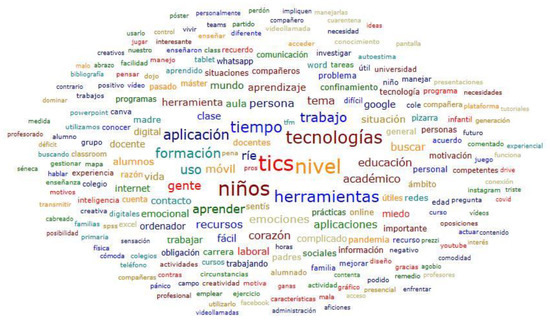
Figure 2.
Word cloud. Source: by authors. Note: In this Figure the word cloud appears in Spanish, since the transcriptions of the focus groups have been made in Spanish.
4. Discussion
This study identified cuatro themes related to: Training experiences and ICT skills, Feelings experienced when confronted with an ICT tool and Task-oriented personal competencies.
Presently, training and knowledge of ICTs have become fundamental to both study and work. However, most of the participants said they had received no professional training on ICT tools in training centers or schools, rather, they had acquired their knowledge on their own. This is in agreement with the results of Røkenes and Krumsvik [12] and Valverde-Berrocoso et al. [13], who showed that the training of future teachers is superficial and insufficient for teaching ICTs to their students, which limits the incorporation of new methodological approaches to teaching.
Simultaneously, this lack of knowledge and training may be due to the lack of technological resources in schools, since, as the participants in the focus groups argued, many schools still are not immersed in ICTs. This digital gap could limit the learning of digital competencies and skills due to inequality in the acquisition of digital resources. That is, the current digital divide in schools limits the learning of digital competencies and skills, which, in turn, increases the future digital divide [26,27].
The participants discussed the benefits that ICTs have provided them in study and work. According to the participants, they provide a multitude of benefits, since the technological tools available today facilitate their work effectively, and furthermore, help them improve the quality of their teaching, contributing creativity to teaching and making teaching significant [7].
In relation to how they personally felt about managing the ICTs, most of them said they did not know the tools they use well, which sometimes caused them frustration and stress. In fact, the evidence emphasizes that those who have low self-efficacy and self-esteem may have little initiative or interest in learning new ICT tools, causing them to avoid ICTs when possible [30]. Nevertheless, some of the members of the groups said they had skills for acquiring ICT competencies, and this is in agreement with studies that show that high self-efficacy in ITCs leads people to have confidence in themselves when they are going to use them, and to use them often in their work [31].
Similarly, people consider themselves creative when they are assigned tasks that interest them or that relate to a certain area. This supports results of previous research, which showed that people who have a creative personality have a strong imagination and interest, favoring creative awareness, which helps them innovate in study and work [42].
In addition, the participants in the focus groups said they felt emotionally competent during the pandemic, and knew how to cope with and adapt to their situations. For some people, the pandemic was a challenge, where emotional intelligence associated with coping strategies was fundamental in dealing with certain situations in daily life related to the pandemic, and to promoting wellbeing and reducing psychological stress [48,49].
Finally, the importance of working on the regulation of emotions and on acknowledging and managing them from an early age was stressed, due to the basic role these skills have in children’s lives, as well as their influence on variables as important as psychological adjustment, health, and life satisfaction [75].
Some limitations should be mentioned. First, the sample size was small. Therefore, a larger sample could have provided better results, giving more weight to commonly shared opinions. Second, only master’s degree students were selected, limiting the analysis of opinions to those with a specific level of education. Therefore, it would be of interest to know the viewpoints of undergraduate students.
5. Conclusions
Information and communication technologies (ICTs), have recently acquired enormous importance in both school and work, where they have become a vital part of teaching/learning, making ICT training indispensable for teachers and students in order to achieve a better-quality education. This study provides a description of teachers’ knowledge of ICTs, and highlights the lack of training that keeps them from using technological tools to effectively perform their work. Therefore, the participants proposed detailed recommendations for improving teaching/learning. The thematic analysis also emphasized that the participants recognize having felt emotionally competent for coping effectively during the pandemic, knowing how to adapt to this new situation and the technological demands it entailed. This possibility of work and academic adaptation during the pandemic, through the effective use and management of ICTs, acted as a resource linked to emotional well being and feelings of self-efficacy. We hope that this study will highlight the student teachers’ currently significant lack of ICT knowledge and training. This gap makes it necessary to emphasize the importance of the use of ICTs, and suggests that training programs should be designed and directed at future teachers to develop and increase their ICT competence, which should include both knowledge of educational technological content and performance levels [76,77]. Thus, they will become better able to prepare their pupils to make optimal use of new technologies.
Author Contributions
M.d.M.M.J., M.d.M.S.M. and M.d.C.P.-F. contributed to the conception and design of the review; A.B.B.M. and Á.M.M. applied the search strategy; All authors applied the selection criteria; All authors completed the assessment of risk of bias; All authors analyzed the data and interpreted data; M.d.M.S.M., M.d.M.M.J., M.d.C.P.-F., Á.M.M. and A.B.B.M. wrote the manuscript; J.J.G.L. edited this manuscript; M.d.C.P.-F. is responsible for the overall project. All authors have read and agreed to the published version of the manuscript.
Funding
This research received no external funding.
Institutional Review Board Statement
The study was approved by the University of Almería Bioethics Committee (Ref: UALBIO2020/046).
Informed Consent Statement
Informed consent was obtained from all subjects involved in the study.
Data Availability Statement
The data presented in this study are available on request from the corresponding author.
Acknowledgments
This publication is part of the I+D+i PID2020-119411RB-I00 funded by MCIN/AEI/10.13039/501100011033/ and FEDER “Una manera de hacer Europa”. In addition, this project has been carried out thanks to the Call for the creation of Innovation Groups and Good Teaching Practices at the University of Almería (2020–2021 biennium). Ref.: 20_21_1_11C.
Conflicts of Interest
The authors declare no conflict of interest.
References
- Kaarakainen, M.T.; Kivinen, O.; Vainio, T. Performance-based testing for ICTSskills assessing: A case study of students and teachers’ ICTSskills in Finnish schools. Univers. Access Inf. Soc. 2018, 17, 349–360. [Google Scholar] [CrossRef]
- van Deursen, A.J.A.M.; van Dijk, J.A.G.M. Modeling Traditional Literacy, Internet Skills and Internet Usage: An Empirical Study. Interact. Comput. 2016, 28, 13–26. [Google Scholar] [CrossRef]
- Wicht, A.; Reder, S.; Lechner, C.M. Sources of individual differences in adults’ ICTSskills: A large-scale empirical test of a new guiding framework. PLoS ONE 2021, 16, e0249574. [Google Scholar] [CrossRef] [PubMed]
- De Toro, X.; Sotomayor, B.; Saracostti, M.; Rossi, A.; Lara, L. Plataforma Online de Evaluación de Compromiso Escolar, Versión 3.0: Avance hacia un sistema de protección de las trayectorias educativas [Online Platform for the Evaluation of School Commitment, Version 3.0: Progress towards a protection system for educational trajectories]. Eur. J. Educ. Psychol. 2021, 14, 1–29. [Google Scholar] [CrossRef]
- Ramírez-García, A.; González-Fernández, N. Media competence of teachers and students of compulsory education in Spain. Comunicar 2016, 24, 49–58. [Google Scholar] [CrossRef]
- Haleem, A.; Javaid, M.; Qadri, M.A.; Suman, R. Understanding the role of digital technologies in education: A review. Sustain. Oper. Comput. 2022, 3, 275–285. [Google Scholar] [CrossRef]
- Banerjee, D.; Das, D.; Pal, S.; Paul, S.; Debnath, S.; Reza, M. Effect of covid-19 on digital transformations in teaching learning methodology and its consequences in society: A review. J. Phys. Conf. Ser. 2021, 1797, 012066. [Google Scholar] [CrossRef]
- UNESCO. ICT Competency Framework for Teachers UNESCO. [Marco de Competencias de los Docentes en Materia de TIC UNESCO]; UNESCO: Paris, France, 2019. [Google Scholar]
- Ministry of Economic Affairs and Digital Transformation National Digital Skills Plan. (n.d.). Available online: https://portal.mineco.gob.es/RecursosArticulo/mineco/ministerio/ficheros/210127_plan_nacional_de_competencias_digitales.pdf (accessed on 14 March 2021).
- Çebi, A.; Bahçekapili, T.; Reisoglu, I.; Çolak, C. From digital competences to technology integration: Re-formation of pre-service teachers’ knowledge and understanding. Int. J. Educ. Res. 2022, 113, 101965. [Google Scholar] [CrossRef]
- Hurajova, A.; Kollarova, D.; Huraj, L. Trends in education during the pandemic: Modern online technologies as a tool for the sustainability of university education in the field of media and communication studies. Heliyon 2022, 8, e09367. [Google Scholar] [CrossRef]
- Røkenes, F.M.; Krumsvik, R.J. Development of Student Teachers’ Digital Competence in Teacher Education-A Literature Review. Nord. J. Digit. Lit. 2014, 9, 250–280. [Google Scholar] [CrossRef]
- Valverde-Berrocoso, J.; Fernández-Sánchez, M.R.; Revuelta, F.I.; Sosa-Díaz, M.J. The educational integration of digital technologies preCovid-19: Lessons for teacher education. PLoS ONE 2021, 16, e0256283. [Google Scholar] [CrossRef]
- Nurhabibah, A.; Setiawan, A.; Yanti, H.; Miraj, Y.; Yannuar, Z. Analysis of ICTSLiteracy Competence among Vocational High School Teachers. IOP Conf. Ser. Mater. Sci. Eng. 2018, 306, 012097. [Google Scholar] [CrossRef]
- Engelhardt, L.; Naumann, J.; Goldhammer, F.; Frey, A.; Wenzel, S.F.; Hartig, K.; Horz, H. Convergent evidence for the validity of a performance-based ICTSskills test. Eur. J. Psychol. Assess 2020, 36, 269–279. [Google Scholar] [CrossRef]
- Mishra, P.; Koehler, M.J. Technological Pedagogical Content Knowledge: A new framework for teacher knowledge. Teach. Coll. Rec. 2006, 108, 1017–1054. [Google Scholar] [CrossRef]
- Pérez, T.; Godoy, C.; Piñero, E. Hábitos de consumo de las nuevas tecnologías en adolescentes ¿Uso o abuso? [Habits of consumption of new technologies in adolescents. Use or abuse?]. Eur. J. Develop. Educa. Psychop. 2019, 7, 47–57. [Google Scholar] [CrossRef]
- Barragán, A.B.; Molero, M.M.; Pérez-Fuentes, M.C.; Simón, M.M.; Martos, Á.; Sisto, M.; Gázquez, J.J. Study of cyberbullying among adolescents in recent years: A bibliometric analysis. Int. J. Environ. Res. Public Health 2021, 18, 3016. [Google Scholar] [CrossRef]
- Feijóo, S.; Foofy, M.; O’Higgins Norman, O.; Pichel, R.; Rial, A. Cyberbullies, the cyberbullied, and problematic internet use: Some reasonable similarities. Psicothema 2021, 33, 198–205. [Google Scholar] [CrossRef]
- Nasaescu, E.; Zych, I.; Ortega-Ruiz, R.; Farrington, D.P.; Llorent, V.J. Longitudinal Patterns of Antisocial Behaviors in Early Adolescence: A Latent Class and Latent Transition Analysis. Eur. J. Psychol. Appl. Leg. Context 2020, 12, 85–92. [Google Scholar] [CrossRef]
- Oksanen, A.; Miller, B.L.; Savolainen, I.; Sirola, A.; Demant, J.; Kaakinen, M.; Zych, I. Social Media and Access to Drugs Online: A Nationwide Study in the United States and Spain among Adolescents and Young Adults. Eur. J. Psychol. Appl. Leg. Context 2020, 13, 29–36. [Google Scholar] [CrossRef]
- Pérez-Fuentes, M.C.; Gázquez, J.J.; Molero, M.M.; Cardila, F.; Martos, Á.; Barragán, A.B.; Garzón, A.; Carrión, J.J.; Mercader, I. Adolescent impulsiveness and use of alcohol and tobacco. Eur. J. Investig. Health Psychol. Educ. 2015, 5, 371–382. [Google Scholar] [CrossRef]
- Molero, M.M.; Martos, Á.; Barragan, A.B.; Pérez-Fuentes, M.C.; Gázquez, J.J. Anxiety and Depression from Cybervictimization in Adolescents: A Metaanalysis and Meta-regression Study. Eur. J. Psychol. Appl. Leg. Context 2022, 14, 42–50. [Google Scholar] [CrossRef]
- Yilmaz, R.M.; Baydas, O. An examination of undergraduates’ metacognitive strategies in pre-class asynchronous activity in a flipped classroom. Educ. Technol. Res. Dev. 2017, 65, 1547–1567. [Google Scholar] [CrossRef]
- Álvarez-Icaza, I.; Bustamante-Bello, R.; Ramírez-Montoya, M.S.; Molina, A. Systematic Mapping of Digital Gap and Gender, Age, Ethnicity, or Disability. Sustainability 2022, 14, 1297. [Google Scholar] [CrossRef]
- Hori, R.; Fujii, M. Impact of using ICTSfor learning purposes on self-efficacy and persistence: Evidence from Pisa 2018. Sustainability 2021, 13, 6463. [Google Scholar] [CrossRef]
- van Deursen, A.; van Dijk, J. Internet skills and the digital divide. New Media Soc. 2011, 13, 893–911. [Google Scholar] [CrossRef]
- Norris, C.; Soloway, E. y Texas Center for Educational Technology Snapshot Survey. 1999. Available online: http://www.iittl.unt.edu/surveys/demos/index.htm (accessed on 14 March 2021).
- Bandura, A. Self-efficacy: Toward a unifying theory of behavioral change. Psychol. Rev. 1977, 84, 191–215. [Google Scholar] [CrossRef]
- Elstad, E.; Christophersen, K.A. Perceptions of digital competency among student teachers: Contributing to the development of student teachers’ instructional self-efficacy in technology-rich classrooms. Educ. Sci. 2017, 7, 27. [Google Scholar] [CrossRef]
- Rohatgi, A.; Scherer, R.; Hatlevik, O.E. The role of ICTSself-efficacy for students’ ICTSuse and their achievement in a computer and information literacy test. Comput. Educ. 2016, 102, 103–116. [Google Scholar] [CrossRef]
- Guo, Y.; Connor, C.M.; Yang, Y.; Roehig, A.D.; Morrison, F.J. The effects of teacher qualification, teacher self-efficacy, and classroom practices on fifth graders’ literacy outcomes. Elem. Sch. J. 2012, 113, 3–24. [Google Scholar] [CrossRef]
- Zee, M.; Koomen, H.M.Y.; Jellesma, F.C.; Geerlings, J.; deJong, P.F. Inter- and intra-individual differences in teachers’ self-efficacy: A multilevel factor exploration. J. Sch. Psychol. 2016, 55, 39–56. [Google Scholar] [CrossRef]
- Pfitzner-Eden, F. I feel less confident so I quit? Do true changes in teacher self-efficacy predict changes in preservice teachers’ intention to quit their teaching degree? Teach. Teach. Educ. 2016, 55, 240–254. [Google Scholar] [CrossRef]
- Antonietti, C.; Cattaneo, A.; Amenduni, F. Can teachers’ digital competence influence technology acceptance in vocational education? Comput. Hum. Behav. 2022, 132, 107266. [Google Scholar] [CrossRef]
- Grushka, K.; Hope, A.; Clement, N.; Lawry, M.; Devine, A. New visuality in Art/Science: A pedagogy of connection for cognitive growth and creativity. Peabody J. Educ. 2018, 93, 320–331. [Google Scholar] [CrossRef]
- Tanggaard, L. The Creative Pathways of Everyday Life. J. Create Behav. 2015, 49, 181–193. [Google Scholar] [CrossRef]
- Cropley, D.H.; Parston, T.; Marrone, R.L.; Kaufman, J.C. Essential, unexceptional and universal: Teacher implicit beliefs of creativity. Think. Ski. Creat. 2019, 34, 100604. [Google Scholar] [CrossRef]
- Loveless, A.; Burton, J.; Turvey, K. Developing conceptual frameworks for creativity, ICT and teacher education. Think. Ski. Creat. 2006, 1, 3–13. [Google Scholar] [CrossRef]
- Elisondo, R.C.; Soroa, G.; Flores, B. Leisure activities, creative actions and emotional creativity. Think. Ski. Creat. 2022, 45, 101060. [Google Scholar] [CrossRef]
- Guilford, J.P. Creativity. Am. Psychol. 1950, 5, 444–454. [Google Scholar] [CrossRef]
- Duguid, M.M.; Goncalo, J.A. Squeezed in the middle: The middle status trade creativity for focus. J. Pers. Soc. Psychol. 2015, 109, 589–603. [Google Scholar] [CrossRef]
- Pérez-Fuentes, M.C.; Molero, M.M.; Gázquez, J.J.; Oropesa, N.F.; Simón, M.M.; Saracostti, M. Self-Expressive Creativity in the Adolescent Digital Domain: Personality, Self-Esteem, and Emotions. Int. J. Environ. Res. Public Health 2019, 16, 4527. [Google Scholar] [CrossRef]
- Zhou, K. The Influence of Creative Personality and Goal Orientation on Innovation Performance. Front. Physiol. 2021, 12, 634951. [Google Scholar] [CrossRef]
- Sahin, F. The effects of personality traits of teachers on the development of student creativity. Educ. Sci. 2020, 46, 191–206. [Google Scholar] [CrossRef]
- Ayyildiz, P.; Yilmaz, A. ‘Moving the Kaleidoscope’ to see the effect of creative personality traits on creative thinking dispositions of preservice teachers: The mediating effect of creative learning environments and teachers’ creativity fostering behavior. Think. Ski. Creat. 2021, 41, 100879. [Google Scholar] [CrossRef]
- Fischer, B.M. Developing and sustaining creativity: Creative processes in Canadian junior college teachers. Think. Ski. Creat. 2020, 38, 100754. [Google Scholar] [CrossRef]
- Davis, S. Emotional intelligence in adolescence and early adulthood. In An Introduction to Emotional Intelligence; Pool, L.D., Qualter, P., Eds.; John Wiley & Sons: Hoboken, NJ, USA, 2018; pp. 105–122. [Google Scholar]
- Keefer, K.V.; Parker, J.D.; Saklofske, D. Emotional Intelligence in Education: Integrating Research with Practice. Build. Emot. Intell. Sch. Presch. High Sch. Beyond 2018, 173–198. [Google Scholar] [CrossRef]
- Morales, F.M. Estrategias de afrontamiento, empatía y tendencia prosocial en universitarios [Coping strategies, empathy and prosocial tendency in university students]. Eur. J. Psychol. Educ. 2020, 13, 187–200. [Google Scholar] [CrossRef]
- Zhao, J.; Zheng, H.; Qin, C.; Wang, Z.; Vjayashree, J.; Jayashree, J. Moderating role in the relationship between job stress and deviant emotional intelligence in education. Aggress Violent Behav. 2021, 101626, in press. [Google Scholar] [CrossRef]
- Alrajhi, M.; Aldhafri, S.; Alkharusi, H.; Albusaidi, S.; Alkharusi, B.; Ambusaidi, A.; Alhosni, K. The predictive effects of math teachers’ emotional intelligence on their perceived self-efficacy beliefs. Teach. Teach. Educ. 2017, 67, 378–388. [Google Scholar] [CrossRef]
- Pittman, T.; Gaines, T. Technology integration in third, fourth and fifth grade classrooms in a Florida school district. Educ. Technol. Res. Dev. 2015, 63, 539–554. [Google Scholar] [CrossRef]
- Quezada, R.L.; Talbot, C.; Quezada-Parker, K.B. From bricks and mortar to remote teaching: A teacher education programmes’s response to Covid 19. J. Educ. Teach. 2020, 46, 472–483. [Google Scholar] [CrossRef]
- Gupta, V.; Roy, H.; Sahu, G. HOW the tourism & hospitality lecturers coped with the transition to online teaching due to COVID-19: An assessment of stressors, negative sentiments & coping strategies. J. Hosp. Leis. Sports Tour. Educ. 2022, 30, 100341. [Google Scholar] [CrossRef]
- Pérez-Fuentes, M.C.; Molero, M.M.; Martos, Á.; Gázquez, J.J. Threat of COVID-19 and emotional state during quarantine: Positive and negative affect as mediators in a cross-sectional study of the Spanish population. PLoS ONE 2020, 15, e0235305. [Google Scholar] [CrossRef]
- Budimir, S.; Probst, T.; Pieh, C. Coping strategies and mental health during COVID-19 lockdown. J. Ment. Health 2021, 30, 156–163. [Google Scholar] [CrossRef]
- Dowling, K.; Barry, M.M. The effects of implementation quality of a school-based social and emotional well-being program on students’ outcomes. Eur. J. Investig. Health Psychol. Educ. 2020, 10, 595–614. [Google Scholar] [CrossRef]
- Manasia, L.; Pârvan, A.; Macovei, M. Towards a model of teacher well-being from a positive emotions perspective. Eur. J. Investig. Health Psychol. Educ. 2020, 10, 469–496. [Google Scholar] [CrossRef]
- Bradshaw, C.; Atkinson, S.; Doody, O. Employing a Qualitative Description Approach in Health Care Research. Glob. Qual. Nurs. Res. 2017, 4, 2333393617742282. [Google Scholar] [CrossRef]
- Colorafi, K.J.; Evans, B. Qualitative Descriptive Methods in Health Science Research. HERD 2016, 9, 16–25. [Google Scholar] [CrossRef]
- Krueger, R.; Casey, M. Focus Groups: A Practical Guide for Applied Research; Sage Publications: Thousand Oaks, CA, USA, 2009. [Google Scholar]
- Gill, P.; Stewart, K.; Treasure, E.; Chadwick, B. Methods of data collection in qualitative research: Interviews and focus groups. Br. Dent. J. 2008, 204, 291–295. [Google Scholar] [CrossRef]
- Gibb, A. Focus group. Soc. Res. Update 1997, 5, 1–8. [Google Scholar]
- Smithson, J. Using and analysing focus groups: Limitations and possibilities. Int. J. Soc. Res. Methodol. 2000, 3, 103–119. [Google Scholar] [CrossRef]
- Creswell, J.W. Educational Research: Planning, Conducting, and Evaluating Quantitative and Qualitative Research; Pearson: London, UK, 2012. [Google Scholar]
- Etikan, I.; Abubakar, S.; Sunusi, R. Comparison of Convenience Sampling and Purposive Sampling. Am. J. Theor. Appl. Stat. 2016, 5, 1–4. [Google Scholar] [CrossRef]
- Vaismoradi, M.; Turunen, H.; Bondas, T. Content analysis and thematic analysis: Implications for conducting a qualitative descriptive study. Nurs. Health Sci. 2013, 15, 398–405. [Google Scholar] [CrossRef] [PubMed]
- Guest, G.; Bunce, A.; Johnson, L. How many interviews are enough? An experiment with data saturation and variability. Field Methods 2006, 18, 59–82. [Google Scholar] [CrossRef]
- Braun, V.; Clarke, V. Using thematic analysis in psychology. Qual. Res. Psychol. 2006, 3, 77–101. [Google Scholar] [CrossRef]
- Clarke, V.; Braun, V. Thematic analysis. In Encyclopedia of quality of life and well-being research; Michalos, A.C., Ed.; Springer: Berlin/Heidelberg, Germany, 2006; pp. 6626–6628. [Google Scholar]
- Vaismoradi, M.; Jones, J.; Turunen, H.; Snelgrove, S. Theme development in qualitative content analysis and thematic analysis. Int. J. Nurs. Pract. 2016, 6, 100–110. [Google Scholar] [CrossRef]
- ATLAS.ti Qualitative Software (Ver. 8.4, Scientific Software Development). ATLAS.ti Scientific Software Development GmbH [ATLAS.ti 8.4 Windows]. 2022. Available online: https://atlasti.com (accessed on 14 March 2021).
- Lincoln, Y.S.; Guba, E.G. Naturalistic Inquiry; Sage Publications: Newbury Park, CA, USA, 1985. [Google Scholar]
- Lucas-Molina, B.; Quintanilla, L.; Sarmento-Henrique, R.; Martín Babarro, J.; Giménez-Dasí, M. The Relationship between emotion regulation and emotion knowledge in preschoolers: A longitudinal study. Int. J. Environ. Res. Public Health 2020, 17, 5726. [Google Scholar] [CrossRef]
- Kotzebue, L.V.; Meier, M.; Finger, A.; Kremser, E.; Huwer, J.; Thoms, L.J.; Becker, S.; Bruckermann, T.; Thyssen, C. The Framework DiKoLAN (Digital Competencies for Teaching in Science Education) as Basis for the Self-Assessment Tool DiKoLAN-Grid. Educ. Sci. 2021, 11, 775. [Google Scholar] [CrossRef]
- Henne, A.; Möhrke, P.; Thoms, L.J.; Huwer, J. Implementing Digital Competencies in University Science Education Seminars Following the DiKoLAN Framework. Educ. Sci. 2022, 12, 356. [Google Scholar] [CrossRef]
Publisher’s Note: MDPI stays neutral with regard to jurisdictional claims in published maps and institutional affiliations. |
© 2022 by the authors. Licensee MDPI, Basel, Switzerland. This article is an open access article distributed under the terms and conditions of the Creative Commons Attribution (CC BY) license (https://creativecommons.org/licenses/by/4.0/).