


Abstract
Carbon emission reduction is an important issue for sustainable development around the world, and the digital economy is an important driver of carbon emission reduction. Hence, using panel data from 282 Chinese cities collected during 2011–2019, this study empirically explores the impact of the digital economy on carbon emissions based on the spatial Durbin econometric model. The findings show that there is a positive spatial correlation in carbon emissions among regions. That is, the reduction in carbon emissions in one region can lead to a reduction in carbon emissions in neighboring regions. Meanwhile, the digital economy has significant negative local and spillover effects on carbon emissions. However, the spatial-spillover effect of the digital economy on carbon emission reduction has a regional boundary. It is only significant within a range of 750 km and decreases with increasing geographical distance within this range. As China is a major carbon-emitting country, the findings of this study provide empirical strategies for achieving China’s “double carbon” target and have some reference value for other countries’ sustainable-development strategies.
1. Introduction
The accumulation of carbon dioxide emissions has led to a series of environmental problems, such as global warming, sea level rise, and frequent outbreaks of extreme weather [1]. Therefore, carbon dioxide emission reduction has become an important issue of concern for all countries in the world [2]. To control CO2 emissions and protect the ecological environment, the international community has signed the United Nations Framework Convention on Climate Change (1992), the Kyoto Protocol (1997), and the Paris Agreement (2016) [3]. As the world’s second-largest economy, China is also the world’s largest emitter of carbon dioxide [4]. Therefore, China’s energy conservation and emission reduction play a pivotal role in mitigating global climate change [5]. As a responsible country, China understands the importance of environmental protection. In September 2020, China pledged to reach peak carbon by 2030 and carbon neutrality by 2060 [6]. However, for a long time, China’s economy has been characterized by the uncoordinated growth of high input, high consumption, and low output, and the Chinese government is under enormous pressure to reduce carbon emissions [7]. Based on this, it is particularly important to explore the influencing factors and mechanisms behind carbon emission reduction in China.
At the same time, with the rapid development of digital technologies such as artificial intelligence, blockchain, cloud computing, and big data, the digital economy has become the most active area of economic development in all countries [8]. According to the “White Paper on Global Digital Economy in 2021” released by the China Academy of Information and Communication Research, China’s digital economy will be the second largest in the world at nearly USD 5.4 trillion in 2020, with a year-on-year growth rate of 9.6%, ranking first in the world. However, in terms of the proportion of the digital economy to GDP, the average level of developed countries is 70%, while the value in China is only 38.6%, so there is still a significant amount of room for improvement [9]. According to the National Bureau of Statistics of China, in 2021, the number of Internet users in China was 1.032 billion, and the Internet penetration rate was 73.06%, which is a good foundation for the continued expansion of the digital economy. Can the development of the digital economy be a powerful tool to achieve carbon reduction in China? This is a question that deserves some thought.
There is no consensus on whether the digital economy contributes to carbon emission reduction. Some scholars have argued through empirical analysis that the digital economy can effectively reduce carbon emissions by promoting green technology spillover [10], influencing energy consumption [11], optimizing resource allocation [12], enhancing government governance [13], and stimulating public participation in environmental governance [14] in various ways. However, some scholars have argued the opposite view. The digital economy has spawned the production and use of a large number of electronic devices, which has increased electricity consumption [15]. Additionally, digital technologies have facilitated online shopping, which has led to a surge in logistics and transportation needs [16]. For example, in China, the number of online shopping users has reached 812 million as of June 2021. Moreover, since 2011, China’s e-tailing market has grown rapidly, with China’s e-tailing sales reaching CNY 11.76 trillion by 2020, which has accounted for up to 30% of the total retail sales of consumer goods. E-commerce companies led by Alibaba and Jingdong have been increasing in number recently. Behind these astonishing and huge values is a surge in energy demand. Additionally, this phenomenon is not just limited to China but is prevalent globally. This suggests that the digital economy increases energy demand, leading to an increase in carbon emissions [17]. This leads to the first question: can the digital economy actually significantly reduce China’s carbon emissions? In addition, local governments can interact strategically in a “race to the top” in terms of environmental governance [18]. At the same time, the nature of the digital industry may lead to spatial spillovers of the impact of the digital economy on carbon emissions [19]. This leads to the following questions: “What are the strategic interactions between regions regarding carbon emissions?”, “How does the digital economy affect the carbon emissions of neighboring regions?”. Going deeper, “is there an effective boundary for spatial spillovers from the digital economy?”.
To address the above issues, this study uses a spatial econometric model to empirically test the panel data of 282 cities in China from 2011 to 2019 (see Section 3.3’s data in this study for details of the selection principles for the 282 cities). The marginal contributions of this study are as follows: first, this study integrates carbon emissions from direct energy, electricity, transportation, and thermal energy consumption. The summation of this energy consumption gives more comprehensive and realistic total carbon emissions for each city, which is incorporated into the empirical model to discuss carbon emissions. Second, this study uses spatial econometric analysis to assess the strategic interactions of carbon emissions between regions and the impact of the digital economy on carbon emissions in local and neighboring regions. Third, after identifying the spillover effects of the digital economy, this study further captures the regional boundaries of the digital economy, which can deepen the cross-regional linkages of carbon emission reduction.
2. Hypotheses Development
To answer the above questions, this study analyzes the strategic interactions of carbon emissions between regions, the impact of the digital economy on carbon emissions, the spillover effects of the digital economy, and the regional boundaries of spillover effects. Accordingly, we propose four hypotheses.
2.1. Strategic Interaction in Carbon Emissions
Under China’s environmental governance system, carbon emissions exhibit significant strategic interactions among cities for three main reasons. First, under the “promotion tournament” model of Chinese government officials, the central government has included carbon-intensity-constraint targets in the assessment of government officials, which forces Chinese governments to seek low-carbon transition development, resulting in a “race to the top” among governments. This has led to a benign competition effect among governments [20]. Second, some pilot cities or cities with better resource endowments are “leading” in the development of low-carbon transition. Through the flow of information between regions, the transfer of local government officials by the central government, and the spillover of green innovation technologies, the “leading” cities can establish a demonstration and imitation effect on other cities so that other cities can accelerate the pace of low-carbon transition development [21]. Third, the low-carbon transition development of some cities means that these cities have completed or partially completed the low-carbon transformation of industries and economic growth modes. This can influence cities and regions associated with their economies through the transmission of inter-regional industrial linkages, stimulate the formation of new green economic growth points in economically linked cities, and give rise to the economic linkage effect of inter-regional synergistic low-carbon development [22]. Accordingly, this study proposes Hypothesis 1.
Hypothesis 1.
An increase in carbon emissions in one region will lead to an increase in neighboring regions. Conversely, a decrease in carbon emissions in one region will lead to a decrease in neighboring regions.
2.2. Impact of the Digital Economy on Carbon Emissions
The impact of the digital economy on carbon emissions is mainly reflected in the following three aspects. First, the digital industry itself has environmentally friendly characteristics. Digital industries are dominated by Internet and information service enterprises, which are generally greener than traditional industries [23]. Moreover, digital enterprises tend to pay more attention to environmental effects as well. For example, Tencent has actively responded to China’s carbon neutrality target and was the first to announce the launch of its carbon neutrality plan in January 2021. This was followed by Alibaba’s Ant Group, which, in March 2021, pledged to achieve net-zero carbon emissions by 2030. At the same time, digital business models are changing how the public produce and live. Through online shopping, online office, and paperless transmission, unnecessary travel and logistics transportation are reduced, thus reducing carbon emissions [24]. Second, the digital economy helps traditional industries to green their development. Digital technologies with artificial intelligence and blockchain as the core are fully penetrated and widely used in traditional industries, which improve the operational efficiency of industrial organizations and promote the development of traditional industries towards intelligence and greening [25]. Moreover, digital technologies enable the transfer of production factors from inefficient sectors to high-efficiency parts, enhance resource allocation efficiency, promote the optimization and upgrading of industrial structure and energy efficiency, and ultimately promote a reduction in carbon emissions [26]. Third, digital technology can improve low-carbon governance capacities. With the support of digital technology, the government can map and rank carbon emissions more efficiently; build more powerful and accurate carbon data statistics and a service platform; significantly reduce the cost of searching, classifying, and calculating carbon information; and enhance the government’s carbon-regulation and carbon-governance capacity [27]. Meanwhile, for enterprises, digital technology not only realizes the real-time collection, monitoring, and analysis of energy data [28] but also optimizes the end-of-pipe management technology of enterprise carbon emissions [29]. For the public, using digital technology increases the transparency of environmental information and enhances public participation in environmental governance. Accordingly, this study proposes Hypothesis 2.
Hypothesis 2.
The digital economy can have a significant inhibitory effect on carbon emissions.
2.3. Spillover Effects of the Digital Economy
The spatial-spillover effect of the digital economy that promotes urban carbon emission reduction is mainly reflected in the following three aspects. First, digital technology has the characteristics of efficient information transmission, which breaks the shackles of geographical distance [30] and increases the depth and breadth of inter-regional economic activity association. As a result, the inhibitory effect of the digital economy on carbon emissions continues to spill outward. For example, China has adopted digital technology to establish a carbon-emission trading market, effectively promoting carbon emission reduction in various regions. Second, the digital economy can positively influence the cross-regional flow of various production factors, improving resource allocation and energy utilization efficiency between different regions, thus leading to a synergistic reduction in carbon emissions in different regions [31]. Third, the digitalized carbon emission governance model can enable local governments at all levels to share carbon knowledge and information, accelerating the formation and improvement in inter-regional carbon-emission synergistic governance patterns and realizing the joint reduction in carbon emissions between local and neighboring regions [32]. Accordingly, this study proposes Hypothesis 3.
Hypothesis 3.
The digital economy promotes carbon emission reduction with a spatial-spillover effect, which contributes to carbon emission reduction in geographically and economically connected regions.
2.4. Regional Boundary of Spillover Effect
Although there is an obvious spatial-spillover effect of the digital economy on the suppression of carbon emissions, there is a regional boundary for this spillover effect. The regional boundary of the spillover effect is mainly due to the following three reasons. First, from the perspective of industrial characteristics, the important driving force of the digital economy to suppress carbon emissions is the transmission of information, and the attenuation of information in the process of spatial transmission leads to the existence of certain regional boundaries for the spatial-spillover effect of the digital economy [33]. Second, in terms of social factors, China’s digital economy has only been emerging for a short period of time; the social integrity system of the digital economy needs to be improved, and the development environment needs to be enhanced, while most of the products and businesses related to the digital economy belong to the category of “trust goods“, and there is certain “acquaintance preference“ and “local preference“. The spillover effects of the digital economy are borderline due to “ local preference“ and “acquaintance preference“. Third, as measured by institutional factors, although China has emphasized the integrated development of urban agglomerations for many years, inter-provincial barriers, administrative economies, and market segmentation still exist [34], and the institutional constraint of local protectionism reinforces the border effect of spatial spillovers of the digital economy. Accordingly, this study proposes Hypothesis 4.
Hypothesis 4.
There is a regional boundary for the spatial-spillover effect of the digital economy to promote carbon emission reduction; the negative effect of the spatial spillover of the digital economy decays with the increase in geographical distance.
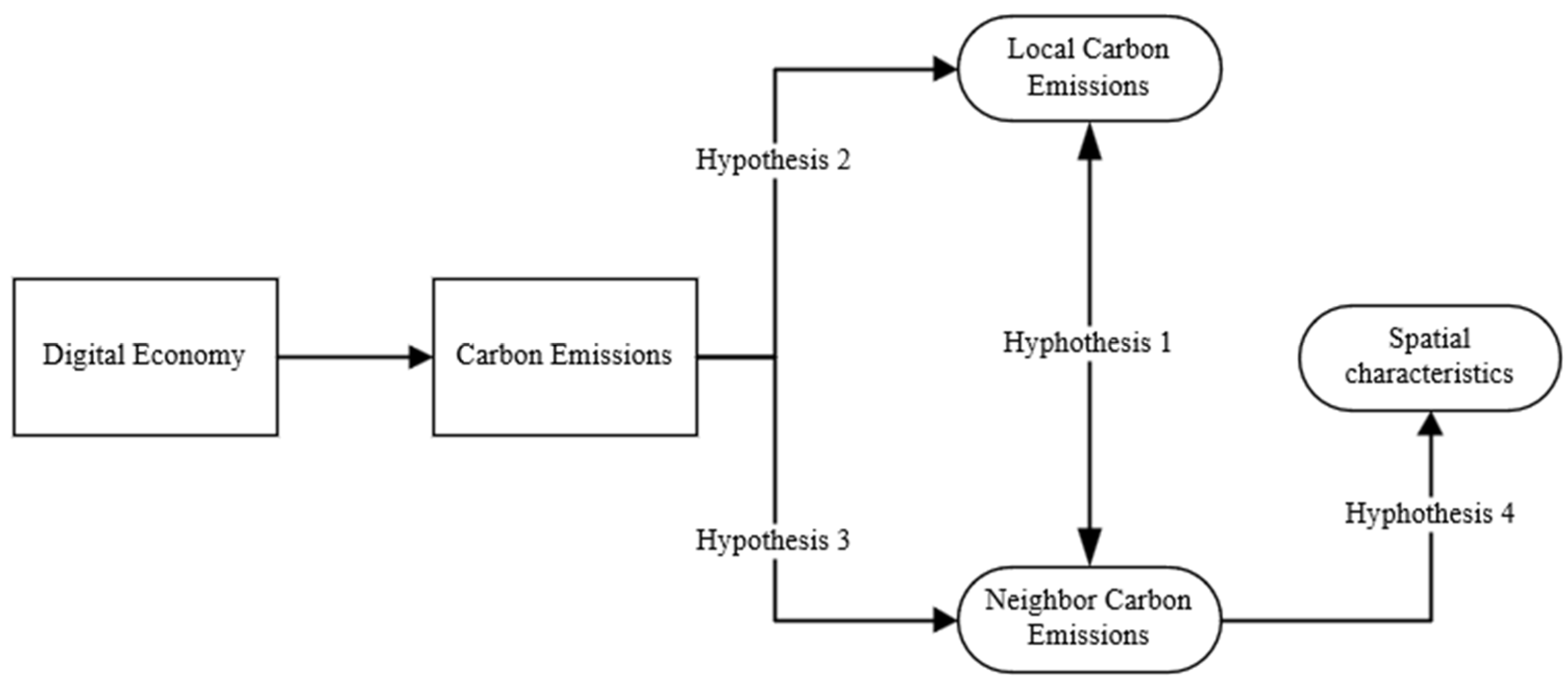
Figure 1 illustrates the main ideas and theoretical conceptualization of this study.
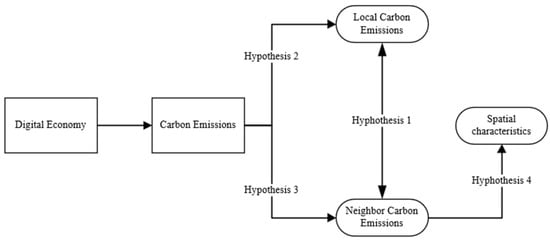
Figure 1.
Hypothesized conceptual model.
3. Methods and Data
3.1. Methods
3.1.1. Spatial Autocorrelation Analysis
Before determining whether to use spatial measures, it is necessary to examine whether there is a spatial correlation in the data. The global Moran index is most commonly used in academia to test for spatial correlation. Its formula is as follows:
where (n = 282) denotes the number of study samples. and are the carbon emissions of city i and city j, respectively; denotes the mean value of carbon emissions; and represents the spatial weight matrix. The value of Moran index I is generally between −1 and 1; greater than 0 indicates a positive correlation, less than 0 indicates a negative correlation, and equal to 0 indicates that the spatial distribution is random [35].
3.1.2. Model Construction
Due to the variability of economic laws interpreted by different spatial econometric models, to obtain the model with the best fitting effect, we drew on the research results of Elhorst [36]; the models were constructed according to the path of ordinary least squares (OLS)—spatial autoregressive model (SAR)/spatial error model (SEM)—generalized spatial autocorrelation model (SAC)—spatial Durbin model (SDM). First, the classical OLS econometric model without considering the spatial correlation between regions was developed:
Based on Equation (2), the SAR model was constructed by introducing the spatial lag term of carbon emissions:
Based on Equation (2), the SEM model was obtained by considering the spatial dependence of conduction through the error term:
Combining Equations (3) and (4), the SAC model can be built:
Further examining the spatial interaction based on Equation (3), the SDM model can be obtained as follows:
In Equations (2)–(6), is the carbon emission index of city i in period t; is the numerical economic indicator of city i in period t; denotes a series of control variables; , , , respectively, represent the constant terms and the regression coefficients to be estimated; W is the spatial weight matrix; δ is the spatial autoregressive coefficients; λ is the spatial error term coefficient; and , respectively, denote the spatial interaction term coefficients; is the time-invariant individual fixed effect of city i; is the time fixed effect; and represent random perturbation terms that obey independent identical distribution, satisfying and ; and and , are uncorrelated.
It should be noted above that in Equation (5), when , Equation (5) simplifies to Equation (3), and the SAC degenerates to the SAR. When , Equation (5) simplifies to Equation (4), and the SAC degenerates to the SEM. In Equations (6), when and , Equation (6) is simplified to Equation (3), and the SDM degenerates to the SAR. When , , Equation (6) simplifies to Equation (4), and the SDM degenerates to the SEM.
3.1.3. Spatial Weight Matrix
The setting of the spatial weight matrix is crucial to the spatial measurement model. The main spatial weight matrices used in academic circles include the adjacency matrix, geographic distance matrix, and economic distance matrix. Based on this, the geographic weight matrix () and economic weight matrix () are established to measure the spatial-spillover effect of the digital economy on carbon emissions, respectively. The distances between the urban centers of mass are calculated using latitude and longitude to generate the geographic weight matrix . Using the difference of economic development level between cities, the economic weight matrix is generated. and are calculated as follows:
where stands for the distance between the center of mass of city and city , and and represent the average GDP of city i and city j, respectively.
3.2. Variables
3.2.1. Explained Variable
Urban carbon emissions include not only carbon emissions from direct energy consumption (e.g., gas and liquefied petroleum) but also from electricity, transportation, and thermal energy consumption. Among them, carbon emissions from direct energy consumption can be calculated according to the conversion factors provided by IPCC 2006. The carbon emissions from electricity consumption are calculated using the method of Glaeser and Kahn [37]. The baseline emission factors of the grid and the electricity consumption of each city in the six regions of North China, Northeast China, East China, Central China, Northwest China, and South China were used to calculate the carbon emissions from transportation consumption. The carbon emissions from transportation consumption were calculated using the method of Li et al. [38], assuming that the energy consumption intensity and carbon emissions are proportional among various modes of transportation, and then using the unit passenger and freight volumes of various modes of transportation in each city. The carbon emissions from thermal energy consumption were calculated using the method of Zhang et al. [39] using centralized heating data and raw coal emission coefficients for each city. The carbon emissions from direct energy, electricity, transportation, and thermal energy consumption calculated by the above methods were summed to obtain the total carbon emissions of each city. To eliminate the dimensionality, the total carbon emissions were taken as a logarithm and denoted as CE.
3.2.2. Explanatory Variable
Few studies measure the digital economy at the city level in China. Drawing on Chen [40], we measured the digital economy in terms of digital inclusive finance and Internet development. The indicators include the digital inclusive finance index, the number of Internet broadband access users per 100 people, the number of cell phone users per 100 people, the proportion of computer service and software employees to urban unit employees, and the total amount of telecommunication services per capita. The above five indicators were processed by using principal component analysis. The data obtained were used as the measure of the digital economy and are denoted as dige.
3.2.3. Control Variables
To analyze the influencing factors of urban carbon emissions more comprehensively, control variables were selected in terms of environmental regulation and economic development: (1) environmental regulation (er), measured by linear standardized values of emissions of three pollutants: wastewater, sulfur dioxide, and soot [41]; (2) the level of economic development (eco), measured by the logarithm of GDP per capita [42]; (3) the level of financial development (fin), measured by the loan balance of financial institutions compared to GDP [43]; (4) the level of openness to the outside world (open), measured by the ratio of actual foreign capital used to GDP [44]; (5) population density (pop), measured by the logarithm of the number of people per unit of land area [45].
3.3. Data
Considering the specificity of the new crown epidemic in 2020, we only selected data from 2011 to 2019. There are 4 municipalities directly under the central government and 293 prefecture-level cities in China (excluding Hong Kong, Macau, and Taiwan). Based on the availability of data, this study screened out the following from the original sample: cities with missing data for more than 4 consecutive years; cities with administrative divisions adjusted and changed during the study period; and cities whose statistical caliber was not consistent among various statistical yearbooks. In summary, balanced panel data of 282 cities in China from 2011 to 2019 were selected for analysis in this study (a detailed list of the 282 cities is shown in Table A1 in the Appendix A). Among them, the digital financial inclusion index was compiled by the Digital Finance Research Center of Peking University. The original data of the remaining indicators were obtained from statistical sources such as the China City Statistical Yearbook, China City Construction Statistical Yearbook, and China Regional Statistical Yearbook. Some of the missing data were completed using linear interpolation. The descriptive statistical results of each indicator are shown in Table 1. The results of the correlation analysis between explanatory variables and all control variables are shown in Table 2. According to the judgment criterion of Lee [46] and Krammer [47], it is known that if the correlation coefficient between variables is greater than 0.85, there is a serious problem of multicollinearity leading to bias in the estimation results. In Table 2, the maximum value of the correlation coefficient among the variables is 0.669; therefore, the regression analysis in the latter part of this research did not need to consider the multicollinearity problem.

Table 1.
Summary statistics.
Table 2.
Pearson correlation coefficients.
4. Results and Discussion
4.1. Spatial Autocorrelation Test
Before conducting spatial econometric regression, the global Moran’s I index was calculated. The results are shown in Table 3, which tested whether there was a spatial correlation between carbon emissions in Chinese cities. As shown in Table 3, Moran’s I values of carbon emissions of Chinese cities were significantly greater than 0, regardless of whether the geographical weight matrix or the economic weight matrix was introduced. It is confirmed that the carbon emissions of Chinese cities exhibit significant high–high and low–low clustering, which are positively spatially autocorrelated. Therefore, it is feasible to investigate the impact of the digital economy on urban carbon emissions empirically using spatial econometric models.
Table 3.
Global Moran’s I of CE.
4.2. Benchmark Results
To select a suitable spatial econometric model, model screening was performed using Matlab2021a according to the screening steps of Elhorst [36]. (1) OLS estimation was performed on the sample data, based on which the LM test was used to determine whether to use the SAR or SEM. If only one LM lag and LM error passed the significance test, the SAR was selected if the LM lag was significant, and the SEM was selected if the LM error was significant. If both the LM lag and LM error passed the significance test, the significance of the robust-LM lag and robust-LM error were further compared. If robust-LM lag was significant, the SAR was selected; if the robust-LM error was significant, the SEM was selected. If all four statistics were significant, the magnitude of the statistics needed to be compared for selection. (2) Under the assumption that the SDM was selected, the likelihood ratio test was used to determine whether there was a time- or space-fixed effect in the model. (3) The Hausman test was performed to further analyze whether the model uses random effects or fixed effects. (4) We used the LR or Wald test to test whether the and hypothesis could be rejected. If the hypothesis could not be rejected, and the LM test supported SAR, SAR was chosen. If , the hypothesis could not be rejected, and the LM test supported SEM; we chose SEM. If both of the above hypotheses were rejected, we selected SDM. If the LR or Wald test contradicted the model supported by the LM test, we selected SDM.
Based on the above test steps and judgment criteria, it was determined that the time–space dual fixed effects SDM should be selected for estimation. Given this, the regression results of SDM were mainly used for analysis. To compare and test the robustness of the regression results, the regression results of OLS, SAR, SEM, and SAC were also given as controls. The regression results are shown in Table 4.
Table 4.
Baseline estimation results of digital economy on carbon emissions.
In SAR, SAC, and SDM, the regression coefficients of W∙CE were all significantly positive. This indicates that the increase (or decrease) in carbon emissions in this city will significantly increase (or decrease) the carbon emissions in other cities through geographical and economic correlations. This is a significant strategic interaction effect of the carbon emissions themselves. It verifies Hypothesis 1.
In the OLS and four spatial econometric models, the regression coefficient of dige was significantly negative, at least at the 5% level, which indicates that there is a significant inhibitory effect of the digital economy on carbon emissions. This initially verifies hypothesis 2. Among them, it is noteworthy that comparing the regression coefficients of dige in OLS regression and SDM regression found that the negative effect of the digital economy on carbon emissions may be overestimated if the spatial-spillover effect is not considered. In the SDM, the regression coefficient of W∙dige was significantly negative, at least at the 10% level. This suggests that the digital economy can contribute to carbon emission reduction in both geographic and economic space. This is a preliminary test of Hypothesis 3.
4.3. Decomposition Effect
Lesage and Pace [48] pointed out that analyzing the spatial-spillover effects between cities through simple point regression results may lead to erroneous conclusions. Therefore, it is impossible to discuss the marginal effects of the digital economy and each control variable on urban carbon emissions directly based on the regression coefficients of the spatial interaction terms. The analysis needs to be performed using the estimated results of decomposition effects.
Table 5 reports the direct and indirect effects of the digital economy and control variables in SDM and their significance. In Table 5, both the direct and indirect effects of the digital economy are significantly negative, at least at the 5% level. This indicates that the development of the digital economy suppresses not only local carbon emissions but also the spatial-spillover effects caused by it have significant suppression effects on carbon emissions in geographically and economically connected areas. Thus, hypothesis 2 and hypothesis 3 are verified. It is noteworthy that when comparing the regression results in columns (2) and (4), it was found that the spillover effect of the digital economy on carbon emissions was stronger in economically connected regions than in geographically connected regions. This may be because the spillover effect of the digital economy on carbon emission reduction is mainly transmitted through economic activities.
Table 5.
Decomposition effects of digital economy.
4.4. Robustness Tests
4.4.1. Replacement of the Treatment of Explanatory Variables
To ensure the scientific validity of the digital economy indicators, the five sub-indicators of the digital economy were treated by the entropy-weighting method and included in the model as proxy variables for the digital economy indicators obtained by using principal component analysis. The test results are shown in columns (1) and (2) in Table 6. The estimation results in columns (1) and (2) both show that each effect of the digital economy on carbon emissions remains significantly negative, and this finding is consistent with the estimation results above.
Table 6.
SDM regressions for robustness tests.
4.4.2. Replace the Weight Matrix
There is a possible bias when measuring the spatial correlation between cities by any distance criterion alone. To remedy this deficiency, the economic–geographic nested matrix W3, which considers both geographical and economic factors, was constructed by referring to Parent and Lesage’s method [49]. The formula was calculated as follows.
The spatial weight matrix was introduced into the model, and SDM estimation was performed again. The regression results are shown in column (3) of Table 6. The regression results in column (3) show that the direction and significance of each regression coefficient in the model did not change substantially. This conclusion confirms that the above estimation results are accurate and reliable.
4.4.3. Subsample Regression
The level of the digital economy in 31 central cities (the detailed list of the 31 central cities is shown in Table A2 in the Appendix A), such as Beijing and Shanghai, is significantly higher than that of other cities. To ensure the robustness of the results, the impact of the digital economy on carbon emissions was analyzed by excluding the central cities. The regression results are shown in columns (4) and (5) in Table 6. The regression results in columns (4) and (5) showed that the direction and significance of each regression coefficient were consistent with the above after excluding the special city sample. Again, the robustness of the above analytical findings is demonstrated.
4.5. Further Analysis: Regional Boundary Tests for Spillover Effects
To further dissect whether the spatial-spillover effects of the digital economy are global or local, we referred to the research results of Halpern and Murakoezy [50]. The spatial-spillover effects of the digital economy on different distance thresholds were re-estimated to identify the regional boundaries of the spatial-spillover effects of the digital economy. Drawing on the method of Yuan et al. [51], the spatial weight matrix was constructed. The calculation formula was as follows.
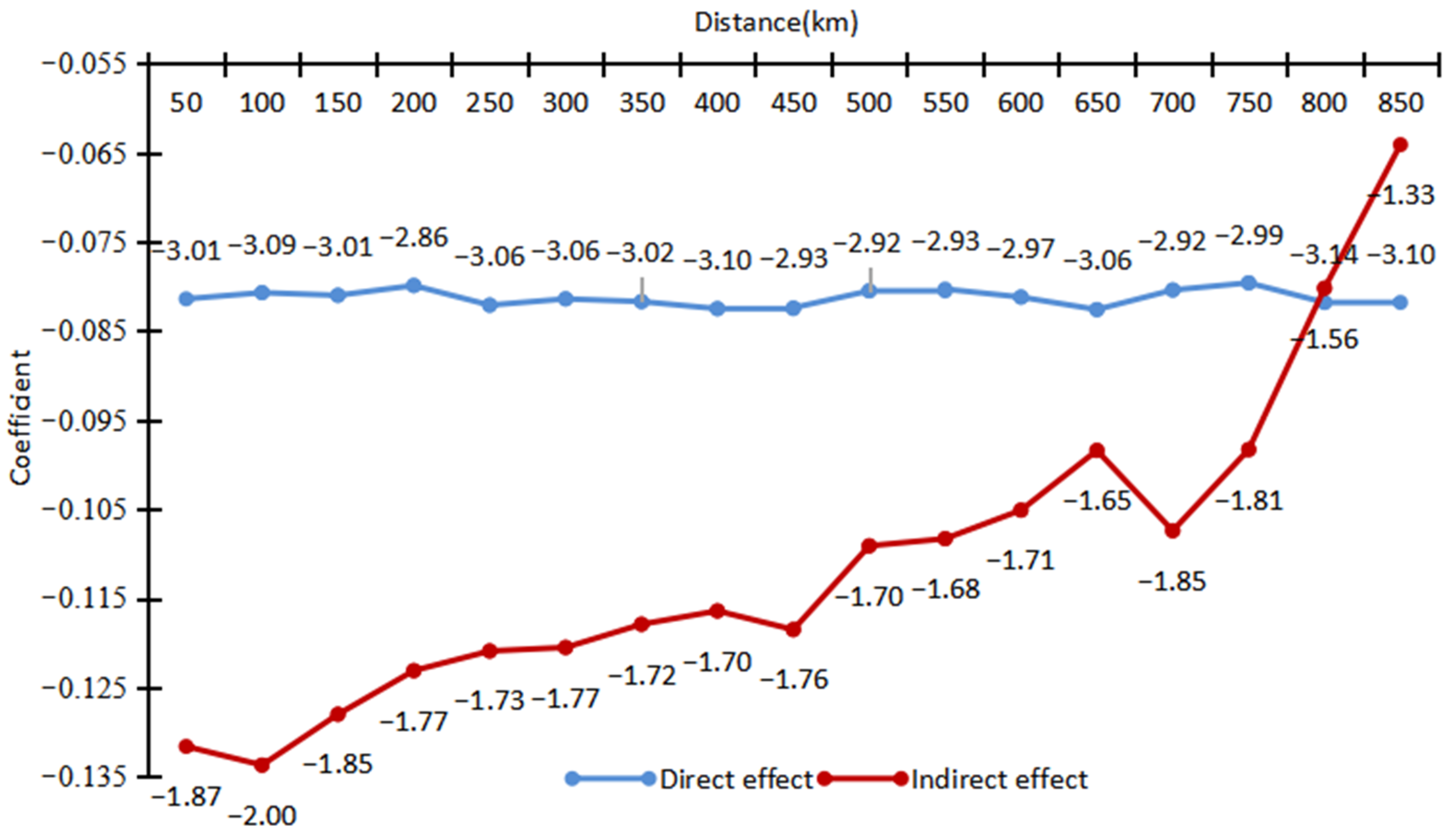
When the distance between cities i and j’s center of mass is not less than the distance threshold d, the element is the square of the inverse of the geographical distance between the two cities; otherwise, it is 0. The function of the distance threshold d is mainly to exclude the cities within distance d from the geographic weight matrix to facilitate the observation of the change of distance decay of the spillover effect of the digital economy on carbon emissions. When setting the distance threshold d, there were only a few pairs of cities because the distance was less than 50 km. In this study, the SDM regressions were conducted at 50 km intervals, starting from 50 km. The direct-effect coefficients and spatial-spillover coefficients of the digital economy and their t-values were recorded sequentially for different distance thresholds. The trends of the direct and indirect effects of the digital economy with geographical distance are shown in Figure 2.
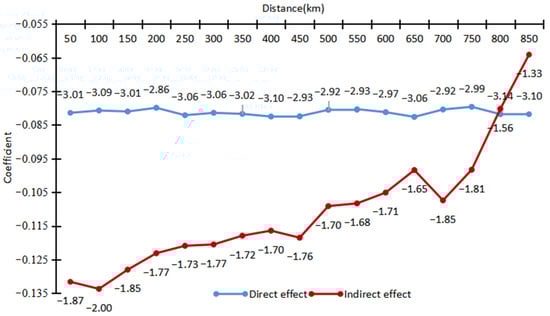
Figure 2.
Boundary effect of digital economy. Note: the values on the curve in the figure are t statistics.
In the direct-effect coefficient and its t-value, it can be seen that the suppression effect of the digital economy on local carbon emissions is always significant as the distance threshold d increases. Additionally, the fluctuation of this suppression effect is relatively small and stable. As seen in the t-value of the spatial-spillover effect, we know that when the distance threshold d is not greater than 750 km, the spatial-spillover coefficient of the digital economy at each distance threshold at least passes the 10% significance test. When the distance threshold d exceeds 750 km, although the spatial-spillover coefficient of the digital economy is still positive, it cannot pass the significance test. This indicates that 750 km is the effective boundary for the spatial-spillover effect of the digital economy on the carbon emissions of surrounding cities. Therefore, in this study, the spatial-spillover effect within 750 km was adopted as the cut-off point.
Although the negative effect of digital economy spillover shows an obvious distance-decay phenomenon, its decay trajectory is not linear but fluctuates and decreases. According to this decay trajectory, it can be divided into two intervals.
The first interval is within 450 km. The negative effect of spatial spillover decreases from −0.131 to −0.119, but the overall decrease is small. The spatial-spillover effect of the digital economy on urban carbon emission reduction is stable and significant within 450 km, which is basically within the provincial boundary. The spatial-spillover effect of the digital economy on urban carbon emission reduction is stable and significant within the provincial boundaries, and within 450 km is the effective distance for the digital economy to promote the green synergy of urban clusters. This may be because cities in the province are less affected by administrative differentiation, and through communication and cooperation, they can quickly realize the optimal allocation of digital resources and stimulate the potential vitality of the digital economy. It is easier to spontaneously form a relatively close digital economy spillover network and promote carbon emission reduction in the province.
The second interval is the rapidly declining area from 450 km to 750 km. The negative effect of spatial spillover of the digital economy in this interval is reduced from −0.119 to −0.098. The 450 km almost exceeds the provincial boundary; this indicates that the spillover effect of the digital economy in suppressing carbon emissions in spatially connected cities decreases more significantly beyond the provincial boundaries. This may be due to the competition among provinces and the differences in the infrastructure and policy environment of the digital economy in each province, which prevent the spatial-spillover effect of the digital economy from spreading continuously. As seen in the above analysis, Hypothesis 4 holds.
5. Conclusions and Policy Implications
China is vigorously promoting the dual carbon goals of “peak carbon” and “carbon neutral”. Additionally, the booming digital economy can effectively promote the transformation of China’s economy into a low-carbon economy. Therefore, this study explored the impact of the digital economy on carbon emissions based on panel data from 282 cities in China from 2011 to 2019. This study first investigated the strategic interaction of carbon emissions among cities using SDM. Then, the local and spillover effects of the digital economy on carbon emissions were analyzed by decomposing the estimated coefficients. Finally, the spatial weight matrix was adjusted by setting distance thresholds to explore the regional boundaries of the spillover effects of the digital economy on carbon emissions.
We have drawn the following conclusions. First, in the spatial dimension, carbon emissions between regions show a significant positive spatial correlation, indicating that the reduction in carbon emissions in one region can lead to a reduction in carbon emissions in other regions. Second, the digital economy has a significant negative impact on carbon emissions, and the development of the digital economy is helping China to achieve the “double carbon” target. Third, the digital economy also has a significant negative effect on carbon emissions in geographically and economically connected regions, and the spillover effect is more obvious in economically connected regions. Fourth, the spillover effect of the digital economy on carbon emission reduction in cities has a regional boundary, which decreases with the increase in geographical distance within the regional boundary, and the effective boundary of spatial spillover is within 750 km.
Based on the above empirical results, this study proposes the following policy recommendations. First, because of the competition effect, demonstration effect, and economic linkage effect among cities, governments at all levels should pay attention to the positive effects of these effects on carbon emission reduction in cities. Through a combination of promotion systems, administrative orders, and fiscal policies, cities should be guided to learn and exchange with each other to establish a long-term mechanism of environmental regulation of “joint prevention and control”. Second, we should attach great importance to and affirm the significant role of the digital economy in reducing carbon emissions in cities, which includes increasing the role of government guidance and support, increasing the intensity and scale of investment in the digital economy, and accelerating the application and upgrade of digital technology in the transformation of traditional industries, government supervision, and governance. Third, it is important to profoundly grasp the spatial-spillover effect of the digital economy. We should optimize the allocation of digital resources and coordinate the construction of the Internet, 5G, and other digital infrastructure in all regions. Moreover, while consolidating the development advantages of regions with good momentum in the digital economy, we should guide the flow and diffusion of digital resources to lagging regions. Moreover, it is important to actively promote the establishment and improvement in the carbon emission trading market to fully release the spatial contribution of the digital economy to urban carbon emission reduction. Finally, the spatial-spillover effect of the digital economy on urban carbon emission reduction has regional boundaries and is, to a certain extent, hindered by provincial boundaries. This requires governments at all levels to actively eliminate the spatial fragmentation formed by administrative zones. The central government should solve the fragmentation situation between cities and regions at the institutional level. The reasonable formulation and introduction of bilateral or multilateral agreements should be used to achieve a win–win situation. This should strengthen the construction of an integrity system, optimize the development environment of the digital economy, reduce the negative impact of the trust crisis, and increase the spatial spillover radius of the digital economy. Local governments should formulate different strategies for developing the digital economy while considering their own natural endowments and development processes. Moreover, they should actively seek opportunities for cooperation and exchange with other regions to complement their strengths and weaknesses. Thus, the spatial-spillover effect of the digital economy on carbon emission reduction can be amplified to a greater extent.
Author Contributions
Conceptualization, X.C.; methodology, X.C.; data curation, X.C.; software, X.C.; writing—original draft, X.C.; writing—review and editing, X.C.; supervision, J.L.; project administration, J.L.; funding acquisition, J.L. All authors have read and agreed to the published version of the manuscript.
Funding
This research was funded by the National Science Foundation of China. The approval number is 71964032.
Institutional Review Board Statement
Not applicable.
Informed Consent Statement
Not applicable.
Data Availability Statement
All data can be obtained by email from the corresponding author.
Conflicts of Interest
The authors declare no conflict of interest.
Appendix A
Table A1.
The detailed list of the 282 cities.
Table A1.
The detailed list of the 282 cities.
| Serial Number | Province | City |
|---|---|---|
| 1 | Beijing | Beijing |
| 2 | Tianjin | Tianjin |
| 3 | Hebei | Baoding |
| 4 | Hebei | Cangzhou |
| 5 | Hebei | Chengde |
| 6 | Hebei | Handan |
| 7 | Hebei | Hengshui |
| 8 | Hebei | Langfang |
| 9 | Hebei | Qinhuangdao |
| 10 | Hebei | Shijiazhuang |
| 11 | Hebei | Tangshan |
| 12 | Hebei | Xingtai |
| 13 | Hebei | Zhangjiakou |
| 14 | Shanxi | Datong |
| 15 | Shanxi | Jincheng |
| 16 | Shanxi | Jinzhong |
| 17 | Shanxi | Linfen |
| 18 | Shanxi | Luliang |
| 19 | Shanxi | Shuozhou |
| 20 | Shanxi | Taiyuan |
| 21 | Shanxi | Xinzhou |
| 22 | Shanxi | Yangquan |
| 23 | Shanxi | Yuncheng |
| 24 | Shanxi | Changzhi |
| 25 | Inner Mongolia | Bayannur |
| 26 | Inner Mongolia | Baotou |
| 27 | Inner Mongolia | Chifeng |
| 28 | Inner Mongolia | Ordos |
| 29 | Inner Mongolia | Hohhot |
| 30 | Inner Mongolia | Hulun Buir |
| 31 | Inner Mongolia | Tongliao |
| 32 | Inner Mongolia | Wuhai |
| 33 | Inner Mongolia | Ulanqab |
| 34 | Liaoning | Anshan |
| 35 | Liaoning | Benxi |
| 36 | Liaoning | Chaoyang |
| 37 | Liaoning | Dalian |
| 38 | Liaoning | Dandong |
| 39 | Liaoning | Fushun |
| 40 | Liaoning | Fuxin |
| 41 | Liaoning | Huludao |
| 42 | Liaoning | Jinzhou |
| 43 | Liaoning | Liaoyang |
| 44 | Liaoning | Panjin |
| 45 | Liaoning | Shenyang |
| 46 | Liaoning | Tieling |
| 47 | Liaoning | Yingkou |
| 48 | Jilin | Baicheng |
| 49 | Jilin | Baishan |
| 50 | Jilin | Jilin |
| 51 | Jilin | Liaoyuan |
| 52 | Jilin | Siping |
| 53 | Jilin | Songyuan |
| 54 | Jilin | Tonghua |
| 55 | Jilin | Changchun |
| 56 | Heilongjiang | Daqing |
| 57 | Heilongjiang | Harbin |
| 58 | Heilongjiang | Hegang |
| 59 | Heilongjiang | Heihe |
| 60 | Heilongjiang | Jixi |
| 61 | Heilongjiang | Jiamusi |
| 62 | Heilongjiang | Mudanjiang |
| 63 | Heilongjiang | Qitaihe |
| 64 | Heilongjiang | Qiqihar |
| 65 | Heilongjiang | Shuangyashan |
| 66 | Heilongjiang | Suihua |
| 67 | Heilongjiang | Yichun |
| 68 | Shanghai | Shanghai |
| 69 | Jiangsu | Changzhou |
| 70 | Jiangsu | Huai’an |
| 71 | Jiangsu | Lianyungang |
| 72 | Jiangsu | Nanjing |
| 73 | Jiangsu | Nantong |
| 74 | Jiangsu | Suzhou |
| 75 | Jiangsu | Suqian |
| 76 | Jiangsu | Taizhou |
| 77 | Jiangsu | Wuxi |
| 78 | Jiangsu | Xuzhou |
| 79 | Jiangsu | Yancheng |
| 80 | Jiangsu | Yangzhou |
| 81 | Jiangsu | Zhenjiang |
| 82 | Zhejiang | Hangzhou |
| 83 | Zhejiang | Huzhou |
| 84 | Zhejiang | Jiaxing |
| 85 | Zhejiang | Jinhua |
| 86 | Zhejiang | Lishui |
| 87 | Zhejiang | Ningbo |
| 88 | Zhejiang | Quzhou |
| 89 | Zhejiang | Shaoxing |
| 90 | Zhejiang | Taizhou |
| 91 | Zhejiang | Wenzhou |
| 92 | Zhejiang | Zhoushan |
| 93 | Anhui | Anqing |
| 94 | Anhui | Bengbu |
| 95 | Anhui | Bozhou |
| 96 | Anhui | Chizhou |
| 97 | Anhui | Chuzhou |
| 98 | Anhui | Fuyang |
| 99 | Anhui | Hefei |
| 100 | Anhui | Huaibei |
| 101 | Anhui | Huainan |
| 102 | Anhui | Huangshan |
| 103 | Anhui | Lu’an |
| 104 | Anhui | Ma’anshan |
| 105 | Anhui | Suzhou |
| 106 | Anhui | Tongling |
| 107 | Anhui | Wuhu |
| 108 | Anhui | Xuancheng |
| 109 | Fujian | Fuzhou |
| 110 | Fujian | Longyan |
| 111 | Fujian | Nanping |
| 112 | Fujian | Ningde |
| 113 | Fujian | Putian |
| 114 | Fujian | Quanzhou |
| 115 | Fujian | Sanming |
| 116 | Fujian | Xiamen |
| 117 | Fujian | Zhangzhou |
| 118 | Jiangxi | Fuzhou |
| 119 | Jiangxi | Ganzhou |
| 120 | Jiangxi | Ji’an |
| 121 | Jiangxi | Jingdezhen |
| 122 | Jiangxi | Jiujiang |
| 123 | Jiangxi | Nanchang |
| 124 | Jiangxi | Pingxiang |
| 125 | Jiangxi | Shangrao |
| 126 | Jiangxi | Xinyu |
| 127 | Jiangxi | Yichun |
| 128 | Jiangxi | Yingtan |
| 129 | Shandong | Binzhou |
| 130 | Shandong | Dezhou |
| 131 | Shandong | Dongying |
| 132 | Shandong | HeZe |
| 133 | Shandong | Jinan |
| 134 | Shandong | Jining |
| 135 | Shandong | LiaoCheng |
| 136 | Shandong | Linyi |
| 137 | Shandong | Qingdao |
| 138 | Shandong | Rizhao |
| 139 | Shandong | Tai’an |
| 140 | Shandong | Weihai |
| 141 | Shandong | Weifang |
| 142 | Shandong | Yantai |
| 143 | Shandong | Zaozhuang |
| 144 | Shandong | Zibo |
| 145 | Henan | Anyang |
| 146 | Henan | Hebi |
| 147 | Henan | Jiaozuo |
| 148 | Henan | Kaifeng |
| 149 | Henan | Luoyang |
| 150 | Henan | Luohe |
| 151 | Henan | Nanyang |
| 152 | Henan | Pingdingshan |
| 153 | Henan | Puyang |
| 154 | Henan | Sanmenxia |
| 155 | Henan | Shangqiu |
| 156 | Henan | Xinxiang |
| 157 | Henan | Xinyang |
| 158 | Henan | Xuchang |
| 159 | Henan | Zhengzhou |
| 160 | Henan | Zhoukou |
| 161 | Henan | Zhumadian |
| 162 | Hubei | Ezhou |
| 163 | Hubei | Huanggang |
| 164 | Hubei | Huangshi |
| 165 | Hubei | Jingmen |
| 166 | Hubei | Jingzhou |
| 167 | Hubei | Shiyan |
| 168 | Hubei | Suizhou |
| 169 | Hubei | Wuhan |
| 170 | Hubei | Xianning |
| 171 | Hubei | Xiangyang |
| 172 | Hubei | Xiaogan |
| 173 | Hubei | Yichang |
| 174 | Hunan | Changde |
| 175 | Hunan | Chenzhou |
| 176 | Hunan | Hengyang |
| 177 | Hunan | Huaihua |
| 178 | Hunan | Loudi |
| 179 | Hunan | Shaoyang |
| 180 | Hunan | Xiangtan |
| 181 | Hunan | Yiyang |
| 182 | Hunan | Yongzhou |
| 183 | Hunan | Yueyang |
| 184 | Hunan | Zhangjiajie |
| 185 | Hunan | Changsha |
| 186 | Hunan | Zhuzhou |
| 187 | Guangdong | Chaozhou |
| 188 | Guangdong | Dongguan |
| 189 | Guangdong | Foshan |
| 190 | Guangdong | Guangzhou |
| 191 | Guangdong | Heyuan |
| 192 | Guangdong | Huizhou |
| 193 | Guangdong | Jiangmen |
| 194 | Guangdong | Jieyang |
| 195 | Guangdong | Maoming |
| 196 | Guangdong | Meizhou |
| 197 | Guangdong | Qingyuan |
| 198 | Guangdong | Shantou |
| 199 | Guangdong | Shanwei |
| 200 | Guangdong | Shaoguan |
| 201 | Guangdong | Shenzhen |
| 202 | Guangdong | Yangjiang |
| 203 | Guangdong | Yunfu |
| 204 | Guangdong | Zhanjiang |
| 205 | Guangdong | Zhaoqing |
| 206 | Guangdong | Zhongshan |
| 207 | Guangdong | Zhuhai |
| 208 | Guangxi | Baise |
| 209 | Guangxi | Beihai |
| 210 | Guangxi | Chongzuo |
| 211 | Guangxi | Fangchenggang |
| 212 | Guangxi | Guigang |
| 213 | Guangxi | Guilin |
| 214 | Guangxi | Hechi |
| 215 | Guangxi | Hezhou |
| 216 | Guangxi | Laibin |
| 217 | Guangxi | Liuzhou |
| 218 | Guangxi | Nanning |
| 219 | Guangxi | Wuzhou |
| 220 | Guangxi | Yulin |
| 221 | Hainan | Haikou |
| 222 | Hainan | Sanya |
| 223 | Chongqing | Chongqing |
| 224 | Sichuan | Bazhong |
| 225 | Sichuan | Chengdu |
| 226 | Sichuan | Dazhou |
| 227 | Sichuan | Deyang |
| 228 | Sichuan | Guang’an |
| 229 | Sichuan | Guangyuan |
| 230 | Sichuan | Leshan |
| 231 | Sichuan | Luzhou |
| 232 | Sichuan | Meishan |
| 233 | Sichuan | Mianyang |
| 234 | Sichuan | Nanchong |
| 235 | Sichuan | Neijiang |
| 236 | Sichuan | Panzhihua |
| 237 | Sichuan | Suining |
| 238 | Sichuan | Ya’an |
| 239 | Sichuan | Yibin |
| 240 | Sichuan | Ziyang |
| 241 | Sichuan | Zigong |
| 242 | Guizhou | Anshun |
| 243 | Guizhou | Guiyang |
| 244 | Guizhou | Liupanshui |
| 245 | Guizhou | Zunyi |
| 246 | Yunnan | Baoshan |
| 247 | Yunnan | Kunming |
| 248 | Yunnan | Lijiang |
| 249 | Yunnan | Lincang |
| 250 | Yunnan | Qujing |
| 251 | Yunnan | YuXi |
| 252 | Yunnan | Zhaotong |
| 253 | Shaanxi | Ankang |
| 254 | Shaanxi | Baoji |
| 255 | Shaanxi | Hanzhong |
| 256 | Shaanxi | Shangluo |
| 257 | Shaanxi | Tongchuan |
| 258 | Shaanxi | Weinan |
| 259 | Shaanxi | Xi’an |
| 260 | Shaanxi | Xianyang |
| 261 | Shaanxi | Yan’an |
| 262 | Shaanxi | Yulin |
| 263 | Gansu | Baiyin |
| 264 | Gansu | Dingxi |
| 265 | Gansu | Jiayuguan |
| 266 | Gansu | Jinchang |
| 267 | Gansu | Jiuquan |
| 268 | Gansu | Lanzhou |
| 269 | Gansu | Longnan |
| 270 | Gansu | Pingliang |
| 271 | Gansu | qingyang |
| 272 | Gansu | Tianshui |
| 273 | Gansu | Wuwei |
| 274 | Gansu | Zhangye |
| 275 | Qinghai | Xining |
| 276 | Ningxia | Guyuan |
| 277 | Ningxia | Shizuishan |
| 278 | Ningxia | Wuzhong |
| 279 | Ningxia | Yinchuan |
| 280 | Ningxia | Zhongwei |
| 281 | Xinjiang | Karamay |
| 282 | Xinjiang | Urumqi |
Table A2.
The detailed list of the 31 central cities.
Table A2.
The detailed list of the 31 central cities.
| Serial Number | Province | City |
|---|---|---|
| 1 | Gansu | Lanzhou |
| 2 | Qinghai | Xining |
| 3 | Shaanxi | Xi’an |
| 4 | Henan | Zhengzhou |
| 5 | Shandong | Jinan |
| 6 | Shanxi | Taiyuan |
| 7 | Anhui | Hefei |
| 8 | Hunan | Changsha |
| 9 | Hubei | Wuhan |
| 10 | Jiangsu | Nanjing |
| 11 | Sichuan | Chengdu |
| 12 | Guizhou | Guiyang |
| 13 | Yunnan | Kunming |
| 14 | Heilongjiang | Harbin |
| 15 | Jilin | Changchun |
| 16 | Liaoning | Shenyang |
| 17 | Hebei | Shijiazhuang |
| 18 | Zhejiang | Hangzhou |
| 19 | Jiangxi | Nanchang |
| 20 | Guangdong | Guangzhou |
| 21 | Fujian | Fuzhou |
| 22 | Hainan | Haikou |
| 23 | Beijing | Beijing |
| 24 | Tianjin | Tianjin |
| 25 | Shanghai | Shanghai |
| 26 | Guangdong | Shenzhen |
| 27 | Chongqing | Chongqing |
| 28 | Guangxi | Nanning |
| 29 | Ningxia | Yinchuan |
| 30 | Xinjiang | Urumqi |
| 31 | Inner Mongolia | Hohhot |
References
- Hussain, J.; Lee, C.-C.; Chen, Y. Optimal Green Technology Investment and Emission Reduction in Emissions Generating Companies under the Support of Green Bond and Subsidy. Technol. Forecast. Soc. Change 2022, 183, 121952. [Google Scholar] [CrossRef]
- Acheampong, A.O.; Boateng, E.; Amponsah, M.; Dzator, J. Revisiting the Economic Growth–Energy Consumption Nexus: Does Globalization Matter? Energy Econ. 2021, 102, 105472. [Google Scholar] [CrossRef]
- Nukusheva, A.; Ilyassova, G.; Rustembekova, D.; Zhamiyeva, R.; Arenova, L. Global Warming Problem Faced by the International Community: International Legal Aspect. Int. Environ. Agreem. Polit. Law Econ. 2021, 21, 219–233. [Google Scholar] [CrossRef]
- Yang, P.; Liang, X.; Drohan, P.J. Using Kaya and LMDI Models to Analyze Carbon Emissions from the Energy Consumption in China. Environ. Sci. Pollut. Res. 2020, 27, 26495–26501. [Google Scholar] [CrossRef]
- Shi, X.; Zheng, Y.; Lei, Y.; Xue, W.; Yan, G.; Liu, X.; Cai, B.; Tong, D.; Wang, J. Air Quality Benefits of Achieving Carbon Neutrality in China. Sci. Total Environ. 2021, 795, 148784. [Google Scholar] [CrossRef]
- Cheng, J.; Tong, D.; Zhang, Q.; Liu, Y.; Lei, Y.; Yan, G.; Yan, L.; Yu, S.; Cui, R.Y.; Clarke, L.; et al. Pathways of China’s PM2.5 Air Quality 2015–2060 in the Context of Carbon Neutrality. Natl. Sci. Rev. 2021, 8, nwab078. [Google Scholar] [CrossRef]
- Wang, H.; Li, Y.; Lin, W.; Wei, W. How Does Digital Technology Promote Carbon Emission Reduction? Empirical Evidence Based on e-Commerce Pilot City Policy in China. J. Environ. Manag. 2023, 325, 116524. [Google Scholar] [CrossRef]
- Wang, L.; Chen, Y.; Ramsey, T.S.; Hewings, G.J.D. Will Researching Digital Technology Really Empower Green Development? Technol. Soc. 2021, 66, 101638. [Google Scholar] [CrossRef]
- Zhang, L.; Mu, R.; Zhan, Y.; Yu, J.; Liu, L.; Yu, Y.; Zhang, J. Digital Economy, Energy Efficiency, and Carbon Emissions: Evidence from Provincial Panel Data in China. Sci. Total Environ. 2022, 852, 158403. [Google Scholar] [CrossRef]
- Wang, J.; Dong, X.; Dong, K. How Does ICT Agglomeration Affect Carbon Emissions? The Case of Yangtze River Delta Urban Agglomeration in China. Energy Econ. 2022, 111, 106107. [Google Scholar] [CrossRef]
- Dubey, R.; Gunasekaran, A.; Childe, S.J.; Papadopoulos, T.; Luo, Z.; Wamba, S.F.; Roubaud, D. Can Big Data and Predictive Analytics Improve Social and Environmental Sustainability? Technol. Forecast. Soc. Change 2019, 144, 534–545. [Google Scholar] [CrossRef]
- Ren, S.; Hao, Y.; Xu, L.; Wu, H.; Ba, N. Digitalization and Energy: How Does Internet Development Affect China’s Energy Consumption? Energy Econ. 2021, 98, 105220. [Google Scholar] [CrossRef]
- Shahbaz, M.; Wang, J.; Dong, K.; Zhao, J. The Impact of Digital Economy on Energy Transition across the Globe: The Mediating Role of Government Governance. Renew. Sustain. Energy Rev. 2022, 166, 112620. [Google Scholar] [CrossRef]
- Jiang, X.; Li, G.; Fu, W. Government Environmental Governance, Structural Adjustment and Air Quality: A Quasi-Natural Experiment Based on the Three-Year Action Plan to Win the Blue Sky Defense War. J. Environ. Manag. 2021, 277, 111470. [Google Scholar] [CrossRef] [PubMed]
- Park, Y.; Meng, F.; Baloch, M.A. The Effect of ICT, Financial Development, Growth, and Trade Openness on CO2 Emissions: An Empirical Analysis. Environ. Sci. Pollut. Res. 2018, 25, 30708–30719. [Google Scholar] [CrossRef]
- Li, J.; Wang, Q. Impact of the Digital Economy on the Carbon Emissions of China’s Logistics Industry. Sustainability 2022, 14, 8641. [Google Scholar] [CrossRef]
- Li, Y.; Dai, J.; Cui, L. The Impact of Digital Technologies on Economic and Environmental Performance in the Context of Industry 4.0: A Moderated Mediation Model. Int. J. Prod. Econ. 2020, 229, 107777. [Google Scholar] [CrossRef]
- Zhang, L.; Wang, Q.; Zhang, M. Environmental Regulation and CO2 Emissions: Based on Strategic Interaction of Environmental Governance. Ecol. Complex. 2021, 45, 100893. [Google Scholar] [CrossRef]
- Liu, J.; Yu, Q.; Chen, Y.; Liu, J. The Impact of Digital Technology Development on Carbon Emissions: A Spatial Effect Analysis for China. Resour. Conserv. Recycl. 2022, 185, 106445. [Google Scholar] [CrossRef]
- Li, Q.; Song, J.; Wang, E.; Hu, H.; Zhang, J.; Wang, Y. Economic Growth and Pollutant Emissions in China: A Spatial Econometric Analysis. Stoch. Environ. Res. Risk Assess. 2014, 28, 429–442. [Google Scholar] [CrossRef]
- Wang, J.; Wu, Q.; Yan, S.; Guo, G.; Peng, S. China’s Local Governments Breaking the Land Use Planning Quota: A Strategic Interaction Perspective. Land Use Policy 2020, 92, 104434. [Google Scholar] [CrossRef]
- Pang, R.; Zheng, D.; Shi, M.; Zhang, X. Pollute First, Control Later? Exploring the Economic Threshold of Effective Environmental Regulation in China’s Context. J. Environ. Manag. 2019, 248, 109275. [Google Scholar] [CrossRef] [PubMed]
- Ghobakhloo, M.; Ching, N.T. Adoption of Digital Technologies of Smart Manufacturing in SMEs. J. Ind. Inf. Integr. 2019, 16, 100107. [Google Scholar] [CrossRef]
- Chen, W.; Yan, W. Impact of Internet Electronic Commerce on SO2 Pollution: Evidence from China. Environ. Sci. Pollut. Res. 2020, 27, 25801–25812. [Google Scholar] [CrossRef] [PubMed]
- Ge, W.; Xu, Y.; Liu, G.; Shen, B.; Su, X.; Liu, L.; Yang, X.; Ran, Q. Exploring the Impact of the Digital Economy on Carbon Emission Efficiency Under Factor Misallocation Constraints: New Insights from China. Front. Environ. Sci. 2022, 10, 953070. [Google Scholar] [CrossRef]
- Qin, S.-F.; Cheng, K. Future Digital Design and Manufacturing: Embracing Industry 4.0 and Beyond. Chin. J. Mech. Eng. 2017, 30, 1047–1049. [Google Scholar] [CrossRef]
- Janowski, T. Digital Government Evolution: From Transformation to Contextualization. Gov. Inf. Q. 2015, 32, 221–236. [Google Scholar] [CrossRef]
- Weng, Q.; Xu, H. A Review of China’s Carbon Trading Market. Renew. Sustain. Energy Rev. 2018, 91, 613–619. [Google Scholar] [CrossRef]
- Yu, Z.; Liu, S.; Zhu, Z. Has the Digital Economy Reduced Carbon Emissions?: Analysis Based on Panel Data of 278 Cities in China. Int. J. Environ. Res. Public Health 2022, 19, 11814. [Google Scholar] [CrossRef]
- Li, Z.; Liu, Y. Research on the Spatial Distribution Pattern and Influencing Factors of Digital Economy Development in China. IEEE Access 2021, 9, 63094–63106. [Google Scholar] [CrossRef]
- Bi, C.; Zeng, J. Nonlinear and Spatial Effects of Tourism on Carbon Emissions in China: A Spatial Econometric Approach. Int. J. Environ. Res. Public Health 2019, 16, 3353. [Google Scholar] [CrossRef] [PubMed]
- Wang, D.; Zhou, T.; Lan, F.; Wang, M. ICT and Socio-Economic Development: Evidence from a Spatial Panel Data Analysis in China. Telecommun. Policy 2021, 45, 102173. [Google Scholar] [CrossRef]
- Eriksson, R.H. Localized Spillovers and Knowledge Flows: How Does Proximity Influence the Performance of Plants? Econ. Geogr. 2011, 87, 127–152. [Google Scholar] [CrossRef]
- Lu, C.; Venevsky, S.; Shi, X.; Wang, L.; Wright, J.S.; Wu, C. Econometrics of the Environmental Kuznets Curve: Testing Advancement to Carbon Intensity-Oriented Sustainability for Eight Economic Zones in China. J. Clean. Prod. 2021, 283, 124561. [Google Scholar] [CrossRef]
- Moran, P. Notes on Continuous Stochastic Phenomena. Biometrika 1950, 37, 17–23. [Google Scholar] [CrossRef]
- Elhorst, J.P. Matlab Software for Spatial Panels. Int. Reg. Sci. Rev. 2014, 37, 389–405. [Google Scholar] [CrossRef]
- Glaeser, E.L.; Kahn, M.E. The Greenness of Cities: Carbon Dioxide Emissions and Urban Development. J. Urban Econ. 2010, 67, 404–418. [Google Scholar] [CrossRef]
- Li, H.; Lu, Y.; Zhang, J.; Wang, T. Trends in Road Freight Transportation Carbon Dioxide Emissions and Policies in China. Energy Policy 2013, 57, 99–106. [Google Scholar] [CrossRef]
- Zhang, W.; Liu, X.; Wang, D.; Zhou, J. Digital Economy and Carbon Emission Performance: Evidence at China’s City Level. Energy Policy 2022, 165, 112927. [Google Scholar] [CrossRef]
- Chen, P. Is the Digital Economy Driving Clean Energy Development? -New Evidence from 276 Cities in China. J. Clean. Prod. 2022, 372, 133783. [Google Scholar] [CrossRef]
- Ge, T.; Hao, X.; Li, J. Effects of Public Participation on Environmental Governance in China: A Spatial Durbin Econometric Analysis. J. Clean. Prod. 2021, 321, 129042. [Google Scholar] [CrossRef]
- Mikayilov, J.I.; Galeotti, M.; Hasanov, F.J. The Impact of Economic Growth on CO2 Emissions in Azerbaijan. J. Clean. Prod. 2018, 197, 1558–1572. [Google Scholar] [CrossRef]
- Ma, D.; Zhu, Q. Innovation in Emerging Economies: Research on the Digital Economy Driving High-Quality Green Development. J. Bus. Res. 2022, 145, 801–813. [Google Scholar] [CrossRef]
- Cole, M.A.; Elliott, R.J.R.; Okubo, T. Trade, Environmental Regulations and Industrial Mobility: An Industry-Level Study of Japan. Ecol. Econ. 2010, 69, 1995–2002. [Google Scholar] [CrossRef]
- Xu, L.; Fan, M.; Yang, L.; Shao, S. Heterogeneous Green Innovations and Carbon Emission Performance: Evidence at China’s City Level. Energy Econ. 2021, 99, 105269. [Google Scholar] [CrossRef]
- Lee, G. The Effectiveness of International Knowledge Spillover Channels. Eur. Econ. Rev. 2006, 50, 2075–2088. [Google Scholar] [CrossRef]
- Krammer, S.M.S. International R&D Spillovers in Emerging Markets: The Impact of Trade and Foreign Direct Investment. J. Int. Trade Econ. Dev. 2010, 19, 591–623. [Google Scholar] [CrossRef]
- Lesage, J.P.; Pace, R.K. Introduction to Spatial Econometrics; Chapman and Hall: London, UK; CRC: Boca Raton, FL, USA, 2009; ISBN 978-0-429-13808-9. [Google Scholar]
- Parent, O.; Lesage, J.P. Using the Variance Structure of the Conditional Autoregressive Spatial Specification to Model Knowledge Spillovers. J. Appl. Econ. 2008, 23, 235–256. [Google Scholar] [CrossRef]
- Halpern, L.; Muraközy, B. Does Distance Matter in Spillover? Econ. Transit. 2007, 15, 781–805. [Google Scholar] [CrossRef]
- Yuan, H.; Feng, Y.; Lee, J.; Liu, H.; Li, R. The Spatial Threshold Effect and Its Regional Boundary of Financial Agglomeration on Green Development: A Case Study in China. J. Clean. Prod. 2020, 244, 118670. [Google Scholar] [CrossRef]
Publisher’s Note: MDPI stays neutral with regard to jurisdictional claims in published maps and institutional affiliations. |
© 2022 by the authors. Licensee MDPI, Basel, Switzerland. This article is an open access article distributed under the terms and conditions of the Creative Commons Attribution (CC BY) license (https://creativecommons.org/licenses/by/4.0/).