


Abstract
Various national and international standards for building structures and other common structures specify a design working life of 50 years. Therefore, the statistical parameters of loads and the design expressions in current design codes are also based on a design reference period of 50 years. When the design working life is not 50 years, the variable load adjustment factor for the design working life needs to be considered. The corresponding load adjustment factors of office building live load, residential live load, snow load, and wind load are given in (GB50153-2008), (GB50009-2012), and (GB50068-2018) with different design working life (5, 10, 20, 30, 75 and 100 years), respectively. However, the recommended values presented in these documents are inconsistent and no provisions are found in those specifications for the selection of load design parameters in the design expression, which will result in designers having doubts in choosing design parameters, especially for building structures designed for a working life of 100 years. Using different design parameters in the design expression, the implied reliability level of the members with a design working life of 100 years was clarified in the paper. Furthermore, guidance for the specification in actual design is provided. For structural members designed for working life of 100 years, 14 representative structural members were selected to calculate their partial factors of resistance. Considering two simple combinations (dead load and wind load, dead load and snow load) and common load effect ratios, the reliability analysis of each member are carried out according to the load partial factors in China’s old and new codes. The study indicated that the structural importance coefficient of 1.1 needs to be taken in the design expression to increase all the load effects on the structural members designed for 100 years. The basic wind pressure and snow pressure should be taken with a return period of 100 years and the variable load adjustment factor for the design working life should not be considered.
1. Introduction
The design working life is understood as an assumed period of time for which a structure is to be used for its intended purpose without any major repair being necessary. Indicative values of design working life (10, 10–25, 15–30, 50 and 100 years for different types of new structures) are given in EN 1990:2002 [1] (Table 1). The reference period is understood as a chosen period of time used as a basis for statistically assessing the time variant basic random variables, and the corresponding probability of failure. The concept of reference period is therefore fundamentally different from the concept of design working life. Confusion is often caused when the difference between these two concepts is not recognized [2]. Various national and international standards for building structures and other common structures specify a design working life of 50 years. The reference period of 50 years and the related target reliability values have been used in the derivation of the partial factors [3], and the statistical parameters of loads in various national and international standards for building structures are all based on a design reference period of 50 years [1,3,4]. When the design working life differs from the design reference period of 50 years, the relationship between the optimum target reliability levels of temporary structures, failure consequences, the design working life, and the discount rate has been clarified in [5]. The simple relations of the target reliability as a function of the reference period considered are provided in [6]. The reference design values and partial factors of basic variables are studied in [7]. The partial factors under the design reference period of 60 years are obtained in [8]. The durability model and the statistical properties of the model parameters of concrete structures for service life of 120 years are studied in [9]. The Chinese standards indicate that the variable load adjustment factor for the design working life needs to be considered in the structural design expressions if the design working life differs from the design reference period of 50 years [4,10,11].

Table 1.
Indicative design working life.
The specific values of the variable load adjustment factors are given in Chinese structural reliability standards (GB50153-2008) [10] and (GB50068-2018) [11], and it is not stressed that these values are not suitable for wind load or snow load. The specific values of variable load adjustment factor in Chinese load code (GB50009-2012) [4] are quoted from (GB50153-2008) [10]. Meanwhile, the expressions and the calculated values of the variable load adjustment factors for live loads, wind load, and snow load under different design working lives, are shown in (GB50009-2012) [4]. Although the code (GB50009-2012) [4] gives the calculated values of the adjustment factors for wind and snow loads, it states that the variable load adjustment factors are only applicable to floor and roof live loads. The inconsistency of these provisions in the specifications will lead to doubts among designers. Furthermore, there are no clear specifications on the selection of the corresponding design parameters in design expressions in above-mentioned documents.
The Chinese load code (GB50009-2012) [4] lists wind pressure and snow pressure values of return periods of 10, 50, and 100 years for all cities across China. Take Xi’an as an example: if the return period is 50 years, the basic wind pressure and basic snow pressure are taken to be 0.35 kN/m2 and 0.25 kN/m2, respectively; and if the return period is 100 years, the basic wind pressure and basic snow pressure are taken to be 0.4 kN/m2 and 0.3 kN/m2, respectively. For structural members designed for a working life of 100 years, the structural importance coefficient of 1.1 is taken in the design expression to increase all the load effects on the structural members [12]. In this case, should the basic wind pressure and snow pressure values be taken with the return periods of 50 years or 100 years? If the return period of 50 years is used, what is the use of the wind and snow pressure values with a return period of 100 years in the code? If taken as the return period of 100 years, do we still need to consider the load adjustment factor? This issue was raised in the literature as early as 2014 [13], but these issues are not clearly explained in the specification and there is no relevant literature on the subject. Thus, it is not clear how load parameters and load adjustment factors should be selected for a given design working life different from 50 years (say 100 years), which will lead to the trouble in the actual design process. For example, when selecting load parameters for a building structure designed for a working life of 100 years, literature [14] adopts basic wind pressure and basic snow pressure with a return period of 100 years and considers the variable load adjustment factor for the design working life, while literature does not consider the load adjustment factor for the design working life [15,16].
Designing structures involves ensuring an adequate level of safety. The load and resistance factor design (LRFD) method has been widely used in building design. This is done by applying the appropriate set of partial factors for resistance and loads and the corresponding design parameters in design expressions. Reliability-based structural analysis of buildings and constructions made from conventional materials such as masonry, steel or concrete is commonly available in literatures. The theoretical background and basic principles for the reliability analysis and calculations can be found in [17,18,19,20,21,22,23], which already has been applied in several studies [24,25,26,27,28,29]. Peng et al. [24] studied the reliability of long span structure under wind and snow loading, and their results indicated that the equivalent extreme-value of element stress of the structure subjected to the dead load and the 100-year return period of wind and snow loads is far less than the allowable value, and the long-span building structure is therefore safe enough. The probability of structural failure by use of design standards for assessing marine operations is studied using structural reliability analyses to shed light on the implicit reliability levels of such standards. Natskår Asle et al. [25] presented a structural reliability approach to accommodate the uncertainties affecting design checks. By applying the appropriate set of partial factor for strength and partial factors for actions in accordance with the recommendations of the Eurocodes. Joanna Zięba et al. [26] presents an analysis of the reliability of a compressive masonry structure on the example of a wall fragment made of silicate blocks, and the relationship between partial factors applied to actions in various configurations and factors for the compressive strength of masonry was investigated. Considering samples generated by Latin Hypercube Sampling (LHS), the appropriate target reliability levels based on simulations of different scaffold design situations for facade scaffolds were proposed, based on which partial factors are determined [27]. The appropriate probability distribution for annual maximum ground snow loads are studied in detail based on the samples of snow loads on the ground in [28]. Then, the reliability of members of steel roof structures subjected to snow load at four representative sites in China is investigated, and it is found that the probability distribution function and parameter estimation method for ground snow loads have a great influence on reliability assessment results. Zhang et al. [29] investigated the resistance uncertainty of the membrane material, proposed partial factors for the dimensioning of membrane structures and evaluated the obtained reliability index. For USL the membrane strength was considered. Zhang et al. used three different reliability analysis methods, the central point method [30], the Rackwitz-Fiessler method [31] and the response surface method [32] in combination with Monte Carlo simulations [33]. It was observed that the calculated reliability indexes for all cases meet the specified target reliability index from the unified standard of reliability design of engineering structures of China [10]. Because there does not yet exist a unified design approach for membrane structures as is available for conventional buildings. In [34], the partial factors for prestress, snow load and wind uplift load are calibrated, for the design of a 6 m by 6 m hyper-membrane structure. It can be stated that there is a need to adjust the common calibration methods to the application to tensile membrane structures.
The discussed article applied reliability analysis methods to structural members in order to determine the design parameters of the snow load and wind load in the design expressions of the members designed for working life of 100 years and to provide guidance for the specification in actual design. For structural members designed for working life of 100 years, 14 representative structural members were selected to calculate their partial factors of resistance. Considering two simple combinations (dead load and wind load, dead load and snow load) and common load effect ratios, the reliability analysis of each member are carried out according to the load partial factor in China’s old code (GB50153-2008) [10] and new code (GB50068-2018) [11]. The research can clarify the reliability levels implied by using different design parameters and eliminate the doubts of designers, which can better meet the needs of actual design.
2. Partial Factors and Related Statistical Parameters
2.1. Partial Factors for Loads
The combination of loads controlled by the dead load has been cancelled in Chinese structural reliability standard (GB50068-2018) [11] and then the partial factor for dead loads changes from to , the partial factor for variable loads changes from to . Therefore, there is only one basic combination of load effect () in current design. The partial factors for loads in national and international documents are listed in Table 2.
Table 2.
Partial factors for loads in national and international documents.
2.2. Statistical Parameters for Loads
Loads shall be classified by their variation in time as dead load and variable load [17,18,35,36]. The dead load is treated as a normal distribution with a variable coefficient 0.074 and a coefficient of mean value 1.06.
Probability distribution of the maximum snow and wind load in the design working life which is given by:
where is the design working life of structural members, which is 100 years in this study. is the cumulative distribution function for the annual maximum variable loads. is the cumulative distribution function of the maximum variable loads in the design working life.
A Gumbel distribution is adopted for variable loads and its distribution function is [19,37]:
where () is the scale parameter of the distribution and () is the location parameter of the distribution. The mean value and standard deviation of the variable loads are:
where is the Euler’s constant.
Only snow load and wind load are considered in this paper. The statistical parameters of snow load and wind load can be obtained from the method in [20,21,38,39], which suggests that taking the target service period of buildings as the recurrence period of the wind pressure and snow pressure firstly and then determined the statistical parameters based on the mathematical model of extreme value I type distribution and the principle of the consistency for the probability of exceeding the design value of load in the design reference period. The distribution types and statistical parameters for loads are listed in Table 3 [22,40].
Table 3.
Distribution types and statistical parameters for loads.
2.3. Statistical Parameters and Partial Factors for Resistance
The resistance of the structure is influenced by many factors. In the case of design, it should be considered that the factors should include the uncertainty in the material properties, the uncertainty in the geometrical data and the modeling uncertainty [1,23,24,25,41,42,43]. The suggestion distribution of the resistance of the structure can be defined by a lognormal distribution [27,44]. 14 representative structural members were selected and the statistical parameters for resistance of different structural members under different stress statuses are given in Table 4 [26,45].
Table 4.
Statistical parameters and partial factors for resistance of different structural members.
According to the design value method, there is:
where is the design value of the resistance, is the target reliability index, the recommended values are shown in Table 5, is the cumulative density function of the standard normal distribution, is the value of the FORM sensitivity factor and for resistance, it may be taken as 0.8. Based on the design value method and the current design expression, for resistance obeys to lognormal distribution [27,44], the partial factor for resistance can be expressed as:
where , and are the mean value, the coefficient of mean value and the variable coefficient of the resistance, respectively. The calculated partial factors for resistance are shown in Table 4.
Table 5.
Target values for reliability indexes.
2.4. The Variable Load Adjustment Factor for the Design Working Life
The Chinese standards indicate that the variable load adjustment factor for the design working life needs to be considered in the structural design expressions when the design working life differs from the design reference period of 50 years. The specific values of the variable load adjustment factors are given in Chinese structural reliability standards (GB50153-2008) [10], (GB50068-2018) [11] and it is not stressed that these values are not suitable for wind load and snow load, see in Table 6. The specific values of variable load adjustment factor in Chinese load code (GB50009-2012) [4] are quoted from (GB50153-2008) [10]. Meanwhile, the expressions and the calculated values of the variable load adjustment factors for live loads, wind load and snow load for different design working lives are given in (GB50009-2012) [4], shown in Table 7. Although the code (GB50009-2012) [4] gives the calculated values of the adjustment factors for wind and snow loads, it states that the variable load adjustment factors are only applicable to floor and roof live loads.
Table 6.
The variable load adjustment factors for the design working life.
Table 7.
The calculated values of variable load adjustment factor for the design working life.
3. Reliability Analysis of Structural Members
Reliability of structural members subjected to snow load or wind load can be defined by the limit state function as follows [28]:
where and are structural resistance and dead load on structural members, which are assumed to not change with time; is the maximum live load on structural members during the design working life; and are the conversion coefficients of load to effect for dead load and live load, respectively.
For the ultimate limit states, considering the combination of dead and live load (snow load or wind load), the design value of load effect can be determined by Equation (8), the required characteristic value of structural resistance can be determined by Equation (9):
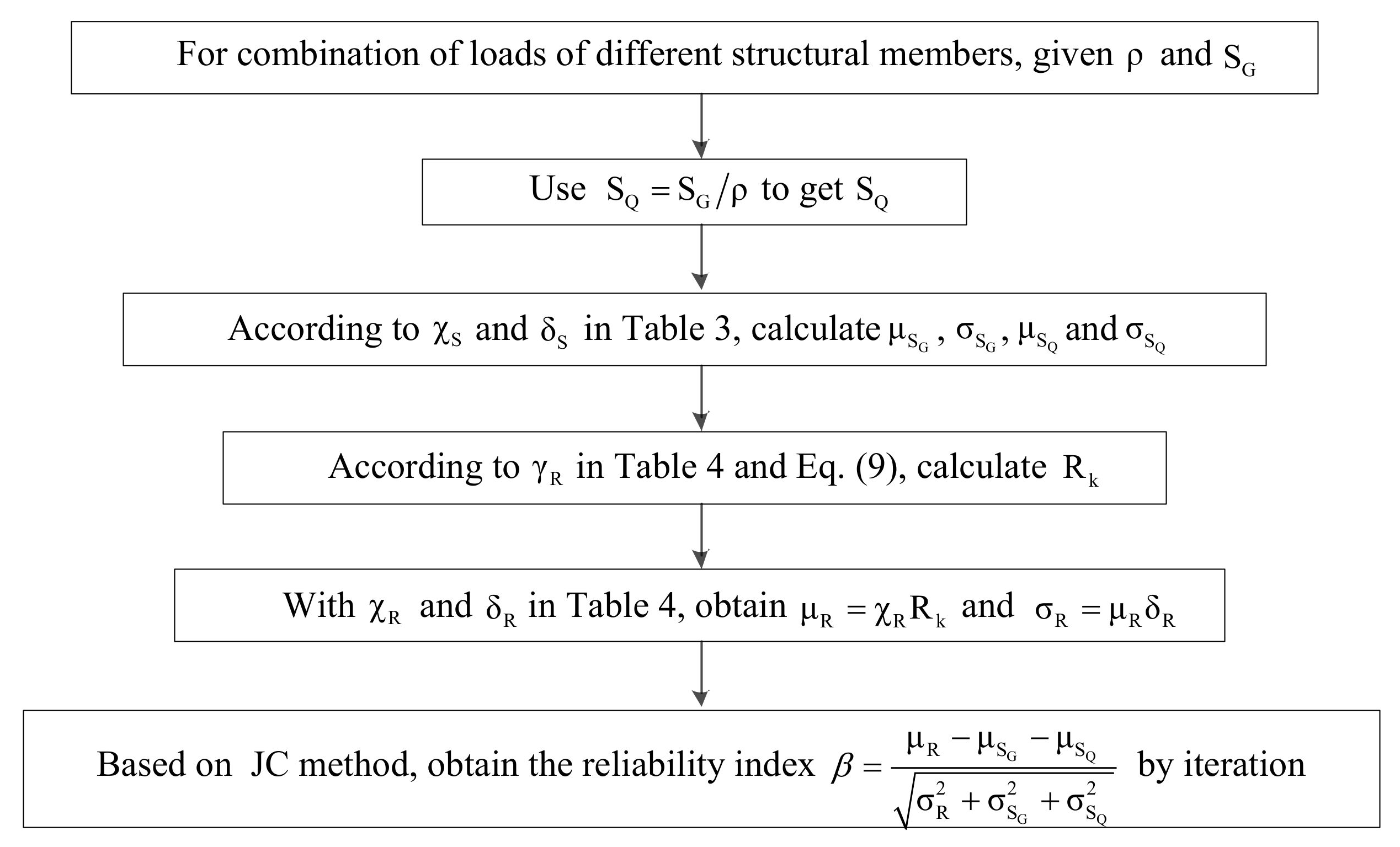
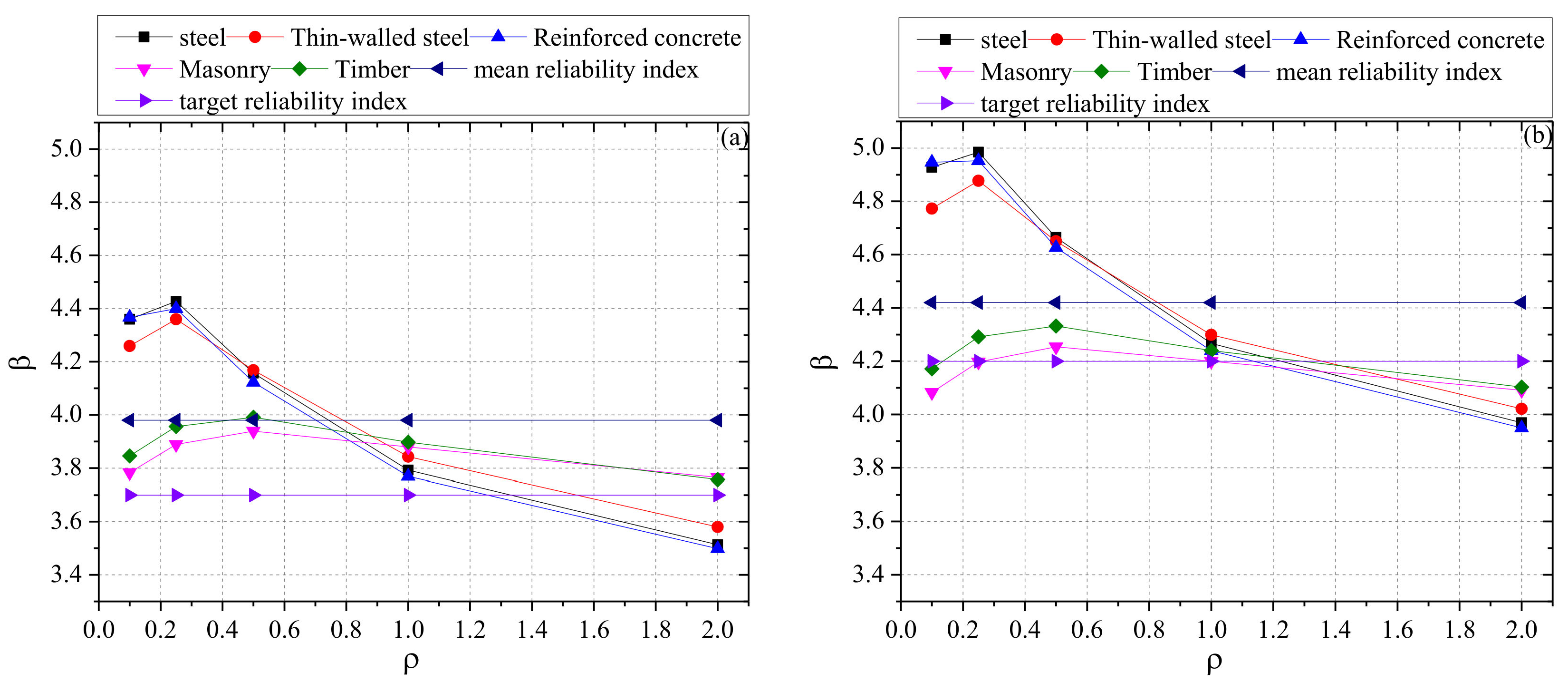
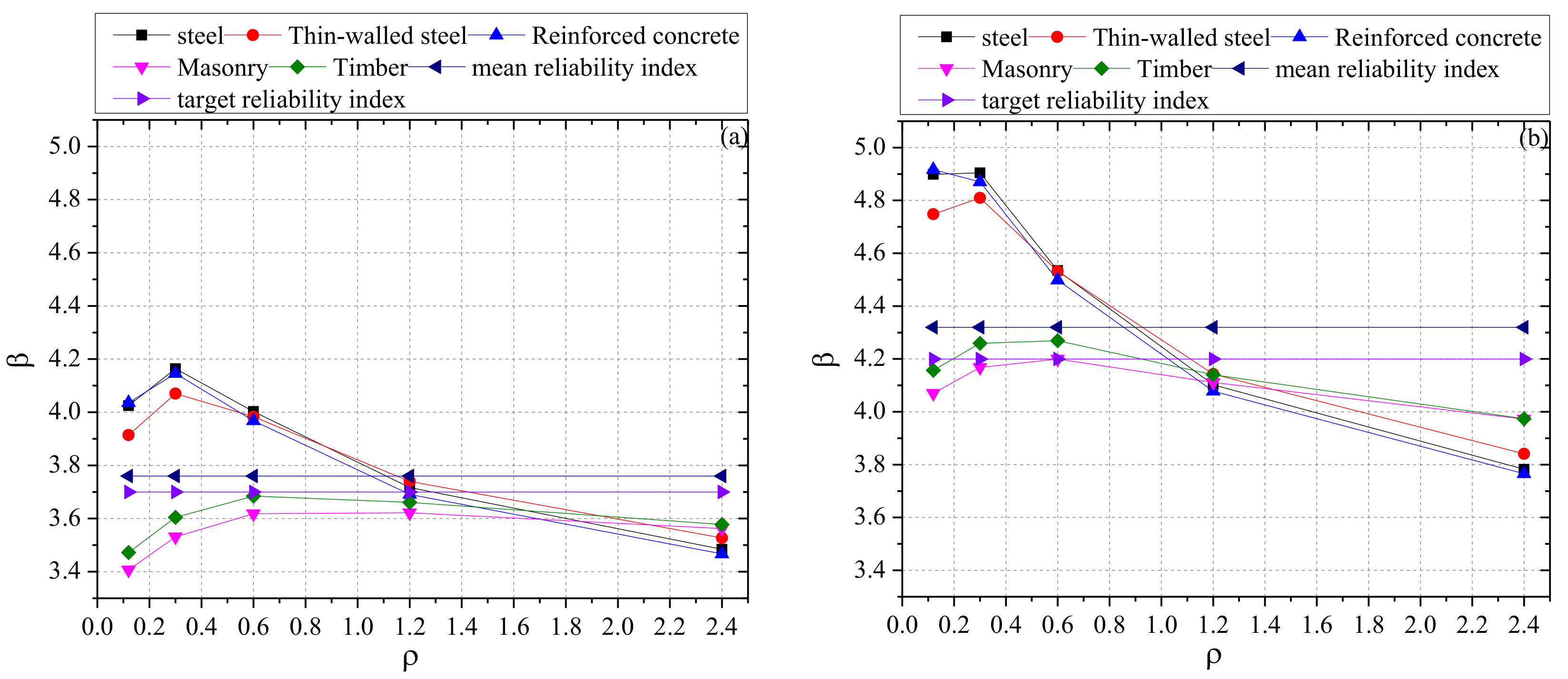
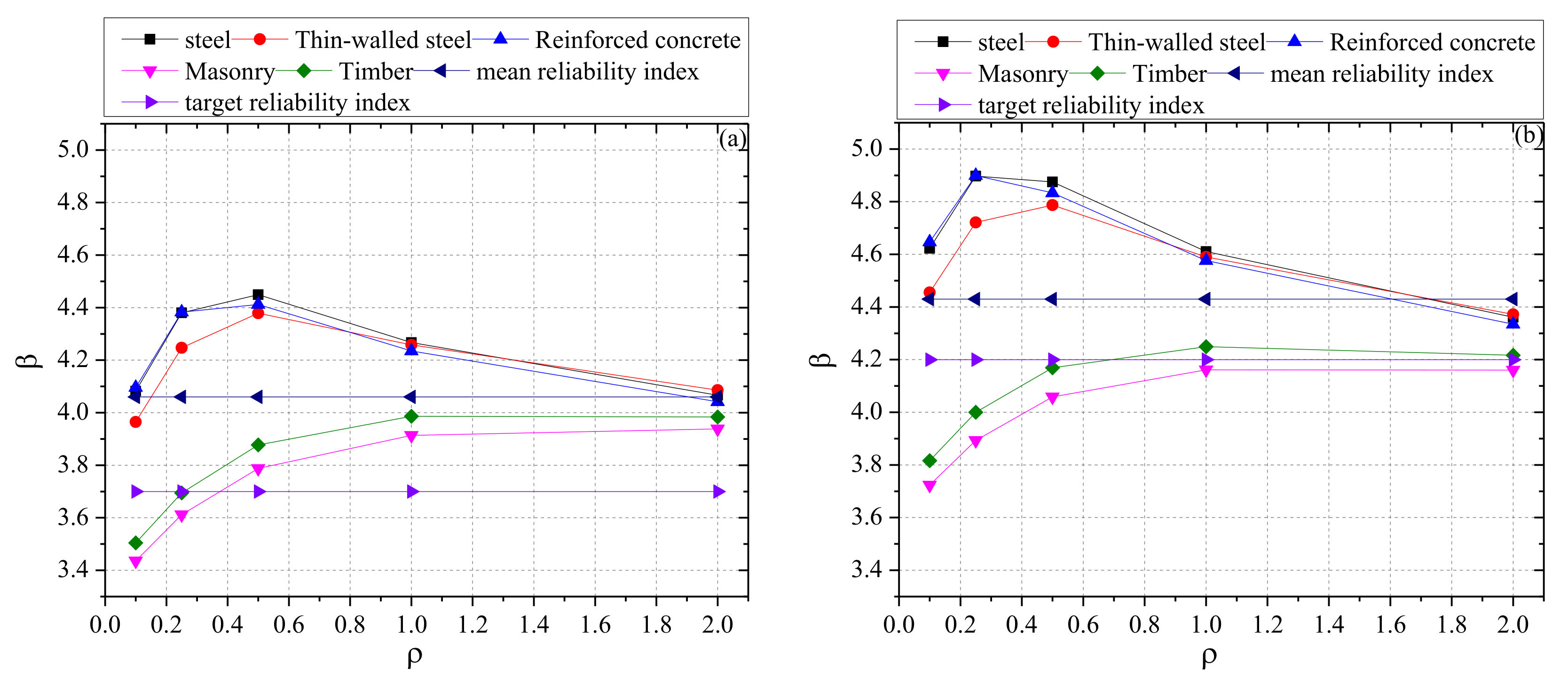
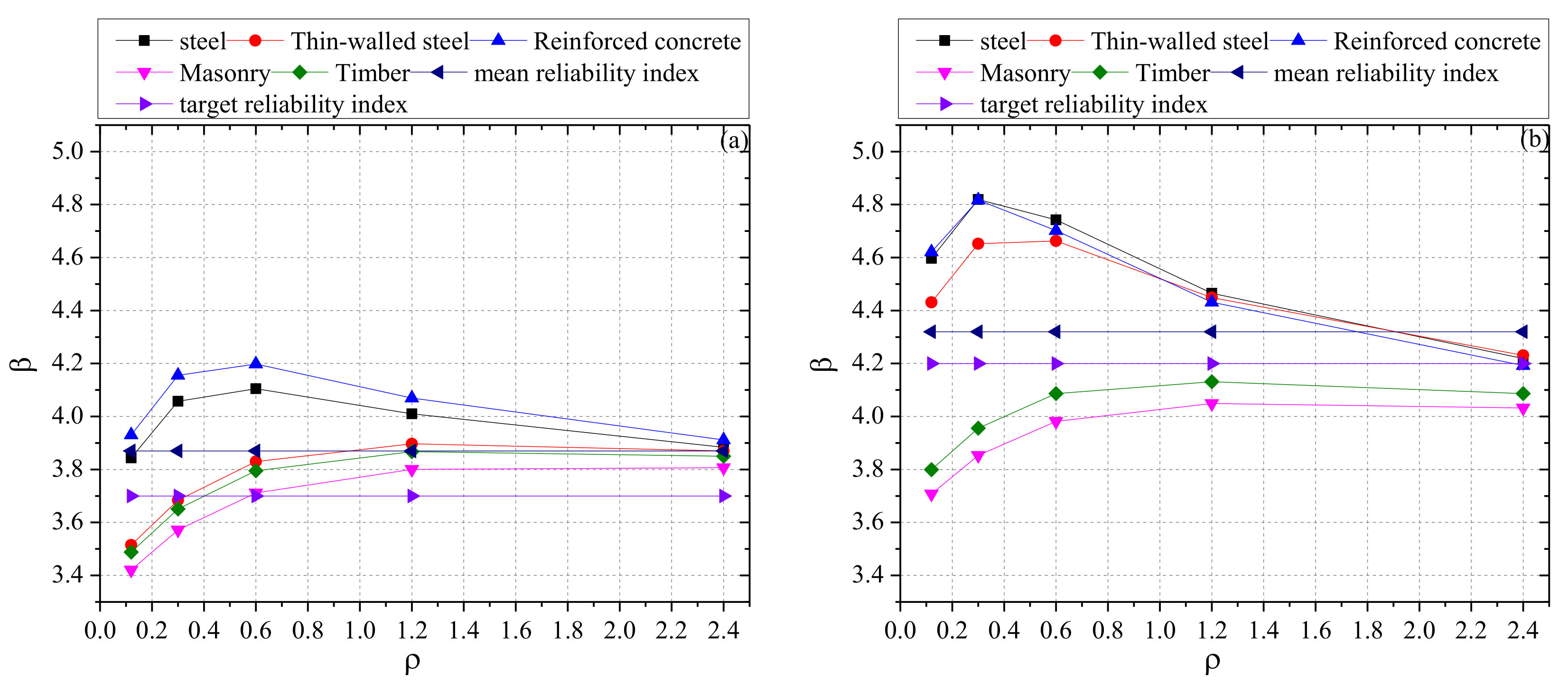
where , and are the characteristic values of the resistance, the effect of dead load and the effect of live load, respectively; , and are the partial factors of the resistance, the dead load and the live load, respectively; is the structural importance coefficient, when the design working life is 100 years, it may be taken as 1.1; is the variable load adjustment factor for the design working life. The combinations of loads are dead load + snow load and dead load + wind load. For the snow load and wind load of a building structure designed for working life of 100 years, 2 different conditions are initially assumed. The two conditions are: ① the basic snow pressure or wind pressure with a return period of 50 years is adopted and the variable load adjustment factor for the design working life is considered in the design expression. And the ratios of the snow or wind load effect to dead load effect are 0.1, 0.25, 0.5, 1.0, 2.0; ② the basic snow pressure or wind pressure with a return period of 100 years is adopted and the variable load adjustment factor for the design working life is not considered in the design expression. Because the ratios of the 100 years wind or snow pressure R100 to the 50 years wind or snow pressure R50 is about 1.1~1.3 for all cities in China. So the ratios of the snow or wind load effect to dead load effect can be taken as , that is, 0.12, 0.3, 0.6, 1.2, 2.4. The reliability analysis of each member are carried out according to the load partial factor in China’s old code (GB50153-2008) [10] and new code (GB50068-2018) [11]. The flowchart for the calculation of the reliability index of the structural members is shown in Figure 1. The reliability indexes of members under partial factors in (GB50153-2008) [10] and (GB50068-2018) [11] based on 50 years snow pressure are shown in Table 8 and Table 9. Figure 2 shows the corresponding variation trend of reliability indexes based on 50 years snow pressure. The reliability indexes of members of partial factors in (GB50153-2008) [10] and (GB50068-2018) [11] based on 100 years snow pressure are shown in Table 10 and Table 11. Figure 3 shows the corresponding variation trend of reliability indexes based on 100 years snow pressure.

Figure 1.
The flowchart for the calculation of the reliability index of the structural members.
Table 8.
Reliability indexes of members under partial factors in (GB50153-2008) for 50 years snow pressure.
Table 9.
Reliability indexes of members under partial factors in (GB50068-2018) for 50 years snow pressure.

Figure 2.
Variation trend of reliability indexes of members for 50 years snow pressure. (a) under partial factors in (GB50153-2008), (b) under partial factors in (GB50068-2018).
Table 10.
Reliability indexes of members under partial factors in (GB50153-2008) for 100 years snow pressure.
Table 11.
Reliability indexes of members under partial factors in (GB50068-2018) for 100 years snow pressure.

Figure 3.
Variation trend of reliability indexes of members for 100 years snow pressure. (a) under partial factors in (GB50153-2008), (b) under partial factors in (GB50068-2018).
The analysis indicates that when the basic snow pressure with a return period of 50 years is adopted and the variable load adjustment factor for the design working life of 1.1 is considered in the design expression, the average reliability index of 3.98 is much higher than the target reliability index of 3.7 with the partial factors in (GB50153-2008) [10] and the average reliability index of 4.42 is much higher than the target reliability index of 4.2 with the partial factors (GB50068-2018) [11]. Apparently, the corresponding design is unreasonable from an economic point of view. When the basic snow pressure with a return period of 100 years is adopted and the variable load adjustment factor for the design working life is not considered in the design expression, the average reliability index of 3.76 is much closer to the target reliability index of 3.7 with the partial factors in (GB50153-2008) [10] and the average reliability index of 4.32 is much closer to the target reliability index of 4.2 with the partial factors (GB50068-2018) [11]. This is more in line with the design principles of safety and economy in structural design. The similar results and conclusions can be obtained for wind load, the reliability indexes and the corresponding variation trend of reliability indexes are shown in Table 12, Table 13, Table 14, Table 15 and in Figure 4, Figure 5.
Table 12.
Reliability indexes of members under partial factors in (GB50153-2008) for 50 years wind pressure.
Table 13.
Reliability indexes of members under partial factors in (GB50068-2018) for 50 years wind pressure.
Table 14.
Reliability indexes of members under partial factors in (GB50153-2008) for 100 years wind pressure.
Table 15.
Reliability indexes of members under partial factors in (GB50068-2018) for 100 years wind pressure.

Figure 4.
Variation trend of reliability indexes of members based on 50 years wind pressure. (a) under partial factors in (GB50153-2008), (b) under partial factors in (GB50068-2018).
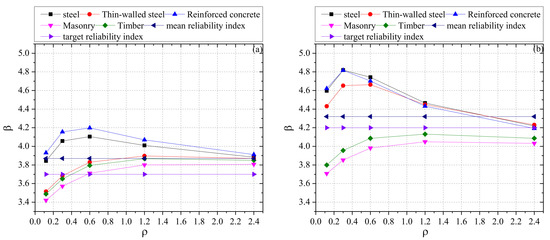
Figure 5.
Variation trend of reliability index of members based on 100 years wind pressure. (a) under partial factors in (GB50153-2008), (b) under partial factors in (GB50068-2018).
4. Conclusions
According to the load partial factor in China’s old and new codes, the reliability analysis of 14 representative structural members designed for working life of 100 years are developed with the basic snow pressure and wind pressure with a return period of 50 years and 100 years. The following conclusions are drawn from the present study:
- (1)
- When the basic snow pressure or wind pressure with a return period of 50 years is adopted and the variable load adjustment factor for the design working life of 1.1 is considered in the design expression, the average reliability index is much higher than the target reliability index, this lead to uneconomic design.
- (2)
- When the basic snow pressure or wind pressure with a return period of 100 years is adopted and the variable load adjustment factor for the design working life is not considered in the design expression, the average reliability index is much closer to the target reliability index, this is a more reasonable design.
- (3)
- For structural members designed for working life of 100 years, the structural importance coefficient of 1.1 needs to be taken in the design expression to increase all the load effects on the structural members. The basic wind pressure and snow pressure should be taken with a return period of 100 years and the variable load adjustment factor for the design working life should not be considered.
Author Contributions
Conceptualization, K.C. and J.Y.; writing—original draft preparation, K.C.; writing—review and editing, G.L. and N.L.; supervision, J.Y and Y.Z.; project administration, K.C. All authors have read and agreed to the published version of the manuscript.
Funding
This work was supported by the Scientific Research Program Funded by Shaanxi Provincial Education Department (No.21JK0834), Shaanxi Key Laboratory of Geotechnical and Underground Space Engineering (No.YT202008) and the Natural Science Foundation of Shaanxi Province, China (2019JQ-055; 2021JM-406).
Institutional Review Board Statement
Not applicable.
Informed Consent Statement
Not applicable.
Data Availability Statement
The data presented in this study are openly available.
Conflicts of Interest
The authors declare no conflict of interest.
References
- European Committee for Standardization. Eurocode—Basis of Structural Design (EN1990-2002); BSI: London, UK, 2002. [Google Scholar]
- Sykora, M.; Diamantidis, D.; Holicky, M.; Jung, K. Target reliability for existing structures considering economic and societal aspects. Struct. Infrastruct. Eng. 2017, 13, 181–194. [Google Scholar] [CrossRef]
- Joint Committee on Structural Safety. JCSS Probabilistic Model Code Part 3: Resistance Models; Joint Committee on Structural Safety: Copenhagen, Denmark, 2001. [Google Scholar]
- Housing and Urban-Rural Development of the People’s Republic of China. Load Code for the Design of Building Structures (GB50009-2012); China Architecture and Building Press: Beijing, China, 2012. [Google Scholar]
- Holický, M. Optimisation of the target reliability for temporary structures. Civ. Eng. Environ. Syst. 2013, 30, 87–96. [Google Scholar] [CrossRef]
- Holicky, M.; Diamantidis, D.; Sykora, M. Reliability levels related to different reference periods and consequence classes. Beton Stahlbetonbau 2018, 113, 22–26. [Google Scholar] [CrossRef]
- Yao, J.T.; Cheng, K.K. General expressions for structural safety design. Chin. J. Appl. Mech. 2014, 31, 275–281. [Google Scholar]
- Zhang, J.H.; Lin, S.B.; Chen, F.; Gan, M.J.; Zhang, J.C.; Xu, Q.; Li, P.; Lv, P. Study on the partial factors of conventional island structures under the design reference period of 60 years. Nucl. Sci. Eng. 2020, 40, 114–121. [Google Scholar]
- Li, K.F.; Wang, P.P.; Li, Q.W.; Fan, Z.H. Durability assessment of concrete structures in HZM sea link project for service life of 120 years. Mater. Struct. 2016, 49, 3785–3800. [Google Scholar] [CrossRef]
- GB50153-2008Unified Standard for Reliability Design of Engineering Structures, China Architecture and Building Press: Beijing, China, 2008.
- GB50068-2018Unified Standard for Reliability Design of Building Structures, China Architecture and Building Press: Beijing, China, 2018.
- Shi, Z.H. On Structural Design Working Life and the Importance Factor of Structure. Build. Sci. 2000, 16, 32–33, 42. [Google Scholar]
- Hu, D.L. Correct understanding and application of “Design service life of building Structure”. Eng. Constr. Stand. 2014, 9, 54–60. [Google Scholar]
- Yuan, H. Discussion on the design of class C building with working life of 100 years. Doors Windows 2019, 22, 175. [Google Scholar]
- Yuan, T.T. Design and Analysis of Lanzhou Subway Control Center Frame-Dual Core Tube Structure. Railw. Stand. Des. 2016, 60, 108–110, 124. [Google Scholar]
- Deng, Z.W.; Yu, Z.G. Design of building structure with working life of 100 years. Gansu Sci. Technol. 2010, 26, 142–144. [Google Scholar]
- Li, J.H.; Lin, Z.M.; Li, M.S. The Limit State Design based on Probability for Building Structures; China Architecture and Building Press: Beijing, China, 1990. [Google Scholar]
- Madsen, H.O.; Krenk, S.; Lind, N.C. Methods of Structural Safety; Dover Publications: Mineola, NY, USA, 2006. [Google Scholar]
- Thoft-Cristensen, P.; Baker, M.J. Structural Reliability Theory and Its Applications; Springer: Berlin/Heidelberg, Germany, 1982. [Google Scholar]
- Ditlevsen, O.; Madsen, H.O. Structural Reliability Methods, 1st ed.; Wiley: New York, NY, USA; Chichester, UK, 1996. [Google Scholar]
- Melchers, R.E.; Beck, A.T. Structural Reliability Analysis and Prediction, 3rd ed.; Wiley: Blackwell, NJ, USA, 2018. [Google Scholar]
- Haldar, A.; Mahadevan, S. Reliability Assessment Using Stochastic Finite Element Analysis; Wiley: Hoboken, NJ, USA, 2000. [Google Scholar]
- Faber, M.H.; Sørensen, J.D. Reliability Based Code Calibration; Joint Committee on Structural Safety: Zurich, Switzerland, 2002. [Google Scholar]
- Peng, Y.B.; Li, S.; Zhao, W.J. Reliability analysis of long span roof structure under wind and snow loading. In Proceedings of the 8th International Conference on Vibration Engineering (ICVE 2021), Shanghai, China, 23–26 July 2021. [Google Scholar]
- Natskår, A.; Moan, T. Structural reliability analysis of a seafastening structure for sea transport of heavy objects. Ocean Eng. 2021, 235, 109364. [Google Scholar] [CrossRef]
- Zięba, J.; Skrzypczak, I. Analysis of reliability of compressed masonry structures. Open Eng. 2020, 10, 462–468. [Google Scholar] [CrossRef]
- Vereecken, E.; Botte, W.; Droogné, D.; Caspeele, R. Reliability-based calibration of partial factors for the design of temporary scaffold structures. Struct. Infrastruct. E 2020, 16, 642. [Google Scholar] [CrossRef]
- Qiang, S.; Zhou, X.; Gu, M. Research on reliability of steel roof structures subjected to snow loads at representative sites in China. Cold Reg. Sci. Technol. 2018, 150, 62–69. [Google Scholar] [CrossRef]
- Zhang, Y.; Lu, Y.; Zhou, Y.; Zhang, Q. Resistance uncertainty and structural reliability of hypar tensioned membrane structures with PVC coated polyesters. Thin Wall. Struct. 2018, 124, 392–401. [Google Scholar] [CrossRef]
- Zhao, G.F.; Jin, W.L.; Gong, J.X. Structural Reliability Theory; China Building Industry Press: Beijing, China, 2000. [Google Scholar]
- Rackwitz, R.; Flessler, B. Structural reliability under combined random load sequences. Comput. Struct. 1978, 9, 489–494. [Google Scholar] [CrossRef]
- Rajashekhar, M.; Ellingwood, B. A response surface approach for reliability analysis. Struct. Saf. 1993, 12, 205–220. [Google Scholar] [CrossRef]
- Metropolis, N.; Ulam, S. The monte carlo method. J. Am. Stat. Assoc. 1949, 44, 335–341. [Google Scholar] [CrossRef]
- Smedt, E.D.; Mollaert, M.; Caspeele, R.; Botte, W.; Pyl, L. Reliability-based calibration of partial factors for the design of membrane structures. Eng. Struct. 2020, 214, 1106332. [Google Scholar] [CrossRef]
- American Society of Civil Engineers. Minimum Design Loads for Buildings and Other Structures: Asce/sei 7-10, 3rd ed.; American Society of Civil Engineers: New York, NY, USA, 2013. [Google Scholar]
- Haldar, A.; Mahadevan, S. Probability, Reliability and Statistical Methods in Engineering Design; Wiley: New York, NY, USA; Chichester, UK, 2000; pp. 1–320. [Google Scholar]
- Kang, Y.M.; Liu, Z.A.; Wu, P.F. Structural Reliability Analysis Method Considering Load Sequence. J. Northeast. Univ. (Nat. Sci.) 2019, 40, 1648–1653. [Google Scholar]
- Gu, X.L.; Xu, Y.; Zhang, W.P. Safety analysis of structural members of existing buildings. J. Build. Struct. 2004, 25, 117–122. [Google Scholar]
- Wang, K.; Lv, L.Y.; Zhou, J.Z.; Zhang, J.C.; Lin, S.B. Study on the variable load in 60-year design reference period. Archit. Struct. Des. 2009, 10, 19–22. [Google Scholar]
- Jiang, J.T.; Wu, Y.X.; Du, D.R. Solution on the coefficients of design formulation for the pragmatic usage under different design working lives. Period. Ocean Univ. China 2016, 46, 121–125, 133. [Google Scholar]
- ISO 13822:2015Bases for Design of Structures—Assessment of Existing Structures, International Organization for Standardization: Geneva, Switzerland, 2015.
- ISO 2394:2015General Principles on Reliability for Structures, International Organization for Standardization: Geneva, Switzerland, 2015.
- Yao, J.T.; Xie, Y.K. Method for inferring current resistance of a single member based on belief function. Build. Struct. 2011, 41, 120–124. [Google Scholar]
- Yao, J.T.; Cheng, K.K. Review and improvement on methods for inferring structural resistance design value in international standard and European code. J. Build. Struct. 2015, 36, 111–115. [Google Scholar]
- Xie, Y.K. General Methods for Reliability-Based Design & Assessment of Engineering Structure; Xi’an University of Architecture & Technology: Xi’an, China, 2010. [Google Scholar]
Publisher’s Note: MDPI stays neutral with regard to jurisdictional claims in published maps and institutional affiliations. |
© 2022 by the authors. Licensee MDPI, Basel, Switzerland. This article is an open access article distributed under the terms and conditions of the Creative Commons Attribution (CC BY) license (https://creativecommons.org/licenses/by/4.0/).