


Abstract
Sharing activities are receiving greater attention due to increasing popularity in recent years. This article focuses on how the use of digital sharing platforms by customers to share products and services helps to increase the saving of natural resources and support sustainable development. In the paper, the authors investigated the main elements affecting ICT based sharing. (1) Literature review: The theoretical part starts with the revision of definitions of sharing activities; descriptions of the links between sharing and sustainable development, policy recommendations, and relevant regulation in the field. Further on, the study emphasises key elements, including ICT ones, that are important for sharing. Finally, the authors investigate how the COVID-19 pandemic affected sharing activities in previously published studies. (2) Methods: During empirical research, the authors revised a list of 33 variables, among which are 16 indicators describing network infrastructure, internet literacy and online shopping. The study uses data for each of the 27 EU countries from 2011 to 2020. The authors investigated correlations between macroeconomics and other variables to determine key variables for the regression model. (3) Results: The authors constructed a dynamic regression model that can be applied to predict the number of participants visiting digital sharing platforms in the European Union (EU). (4) Conclusions: The study shows that, when seeking to forecast the number of visits to digital sharing platforms, it is necessary to use values of main macroeconomic and ICT variables. Among these variables, ICT based indicators are highly dominating.
1. Introduction
Economic and social systems that provide access to goods, services, data, and talent without ownership are called sharing systems (otherwise known as collaborative consumption) [1,2,3,4]. All systems operate based on information technology and peer-to-peer communities, where individuals can distribute, share, and reuse overcapacity and obsolete (or rarely used) assets [5,6,7,8]. All systems come in a variety of forms.
Sharing is spreading rapidly across Europe and a wide range of sectors [1,9]. Shared consumer services, such as home-sharing and car-sharing, for domestic use are already known and used by many people in the EU [10]. Collaborative consumption offers many new ICT based opportunities for citizens and innovative entrepreneurs [11,12,13,14]. A distinctive feature of cooperative consumption is that service providers are usually private individuals who offer their assets or services, sometimes based on cooperation [15]. More and more micro-entrepreneurs and small businesses are using digital collaboration platforms [16,17].
A survey conducted by Eurostat in 2019 showed that 21% of EU citizens used a website or an app to arrange accommodation from another person and 8% have performed the same action for transport services. In the tourism sector, collaborative consumption provides many exciting opportunities for citizens as consumers as well as for micro-entrepreneurs and SMEs [8].
Although collaborative consumption offers new ICT based opportunities for entrepreneurs and more choices for consumers, there are rules and obligations that citizens and businesses need to be aware of [18]. Applicable EU rules and policy recommendations to help citizens, businesses and EU countries take full advantage of new business models and promote sustainable business development and collaborative consumption are explained in the EU 2016 June Communication on the European Agenda for collaborative consumption [19].
It is sometimes very difficult for existing market operators to succeed in collaborative platforms [4,20]. However, digital platforms enable individual citizens to offer their services, as well as promoting new employment opportunities, flexible working arrangements and new sources of income. Collaborative consumption for consumers can provide benefits through new services, an extended supply, and lower prices [21,22,23].
The study starts with the presentation of methodology integrating all information in the article, then introduces the literature and regimentation after presenting the core elements. The study then discusses COVID-19 aspects regarding sharing and ends with empirical research on whose purpose it was to identify main macroeconomic and ICT variables important for sharing activity. Finally, the authors provide the discussion part and conclusions.
The literature review shows that studies on sharing activity are available from the last two decades (Table 1).

Table 1.
Review of literature.
The analysis of literature (i.e., review of books published by Oxford University Press, Cambridge University Press, Harvard University Press, Springer, M.E. Sharpe, Routledge), shows that other publishers identified rarely discuss the theme of sharing activity under literature focusing on economic and ICT topics. The analysis presented under Table 1 shows that less than 0.002 per cent of the above publications contain investigations in the economic research area and 3.43 per cent in the ICT research area. That is why it is important to investigate possibilities to activate ICT based sharing activities. This shows that it is evident that ICT supports sharing activities in various forms and the research about such digital systems started in advance.
2. Methodology for Activating Sharing Activities
The intensification of sharing to meet the requirements of sustainability is associated with an understanding of a complex and dynamic phenomenon. This requires a review of research in this area, an analysis of macroeconomic and ICT variables, and an identification of the popularity of digital sharing platforms, including consumer preferences and the use of various ICT technologies. The framework of the methodology for enhancing sharing activities contains several structural levels in Table 2. The application of the methods is necessary for the analysis of theoretical and statistical data while maintaining the complex popularity of digital sharing platforms.
Table 2.
Three-level methodology activating sharing activity in the EU.
The authors constructed a methodology to present the research directions.
The authors divided the methodology into three layers where each focuses on the activation of sharing activity (see Table 2).
Table 2 provides descriptions, relationships, and methods specific to each level of the presented three-level methodology.
All levels of analysis are sustainable and meet the requirements of the sharing process. Sharing reduces energy consumption and environmental pollution during the production process, saves materials and protects the environment.
Various digital online platforms that allow businesses and individuals to share goods and services for free, connect the seller and the buyer from the sharing infrastructure. Digital platform sharing is grouped into limited capacity assets (such as products) and unlimited capacity (such as services). With the advent of ICTs, which allows companies to offer users an easily accessible platform, this type of service is becoming increasingly popular.
There is a growing interest in total consumption in science. The sharing of activities essentially contributes to the concept of preserving original natural resources and saving human power. Success factors, such as convenience and accessibility, are becoming increasingly important for any business, whether C2C (consumer to consumer), B2B (business to business), or B2C (business to consumer), for business models built on ICT platforms that connect the vendor with the customer and facilitates their exchange of goods and/or services.
Individuals use the internet for various purposes. Experts in e-commerce report that business and consumer literacy, two different and heterogeneous areas, are now being integrated. All sellers and customers can be united with the help of professional ICT solutions.
From a macroeconomic point of view, it is important to link purchasing power (price and productivity) and household unemployment. People want to cut back on their expenses, save money, and look for extra income.
3. Literature Review
The EU have common goals: increasing resource efficiency, creating jobs and supporting micro-entrepreneurship, increasing community participation, and fostering digital innovation [24]. It is an opportunity to unite in pursuit of common priorities and to integrate a stronger, more resilient Europe [24].
The sharing model [25,26,27,28] offers more opportunities to adapt to our needs to use assets more efficiently at a lower cost [29,30,31,32]. It revolves around three models:
Product-based Systems: Without product ownership, users pay for the benefits of using the product (e.g., by sharing a car/bike) [33]. Such a model undermines traditional industries based on individual private ownership models [17,18].
Redistributing Markets [34]: Redistribution of second-hand goods from those who do not want them to those who want them (e.g., barter markets and second-hand goods). In different markets, products may be free (Freecycle), others may be exchanged (thredUP) or sold (eBay).
Collaborative Lifestyles [8,32,34]: When people with similar needs or interests come together and share assets that are less tangible, such as time, space, skills, and money [35]. These include jobs (CitizenSpace), gardens (Landshare) or car parks (ParkatmyHouse), loans between individuals (Lending Club) and housing rentals (Airbnb and Couchsurfing) [6,11,36,37,38].
Given the loose definitions of sharing, many have adopted a flexible and open approach to the topic.
The sharing activity refers [8,39] to “business models where activities are facilitated by digital collaborative platforms” [17] that create an open marketplace for the temporary usage of goods or services often is provided by private individuals [7].
According to the EU definition, sharing is a business model where activities are facilitated by digital collaborative platforms that create an open marketplace for the temporary usage of goods or services often provided by private individuals [40]. As the European Commission recognizes in offering such definition “The term of collaborative consumption is often interchangeably used with the term ‘sharing activity’. Sharing is a rapidly evolving phenomenon, and its definition may evolve accordingly” [24,41,42,43,44].
Vaughan and Hawksworth replied on the definition of PriceWaterhouseCoopers (PwC) that “sharing uses digital platforms to allow customers to have access to, rather than ownership of, tangible and intangible assets” [45]. In addition to typical examples, such as Uber and Airbnb, the definition also includes productive collaborations, as well as Spotify subscription models for content and music entertainment [8,9,12,14].
Authors argue that sharing is a promising phenomenon due to many economic, social, and technological factors [46]. References [11,35] argue that sharing promotes efficiency, community, and sustainability by focusing on servicing untapped resources, and [47] argue that sustainability is a major business concern.
De las Heras et al. stated that sharing is not a “fragile and temporary trend”, and it has a significant influence on reversing competition around the world by offering opportunities for many small services providers to access the market [48]. Olson and Kemp identified the main benefits of sharing for consumers, such as: adapting to the needs of individuals, rather than reacting to the changes in demand; offering unique experiences that commercial providers cannot ensure, and lower prices compared to commercial providers [49]. Furthermore, various researchers (for example, [50,51,52,53]) underlined the reduction of consumers’ costs as the main benefit of sharing. Sharing is advantageous to the environment, as it makes greater use of existing resources and the potential energy savings that would result from car and bike-sharing [54,55]. Furthermore, Reference [56] state that sharing is less resource intensive.
Sharing encourages resource efficiency, waste reduction, and lower consumption to promote sustainable consumption practices [57]. Furthermore, energy savings as an advantage of the sharing is underlined by [4,29,58]. Reference [59] emphasised that social innovations and new technologies could improve people’s lives and protect the Earth. Reference [51] state that sharing creates new opportunities for entrepreneurs and consumers, provides the flexibility of access to goods, and increases consumer choices; it offers broader and cheaper access to services for customers in the short term [1].
According to reference [60], sharing is a potential new path to sustainability. References [27,61] state that sharing promotes sustainable growth and energy efficiency. Furthermore, it can be argued that sharing is closely related to sustainability [62,63] and the benefits of sharing correspond to the dimensions of sustainable development: economic, social and environmental [3,17,33]; sharing contributes to sustainable development goals by promoting sustainable consumption and provides growth opportunities for innovative start-ups [40]. Furthermore, [64,65] stressed that sharing could promote sustainability and is a pathway to circularity.
There is no consensus on what activities are part of the “sharing”. According to [9], what is now called “sharing” has also been called “collaborative consumption”. Other authors name other parts of the “sharing”. For a more extensive overview, see Table 3.
Table 3.
Alternative names for sharing.
According to the European Parliament, “the sharing or collaborative consumption, is a new socio-economic model that has taken off thanks to the technological revolution, with the internet connecting people through online platforms on which transactions involving goods and services can be conducted securely and transparently” [41]. The internet and connectivity technologies have made it possible to bring together demand and supply in a broad spectrum of markets [10]. Various research, e.g., [8,25,30,66,102,103,104,105], have stated that technological factors are the most significant factors stimulating the growth of sharing.
According to [106], the internet is one of the most critical general-purpose technologies globally, that impacts all activities linked to the internet. Reference [106] emphasised the ability of Information and Communication Technology (ICT) to improve access to services and enhance connectivity. Therefore, ICT is one of the most critical factors that determines the growth of sharing. Therefore, it can be stated that the level of network infrastructure and access to ICT are crucial for the development of sharing. The internet and mobile technology stimulate the growth of a vast online marketplace. Technology has enabled an easy and more convenient way to interact with others, and to share idle assets with others. Reference [16] emphasised the importance of such technical elements as big data analytics, low-cost cloud storage, social media user growth, and the increased use of mobile devices to develop sharing. The latest technologies can maintain vast amounts of data concerning people and assets, ensuring continued sharing. Secure payment systems provide a safe and convenient way to transfer money between sharing parties, i.e., between providers and users of services. The Internet of Things (IoT) has a significant impact on the development of sharing by enabling owners of the resources to be connected remotely. According to [105], the Internet of Things and blockchain technology [1] open opportunities to create peer-to-peer secure automatic payment mechanisms and foreign exchange digital platforms. The latest technologies provide impetus to spread sharing by facilitating peer to peer business models [107].
4. Sharing Regulations in the EU
In 2015, the European Commission (EC) adopted the Single Market Strategy and declared the development of the European Agenda for collaborative consumption. As a result, “A European Agenda for Collaborative Economy” was published in 2016 and aimed to “support consumers, businesses and public authorities to engage confidently in this rapidly evolving landscape”. It should be noted that collaborative consumption is a part of the Digital Single Market Strategy presented in 2016. In addition, the Communication on [108] highlights the importance of online platforms, including sharing platforms, for further developing digitalisation in the EU.
Although the term “collaborative consumption” was used in the report, the European Commission acknowledges that the terms “collaborative consumption” and “sharing” can be used interchangeably. The report defines sharing as “business models where activities are facilitated by digital collaborative platforms that create an open marketplace for the temporary usage of goods or services often provided by private individuals.” Sharing encompasses service providers, service users and internet platforms, which act as intermediaries connecting providers with users. Service providers can be private individuals offering services occasionally or service providers acting in their professional capacity [24]. Furthermore, it was stated that transactions in the sharing community generally do not involve a change of ownership. However, some transfer of intellectual property ownership could be possible when sharing. Hence, it can be argued that if individuals sell used things through digital platforms, such transactions cannot be classified as part of sharing. Therefore, it could be argued that e-commerce cannot be considered a part of collaborative consumption platforms.
The European Agenda for Collaborative Economy amplified the contribution of the sharing to job creation and growth, emphasised the emergence of new opportunities for consumers and entrepreneurs and the potential of sharing to contribute to competitiveness and growth. Collaborative consumption (or sharing) is recognised as a new, innovative, dynamic sector in which consumers may benefit through new services, increased supply, and lower prices. However, the European Commission indicates that policy recommendations and adequate regulations are needed to help EU countries benefit from sharing and promote balanced development. The critical areas required for regulation emphasised in “A European Agenda for Collaborative Economy” are market access, consumer protection, liability, labour law, and taxes.
European Commission documents state that technological, economic, and societal factors drive collaborative consumption [24]. However, it should be noted that political-legal factors are not mentioned as essential factors in developing a sharing activity. Meanwhile, it is acknowledged that the regulatory environment impacts sharing development. Therefore, the authors of this article argue that technological, economic, social-demographical, and political-regulatory factors are essential for the development of sharing activity.
5. COVID-19 Impact on Sharing in Literature
There is currently little academic literature that analyses and describes the impact of the COVID-19 pandemic on various aspects of life, including sharing. This pandemic has shown both how much sharing helped consumers access essential goods and services, while at the same time revealing the very real restrictions and regulations that undermine them.
According to [109], COVID-19 has affected digital sharing platforms, service providers, and service receivers (customers) along with governments. Reference [110] says COVID-19 has disproportionately affected vulnerable groups and millions of people involved in sharing have lost their livelihoods. Reference [29] note that some service providers may believe that they should be treated as employees, but profits and social welfare in sharing are controversial issues.
In response to COVID-19, it was important for digital platforms to update their websites. According to [111], until the physical sites were closed, platform owners have been working to redesign their online infrastructure and physical space, including “…hosting websites, mail server upgrade to solve spam problems that are introduced the inventory stocks of consumables, vendor management software”.
Reference [109] notes that understanding the impact of the COVID-19 pandemic on sharing activities is crucial. Particularly significant changes in COVID-19 have led to accommodation and transport sectors being impacted. According to [112], both passenger and freight transport have experienced severe declines due to the COVID-19 crisis. The carriage of passengers within EU Member States and between the European Union and the rest of the world has been partially or completely closed [113]. Land transport was also disrupted and slowed down due to additional sanitary checks at the border.
According to [6], during the pandemic, there has been a significant increase in online networking platforms (P2P) through which individuals can rent out unused real estate for a short period. Property owners benefit from a variety of benefits; they offer guests comfortable and affordable accommodation that is usually more authentic and more localized than hotel accommodation. P2P hosting offers entrepreneurial opportunities, extra income, and hosts receive satisfaction from their hospitality service.
Reference [114] based on the World Transport Conference the Research Society (WCTRS), say there is a platform for transport researchers, managers, policy makers and educators around the world to exchange ideas, which surveyed the impact of COVID-19.
As described by many researchers, quarantine has harmed the transport and accommodation sectors. However, activities in other sectors of sharing, such as freelance work, streaming services, and online delivery, have flourished. Reference [115] note that the use of the internet and food delivery services has increased during the COVID-19 pandemic. The closure of offices has increased the demand for freelance work. With the closure of cinemas, video streaming services, such as Netflix, Disney+ and Amazon Prime, have become the main source of entertainment, with subscriptions and usage of all streaming services increasing dramatically [116].
E-commerce has fundamentally changed the structure of trading goods. Currently, 55% of the world’s population shop online regularly. The penetration of internet-enabled devices and the increasing number of online stores have led to an inevitable change within the retail landscape. Naturally, this has also had a tremendous influence on shopping behaviours. Nowadays, there are two major ways for a retailer to bring products or services to market—online and offline. The online sales channel refers to the purchase of physical goods via the internet—on the desktop of a personal computer, tablet, or smartphone. The offline sales channel covers all purchases in stationery stores, via tele sales or mail-order (e.g., print catalogues). The online market for pharmaceuticals varies considerably by country because legislations on over-the-counter pharmaceuticals differ widely from country to country. Thus, the online share in Europe and Asia in 2019 was 12%.
6. Key Elements in Studies Focusing on Sharing
The business models of sharing services are very different from each other. To identify the key elements behind the development of business models of sharing, the authors have examined studies by different researchers in the field of sharing and its links to key elements synergy. Table 4 provides descriptions of the sharing of other researchers, highlighting key trends in the field.
Table 4.
Authors researching sharing.
According to [119], social networking technologies, mobile technologies, and payment systems are the main technological drivers. Social networking technologies are essential for social profiles and reputation tracking. Mobile technologies with location-sensing technologies allow one to establish user location, essential for transportation. The latest technologies have also been described as ‘disruptive technologies’ crucial to the emergence of sharing. The Communication “Digitising European industry reaping the full benefits of a digital single market” indicates how the internet, the web, and recent developments in technology reshape business models, transform the business landscape and people’s lives and enable the growth of sharing [108]. With the rise of digital technology and the internet, information costs fell sharply and coordination costs for sharing activities dropped correspondingly.
7. Materials and Methods
The authors examined what quantitative and qualitative methods are used by other authors for their research. Table 5 summarizes and provides a review of the literature. Among the methods, the most popular is the network model in studies dedicated to the above-mentioned topic. The authors identified that the dynamic regression model, as well as other mathematical methods, is rarely mentioned among above listed quantitative methods. Time series analysis could help to identify factors that support the activation of sharing that is required.
Table 5.
Hierarchy of quantitative and qualitative methods and models for researching sharing activities.
The authors revised 8 studies discussing the application of the qualitative Delphi method and presented their application results in Table 6.
Table 6.
Application of Delphi method.
For the study, the authors collected time-series data and investigated the application of the quantitative method.
The purpose of the study is to identify the main macroeconomic factors and the development of a regression model. Selected available data for variables from the Eurostat public database for the 10 years 2011–2020 are used to analyse dynamic interactions. To identify linear relationships, the authors took 33 macroeconomic variables (grouping them according to 6 groups: network infrastructure, internet literacy, shopping online variables, variables describing population, macroeconomic indicators and economic freedom indicators) for the 27 EU countries and determined how the consumers of each of these countries visit their 10 online exchange platforms (Airbnb, BlaBlaCar, eBay, Fiverr, Gumtree, Kickstarter, Lime, Uber, UpWork and Vinted) (Table 7). For this dataset, the authors tested the significance of the correlation. Later, statistically insignificant variables were removed, and the procedure was applied only to 22 macroeconomic variables whose probability of variance was significant for visits to online exchange platforms.
Table 7.
Digital sharing platforms supporting sustainability.
The authors, in Table 7, provide the list of digital sharing platforms supporting sustainability and their provided services which represent different economic sectors.
The authors apply a linear regression model. The authors use a simple regression analysis procedure to convert the regression coefficients into a model depicting a linear relationship between the dependent and the regressors.
Based on the regression equation, the authors identified variables affecting the number of visits to digital sharing platforms. The process consists of four steps:
- The stage of creating a theoretical basis was used to clearly understand the phenomena and structure the various variables affecting the phenomenon and compile a list of critical ones;
- The data selection phase included analytical reliability, measurability, and phenomenon adequacy. The quality of the available data was verified by analysing their strengths and weaknesses and verifying the data sources and the availability of the required data;
- The normalization phase was performed seeking to compare variables by the percentage of monthly differences. The percentage of monthly differences shows the percentage change compared to the previous month;
- The validation analysis phase was used to evaluate the regression equation constructed according to the normalization scheme.
Following the four main steps, the authors constructed (1) the theoretical framework and presented it under Equation (1); (2) selected the data based on the correlation coefficients and probabilities based on a constructed matrix of variables, shown in Appendix A; (3) normalised the data by using a logarithmic process (Equation (2)); and (4) presented validation analysis and provided it in Table 8.
Table 8.
Statistical validity.
This analysis reveals dynamic trends and allows assumptions about the existence (non-existence) of relationships in pairs. The authors of the dependent variables selected the number of visits to digital sharing platforms for which data for the last month of the year were collected from Google Trends [130].
The regression model was developed to estimate how macroeconomic variables affect the number of visits to digital sharing platforms:
where:
—logarithmic dependent variable of the number of customer visits to digital sharing platforms in the 27 EU countries in year t, —intercept, – dlog of consumer price index in the 27 EU countries in year t; – dlog of the number of households connected to the internet in the 27 EU countries in year t; —dlog of the number of internet users seeking health information in the 27 EU countries in year t; —dlog of the number of individuals who use the internet in the 27 EU countries in year t; – dlog of the number of individuals using the internet for ordering goods or services in the 27 EU countries in year t; —dlog of productivity index (when real labour productivity per person is used, assuming that 2010 = 100) in the 27 EU countries in year t; —dlog of the total unemployment rate (percentage of the total population) in the 27 EU countries in year t; —random model error, β1, β2, β3, β4, β5, β6, β7—coefficients of elasticity reflect the influence of independent variables on sharing.
The authors delivered a specific regression model, which results in:
| (−1.55) | (1.71) | (−3.21) | (3.23) |
| (2.04) | (−1.71) | (2.63) | (1.98) |
The equation includes variables describing network infrastructure and internet literacy, variables describing online shopping and macroeconomic indicators.
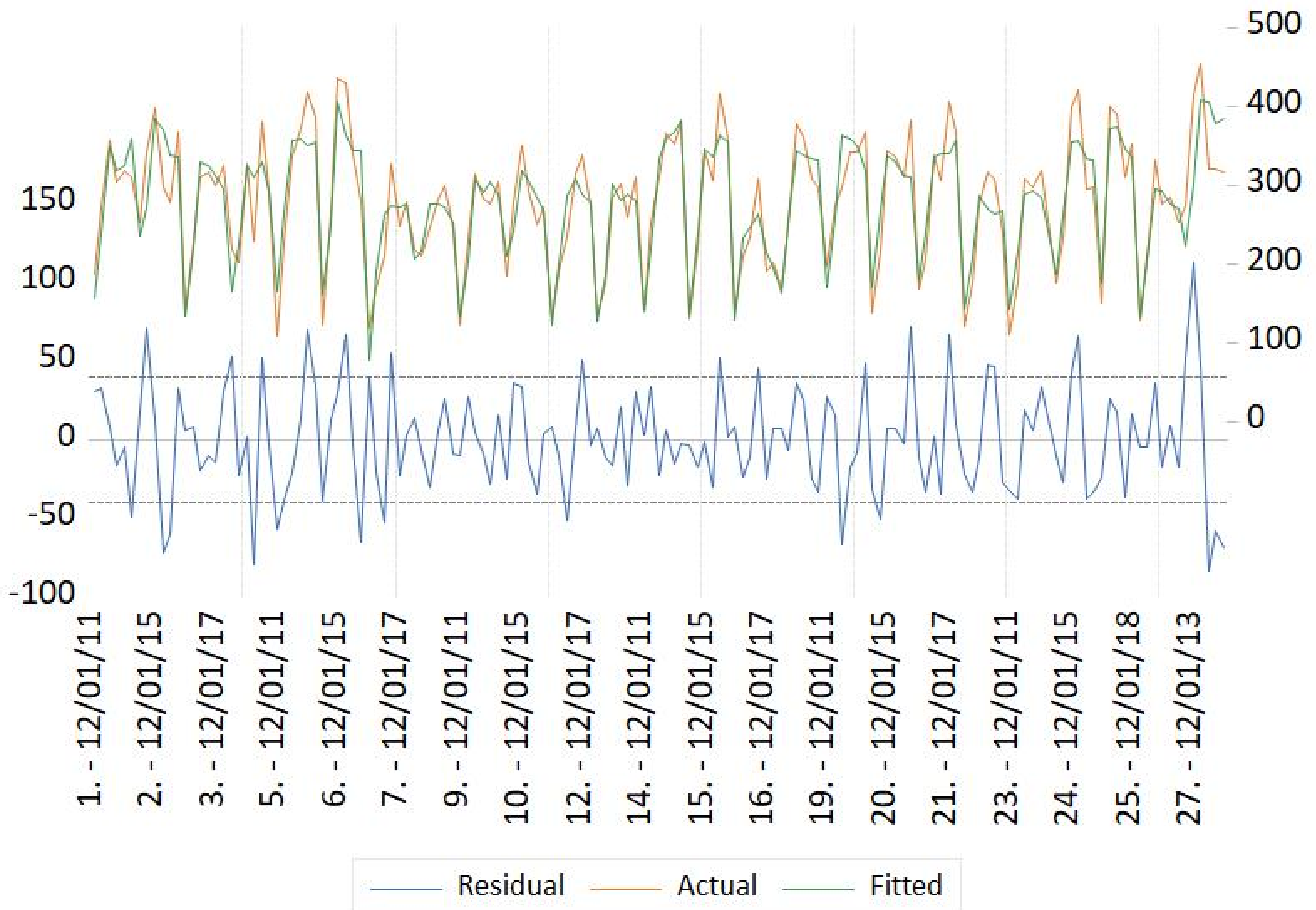
The correlation coefficient of the formed regression model is 0.82, and the adjusted R2 is 0.76. The provided model is placed in Figure 1.
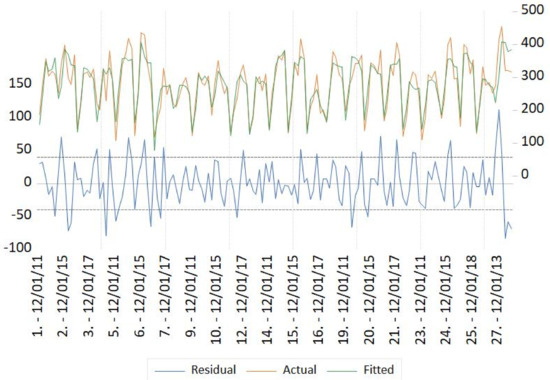
Figure 1.
The forecasting of the number of visits to ten digital sharing platforms in the EU countries. Source: constructed by the authors.
The authors performed statistical validity tests. Probability t and probability χ2 in the test statistics do not indicate significant autocorrelation and heteroskedasticity. All other results of the performed dynamic regression analysis are provided in Table 8.
This proves that other values are also very important in the study of the number of visits to digital sharing platforms, not included in the early studies for sharing. The authors found that variables, such as a consumer price index, productivity index, unemployment rate, and internet users, are critical and affect the number of visits to online sharing platforms. The data provide a pattern and are normalized using a logarithmic process.
8. Results and Discussion
The authors researched sharing activities, supported by ICT, that have recently been developing across the world. Due to the higher focus on sharing sustainable development compared with traditional activities, it is important to research and clarify how we could stimulate environment-friendly activities to share products and services.
The previous study of the authors was dedicated to the US market and this study focus on the EU landscape. The statistic describing each market is a bit different, so the results stating which variables are important for sharing are a bit different. However, the authors could mention that for researching the US market—71 variables were investigated. However, for research on sharing in the EU market, the number of variables was half lower. What is interesting is that the authors also included the COVID-19 topic to the investigation thematic, as two years of the pandemic are already visible in statistics.
The authors analysed the different methods used to explore sharing activities. It is noteworthy that the most popular is the Delphi method, which despite its capabilities and popularity, has still received criticism from other authors. The solutions in this method are considered to be very different from the average, and the usual Delphi method is often time-consuming and does not provide insight into the results. Due to the lack of reliability of this method, the method was not used in this article, only the experience of other authors in describing the Delphi method was analysed and provided.
The results can be useful for practitioners and policymakers exploring the promotion of sharing activities. Such activity has been evident for a long time as online platforms have contributed to wider accessibility. However, sharing is still a new area of research and few studies have been carried out. Thus, the authors attempted to explore the phenomenon of knowledge sharing and conceptual level expansion.
The study had some limitations. The COVID-19 impact was not researched due to the lack of recent data presented under the Eurostat database. Thus, this topic was just theoretically described.
9. Conclusions
The study revises the application of ICT by information societies for sharing, which supports sustainable development, in several directions:
- -
- The application of digital sharing platforms to share products;
- -
- The connection of information societies to ICT network infrastructure;
- -
- The internet literacy and shopping online skills of information societies.
In the study, the authors identified that macroeconomic variables, such as a consumer price index, productivity index, total unemployment rate, the number of users and households connected to the internet, are critical and affect the number of visits to digital sharing platforms in EU countries.
The scientific literature analysing the growth of sharing activities lacks research on quantitative factors that ensure the development trends and opportunities of sharing activities. The number of visits to digital sharing platforms and the number of sharing platforms are growing. Even in countries that have focused on sharing activities from the outset, data suggest that predicting the size of the sharing market or the growth of digital sharing platforms is not easy. During this investigation of sharing activities, the authors tried to fill the gap, as scientific literature lacks deep analysis on sharing activities and their growth.
The literature review shows strong research development in the direction of revising technological factors. The study expands knowledge in this area.
The authors investigated the number of critical elements required to visit digital sharing platforms and presented a linear regression model. The model is useful for predicting the number of visits using monthly data. As sharing is still a new field of research and little research has been conducted, the authors have tried to explore the phenomenon of sharing and expand the conceptual level of knowledge. The authors introduced an equation and provided a tool to predict the number of visits to online sharing platforms. The equation presenting the number of visits to business digital sharing platforms included variables describing network infrastructure, internet literacy, online shopping, and macroeconomic indicators. However, ICT based indicators are dominating in predicting the amount of customer visits to digital sharing platforms.
The authors identified that for the revision of sharing activity, 20 qualitative and quantitative methods were applied in the studies. Of course, quantitative methods are prioritized among these papers.
The authors analysed the qualitative methods used by other researchers investigating sharing activities and found that the most popular is the Delphi method, which is assessed by different scientists ambiguously, with some describing the circumstances of its application. Most of the authors apply this method when seeking to research situations in the concrete economic sector.
The research has certain limitations, so the research can be extended to other directions:
- Revision of number of visits to other digital sharing platforms (including more services);
- Revision of situation in other countries;
- Analysis of additional components;
- Review of different periods.
In addition, other directions for predicting visits to digital sharing platforms could be included in the composite index setup.
Author Contributions
Conceptualization and statistics, O.L. and V.G.; methodology, A.B.; updates, O.L.; formal analysis, V.G.; writing—review and editing, A.B. All authors have read and agreed to the published version of the manuscript.
Funding
This research received no external funding.
Institutional Review Board Statement
Not applicable.
Informed Consent Statement
Not applicable.
Data Availability Statement
Not applicable.
Conflicts of Interest
The authors declare no conflict of interest.
Appendix A
Table A1.
Correlation between macroeconomics and ICT variables.
Table A1.
Correlation between macroeconomics and ICT variables.
| Groups | The Number of Visits to Digital Sharing Platforms | Abbreviation | Statistics | |
|---|---|---|---|---|
| Network infrastructure variables | Households—level of internet access | HIA | Corr. Coefficient | 0.4 |
| Probability | 0 | |||
| Households—the type of connection to the internet | HCI | Corr. Coefficient | 0.48 | |
| Probability | 0 | |||
| Mobile internet access (percentage of individuals) individuals used a mobile phone (or smart phone) to access the internet | IMP | Corr. Coefficient | 0.61 | |
| Probability | 0 | |||
| Mobile-cellular subscriptions per 100 inhabitants | MCS | Corr. Coefficient | 0 | |
| Probability | 1 | |||
| Fixed broadband subscriptions (per 100 people) | FBS | Corr. Coefficient | 0.33 | |
| Probability | 0 | |||
| Internet literacy | Individuals using the internet (% of population) | IUI | Corr. Coefficient | 0.26 |
| Probability | 0 | |||
| Individuals—internet use | IIU | Corr. Coefficient | 0.31 | |
| Probability | 0 | |||
| Individuals—mobile internet access | MIA | Corr. Coefficient | 0.35 | |
| Probability | 0 | |||
| Internet use—finding information about goods and services | IFI | Corr. Coefficient | 0.36 | |
| Probability | 0 | |||
| Internet use—internet banking | IIB | Corr. Coefficient | 0.2 | |
| Probability | 0 | |||
| Internet use—participating in social networks | ISN | Corr. Coefficient | 0.41 | |
| Probability | 0 | |||
| Internet usage—seeking health information | IHI | Corr. Coefficient | 0.34 | |
| Probability | 0 | |||
| Internet use—telephoning or video calls | ITC | Corr. Coefficient | 0.28 | |
| Probability | 0 | |||
| Shopping on-line variables | Last online purchase in the past 12 months | IPO | Corr. Coefficient | 0.34 |
| Probability | 0 | |||
| Individuals using the internet for ordering goods or services | IOG | Corr. Coefficient | 0.33 | |
| Probability | 0 | |||
| Individuals using the internet for selling goods or services, percentage of individuals | ISG | Corr. Coefficient | 0.17 | |
| Probability | 0 | |||
| Variables describing population | Entrepreneurial intention | EI | Corr. Coefficient | −0.1 |
| Probability | 0.2 | |||
| The ratio of young people in the total population on 1 January by sex and age (from 15 to 29), percentage | YP | Corr. Coefficient | −0.29 | |
| Probability | 0 | |||
| Cultural and social norms | CSN | Corr. Coefficient | 0.16 | |
| Probability | 0.1 | |||
| Population density | PD | Corr. Coefficient | 0.04 | |
| Probability | 0.6 | |||
| Macroeconomic variables | Consumer price index | CPI | Corr. Coefficient | 0.4 |
| Probability | 0 | |||
| Labour costs (wages and salaries total) | LC | Corr. Coefficient | 0.16 | |
| Probability | 0.1 | |||
| Total unemployment rate (percentage of the total population) | TUR | Corr. Coefficient | −0.31 | |
| Probability | 0 | |||
| GDP per capita, PPP (current international $) | GPC | Corr. Coefficient | 0.12 | |
| Probability | 0.1 | |||
| Productivity (real labour productivity per person, index, 2010 = 100) | LPP | Corr. Coefficient | 0.32 | |
| Probability | 0 | |||
| R&D expenditure (% of GDP) | RDE | Corr. Coefficient | 0.22 | |
| Probability | 0 | |||
| Economic freedom variables | Business freedom | BF | Corr. Coefficient | 0.09 |
| Probability | 0.3 | |||
| Investment freedom | IF | Corr. Coefficient | 0.15 | |
| Probability | 0.1 | |||
| Property rights | PR | Corr. Coefficient | 0.24 | |
| Probability | 0 | |||
| Regulatory quality | RQ | Corr. Coefficient | 0.13 | |
| Probability | 0.1 | |||
| Rule of law | ROL | Corr. Coefficient | 0.16 | |
| Probability | 0 | |||
| Government effectiveness | GE | Corr. Coefficient | 0.15 | |
| Probability | 0.1 | |||
| Tax burden | TB | Corr. Coefficient | −0.13 | |
| Probability | 0.1 |
References
- Acquier, A.; Daudigeos, T.; Pinkse, J. Promises and paradoxes of the sharing economy: An organising framework. Technol. Forecast. Soc. Change 2017, 125, 1–10. [Google Scholar] [CrossRef]
- Akbar, P.; Mai, R.; Hoffmann, S. When do materialistic consumers join commercial sharing systems? J. Bus. Res. 2016, 69, 4215–4224. [Google Scholar]
- Böcker, L.; Meelen, T. Sharing for people, planet or profit? Analysing motivations for intended sharing economy participation. Environ. Innov. Soc. Transit. 2017, 23, 28–39. [Google Scholar] [CrossRef] [Green Version]
- Curtis, S.K.; Lehner, M. Defining the sharing economy for sustainability. Sustainability 2019, 11, 567. [Google Scholar] [CrossRef] [Green Version]
- Choi, T.M.; He, Y. Peer-to-peer collaborative consumption for fashion products in the sharing economy: Platform operations. Transp. Res. Part E Logist. Transp. Rev. 2019, 126, 49–65. [Google Scholar]
- Farmaki, A.; Miguel, C.; Drotarova, M.H.; Aleksić, A.; Časni, A.Č.; Efthymiadou, F. Impacts of Covid-19 on peer-to-peer accommodation platforms: Host perceptions and responses. Int. J. Hosp. Manag. 2020, 91, 102663. [Google Scholar]
- Piscicelli, L.; Ludden, G.D.; Cooper, T. What makes a sustainable business model successful? An empirical comparison of two peer-to-peer goods-sharing platforms. J. Clean. Prod. 2018, 172, 4580–4591. [Google Scholar] [CrossRef]
- Selloni, D. New forms of economies: Sharing economy, collaborative consumption, peer-to-peer economy. In CoDesign for Public-Interest Services; Springer: Cham, Germany, 2017; pp. 15–26. [Google Scholar]
- Botsman, R. The sharing economy lacks a shared definition. Fast Co. 2013, 21, 2013. [Google Scholar]
- Becchis, F.; Postiglione, M.; Valerio, S. Regulating the Platform Economy: Problems, Challenges, Tools. Netw. Ind. Q. 2019, 21, 12–16. Available online: https://www.network-industries.org/wp-content/uploads/2019/09/Regulating-the-Platform-Economy-Problems-Challenges.pdf (accessed on 5 January 2022).
- Cheng, M.; Chen, G.; Wiedmann, T.; Hadjikakou, M.; Xu, L.; Wang, Y. The sharing economy and sustainability–assessing Airbnb’s direct, indirect and induced carbon footprint in Sydney. J. Sustain. Tour. 2020, 28, 1083–1099. [Google Scholar]
- Ertz, M. Collaborative consumption, a buzzword that has gone conceptual: Three shades of the sharing economy. Economics 2020, 14, 1–14. [Google Scholar]
- Graessley, S.; Horak, J.; Kovacova, M.; Valaskova, K.; Poliak, M. Consumer attitudes and behaviors in the technology-driven sharing economy: Motivations for participating in collaborative consumption. J. Self-Gov. Manag. Econ. 2019, 7, 25–30. [Google Scholar]
- Huang, L.; Li, Y.; Huang, X.; Zhou, L. How social distance affects the intention and behavior of collaborative consumption: A study based on online car-hailing service. J. Retail. Consum. Serv. 2021, 61, 102534. [Google Scholar]
- Chandna, V. Social entrepreneurship and digital platforms: Crowdfunding in the sharing-economy era. Bus. Horizons. 2021, 65, 21–31. [Google Scholar]
- Evans, P.C.; Gawer, A. The Rise of the Platform Enterprise: A Global Survey. 2016. Available online: https://www.thecge.net/wp-content/uploads/2016/01/PDF-WEB-Platform-Survey_01_12.pdf (accessed on 7 January 2022).
- Wagner, N.; Strulak-Wojcikiewicz, R. Concerns about the technology used by collaborative platforms-a challenge for managers. Procedia Comput. Sci. 2020, 176, 2536–2545. [Google Scholar] [CrossRef]
- Yoon, S.J. Role of Social Capital and Consumer Citizenship on Sharing Economy Participation on O2O Retail Platforms. J. Distrib. Sci. 2021, 19, 55–64. [Google Scholar]
- European Commission. Communication from the Commission to the European Parliament, the Council, the European economic and Social Committee and the Committee of the Regions; A European Agenda for the Collaborative Economy: Brussels, Belgium, 2016; COM (2016) 356 Final. Available online: https://eur-lex.europa.eu/legal-content/EN/TXT/?uri=COM%3A2016%3A356%3AFIN (accessed on 7 January 2022).
- Brečko, B.; Ferrari, A.; Vuorikari, R.; Punie, Y. The digital competence framework for consumers. Jt. Res. Centre Sci. Policy Rep. 2016, 1, 1–32. [Google Scholar]
- Battle, A.; Ryding, D.; Henninger, C.E. Access-based consumption: A new business model for luxury and secondhand fashion business? In Vintage Luxury Fashion; Palgrave Macmillan: Cham, Germany, 2018; pp. 29–44. [Google Scholar]
- Catulli, M.; Lindley, J.K.; Reed, N.B.; Green, A.; Hyseni, H.; Kiri, S. What is Mine is NOT Yours: Further insight on what access-based consumption says about consumers. In Consumer Culture Theory; Emerald Group Publishing Limited: Bingley, UK, 2013. [Google Scholar]
- Edbring, E.G.; Lehner, M.; Mont, O. Exploring consumer attitudes to alternative models of consumption: Motivations and barriers. J. Clean. Prod. 2016, 123, 5–15. [Google Scholar]
- European Commission Staff Working Document Accompanying the Document. Communication from the Commission to the European Parliament, The Council, The European Economic and Social Committee and The Committee of The Regions—A European Agenda for the Collaborative Economy. European Agenda for the Collaborative Economy—Supporting Analysis (COM (2016) 356 Final). Available online: https://www.ec.europa.eu/transparency/documents-register/detail?ref=COM(2015)550&lang=en (accessed on 20 January 2022).
- Dervojeda, K.; Verzijl, D.; Nagtegaal, F.; Lengton, M.; Rouwmaat, E.; Monfardini, E.; Frideres, L.; The Sharing Economy. Accessibility Based Business Models for Peer-to-Peer Markets. 2013. Available online: http://eukn.eu/fileadmin/Lib/files/EUKN/2014/12-she-accessibility-based-business-models-for-peer-to-peer-markets_en.pdf (accessed on 8 January 2022).
- Henry, M.; Schraven, D.; Bocken, N.; Frenken, K.; Hekkert, M.; Kirchherr, J. The battle of the buzzwords: A comparative review of the circular economy and the sharing economy concepts. Environ. Innov. Soc. Transit. 2021, 38, 1–21. [Google Scholar]
- Muñoz, P.; Cohen, B. Mapping out the sharing economy: A configurational approach to sharing business modeling. Technol. Forecast. Soc. Change 2017, 125, 21–37. [Google Scholar] [CrossRef] [Green Version]
- Schwanholz, J.; Leipold, S. Sharing for a circular economy? An analysis of digital sharing platforms’ principles and business models. J. Clean. Prod. 2020, 269, 122327. [Google Scholar]
- Curtis, S.K.; Mont, O. Sharing economy business models for sustainability. J. Clean. Prod. 2020, 266, 121519. [Google Scholar] [CrossRef]
- Daunorienė, A.; Drakšaitė, A.; Snieška, V.; Valodkienė, G. Evaluating sustainability of sharing economy business models. Procedia Soc. Behav. Sci. 2015, 213, 836–841. [Google Scholar] [CrossRef] [Green Version]
- Jabłoński, A.; Jabłoński, M. New economy business models in the concepts of big data, the sharing economy and the circular economy. In Social Business Models in the Digital Economy; Palgrave Macmillan: Cham, Germany, 2020; pp. 51–88. [Google Scholar]
- Minami, A.L.; Ramos, C.; Bortoluzzo, A.B. Sharing economy versus collaborative consumption: What drives consumers in the new forms of exchange? J. Bus. Res. 2021, 128, 124–137. [Google Scholar]
- Strulak-Wójcikiewicz, R.; Wagner, N. Exploring opportunities of using the sharing economy in sustainable urban freight transport. Sustain. Cities Soc. 2021, 68, 102778. [Google Scholar] [CrossRef]
- Bardhi, F.; Eckhardt, G.M. Access-based consumption: The case of car sharing. J. Consum. Res. 2012, 39, 881–898. [Google Scholar]
- Geissinger, A.; Laurell, C.; Öberg, C.; Sandström, C. How sustainable is the sharing economy? On the sustainability connotations of sharing economy platforms. J. Clean. Prod. 2019, 206, 419–429. [Google Scholar]
- Broeder, P.; Crijns, K. Self-disclosure and trust on Airbnb: A cross-cultural perspective. In Storytelling Across Platforms: MANAGING Corporate and Marketing Communications from a Storytelling Perspective; Ariel University: Ariel, Israel, 2019; pp. 160–171. [Google Scholar]
- Lutz, C.; Newlands, G. Consumer segmentation within the sharing economy: The case of Airbnb. J. Bus. Res. 2018, 88, 187–196. [Google Scholar]
- Schor, J. Debating the sharing economy. J. Self-Gov. Manag. Econ. 2016, 4, 7–22. [Google Scholar]
- Taeihagh, A. Crowdsourcing, sharing economies and development. J. Dev. Soc. 2017, 33, 191–222. [Google Scholar]
- European Commission. Communication from the Commission to the European Parliament, the Council, the European Economic and Social Committee and the Committee of the Regions. 550 Final. Upgrading the Single Market: More Opportunities for People and Business. 2015. Available online: https://ec.europa.eu/transparency/documents-register/detail?ref=COM(2015)550&lang=en (accessed on 6 January 2022).
- European Parliament Resolution of 29 October 2015 on New Challenges and Concepts for the Promotion of Tourism in Europe (2014/2241(INI). Available online: https://eur-lex.europa.eu/legal-content/EN/TXT/HTML/?uri=CELEX:52015IP0391&from=EN (accessed on 9 January 2022).
- Probst, L.; Frideres, L.; Pedersen, B.; Lidé, S. Collaborative Economy. Collaborative Production and the Maker Economy. In Directorate-General Growth; European Commission: Brussels, Belgium, 2015. [Google Scholar]
- Probst, L.; Frideres, L.; Pedersen, B.; Lidé, S. Collaborative Economy. Crowdsourcing. In Directorate-General Growth; European Commission: Brussels, Belgium, 2015. [Google Scholar]
- Probst, L.; Frideres, L.; Pedersen, B.; Lidé, B.; Kasselstrand, E. PwC Luxembourg and Sweden. Freemium model: Zero marginal cost. In Directorate-General Growth; European Commission: Brussels, Belgium, 2015. [Google Scholar]
- Vaughan, R.; Hawksworth, J. The sharing economy: How will it disrupt your business? In Megatrends: The Collisions; PriceWaterhouse & Cooper: London, UK, 2014. [Google Scholar]
- Mody, M.; Suess, C.; Lehto, X. Using segmentation to compete in the age of the sharing economy: Testing a core-periphery framework. Int. J. Hosp. Manag. 2019, 78, 199–213. [Google Scholar] [CrossRef]
- Muduli, K.K.; Luthra, S.; Kumar Mangla, S.; Jabbour, C.J.C.; Aich, S.; de Guimarães, J.C.F. Environmental management and the “soft side” of organisations: Discovering the most relevant behavioural factors in green supply chains. Bus. Strategy Environ. 2020, 29, 1647–1665. [Google Scholar]
- De las Heras, A.; Relinque-Medina, F.; Zamora-Polo, F.; Luque-Sendra, A. Analysis of the evolution of the Sharing Economy towards sustainability. Trends and transformations of the concept. J. Clean. Prod. 2020, 291, 125227. [Google Scholar] [CrossRef]
- Olson, M.J.; Kemp, S.J. Sharing Economy: An In-Depth Look Its Evolution & Trajectory Across Industries. Piper Jaffray Investig. Res. 2015, 15, 12–24. [Google Scholar]
- De Leeuw, T.; Gössling, T. Theorising change revisited: An amended process model of institutional innovations and changes in institutional fields. J. Clean. Prod. 2016, 135, 435–448. [Google Scholar] [CrossRef]
- Huarng, K.H. Entrepreneurship for long-term care in sharing economy. Int. Entrep. Manag. J. 2018, 14, 97–104. [Google Scholar] [CrossRef]
- Wu, X.; Zhi, Q. Impact of shared economy on urban sustainability: From the perspective of social, economic, and environmental sustainability. Energy Procedia 2016, 104, 191–196. [Google Scholar] [CrossRef]
- Zhu, X.; Liu, K. A systematic review and future directions of the sharing economy: Business models, operational insights and environment-based utilities. J. Clean. Prod. 2020, 290, 125209. [Google Scholar] [CrossRef]
- Heinrichs, H. Sharing economy: A potential new pathway to sustainability. GAIA-Ecol. Perspect. Sci. Soc. 2013, 22, 228–231. [Google Scholar] [CrossRef]
- Martin, C.J. The sharing economy: A pathway to sustainability or a nightmarish form of neoliberal capitalism? Ecol. Econ. 2016, 121, 149–159. [Google Scholar] [CrossRef]
- Schor, J.B.; Wengronowitz, R. The new sharing economy: Enacting the eco-habitus. In Social Change and the Coming of Post-consumer Society: Theoretical Advances and Policy Implications; Cohen, M.J., Szejnwald Brown, H., Vergragt, P.J., Eds.; Routledge: London, UK, 2017; Volume 246, pp. 25–42. [Google Scholar]
- Toni, M.; Renzi, M.F.; Mattia, G. Understanding the link between collaborative economy and sustainable behaviour: An empirical investigation. J. Clean. Prod. 2018, 172, 4467–4477. [Google Scholar] [CrossRef]
- Skjelvik, J.M.; Erlandsen, A.M.; Haavardsholm, O. Environmental Impacts and Potential of the Sharing Economy; Nordic Council of Ministers: Copenhagen, Denmark, 2017; pp. 1–78.
- Schor, J.B. Plenitude: The New Economics of True Wealth; Penguin Press: New York, NY, USA, 2010. [Google Scholar]
- Harvey, J.; Smith, A.; Golightly, D. Giving and sharing in the computer-mediated economy. J. Consum. Behav. 2017, 16, 363–371. [Google Scholar] [CrossRef] [Green Version]
- Kaushal, L.A. The sharing economy and sustainability: A case study of India. Valahian J. Econ. Stud. 2018, 9, 7–16. [Google Scholar] [CrossRef] [Green Version]
- Hossain, M. Sharing economy: A comprehensive literature review. Int. J. Hosp. Manag. 2020, 87, 102470. [Google Scholar] [CrossRef]
- Dabbous, A.; Tarhini, A. Does sharing economy promote sustainable economic development and energy efficiency? Evidence from OECD countries. J. Innov. Knowl. 2021, 6, 58–68. [Google Scholar] [CrossRef]
- Räisänen, J.; Ojala, A.; Tuovinen, T. Building trust in the sharing economy: Current approaches and future considerations. J. Clean. Prod. 2020, 279, 123724. [Google Scholar] [CrossRef]
- Geissdoerfer, M.; Savaget, P.; Bocken, N.M.; Hultink, E.J. The Circular Economy—A new sustainability paradigm? J. Clean. Prod. 2017, 143, 757–768. [Google Scholar] [CrossRef] [Green Version]
- Hamari, J.; Sjöklint, M.; Ukkonen, A. The sharing economy: Why people participate in collaborative consumption. J. Assoc. Inf. Sci. Technol. 2015, 67, 2047–2059. [Google Scholar] [CrossRef]
- Möhlmann, M. Collaborative consumption: Determinants of satisfaction and the likelihood of using a sharing economy option again. J. Consum. Behav. 2015, 14, 193–207. [Google Scholar]
- Perren, R.; Grauerholz, L. Collaborative consumption. Int. Encycl. Soc. Behav. Sci. 2015, 4, 139–144. [Google Scholar]
- Cheng, M. Sharing economy: A review and agenda for future research. Int. J. Hosp. Manag. 2016, 57, 60–70. [Google Scholar]
- Belk, R. You are what you can access: Sharing and collaborative consumption online. J. Bus. Res. 2014, 67, 1595–1600. [Google Scholar]
- Gruen, A. Design and the creation of meaningful consumption practices in access-based consumption. J. Mark. Manag. 2017, 33, 226–243. [Google Scholar]
- Lawson, S.J.; Gleim, M.R.; Hartline, M.D. Decisions, decisions: Variations in decision-making for access-based consumption. J. Mark. Theory Pract. 2021, 29, 358–374. [Google Scholar]
- Gansky, L. The Mesh: Why the Future of Business is Sharing; Penguin: Westminster, MD, USA, 2010. [Google Scholar]
- Ferranti, L.; D’Oro, S.; Bonati, L.; Demirors, E.; Cuomo, F.; Melodia, T. Hiro-net: Self-organized robotic mesh networking for internet sharing in disaster scenarios. In Proceedings of the 2019 IEEE 20th International Symposium on “A World of Wireless, Mobile and Multimedia Networks” (WoWMoM), Washington, DC, USA, 10–12 June 2019; pp. 1–9. [Google Scholar]
- Sanchez-Espiga, J.; Fernandez-del-Rincon, A.; Iglesias, M.; Viadero, F. Influence of errors in planetary transmissions loads sharing under different mesh phasing. Mech. Mach. Theory 2020, 153, 104012. [Google Scholar]
- Light, A.; Miskelly, C. Platforms, scales and networks: Meshing a local sustainable sharing economy. Comput. Supported Coop. Work (CSCW) 2019, 28, 591–626. [Google Scholar]
- Lamberton, C.P.; Rose, R.L. When is ours better than mine? A framework for understanding and altering participation in commercial sharing systems. J. Mark. 2012, 76, 109–125. [Google Scholar]
- Lee, H. The effect of anti-consumption lifestyle on consumer’s attitude and purchase intention toward commercial sharing systems. Asia Pac. J. Mark. Logistics. 2019, 31, 1422–1441. [Google Scholar]
- Oyedele, A.; Simpson, P. Emerging adulthood, sharing utilities and intention to use sharing services. Serv. Mark. 2017, 32, 161–174. [Google Scholar]
- Bielefeldt, J.; Poelzl, J.; Herbst, U. What’s mine Isn’t yours–barriers to participation in the sharing economy. Die Unternehm. 2016, 70, 4–25. [Google Scholar]
- Lan, J.; Ma, Y.; Zhu, D.; Mangalagiu, D.; Thornton, T.F. Enabling value co-creation in the sharing economy: The case of mobile. Sustainability 2017, 9, 1504. [Google Scholar]
- Fitzsimmons, J.A. Consumer Participation and Productivity in Service Operations. Interfaces 1985, 15, 60–67. [Google Scholar]
- Boateng, H.; Kosiba, .P.B.; Okoe, A.F. Determinants of consumers’ participation in the sharing economy: A social exchange perspective within an emerging economy context. Int. J. Contemp. Hosp. Manag. 2019, 31, 718–733. [Google Scholar]
- Kim, J.; Yoon, Y.; Zo, H. Why People Participate in the Sharing Economy: A Social Exchange Perspective. In Proceedings of the 19th Pacific Asia Conference on Information Systems, PACIS 2015, Singapore, 5–9 July 2015; p. 76. Available online: https://core.ac.uk/download/pdf/301365281.pdf (accessed on 7 January 2022).
- Dubois, E.; Schor, J.; Carfagna, L. New Cultures of Connection in a Boston Time Bank. In Practising Plenitude; Schor, J., Thompson, C., Eds.; Yale University Press: New Haven, CT, USA, 2014; pp. 95–124. [Google Scholar]
- Schor, J. Getting Sharing Right. Contexts 2015, 14, 14–15. [Google Scholar]
- Schor, J.; Fitzmaurice, C. Collaborating and Connecting: The Emergence of the Sharing Economy Handbook of Research on Sustainable Consumption Cheltenham; Edward Elgar: Cheltenham Glos, UK, 2015; pp. 410–425. [Google Scholar]
- WEF. Young Global Leaders Sharing Economy Dialogue Position Paper World Economic Forum (WEF). 2013. Available online: http://www3.weforum.org/docs/WEF_YGL_CircularEconomyInnovation_PositionPaper_2013.pdf (accessed on 1 August 2021).
- WEF. Towards the Circular Economy: Accelerating the Scale-up Across Global Supply Chains: World Economic Forum (WEF). 2014. Available online: http://www3.weforum.org/docs/WEF_ENV_TowardsCircularEconomy_Report_2014.pdf (accessed on 1 August 2021).
- Gössling, S.; Michael Hall, C. Sharing versus collaborative economy: How to align ICT developments and the SDGs in tourism? J. Sustain. Tour. 2019, 27, 74–96. [Google Scholar]
- Sutherland, W.; Jarrahi, M.H. The sharing economy and digital platforms: A review and research agenda. Int. J. Inf. Manag. 2018, 43, 328–341. [Google Scholar]
- Garud, R.; Kumaraswamy, A.; Roberts, A.; Xu, L. Liminal movement by digital platform-based sharing economy ventures: The case of Uber Technologies. Strateg. Manag. J. 2020, 43, 447–475. [Google Scholar]
- Scholz, T. Platform cooperativism vs. the sharing economy. Big Data Civ. Engagem. 2014, 47, 47–52. [Google Scholar]
- Yaraghi, N.; Ravi, S. The Current and Future State of the Sharing Economy; Brookings India: Chanakyapuri, India, 2017; pp. 1–38. [Google Scholar]
- Mazzella, F.; Sundararajan, A.; d’Espous, V.B.; Möhlmann, M. How digital trust powers the sharing economy. IESE Bus. Rev. 2016, 26, 24–31. [Google Scholar]
- Markendahl, J.; Hossain, M.I.; Mccormick, K.; Lund, T.; Moller, J.; Näslund, P. Analysis of sharing economy services: Initial findings from sharing cities Sweden. Nord. Balt. J. Inf. Commun. Technol. 2018, 1, 239–260. [Google Scholar]
- Gerwe, O.; Silva, R. Clarifying the sharing economy: Conceptualization, typology, antecedents, and effects. Acad. Manag. Perspect. 2020, 34, 65–96. [Google Scholar]
- Schor, J.B. Does the sharing economy increase inequality within the eighty percent?: Findings from a qualitative study of platform providers. Camb. J. Reg. Econ. Soc. 2017, 10, 263–279. [Google Scholar]
- Hunt, R.C. Forager food sharing economy: Transfers and exchanges. Senri Ethnol. Stud. 2000, 53, 7–26. [Google Scholar]
- Yang, S.; Song, Y.; Chen, S.; Xia, X. Why are customers loyal in sharing-economy services? A relational benefits perspective. J. Serv. Mark. 2017, 31, 48–62. [Google Scholar]
- Borsenberger, C. The Sharing Economy and the “Uberization” Phenomenon: What Impacts on the Economy in General and for the Delivery Operators in Particular? In The Changing Postal and Delivery Sector; Springer: Cham, Germany, 2017; pp. 191–203. [Google Scholar]
- Molenaar, C. Why customers would rather have a smartphone than a car: Relationship retailing as an opportunity. Gower 2015, 21, 11–27. [Google Scholar]
- Demailly, D.; Novel, A.S. The sharing economy: Make it sustainable. Studies 2014, 3, 14–30. Available online: https://www.iddri.org/en/publications-and-events/study/sharing-economy-make-it-sustainable (accessed on 14 December 2021).
- Dabbous, A.; Tarhini, A. Assessing the impact of knowledge and perceived economic benefits on sustainable consumption through the sharing economy: A sociotechnical approach. Technol. Forecast. Soc. Change 2019, 149, 119775. [Google Scholar]
- Huckle, S.; Bhattacharya, R.; White, M.; Beloff, N. Internet of Things, block chain and shared Economy applications. Procedia Comput. Sci. 2016, 98, 461–466. [Google Scholar] [CrossRef] [Green Version]
- Baller, S.; Dutta, S.; Lanvin, B. The Global Information Technology Report 2016. In Innovating in the Digital Economy; World Economic Forum: Geneva, Switzerland, 2016. [Google Scholar]
- CIO Review. How Technological Advancements are Beneficial for Sharing Economy. 2016. Available online: http://www.cioreview.com/news/how-technological-advancements-are-beneficial-for-sharing-economy-nid-18307-cid-15.html (accessed on 3 January 2022).
- European Commission. Communication from the Commission to the European Parliament, the Council, the European Economic and Social Committee and the Committee of the Regions. Online Platforms and the Digital Single Market. Opportunities and Challenges for Europe. (SWD (2016) 172 final)). Available online: https://eur-lex.europa.eu/legal-content/EN/TXT/?uri=CELEX%3A52016DC0288 (accessed on 20 January 2022).
- Hossain, M. The effect of the Covid-19 on sharing economy activities. J. Clean. Prod. 2021, 280, 124782. [Google Scholar]
- Evelyn, K. It’s racial justice issue’: Black Americans are dying in greater numbers from COVID-19. Guardian. 2020. Available online: https://www.theguardian.com/world/2020/apr/08/its-a-racial-justice-issue-black-americans-are-dying-in-greater-numbers-from-covid-19 (accessed on 1 February 2022).
- Willison, T. Sharing during Pandemic-How TTL is Dealing with C19 [WWW Document]. 2020. Available online: https://www.torontotoollibrary.com/blogs/post/sharing-during-pandemic (accessed on 12 December 2021).
- Tardivo, A.; Sánchez Martín, C.; Carrillo Zanuy, A. Covid-19 impact in Transport, an essay from the Railways’ system research perspective. Advance 2020, 1, 1–16. [Google Scholar]
- Shortall, R.; Mouter, N.; Van Wee, B. COVID-19 passenger transport measures and their impacts. Transp. Rev. 2021, 41, 1–26. [Google Scholar]
- Zhang, J.; Hayashi, Y.; Frank, L.D. COVID-19 and transport: Findings from a world-wide expert survey. Transp. Policy 2021, 103, 68–85. [Google Scholar]
- Batool, M.; Ghulam, H.; Hayat, M.A.; Naeem, M.Z.; Ejaz, A.; Imran, Z.A.; Gorun, T.H. How COVID-19 has shaken the sharing economy? An analysis using Google trends data. Econ. Res.-Ekon. Istraživanja 2020, 34, 2374–2386. [Google Scholar]
- Koetsier, J. COVID-19 App Economy: Instacart, Walmart, Costco Way Up, Uber and Lyft Drop Like Rocks. 2020. Available online: https://www.forbes.com/sites/johnkoetsier/2020/03/24/covid-19-app-economy-instacart-walmart-costco-way-up-uber-and-lyft-drop-like-rocks/#234234f5551c (accessed on 5 January 2022).
- Castillo, V.E.; Bell, J.E.; Rose, W.J.; Rodrigues, A.M. Crowdsourcing last mile delivery: Strategic implications and future research directions. J. Bus. Logist. 2018, 39, 7–25. [Google Scholar]
- Frenken, K. Political economies and environmental futures for the sharing economy. Philos. Trans. R. Soc. A Math. Phys. Eng. Sci. 2017, 375, 20160367. [Google Scholar]
- Owyang, J. The Three Market Drivers: Causes for the Collaborative Economy. 2013. Available online: http://www.web-strategist.com/blog/2013/05/09/the-three-market-drivers-causes-for-the-collaborative-economy/ (accessed on 14 December 2021).
- Bai, C.; Yu, B. Research on the value co-creation of the crowdsourcing services under the sharing economy. Int. J. Electr. Eng. Educ. 2021. [Google Scholar] [CrossRef]
- Morschheuser, B.; Hamari, J.; Maedche, A. Cooperation or competition–When do people contribute more? A field experiment on gamification of crowdsourcing. Int. J. Hum.-Comput. Stud. 2019, 127, 7–24. [Google Scholar]
- Padilla-Rivera, A.; do Carmo, B.B.T.; Arcese, G.; Merveille, N. Social circular economy indicators: Selection through fuzzy Delphi method. Sustain. Prod. Consum. 2021, 26, 101–110. [Google Scholar] [CrossRef]
- Papanaoum, D.; Palantzas, G.; Chrysanidis, T.; Nalmpantis, D. The Impact of Megatrends on the Transition from Car-Ownership to Carsharing: A Delphi Method Approach. In Advances in Mobility-as-a-Service Systems. CSUM 2020. Advances in Intelligent Systems and Computing; Nathanail, E.G., Adamos, G., Karakikes, I., Eds.; Springer: Cham, Germany, 2021. [Google Scholar] [CrossRef]
- Jittrapirom, P.; Marchau, V.; van der Heijden, R.; Meurs, H. Future implementation of mobility as a service (MaaS): Results of an international Delphi study. Travel Behav. Soc. 2020, 21, 281–294. [Google Scholar] [CrossRef] [Green Version]
- Wang, L.; Wei, Z.; Qiu, S.; Feng, Q. Development and App-Based Comparison of Bike-Sharing Systems in China. Available online: https://road.cnki.net/download/jtdh/JT0103-008.pdf (accessed on 8 December 2021).
- Gassmann, S.-E.; Nunkoo, R.; Tiberius, V.; Kraus, S. My home is your castle: Forecasting the future of accommodation sharing. Int. J. Contemp. Hosp. Manag. 2021, 33, 467–489. [Google Scholar] [CrossRef]
- Shokouhyar, S.; Shokoohyar, S.; Sobhani, A.; Gorizi, A.J. Shared mobility in the post-COVID era: New challenges and opportunities. Sustain. Cities Soc. 2021, 67, 102714. [Google Scholar] [CrossRef]
- Barnes, S.J.; Mattsson, J. Understanding current and future issues in collaborative consumption: A four-stage Delphi study. Technol. Forecast. Soc. Change 2016, 104, 200–211. [Google Scholar] [CrossRef] [Green Version]
- López, Á.G.; de Rivera, J.; Cassidy, P.R. The measurement of the economic, social and environmental impact of Peer to Peer online platforms: The case of collaborative consumption. EMPIRIA Rev. Metodol. Cienc. Soc. 2021, 49, 87–119. Available online: https://www.redalyc.org/journal/2971/297165169004/297165169004.pdf (accessed on 10 December 2021).
- Google trends. The Number of Visits to Sharing Platforms. 2021. Available online: https://trends.google.com/trends/?geo=US (accessed on 11 December 2021).
Publisher’s Note: MDPI stays neutral with regard to jurisdictional claims in published maps and institutional affiliations. |
© 2022 by the authors. Licensee MDPI, Basel, Switzerland. This article is an open access article distributed under the terms and conditions of the Creative Commons Attribution (CC BY) license (https://creativecommons.org/licenses/by/4.0/).