


Abstract
Rosemary (Rosmarinus officinalis L.) is a plant with needle-shaped leaves. It is mainly found in Mediterranean regions (Algeria, Morocco and Tunisia). Rosemary essential oil (EO) has several therapeutic virtues that were widely studied. However, the use of this EO is restricted due to its sensitivity to oxidation. Nanoencapsulation based on EO and polymers has been developed as one of the promising techniques to overcome this limitation. In this study, the emphasis was on optimizing the extraction and formulation of a food additive based on rosemary EO. In fact, the results showed that rosemary EO extraction depended on the parameters of the extraction process, and the optimum heating temperature and extraction time were determined using an experimental design methodology. The parameters for extraction were chosen as follows: heating temperature of 250 °C and a hydrodistillation time of 180 min. This optimization revealed that the maximum oil yield can be obtained. Rosemary EO was characterized by a dominance of 1,8-cineole, camphor, α-pinene, borneol and camphene as well as by high antioxidant and antibacterial capacities with low acute toxicity. The obtained formulation of a stable rosemary EO powder can be used as a food additive in several industrial applications.
1. Introduction
Consumer interest in natural food products is on the rise today. To limit the need for synthetic additives, natural compounds derived from aromatic and medicinal plants, herbs and spices are added to foods. Rosemary, Rosmarinus officinalis L., is a widely used medicinal herb all over the world. It is without a doubt one of Tunisian’s most popular plants, and it exists as a single species with numerous chemotypes. Rosemary is a natural source of several metabolites with a wide range of biological activities. Rosemary has a particular essential oil that gives it its distinctive characteristics. Rosemary essential oil has anti-asthmatic [1], antidepressant [2], antinociceptive and anti-inflammatory properties [3]; and antirheumatic [4], antiseptic [5], antispasmodic [6], bronchodilator, diuretic [7], gastroprokinetics [8], hepatoprotective [9] and antioxidant [10] properties. As a result, increasing essential oil yields has become a primary concern. In addition, the use of statistical techniques such as the design of experiments makes this improvement increasingly attainable. These methods, which allow for a small number of tests [11], allow the screening of parameters from the most important to the least important, as well as the optimization of operating conditions to achieve the desired outcome.
Several publications have highlighted the use of experimental designs in the optimization of the hydrodistillation process. Some authors have proceeded straight to optimization using response surface designs [12,13], while others have used other types of designs such as full factorial designs [14,15]. This research study is a follow-up to a study that examined the parameters influencing rosemary essential oil yields obtained through hydrodistillation [16]. It was also possible to identify a set of parameters that were thought to have an effect on the reaction in trials of response surface optimization. Response surface designs are the best advised for optimizing operational variables because this is an optimization rather than a research study of the effect of each factor [17]. The improvement of these variables has an impact on the process of rosemary EO extraction. After rosemary EO extraction, the step of enhancing rosemary EO has been well studied. Several researchers have proved the possibility of the direct use of rosemary EO in food formulation [18], other studies have proposed a change of the physical aspect of rosemary EO to widen its field of use and to reduce the risk of degradation of some molecules [19,20].
The nanoencapsulation of the active ingredient is the most popular method for preserving the characteristics of essential oils. The goal of encapsulation is to preserve the stability of bioactive compounds during processing and storage, prevent unwanted interactions and slow down degradation processes (e.g., oxidation or hydrolysis) until the product is released to the desired sites [20,21]. Encapsulation can modify the physical characteristics of the original product to facilitate its carriage, helps separate components of the mixture that otherwise react with each other and provide adequate concentration and uniform dispersion of an active agent [22].
To the best of our knowledge, there was no study focusing on optimizing the parameters for the essential oil extraction from Tunisian rosemary aerial parts using methodology design. Therefore, this study was summarized by looking for the optimal extraction method of rosemary essential oil by using the response surface methodology (RSM). The obtained essential oil was evaluated for its antioxidant, antibacterial, cytotoxicity and anti-inflammatory activities. Finally, rosemary EO was subjected to a nanoencapsulation treatment to facilitate its subsequent use in food applications.
2. Materials and Methods
2.1. Plant Material
Fresh aerial parts of wild rosemary (Rosmarinus officinalis var. typicus L.) were collected in June 2016 from Zaghouan (Northeastern Tunisia, Altitude 176 m; Latitude: 36°24′10″ North; Longitude: 10°08′34″ East). The botanist Abderrazzak Smaoui of the Biotechnology Center of Borj-Cedria (Tunisia) confirmed the herbarium specimen. A voucher specimen was deposited in the herbarium of our laboratory (RO20160025). Fresh rosemary leaves were left to dry at ambient temperature for eight days until reaching a constant mass of the plant material. Then, they were ground to a fine powder (particle size fraction smaller than 0.5 mm) using a knife mill (Grindomix GM 200, Retsch, Germany).
2.2. Optimization of Essential Oil Extraction by Using Response Surface Methodology (RSM)
The extraction temperature (X1) and the extraction duration (X2) were two experimentally accessible parameters that were optimized by this method. The entire two-level factorial plan of the two parameters selected allowed for a simultaneous change of the two parameters, allowing the collection of the most amounts of data on the system’s behavior and the establishment of a mathematical model. [23]. The lower, medium and upper levels of the parameters to be optimized were placed by considering the capacity of the installation and drawing inspiration from previous studies [13,16,24,25]. The values of the real and coded variables of the two parameters are gathered in Table 1.

Table 1.
Parameter levels to optimize the extraction process of rosemary EO: temperature and time.
The variation in EO yield was expressed by the first-order polynomial function in X1 and X2.
Rosemary EO was extracted in triplicate from 100 g of dried rosemary leaf powder using the hydrodistillation by Clevenger apparatus (Sigma-Aldrich, L’lsle d’Abeau Chesnes, France) in 1500 mL of distilled water for 250 min. The condensed vapor obtained resulted in the essential oil, which was separated from the hydrolate (aromatic waters) by decantation after adding magnesium sulfate (MgSO4, Sigma-Aldrich, Oakville, ON, Canada) to remove traces of water. The essential oils were directly collected without adding any solvent. Yield percentage was calculated as weight (w/w) of essential oil per 100 g of dry plant matter. The essential oil was stored in opaque bottles (Sigma-Aldrich, L’lsle d’Abeau Chesnes, France) at 4 °C.
2.3. Characterization of Essential Oils by Chromatographic Analysis
2.3.1. GC-FID Quantification Method
The analysis was carried out on a Hewlett-Packard 6890 chromatograph (Agilent Technologies, Palo Alto, CA, USA) equipped with an electronic pressure control injector, a flame ionization detector and an HP Innowax (polyethylene glycol capillary, Agilent Technologies, Palo Alto, CA, USA) column (30 m × 0.25 mm; 0.25 μm) [10].
2.3.2. Identification of Volatile Compounds by GC/MS
GC/MS coupling made it possible to identify volatile compounds [14]. The released ions will be classified according to their mass/charge ratio (m/z). The analysis is carried out by a chromatograph coupled to an Agilent (Agilent Technologies, Palo Alto, CA, USA) mass spectrometer (5975C inert XL MSD) and electron impact ionization (70 eV). An HP-5MS capillary column (30 m × 0.25 mm, 0.25 μm film thickness) coated with 5% phenyl methyl silicone and 95% dimethylpolysiloxane (Agilent Technologies, Palo Alto, CA, USA) was used.
2.4. Methods for Evaluating the Activity of Essential Oils
Determination of Antioxidant Capacity
The percentage inhibition of 2,2-diphenyl-1-picrylhydrazyl (DPPH) free radical degradation was determined by spectrophotometry according to Hatano et al. [26]. The lipid peroxidation inhibitory activity was performed by the measurement of the inhibitory power of β-carotene bleaching according to the method of Kaur and Kapoor [27]. The total antioxidant capacity was established by the measurement of reducing power by the Ferric Reducing Antioxidant Power assay (FRAP) method according to Benzie and Strain [28]. The measurement of the trapping capacity of the cationic radical ABTS●+ (2,2′-azino-bis-3-ethylbenzthiazoline-6-sulphonic acid) was determined by spectrophotometry according to Re et al. [29]. For microcapsules, antioxidant capacity was measured in recovered hexane from the aqueous phase after the rehydration of spray-dried microcapsules [30]. All measurements of DPPH, FRAP, β-carotene bleaching and ABTS assays (Sigma-Aldrich, Oakville, ON, Canada) were carried out in triplicate.
2.5. Antibacterial Activity of Essential Oil
The antibacterial activity of rosemary EO was performed by disk diffusion [31]. The antibacterial activity of rosemary EO has been tested on Gram-negative strains such as Escherichia coli (ATCC 25922), Pseudomonas aeruginosa (ATCC 27853), Enterobacter aerogenes (ATCC 13048), Campylobacter jejuni (ATCC 33560) and Salmonella enterica (ATCC 14028) as well as Gram-positive strains such as Bacillus subtilis (ATCC 6051), Enterococcus faecalis (ATCC 29212) and Staphylococcus aureus (ATCC 29213). These bacterial strains were obtained from the microorganism collection of the laboratory of Aromatic and Medicinal Plants, CBBC, Tunisia.
The bacterial suspensions were prepared in NaCl 0.85% (BioMérieux, Marcy-l’Etoile, France) adjusted to a concentration of 0.5 McFarland to yield approximately 108 colony-forming units (CFU)/mL, and 100 μL of each suspension was inoculated on Mueller-Hinton (MH) agar. For the C. jejuni strain, defibrinated sheep blood 5% (BioMérieux, Marcy-l’Étoile, France) was added to the MH agar. Then, sterile filter paper discs (Sigma-Aldrich, L’lsle d’Abeau Chesnes, France) 6 mm in diameter were placed on the surface of the plate of MH agar previously inoculated and 10 μL of rosemary EO was added to the disks. The C. jejuni plate was incubated at 37 °C under microaerophilic conditions (85% nitrogen, 10% carbon dioxide, 5% oxygen) using GENBag microaer (BioMérieux, Marcy-l’Étoile, France). The other bacterial plates were covered and incubated for 24 at 37 °C. The diameter of the inhibition zone (mm) was measured by taking into account the initial diameter of the discs. The sterile disc was used as a negative control and the antibiotic streptomycin (10 μL/disc) was used as a positive control. All experiments were performed in triplicate.
The minimum inhibitory concentration (MIC) was determined by microdilution technique [32]. The bacterial suspension was prepared using a dilution of the standardized suspension (0.5 McFarland meaning 108 CFU/mL) for bacterial strains to yield 5 × 10⁵ CFU/mL. Serial dilutions of rosemary EO in dimethyl sulfoxide (DMSO, Sigma-Aldrich, Oakville, ON, Canada) were prepared to achieve various concentrations (400, 200, 100, 50, 25 and 12.5 mg/mL). In six test tubes, 100 μL of each dilution of rosemary EO, 400 μL of MH broth (BioMérieux, Marcy-l’Etoile, France) and 500 μL bacterial suspension was added, obtaining final inoculums of approximately 0.5 × 10⁵ CFU/mL. For the C. jejuni strain, defibrinated sheep blood 5% (BioMérieux, Marcy-l’Étoile, France) was added to MH broth, and it was incubated at 37 °C under microaerophilic conditions (85% nitrogen, 10% carbon dioxide, 5% oxygen) using GENBag microaer (BioMérieux, Marcy-l’Étoile, France). The other bacterial tubes were covered and incubated for 24 h at 37 °C. MIC was defined as the lowest concentration of each substance that was able to inhibit bacterial growth. All experiments were performed in triplicate.
To determine the minimum bactericidal concentration (MBC), 10 μL culture from each tube, which did not show an apparent growth as confirmed by MIC determination, was taken and plated on a Columbia agar supplemented with 5% sheep’s blood (BioMérieux, Marcy-l’Étoile, France). The C. jejuni plate was incubated at 37 °C under microaerophilic conditions (85% nitrogen, 10% carbon dioxide, 5% oxygen) using GENBag microaer (BioMérieux, Marcy-l’Étoile, France). The other bacterial plates were covered and incubated for 24 h at 37 °C. MBC was defined as the lowest essential oil concentration able to reduce and kill more than 99.9% of the initial inoculums [32]. All experiments were performed in triplicate.
2.6. Acute Toxicity of Rosemary Essential Oil
According to Ecobichon [33], acute toxicity is considered as a form of induced toxicity, which results from short-term exposure following the rapid absorption of the toxic substance by an administration of single or multiple doses not exceeding 24 h. Three groups of C57BL/6 mice (25–29 g, n = 3 per group) received different EO doses (10, 50 and 150 mg/kg body weight (BW)) twice daily at the same time every day for 15 days, versus a control group that received oral distilled water. The observations of toxic symptoms and mortality rate were achieved within 2 weeks. After this period, mice were sacrificed, and the blood was subjected to biochemical analysis by assaying biochemical markers such as aspartate amino transferase (AST), alanine amino transferase (ALT), alkaline phosphatase (ALP), blood uric nitrogen (BUN), total protein (TP), glucose (GLU), total bilirubin (T-BIL), creatinine (Crea) and total cholesterol (T-CHO). All experiments were performed in triplicate.
2.7. Microencapsulation Procedure
The nanoencapsulation was carried out according to the method of Hou et al. [34] using a solution of an emulsion of 1% EO with a quantity of 1% of Tween 80 (Sigma-Aldrich, Oakville, ON, Canada). Then, the mixtures were mixed with a high-speed homogenizer (Wilmington, DE, USA) at 10,000 rpm for 5 min. Then, the encapsulating agent (Maltodextrin, Sigma-Aldrich, Oakville, ON, Canada) was added at 5% (w/v) concentration. The mixture was introduced into the Buchi mini-B-290 spray dryer (Buchi, Flawil, Switzerland) to evaporate water. The inlet and outlet air temperatures were 120 and 52 °C, respectively. A feed flow of the solution to be dried at 2 mL/min, a spray air flow rate of 742 L/h and a pressure drop of 1.35 bar were used. The vacuum cleaner had a gas flow of 25 m3/h. To maintain the homogeneity of the solution, and the suspensions were gently shaken using magnetic stirring. After spray drying, the powder was collected, weighed and stored in a closed metal bag under a vacuum [35].
2.8. Physicochemical Characterization of the Active Nanoemulsion
According to Yamamoto et al. [36], the particles sizes and zeta potential of the suspension were measured by Dynamic Light Scattering measurements using a zetasizer (Zetasizer Nano-ZS/Malvern Instruments, UK) after proper dilution. The zeta potential, defined as the charge of a particle at the level of the shear plane, is also the measure of the intensity of the electrostatic or electrical repulsion/attraction between particles. This parameter provides an essential method to predict nanoemulsion stability. This analysis is carried out with a Zetasizer Nano-ZS/Malvern Instruments (UK).
2.9. Statistical Analysis
To establish the average values and standard errors, the results were statistically analyzed using the Statistica v. 7.0 program (StatSoft Inc., Oklahoma, USA). A one-way ANOVA was utilized with Tukey’s post hoc test and a significance level of p = 0.05%. Significance was defined as a probability level of p < 0.05%. The construction and the statistical analysis of the experimental were designed with the NemrodW (LPRAI, version 2000) software.
3. Results and Discussion
3.1. Optimization of Essential Oil Extraction by the Response Surface Methodology (RSM)
3.1.1. Design of Experiment Methodology
To determine the effect of the extraction temperature (X1) and time (X2) as well as their interaction on the extraction EO yield (Y1), the response surface methodology (RSM) by adopting the plan of the central composite type was applied. In addition, the main objective resided in the determination of the optimal conditions for EO extraction with a good yield. Based on the preliminary study, it was determined that the domain of each factor influenced the response (Y1: EO extraction efficiency) (Table 1).
Table 2 illustrates the 13 tests carried out according to the “central composite plane” model describing the combination between the factor levels. It was used extraction temperatures ranging from 200 to 250 °C, extraction time from 60 to 180 min and EO yield from 1.2 to 2.70%.
Table 2.
Matrix of experiments carried out according to the two-factor model (central composite plane).
3.1.2. Factor Signification
The significance of the two factors is provided in Table 3. Results showed that the extraction temperature (X1) was expressed by the term β1 with a significant probability with a positive coefficient (0.317). Similarly, the extraction time (X2) was expressed by the term β2 with significant probability and positive coefficient (0.562). These positive coefficients clearly showed that efficiency depended on the heating temperature and the extraction time. The interaction between these two factors was marked by the term β12 possessing a positive coefficient (0.275). All those values were significant at p < 5%.
Table 3.
Coefficient significance.
Taking into account only the coefficients with significant factors, the model is written as follows.
3.1.3. Variance Analysis (ANOVA)
To validate the model, the analysis of variance was performed. The examination of Table 4 shows that “F-ratio” regression corresponded to the ratio between the mean square of the regression (0.606) and the residue (0.029) equal to 20.74 (F Regression), which was greater than the value-tabulated “F-ratio” tabulated (5. 7.0.05) = 3.97 < 20.740 with a probability that was less than 5%. Thus, the factor coefficients of the postulated model were significant. In addition, “F-ratio” validity corresponds to the ratio between the mean square of the validity (0.053) and the experimental error (0.011). It was equal to 4.658 (F Validity), which was less than the tabulated value “F-ratio” (3.4.0.05) = 6.59 > 4.658; (p > 5%). This confirmed the validity of the postulated model.
Table 4.
Analysis of variance.
3.1.4. Determination of the Optimal Conditions by Iso-Response Curves
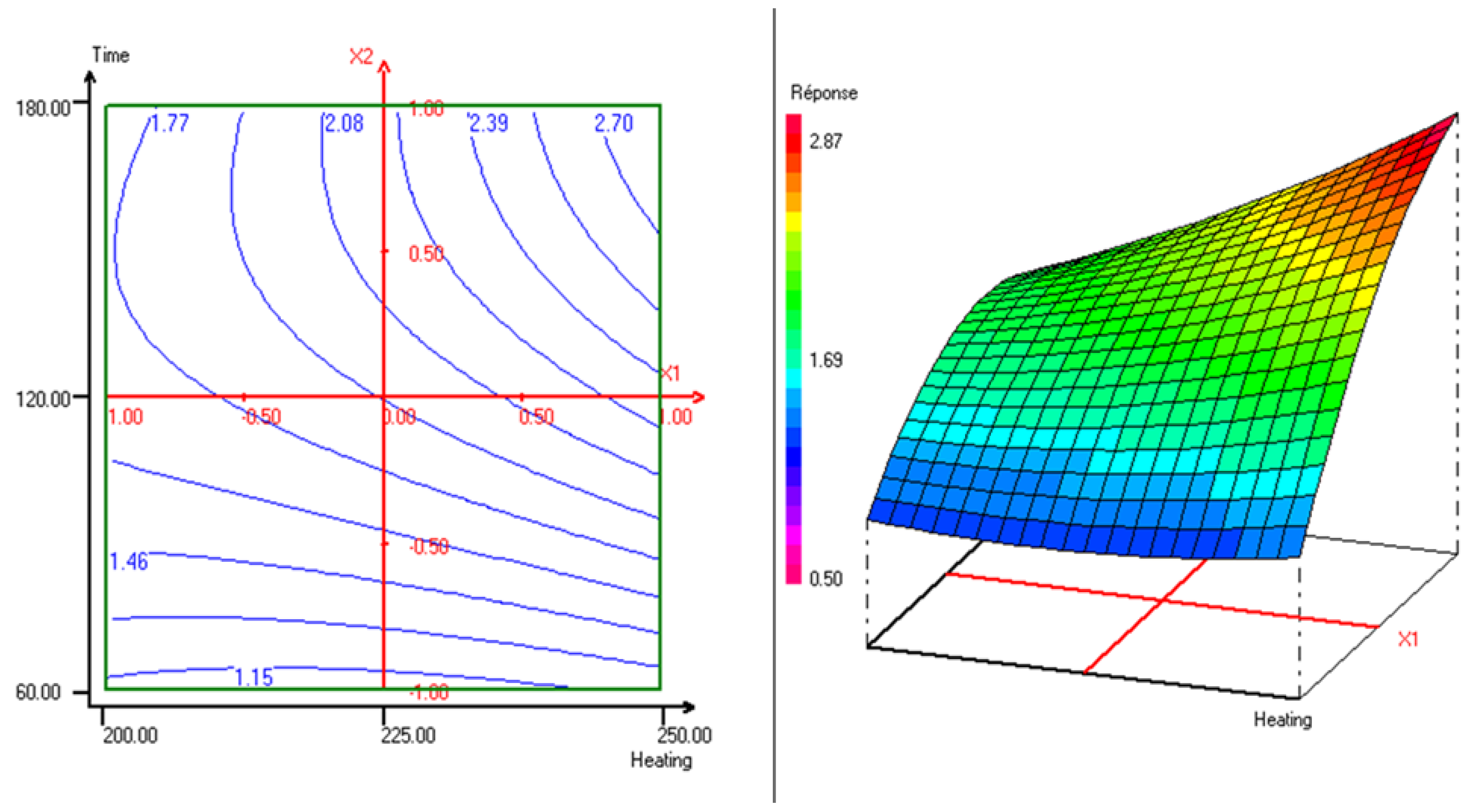
To determine the optimal conditions for extracting EOs with a good yield, the methodology of response surfaces was used. Figure 1 shows the iso-reponse curves resulting from the interaction between the two significant factors (extraction temperature (X1) and extraction time (X2)). It was found that at 225 °C and by increasing extraction times, the extraction yield of rosemary EO considerably increased, and it can reach 2 g/100 g dry weight (DW). In this context, the optimal extraction temperature was 250 °C for an extraction time of 180 min. allowing an obtained extract to be rich in EOs with a predicted yield of around 2.87 g/100 g DW.
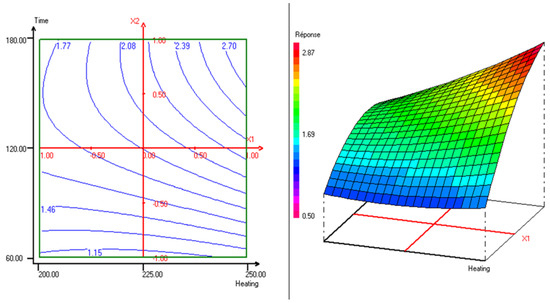
Figure 1.
Estimated response surface for optimization of the extraction of rosemary essential oil by hydrodistillation.
3.1.5. Selected Extraction Parameters and Their Effects on Rosemary Essential Oil Yield
After an appropriate choice of two variables, 13 experiments resulted in a second-degree mathematical model linking the response (yield of EOs (Y1)) to the factors and allowing good control of the extraction process. After performing the tests and analyzing the data, the study determined the optimal conditions necessary for obtaining a better yield of rosemary EO. These conditions were a heating temperature of 250 °C and a time of 180 min. According to the observed results given by using the composite centred experiment design, it was shown that the ideal yield of rosemary EO obtained was between 2.24 and 2.41 g/100 g DW. To confirm the predicted responses proposed by the experiment’s design model, several experiments of EO extraction were performed by the optimization of the following parameters, as indicated in Table 5. Results showed that the predicted yield of rosemary EO was between 2.70 and 2.78 g/100 g DW. This latter was similar to that of the experimental yield with 2.85 ± 0.02 g/100 g DW. In fact, it can be mentioned that the experimental design model was valid, and the optimal extraction conditions were reached. Similar results were obtained by Fadil et al. [16] who optimized the EO extraction by a design of experiment model and achieved a reliable rosemary EO yield (2.3 ± 0.05 g/100 g DW).
Table 5.
Influence of the parameters optimized by design of the experiment on EO yield.
3.2. Characterization of Rosemary Essential Oils by Chromatographic Analysis
The EO yield of rosemary leaves was 2.85% based on dry weight. On the basis of their mass spectra features and retention indices, 33 volatile components were identified (Table 6).
Table 6.
Chemical composition of Tunisian rosemary essential oil.
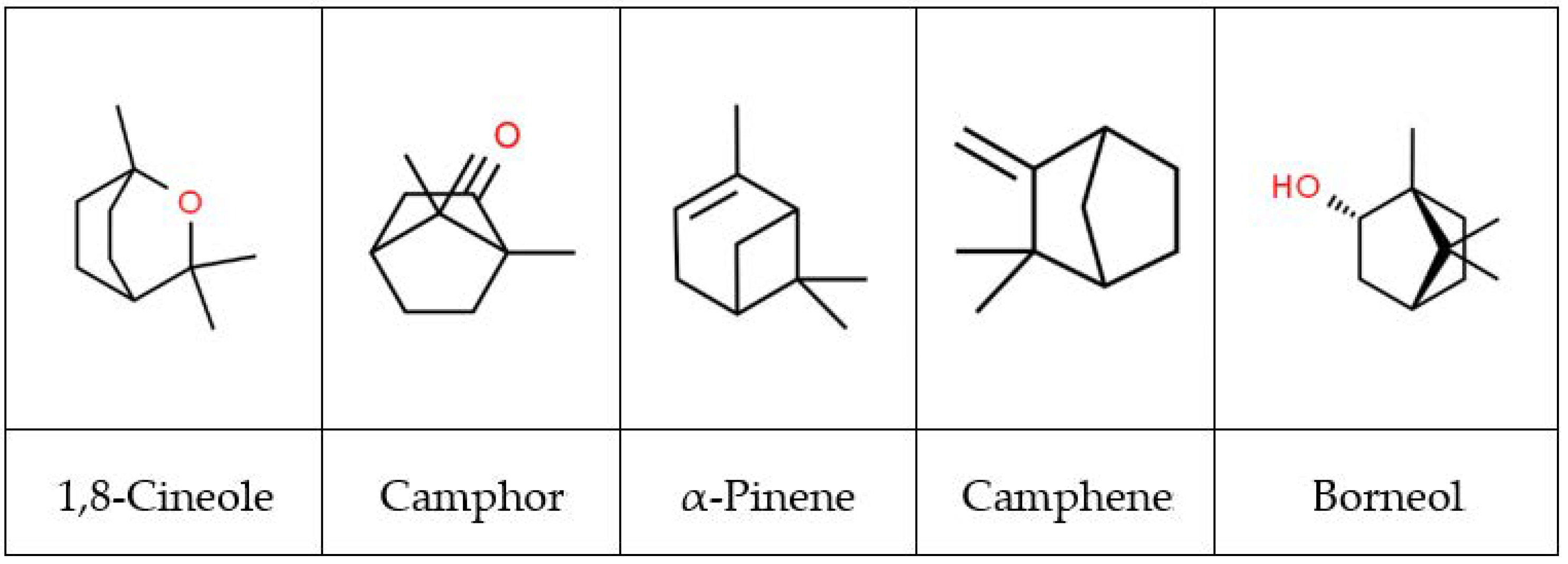
The main components of rosemary EO were 1,8-cineole (25.26 ± 7.71%), camphor (29.46 ± 4.92%), α-pinene (12.34 ± 1.83%), camphene (11.63 ± 2.03%) and borneol (5.05 ± 0.538%). Figure 2 shows the chemical structures of some of the main components.
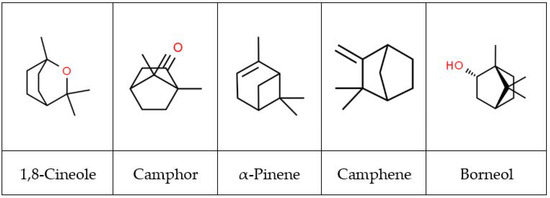
Figure 2.
Chemical structures of the main compounds of rosemary essential oils.
The present research revealed that 1,8-cineole and camphor chemotype occurred in Tunisian rosemary. The chemotype of 1,8-cineole was comparable to that previously described for Tunisian rosemary [37,38,39]. The heterogeneity of the qualitative and quantitative composition of rosemary EO was attributed to both intrinsic (genetics and phonological stages) and extrinsic (climate, growing circumstances, extraction processes, etc.) factors [39]. The chromatographic analysis of rosemary EO extracted from nanocapsules showed that it retained the same proportions of the majority compounds. These results showed that rosemary EO encapsulation retained the biological activities of rosemary EO. Similar results were proven by Hadian et al. [40], Karadağ et al. [41] and Silva-Flores et al. [42].
3.3. Antioxidant Activity of Rosemary Essential Oil
The antioxidant activity of rosemary essential oil was evaluated using three methods, namely DPPH, FRAP and β-carotene bleaching assays (Table 7). Although the three assays produced quantitatively diverse antioxidant activity results, rosemary EO possessed a significant antioxidant activity. The IC50 values of DPPH were in the range of 3.87 ± 0.21 μg/mL for free EO and 4.21 ± 0.54 μg/mL for recovered EO. The total antioxidant capacity of Eos was assessed by the FRAP assay. The values did not significantly differ between free (IC50 = 3.88 ± 0.02 μg/mL) and recovered EO values (IC50 = 4.11 ± 0.02 μg/mL). The results of β-carotene bleaching activity of rosemary free (IC50 = 20.80 ± 1.22 μg/mL) and recovered EO (IC50 = 23.02 ± 1.45 μg/mL) were compatible with those of DPPH. This is in accordance with previous studies showing the potential of the combined emulsification and spray drying techniques to encapsulate rosemary leaf extract [30]. Similar results were obtained concerning the scavenging activity of rosemary EO [43,44,45].
Table 7.
Antioxidant activity of rosemary essential oil.
3.4. Antibacterial Activity of Rosemary Essential Oil
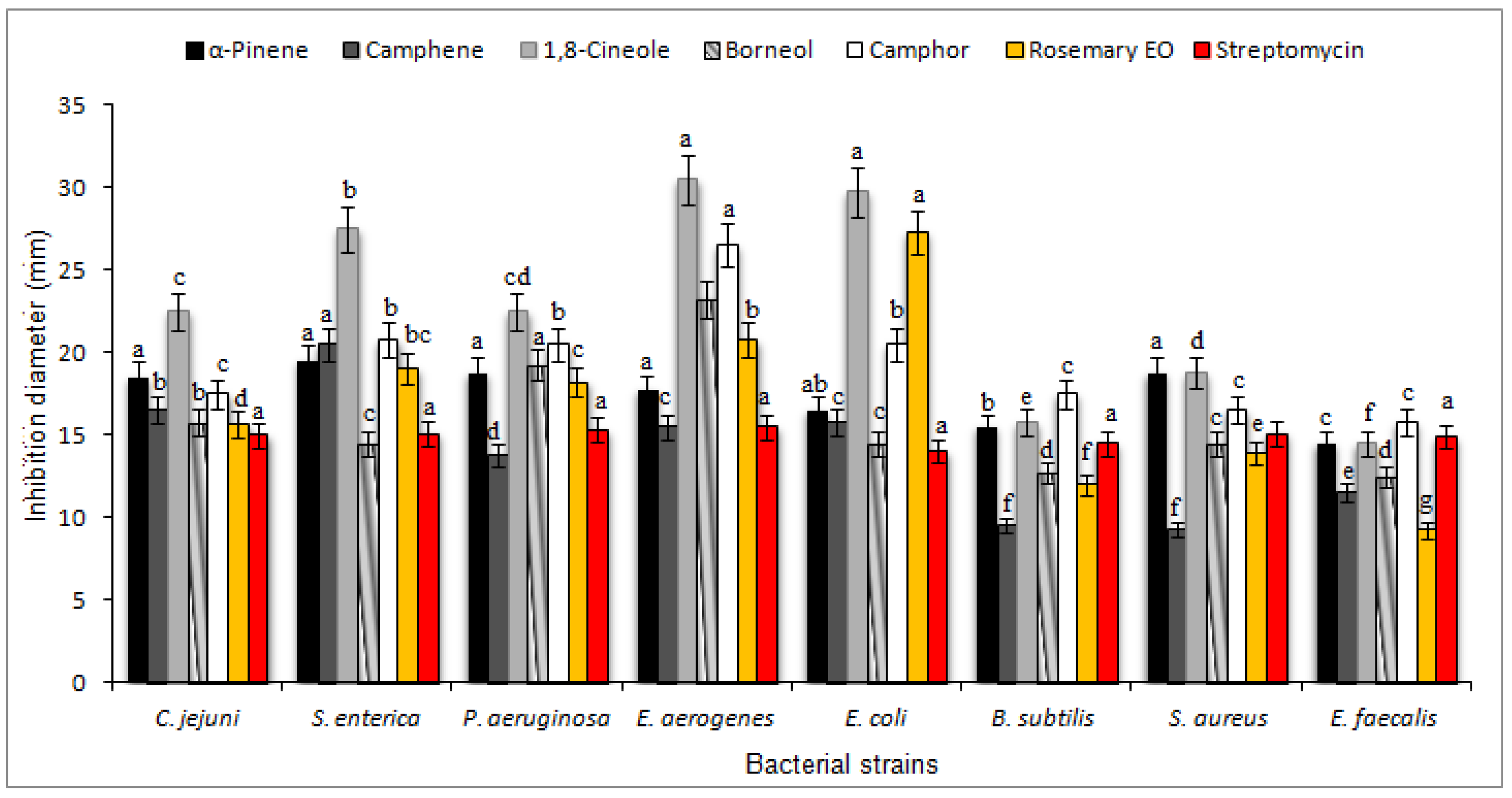
The evaluation of the antimicrobial activity showed that rosemary EO and its main constituents (α-pinene, camphene, 1,8-cineole, borneol and camphor) possessed significant antibacterial power (Figure 3).
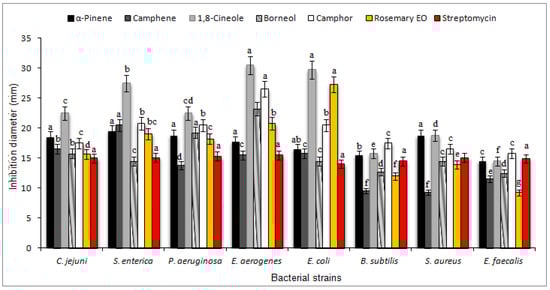
Figure 3.
Inhibition diameters of rosemary essential oil and its main constituents against bacterial strains. One-way ANOVA followed by Duncan’s multiple range test was used. Values with different letters (a–g) for each histogram color showed significant differences at p < 0.05.
Indeed, rosemary EO provoked an inhibition of the growth of Gram-negative bacteria C. jejuni, S. enterica, P. aeruginosa, E. aerogenes and E. coli with inhibition diameters (ID) of the order of 15.65 ± 0.36 mm; 19.05 ± 0.24 mm; 18.22 ± 0.28 mm; 20.75 ± 0.18 mm; and 27.30 ± 0.56 mm, respectively. These diameters are greater than those of the positive control streptomycin (ID = 14 ± 0.77–15.50 ± 0.75 mm). In contrast, the IDs of Gram-positive bacteria B. subtilis (ID = 11.99 ± 0.48 mm), S. aureus (ID = 13.88 ± 0.68 mm) and E. faecalis (ID = 9.23 ± 0.58 mm) were lower than those of streptomycin (ID = 14 ± 0.77–15.50 ± 0.75 mm). In fact, EOs act to inhibit the growth of bacterial cells and also inhibit the production of toxic bacterial metabolites. The results showed that rosemary EO had a more powerful effect on Gram-negative bacteria than Gram-positive bacteria. In fact, this effect could be due to differences in cell membrane compositions. According to Salamon et al. [46], Egyptian rosemary EO exhibited lower antibacterial activity than Tunisian EO for E. coli (ID = 8.50 ± 0.29 mm). Additionally, Bosnić et al. [47] reported that Bosnian rosemary EO has significant antibacterial activities against E. coli (ID = 13 mm) and P. aeruginosa (ID = 9 mm). Recent studies had shown that this antibacterial activity was mainly due to the presence of high contents of 1.8 cineole and camphor [48,49]. Generally, it is believed that the antibacterial efficacy of an essential oil is not entirely associated with a specific constituent but rather a synergistic effect of all of the constituents contained [50].
In our study, the ratio of MBC/MIC was also determined to examine the antibacterial activity of rosemary EO and its main constituents. The efficacy of an antibacterial agent is dependent on MIC and MBC values and their ratios [51]. An antibacterial agent is regarded as bactericidal if the MBC value is not more than four times the MIC value [52]. From Table 8, it can be observed that rosemary EO and its main constituents possessed MBC/MIC values inferior or equal to 2. These results revealed that rosemary EO and its main constituents had a strong bactericidal effect comparable to streptomycin. Regarding MBC/MIC values, rosemary essential oil had lower antibacterial activity compared to its main compounds. Similar results were obtained by Bernardes et al. [53], who determined the antibacterial activity of rosemary EO and its major components against oral pathogen (E. faecalis, S. salivarius, S. mitis, S. mutans, S. sobrinus and S. sanguinis).
Table 8.
Antibacterial activity of rosemary essential oil and its main compounds tested by microdilution method (MIC and MBC in mg/mL).
3.5. Acute Toxicity of Rosemary Essential Oil in Mice
The acute toxicity was checked when the EO was administered twice/day at the same time every day for 15 days to batches (n = 3) of mice by gavage at three doses/day (10mg (D1), 50 mg (D2) and 150 mg/kg BW (D3)). Table 9 shows the blood analysis for the determination of biochemical markers as aspartate amino transferase (AST), alanine amino transferase (ALT), alkaline phosphatase (ALP), blood uric nitrogen (BUN), total protein (TP), glucose (GLU), total bilirubin (T-BIL), creatinine (Crea) and total cholesterol (T-CHO). The analysis of the acute toxicity results showed that rosemary EO had no toxicity in the subjects treated for 15 days. There were no significant differences between the different groups compared to the control group (p < 0.005). In addition, no evidence of physiological deterioration or abnormal behaviour was reported for animals. Additionally, no symptoms occurred, and no signs of death were reported during treatment. Indeed, these results were in agreement with Hamed et al. [54], who found that the administration of 100 mg of Tunisian rosemary extract did not affect biochemical markers such as Crea (1.99 ± 0.3 against a control 2.31 ± 0.4 mmol/L) and BUN (0.18 ± 0.05 against a control 0.17 ± 0.03 mmol/L). These authors also reported that the oral administration of rosemary EO (500 mg/kg) showed no signs of toxicity and no mortality in any of the mice treated for 15 days during the observation period. Therefore, the oral lethality 50 (LD50) dose of rosemary EO was greater than that of 150 mg/kg.
Table 9.
Acute toxicity of essential oil in mice.
3.6. Physicochemical Characterization of the Active Nanoemulsion
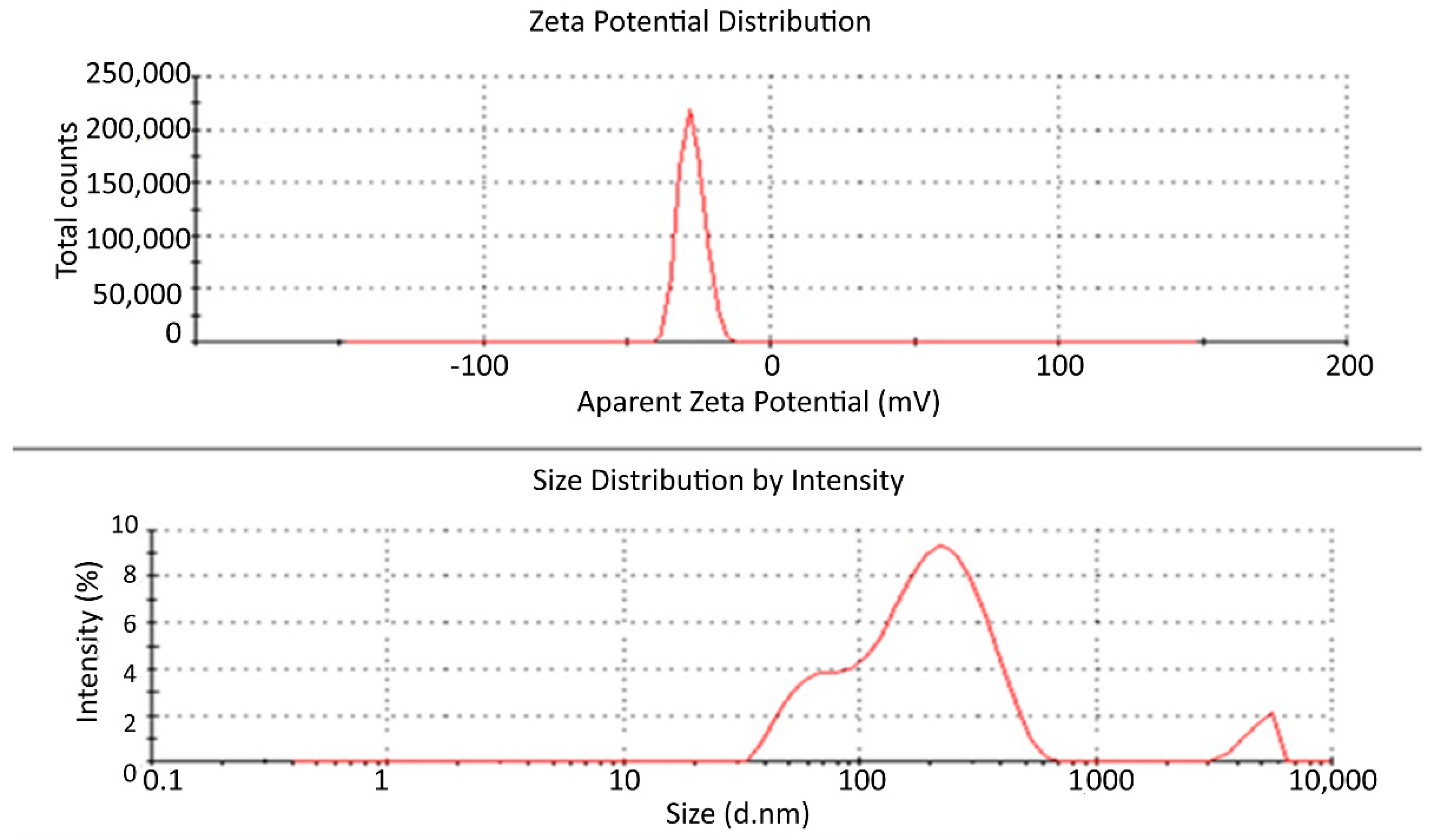
Using the polysaccharide’s natural shell material as maltodextrin and Tween 20, very small sized encapsulated oil particles of the order of 256.56 nm were observed. Furthermore, the data obtained from the emulsion stability diagram revealed that using maltodextrin as the coating support and Tween 20 as the surfactant allowed for the creation of an emulsion with a zeta potential of the order of −37.31 mV (Figure 4). Likewise, carvacrol encapsulated with chitosan revealed an average diameter particle size ranging between 532.5 and 716.6 nm [55]. Esmaeili and Asgari [56] had used essential oils to prepare the ionic gelation process and found that nanoparticles had an average diameter of 236–721 nm. Particle size and zeta potential were the key conditions to have a successful drug delivery [57].
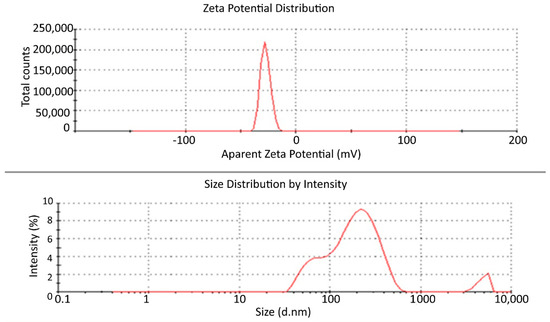
Figure 4.
Particle size and zeta potential of the rosemary essential oil emulsified by Tween 20 and maltodextrin.
4. Conclusions
Extraction optimization was conducted by using the response surface methodology (RSM). It showed that the obtained rosemary EO exhibited good antioxidant and antibacterial activities with a very low toxicological profile. The antimicrobial activity and the acute toxicity of the optimized EO were evaluated before the encapsulation process, and it was demonstrated that the EO was characterized by a considerable antibacterial property against Gram-negative bacteria C. jejuni, S. enterica, P. aeruginosa, E. aerogenes and E. coli. Likewise, rosemary EO had low-level toxicity, which was proved by the biochemical markers to evaluate the renal and hepatic balance. The antioxidant activity of rosemary EO was evaluated before and after the encapsulation process, and it was found that the encapsulation technique using the spray drying process can preserve the antioxidant potential of the encapsulated EO. This considerable antioxidant and antimicrobial activity of the rosemary EO can be related to the conservation of high contents of 1.8-cineole and camphor in rosemary essential oils. According to the physicochemical analysis of the nanoemulsion, it has been found that the use of maltodextrin as the coating support and Tween 20 as a surfactant allowed an improvement in stability with -37.31 mV as the potential zeta and 256.56 nm as the particle size. Finally, these results clearly show that this formula can be an important alternative for any industrial process using this particular rosemary EO.
Author Contributions
Conceptualization, W.Y.; writing, W.Y., W.A.-W., T.G.A., H.G., M.H. and S.N.M.; methodology, W.Y. and M.H.; investigation, W.Y., M.S.-T. and H.G., formal analysis, W.Y., M.S.-T. and I.O.; data curation, W.A.-W., D.W.-R. and M.N.; resources, W.Y.; supervision, M.S.-T. and M.N.; writing—review editing, M.N.; funding acquisition, M.N., D.W.-R. and M.S.-T. All authors have read and agreed to the published version of the manuscript.
Funding
This work was supported by the Tunisian Ministry of Higher Education and Scientific Research (LR15CBBC06). This research was also funded by Institute of Food Sciences, Warsaw University of Life Sciences, Poland.
Institutional Review Board Statement
This study was conducted according to the guidelines of the Care and Use of Laboratory Animals published by the U.S. National Institutes of Health. The animal protocol was approved by the Consultative Ethics Committee on Animal Experiments at the Pasteur Institute of Tunis (Pasteur Institute of Tunisia).
Informed Consent Statement
Not applicable.
Data Availability Statement
Data available on request.
Conflicts of Interest
The authors declare no conflict of interest.
References
- Mirsadraee, M.; Tavakoli, A.; Ghorani, V.; Ghaffari, S. Effects of Rosmarinus officinalis and Platanus orientalis extracts on asthmatic subjects resistant to routine treatments. Avicenna J. Phytomed. 2018, 8, 399. [Google Scholar] [PubMed]
- Sasaki, K.; Ferdousi, F.; Fukumitsu, S.; Kuwata, H.; Isoda, H. Antidepressant-and anxiolytic-like activities of Rosmarinus officinalis extract in rodent models: Involvement of oxytocinergic system. Biomed. Pharmacother. 2021, 144, 112291. [Google Scholar] [CrossRef] [PubMed]
- Déciga-Campos, M.; Beltrán-Villalobos, K.L.; Aguilar-Mariscal, H.; González-Trujano, M.E.; Ángeles-López, G.E.; Ventura-Martínez, R. Synergistic herb-herb interaction of the antinociceptive and anti-inflammatory effects of Syzygium aromaticum and Rosmarinus officinalis combination. Evid. Based Complement. Altern. Med. 2021, 2021, 8916618. [Google Scholar] [CrossRef] [PubMed]
- Paixão, V.L.B.; de Carvalho, J.F. Essential oil therapy in rheumatic diseases: A systematic review. Complement. Ther. Clin. Pract. 2021, 43, 101391. [Google Scholar] [CrossRef] [PubMed]
- Garzoli, S.; Laghezza Masci, V.; Franceschi, S.; Tiezzi, A.; Giacomello, P.; Ovidi, E. Headspace/GC–MS analysis and investigation of antibacterial, antioxidant and cytotoxic activity of essential oils and hydrolates from Rosmarinus officinalis L. and Lavandula angustifolia Miller. Foods 2021, 10, 1768. [Google Scholar] [CrossRef]
- Ventura-Martínez, R.; Rivero-Osorno, O.; Gómez, C.; González-Trujano, M.E. Spasmolytic activity of Rosmarinus officinalis L. involves calcium channels in the guinea pig ileum. J. Ethnopharmacol. 2011, 137, 1528–1532. [Google Scholar] [CrossRef]
- Haloui, M.; Louedec, L.; Michel, J.-B.; Lyoussi, B. Experimental diuretic effects of Rosmarinus officinalis and Centaurium erythraea. J. Ethnopharmacol. 2000, 71, 465–472. [Google Scholar] [CrossRef]
- Takayama, C.; de-Faria, F.M.; de Almeida, A.C.A.; Dunder, R.J.; Manzo, L.P.; Socca, E.A.R.; Batista, L.M.; Salvador, M.J.; Souza-Brito, A.R.M.; Luiz-Ferreira, A. Chemical composition of Rosmarinus officinalis essential oil and antioxidant action against gastric damage induced by absolute ethanol in the rat. Asian Pac. J. Trop. Biomed. 2016, 6, 677–681. [Google Scholar] [CrossRef] [Green Version]
- El-Demerdash, F.M.; El-Sayed, R.A.; Abdel-Daim, M.M. Hepatoprotective potential of Rosmarinus officinalis essential oil against hexavalent chromium-induced hematotoxicity, biochemical, histological, and immunohistochemical changes in male rats. Environ. Sci. Pollut. Res. 2021, 28, 17445–17456. [Google Scholar] [CrossRef]
- Yeddes, W.; Nowacka, M.; Rybak, K.; Boruszewski, P.; Ostrowska-Ligeza, E.; Betlej, I.; Aidi Wannes, W.; Hammami, M.; Jallouli, S.; Horchani-Naifer, K.; et al. Effect of rosemary essential oil and ethanol extract on physicochemical and antibacterial properties of optimized gelatin–chitosan film using mixture design. J. Food Process. Preserv. 2021, 46, e16059. [Google Scholar]
- Zeboudj, S.; Belhanèche-Bensemra, N.; Belabbès, R. Use of surface response methodology for the optimization of the concentration of the sweet orange essential oil of Algeria by wiped film evaporator. J. Food Eng. 2005, 67, 507–512. [Google Scholar] [CrossRef]
- Tan, Q.L.P.; Kieu, X.N.T.; Kim, N.H.T.; Hong, X.N.T. Application of response surface methodology (RSM) in condition optimization for essential oil production from Citrus latifolia. Emir. J. Food Agric. 2012, 24, 25–30. [Google Scholar] [CrossRef] [Green Version]
- Elyemni, M.; Louaste, B.; El Ouadrhiri, F.; Bouia, A.; Eloutassi, N. Application of response surface methodology to optimize the extraction of essential oil from Rosmarinus officinalis using microwave-assisted hydrodistillation. J. Appl. Pharmaceut. Sci. 2021, 11, 129–136. [Google Scholar]
- Halim, N.A.; Abidin, Z.Z.; Siajam, S.I.; Hean, C.G.; Harun, M.R. Screening of factors influencing the yield of Citrus hystrix leaves essential oil extracted via pressurized hot water extraction based on resolution V fractional factorial design. J. Food Process Eng. 2020, 43, e13531. [Google Scholar] [CrossRef]
- Perović, A.; Stanković, M.Z.; Veljković, V.B.; Kostić, M.D.; Stamenković, O.S. A further study of the kinetics and optimization of the essential oil hydrodistillation from lavender flowers. Chin. J. Chem. Eng. 2021, 29, 126–130. [Google Scholar] [CrossRef]
- Fadil, M.; Farah, A.; Ihssane, B.; Haloui, T.; Rachiq, S. Optimization of parameters influencing the hydrodistillation of Rosmarinus officinalis L. by response surface methodology. J. Mat. Environ. Sci. 2015, 6, 2346–2357. [Google Scholar]
- Cheynier, V.; Feinberg, M.; Chararas, C.; Ducauze, C. Application of response surface methodology to evaluation of bioconversion experimental conditions. Appl. Environ. Microbiol. 1983, 45, 634–639. [Google Scholar] [CrossRef] [Green Version]
- Moro, A.; Librán, C.M.; Berruga, M.I.; Carmona, M.; Zalacain, A. Dairy matrix effect on the transference of rosemary (Rosmarinus officinalis) essential oil compounds during cheese making. J. Sci. Food Agric. 2015, 95, 1507–1513. [Google Scholar] [CrossRef]
- Fernandes, R.V.d.B.; Guimarães, I.C.; Ferreira, C.L.R.; Botrel, D.A.; Borges, S.V.; de Souza, A.U. Microencapsulated rosemary (Rosmarinus officinalis) essential oil as a biopreservative in minas frescal cheese. J. Food Process. Preserv. 2017, 41, e12759. [Google Scholar] [CrossRef]
- Akbarbaglu, Z.; Peighambardoust, S.H.; Sarabandi, K.; Jafari, S.M. Spray drying encapsulation of bioactive compounds within protein-based carriers; different options and applications. Food Chem. 2021, 359, 129965. [Google Scholar] [CrossRef]
- Marcillo-Parra, V.; Tupuna-Yerovi, D.S.; González, Z.; Ruales, J. Encapsulation of bioactive compounds from fruit and vegetable by-products for food application–A review. Trends Food Sci. Technol. 2021, 116, 11–23. [Google Scholar] [CrossRef]
- Nedovic, V.; Kalusevic, A.; Manojlovic, V.; Levic, S.; Bugarski, B. An overview of encapsulation technologies for food applications. Proc. Food Sci. 2011, 1, 1806–1815. [Google Scholar] [CrossRef] [Green Version]
- Vaillé, J.; Goupy, J. Construire et interpréter un Plan d’expériences factoriel complet. Rev. MODULAD 2006, 35, 1–5. [Google Scholar]
- Ouzzar, M.L.; Louaer, W.; Zemane, A.; Meniai, A.-H. Comparison of the performances of hydrodistillation and supercritical CO2 extraction processes for essential oil extraction from rosemary (Rosmarinus officinalis L.). Chem. Eng. Trans. 2015, 43, 1129–1134. [Google Scholar]
- Khorshidi, J.; Mohammadi, R.; Fakhr, M.; Nourbakhsh, H. Influence of drying methods, extraction time, and organ type on essential oil content of rosemary (Rosmarinus officinalis L.). Nat. Sci. 2009, 7, 42–44. [Google Scholar]
- Hatano, T.; Kagawa, H.; Yasuhara, T.; Okuda, T. Two new flavonoids and other constituents in licorice root: Their relative astringency and radical scavenging effects. Chem. Pharmaceut. Bull. 1988, 36, 2090–2097. [Google Scholar] [CrossRef] [Green Version]
- Kaur, C.; Kapoor, H.C. Anti-oxidant activity and total phenolic content of some Asian vegetables. Int. J. Food Sci. Technol. 2002, 37, 153–161. [Google Scholar] [CrossRef]
- Benzie, I.F.; Strain, J. Ferric reducing/antioxidant power assay: Direct measure of total antioxidant activity of biological fluids and modified version for simultaneous measurement of total antioxidant power and ascorbic acid concentration. Methods Enzymol. 1999, 299, 15–27. [Google Scholar]
- Re, R.; Pellegrini, N.; Proteggente, A.; Pannala, A.; Yang, M.; Rice-Evans, C. Antioxidant activity applying an improved ABTS radical cation decolorization assay. Free Rad. Biol. Med. 1999, 26, 1231–1237. [Google Scholar] [CrossRef]
- Bušić, A.; Komes, D.; Belščak-Cvitanović, A.; Cebin, A.V.; Špoljarić, I.; Mršić, G.; Miao, S. The potential of combined emulsification and spray drying techniques for encapsulation of polyphenols from rosemary (Rosmarinus officinalis L.) leaves. Food Technol. Biotechnol. 2018, 56, 494. [Google Scholar] [CrossRef]
- Yeddes, W.; Nowacka, M.; Rybak, K.; Younes, I.; Hammami, M.; Saidani-Tounsi, M.; Witrowa-Rajchert, D. Evaluation of the antioxidant and antimicrobial activity of rosemary essential oils as gelatin edible film component. Food Sci. Technol. Res. 2019, 25, 321–329. [Google Scholar] [CrossRef]
- Jianu, C.; Moleriu, R.; Stoin, D.; Cocan, I.; Bujancă, G.; Pop, G.; Teodora Lukinich-Gruia, A.; Muntean, D.; Rusu, L.C.; Horha, D.I. Antioxidant and antibacterial activity of Nepeta × faassenii bergmans ex stearn essential oil. Appl. Sci. 2021, 11, 442. [Google Scholar] [CrossRef]
- Ecobichon, D.J. The Basis of Toxicity Testing; CRC Press: Boca Raton, FL, USA, 1997. [Google Scholar]
- Hou, K.; Xu, Y.; Cen, K.; Gao, C.; Feng, X.; Tang, X. Nanoemulsion of cinnamon essential oil Co-emulsified with hydroxypropyl-β-cyclodextrin and Tween-80: Antibacterial activity, stability and slow release performance. Food Biosci. 2021, 43, 101232. [Google Scholar] [CrossRef]
- Chew, S.C.; Tan, C.P.; Nyam, K.L. Microencapsulation of refined kenaf (Hibiscus cannabinus L.) seed oil by spray drying using β-cyclodextrin/gum arabic/sodium caseinate. J. Food Eng. 2018, 237, 78–85. [Google Scholar]
- Yamamoto, T.; Kawaguchi, K.; Takahashi, Y. Particle size control in the soap-free emulsion polymerization of styrene by an oil-soluble initiator with a weakly acidic water-soluble initiator. Colloids Surf. 2016, 502, 1–5. [Google Scholar] [CrossRef]
- Hcini, K.; Sotomayor, J.; Jordan, M.; Bouzid, S. Chemical composition of the essential oil of Rosemary (Rosmarinus officinalis L.) of Tunisian origin. Asian J. Chem. 2013, 25, 2601. [Google Scholar] [CrossRef]
- Zaouali, Y.; Messaoud, C.; Salah, A.B.; Boussaid, M. Oil composition variability among populations in relationship with their ecological areas in Tunisian Rosmarinus officinalis L. Flav. Fragrour J. 2005, 20, 512–520. [Google Scholar] [CrossRef]
- Yeddes, W.; Aidi Wannes, W.; Hammami, M.; Smida, M.; Chebbi, A.; Marzouk, B.; Saidani Tounsi, M. Effect of environmental conditions on the chemical composition and antioxidant activity of essential oils from Rosmarinus officinalis L. growing wild in Tunisia. J. Essent. Oil Bear. Plants 2018, 21, 972–986. [Google Scholar] [CrossRef]
- Hadian, M.; Rajaei, A.; Mohsenifar, A.; Tabatabaei, M. Encapsulation of Rosmarinus officinalis essential oils in chitosan-benzoic acid nanogel with enhanced antibacterial activity in beef cutlet against Salmonella typhimurium during refrigerated storage. LWT 2017, 84, 394–401. [Google Scholar] [CrossRef]
- Karadağ, A.E.; Üstündağ Okur, N.; Demirci, B.; Demirci, F. Rosmarinus officinalis L. essential oil encapsulated in new microemulsion formulations for enhanced antimicrobial activity. J. Surfactants Deterg. 2021, in press. [Google Scholar] [CrossRef]
- Silva-Flores, P.G.; Pérez-López, L.A.; Rivas-Galindo, V.M.; Paniagua-Vega, D.; Galindo-Rodríguez, S.A.; Álvarez-Román, R. Simultaneous GC-FID quantification of main components of Rosmarinus officinalis L. and Lavandula dentata essential oils in polymeric nanocapsules for antioxidant application. J. Anal. Methods Chem. 2019, 2019, 2837406. [Google Scholar] [CrossRef] [PubMed] [Green Version]
- Bozin, B.; Mimica-Dukic, N.; Samojlik, I.; Jovin, E. Antimicrobial and antioxidant properties of rosemary and sage (Rosmarinus officinalis L. and Salvia officinalis L., Lamiaceae) essential oils. J. Agric. Food Chem. 2007, 55, 7879–7885. [Google Scholar] [CrossRef] [PubMed]
- Zaouali, Y.; Bouzaine, T.; Boussaid, M. Essential oils composition in two Rosmarinus officinalis L. varieties and incidence for antimicrobial and antioxidant activities. Food Chem. Toxicol. 2010, 48, 3144–3152. [Google Scholar] [CrossRef] [PubMed]
- Ben Jemia, M.; Tundis, R.; Pugliese, A.; Menichini, F.; Senatore, F.; Bruno, M.; Kchouk, M.E.; Loizzo, M.R. Effect of bioclimatic area on the composition and bioactivity of Tunisian Rosmarinus officinalis essential oils. Nat. Prod. Res. 2015, 29, 213–222. [Google Scholar] [CrossRef]
- Salamon, I.; Kryvtsova, M.; Bucko, D.; Tarawneh, A.H. Chemical characterization and antimicrobial activity of some essential oils after their industrial large-scale distillation. J. Microbiol. Biotechnol. Sci. 2021, 2021, 984–988. [Google Scholar] [CrossRef] [Green Version]
- Bosnić, T.; Softić, D.; Grujić-Vasić, J. Antimicrobial activity of some essential oils and major constituents of essential oils. Acta Med. Acad. 2006, 35, 9–14. [Google Scholar]
- Jirovetz, L.; Buchbauer, G.; Denkova, Z.; Stoyanova, A.; Murgov, I.; Schmidt, E.; Geissler, M. Antimicrobial testinas and gas chromatoaraphic analvsis of pure oxvaenated monoterpenes 1.8-cineole, α-terpineol, terpinen-4-ol and camphor as well as target comoounds in essential oils of pine (Pinus pinaster), rosemary (Rosmarinus officinalis), tea tree (Melaleuca alternifolia). Sci. Pharmaceut. 2005, 73, 27–39. [Google Scholar]
- Zainudin, Z.; Azim, M.M. Study on the Antibacterial and Antifungal Effects of Camphor Oil; Cinnamomum camphora with Emphasis on the Control of Overpopulation of Tilapia. Ph.D. Thesis, Universiti Putra Malaysia, Seri Kembangan, Malaysia, 2010. [Google Scholar]
- Radaelli, M.; Parraga da Silva, B.; Weidlich, L.; Hoehne, L.; Flach, A.; Mendonc, L.A.; da Costa, A.; Ethur, E.M. Antimicrobial activities of six essential oils commonly used as condiments in Brazil against Clostridium perfringens. Braz. J. Microb. 2016, 47, 424–430. [Google Scholar] [CrossRef] [Green Version]
- Gonzalez, N.; Sevillano, D.; Alou, L.; Cafini, F.; Gimenez, M.J.; Gomez-Lus, M.L.; Prieto, J.; Aguilar, L. Influence of the MBC/MIC ratio on the antibacterial activity of vancomycin versus linezolid against methicillin-resistant Staphylococcus aureus isolates in a pharmacodynamic model simulating serum and soft tissue interstitial fluid concentrations reported in diabetic patients. J. Antimicrob. Chemother. 2013, 68, 2291–2295. [Google Scholar]
- French, G.L. Bactericidal agents in the treatment of MRSA infections--the potential role of daptomycin. J. Antimicrob. Chemother. 2006, 58, 1107–1117. [Google Scholar] [CrossRef] [Green Version]
- Bernardes, W.A.; Lucarini, R.; Tozatti Marcos, G.; Bocalon Flauzino, L.G.; Souza, M.G.M.; Turatti, I.C.C.; Andrade e Silva, M.L.; Martins, C.H.G.; da Silva Filho, A.A.; Cunha, W.R. Antibacterial activity of the essential oil from Rosmarinus officinalis and its major components against oral pathogens. Z. Naturforsch. C J. Biosci. 2010, 65, 588–593. [Google Scholar] [CrossRef] [PubMed] [Green Version]
- Hamed, H.; Boulila, S.; Ghrab, F.; Kallel, R.; Boudawara, T.; El Feki, A. The preventive effect of aqueous extract of rosemary (Rosmarinus officinalis) leaves against the nephrotoxicity of carbon tetrachloride in mice. Arch. Physiol. Biochem. 2020, 126, 201–208. [Google Scholar] [CrossRef] [PubMed]
- Keawchaoon, L.; Yoksan, R. Preparation, characterization and in vitro release study of carvacrol-loaded chitosan nanoparticles. Colloids Surf. B. 2011, 84, 163–171. [Google Scholar] [CrossRef] [PubMed]
- Esmaeili, A.; Asgari, A. In vitro release and biological activities of Carum copticum essential oil (CEO) loaded chitosan nanoparticles. Int. J. Biol. Macromol. 2015, 81, 283–290. [Google Scholar] [CrossRef]
- Krishnamoorthy, B.; Rahman, S.H.; Rajkumar, M.; Vamshikrishna, K.; Gregory, M.; Vijayaraghavan, C. Design, formulation, in vitro, in vivo, and pharmacokinetic evaluation of nisoldipine-loaded self-nanoemulsifying drug delivery system. J. Nanopart. Res. 2015, 17, 34. [Google Scholar] [CrossRef]
Publisher’s Note: MDPI stays neutral with regard to jurisdictional claims in published maps and institutional affiliations. |
© 2022 by the authors. Licensee MDPI, Basel, Switzerland. This article is an open access article distributed under the terms and conditions of the Creative Commons Attribution (CC BY) license (https://creativecommons.org/licenses/by/4.0/).