


Abstract
The long-lasting pandemic has disrupted face–to–face education and has forced higher education institutions to adopt digital learning management systems, albeit many public universities in developing counties could not properly undertake this shift and adopted either free interactive platforms (e.g., zoom) or social network applications (SNAs) (e.g., Facebook and WhatsApp) due to their limited resources and infrastructure. Despite that the COVID-19 pandemic has emphasized the value of e-learning, some concerns were raised about the quality of learning outcomes and academic performance of students, using these SNAs for learning, compared to traditional face–to–face education. Therefore, examining the impact of SNAs as an e-learning platform on the academic performance students is inevitable, notwithstanding that this has not been sufficiently examined by researchers amid COVID-19. For this purpose, an online questionnaire was distributed to students via research teams’ personal networks, i.e., university lecturers at various public universities in Egypt. They were asked to distribute the survey link with their undergraduates via email or WhatsApp. A total of 600 valid questionnaires was obtained from students in nine public colleges that deliver tourism and hotel management courses in Egypt and adopted SNAs for e-learning at least one semester amid COVID-19. Unlike the results of previous arguments and research, the results of the structural equation modelling using AMOS showed a positive, significant impact of SNAs as e-learning platforms on students’ academic performance. The results have several implications for higher education policymakers, educators, and scholars, especially in relation to the future of use social media applications in higher education, particularly in developing countries’ contexts.
1. Introduction
Traditional face–to–face education has been severely disrupted by the global pandemic of coronavirus (COVID-19). The long-lasting COVID-19 pandemic has forced countries to adopt different strategies to control virus outbreaks, including limiting huge gatherings and maintaining physical social distance. As a result, policymakers have had a quick response and turned education from traditional face–to–face to distance learning using different digital platforms [1,2]. Nonetheless, most public universities, especially those in developing countries such as Egypt, are lacking formal digital learning management systems (DLMS), such as Blackboard, to continue their e-learning process [3]. Higher education policymakers and public universities’ leaders had to respond rapidly with substitutions to the traditional classroom-based learning system. Most Egyptian universities, for instance, have pushed to apply free interactive online platforms, e.g., Zoom and Google Classroom, or social network applications (SNAs), e.g., WhatsApp, Facebook, Twitter, or Microsoft Teams for e-learning [4]. Nevertheless, the transmission of knowledge with sufficient quality using these digital platforms and/or SNAs needs to be examined [3]. Additionally, the impact of these platforms, especially SNAs on the quality of education and learning outcomes compared to face–to–face education, needs further examination [3], which has not been addressed sufficiently to date [5].
Studies (see for example, [5,6,7]) have undertaken different theories to understand the adoption of SNAs in education. A technology acceptance model (TAM) and theory of planned behavior (TPB) are the most often adopted theories for understanding students’ behaviors towards the use of SNAs for academic purposes [5,6,7,8]. Nevertheless, the debate about the impact of SNAs on students’ academic performance has not been sorted to date. While some studies reported positive influence of SNAs on students’ academic performance [9,10], other studies confirmed a negative influence [5,7]. Despite the crucial role of using social networking sites in higher education as a quick response especially amid the COVID-19 pandemic, it has several challenges faced by students [11,12,13]. The study of Giusti et al. [11] showed that social network applications are among the main determinants of psychological distress, habits, and learning concentration impairment, which negatively effects students’ academic performance. In addition, home confinement compromised the possibility of fully experiencing university life, influencing academic study (e.g., cancellation uncertainties, activities delays, and digital platform use) [12].
The current research draws on the TPB to examine the impact of COVID-19 on higher education and the adoption of SNAs for e-learning based on its accessibility as well as students’ mindsets and behaviors towards use SNAs for academic purposes before COVID-19. Despite that previous research before COVID-19 (e.g., [14,15]) and amid COVID-19 (e.g., [4,5,7] highlighted the value of SNAs usage for e-learning purposes, the impact of SNAs on students’ academic performance is under-researched [5,16]. This research bridges a gap in knowledge and examines the impact of SNAs usage for e-learning amid COVID-19 on students’ academic performance. The results of the research could have several further implications for the future of e-learning in higher education, especially in public universities in the developing countries context.
2. Review of Related Literature
2.1. Attitude towards Behaviors and Intention to Use Social Network Applications in Higher Education
The theory of planned behavior (TPB) reinforces the significance of attitudes in influencing individual intention and, thus, behaviors [17]. Attitude is the degree to which an individual has a positive or negative mind state and judgment towards a specific behavior [17,18,19]. Several studies (e.g., [5,20,21]) emphasized the role of perceived usefulness (PU) and perceived ease of use (PEOU) as a driving force behind students’ attitudes and thus their intentions to use SNAs for e-learning. Research to date (e.g., [5,22,23,24,25,26,27]) have discussed the relationship between students’ attitudes and their intention to use SNAs for academic-related purposes in higher education. The major results of these studies indicated that attitude positively influences students’ intention to use SNAs in their study. Students were already using SNAs in their social life and, due to PU and PEOU, they have a positive attitude towards the intention to use and actual use in their e-learning [5,15,27]. Building on this literature, the following hypothesis could be suggested:
Hypothesis 1 (H1).
Attitude towards behaviors positively influences intention to use SNAs for e-learning.
2.2. Subjective Norm and Intention to Use Social Network Applications in Higher Education
Subjective norm refers to the extent to which an individual perceives pressures from others to behave in a certain way [17,28]. Research studies in general (e.g., [8,29,30,31,32]) have examined the influence of subjective norm on the intention to adopt technology in higher education. The key findings of these studies showed that subjective norms positively influence the intention to use digital technology in higher education. On the other side, there is limited, but growing, research measuring the influence of subjective norm on students’ intention to use SNAs in higher education [33,34]. Notwithstanding this, there is evidence that if students’ colleagues were using SNAs in education, other students would respond by speaking the same language and integrate themselves in this experience [15]. Additionally, research indicated that if a powerful person encourages SNAs usage, an individual would trust and adopt that person’s direction [35]. This was the case amid COVID-19 pandemic, after the institutions’ leadership approval to adopt SNAs as the sole e-learning tool to sustain the learning process; thus, students reported positive intention to use SNAs [2,36]. Based upon this discussion, the following hypothesis could be proposed:
Hypothesis 2 (H2).
Subjective norm positively influences intention to use SNAs for e-learning.
2.3. Perceived Behavioral Control and Intention to Use Social Network Applications in Higher Education
As mentioned by [17], PBC is known as the extent to which an individual believes there is a control aspect that supports or restricts his or her behaviors. The PBC is a vital part of the TPB and has the ability to influence an individual’s behavioral intention [37]. According to the TPB, there is an unambiguous influence of PBC on intention to use, which practically specifies the individuals’ behavior. Several studies in different contexts, i.e., [8,27,30,31,32], suggested that PBC has a direct effect on intention to use technology. Meanwhile, the study of Chandrasiri and Samarasinghe [5] highlighted that PBC positively influences students’ intention to use SNAs for academic-related purposes. Students perceive their ability to adopt SNAs easily in education using their smart phones, for instance, which positively influences their intention to use and their actual use [17,37]. Depending on the previous literature, the following hypothesis could be suggested:
Hypothesis 3 (H3).
PBC positively influences intention to use SNAs for e-learning.
2.4. Intention to Use/Use Social Network Applications in Higher Education and Academic Performance
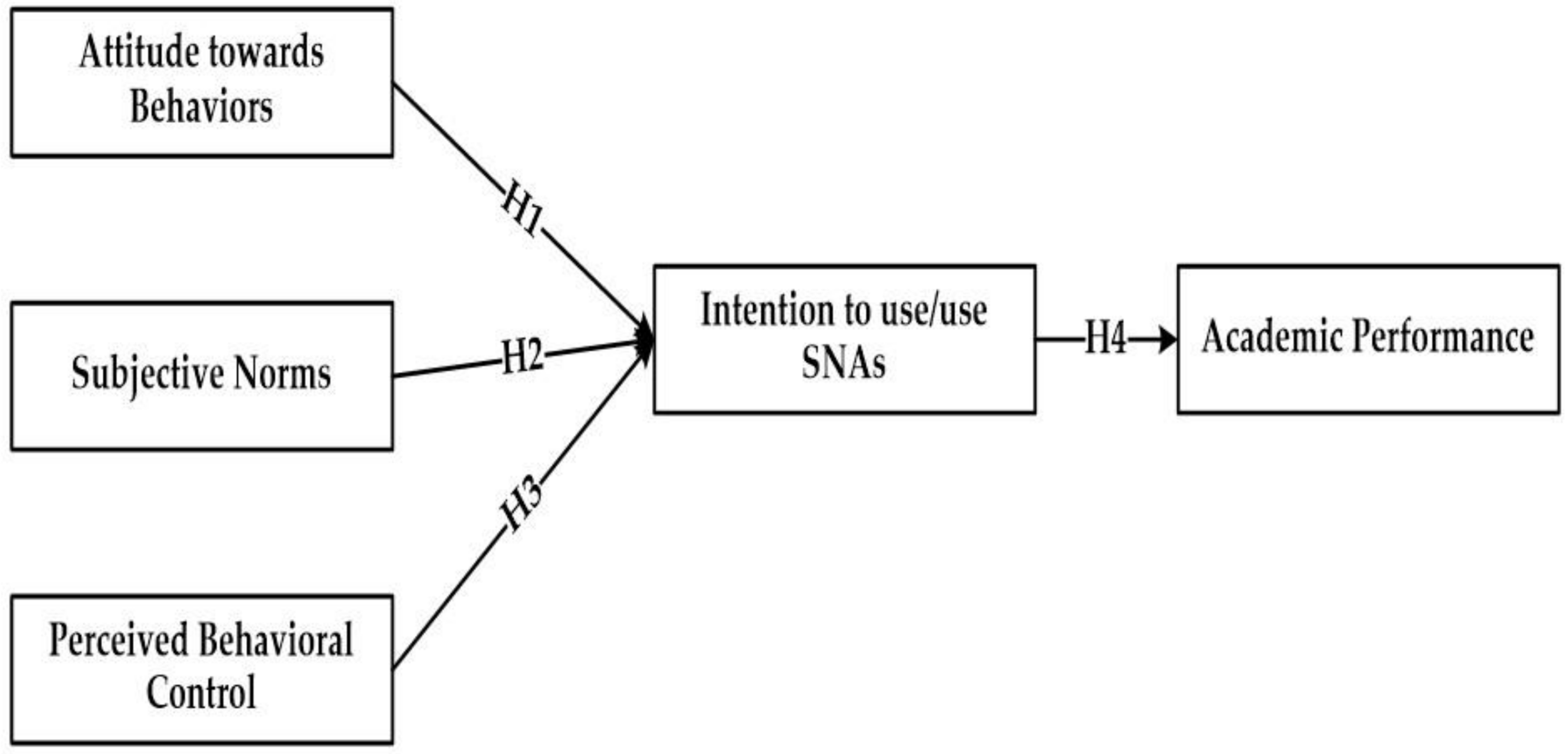
Intention to use can broadly be defined as individuals’ decisions to engage in or resist a particular behavior [17,19]. In a digital context, the research to date (e.g., [3,38,39]) have found that virtual interaction between students and faculty members, as well as students themselves, have a significant influence on students’ intention to use e-learning and satisfaction. In relation to the impact of SNAs usage in education on students’ academic performance, previous research showed paradoxical findings. While a study found a positive relationship between Facebook usage and students’ academic performance [40], other studies (e.g., [6,9,10]) found that the use of SNAs by students negatively affect students’ academic performance because they are likely to use it for their social or nonacademic purposes, which negatively affect their academic purposes. Recent research studies [5,7] examined the relationship between SNAs usage and students’ academic performance amid COVID-19. The major findings confirmed that SNAs can assist and enhance students’ academic performance. Moreover, a recent study of Sobaih et al., [4], highlighted the value of using SNAs in higher education for maintaining students’ interaction, online learning community building, and developing students’ learning experience. A summary of the research framework is presented in Figure 1. Based upon this discussion, the following hypothesis could be proposed:
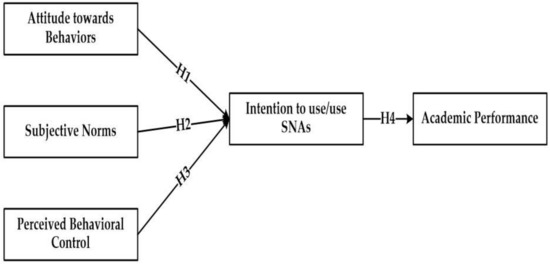
Figure 1.
The research conceptual model.
Hypothesis 4 (H4).
Intention to use SNAs in higher education positively influences students’ academic performance.
3. Methodology
3.1. Instrument Development
The multi-items scale was taken from Bhattacherjee [41] and Venkatesh and Davis [42], which was developed based on the frameworks of the TPB by Ajzen [17]; Fishbein and Ajzen [43]; and Ajzen [44], which were used to create the items that measure employees’ attitude (ATT), perceived behavioral control (PBC), intent to use (IU), and subjective norms (SN). Academic performance (AP) was conceptualized and measured based on the work of [9]. The academic performance of students was measured through the students’ self-reporting on their academic performance in the 2020–2021 first semester.
The instrument has used a 10-point scale, with 0 denoting significant disagreement and 10 denoting strong agreement, for all measurements. The instrument was pilot-tested by some academics (n = 5) and students (n = 20). It was checked for readability, clarity, suitability, and comprehension. In the pursuit of trustworthy and consistent data, the questionnaire clearly guaranteed anonymity and secrecy to all participants. CVC “common method variance” could have been a problem because the study collected data with a self-reporting online questionnaire [45]. A single factor analysis was employed in the SPSS exploratory factor analysis (EFA) test, with the number of recovered components limited to one in order to minimize any potential CMV issue. One factor appeared and explained about 32% of the variance; therefore, CMV was not a problem.
3.2. Participants and Collection of Data
This study focuses on developing countries’ public universities. For reasonable causes, the study focuses on Egypt’s nine public colleges that provide bachelor’s degrees in tourism and hotel management. Prior to the pandemic of COVID-19, these universities relied primarily on the traditional in-class learning system and face–to–face interconnection with undergraduates and adopted SNAs (mainly WhatsApp and Facebook) as the sole learning platforms [4]. Students were interacting with their colleagues and educators through these SNAs and were assessed through a written assignment or research paper. There are approximately 12,000 undergraduate students enrolled in these institutions [2]. An online survey was designed and directed to the targeted respondents to collect the required data. The online survey methodology suggested by [46] was adopted as the following: first, after the formation of the instrument, a study team member began constructing the online questionnaire, which was thoroughly verified for presentation and correctness by other team members before being distributed to the targeted population. Second, an opening was designed in the questionnaire to highlight the study main aim and to ask students to take part in it. Students in the nine institutions received the questionnaire opening statement with the web address in two languages, English and Arabic, through emails and/or SNAs accounts. Third, on a daily basis, one of the members of the research team double-checked and followed up on the responses. Finally, by the end of the introduction, personal information such as participant name, mobile number, emails, and SNAs had been included for any additional inquiries. A total of 600 valid questionnaires were obtained from students via research teams’ personal networks, i.e., university lecturers at colleges of tourism and hotel management in Egypt. They were asked to distribute the survey link via email or WhatsApp with their undergraduates’ students who are enrolled in tourism and hotels management-specialized courses. The targeted nine tourism and hotel management colleges adopted SNAs for e-learning at least one semester amid COVID-19. Students were free to accept or reject responding to the survey and were informed that their answers will be anonymous and for research purposes.
4. The Study Results
4.1. Descriptive Analysis
The proportion of male (49%) and female (51%) student participants was nearly equal. All participants were below the age of 30 due to the lack of a gap between Egypt’s higher education and secondary school systems. As a result, nearly all bachelor’s degree students were under the age of 25 years. Furthermore, students from various study levels (from year one to year four) participated in nearly similar numbers. More specifically, 29% of participant were enrolled in year one, 27% were enrolled in year three, 23% were in year two, and 21% from year four. It is interesting to note that all of the students in this survey used SNAs on a daily basis for formal academic communication. WhatsApp was a completely agreed-upon method for official academic interaction by all undergraduates including e-learning. This was followed by Facebook (75%), YouTube (60%), Wikis (40%), and other SNAs (22%), e.g., Twitter and Blogs.
Table 1 also contains some descriptive data. There was a 10-point scale used to score the responses, with 10 being the highest level of agreement and 0 being the lowest level of disagreement. S.D. values of 1.54 to 2.05 indicated that the data were more uniformly distributed around the mean, and hence less prone to being clustered around the mean [47]. According to Table 1, there was no data distribution (skewness or kurtosis) that had values larger than −2 or +2, indicating a normal distribution.

Table 1.
Descriptive analysis (n = 600).
4.2. Results of First Order Confirmatory Factor Analysis (CFA)
A first-order CFA test with the Maximum Likelihood (ML) estimation method was used to test the validity (convergent discriminant) of the scale that was used. Five dimensions (ATT, SN, PBC, IB, and AP) with their related variables were subjected to CFA and, as suggested by [48,49,50], different goodness-of-fit (GoF) values were utilized to evaluate the models’ GoFs, as shown in Table 2. The GoF results of CFA demonstrated a satisfactory model fit to the data (as depicted in Table 2). Cronbach’s alpha and composite reliability (CR) values were used to examine the employed factor’s reliability and validity. As given in Table 3, the CR scores for the four dimensions were as follows: ATT (0.937), SN (0.910), PBC (0.924), IU (0.930), and AP (0.934). The output was all higher than the stipulated cut-off level of 0.70, giving signals that there was excellent internal consistency between the variables [48].
Table 2.
First order factor analysis convergent and discriminant validity.
Table 3.
Result of the tested structural model.
Moreover, the employed scale had convergent validity for two reasons: first, the factor loadings (FL) for all variables were high and significant (Table 2). As depicted in Table 2, the FLs were between 0.828 to 0.956, thus outperforming the recommended level of 0.50 [47]. Second, the “average variance extracted” (AVE) scores of all the study factors (ATT, SN, PBC, IU, and AP) were 0.781, 0.785, 0.802, 0.816, and 0.825, correspondingly (see Table 2). All the AVE values outstripped 0.50, showing appropriate convergent validity [47]. Each “maximum shared variance” (MSV) was lower than the AVE value (see Table 1), which suggested a satisfactory discriminant validity [47]. Finally, because the square root of the AVE values for each dimension was greater than the interdimensional correlation, the study measurement had a good discriminant validity [48,49,50] (see Table 2).
4.3. Structural Model Results
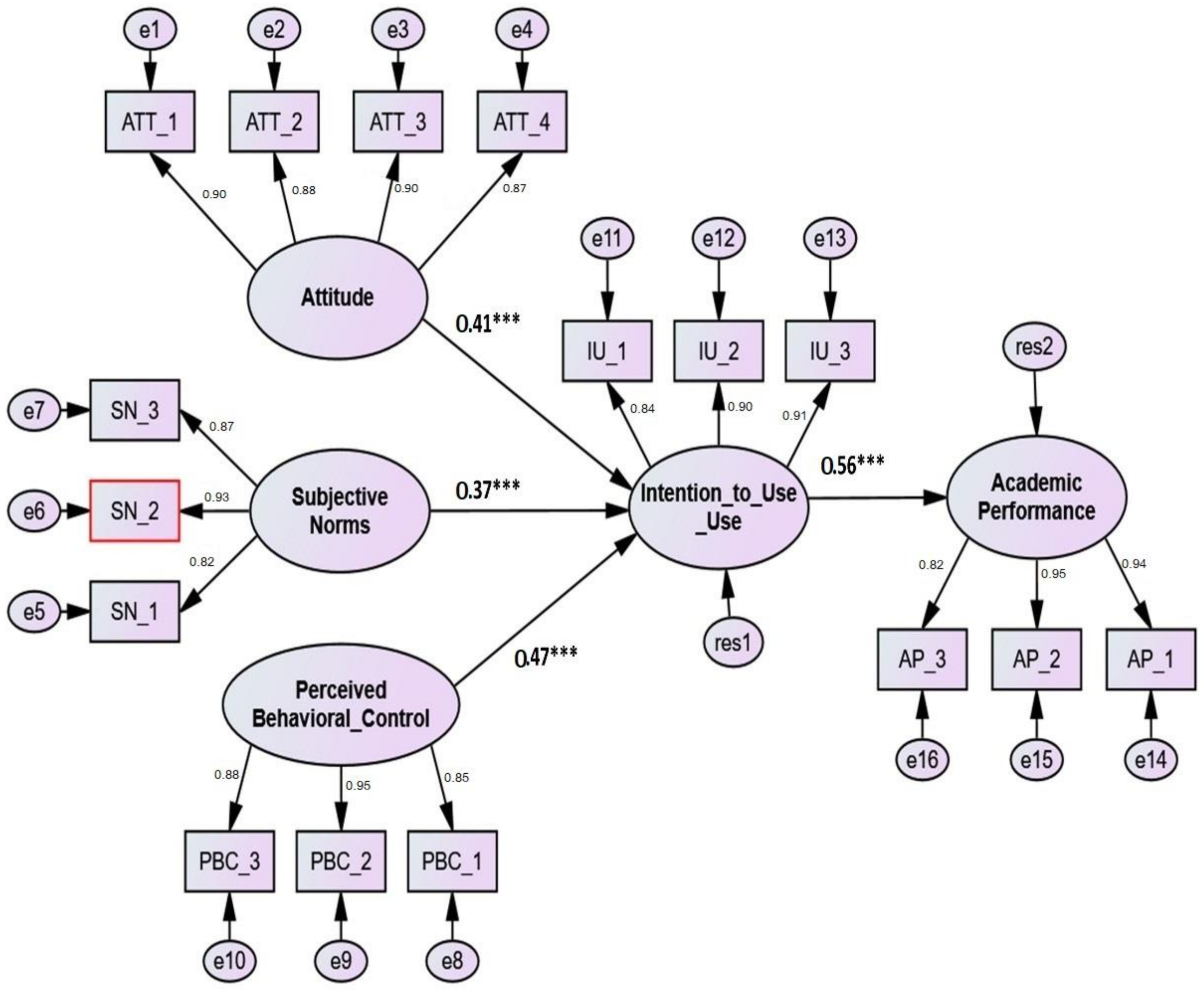
This study used a confirmatory technique, in which a thorough literature review was first conducted to develop a conceptual model, and then empirical primary data was obtained to see if both matched [51]. The conceptual theoretical model is either rejected or approved based on the proposed model fit. As provided in Table 3, the conceptual model perfectly matched the collected data, giving the following SEM results: χ2 (100, n = 600) =422.2, p < 0.001, (Normed χ2) =4.22, (SRMR = 0.0303, RMSEA = 0.0405, CFI = 0.957, NFI = 0.949, and TLI = 0.957, PCFI = 0.714, and PNFI = 0.707). After obtaining adequate model fit, the study hypotheses were tested. Research hypotheses are depicted in the structural model displayed in Figure 2.
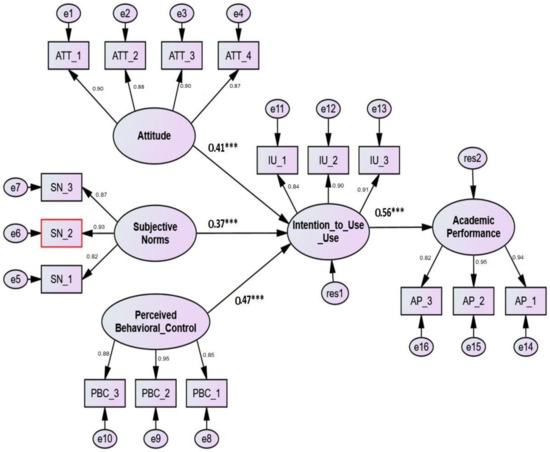
Figure 2.
The research structural model. *** p < 0.001.
This study proposed four hypotheses. The first hypothesis that tested the influence of ATT on the IU of SNAs (H1) was supported (T-value = 9.164, p < 0.001), with a highly significant path coefficient of 0.41 exposing that the two dimensions had a positive direct relationship. Likewise, the SEM outputs signaled that the impact of SN on IU of SNAs (H2) is significant and positive (T-value = 8.961, p < 0.001), with a good path coefficient of 0.37, therefore supporting hypothesis number two (H2). Furthermore, the third proposed hypothesis tested the impact of PBC on IU of SNAs, the SEM outcomes displayed a positive and significant (T-value = 10.456, p < 0.001) correlation between the two latent dimensions with a high path coeffective of 0.47, hence supporting hypothesis number three (H3). Finally, the impact of IU of SNAs on students’ AP was significant and positive (T-value = 13.693, p < 0.001) with a high path co-effective of 0.56, supporting hypothesis number four (H4).
Finally, as depicted in Table 2, IU of SNAs fully mediates the path between the three dimension of planned behavior theory (ATT, SN, and PBC) and AP. Table 3 shows that all routes’ explanatory power (R2) explains 53% of the variation in intention to use/use of SNAs (R2 = 0.53) and 32% of the variance in academic achievement (R2 = 0.32).
5. Discussions
Drawing on the TPB, this research examined the impact of SNAs adoption for e-learning purposes on the academic performance of students amid the COVID-19 pandemic. Previous research [2,3,4,5] showed that many public universities, especially in developing countries, adopted SNAs for e-learning amid COVID-19 due to the unavailability of DLMs, albeit the impact of this on learning outcomes and academic performance has not properly been addressed in previous research. Previous research examined the use of SNAs as a supporting e-learning tool beside the DLMs. This research, however, examined the use of SNAs as a sole e-learning tool in many higher education institutions amid COVID-19 using the TPB framework. According to the TPB, intention is the only antecedent of human behavior, and the antecedent of intention are attitude towards behaviors, subjective norms, and perceived behavioral control [17,44]. The results of this research supported the three research hypotheses in relation to the impact of attitude towards behaviors, subjective norms, and perceived behavioral control on the intention to use/use SNAs for e-learning purposes amid COVID-19 (supporting H1, H2, and H3, respectively). These findings are in line with the TPB framework [17,43,44] as well as previous research on antecedents of using technology and SNAs in higher education as e-learning tools (see, for example, [27,32]). The results also supported hypothesis four in relation to the impact of intention to use/use of SNAs for e-learning purposes on students’ academic performance.
Unlike the work of previous research studies [5,9,10], which found that students’ usage of SNAs negatively affects their academic performance, this research showed a positive significant and direct influence of SNAs usage on students’ academic performance. On the other side, the results of this research coincide with some earlier studies on the influence of social media usage for e-learning on the academic performance of students [3,4,7], which also showed that the use of SNAs in higher education for e-learning (e.g., Facebook, WhatsApp, and Twitter) has a positive influence on students’ academic performance. The results are also in agreement with the work of Chandrasiri and Samarasinghe [5], who argued that the SNAs could help students achieve a better learning experience and enhance their academic performance.
The results, interestingly, showed that perceived behavioral control was the most influential construct on students’ intention to use SNAs for e-learning. This is because students found that SNAs are within their control, and they have the resources, knowledge and ability to use SNAs for e-learning. Students were using SNAs to supplement their learning during conventional education, with physical classrooms, before COVID-19 [13,14]; hence, they find them more easy and appropriate to use as a sole e-learning tool amid COVID-19. Furthermore, attitudes towards behavior came at the second influential construct on intention to use SNAs for e-learning. Students perceived the use of SNAs for e-learning as a wise idea and they expect that they would have a pleasant experience; hence, they have the intention to use them in their learning. The use of SNAs by educators and its approval by leadership for e-learning has facilitated students’ intention to use and encouraged them for maintaining proper performance in their academic life [35].
6. Implications of the Study
These results have some implications for higher education scholars, policymakers, and educators. In relation to the theoretical implications, this research is an attempt to resolve the unsorted debate about the impact of SNAs on students’ academic performance, since previous research have presented contradictory findings of either negative influence [6,9,10] or positive influence [5,7] on students’ academic performance. Studies that found negative influences of SNAs on students’ academic performance often examined SNAs as a supporting tool for learning beside formal learning methods (either face–to–face or DLMS). This research took the first attempt to examine the influence of SNAs as a sole e-learning tool and found a positive significant influence on students’ academic performance. This implies that SNAs helped both institutions to continue the learning process amid COVID-19 and students to achieve positive significant learning outcomes and performance. Notwithstanding this positive significant impact of SNAs on students’ academic performance does not mean that SNAs can replace conventional learning or are better than traditional face–to–face classroom learning. However, it means that SNAs can help both policymakers and their educators to ensure their learning process during the crises, such as the COVID-19 pandemic, especially with the absence of DLMs in many public institutions in developing countries. Furthermore, SNAs have additional limitations of mechanisms that can be used to assess the leaning outcomes of students [4]. In the case of this research, students were assessed through written assignment and/or research papers, which does not fit with all courses, e.g., practical courses, for instance. Hence, despite SNAs having had positive significant impacts on students’ academic performance, they have some deficiencies that should be considered before their full implementation in the learning process. On the other side, other studies [11,12,13] found that SNAs are among the main determinants of psychological distress and learning concentration impairment, which may have a negative influence on students’ academic performance.
The results also send some important messages for policymakers and educators in higher education institutions. The integration of e-learning in higher education institution post COVID-19 is crucial, since it was found that it created positive learning experience [51,52] and enhanced students’ academic performance amid COVID-19 pandemic, as the current study showed. Since students’ mindsets and behaviors are supported by their colleagues and their ability to control their usage towards SNAs’ usage for e-learning, policymakers should set guidelines for their educators and students on how to adopt SNAs for academic-related purposes, especially e-learning post-COVID-19. To ensure the privacy of educators and protect their social lives, official accounts could be established for educators for use in their academic-related purposes as this was a major concern for many educators [2,14]. Ethical codes should also be published to protect the social life of all parties. Policymakers and institutions’ leaders have to give the appropriate IT support and solutions for both educators and their students when needed to facilitate their e-learning process.
7. Conclusions
Social network applications have become one of the major tools for communication among students and their educators, especially for academic-related purposes. This research integrated the TPB to examine the effect of SNAs, which were used for e-learning amid COVID-19 on students’ academic performance. This research among the first attempts that examined the influence of SNAs as a sole learning platform. The results, interestingly, showed a positive and significant influence of SNAs for e-learning on the academic performance of students. The three constructs of TBP are positive and significant on students’ intention to use SNAs for e-learning, hence influencing their academic performance. This implies that SNAs helped institutions to continue learning processes amid COVID-19 and students to achieve positive learning outcomes. This finding has some implications for the sustainability of higher education institutions post the COVID-19 pandemic. The integration of SNAs in e-learning after COVID-19, beside face–to–faceface education, has become crucial for higher education institutions, especially those with no DLMs. To generalize this model, further studies are needed to examine its appropriateness to different countries’ contexts. Future studies could include additional constructs that would be meaningful for examining the impact of SNAs on students’ academic performance in higher education.
8. Limitations and Further Research
This research was undertaken on bachelor’s students, in public institutions offering a tourism and hotel degree, who were adopting SNAs as their sole e-learning platform; therefore, the results may be limited to students and institutions of a similar context. Furthermore, based on the literature review, the research conceptual model was developed based on the TPB with full mediation of the intention to use/use of SNAs between attitude, subjective norms, PBC, and students’ academic performance. Further research could also examine the direct and indirect relationship of these constructs on academic performance. This study did not consider the psychological state of the students; hence, further research could also examine other factors, which could affect students’ academic performance, e.g., their psychological state, satisfaction, and engagement in e-learning.
Author Contributions
Conceptualization, A.E.E.S. and I.A.E.; methodology, I.A.E., A.E.E.S. and A.H.; software, I.A.E.; validation, A.E.E.S. and I.A.E.; formal analysis, I.A.E. and A.E.E.S.; investigation A.E.E.S. and I.A.E.; resources, A.E.E.S.; data curation, A.E.E.S. and I.A.E.; writing—original draft preparation, I.A.E., A.E.E.S. and A.H.; writing—review and editing, A.E.E.S. and I.A.E.; visualization, I.A.E.; supervision, I.A.E.; project administration, A.E.E.S., I.A.E. and A.H.; funding acquisition, A.E.E.S. and I.A.E. All authors have read and agreed to the published version of the manuscript.
Funding
The authors extend their appreciation to the Deputyship for Research and Innovation, Ministry of “Education” in Saudi Arabia, for funding this research work through project number (IFT20202).
Institutional Review Board Statement
The study was conducted according to the guidelines of the Declaration of Helsinki and approved by the deanship of scientific research ethical committee, King Faisal University (project number: (IFT20202, date of approval: 1 June 2021).
Informed Consent Statement
Informed consent was obtained from all subjects involved in the study.
Data Availability Statement
Data are available upon request from researchers who meet the eligibility criteria. Kindly contact the first author privately through e-mail.
Conflicts of Interest
The authors declare no conflict of interest.
References
- Hsieh, M.Y. The Most Sustainable Niche Principles of Social Media Education in A Higher Education Contracting Era. Sustainability 2020, 12, 399. [Google Scholar] [CrossRef] [Green Version]
- Sobaih, A.; Hasanein, A.; Abu Elnasr, A. Responses to COVID-19 in Higher Education: Social Media Usage for Sustaining Formal Academic Communication in Developing Countries. Sustainability 2020, 12, 6520. [Google Scholar] [CrossRef]
- Jacques, S.; Ouahabi, A.; Lequeu, T. Synchronous E-learning in Higher Education during the COVID-19 Pandemic. In Proceedings of the 2021 IEEE Global Engineering Education Conference (EDUCON), Vienna, Austria, 21–23 April 2021; IEEE: Piscataway, NJ, USA; pp. 1102–1109. [Google Scholar]
- Sobaih, A.E.E.; Salem, A.E.; Hasanein, A.M.; Abu Elnasr, A.E. Responses to COVID-19 in Higher Education: Students’ Learning Experience Using Microsoft Teams versus Social Network Sites. Sustainability 2021, 13, 10036. [Google Scholar] [CrossRef]
- Chandrasiri, G.D.T.D.; Samarasinghe, S.M. Use of social media in student learning and its effect on academic performance. In New Horizons in Management, Leadership and Sustainability; Springer: Cham, Switzerland, 2021; pp. 357–374. [Google Scholar]
- Samarasinghe, S.; Chandrasiri, T. The Impact of social media on Students’ Academic Performance. Am. Sci. Res. J. Eng. Technol. Sci. 2021, 60, 40–51. [Google Scholar]
- Alamri, M.; Almaiah, M.; Al-Rahmi, W. Social Media Applications Affecting Students’ Academic Performance: A Model Developed for Sustainability in Higher Education. Sustainability 2020, 12, 6471. [Google Scholar] [CrossRef]
- Choi, G.; Chung, H. Applying the Technology Acceptance Model to Social Networking Sites (SNS): Impact of Subjective Norm and Social Capital on the Acceptance of SNS. Int. J. Human-Comput. Interact. 2013, 29, 619–628. [Google Scholar] [CrossRef]
- Owusu-Acheaw, M.; Larson, A.G. Use of social media and its impact on academic performance of tertiary institution students: A study of students of Koforidua Polytechnic, Ghana. J. Educ. Pract. 2015, 6, 94–101. [Google Scholar]
- Lau, W.W. Effects of social media usage and social media multitasking on the academic performance of university students. Comput. Hum. Behav. 2016, 68, 286–291. [Google Scholar] [CrossRef]
- Giusti, L.; Salza, A.; Mammarella, S.; Bianco, D.; Ussorio, D.; Casacchia, M.; Roncone, R. Everything Will Be Fine. Duration of Home Confinement and “All-or-Nothing” Cognitive Thinking Style as Predictors of Traumatic Distress in Young University Students on a Digital Platform During the COVID-19 Italian Lockdown. Front. Psychiatry 2020, 11, 1398. [Google Scholar] [CrossRef]
- Giusti, L.; Mammarella, S.; Salza, A.; Del Vecchio, S.; Ussorio, D.; Casacchia, M.; Roncone, R. Predictors of academic performance during the COVID-19 outbreak: Impact of distance education on mental health, social cognition and memory abilities in an Italian university student sample. BMC Psychol. 2021, 9, 142. [Google Scholar] [CrossRef]
- Casacchia, M.; Cifone, M.G.; Giusti, L.; Fabiani, L.; Gatto, R.; Lancia, L.; Cinque, B.; Petrucci, C.; Giannoni, M.; Ippoliti, R.; et al. Distance education during COVID 19: An Italian survey on the university teachers’ perspectives and their emotional conditions. BMC Med. Educ. 2021, 21, 335. [Google Scholar] [CrossRef] [PubMed]
- Sobaih, A.E.E.; Moustafa, M.A.; Ghandforoush, P.; Khan, M. To use or not to use? Social media in higher education in developing countries. Comput. Hum. Behav. 2016, 58, 296–305. [Google Scholar] [CrossRef]
- Sobaih, A.E.E.; Moustafa, M.A. Speaking the Same Language: The Value of Social Networking Sites for Hospitality and Tourism Higher Education in Egypt. J. Hosp. Tour. Educ. 2016, 28, 21–31. [Google Scholar] [CrossRef]
- Mahesa, A.R.; Apriandi, R.M.; Anugrah, R.; Furqon, I.; Rizky, F.; Sutisna, Y. The Impact of social media on Students Academic Performance. Undergrad. Conf. Appl. Linguist. Linguist. Lit. 2021, 1, 361–367. [Google Scholar]
- Ajzen, I. The Theory of Planned Behavior. Organ. Behav. Hum. Decis. Processes 1991, 50, 179–211. [Google Scholar] [CrossRef]
- Davis, F.D. Perceived usefulness, perceived ease of use, and user acceptance of information technology. MIS Q. 1989, 13, 319–340. [Google Scholar] [CrossRef] [Green Version]
- Madden, T.J.; Ellen, P.S.; Ajzen, I. A comparison of the theory of planned behavior and the theory of reasoned action. Pers. Soc. Psychol. Bull. 1992, 18, 3–9. [Google Scholar] [CrossRef]
- Fan, W.S.; Haung, Y.K.; Hsu, H.C.; Chen, C.C. An Analysis of the Blog-User Attitude Employing Structural Equation Modeling Combine TAM and TPB Model. Appl. Mech. Mater. 2013, 411–414, 90–93. [Google Scholar] [CrossRef]
- Bernard, K.J.; Dzandza, P.E. Effect of Social Media on Academic Performance of Students in Ghanaian Universities: A Case Study of University of Ghana, Legon; Balme Library, University of Ghana: Accra, Ghana, 2018. [Google Scholar]
- Park, S.Y. An analysis of the technology acceptance model in understanding university students’ behavioral intention to use e-learning. J. Educ. Technol. Soc. 2009, 12, 150–162. [Google Scholar]
- Alharbi, S.; Drew, S. Using the technology acceptance model in understanding academics’ behavioural intention to use learning management systems. Int. J. Adv. Comput. Sci. Appl. 2014, 5, 143–155. [Google Scholar] [CrossRef]
- Alqasa, K.; Isa, F.M.; Othman, S.N.; Zolait, A. The impact of students’ attitude and subjective norm on the behavioural intention to use services of banking system. Int. J. Bus. Inf. Syst. 2014, 15, 105–122. [Google Scholar] [CrossRef] [Green Version]
- Irianto, H. Consumers’ attitude and intention towards organic food purchase: An extension of theory of planned behavior in gender perspective. Int. J. Manag. Econ. Soc. Sci. 2015, 4, 17–31. [Google Scholar]
- Hussein, Z. Leading to Intention: The Role of Attitude in Relation to Technology Acceptance Model in E-Learning. Procedia Comput. Sci. 2017, 105, 159–164. [Google Scholar] [CrossRef]
- Isaac, O.; Aldholay, A.; Abdullah, Z.; Ramayah, T. Online learning usage within Yemeni higher education: The role of compatibility and task-technology fit as mediating variables in the IS success model. Comput. Educ. 2019, 136, 113–129. [Google Scholar] [CrossRef]
- Taylor, S.; Todd, P. Decomposition and crossover effects in the theory of planned behavior: A study of consumer adoption intentions. Int. J. Res. Mark. 1995, 12, 137–155. [Google Scholar] [CrossRef]
- Chang, Y.P.; Zhu, D.H. Understanding social networking sites adoption in China: A comparison of pre-adoption and post-adoption. Comput. Hum. Behav. 2011, 27, 1840–1848. [Google Scholar] [CrossRef]
- Li, P.; Sun, Y. Modeling and performance analysis of information diffusion under information overload in Facebook-like social networks. Int. J. Commun. Syst. 2014, 27, 1268–1288. [Google Scholar] [CrossRef]
- Mouakket, S. Factors influencing continuance intention to use social network sites: The Facebook case. Comput. Hum. Behav. 2015, 53, 102–110. [Google Scholar] [CrossRef]
- Doleck, T.; Bazelais, P.; Lemay, D.J. Examining the antecedents of Facebook acceptance via structural equation modeling: A case of CEGEP students. Knowl. Manag. E-Learn. Int. J. 2017, 9, 69–89. [Google Scholar]
- Kim, J.; Lee, J.-E.R. The Facebook Paths to Happiness: Effects of the Number of Facebook Friends and Self-Presentation on Subjective Well-Being. Cyberpsychol. Behav. Soc. Netw. 2011, 14, 359–364. [Google Scholar] [CrossRef]
- Raza, S.A.; Qazi, W.; Shah, N.; Qureshi, M.A.; Qaiser, S.; Ali, R. Drivers of intensive Facebook usage among university students: An implications of U&G and TPB theories. Technol. Soc. 2020, 62, 101331. [Google Scholar]
- Ku, Y.-C.; Chen, R.; Zhang, H. Why do users continue using social networking sites? An exploratory study of members in the United States and Taiwan. Inf. Manag. 2013, 50, 571–581. [Google Scholar] [CrossRef]
- Palla, I.A.; Sheikh, A. Impact of social media on the academic performance of college students in Kashmir. Inf. Discov. Deliv. 2020, 49, 298–307. [Google Scholar] [CrossRef]
- Ajzen, I. Perceived behavioral control, self-efficacy, locus of control, and the theory of planned behavior 1. J. Appl. Soc. Psychol. 2002, 32, 665–683. [Google Scholar] [CrossRef]
- Auer, M.E.; Tsiatsos, T. The Challenges of the Digital Transformation in Education. In Proceedings of the 21st International Conference on Interactive Collaborative Learning (ICL2018), Kos Island, Greece, 25–28 September 2018; Springer: Berlin/Heidelberg, Germany, 2018; Volume 1. [Google Scholar]
- Salloum, S.A.; Alhamad, A.Q.M.; Al-Emran, M.; Monem, A.A.; Shaalan, K. Exploring Students’ Acceptance of E-Learning Through the Development of a Comprehensive Technology Acceptance Model. IEEE Access 2019, 7, 128445–128462. [Google Scholar] [CrossRef]
- González, M.R.; Gasco, J.; Llopis, J. Facebook and Academic Performance: A Positive Outcome. Anthr. 2016, 23, 59–67. [Google Scholar] [CrossRef] [Green Version]
- Bhattacherjee, A. Acceptance of e-commerce services: The case of electronic brokerages. IEEE Trans. Syst. Man, Cybern.-Part A Syst. Humans 2000, 30, 411–420. [Google Scholar] [CrossRef] [Green Version]
- Venkatesh, V.; Davis, F.D. A Theoretical Extension of the Technology Acceptance Model: Four Longitudinal Field Studies. Manag. Sci. 2000, 46, 186–204. [Google Scholar] [CrossRef] [Green Version]
- Fishbein, M.; Ajzen, I. Understanding Attitudes and Predicting Social Behavior; Prentice-Hall: Englewood Cliffs, NJ, USA, 1980. [Google Scholar]
- Ajzen, I. From Intentions to Actions: A Theory of Planned Behavior. In Action Control; Springer: Berlin/Heidelberg, Germany, 1985; pp. 11–39. [Google Scholar]
- Lindell, M.K.; Whitney, D.J. Accounting for common method variance in cross-sectional research designs. J. Appl. Psychol. 2001, 86, 114–121. [Google Scholar] [CrossRef] [Green Version]
- Evans, J.R.; Mathur, A. The value of online surveys. Internet Res. 2005, 15, 195–219. [Google Scholar] [CrossRef]
- Hair, J.F.; Black, W.C.; Babin, B.J.; Anderson, R.E. Multivariate Data Analysis: Pearson New International Edition; Essex Pearson Educ. Ltd.: Harlow, UK, 2014; Volume 1. [Google Scholar]
- Bryman, A.; Cramer, D. Quantitative Data Analysis with IBM SPSS 17, 18 & 19: A Guide for Social Scientists; Routledge: London, UK, 2012. [Google Scholar]
- Kline, R.B. Principles and Practice of Structural Equation Modeling; Guilford Publications: New York, NY, USA, 2015. [Google Scholar]
- Schumacker, R.E.; Lomax, R.G. A Beginner’s Guide to. Structural Equation Modeling, 3rd ed.; Taylor & Francis Group: New York, NY, USA, 2010. [Google Scholar]
- Alyahya, M.A.; Elshaer, I.A.; Abunasser, F.; Hassan, O.H.M.; Sobaih, A.E.E. E-Learning Experience in Higher Education amid COVID-19: Does Gender Really Matter in A Gender-Segregated Culture? Sustainability 2022, 14, 3298. [Google Scholar] [CrossRef]
- Elshaer, I.A.; Sobaih, A.E.E. FLOWER: An Approach for Enhancing E-Learning Experience Amid COVID-19. Int. J. Environ. Res. Public Health 2022, 19, 3823. [Google Scholar] [CrossRef] [PubMed]
Publisher’s Note: MDPI stays neutral with regard to jurisdictional claims in published maps and institutional affiliations. |
© 2022 by the authors. Licensee MDPI, Basel, Switzerland. This article is an open access article distributed under the terms and conditions of the Creative Commons Attribution (CC BY) license (https://creativecommons.org/licenses/by/4.0/).