


Abstract
The effective and safe use of FGD gypsum in agricultural land is still debated in some countries even though its effectiveness in soil management has been reported in many studies. Thus, the changes in the levels of soil salinity, alkalinity, crop yield, and other physicochemical properties in different soil types and crops after reclamation and planting with FGD gypsum over four years are evaluated in this paper. The main aim of this paper is to review the effects of six treatment technologies in addressing soil salinity and sodicity and crop production in soils, with a focus on the basic theory, key technologies, and industrialized applications. This paper also shows that soil conditions can be improved and crop yields can be increased by using FGD alone or in combination with humic acid or fertilizer. FGD gypsum plus K–Zn–Mn fertilizer increased the yield of rice by 135%. In alkaline, salinized, and secondary salinized soils, FGD gypsum combined with organic fertilizer or organic plus chemical fertilizer increased the yield of rice by 21.2% and 60.4%, the yield of sunflower by 2.4% and 23.6%, and the yield of medlar by 18.81% and 20.78%, respectively. The application of FGD gypsum also increased the salt tolerance of salt-tolerant plants. Combined with drainage, laser field levelling and tillage decreased soil salinity by more than 63.76% and increased the yield of oil sunflower by up to 96.96%. This study provides convincing evidence of the benefits of the application of the six treatments to reclaim saline–alkali soils. It is suggested that comprehensive measures should be taken to improve saline–alkaline soil.
1. Introduction
Soil salinization and/or alkalization is estimated to affect over a quarter of the world’s crop cultivation systems [1]. Nearly 10 million ha in China (mainly Northern China and coastal areas) are subject to saline–alkali stress or are potentially degraded via secondary salinization. Currently, saline soils are distributed in at least 100 countries [2], with a total coverage of 932.2 Mha [3]. The salinization and alkalization of soil has become a growing problem across the world. The ecological management and amendment of saline–alkaline land is of great importance for enhancing the stability of ecological systems, improving soil productivity, and promoting the utilization efficiency of resources. In addition, the area of saline–alkali land has consistently grown by (1–15) × 106 hm2 per year [3,4]. Saline–alkali soil, as one of the dominant soil types in ecologically fragile areas of China, is widely distributed, especially in the northwest, north, and northeast regions of China and coastal areas [5], and other countries such as the USA and Spain [6,7].Saline–alkali soils are found in most of the cultivated land in these areas [8]. With respect to China, a total of 8.18 × 10⁷ hm2 of cultivated land is classified as saline–alkali land, and 1.77 × 10⁷ hm2 of cultivated land has a potential saline–alkali risk [9,10]. The saline–alkalinity of soil is a growing problem throughout the world due to a shortage of fresh water, rapid evaporation, and excessive irrigation and fertilization [11,12,13].
Techniques to improve saline soil have been developed. These include improving soil drainage [14], the leaching of chemicals [15,16], and the breeding of salt-tolerant plant varieties [17]. However, shortcomings inevitably exist in each of these methods. Drainage contributes to lowering the groundwater level but at a high cost [18,19]. Leaching with fresh water is conducive to transferring salt from the plant root zone to soil even deeper down but is impractical in areas where fresh water is scarce [16]. Chemical agents can react with certain types of salts and remove them from soils, but this method is costly and may cause other negative environmental consequences [20]. The breeding and genetic modification of salt-tolerant plants is an option in saline–alkali soils, but it may not be permitted by local laws or accepted by the public [21,22]. Additionally, moderate irrigation and fertilization, and even the application of certain industrial wastes, could be reliable choices for remedying saline–alkalinity of land [23]. The development of a low-cost and effective treatment with little-to-no negative environmental impact would greatly improve our ability to ameliorate saline–alkaline soils and increase agricultural productivity in many of the poorer areas of the world. One potential technique is the application of flue-gas desulfurization gypsum, a by-product of technologies developed to remove sulfur dioxide from the exhaust flue gases of coal- and gas-fueled power plants and placing it into soil [24,25,26,27,28,29,30].
A long-term and complex approach needs to be established to improve and cultivate saline–alkali resources, with the main purpose of reducing harmful salts in the topsoil and improving soil structure. Traditionally, flooding and leaching is used to ameliorate poor soil conditions in Ningxia, China, but this approach is not sustainable in such a water-scarce area. The properties of FGD gypsum have a direct impact on its potential use in agriculture. The potential land application uses of FGD gypsum are identified by matching the properties of FGD gypsum with improvements in some ecosystem function (or functions). For beneficial use, the change in ecosystem function is assumed to be positive. In this paper, the effects of adding flue-gas desulfurization gypsum to traditional approaches to improving saline–alkali land resources have been reviewed.
2. Overview of Study Area in Ningxia, China
2.1. Study Site
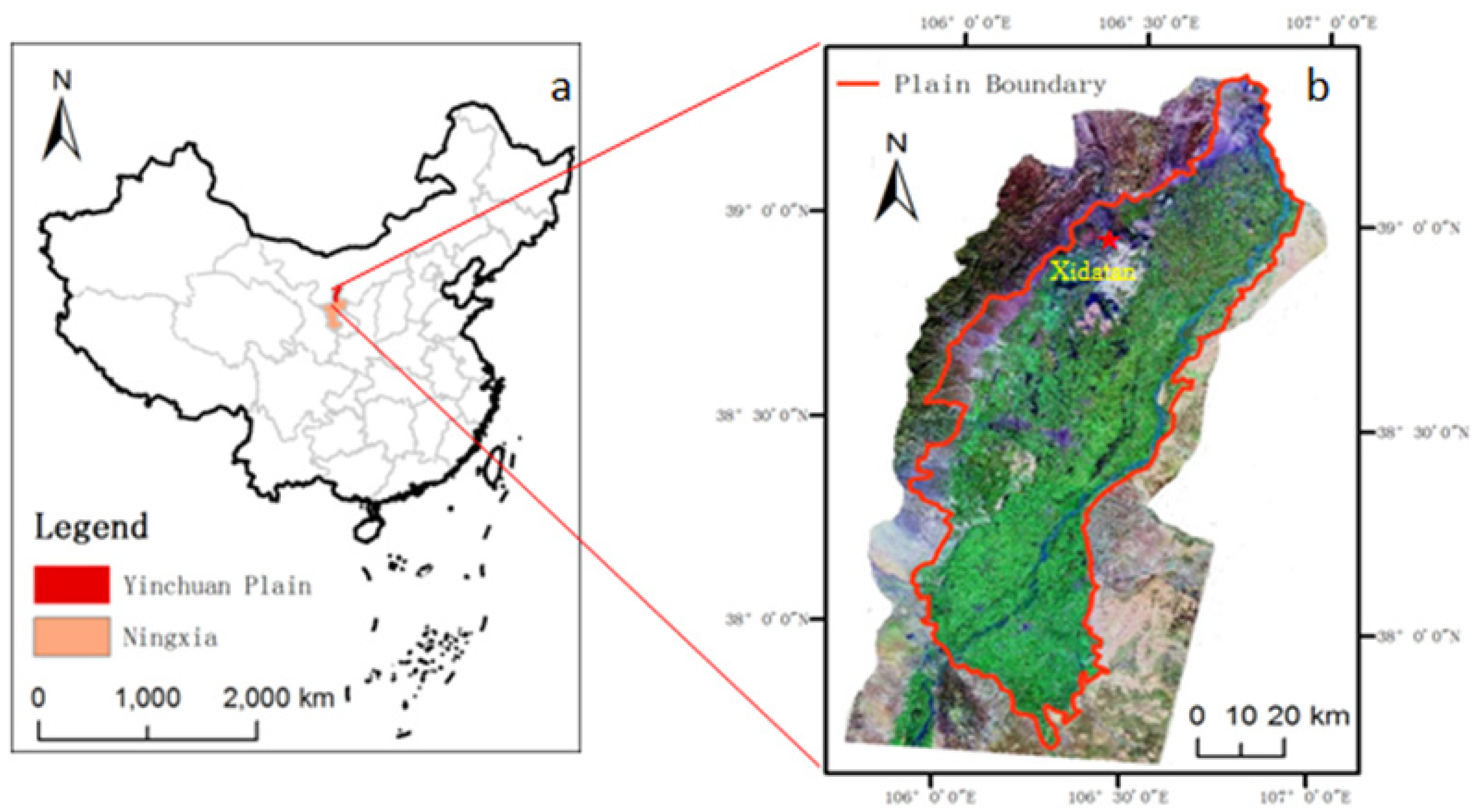
In Ningxia, saline–alkali land occurs mostly in the northern Yinchuan Plain, which belongs to the Yellow River irrigation area. The northern Yinchuan Plain is located between 106°13′–106°26′ E and 38°45′–38°55′ N, with an average elevation of 1100 m (Figure 1). The Yinchuan Plain is a piedmont pluvial–alluvial sediment zone lying west of the eastern foot of the Helan Mountains and east of the Yellow River alluvial plain. It is a semi-arid temperate climate zone which is characterized by low precipitation (average 292 mm yr−1) and a high evaporation rate (1296 mm yr−1, which is about four times greater than precipitation). Soil salinization that is caused by natural and anthropic factors, such as soil erosion, desertification, vegetation degradation, decrease in arable land, and air pollution has greatly restricted the agricultural production capacity of cultivated land in this area and threatened secure national food output.
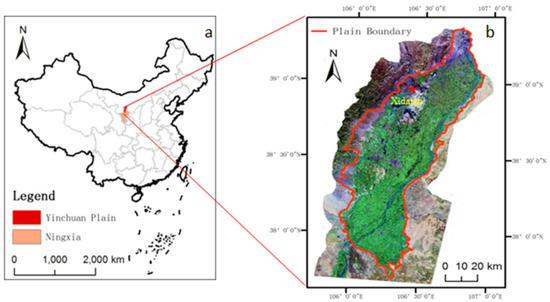
Figure 1.
Location of the study area (a) and distribution of sampling sites (b).
2.2. Climate
The study area is dominated by the typical temperate continental climate of the Northern Hemisphere. Most (75%) of the annual precipitation occurs during the period of June–September [31,32], with frequent spring droughts. The annual average temperature is 8.7 °C, and the maximum temperature is 38.9 °C. The accumulated temperature ≥10 °C is 3481 °C, with an annual sunshine time of 3067 h. Due to the influence of the topography of the Helan Mountains, on average, there are 13.8 days per year with wind speeds exceeding 17 m s−1, and 2–7 days per year with greater than level 8 winds in spring. Regional climatic factors such as low rainfall with high evaporation cause the formation of saline–alkaline soils.
2.3. Soil
The soil in the study area is takyric solonetz, which is characterized by a hard white surface, high salinity and pH, poor soil structure, and low fertility. The exchangeable sodium saturation percentage (ESP) of the takyric solonetz is as high as 42.1%, and the pH value may be as high as 9.0–10.5 (Table 1). The sediment consists of the material of takyric solonetz. Three layers develop along the soil profile: the natric horizon, the transition layer, and the parent material. The natric horizon consists of a 1 cm thick incrustation layer with fine pores and a 40 cm thick, hard, angular, blocky structure. The transition layer also contains a blocky structure. The parent material layer for the lake sediments has a low degree of alkalization. Clay minerals (principally of hydro-mica, but also of chlorite, kaolinite, and smectite) occur in the natric horizon but contain too little calcium sulphate to improve the soil. This area, therefore, is representative of the regional hydrogeological and climatic conditions for the analysis of the effects of FGD gypsum on soil salinity and sodicity.

Table 1.
Physical and chemical properties of typical soil (takyric solonetz) in Ningxia, China.
With the exception of high ESP, salinization is the main obstacle to the fertility of takyric solonetz soil. Accordingly, takyric solonetz can be divided into subclasses of alkalized and salinized takyric solonetz, including mild, moderate, and severe takyric solonetz (Table 2).
Table 2.
Classification of takyric solonetz soils in Ningxia, China.
3. Approaches to Soil Improvement in the Study Area
Considering that soil salinization always occurs under conditions of high evaporation, low rainfall, and high groundwater level, several studies have suggested using a coarse layer of sand or gravel in the subsoil to decrease salt accumulation in the root zone [33]. Such an increase in cultivated land, when the land is reclaimed with FGD gypsum, will have considerable importance in China and elsewhere [34,35]. However, the effectiveness and environmental impact of this treatment within large areas of FGD gypsum application should be studied in more detail and addressed carefully. Thus, a large-scale (600 ha) demonstration study was conducted on the Yinchuan plain, Northwest China, to investigate the effects of FGD gypsum on soil salinity, soil sodicity, and crop yields. The objective of the study was to evaluate whether saline–alkali wasteland reclamation with FGD gypsum could improve the soil quality and increase the crop yields to the levels of local crops within farmed lands.
Five methods have traditionally been used to improve saline–alkali soils: regional water–salt regulation, soil amendments, balanced fertilization, the improvement of soil fertility, and the cultivation of salt-tolerant plant species [36]. In recent years, flue-gas desulfurization gypsum has been widely used as a further amelioration technique, either on its own or in addition to traditional techniques [28,37,38].
Flue-Gas Desulfurization Gypsum
Flue-gas desulfurization (FGD) gypsum, as a by-product of industrial waste from coal-fired power plants, results from scrubbing techniques that are used to remove the SO2 that is produced during the burning of high-sulfur coal [25]. FGD gypsum can be present in a wet slurry or dry form and achieves saline soil amelioration by increasing soluble calcium (Ca2+) and sodium (Na+) ion substitution combined with irrigation. Previous studies have provided a good review of the agricultural application of FGD gypsum [37]. FGD gypsum has been primarily used to mitigate low pH problems in acidic soils that are caused by Al and Mn toxicities [39]. However, it normally does not increase the pH of acidic soil much, even at high application levels. Tsinghua University and Tokyo University first proposed the amelioration of saline–alkali soil using FGD gypsum in 1995. They cooperated to undertake a field experiment in Northeast China and achieved good results in soil amendment.
4. Soil Amendments
In this section, the effects of each of the six treatments described above are reviewed. These treatments include the treatment via FGD gypsum alone, the treatment via regional water–salt control integrated with FGD gypsum, the treatment via soil amendments integrated with FGD gypsum, the treatment via soil nutrient control integrated with FGD gypsum, the treatment via the rapid improvement of saline soil fertility integrated with FGD gypsum, and the treatment via FGD-gypsum-improved soil for salt-tolerant plant cultivation.
4.1. Effects of FGD Gypsum Alone
The key to using FGD gypsum in saline–alkali amelioration is to determine the amount applied, the period of application, and the application depth. Xiao et al. [40] suggested using FGD gypsum on three different types of saline–alkali soils based on plot and field experiments carried out in Xidatan (Table 3). They also indicated that the degree of soil alkalization and of total alkalization was significantly decreased by 56–60% with the application of FGD gypsum. However, the emergence rate and yield of sunflower was affected by the depth at which the recommended amount of 30,000 kg/ha of FGD gypsum was applied in severely alkaline soils [40]. The experimental results show that applying FGD gypsum different seasons and depths has different effects on promoting the germination rate and yield of sunflower. The response of crops to FGD gypsum is affected by application season and application depth (Table 4). The germination rate and yield were greatest when FGD gypsum was applied at a depth of 25 cm in autumn [41]. When it is applied deeply in autumn other than shallowly in autumn, deeply in spring or shallowly in spring, the germination rate is respectively improved by 12.0%, 25.6% and 21.5%, and the yield are respectively improved by 14.4%, 32.7% and 29.9%.
Table 3.
Recommended FGD gypsum amount for saline–alkali soil improvement in oil sunflower cultivation.
Table 4.
Effects of FGD gypsum application methods on the seedling emergence rate and yield of oil sunflower.
4.2. Regional Water–Salt Control Integrated with FGD Gypsum
The method of water and salt control has a unique role not only in ameliorating soil conditions such as pH, salt content, and alkalinity but also in improving both crop growth and yield (Table 5) [33].
Table 5.
Effects of soil improvement following water and salt control method.
4.3. Soil Amendments Integrated with FGD Gypsum
The effects of FGD gypsum combined with goat manure, shredded stalk, K–Zn–Mn fertilizer, and humic acid (with furfural-residue as the basic material), respectively, on rice and oil sunflower cultivation in the Xidatan demonstration area (Wang, unpublished data) were tested. It was found that the yield of rice and sunflower in the alkaline soil and the sunflower yield in the saline soil increased with FGD gypsum addition over that of CK (Table 6).
Table 6.
Effects of FGD gypsum and soil amendments in Xidatan on the yield of rice and oil sunflower.
4.4. Soil Nutrient Control Integrated with FGD Gypsum
Soil productivity can be greatly improved by FGD gypsum combined with the technologies of soil nutrient control and balanced fertilization [44,45]. The integrated technology was used in alkaline soils with rice and oil sunflower cultivation in Xidatan (Table 7). In alkaline soil with rice cultivation, the yield of rice can reach >9000 kg/ha when the N–P–K ratio is in an optimal range of 225–240 kg/ha for N, 75 kg/ha for phosphate, and 30 kg/ha for potash [44].
Table 7.
Effect of crop nutrition regulation on the yield of rice and oil sunflower.
4.5. Effects of Technologies for Rapid Improvement of Saline Soil Fertility Integrated with FGD Gypsum
Techniques for rapidly improving soil fertility integrated with FGD gypsum were demonstrated for different types of saline–alkali lands with the cultivation of different crops (Table 8) [46]. The application of chemical fertilizer and the application of organic fertilizer combined with FGD gypsum increased the yield of rice in alkaline soil by 12–60% and increased the yield of sunflower in saline soil by 0.7–31%, respectively, compared to no application of FGD gypsum. The application of different organic materials with FGD gypsum increased the medlar yield in secondary saline soil by 13–21% when compared to the soil nutrient control method.
Table 8.
Effects of fertilizing treatments on soil fertility of rice in Xidatan.
In addition, the application of FGD gypsum with chemical and organic fertilizers caused a drop of 0.7 in the pH. The desalination rate was 34.1%, and soil nitrogen and the availability of phosphorus were improved [47].
4.6. Effects of FGD-Gypsum-Improved Soil for Salt-Tolerant Plant Cultivation
Cultivating salt-tolerant plants is a traditional technique for using and improving saline–alkali soils. The suitability of nine commonly used salt-tolerant plant varieties was evaluated by using a TOPSIS evaluation (a Technique for Order Preference of Similarity to Ideal Solution) based on the indexes of plant growth, plant physiology, environment, and economic benefit in a split-plot experiment with and without FGD gypsum in saline and alkaline soils in 2008–2010 [48].FGD gypsum was applied to the main plots and sub-plots, in which different types of salt-tolerant plants were planted. Nine kinds of salt-tolerant plants were selected for secondary treatment. Based on comprehensive evaluation, the nine species were divided into four salt tolerance levels: strongest tolerance, stronger tolerance, moderate tolerance, and weak tolerance (Table 9). The application of FGD gypsum enhanced the salt tolerance level and widened the planting range of salt-tolerant plants. The salt tolerance properties of plants were influenced by different factors, including plant type, soil type, soil amelioration measures, etc. It was therefore important to seek comprehensive methods to ascertain the ecological and economic salt tolerance properties of salt-tolerant plants. This could lay the theoretical basis for the development of superior ecological reclamation modes for saline–alkali soils.
Table 9.
Comprehensive evaluation of the salt tolerance of various halophytes in alkali and.
5. Discussion
Alkali–saline land improvement isa complex task. A large number of studies have shown that a comprehensive application strategy has the best effects on soil improvement, plant response, and economical efficiency, whereas the effects of the other technologies combined with FGD gypsum on the soil, the plant, and economic efficiency are different. Thus, a comprehensive application of techniques is recommended. From the aspect of soil improvement, the technique of water–salt regulation with FGD gypsum is better than the technique of only FGD gypsum treatment and the balanced fertilization technique with soil amendments integrated with FGD gypsum. From the aspect of alfalfa growth and economic efficiency, the balanced fertilization technique with soil amendments integrated with FGD gypsum is better than the others. From the aspect of the effect of the comprehensive application of techniques, the balanced fertilization technique with soil amendments integrated with FGD gypsum is better than the water–salt regulation technique. In this article, we described measures for alkali–saline land improvement, ranging from single techniques to more comprehensive ones. The comprehensive measures appear to offer the best solution. Future research on saline–alkali improvement should consider other technologies, such as remote sensing, image processing combined with soil salinization assessment and measurement [49], and the development of soil salinization monitoring, for research on both the prediction and prevention of potential land salinization [39]. Meanwhile, the long-term monitoring of water conservancy and chemical and biological measures should be enhanced through joint inter-regional and multidisciplinary cooperation [50]. The forecasting and prediction of regional water and salt information, secondary salinization, and potential salinization should be improved. National food and ecological security by reusing industrial and agricultural waste resources are critical objectives and promote a sustainable economy.
Along with the development of science and technology, studies on plant salt resistance, salt tolerance physiology [51], and salt tolerance genetic engineering have advanced the application of vegetation-enhancing techniques in saline–alkali land and the effective utilization of salt-resistant plant varieties [52,53], which will greatly accelerate the process of using alkali–saline land. Thus, in the future, we should conduct further studies on biological measures for saline–alkali improvement.
6. Conclusions
The results obtained from this investigation, which was conducted over several years, demonstrate the beneficial effects of FGD gypsum on reducing soil salinity and alkalinity and increasing crop yield. Recent advances in the application of FGD gypsum have provided a feasible low-cost method for soil improvement. Specifically, soil salinity can be reduced using FGD gypsum because it increases soil-soluble calcium (Ca2+) and reduces sodium (Na+) ions when combined with irrigation and leaching [54]. However, the method of applying FGD gypsum should be considered. Following the application of FGD gypsum, sunflower growth is better in autumn than in spring and better with deep incorporation in the soil at 25 cm than at 10 cm [39]. Poor water drainage is the primary cause of soil salinization. However, in coastal areas, saline water intrusions by tidal currents naturally increase the soil salinity. The mode of regional water and salt control plays a role not only in ameliorating soil pH, salt content, and alkalinity but also in improving crop growth and yield [25]. In addition, the application of FGD gypsum integrated with traditional methods can further enhance the soil amelioration effect and improve crop yields. After FGD gypsum was applied to takyric solonetz in the Ningxia Hui Autonomous Region, Northwest China, salt-tolerant plants had higher salt tolerance, facilitating the cultivation of salt-tolerant plants and thereby improving the soil. The possibility of using FGD gypsum to improve takyric solonetz is well-demonstrated by this study. In spite of the amature saline–alkali land improvement work that has been established in Ningxia, the formation and stability of the ecosystem will be a long-term process, and a variety of measures still need to be taken for the ecological management of saline–alkali land.
Author Contributions
Conceptualization, G.X. and F.M.; methodology, J.W.; validation, G.X., F.M. and J.L.; investigation, J.L.; resources, X.X.; data curation, G.X.; writing—original draft preparation, J.W. and A.Z.; writing—review and editing, J.W.; visualization, J.W.; supervision, X.X.; project administration, X.X.; funding acquisition, J.L. All authors have read and agreed to the published version of the manuscript.
Funding
The National Key Research and Development Project (2021YFD1900603) and the Natural Science Foundation of Ningxia Autonomous Region (2022AAC03079).
Institutional Review Board Statement
Not applicable.
Informed Consent Statement
Not applicable.
Data Availability Statement
All data need to evaluate the conclusion in the paper are present from the corresponding author.
Conflicts of Interest
All the authors of this manuscript claim no conflict of interest.
Glossary
takyric solonetz, diluvial fan, solonchak.
Abbreviation
FGD—Flue-gas desulfurization.
References
- Qadir, M.; Noble, A.D.; Schubert, S.; Thomas, R.J.; Arslan, A. Sodicity-induced land degradation and its sustainable management: Problems and prospects. Land Degrad. Dev. 2006, 17, 661–676. [Google Scholar] [CrossRef]
- Qadir, M.; Ghafoor, A.; Murtaza, G. Amelioration strategies for saline soils: A review. Land Degrad. Dev. 2000, 11, 501–521. [Google Scholar] [CrossRef]
- Rengasamy, P. World salinization with emphasis on Australia. J. Exp. Bot. 2006, 57, 1017–1023. [Google Scholar] [CrossRef] [PubMed]
- Ashraf, M.; Akram, N.A. Improving salinity tolerance of plants through conventional breeding and genetic engineering: An analytical comparison. Biotechnol. Adv. 2009, 27, 744–752. [Google Scholar] [CrossRef]
- Spanò, C.; Balestri, M.; Bottega, S.; Grilli, I.; Maria, L.; Forino, C.; Ciccarelli, D. Anthemis maritime L. in different coastal habitats: A tool to explore plant plasticity. Estuar. Coast. Shelf Sci. 2013, 129, 105–111. [Google Scholar] [CrossRef]
- Amezketa, E.; Aragüés, R.; Gazol, R. Efficiency of sulfuric acid, mined gypsum, and two gypsum by-products in soil crusting prevention and sodic soil reclamation. Agron. J. 2005, 97, 983–989. [Google Scholar] [CrossRef]
- DeSutter, T.M.; Cihacek, L.J. Potential agricultural uses of flue gas desulfurization gypsum in the northern Great Plains. Agron. J. 2009, 101, 817–825. [Google Scholar] [CrossRef]
- Gao, H.; Liu, J.T.; Eneji, A.E.; Han, L.P.; Tan, L.M. Using modified remote sensing imagery to interpret changes in cultivated land under saline-alkali condition. Sustainability 2016, 8, 996. [Google Scholar] [CrossRef]
- Wang, Z.Q.; Zhu, S.Q.; Yu, R.P. Salinized Soil in China; Science Press Ltd.: Beijing, China, 1993. (In Chinese) [Google Scholar]
- The National Soil Survey Office. Soils of China; China Agriculture Press: Beijing, China, 1998. [Google Scholar]
- Munns, R. Genes and salt tolerance: Bringing them together. New Phytol. 2005, 167, 645–663. [Google Scholar] [CrossRef]
- Sharma, B.R.; Minhas, P.S. Strategies for managing saline/alkali waters for sustainable agricultural production in South Asia. Agric. Water Manag. 2005, 78, 136–151. [Google Scholar] [CrossRef]
- Yang, J.Y.; Zheng, W.; Tian, Y.; Wu, Y.; Zhou, D.W. Effects of various mixed salt-alkaline stress on growth, photosynthesis and photosynthetic pigment concentration of Medicagoruthenica seedlings. Photosynthetica 2011, 49, 275–284. [Google Scholar] [CrossRef]
- Zhang, Z.Z.; Zhang, J.X.; Huang, J.S.; Zhang, T.; Tang, D.; He, K.N.; Li, R.J. Efficacy of a Drainage System in Remediating Saline-alkali Soils in the Alpine Region of Qinghai Province. J. Irrig. Drain. 2018, 37, 78–85. (In Chinese) [Google Scholar] [CrossRef]
- Crescimanno, G.; Garofalo, P. Management of Irrigation with Saline Water in Cracking Clay Soils. Soil Sci. Soc. Am. J. 2006, 70, 1774–1787. [Google Scholar] [CrossRef]
- Kara, T. Leaching Requirements to Prevent Soil Salinization. J. Appl. Sci. 2006, 6, 1481–1489. [Google Scholar] [CrossRef]
- Yamaguchi, T.; Blumwald, E. Developing salt-tolerant crop plants: Challenges and opportunities. Trends Plant Sci. 2005, 10, 615–620. [Google Scholar] [CrossRef] [PubMed]
- Wang, X.L.; Zhang, F.R.; Wang, Y.P. Effect of irrigation and drainage engineering control on improvement of soil salinity in Tianjin. Trans. Chin. Soc. Agric. Eng. 2013, 29, 82–88. (In Chinese) [Google Scholar] [CrossRef]
- Heng, T.; Liao, R.; Wang, Z.; Wu, W.; Li, W.; Zhang, J. Effects of combined drip irrigation and sub-surface pipe drainage on water and salt transport of saline-alkali soil in Xinjiang, China. J. Arid. Land 2018, 10, 932–945. [Google Scholar] [CrossRef]
- Hanay, A.; Büyüksönmez, F.; Kiziloglu, F.M.; Canbolat, M.Y. Reclamation of Saline-Sodic Soils with Gypsum and MSW Compost. Compos. Sci. Util. 2004, 12, 175–179. [Google Scholar] [CrossRef]
- Murtaza, G.; Ghafoor, A.; Owens, G.; Qadir, M.; Kahlon, U.Z. Environmental and Economic Benefits of Saline-Sodic Soil Reclamation Using Low-quality Water and Soil Amendments in Conjunction with a Rice-Wheat Cropping System. J. Agron. Crop. Sci. 2009, 195, 124–136. [Google Scholar] [CrossRef]
- Wang, Q.Z.; Liu, Q.; Gao, Y.N.; Liu, X. Review on the mechanisms of the response to salinity-alkalinity stress in plants. Acta Ecol. Sin. 2017, 37, 5565–5577. (In Chinese) [Google Scholar]
- Hayat, K.; Bundschuh, J.; Jan, F.; Menhas, S.; Hayat, S.; Haq, F.; Shah, M.A.; Chaudhary, H.J.; Ullah, A.; Zhang, D.; et al. Combating soil salinity with combining saline agriculture and phytomanagement with salt-accumulating plants. Crit. Rev. Environ. Sci. Technol. 2019, 50, 1085–1115. [Google Scholar] [CrossRef]
- Crocker, W. History of the Use of Agricultural Gypsum Industries Association; Gypsum Association: Chicago, IL, USA, 1922. [Google Scholar]
- Clark, R.; Ritchey, K.; Baligar, V. Benefits and constraints for use of FGD products on agricultural land. Fuel 2001, 80, 821–828. [Google Scholar] [CrossRef]
- Chun, S.; Nishiyama, M.; Matsumoto, S. Sodic soils reclaimed with by-product from flue gas desulfurization: Corn production and soil quality. Environ. Pollut. 2001, 114, 453–459. [Google Scholar] [CrossRef] [PubMed]
- Sakai, Y.; Matsumoto, S.; Sadakata, M. Alkali Soil Reclamation with Flue Gas Desulfurization Gypsum in China and Assessment of Metal Content in Corn Grains. Soil Sediment Contam. Int. J. 2004, 13, 65–80. [Google Scholar] [CrossRef]
- Chen, H.; Wang, S.J.; Chen, C.H.; Xu, X.C.; Li, Y.; Wu, L.G.; Zhang, W.H. The application and effect of desulphurized waste of flue gas in improving alkali soil. Agric. Res. Arid. Areas 2005, 23, 38–42. (In Chinese) [Google Scholar]
- Dick, W.A.; Kost, D.; Nakano, N. A Review of Agricultural and Other Land Application Uses of Flue Gas Desulfurization Products; Report 1010385; EPRI: Palo Alto, CA, USA, 2006. [Google Scholar]
- Wang, J.; Xiao, G.J.; Zhang, F.J.; Wang, J.; Xu, X. Effect of returning straw with straw-decomposing inoculants onsaline-alkali soil in North Yinchuan of China. Agric. Res. Arid. Areas 2017, 35, 209–215. (In Chinese) [Google Scholar]
- Zhu, L.; Wang, Z.H.; Mao, G.L.; Zheng, S.X.; Xu, X. Water uptake from different soil depths for halophytic shrubs grown in Northern area of Ningxia plain (China) in contrasted water regimes. J. Plant Interact. 2012, 9, 26–34. [Google Scholar] [CrossRef]
- Wang, J.; Xu, X.; Xiao, G.J. Effect of typical takyrsolonetzs reclamation with Flue gas desulphurization gypsum and assessment of mental content in rice grains. Trans. Chin. Soc. Agric. Eng. 2015, 32, 141–147. (In Chinese) [Google Scholar]
- Sun, Z.J. Amelioration Models for Saline Alkali Wasteland in Yinchuan Plain; Beijing Forest University: Beijing, China, 2011. (In Chinese) [Google Scholar]
- Wang, S.J.; Chen, Q.; Li, Y.; Zhuo, Y.Q.; Xu, L.Z. Research on saline-alkali soil amelioration with FGD gypsum. Resour. Conserv. Recycl. 2016, 121, 82–92. [Google Scholar] [CrossRef]
- Rooney, D.J.; Brown, K.W.; Thomas, J.C. The Effectiveness of Capillary Barriers to Hydraulically Isolate Salt Contaminated Soils. Water Air Soil Pollut. 1998, 104, 403–411. [Google Scholar] [CrossRef]
- Guo, G.; Araya, K.; Jia, H.; Zhang, Z.; Ohomiya, K.; Matsuda, J. Improvement of Salt-affected Soils, Part 1: Interception of Capillarity. Biosyst. Eng. 2006, 94, 139–150. [Google Scholar] [CrossRef]
- Akudago, J.A.; Nishigaki, M.; Chegbeleh, L.P.; Komatsu, M.; Alim, M.A. Capillary cut design for soil-groundwater salinity control. J. Fac. Environ. Sci. Technol. 2009, 14, 17–22. [Google Scholar] [CrossRef]
- Zhao, Y.; Wang, S.; Li, Y.; Zhuo, Y.; Liu, J. Sustainable effects of gypsum from desulphurization of flue gas on the reclamation of sodic soil after 17 years. Eur. J. Soil Sci. 2019, 70, 1082–1097. [Google Scholar] [CrossRef]
- Stout, W.L.; Priddy, W.E. Use of flue gas desulfurization (FGD) by-product gypsum on alfalfa. Commun. Soil Sci. Plant Anal. 1996, 27, 2419–2432. [Google Scholar] [CrossRef]
- Xiao, G.J.; Luo, C.K.; Zhang, F.J.; Wang, B.; Zhang, G.Q.; Yang, J.; Mao, G.L.; Bai, H.B. Application amount of desulfurized gypsum from coal fired power plants on improving the quality of alkalized soil. Res. Environ. Sci. 2010, 23, 762–767. (In Chinese) [Google Scholar]
- Xiao, G.J.; Luo, C.K.; Zhang, F.J.; Qin, P. Impacts of the applied period and depth of desulfurized gypsum on improving the alkaline soil. Agric. Res. Arid. Areas 2009, 27, 197–203. (In Chinese) [Google Scholar]
- Huang, J.Y.; Yu, H.L.; Zhang, J.H. Effects of flue gas desulfurization gypsum and krilium application on alkali soil amelioration. Chin. J. Soil Sci. 2011, 42, 1467–1471. (In Chinese) [Google Scholar]
- Du, Y.X.; Ma, K.B.; Kang, Y.M.; Yu, H.L.; Huang, J.Y.; Zhang, J.H. Influence of adding structure krilium combined with desulfurized gypsum on takyric solonetz soil improvement and growth of Lyciumchinense. North. Hortic. 2018, 21, 129–135. (In Chinese) [Google Scholar]
- He, W.S.; Li, H.G.; Yan, C.X.; Zhang, J.H.; Sun, Z.J.; Xia, X.Z.; Lv, W.; He, J.Q. DB64/T552-2009; Fertilization Technology Regulation of Rice in Saline-Alkali Land of Ningxia. Department of Agriculture and Rural Affairs of Ningxia Hui Autonomous Regions: Yinchuan, China, 2009. (In Chinese)
- Chen, P.; He, W.S. The effects of different fertilization structure on yield of sunflower in saline alkali soil. Agric. Res. Arid. Areas 2011, 29, 108–114. (In Chinese) [Google Scholar]
- Huang, J.C.; Chen, G.D.; Gui, L.G. Study on the improved technology of comprehensive rapid fertilization of saline and alkali soil. Ningxia J. Agric. For. Sci. Technol. 2010, 4, 5–6. (In Chinese) [Google Scholar]
- Erario, M.d.l.Á.; Croce, E.; Moviglia Brandolino, M.T.; Moviglia, G.; Grangeat, A.M. Ozone as Modulator of Resorption and Inflammatory Response in Extruded Nucleus Pulposus Herniation. Revising Concepts. Int. J. Mol. Sci. 2021, 22, 9946. [Google Scholar] [CrossRef] [PubMed]
- Wang, F.; Yang, S.; Wei, Y.; Shi, Q.; Ding, J. Characterizing soil salinity at multiple depth using electromagnetic induction and remote sensing data with random forests: A case study in Tarim River Basin of southern Xinjiang, China. Sci. Total. Environ. 2021, 754, 142030. [Google Scholar] [CrossRef] [PubMed]
- Yang, J.S.; Yao, R.J.; Wang, X.P.; Xie, W.; Zhang, X.; Zhu, W.; Zhang, L.; Sun, R. Research on Salt-affected Soils in China: History, Status Quo and Prospect. Acta Pedol. Sin. 2022, 59, 10–27. [Google Scholar] [CrossRef]
- Arzani, A. Improving salinity tolerance in crop plants: A biotechnological view. Vitr. Cell. Dev. Biol. Plant 2008, 44, 373–383. [Google Scholar] [CrossRef]
- Agarwal, P.K.; Shukla, P.S.; Gupta, K.; Jha, B. Bioengineering for Salinity Tolerance in Plants: State of the Art. Mol. Biotechnol. 2012, 54, 102–123. [Google Scholar] [CrossRef] [PubMed]
- Arzani, A.; Ashraf, M. Smart engineering of genetic resources for enhanced salinity tolerance in crop plants. Crit. Rev. Plant Sci. 2016, 35, 146–189. [Google Scholar] [CrossRef]
- Watts, D.B.; Dick, W.A. Sustainable uses of FGD Gypsum in agricultural systems: Introduction. J. Environ. Qual. 2014, 43, 246–252. [Google Scholar] [CrossRef]
- Chen, Q.; Wang, S.; Li, Y.; Zhang, N.; Zhao, B.; Zhuo, Y.; Chen, C. Influence of flue gas desulfurization gypsum amendments on heavy metal distribution in reclaimed sodic soils. Environ. Eng. Sci. 2015, 32, 470–478. [Google Scholar] [CrossRef]
Disclaimer/Publisher’s Note: The statements, opinions and data contained in all publications are solely those of the individual author(s) and contributor(s) and not of MDPI and/or the editor(s). MDPI and/or the editor(s) disclaim responsibility for any injury to people or property resulting from any ideas, methods, instructions or products referred to in the content. |
© 2023 by the authors. Licensee MDPI, Basel, Switzerland. This article is an open access article distributed under the terms and conditions of the Creative Commons Attribution (CC BY) license (https://creativecommons.org/licenses/by/4.0/).