


Abstract
As the need for food safety rises, consumers are becoming more interested in certified safe pork products, such as those with safety certification or traceability. Implementing GAHP guidelines for pig farming is one potential approach to achieving food safety in Vietnam. Nevertheless, since GAHP requires a relatively substantial initial investment, its adoption is mostly determined by the economic feasibility of pig farming. A choice experiment was used in this study to investigate farmers’ preferences for adopting GAHP in pig farming in Vietnam. The findings show that pig farmers are strongly inclined to adopt GAHP if specific conditions are met. The presence of guaranteed output contracts, increased yields, and price premiums are important variables influencing their decision to implement GAHP. The findings could be used by policymakers to develop and implement supportive regulations to encourage GAHP adoption, while buyers, processors, and retailers can capitalize on pig farmers’ preferences by establishing and publicizing market channels for GAHP-certified products. Furthermore, these findings could be used to assist pig farmers in making informed choices about their farming practices, allowing them to analyze the possibility of getting output contracts, implementing productivity-boosting initiatives, and exploring market potential for GAHP-certified pigs.
1. Introduction
Pig farming is one of the most important agricultural operations in Vietnam’s livestock industry and agriculture sector. There were approximately 2.6 million pig farms, which employed approximately 7 million Vietnamese people. According to the Livestock Department, the number of pigs raised in 2022 was around 24.9 million heads, with an output of approximately 3.29 million tons of pork.
There have been concerns about the sustainability of pig farming in recent years due to the use of prohibited drugs and illness outbreaks. Pig farmers employed prohibited chemicals in their production, such as beta-agonist growth enhancers such as salbutamol and clenbuterol, which are difficult to control [1]. Furthermore, consumer trust in pork meat has suffered as a result of the impact of food safety crises such as the use of pork with lean meat enhancers, growth promoters, blue ear disease, African swine fever, and pork contaminated with Salmonella bacteria [2,3]. As a result, consumers are becoming increasingly concerned about the food safety hazards related to pigs, leading to a growing demand for safer pork, and consumers are willing to pay higher prices for safer pork.
To address sustainability concerns and meet the growing demand for certified safe pork, pig farming, according to Good Animal Husbandry Practice (GAHP) safety standards, has been proposed as a potential solution to reduce the use of banned substances, disease rates, and environmental pollution in order to meet environmental regulations. GAHP is a collection of guidelines designed to ensure that animals are raised in a humane, healthy, and safe setting. The standards address different elements of pig production, such as housing, feeding, and disease control. The implementation of GAHP is expected to improve animal health and welfare, reduce the environmental impact of pig farming, and improve the safety and quality of pork products.
Traceability or safety certification can ensure safety in pig farming, according to GAHP requirements. Many countries have introduced food traceability, including the United States, Australia, Canada, and New Zealand [4]. A food product sold on the market must follow traceability and origin laws. These regulations assist stakeholders in tracing products affected by incidents, reducing information asymmetry in product information, protecting consumers’ right to know about the food they purchase, and eliminating food safety hazards [5]. Furthermore, traceability requirements, along with food safety, environmental, and social welfare standards, have recently been added to quality assurance certifications such as Global GAP or VietGAP [6]. However, the pricing of traceable commodities may be higher than that of non-traceable products in order to incentivize producers to implement traceability [7]. Safety certification is not required, and producers who follow safety standards (such as Global GAP or GAHP) are personally responsible for their economic effects. Products with safety certification labels attached serve as a signal of commitment by suppliers to their clients in terms of quality assurance [8]. Producers who adopt safety requirements must additionally pay certification fees for certification services, but, on the other hand, they may have better market access and higher economic efficiency.
Many previous studies have explored agricultural farmers’ preferences and the costs associated with adopting sustainable agricultural practices [9,10,11,12,13,14,15,16,17]. Ngoc et al. [14] discovered that the initial cost of investment had an adverse effect on catfish producers’ decisions to invest in recirculating aquaculture systems (RAS). Farmers anticipated that when production costs increased, their benefits would decrease [13]. The additional benefit could be compensated through a higher selling price compared to not applying sustainable production practices. The increasing price of goods is a widespread attribute in studies that are connected to producer preferences for sustainable farming techniques [11,14,15,16]. Farmers would be more likely to adopt sustainable agriculture practices if the extra price of sustainably farmed aquatic products increased. If the price of fish climbed by 10%, the likelihood of adopting RAS models increased by 1.2% [14]. According to Ortega et al. [11], fish farmers in China were willing to participate in food safety-assured farming if the average price increased by approximately 2.5%. Vu Thi et al. [16] reported that if the price of litchi increased by 16% to 60%, Vietnamese farmers would participate in VietGAP. Low output prices were also recognized as the primary obstacle that farmers faced while implementing GAHP [15]. These studies suggest that price is a key factor in the decision to adopt sustainable agriculture practices. Lapar et al. [1] claimed that compliance with GAHP might increase yield due to lower death rates in pig farming, resulting in greater economic efficiency. Despite higher costs, the application of safety standards will result in safer and more productive products with higher selling prices, ultimately leading to better profitability for farmers [9]. A study by Chelang’a et al. [17] found that contracted farmers exhibited a higher level of adoption of GGAP standards compared to non-contracted farmers.
It remains unclear why the adoption of GAHP among Vietnamese pig farmers has been relatively low. According to the Ministry of Agriculture and Rural Development (MARD), just 18% of Vietnam’s pig farms adopted GAHP in 2019. Low adoption rates can be attributed to a variety of factors, including high initial investment costs, unstable selling prices, a lack of contract farming, and uncertain high yields.
The aim of this study was to examine farmers’ preferences for adopting GAHP in pig farming in Vietnam. The choice experiment was used in this study to imitate a real-world scenario in which farmers are obliged to adopt GAHP. The experiment enabled the study to investigate the factors that influence farmers’ willingness to adopt GAHP, such as initial cost, increased yield, output contract, and price premium. The findings of this study could be used to impact policies and actions targeted at increasing the adoption of GAHP among pig farmers in Vietnam.
2. Materials and Methods
2.1. A Choice Experiment
Choice Experiment (CE) is often used by researchers to assess respondents’ preferences for a specific commodity that is not traded in the real market [18]. CE involves presenting respondents with multiple alternative options associated with a specific commodity under evaluation. These options, commonly referred to as choice cards, encompass a range of attributes related to the commodity. Respondents are asked to select their preferred option from each choice card. These choice cards comprise a set of distinct attributes, each with multiple levels [19]. If the attributes represent monetary values such as prices or costs, the respondent’s willingness to pay for the attributes of the commodity can be determined based on their choices.
A CE study typically includes the following steps: (1) selecting attributes and determining their levels, (2) designing choice cards, (3) data collection, and (4) measuring preferences through willingness to pay.
2.1.1. Selecting Attributes and Determining Their Levels
Firstly, a list of potential attributes was constructed based on the characteristics of GAHP and previous studies such as Ngoc et al. [14] and Phong et al. [20]. Secondly, a group discussion was conducted with experts and pig farmers to select the key attributes from the list. The experts came from diverse professional backgrounds, including farm managers and pig farmers, all of whom possess knowledge of pig farming and GAHP. The potential attributes that may influence the preference and adoption of GAHP by pig farmers include initial investment, increased yield, output contract, GAHP certification, higher prices, impact from neighbors, uncertainty, farm scale, credit accessibility, and availability of agricultural extension services. Thirdly, these attributes were transformed into statements regarding the application of GAHP (Table 1). The statements were evaluated by 21 pig farmers from medium and large-scale farms through a group discussion session. The assessments were measured by using a Likert scale ranging from 1 (strongly disagree) to 5 (strongly agree), which were presented in Table 1.

Table 1.
The potential attributes and statements about GAHP.
The list of attributes was then identified. We sought to keep the number of attributes reasonably limited, as recommended by Abiiro et al. [21], to ensure respondent manageability when managing the choice cards. Those attributes were scored 4 or 5 by at least 75% of participants. These included initial investment, increased yield, output contract, GAHP certification, traceability, and price premium. Attributes, including the influence of neighbors, uncertainty, farm scale, credit accessibility, and agricultural extension services, were removed from the final list since less than 75% of respondents rated them as 4 or 5. Rearing pigs according to GAHP standards can help meet the requirements of GAHP certification, traceability, and, eventually, price premium. These attributes were interconnected, and therefore, these were combined into 1 attribute. Keeping them as independent variables would go against the choice experiment’s requirement for mutually exclusive variables.
The final list of attributes contains (1) initial investment, (2) increased yield, (3) output contract, and (4) price premium. According to Bateman et al. [22], the attribute levels must be reasonable, span the predicted range for individuals, and be achievable in practice. The selection of extreme values for the levels helps to ensure alternatives among attributes [23].
The level of initial investment attribute was established by conducting a survey among pig farmers. The construction and equipment costs constitute the largest investment for pig farming under GAHP. The initial investment varies from 1200 million VND (Exchange rate: 1 USD = 24,000 VND in 2022; around 50,000 USD) to 1800 million VND (75,000 USD) with an average of 1500 million VND (around 62,500 USD) per 1000 m2 of pigsty. Four levels of initial investment, namely 1200; 1400; 1600; and 1800 million VND per 1000 m2 of pigsty, were then selected for the farm survey. The attribute level for increased yield is based on the study of LIFSAP, which stated that when pig farmers applied GAHP, the pig mortality rate decreased from 15% to 4.62%, resulting in yields being increased by approximately 10% or less. Two levels of increased yield attributes were chosen, namely 5% and 10%. The contract farming agreement between pig farmers and buyers established the levels of output contract attributes. The 2 levels were classified as having or not having an output contract while selling pigs to traders or purchasing enterprises. The amount of money that consumers are willing to pay for pork safety linked to GAHP determines the premium price for pork produced. Consumers are willing to spend around 27% more for traceable pork compared to non-traceable pork [24]. Mai et al. [25] also indicated that consumers are willing to pay approximately 32.6% more for safe pork with traceability compared to non-traceable pork. Moreover, if the pork has safety certification, consumers are willing to pay 31.1% more compared to uncertified pork. Based on that information, 3 levels for the price premium with GAHP certification, namely 10%, 20%, and 30%, were chosen for the field survey (Table 2).
Table 2.
Attributes and their levels.
2.1.2. Designing Choice Cards
The combination of 2 attributes with 2 levels, 1 attribute with 3 levels, and 1 attribute with 4 levels would provide a full factorial design with 48 alternative choice sets. However, according to Allenby et al. [26], administering too many choice sets can cause fatigue in respondents. It is generally advised that each survey questionnaire contains no more than 10 choice sets. This eliminates the burden on respondents during interviews while also ensuring the quality of the investigation. This study applied the fractional factorial design to determine the optimal number of choice sets to incorporate into the survey questionnaire. The selection of subsets should be based on certain principles, specifically the idea of balance, and could not be arbitrary [27]. The principle of balance ensured that the estimated model from the survey data was minimally impacted by the experimental design. Various methods or algorithms could be employed to identify subsets from a full factorial design, with the most advantageous approach being the utilization of an orthogonal design.
Using an orthogonal design resulted in a set of options that provided balance without significantly affecting the accuracy of the model’s estimation. The most optimal 6 choice sets were chosen using the SPSS software version 20. The choice sets were presented in the form of choice cards, providing pig farmers with the opportunity to select either (1) non-adoption of GAHP or (2) adoption of GAHP. A choice card example is presented in Table 3.
Table 3.
An example of a choice card.
2.1.3. The Survey and Data Collection
In May of 2022, a survey was conducted in Dong Nai and Binh Duong provinces, which are well-known for their high concentration of pig farms and are important areas for promoting GAHP implementation. The survey focused on 3 districts, specifically Trang Bom and Thong Nhat districts in Dong Nai Province and Phu Giao district in Binh Duong Province. A stratified random sampling methodology was utilized within each district to select 50 pig farmers who engage in open-cycle pig rearing. A total of 150 pig farmers were interviewed, all of whom were primary decision-makers in their households. Medium (30–300 pigs/farm) and large (above 300 pigs/farm) pig farms were selected, as they could meet the GAHP criteria according to Vietnam’s Livestock Law in 2018. The survey was conducted using a structured questionnaire that included an introduction, socio-economic characteristics questions, choice cards, and statements to clarify decisions. To ensure the questions were clear and the choice tasks manageable, the questionnaire was pre-tested by 3 farmers.
2.2. Economic Modelling
The theory of choice was based on Lancaster’s theory of consumer behavior [28] and McFadden’s random utility theory [29]. It was assumed that people act rationally and make decisions to maximize the benefits that they receive from the available alternatives. The model to estimate the utility function can be provided using the data obtained from the choice experiment with alternative options as shown below:
where is the utility that is received by individual a from option b, denotes the observed utility component of individual a from option b, and denotes the unobserved component. has a linear relationship with the option’s set of attributes Therefore, is presented as:
where is the utility which depends on the attributes, namely initial cost, increased yield, output contract, and price premium; is the vector of the levels of GAHP adoption b received by farmer a, and represents the parameters that are consistent across all farmers. The likelihood that farmer a choose GAHP adoption b over GAHP adoption s relates to the probability that Ub > Us. Specifically, the probability of choosing b of individual a (Pab) will be:
where Ta = {t1, t2, …, tT} indicates that respondent a is given a choice task.
The typical multinomial logit (MNL) model will explain the likelihood of farmer a selecting alternative b [30]:
The MNL model’s premise that individual preferences are homogeneous is a weakness [31]. If the random part does not satisfy the condition iid but is determined to have other distributions such as normal, triangular, or uniform distribution and a part satisfying iid, the choice probability function is known as a random parameter logit model (RPL) or Mixed Logit model (MXL), as shown in [32]:
where is the random parameter density function.
2.3. The Mixed Logit Model (MXL)
The benefits of pig farmers in the experiment when they choose the option of investing in GAHP pig farming can be presented as the MXL model:
Vab = β0 + β1∗initial cost + β2∗increased yield + β3∗output contract + β4∗price premium
The influence of individual characteristics on pig farmers’ preferences for GAHP is represented by the following the MXL model with individual characteristics:
where Vab is the utility that individual a receives from alternative b, and β0 is an alternative-specific constant (ASC) that corresponds to the non-adoption option.
Vab = β0 + β1∗initial cost + β2∗increased yield + β3∗output contract + β4∗price premium + α1∗gender + α2∗education + α3∗age + α4∗income
Willingness to pay (WTPa) for each attribute is the ratio of the marginal utility of the attribute to the marginal utility of the monetary attribute [18]. The monetary aspect considered in this study is the initial investment cost:
The model estimations and analysis preparation were carried out using Stata 16.0.
3. Results
3.1. Social Characteristics of Pig Farmers
Table 4 provides descriptive statistics about a sample of individuals in pig farming, including gender, age, education, experience, number of pigs raised, and household income. In terms of gender, 70% of the respondents were male, while 30% were female. Regarding age, the largest group consisted of respondents aged 45–59, accounting for 56% of the total. The age groups of 30–44, 60–69, and under 30 represented 30%, 10%, and 4%, respectively. Regarding education, most respondents had a secondary school education, comprising 54% of the total. Primary school-educated respondents accounted for 26%, while those with a high school education and university degree represented 12% and 8%, respectively. Concerning experience, the largest group had 10–19 years of experience, comprising 44% of the respondents. Those with less than 10 years of experience represented 22%, while those with 20–30 years and over 30 years of experience accounted for 30% and 4%, respectively. In terms of the number of pigs raised, 66% of the respondents reported raising from 30 to 300 pigs (medium farms), while 34% indicated raising more than 300 pigs (large farms). Regarding household income, the category with the highest frequency was the range of 100–199 million Vietnamese Dong (VND) per year, accounting for 30% of respondents. The income ranges of 200–299 million VND and 300–400 million VND represented 28% and 20% of respondents, respectively. Those with incomes below 100 million VND and above 400 million VND accounted for 4% and 18%, respectively.
Table 4.
Summary characteristics of the respondents.
3.2. Pig Farmers’ Preferences for the Adoption of GAHP
To explore the preferences of pig farmers towards the attributes of GAHP, a Mixed Logit model (MXL) was estimated. The estimating process is divided into three steps. First, a main effect model was estimated, which did not include the social characteristics of the respondents. Then, an MXL model with the respondents’ social characteristics was estimated. Finally, the WTP was calculated and reported for each attribute.
3.2.1. The MXL Model
The main effect model is shown in Table 5. Although the magnitude of the coefficients varied, all attributes had significant coefficients. The results of the MXL model show that the attributes of initial cost, increased yield, output contract and price premium have significant positive coefficients. This implies that farmers would prefer adopting GAHP over the alternatives.
Table 5.
The estimated results of the MXL model.
3.2.2. The MXL Model with Individual Characteristics
The estimated results of the MXL model with individual characteristics are presented in Table 6. The model with individual characteristics has a better log-likelihood value and AIC value (−393.095 and 806.19) than that without these values (−401.19 and 812.38), indicating that the inclusion of individual characteristics has improved model goodness of fit. The Wald chi-square (47.64) and Likelihood ratio test (10.74) with a level of significance of 1% also show the goodness-of-fit of the MXL model with individual characteristics, demonstrating the suitability of this model.
Table 6.
The MXL model with individual characteristics and pig farmers’ preferences.
All the coefficients of the attribute variables have expected impacts and are statistically significant. The average impact on the utility of the status quo is recorded by the Alternative-Specific Constant (ASC). The ASC for status quo was positive and significant, indicating that respondents in this survey were more inclined to choose GAHP on average, demonstrating that pig farmers are interested in and willing to adopt GAHP.
The coefficient estimation for the initial cost attribute is negative and exhibits statistical significance at the 5% level. This implies that a higher initial cost leads to a decreased likelihood of selecting GAHP and a reduction in the utility for pig farmers. Conversely, the estimated coefficients for attributes such as increased yield, output contract, and price premium are positive, indicating that they increase the probability of GAHP adoption and improve the utility for pig farmers.
For gender, the coefficient of 0.3943 suggests a positive relationship with the likelihood of adopting GAHP, although it is slightly significant at the 10% level. This indicates that pig farms with male household heads may slightly increase the probability of adopting GAHP compared to those with female household heads. Regarding age, the coefficient of 0.0277 implies a positive relationship with the likelihood of adopting GAHP and is significant at the 10% level. This suggests that older farmers may be slightly more likely to adopt GAHP compared to younger farmers. The coefficient for income is positive and statistically significant at the 10% level. This implies that higher income levels may have a positive effect on the probability of adopting GAHP. In contrast, the coefficient for education is not statistically significant, indicating that the education level of the household head does not significantly impact the likelihood of adopting GAHP.
The results of the study show that pig farmers were willing to pay 2360 million VND (around 98,333 USD) per 1000 m2 to invest in GAHP; this amount is higher than the average GAHP investment cost. Pig farmers that implement GAHP place a high priority on the output contract, which is reflected in their highest level of willingness to pay for GAHP investments. On average, pig farmers are willing to pay approximately 685.3 million VND (around 28,554 USD) per 1000 m2 to invest in GAHP if the output contract is guaranteed. The pig farmers also expressed a preference for GAHP, as its implementation resulted in an increase in yield and higher selling prices. Indeed, pig farmers are willing to pay 115.9 million VND (around 4829 USD) per 1000 m2 if GAHP adoption results in a 5% increase in yield. Similarly, pig farmers are willing to pay 58.9 million VND (around 2454 USD) per 1000 m2 if the adoption of GAHP leads to a 10% increase in the price premium. These findings provide important information for relevant parties to promote the adoption of GAHP in pig farming.
Using the Latent Class Model (LCM) to assess the heterogeneity of farmers’ preferences was presented in Table 7. The survey farmers were categorized into three groups, namely those who value greater yields (productivity concerned), those who value output contracts (contract preferred), and those who value price premiums (price concerned). The results indicate that Class 1 farmers, accounting for 22% of the respondents, place significant importance on achieving higher yields. The positive and significant coefficient of increased yield suggests that these farmers benefit financially from adopting GAHP, as it leads to improved productivity. Conversely, the negative and significant ASC coefficient indicates that these farmers were not initially interested in adopting GAHP, highlighting the need for additional incentives or interventions to encourage their adoption. Class 2 farmers, comprising the majority of respondents (48%), demonstrates a stronger preference for output contract. The positive and significant coefficient associated with this group signifies that these farmers attach great importance to the assurance of a stable market and reliable demand through output contracts. The positive and significant ASC coefficient suggests their willingness to adopt GAHP when such contracts are in place. Class 3 farmers, representing 30% of the respondents, prioritize price premiums. The positive and significant coefficient indicates that these farmers are willing to adopt GAHP when higher prices are offered for GAHP-certified products. This finding emphasizes the importance of economic incentives in influencing technology adoption decisions.
Table 7.
Pig farmers’ preference heterogeneity and latent class model.
3.3. Adoption Decision Clarification
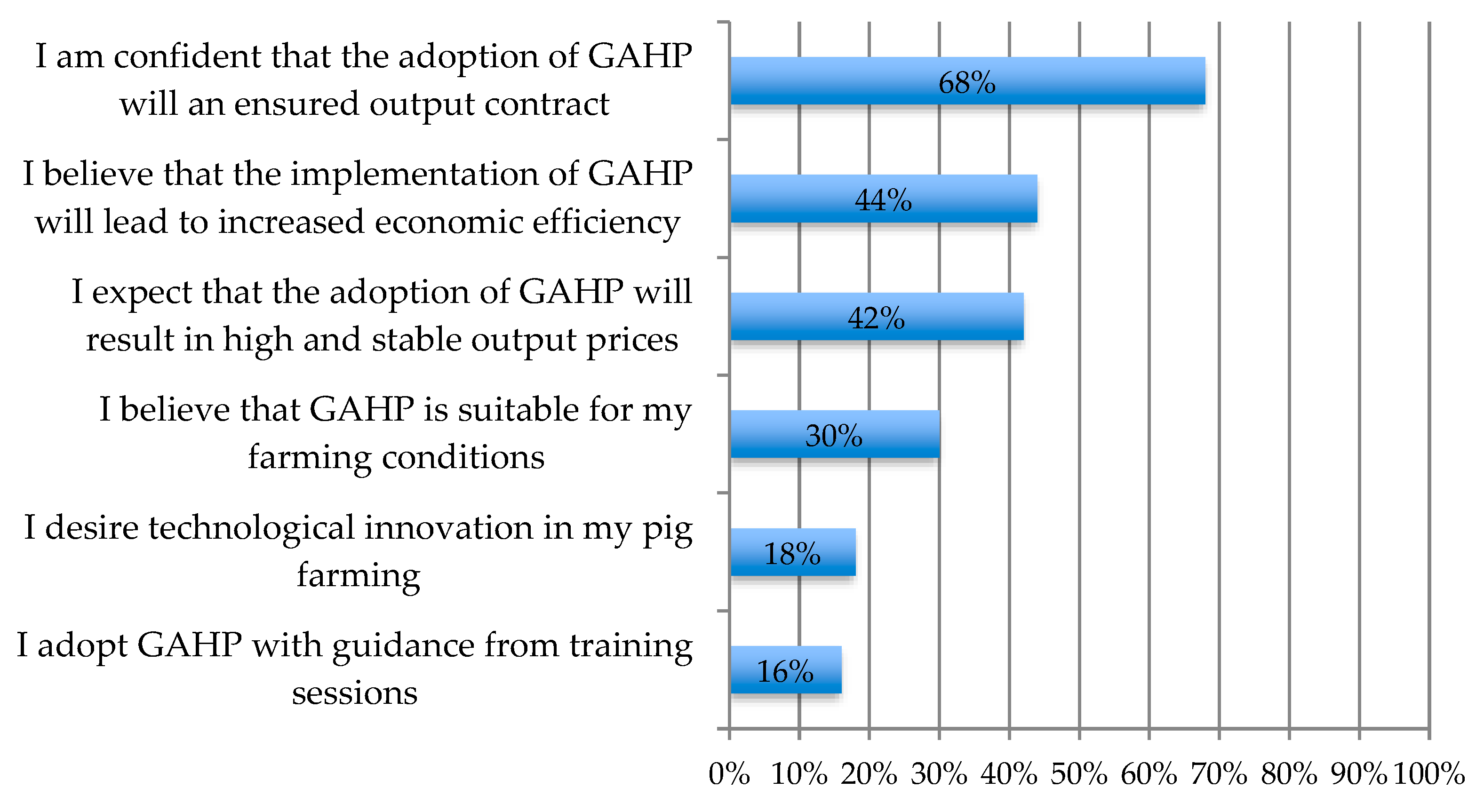
The findings from the choice experiment indicate a relatively high overall preference for adopting GAHP. This is supported by the responses to the statements aiming to clarify the choice between the adoption of GAHP and the non-adoption of GAHP. For instance, pig farmers considered an ensured output contract as the most important attribute in the adoption of GAHP in our choice experiment. A noTable 68% of pig farmers believe that the adoption of GAHP will result in an ensured output contract, highlighting their reliance on its dependability and security. Furthermore, 44% of pig farmers believe that the adoption of GAHP will result in increased economic efficiency, indicating their comprehension of potential cost savings and optimized resource utilization. Moreover, 42% of pig farmers expect that the adoption of GAHP will lead to stable and high output prices, demonstrating their anticipation of improved profitability and market competitiveness. Additionally, 30% of pig farmers consider GAHP suitable for their farming conditions, emphasizing its adaptability and compatibility. Also, 18% of pig farmers express a desire for technological innovation in their pig farming practices, signifying their dedication to staying ahead in the industry. Lastly, 16% of pig farmers adopt GAHP with the guidance of training sessions, highlighting the importance they place on acquiring knowledge and professional support. The reasons for the adoption of GAHP are depicted in Figure 1.
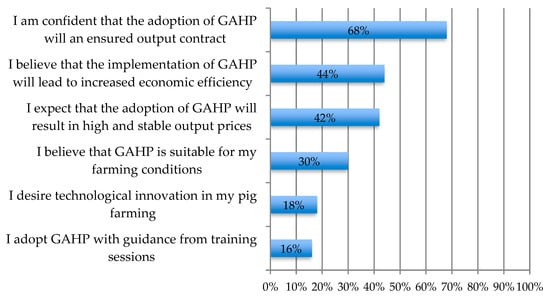
Figure 1.
Reasons for the adoption of GAHP.
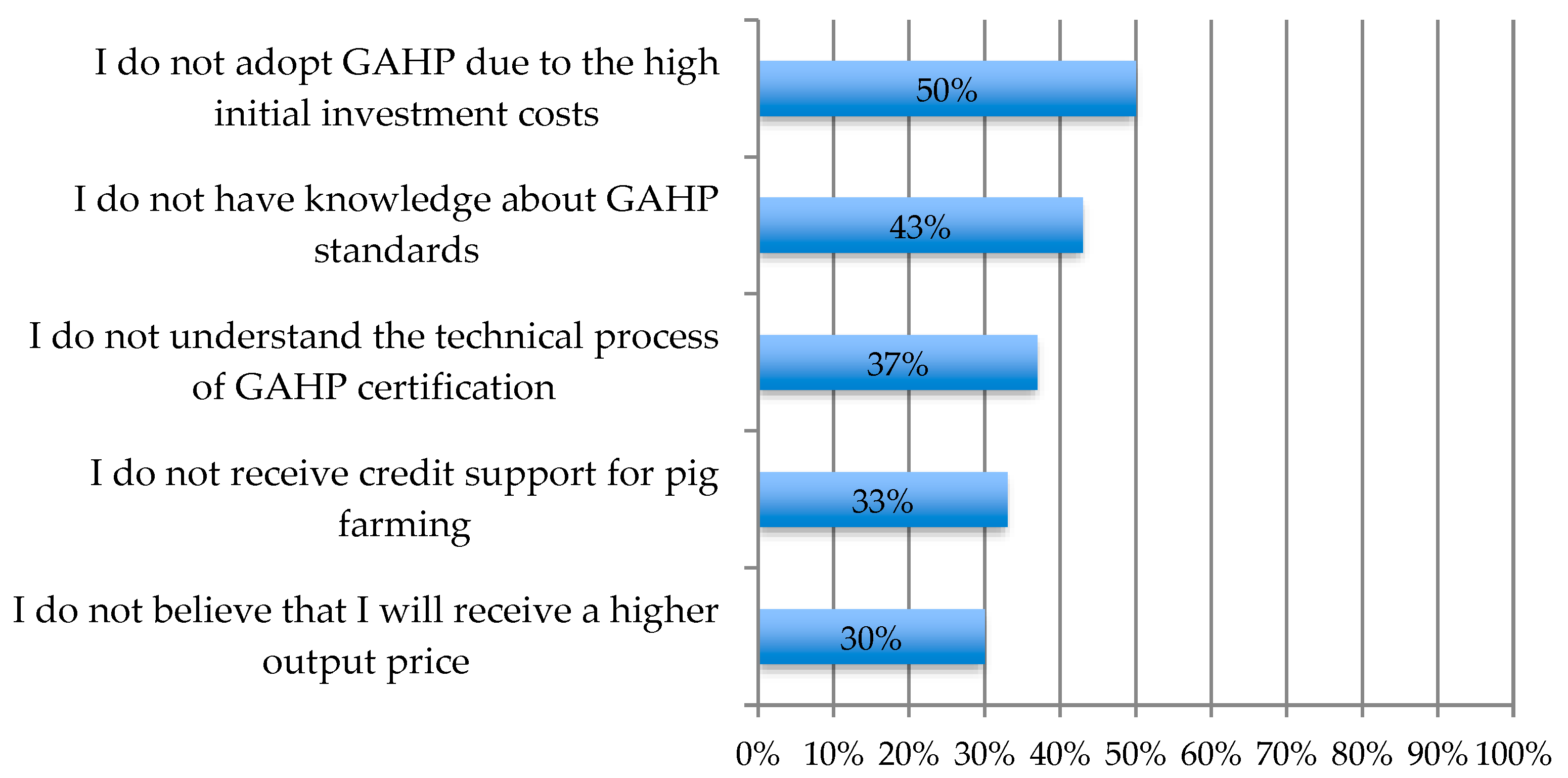
The reasons for the non-adoption of GAHP are presented in Figure 2. It was found that a significant 50% of pig farmers did not adopt GAHP due to the high initial investment costs, which highlights the financial barriers. Moreover, 43% of pig farmers expressed a lack of knowledge about GAHP standards, indicating the need for extension services. Furthermore, 37% of pig farmers did not understand the technical process of GAHP certification, which could be a potential barrier to implementation. Additionally, 33% of pig farmers did not receive credit support for pig farming, underscoring their financial difficulties in accessing necessary resources. Finally, 30% of pig farmers did not believe that adopting GAHP would result in a higher output price, suggesting the need for more convincing evidence of the associated economic benefits.
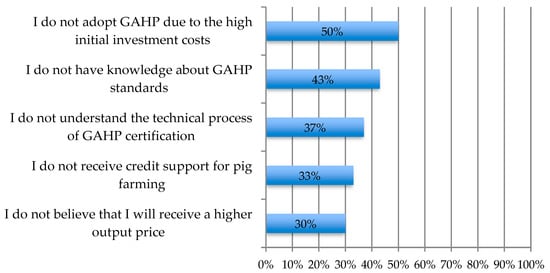
Figure 2.
Reasons for the non-adoption of GAHP.
4. Discussion
The initial cost attribute has a negative impact on the adoption of GAHP. Applying GAHP with a higher initial investment is less attractive to pig farmers because investing in a new technology entails sunk costs that are irreversible [33]. Similarly, the findings of Ngoc et al. [14] suggested that high initial investment costs are an important factor leading to the slow adoption rate of RAS. The cost of implementation significantly influences the decision to adopt new technologies [14,34]. Conversely, increased yield and price premium have a positive impact on the adoption of GAHP by pig farmers. Because of the direct benefit, such as from increased yield and higher selling prices, farmers revealed a greater preference for GAHP [20]. Akudugu et al. [35] discovered that farmers are more inclined to adopt new technologies if the predicted profits are larger. Similarly, Lapar et al. [1] argued that the adoption of GAHP significantly reduces mortality rates in pig farming, resulting in higher productivity. The attribute of output contracts has been demonstrated to be highly preferred by pig farmers. The findings indicate that pig farmers have a favorable inclination and are willing to make the highest investments in raising GAHP-certified pigs when the output is assured. This result is compatible with the finding of Chelang’a et al. [17] found that contracted farmers exhibited a higher level of adoption of Global GAP standards compared to non-contracted farmers.
Individual characteristics of pig farmers also influence the adoption of GAHP. We find that gender is positively related to the adoption of GAHP, which is in line with our expectations. This indicates that male farmers have a higher probability of adopting GAHP compared to female farmers. This result is consistent with Nguyen et al. [33] found that male farmers are positively influencing the adoption of GAHP. Male household heads were also found to have higher adoption rates of technology in production [14]. A study by Gillespie et al. [36] indicated that male farmers in beef cattle production were more inclined to follow optimal management methods. The age variable has been observed to have a positive impact on the acceptance and implementation of GAHP among the characteristic of pig farmers. Additionally, it has been identified as a crucial factor in the decision to adopt novel technological advancements. It is widely believed that older farmers have accumulated invaluable knowledge and expertise over the years, enabling them to assess technical information more effectively than their younger counterparts [37,38]. Another characteristic of farmers that has a positive impact on the adoption of GAHP is household income. The probability of adopting GAHP increased with higher household income. This supports the observation that even when new technologies initially require a substantial amount of money, affluent farmers are still willing to adopt them [35]. The positive relationship between the adoption of GAHP and household income aligns with our expectations, similar to Wu, Li and Ge [39]. On the other hand, education was found to be statistically insignificant. This result is consistent with those of the studies by Rodriguez–Entrena and Arriaza [40], which suggested that education did not significantly impact farmers’ ability to adopt technology.
This study provides empirical evidence on the influence of specific attributes on farmers’ adoption decisions. The findings confirm the negative impact of the initial investment cost attribute on the adoption of GAHP. This highlights the role of sunk costs and irreversible investments as barriers to technology adoption. Additionally, the positive impact of attributes such as increased yield, output contract, and price premium on adoption emphasizes the economic incentives and benefits associated with new technologies. By examining the characteristics of pig farmers, such as gender, age, education, and household income, the study provides insights into how these factors influence farmers’ adoption behavior. The findings of this study also highlight the significance of market-oriented strategies in promoting GAHP adoption. The emphasis on the presence of guaranteed output contracts as a driving force for adoption aligns with theories of transaction costs and contract farming.
By investigating the heterogeneity of farmers’ preferences and providing empirical evidence on the factors that influence their adoption decisions within each group, this study highlights the significance of considering different farmer segments and tailoring adoption strategies to their specific preferences and motivations. This knowledge can inform policy-making and intervention design to effectively promote the adoption of GAHP and other sustainable agricultural practices.
5. Conclusions
The adoption of GAHP in pig farming was considered an important step towards achieving food safety for consumers and improving economic efficiency for pig farmers. The choice experiment method with a Mixed Logit model was used to examine pig farmers’ preferences for the adoption of GAHP. The findings of this study demonstrated that pig farmers had a strong preference for adopting GAHP and were willing to invest in it under certain conditions. The presence of guaranteed output contracts, increased yields, and price premiums were identified as key factors influencing their willingness to adopt GAHP.
The implications of these findings are significant for various stakeholders in the pig farming industry. Policymakers can use these findings to design and implement supportive policies that promote the adoption of GAHP. Providing incentives and support programs, such as financial assistance for infrastructure upgrades or facilitating access to guaranteed output contracts, can encourage more farmers to invest in GAHP and enhance overall industry sustainability. Buyers, processors, and retailers can capitalize on the willingness of pig farmers to invest in GAHP by establishing and promoting market channels for GAHP-certified products. By offering price premiums and highlighting the quality and safety aspects of GAHP-certified pigs, market actors can create stronger demand and incentivize farmers to adopt GAHP. The findings can guide pig farmers in making informed decisions regarding their farming practices. They can assess the feasibility of securing output contracts, implementing productivity-enhancing measures, and exploring market opportunities for GAHP-certified pigs. Farmers can also collaborate with industry stakeholders to collectively strengthen the adoption and promotion of GAHP. By promoting and supporting GAHP, the industry can enhance pig welfare, food safety, and environmental sustainability while meeting consumer demand for high-quality, ethically produced pork products.
There are certain limitations that should be acknowledged. Firstly, the findings were derived from a field survey with a limited sample size, which raised the possibility of sampling bias and could not fully represent the entire population of pig farmers. Secondly, the study focused primarily on the preferences and motivations of pig farmers in relation to GAHP adoption. While this provided valuable insights specific to the pig farming sector, it could not capture the broader factors that influence technology adoption in the agricultural industry. Investigating the impact of external factors, such as government policies and market structures, on GAHP adoption would be valuable in future research. Understanding the role of supportive regulations, financial incentives, and market demand in facilitating or hindering adoption can guide policymakers in designing effective interventions and incentive mechanisms to encourage farmers to adopt GAHP.
Author Contributions
Conceptualization, M.D.Q.; methodology, M.D.Q.; software, M.D.Q.; validation, M.D.Q.; formal analysis, M.D.Q.; investigation, M.D.Q.; resources, M.D.Q.; data curation, M.D.Q.; writing—original draft preparation, M.D.Q.; writing—review and editing, M.D.Q.; visualization, D.T.H.; supervision, D.T.H.; project administration, M.D.Q.; funding acquisition, not applicable. All authors have read and agreed to the published version of the manuscript.
Funding
This research was funded by NONGLAM UNIVERSITY, HO CHI MINH CITY, grant number “CS-CB21-KT-08”.
Institutional Review Board Statement
Not applicable.
Informed Consent Statement
Not applicable.
Data Availability Statement
The data are not publicly available due to privacy concerns.
Conflicts of Interest
The authors declare no conflict of interest.
References
- Lapar, M.; Nga, N.T.D.; Thinh, M.T.; Huyen, N.T.T.; Unger, F.; Grace, D. Adoption and Impact of Gaps in Pig Value Chains: Implications for Institutional Policy and Practice Change. In Proceedings of the ASAE 9th International Conference, Bangkok, Thailand, 11–13 January 2017. [Google Scholar]
- Nguyen-Viet, H.; Dang-Xuan, S.; Pham-Duc, P.; Roesel, K.; Huong, N.M.; Luu-Quoc, T.; Grace, D. Rapid integrated assessment of food safety and nutrition related to pork consumption of regular consumers and mothers with young children in Vietnam. Glob. Food Sec. 2019, 20, 37–44. [Google Scholar] [CrossRef]
- Ngo, H.H.T.; Nguyen-Thanh, L.; Pham-Duc, P.; Dang-Xuan, S.; Le-Thi, H.; Denis-Robichaud, J.; Unger, F. Microbial contamination and associated risk factors in retailed pork from key value chains in Northern Vietnam. Int. J. Food Microbiol. 2021, 346, 109163. [Google Scholar] [CrossRef] [PubMed]
- David, D.L.; Bailey, D. Meat Traceability: Are U.S. Consumers Willing to Pay for It? J. Agric. Resour. Econ. 2002, 27, 348–364. [Google Scholar]
- Charlebois, S.; Sterling, B.; Haratifar, S.; Naing, S.K. Comparison of global food traceability regulations and requirements. Compr. Rev. Food Sci. Food Saf. 2014, 13, 1105–1123. [Google Scholar] [CrossRef]
- Dong, K.T.P.; Matsuishi, T.F.; Duc, N.M.; Hoa, N.T.N.; Saito, Y.; Dan, T.Y. Does application of quality assurance certification by shrimp farmers enhance feasibility of implementing traceability along the supply chain? Evidence from Vietnam. J. Appl. Aquac. 2022, 34, 402–424. [Google Scholar] [CrossRef]
- Bjornlund, H.; van Rooyen, A.; Stirzaker, R. Profitability and productivity barriers and opportunities in small-scale irrigation schemes. Int. J. Water Resour. Dev. 2017, 33, 690–704. [Google Scholar] [CrossRef]
- Kehagia, O.; Chrysochou, P.; Chryssochoidis, G.; Krystallis, A.; Linardakis, M. European consumers’ perceptions, definitions and expectations of traceability and the importance of labels, and the differences in these perceptions by product type. Sociol. Ruralis 2007, 47, 400–416. [Google Scholar] [CrossRef]
- Hansson, H. Are larger farms more efficient? A farm level study of the relationships between efficiency and size on specialized dairy farms in Sweden. Agric. Food Sci. 2008, 17, 325–337. [Google Scholar] [CrossRef]
- Schulz, L.L.; Tonsor, G.T. Cow-calf producer perceptions regarding individual animal traceability. J. Agric. Appl. Econ. 2010, 42, 659–677. [Google Scholar] [CrossRef]
- Ortega, D.L.; Wang, H.H.; Wu, L.; Olynk, N.J. Modeling heterogeneity in consumer preferences for select food safety attributes in China. Food Policy 2011, 36, 318–324. [Google Scholar] [CrossRef]
- Richardson, R.B.; Kellon, D.; Leon, R.G.; Arvai, J. Using choice experiments to understand household tradeoffs regarding pineapple production and environmental management in Costa Rica. J. Environ. Manag. 2013, 127, 308–316. [Google Scholar] [CrossRef] [PubMed]
- Larue, B.; West, G.E.; Tamini, L.D.; Singbo, A.; Dangbedji, J. Willingness to pay for BMP-induced water quality benefits and deviations around expected water quality outcomes. Can. Water Resour. J. 2014, 39, 437–448. [Google Scholar] [CrossRef]
- Ngoc, P.T.A.; Meuwissen, M.P.; Le, T.C.; Bosma, R.H.; Verreth, J.; Lansink, A.O. Adoption of recirculating aquaculture systems in large pangasius farms: A choice experiment. Aquaculture 2016, 460, 90–97. [Google Scholar] [CrossRef]
- Nguyen, L.T.; Nanseki, T.; Chomei, Y. Farmer constraints on implementing Good Animal Husbandry Practices in Vietnam: Case study on household pig production. Asia-Pac. J. Reg. Sci. 2021, 5, 933–950. [Google Scholar] [CrossRef]
- Vu, T.H.; Nguyen, M.D.; Santi, S. Litchi farmers’ preference for the adoption of Vietnamese Good Agricultural Practices in Luc Ngan district, Vietnam. Int. Soc. Southeast Asian Agric. Sci. 2016, 22, 64–76. [Google Scholar]
- Chelang’a, N.C.; Kariuki, I.M.; Obare, G.A.; Otieno, D.O. Determinants of adoption of GLOBAL GAP standards: Evidence from smallholder French beans farmers in Murang’a County, Kenya. Cogent Food Agric. 2023, 9, 2176949. [Google Scholar] [CrossRef]
- Louviere, J.J.; Hensher, D.A.; Swait, J.D. Stated Choice Methods: Analysis and Applications; Cambridge University Press: Cambridge, UK, 2000. [Google Scholar]
- Hanley, N.; MacMillan, D.; Patterson, I.; Wright, R.E. Economics and the design of nature conservation policy: A case study of wild goose conservation in Scotland using choice experiments. Anim. Conserv. 2003, 6, 123–129. [Google Scholar] [CrossRef]
- Phong, T.N.; Thang, V.T.; Hoai, N.T. What motivates farmers to accept good aquaculture practices in development policy? Results from choice experiment surveys with small-scale shrimp farmers in Vietnam. Econ. Anal. Policy 2021, 72, 454–469. [Google Scholar] [CrossRef]
- Abiiro, G.A.; Leppert, G.; Mbera, G.B.; Robyn, P.J.; De Allegri, M. Developing attributes and attribute-levels for a discrete choice experiment on micro health insurance in rural Malawi. BMC Health Serv. Res. 2014, 14, 235. [Google Scholar] [CrossRef]
- Bateman, I.; Carson, R.; Day, B.; Hanemann, M.; Hanley, N.; Hett, T.; Loomes, G. Economic Valuation with Stated Preference Techniques; Edward Elgar Publishing: Northampton, MA, USA, 2002. [Google Scholar]
- Kløjgaard, M.E.; Bech, M.; Søgaard, R. Designing a stated choice experiment: The value of a qualitative process. J. Choice Model 2012, 5, 1–18. [Google Scholar] [CrossRef]
- Khuu, T.P.D.; Saito, Y.; Tojo, N.; Nguyen, P.D.; Nguyen, T.N.H.; Matsuishi, T.F. Are consumers willing to pay more for traceability? Evidence from an auction experiment of Vietnamese pork. Int. J. Food Agric. Econ. 2019, 7, 127–140. [Google Scholar]
- Mai, D.Q.; Pham, T.P.; Dang, T.H.; Chau, T.L.; Nguyen, H.T. Consumers’ willingness to pay for pork safety in the Southeast region of Vietnam. IOP Conf. Ser. Earth Environ. Sci. 2023, 1155, 012026. [Google Scholar] [CrossRef]
- Allenby, G.M.; Rossi, P.E. Marketing models of consumer heterogeneity. J. Econom. 1998, 89, 57–78. [Google Scholar] [CrossRef]
- Kuhfeld, W.F. Marketing Research Methods in SAS: Experimental Design, Choice, Conjoint, and Graphical Techniques; SAS Institute Inc.: Cary, NC, USA, 2010; pp. 681–801. [Google Scholar]
- Lancaster, K.J. A New Approach to Consumer Theory. J. Political Econ. 1996, 74, 132–157. [Google Scholar] [CrossRef]
- McFadden, D. Conditional Logit Analysis of Qualitative Choice Behavior. In Frontiers in Econometrics; Zarembka, P., Ed.; Academic Press: New York, NY, USA, 1973; pp. 105–142. [Google Scholar]
- Loureiro, M.L.; Umberger, W.J. A choice experiment model for beef: What US consumer responses tell us about relative preferences for food safety, country-of-origin labeling and traceability. Food Policy 2007, 32, 496–514. [Google Scholar] [CrossRef]
- Hensher, D.A.; Greene, W.H. The mixed logit model: The state of practice. Transportation 2003, 30, 133–176. [Google Scholar] [CrossRef]
- McFadden, D.; Train, K. Mixed MNL models for discrete response. J. Appl. Econom. 2000, 15, 447–470. [Google Scholar] [CrossRef]
- Nguyen, L.T.; Nanseki, T.; Chomei, Y. The impact of VietGAHP implementation on Vietnamese households’ pig production. Environ. Dev. Sustain. 2020, 22, 7701–7725. [Google Scholar] [CrossRef]
- Pannell, D.J.; Marshall, G.R.; Barr, N.; Curtis, A.; Vanclay, F.; Wilkinson, R. Understanding and promoting adoption of conservation practices by rural landholders. Aust. J. Exp. Agric. 2006, 46, 1407–1424. [Google Scholar] [CrossRef]
- Akudugu, M.A.; Guo, E.; Dadzie, S.K. Adoption of modern agricultural production technologies by farm households in Ghana: What factors influence their decisions? J. Biol. Agric. Healthc. 2012, 2, 1–13. [Google Scholar]
- Gillespie, J.; Kim, S.; Paudel, K. Why don’t producers adopt best management practices? An analysis of the beef cattle industry. Agric. Econ. 2007, 36, 89–102. [Google Scholar] [CrossRef]
- Mignouna, D.B.; Manyong, V.M.; Rusike, J.; Mutabazi, K.D.S.; Senkondo, E.M. Determinants of Adopting Imazapyr-Resistant Maize Technologies and its Impact on Household Income in Western Kenya. AgBioForum 2006, 14, 158–163. [Google Scholar]
- Kariyasa, K.; Dewi, Y.A. Analysis of factors affecting adoption of integrated crop management farmer field school (ICM-FFS) in swampy areas. Int. J. Food Agric. Econ. 2013, 1, 29–38. [Google Scholar]
- Wu, H.; Li, J.; Ge, Y. Ambiguity preference, social learning and adoption of soil testing and formula fertilization technology. Technol. Forecast Soc. Chang. 2022, 184, 122037. [Google Scholar] [CrossRef]
- Rodríguez-Entrena, M.; Arriaza, M. Adoption of conservation agriculture in olive groves: Evidences from Southern Spain. Land Use Policy 2013, 34, 294–300. [Google Scholar] [CrossRef]
Disclaimer/Publisher’s Note: The statements, opinions and data contained in all publications are solely those of the individual author(s) and contributor(s) and not of MDPI and/or the editor(s). MDPI and/or the editor(s) disclaim responsibility for any injury to people or property resulting from any ideas, methods, instructions or products referred to in the content. |
© 2023 by the authors. Licensee MDPI, Basel, Switzerland. This article is an open access article distributed under the terms and conditions of the Creative Commons Attribution (CC BY) license (https://creativecommons.org/licenses/by/4.0/).