


Abstract
This paper proposes a maturity model (MM) to become a smart organization considering Lean as a key enabler to drive I4.0 adoption. A systematic literature review on I4.0 and Lean concepts plus I4.0 adoption models was conducted through the PRISMA method based on articles from Scopus and Web of Science databases, and records from official websites (e.g., consulting firms) published between 2011 and 2022. Identifying the Lean and I4.0 relationship and comparing the models’ relevant characteristics allowed the development of the MM proposal. Although previous research refers to Lean and I4.0 collaboration, the opportunity to design a reference model for adopting both approaches was identified since their interaction enhances value creation. The comprehensive model supports structuring the types of Lean principles/methods/tools and I4.0 technologies and their action to link them and define which of them need to be implemented according to the maturity level chronologically. Additionally, the proposed MM provides an adoption roadmap that starts eliminating non-added activities in the initial stages for process improvement to integrate I4.0 enabling technologies later. The model makes it possible for practitioners to generate implementation and development processes oriented toward I4.0 adoption based on maturity levels in which Lean has the starting point at the first ones. Hence, it defines the enabling technologies to be incorporated and linked throughout the value chain, enhancing a Lean culture. This model will help organizations to become “smart” by allowing them to transition toward the best technology investment and continuously add value to their processes, people, and products. Moreover, the results will motivate researchers to study further the application of models for I4.0 adoption in which Lean is integrated to fill the gap with the I4.0 embrace caused by quickly changing industrial environments and the uncertainty and unknowledge of guidelines associated with incorporating new technologies.
1. Introduction
Global competitiveness and quickly changing environments in modern life are influencing manufacturing systems since awareness, flexibility, and cost-effective solutions are needed [1]. Industry 4.0 (I4.0) is a new area of interest to address these issues. It is a transformation initiative that seeks to integrate advanced technologies and production systems to improve organizations’ operations [2] and modify their value chains into agile and intelligent interconnected scenarios [3]. This initiative incorporates enabling technologies to share data, support human activities, improve processes, and achieve higher competitiveness [4]. However, adopting I4.0 intelligent ecosystems is challenging for organizations due to the lack of models to incorporate advanced technologies and support digital interconnectivity between “Smart” processes, people, and products, which are considered the “Smart” components and defined in the present work as the “Smart” Ps. Moreover, organizations feel unguided and uncertain, as they lack clarity on this initiative’s benefits [5] and a digital strategy to adopt it [6]. Therefore, when embracing I4.0, enterprises cope with making high investments, training people, and changing their culture [7].
Moreover, it is complex for enterprises to integrate their value chains and reconfigure their existing processes to be compatible with the I4.0 initiative [8]. Thus, actions result in a waste of resources (i.e., human capital, time, investments) and failure in adopting I4.0. In addition, workers cope in collaborating with “smart” devices and performing digital tasks in socio-technical systems [9].
To face these challenges, various methods, frameworks, and models have been developed to guide enterprises in this transformation journey. Nevertheless, the I4.0 initiative is still in its initial stage of evolution [10]. Given organizations’ diversity and readiness for I4.0 adoption, there is space for new models, methods, and tools to help them overcome their difficulties in embracing this initiative [11]. Due to the value chain complexity, the use of a well-known and accepted approach to eliminate non-value-added activities, such as Lean, could be a launching path to incorporate technology, human–machine interactions, and the generation of business intelligence, all of them being key elements of “Smart” processes. In addition, when Lean becomes a culture, organizations improve their value chains and benefit not only their processes but also their workforce’s talents and customers’ satisfaction. Such is the case in different sectors, including the automotive field [12], food and beverages [13], and healthcare [14].
Furthermore, both Lean and I4.0 seek to improve productivity and efficiency, ensuring higher quality in processes and products and focusing on the human factor [15]. Moreover, both are sustainable approaches that are important for organizations to ensure their operations since Lean can incorporate Industry 4.0 to benefit them [16]. Rossini et al. [17] acknowledged that Lean drives I4.0 implementation at the strategic level, while I4.0 enhances Lean practices at the operative one. Similarly, Tortorella and Fettermann [18] stated that Lean practices and I4.0 technologies are favorably related such that their collaboration allows for accomplishing more significant levels of competitiveness. Regarding this, Sony [19] developed the first general integration model of Lean and I4.0, in which horizontal, vertical, and end-to-end engineering were considered. However, Pereira and Sachidananda [20] identified the lack of a comprehensive framework that links Lean and I4.0 and acknowledged how these two approaches combined can add value to organizations. This has also been indicated by Alsadi et al. [21], who observed that Lean and I4.0 integration has been a research area of great interest that needs additional investigation and particularly indicated the need for a framework that conceptually integrates Lean and I4.0 to help organizations to transition toward this journey. Likewise, Bittencourt, Alves, and Leão [22] depicted that future research should study the implications of Lean and I4.0 collaboration and develop a framework that strengthens their support while integrating people and technology into it. Similarly, Komkowski et al. [23] acknowledged the still existing gap of operational frameworks that integrate Lean and I4.0. Therefore, a new model is needed for I4.0 adoption that fulfills the areas of opportunity identified in the literature in which Lean and I4.0 are synergically linked.
Thus, the objective of this research is to create a new model that balances the adoption of I4.0 enabling technologies and a platform for process improvements such as Lean. The comprehensive model establishes Lean in the initial stages to integrate I4.0 enabling technologies later, supporting organizations to become “smart”, and additionally, to detail a strategic roadmap to help enterprises with a focused advancement pathway. Consequently, the model and roadmap could be an initial point to encourage value creation in organizations toward socio-technical systems and digitization.
Hence, this work addresses the following research questions (RQs):
- How to become a smart organization while coping with digital challenges?
- Which characteristics must be included in an MM oriented to provide a transformation roadmap toward becoming a smart organization based on a Lean and I4.0 synergy?
The remaining sections of the paper are organized as follows. In Section 2, the related literature review is reported. Section 3 describes the methodology implemented to develop the MM based on a systematic literature review (SLR). The results obtained are presented in Section 4, identifying I4.0 and Lean synergy and comparing existing models for I4.0 adoption. Later, Section 5 explains the proposed model and the roadmap developed. Finally, in Section 6, conclusions, limitations, and future directions are presented.
2. Literature Review
This section presents literature about the I4.0 and Lean concepts relationship to identify their benefits to support an enterprise during the transformation journey to become a “smart” organization. The former makes it possible to provide new enabling technologies in “smart” ecosystems to support organizations in improving their competitiveness. The latter allows organizations to identify activities that generate waste so that projects are deployed to improve efficiency and effectiveness by removing waste. In this regard, Section 2.1 details the relevance of I4.0 for organizations as a digital innovation strategy, while Section 2.2 focuses on presenting Lean as a tool that supports organizations in improving their processes by eliminating non-value-added activities.
Considering that Lean and I4.0 initiatives have been individually positioned, the literature was reviewed to identify common elements and validate how their collaboration synergically supports and improves each of them. Following this, a third line of study is depicted in Section 2.3, which integrates both approaches by explaining the relevance of the Lean and I4.0 relationship since Lean is a key enabler in driving I4.0 adoption, and I4.0 enhances the development of Lean practices, particularly given that both approaches’ collaboration was verified in previous studies.
2.1. I4.0: A Digital Initiative for Competitiveness Enhancement
I4.0 is an initiative proposed by Germany in 2011 as a digital innovation strategy to support its companies in achieving higher competitiveness [24]. It seeks to create “smart” factories where physical and virtual worlds are connected, sharing information across multiple systems and bringing transparency across value chains [25]. Its enabling technologies drive radical changes that allow higher productivity and efficiency in their processes. Based on their implementation, the benefits of embracing I4.0 have been distinguished in the literature, including production and cost efficiencies, traceability, flexibility, productivity, reduced wastage, and better quality [5].
This initiative proposes a digital interconnection ecosystem between processes, people, and products, capturing and analyzing information in real-time to make timely decisions and solve problems [26]. Here, different enabling technologies are incorporated, such as the Internet of Things (IoT), cyber-physical systems (CPS), and Big Data, among others [27]. These advanced technologies allow organizations to improve their production schemes from managerial and operational perspectives.
Although I4.0 represents an opportunity for digital interconnection for processes’ improvement, technological, organizational, and environmental barriers that hinder its adoption are identified by Senna et al. [28]. For instance, there are high levels of uncertainty and high investment costs associated with this initiative’s adoption, for which not only the need for a qualified workforce with digital technical skills is identified but also the need for attending to cybersecurity risks and securing privacy when using I4.0 enabling technologies. Therefore, the need for a digital strategy for I4.0 adoption is recognized.
2.2. Lean: A Key Enabler to Become a “Smart” Organization
Regarding the development of a “smart” organization, the organization requires relevant decision-making that will involve people, technology, and processes. In this involvement, Lean can contribute in terms of making processes more efficient, developing people, and facilitating technology adoption. Following the pathway of transforming organizations, Lean’s scope encompasses human development management and waste elimination. Its practices improve processes, create value, and support organizations, enabling them to succeed throughout the I4.0 adoption journey [17]. Additionally, Lean benefits organizations since it allows them to obtain relevant information from their value chains to make decisions, upgrade processes, and obtain economic savings [29].
For this to be possible, Lean establishes five principles that encourage pursuing a constant cross-functional effort as described below based on [30]:
- Identify value: Value is created by the producer but defined by the customer based on how a product or service meets the customer’s needs.
- Map value stream: Value stream mapping involves identifying the actions required to deliver a product or service through problem-solving, information management, and physical transformation tasks, detecting activities that do not create value (i.e., uselessness and wastefulness).
- Create flow: Make value flow by ensuring a smooth process from when an order is placed to when it is delivered to the customer.
- Establish pull: After improving the flow, let the customer pull the product as needed rather than relying on the organization to push it.
- Seek perfection: Processes must be constantly analyzed, looking for improvements to eliminate waste and increase value.
Moreover, some of the Lean principles/methods/tools, such as Just-In-Time (JIT) and value stream mapping (VSM), among others [31], allow organizations to identify opportunities, establish a perfect value stream, handle and control production to raise efficiency, and strengthen workers’ active development [32]. Accordingly, enterprises can direct their efforts toward a work culture management focused on continuously creating value.
The implementation of Lean in organizations has significantly benefited various sectors including the automotive field [12], food and beverages [13], and healthcare [14]. Particularly when Lean is integrated with new technologies, it has been identified in the literature as enhancing organizations’ performance [33]. It has been distinguished in the healthcare context, where Lean applications have had positive effects on healthcare services when supported by digital technologies, including simulation and automation [34]. Furthermore, in the manufacturing sector, Lean implementation integrated with technologies such as CPS has represented a cost–benefit approach that improves system flexibility, seeking higher efficiency and effectiveness [35]. In this regard, organizations have benefited from applying Lean supported by enabling technologies in continuously changing industrial environments.
It is worth noting that one of the most valuable contributions of Lean is that its philosophy supports positioning human resources as the most important element in all of the organization’s activities [36]. This is similar to I4.0, which has been recognized for locating humans at the center of the enterprise’s value chain [37]. However, one of the challenges to become a “smart” organization relies on the adoption of new technologies. This challenges employees in their work activities since new skills and competencies are needed in people. Hence, Lean is important in this initiative adoption because it seeks to improve individuals’ activities to benefit them and the enterprises’ processes. Nonetheless, integrating a Lean culture is not a trivial journey; organizations need top-down support from leaders to motivate others and align the adoption initiative with the companies’ strategy.
2.3. Synergy between Lean and I4.0
Considering Lean and I4.0, previous studies have indicated that both approaches can generate a very relevant synergy to add value to organizations’ processes and improve their competitiveness. Ejsmont et al. [38] referred to “Lean Industry 4.0” as a concept to increase a company’s operational excellence level, for which higher research is needed to propose new frameworks that interpret Lean and I4.0 synergism. In this regard, some authors agree that Lean principles support I4.0 adoption [22,39]. Nevertheless, other researchers consider that the I4.0 implementation supports Lean and improves its effectiveness [15,40]. But most importantly, some authors validate Lean and I4.0 collaboration in which one approach is a key enabler of the other and vice versa, meaning they can co-exist favorably to improve organizations’ competitiveness [18,41,42].
Based on the above, Lean and I4.0 can synergically collaborate, supporting and improving each other to support organizations on their transformation journey. Thus, Lean will strengthen I4.0 by helping improve ecosystems in which I4.0 intervenes, and I4.0 will enhance Lean practices aimed at improving organizations’ performance. For this to be possible, it is important to not only link these two approaches, but also encourage the participation of people who play a central role in them. Mainly, managers must identify workers that are enthusiastic and committed to facing new changes and participating in improvement programs, and allocate job tasks based on employees’ skills and competencies [43]. In this regard, a learning-to-learn capability centered on Lean serves as a construct to enable technology adoption, particularly for leaders who need to be learning facilitators in organizations [44], such that workers’ active participation in an encouraging learning environment will contribute to adopting I4.0 since it requires continuous improvement as a part of inevitable digital interconnectivity.
In this section, statements from the literature were pointed out: (i) that methods for adopting Lean are more widely accepted and proven than those for I4.0, (ii) the relevance of Lean and I4.0 working collaboratively to create a synergy, and (iii) some key elements and challenges to adopting I4.0.
3. Methodology
The present work proposes an MM developed through a literature review and analyzed in terms of Lean and I4.0 collaboration and “Smart” components, and through a comparison with existing models for I4.0 adoption. This research methodology was developed based on Wagire et al. [11]. Research on both approaches was needed to provide trends and answer the RQs. This section presents the methodology followed in carrying out an SLR in two parts (A and B).
On the one hand, Part A searches for publications related to I4.0 and Lean to identify their synergism, particularly the relationship among Lean principles/methods/tools and I4.0 enabling technologies, as well as acknowledging the digital interconnection between the “Smart” components. On the other hand, Part B identifies the existing models for I4.0 adoption to characterize their relevant elements, detect Lean integration in them, and distinguish opportunity areas.
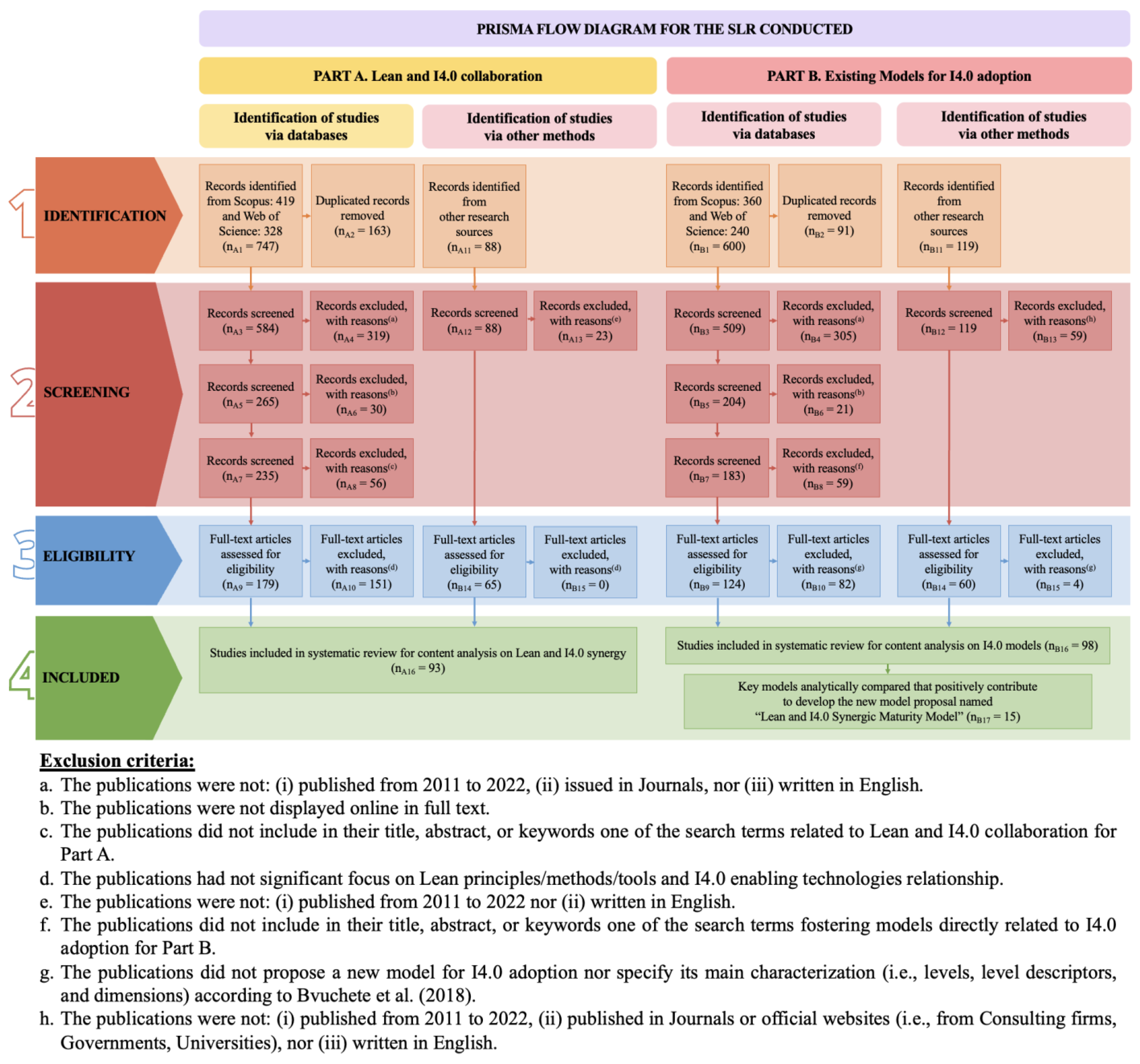
The method selected was the Preferred Reporting Items for Systematic Reviews and Meta-Analyses (PRISMA). To choose the publications that contribute to the research, this widely accepted method establishes four stages: (1) identification, (2) screening, (3) eligibility, and (4) included [45]. The PRISMA method is well-known for its structure for identifying all of the available information in the literature for a specific topic, taking into consideration inclusion and exclusion criteria to come up with the key records for the research conducted [46]. Previous works have investigated Lean and I4.0 through SLRs following this method, such as Bittencourt et al. [22] and Salvadorinho and Teixeira [47]. Moreover, other authors have used the same methodology to identify and develop maturity models, for instance, Jayanetti et al. [48]. Figure 1 illustrates the PRISMA flow diagram implemented in this paper.
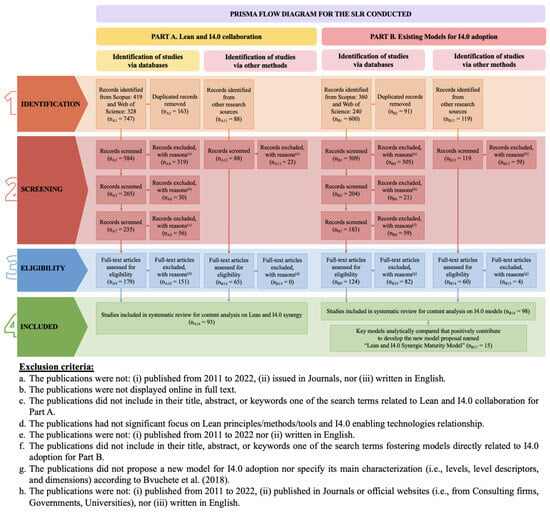
Figure 1.
PRISMA flow diagram followed for the SLR.
Scopus and Web of Science were the scientific databases used to perform the SLR since they are considered leaders in covering and reporting high-quality journals [49]. Additionally, in Part B, Google Scholar was implemented as a search engine to identify publications not listed in those databases. The research was conducted in December 2022, searching related terms in titles, abstracts, and/or keywords. In addition, the time horizon was selected considering that I4.0 was initially presented as a digital innovation initiative in 2011 by the German government [24]. Hence, the review was limited to publications written in English from 2011 to 2022 and published in journals.
On the one hand, when performing the search in Part A, the publications chosen included key concepts, theoretical findings, and the connection and association between Lean and I4.0, as well as theories on Lean benefits and contributions to drive and strengthen I4.0, and vice versa. Consequently, the following Boolean search string was used [(“Industry 4.0” OR “Fourth Industrial Revolution”) AND (“Lean”) AND (“synerg*” OR “collaborat*” OR “relation*” OR “link*” OR “integrat*”)].
In the first stage of Part A, 747 publications were identified. A total of 163 records were discarded because they were duplicated in the entire set of papers, resulting in 584 articles remaining. In the second stage, these were screened and assessed based on the exclusion criteria (reasons a, b, and c). The screening process resulted in 405 records being excluded. Then, in the third stage, an in-depth screening of the 179 full-text eligible articles was performed, excluding 151 publications with no significant focus on the relationship between Lean principles/methods/tools and I4.0 enabling technologies (reason d of the exclusion criteria), leaving 28 records remaining. Additionally, 88 documents were identified from the eligible publications’ references, from which 23 records were excluded for not meeting reason e, leaving 65 papers. Consequently, a total of 93 papers were outstanding publications included for the content analysis on Lean and I4.0 synergy.
On the other hand, for Part B, we intended to search for the relevant documents presenting models for I4.0 adoption. After reviewing the different terms found in previous research, the most used in the literature were the following categories: maturity, readiness, assessment, diagnostic, and capability models. Based on the research type of this manuscript, these models’ categories were selected to conduct the literature review of Part B. Their definitions were considered as follows:
- Maturity model (MM): It measures an organization’s maturity based on a conceptualization of maturity levels and a target state to detect the need for change [50].
- Readiness model (RM): It captures the initial point for a company to start its development process [51].
- Assessment model (AM): It evaluates the implementation level around defined dimensions [52].
- Diagnostic model (DM): It recognizes the principal elements of an enterprise and their relationship, aiming to realize an organization’s constant change [53].
- Capability model (CM): It focuses on the organization’s abilities and capacities to accomplish a specific objective [54].
Considering these definitions, the following Boolean search string was used [(“Industry 4.0” OR “Fourth Industrial Revolution”) AND (“maturity model” OR “readiness model” OR “assessment model” OR “diagnostic model” OR “capability model”)].
In the first stage of Part B, 600 publications were recognized. In all, 91 documents were removed since they were duplicated in the entire set of works, leaving 509 papers. In the second stage, the records were screened and assessed based on the exclusion criteria (reasons a, b, and f). A total of 385 documents were excluded, resulting in 124 full-text eligible publications. They were analyzed, and 82 were excluded considering reason g of the exclusion criteria, leaving 42 records. It is worth noting that at this point the search in databases identified articles that performed a literature review of existing models for I4.0 adoption rather than proposing a new one. Thus, new documents that depicted models for I4.0 were selected from the eligible publications’ references and from other research sources (e.g., consulting firms’ reports, governmental publications, research academies’ records). Therefore, 119 records were identified for searching studies via other methods. Later, 59 publications were disregarded in the screening process according to reason h defined in Figure 1. Of the remaining 60 full-text documents eligible, four were excluded considering reason g, leaving 56 records. From both searches, the articles excluded for not meeting the criteria established were publications that commonly dealt with performing an SLR of the models for I4.0 adoption and quoting existing ones. Finally, in the fourth stage, considering both search processes, 98 records were relevant for the review for I4.0 models. From them, only a set of 15 publications were key to characterizing existing models and detailing all of their relevant characteristics, and consequently, contributing to the development of the “Maturity Model to Become a Smart Organization based on Lean and Industry 4.0 Synergy”. The procedure followed through the SLR allowed validating the Lean and I4.0 synergy, as well as identifying the main elements that constitute a model.
4. Results
This section first presents Lean and I4.0 collaboration findings (Section 4.1). Then, it provides a comparative analysis of the existing models for I4.0 adoption that were suitable for this study to distinguish the models’ characterization and current areas of opportunity in them (Section 4.2).
4.1. Analysis of I4.0 and Lean Relationship
In the literature reviewed, different approaches related to Lean and I4.0 collaboration were identified. In light of this, a total of 93 documents with a significant focus on the relationship between Lean principles/methods/tools and I4.0 enabling technologies were considered for content analysis. Nine indicated that Lean drives I4.0, 49 stated that I4.0 enhances Lean, and 35 mentioned that both can synergically collaborate. A set of 20 publications was selected, from which three documents depicted that Lean drives I4.0 [22,44,55], six records indicated that I4.0 enhances Lean [15,31,40,56,57,58], and 11 of them mentioned Lean and I4.0 collaboration [17,18,19,20,41,59,60,61,62,63,64]. This means that more than 50% of the selected publications recognized these approaches’ synergy.
Analyzing these documents, it was significant to recognize that I4.0 incorporates enabling technologies into organizations to generate timely information, support human activities, and achieve higher competitiveness. However, its adoption remains challenging for organizations since socio-technical “smart” systems are required to create digital interconnections between processes, people, and products [65]. Hence, organizations need to determine new processes to eliminate non-value-added activities and improve their practices. In this regard, Lean provides well-established and easily adopted methods to improve socio-technical systems.
Therefore, due to Lean’s scope, focusing on value creation aligns with I4.0′s objectives, and both collaborate within a fruitful synergy. Aiming to start embracing I4.0, it is important for an organization to assess its readiness from a Lean culture perspective, being committed to active and continuous learning. It requires implementing sustainable practices and projects in search of continuous improvement to create value by involving and motivating all workers [66]. In summary, I4.0 emphasizes implementing advanced technologies throughout the organizations’ value chains, seeking to upgrade processes and improve performance. I4.0 enabling technologies can strengthen Lean principles’ efficiency [67]. However, since a technological solution does not guarantee an improvement, Lean process mapping must be performed to recognize wastes before their adoption [22]. Accordingly, Table 1 summarizes several relationships between Lean principles/methods/tools and I4.0 enabling technologies that were found in the literature. As a result, this relationship can be used as a basis for the model proposal.

Table 1.
The relationship between Lean principles/methods/tools and I4.0 enabling technologies, based on [31,40,41].
The table validates the relationship between Lean principles/methods/tools and I4.0 enabling technologies in such a way that it helps in constructing the approaches’ collaboration across the model proposal. As examples of the interactions between Lean and I4.0, it was identified that when a CPS is incorporated with JIT practices, automatic control of products is handled throughout the value chain from order to delivery. Therefore, maintaining a digital interconnection makes tracking information visible to all workers involved in the process [40]. In addition, Kanban practices can be applied to visualize the workflow better, measure the lead time, and limit the work in progress, resulting in the prioritization of tasks [68]. Products identified as “smart” can comprise information from the Kanban approach since they have sensors that capture data and analyze the information obtained to support their manufacturing processes. From this, it is possible to map the value stream identify wastes, assign strategic activities, handle and control production processes, and ensure continuous improvement [60]. Additionally, from the suppliers’ perspective, implementing wireless item tagging of goods can benefit JIT delivery, eliminating unexpected delays or incomplete shipping [56]. Further, by adopting “smart” devices, such as sensors, information can be captured in a cloud manufacturing platform for intelligent assessment, data analysis, and optimization to avoid error, strengthening the Poka-Yoke method [60].
From a digital migration point of view, organizations need to develop digital competence in “Smart” people to advance through the I4.0 initiative. Data analytics and real-time decision-making are significant since I4.0 enabling technologies support employees in their work activities. Moreover, “smart” feedback devices are required to monitor and evaluate the workforce’s tasks, such that their involvement in pursuing the I4.0 initiative is achieved while Lean culture is sustained [56]. Also, the Lean method Jidoka must be implemented, focusing on Andon, because it allows organizations to reduce the time between failure occurrences and notifications. To enrich this, workers can use “smart” devices (e.g., tablets, smartwatches) to receive real-time warnings regarding the occurring errors, collected in a database for further analysis to act and achieve continuous improvement [60]. Therefore, by considering “smart” devices’ contributions, organizations need to pay special attention to establishing policies and governance oriented toward an ethical approach that secures human–machine interaction and ensures proper data management systems.
The literature shows just a few previous works regarding the incorporation of Lean on I4.0 adoption models. Leyh et al. [57] found that although there are several frameworks for I4.0 adoption, only three records from the 31 the authors reviewed in their study completely addressed Lean principles. The first study was developed by Villalba-Diez et al. [69]. They proposed “The Hoshin Kanri Tree” as a novel Lean shopfloor management model to standardize communication patterns across a value network by the Deming cycle, Plan-Do-Check-Act (PDCA), to face I4.0 challenges. This model’s limitation stems from the difficulty of consolidating leaders’ strategic management with the model’s application. The second study, implemented by Kolberg and Zühlke [59], identified parallelism between I4.0 and Lean and defined combinations to develop a comprehensive framework. The authors acknowledged the absence of a framework; thus, they provided recommendations for it rather than creating a new proposal. Lastly, the third study was performed by Brettel et al. [70]. They analyzed manufacturing advancements in I4.0 to add the production flexibility approach in a framework previously proposed by Schuh et al. [71]. The limitation centers on researching frameworks related to production flexibility and selecting one model instead of proposing a new one.
The information analyzed about the relationship between Lean principles/methods/tools and I4.0 enabling technologies allowed depicting how both approaches can collaborate to help organizations become smart and face digital challenges. These include enterprises being able to face uncertainty in adopting new technologies, processes being optimized, digitized, and improved toward value creation, workforces developing new digital tasks and collaborating with I4.0 enabling technologies, among others.
4.2. Comparative Analysis of Existing Models for I4.0 Adoption
In the review of literature on models for I4.0 adoption, a total of 35 documents were studied. After a deep analysis, 15 documents were considered key to analytically compare and identify their relevant characteristics (as shown in Table 2). The characterization of these models positively contributed to developing the new model proposal.
Table 2.
Comparative Analysis of Existing Models for I4.0 Adoption.
Several models for I4.0 adoption were reviewed and analyzed based on their definitions and relevant characteristics of objective, levels, levels descriptors, and dimensions. The selected models were developed by researchers, consulting firms, governments, research academies, and industrial associations, and were intended to provide guidelines to support organizations in addressing the challenges of I4.0 adoption. The current models mainly focus on I4.0 enabling technologies, followed by process digitization. Six of them pay attention to the organizational approach to human factor development, detailing relevant insights about people’s integration, participation, and collaboration with other humans and technologies in I4.0 scenarios.
The models reviewed propose four to six levels that establish an advancement path from understanding to achieving an expert role in digital interconnectivity. They represent the evolutionary steps an organization must pass through as it masters its capabilities. On the other hand, the models’ dimensions varied between three and sixteen, which provided the models’ scope.
The previous models for I4.0 adoption have determined levels and dimensions to guide organizations toward this digital journey. It was identified in the reviewed models that while the most common dimensions included in them are technology, processes, organization, and strategy, none incorporates Lean as a strategy to drive I4.0. Hence, an opportunity to incorporate this well-known method to pursue value creation and improve socio-technical systems supporting I4.0 adoption was identified.
Based on the comparative analysis of existing I4.0 models, their foundation and relevant concepts for their structure were considered to characterize the new model proposal and build on current knowledge for I4.0 adoption incrementally. The design of a new MM was depicted since its objective, according to Santos and Martinho [73], is to measure the maturity level of adoption based on quantifying performed activities related to the domain. The levels and dimensions defined in the proposed model were selected from the revision of Lean and I4.0 synergy and existing models. In Section 5, we describe the new model, which seeks to promote a balance between implementing a process improvement methodology and using enabling technologies for value creation in which Lean is primarily included, as it works as an accelerator in the early stages of I4.0 adoption.
5. The Proposed Maturity Model
This section presents the MM proposal (Section 5.1) and strategic roadmap (Section 5.2) to help enterprises become “smart” by adopting I4.0 throughout the defined steps in which Lean drives I4.0 while I4.0 enhances Lean. Additionally, managerial implications are included to depict the results and actions for practitioners based on the model proposal (Section 5.3).
5.1. Development of Maturity Model
The model proposed for this study has been developed using available theory on Lean and I4.0 and comparing existing models for I4.0 adoption. The design of an MM was selected since it allows measuring an organization’s current maturity level to recognize the need for change toward integrating best practices for digitization, innovation, and value creation, thus achieving the desired adoption target for I4.0 [50].
The resulting “Maturity Model to Become a Smart Organization based on Lean and Industry 4.0 Synergy” is presented in Figure 2, which is constituted of four key elements: strategic pillars (5.1.1), perspectives (5.1.2), dimensions (5.1.3), and maturity levels (5.1.4). The strategic pillars are the main constructs of the model, being Lean and I4.0. Moreover, the perspectives are the three “Smart” components of processes, people, and products, while the dimensions allow comprehending the Lean principles/methods/tools and I4.0 enabling technologies, the relationships of which was previously validated in Table 1. Additionally, the maturity levels are defined for the strategic pillars as the strategic maturity levels, and for perspectives as the “smart” maturity levels. Lastly, it is worth indicating that a specific scope is depicted for each perspective in each maturity level in order to complete it, advance throughout the model, and achieve the desired adoption target.
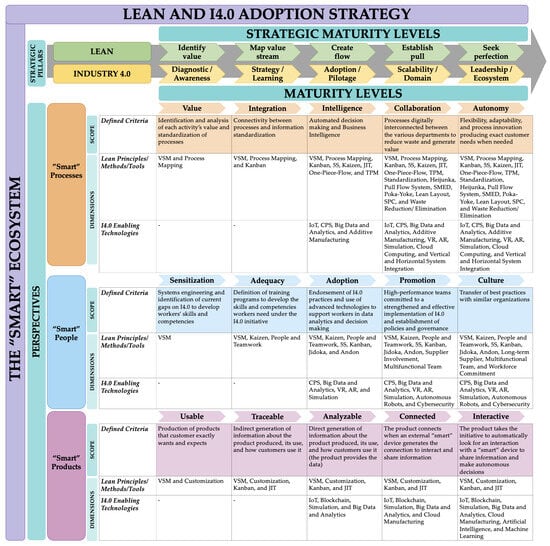
Figure 2.
Maturity Model to Become a Smart Organization based on Lean and Industry 4.0 Synergy.
5.1.1. Strategic Pillars
The model presents two strategic pillars that depict the two main concepts of this study: Lean and I4.0. They can collaborate synergically to enhance I4.0 adoption by facilitating comprehension of their main aspects and considering the processes, people, and products in a “Smart” ecosystem.
5.1.2. Perspectives
In addition to the strategic pillars, the model comprises three perspectives related to the main “Smart” components of I4.0: processes, people, and products (“Smart” Ps). These perspectives relate to the pillars due to the digital interconnectivity needed in “smart” scenarios. For each perspective, a definition that justifies its function is established as follows, based on the comparison of model dimensions analyzed in Table 2:
- “Smart” processes comprise implementing I4.0 enabling technologies that can capture, store, and analyze data to make decisions in real-time, besides improving productivity, efficiency, and effectiveness.
- “Smart” people refer to “workers 4.0” who have the skills desired in I4.0 and can perform digital tasks while interacting with other people and machines to be supported and improve their tasks.
- “Smart” products can capture and store data and digitally interact with other “smart” devices to share real-time information related to their properties, usage, and how customers use them for further decision-making.
These perspectives are the areas of interest to be improved by organizations through the I4.0 adoption strategy. Each perspective identifies relevant aspects to be evaluated to receive a maturity level. Considering them together depicts the overall maturity level for I4.0 adoption.
5.1.3. Dimensions
The perspectives presented are divided into two dimensions (previously described in Section 4): Lean principles/methods/tools and I4.0 enabling technologies. They were decided based on the literature review about Lean and I4.0 synergy and can be perceived as relevant elements to be implemented in organizations since Lean and I4.0 can collaborate across the entire visualization of the model to enhance I4.0 adoption.
5.1.4. Maturity Levels
Based on the SLR and the comparative analysis of the existing models for I4.0 adoption, four to six levels were identified in the reference models studied. These levels depict an advancement approach manageable for organizations. Hence, strategic maturity levels and “smart” maturity levels detailing a development process were established in the MM proposal. On the one hand, the strategic maturity levels correspond to the Lean Pillar (based on Lean principles previously described in Section 2) and the I4.0 Pillar (further explained in Table 3). On the other hand, the “smart” maturity levels are depicted for each perspective (as presented in Table 4). Both cases are evaluated based on five maturity levels (from level 1 to 5) that are individually outlined considering specific level descriptors. The maturity levels are indicated sequentially from an initial point of awareness (level 1) to an advanced stage of leadership (level 5). It is important to mention that for each perspective presented in the model, a specific scope is specified as a statement to be achieved to complete the maturity level and continue to the next one and so on across the “Maturity Model to Become a Smart Organization based on Lean and Industry 4.0 Synergy”.
Table 3.
Descriptors of Strategic Maturity Levels for I4.0 Strategic Pillar.
Table 4.
Descriptors of Maturity Levels for “Smart” P Perspectives.
The “Maturity Model to Become a Smart Organization based on Lean and Industry 4.0 Synergy” incorporates the “Smart” processes, people, and products into a synergic collaboration between Lean and I4.0. The model depicts a framework for academicians and practitioners to facilitate the adoption path toward I4.0 from a value creation perspective. It enhances them for continuing the digital journey by benefiting them from aligning Lean principles/methods/tools and I4.0 enabling technologies across their organization.
This section depicts the proposed MM, emphasizing its strategic pillars, perspectives, dimensions, maturity levels, and descriptors. This model provides a systematic pathway for enterprises to strategically navigate their transformation toward “smart” organizations by effectively integrating Lean and I4.0 principles and practices, mainly because the strategic perspectives synergistically collaborate to facilitate I4.0 adoption by holistically considering various aspects related to processes, people, and products within a “smart” ecosystem.
Based on the model proposal, it should be highlighted that Lean needs to be applied prior to incorporating enabling technologies. Thus, I4.0 is implemented until the third maturity level. The balance between both approaches allows supporting organizations in developing “smart” organizations.
5.2. Strategic Roadmap for I4.0 Successful Adoption Linking Lean
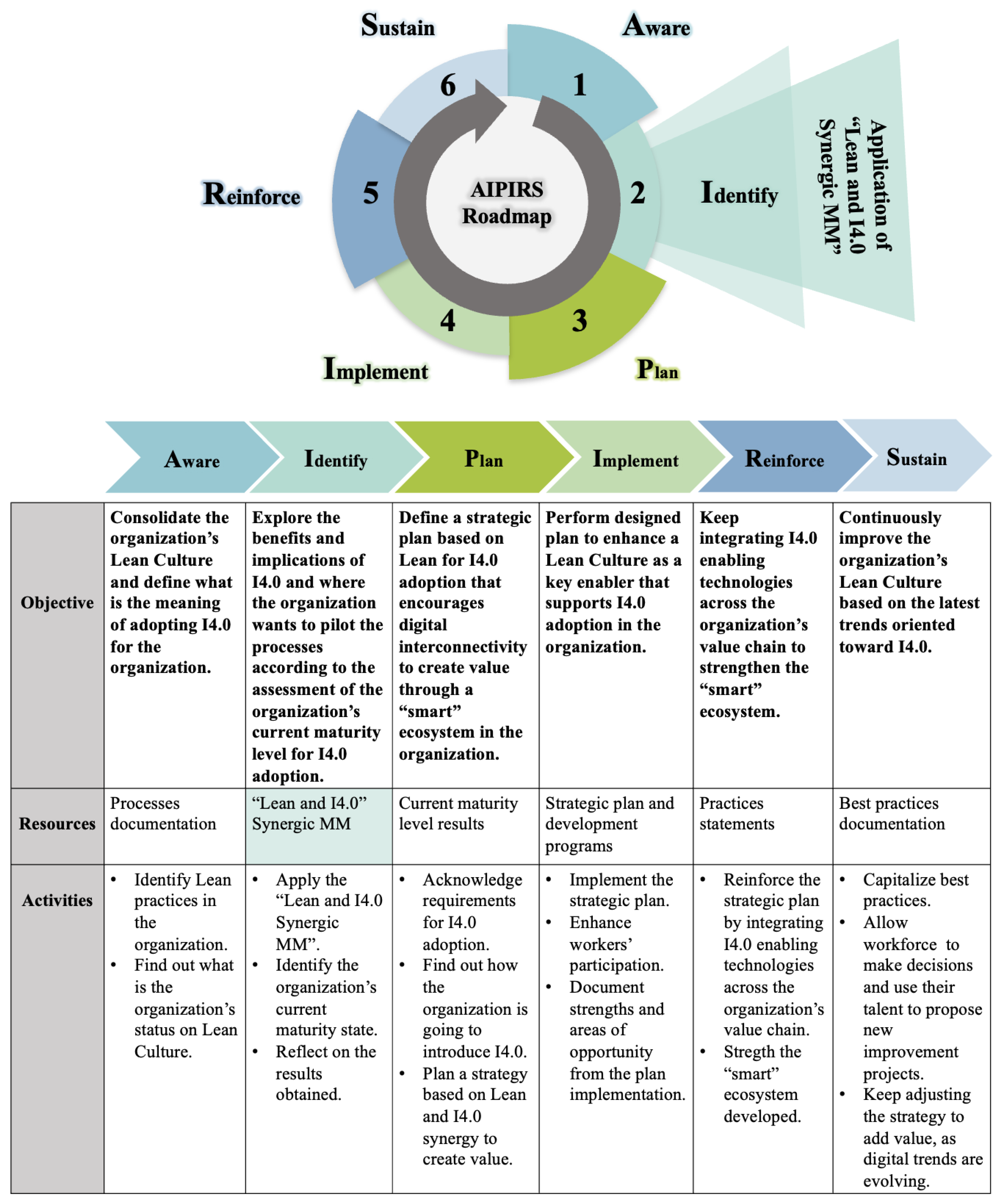
Based on the “Smart” ecosystem previously presented in the MM, Figure 3 presents a strategic roadmap for embracing I4.0 linking Lean (abbreviated “AIPIRS”). It is designed to facilitate organizations’ transition toward I4.0 adoption.
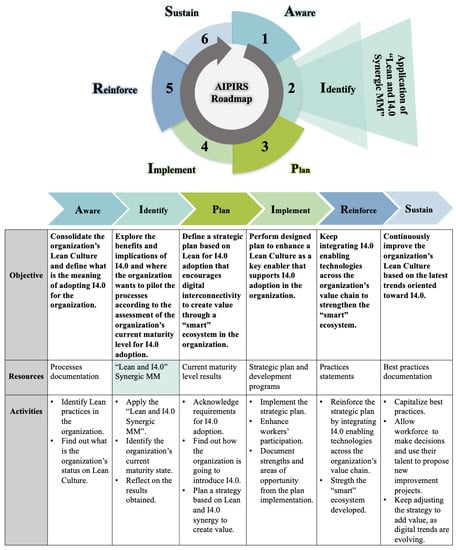
Figure 3.
Strategic roadmap for successful I4.0 adoption linking Lean.
The proposed roadmap is divided into six sequential steps intended to apply to all organizations regardless of their sector or size. The strategic roadmap is a guideline with recommendations to facilitate the planning, implementing, and sustaining process for embracing I4.0. It helps managers and leaders orient their teams toward a successful I4.0 adoption by considering a synergism with Lean. Moreover, it allows organizations to visualize and understand their status to make decisions and advance on the route for a “Smart” ecosystem. The roadmap is a basis for starting an I4.0 adoption, for which the MM must be used simultaneously.
The roadmap structure considers in step 1 that the organization needs to consolidate its Lean culture status and define what the meaning of adopting I4.0 for the organization is. Recognition of its current VSM and workers’ participation in a socio-technical system is important. Once Lean practices are being explored in the organization, step 2 requires that the organization explore the benefits and implications of I4.0 and where the organization wants to pilot the digital processes based on its current maturity level for I4.0 adoption. Thus, the proposed “Maturity Model to Become a Smart Organization based on Lean and Industry 4.0 Synergy” is applied in this stage. After having the results and reflecting on them, in step 3 the organization discovers an impulse to introduce I4.0; thus, it plans a strategy based on Lean and I4.0 synergism to create value. Afterward, step 4 encourages the organization to implement the strategic plan and motivate its workforce to participate. Once it is carrying out the plan, it will be worthwhile for the organization to document strengths and areas of opportunity identified from that process. Later, in step 5, the organization needs to reinforce its strategy by integrating I4.0 enabling technologies across its value chain to strengthen the “Smart” ecosystem it has developed. Lastly, step 6 suggests the organization’s workforce will be capable of participating actively while making decisions and using their talent to propose new improvement projects that help increase the organization’s productivity, efficiency, and effectiveness. For this purpose, it will be relevant for the organization to capitalize on best practices and keep adjusting its strategic plan to add value in its ecosystem as digital trends evolve.
5.3. Managerial Implications
From the managerial perspective, this study provides significant managerial implications on the role of Lean and I4.0 linkage in improving organizations’ competitiveness. For instance, the proposed model serves as a reference to determine under what conditions I4.0 is being implemented in the organization. Hence, the model makes it possible for practitioners to identify areas for improvement according to the maturity status of the enterprise and generate implementation and development processes oriented toward adopting I4.0, considering Lean as a key enabler to become a “smart” organization, likewise identifying where and when to define and implement the I4.0 enabling technologies to be incorporated and linked throughout the value chain, thus maintaining a Lean culture for continuous improvement.
6. Conclusions
Preliminary analyses on challenges, principles, methods, tools, technologies, and applications for Lean and I4.0 have been addressed in this work from a synergic perspective. Since Lean is a continuous improvement philosophy with established methods, it was analyzed and identified as an alignment with the I4.0 initiative. Thus, the Lean and I4.0 relationship was presented as a key enabler for I4.0 adoption from a value creation point of view.
The presented “Maturity Model to Become a Smart Organization based on Lean and Industry 4.0 Synergy” enhances the collaboration between Lean and I4.0 in a “Smart” ecosystem. It offers organizations an orientation on adopting I4.0 with its main “Smart” components by incorporating a Lean culture that creates value, recognizes talent, and guarantees continuous improvement. Regarding the representation previously described for Lean and I4.0 synergy, and the “Smart” ecosystem integration, explanations on how to advance based on the “Smart” components are presented. The MM provides the literature with knowledge of the relevance of the synergy explained and the integration of “Smart” components to a new model for I4.0 adoption. The Lean and I4.0 synergy is consistent with the publications that stated a positive collaboration between them. Similarly, it is supported by considering the three “Smart” Ps, where Lean principles/methods/tools and I4.0 enabling technologies are simultaneously implemented.
The proposed MM provides answers to RQ1 and RQ2. The former acknowledges the synergism between Lean and I4.0 to collaborate and strengthen the I4.0 adoption. The latter defines the different characteristics of an MM to strategically guide organizations toward this initiative adoption, considering Lean as a key enabler to drive I4.0, while I4.0 enhances Lean. Hence, the relationship between Lean principles/methods/tools and I4.0 enabling technologies was identified.
Additionally, the proposed model focuses on Lean and I4.0 synergy from three common “Smart” components: processes, people, and products, where Lean drives and strengthens I4.0, and I4.0 enhances and supports Lean, seeking to help organizations in becoming “smart". The need for a Lean linkage with the I4.0 initiative was justified since Lean allows developing human talent and eliminating waste during processes. The proposed synergism enhances embracing I4.0 based on a sustainability conceptualization of an organization’s efforts to advance, succeed, and become digitally interconnected while creating value and coping with global competitiveness. After depicting the relationship between Lean principles/methods/tools and I4.0 enabling technologies and developing a comparative analysis of existing models for I4.0 adoption, a “Maturity Model to Become a Smart Organization based on Lean and Industry 4.0 Synergy” was provided. Its maturity levels are individually specified for Lean, I4.0, and the “Smart” components. They must be followed sequentially to ensure that organizations can systematically recognize their current maturity on I4.0 adoption, mainly to allow them to follow a process where different criteria are considered, reach the desired requirements for each level, and become “smart” organizations that seek a leadership role and serve as a benchmark for similar enterprises.
Based on the research, analysis, and contributions developed, the main findings of this work highlight that incorporating I4.0 enabling technologies when the processes have deficiencies would cause greater problems because not only would there be problems in the processes, but also in technological adoption, since efforts would be required to incorporate these technologies and develop training programs in this regard. Something similar would happen if there are lean processes, but technological changes are left aside; this could delay organizations in achieving competitiveness in the market. Therefore, the model seeks to provide a balance between the two approaches, in such a way that organizations can be supported to create value while facing digital challenges.
Following this, Lean and I4.0 can generate a synergy if Lean is used before starting the I4.0 journey, which is what the model shows since there is no I4.0 implementation until the third maturity level. This answers the questions that Buer et al. [15] raised: “Should Industry 4.0 and lean manufacturing be implemented concurrently or sequentially? If they should be implemented sequentially, which one should be implemented first?”. Moreover, the model clearly provides a vision of processes, people, and products. It benefits organizations to consider an entire “Smart” ecosystem when embracing I4.0 with Lean’s collaboration as a key enabler.
In addition, considering the proposed model’s characteristics and value proposition, it differs from the reviewed models since it provides a guideline for I4.0 adoption based on a strategic synergy between Lean and I4.0. The “AIRPIRS” roadmap was proposed as a suitable tool to improve the I4.0 adoption strategy, considering Lean as a key enabler to drive this initiative. Its six steps depict the relevant criteria organizations need to undertake to transition toward I4.0. Following this, the research answered the two main questions established in this work about (1) how to become a smart organization while coping with digital challenges and (2) the development of a MM where Lean drives I4.0, and I4.0 enhances Lean, collaborating simultaneously to face digital challenges. Accordingly, researchers and practitioners can benefit from the model and roadmap to help enterprises understand, assess, and implement I4.0 principles and technologies based on incorporating Lean culture in their organizations. Thus, practitioners can use the MM and roadmap to identify their organization’s maturity level and determine the further steps to advance toward the desired I4.0 maturity level considering Lean as a key enabler. This is because synergism identifies the importance of sustaining continuous improvement and creating value from the digital interconnection between the “Smart” components. Additionally, researchers mainly benefit from the MM and roadmap developed since studying the adoption and implementation of the MM in diverse industries generates new insights into the challenges, best practices, and success factors for integration of I4.0 enabling technologies with Lean principles, methods, and tools. Hence, while practitioners have a structured path toward digital and technological advancement, researchers are empowered to contribute to the field’s Lean and I4.0 evolving approaches through knowledge generation.
The limitations of this study include the exclusion criteria used in the SLR, where timeframe, language, and source type may have eliminated relevant records from the analysis, as well as documents with other keywords different from those stated in the search protocol. Hence, these considerations could be an initial point for further studies by incorporating documents in more languages than English and available in other sources. Additionally, since Lean and I4.0 will continue to be developed such that new tools will need to be generated, it will be necessary to consider the latest trends related to both approaches while updating and enriching the proposed MM to pursue a strategic synergy to support organizations in becoming “smart". Lastly, the model could be strengthened when reviewing and incorporating particular lines of industry to adapt it to different realities and apply it to various sectors of organizations to ensure its reliability regardless of their context.
Author Contributions
Conceptualization, B.L.T.-E., H.G.-R. and R.E.P.-G.; methodology, B.L.T.-E., H.G.-R. and R.E.P.-G.; validation, B.L.T.-E., H.G.-R. and R.E.P.-G.; formal analysis, B.L.T.-E., H.G.-R. and R.E.P.-G.; investigation, B.L.T.-E., H.G.-R. and R.E.P.-G.; data curation, B.L.T.-E.; writing—original draft preparation, B.L.T.-E., H.G.-R. and R.E.P.-G.; writing—review and editing, B.L.T.-E., H.G.-R. and R.E.P.-G.; visualization, B.L.T.-E.; supervision, H.G.-R. and R.E.P.-G. All authors have read and agreed to the published version of the manuscript.
Funding
This research received no external funding.
Institutional Review Board Statement
Not applicable.
Informed Consent Statement
Not applicable.
Data Availability Statement
Not applicable.
Conflicts of Interest
The authors declare no conflict of interest.
References
- Grabowska, S.; Gajdzik, B.; Saniuk, S. The Role and Impact of Industry 4.0 on Business Models. In Sustainable Logistics and Production in Industry 4.0: New Opportunities and Challenges; Grzybowska, K., Awasthi, A., Sawhney, R., Eds.; Springer: Poznań, Poland, 2020; pp. 31–49. [Google Scholar]
- Lu, Y. The Current Status and Developing Trends of Industry 4.0: A Review. Inf. Syst. Front. 2021, 1–20. [Google Scholar] [CrossRef]
- Laad, M.; Renedo, M. Skill Requirement in Industry 4.0. In Industry 4.0 in Small and Medium-Sized Enterprises (SMEs); Kotecha, K., Kumar, S., Bongale, A., Suresh, R., Eds.; CRC Press of Taylor & Francis Group: Boca Raton, FL, USA, 2022; pp. 169–182. [Google Scholar]
- Peruzzini, M.; Grandi, F.; Pellicciari, M. Exploring the Potential of Operator 4.0 Interface and Monitoring. Comput. Ind. Eng. 2020, 139, 105600. [Google Scholar] [CrossRef]
- Khin, S.; Kee, D.M.H. Factors Influencing Industry 4.0 Adoption. J. Manuf. Technol. Manag. 2022, 33, 448–467. [Google Scholar] [CrossRef]
- Raj, A.; Dwivedi, G.; Sharma, A.; de Sousa Jabbour, A.B.L.; Rajak, S. Barriers to the Adoption of Industry 4.0 Technologies in the Manufacturing Sector: An Inter-Country Comparative Perspective. Int. J. Prod. Econ. 2020, 224, 107546. [Google Scholar] [CrossRef]
- Satyro, W.C.; de Almeida, C.M.V.B.; Pinto Jr Jr, M.J.A.; Contador, J.C.; Giannetti, B.F.; de Lima, A.F.; Fragomeni, M.A. Industry 4.0 Implementation: The Relevance of Sustainability and the Potential Social Impact in a Developing Country. J. Clean. Prod. 2022, 337, 130456. [Google Scholar] [CrossRef]
- Majumdar, A.; Garg, H.; Jain, R. Managing the Barriers of Industry 4.0 Adoption and Implementation in Textile and Clothing Industry: Interpretive Structural Model and Triple Helix Framework. Comput. Ind. 2021, 125, 103372. [Google Scholar] [CrossRef]
- Margherita, E.G.; Bua, I. The Role of Human Resource Practices for the Development of Operator 4.0 in Industry 4.0 Organisations: A Literature Review and a Research Agenda. Businesses 2021, 1, 18–33. [Google Scholar] [CrossRef]
- Singh, M.; Goyat, R.; Panwar, R. Fundamental Pillars for Industry 4.0 Development: Implementation Framework and Challenges in Manufacturing Environment. TQM J. 2023, 1754-2731. [Google Scholar] [CrossRef]
- Wagire, A.A.; Joshi, R.; Rathore, A.P.S.; Jain, R. Development of Maturity Model for Assessing the Implementation of Industry 4.0: Learning from Theory and Practice. Prod. Plan. Control 2021, 32, 603–622. [Google Scholar] [CrossRef]
- Ojha, R.; Venkatesh, U. Manufacturing Excellence Using Lean Systems—A Case of an Automotive Aggregate Manufacturing Plant in India. J. Adv. Manag. Res. 2022, 19, 1–11. [Google Scholar] [CrossRef]
- Kezia, P.; Kumar, K.S.; Sai, B.L.N.K. Lean Manufacturing in Food and Beverage Industry. Int. J. Civ. Eng. Technol. (IJCIET) 2017, 8, 168–174. [Google Scholar]
- Maijala, R.; Eloranta, S.; Reunanen, T.; Ikonen, T.S. Successful Implementation of Lean as a Managerial Principle in Health Care: A Conceptual Analysis from Systematic Literature Review. Int. J. Technol. Assess Health Care 2018, 34, 134–146. [Google Scholar] [CrossRef] [PubMed]
- Buer, S.V.; Strandhagen, J.O.; Chan, F.T.S. The Link between Industry 4.0 and Lean Manufacturing: Mapping Current Research and Establishing a Research Agenda. Int. J. Prod. Res. 2018, 56, 2924–2940. [Google Scholar] [CrossRef]
- Maware, C.; Parsley, D.M. Can Industry 4.0 Assist Lean Manufacturing in Attaining Sustainability over Time? Evidence from the US Organizations. Sustainability 2023, 15, 1962. [Google Scholar] [CrossRef]
- Rossini, M.; Powell, D.J.; Kundu, K. Lean Supply Chain Management and Industry 4.0: A Systematic Literature Review. Int. J. Lean Six Sigma 2023, 14, 253–276. [Google Scholar] [CrossRef]
- Tortorella, G.L.; Fettermann, D. Implementation of Industry 4.0 and Lean Production in Brazilian Manufacturing Companies. Int. J. Prod. Res. 2018, 56, 2975–2987. [Google Scholar] [CrossRef]
- Sony, M. Industry 4.0 and Lean Management: A Proposed Integration Model and Research Propositions. Prod. Manuf. Res. 2018, 6, 416–432. [Google Scholar] [CrossRef]
- Pereira, C.; Sachidananda, H.K. Impact of Industry 4.0 Technologies on Lean Manufacturing and Organizational Performance in an Organization. Int. J. Interact. Des. Manuf. 2022, 16, 25–36. [Google Scholar] [CrossRef]
- Alsadi, J.; Antony, J.; Mezher, T.; Jayaraman, R.; Maalouf, M. Lean and Industry 4.0: A Bibliometric Analysis, Opportunities for Future Research Directions. Qual. Manag. J. 2023, 30, 41–63. [Google Scholar] [CrossRef]
- Bittencourt, V.L.; Alves, A.C.; Leão, C.P. Industry 4.0 Triggered by Lean Thinking: Insights from a Systematic Literature Review. Int. J. Prod. Res. 2021, 59, 1496–1510. [Google Scholar] [CrossRef]
- Komkowski, T.; Antony, J.; Garza-Reyes, J.A.; Tortorella, G.L.; Pongboonchai-Empl, T. The Integration of Industry 4.0 and Lean Management: A Systematic Review and Constituting Elements Perspective. Total Qual. Manag. Bus. Excell. 2023, 34, 1052–1069. [Google Scholar] [CrossRef]
- Tay, S.I.; Lee, T.C.; Aziati, A.H.N.; Ahmad, A.N.A. An Overview of Industry 4.0: Definition, Components, and Government Initiatives. Artic. J. Adv. Res. Dyn. Control Syst. 2018, 10, 1379–1387. [Google Scholar]
- Lee, J. Smart Factory Systems. Inform.-Spektrum 2015, 38, 230–235. [Google Scholar] [CrossRef]
- Kagermann, H.; Anderl, R.; Gausemeier, J.; Schuh, G.; Wahlster, W. (Eds.) Industrie 4.0 in a Global Context: Strategies for Cooperating with International Partners (Acatech STUDY); Herbert Utz Verlag: München, Germany, 2016. [Google Scholar]
- Ustundag, A.; Cevikcan, E. Industry 4.0: Managing the Digital Transformation; Springer Series in Advanced Manufacturing; Springer Nature: Cham, Switzerland, 2018; ISBN 978-3-319-57869-9. [Google Scholar]
- Senna, P.P.; Ferreira, L.M.D.F.; Barros, A.C.; Bonnín Roca, J.; Magalhães, V. Prioritizing Barriers for the Adoption of Industry 4.0 Technologies. Comput. Ind. Eng. 2022, 171, 108428. [Google Scholar] [CrossRef]
- Javaid, M.; Haleem, A.; Singh, R.P.; Rab, S.; Suman, R.; Khan, S. Exploring Relationships between Lean 4.0 and Manufacturing Industry. Ind. Robot Int. J. Robot. Res. Appl. 2022, 49, 402–414. [Google Scholar] [CrossRef]
- Womack, J.P.; Jones, D.T. Lean Thinking: Banish Waste and Create Wealth in Your Corporation; Simon and Schuster: New York, NY, USA, 2003. [Google Scholar]
- Mayr, A.; Weigelt, M.; Kühl, A.; Grimm, S.; Erll, A.; Potzel, M.; Franke, J. Lean 4.0-A Conceptual Conjunction of Lean Management and Industry 4.0. Procedia CIRP 2018, 72, 622–628. [Google Scholar] [CrossRef]
- Thangarajoo, Y.; Smith, A. Lean Thinking: An Overview. Ind. Eng. Manag. 2015, 4, 159. [Google Scholar] [CrossRef]
- Frecassetti, S.; Kassem, B.; Kundu, K.; Ferrazzi, M.; Portioli-Staudacher, A. Introducing Lean Practices through Simulation: A Case Study in an Italian SME. Qual. Manag. J. 2023, 30, 90–104. [Google Scholar] [CrossRef]
- Tlapa, D.; Tortorella, G.; Fogliatto, F.; Kumar, M.; Mac Cawley, A.; Vassolo, R.; Enberg, L.; Baez-Lopez, Y. Effects of Lean Interventions Supported by Digital Technologies on Healthcare Services: A Systematic Review. Int. J. Environ. Res. Public Health 2022, 19, 9018. [Google Scholar] [CrossRef]
- Ma, J.; Wang, Q.; Zhao, Z. SLAE–CPS: Smart Lean Automation Engine Enabled by Cyber-Physical Systems Technologies. Sensors 2017, 17, 1500. [Google Scholar] [CrossRef]
- Varela, L.; Araújo, A.; Ávila, P.; Castro, H.; Putnik, G. Evaluation of the Relation between Lean Manufacturing, Industry 4.0, and Sustainability. Sustainability 2019, 11, 1439. [Google Scholar] [CrossRef]
- Fantini, P.; Pinzone, M.; Taisch, M. Placing the Operator at the Centre of Industry 4.0 Design: Modelling and Assessing Human Activities within Cyber-Physical Systems. Comput. Ind. Eng. 2020, 139, 105058. [Google Scholar] [CrossRef]
- Ejsmont, K.; Gladysz, B.; Corti, D.; Castaño, F.; Mohammed, W.M.; Martinez-Lastra, J.L. Towards ’Lean Industry 4.0’–Current Trends and Future Perspectives. Cogent Bus. Manag. 2020, 7, 1781995. [Google Scholar] [CrossRef]
- Csiki, O.; Demeter, K.; Losonci, D. How to Improve Firm Performance?–The Role of Production Capabilities and Routines. Int. J. Oper. Prod. Manag. 2023, 43, 1–26. [Google Scholar] [CrossRef]
- Wagner, T.; Herrmann, C.; Thiede, S. Industry 4.0 Impacts on Lean Production Systems. Procedia CIRP 2017, 63, 125–131. [Google Scholar] [CrossRef]
- Ciano, M.P.; Dallasega, P.; Orzes, G.; Rossi, T. One-to-One Relationships between Industry 4.0 Technologies and Lean Production Techniques: A Multiple Case Study. Int. J. Prod. Res. 2021, 59, 1386–1410. [Google Scholar] [CrossRef]
- Narula, S.; Puppala, H.; Kumar, A.; Luthra, S.; Dwivedy, M.; Prakash, S.; Talwar, V. Are Industry 4.0 Technologies Enablers of Lean? Evidence from Manufacturing Industries. Int. J. Lean Six Sigma 2023, 14, 115–138. [Google Scholar] [CrossRef]
- Ramingwong, S.; Ramingwong, L.; Thaiupathump, T.; Chompu-inwai, R. Readiness Model for Integration of ICT and CPS for SMEs Smart Logistics. In Implementing Industry 4.0 in SMEs: Concepts, Examples and Applications; Matt, D.T., Modrák, V., Zsifkovits, H., Eds.; Springer International Publishing: Cham, Switzerland, 2021; pp. 187–209. [Google Scholar]
- Saabye, H.; Kristensen, T.B.; Wæhrens, B.V. Developing a Learning-to-Learn Capability: Insights on Conditions for Industry 4.0 Adoption. Int. J. Oper. Prod. Manag. 2022, 42, 25–53. [Google Scholar] [CrossRef]
- Liberati, A.; Altman, D.G.; Tetzlaff, J.; Mulrow, C.; Gøtzsche, P.C.; Ioannidis, J.P.A.; Clarke, M.; Devereaux, P.J.; Kleijnen, J.; Moher, D. The PRISMA Statement for Reporting Systematic Reviews and Meta-Analyses of Studies That Evaluate Health Care Interventions: Explanation and Elaboration. J. Clin. Epidemiol. 2009, 62, e1–e34. [Google Scholar] [CrossRef]
- Rethlefsen, M.L.; Kirtley, S.; Waffenschmidt, S.; Ayala, A.P.; Moher, D.; Page, M.J.; Koffel, J.B.; Blunt, H.; Brigham, T.; Chang, S.; et al. PRISMA-S: An Extension to the PRISMA Statement for Reporting Literature Searches in Systematic Reviews. Syst. Rev. 2021, 10, 39. [Google Scholar] [CrossRef]
- Salvadorinho, J.; Teixeira, L. Stories Told by Publications about the Relationship between Industry 4.0 and Lean: Systematic Literature Review and Future Research Agenda. Publications 2021, 9, 29. [Google Scholar] [CrossRef]
- Jayanetti, J.K.D.D.T.; Perera, B.A.K.S.; Waidyasekara, K.G.A.S.; Siriwardena, M. Critical Analysis of Lean Construction Maturity Models: A Systematic Literature Review. Buildings 2023, 13, 1508. [Google Scholar] [CrossRef]
- Pranckutė, R. Web of Science (Wos) and Scopus: The Titans of Bibliographic Information in Today’s Academic World. Publications 2021, 9, 12. [Google Scholar] [CrossRef]
- Felch, V.; Asdecker, B.; Sucky, E. Maturity Models in the Age of Industry 4.0—Do the Available Models Correspond to the Needs of Business Practice? In Proceedings of the 52nd Hawaii International Conference on System Sciences, Grand Wailea, HI, USA, 8–11 January 2019. [Google Scholar]
- Schumacher, A.; Erol, S.; Sihn, W. A Maturity Model for Assessing Industry 4.0 Readiness and Maturity of Manufacturing Enterprises. Procedia CIRP 2016, 52, 161–166. [Google Scholar] [CrossRef]
- Bibby, L.; Dehe, B. Defining and Assessing Industry 4.0 Maturity Levels—Case of the Defence Sector. Prod. Plan. Control 2018, 29, 1030–1043. [Google Scholar] [CrossRef]
- Janićijević, N. Business Processes in Organizational Diagnosis. Manag. J. Contemp. Manag. Issues 2010, 15, 85–106. [Google Scholar]
- Basios, A.; Loucopoulos, P. Six Sigma DMAIC Enhanced with Capability Modelling. In Proceedings of the 2017 IEEE 19th Conference on Business Informatics (CBI), Thessaloniki, Greece, 24–27 July 2017; Volume 2, pp. 55–62. [Google Scholar]
- Alieva, J.; Von Haartman, R. Digital MudA-The New Form of Waste by Industry 4.0. Proceeding Int. Conf. Oper. Supply Chain Manag. (OSCM) 2020, 13, 269–278. [Google Scholar] [CrossRef]
- Sanders, A.; Elangeswaran, C.; Wulfsberg, J. Industry 4.0 Implies Lean Manufacturing: Research Activities in Industry 4.0 Function as Enablers for Lean Manufacturing. J. Ind. Eng. Manag. (JIEM) 2016, 9, 811–833. [Google Scholar] [CrossRef]
- Leyh, C.; Martin, S.; Schäffer, T. Industry 4.0 and Lean Production—A Matching Relationship? An Analysis of Selected Industry 4.0 Models. In Proceedings of the 2017 Federated Conference on Computer Science and Information Systems (FedCSIS), Prague, Czech Republic, 3–6 September 2017; pp. 989–993. [Google Scholar]
- Kamble, S.; Gunasekaran, A.; Dhone, N.C. Industry 4.0 and Lean Manufacturing Practices for Sustainable Organisational Performance in Indian Manufacturing Companies. Int. J. Prod. Res. 2020, 58, 1319–1337. [Google Scholar] [CrossRef]
- Kolberg, D.; Zühlke, D. Lean Automation Enabled by Industry 4.0 Technologies. IFAC-PapersOnLine 2015, 48, 1870–1875. [Google Scholar] [CrossRef]
- Mrugalska, B.; Wyrwicka, M.K. Towards Lean Production in Industry 4.0. Procedia Eng 2017, 182, 466–473. [Google Scholar] [CrossRef]
- Dixit, A.; Jakhar, S.K.; Kumar, P. Does Lean and Sustainable Manufacturing Lead to Industry 4.0 Adoption: The Mediating Role of Ambidextrous Innovation Capabilities. Technol. Forecast. Soc. Chang. 2022, 175, 121328. [Google Scholar] [CrossRef]
- Yilmaz, A.; Dora, M.; Hezarkhani, B.; Kumar, M. Lean and Industry 4.0: Mapping Determinants and Barriers from a Social, Environmental, and Operational Perspective. Technol. Forecast. Soc. Chang. 2022, 175, 121320. [Google Scholar] [CrossRef]
- Pagliosa, M.; Tortorella, G.; Ferreira, J.C.E. Industry 4.0 and Lean Manufacturing: A Systematic Literature Review and Future Research Directions. J. Manuf. Technol. Manag. 2021, 32, 543–569. [Google Scholar] [CrossRef]
- Spenhoff, P.; Wortmann, J.C.; Semini, M. EPEC 4.0: An Industry 4.0-Supported Lean Production Control Concept for the Semi-Process Industry. Prod. Plan. Control 2022, 33, 1337–1354. [Google Scholar] [CrossRef]
- Sony, M.; Naik, S. Industry 4.0 Integration with Socio-Technical Systems Theory: A Systematic Review and Proposed Theoretical Model. Technol. Soc. 2020, 61, 101248. [Google Scholar] [CrossRef]
- Sorli, M.; Sopelana, A.; Salgado, M.; Pelaez, G.; Ares, E. Expanding Lean Thinking to the Product and Process Design and Development within the Framework of Sustainability. AIP Conf. Proc. 2012, 1431, 815–822. [Google Scholar] [CrossRef]
- Rosin, F.; Forget, P.; Lamouri, S.; Pellerin, R. Impacts of Industry 4.0 Technologies on Lean Principles. Int. J. Prod. Res. 2020, 58, 1644–1661. [Google Scholar] [CrossRef]
- Rodríguez, P.; Partanen, J.; Kuvaja, P.; Oivo, M. Combining Lean Thinking and Agile Methods for Software Development: A Case Study of a Finnish Provider of Wireless Embedded Systems Detailed. In Proceedings of the 2014 47th Hawaii International Conference on System Sciences, Waikoloa, HI, USA, 6–9 January 2014; pp. 4770–4779. [Google Scholar]
- Villalba-Diez, J.; Ordieres-Mere, J.; Nuber, G. The HOSHIN KANRI TREE. Cross-Plant Lean Shopfloor Management. Procedia CIRP 2015, 32, 150–155. [Google Scholar] [CrossRef][Green Version]
- Brettel, M.; Klein, M.; Friederichsen, N. The Relevance of Manufacturing Flexibility in the Context of Industrie 4.0. Procedia CIRP 2016, 41, 105–110. [Google Scholar] [CrossRef]
- Schuh, G.; Potente, T.; Wesch-Potente, C.; Weber, A.R.; Prote, J.P. Collaboration Mechanisms to Increase Productivity in the Context of Industrie 4.0. Procedia CIRP 2014, 19, 51–56. [Google Scholar] [CrossRef]
- Sjödin, D.R.; Parida, V.; Leksell, M.; Petrovic, A. Smart Factory Implementation and Process Innovation: A Preliminary Maturity Model for Leveraging Digitalization in Manufacturing Moving to Smart Factories Presents Specific Challenges That Can Be Addressed through a Structured Approach Focused on People, Processes, and Technologies. Res.-Technol. Manag. 2018, 61, 22–31. [Google Scholar] [CrossRef]
- Santos, R.C.; Martinho, J.L. An Industry 4.0 Maturity Model Proposal. J. Manuf. Technol. Manag. 2020, 31, 1023–1043. [Google Scholar] [CrossRef]
- De-Carolis, A.; Macchi, M.; Negri, E.; Terzi, S. A Maturity Model for Assessing the Digital Readiness of Manufacturing Companies. In Proceedings of the Path to Intelligent, Collaborative and Sustainable Manufacturing: IFIP WG 5.7 International Conference, APMS 2017, Hamburg, Germany, 3–7 September 2017; Springer International Publishing: Hamburg, Germany, 2017; Volume 513, pp. 13–20. [Google Scholar]
- Lichtblau, K.; Stich, V.; Bertenrath, R.; Blum, M.; Bleider, M.; Millack, A.; Schmitt, K.; Schmitz, E.; Schröter, M. INDUSTRIE 4.0 READINESS; Impuls-Stiftung: Frankfurt, Germany, 2015; pp. 1–78. [Google Scholar]
- Geissbauer, R.; Vedso, J.; Schrauf, S. Industry 4.0: Building the Digital Enterprise; PwC: London, UK, 2016; Available online: https://www.pwc.com/gx/en/industries/industrial-manufacturing/publications/assets/pwc-building-digital-enterprise.pdf (accessed on 12 May 2023).
- Schuh, G.; Anderl, R.; Dumitrescu, R.; Krüger, A. Industrie 4.0 Maturity Index; Acatech STUDY: Berlin, Germany, 2020; pp. 1–64. [Google Scholar]
- Gökalp, E.; Şener, U.; Eren, P.E. Development of an Assessment Model for Industry 4.0: Industry 4.0-MM. In Proceedings of the Communications in Computer and Information Science; Springer: Berlin/Heidelberg, Germany, 2017; Volume 770, pp. 128–142. [Google Scholar]
- Agca, O.; Gibson, J.; Godsell, J.; Ignatius, J.; Davies, C.W.; Xu, O. An Industry 4 Readiness Assessment Tool; University of Warwick: Coventry, UK, 2017; pp. 1–11. [Google Scholar]
- Akdil, K.Y.; Ustundag, A.; Cevikcan, E. Maturity and Readiness Model for Industry 4.0 Strategy. In Industry 4.0: Managing the Digital Transformation; Ustundag, A., Cevikcan, E., Eds.; Springer International Publishing: Cham, Switzerland, 2018; pp. 61–94. [Google Scholar]
- Weber, C.; Königsberger, J.; Kassner, L.; Mitschang, B. M2DDM—A Maturity Model for Data-Driven Manufacturing. Procedia CIRP 2017, 63, 173–178. [Google Scholar] [CrossRef]
- Kiang, L.K.; Fen, F.P.; Tah, A.C.; Yinghui, X.; Ong, B.; Foo, C. The Singapore Smart Industry Readiness Index: Catalysing the Transfor-Mation of Manufacturing; Singapore Economic Development Board: Singapore, 2017; pp. 1–48.
- Leyh, C.; Bley, K.; Schäffer, T.; Forstenhäusler, S. SIMMI 4.0—A Maturity Model for Classifying the Enterprise-Wide It and Software Landscape Focusing on Industry 4.0. In Proceedings of the 2016 Federated Conference on Computer Science and Information Systems (FedCSIS), Gdansk, Poland, 11–14 September 2016; pp. 1297–1302. [Google Scholar]
- Allen-Bradley; Rockwell Software. The Connected Enterprise Maturity Model; Rockwell Automation: Milwaukee, WI, USA, 2014; pp. 1–12. [Google Scholar]

Disclaimer/Publisher’s Note: The statements, opinions and data contained in all publications are solely those of the individual author(s) and contributor(s) and not of MDPI and/or the editor(s). MDPI and/or the editor(s) disclaim responsibility for any injury to people or property resulting from any ideas, methods, instructions or products referred to in the content. |
© 2023 by the authors. Licensee MDPI, Basel, Switzerland. This article is an open access article distributed under the terms and conditions of the Creative Commons Attribution (CC BY) license (https://creativecommons.org/licenses/by/4.0/).