


Abstract
In the current era, social media is changing how people interact with each other and their perceptions of branding, marketing, and commerce. Due to the growing concern about the sustainability of the environment and the wellbeing of societies, green marketing and branding are essential to reach these aims. Leveraging the power of brand pages in social media for green branding and impact are critical issues. This study is concerned with information influence, persuasiveness, adoption, and its impact on green page use engagement, especially on social media, such as Facebook. Based on the perspective of the Information Adoption Model (IAM) and Information Acceptance Model (IACM) that integrated theories from information influence and adoption, this study advances by identifying the antecedents of information usefulness and applying information adoption in the context of Facebook brand engagement. A questionnaire survey with 416 valid responses from Facebook fan page users is used. The hypotheses of the proposed model are tested using a structural equation model with AMOS software. The results show that: (1) Information and source credibility are two critical antecedents of information usefulness with different degrees of impact. (2) Information usefulness, brand engagement, and brand loyalty are found to have a significant cause-and-effect relationship. (3) Brand engagement is found to mediate the relationship between information usefulness and brand loyalty. (4) Enhancing information usefulness would improve customers’ brand loyalty to the brand pages. The significant findings of this study could provide insightful information on how to improve the engagement and loyalty of Facebook brand page users to sustain the benefits of green marketing.
1. Introduction
Social media, such as Facebook, Wikipedia, YouTube, or Twitter, have gained significant popularity because they provide channels for individuals to present themselves, their interests, and how they build relationships and connections [1]. Social media has changed the way people interact with each other. People have begun using online platforms to share articles, photos, videos, ideas, news, and personal insights [2,3,4]. Currently, Facebook is one of the most popular social media platforms, on which people like to socialize. According to the latest data on the DatarePortal website, in April 2022, Facebook’s global monthly active users exceeded 2.936 billion, which was more than one-third of the world’s population [5]. In 2007, Facebook launched the service of fan pages, also called brand pages. Individuals or businesses can use this service to efficiently and effectively provide users with their brand information and interact with their members on the fan page. When users are interested in the information on the fan pages, they can begin sharing and recommending it to other internet users [6].
Today, consumers are growing concerned about the sustainability of the environment and the wellbeing of societies. In response to this trend, businesses are implementing green marketing to encourage consumers to buy green goods [7]. Majeed et al. [7] confirmed green marketing significantly and positively affects customers’ green purchase intentions. Furthermore, they identified green branding as one of the driving factors for preferring green products. Several studies also recognized the importance of green branding. For instance, a study by Gong et al. [8] verified green branding effects on customer responses. Similarly, Huang and Guo [9] proposed that a green brand story benefits perceived brand authenticity and trust. In addition, [10] verified the impact of green image on green brand equity. Due to the essentiality of green branding for sustainability purposes, it is essential to refocus the brand page’s role in social media.
Brand pages function as online communities, in that the information provided tends to influence the perceptions of its members regarding the topics discussed online. One significant attraction of fan pages is the vast amount of information sharing online and the potential to create electronic word of mouth (eWOM). Consequently, the credibility of eWOM has attracted many researchers’ attention. This study concerns the effectiveness of eWOM for green marketing. It examines how opinion leaders on Facebook brand pages attract and affect people’s perception, how they use the information, and why they are willing to engage in and be loyal to a particular brand page.
With a focus on the brand pages of Facebook, this study follows the theoretical lens of the Information Acceptance Model (IACM) [11] and Information Adoption Model (IAM) [12], which draw on the Elaboration Likelihood Model (ELM) of informational influence and the Technology Acceptance Model (TAM) of information acceptance [13].
Though ELM- and TAM-related studies are not scarce, some research gaps exist. First, applications of ELM and TAM in the social media context deserve a more in-depth investigation. Second, current related studies concentrate on traditional marketing issues, such as purchase intentions for specific products. This study instead stresses the broader concepts and urgent need for green marketing with higher benefits. Third, this study extends information acceptance in social media to brand engagement and loyalty to lay a solid foundation for promoting green branding and marketing.
Specifically, This study adopts a more holistic and insightful perspective to explore the factors influencing online information’s credibility and how information usefulness can affect users’ brand engagement and loyalty to a specific fan page. The current study has several objectives: (1) to examine the factors influencing information credibility and source credibility; (2) to explore the effects of information credibility and source credibility on information usefulness; (3) to investigate the relationship between information usefulness and marketing performance in terms of brand engagement and loyalty; and (4) to suggest strategies for the hosts of brand pages to promote green branding and marketing.
The paper consists of five parts. After the introduction, the literature is reviewed, hypotheses are developed, and a research framework is established. Next, the research methodology is presented, including the sample description and research instrument. Data analysis results and main research findings are shown in the fourth section. Finally, after the conclusion is summarized, theoretical and managerial implications are discussed, and directions for future research are outlined
2. Literature Review and Hypotheses Development
2.1. Green Marketing, Green Branding, and Brand Pages in Social Media
The concept of green marketing stems from the theory of the natural resource-based view (NRBV) proposed by Hart [14], which concerns three strategic capabilities. First, the pollution prevention strategy relates to controlling and preventing the pollution created during the production and consumption processes. Second, the product stewardship strategy integrates environmental concerns into product design and development. Third, sustainable development emphasizes long-term commitment to the environmental vision and market development. Majeed et al. [7] confirmed that green marketing significantly and positively affects customers’ green purchase intentions.
For successful green marketing, green branding has been highly stressed. For instance, Majeed et al. [7] discovered that green brand image and customers’ attitudes towards the environment considerably affect green purchase intentions. Furthermore, Gong and Sheng [8] revealed that green branding strategies facilitate consumers’ positive emotions and supportive reactions toward green attitudes and green purchase intentions. In a study regarding the drivers of green brand equity, Chen [10] claimed the importance of green image. Huang and Guo [9] also identified the effect of a green brand story on perceived brand authenticity and brand trust.
In 1960, the American Marketing Association (AMA) defined a brand as a: “Name, term, design, symbol, or any other feature that identifies one seller’s good or service as distinct from those of other sellers.” This definition meant that a brand’s purpose was to create a distinctive identity. In the past decade, researchers have emphasized the brand equity construct, which refers to the incremental utility or value added to a product by its brand name. Almost all marketing activities focus on building, managing, and exploiting brand equity (e.g., [15,16,17]). Among them, the brand community is an essential tool.
A brand community is characterized by various connections and relationships built by a group of people centered on a specific brand [12]. According to Muniz and O’Guinn [18], “a brand community is a specialized, non-geographically bound community, based on a structured set of social relations among admirers of a brand”. In the social media era, De Vries et al. [19] indicated that brand pages offered a platform for creating a brand community. Users could interact with the brand by liking or commenting on the posts. For the promotion of green branding on brand pages, the persuasiveness of information communicated is essential. Therefore, this study further investigates factors influencing the adoption of information shared.
2.2. Two-Way Influences on Information Adoption
2.2.1. Dual-Process Models of Informational Influence
Petty and Cacioppo [13] proposed the Elaboration Likelihood Model (ELM) to understand how individuals handle persuasive information. They identified a central route and a peripheral route in the process of communication and persuasion. Argument quality represents the central route and refers to an argument’s persuasiveness. In contrast, source credibility means the peripheral route and denotes the degree to which the information source perceived by the receiver was credible, satisfactory, and trustworthy [12,13,20]. Similarly, Deutsch and Gerrard’s [21] dual-process theory claimed that a message’s credibility lies in the message sources’ reliability and the quality of the message arguments. These two features were considered normative and informational factors. Furthermore, McKnight and Kacmar [22] emphasized that information credibility and persuasiveness influenced how customers perceived the target information.
2.2.2. Information Usefulness and Adoption
Research has confirmed that people are affected by the information from computer-mediated communication platforms [11,23]. Consequently, Sussman and Siegal [12] combined the ELM with the TAM of Davis [24] and proposed the information adoption model (IAM). IAM highlights perceived information usefulness mediating between information influence processes and information adoption. In terms of information influence, they followed the dual process of ELM that maintained argument quality as the central route and source credibility as a peripheral route. Furthermore, they defined information usefulness as the degree to which information was considered valuable, informative, and helpful [20].
Based on IAM, Erkan and Evans [11] developed their Information Acceptance Model (IACM). In this model, they confirmed the chain from information influence to information usefulness and, finally, to information adoption. Under the context of eWOM in social media, IACM proposes that information quality, information credibility, needs for information, and attitude towards information are the critical factors to information usefulness and adoption. Though not explicitly stated, information quality and credibility relates to the central route; needs of information and attitude toward information to the peripheral route of information influence.
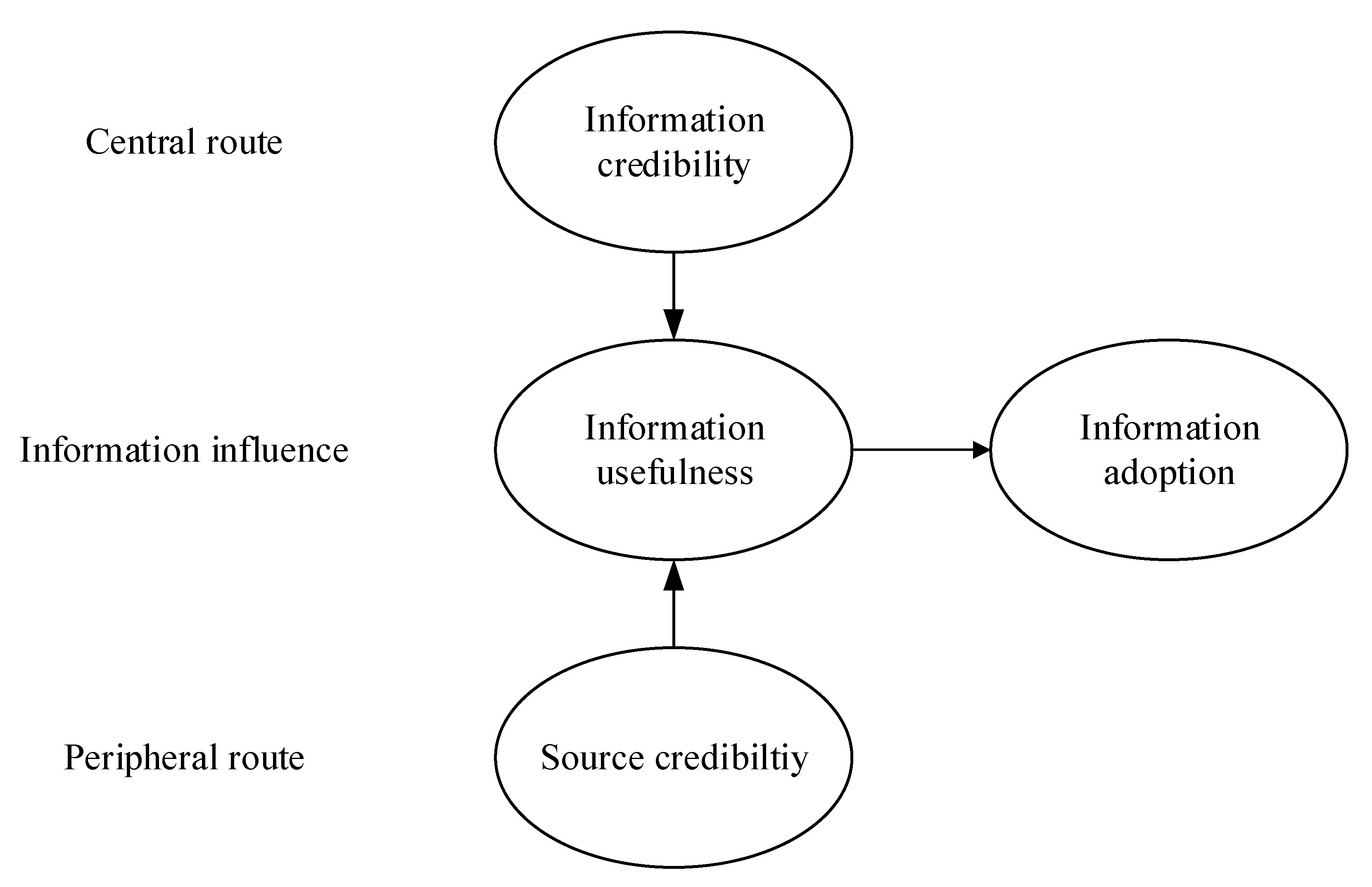
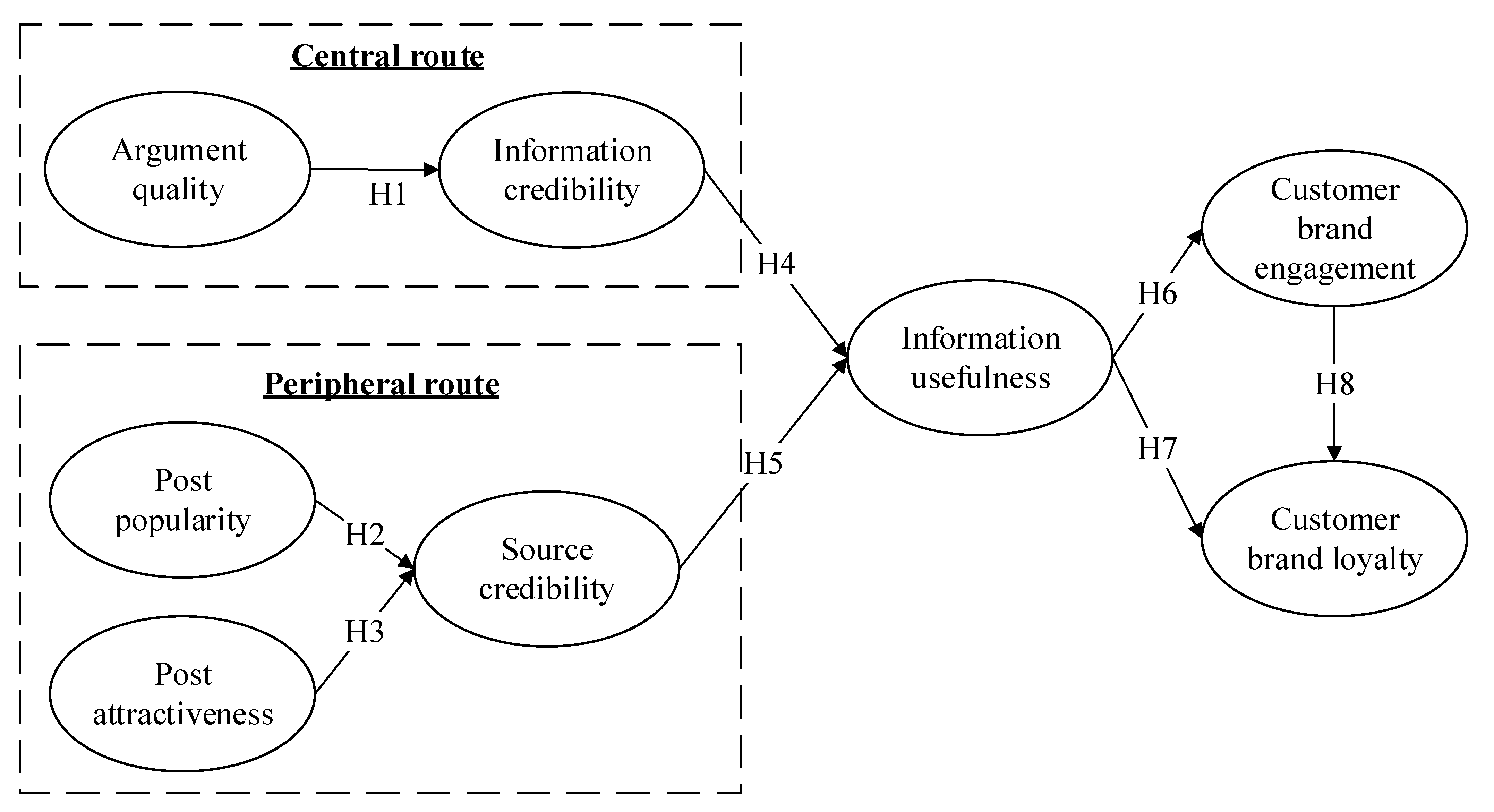
This study uses ELM, IAM, and IACM to establish a two-way influence model for further research model development, as shown in Figure 1. This model highlights the two-way influences of information and source credibility on information usefulness and adoption.
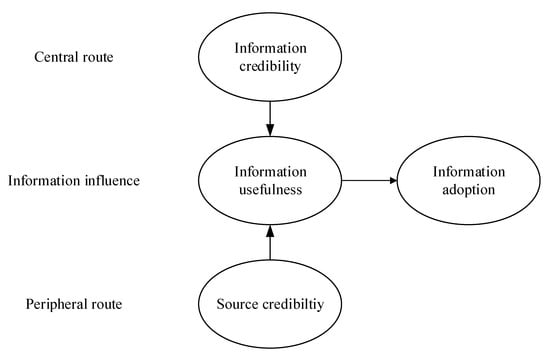
Figure 1.
Two-Way Information Influence Model.
2.3. Argument Quality as Information Credibility
Information credibility is defined as the degree to which information is perceived as credible by an individual. It is a significant predictor of which further actions information receivers may take, such as recommending a product or adopting the views of the received information [25]. Information credibility is a critical factor in communication, emphasizing the information’s quality [26]. High-quality information prompts users to cognitively and positively respond to the posts of a personal brand page [27]. Otherwise, McKnight and Kacmar [22] indicated that if customers could not perceive the information provided to be credible, they might not trust the information and would not revisit the same website, not to mention the possibility of becoming loyal to the website.
Other studies have also held similar views and stressed that information credibility could be measured by message credibility [13,25]. Message credibility refers to the perceived credibility of the delivered message, such as information quality and accuracy [26]. According to the ELM, argument quality is associated with substantial strength to argue with a message. The stronger argument quality would reflect more desired information quality and credibilities, such as relevance, accuracy, comprehensiveness, and timeliness. Previous studies have found that argument quality, information credibility, post popularity, and source credibility positively affect information usefulness [15,27,28]. Therefore, the following hypothesis is formulated.
H1.
Argument quality positively affects information credibility.
2.4. Post Popularity and Attractiveness as Source Credibility
Social media users might perceive a message as credible and valuable because of many likes, shares, and responses to the post. Chang et al. [27] called this phenomenon post popularity. Post popularity refers to the number of likes, comments, and opinions on the shared posts and responses [19]. Because the information receivers were not highly involved in reviewing this information and were only concerned with the appearance of the message (i.e., many likes, shares, and responses), this kind of quick response can be categorized into the peripheral route of the ELM. Furthermore, images in the posts of fan pages might attract social media users. Although they might not spend much time and energy reviewing the content of the information, they swiftly acknowledged the quality of the post by giving a thumbs-up or a thumbs-down. This kind of evaluation represents post attractiveness. Van der Heijden [29] and Cyr et al. [30] found that perceived attractiveness significantly affected perceived usefulness. Therefore, the present study assumes that post popularity and attractiveness relate to source credibility.
H2.
Post popularity positively affects source credibility.
H3.
Post attractiveness positively affects source credibility.
According to Sussman and Siegal [12], primary approaches to explain information technology (IT) adoption include the information influence perspective, such as ELM and the information adoption perspective, such as Technology Acceptance Model (TAM). They further claimed that the amount of adoption variance explained by information adoption (i.e., TAM) generally exceeds levels of persuasion variance explained by information influence (i.e., ELM). In addition, they propose perceptions of information usefulness can be explained by information influence. Therefore, we propose the following hypotheses.
H4.
Information credibility positively affects information usefulness.
H5.
Source credibility positively affects information usefulness.
2.5. Impact of Information Usefulness on Brand Engagement and Loyalty
2.5.1. Impact of Information Usefulness on Brand Engagement
Brand engagement (or customer brand engagement; CBE) can be defined as a type of customer behavior positively associated with the brand or the firm. This behavior would go beyond buying and is driven by motivational factors [31,32,33]. Hollebeek [34] argued that an individual customer’s brand-related and environment-related psychological characteristics resided in the specific degrees of cognitive, affective, and behavioral activities in brand interactions. Alvarez-Milán et al. [35] recognized CBE as a firm-initiated resource. They proposed a strategic CBE marketing decision-making framework including conceptualization, target, domain, experiential routes, and value as significant facets. Under this framework, CBE has the potential to enhance relationship marketing and create sustainable competitive advantages.
Van Doorn et al. [31] argued that CBE was a highly sophisticated behavior and that these non-buying behaviors should include word-of-mouth activities, recommendations, assisting other users, blogging, writing reviews, and even engaging in legal actions. Among these activities, information usefulness is the essential driving element. Directly engaging customers with brand messages (posts) are one advantage of social media, such as Facebook. Furthermore, in the online brand community engagement framework proposed by Dessart, Veloutsou, and Morgan-Thomas [36], the information relates to community value-oriented drivers to brand engagement that further contribute to brand loyalty. Therefore, this study formulates the following hypotheses.
H6.
Information usefulness positively affects brand engagement.
H7.
Information usefulness positively affects brand loyalty.
2.5.2. Impact of Brand Engagement on Brand Loyalty
Aaker and Equity [16] defined brand loyalty as “the attachment a customer has to a brand”. Jacoby [37] described brand loyalty as a bias of a decision unit over time regarding behavioral responses toward one or more brands, forming a set of favored brands as a psychological process. Hagel [38] indicated that when members displayed high loyalty, they were more likely to exhibit a high usage rate, a relatively high degree of engagement, and closer-than-usual relationships, resulting in greater-than-usual member loyalty.
In this study, brand loyalty refers to the tendency to be loyal to a focal brand, which is demonstrated by the intention to follow Facebook fan pages. Loyal members can continually and extensively affect other brand community members’ ideas and actions, constantly spreading knowledge as other members reference their brand evaluations [18]. Therefore, loyal members would always revisit their favored brands, maintain loyalty, and enthusiastically commit to these brands. They would promote the brands with a substantial amount of positive e-WOM.
In Brodie, Ilic, Juric, and Hollebeek’s [39] exploratory analysis of customer engagement in a virtual brand community, they recognized that the customer engagement process generates customer loyalty, satisfaction, empowerment, connection, commitment, and trust. It was empirically confirmed that the engagement of customers in online brand communities was one of the approaches to establishing and reinforcing brand loyalty [21]. Therefore, this study formulates the following hypothesis.
H8.
Brand engagement positively affects brand loyalty.
In summary, the proposed research framework can be shown in Figure 2.
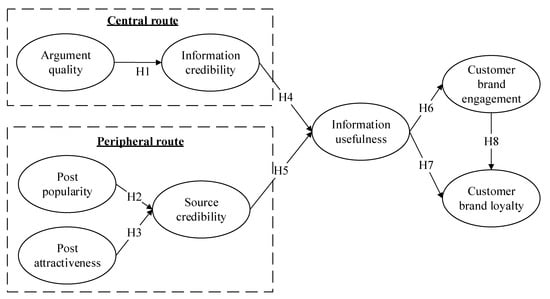
Figure 2.
Research framework.
3. Method
3.1. Sampling
This study focused on the followers of Facebook fan pages, and the data was collected using convenience sampling. An online questionnaire was designed to test the proposed research model, using a platform provided by Google. The questionnaire employed a 7-point Likert scale for measurement, with a score ranging from 1 (strongly disagree) to 7 (strongly agree). It was developed in two stages. In the first stage, scholars of Internet marketing were invited to examine the appropriateness of the questionnaire. In the second stage, the revised questionnaire was distributed to 50 randomly invited participants as a pilot study.
The final questionnaire was adequately designed with the separation of items for different constructs to avoid possible attention problems. A link to the online questionnaire was posted and promoted on Facebook between 2 April 2017 and 2 May 2017. Active users on Facebook voluntarily filled out the questionnaire according to their favorite brand page. A total of 416 valid responses were collected. This sample size was appropriate according to Krejcie and Morgan’s [40] criteria.
The participants’ demographics are summarized in Table 1. Among the samples, more than 70% were aged 20–29, which was consistent with the latest statistics showing adults between the ages of 18–29 as the majority of social media users [11].

Table 1.
Sample characteristics (n = 416).
3.2. Measures
The measurement items of major constructs were summarized as shown in Table 2.
Table 2.
The survey instrument.
4. Data Analysis and Results
This study analyzed each construct’s mean, standard deviation, skewness, and kurtosis. All constructs reached an absolute value of skewness < 3.0 and an absolute value of kurtosis < 10.0, conforming to a normal distribution. Furthermore, this study used the Mardia coefficient [44] to test whether the data were consistent with a multivariate normal distribution. Since the number of observed variables was 1599, which was greater than the Mardia coefficient of this study (109.617), the data of this study were consistent with a multivariate normal distribution.
Furthermore, according to Podsakoff and Organ [45], Common-Method Variance (CMV) can be tested through Harman’s single-factor confirmatory factor analysis (CFA). The test results showed that the chi-squared difference between the single-factor and multi-factor models is significant, and the p value was approximately 0, indicating that no severe CMV occurred in this study.
4.1. Analysis of Measurement Model
Before conducting the SEM analysis, this study checked the reliability and validity of the model. This study used Cronbach’s α to test model reliability and content validity and construct validity to measure the validity of the model. Cronbach’s α values ranged from 0.878 to 0.942, and they were all greater than 0.7, indicating high reliability, as presented in Table 3.
Table 3.
Reliability Analysis.
Validity was divided into content validity and construct validity. The questionnaire’s content was modified from the essential relevant literature review. Thus, this study would have content validity. The standardized factor loadings of this study all reached the desired level. The composite reliability values were greater than 0.7, and the average variance extracted values were greater than 0.5. Therefore, this study exhibited convergent validity, as shown in Table 4.
Table 4.
Convergent Validity.
Additionally, most factors in this study were greater than the correlation coefficient in each dimension. Therefore, the proposed model had fair discriminant validity, as shown in Table 5.
Table 5.
Discriminant Validity.
4.2. Analysis of Structural Model
A collinearity evaluation, a test for overall model fit, and an evaluation of the path coefficients assessed the structural model. In addition, mediating analysis was also conducted.
As shown in Table 6, no tolerance value was less than 0.2, and no variance inflation factors (V.I.F.) were greater than 5.0; therefore, collinearity did not exist in this study.
Table 6.
V.I.F. Results.
This study tested the structural model with Bollen–Stine bootstrapping. In the evaluation of the overall model fit, the result of each test was consistent with general S.E.M. analysis criteria, confirming the adequacy of the model used in this study, as summarized in Table 7.
Table 7.
Checklist of Model Fit Indicators.
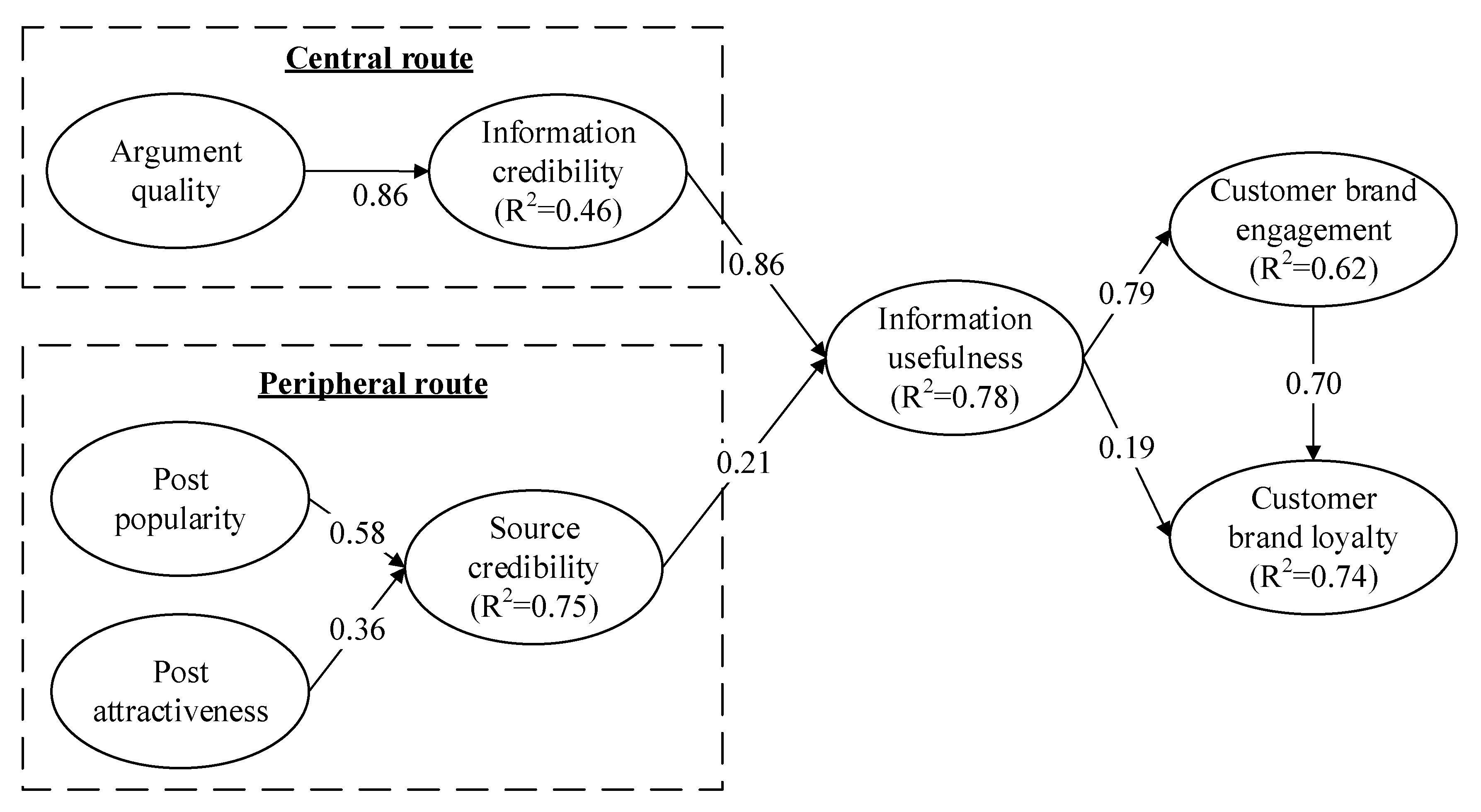
The standardized path coefficients also reached significant levels, indicating that all hypotheses in this study were supported, as presented in Table 8 and Figure 3.
Table 8.
Test Results of Path Coefficient Significance.
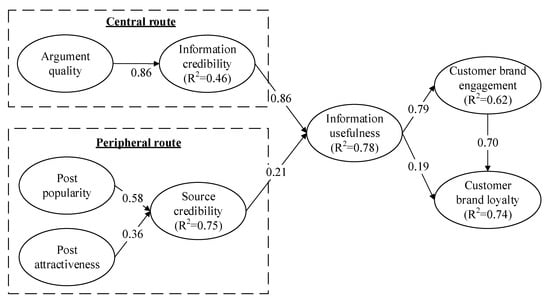
Figure 3.
Results of testing the hypothesis.
Additionally, to examine the mediating effect of brand engagement (BE) on the relationship between information usefulness (IU) and brand loyalty (BL), this study used Amos bootstrapping to analyze the mediating effect. As presented in Table 9, the confidence interval of the total effect (lower bounds–upper bounds) was not 0, indicating that the total effect existed. The confidence interval of the direct effect was not 0, indicating that a direct effect existed. The confidence interval of the indirect effect was not 0, indicating that an indirect effect existed. Thus, it verified the presence of a partial mediating effect.
Table 9.
Analysis of Mediating Effect (IU → BE →BL).
Variance Account For (VAF) was also analyzed to verify the partial mediating effect, revealing that the effect of independent variables on dependent variables decreased but remained significant. Accordingly, due to brand engagement, the independent variables affected the dependent variables through Facebook opinion leaders. The analytical results are listed in Table 10.
Table 10.
Variance Account For (VAF) Analysis (IU → BE → BL).
5. Discussion
5.1. Conclusions
Major research findings are summarized in the following. First, for the determinants of information credibility and source credibility, the empirical results showed that argument quality as the central route exerted a significantly positive effect on information credibility. Furthermore, post popularity and attractiveness as the peripheral route significantly positively impact source credibility.
Second, for factors influencing information usefulness, the empirical results revealed that information credibility and source credibility significantly positively affect information usefulness. This study also validated that post popularity and post attractiveness were two critical determinants of source credibility in the context of Facebook brand pages. Additionally, information credibility as a central route had a more substantial impact on perceived information usefulness, consistent with previous studies (e.g., [11,27,46]).
Last, for the relationship between information usefulness, brand engagement, and brand loyalty, the empirical results showed that information usefulness significantly positively affected brand engagement and brand loyalty. Moreover, brand engagement positively affected brand loyalty and mediated the relationship between information usefulness and brand loyalty. This finding shed new light on effective ways to enhance band engagement and loyalty on the platform of social media.
5.2. Theoretical Implications
This study is concerned with the chain effects of information influence, usefulness, and adoption, and its impact on brand engagement, especially in social media, such as Facebook brand pages. Traditionally, two-way influences are the main theoretical streams in information persuasiveness research. For example, the dual-process theory [21] posits two distinct categories of influences that shape the reader’s evaluation of the persuasiveness of received messages: informational and normative influence. Informational influence is content-orientated on the received messages, whereas normative influence reflects the impact of social interactions in today’s online communities. Similarly, the ELM theory concentrates on how different levels/depths of processing, specifically between comprehensive (or central route) vs. heuristic (or peripheral route) processing, affect persuasive communication.
Sussman and Siegal [12] proposed the IAM to advance the ELM (as information influence) by integrating with the TAM (as information adoption). Furthermore, they identified that TAM has more substantial prediction power than ELM. Consequently, they proposed that information usefulness is crucial in adoption behaviors. Namely, perceived information usefulness is a mediator between information influence, such as argument quality and source credibility from ELM, and the desired outcome (i.e., information adoption). This study empirically confirmed the approach that combined ELM with TAM.
However, to refine this framework, this study first clarifies the relationship between argument quality and information credibility because the former might not directly contribute to the latter due to users’ possible different levels of involvement. Second, in parallel to identifying antecedents to information credibility, this study adopted post popularity and attractiveness as drivers for source credibility, following Chang et al.’s viewpoint [27]. Nevertheless, instead of looking upon post popularity and attractiveness as direct influences of information usefulness, this study also recognizes the importance of the mediating role of source credibility. Thus, this study further clarifies the essence of information influence.
Furthermore, most information influence-related studies ended their investigation with information adoption or behavioral intention (e.g., [12,24,27,30]). This study goes further by linking information adoption with brand engagement and loyalty; therefore, it broadens the theoretical lens of the two disciplines and creates tremendous synergies. In summary, this study adopts a more holistic and insightful perspective to explore the factors influencing the credibility of online information and its impact on brand engagement and loyalty, and, finally, effectively enhancing brand equity through social media, such as Facebook brand pages.
5.3. Managerial Implications
Due to the growing concern regarding the sustainability of the environment and the wellbeing of societies, green marketing in general and specific branding are essential to achieve these aims. Leveraging the power of brand pages in social media for green branding and impact are critical issues. This study proposes some practical suggestions for practitioners based on significant research findings.
First, information credibility is vital in determining whether social media users take further action toward the brand. The hosts of brand pages are advised to strive and enhance the information credibility of their content. Through the central route, one of the approaches is to support the brand pages with richness, immediacy, integrity, accuracy, consistency, and correctness. Then, the followers of the brand pages will begin to recognize that the information provided on the brand pages is correct, credible, and persuasive. Through the peripheral route, the hosts of brand pages could increase source credibility by increasing post popularity and post attractiveness. Specifically, by gaining a higher number of likes, shares, and positive responses to the posts, the followers of the brand pages will begin to perceive that the hosts are qualified as an expert and that the posts’ content is trustworthy and reliable. The hosts of brand pages can also make the posts more aesthetically pleasing with attractive images and layouts. Then, the followers of brand pages will perceive that the content of the posts is professional and reliable.
Second, the hosts of brand pages could leverage their information credibility to enhance their followers’ perception of information usefulness so that the followers’ brand engagement and loyalty could simultaneously improve. Brand pages can activate the viewers’ cognitive, affective, and behavioral engagement by providing informative, helpful, and valuable posts. They may, then, demonstrate the attitude of loyalty to the brand pages. The hosts of brand pages are recommended to manage followers’ brand engagement with great care because an active engagement of followers will not only enhance brand loyalty, but also mediate the relationship between information usefulness and brand loyalty.
5.4. Limitations and Future Research
The limitations of the current study can be described as follows. First, it focuses on participants in Taiwan. Future studies are recommended to survey participants in other countries and regions to check possible cultural differences and enhance the generalization of research findings. Second, this study concentrates on the survey of Facebook fan page users. Future studies could include users of other social media and online communities. Third, qualitative research could be applied to investigate the issues more in-depth. Fourth, this study focuses on personal brand pages; other brand pages can be explored and compared. Finally, a cross-platform comparison, such as desktop computers and mobile phones, could be conducted.
Author Contributions
H.-M.C.: Conceptualization, Methodology, Software, Supervision, Writing—Original draft preparation, and Writing—Reviewing and Editing. C.-I.C.: Conceptualization, Data curation, Visualization, Writing—Original draft preparation, and Writing—Reviewing and Editing. All authors have read and agreed to the published version of the manuscript.
Funding
This research received no external funding.
Informed Consent Statement
Informed consent was obtained from all subjects involved in the study.
Data Availability Statement
Not applicable.
Conflicts of Interest
The authors declare no conflict of interest.
References
- Schmidt, J.H. Social Media; Springer VS: Wiesbaden, Germany, 2018. [Google Scholar]
- Drury, G. Opinion Piece: Social Media: Should Marketers Engage and How Can it be done effectively? J. Direct Data Digital Mark. Practice 2008, 9, 274–277. [Google Scholar] [CrossRef]
- Wibowo, A.; Chen, S.C.; Wiangin, U.; Ma, Y.; Ruangkanjanases, A. Customer behavior as an outcome of social media marketing: The role of social media marketing activity and customer experience. Sustainability 2020, 13, 189. [Google Scholar] [CrossRef]
- Iglesias, C.A.; Moreno, A. Customer behavior as an outcome of social media marketing: The role of social media marketing activity and customer experience. Appl. Sci. 2019, 9, 5037. [Google Scholar] [CrossRef]
- Facebook Statistics and Trends. Available online: https://datareportal.com/essential-facebook-stats (accessed on 10 April 2022).
- Ibrahim, B.; Aljarah, A.; Sawaftah, D. Linking social media marketing activities to revisit intention through brand trust and brand loyalty on the coffee shop facebook pages: Exploring sequential mediation mechanism. Sustainability 2021, 13, 2277. [Google Scholar] [CrossRef]
- Majeed, M.U.; Aslam, S.; Murtaza, S.A.; Attila, S.; Molnár, E. Green Marketing Approaches and Their Impact on Green Purchase Intentions: Mediating Role of Green Brand Image and Consumer Beliefs towards the Environment. Sustainability 2022, 14, 11703. [Google Scholar] [CrossRef]
- Gong, S.; Sheng, G.; Peverelli, P.; Dai, J. Green branding effects on consumer response: Examining a brand stereotype-based mechanism. J. Prod. Brand Manag. 2020, 30, 1033–1046. [Google Scholar] [CrossRef]
- Huang, C.; Guo, R. The effect of a green brand story on perceived brand authenticity and brand trust: The role of narrative rhetoric. J. Brand Manag. 2021, 28, 60–76. [Google Scholar] [CrossRef]
- Chen, Y.S. The drivers of green brand equity: Green brand image, green satisfaction, and green trust. J. Bus. Ethics 2010, 93, 307–319. [Google Scholar] [CrossRef]
- Erkan, I.; Evans, C. The influence of eWOM in social media on consumers’ purchase intentions: An extended approach to information adoption. Comput. Hum. Behav. 2016, 61, 47–55. [Google Scholar] [CrossRef]
- Sussman, S.W.; Siegal, W.S. Informational influence in organizations: An integrated approach to knowledge adoption. Inf. Syst. Res. 2003, 14, 47–65. [Google Scholar] [CrossRef]
- Petty, R.E.; Cacioppo, J.T. Communication and Persuasion: Central and Peripheral Routes to Attitude Change; Springer: New York, NY, USA, 2012. [Google Scholar]
- Hart, S.L. A natural-resource-based view of the firm. Acad. Manag. Rev. 1995, 20, 986–1014. [Google Scholar] [CrossRef]
- Keller, K.L. Conceptualizing, measuring, and managing customer-based brand equity. J. Mark. 1993, 57, 1–22. [Google Scholar] [CrossRef]
- Aaker, D.A.; Equity, M.B. Capitalizing on the Value of a Brand Name; The Free Press: New York, NY, USA, 1991; Volume 28, pp. 35–37. [Google Scholar]
- Yoo, B.; Donthu, N.; Lee, S. An examination of selected marketing mix elements and brand equity. J. Acad. Mark. Sci. 2000, 28, 195–211. [Google Scholar] [CrossRef]
- Muniz, A.M.; O’Guinn, T.C. Brand community. J. Consum. Res. 2001, 27, 412–432. [Google Scholar] [CrossRef]
- De Vries, L.; Gensler, S.; Leeflang, P.S.H. Popularity of Brand Posts on Brand Fan Pages: An Investigation of the Effects of Social Media Marketing. J. Interact. Mark. 2012, 26, 83–91. [Google Scholar] [CrossRef]
- Bhattacherjee, A.; Sanford, C. Influence processes for information technology acceptance: An elaboration likelihood model. MIS Q. 2006, 30, 805–825. [Google Scholar] [CrossRef]
- Deutsch, M.; Gerrard, H.B. A Study of Normative and Informational Social Influence upon Individual Judgment. J. Abnorm. Soc. Psychol. 1955, 53, 629–636. [Google Scholar] [CrossRef]
- McKnight, D.H.; Kacmar, C.J. Factors and effects of information credibility. In Proceedings of the Ninth International Conference on Electronic Commerce, AMC, Minneapolis, MN, USA, 19–22 August 2007; pp. 423–432. [Google Scholar]
- Gunawan, D.D.; Huarng, K.H. Viral effects of social network and media on consumers’ purchase intention. J. Bus. Res. 2015, 68, 2237–2241. [Google Scholar] [CrossRef]
- Davis, F.D. Perceived usefulness, perceived ease of use, and user acceptance of information technology. MIS Q. 1989, 13, 319–340. [Google Scholar] [CrossRef]
- Li, R.; Suh, A. Factors Influencing Information credibility on Social Media Platforms: Evidence from Facebook Pages. Proced. Comput. Sci. 2015, 72, 314–328. [Google Scholar] [CrossRef]
- Metzger, M.J.; Flanagin, A.J.; Eyal, K.; Lemus, D.R.; McCann, R.M. Bringing the concept of credibility into the 21st century: Integrating perspectives on source, message, and media credibility in the contemporary media environment. Commun. Yearb. 2003, 27, 293–335. [Google Scholar] [CrossRef]
- Chang, Y.T.; Yu, H.; Lu, H.P. Persuasive messages, popularity cohesion, and message diffusion in social media marketing. J. Bus. Res. 2015, 68, 777–782. [Google Scholar] [CrossRef]
- Godey, B.; Manthiou, A.; Pederzoli, D.; Rokka, J.; Aiello, G.; Donvito, R.; Singh, R. Social media marketing efforts of luxury brands: Influence on brand equity and consumer behavior. J. Bus. Res. 2016, 69, 5833–5841. [Google Scholar] [CrossRef]
- Van der Heijden, H. Factors influencing the usage of websites: The case of a generic portal in The Netherlands. Inf. Manag. 2003, 40, 541–549. [Google Scholar] [CrossRef]
- Cyr, D.; Head, M.; Ivanov, A. Design aesthetics leading to m-loyalty in mobile commerce. Inf. Manag. 2006, 43, 950–963. [Google Scholar] [CrossRef]
- Van Doorn, J.; Lemon, K.N.; Mittal, V.; Nass, S.; Pick, D.; Pirner, P.; Verhoef, P.C. Customer engagement behavior: Theoretical foundations and research directions. J. Serv. Res. 2010, 13, 253–266. [Google Scholar] [CrossRef]
- Vinerean, S.; Opreana, A. Measuring customer engagement in social media marketing: A higher-order model. J. Theor. Appl. Electron. Commer. Res. 2021, 16, 2633–2654. [Google Scholar] [CrossRef]
- Guerreiro, J.; Pacheco, M. How green trust, consumer brand engagement and green word-of-mouth mediate purchasing intentions. Sustainability 2021, 13, 7877. [Google Scholar] [CrossRef]
- Hollebeek, L. Exploring customer brand engagement: Definition and themes. J. Strat. Mark. 2011, 19, 555–573. [Google Scholar] [CrossRef]
- Alvarez-Milán, A.; Felix, R.; Rauschnabel, P.A.; Hinsch, C. Strategic customer engagement marketing: A decision-making framework. J. Bus. Res. 2018, 92, 61–70. [Google Scholar] [CrossRef]
- Dessart, L.; Veloutsou, C.; Morgan-Thomas, A. Consumer engagement in online brand communities: A social media perspective. J. Prod. Brand Manag. 2015, 24, 28–42. [Google Scholar] [CrossRef]
- Jacoby, J. A model of multi-brand loyalty. J. Advert. Res. 1971, 11, 25–30. [Google Scholar]
- Hagel, J. Net gain: Expanding markets through virtual communities. J. Interact. Mark. 1999, 13, 55–65. [Google Scholar] [CrossRef]
- Brodie, R.J.; Ilic, A.; Juric, B.; Hollebeek, L. Consumer engagement in a virtual brand community: An exploratory analysis. J. Bus. Res. 2013, 66, 105–114. [Google Scholar] [CrossRef]
- Krejcie, R.V.; Morgan, D.W. Determining sample size for research activities. Educ. Psychol. Meas. 1970, 30, 607–610. [Google Scholar] [CrossRef]
- Zhang, W.; Watts, S. Knowledge Adoption in Online Communities of Practice. In Proceedings of the 24th International Conference on Information Systems, ICIS 2003 Proceedings, Seattle, WA, USA, 14–17 December 2003; pp. 15–17. [Google Scholar]
- Prendergast, G.P.; Tsang, A.S.; Chan, C.N. The interactive influence of country of origin of brand and product involvement on purchase intention. J. Consum. Mark. 2010, 27, 180–188. [Google Scholar] [CrossRef]
- Hollebeek, L.D.; Glynn, M.S.; Brodie, R.J. Consumer brand engagement in social media: Conceptualization, scale development and validation. J. Interact. Mark. 2014, 28, 149–165. [Google Scholar] [CrossRef]
- Mardia, K.V.; Foster, K. Omnibus tests of multiformity based on skewness and kurtosis. Commun. Stat.-Theory Methods 1983, 12, 207–221. [Google Scholar] [CrossRef]
- Podsakoff, P.M.; Organ, D.W. Self-reports in organizational research: Problems and prospects. J. Manag. 1986, 12, 531–544. [Google Scholar] [CrossRef]
- Jin, X.L.; Cheung, C.M.K.; Lee, M.K.O.; Chen, H.P. How to keep members using the information in a computer-supported social network. Comput. Hum. Behav. 2009, 25, 1172–1181. [Google Scholar] [CrossRef]
Disclaimer/Publisher’s Note: The statements, opinions and data contained in all publications are solely those of the individual author(s) and contributor(s) and not of MDPI and/or the editor(s). MDPI and/or the editor(s) disclaim responsibility for any injury to people or property resulting from any ideas, methods, instructions or products referred to in the content. |
© 2023 by the authors. Licensee MDPI, Basel, Switzerland. This article is an open access article distributed under the terms and conditions of the Creative Commons Attribution (CC BY) license (https://creativecommons.org/licenses/by/4.0/).