


Abstract
In the current challenging and competitive dynamic business world today, automotive companies have been rapidly developing and promoting autonomous vehicles (AVs), which aim to reduce crashes, energy consumption, pollution, and congestion and increase transport accessibility. To ensure the successful adoption of AVs, an increasing number of studies have been conducted to understand public acceptance. This paper used the bibliometric technique to understand the distribution, emerging trend, and the research cluster in the context of AV technology acceptance through knowledge mapping. The Web of Science database was used to retrieve 401 scientific articles from 2000 to June 2022. The findings reported that the previous studies mainly focused on the research clusters related to the domains of attitude, trust, technology, impact, and models. Finally, this study added to the existing body of literature by providing the current knowledge landscape to guide the future research.
1. Introduction
According to WHO [1], road traffic crash is the eighth leading cause of death of people of all ages around the world. Every year, about 1.35 million people are killed, while as many as 50 million people suffer different levels of injury due to road traffic accidents. Pieces of evidence have shown that more than half of these traffic crashes are associated with a certain level of human errors [2,3], such as distracted driving, speeding, risky driving behavior, driving under the influence, and fatigue driving.
Subsequently, many automotive and startupscompanies such as Waymo/Google, Uber, BMW, Ford, Nissan, General Motors, and Volvo, are spearheading the development of autonomous vehicles [4,5]. The emergence of autonomous vehicle (AV) technology is advocated as one of the solutions to reduce traffic crashes by eliminating human-error-induced accidents [6]. With this, the development of AVs has achieved several milestones over the years. For instance, Audi allocated USD 16 billion for electric and autonomous vehicles [7], while Ford and Toyota invested USD 4 billion and USD 2.8 billion, respectively, in AV technology. Generally, the deployment of AVs, which could be classified from level 1 (driver assistance) to level 5 (fully automated), is entering the market in stages. In more than 130 cities, policy makers in the United States, Asia, and Europe started pilot projects related to AV technology in buses or robotaxi [6]. Some researchers forecasted that by 2040, AVs will constitute about 25% of the global new car market [8], and by 2050, it is estimated that fully automated vehicles would achieve 50% market share [9].
At the forefront of a full automation mobility environment, extensive research has been carried out to explore the potential implications brought by AVs from a broad range of perspectives [10,11]. The results reported are mixed. While some studies promoted the use of AV technology in terms of reducing traffic fatalities and air pollution and improving the life quality of disabled groups, other studies argued that the benefits will only be realized when AVs are accepted and used on a broader scale [12]. Despite extensive work carried out in the past, there is incongruent consensus on the public acceptance of AV technology. One of the plausible reasons could be the different theoretical models developed to answer various objectives [13]. The current state of knowledge and literature is mainly centered on the perception of consumers based on the theories of technology acceptance or intention to use or adopt, in which the actual acceptance might be influenced by many other uncertainties due to the evolution of the environment in the coming years. The uncertainties include global government policies, legal implications between countries, socioeconomic pressures, culture, and sustainability [14]. As such, the subject of public acceptance of AV is still drawing serious attention from various parties and has seen an upsurge trend in related research.
In view of the increasing literature, the bibliometric method is used as another systematic and statistical approach to understand the trend and research pattern. The term bibliometrics, which was derived from Latin and Greek words, was first published by Pritchard in 1969 [15]. It is defined as a statistical method of analyzing a book and other literature. Bibliometrics is often used synonymous with scientometrics [16].
There are very few studies applying a quantitative approach to understand the research area related to AV [17,18,19,20]. Several studies conducted in the past attempted to analyze the trend of AV research over the past two decades [17,18,19,20], and included a study related to the application of innovation in self-driving cars [17]. These findings are very informative as they summarize the research areas on AV technologies at a glance. Although past studies provided a comprehensive review based on the findings from previous studies in the transportation field that involved AVs based on the systematic review method [11,21], the literature search using the bibliometrics method to holistically review the strand of public acceptance of AVs is still limited. Therefore, the following three research objectives were developed in order to present a comprehensive report based on bibliometric analysis in this study:
- To compare the nature of distributions in terms of the authorship and geographical areas spanning across countries in the context of AVs;
- To identify the global emerging trends and core research clusters related to people’s acceptance of AV technology;
- To propose the research directions that can open new avenues for future research based on the review performed in this study.
The outcome of the review is expected to contribute to the existing literature by illustrating the latest development and state-of-the-art research in AV, and give insights for future research direction. In addition, this study compliments previous systematic review papers by using a bibliometric technique in which the findings are displayed in a visualized knowledge map in terms of citation analysis, coauthorship, cocitation map, and keyword analysis. For the purpose of this study, the VOSviewer software developed by Van Eck and Waltman [22] was selected to generate the knowledge maps.
The current paper is organized as follows: Section 2 describes the materials and methods used in this study. Section 3 answers research objective (1), while Section 4 addresses research objective (2). Lastly, Section 5 echoes research objective (3) by identifying the gaps in the existing literature and providing recommendations for future research.
2. Materials and Methods
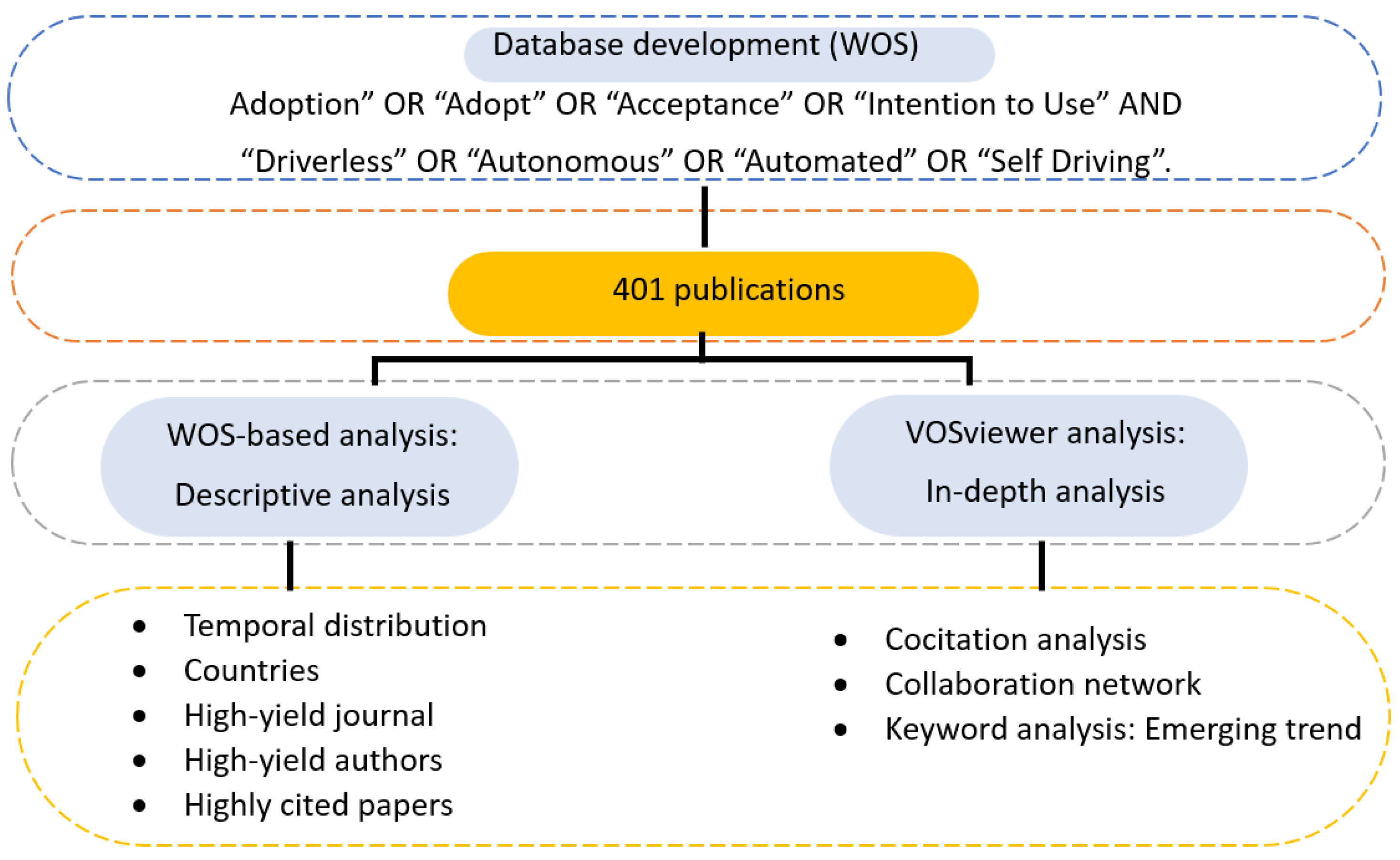
To achieve the three research objectives, a search for all the reference articles indexed in the Web of Science (WOS), which covers most of the primary journal publications in the world, was conducted. The article period was set to years dating back to the past decades (2000) until the present, June 2022 (until the point of this study). Autonomous vehicles (AVs) refer to vehicles with a certain level of a safety-critical control function (such as steering, throttle, or braking) that takes place without direct driver input [12]. According to the Society of Automotive Engineers [23], AV can be classified into six levels, ranging from Level 0 (no automation or manual) to Level 5 (full automation). Najm et al. [24] defined acceptance is “the precondition that will permit new automotive technologies to achieve their forecasted benefit levels” (p. 5–1). As mentioned by Cserdi and Kenesei [25], Rezaei and Caulfield [26], and Weigl et al. [27], acceptance and adoption are interchangeably used in the literature. Other words related to the potential adoption or use of AVs were also included. Therefore, the search terms/keywords identified were: “Adoption” OR “Adopt” OR “Acceptance” OR “Intention to Use” AND “Driverless” OR “Autonomous” OR “Automated” OR “Self-Driving”. The initial search resulted in 10,051 articles. The pool of publications was further screened manually by title and abstract with reference to a set of criteria as listed in Table 1. Based on the criteria, a total of 401 articles were downloaded in the format of “plain text” on 1 July 2022 for subsequent analysis. The information of the articles includes authors, titles, keywords, institutions, years of publication, and citation numbers. In addition, Figure 1 summarizes the search procedure applied in locating the appropriate articles to realize the aims of this study.

Table 1.
Inclusion and exclusion criteria.
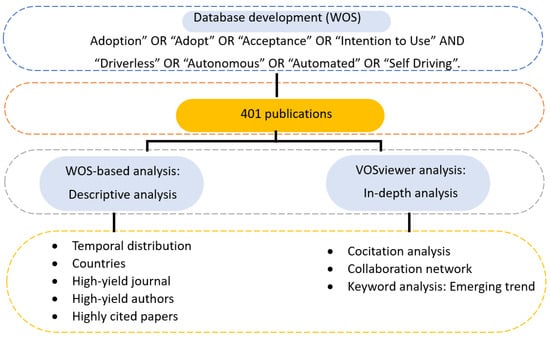
Figure 1.
Search term and process.
This study used the WOS database, which is the world’s most comprehensive, reliable, and trusted database. It contains more than 171 million records and includes other databases, such as Scopus, ProQuest, and Wiley [21]. All the articles are indexed in a way that promises the quality of the works. The timeframe selected from 2000 up to June 2022 was consistent with the booming of AV since the Second Digital Revolution [28]. In addition, it is to highlight that the screening process is not straightforward, given that the query has resulted in 10,051 articles. The subsequent step involves manually screening in detail based on a set of inclusion and exclusion criteria. As autonomous technology is developing, various new terms, such as self-driving, driverless, robocar, and robotaxi, might be used to represent AVs. Therefore, manually screening can avoid data loss.
3. Nature of Distributions Related to AV Studies
This section presents a statistical analysis that includes the temporal distribution of published papers, countries, high-yield journals, high-yield authors, and highly cited papers.
3.1. Temporal Distribution of Paper
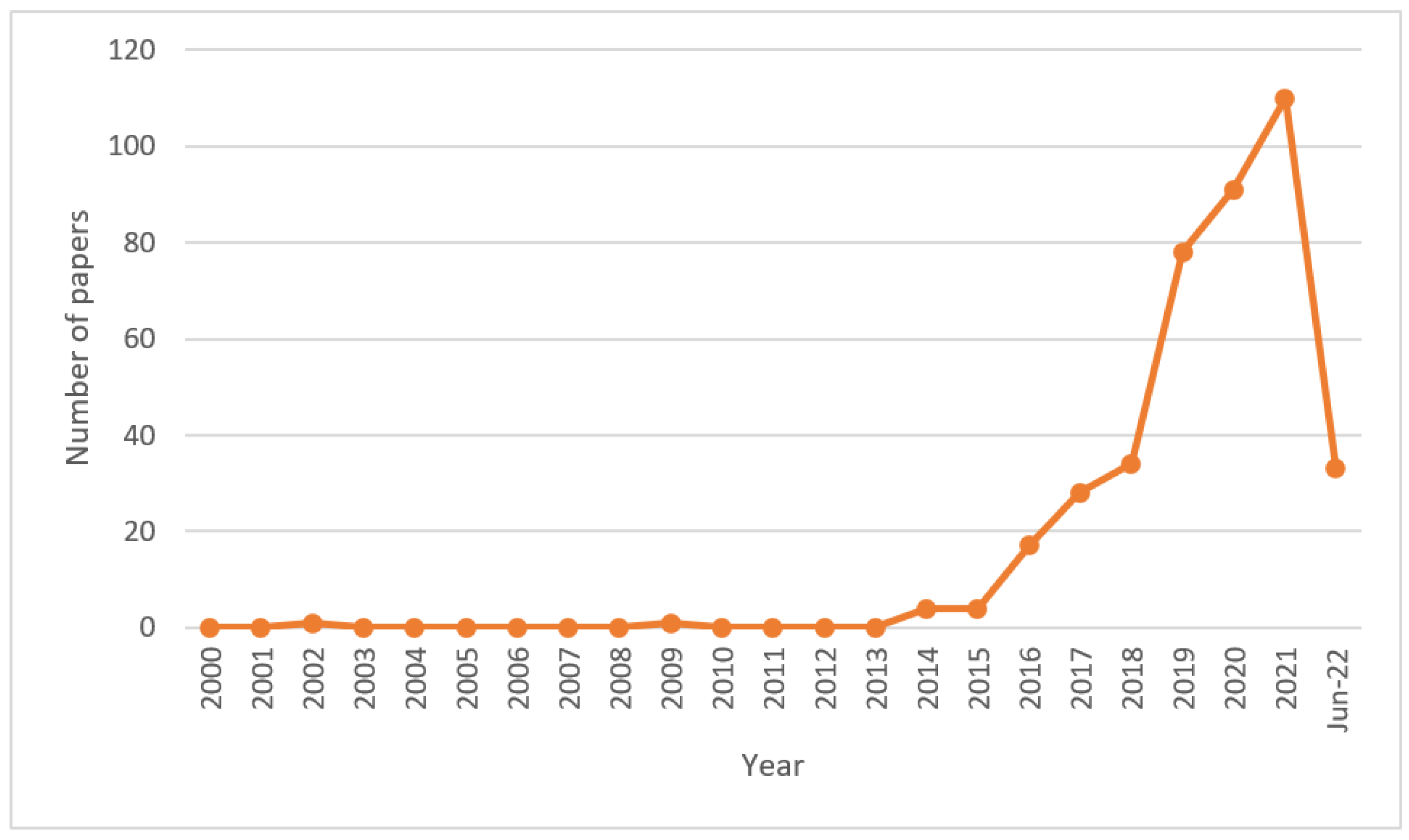
The concept of automated vehicles (AVs) was first introduced in the year 1918 [29]. Nonetheless, the publication work on AV has seen some disruption until 1982 [20]. Figure 2 presents the temporal distribution of publications on the acceptance of AVs from 2000 to June 2022. Publications started to increase since 2015 with the highest number of 110 articles published in 2021. The possible reasons might be attributed to the growing road testing of AVs by not only traditional car makers (BMW, Mercedes Benz, Ford, Nissan, and Toyota) but also startup projects from Google, Tesla in the US and Baidu in China, as well as the intensified evolution of AV technology from Level 3 to Level 4 automation. Mass testing of AVs on the road spurred the urgency and interest to understand factors influencing the diffusion of AVs. The drop in the number of publications might be attributed to the period considered up to June 2022 and also impacts due to COVID-19.
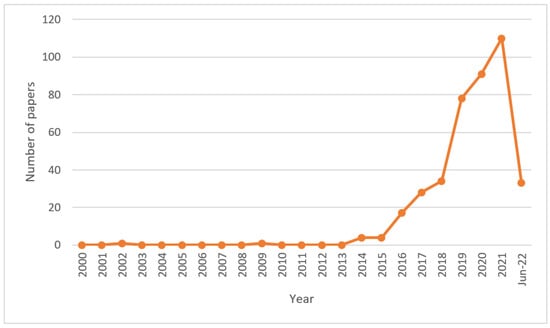
Figure 2.
The temporal distribution of papers related to public acceptance of AV. Source: authors’ elaboration.
3.2. Countries
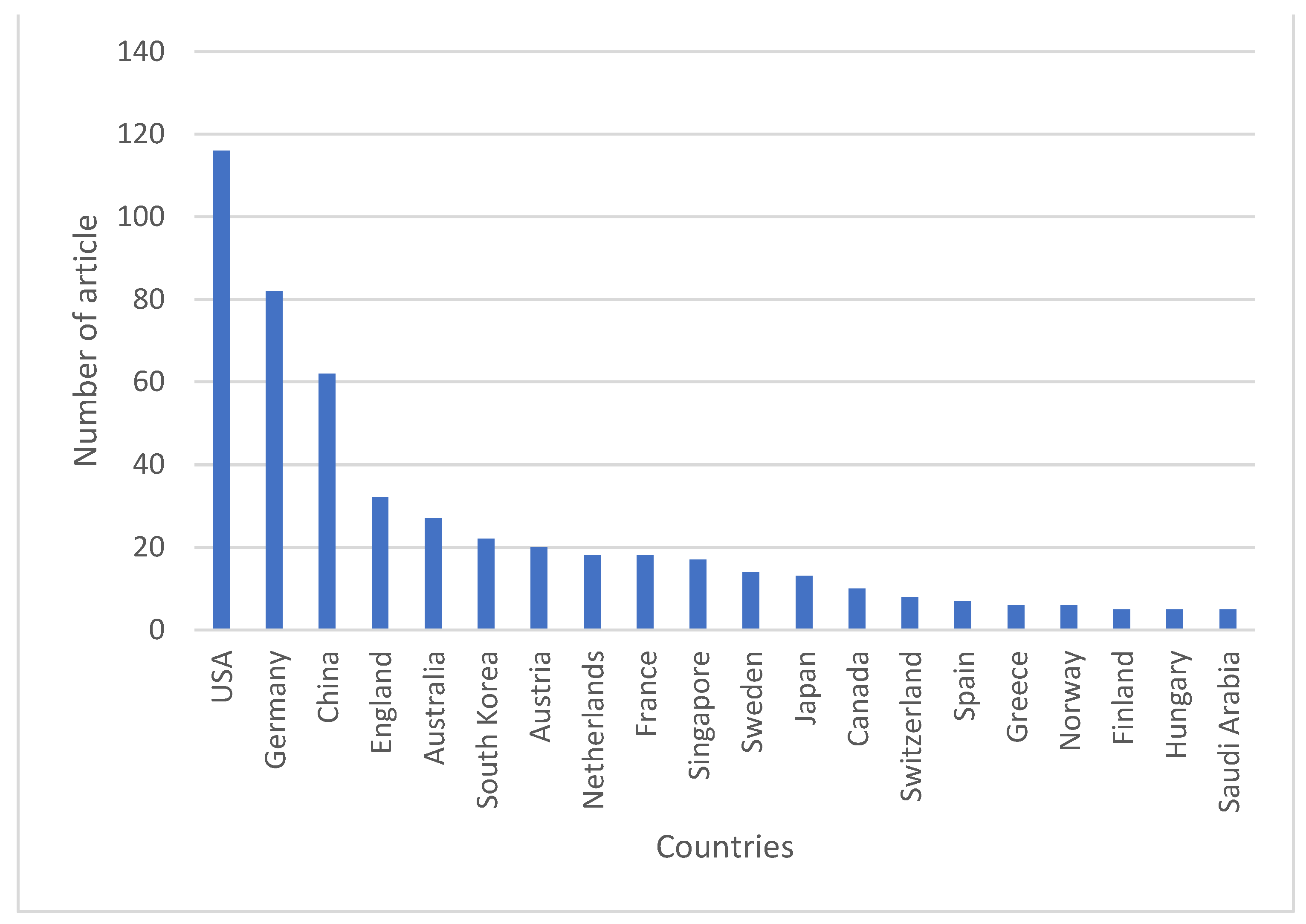
From the review of 401 papers, studies on public acceptance or adoption of AV were conducted by authors across 53 countries. A minimum 5 as the number of documents of a country criterion was set for the bibliometric map, as shown in Figure 3. The US is the main contributor to the body of literature in this area with 116 documents, followed by Germany (82) and China (62). The finding suggests that there is a positive relationship between high interest in research and countries’ basis. For instance, the US has the highest number of research papers that may be attributed to its leading position in the area of AV development, where many startup companies, such as Google, Uber, Apple, and Tesla, have been actively involved in the development of AV technology and pilot deployment on the roads [30]. In addition, under Vision 3.0 on the Future of Transportation (US Department of Transportation, 2018), the US government has been actively encouraging AV companies and car manufacturers to address potential buyers and all the barriers that would disrupt the implementation of AV technologies [31]. In January 2019, a total of 62 testing permits were approved in the US (DMV, 2018), and there were 29 states conducting AV testing on public roads [11].
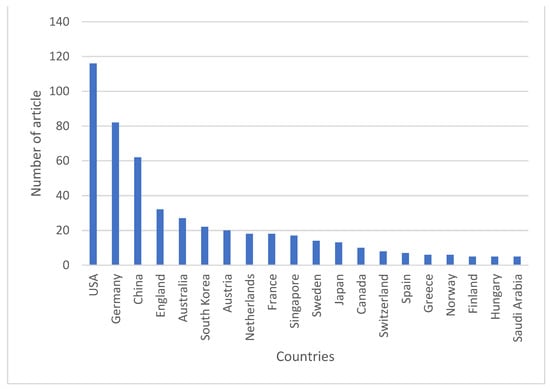
Figure 3.
Distribution of papers published by authors from respective countries. Source: authors’ elaboration.
Germany, the origin country of Audi, BMW, and Mercedes-Benz, has also seen extensive research work in promoting automated technology. In response to the support and commitment of the government for AV technologies, various studies have been carried out with the aim of discovering the barriers and ensuring the smooth deployment of AVs in the country. Meanwhile, in the East, the Chinese government strives to be the leader in the electric and AV market by 2030 [20]. It was projected that Level 2 automation vehicles consisted half of the vehicle sales in China by 2020, and Level 3 automation vehicles are estimated to obtain 15% of the sales by 2025, and subsequently, Level 4 and Level 5 automation vehicles will achieve 10% of the market sales by 2030, which equals 4 million robocars yearly [32]. Foreseeing the arrivals of fully automated vehicles on the roads of China in the very near future has attracted the interest of academicians, researchers, and other related parties to put in more effort and time to understand the influential factors and the potential impacts of AV adoption in society [30].
It is also interesting to note that another country, Singapore, has been very positive about adopting AVs since 2010 [33]. It was the first country in the world to approve a trial run of commercial autonomous mobility-on-demand (MoD) services in 2016 [34]. In 2018, the government approved autonomous shuttles to be operated on selected public roads [34]. Singapore further made another world record by introducing 40-seater AV buses in 2019 and will be fully deployed as the first- and last-mile mode for people in a few towns by 2022. In response to the government’s decision, many works in understanding the acceptance of AVs have been carried out, of which a total of 17 articles were published in the past decade.
While Japan is the third largest automotive producer in the world [35], studies on the acceptance of AVs seem to be lacking as compared with other countries, with only 13 publications found. The Ministry of Land, Transport, and Infrastructure (2020) reported that AVs accounted for only 2.5% market share in 2020 [30]. This leads to the urgency of relevant parties to devote more efforts and time to increasing the market shares and to understand consumers’ demand for AVs [28]. Apart from these prolific countries, research on AVs also draws the attention of researchers from Spain, Greece, Norway, Finland, Hungary, and Saudi Arabia.
3.3. High-Yield Journal
The 401 articles were published across 180 sources, of which 44 articles or 10.9% were published in the journal Transportation Research Part F—Traffic Psychology and Behavior (as shown in Table 2), which implies that most of the studies were related to exploring the behavior of the public on the acceptance or adoption of the emerging AV technology. Other sources of publications are Transportation Research Part C with 6.2%, Transportation Research Part A, and Sustainability with 5.2%.
Table 2.
High-yield journal.
3.4. Highly-Yield Authors
Further exploration shows that the 401 papers were published by a group of 1160 authors. Table 3 shows the top 5 most productive authors together with the citations for their publications. Among the researchers working on the topic related to public acceptance of AV, Sina Nordhoff, from Delft University, Netherlands, had the highest number of publications, with 9 documents published in the past decades.
Table 3.
Top 5 high-yield authors.
3.5. Highly Cited Papers
On the other hand, authors with a high number of publications might not have a high number of citations. Papers with the highest number of citations were extracted and are reported in Table 4. The paper published by Kyriakidis et al. in 2015 [9] was frequently referred to in this stream of research with a total of 523 citations, which implies that the paper has become a popular reference. The second highest cited paper with 376 citations was produced by Bansal et al. in 2016 on assessing public opinions in new vehicle technologies.
Table 4.
Top 10 most cited papers based on the database.
4. Global Emerging Trends and Core Research Clusters
This section presents the bibliometric analysis using VOSviewer to visualize the intellectual structure of the public acceptance of AV research. The document cocitation analysis, coauthorship collaboration network analysis, and emerging trend analysis will be discussed. Cocitation analysis was introduced by White and Griffith [45], which explained that two papers were cocited if there was a third publication that cited both of them. The cocitation analysis was further acknowledged by Braam et al. [46], in which it was able to identify the differences of the research domains between sets of publications and understand the knowledge structure of the specific research area. On the other hand, the co-authorship collaboration network analysis provides an overview of collaboration between researchers across the world. It is crucial as it shows the level of scholarly communication and knowledge diffusion [47]. Finally, the keyword analysis sheds some light into the prevalent research topics within the field and research domains.
4.1. Document Cocitation Analysis
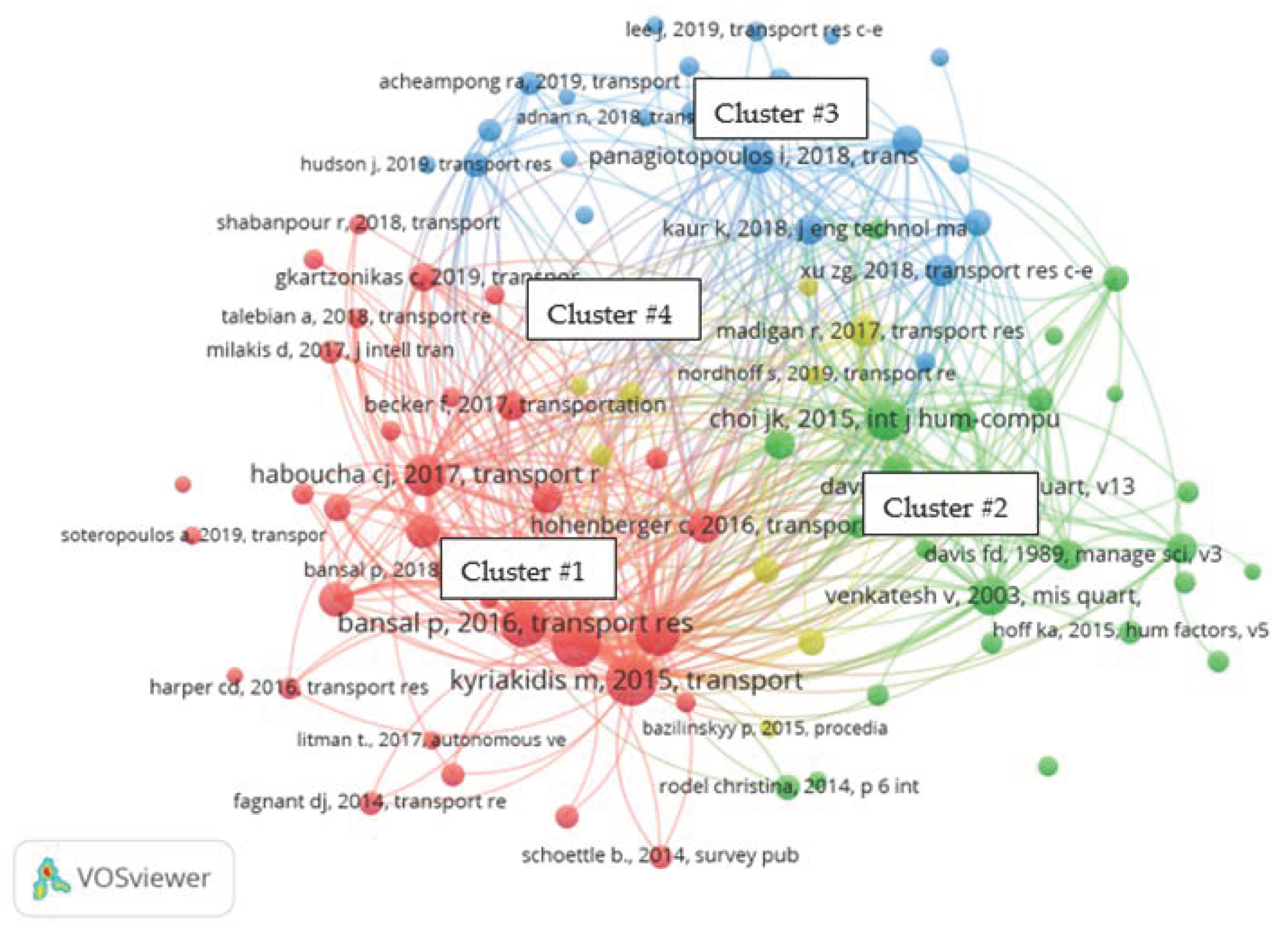
By setting the threshold of minimum citations of a cited reference as 20, a total of 91 nodes under four main clusters were generated, as shown in Figure 4. Each node represents a document, and the links denote the connectivity or relatedness of the documents. Larger nodes mean that the document is widely cited by other scholars, which implies that the ideas, experiments, or methods encompassed in the document have been acknowledged by their peers [48]. In other words, the size of the node links to the influence of the document to research development within the field.
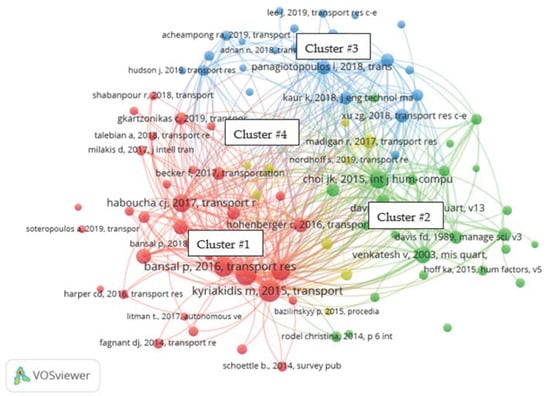
Figure 4.
Bibliometric map of document cocitation. Source: authors’ elaboration performed in VOSviewer (version 1.6.18).
Next, the detailed explanations of the clusters are tabulated in Table 5. In Table 5, the top 2 authors (the top 2 biggest nodes) in each cluster were selected to represent the clusters generated.
Table 5.
The selected top 2 cited references in each cluster as visible in Figure 4.
The representatives’ cited reference papers in this cluster are Kyriakidis et al. [9] and Bansal et al. [36], where both papers discussed survey findings on the acceptance of smart car/AV technologies. The paper by Kyriakidis et al. [9] has 2319 links, while the paper by Bansal et al. [36] has 2105 links. The extensive work conducted by Kyriakidis et al. (included 5000 responses from 109 countries) that gathered valuable information made the paper widely referred by other peers. The survey results revealed that the responses were different in terms of country, culture, and personal variable/trait, such as age, gender, and educational level.
Cluster #2 can be generally labelled with the application of an underlying theory or model in studying the variables influencing the acceptance of AVs. There are 23 documents grouped in this cluster. Among the documents, the main reference papers are by Choi et al. [40] and Venkatesh et al. [49], which have created 1955 and 1296 links, respectively. The former study used the technology acceptance model (TAM) and trust theory in investigating the potential adoption of AVs on 552 drivers. Meanwhile, the latter paper is a seminal work by Vankatesh et al. [49], who proposed the unified theory of acceptance and use of technology (UTAUT).
Cluster #3 gathers more recent publications, which range between the years 2017 and 2020 with a total of 23 papers grouped under this category. The main references in this cluster are authored by Panagiotopoulos et al. [50] with 1433 links and Xu et al. [51] with 1274 links. The development of the research in the category has evolved to the application of an extended model to examine the acceptance of AVs. A psychological model, trust theory, and other determinants, such as perceived safety, were included in the study frameworks.
Cluster # 4 is labeled with automated public transport. There are 10 papers under this cluster #4, where the publications by Madigan et al. [52,53] dominated the references with 1270 and 752 links, respectively. The work by Madigan et al. applied the UTAUT theory in investigating the public acceptance of AVs.
4.2. Collaboration
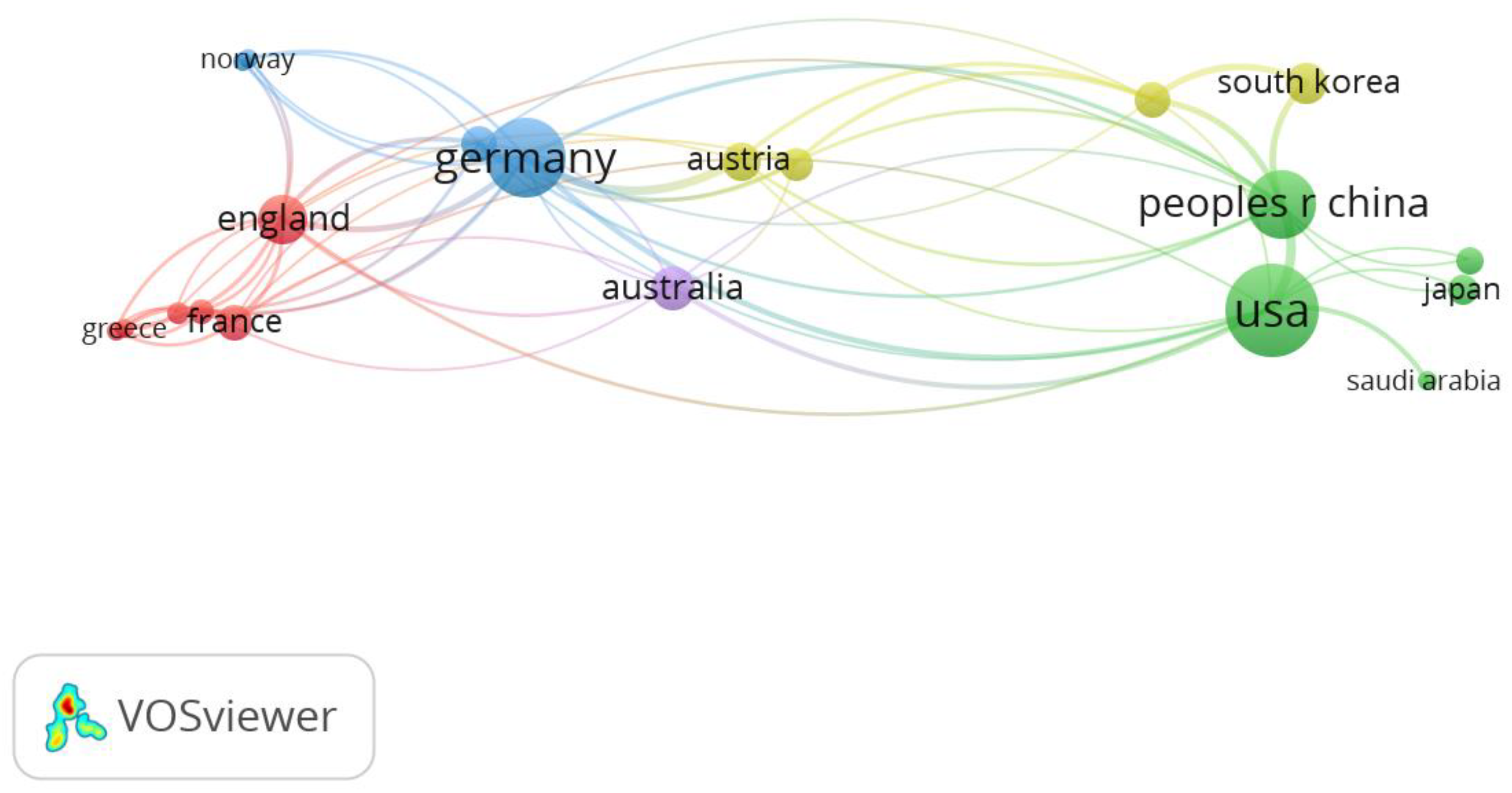
Figure 5 illustrates the author collaboration network map. Based on the frequency threshold of 5 documents, a total of 20 countries were identified. The largest author network is from the US, where the researchers in the US jointly collaborated with researchers from China, Japan, Canada, Saudi Arabia, Singapore, Austria, Australia, Germany, Netherlands, England, and France. The high level of cooperation between these countries might be due to the large scale of AV testing in the particular countries.
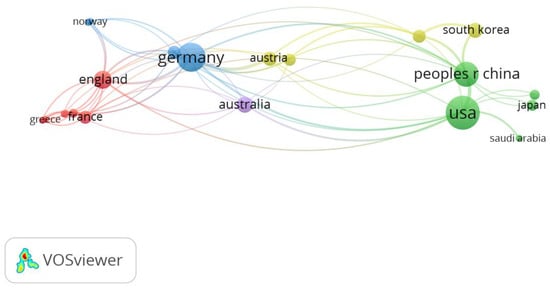
Figure 5.
Bibliometric map of coauthorships. Source: authors’ elaboration performed in VOSviewer (version 1.6.18).
4.3. Keyword Analysis: The Emerging Research Trend
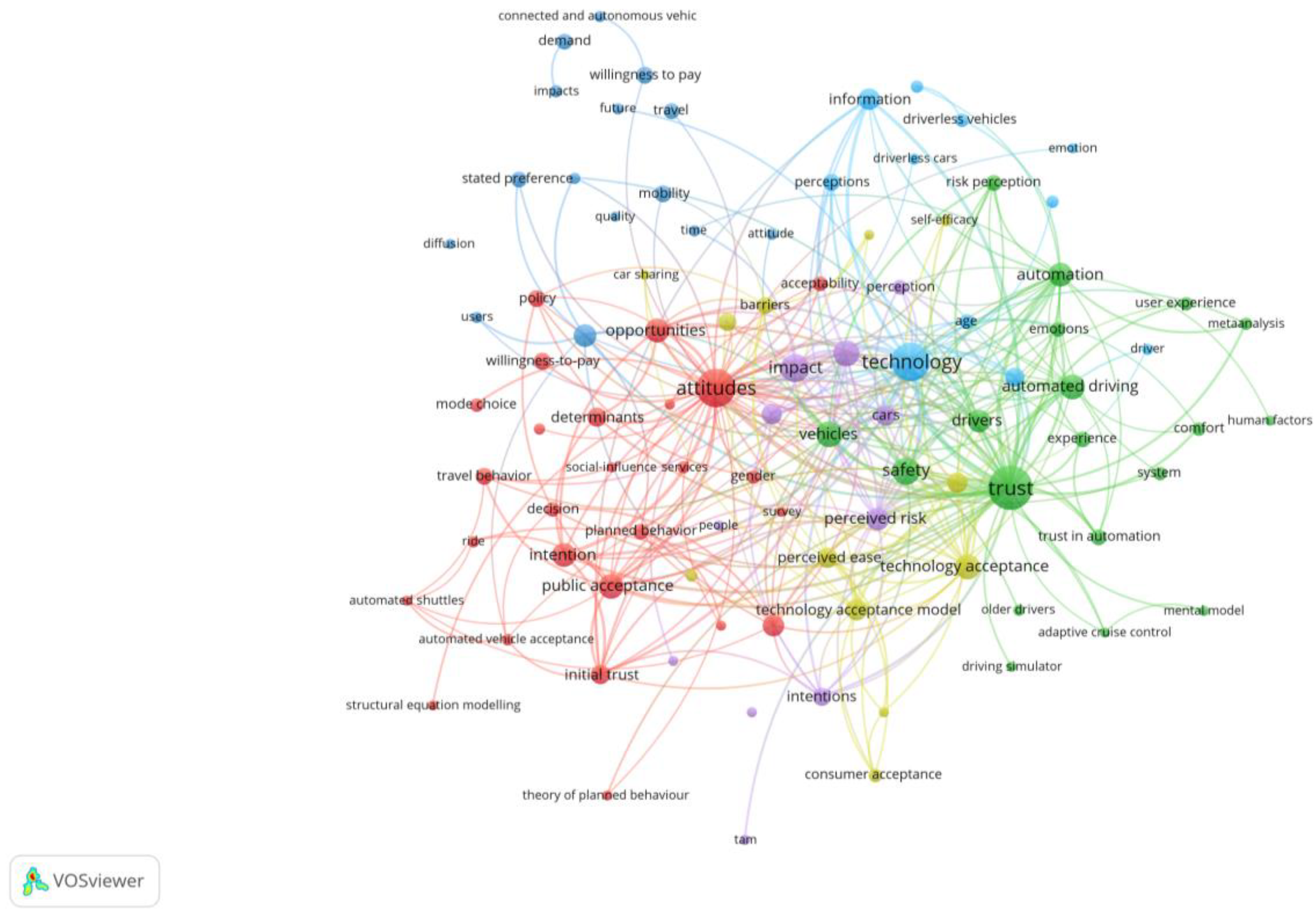
By using the co-occurrence function in VOSviewer for all the keywords in the articles with a minimum occurrence threshold value of 5, the frequently cited keywords were identified. Figure 6 illustrates the key research domains, which can be grouped into 5 clusters with 5 colors. According to the manual of VOSviewer, a cluster (also known as “community” in literature) is a set of items included in a map. The same color of the items represents the same cluster. Clusters are nonoverlapping in VOSviewer, or an item may belong to only one cluster. In addition, based on the keyword map, keywords such as “automated vehicles”, “acceptance”, and “user acceptance” dominate the word cloud. These words are the keywords used to search for the related articles. Therefore, when omitting these filtering keywords, the next top 5 keywords—trust, attitude, technology, impact, and models—based on the cited frequency were captured and are shown in Table 5.
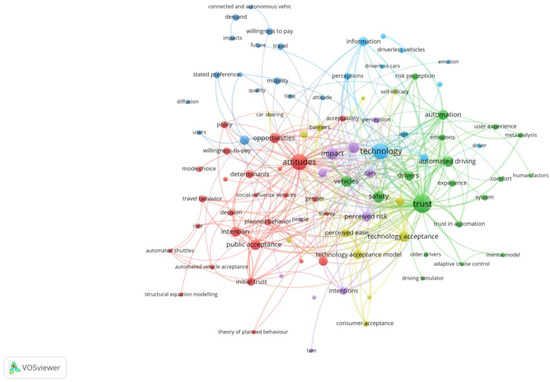
Figure 6.
Bibliometric map of keywords’ co-occurrence (minimum of 5). Source: authors’ elaboration performed in VOSviewer (version 1.6.18).
As shown in Table 6, attitude is the s most quoted keyword in the literature. According to Modliński et al. [54], there is a disparity between trust and attitude. Trust is a belief or judgment about the trustworthiness of an object or technology that justifies [55], while attitude refers to the general predisposition of an individual’s behavior towards an object or technology. Both are important research domains that greatly affect the level of acceptance or adoption of AVs [9,56,57,58]. The findings of the studies have shown that there are differences in the attitude towards autonomous technology in gender [42,59,60], age [61], country [11], religion [54], educational background [62], personal traits [63], and culture [64,65]. For instance, male respondents who are more tech-savvy and younger are more likely to adopt AVs [66]. In addition, Zmud and Sener [12] reported mixed findings due to different educational levels. Some researchers revealed that people with higher educational background are more open to AV technologies, but there are also studies that reveal that well-educated people are less likely to accept AVs as they are more skeptical of data protection and cybersecurity matters.
Table 6.
Cluster of keywords’ co-occurrences as presented in Figure 6.
Trust is the second most cited keyword in the literature. Gefen et al. [67] stated that trust is an important study domain particularly in new technologies. Numerous studies have been conducted to understand users’ acceptance and use of AVs based on trust in AV technology, which might be still uncertain and vulnerable [68,69]. Findings suggest that self-reported trust increases after participants have experienced the technology [70], and trust has been shown to be a significant positive predictor of future intentions to use AVs [71]. Most studies have evaluated initial trust in AVs via self-reported questionnaires (e.g., [43,50]) or after experiencing vehicle functions within a simulated driving environment (e.g., [70,71]). It was found that self-reported trust increased when an individual participated in experiencing the technology [70]. Hence, there is evidence that trust is a positive significant predictor of future intentions to use AVs [71]. In addition, studies have shown that participants who experienced a planned but unexpected automation failure in an AV on a closed track demonstrated a reduction in their sentiments (trust) towards AVs [51]. There are many other factors beyond trust that contribute to the public interest in using AVs and their willingness to share the road with AVs [42,72], such as workload [73], age [74,75], and training. Therefore, to make AV technology become ubiquitous, understanding the causal factors on trust is of utmost importance, thereby helping to design strategies for increasing drivers’ trust in automated driving systems [43,51].
The third keyword is technology. Alawadhi et al. [76] documented that the concept of automation vehicle was introduced in 1918, and the first working paper was presented by General Motors in 1939 [77]. Following that, the innovative cruise control was developed in 1948 [78]. Since then, the development of technology is rapidly evolving, whereby technology readiness is the major agenda for automotive makers and high-tech companies. Apart from vehicle technology, other technologies, such as road infrastructure (communication systems between the environment and AVs), charging infrastructure (provision of battery charging facility), and computer technology (privacy protection and cybersecurity) are widely explored [76,79,80].
Next, model is the fourth keyword searched. It refers to the methods or approaches applied in predicting the acceptance of AV technology. While the technology acceptance model is the most popular model, other models include the theory of reasoned action, motivational model, theory of planned behavior, combined TAM and TPB, model of PC utilization, innovation diffusion theory, social cognitive theory, and the unified theory of acceptance and use of technology (UTAUT) model. Jing et al. [81] summarized that theory-based models can better explain the predictors of AV adoption intention.
The last keyword is impact. While focusing on the development of AV technology, the potential impacts anticipated with AV technology are also widely investigated in the literature [18]. AV is known as the disruptive innovation that would significantly change every aspect of human life in terms of the environment, society, and economy [82,83]. The invention of AV is expected to reduce up to 94% of traffic crashes by eradicating driver’s errors [84]. Fagnant and Kockelman [85] stated that the emerging AV technology can bring extensive benefits to society, such as increase in traffic safety performance, reduced congestion and emissions, and provision of a safe and inexpensive transport mode to disabled or mobility-limited people. Nonetheless, it is also reported that AV brings other new safety problems [86]. This was due to the two fatal accidents involving AV in 2018; the safety of AVs has drawn wide attention from the public [87]. Thereafter, studies on safety concerns particularly from the vulnerable road user’s perspective have been escalated [62,88,89,90,91]. Other system operation failures, such as malfunction sensor in detecting the signages or obstacles, poses another concern to road users [92]; increasing trip frequencies and expensive provision of a transport infrastructure and land-use development [93] are also some concerns of AV safety issues.
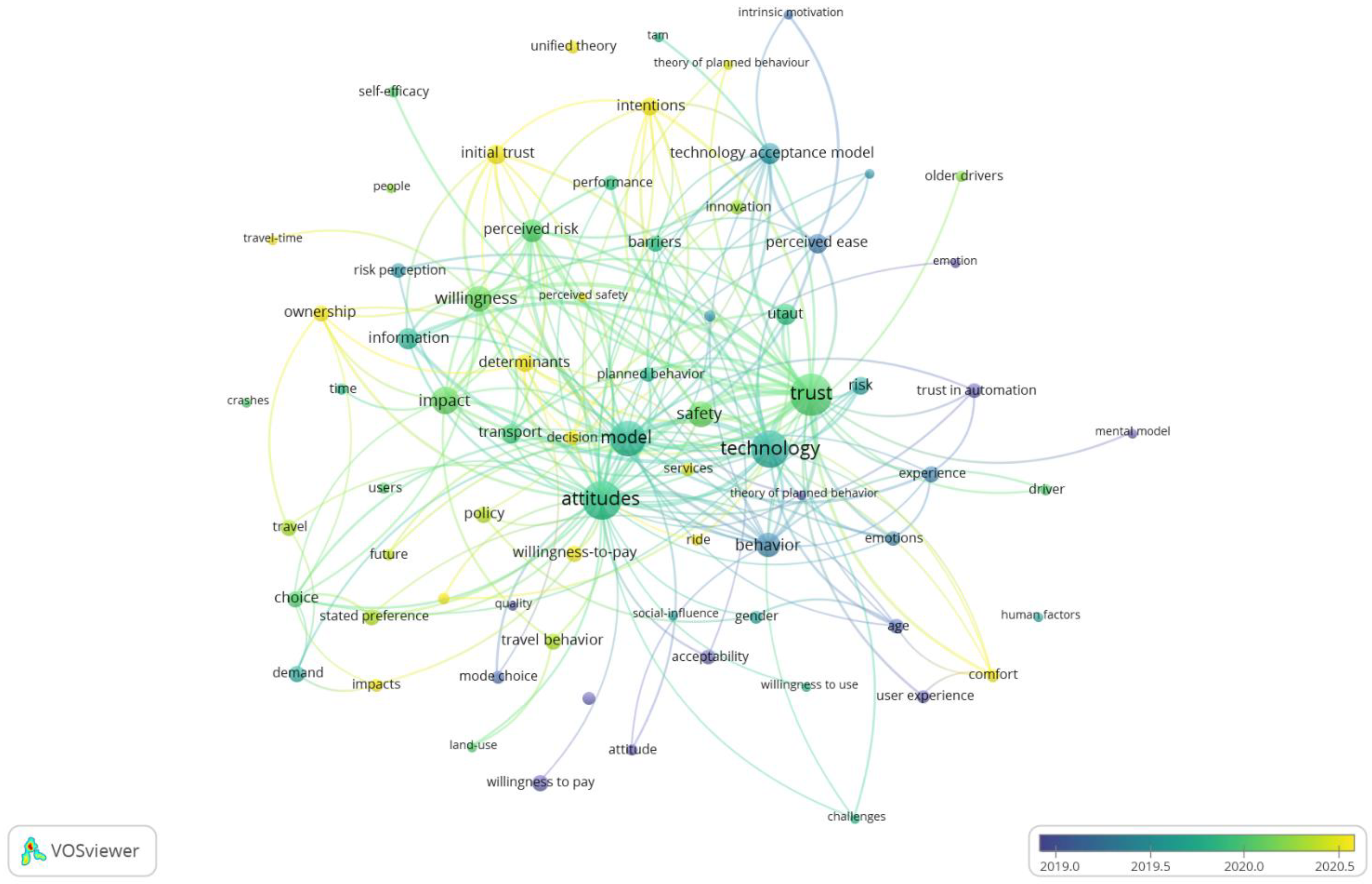
On the other hand, the bibliometric map of the keyword trend is presented in Figure 7. The overlay visualization map illustrates the development of the keywords (research topics) over the years, which are displayed in various color ranges (from darker color and blue to light yellow color). A darker color (from the years 2019–2019.5) represents older research, while the yellow color starts in the earlier year of 2020. As shown in Figure 7, the research interest has evolved from a behavioral study (purple color) to more specific investigations, such as the role of determinants and ownership of AVs (yellow color). Comfort experience with AVs and the impacts of AVs are also among the recent emerging trends of research. It is interesting to note that the trust topic is consistently drawing the attention of researchers over the past years (color ranging from purple to yellow) as many researchers suggest that trust in AVs would evolve in line with the advancement of AV technology, thereby requesting longitudinal analysis on trust.
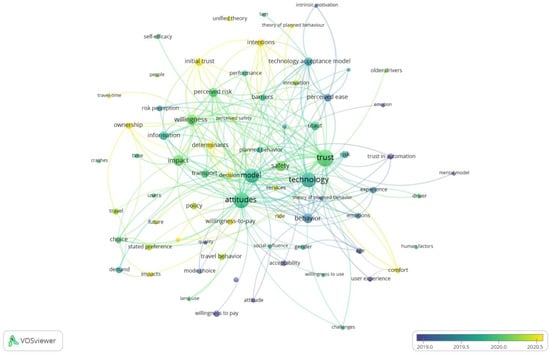
Figure 7.
Bibliometric map of keywords in the overlay visualization context, co-occurrence (minimum of 5). Source: authors’ elaboration performed in VOSviewer (version 1.6.18).
5. Future Research Direction
This study complements the very few existing bibliometrics and systematic review papers by converging into the public acceptance of AV research in the past decade. Hence, several recommendations from the aspects of research approaches and regions, antecedents and models of AV adoption, and consequences’ effect after adopting the technology for future research opportunities are provided in the next section.
5.1. Research Approaches and Region
Based on the review, quantitative approaches and cross-sectional studies predominate the AV technology adoption literature. On the other hand, the qualitative studies adopting a holistic perspective, such as in-depth analysis, are still rarely available in technology adoption studies. Therefore, a mixed method research approach whereby researchers collect and analyze both quantitative and qualitative data within the same study is recommended in future studies. Mixed methods research allows researchers to explore diverse perspectives and uncover relationships that exist between the intricate layers of multifaceted research questions related to the perspectives of AV and discovered from a particular market segment, who is the potential user of AV in the future.
Next, AV technology adoption in different regions should be explored in future studies. A search in the WOS database indicates that interests in the topic of AV are escalating in the last few years. The most productive year was in 2021 with a total of 110 publications. Of the 401 articles, about 29% were produced by US scholars in collaboration with their peers from 11 countries, such as China, Japan, Canada, Saudi Arabia, Singapore, Austria, Australia, Germany, Netherlands, England, and France. These are countries where AV technologies are actively developed and tested. Inversely, no leading studies were conducted in developing countries or in third world countries. This may be because of the limited demand in the implementation of AV technologies in those countries. Public behavior towards AV adoption in other countries, particularly in Southeast Asian countries, is unknown and requires further investigation.
In addition, the findings reported today might not be true tomorrow when fully automated vehicles (Level 4 and Level 5) eventually hit the roads. The uncertainties of the world evolution might also change human perception especially when they have experience with AVs. Policy makers and car developers play important roles in propagating the benefits of AVs and making AVs easily accessible in order to build trust. Therefore, test and retest studies should be carried out along with initiatives to validate these findings from time to time. Compared with trust, studies associated with the term of impacts were less discussed as the current focus is allotted to the diffusion of AVs. Perhaps more attention could be given to look into the implications of policies and regulations, ethical issues, liability, cybersecurity related to AV operation in the traffic streams, and the environment to humans. The advocated benefits associated with AVs should also be evaluated to avoid overglorification of their merits.
5.2. Antecedents and Models
Along with the findings from keyword analysis, it is shown that the literature within this study circled on the influence of personal traits and social demographic attributes in sculpting attitudes towards AVs. The five major trunks of studies are: attitude, trust, technology, models, and impacts. Trust is regarded as a critical determinant for AV acceptance. It is argued that the more people trust the technology, the higher the acceptance of AV technology will be. Zhang et al. [94] concluded that an increase in the trust level is one of the persuasive approaches to promote AVs. Nevertheless, the literature also revealed that trust is differed across continents, backgrounds, and other subgroups. To be more specific, future researchers are recommended to examine the impact of the trust dimensions, such as competence, integrity, and benevolence, on AV adoption intention.
In terms of the model used, although the analysis of public acceptance is highly dependent on the psychological theory, such as the technology acceptance model, theory of reasoned action, theory of planned behavior, UTAUT, and other models, to predict the adoption of AVs, results reported from the past are still far from being conclusive. Since the majority of the studies applied or extended from a single model to study the technology acceptance or adoption, this may result in the possibilities of neglecting the blend or integration of multiple models for a better decision-making process of practitioners in the AV industry. Future researchers are recommended to evaluate and compare the predictive power of the single and blended model, and identify the best fitted model to better explain public adoption of AV.
5.3. Consequences Effects
Most of the studies conducted in the past investigated consumer intention to use or actual adoption behavior towards AV technology. However, studies that discussed the consequent effects, such as benefits or drawbacks after adopting these technologies, are limited. It is important to understand the consequences obtained by users after the actual adoption of AV technology. A more realistic experience and feedback regarding the benefits, drawbacks, or effectiveness of AV technology can be provided to researchers and practitioners to implement or invent a technology that fulfills customers’ actual needs rather than based on perception-based studies, which may lead to bias.
6. Conclusions
This study contributes to the existing body of literature by applying the bibliometric technique to analyze the topic of AV technology adoption with three research objectives: (1) analysis of the nature of distribution from various studies, (2) the global emerging research trends and core research cluster of AVs, and (3) the future research direction recommendation. The bibliometrics review in this paper was novel in the context of AV adoption as it was conducted based on 401 related articles indexed in the Web of Science (WOS) reported from 2000 to June 2022. Among these 401 related articles across 53 countries, the US is the main contributor to the body of literature, followed by Germany and China. More collaborations between researchers in developed and developing countries should be encouraged in order to understand the localized challenges and increase knowledge sharing, thereby strengthening the technical, social, ethical, and governance aspects of the development of AVs.
AV is an emerging technology that is expected to change the human lifestyle with promises to bring benefits in terms of safety, mobility, and sustainable environment. Nonetheless, the public acceptance of AVs is still low, probably due to the unavailability of AVs in the market yet. Alongside these findings, the five domain research clusters in previous AV studies, such as attitude, trust, technology, models, and impacts, were identified, in which these areas of studies are expected to remain valid and important in the near future until the AV market becomes mature. In addition, the agenda for future research includes research approaches and regions, antecedents and model testing, and consequence effects of AV adoption. Hence, for the theoretical contribution, the overview of bibliometric maps is particularly important to researchers in developing countries where AVs are soon to be introduced in their countries. Researchers can borrow the experience of the developed countries as their dominant focus in their research direction. The trends and gaps of the previous main research serve as a basis for their startup research. Moreover, the collaboration map shares an impression of the prominent researchers or institutions in the AV adoption research studies. For instance, the five domain research clusters identified from this paper can be applied or integrated in studies related to AVs to better understand user acceptance towards new technology across different countries.
In terms of practical implications, the illustration of the focus of research topics related to the acceptance of AVs in the world is essential to policy makers and industry players. For instance, prolific research topics such as trust in technology and its impacts (as shown in the bibliometric map) imply that these factors are the major concerns of potential AV users, which, on the contrary, are seen as challenges to car makers. Therefore, the findings can shed some light on car makers to fine-tune and deepen the relevant aspects of technology development. The trends and issues identified in this study can also assist car makers to strategize the deployment of AVs in the market. At the government level, policy makers should ensure that AVs are to be deployed in a safe environment with a reliable transport infrastructure and safeguard the interest of each type of road users in order to maintain social stability.
Nevertheless, this study inherits two limitations. First, the literature is limited to published articles from the WOS database and a limit timeline between 2000 and June 2022. There are other valuable databases, such as Scopus, EBSCO, ProQuest, ScienceDirect, Sage, and Emerald, that are excluded. Apart from these, besides English, articles in other languages are not included, where it is assumed that there are many critical papers written in German or Chinese judging from the development of AV technologies in the respective countries. Thus, these two shortcomings could be considered in future research for better insight and information.
Author Contributions
The authors worked together for this paper. Conceptualization, J.S.H., B.C.T., T.C.L. and N.K.; formal analysis, J.S.H.; methodology, J.S.H.; project administration, B.C.T., N.K. and T.C.L.; resources, B.C.T. and N.K.; software, J.S.H.; supervision, B.C.T. and N.K.; validation, B.C.T.; writing—original draft, J.S.H., B.C.T. and T.C.L.; writing—review and editing, J.S.H., B.C.T. and T.C.L. All authors have read and agreed to the published version of the manuscript.
Funding
This research received no external funding.
Institutional Review Board Statement
Not applicable.
Informed Consent Statement
Not applicable.
Data Availability Statement
Not applicable.
Acknowledgments
The authors would like to thank Multimedia University for supporting the publication of this paper.
Conflicts of Interest
The authors declare no conflict of interest.
References
- World Health Organization, WHO. Global Status Report on Road Safety. 2018. Available online: https://www.who.int/publications/i/item/9789241565684 (accessed on 22 August 2022).
- Kaye, S.A.; Somoray, K.; Rodwell, D.; Lewis, I. Users’ acceptance of private automated vehicles: A systematic review and meta-analysis. J. Saf. Res. 2021, 79, 352–367. [Google Scholar] [CrossRef]
- Singh, S. Critical Reasons for Crashes Investigated in the National Motor Vehicle Crash Causation Survey. Available online: https://crashstats.nhtsa.dot.gov/Api/Public/ViewPublication/812506 (accessed on 22 August 2018).
- Harb, M.; Stathopoulos, A.; Shiftan, Y.; Walker, J.L. What do we (Not) know about our future with automated vehicles? Transp. Res. Part C Emerg. Technol. 2021, 123, 102948. [Google Scholar] [CrossRef]
- Xing, Y.; Zhou, H.; Han, X.; Zhang, M.; Lu, J. What influences vulnerable road users’ perceptions of autonomous vehicles? A comparative analysis of the 2017 and 2019 Pittsburgh surveys. Technol. Forecast. Soc. Chang. 2022, 176, 121454. [Google Scholar] [CrossRef]
- Korkmaz, H.; Fidanoglu, A.; Ozcelik, S.; Okumus, A. User acceptance of autonomous public transport systems: Extended UTAUT2 model. J. Public Transp. 2021, 23, 100013. [Google Scholar] [CrossRef]
- Winkler, M.; Mehl, R.; Erander, H.; Sule, S.; Buvat, J.; KVJ, S.; Sengupta, A.; Khemka, Y.; Capgemini Research Institute. The Autonomous Car: A Consumer Perspective. Available online: https://www.capgemini.com/wp-content/uploads/2019/05/30min-%E2%80%93-Report-1-1.pdf (accessed on 22 August 2022).
- MIT Technology Reviews. Autonomous Vehicles: Are You Ready for the New Ride? 2007. Available online: https://www.technologyreview.com/s/609450/autonomous-vehicles-are-you-ready-for-the-new-ride/ (accessed on 22 August 2022).
- Kyriakidis, M.; Happee, R.; De Winter, J.C.F. Public opinion on automated driving: Results of an international questionnaire among 5000 respondents. Transp. Res. Part F Traffic Psychol. Behav. 2015, 32, 127–140. [Google Scholar] [CrossRef]
- Emory, K.; Douma, F.; Cao, J. Autonomous vehicle policies with equity implications: Patterns and gaps. Transp. Res. Interdiscip. Perspect. 2022, 13, 100521. [Google Scholar] [CrossRef]
- Othman, K. Exploring the implications of autonomous vehicles: A comprehensive review. Innov. Infrastruct. Solut. 2022, 7, 165. [Google Scholar] [CrossRef]
- Zmud, J.P.; Sener, I.N. Towards an Understanding of the Travel Behavior Impact of Autonomous Vehicles. Transp. Res. Procedia 2017, 25, 2500–2519. [Google Scholar] [CrossRef]
- Ziad, A.; Ramdani, B. Behavioural intention to use fully autonomous vehicles: Instrumental, symbolic and affective motives. Transp. Res. Part F Psychol. Behav. 2022, 86, 226–237. [Google Scholar] [CrossRef]
- Raj, A.; Kumar, J.A.; Bansal, P. A multicriteria decision making approach to study barriers to the adoption of autonomous vehicles. Transp. Res. Part A Policy Pract. 2020, 133, 122–137. [Google Scholar] [CrossRef]
- Pritchard, A. Statistical bibliography or bibliometrics. J. Doc. 1969, 25, 348–349. [Google Scholar]
- Hood, W.W.; Wilson, C.S. The Literature of Bibliometrics, Scientometrics, and Informetrics. Scientometrics 2001, 52, 291–314. [Google Scholar] [CrossRef]
- Biggi, G.; Stilgoe, J. Artificial Intelligence in Self-Driving Cars Research and Innovation: A Scientometric and Bibliometric Analysis. 2021. Available online: https://ssrn.com/abstract=3829897 (accessed on 22 August 2022).
- Faisal, A.; Yigitcanlar, T.; Kamruzzaman, M.; Paz, A. Mapping Two Decades of Autonomous Vehicle Research: A Systematic Scientometric Analysis. J. Urban Technol. 2021, 28, 45–74. [Google Scholar] [CrossRef]
- Schauer, C.; Schiebel, E.; Schlögl, C. A bibliometric view of the research development in autonomous driving from 2018 to 2021. SSRN 4102784. [CrossRef]
- Gandia, R.M.; Antonialli, F.; Cavazza, B.F.; Neto, F.M.; de Lima, D.A.; Sugano, J.Y.; Nicolai, I.; Zambalde, A.L. Autonomous vehicles: Scientometric and bibliometric review. Transp. Rev. 2019, 39, 9–28. [Google Scholar] [CrossRef]
- Golbabaei, F.; Yigitcanlar, T.; Paz, A.; Bunker, J. Individual predictors of autonomous vehicle public acceptance and intention to use: A systematic review of the literature. J. Open Innov. Technol. Mark. Complex. 2020, 6, 106. [Google Scholar] [CrossRef]
- Van Eck, N.J.; Waltman, L. VOS: A new method for visualizing similarities between objects. In Advances in Data Analysis, Proceedings of the 30th Annual Conference of the German Classification Society, Berlin, Germany, 8–10 March 2006; Lenz, H.-J., Decker, R., Eds.; Springer: Berlin/Heidelberg, Germany, 2007; pp. 299–306. [Google Scholar]
- Society of Automotive Engineers—SAE. SAE International Releases Updated Visual Chart for Its ‘Levels of Driving Automation’ Standards for Self-Driving Vehicles. Available online: https://www.sae.org/news/press-room/2018/12/sae-international-releases-updated-visual-chart-for-its-%E2%80%9Clevels-of-driving-automation%E2%80%9D-standard-for-self-driving-vehicles (accessed on 9 December 2022).
- Najm, W.G.; Stearns, M.D.; Howarth, H.; Koopmann, J.; Hitz, J. Evaluation of an Automotive Rear-End Collision Avoidance System. In National Highway Traffic Safety Administration (NHTSA); U.S. Department of Transportation: Washington, DC, USA, 2006. [Google Scholar]
- Cserdi, Z.; Kenesei, Z. Attitudes to forced adoption of new technologies in public transportation services. Res. Transp. Bus. Manag. 2021, 41, 100611. [Google Scholar] [CrossRef]
- Rezaei, A.; Caulfield, B. Examining public acceptance of autonomous mobility. Travel Behav. Soc. 2020, 21, 235–246. [Google Scholar] [CrossRef]
- Weigl, K.; Eisele, D.; Riener, A. Estimated years until the acceptance and adoption of automated vehicles and the willingness to pay for them in Germany: Focus on age and gender. Int. J. Transp. Sci. Technol. 2022, 11, 216–228. [Google Scholar] [CrossRef]
- Barnatt, C. The Second Digital Revolution. J. Gen. Manag. 2001, 27, 1–16. [Google Scholar]
- Pendleton, S.D.; Andersen, H.; Du, X.; Shen, X.; Meghjani, M.; Eng, Y.H.; Ang, M.H. Perception, planning, control, and coordination for autonomous vehicles. Machines 2017, 5, 6. [Google Scholar] [CrossRef]
- Yoo, S.; Managi, S. To fully automate or not? Investigating demands and willingness to pay for autonomous vehicles based on automation levels. IATSS Res. 2021, 45, 459–468. [Google Scholar] [CrossRef]
- Lee, Y.C.; Hand, S.H.; Lilly, H. Are parents ready to use autonomous vehicles to transport children? Concerns and safety features. J. Saf. Res. 2020, 72, 287–297. [Google Scholar] [CrossRef]
- Dunne, M.J. Forbes—China Aims to Be No. 1 Globally in EVs, Autonomous Cars By 2030. Available online: https://www.forbes.com/sites/michaeldunne/2016/12/14/chinas-automotive-2030-blueprint-no-1-globally-in-evs-autonomous-cars/#20056cd61c6e (accessed on 22 August 2022).
- Chng, S.; Cheah, L. Understanding Autonomous Road Public Transport Acceptance: A Study of Singapore. Sustainability 2020, 12, 4974. [Google Scholar] [CrossRef]
- Chng, S.; Anowar, S.; Cheah, L. To embrace or not to embrace? Understanding public’s dilemma about autonomous mobility services: A case study of Singapore. Case Stud. Transp. Policy 2021, 9, 1542–1552. [Google Scholar] [CrossRef]
- Tokyoesque. The Japanese Automotive Market: Driving Strong Demand in 2021 and beyond. Available online: https://tokyoesque.com/japanese-automotive-market/ (accessed on 22 August 2022).
- Bansal, P.; Kockelman, K.; Singh, A. Assessing public opinions of and interest in new vehicle technologies: An Austin perspective. Transp. Res. Part C Emerg. Technol. 2016, 67, 1–14. [Google Scholar] [CrossRef]
- Haboucha, C.J.; Ishaq, R.; Shiftan, Y. User preferences regarding autonomous vehicles. Transp. Res. Part C Emerg. Technol. 2017, 78, 37–49. [Google Scholar] [CrossRef]
- Krueger, R.; Rashidi, T.H.; Rose, J.M. Preferences for shared autonomous vehicles. Transp. Res. Part C Emerg. Technol. 2016, 69, 343–355. [Google Scholar] [CrossRef]
- Payre, W.; Cestac, J.; Delhomme, P. Intention to use a fully automated car: Attitudes and a priori acceptability. Transp. Res. Part F Traffic Psychol. 2014, 27, 252–263. [Google Scholar] [CrossRef]
- Choi, J.K.; Ji, Y.G. Investigating the importance of trust on adopting an autonomous vehicle. Int. J. Hum.-Comput. Interact. 2015, 31, 692–702. [Google Scholar] [CrossRef]
- Bansal, P.; Kockelman, K.M. Forecasting Americans’ long-term adoption of connected and autonomous vehicle technologies. Transp. Res. Part A 2017, 95, 49–63. [Google Scholar] [CrossRef]
- Hulse, L.M.; Xie, H.; Galea, E.R. Perceptions of autonomous vehicles: Relationships with road users, risk, gender and age. Saf. Sci. 2018, 102, 1–13. [Google Scholar] [CrossRef]
- Zhang, T.; Tao, D.; Qu, X.; Zhang, X.Y.; Lin, R.; Zhang, W. The roles of initial trust and perceived risk in public’s acceptance of automated vehicles. Transp. Res. Part C Emerg. Technol. 2019, 98, 207–220. [Google Scholar] [CrossRef]
- Kaur, K.; Rampersad, G. Trust in driverless cars: Investigating key factors influencing the adoption of driverless cars. J. Eng. Tech. Manag. 2018, 48, 87–96. [Google Scholar] [CrossRef]
- White, H.D.; Griffith, B.C. Author cocitation: A literature measure of intellectual structure. J. Am. Soc. Inf. Sci. 1981, 32, 163–171. [Google Scholar] [CrossRef]
- Braam, R.R.; Moed, H.F.; Van Raan, A.F. Mapping of science by combined co-citation and word analysis. II: Dynamical aspects. J. Am. Soc. Inf. Sci. 1991, 42, 252–266. [Google Scholar] [CrossRef]
- Zhang, C.Y.; Wang, S.Y.; Sun, S.L.; Wei, Y.J. Knowledge mapping of tourism demand forecasting research. Tour. Manag. Perspect. 2020, 35, 100715. [Google Scholar] [CrossRef]
- Trujillo, C.M.; Long, T.M. Document co-citation analysis to enhance transdisciplinary research. Sci. Adv. 2018, 4, e1701130. [Google Scholar] [CrossRef]
- Venkatesh, V.; Davis, F.D. User acceptance of information technology: Toward a unified view. Mis Quart. Manage. Inform. Syst. 2003, 27, 425–478. [Google Scholar] [CrossRef]
- Panagiotopoulos, I.; Dimitrakopoulos, G. An empirical investigation on consumers’ intentions towards autonomous driving. Transp. Res. Part C Emerg. Technol. 2018, 95, 773–784. [Google Scholar] [CrossRef]
- Xu, Z.; Zhang, K.; Min, H.; Wang, Z.; Zhao, X.; Liu, P. What drives people to accept automated vehicles? Findings from a field experiment. Transp. Res. Part C Emerg. Technol. 2018, 95, 320–334. [Google Scholar] [CrossRef]
- Madigan, R.; Louw, T.; Wilbrink, M.; Schieben, A.; Merat, N. What influences the decision to use automated public transport? Using UTAUT to understand public acceptance of automated road transport systems. Transp. Res. Part F Traffic Psychol. Behav. 2017, 50, 55–64. [Google Scholar] [CrossRef]
- Madigan, R.; Louw, T.; Dziennus, M.; Graindorge, T.; Ortega, E.; Graindorge, M.; Merat, N. Acceptance of Automated Road Transport Systems (ARTS): An adaptation of the UTAUT model. Transp. Res. Procedia 2016, 14, 2217–2226. [Google Scholar] [CrossRef]
- Modliński, A.; Gwiaździński, E.; Karpińska-Krakowiak, M. The effects of religiosity and gender on attitudes and trust toward autonomous vehicles. J. High Technol. Manag. Res. 2022, 33, 100426. [Google Scholar] [CrossRef]
- McKnight, D.H.; Carter, M.; Thatcher, J.B.; Clay, P.F. Trust in a specific technology: An investigation of its components and measures. ACM Trans. Manag. Inf. Syst. 2011, 2, 1–25. [Google Scholar] [CrossRef]
- Bennett, R.; Vijaygopal, R.; Kottasz, R. Attitudes towards autonomous vehicles among people with physical disabilities. Transp. Res. Part A Policy Pract. 2019, 127, 1–17. [Google Scholar] [CrossRef]
- Bennett, R.; Vijaygopal, R.; Kottasz, R. Willingness of people who are blind to accept autonomous vehicles: An empirical investigation. Transp. Res. Part F Traffic Psychol. Behav. 2020, 69, 13–27. [Google Scholar] [CrossRef]
- Wang, S.; Zhao, J. Risk preference and adoption of autonomous vehicles. Transp. Res. Part A Policy Pract. 2019, 126, 215–229. [Google Scholar] [CrossRef]
- Acheampong, R.A.; Cugurullo, F. Capturing the behavioural determinants behind the adoption of autonomous vehicles: Conceptual frameworks and measurement models to predict public transport, sharing and ownership trends of self-driving cars. Transp. Res. Part F Traffic Psychol. Behav. 2019, 62, 349–375. [Google Scholar] [CrossRef]
- Charness, N.; Yoon, J.S.; Souders, D.; Stothart, C.; Yehnert, C. Predictors of attitudes toward autonomous vehicles: The roles of age, gender, prior knowledge, and personality. Front. Psychol. 2018, 9, 2589. [Google Scholar] [CrossRef]
- Woldeamanuel, M.; Nguyen, D. Perceived benefits and concerns of autonomous vehicles: An exploratory study of millennials’ sentiments of an emerging market. Res. Transp. Econ. 2018, 71, 44–53. [Google Scholar] [CrossRef]
- Hudson, J.; Orviska, M.; Hunady, J. People’s attitudes to autonomous vehicles. Transp. Res. Part A Policy Pract. 2019, 121, 164–176. [Google Scholar] [CrossRef]
- Leicht, T.; Chtourou, A.; Ben Youssef, K. Consumer innovativeness and intentioned autonomous car adoption. J. High Technol. Manag. Res. 2018, 29, 1–11. [Google Scholar] [CrossRef]
- Liu, P.; Xu, Z. Public attitude toward self-driving vehicles on public roads: Direct experience changed ambivalent people to be more positive. Technol. Forecast. Soc. Change 2020, 151, 119827. [Google Scholar] [CrossRef]
- Yuen, K.F.; Wong, Y.D.; Ma, F.; Wang, X. The determinants of public acceptance of autonomous vehicles: An innovation diffusion perspective. J. Clean. Prod. 2020, 270, 121904. [Google Scholar] [CrossRef]
- Hassan, H.M.; Ferguson, M.R.; Vrkljan, B.; Newbold, B.; Razavi, S. Older adults and their willingness to use semi and fully autonomous vehicles: A structural equation analysis. J. Transp. Geogr. 2021, 95, 103133. [Google Scholar] [CrossRef]
- Gefen, D.; Karahanna, E.; Straub, D.W. Trust and TAM in online shopping: An integrated model. MIS Q. 2003, 27, 51–90. [Google Scholar] [CrossRef]
- Abe, G.; Itoh, M.; Tanaka, K. Dynamics of drivers’ trust in warning systems. IFAC Proc. Vol. 2002, 35, 363–368. [Google Scholar] [CrossRef]
- Lee, J.D.; See, K.A. Trust in automation: Designing for appropriate reliance. Hum. Factors 2004, 46, 50–80. [Google Scholar] [CrossRef]
- Gold, C.; Körber, M.; Hohenberger, C.; Lechner, D.; Bengler, K. Trust in automation—Before and after the experience of take-over scenarios in a highly automated vehicle. Procedia Manuf. 2015, 3, 3025–3032. [Google Scholar] [CrossRef]
- Buckley, L.; Kaye, S.A.; Pradhan, A.K. A qualitative examination of drivers’ responses to partially automated vehicles. Transp. Res. Part F Traffic Psychol. Behav. 2018, 56, 167–175. [Google Scholar] [CrossRef]
- Moody, J.; Bailey, N.; Zhao, J. Public perceptions of autonomous vehicle safety: An international comparison. Saf. Sci. 2020, 121, 634–650. [Google Scholar] [CrossRef]
- Banks, V.A.; Stanton, N.A. Driver-centred vehicle automation: Using network analysis for agent-based modelling of the driver in highly automated driving systems. Ergonomics 2016, 59, 1442–1452. [Google Scholar] [CrossRef]
- Berkowsky, R.W.; Sharit, J.; Czaja, S.J. Factors predicting decisions about technology adoption among older adults. Innov. Aging 2017, 1, 2. [Google Scholar] [CrossRef]
- Rogers, W.A.; Mitzner, T.L.; Boot, W.R.; Charness, N.H.; Czaja, S.J.; Sharit, J. Understanding individual and age-related differences in technology adoption. Innov. Aging 2017, 1, 1026. [Google Scholar] [CrossRef]
- Alawadhi, M.; Almazrouie, J.; Kamil, M.; Khalil, K.A. A systematic literature review of the factors influencing the adoption of autonomous driving. Int. J. Syst. Assur. Eng. Manag. 2020, 11, 1065–1082. [Google Scholar] [CrossRef]
- Shladover, S.E. Connected and automated vehicle systems: Introduction and overview. J. Intell. Transp. Syst. 2018, 22, 190–200. [Google Scholar] [CrossRef]
- Ross, P. Robot, you can drive my car. IEEE Spectr. 2014, 51, 60–90. [Google Scholar] [CrossRef]
- Ge, I.J.; Avedisov, S.S.; He, C.R.; Qin, W.B.; Sadeghpour, M.; Orosz, G. Experimental validation of connected automated vehicle design among human-driven vehicles. Transp. Res. Part C Emerg. Technol. 2018, 91, 335–352. [Google Scholar] [CrossRef]
- Zheng, L.; Li, B.; Yang, B.; Song, H.; Lu, Z. Lane-level road network generation techniques for lane-level maps of autonomous vehicles: A survey. Sustainability 2019, 11, 4511. [Google Scholar] [CrossRef]
- Jing, P.; Huang, H.; Ran, B.; Zhan, F.; Shi, Y. Exploring the Factors Affecting Mode Choice Intention of Autonomous Vehicle Based on an Extended Theory of Planned Behavior—A Case Study in China. Sustainability 2019, 11, 1155. [Google Scholar] [CrossRef]
- Potoglou, D.; Whittle, C.; Tsouros, I.; Whitmarsh, L. Consumer intentions for alternative fuelled and autonomous vehicles: A segmentation analysis across six countries. Transp. Res. Part D Transp. Environ. 2020, 79, 102243. [Google Scholar] [CrossRef]
- Tan, S.Y.; Taeihagh, A. Adaptive governance of autonomous vehicles: Accelerating the adoption of disruptive technologies in Singapore. Gov. Inf. Q. 2021, 38, 101546. [Google Scholar] [CrossRef]
- NHTSA’s National Center for Statistics and Analysis, U.S. Department of Transportation; National Highway Traffic Safety Administration. Critical Reasons for Crashes Investigated in the National Motor Vehicle Crash Causation Survey. Available online: https://crashstats.nhtsa.dot.gov/Api/Public/ViewPublication/812115 (accessed on 22 August 2022).
- Fagnant, D.J.; Kockelman, K. Preparing a nation for autonomous vehicles: Opportunities, barriers and policy recommendations. Transp. Res. Part A Policy Pract. 2015, 77, 167–181. [Google Scholar] [CrossRef]
- Litman, T. Autonomous Vehicle Implementation Predictions. Canada: Victoria Transport Policy Institute Victoria. Available online: https://www.vtpi.org/avip.pdf (accessed on 22 August 2022).
- Penmetsa, P.; Adanu, E.K.; Wood, D.; Wang, T.; Jones, S.L. Perceptions and expectations of autonomous vehicles—A snapshot of vulnerable road user opinion. Technol. Forecast. Soc. Change 2019, 143, 9–13. [Google Scholar] [CrossRef]
- Afghari, A.P.; Papadimitriou, E.; Li, X.; Kaye, S.A.; Oviedo-Trespalacios, O. How much should a pedestrian be fined for intentionally blocking a fully automated vehicle? A random parameters beta hurdle model with heterogeneity in the variance of the beta distribution. Anal. Methods Accid. Res. 2021, 32, 100186. [Google Scholar] [CrossRef]
- Berge, S.H.; Hagenzieker, M.; Farah, H.; de Winter, J. Do cyclists need HMIs in future automated traffic? An interview study. Transp. Res. Part F Traffic Psychol. Behav. 2022, 84, 33–52. [Google Scholar] [CrossRef]
- Musleh, J.S.A. Effects of Risk, Trust and Attitude on Online Shopping Intention. Ph.D. Dissertation, Multimedia University Malaysia, Cyberjaya, Malaysia, 2018. [Google Scholar]
- Wicki, M. How do familiarity and fatal accidents affect acceptance of self-driving vehicles? Transp. Res. Part F Traffic Psychol. Behav. 2021, 83, 401–423. [Google Scholar] [CrossRef]
- Sohrabi, S.; Khreis, H.; Lord, D. Impacts of Autonomous Vehicles on Public Health: A Conceptual Model and Policy Recommendations. Sustain. Cities Soc. 2020, 63, 102457. [Google Scholar] [CrossRef]
- Narayanan, S.; Chaniotakis, E.; Antoniou, C. Shared autonomous vehicle services: A comprehensive review. Transp. Res. Part C Emerg. Technol. 2020, 111, 255–293. [Google Scholar] [CrossRef]
- Zhang, T.; Zeng, W.; Zhang, Y.; Tao, D.; Li, G.; Qu, X. What drives people to use automated vehicles? A meta-analytic review. Accid. Anal. Prev. 2021, 159, 106270. [Google Scholar] [CrossRef] [PubMed]
Disclaimer/Publisher’s Note: The statements, opinions and data contained in all publications are solely those of the individual author(s) and contributor(s) and not of MDPI and/or the editor(s). MDPI and/or the editor(s) disclaim responsibility for any injury to people or property resulting from any ideas, methods, instructions or products referred to in the content. |
© 2023 by the authors. Licensee MDPI, Basel, Switzerland. This article is an open access article distributed under the terms and conditions of the Creative Commons Attribution (CC BY) license (https://creativecommons.org/licenses/by/4.0/).