


Abstract
A hybrid microgrid system is modelled using HOMER-Pro software for real-time load data and available energy sources at Elapakkam village under Ramapuram substation, Kanchipuram, Tamil Nadu, India. Optimization approaches are applied for the selection of rating of the physical components, including solar PV systems, diesel generators, storage batteries, converters, inverters, and economic parameters such as system cost, fuel cost, and cash flow. The daily community load profile for the year 2018 was estimated based on data from TANGEDCO. Accordingly, the total load demand for the village represented 8760 lines of hourly load. The aim of this paper is to select an optimal-sized and reliable hybrid microgrid system to meet the load demands with available energy inputs. However, a comparison based on the cost of energy (COE) and the penetration of renewable energy is carried out for different case studies in the village with the economic-feasibility analysis of various countries. From this analysis, emissions cannot be completely avoided, they could be minimized by combining existing systems with renewable energy systems.
1. Introduction
Hybrid renewable energy systems (HRES) are becoming popular as standalone power systems for providing electricity in remote areas due to advancements in renewable energy technologies and the subsequent rise consumption of fossil fuels. A hybrid energy system usually consists of two or more renewable energy sources used together to provide increased system efficiency as well as a greater balance in energy supply. Hybrid systems capture the best features of each energy resource and can provide “grid-quality” electricity, with a power range between 1 kilowatt (kW) to several hundred kilowatts. They can be developed as new integrated designs within small electricity distribution systems (mini-grids) and can also be retrofitted in diesel-based power systems.
For swift economic growth, the power sector has to play an inevitable role. However, the power sector is among the most capital-intensive sectors that are the backbone of a developing nation. Hybrid renewable energy systems (HRESs) are ready to provide a promising solution for an independent, feasible and cost-effective power distribution channel for current and future requirements. Off-grid and on-grid systems have various advantages and disadvantages based on the components used for efficient operation. On-grid distributed generation (DG) depends on sustainable power sources and requires the work of vitality stockpiling to defeat the uncertainty in power production by the sources while representing time-fluctuating power costs [1]. Off-grid hybrid systems are most appropriate for remote areas as they dispense with the necessity for grid expansion. Regardless of whether an HRES is an eco-friendly supply of electrical energy generation, because of the stochastic idea of sustainable power sources, it is not a dependable solution [2].
The United Nations Sustainable Development Goals (SDGs) consist of 17 goals, 169 constituent targets, 230 indicators, and an evidence-based indicator to transform the whole world into a sustainable one. The Sustainable Development Goals are very much essential for the development and growth of a nation to promote prosperity while protecting the environment. The Sustainable Development Goals (SDGs) have set the 2030 agenda to transform our world by tackling multiple challenges humankind is facing to ensure well-being, economic prosperity, and environmental protection [3]. Countries worldwide are moving forward towards achieving SDGs; microgrids can directly help in reaching SDG 7 (affordable and clean energy) and SDG 13 (climate action). Both modes for integrating renewable power generators are excellent steps towards achieving sustainable development goals (SDGs). SDG 7 will be achieved through the presence of sustainable technologies such as PV systems. SDG 13 can be achieved as increasing the penetration level of renewable energies will usually lead to the reduction of carbon dioxide emissions resulting in climatic changes [4].
For the hybridization of renewable energy, a suitable management and control scheme with batteries and converters is necessary to verify different load conditions and fluctuating input supply. The costs of energy and net present costs are minimized by the optimal selection of battery and converter size [5].
HRES gained its importance because load demand is met continuously by the proper selection of alternative energy sources irrespective of shortfalls in any sources. It also enables the effective utilization of excess power generated by the proper sizing of an HRE system. The best hybrid power system bundle based on renewable energies for rural environments can cover the electricity demand reliably and sustainably at a low cost [6].
To improve the proposed advantages, proper selection and optimal sizing of components, the overall performance estimation of the financial, eco-friendly and reliability standards turn into large steps in the planning procedure [7].
The HOMER-Pro optimization algorithm is well suited for critical load analysis and solutions for variable cross-section compression have been put forward. The generalized program is designed to solve the critical load by the analysis and comparison of practical computing. It is proved that the algorithm is simple in program design, high in precision, and fast in convergence. The method can be well used in electrical engineering for solving non-linear optimization problems in a simple manner. Electrical loads are classified based on their importance, i.e., critical and non-critical loads. Critical loads must be met in a specified time whereas non-critical loads may be operated based on their requirements; the critical loads may be categorized as those used in operation rooms (ORS), emergency lighting, etc., as they represent the most essential services to operate. The critical loads can serve as a parameter in the resilience evaluation of the grid through a metrics-based approach. Such categorization is important as it helps to augment the existing quantifiable resilience metrics with CL categorization.
The sensitivity analysis performed with HOMER-Pro to find the feasibility of a microgrid system for a southern part of Bangladesh showed that the hybrid system with suitable grid extensions had reductions in greenhouse gas (GHG) emissions [8]. For the optimization and sensitivity analysis of the Ethiopian hybrid power system, HOMER energy was used to obtain various optimal and possible system configurations with different proportions of renewable energy and total NPC [9].
The HOMER analysis is carried out in Palari (state of Chhattisgarh, India) an off-grid remote village, and showed that the hybrid sustainable power source generators in an off-grid area can be a financially savvy option in contrast to network augmentation, and it is manageable, techno-economically suitable, and eco-friendly [10]. The grid-connected system has a lower electricity price compared with the island system, which improves the system configuration under different load conditions. A hybrid system is economical where network expansion is possible for the villages within and outside the equilibrium distance [11,12].
With this contextual study, the electrification system of Elapakkam, a rural village in Tamil Nadu, has been selected to study our hybrid electrical system. India is a vast country comprising numerous independent states amounting to a paralysing disparity in the distribution of power due to constantly changing rural–urban demarcations. The Indian government has been quite responsive to the growing power demands and has implemented several reforms to rejuvenate the power sector. A significant step in that direction is the Rajiv Gandhi Grameen Vidyutikaran Yojana (RGGVY) and the Rural Electrification Corporation. Collectively, both offer financial incentives and subsidies for setting up power infrastructure in remote areas for achieving an equitable distribution of power across the nation. A vision of RGGVY is to enable “Below Poverty Line” families to have access to power by establishing hybrid power grids that take advantage of modern optimization methods, thereby helping the governments to propose feasible or cost-effective power distribution [13].
Harnessing solar power has gained momentum in several forward-looking countries. The average intensity of solar radiation received in India is 200 MW. The state of Tamil Nadu ranks fifth in solar power capacity as of May 2018, with a total operating capacity of 1.8 GW. Wind power generation has its own contribution towards meeting the country’s power demand. As of June 30, 2018, the total installed wind power capacity in India is 34.29 GW, produced by the fourth-largest wind farm in the world. The cost of wind power is getting cheaper day by day. The levelized tariff for wind power reached a record low of 2.43 INR/kWh (without any direct or indirect subsidiaries). The cumulative capacity of installed wind power capacity in 2017 was 34,046 MW. Tamil Nadu’s share is around 29% of India’s total wind power capacity, with the highest installed wind power capacity of 8197 MW as of March 2018. In recent times, the presence of numerous wind turbines and PV installations has been very prominent in the coastal areas of Tamil Nadu. However, the energy produced by standalone renewable energy systems are fluctuating in nature due to location and weather conditions [14,15,16]. This system may be combined with diesel generators, which reduces the uncertainty in energy production [17,18,19,20].
This hybrid system has the potential utility for the selected location as it has a very good supply of renewable power and it is far not likely possible to be linked to the country-wide grid within the close to future. The main objective of this study is to perform a feasibility and environmental analysis of a normal village. In attaining the preferred system sizing, it is miles vital a few Pre-HOMER checks in terms of the potential of renewable strength resources. The element estimation of load necessities is every other crucial element which ends up in the design of the proper hardware additives. The economic information includes capital investment and running costs, maintenance cost, gasoline rate, and depreciation cost, whereas the emission information needed to assess the environmental analysis have been discussed [21]. Off-grid settlements require efficient, reliable and cost-effective renewable energy as an alternative to the power supplied by diesel generators. A techno-economic analysis is required to find the optimum renewable energy system in the long run. The application of genetic algorithms in the optimization of a hybrid system consisting of a pico hydro system, solar photovoltaic modules, diesel generators, and battery sets has briefly been discussed [22].
2. HOMER Analysis
HOMER (Hybrid Optimization Model for Electrical Renewable) is a simulation tool that is used to design grid-connected and standalone electric power systems [23]. HOMER’s hybrid optimization modelling software accepts a range of input data from conventional generators, wind farms, solar PV farms, hydropower, fuel cells, biomass, batteries, etc., for designing and analysing hybrid power systems. Our desired renewable energy system consists of solar PV, a wind farm, batteries, and a converter. Investigations were carried out considering different load profiles to understand the responses and cash flow of the renewable energy system. With the help of HOMER, we aimed to find the lowest-cost combination of equipment while consistently achieving the demand load. One could imagine having to handle thousands or tens of thousands of equipment combinations, so knowing where to begin is a challenge. Expecting a user to specify all possible options for searching too could be a Herculean task [24].
For improving a microgrid design, HOMER uses a comprehensive calculation that essentially ascertains the net present cost (NPC) of all competitor arrangements and picks the one with the most reduced NPC as an ideal arrangement [25]. The current work pointed towards measuring a microgrid for a provincial area thinking about a yearly demand. A direct procedure spreading out the blend of a dispatch calculation made in MATLAB with HOMER is reviewed in this work. An energy board framework (EMS), load frequency controller (LFC), and a favourable proposed controller were created utilizing MATLAB and incorporated into HOMER to be used for cost-effective energy production [26]. In this work, COE and LPSP boundaries were chosen as target capacities, where the point was to upgrade an HMS that can guarantee supportable energy gracefully and easily [27]. All in all, for the COE examination concerning a half-and-half framework, NPC is a basic factor and comprises capital, operation and maintenance (O&M), and substitution costs. A crossover environmentally friendly power system may have no fuel cost, and subsequently, O&M expenses would be low. Notwithstanding, speculation or capital expenses are normally high. The expenses for running an HMS incorporate those for the PV, breeze turbines, diesel generators, inverters, and battery segments. COE is the normal expense of electrical energy produced by the framework in INR/kWh [28].
3. Microgrid Components
The factors to be considered while modelling the system in HOMER-Pro are the selection of location, electrical loads, energy components and grid models. The aforesaid metrics for a power system need to not only consider how well a system performed during a disturbance event but also how it reduced strain and supplied power [29]. Considering these effects, more researchers are recommending HRES in Asia countries, specifically in remote locations [30,31].
Energy components of HRES in HOMER-Pro are solar PV cells, wind turbines, generators, grids, converters, electrolysers, batteries, and hydrogen tanks, where these components are used to generate, convert, and store the energy [32].
Three modes of operation are analysed in grid modelling, they are standalone, grid-connected, and grid-extended standalone systems. Economic analysis is carried out using capital investment, operation and maintenance cost, fuel cost, and grid tariff. HOMER also produces suitable figures after showing whether the beneficial plans’ output will be modified along uncertain parameters.
3.1. Location of Selected Village
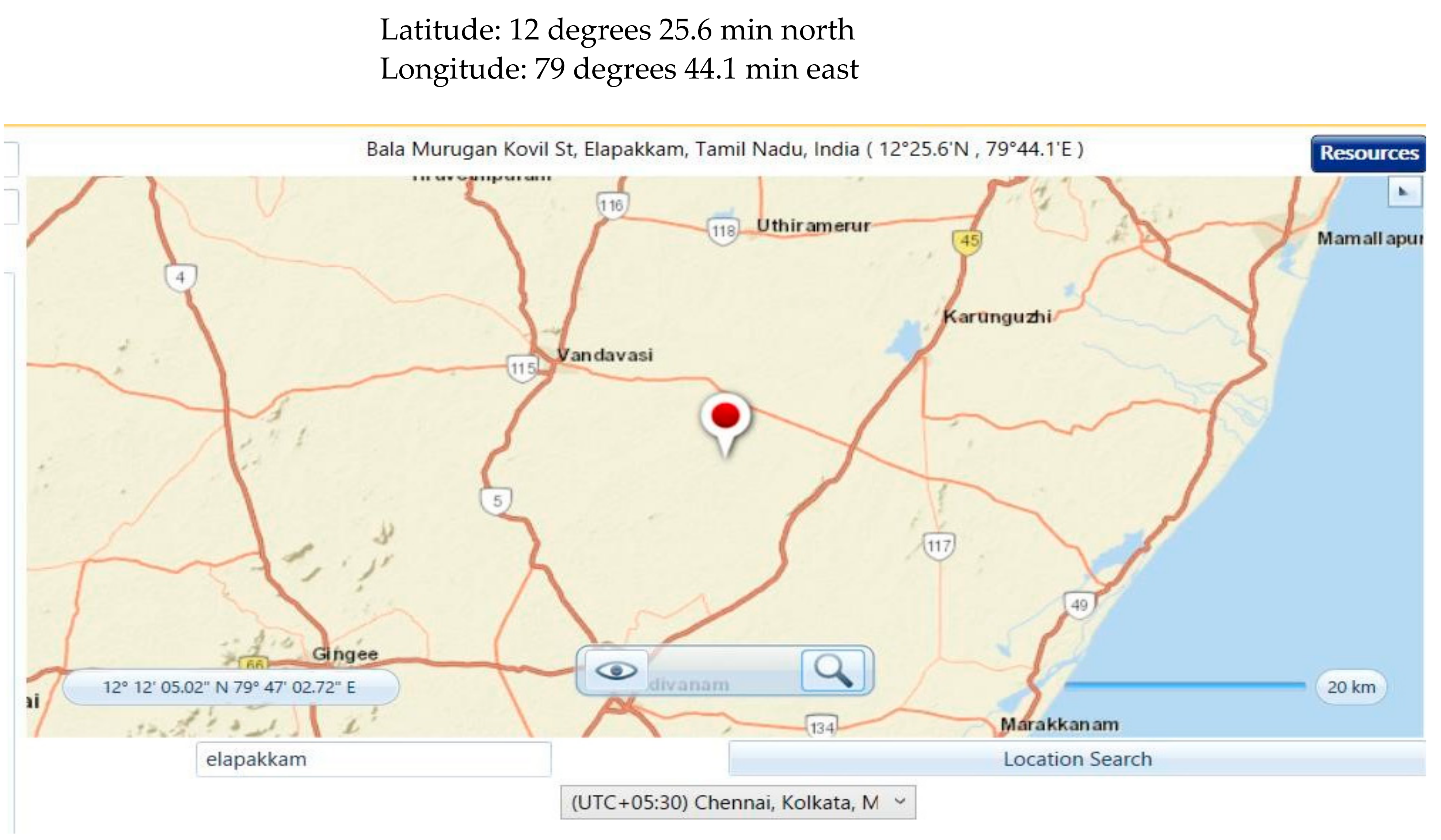
Elapakkam, a rural valley in Tamil Nadu, has been selected to study our hybrid electrical system. This location is not suitable for wind farms, so a solar PV system is considered a renewable energy source. The location of Elapakkam, Kanchipuram, in accordance with HOMER maps is shown in Figure 1.
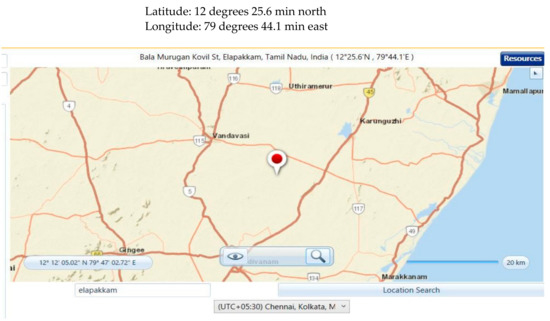
Figure 1.
Location of our selected village on a HOMER map.
3.2. Survey of Electrical Load
The chosen 33 KV substation (SS) in our location of study (Ramapuram, Kanchipuram) has three 11 KV feeders collectively providing power supply to 12 surrounding villages. The three feeders are the Elapakkam feeder, Ramapuram feeder, and Mathur feeder which connect to seven, three, and two villages, respectively. In general, there are different formats of load, namely domestic, industrial, commercial, agricultural, schools, and temples. Table 1 represents the number of services provided by each village. The number of services offered by each village, varying depending on the combinations of load formats, is presented in Table 2. A daily load profile per household was estimated based on a door-to-door survey. The total power load of the village for 2018 was 33,608.55 kWh/day.

Table 1.
Total number of services in each village.
Table 2.
Services for different types of loads.
The demands for power by these services are presently fulfilled by the Ramapuram substation through the three feeders, and TANGEDCO maintains hourly records of power consumed from each feeder. Data collected from the records for 1 February 2018 are shown in Table 3.
Table 3.
Power consumed from three feeders on 1 February 2018.
Using the above data, the total power used can be calculated using the equation
where V is the voltage (11 KV), I is the current (total of three feeders), and cosθ = 0.85.
3.3. Energy Components
Recently, different types of distributed generating units is used to generate electrical power to meet local loads and are also connected to the power exchange utility grid. By providing on-site generation, the distributed generators can provide high reliability. The advantages of distributed generation, such as eliminating transmission losses, using green fuels, and reducing the demand for the load on the utility grid result in a reduction in fossil fuel consumption. There are many DGs available, including PV cells, wind turbines, fuel cells, and diesel and micro hydro plants [33]. Although the capital investment is high, the long-term benefits are huge due to the high cost of installing the rural electrification system combined with a hike in energy prices. There is indeed a cash flow of five years, as well as a standalone PV/wind system with a 100% pollution-free energy system, which is feasible in rural communities [34].
Solar Energy: HOMER has an inbuilt feature to search and link with the NASA Surface Meteorology and Solar Energy Database, which contains dynamic data recorded over a period of 22 years. The annual average solar radiation in this area was 5.14 kWh/m2 per day [35,36].
Diesel Generator: Diesel generators are also crucial for maintaining stable grid operations. Therefore, maintaining a diesel generator within an accessible distance is important. The generator works with low stacking effectiveness and low stacking rate. In this manner, to understand a satisfactory well-being edge for power vacillations, for example, an abrupt population expansion, a diesel generator should work inside a typical working range.
Fuel consumption of a diesel generator, q(t), can be defined as [37]:
where P(t) is the output power, a and b are the fuel cost coefficients, and Prated is the rated output power. a and b were assigned values of approximately 0.246 and 0.08415, respectively [38].
The following equation represents the overall efficiency of the diesel generator [39]:
where η𝑜𝑣𝑒𝑟𝑎𝑙𝑙 is the efficiency, η brake is the thermal efficiency of the brake, and η generator is the generator efficiency
Battery: The battery capacity can be modelled based on self-sufficiency days and load demand as follows:
where EL is electrical load; SD is self-sufficiency days; DOD is the depth of discharge (80%); is the efficiency of the inverter (95%); ηb is the efficiency of the battery (85%).
4. Microgrid Modelling
HOMER-Pro can be handy for optimizing a hybrid system employing various combinations of system decision variables, although different configurations of the power system can be considered, namely grid-connected PV, grid-connected wind, grid-connected PV and wind, standalone PV–generator–wind, standalone PV–generator-wind–battery. The system cost is calculated by HOMER-Pro using a number of PV arrays and wind turbines, the capacity of the diesel generator, the size of the converter, dispatch strategy, and the charging cycle and COE per kWh. In the end, a comprehensive hybrid system with a configuration suitable for meeting the power demand was modelled using HOMER-Pro.
4.1. PV–Generator–Battery (Off-Grid)
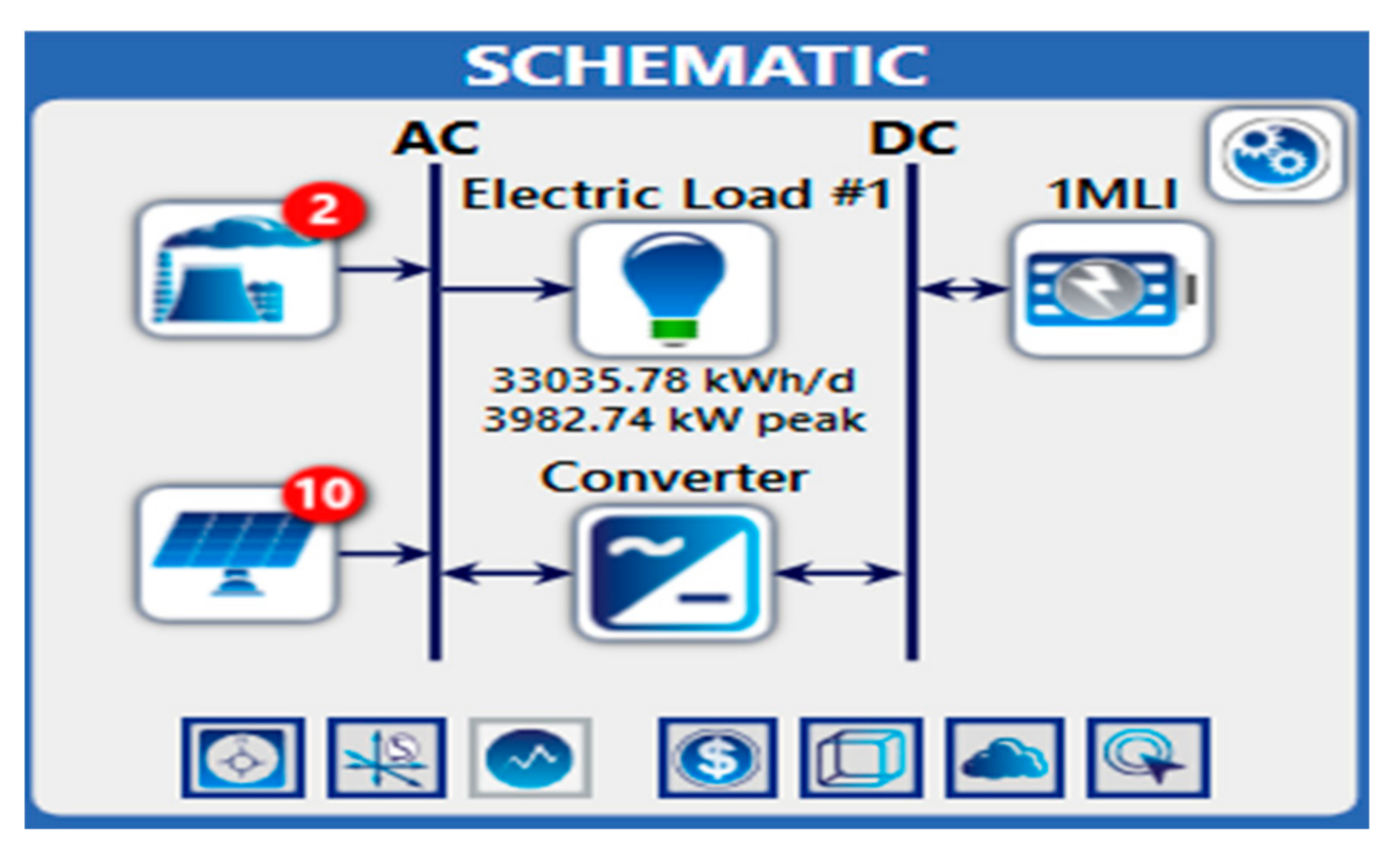
Figure 2 represents the schematic diagram of the case-1 model. The specification of the components used in the case-1 model is presented in Table 4. The optimization result obtained by HOMER from the case-1 model is presented in Table 5. Schneider Conext Core XC 680 kW has a generic PV capital cost multiplier of 1. From the simulation, around 46,263 feasible solutions were found out of 226,274, where 180,011 solutions were infeasible and 130,620 were omitted due to lack of converter or no source of power, leaving behind 46,263 solutions that were found to be feasible. The cost summary of the proposed system is represented in Table 6. COE varied between INR 3.65 and INR 17.15 per kWh, and NPC varied from INR 569 million to INR 2.67 billion. Results are presented for illustration purposes only and are not complete due to space limitations. For the case considered, no sensitivity values were implemented for optimization as the best configuration design was identified. If required, sensitivity values could have been used for solar capital cost multiplier, solar scaled average, diesel price, hub height (when the wind farm is included), etc.
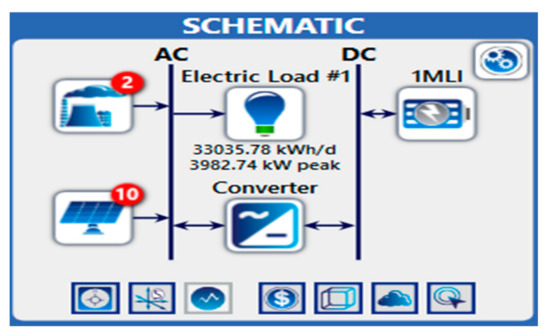
Figure 2.
HOMER-Pro model of the proposed off-grid system.
Table 4.
The architecture of the modelled off-grid system.
Table 5.
Optimization results for PV–Generator–Battery (Off-Grid).
Table 6.
Cost summary for the proposed system for PV–Generator–Battery (Off-Grid).
Net present cost (NPC) includes capital cost, operation and maintenance cost, interest, replacements, fuel cost, legal charges, etc. If the value of NPC is positive, it means it is a feasible system. The PV capacity factor was taken to be 22.5%, and its penetration was 11.1% with an annual power yield of 1340 MWh. The LCOE (levelized cost of energy) for the PV system was INR 1.16 per kWh. The yield of the generator was 508 MWh/year with an average power output of 943 kW. Total power output from the hybrid system was estimated at 14.124 GWh/year with a primary load of 12.055 GWh/year. Payback was considered on the basis of the previously agreed-upon price, at a ratio of 1:1:0.68 (diesel:battery:PV).
Levelized energy cost was calculated considering the PV–diesel–battery configuration. Table 7 shows the fraction of renewable energy sources. The present model would emit 489,854 kg of CO2 a year. Other types of gaseous emissions will be minimized based on the superiority of the present model (Table 8). From a techno-economic perspective, the present model seems to be feasible and may be suggested for reliable power generation.
Table 7.
Renewable fraction for for PV–Generator–Battery (Off-Grid).
Table 8.
Gaseous emissions for for PV–Generator–Battery (Off-Grid).
4.2. PV–Grid–Battery (Hybrid)
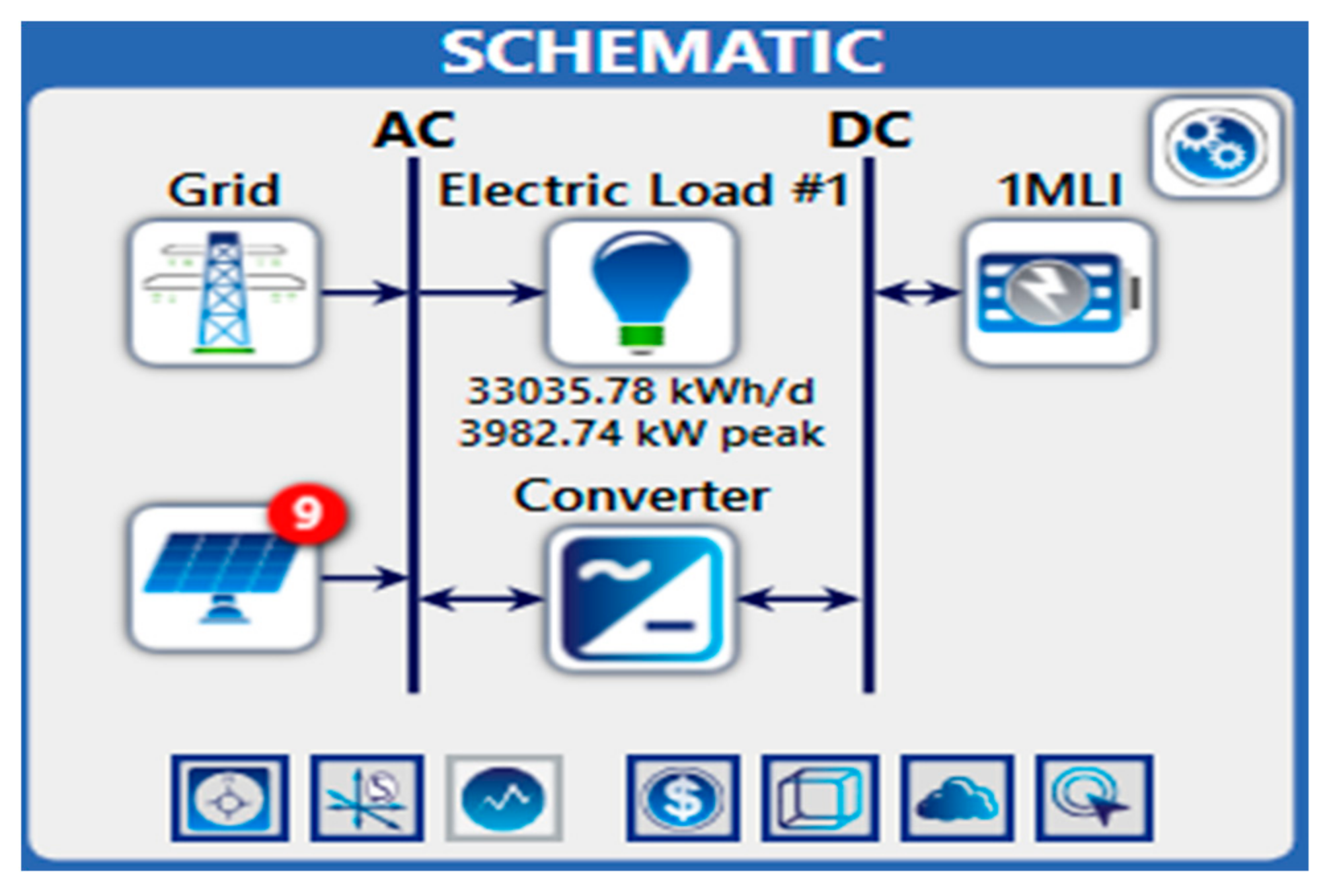
Figure 3 shows the schematic diagram of the case-2 model. The specification of the components used in the case-2 model is presented in Table 9. The optimal result obtained by HOMER from the case-2 model is presented in Table 10. Schneider Conext Core XC 680 kW has a generic PV capital cost multiplier of 1. A total of 59,509 solutions were simulated, all of which were found to be feasible. Of those, 24,691 were omitted due to a lack of a converter or no source of power. The cost summary of the proposed system is represented in Table 11. One unit of cost of energy varied from INR 2.92 to INR 7.01, and the NPC varied between INR 476 million and INR 1.09 billion. Results are presented for illustrative purposes only. For the case considered, no sensitivity values were implemented as the best configuration design was identified. If required, sensitivity values could have been used for solar capital cost multiplier, solar scaled average, diesel price, hub height (when the wind farm is included), etc. The two best system configurations are shown in Table 12. In case 1, NPC was INR 476 million and the optimized cost of energy for a unit was INR 2.92, while in case 2, NPC was INR 722 million and the cost of energy was obtained as INR 3.01 per kWh.
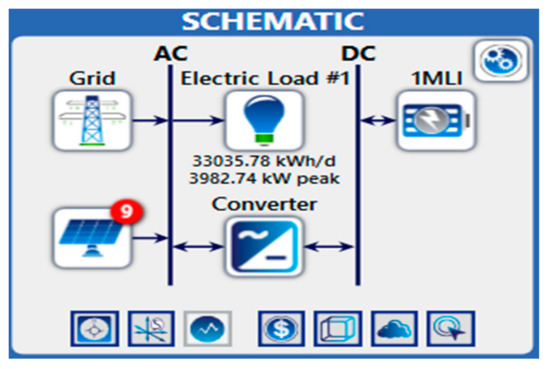
Figure 3.
HOMER-Pro model of the proposed hybrid system.
Table 9.
The architecture of the modelled hybrid system.
Table 10.
Optimization results for PV–Grid–Battery (Hybrid).
Table 11.
Cost summary for the proposed system for PV–Grid–Battery (Hybrid).
Table 12.
Two best system configurations for PV–Grid–Battery (Hybrid).
Following the sensitivity analysis, COE was computed using HOMER-Pro. In the present case, the emission was on the positive side as overall renewable penetration was 83.6%. The PV capacity factor was 22.3%, and its penetration was 11.0% with an annual power output of 1329 MWh. The LCOE for the PV system was INR 1.63 per kWh. The grid contributed 2065 MWh/year with a mean power output of 999,999 kW. The total energy cost was INR 13,621,424.99 annually. The total power output from the hybrid system was estimated at 14.027 GWh/year with a primary load of 12.058 GWh/year. Payback was calculated on the basis of the already approved upfront costs.
Levelized energy cost was calculated considering the PV–grid–battery configuration. In Table 11, the computed values of the NPC are shown. Table 13 shows energy fractions for renewable sources. The present model would emit 1,305,510 kg of CO2 a year. Other types of gaseous emissions will be minimized based on the superiority of the present model (Table 14). From a techno-economic perception, the present model seems to be sustainable and is eligible to be implemented.
Table 13.
Renewable fraction for PV–Grid–Battery (Hybrid).
Table 14.
Gaseous emissions for PV–Grid–Battery (Hybrid).
4.3. PV–Grid (On-Grid)
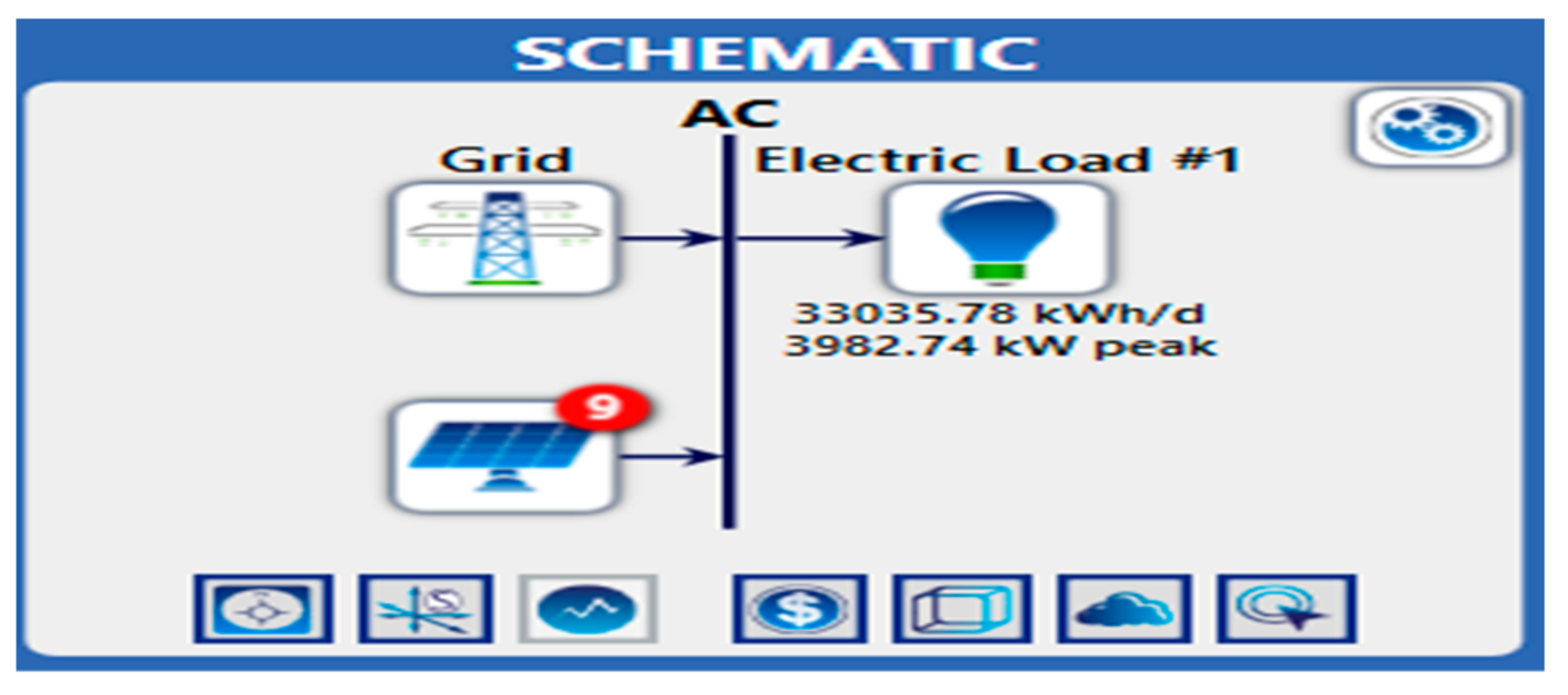
Figure 4 shows the schematic diagram of the case-3 model. The specification of the components used in the case-3 model is presented in Table 15. The optimal result obtained by HOMER from the case-3 model is presented in Table 16. Schneider Conext Core XC 680 kW has a generic PV capital cost multiplier of 1. A total of 65,536 solutions were simulated, all of which were found to be feasible. None needed to be omitted. The cost summary of the proposed model is represented in Table 17. The NPC varied from INR 511 million to INR 1.08 billion and the cost of energy for a unit varied from INR 2.15 to INR 6.5. Results are shown for representation only. The two best PV–grid configurations with sensitivity values on cost multipliers are shown in Table 18. In case 1, the NPC was INR 511 million and the optimized cost of energy was INR 2.15 per kWh. In case 3, the NPC was INR 522 million and COE was obtained as INR 2.20 per kWh.
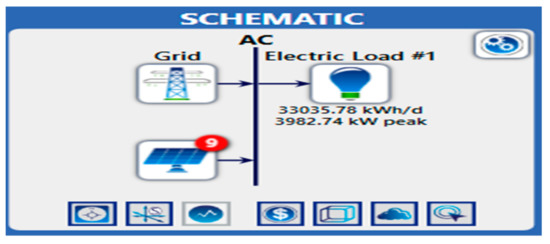
Figure 4.
HOMER-Pro model of the proposed on-grid system.
Table 15.
The architecture of the modelled on-grid system.
Table 16.
Optimization results for PV–Grid (On-Grid).
Table 17.
Cost summary for the proposed system PV–Grid (On-Grid).
Table 18.
Two best system configurations PV–Grid (On-Grid).
In this case, the emission was on the positive side as overall renewable penetration was 64.0%. The PV capacity factor was 21.9% and its penetration was 10.8% with an annual power output of 1306 MWh. LCOE for the PV system was INR 1.65 per kWh. The grid contributed 6620 MWh/year with a mean power output of 999,999 kW. The total energy cost was INR 20,912,733.10 annually.
The total power output from the hybrid system was 18.378 GWh/year with a primary load of 12.058 GWh/year. Payback was considered on the basis of previously accepted costs. Levelized energy cost was calculated considering the PV–grid–battery configuration. In Table 18, the calculated values of NPC are shown. Table 19 shows the fraction of renewable energy sources. The present model would emit 1,305,510 kg of CO2 for a year. Other types of gaseous emissions will be minimized by the superiority of the present model (Table 20). From a techno-economic perception, the present model seems to be feasible and is eligible to be implemented.
Table 19.
Renewable fraction for PV–Grid (On-Grid).
Table 20.
Gaseous emissions for PV–Grid (On-Grid).
5. Results and Discussions
Case studies dealing with the financial study of microgrid systems are generally limited in the literature. A survey of the literature was performed to identify case studies in South Asian regions to compare our results. Comparisons are generally difficult due to the wide variety of components, type of energy mix, environmental characteristics, and demands.
However, a comparison based on COE (INR/kWh), renewable penetration (%), type of hybrid mix, and emission of gases was suggested to be possible and is shown in Table 21 and Table 22, showing the way towards achieving SDG 7 and SDG 13. However, Table 21 satisfies SDG 7 (affordable and clean energy) which clearly explains the comparison based on the cost of energy (COE). The existing methodologies presented by various researchers to reach SDG 7 are as follows: Nandi et al. 32.9 (INR/kWh), Bekele et al. 7.07 (INR/kWh), Sen et al. 4.48 (INR/kWh), Rajbongshi et al. 29.4 (INR/kWh), and Ahmad et al. 3.68 (INR/kWh). The proposed methodology for attaining SDG 7 can be dealt with in three different cases and the COE attained are 3.65, 2.92, and 2.20 (INR/kWh), respectively. The abovementioned discussion confirms that SDG 7 is possible when implementing the proposed methodology.
Table 21.
Comparison with other case studies.
Table 22.
Comparison of emission with other case studies.
The results presented in Table 22 evidently satisfy SDG 13 (climate action) which is based on the emission of different gases. The existing methodology presented can achieve SDG 13. The table clearly explains that the proposed methodology comprising three different cases is effective when compared with the existing methodology in reducing the emission of gases and attaining SDG 13. The results obtained while implementing the proposed methodology show it is possible to achieve SDG 13 for the sustainable growth of the nation.
The lowest NPC and COE were considered the goal of optimization across the studies compared. These results are in sound agreement with included studies with respect to the share of renewable energy, which is around 90% for all cases except for case 3. However, concerning the works of [8,10], COE was reported to be comparatively greater than the proposed model owing to their higher capital cost. Generally, our proposed microgrid system shows good theoretical and computational agreement with other case studies such as [9,11,12].
6. Conclusions
Installation of hybrid renewable energy technologies in the chosen location has been considered a major goal since the feasibility of renewable energy technologies in isolation has been reported to be low in the region. Applicable support and funding by governments will contribute a major role in attracting investments, thereby mitigating risks. Once developed and put into use, the proposed hybrid model is expected to provide significant benefits over existing systems in place.
Presently, the load demand of certain provinces is met by the grid, which requires INR 1.09 billion in terms of O&M costs. By assuming an average tariff of INR 5 per unit, consumers pay an estimated INR 63.875 million per year. Thus, for a term of 25 years, INR 1597 million will have to be paid to power producers, who make a profit of INR 506 million overall. On the other hand, with the proposed hybrid model in case 2 (PV–grid–battery), the total projected NPC is INR 476 million for 25 years with a COE of INR 2.92 per unit. Thus, consumers end up paying as low as INR 37.30 million per year compared to the existing power model. Power producers earn a revenue of INR 933 million over 25 years, leaving a profit of INR 457 million. To conclude, although the profit to power producers may be marginally lower in the proposed model, consumers have the benefit of having to pay INR 2.08 per unit less. Comparing our three cases, positive values of emissions suggest that none of the models are eco-friendly. In case 1 (PV–diesel–battery), emissions may be lower compared to other cases, but the COE is 3.65 INR/kWh, which is comparable with the system proposed by Kallar Kahar (Ahmad et al. 2018). In case 2 (PV–grid–battery), only carbon dioxide, sulphur dioxide, and nitrogen oxide are emitted in larger quantities, but contamination due to carbon monoxide, particulate matter, and unburned hydrocarbons is unlikely. Although the number of gases emitted could be reduced, the quantity of emissions may be higher. Similarly, for case 3 (PV–grid), although only three gases might be emitted, the amount of emission is more than three times compared to the previous case. From this analysis, although emissions cannot be completely avoided, they could be minimized by combining existing systems with renewable sources. However, this is influenced majorly by the choice of location of the power project.
Author Contributions
Conceptualization, K.C. and R.K.A.; methodology, R.K.A.; software, R.K.A.; validation, K.C.; formal analysis, K.C.; investigation, H.H.F.; resources, E.R.; data curation, R.K.A. and K.C.; writing—original draft preparation, H.H.F.; writing—review and editing, H.H.F.; visualization, H.H.F.; supervision, N.R.; project administration, E.R.; funding acquisition, E.R. All authors have read and agreed to the published version of the manuscript.
Funding
The work of the corresponding author was carried out in the framework of the research project DREAM (Dynamics of the Resources and technological Advance in harvesting Marine renewable energy), supported by the Romanian Executive Agency for Higher Education, Research, Development and Innovation Funding—UEFISCDI, grant number PN-III-P4-ID-PCE-2020-0008.
Institutional Review Board Statement
Not applicabe.
Informed Consent Statement
Not applicable.
Data Availability Statement
No data except that in the paper.
Acknowledgments
The work of the corresponding author was carried out in the framework of the research project DREAM (Dynamics of the Resources and technological Advance in harvesting Marine renewable energy), supported by the Romanian Executive Agency for Higher Education, Research, Development and Innovation Funding—UEFISCDI, grant number PN-III-P4-ID-PCE-2020-0008.
Conflicts of Interest
The authors declare no conflict of interest.
References
- Fayek, H.H.; Rusu, E. Novel Combined Load Frequency Control and Automatic Voltage Regulation of a 100% Sustainable Energy Interconnected Microgrids. Sustainability 2022, 14, 9428. [Google Scholar] [CrossRef]
- Fayek, H.H.; Abdalla, O.H. Operation of the Egyptian Power Grid with Maximum Penetration Level of Renewable Energies Using Corona Virus Optimization Algorithm. Smart Cities 2022, 5, 34–53. [Google Scholar] [CrossRef]
- Pakkan, S.; Sudhakar, C.; Tripathi, S.; Rao, M. A correlation study of sustainable development goal (SDG) interactions. In Quality & Quantity; Springer: Berlin/Heidelberg, Germany, 2022. [Google Scholar] [CrossRef]
- Pradhan, P.; Costa, L.; Rybski, D.; Lucht, W.; Kropp, J.P. A Systematic Study of Sustainable Development Goal (SDG) Interactions. Earth’s Futur. 2017, 5, 1169–1179. [Google Scholar] [CrossRef]
- Habib, H.U.R.; Wang, S.; Elkadeem, M.R.; Elmorshedy, M.F. Design optimization and model predictive control of a standalone hybrid renewable energy system: A case study on a small residential load in Pakistan. IEEE Access 2019, 7, 117369–117390. [Google Scholar] [CrossRef]
- Kamal, A.; Mohsine, B.; Abdelali, A.; Abdellatif, B.A. Sizing methods and optimization techniques for PV-wind based hybrid renewable energy system: A review. Renew. Sustain. Energy Rev. 2018, 93, 652–673. [Google Scholar] [CrossRef]
- Kaluthanthrige, R.; Rajapakse, A.D.; Lamothe, C.; Mosallat, F. Optimal Sizing and Performance Evaluation of a Hybrid Renewable Energy System for an Off-Grid Power System in Northern Canada. Technol. Econ. Smart Grids Sustain. Energy 2019, 4, 4. [Google Scholar] [CrossRef]
- Nandi, S.K.; Ghosh, H.R. Prospect of wind–PV-battery hybrid power system as an alternative to grid extension in Bangladesh. Energy 2010, 35, 3040–3047. [Google Scholar] [CrossRef]
- Bekele, G.; Tadesse, G. Feasibility study of small Hydro/PV/Wind hybrid system for off-grid rural electrification in Ethiopia. Appl. Energy 2012, 97, 5–15. [Google Scholar] [CrossRef]
- Sen, R.; Bhattacharyya, S.C. Off-grid electricity generation with renewable energy technologies in India: An application of HOMER. Renew. Energy 2014, 62, 388–398. [Google Scholar] [CrossRef]
- Rajbongshi, R.; Borgohain, D.; Mahapatra, S. Optimization of PV-biomass-diesel and grid base hybrid energy systems for rural electrification by using HOMER. Energy 2017, 126, 461–474. [Google Scholar] [CrossRef]
- Ahmad, J.; Imran, M.; Khalid, A.; Iqbal, W.; Rehan, S. Techno-economic analysis of a wind-photovoltaic-biomass hybrid renewable energy system for rural electrification: A case study of Kallar Kahar. Energy 2018, 148, 208–234. [Google Scholar] [CrossRef]
- Das, N.K.; Sarma, T.R. Social Cost–Benefit Analysis of Rajiv Gandhi Grameen Vidyutikaran Yojana: An Analysis. J. Infrastruct. Dev. 2016, 8, 137–152. [Google Scholar] [CrossRef]
- Kaabeche, A.; Belhamel, M.; Ibtiouen, R. Sizing optimization of grid-independent hybrid photovoltaic/wind power generation system. Energy 2011, 36, 1214–1222. [Google Scholar] [CrossRef]
- Li, Y.; Yue, D.; Liu, H.; Liu, Y. Wind-solar complementary power inverter based on intelligent control. In Proceedings of the 4th IEEE Conference on Industrial Electronics and Applications, Xi’an, China, 25–27 May 2009; pp. 3635–3638. [Google Scholar] [CrossRef]
- Takle, E.S.; Shaw, R.H. Complimentary nature of wind and solar energy at a continental mid-latitude station. Int. J. Energy Res. 1979, 3, 103–112. [Google Scholar] [CrossRef]
- Himri, Y.; Stambouli, A.B.; Draoui, B.; Himri, S. Techno-economical study of hybrid power system for a remote village in Algeria. Energy 2008, 33, 1128–1136. [Google Scholar] [CrossRef]
- Bekele, G.; Palm, B. Feasibility study for a standalone solar-wind-based hybrid energy system for application in Ethiopia. Appl. Energy 2010, 87, 487–495. [Google Scholar] [CrossRef]
- Dali, M.; Belhadj, J.; Roboam, X. Hybrid solar-wind system with battery storage operating in grid-connected and standalone mode: Control and energy management-experimental investigation. Energy 2010, 35, 2587–2599. [Google Scholar] [CrossRef]
- Badawe, M.E.; Iqbal, T.; Mann, G.K.I. Optimization and modeling of a stand-alone wind/PV hybrid energy system. In Proceedings of the 25th IEEE Canadian Conference on Electrical and Computer Engineering (CCECE), Montreal, QC, Canada; 2012; pp. 1–6. [Google Scholar] [CrossRef]
- Mandal, S.; Das, B.K.; Hoque, N. Optimum sizing of a stand-alone hybrid energy system for rural electrification in Bangladesh. J. Clean. Prod. 2018, 200, 12–27. [Google Scholar] [CrossRef]
- Razak, J.A.; Sopian, K.; Nopiah, Z.M.; Zaharim, A.; Ali, Y. Optimal operational strategy for hybrid renewable energy system using genetic algorithms. ISESCO Since Technol. Vis. 2008, 4, 55–59. [Google Scholar] [CrossRef]
- Okedu, K.E.; Uhunmwangho, R. Optimization of Renewable Energy Efficiency using HOMER. Int. J. Renew. Energy Res. 2014, 4, 421–427. [Google Scholar] [CrossRef]
- Kumar, A.; Deng, Y.; Xiangning, H.; Kumar, P.; Bansal, R.C. Energy management system controller for a rural microgrid. J. Eng. 2017, 13, 834–839. [Google Scholar] [CrossRef]
- Kashif, S.M.; Adeem, Z.; Tanzeel, U.R.; Mirza, A.R.; Muzaffar, A.; Mueen, A. Techno-economic feasibility analysis of a solar-biomass off grid system for the electrification of remote rural areas in Pakistan using HOMER software. Renew. Energy 2017, 106, 264–273. [Google Scholar] [CrossRef]
- Margaret, A.W.; Rajini, V. Cost benefit and technical analysis of rural electrification alternatives in southern India using HOMER. Renew. Sustain. Energy Rev. 2016, 62, 236–246. [Google Scholar] [CrossRef]
- Muhammad, S.J.; Tao, M. Techno-economic assessment of a hybrid solar-wind-battery system with genetic algorithm. Energy Procedia 2019, 158, 6384–6392. [Google Scholar] [CrossRef]
- Tsai, C.T.; Beza, T.M.; Wu, W.B.; Kuo, C.C. Optimal Configuration with Capacity Analysis of a Hybrid Renewable Energy and Storage System for an Island Application. Energies 2020, 13, 8. [Google Scholar] [CrossRef]
- Chalishazar, V.H.; Poudel, S.; Hanif, S.; Thekkumparambath Mana, P. Power System Resilience Metrics Augmentation for Critical Load Prioritization; Pacific Northwest National Laboratory: Richland, DC, USA, 2021. [Google Scholar] [CrossRef]
- Balamurugan, P.; Ashok, S.; Jose, T.L. Optimal Operation of Biomass/Wind/PV Hybrid Energy System for Rural Areas. Int. J. Green Energy 2009, 6, 104–116. [Google Scholar] [CrossRef]
- Fasihi, M.; Breyer, C. Baseload electricity and hydrogen supply based on hybrid PV-wind power plants. J. Clean. Prod. 2020, 243, 118466. [Google Scholar] [CrossRef]
- Bahramara, S.; Parsa, M.M.; Haghifam, M.R. Optimal planning of hybrid renewable energy systems using HOMER: A review. Renew. Sustain. Energy Rev. 2016, 62, 609–620. [Google Scholar] [CrossRef]
- Jamalaiah, A.; Raju, C.P.; Srinivasarao, R. Optimization and operation of a renewable energy based pv-fc-micro grid using HOMER. In Proceedings of the International Conference on Inventive Communication and Computational Technologies (ICICCT), Coimbatore, India, 10–11 March 2017; pp. 450–455. [Google Scholar] [CrossRef]
- Masud, A. The application of HOMER optimization software to investigate the prospects of hybrid renewable energy system in rural communities of Sokoto in Nigeria. Int. J. Electr. Comput. Eng. 2017, 7, 596–603. [Google Scholar] [CrossRef]
- Solar Resource Assessment and Mapping for India. Available online: https://www.nrel.gov/international/india (accessed on 25 January 2018).
- Solar Radiance Data Online. Available online: http://www.synergyenviron.com/tools/solar-irradiance/kancheepuram (accessed on 25 January 2018).
- Ashari, M.; Nayar, C.V. An optimum dispatch strategy using set points for a photovoltaic (PV)/diesel/battery hybrid power system. Sol. Energy 1999, 66, 1–9. [Google Scholar] [CrossRef]
- Azoumah, Y.; Yamegueu, D.; Ginies, P.; Coulibaly, Y.; Girard, P. Sustainable electricity generation for rural and peri-urban populations of sub-Saharan Africa: The flexy-energy concept. Energy Policy 2011, 39, 131–141. [Google Scholar] [CrossRef]
- Deshmukh, M.K.; Deshmukh, S.S. Modeling of hybrid renewable energy systems. Renew. Sustain. Energy Rev. 2008, 12, 235–249. [Google Scholar] [CrossRef]
Disclaimer/Publisher’s Note: The statements, opinions and data contained in all publications are solely those of the individual author(s) and contributor(s) and not of MDPI and/or the editor(s). MDPI and/or the editor(s) disclaim responsibility for any injury to people or property resulting from any ideas, methods, instructions or products referred to in the content. |
© 2023 by the authors. Licensee MDPI, Basel, Switzerland. This article is an open access article distributed under the terms and conditions of the Creative Commons Attribution (CC BY) license (https://creativecommons.org/licenses/by/4.0/).