


Abstract
This study aims to construct an evaluation index system to measure the commodification of living space in Chinese rural areas and investigate the spatial characteristics of the commodification. Based on the dataset collected from public institutions in Zhejiang province, this study applies the entropy method to calculate the weights of the evaluation indicators and the commodification level. The results reveal that overall commodification levels of rural spaces in Zhejiang Province are different from each other due to different levels of economic development, transportation, tourism resources, and government support. In addition, this study suggests appropriate commodification strategies corresponding to the commodification development potential of the four types of rural living spaces (i.e., advanced development areas, promotion development areas, transformation development areas, and potential development areas). This study provides an evaluation index system measuring the commodification of rural living places and guidelines for effectively developing commodification of rural places.
1. Introduction
With the development of industrialization and urbanization, the traditional productive space of the countryside has evolved into a post-productive space. Along with economic development, redefining the traditional functions of rural spaces is a crucial step in promoting rural development. For instance, the commodification of rural space is a clear example of the functional evolvement and transformation of contemporary rural spaces, which has also attracted significant attention from academic researchers.
However, many rural spaces commonly experience the phenomenon of hollow villages and economic recession as the rural population continues to migrate to cities and towns [1,2]. Given this challenge, many scholars have investigated the rural revitalization strategy and studied how to improve and develop rural areas by utilizing diverse rural resources. Rural tourism, which includes location, sustainable development, community-based features, and experience [3], is one of the important strategies for developing rural areas using rural resources [4,5,6]. Previous studies have also emphasized the important role of rural tourism in promoting rural commodification [7,8]. Some scholars studied rural commodification at the national level [9,10,11]. Previous studies also explored commodification strategies from rural production and ecological space perspectives [12,13].
Meanwhile, there is a dearth of studies on rural tourism’s role in promoting the commodification of rural living space. More specifically, it is necessary to study how to evaluate the commodification level of rural living space and its influencing factors for further research and rural commodification development. In response to this research necessity, this study attempts to construct an evaluation index system to measure the commodification level of rural living spaces by focusing on rural tourism and investigating the spatial characteristics of commodification based on space production theory.
To achieve this research objective, the rest of this paper is organized as follows. We present the literature overview to address the concept of the commodification of rural living space and previous research findings. Next, we describe the research methods, followed by discussions of the main findings of this study. Then, we discuss the theoretical and practical implications of implementing sustainable rural living space development. We conclude by addressing the summary and limitations of this research and suggesting future research directions.
2. Literature Review
The concept of commodification is derived from the formation and continued development of the market economy. Tracing its origins to the creation of the commodity, it refers to the process through which tradable and monetarily equivalent items that were not initially bought, sold, and circulated by the rules of the market economy are converted into such. The idea of commodification has gradually crept into the area of social geography as the research field has grown and the research degree has deepened. In the context of industrialization and urbanization, cities were the production spaces for commercial activities and rural areas for agricultural activities. However, the city’s commercial development has radiated to the countryside, which led to the development of various fields and the exchange of commodity values in the countryside. Thus, rural space has become commercialized when it acquires the characteristics of a commodity and has a market value. In his book The Production of Space, Lefebvre introduced the theory of spatial production in the 1970s. According to this space production theory, the entire process of creating, constructing, utilizing, and modifying space is referred to as spatial production [14].
Along with interpreting and disseminating spatial production theory, Woods defines it as the marketing of rural resources through travel, real estate investment, buying and selling rural commodities, promoting rural images, and other commodities [15,16]. Perkins further highlights four types of rural commodities and claims that the commodification of rural space is a negotiation process between local actors to meet specific conditions and requirements and emphasizes that the form and substance of this negotiation differs from place to place [17]. Akira added a fifth type of rural commodity based on Perkins’ work: actions to improve the quality of life through the conservation and management of landscapes and natural surroundings, as well as comprehending traditional rural culture and society [18].
In the study related to geography, the commodification of rural space is a term to describe the market opening to various commodities that have recently been moved from urban to rural locations [18]. It manifests that in a modern rural space, the role of material production is relatively declining while the role of immaterial production, namely commodity consumption space, is gradually expanding and developing a rural consumption space that integrates material production and immaterial production [19]. A growing number of academics are also studying the transformation of rural spatial functions as a result of China’s rapid urbanization, concentrating on themes including the rural spatial reconstruction field [20], social governance [21], and rural spatial planning [22]. The emergence of different consumption patterns has caused the countryside to gradually transform into a place for recreation, environmental protection, science education, and retirement vacations. Therefore, people’s perceptions of rural areas have slowly shifted from poverty and backwardness to leisure and comfort [23,24].
As an important part of rural space, rural living space is the place where people carry out various daily activities to meet various needs such as residence, consumption, and entertainment, and it is a compound system including the various human–land and human–social relationships [9,25,26]. Rural living space is an organic unity of certain regional spatial forms, spatial connotations, and spatial meanings intrinsically related to reflect the development of the countryside [27]. In other words, rural living space is the place of the daily life of rural residents in a certain region and is a spatial aggregation of daily activities such as residence, employment, consumption, and leisure of rural residents, as well as an organic unity of spatial form, spatial connotation, and spatial meaning of a certain rural region [28]. As a place that carries villagers’ daily life behavior, rural living space continues to increase its commodification along with the expansion and use of multi-functional features such as leisure, tourism, and consumption. The commodification of rural space largely reflects the evolution of the morphological use and functional reengineering of rural space [29]. Along with the change in the urban–rural development relationship, the development of new industrial and commercial tourism industries oriented to commodity production has strengthened the degree of the commodification of rural space [30].
Rural living space has become a commodity to create value, gradually transforming from a single residence and employment function through rural tourism activities to multi-functional functions, such as residence, employment, consumption, and leisure, and then generating profits. There are many previous studies on the relationship between tourism and commercialization. For instance, based on the theory of space production, researchers analyzed the multidimensional impact of tourism on rural physical space, economic and social relations, and power structures [31], and also examined the change in relationships and roles of various participants (i.e., both human and non-human actors) in the process of rural development under the influence of tourism [32,33]. Understanding how rural tourism is produced and represented in contemporary rurality in China begins with a discussion of commodification. Thus, by focusing on rural tourism, constructing an evaluation index system for measuring the commodification level of rural living spaces and investigating the spatial characteristics of commodification are necessary for guiding rural living space development. The measurement of the commodification of rural living space is an important precondition for clarifying the current situation of rural living space use and a key indicator for measuring the level of sustainable rural development. Therefore, a scientific and quantitative study on the evaluation of the commodification of rural living space and its influencing factors is of great significance for promoting sustainable rural development.
3. Materials and Methods
3.1. Research Target Area
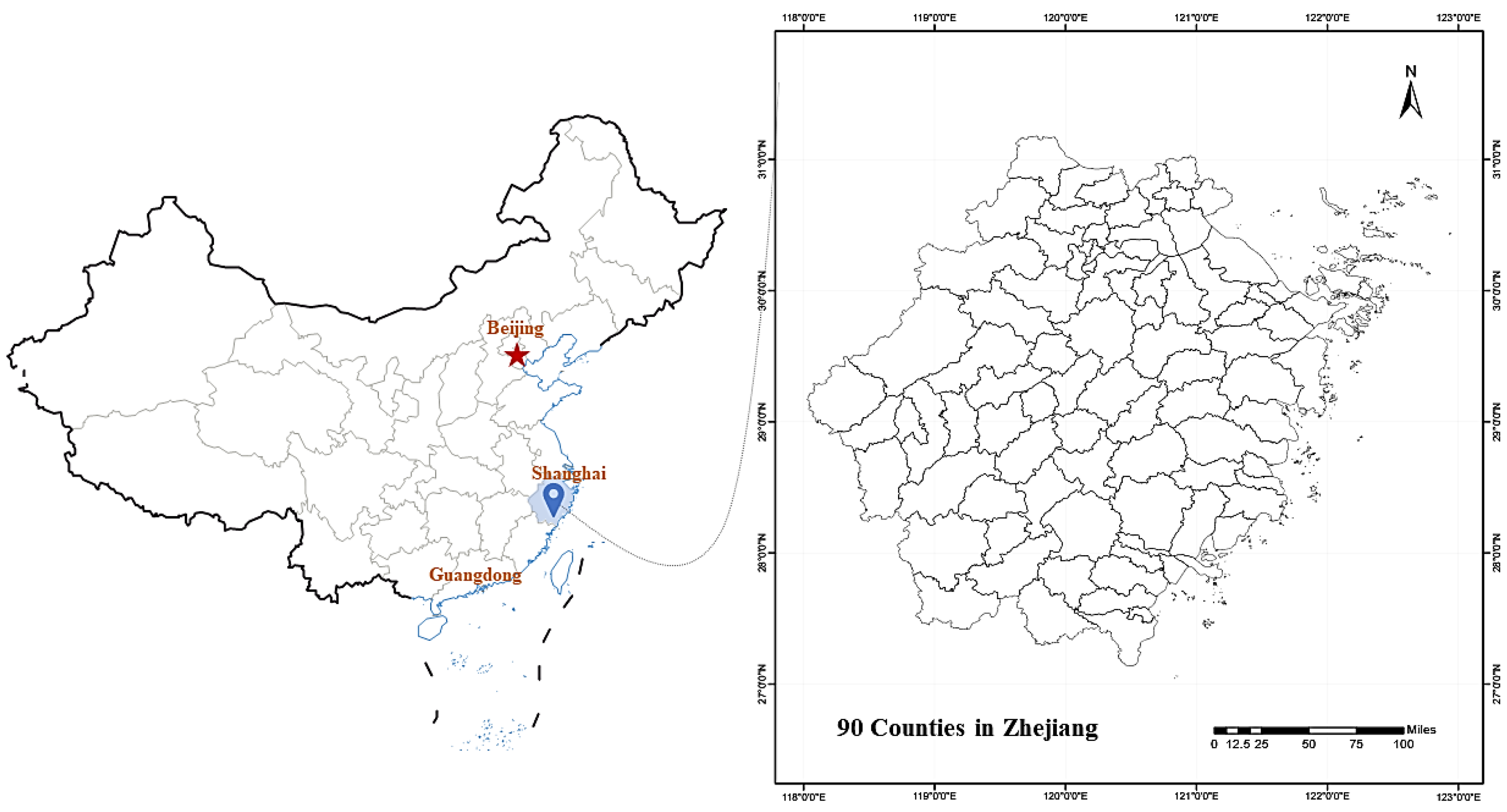
Zhejiang Province is located in the southern part of the Yangtze River Delta on the southeast coast of China (Figure 1), bordering the East China Sea to the east, Fujian Province to the south, Jiangxi and Anhui Provinces to the west, and Shanghai and Jiangsu Province to the north. It is a relatively economically developed region of China and includes 11 cities and 90 counties. Zhejiang is renowned for its picturesque landscapes. It has long been known as “a region of fish and rice, the home of silk, a paradise for tourists, and a land of rich cultural heritage” in China. By 2021, Zhejiang province had built 10,083 A-class tourist picturesque villages, including 1597 3A-class villages. The overall coverage of villages in scenic country areas has reached 49.4%, and 47 of these villages have been selected for the list of Key National Rural Tourism Villages. Furthermore, the scale of the leisure, agriculture, and rural tourism industries exceeds RMB100 billion (USD14.77 billion). Broadly, Zhejiang Province has made outstanding achievements in economic development and urban–rural integration. It has consistently promoted the implementation of the rural revitalization strategy through rural tourism and the creation of new rural areas and ecological civilization, both supporting one another over the past few years. Thus, Zhejiang province is an appropriate area to research tourism-based rural commodification.
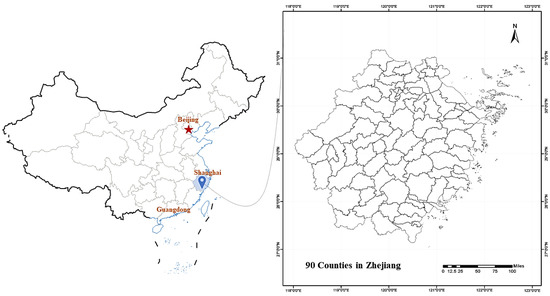
Figure 1.
The location of Zhejiang Province in China.
3.2. Data Collection
Each county and district in Zhejiang Province served as the evaluation unit to conduct a thorough assessment of the degree of the commercialization of rural living space in that province. In order to conduct the analysis, pertinent data up to 2020 were chosen based on the accuracy and reliability of the data. The data for this study were primarily collected using lists published by the Central People’s Government of the People’s Republic of China, the Ministry of Education of the People’s Republic of China, the People’s Government of Zhejiang Province, and the Department of Culture and Tourism of Zhejiang Province, as well as the statistical bulletin of national economic and social development of each county and district in Zhejiang Province.
3.3. Construction of Evaluation Index System
The evaluation index system is constructed in 3 levels: objective level, system layer, and index layer following the principles of accessibility, rationality, independence, importance, and comprehensiveness of evaluation indexes [34]. Overall, the indicators were adapted from the existing research on tourism and rural space commodification [35,36,37,38]. After optimizing the hierarchical structure and index factors, an index system that can reflect tourism and living space commodification in rural areas was constructed from 3 aspects, as shown in Table 1. The objective system can be structured into 3 parts, i.e., the cultural inheritance and industrial integration system, the scenic protection and scientific governance system, and the tourism development and urban–rural construction system [25,39,40,41,42]. To reflect the current situation of cultural and tourism integration, 6 indicators (i.e., national historical and cultural villages, provincial historical and cultural villages, history education bases, the provincial rural tourism industry cluster, provincial primary and secondary school study and practice education bases, and cultural tourism integration pilot areas) are selected. For the abundance of tourism resources, 4 indicators (i.e., the number of scenic spots above class A and scenery towns) are selected. Lastly, 6 indicators are selected to reflect the systematic and spatial utilization of tourism, including the rural tourism demonstration villages, the all-for-one tourism demonstration areas, and the tourism resorts.

Table 1.
Evaluation index system and weight of county rural living space commodification measurement of Zhejiang Province.
3.4. Evaluation Approach of Rural Space Commodification Level
3.4.1. Determination of the Index Weights
As one of the objective weighting methods [43], the entropy method was employed in this study [44,45]. The specific steps are as follows.
- Forming a matrix. According to the basic idea of the overall entropy method, the 3D data table is sorted into a 2D table in time order. Taking the cultural heritage and industrial integration system as an example, it is necessary to evaluate the current situation of the cultural and tourism integration level of 90 counties with 6 indicators. Thus, a 90 × 6-order matrix can be obtained.
- Data standardization and dimensionless. In order to eliminate the influence of magnitude and dimensions, the raw data need to be standardized. In this study, all indicators are positive indicators. Thus, non-negative translation was not to be carried out, and then the dimensionless method was adopted to ensure that all normalized data are positive and can be calculated. The calculation formulas are as follows:where the “m” indicators are selected for a total of “n” samples, then is the value of the “j” indicator of the “I” sample, i = 1,2,3...n; j = 1,2,3...m. is the minimum index of column j; is the maximum index of column j. In order to ensure that the logarithm calculation is meaningful, 0.01 is added.
- Calculate the proportion of the j-th indicator of the i-th:
- 2.
- Calculation of the information entropy:where K is a constant, and K > 0.
- 3.
- Calculate the information utility value of the j-th indicator:
- 4.
- Calculate the weights of the indicators:
3.4.2. Calculation of the Comprehensive Evaluation Score of the Degree of the Commodification of Each County, for Which the Equation Is:
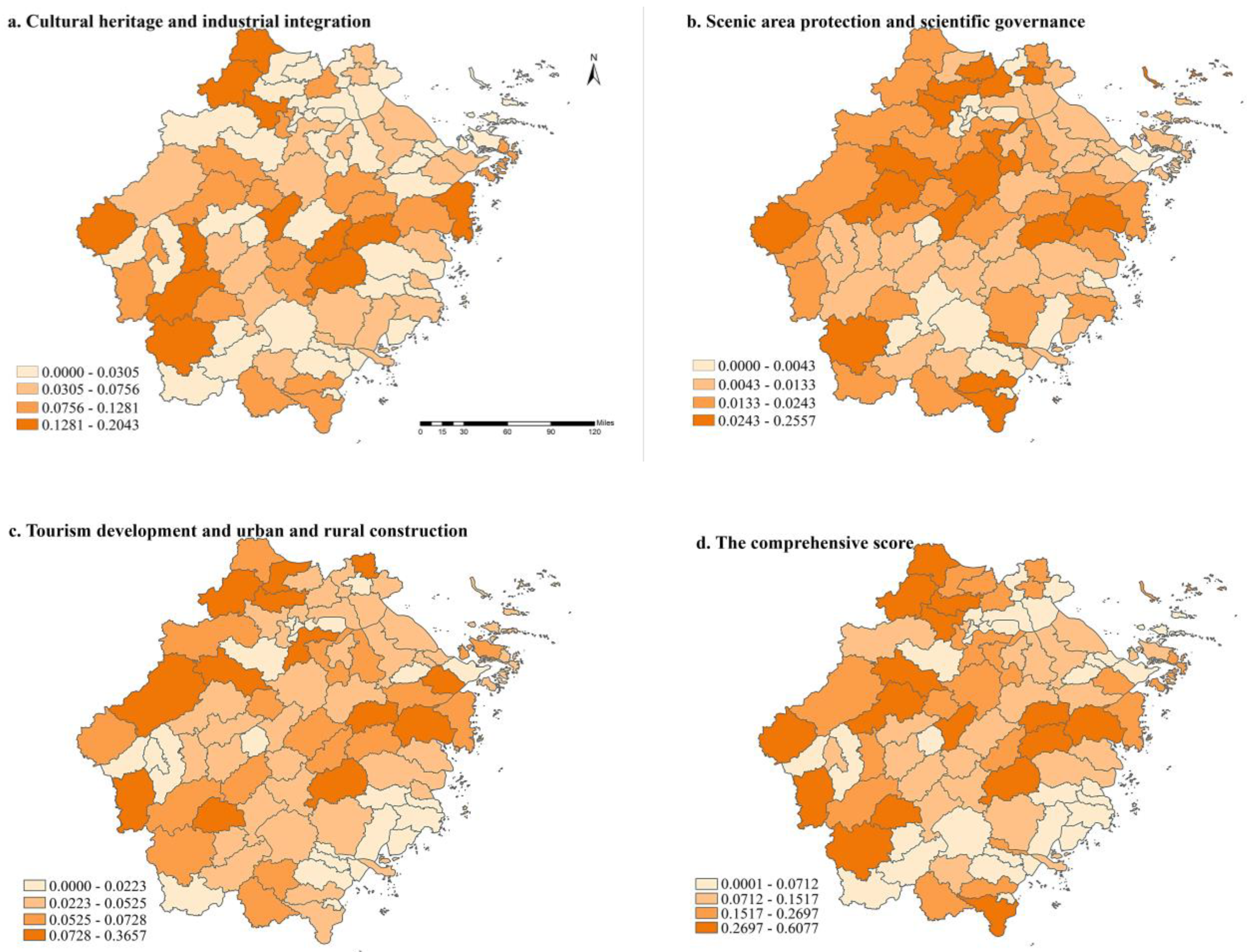
The entropy value approach was utilized to determine the rural living space commodification score of 90 counties in Zhejiang Province using the aforementioned index system. The degree of rural living space commodification in the county is proportionally correlated with a score. Based on the statistical data analysis, ArcGIS10.7 software was used to create an evaluation map of the commodification of rural living space in Zhejiang Province to visualize and analyze the index layer and comprehensive score data. This was undertaken to show the spatial distribution differences and corresponding characteristics of the degree of the commodification of rural living space in Zhejiang Province.
4. Result
4.1. Analysis of the County Differences in the Commodification Evaluation System
Using the collected data in each indicator, the grid method is used to reclassify each indicator, and then the grid of each factor is weighted and superimposed using weighted summation to derive the evaluation results of each evaluation indicator grid cell on the commercialization of rural living space. The commodification of rural living space in each country is shown in Table 2. Only the top 40 are shown due to space constraints.
Table 2.
The comprehensive score table of county rural living space commodification.
The spatial distribution of counties’ rural living space commodification was formed through ArcGIS 10.7, as shown in Figure 2. The degree of rural living space commodification in each county of Zhejiang Province is different. Meanwhile, the development level differs significantly depending on different dimensions, showing the spatial variation characteristics that the west and north are better than the east and south. The differences in scenic protection and scientific governance are small and common, indicating that in the process of rural spatial utilization and transformation, the overall coverage of villages transforming scenic areas has balanced the development, according to a cross-sectional comparison of the three indicators of cultural inheritance and industrial integration, scenic protection and scientific governance, and tourism development and urban–rural construction. The disparity in commodification between urban–rural construction and tourism development and between cultural heritage and industrial integration is relatively considerable. Through the results of cultural heritage and industrial integration, scenic area protection and scientific governance, tourism development, and urban and rural construction, it could be found that the various index systems are dramatically different, mainly due to the site conditions, policies of the environment, and rural town tourism resources.
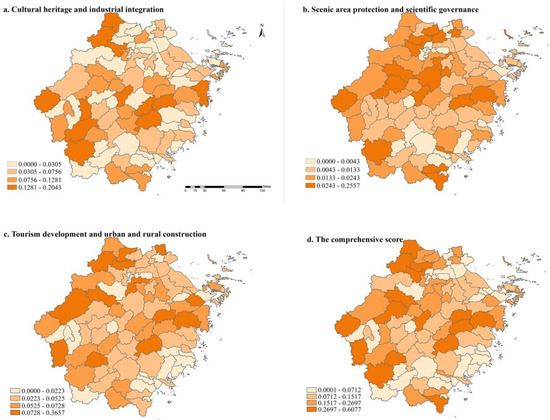
Figure 2.
(a) The score of cultural heritage and industrial integration; (b) the score of scenic area protection and scientific governance; (c) the score of tourism development and urban and rural construction; (d) the comprehensive score chart of county rural living space commodification.
4.2. Analysis of the Different Types of the Commodification Development Potential
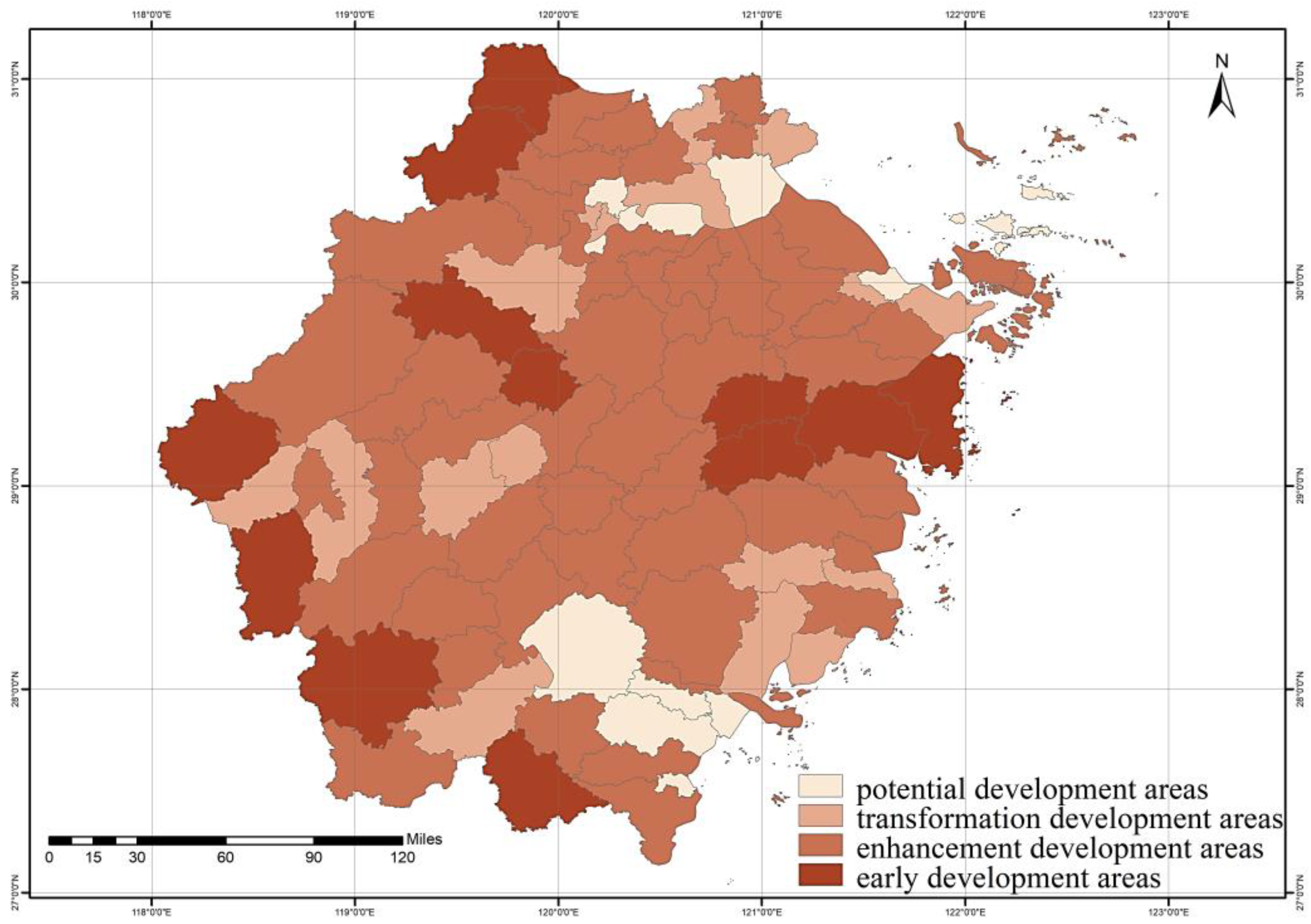
The result of the commodification development potential index is shown in Table 3. According to the scores in three systems, the CDP index in 90 counties was divided into four categories: early development areas, enhancement development areas, transformation development areas, and potential development areas (Figure 3).
Table 3.
The result of the CDP.
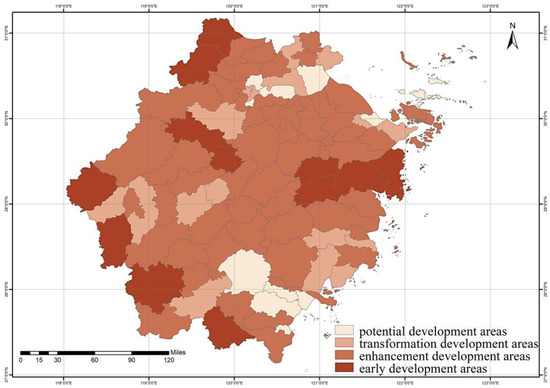
Figure 3.
Distribution map of different CDP areas.
There are 12 early development counties, making up 13.4% of the total, including Ninghai County, Anji County, Changxing County, Tonglu County, etc. These areas have a good natural environment, excellent transportation location, leading transportation accessibility, and diverse transportation modes. The diversified development of rural industries has a positive effect on agricultural economic development, which objectively also contributes to improving the commodification of rural living space. Furthermore, by strengthening rural governance, they improve the rural living environment. Among them, Anji County developed rural tourism and the tourism industry early. It is in a leading position in the rural tourism market in Zhejiang Province, with a wide range of radiation in the customer market. With cultural and tourism resource endowment, Changxing County vigorously developed the pilot area of cultural tourism integration, emphasizing the superimposed effect of culture and tourism. All of the above initiatives contribute to the functional reengineering of rural living spaces and promote the process of commodification of rural living spaces.
Fifty enhancement development counties, accounting for 55.5% of the total, are continuously distributed around the middle of Zhejiang. These enhancement development areas already met the requirements for commodification development. Regarding tourism resources, the building of leisure service facilities, and other aspects of certain development, Wuxing District, Deqing County, Xianju County, Jiande City, and other 50 counties and urban regions have improved socio-economic and transportation conditions. Deqing County, for instance, has attracted many tourists despite being in a developed economic zone because of the stunning natural surroundings of the countryside and has explored the transformation of “rural vacation” to “rural life” in the growth of rural tourism. Nevertheless, there are still a lot of rivals, including the neighboring Anji County. Consequently, it is essential to plan more thoroughly and to develop a unique brand and a rural brand effect. The branding and marketing of specialty agricultural products help the county’s tourism industry grow quickly and raise the level of the commodification of living space.
Seventeen transformation development counties, accounting for 18.9% of all, have two low-level categories, resulting in a low level of current commodification development. One category, however, still falls into the medium or high range and is in the stage of transformational development. This category consists of 18 counties as well as urban districts, including Pinghu City, Fuyang District, Qujiang District, and Yuhuan City. Due to the past industrial structure in these places, the environmental quality is generally low, and rural administration and management are inadequate. At the same time, due to the general natural environment and the lack of tourism resources, the influence and reception capacity of tourism and visibility are relatively lacking. In addition, the rural living space range is limited because some areas are major urban districts, while the geographical environment constraints and relatively single resources are a poor combination. The commodification of the rural living space in these areas has been delayed by the lack of common construction, sharing of infrastructure, and public service facilities between villages while ignoring the participation of the main body of the rural living space.
Eleven potential development areas make up 18.2% of the total, including Qingtian County, Zhenhai District, Daishan County, and Binjiang District. They are low in the evaluation index’s three types of quasi-measurement layers. The commodification of rural living space generally in these places is minimal. Some of them are areas with high local economic levels and their own high degree of commercialization, and some others lack accessibility due to their own poor location conditions but still have rural tourism resources and still have potential in the development of rural living space commercialization. For instance, the United Nations Food and Agriculture Organization selected Qingtian County as the first group for significant agricultural heritage because it has a history of more than 1300 years of fish farming in rice fields. The collection and arrangement of various traditional farming cultural resources have been accelerated in Qingtian in recent years to build agricultural complexes that combine fair travel, farming experience, and agricultural civilization and draw a large number of tourists interested in learning about farming and rural life.
5. Discussion
5.1. Theoretical Contributions
Our findings extend our understanding of the complex nature of the commodification of rural living space. By constructing an index system for assessing the degree of commodification of rural living space and comparing it between counties in Zhejiang Province, this study investigates regional disparities and influencing factors of the commodification of rural living space in the province. The results of this study support the previous findings that emphasize the important role of rural tourism in promoting rural commodification [7,8] and driving rural revitalization and poverty alleviation [46]. Through rural tourism activities, the single residence and employment functions are gradually transformed into the residence, employment, consumption, leisure, and other multi-functions [30], thus generating economic profits. With rapid urbanization and rural tourism development, the morphological use and functional reengineering of rural living space as a place carrying villagers’ daily life behaviors have gradually expanded from a single residential space function to leisure, tourism, consumption, and other functions, has received wide attention [47,48]. Due to the development of the market economy, rural living space has already acquired commodity properties, and the rural living space itself has become a commodity to create value. In addition, the results show that the spatial distribution of commercialization’s degree of rural living space in Zhejiang Province has significant regional differences, with more in the west and north and less in the east and south. These differences might come from different levels of economic development, transportation, tourism resources, and government support, leading to the four types of commodification development in rural living spaces (i.e., advanced development areas, promotion development areas, transformation development areas, and potential development areas), requiring different rural space commodification strategies.
In sum, based on deconstructing the concept of rural living space commodification, this study establishes an evaluation index system of the commodification of rural living space in Zhejiang Province counties, filling the study’s gap on the evaluation index system of rural living space in the counties of Zhejiang Province. Furthermore, this study shows the results of the differences in the commodification of rural living space, analyzes the influence reasons for various influencing factors, and provides appropriate suggestions for improving the commodification of rural living space in the counties of Zhejiang Province.
5.2. Practical Contributions
According to the measurement results of various indicators, the evaluation threshold of rural space commodification level in Zhejiang Province counties and districts was divided into four levels. The commercial development types of rural living space counties and districts of Zhejiang Province were divided into four categories: the early development areas, the enhancement development areas, the transformation development areas, and the potential development areas.
We provide the following suggestions for the different types of commodification development potential. First, the early development counties should consider local government policies in the subsequent development process, overcome the constraints of a single type of rural tourism, and establish a comprehensive system of rural tourism standards under the constructive guidance of national policies on rural revitalization and rural development. At the same time, to encourage the shared development of rural areas, the successful experience of rural tourism development could be shared with other regions.
Second, for the enhancement development areas, the existing rural resources—including human, material, and cultural ones—should be systematically organized to create a detailed list of resources that clarifies the rural area’s overall development direction with the help of valuable resources to directs villagers to use their rural living space in industries with comparative advantages. While keeping the characteristics of industrial growth, the commercialization of rural living spaces expands the brand effect of the rural industry in order to promote the distinctive rural brand.
Third, rural governance should be improved for those transformation development areas. Effective rural government is the cornerstone of rural rejuvenation and a requirement for commoditizing rural territory. It is essential to support the main stance of the villagers and respect their desires to improve the synergistic integration of autonomy, the rule of law, and moral governance in rural governance. The development of public infrastructure, public transportation, the county’s service capacity, efficient resource allocation between the urban and rural areas, the growth of rural commerce, and the commodification of rural living space are all necessary simultaneously.
Lastly, for the potential development areas, it is necessary to fully utilize available resources and location advantages and enhance the industrial support system to accomplish diversified and integrated growth of urban and rural leisure agriculture, tourism, specialty agriculture, and other businesses. Meanwhile, it is vital to coordinate the link between the natural and humanistic environment around the area, assure acceptable exploitation within the affordability of rural living space, and moderately develop cultural and creative tourism. Villagers can utilize their homes to conduct lodging, catering, and B&B experiences. Furthermore, the government can drive the development of rural areas directly and introduce social capital to entice exceptional companies and talents to settle in simultaneously. Increasing villagers’ income through local employment and raising the level of rural economic development are essential for optimizing the utilization of rural dwelling space. Additionally, it is critical to enhance cultural heritage and focus on creative development by incorporating cultural implications into establishing distinctive settlements and attractive areas.
6. Conclusions
This paper establishes an evaluation index system to measure the commodification of living space in rural areas, including the cultural inheritance and industrial integration system, the scenic protection and scientific governance system, and the tourism development and urban–rural construction system. The rural living space of counties in Zhejiang Province, China, was selected as a case study to evaluate the commodification level. The results of this study provide practical insights for effective development and policy implementation for the commodification of rural areas.
Although this study provides useful insights for developing the commodification of rural spaces, some limitations still exist in this study. Firstly, this study only established the evaluation indexes mainly based on rural tourism, which may not be comprehensive enough. The index system can be enriched from various aspects, such as environment, land use, and economy in future studies. Secondly, Zhejiang Province is relatively rich in resources, but the degree of the commodification of rural living spaces varies across China with different levels of economic development. In order to understand more deeply the interrelationship between the commercialization of living space and other elements, a more detailed investigation and in-depth study of the formation mechanism, development stage, and spatial and temporal evolution of the commercialization of rural living space in Zhejiang Province, in terms of regional differences, resource diversity, and other aspects, remains the focus of future research. Thirdly, our analysis is based on the dataset of 2020 in Zhejiang Province. It would be more interesting and useful to collect data over the past five years to understand the dynamic characteristics of the rural space commodification process.
Author Contributions
Conceptualization and data collection, C.W. and G.Z.; data analysis, C.W.; writing—original draft, C.W.; writing—review and editing, C.W. and G.Z. All authors have read and agreed to the published version of the manuscript.
Funding
This research was funded by the National Social Science Fund of China (reference numbers 19BSH109).
Institutional Review Board Statement
Not applicable.
Informed Consent Statement
Not applicable.
Data Availability Statement
The data presented in this study are available on request from the corresponding author. The data are not publicly available due to privacy restrictions.
Acknowledgments
We would like to thank the anonymous reviewers for their constructive comments and feedback to improve this manuscript.
Conflicts of Interest
The authors declare no conflict of interest.
References
- Li, T.; Long, H.; Liu, Y.; Tu, S. Multi-Scale Analysis of Rural Housing Land Transition under China’s Rapid Urbanization: The Case of Bohai Rim. Habitat Int. 2015, 48, 227–238. [Google Scholar] [CrossRef]
- Wu, H.X.; Li, Z. Rural-to-Urban Migration in China. Asian-Pac. Econ. Lit. 1996, 10, 54–67. [Google Scholar] [CrossRef]
- Rosalina, P.D.; Dupre, K.; Wang, Y. Rural Tourism: A Systematic Literature Review on Definitions and Challenges. J. Hosp. Tour. Manag. 2021, 47, 134–149. [Google Scholar] [CrossRef]
- Garrod, B.; Wornell, R.; Youell, R. Re-Conceptualising Rural Resources as Countryside Capital: The Case of Rural Tourism. J. Rural Stud. 2006, 22, 117–128. [Google Scholar] [CrossRef]
- Ohe, Y. Evaluating Diversified Utilization of Rural Resources: A Case of Rural Tourism. J. Rural Probl. 2008, 43, 74–88. [Google Scholar] [CrossRef]
- Yin, Z.E.; Yin, J.; Xu, S.-Y. A Study on the Quantitative Evaluation of Rural Tourism Resources in Shanghai. Tour. Trib. 2007, 8, 59–63. [Google Scholar]
- Villanueva-Álvaro, J.-J.; Mondéjar-Jiménez, J.; Sáez-Martínez, F.-J. Rural Tourism: Development, Management and Sustainability in Rural Establishments. Sustainability 2017, 9, 818. [Google Scholar] [CrossRef]
- Chen, P.; Kong, X. Tourism-Led Commodification of Place and Rural Transformation Development: A Case Study of Xixinan Village, Huangshan, China. Land 2021, 10, 694. [Google Scholar] [CrossRef]
- Tonts, M.; Greive, S. Commodification and Creative Destruction in the Australian Rural Landscape: The Case of Bridgetown, Western Australia. Aust. Geogr. Stud. 2002, 40, 58–70. [Google Scholar] [CrossRef]
- Öztürk, M.; Jongerden, J.; Hilton, A. Commodification and the Social Commons: Smallholder Autonomy and Rural–Urban Kinship Communalism in Turkey. Agrar. South J. Political Econ. Triannual J. Agrar. South Netw. CARES 2014, 3, 337–367. [Google Scholar] [CrossRef]
- Rokpelnis, K.; Ho, P.; Cheng, G.; Zhao, H. Consumer Perceptions of the Commodification and Related Conservation of Traditional Indigenous Naxi Forest Products as Credence Goods (China). Sustainability 2018, 10, 3801. [Google Scholar] [CrossRef]
- Duan, Y.; Wang, H.; Huang, A.; Xu, Y.; Lu, L.; Ji, Z. Identification and Spatial-Temporal Evolution of Rural “Production-Living-Ecological” Space from the Perspective of Villagers’ Behavior—A Case Study of Ertai Town, Zhangjiakou City. Land Use Policy 2021, 106, 105457. [Google Scholar] [CrossRef]
- Liao, G.; He, P.; Gao, X.; Lin, Z.; Huang, C.; Zhou, W.; Deng, O.; Xu, C.; Deng, L. Land Use Optimization of Rural Production–Living–Ecological Space at Different Scales Based on the BP–ANN and CLUE–S Models. Ecol. Indic. 2022, 137, 108710. [Google Scholar] [CrossRef]
- Lefebvre, H. The Production of Space; Blackwell: Cambridge, MA, USA, 1991; ISBN 978-0-631-18177-4. [Google Scholar]
- Woods, M.; Flemmen, A.B.; Wollan, G. Beyond the Idyll: Contested Spaces of Rural Tourism. Nor. Geogr. Tidsskr.—Nor. J. Geogr. 2014, 68, 202–204. [Google Scholar] [CrossRef]
- Woods, M.; Woods, M. Rural Geography: Processes, Responses and Experiences in Rural Restructuring. Rural Geogr. Process. Responses Exp. Rural Restruct. 2005, 7, 494–496. [Google Scholar] [CrossRef]
- Perkins, H.C. Commodification: Re-Resourcing Rural Areas. In Handbook of Rural Studies; Sage Publications Ltd.: New York, NY, USA, 2006; pp. 243–257. [Google Scholar] [CrossRef]
- Akira, T. Regional Development Owing to the Commodification of Rural Spaces in Japan. Geogr. Rev. Jpn. Ser. B 2010, 82, 103–125. [Google Scholar] [CrossRef]
- Cloke, P. The Countryside as Commodity: New Spaces for Rural Leisure. In Leisure and the Environment; Bellhaven: London, UK, 1993; pp. 53–67. [Google Scholar]
- Chu, C.; Li, G.B. Suburban Rural Space Reconstruction from Perspective of Rescaling: The Case of Yaogang Village in Changzhou. Mod. Urban Res. 2018, 52–58. [Google Scholar] [CrossRef]
- Ge, D.; Long, H. Rural Spatial Governance and Urban-Rural Integration Development. Li Xue Bao Chung-Kuo Ti Li Hsüeh Hui Pien Chi 2020, 75, 1272–1286. [Google Scholar]
- Liu, C.X.; Tang, D.J. Spatial Pattern of Rural Flow in Zhejiang and Its Influencing Factors: Based on the Analysis of Taobao Village and Tourism Village. Acta Agric. Zhejiangensis 2016, 28, 1438–1446. [Google Scholar]
- Gotham, K.F. Marketing Mardi Gras: Commodification, Spectacle and the Political Economy of Tourism in New Orleans. Urban Stud. 2002, 39, 1735–1756. [Google Scholar] [CrossRef]
- Fan, L.; Wang, P.; Wang, C.; Fan, Y. Commodification of Rural Spaces and Rural Restructuring and Their Future Research Directions in China. Sci. Geogr. Sin. 2019, 39, 316–324. [Google Scholar]
- Shuang, G. Commodification of Place, Consumption of Identity: The Sociolinguistic Construction of a ‘Global Village’ in Rural China. J. Socioling. 2012, 16, 336–357. [Google Scholar] [CrossRef]
- Rahmani Fazli, A.; Sajjadi, Z.; Sedighi, S. Analyses of Effective Factors on Intensifying of Tourism Space Commodification Process (Case Study: Rural Areas of Ahmoudabad Town). Tour. Manag. Stud. 2019, 14, 1–28. [Google Scholar] [CrossRef]
- Kordel, S. Selling Ruralities: How Tourist Entrepreneurs Commodify Traditional and Alternative Ways of Conceiving the Countryside. Rural Soc. 2016, 25, 204–221. [Google Scholar] [CrossRef]
- Yu, B.; Yan, L.; Zeng, J.; Zhu, Y. Progress and Prospect on Rural Living Space. Sci. Geogr. Sin. 2017, 37, 375–385. [Google Scholar]
- Shen, M.; Shen, J. State-Led Commodification of Rural China and the Sustainable Provision of Public Goods in Question: A Case Study of Tangjiajia, Nanjing. J. Rural Stud. 2022, 93, 449–460. [Google Scholar] [CrossRef]
- Miller, G. The Development of Indicators for Sustainable Tourism: Results of a Delphi Survey of Tourism Researchers. Tour. Manag. 2001, 22, 351–362. [Google Scholar] [CrossRef]
- Ye, C.; Ma, X.; Gao, Y.; Johnson, L. The Lost Countryside: Spatial Production of Rural Culture in Tangwan Village in Shanghai. Habitat Int. 2020, 98, 102137. [Google Scholar] [CrossRef]
- René, V.D.D.; Ren, C.B.; Jóhannesson, G. Actor-Network Theory and Tourism: Ordering, Materiality and Multiplicity; Routledge: Abingdon-on-Thames, UK, 2012. [Google Scholar]
- Johannesson, G.T. Tourism Translations: Actor-Network Theory and Tourism Research. Tour. Stud. 2005, 5, 133–150. [Google Scholar] [CrossRef]
- Zhang, J.; Ji, M.; Zhang, Y. Tourism Sustainability in Tibet—Forward Planning Using a Systems Approach. Ecol. Indic. 2015, 56, 218–228. [Google Scholar] [CrossRef]
- Hopkins, J. Signs of the Post-rural: Marketing Myths of a Symbolic Countryside. Geogr. Ann. Ser. B Hum. Geogr. 1998, 80, 65–81. [Google Scholar] [CrossRef]
- Devine, J.; Ojeda, D. Violence and Dispossession in Tourism Development: A Critical Geographical Approach. J. Sustain. Tour. 2017, 25, 605–617. [Google Scholar] [CrossRef]
- Kneafsey, M. Tourism, Place Identities and Social Relations in the European Rural Periphery. Eur. Urban Reg. Stud. 2000, 7, 35–50. [Google Scholar] [CrossRef]
- Walmsley, D.J. Rural Tourism: A Case of Lifestyle-Led Opportunities. Aust. Geogr. 2003, 34, 61–72. [Google Scholar] [CrossRef]
- Bardone, E.; Rattus, K.; Jääts, L. Creative Commodification of Rural Life from a Performance Perspective: A Study of Two South-East Estonian Farm Tourism Enterprises. J. Balt. Stud. 2013, 44, 205–227. [Google Scholar] [CrossRef]
- Zhou, J. Statistical Research on the Development of Rural Tourism Economy Industry under the Background of Big Data. Mob. Inf. Syst. 2021, 2021, 9152173. [Google Scholar] [CrossRef]
- Cederholm, E.A. Being with Others: The Commodification of Relationships in Tourism. In Proceedings of the Gazing, Glancing, Glimpsing: Tourists and Tourism in a Visual World, Brighton, UK, 13–15 June 2007. The Association for Tourism and Leisure Education and Research (ATLAS). [Google Scholar]
- Zhao, F.; Jiang, M.; Zhang, J.; Nie, R. Research on the Rural Homestay Inn Development under the View of Rural Revitalization: A Case of “Ten Thousand Hostels” in Zengcheng District, Guangzhou City. Chin. J. Eco-Agric. 2019, 27, 218–226. [Google Scholar]
- Liu, X.; Liu, Z.; Zhong, H.; Jian, Y.; Shi, L. Multi-Dimension Evaluation of Rural Development Degree and Its Uncertainties: A Comparison Analysis Based on Three Different Weighting Assignment Methods. Ecol. Indic. 2021, 130, 108096. [Google Scholar] [CrossRef]
- Zou, Z.; Yun, Y.; Sun, J. Entropy Method for Determination of Weight of Evaluating Indicators in Fuzzy Synthetic Evaluation for Water Quality Assessment. J. Environ. Sci. 2006, 18, 1020–1023. [Google Scholar] [CrossRef]
- Pan, X.-F.; Liu, Q.; Peng, X.-X. Evaluation and Analysis of Regional Innovation Ability in China Based on Overall Entropy Method. Oper. Res. Manag. Sci. 2015, 24, 155. [Google Scholar] [CrossRef]
- Blancas, F.J.; Lozano-Oyola, M.; González, M.; Guerrero, F.M.; Caballero, R. How to Use Sustainability Indicators for Tourism Planning: The Case of Rural Tourism in Andalusia (Spain). Sci. Total Environ. 2011, 412, 28–45. [Google Scholar] [CrossRef] [PubMed]
- Nie, C.; Liu, Z.; Yang, L.; Wang, L. Evaluation of Spatial Reconstruction and Driving Factors of Tourism-Based Countryside. Land 2022, 11, 1446. [Google Scholar] [CrossRef]
- Keisuke, M. Commodification of a Rural Space in a World Heritage Registration Movement: Case Study of Nagasaki Church Group. Geogr. Rev. Jpn. Ser. B 2010, 82, 149–166. [Google Scholar] [CrossRef]
Disclaimer/Publisher’s Note: The statements, opinions and data contained in all publications are solely those of the individual author(s) and contributor(s) and not of MDPI and/or the editor(s). MDPI and/or the editor(s) disclaim responsibility for any injury to people or property resulting from any ideas, methods, instructions or products referred to in the content. |
© 2023 by the authors. Licensee MDPI, Basel, Switzerland. This article is an open access article distributed under the terms and conditions of the Creative Commons Attribution (CC BY) license (https://creativecommons.org/licenses/by/4.0/).