


Abstract
Since the outbreak of COVID-19, online teaching has been widely practiced. Ensuring the quality and efficiency of online teaching has become an important research topic. Teachers’ views of online teaching directly affect the quality of instruction. The study aimed to understand whether there are differences in the basic perceptions of online teaching among teachers in different disciplines. Through a web-based questionnaire, the researchers surveyed 198 teachers from different disciplines about their perceptions of online teaching. The research method was a convergent mixed-method design. SPSS 22.0 was used to analyze quantitative data, and qualitative data were analyzed using NVivo 11. The results showed significant differences in the attitudes of teachers to adopt online teaching as the norm in different disciplines. Social science teachers preferred online education not to be the norm, while natural science teachers preferred online education to be the norm. In addition, there was little difference in the perceptions of online teaching among teachers of different disciplines. Most of them pointed out the problem of interactive communication in online teaching and gave suggestions about it. Online teaching has value, but there is still much room for improvement. It is necessary to strengthen the construction of facilities for online education, consider the characteristics of disciplines, and train teachers in teaching methods, learning psychology, and technology.
1. Introduction
Online teaching has increasingly become an indispensable form of teaching. Since the outbreak of COVID-19, online teaching has provided countless students with the necessary learning opportunities. The COVID-19 epidemic has caused panic globally, and school education has had to undergo significant changes. Online teaching is the primary means to make the transition possible. Some researchers have conducted interesting empirical studies on online teaching [1], but there is very little research on instructors’ characteristics in online teaching. Only a few studies have examined instructors’ motivation and experience, instructors’ ability to teach online, and the role of online instructors [2]. No matter what form of instruction, the ultimate goal is to help students learn better. The critical question is, do students and instructors accept online teaching?
Many researchers have answered this question. Questionnaires already exist to survey students’ learning experiences [3]. A survey shows students’ widespread acceptance of online classes during the COVID-19 pandemic and suggests that digital learning options can partially replace traditional in-person instruction [4]. Another study has found considerable heterogeneity in students’ preferences for different learning methods [5]. Not every student views online teaching positively [6]. Students’ inability to use personal computers, smartphones, and the internet is the most critical factor affecting their online learning [7]. Some students are less receptive to online teaching; they are dissatisfied with the online learning experience and prefer face-to-face teaching for future education [8]. Researchers have called for further research into practical training courses that integrate online teaching to support innovative teaching techniques for teachers, learners, and education policymakers [9].
Students have different perspectives on online teaching. Since teachers are the other essential participants in the process, how do they view online teaching? A study stated that teachers’ perceptions of using online resources during the teaching process were positive. Teachers think it is imperative to use these resources since the teaching process becomes more attractive, increases learning engagement, and is compatible with various learning styles [10]. Another study showed that teachers’ technological self-efficacy and interest increased over time after online teaching, and their attitudes toward online learning became cheerful [11]. However, a survey of 183 university teachers showed that teachers generally felt that, while the quality of online teaching courses remained the same, student engagement and performance declined, and satisfaction was low [12]. Increasing the teaching satisfaction of instructors is one of the best strategies for increasing student satisfaction with their online learning experience [13]. The existing research pays less attention to the situation in different disciplines. Whether instructors of various fields have the same opinions on online teaching needs to be studied. This study examines instructors’ perceptions of online teaching in different disciplines and mainly answers the question: do instructors in different disciplines have the same perceptions of online teaching?
2. Literature Review
2.1. Online Education
Online learning has been increasing in the last two decades. Especially since the outbreak of COVID-19, online teaching has become the fundamental form of teaching and learning. A study conducted a systematic literature review of online education research from 2009 to 2018. In a systematic review of 619 research articles on online learning, researchers examined publication trends and patterns, research themes, methods, and settings [2]. They noted that online learner characteristics had received much attention, while limited research had been conducted on classroom and organizational levels and teacher characteristics.
Recent research has integrated technologies such as virtual reality into online teaching and learning. A survey analyzed the effectiveness of virtual reality technology and online learning [14]. Online teaching systems compensate for interruptions in physical instruction, and students can use virtual reality technology for practical skills training. The solutions during COVID-19—distance, online teaching, learning, and assessment—lasted longer than initially expected, frustrating students, parents, and teachers alike. Nevertheless, online teaching and learning strengthen the digital skills of students and teachers in a technology-led future [15]. The educational process needs to change and be made more practical through technology. Online teaching and learning can change the future of education if implemented in industry, universities, and government [16]. The importance of online education has become more evident: in the long run, technology must continue to be adopted to meet the equitable learning needs of students.
Online teaching and learning models confer new advantages and disadvantages, as there is no perfect way to teach [17]. Online education offers efficiency, scalability, and low-cost learning environments that provide collaboration, exploration, and accessible content updates. At the same time, online teaching faces adaptation difficulties, the need for self-discipline, additional training for teachers, technical issues, and more screen time. Although traditional teaching in the context of ICT (information and communication technology) still dominates science education, education systems are changing the balance between traditional and innovative pedagogical orientations [18].
The effectiveness of online teaching and learning has been explored in depth by many researchers. Several researchers used surveys and semi-structured interviews to assess the effectiveness of 90% of online instruction. The study involved 15 university courses and 88 students who completed questionnaires and conducted three in-depth interviews [19]. The results showed that students had a positive learning experience in their online classes. However, this study also pointed to poor student engagement in online learning. Another study developed an online module with a video instructional component and used continuous assessments and online surveys to conduct formative and summative assessments of students and instructors [20]. These assessments showed that students and instructors were pleased with the implementation of the modules.
The evidence base on the effectiveness of online instruction is growing. Researchers conducted a literature review to determine online education’s effectiveness, potential, and challenges. Results showed that online education enhanced diversity and equity in learning and that online and campus students had similar performance and satisfaction [21]. Using data from two large-scale examinations in representative primary and secondary schools in China before and after COVID-19, a study analyzed face-to-face instruction before the epidemic and online instruction after the epidemic [22]. The results showed that 106 students in primary and secondary schools before the epidemic had significantly better academic performance than after the epidemic. The negative impact of online instruction on rural areas exceeded that of urban areas; the original gap between urban and rural students widened after online instruction. The effectiveness of online teaching needs to be further studied, and further improvements in technology and teachers are needed.
2.2. Teachers’ Views on Online Teaching
Understanding teacher and student perceptions of online instruction have been an important and popular research topic [23], which is necessary to improve the effectiveness of online instruction. A cross-sectional survey of students and teachers was conducted to assess the quality, attendance, equivalency, and perceptions of the sustainability of online instructional programs [24]. One hundred forty-six students and 26 faculty members completed the survey. 89% of students felt that the online instruction offered during the epidemic was an appropriate teaching method. Less than half of the learners and teachers felt they received the same level and quality of training as in the regular curriculum. Another study showed that COVID-19 isolation had varying degrees of impact on the academic performance of most participants [25]. Most participants did not believe online courses could replace physical methods, and only 10.1% believed online courses could replace face-to-face courses. Ease of use positively influenced teachers’ attitudes toward online teaching [26]. The Statement on Online Teaching and Learning mentions that online teaching and learning should not be divorced from traditional teaching methods but should integrate digital tools into teaching methods to facilitate the development of student learning with richer teaching resources [27]. Given that teachers’ attitudes are the main predictors of the ICT integration process [28], teachers’ perceptions of online teaching and learning need further study.
Online teaching has been widely popularized in recent years. As the leader of online teaching, teachers’ perception of online teaching has also attracted the attention of many researchers. A researcher surveying teachers’ experiences of online teaching from a constructivist perspective and interviewing 19 teachers showed that online teaching facilitated and hindered teachers’ experiences of teaching flexibility, academic freedom, etc. [29]. For teachers, transitioning from traditional to online education can be mentally taxing and stressful, coupled with low satisfaction with online teaching, leading to teacher burnout [27]. Some teachers were confident that they could perform well and were well-prepared for tasks related to online teaching [30]. Others felt that their online teaching experience was essential to their development as teachers, helping them develop different perspectives on learning [31]. An online survey of 107 teachers in 25 US states found that the main challenges teachers faced during the pandemic included low student engagement, lack of parental support, inability to interact face-to-face with students, inability to balance work and life, and inability to learn new technologies [32]. Teachers’ experience, self-efficacy, and technological competence slightly improved their perception of online teaching, but not enough to change their mindset [33].
Research findings have identified mathematics teachers’ attitudes, perceptions, gender, and experience as factors influencing their use of ICT and that digital self-efficacy and perceived support from school can increase teachers’ motivation to increase ICT use in the classroom [34]. One study found gaps in teachers’ TPACK frameworks and self-efficacy, which influenced their curriculum development, pedagogy, and assessment practices. However, online teaching and assessment practices during the COVID-19 epidemic need further investigation [35]. A theoretical study based on post-positivism explored the characteristics of 16 teachers’ attitudes toward online education: (1) their efforts to express topics with personal meaning and (2) their efforts to assume various social roles [36]. The extent to which these efforts were facilitated determined teachers’ attitudes toward online education. Other researchers investigated in-service teachers’ understanding of classroom teaching and learning [37]. Data sources for this study included teacher interviews, classroom observations, and analysis of documents such as teacher profiles, course lesson plans, and syllabi from the College of Education during in-service teacher training. The results indicated that in-service teachers’ lack of understanding of teaching had a negative impact on teaching. Further research on teacher efficacy, evaluation, well-being, and contribution is critical for education professionals working with and consulting with teachers to promote student success [38]. Therefore, there is a need to explore teachers’ perceptions of online teaching, which has implications for future development and improvement.
Since the COVID-19 outbreak, many studies have also noted student satisfaction with online teaching, and faculty perceptions of online teaching and have explored factors that facilitate online education. However, few studies have been conducted on online teaching for teachers in different subjects. One study investigated whether factors facilitating teachers’ use of technology differed among Italian teachers across grades and subjects. The results showed that high school natural science teachers were more likely to use technology and technology teaching skills, and social science teachers had lower advanced technology skills. Pre-service teachers had the strongest behavioral intention to use technology [39]. Still, the study’s sample included a few teachers from lower high schools and had not considered the variable of teachers’ online teaching experience before participating in the survey. Some studies discuss teachers’ perceptions of online teaching only for a particular discipline. For example, a survey used a questionnaire to understand the use of ICT and attitudes toward ICT among Turkish high school EFL teachers. One of the results was that English teachers had positive attitudes toward using ICT for education. They believed computers were more beneficial and better suited to their curricular goals than traditional teaching methods. However, insufficient class time and training opportunities are the main obstacles in the ICT integration process [28]. Important factors influencing language teachers’ motivation and decisions to adopt online teaching in the future have been identified [40]. However, the results of these studies do not reflect specific disciplinary characteristics. Teachers, influenced by their disciplinary traditions [41], may have different perceptions of online teaching, and online teaching may contribute differently in different disciplines. Understanding online teaching and learning perceptions among teachers in different disciplines are critical to ensuring quality teaching and learning.
This short literature review suggests that research on teachers’ attitudes toward online teaching can effectively support the improvement and development of online education. Exploring teachers’ perceptions of online teaching from the perspectives of different disciplines can contribute to the personalized and effective development of online education. This hypothesis provides a basis for exploring teachers’ perceptions of online teaching in different disciplines in a post-epidemic context.
3. Materials and Methods
Online teaching is increasingly becoming a necessary form of teaching and learning. Traditional teaching by discipline is being moved from the classroom to the internet. The perception of online teaching by teachers of different subjects directly impacts the quality of teaching and learning. The study aimed to understand whether there are differences in the basic perceptions of online teaching among teachers in different disciplines. Therefore, this study investigated high school teachers’ perceptions of online teaching and learning in the different disciplines through an online questionnaire using a convergent mixed-method design combining qualitative and quantitative analyses. The questionnaire designed for this study collected quantitative and qualitative data. The two kinds of data use different data analysis methods to serve the research purpose.
3.1. Participants and Procedure
The participants in this study were mainly high school teachers of different disciplines from Guangxi, China, a province located in the lower-to-middle range of the overall education level in China. During the COVID-19 epidemic, online live teaching was used in all provinces and regions of China. An online questionnaire was used to collect data. The researcher pushed the online questionnaire to some teaching and research WeChat groups in Guangxi, and all teachers in the groups could see the questionnaire. It takes about 5–10 min to complete the questionnaire. The completion of the questionnaire by the participants was entirely voluntary.
The study used a convergent design in a mixed-methods design, aimed to combine the advantages of quantitative and qualitative methods to obtain different but complementary data on the same topic to understand the research questions better. The questionnaire for this study was a semi-structured questionnaire designed according to the research objectives. The questionnaire contained both questions with pre-determined, fixed options and questions for the respondents to answer freely. The questionnaire was able to generate both qualitative and quantitative data. Questionnaire variants were used as the questionnaire contained both open-ended and closed-ended questions. The results of the open-ended questions were used to confirm or validate the results of the closed-ended questions.
After the questionnaire data were collected, SPSS 22.0 was used to analyze the quantitative data, and NVivo 11 was used to process the qualitative data. NVivo 11 is a qualitative research software. The researchers used NVivo 11 to count the frequency of words in teachers’ views, set the retrieval conditions to display the first 100 words with the highest frequency, and selected synonyms to integrate. Then the qualitative text was encoded by NVivo 11, and parent nodes were formed. The study was encoded according to participants’ original answers, repeated the analysis steps many times, and established a coding table with the core code. The purpose of using NVivo 11 was to present the main points of the participants more objectively.
The two types of data were analyzed separately and then integrated. The first and most common method directly compared the two datasets’ results. The second method analyzed the data by transforming one of the datasets with the other. In this study, the first method was used to integrate the data to obtain and interpret the results, making them more comprehensive and reliable [42].
3.2. Questionnaire Design
The questionnaire was designed in three steps. The first step was to determine the feasibility of the questionnaire by reviewing the literature. The second step was for the researchers to brainstorm to determine the content of the questionnaire. The third step was to conduct an expert validation of the validity of the questionnaire. Based on these steps, the questionnaire was ready to be implemented (see Appendix A). The following are the reasons for the design of each questionnaire topic.
The urgent transfer of school teaching from offline to online faces many problems, and some studies have found that teachers who have experience with distance learning do not like online teaching [43]. Therefore, it was necessary to know whether the participants had recently conducted online teaching. The recent experience directly impacts current perceptions, which is the reason for the first item in the questionnaire. The second item of the questionnaire was used to investigate the subjects’ teaching discipline, which was the crucial category information. The third item was used to determine the participants’ title to exclude its effect on perceptions of online teaching. The fourth item was used to collect data on the age of the participants. Since the COVID-19 pandemic has triggered digital transformation, emergence, and reinforcement of various digital divides [44], teachers of different ages may accept online teaching technologies differently. The fifth item was used to understand the participants’ motivation to adopt online teaching. The sixth question was used to determine whether the subjects successfully conducted online teaching, i.e., whether they were competent to teach online. Some studies have found that online learning is as fast as or faster than traditional offline teaching in language learning. There is also a general belief that online learning can replace traditional classroom learning [45]. Thus, items seven, eight, and nine were set in this questionnaire to determine the participant’s satisfaction with the effectiveness of their online teaching, the shortcomings of online teaching, and the participants’ views on whether online teaching could become a common form of teaching, respectively. The tenth item was an open-ended question designed to collect qualitative data on teachers’ perceptions of online teaching. The question was a valuable supplement to the previous questions and provided participants with more detailed information about online teaching and learning.
Because the first four items collected basic category information, items 5–9 collected ordinal and nominal information, and item 10 was an open-ended question, the questionnaire could not give quantitative results on typical reliability and validity. However, as mentioned above, each question item and choice was designed to understand the participants’ perceptions of online teaching, so the questionnaire was acceptable.
The questionnaire’s timeliness is based on teachers’ perceptions of different disciplines of online education. With the rapid development of information technology, there is an increasing demand for teachers’ information literacy. Online education will not only play a role in the context of the epidemic but will also play an essential supporting role in regular teaching. Therefore the questionnaire can still be used in the future to study teachers’ perceptions of online education, and it will be able to identify changes in teachers’ views with the changing times.
4. Results
4.1. Demographic Statistics
The researchers received 198 valid questionnaires, but 92 participants did not answer item 10. One hundred eighty-two teachers (91.9%) were directly involved in online teaching, and 16 teachers (8.1%) had no experience with online education. The teachers’ titles are shown in Table 1, with 62 (31.3%) junior teachers, 79 (39.9%) intermediate teachers, 55 (27.8%) associate senior teachers, and 2 (1.0%) senior teachers. Regarding teacher titles, there were more junior teachers, intermediate teachers, and associate senior teachers than senior teachers.

Table 1.
Statistics of teachers’ titles.
The subjects that the participants taught are shown in Table 2. There were 47 mathematics teachers (23.7%), 21 Chinese teachers (10.6%), 21 physics teachers (10.6%), 20 chemistry teachers (10.1%), 17 English teachers (8.6%), 17 history teachers (8.6%), 16 biology teachers (8.1%), 12 politics teachers (6.1%), 11 geography teachers (5.6%) and 16 other teachers (8.1%). The professional background of teachers is representative.
Table 2.
Statistics of teachers’ subjects.
In terms of age, most of the participants who filled in the answers were young and middle-aged. There were 129 teachers aged between 20 and 49, accounting for 65.2%. There were more young teachers than older teachers.
4.2. Descriptive Statistics
The results of items 5–9 are shown in Table 3.
Table 3.
Statistics of I5–I9.
In terms of the motivation for online teaching, 84 people (42.4%) chose online teaching because their schools required them to do so. Eighty people (40.4%) use online teaching to assist in daily education. Thirty-four people (17.2%) like to use online education, hoping that online education could help improve the quality of teaching. Statistics show that more than half of the teachers tend to adopt the online teaching model and recognize its auxiliary teaching function; some teachers are interested in online teaching and have expectations of it.
Regarding the implementation conditions and effects of online teaching, 94 people (47.5%) had the corresponding technical conditions and completed online schooling. Eighty-nine people (44.9%) had technical difficulties and poor online teaching. Fifteen people (7.6%) did not know how to operate and could not carry out online education. From the data perspective, most teachers have the information and communication technology needed for online teaching and can carry out online teaching smoothly. However, more than 50% of teachers’ online teaching cannot be carried out smoothly, and teachers’ information technology literacy needs to be improved.
As to whether online teaching is effective, 26 people (13.1%) thought that online teaching was very effective, just like the usual classroom. One hundred and fifty-five people (78.3%) thought that the effect of online teaching was not as good as that of conventional classroom teaching. Seventeen people (8.6%) thought online education’s impact was poor. It can be found that a tiny number of teachers deny the effect of online teaching, and most teachers think that it is effective, but the effect is not as good as traditional offline teaching.
One teacher pointed out that there were problems in online teaching, and eight people (4.0%) thought online education takes a long time to prepare. Fifty-nine people (29.8%) thought they lacked technical support for online teaching. One hundred and thirty-one people (66.2%) believed that the main problem was that the effect of online education was not good enough. Compared with the time limit of online lesson preparation, educational technology affects teachers’ online teaching more. Therefore, there is a lot of room to improve the quality of online teaching.
As to whether online teaching could become a common way of education, 135 people (68.18%) thought that online teaching could be used as an auxiliary teaching method, 58 people (29.29%) thought that online teaching could be used in particular periods, and five people (2.53%) thought that online teaching could become a common teaching method. Generally speaking, most teachers affirmed the value of online teaching but felt that online teaching could be used as an effective auxiliary tool, not as common teaching.
4.3. Perspectives of Teachers in Different Disciplines
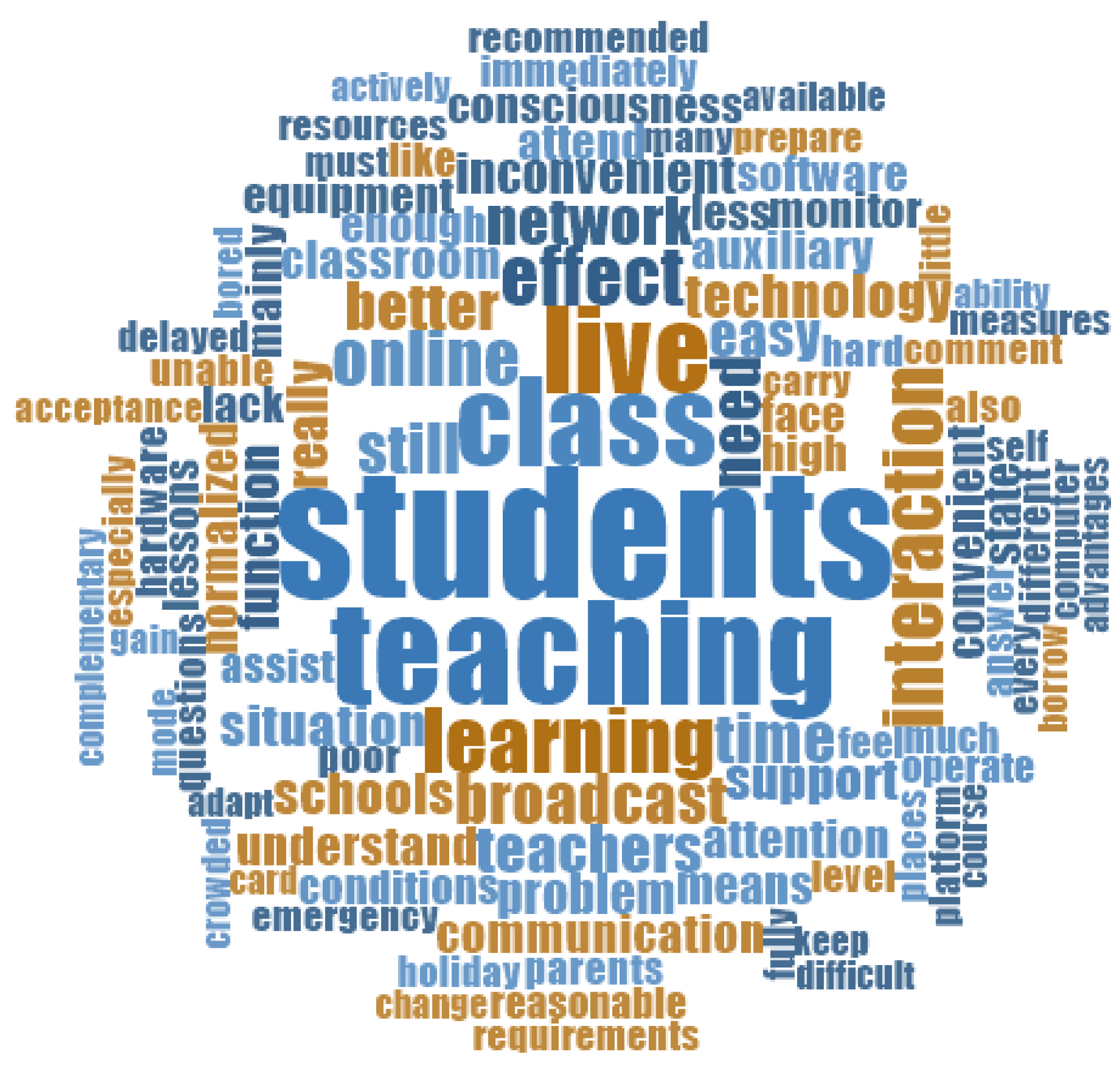
The tenth question is about teachers’ views on online education, which is an open question. This question is described using thematic analysis. The thematic analysis searches the data for themes that explain phenomena [46]. Its advantage is that it is not tied to a particular theoretical or epistemological position, so it can be applied flexibly in a broader context [47]. The researchers used NVivo 11 to analyze the views of 106 teachers. Figure 1 is the “vocabulary cloud” derived from the “word frequency statistics” of 106 viewpoints. The larger the word size in the Lexical Cloud, the higher the frequency of occurrence. From Figure 1, we can see the most frequent words in teachers’ views on online education: students, teaching, assist, live, interaction, learning, effect, equipment, and so on. Through the word frequency diagram, we can see that students occupy the dominant position in the classroom no matter the teaching method. Most teachers think that online education can be used as auxiliary teaching and pay more attention to the interaction and effect of online education. However, the “vocabulary cloud” cannot fully show teachers’ views on online education and whether further coding analysis of the content is needed.
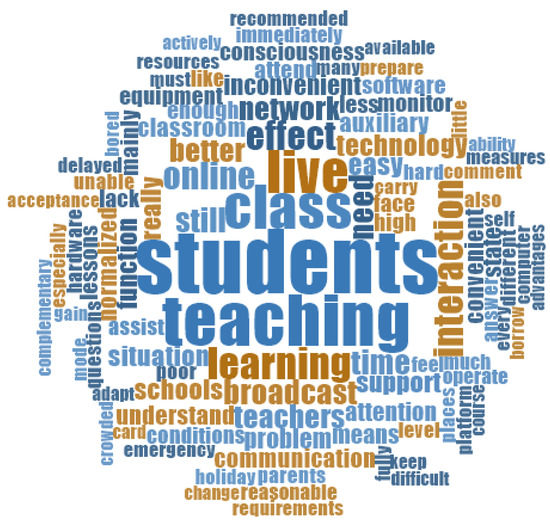
Figure 1.
The word frequency diagram of teachers’ views on online education.
Then the qualitative text was encoded by NVivo 11, and six parent nodes were formed. There were 17 sub-nodes and 35 reference points of social science teachers’ view, and 24 sub-nodes and 134 reference points of natural science teachers’ view. The overall view of teachers on online education is shown in Table 4. It can be found that the coverage rate of social science teachers in suggestion was higher than that of natural science teachers. In other aspects, the coverage of natural science teachers was higher than that of social science teachers. It showed that natural science teachers had more feelings and views on online education, and social science teachers put forward more suggestions.
Table 4.
Reference points of teachers’ views on online teaching in different disciplines.
Encoding was carried out according to the original answers of 106 teachers, the analysis steps were repeated many times, and a coding table was established with the core code of “Teachers’ views on online teaching”. The results are shown in Table 5.
Table 5.
The coding of teachers’ views on online teaching.
Table 5 shows teachers’ views on teaching, technology, students, teachers, etc. The views on teaching mainly include four parts. Many teachers thought there were obstacles to communicating with students and that it was difficult to monitor the situation of classes and students, resulting in inefficient teaching. Some teachers thought online teaching could give students time to think and practice. More teachers thought that online teaching had obstacles in interactive communication, and natural science teachers were more likely to think that online teaching was ineffective.
The view on technology mainly includes four parts. Some teachers and students lacked hardware equipment. Many teachers thought that the technical function of online teaching was limited, it was not efficient and convenient, and network stutter was also severe. Compared with social science teachers, more natural science teachers thought that online teaching lacked hardware equipment and limited technical functions, which may be because natural science needs more calculus and interaction. Still, the current technology cannot meet the needs well.
There were three main problems in students: many were not conscious enough to go to class on time; students’ learning state was not very good, lacking concentration and participation; and students were resistant to online teaching. Teachers’ views mainly included the following parts: obstacles to using equipment; online teaching was time-consuming and laborious, reducing passion in class; improving their ability to keep up with the trend of the times, but social teachers had not put forward their views in this regard.
Generally speaking, teachers had support, neutrality, and opposition to the evaluation of online teaching. Most teachers thought that online education had a particular value and was an extraordinary method in extraordinary times. Still, it could only be used as an additional teaching tool, not a substitute for regular teaching. Some opposing views thought online teaching was inadequate, impractical, and would affect students’ eyesight.
Teachers also made some suggestions for online teaching: (1) It should be carefully designed to make it a better teaching assistant; (2) the level of information technology needs to be strengthened, the function needs to be increased, and the operation should be more concise and clear; (3) due to the need for teaching, good high schools and universities can make effective use of online education; (4) it is more realistic to arrange the density and intensity of the course reasonably; and (5) online teaching should provide more abundant network resources.
4.4. Difference Analysis
4.4.1. Analysis of the Difference between Title
Since the variables for items 6, 7, and 9 can be considered ordinal, the variables for items 5 and 8 are nominal. Therefore, we used the non-parametric Kruskal–Wallis test for items 6, 7 and 9, and the chi-square test for items 5 and 8. In order to explore the influence of teachers’ professional titles on their views on online teaching, the above two test methods were used to compare the results of teachers with different professional titles in items 5 to 9. Table 6 reflects the result of the Kruskal–Wallis test.
Table 6.
The influence of professional titles on online teaching in items 6, 7 and 9.
The results showed that there was no significant difference in the choice of I6 (H(3) = 3.501, p = 0.321), I7 (H(3) = 7.618, p = 0.055), and I9 (H(3) = 1.611, p = 0.657) among teachers with different professional titles.
The chi-square analysis results of I5 and I8 are shown in Table 7. Since more than 20% of the expected count of the two items was less than 5, the significant value was obtained using Fisher’s test. The results showed no significant difference in the choice of I5 (χ2 = 9.597, df = 6, p = 0.086) and I8 (χ2 = 10.383, df = 6, p = 0.101) among teachers with different professional titles. That is, there is no significant difference in the motivation for offering online courses and the evaluation of the online teaching effect among teachers with different professional titles. It shows that teachers at all stages of career development have similar perceptions of online teaching.
Table 7.
The influence of professional titles on online teaching in items 5 and 8.
4.4.2. Analysis of Differences between Different Disciplines
In China, middle schools often regard Chinese, English, politics, history, and geography as social sciences and regard mathematics, physics, chemistry, and biology as natural sciences. Therefore, in this study, researchers classified disciplines according to this standard. This study explored the views of social science and natural science teachers on online teaching. The Kruskal–Wallis test was used in the non-parametric test to analyze the differences in the views of social science and natural science teachers on I6, I7, and I9, and the chi-square test for items 5 and 8.
Table 8 shows the results of the Kruskal–Wallis test. There were significant differences between social science and natural science teachers in I9 (H(1) = 3.922, p = 0.048 < 0.05). There was no significant difference between social and natural science teachers in I6 (H(1) = 0.019, p = 0.891) and I7 (H(1) = 0.853, p = 0.356).
Table 8.
Teachers’ views in different disciplines in items 6, 7 and 9.
Table 9 reflects the rank of social science and natural science teachers in I9. The results showed that the average rank of social science teachers was higher than that of natural science teachers (98.75 > 86.06). It showed that, compared with social science teachers, natural science teachers were more inclined to use online teaching as the norm.
Table 9.
The rank of social science and natural science teachers in I9.
The chi-square analysis results of I5 and I8 are shown in Table 10. Since more than 20% of the expected count of item 8 was less than 5, the significant value of I8 was obtained using Fisher’s test. The results showed no significant difference in the choice of I5 (χ2 = 0.915, df = 2, p = 0.633) and I8 (χ2 = 0.692, df = 2, p = 0.823) among teachers with different disciplines.
Table 10.
Teachers’ views in different disciplines in items 5 and 8.
4.4.3. Analysis of Differences between Different Ages
In this study, teachers who had been teaching for less than ten years were called young teachers, and teachers who had been teaching for more than ten years and less than 20 years were called middle-aged teachers. Therefore, according to the age range, teachers were divided into young teachers (20–30 years old), middle-aged teachers (30–50 years old), and old teachers (50–60 years old). The researchers conducted the Kruskal–Wallis test and analysis of teachers’ responses to I6, I7, and I9 in three age groups to investigate the differences in teachers’ views on online teaching among different age groups. Table 11 reflects the result.
Table 11.
Teachers’ views among different ages in items 6, 7 and 9.
The results showed that there was no significant difference among the teachers of the three age groups in I6 (H(2) = 1.032, p = 0.597) and I7 (H(2) = 0.476, p = 0.788) items, while the significant difference of teachers of different ages in I9 (H(2) = 6.454, p = 0.04 < 0.05) had statistical significance. Furthermore, pairwise comparisons were made among the three age groups.
Each row tested the null hypothesis that the Sample 1 and Sample 2 distributions were the same.
Asymptotic significances (2-sided tests) are displayed. The significance level is 0.05.
According to Table 12, the following results are shown: comparing group 2 with group 1, the test statistic was 14.777, and the test p-value was 0.038, indicating that there was a significant difference between the two groups, and the data of group 1 were significantly lower than those of group 2; comparing group 2 with group 3, the test statistic was −19.903, and the test p-value was 0.065, which showed that there was no difference between the two groups. Comparing group 1 with group 3, the test statistic was −5.126, and the test p-value was 0.663, indicating no difference between the two groups. It can be seen that there was a significant difference between young teachers and middle-aged teachers in their views on I9 (p = 0.038 < 0.05). The average value of middle-aged teachers was higher than that of young teachers, indicating that young teachers were more active than middle-aged teachers in expressing their position on whether online live teaching should be the norm.
Table 12.
The results of paired tests.
The chi-square analysis results of I5 and I8 are shown in Table 13. Since there is an expected count of less than 5 in two items, the significant value was obtained using Fisher’s test. The results showed that there was no significant difference in the choice of I5 (χ2 = 2.727, df = 4, p = 0.620) among teachers with different disciplines, while there was a significant difference in the choice of I8 (χ2 = 14.373, df = 4, p = 0.007). Post hoc testing was used to determine the differences among age groups in I8 according to adjusted standardized residuals. Table 14 reports the results.
Table 13.
Teachers’ views among different ages in items 5 and 8.
Table 14.
Crosstabulation of I8 and ages.
Multiple comparisons between groups were performed for I8, and the results are shown in Table 14. The absolute value of the adjusted standardized residual was selected to be bounded by 3. When the value is greater than 3, we consider the difference between the observed and expected frequencies statistically significant. It can be seen that among the teachers who believed in ‘no technical conditions’ and ‘ineffective,’ the absolute value of the adjusted standardized residual of middle-aged teachers was more significant than 3. The two standardized residuals were 3.0 and −3.7, respectively, and the differences were statistically significant. It indicates that middle-aged teachers were likelier to think that the main problem of online live classes was the lack of technical conditions rather than the poor effect of live classes.
5. Discussion and Conclusions
Since the COVID-19 outbreak, online teaching has been widely used. Many schools require teachers to conduct complete online teaching. Ensuring the quality and efficiency of online teaching has become an important research topic. Teachers’ perceptions of online teaching directly impact the quality of teaching and learning. This study, therefore, explored teachers’ perceptions of online teaching and learning in different disciplines through a convergent mixed research method combining quantitative and qualitative approaches.
Teachers’ perceptions of online teaching were obtained mainly through qualitative analysis. Martin et al. identified four domains of online teaching competencies. Communication and interaction competencies are one of them. Teachers must provide learners with timely responses and feedback and facilitate and engage in discussions [48]. The teachers’ perceptions of the pedagogical aspects of teaching and learning then focused on the issue of interactive communication and feedback. Many teachers reported that online teaching did not allow for face-to-face communication and did not allow for timely feedback from students, thus making it impossible for teachers to keep track of student mastery. It is why teachers may need to learn more about the methods of communication and exchange in online teaching. In addition, the state of students in online teaching also influenced teachers’ perceptions of online teaching. Many teachers reported that students’ learning status was not as good as offline teaching. A study in Portugal also showed that students were not very effective at learning due to the stress caused by the change in teaching methods [49]. Most teachers were against online teaching. Much data from extensive national surveys also revealed a high level of skepticism, hesitation, and pessimism among teachers about online teaching [50].
The perceptions of teachers of different disciplines regarding online teaching and learning were analyzed through quantitative and qualitative studies that corroborated each other. This study aimed to understand the similarities and differences in teachers’ views on online teaching in different disciplines, revealing significant differences in the views of normalized online teaching among teachers of different disciplines. Social science teachers preferred online live streaming not to be the norm, while science teachers preferred online live streaming to be the norm. Natural science teachers often needed more information technology to display teaching content than social science teachers. For example, mathematics teaching needs to use GeoGebra and other tools to show images of complex functions and other abstract content to help students to imagine intuitively. Some studies have pointed out that an essential element of effective mathematics teaching and learning is the use of appropriate technology and tools [51]. The effective use of technology has been shown to improve student’s performance in mathematics [52]. The qualitative data of this study also showed that natural science teachers had more views on the technology of live online teaching. In terms of “online teaching implementation conditions”, “online teaching effect”, and “main problems in online teaching”, there was no significant difference in the views of teachers from different disciplines.
The results showed age differences in the views of problems with live teaching and regular teaching. Younger teachers preferred online teaching as a regular method, while middle-aged teachers did the opposite. It may be because younger teachers are more enthusiastic about change and innovation in teaching, more receptive to information technology in teaching and learning, and more willing to learn and master online teaching technologies. The popularity of online teaching has had a definite impact on teaching habits and effectiveness. Middle-aged teachers needed a particular buffer time to accept online teaching. There was a gap between their information literacy and that of younger teachers, which also affected their use of online platforms for teaching. Middle-aged teachers were more inclined to believe that the main problem with live online classes was the lack of technical conditions rather than the ineffectiveness of the live classes themselves. Technology issues are the foundation of online teaching and learning, with efficient software and a smooth network providing guarantees for the effectiveness of online teaching. So there is also a need to strengthen the software and hardware equipment for online teaching.
The quantitative results showed that some teachers thought that the supporting technology of web-based education was not perfect. The results of qualitative research also showed that teachers thought that technical problems still needed to be solved. However, there are also some problems for teachers themselves. Many teachers lack technical and activity experience in online teaching. Nearly half of the teachers in this study had technical difficulties, and some did not even know how to implement online teaching. As a result, good teachers in traditional classroom teaching cannot guarantee the effectiveness of online teaching [33]. Technical difficulties affect the effect of online teaching. Some teachers show that they need to improve their ability to use educational technology to adapt to the development of the times. Therefore, educational administrators should equip teachers with communication technology tools for online teaching and carry out training on the use of technology [53,54]. Both teachers and students need to make technical preparations for online education.
Although knowing how to use online learning platforms and tools is critical to effective online teaching, technical training alone is not enough [48]. How to ensure the effectiveness of online teaching needs more attention. The quantitative results showed that many teachers thought online teaching was as effective as offline, face-to-face teaching. Still, most people think that online education is not effective enough. There may be two reasons: (1) online learning gives students more freedom, students are prone to inattention, reduced interaction between teachers and students, and so on, resulting in poor results of online learning, resulting in a decline in performance. (2) Because teachers cannot communicate face-to-face with students, they need to attract students’ attention through virtual communication, but the effect is not good [55]. The results of qualitative research also confirm this reason. Teachers of different disciplines have often mentioned that there are obstacles in interactive communication in online education, which prevent teachers from receiving students’ feedback in time, leading to poor teaching effects. Quantitative and qualitative results show that most teachers believe that online teaching can be used as an auxiliary means of daily teaching and can replace daily teaching in a specific period but cannot be used as a regular teaching method.
The above discussion shows that, although there are some problems with online teaching, it also has great value. It is suggested that education departments and schools should pay more attention to online teaching, provide distance training to support teachers and students to adapt to online education and guide teachers to combine online and offline teaching [36,37]. Teachers should also improve their information literacy, keep pace with the times, strive to create different teaching methods from the traditional offline classroom, form a positive and active online classroom atmosphere, and strengthen interaction and communication with students [56].
6. Limitations and Scope of Future Research
This study investigates the views of teachers of different disciplines on online teaching. According to the characteristics of the discipline, researchers divide teachers into social science and natural science teachers for research, which is a new perspective. This study uses a mixed research method, through the combination of qualitative and quantitative research, to understand teachers’ views and feelings more precisely and find significant differences in the motivation of online teaching among teachers of different disciplines. Because different disciplines have different characteristics and teaching needs, the research results are significant for the future online teaching curriculum design, resource support, and the personalization of teacher training.
There are also some limitations in this study. The questionnaire is not detailed enough, which limits us from collecting more information, and the setting of open questions is both bright and inadequate. If we can conduct in-depth interviews and case studies on teachers of different disciplines in the study, we may be able to provide a more in-depth perspective. Due to the differences in economic development in different provinces and regions, the development and application of modern educational technology are also different. Future research can consider expanding the scope of the investigation and comparing cross-regional online teaching.
Author Contributions
Conceptualization, Y.J. and P.J.; methodology, P.J.; formal analysis, P.J.; investigation, Y.J.; resources, Y.J.; writing—original draft preparation, P.J.; writing—review and editing, Z.F. and X.R.; funding acquisition, P.J. All authors have read and agreed to the published version of the manuscript.
Funding
This research was funded by Hunan Provincial Department of Education (Hunan Provincial Teaching Reform Research Project), grant number HNJG-2022-0051.
Institutional Review Board Statement
Not applicable.
Informed Consent Statement
Not applicable.
Data Availability Statement
The raw data supporting the conclusions of this article will be made available by the authors without undue reservation.
Acknowledgments
Since there was no material reward for participating in the survey, all teachers and students who volunteered to complete the survey are thanked!
Conflicts of Interest
The authors declare no conflict of interest.
Appendix A
The ten items are listed below.
- 1. Have you recently conducted (organized or participated) online classes?
- □ Yes □ No
- 2. What subject do you teach?
- □ Language □ Maths □ English □ Physics □ Chemistry
- □ Biology □ Politics □ History □ Geography □ Other
- 3. What is your professional and technical title?
- □ Junior □ Intermediate □ Associate Senior □ Senior
- 4. How old are you?
- □ 20–24 □ 25–29 □ 30–34 □ 35–39
- □ 40–44 □ 45–49 □ 50–54 □ 55–59
- 5. Why do you conduct online classes?
- □ like to use ICT □ school requirement □ auxiliary teaching
- 6. Is your online class going smoothly?
- □ smooth, technical conditions are available
- □ neutral, there are technical difficulties
- □ not smooth, do not know how to operate
- 7. Do you think your online teaching is effective?
- □ The effect is perfect, the same as the usual classroom
- □ The result is not good enough, and it is impossible to do the same as usual
- □ The effect is inferior; I feel a little bit tricky for students
- 8. What do you think are the main problems of online classes?
- □ No technical conditions □ Ineffective □ long preparation time
- 9. Do you think online teaching can become a common way of teaching??
- □ should become a common form □ can be used as an auxiliary
- □ applicable only during special periods
- 10. What is your opinion on online classes?
References
- Jiang, P.; Xiong, B. Online Live Teaching of Mathematics Gifted Students on the Tablet. In Proceedings of the 2021 6th International Conference on Distance Education and Learning (ICDEL 2021), New York, NY, USA, 21–24 May 2021. [Google Scholar]
- Martin, F.; Sun, T.; Westine, C.D. A systematic review of research on online teaching and learning from 2009 to 2018. Comput. Educ. 2020, 159, 104009. [Google Scholar] [CrossRef]
- Gormaz-Lobos, D.; Galarce-Miranda, C.; Kersten, S.; Hilgarth, A.; Hortsch, H. Validation of an Instrument to Measure Students‘ Perceptions of Online Learning. Int. J. Emerg. Technol. Learn. 2022, 17, 226–242. [Google Scholar] [CrossRef]
- Olmes, G.L.; Zimmermann, J.S.M.; Stotz, L.; Takacs, F.Z.; Hamza, A.; Radosa, M.P.; Findeklee, S.; Solomayer, E.-F.; Radosa, J.C. Students’ attitudes toward digital learning during the COVID-19 pandemic: A survey conducted following an online course in gynecology and obstetrics. Arch. Gynecol. Obstet. 2021, 304, 957–963. [Google Scholar] [CrossRef] [PubMed]
- Seifert, T.; Cite, T.; Journal, M.O. Students’ Perceptions of Online Teaching and Learning. Malays. Online J. Educ. Technol. 2021, 9, 1–12. [Google Scholar] [CrossRef]
- Alaghawat, M.; Alshamailah, I. Distance Learning at the University of Jordan in the Setting of COVID-19 Pandemic from the Students‘ Perspectives. Int. J. Emerg. Technol. Learn. 2022, 17, 4–22. [Google Scholar] [CrossRef]
- Werang, B.R.; Leba, S.M. Factors Affecting Student Engagement in Online Teaching and Learning: A Qualitative Case Study. Qual. Rep. 2022, 27, 555–577. [Google Scholar] [CrossRef]
- Tamal, M.A.; Hossain, M.E. Acceptance of E-Learning Among University Students During COVID-19 Crisis: Bangladesh Perspective. Int. J. Emerg. Technol. Learn. 2022, 17, 152–162. [Google Scholar] [CrossRef]
- Almusharraf, N.M.; Khahro, S.H. Students’ Satisfaction with Online Learning Experiences during the COVID-19 Pandemic. Int. J. Emerg. Technol. Learn. 2020, 15, 246–267. [Google Scholar] [CrossRef]
- Shatri, K.; Buza, K.; Bunjaku, F. Teachers’ Perception on the Benefits of Using Online Resources. Int. J. Emerg. Technol. Learn. 2021, 16, 289–307. [Google Scholar] [CrossRef]
- Bai, X. Preservice Teachers‘ Evolving View of the Impact of the COVID-19 Pandemic on Online Learning. Int. J. Emerg. Technol. Learn. 2022, 17, 212–224. [Google Scholar] [CrossRef]
- Kerr-Sims, S.; Baker, D.M. Faculty Perceptions of Teaching Online During the COVID-19 University Transition of Courses to an Online Format. J. Teach. Learn. Technol. 2021, 10, 337–353. [Google Scholar] [CrossRef]
- Dhawan, S. Teachers’ Satisfaction with Online Teaching: A Study of Private Senior-Secondary Schools in Delhi. Glob. J. Enterp. Inf. Syst. 2021, 13, 30–42. [Google Scholar]
- Tsekhmister, Y.V.; Konovalova, T.; Tsekhmister, B.Y.; Agrawal, A.; Ghosh, D. Evaluation of Virtual Reality Technology and Online Teaching System for Medical Students in Ukraine During COVID-19 Pandemic. Int. J. Emerg. Technol. Learn. 2021, 16, 127–139. [Google Scholar] [CrossRef]
- Mihele, R. Online Teaching and Learning between Temporary Solution and Future Necessity. Rom. Rev. Geogr. Educ. 2021, 10, 45–66. [Google Scholar] [CrossRef]
- Sharma, N.; Bansal, S.; Pandey, A.K. Significance and Challenges of Online Teaching. Ilkogretim Online 2021, 20, 1445–1449. [Google Scholar]
- Abrudan, C.L.; Horea, I.C. the Perks and Downsides of Teaching English Online. Ann. Univ. Oradea. Econ. Sci. 2021, 30, 465–472. [Google Scholar] [CrossRef]
- Voogt, J. How different are ICT-supported pedagogical practices from extensive and non-extensive ICT-using science teachers? Educ. Inf. Technol. 2009, 14, 325–343. [Google Scholar] [CrossRef]
- Hegde, A.V.; Hewett, B.S. Examining effectiveness of online teaching modules on Developmentally Appropriate Practices (DAP) for guiding young children’s behavior: Student and instructor perspectives. J. Early Child. Teach. Educ. 2021, 42, 93–109. [Google Scholar] [CrossRef]
- Flores, M.A.; Barros, A.; Simão, A.M.V.; Pereira, D.; Flores, P.; Fernandes, E.; Costa, L.; Ferreira, P.C. Portuguese higher education students’ adaptation to online teaching and learning in times of the COVID-19 pandemic: Personal and contextual factors. High. Educ. 2022, 83, 1389–1408. [Google Scholar] [CrossRef]
- Feng, X.; Ioan, N.; Li, Y. Comparison of the effect of online teaching during COVID-19 and pre-pandemic traditional teaching in compulsory education. J. Educ. Res. 2021, 114, 307–316. [Google Scholar] [CrossRef]
- Lei, S.I.; So, A.S.I. Online Teaching and Learning Experiences During the COVID-19 Pandemic–A Comparison of Teacher and Student Perceptions. J. Hosp. Tour. Educ. 2021, 33, 148–162. [Google Scholar] [CrossRef]
- Motte-Signoret, E.; Labbé, A.; Benoist, G.; Linglart, A.; Gajdos, V.; Lapillonne, A. Perception of medical education by learners and teachers during the COVID-19 pandemic: A cross-sectional survey of online teaching. Med. Educ. Online 2021, 26, 1919042. [Google Scholar] [CrossRef]
- Geçer, E.; Bağci, H. Examining students’ attitudes towards online education during COVID-19: Evidence from Turkey (Análisis de las actitudes de los estudiantes hacia la educación en línea durante la pandemia de COVID-19. Evidencia de un estudio realizado en Turquía). Cult. Educ. 2022, 1–28. [Google Scholar] [CrossRef]
- Bajaj, P.; Khan, A.; Tabash, M.I.; Anagreh, S. Teachers’ intention to continue the use of online teaching tools post COVID-19. Cogent Educ. 2021, 8, 2002130. [Google Scholar] [CrossRef]
- Bayne, S.; Evans, P.; Ewins, R.; Knox, J.; Lamb, J. The Manifesto for Teaching Online; MIT Press: Cambridge, MA, USA, 2020. [Google Scholar]
- Mansbach, J.; Austin, A.E. Nuanced Perspectives about Online Teaching: Mid-Career and Senior Faculty Voices Reflecting on Academic Work in the Digital Age. Innov. High Educ. 2018, 43, 257–272. [Google Scholar] [CrossRef]
- Şahin-Kizil, A. EFL teachers attitudes towards information and communication technologies (ICT). In Proceedings of the 5th International Computer & Instructional Technologies Symposium, Laziğ, Turkey, 22–24 September 2011. [Google Scholar]
- Bolliger, D.U.; Halupa, C. An Investigation of Instructors’ Online Teaching Readiness. TechTrends 2022, 66, 185–195. [Google Scholar] [CrossRef]
- Lei, M.; Medwell, J. Impact of the COVID-19 pandemic on student teachers: How the shift to online collaborative learning affects student teachers’ learning and future teaching in a Chinese context. Asia Pac. Educ. Rev. 2021, 22, 169–179. [Google Scholar] [CrossRef]
- An, Y.; Kaplan-Rakowski, R.; Yang, J.; Conan, J.; Kinard, W.; Daughrity, L. Examining K-12 teachers’ feelings, experiences, and perspectives regarding online teaching during the early stage of the COVID-19 pandemic. Educ. Tech Res. 2021, 69, 2589–2613. [Google Scholar] [CrossRef]
- DeCoito, I.; Estaiteyeh, M. Transitioning to Online Teaching During the COVID-19 Pandemic: An Exploration of STEM Teachers’ Views, Successes, and Challenges. J. Sci. Educ. Technol. 2022, 31, 340–356. [Google Scholar] [CrossRef]
- Kim, L.E.; Burić, I. Teacher self-efficacy and burnout: Determining the directions of prediction through an autoregressive cross-lagged panel model. J. Educ. Psychol. 2022, 112, 1661. [Google Scholar] [CrossRef]
- Trujillo-Torres, J.M.; Hossein-Mohand, H.; Gómez-García, M.; Hossein-Mohand, H.; Cáceres-Reche, M.P. Mathematics teachers’ perceptions of the introduction of ICT: The relationship between motivation and use in the teaching function. Mathematics 2020, 8, 2158. [Google Scholar] [CrossRef]
- DeCoito, I.; Estaiteyeh, M. Online teaching during the COVID-19 pandemic: Exploring science/STEM teachers’ curriculum and assessment practices in Canada. Discip. Interdiscip. Sci. Educ. Res. 2022, 4, 1–18. [Google Scholar] [CrossRef]
- Setoromo, M.; Hadebe-Ndlovu, B. An exploration of in-service teachers’ understanding of teaching mathematics in Grade R classrooms: A case study of Grade R in Lesotho University of KwaZulu-Natal, South Africa. South Afr. J. Child. Educ. 2020, 10, 1–9. [Google Scholar] [CrossRef]
- Jimerson, S.R.; Haddock, A.D. Understanding the importance of teachers in facilitating student success: Contemporary science, practice, and policy. Sch. Psychol. Q. 2015, 30, 488. [Google Scholar] [CrossRef]
- Rajasekhar, Y. Techniques to Effectively Teach a Course Online. J. Comput. Sci. Coll. 2020, 36, 19. [Google Scholar]
- Menabò, L.; Skrzypiec, G.; Sansavini, A.; Brighi, A.; Guarini, A. Distance Education among Italian Teachers: Differences and Experiences. Educ. Inf. Technol. 2022, 27, 9263–9292. [Google Scholar] [CrossRef]
- Kwee, C.T.T. To teach or not to teach: An international study of language teachers’ experiences of online teaching during the COVID-19 pandemic. SN Comput. Sci. 2022, 3, 1–16. [Google Scholar] [CrossRef]
- Borg, C.; Gericke, N.; Höglund, H.O.; Bergman, E. The barriers encountered by teachers implementing education for sustainable development: Discipline bound differences and teaching traditions. Res. Sci. Technol. Educ. 2012, 30, 185–207. [Google Scholar] [CrossRef]
- Creswell, J.W.; Clark, V.L.P. Designing and Conducting Mixed Methods Research; Sage Publications Ltd.: London, UK, 2007. [Google Scholar]
- Gulinna, A.; Jingrong, X.; Nilufer, K. Factors influencing faculty’s online teaching decisions. Distance Educ. 2022, 43, 426–443. [Google Scholar]
- Iivari, N.; Sharma, S.; Ventä-Olkkonen, L. Digital transformation of everyday life—How COVID-19 pandemic transformed the basic education of the young generation and why information manage-ment research should care? Int. J. Inf. Manag. 2020, 55, 102183. [Google Scholar] [CrossRef]
- Manegre, M.; Sabiri, K.A. Online language learning using virtual classrooms: An analysis of teacher perceptions. Comput. Assist. Lang. Learn. 2022, 35, 973–988. [Google Scholar] [CrossRef]
- Fereday, J.; Muir-Cochrane, E. Demonstrating Rigor Using Thematic Analysis: A Hybrid Approach of Inductive and Deductive Coding and Theme Development. Int. J. Qual. Methods 2006, 5, 80–92. [Google Scholar] [CrossRef]
- Braun, V.; Clarke, V. Using thematic analysis in psychology. Qual. Res. Psychol. 2006, 3, 77–101. [Google Scholar] [CrossRef]
- Martin, F.; Budhrani, K.; Wang, C. Examining faculty perception of their readiness to teach online. Online Learn. 2019, 23, 97–119. [Google Scholar] [CrossRef]
- Xavier, B.; Camarneiro, A.P.; Loureiro, L.; Menino, E.; Cunha-Oliveira, A.; Monteiro, A.P. Impacto da COVID-19 nas dinâmicas sociofamiliares e académicas dos estudantes de enfermagem em Portugal. Rev. De Enferm. 2020, 4, 1–9. [Google Scholar]
- Allen, I.E.; Seaman, J. Online Report Card: Tracking Online Education in the United States [M]; Babson Survey Research Group: Babson Park, MA, USA, 2016. [Google Scholar]
- Polly, D.; Orrill, C.H. Designing professional development to support teachers’ TPACK in elementary school mathematics. In Handbook of Technological Pedagogical Content Knowledge, 2nd ed.; Herring, M., Koehler, M.J., Mishra, P., Eds.; Routledge: London, UK, 2016; pp. 259–268. [Google Scholar]
- Polly, D. Modeling the influence of calculator use and teacher effects on first grade students’ mathematics achievement. J. Technol. Math. Sci. Teach. 2008, 27, 245–263. [Google Scholar]
- Davis, N.; Roblyer, M.D.P.; Charania, A. Illustrating the “virtual” in virtual schooling: Challenges and strategies for creating real tools to prepare virtual teachers. Internet High. Educ. 2007, 10, 27–39. [Google Scholar] [CrossRef]
- Kim, L.E.; Dar-Nimrod, I.; MacCann, C. Teacher personality and teacher effectiveness in secondary school: Personality predicts teacher support and student self-efficacy but not academic achievement. J. Educ. Psychol. 2018, 110, 309–323. [Google Scholar] [CrossRef]
- Easton, S.S. Clarifying the instructor’s role in online distance learning. Commun. Educ. 2003, 52, 87–105. [Google Scholar] [CrossRef]
- Ali, T.T.; Herrera, M. Distance Learning during COVID-19: 7 Equity Considerations for Schools and Districts; Southern Education Foundation: Atlanta, GA, USA, 2020. Available online: https://files.eric.ed.gov/fulltext/ED605744.pdf (accessed on 1 December 2022).
Disclaimer/Publisher’s Note: The statements, opinions and data contained in all publications are solely those of the individual author(s) and contributor(s) and not of MDPI and/or the editor(s). MDPI and/or the editor(s) disclaim responsibility for any injury to people or property resulting from any ideas, methods, instructions or products referred to in the content. |
© 2023 by the authors. Licensee MDPI, Basel, Switzerland. This article is an open access article distributed under the terms and conditions of the Creative Commons Attribution (CC BY) license (https://creativecommons.org/licenses/by/4.0/).