


Abstract
Food waste is a global challenge and fits within the remit of the United Nations Sustainable Development Goal 12; hence, strategies to promote engagement, especially at an individual level, are key to maximise societal benefits. Accordingly, it is important to understand the relevant design cues from a segmentation and intervention viewpoint for food waste. This review aims to explore (i) common characteristics associated with food waste segmentation and (ii) delivery formats typically utilised in food waste interventions. Overall, it was apparent that food waste encompasses a broad term per se, resulting in varying quantification approaches, which subsequently contribute to heterogenicity of the findings. However, key themes emerged, such as gender, age, food waste level, motivation, engagement and environment as common components from the food waste segmentation. Visual (text, infographic, booklets), audio/oral (videos, door stepping, coaching), interactive (recipe, community engagement, diary/notepad) and touch (magnet, bins, stickers) were the dominant delivery formats used in food waste interventions; suggesting that a combination of senses is required to successfully promote engagement and behavioural effects. Going forwards, more consistency in measuring food waste is needed to enable comparison (within and between countries), coupled with the consideration of design cues, so that toolkits can be developed to meet the needs of differing consumer segments.
1. Introduction
Sustainability incorporating economic, social and environmental aspects is a key global goal identified by the United Nations, with an emphasis on the needs of current and future generations [1]. More specifically, Sustainable Development Goal 12 “responsible consumption and production” identified food waste as a fundamental and urgent challenge to be addressed [2]. This is a worldwide problem, with approximately 931 million tons of food waste generated per annum [2]. In the UK, it is evident that the majority of food waste occurs in a household context (60%: household; 15%: on-farm; 13%: manufacturing; 10%: hospitality/food service; and 2%: retail (data reported by weight)) [3]. For example, the implications are noteworthy from an economic perspective, as food waste is valued at appropriately GBP 250 over a 12-month period per individual in the UK [3]. More broadly, the estimated total market value is EUR 132 billion at an EU level with 54% being generated from households [4]. In addition, the negative consequences of wasted food on the environment (e.g., greenhouse gases) are widespread [5]. Accordingly, embracing change at an individual level, coupled with the implementation of relevant government policies and solutions from industry, can have notable societal impact as well as help consumers achieve a more sustainable lifestyle overall [2].
There are varying definitions and terminologies used to quantify food waste, leading to further complications [5]. This review will focus on food waste based on the definition used by the Food and Agriculture Organisation (FAO) of the United Nations [6]: “decrease in the quantity or quality of food resulting from decisions and actions by retailers, food services and consumers” from a household perspective.
The food waste journey, as noted by Principato et al. [7], is considered a dynamic process from planning, purchase, preparation and consumption to disposal. Therefore, it is important to understand the different barriers and drivers that can impact an individual’s level of food waste in a household context, subsequently impacting behaviour at each step in order to enable the development of targeted interventions [7,8,9,10]. Overall, it is apparent that key food waste-related challenges from a household perspective are centred around a plethora of issues (such as storage, labelling, preferences, planning, awareness, skills and packaging) coupled with cost, health and environmental implications [5,7,8,9,10,11,12,13,14]. In addition, common food waste categories include vegetables, fruits, salads, meals (homemade/pre-prepared), bakery and dairy, with cited disposal reasons such as food safety (smell, not appropriate appearance), prepared too much, labelling (date on packaging) and inedible/preferences [13,15,16,17]. Food waste-related interventions are typically conducted in varying contexts and are perceived to have a moderate effect on consumer behaviour [18,19,20,21]. However, an emphasis on a more tailored approach capturing different consumer segments could be fundamental to encourage long-term engagement and a sustained reduction in food waste. Accordingly, this review aims to address such a research gap by breaking down the relevant components, predominantly in developed countries [6], focusing on consumer-centric articles (retrieved from Web of Science in a twenty-year timeframe: 2004–2024, adhering to pre-selected keywords such as food waste, intervention, messaging, communication, segmentation, consumer behaviour, household, cross-cultural and Europe) at a household level. The corresponding studies were reviewed and included based on relevance to answer defined review objectives: (1) explore food waste segmentation studies and (2) identify delivery formats used in food waste interventions in order to support future development of consumer-centric toolkits.
2. Food Waste Segmentation
Consumer segmentation is a process of identifying common characteristics shared by a sub-group so that a more tailored experience and/or practical application is possible [22]. This approach has been applied to food waste, and examples of such studies are outlined in Table 1 [23,24,25,26,27,28,29,30,31,32,33,34,35,36,37,38,39,40,41,42,43,44,45,46,47,48,49,50,51]. It is evident that most studies have utilised surveys to quantify consumers’ food waste behaviour; hence, as has previously been noted in the literature, this can be associated with potential bias and mismatch with actual behaviour [24,27,31,37,43,49,51,52]. Recently, a few studies have tried to address such a limitation by supplementing survey data with additional data (e.g., interventions, bin audit waste and/or purchase data) to validate segmentations [27,41,42,48]. However, such analyses have only included a sub-set, not linked with segmentation or more retailer-focused approaches [27,41,42]. This suggests that future research should focus on tracking actual behaviour using repeated measures approaches (e.g., over time) in ecological settings to cluster consumers based on common food waste characteristics in order to help successfully implement positive behaviours.

Table 1.
Examples of consumer-centric food waste segmentation studies.
In addition, studies have used varying sample sizes (n = 150 to 12,187) in different countries (USA: n = 1; Australia: n = 4; and Europe: n = 28), resulting in findings that could only be considered representative for the specific studies and/or country rather than globally relevant. Moreover, food waste challenges are present regardless of age for households; therefore, studies need to adopt balanced design for age and use a life-course approach. Studies have also used different numbers of segments with varying proportions within each cluster; thereby impacting the findings’ potential representativeness. Studies have also utilised different food waste-related measures (e.g., behaviours, generations, lifestyles, levels, intentions, emergence, awareness, practices, drivers, attitudes, knowledge, motivations, etc.) to determine such segments and used their own terminology to describe such sub-groups; thus, comparisons between studies can be considered challenging. Despite the varying approaches and inconsistencies in naming segments, it is essential to map any commonalities from the various studies. For example, the following key trends have been identified across the literature:
(1) Gender: this was a common segmentation characteristic reported in various studies, such as female (e.g., proactive, young foodie, carrying, average composters, active environmentalists, causal, 20–40s food waste fighters, 20–40s food wasters, typical, considerates, reluctants, positive attitude, planning, young waster, leftover fan, planner, impulsive waster, aware wasters, thrifty altruists, etc.) and male (e.g., discouraged, self-indulgent, uninvolved, indifferent, uncaring, typical, control-conscious, etc.) [23,25,28,29,32,35,36,39,42,45,49,50,51]. Additional demographics (e.g., income, education, children, city vs. rural, etc.) have also been used in consumer food waste segmentation; however, such variables are associated with considerable variability between studies due to cross-cultural and country differences (hence not the focus of our review). Overall, it could be suggested that based on the resulting segmentations, females may display more conscious food waste behaviour than males.
(2) Age: it was a challenge to group consumers, as studies typically used different age-criteria and unbalanced age-related designs. More specifically, trends related to younger (e.g., young waster/foodie, unaware, concerned, uninvolved, uncaring, food waste reducing sharing, causal females, control conscious, positive attitude, planning seeking, aware, pragmatic, convenience lovers, 20-40s food wasters/food waste fighters, etc.) and older (e.g., established, proactive, well-planning cook/frugal food avoider, no food waste, considerate planners, caring, helpless apartment residents, active environmentalists, traditionalists, total food waste fighters, thrifty altruists, etc.) segments [23,25,27,32,33,35,36,39,41,42,45,49,50,51]. Based on such findings, older consumers could be more resourceful in terms of food waste approaches, potentially driven by experience gained over time.
(3) Food waste level: consumers can be grouped as lower (e.g., proactive, considerate planners, frugal consumers/believers, uninterested urban citizens, conscientious conservers, unrepresented drink wasters, conservers, epicures, pragmatic, slackers, warriors, no food waste, planner, etc.) or higher (e.g., discouraged, self-indulgent, over providers, conscious fussy type, average composters, harried profligates, guilty carb wasters, prodigals, causal consumers, strugglers, uninvolved, impulsive buyer, etc.) food wasters [23,27,28,31,33,34,35,36,37,38,42,43,45,48,49,51]. Similarly, this was also difficult to group due to the various parameters used to qualify waste levels. Overall, this suggests that a proactive consumer (e.g., regularly plans and conscious) is more likely to have lower food waste levels.
(4) Motivation: studies used different measures to understand perceived intention to change and/or concern levels. However, consumers could be grouped as having lower (e.g., under planners, non-aware consumers, uncaring, convenience lovers, self-centred, uninvolved, careless, ignorant, unconcerned, reluctants, wasters, impulsive wasters, etc.) or higher (e.g., proactive, conscious, caring, frugal believers, traditional, concerned, precautious, involved, prodigals, considerates, virtuous, etc.) motivation [23,24,27,28,30,32,35,36,41,45,46,47,48,49]. This suggests different interventions will be needed and tailored depending on the particular segment’s perceived level of motivation, interest and/or willingness to successfully modulate future behaviour.
(5) Engagement: it was evident that some segments also noted consumers’ engagement levels in food waste practices such as no (e.g., short-termist, impulse buying, uncaring, conscious-forgetful type, convenience lovers, unaware consumers, waster, exaggerated cook, price-oriented, unconcerned, uninvolved, convenience, prodigals, etc.) or yes (e.g., well-planning cook/frugal food avoider, caring, traditionals, warriors, total food waste fighters, spontaneous, involved, young foodie, conservers, food waste reducing sharer, virtuous, planner leftovers, etc.) [24,25,28,29,32,34,41,43,48,49,50]. Consumers that regularly engage in planning (e.g., shopping lists, plan meals) were considered more organised and therefore more likely to demonstrate lower food waste levels.
(6) Environment: there was a trend demostratingthat segments had an environmental aspect (e.g., eco-responsible, conscious consumers, consequent pro-environmental consumers, average composters, helpless apartment residents, active environmentalists, traditionalists, warriors, concerned, etc.) [29,30,33,35,41,43,45]. Accordingly, such consumers were considered to be actively trying to minimise food waste due to environmental drivers.
In summary, despite the noted variability in the segmentation approach and/or terminology, there are overlapping trends (such as gender, age, food waste level, motivation, engagement and environment). However, future research would benefit from using validated measures to enable comparisons within and between countries as well as capturing relevant infrastructure differences. This would enable a more critical analysis of which food waste quantification measures are needed so as to better understand consumer-centric driven segmentation and how this subsequently modulates behaviour in a variety of contexts.
3. Food Waste Intervention Delivery Formats
Interventions play a fundamental role in establishing which delivery formats can modulate consumers’ food waste behaviour [53]. Accordingly, it is important to understand the various approaches and food waste-related topics utilised as well as recognise key challenges to help inform future work and maximise impact. In this context, our sensory cues (e.g., five key senses: sight, hearing, taste, smell and touch) play a key role in how we perceive and engage with information [54]. Table 2 summarises different food waste intervention-related studies, focusing on the delivery content, format and rationale [48,55,56,57,58,59,60,61,62,63,64,65,66,67,68,69,70,71,72,73,74]. Similar to the food waste segmentation, the reviewed interventions represented a broad range of topics (e.g., awareness, reduction, disposal (separation, recycling), context (environment, taste, emotion, economic), education and societal) and used different intervention-driven study types (such as information strategies, message framing, randomised controlled trials and longitudinal field experiments). The latter also resulted in the variable sample sizes (from n = 40 to n = 33,716) as studies focused on individuals, households and/or areas within a specific location. It should be noted that the unbalanced design, variable study length (short vs long term), small sample size or lack of a control group may also contribute to the heterogenicity of the findings. There was also an “international” flavour, where half of the studies were conducted in American-based countries (Brazil, Canada, USA); hence, individual values and infrastructure differences may impact corresponding study findings as well as the application of intervention outcomes to other countries [75]. Therefore, it is important to understand design cues from a delivery format perspective to successfully modulate consumers’ food waste behaviour. This is especially relevant since food waste studies are associated with variability; therefore, mapping the similarities and differences of delivery formats from interventions can enable a toolkit of resources to be developed in the future.
Table 2.
Examples of food waste intervention studies by delivery content, format and rationale.
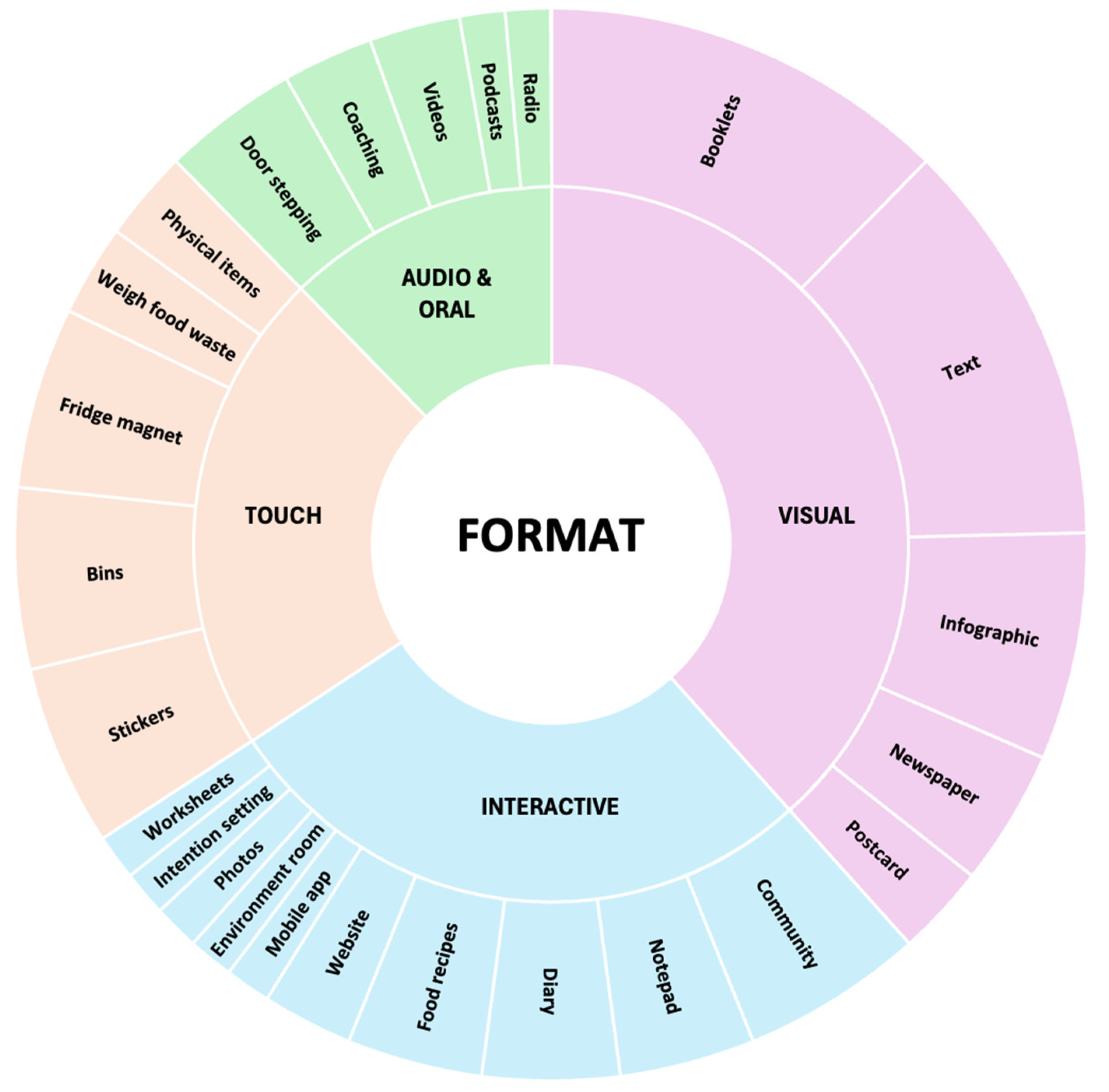
The delivery formats from the studies outlined in Table 2 were collated, and four key overriding delivery formats emerged (visual, audio/oral, interactive and touch), as summarised in Figure 1. For example, visual (sight driven) was mainly either text driven by explaining relevant information or combining text and images to convey its message [48,55,56,57,58,59,60,61,62,63,64,65,66,68,70,71,72,73,74]. Audio (information received by ear or hearing) incorporated radio, podcasts and videos, with the latter having a notable overlap with visual [58,71,74]. Oral (spoken via face-to-face contact) included door stepping and coaching [55,59,63,64,65]. Interactive (a task to complete or interaction with others) denoted a range of activities from recipes to apps [48,57,58,59,61,62,63,64,65,66,71,72,73,74]. Touch (tactical sensation) was similar to interactive; however, it included a more physical presence (e.g., bins, magnets, stickers, scales) [57,58,61,62,63,65,69,70,71,72,73]. Overall, it was apparent that most studies used a combination of senses per se in terms of delivery formats, whereas message framing approaches tended to focus more on visual formats. The effect of the intervention on modulating food waste intentions, interests, awareness, disposal and levels was relatively positive; however, the extent varied depending on the measured outcomes.
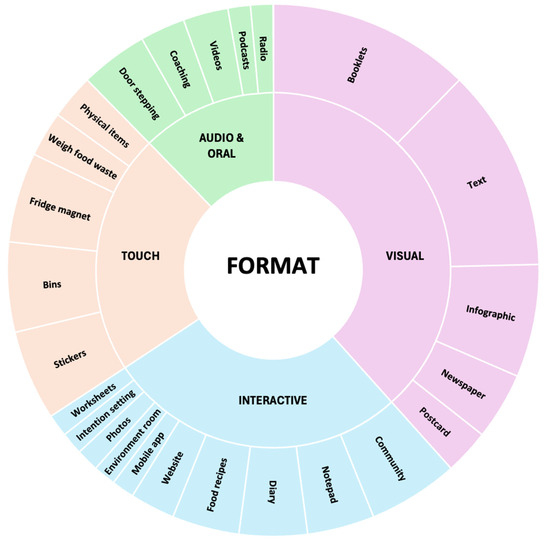
Figure 1.
Overview of different food waste delivery formats commonly used in intervention-driven studies.
This suggests more consistency in methodology in terms of food waste quantification, topics, timeframes (short term vs long term), user involvement and the number of contact points as such factors can play a fundamental role in whether an intervention was successful. Such challenges have also been present in other reviews as well as in identifying key areas of interest (e.g., environment, cost, lack of awareness, labelling, packaging, improved dissemination, etc.) to modulate household food waste levels in the future [76]. In addition, it was evident from the delivery rationale (Table 2) that co-design elements were not typically considered in material development; therefore, this could be a key area to focus on in the future for toolkit creation to maximise impact.
4. Conclusions
This review demonstrated the importance of considering design components in order to maximise food waste-related engagement at an individual and household level. Broadly speaking, the lack of consistency, especially in terms of food waste quantification, poses a noteworthy challenge. Accordingly, overcoming this barrier would enable a more streamlined approach within and between countries as well as an understanding of the effect of country-specific infrastructure from a worldwide perspective. Food waste segmentation would also benefit from a more unified approach in terms of terminology (e.g., how researchers decided on naming a particular segment). It is likely that key characteristics of segments include gender, age, food waste level, motivation, engagement and environmental differences; such drivers need to inform subsequent design to maximise uptake. In addition, mapping the different delivery formats used to communicate information in interventions provided useful insights. This highlighted four overriding formats: visual, audio/oral, interactive and touch, with varying levels of overlap; therefore, involving a combination of different senses is fundamental to effectively communicate food waste-related information. Next steps should focus on employing co-design approaches to develop toolkits targeted at different consumer segments, with varying delivery formats, in order to overcome the one-size-fits-all model typically used with such resources. It is important that such resources are tested in ecologically valid settings and over varying timeframes so that uptake and impact can be captured appropriately. Overall, there is a need for a collective effort (such as from academics, government, food companies and supermarkets) to help drive a sustained shift in reducing food waste levels.
Author Contributions
Conceptualization, V.N., S.L., O.O.O., G.V., P.A.A. and N.A; writing—original draft preparation, V.N.; writing—review and editing, V.N., S.L., O.O.O., G.V., P.A.A. and N.A; visualization, V.N., S.L. and N.A.; supervision, S.L. and N.A. All authors have read and agreed to the published version of the manuscript.
Funding
This research received no external funding.
Institutional Review Board Statement
Not applicable.
Informed Consent Statement
Not applicable.
Data Availability Statement
No new data were created in this review; therefore, data sharing is not relevant.
Conflicts of Interest
The authors declare no conflicts of interest.
References
- United Nations. The Sustainable Development Agenda. Available online: https://www.un.org/sustainabledevelopment/development-agenda/ (accessed on 6 May 2024).
- United Nations. Goal 12: Ensure Sustainable Consumption and Production Patterns. Available online: https://www.un.org/sustainabledevelopment/sustainable-consumption-production/ (accessed on 30 October 2023).
- WRAP. UK Food Waste & Food Surplus—Key Facts. Available online: https://wrap.org.uk/sites/default/files/2024-01/WRAP-Food-Surplus-and-Waste-in-the-UK-Key-Facts%20November-2023.pdf (accessed on 28 April 2024).
- European Commission. Food Waste. Available online: https://food.ec.europa.eu/safety/food-waste_en (accessed on 26 July 2024).
- Malik, X.; Smith, L.; Stewart, I.; Burnett, N. Food Waste in the UK. Available online: https://researchbriefings.files.parliament.uk/documents/CBP-7552/CBP-7552.pdf (accessed on 1 May 2024).
- Food and Agriculture Organisation (FAO) of the United Nations. The State of Food and Agriculture—Moving Forward on Food Loss and Waste Reduction. Available online: https://www.fao.org/3/ca6030en/ca6030en.pdf (accessed on 30 March 2024).
- Principato, L.; Mattia, G.; Di Leo, A.; Pratesi, C.A. The household wasteful behaviour framework: A systematic review of consumer food waste. Ind. Mark. Manag. 2021, 93, 641–649. [Google Scholar] [CrossRef]
- Hebrok, M.; Boks, C. Household food waste: Drivers and potential intervention points for design—An extensive review. J. Clean. Prod. 2017, 151, 380–392. [Google Scholar] [CrossRef]
- Simoes, J.; Carvalho, A.; de Matos, M.G. How to influence consumer food waste behavior with interventions? A systematic literature review. J. Clean. Prod. 2022, 373, 133866. [Google Scholar] [CrossRef]
- Vittuari, M.; Herrero, L.G.; Masotti, M.; Iori, E.; Caldeira, C.; Qian, Z.; Bruns, H.; van Herpen, E.; Obersteiner, G.; Kaptan, G.; et al. How to reduce consumer food waste at household level: A literature review on drivers and levers for behavioural change. Sustain. Prod. Consum. 2023, 38, 104–114. [Google Scholar] [CrossRef]
- Roodhuyzen, D.M.A.; Luning, P.A.; Fogliano, V.; Steenbekkers, L.P.A. Putting together the puzzle of consumer food waste: Towards an integral perspective. Trends Food Sci. Technol. 2017, 68, 37–50. [Google Scholar] [CrossRef]
- Schanes, K.; Dobernig, K.; Gozet, B. Food waste matters—A systematic review of household food waste practices and their policy implications. J. Clean. Prod. 2018, 182, 978–991. [Google Scholar] [CrossRef]
- da Santos, J.I.A.S.; da Silveira, D.S.; da Costa, M.F.; Duarte, R.B. Consumer behaviour in relation to food waste: A systematic literature review. Br. Food J. 2022, 124, 4420–4439. [Google Scholar] [CrossRef]
- Aloysius, N.; Ananda, J.; Mitsis, A.; Pearson, D. Why people are bad at leftover food management? A systematic literature review and a framework to analyse household leftover food waste generation behaviour. Appetite 2023, 186, 106577. [Google Scholar] [CrossRef] [PubMed]
- Visschers, H.M.; Wickli, N.; Siegrist, M. Sorting out food waste behaviour: A survey on the motivators and barriers of self-reported amounts of food waste in households. J. Environ. Psychol. 2016, 45, 66–78. [Google Scholar] [CrossRef]
- Gimenez, A.; Ares, G.; Jaeger, S.R. Exploration of individual factors influencing self-reported household food waste in Australia. J. Sens. Stud. 2023, 38, e12881. [Google Scholar] [CrossRef]
- WRAP. Household Food and Drink Waste in the United Kingdom. Available online: https://www.wrap.ngo/resources/report/household-food-and-drink-waste-united-kingdom-2021-22 (accessed on 1 May 2024).
- Stockli, S.; Niklaus, E.; Dorn, M. Call for testing interventions to prevent consumer food waste. Resour. Conserv. Recycl. 2018, 136, 445–462. [Google Scholar] [CrossRef]
- Reynolds, C.; Goucher, L.; Quested, T.; Bromley, S.; Gillick, S.; Wells, V.K.; Evans, D.; Koh, L.; Kanyama, A.C.; Katzeff, C.; et al. Review: Consumption-stage food waste reduction interventions—What works and how to design better interventions. Food Policy 2019, 83, 7–27. [Google Scholar] [CrossRef]
- Tian, X.; Xia, Z.; Xie, J.; Zhang, C.; Liu, Y.; Xu, M. A meta-analytical review of intervention experiments to reduce food waste. Environ. Res. Lett. 2022, 17, 064041. [Google Scholar] [CrossRef]
- Casonato, C.; Garcia-Herrero, L.; Caldeira, C.; Sala, S. What a waste! Evidence of consumer food waste prevention and its effectiveness. Sustain. Prod. Consum. 2023, 41, 305–319. [Google Scholar] [CrossRef]
- Onwezen, M. Including Context in Consumer Segmentation: A Literature Overview Shows the What, Why and How; Methods in Consumer Research—Volume 1, Woodhead Publishing Series; Woodhead Publishing: Cambridge, UK, 2018; pp. 383–400. [Google Scholar]
- Annunziata, A.; Muca, F.L.; Mariani, A. Preventing Household Food Waste in Italy: A Segmentation of the Population and Suggestions for Action. Sustainability 2022, 14, 7005. [Google Scholar] [CrossRef]
- Aschemann-Witzel, J.; de Hooge, I.E.; Almli, V.L.; Oostindjer, M. Fine-tuning the fight against food waste. J. Macromark. 2018, 38, 168–184. [Google Scholar] [CrossRef]
- Aschemann-Witzel, J.; de Hooge, I.E.; Almli, V.L. My style, my food, my waste! Consumer food waste-related lifestyle segments. J. Retail. Consum. Serv. 2021, 59, 102353. [Google Scholar] [CrossRef]
- Bilska, B.; Tomaszewska, M.; Kolozyn-Krajewska, D.; Piecek, M. Segmentation of Polish households taking into account food waste. Foods 2020, 9, 379. [Google Scholar] [CrossRef] [PubMed]
- Borg, K.; Boulet, M.; Karunasena, G.; Pearson, D. Segmenting households based on food waste behaviours and waste audit outcomes: Introducing over providers, underplanners and considerate planners. J. Clean. Prod. 2022, 351, 131589. [Google Scholar] [CrossRef]
- Coskun, A. Identification of different user types for designing household food waste interventions. Int. J. Sustain. Eng. 2021, 14, 609–617. [Google Scholar] [CrossRef]
- Delley, M.; Brunner, T.A. Foodwaste within Swiss households: A segmentation of the population and suggestions for preventive measures. Resour. Conserv. Recycl. 2017, 122, 172–184. [Google Scholar] [CrossRef]
- Di Talia, E.; Simeone, M.; Scarpato, D. Consumer behaviour types in household food waste. J. Clean. Prod. 2019, 214, 166–172. [Google Scholar] [CrossRef]
- Eicaite, O.; Alencikiene, G.; Pauliukaityte, I.; Salaseviciene, A. Eat or Throw Away? Factors Differentiating High Food Wasters from Low Food Wasters. Sustainability 2021, 13, 10741. [Google Scholar] [CrossRef]
- Flanagan, A.; Priyadarshini, A. A study of consumer behaviour towards food-waste in Ireland: Attitudes, quantities and global warming potentials. J. Environ. Manag. 2021, 284, 112046. [Google Scholar] [CrossRef] [PubMed]
- Funk, A.; Sutterlin, B.; Siegrist, M. Consumer segmentation based on stated environmentally friendly behaviour in the food domain. Sustain. Prod. Consum. 2021, 25, 173–186. [Google Scholar] [CrossRef]
- Gaiani, S.; Caldeira, S.; Adorno, V.; Segre, A.; Vittuari, M. Food wasters: Profiling consumers attitude to waste food in Italy. Waste Manag. 2018, 72, 17–24. [Google Scholar] [CrossRef] [PubMed]
- Kunszabo, A.; Szakos, D.; Dorko, A.; Farkas, C. Household food waste composting habits and behaviours in Hungary: A segmentation study. Sustain. Chem. Pharm. 2022, 30, 100839. [Google Scholar] [CrossRef]
- Kutlu, M.B. A trait-based consumer segmentation for food waste reduction campaigns. Soc. Mark. Q. 2022, 28, 130–146. [Google Scholar] [CrossRef]
- Li, R.; Roe, B.E. Segmenting U.S. consumers by food waste attitudes and behaviours: Opportunities for targeting reduction interventions. Sustain. Prod. Consum. 2024, 45, 348–358. [Google Scholar] [CrossRef]
- Mallinson, L.J.; Russell, J.M.; Barker, M.E. Attitudes and behaviour towards convenience food and food waste in the United Kingdom. Appetite 2016, 103, 17–28. [Google Scholar] [CrossRef]
- Marek-Andrzejewska, E.M.; Wielicka-Regulska, A. Targeting youths’ intentions to avoid food waste: Segmenting for better policymaking. Agriculture 2021, 11, 284. [Google Scholar] [CrossRef]
- Masotti, M.; van der Haar, S.; Janssen, A.; Iori, E.; Zeinstra, G.; Bos-Brouwers, H.; Vittuari, M. Food waste in time of COVID-19: The heterogeneous effects on consumer groups in Italy and the Netherlands. Appetite 2023, 180, 106313. [Google Scholar] [CrossRef] [PubMed]
- Merian, S.; Stoeckli, S.; Fuchs, K.L.; Natter, M. Buy Three to Waste One? How Real-World Purchase Data Predict Groups of Food Wasters. Sustainability 2022, 14, 10183. [Google Scholar] [CrossRef]
- Narvanen, E.; Mesiranta, N.; Saarijarvi, H.; Nevalainen, J. Examining consumer food waste through grocery retailers customer data: Segments and Practical Implications. J. Consum. Stud. 2023, 47, 1273–1290. [Google Scholar] [CrossRef]
- Nguyen, T.T.T.; Malek, L.; Umberger, W.J.; O’Connor, P. Food waste ‘warriors’, ‘strugglers’ and ‘slackers’: Segmenting households based on food waste generation and sorting behaviours. Food Qual. Prefer. 2023, 112, 10500. [Google Scholar] [CrossRef]
- Pandley, S.; Budhathoki, M.; Perez-Cueto, F.J.A.; Thomsen, M. Factors influencing consumers’ food waste reduction behaviour at university canteens. Food Qual. Prefer. 2023, 111, 104991. [Google Scholar] [CrossRef]
- Pearson, D.; Amarakoon, U. Environmentally friendly social changes: Profiling individuals for household food waste reductions. Australas. J. Environ. Manag. 2019, 26, 311–327. [Google Scholar] [CrossRef]
- Pocol, C.B.; Pinoteau, M.; Amuza, A.; Burlea-Schiopoiu, A.; Glogovețan, A.I. Food waste behavior among Romanian consumers: A cluster analysis. Sustainability 2020, 12, 9708. [Google Scholar] [CrossRef]
- Richter, B. Knowledge and perception of food waste among German consumers. J. Clean. Prod. 2017, 166, 641–648. [Google Scholar] [CrossRef]
- Romani, S.; Grappi, S.; Bagozzi, R.P.; Barone, A.M. Domestic food practices: A study of food management behaviors and the role of food preparation planning in reducing waste. Appetite 2018, 121, 215–227. [Google Scholar] [CrossRef] [PubMed]
- Simoes, J.; Pinto-Varela, T.; de Matos, M.G.; Carvalho, A. What influences consumer food waste in urban households? Guidelines for communication strategies in Portugal. J. Clean. Prod. 2023, 429, 139577. [Google Scholar] [CrossRef]
- Theodoridis, P.K.; Zacharatos, T.V. Food waste during COVID-19 lockdown period and consumer behaviour—The case of Greece. Socio-Econ. Plan. Sci. 2022, 83, 101338. [Google Scholar] [CrossRef]
- Vittuari, M.; Falasconi, L.; Masotti, M.; Piras, S.; Segre, A.; Setti, M. ‘Not in my bin’: Consumer’s understanding and concern of food waste effects and mitigating factors. Sustainability 2020, 12, 5685. [Google Scholar] [CrossRef]
- van Herpen, E.; van der Lans, I.A.; Holtuysen, N.; Nijenhuis-de Vries, M.; Quested, T.E. Comparing wasted apples and oranges: An assessment of methods to measure household food waste. Waste Manag. 2019, 88, 71–84. [Google Scholar] [CrossRef] [PubMed]
- Melnyk, B.M.; Morrison-Beedy, D. Intervention Research and Evidence-Based Quality Improvement, 2nd ed.; Springer: New York, NY, USA, 2018. [Google Scholar]
- Stone, H.; Sidel, J.L. Sensory Evaluation Practices, 3rd ed.; Academic Press: San Diego, CA, USA, 2004. [Google Scholar]
- Bernstad, A.; Cour Jansen, J.L.; Aspegren, A. Door-stepping as a strategy for improved food waste recycling behaviour—Evaluation of a full-scale experiment. Resour. Conserv. Recycl. 2013, 73, 94–103. [Google Scholar] [CrossRef]
- Bretter, C.; Unsworth, K.L.; Russell, S.V.; Quested, T.E.; Kaptan, G.; Doriza, A. Food waste interventions: Experimental evidence of the effectiveness of environmental messages. J. Clean. Prod. 2023, 414, 137596. [Google Scholar] [CrossRef]
- Cooper, A.; Lion, R.; Rodriguez Sierra, O.E.; Jeffrey, P.; Thomson, D.; Peters, K.; Christopher, L.; Zhu, M.J.H.; Wistrand, L.; van der Werf, P.; et al. Use-up day and flexible recipes: Reducing household food waste by helping families prepare food they already have. Resour. Conserv. Recycl. 2023, 194, 106986. [Google Scholar] [CrossRef]
- Geislar, S. The new norms of food waste at the curb: Evidence-based policy tools to address benefits and barriers. Waste Manag. 2017, 68, 571–580. [Google Scholar] [CrossRef]
- Leverenz, D.; Moussawel, S.; Maurer, C.; Hafner, G.; Schneider, F.; Schmidt, T.; Kranert, M. Quantifying the prevention potential of avoidable food waste in households using a self-reported approach. Resour. Conserv. Recycl. 2019, 150, 104417. [Google Scholar] [CrossRef]
- Nisa, C.F.; Belanger, J.J.; Schumpe, B.M. Assessing the effectiveness of food waste messaging. Environ. Sci. Policy 2022, 132, 224–236. [Google Scholar] [CrossRef]
- Pelt, A.; Saint-Bauzel, R.; Barbier, L.; Fointiat, V. Food waste: Disapproving, but still doing. An evidence-based intervention to reduce waste at household. Resour. Conserv. Recycl. 2020, 162, 105059. [Google Scholar] [CrossRef]
- Ramos, G.J.; Borges, J.A.R.; de Faria Domingues, C.H.; van Herpen, E. Reducing food waste by simply measuring it: Insights from interventions to reduce household food waste. Br. Food J. 2024, 126, 812–833. [Google Scholar] [CrossRef]
- Read, M.; Gregory, M.K.; Philips, P.S. An evaluation of four key methods for monitoring household waste prevention campaigns in the UK. Resour. Conserv. Recycl. 2009, 54, 9–20. [Google Scholar] [CrossRef]
- Roe, B.E.; Qi, D.; Beyl, R.A.; Neubig, K.E.; Apolzan, J.W.; Martin, C.K. A randomised controlled trial to address consumer food waste with a technology-aided tailored sustainability intervention. Resour. Conserv. Recycl. 2022, 179, 106121. [Google Scholar] [CrossRef]
- Rousta, K.; Bolton, K.; Lundin, M.; Dahlen, L. Quantitative assessment of distance to collection point and improved sorting information on source separation of household waste. Waste Manag. 2015, 40, 22–30. [Google Scholar] [CrossRef] [PubMed]
- Schmidt, K. Explaining and promoting household food waste-prevention by an environmental psychological based intervention study. Resour. Conserv. Recycl. 2016, 111, 53–66. [Google Scholar] [CrossRef]
- Septianto, F.; Kemper, J.A.; Northey, G. Thanks, but no thanks: The influence of gratitude on consumer awareness of food waste. J. Clean. Prod. 2020, 258, 120591. [Google Scholar] [CrossRef]
- Shaw, P.J.; Smith, M.M.; Williams, I.D. On the prevention of avoidable food waste from domestic households. Recycling 2018, 3, 24. [Google Scholar] [CrossRef]
- Shearer, L.; Gatersleben, B.; Morse, S.; Smyth, M.; Hunt, S. A problem unstuck? Evaluating the effectiveness of sticker prompts for encouraging household food waste recycling behaviour. Waste Manag. 2017, 60, 164–172. [Google Scholar] [CrossRef]
- Shu, Y.; Booker, A.; Karetny, J.; O’Keefe, K.; Rees, K.; Schroder, L.; Roe, B.E. Evaluation of a community-based food waste campaign using a national control group. Waste Manag. 2023, 160, 101–111. [Google Scholar] [CrossRef]
- Soma, T.; Li, B.; Maclaren, V. Food waste reduction: A test of three consumer awareness interventions. Sustainability 2020, 12, 907. [Google Scholar] [CrossRef]
- van der Werf, P.; Seabrook, J.A.; Gilliland, J.A. “Reduce food waste, save money”: Testing a novel intervention to reduce household food waste. Environ. Behav. 2021, 53, 151–183. [Google Scholar] [CrossRef]
- van Herpen, E.; Wijnen, T.; Quested, T.; Reynolds, C.; Sharda, N. Convenient tools and social norms: Measuring the effectiveness of an intervention to reduce household food waste. J. Clean. Prod. 2023, 429, 139604. [Google Scholar] [CrossRef]
- Wharton, C.; Vizcaino, M.; Berardy, A.; Opejin, A. Waste watchers: A food waste reduction intervention among households in Arizona. Resour. Conserv. Recycl. 2021, 164, 105109. [Google Scholar] [CrossRef]
- Herbes, C.; Beuthner, C.; Ramme, I. Consumer attributes toward biobased packaging—A cross-cultural comparative study. J. Clean. Prod. 2018, 194, 203–218. [Google Scholar] [CrossRef]
- Rodrigues Deliberador, L.R.; Batalha, M.O.; da Silva Cesar, A.; Azeem, M.M.; Lane, J.L.; Carrijo, P.R.S. Why do we waste so much food? Understanding household food waste through a theoretical framework. J. Clean. Prod. 2023, 419, 137974. [Google Scholar] [CrossRef]
Disclaimer/Publisher’s Note: The statements, opinions and data contained in all publications are solely those of the individual author(s) and contributor(s) and not of MDPI and/or the editor(s). MDPI and/or the editor(s) disclaim responsibility for any injury to people or property resulting from any ideas, methods, instructions or products referred to in the content. |
© 2024 by the authors. Licensee MDPI, Basel, Switzerland. This article is an open access article distributed under the terms and conditions of the Creative Commons Attribution (CC BY) license (https://creativecommons.org/licenses/by/4.0/).