


Abstract
Solid-state magnetocaloric-based magnetic refrigeration offers green and sustainable refrigeration with improved efficiency, compactness and environmental friendliness compared with commercialized gas compression refrigeration systems. Relative cooling power (RCP) plays a significant role in the candidature of any magnetic material refrigerants in this application, while the tunable physical and magnetic properties of rare-earth-transition-metal-based materials strengthen the potential of these materials to be used in a cooling system. This work develops single hidden layer (SIL) extreme learning machine intelligent models for predicting the RCP of rare-earth-transition-metal-based magnetocaloric compounds using elemental constituent ionic radii (IR) and maximum magnetic entropy change (EC) descriptors. The developed model based on the sine (SN) activation function with ionic radii (IR) descriptors (SN-SIL-IR) shows superior performance over the sigmoid (SG) activation function-based model, represented as SG-SIL-IR, with performance improvements of 71.86% and 69.55% determined using the mean absolute error (MAE) and root mean square error (RMSE), respectively, upon testing rare-earth-transition-metal-based magnetocaloric compounds. The developed SN-SIL-IR further outperforms the SN-SIL-EC and SG-SIL-EC models which employed maximum magnetic entropy change (EC) descriptors with improvements of 45.74% and 24.79%, respectively, on the basis of MAE performance assessment parameters. Estimates of the developed model agree well with the measured values. The dependence of the RCP on an applied magnetic field for various classes of rare-earth-transition-metal-based magnetocaloric compounds is established using a developed SN-SIL-IR model. The improved precision of the developed SN-SIL-IR model, coupled with ease of its descriptors, will strengthen and facilitate the comprehensive exploration of rare-earth-transition-metal-based magnetocaloric compounds for their practical implementation as magnetic refrigerants for promoting a sustainable system of refrigeration that is known to be efficient and environmentally friendly.
1. Introduction
Green refrigeration systems based on the magnetocaloric effect have recently received attention as novel and sustainable methods of meeting the globally increasing energy demand [1,2,3]. This type of refrigeration system has the potential to replace and become a substitute for present-day commercialized gas compression technology that has associated disadvantages from the perspectives of efficiency and environmental friendliness [4,5,6]. Magnetic refrigeration technology is regarded as a future-generation system of refrigeration. Additional advantages associated with this cooling system include high stability, energy-saving ability, reliability, low noise and no pollution [2]. The magnetocaloric effect is a thermodynamic property of magnetic material which can be intrinsically induced in the presence of a varying magnetic field [7]. Among the substitutes for fossil fuel, hydrogen stands out as a source of renewable energy with wide application domain. The associated challenges of temperature reduction from liquid nitrogen temperature (77 K) to hydrogen liquefaction (20 K) still persist [8]. The conventional method of hydrogen liquefaction requires helium gas as a refrigerant, while nitrogen is employed to pre-cool the hydrogen gas. Hence, a temperature reduction is needed from that of nitrogen (~77 K) to that of hydrogen (~20 K). The magnetic system of refrigeration is sustainable and addresses the challenges associated with hydrogen liquefaction, storage and transport. However, the requirement for sustainable magnetic refrigeration technology for hydrogen liquefaction and other applications, aside from the possession of a large magnetocaloric effect, is a huge relative cooling power (RCP). The RCP of a magnetic refrigerant measures and controls the amount of heat transferable between cold and hot reservoirs [9]. The experimental determination of RCP is laborious and costly, especially in applications in which high value of RCP is desired. Easy and less-costly computational methods are highly significant for the practical implementation of this sustainable cooling system. Research efforts focused on the identification of potential magnetic materials with promising magnetocaloric effects and RCP have led to the exploration of many compounds, such as manganite-based compounds, Gd-based materials, spinel ferrites, Ni-Mn-based Heusler alloys and La-Fe-Si-based alloys, among others [10,11,12,13,14]. Each of these materials has their associated disadvantages for cooling applications. La-Fe-Si-based alloys and pure Gd-based compounds are commonly utilized for magnetic refrigeration (with room temperature operation), while the cost of these materials, coupled with poor mechanical properties, present major challenges [7]. Alloys based on dysprosium, a rare earth transition metal, have attracted attention due to their remarkable magnetocaloric effect, rich physical properties, large associated magnetic moment, relatively low cost and tunable relative cooling power. The RCP of dysprosium-based magnetocaloric compounds is modeled in this work using an intelligent network algorithm with a single hidden layer.
Magnetic materials with diverse functionalities have attracted attention lately due to their potential for application in various domains [15]. Among these functional magnetic materials are Gd-based compounds, Ni-Mn-based Heusler alloys, manganite-based compounds, La-Fe-Si-based alloys and spinel ferrites, among others [10,11,12,13,14]. Magnetic properties, such as large magnetocaloric effects and a huge relative cooling power around room temperature, are the controlling factors of importance when choosing magnetic materials for cooling applications [16]. Many rare-earth transition-metal-based intermetallic magnetocaloric materials exhibit second-order magnetic phase transition where an elimination of thermal hysteresis accompanies phase transition and further translates to enhanced magnetic properties [17,18]. The origin of magnetic properties of dysprosium-based magnetocaloric alloys can be attributed to the presence of huge magnetic moments emanating from the incomplete occupation of 4f electron shells [19]. From an electronic structural perspective, these intermetallic compounds combine 3d sub-lattices associated with transition metals with 4f sub-lattice rate earth ions [20]. This interesting electronic combination results in the occurrence of excellent magnetic moments that offer them a place in magnetic cooling technology [21]. The purpose of this work is to model the RCP of rare-earth-based transition-metal magnetocaloric materials using a single hidden layer extreme learning machine algorithm with ionic radii and maximum magnetic entropy change descriptors. The proposed models in this work allow the quick and easy determination of the RCP of rare-earth-based transition-metal magnetocaloric materials for sustainable magnetic cooling refrigeration and circumvent the conventional laborious experimental procedures of RCP measurement.
An extreme learning machine (ELM) is a type of neural network in which randomly generated weights are assigned to the connections between the input and the hidden layers [22,23]. The network consists of a single hidden layer (SIL) while the biases are randomly assigned [24]. The training error is minimized through the empirical risk minimization principle. These strategies accelerate the training process, making ELM a compelling choice for applications where quick adaptation to complex input patterns is necessary [25,26,27,28,29]. Model weights (shown in Appendix A, Table A1) can be easily extracted from the trained ELM algorithm, which promotes easy implementation on newly synthesized dysprosium rare-earth transition metal-based magnetocaloric compounds. These unique features of the ELM algorithm necessitate its implementation in modeling the relative cooling power of the dysprosium-based magnetocaloric effect in this work. Therefore, ELM has several advantages over other machine learning algorithms, such as support vector regression, random forest regression, and conventional neural networks [28,30,31]. In recent times, different machine learning techniques have been applied for magnetic property predictions in magnetic cooling applications. Among these techniques are support vector regression for manganite-based compounds [32], the ensemble method [33,34], and the sensitivity linear learning-based method [35], among others [36,37]. The advantages of ELM include a good generalization performance, quick learning speed, and low complexity. Hence, the ELM algorithm is to be considered when efficiency and learning speed are of significant interest. These unique features of the ELM algorithm necessitate its implementation in modeling the relative cooling power of dysprosium-based magnetocaloric compounds in this work.
The generalization and predictive capacity of the developed models were assessed through the computation of assessment parameters, which include the correlation coefficient (CC), root mean square error (RMSE), and mean absolute error (MAE) for both training and testing samples of dysprosium-based magnetocaloric compounds. The developed SN-SIL-IR model, which employs a sine (SN) activation function and ionic radii (IR) descriptors, shows improved performance as compared with the SG-SIL-IR model, which utilizes a sigmoid (SG) activation function. Using CC, MAE, and RMSE assessment parameters, the SN-SIL-IR model performs better than the SG-SIL-IR model with improvements of 140.32%, 71.86%, and 69.55%, respectively. Better performance is also recorded for the developed SN-SIL-IR model over the SN-SIL-EC and SG-SIL-EC models, which employ magnetic entropy change (EC) descriptors. The developed SN-SIL-IR model outperforms the SN-SIL-EC model with improvements of 11.50%, 45.74%, and 55.13% using CC, MAE, and RMSE metrics, respectively, on testing samples of dysprosium-based magnetocaloric compounds.
The remaining manuscript is organized as follows. Section 2 describes and formulates a single hidden layer extreme learning machine with a detailed mathematical background. Data extraction patterns of the investigated dysprosium-based magnetocaloric compounds are also presented in Section 2. The computational details of the simulation are described in Section 2 of the manuscript. Outcomes of the modeling and simulation are presented in Section 3 with the inclusion of performance comparisons. The results of the dependence of relative cooling power on the applied magnetic field are described in Section 3 of the manuscript, while conclusions are presented in Section 4 of the manuscript.
2. Mathematical Formulation and Computational Strategies
This section describes the mathematical formulation of the implemented single hidden layer extreme learning machine. The acquisition and extraction of modeling data samples are contained in this section. The details of the computational methodology are also included.
2.1. Formulation of Single Hidden Layer Extreme Learning Machine
Neural networks belong to a class of intelligent machine learning techniques with variant architectures principally inspired by the structure of the human nervous system [38]. The network consists of layers, including the input, hidden, and output layers, with each layer containing nodes or neurons connected to those in the subsequent layers. In a typical neural network, each node has associated weights and biases that the model learns during training. The weights are updated iteratively using backpropagation (BP) to optimize the model’s error [39]. However, this process can be computationally intensive and dependent on use-case-specific weight initialization, thus resulting in slow training time and poor model generalization. In response to these challenges, Huang introduced the extreme learning machine (ELM) algorithm [23]. Specifically, random weight initialization for the single hidden layer feedforward network (SLFN) was proposed [40]. These random weights are left constant during the training phase, allowing ELM to achieve faster training times and eliminating the local minima problem associated with error optimization. Due to the randomization of biases and input weights in the ELM algorithm, a high complexity of the hidden layer might be required, which hinders the robustness of the algorithm. The implementation of a pseudo-random number generator (seeding) within the MATLAB computing environment controls random weight and biases generations in this work, potentially limiting hidden layer complexity. A network of extreme learning machines is presented in Figure 1.
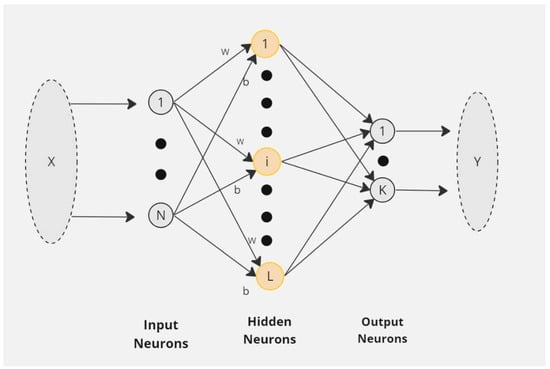
Figure 1.
Extreme learning machine network architecture.
Typically, the output function of the SLFN can be generally represented as shown in Equation (1) [23] for the relative cooling power of dysprosium-based magnetocaloric compounds.
where the variables l and correspond to the number of nodes in the hidden layer and the output weight of the ith hidden node, respectively. The descriptors of the model are represented as x, while g(x) is the activation function, which is presented in Equation (2).
The ELM can be expressed in a unified mathematical form, as shown in Equation (3) [41].
where represent the hidden layer output matrix, weight vector, and target matrix (containing the relative cooling power of dysprosium-based magnetocaloric compounds), respectively. Matrix representations of are, respectively, represented in Equations (4)–(6) [42,43,44].
The output weight is determined by solving the system of matrices equation using the Moore–Penrose matrix transformation defined by Equation (7).
The activation functions that demonstrated better performance for relative cooling power prediction are the sine and sigmoid functions. The mathematical expression of the sigmoid function is presented in Equation (8), while the transformation of Equation (2) after sigmoid function inclusion is presented in Equation (9).
2.2. Data Extraction and Acquisition
The relative cooling power of dysprosium-based magnetocaloric compounds is modeled using a single hidden layer extreme learning machine with ionic radii as well as maximum magnetic entropy change descriptors. The modified chemical formula of dysprosium-based magnetocaloric samples for model extraction and implementation is presented in Equation (10). Experimentally measured values of relative cooling power employed for model validation are extracted from the literature for different thirty-eight dysprosium-based magnetocaloric compounds [8,45,46,47,48,49].
where Dy, X and N, respectively, represent dysprosium metal, transition metal, and non-metal, while stand for their respective concentrations. On the basis of descriptors, two different single hidden layer (SIL) extreme learning machine models have been developed. The SIL-IR based model employs the ionic radii of the elemental constituent, an applied magnetic field, and elemental concentrations as descriptors, while the developed SIL-EC models employ maximum magnetic entropy change (EC) and an applied magnetic field as descriptors. The extracted data samples are analyzed statistically, and the statistical results are presented in Table 1.

Table 1.
Statistical analysis of dysprosium-based magnetocaloric samples.
The significance of the initially conducted statistical analysis is to provide comprehensive insights into the entire data sample. The averages of all the descriptors as well as the measured relative cooling power provide insightful information regarding the overall data sample contents and further guide in cases where over- or under-fitting is observed during modeling, whereby the model returns mean values of the target for every input descriptor. The maximum and minimum values of each of the constituents of the data samples are also computed so as to infer the data sample range. Standard deviation measures consistencies in data samples, while the extent of linearity between the descriptors and relative cooling power is controlled by the coefficient of correlation. All the descriptors in the SIL-IR-based models show a negative correlation with relative cooling power except for the applied magnetic field and dysprosium concentration, while all the descriptors in the SIL-EC-based models show positive correlations with relative cooling power. The proposed single hidden layer-based model has the potential to accurately approximate the patterns and the link joining the descriptors with the relative cooling power due to its strong mathematical strength in implementing the empirical principles of risk and error minimization, random determination of input as well as bias weights, and utilization of the Moore–Penrose inverse matrix for output weight computation. The obtained weights associated with each of the descriptors in the best model (SN-SIL-IR) are presented in Appendix A (Table A1) for practical and future implementation in new samples of dysprosium-based magnetocaloric compounds.
2.3. Computational Implementation of Single Hidden Layer Extreme Learning Machine Algorithm
The ELM-based models presented in this study were formulated and developed within the computational framework of MATLAB (MATLAB, 2015a, 2015, MathWorks, Natick, MA, USA). To ensure an equitable and uniform distribution of dysprosium-based magnetocaloric data samples between the training and testing phases of model development, randomization of the descriptors and measured experimental relative cooling power of the samples under investigation was conducted prior to the separation of data, following a 4:1 ratio for training and testing samples, respectively. Effective randomization further prevents possible over- or under-fitting. The purpose of this randomization was to facilitate efficient computation by promoting an even distribution of dysprosium-based magnetocaloric data samples across both modeling phases. The step-by-step procedures for implementing the proposed ELM-based model are outlined as follows:
Step 1: Pseudo-random numbers, which govern the randomly generated biases and the weights connecting the hidden and input layers, were initialized using the seeding method in MATLAB.
Step 2: The hidden layer output matrix was computed using the training dysprosium-based magnetocaloric data samples.
Step 3: The optimal activation function and its corresponding hidden nodes (within a range between 1 and 100) were determined by sequential selection from a pool of functions, including the sine function, hardlim function, sigmoid function, and triangular basis function, among others.
Step 4: The computation of output weights was performed using the least squares solution to the set of linear systems of equations generated.
Step 5: In order to evaluate and assess the model’s performance during the training phase of the simulation, a testing set of dysprosium-based magnetocaloric data samples was utilized. The performance of these models was assessed by employing three distinct parameters for measuring their efficacy, namely MAE, RMSE, and CC.
Step 6: The best models were identified based on their possession of the lowest error rates (MAE and RMSE) and the highest CC. In order to ease practical implementation of the developed models, especially on newly synthesized dysprosium-based magnetocaloric compounds, computed model weights are presented in Appendix A (Table A1). Figure 2 presents the computational strategies for the proposed ELM-based models.
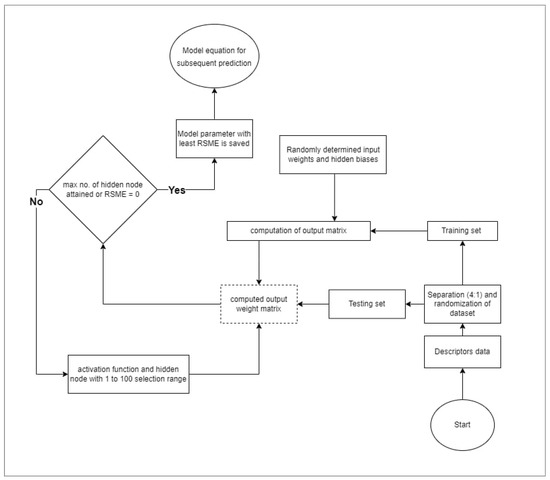
Figure 2.
Flow chart for the algorithm implementation of the SIL-based models.
3. Results and Discussion
The predicted values of relative cooling power for different classes of dysprosium-based magnetocaloric compounds are presented in this section for four developed SIL-based models. A comparison of the model’s performance is also presented. The dependence of relative cooling power on the applied magnetic field is presented in this section.
3.1. Performance Assessment Parameters and Their Comparisons
The future estimation and generalization strength of the developed SIL-based models was assessed and evaluated through the computation of correlation coefficient (CC), mean absolute error (MAE), and root mean square error (RMSE) on both training and testing samples of dysprosium-based magnetocaloric compounds. The coefficient of correlation measures the degree of linear relationship between the measured RCP and the estimated values. The value of CC ranges between 0 and 1, while a 0 value indicates the absence of correlation and a 1 value depicts the maximum possible correlation strength. The higher the value of the correlation coefficient, the better the model. Conversely, errors (such as MAE and RMSE) measure the deviation of the predicted RCP from the experimentally measured values. Lower values of error correspond to a better model. Performance comparisons of the developed models in this work are depicted in Figure 3. The developed SN-SIL-IR model with ionic radii-based descriptors and sine activation function shows 0.9962, 3.80 J/kg and 14.98 J/kg values of CC (as shown in Figure 3a), MAE (as shown in Figure 3b), and RMSE (as shown in Figure 3c), respectively, for training samples of dysprosium-based magnetocaloric compounds, while 0.9462, 28.99 J/kg, and 36.92 J/kg values were computed for the assessment parameters when evaluated on testing samples of dysprosium-based magnetocaloric compounds. The SG-SIL-IR model developed using the same descriptors as SN-SIL-IR but with a sigmoid activation function shows 0.0312, 149.42 J/kg, and 179.48 J/kg values of CC, MAE, and RMSE, respectively, when computed on training samples of dysprosium-based magnetocaloric compounds, while the same model shows −0.3815, 103.05 J/kg and 121.23 J/kg values of CC (as shown in Figure 3d), MAE (as shown in Figure 3e) and RMSE (as shown in Figure 3f), respectively, when validated on testing samples of dysprosium-based magnetocaloric compounds. The developed SN-SIL-EC model with a sine activation function and maximum magnetic entropy change-based descriptors shows 0.8812, 56.59 J/kg, and 79.35 J/kg values of CC, MAE, and RMSE assessment parameters, respectively, when computed using training samples of dysprosium-based magnetocaloric compounds, while the respective computed values of these measures of future estimation parameters using testing samples of dysprosium-based magnetocaloric compounds are 0.8374, 53.44 J/kg, and 82.28 J/kg. The SG-SIL-EC model employs the same set of descriptors as the SN-SIL-EC model, but the sigmoid activation function shows 0.8278 (as shown in Figure 3a), 72.82 J/kg (as shown in Figure 3b) and 94.16 J/kg (as shown in Figure 3c) values of CC, MAE, and RMSE for training samples of dysprosium-based magnetocaloric compounds, while 0.9314 (as shown in Figure 3d), 38. 55 J/kg (as shown in Figure 3e), and 72.96 J/kg (as shown in Figure 3f) were, respectively, obtained during validation with testing samples of dysprosium-based magnetocaloric compounds.
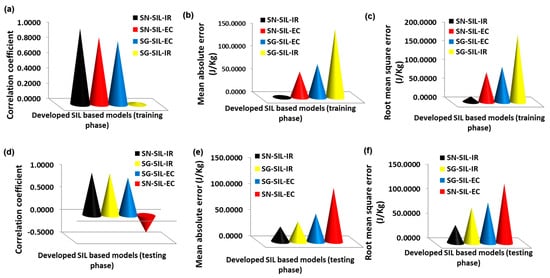
Figure 3.
Generalization capacity of developed SIL-based models using (a) training samples coefficient of correlation, (b) training samples mean absolute error, (c) training samples root mean square error, (d) testing samples coefficient of correlation, (e) testing samples mean absolute error, (f) testing samples root mean square error.
For the performance comparison between the models on the basis of percentage improvement, the developed SN-SIL-IR outperforms the SG-SIL-IR model with improvements of 96.87%, 97.45%, and 91.65% using CC, MAE, and RMSE metrics, respectively, for training samples of dysprosium-based magnetocaloric compounds, while improvements of 140.32%, 71.86%, and 69.54% were, respectively, obtained when computed using testing samples of dysprosium-based magnetocaloric compounds. Similarly, the developed SN-SIL-IR further performs better than the SN-SIL-EC model using training samples of dysprosium-based magnetocaloric compounds with improvements of 11.54% (for the CC metric), 93.27% (using the MAE metric), and 81.11 (using the RMSE metric). For the testing samples of dysprosium-based magnetocaloric compounds, the performance improvements recorded were 11.50% (for the CC metric), 45.74 (for the MAE metric), and 55.13 (for the RMSE metric). Superior performance was also recorded for the SN-SIL-IR model over the SG-SIL-EC model with improvements of 16.90% (for the CC metric), 94.77% (for the MAE metric), and 84.08% (for the RMSE metric) on training samples of dysprosium-based magnetocaloric compounds. For the testing samples of dysprosium-based magnetocaloric compounds, improvements of 1.56% (for the CC metric), 24.79% (for the MAE metric), and 49.40% (for the RMSE metric) were obtained. The developed SN-SIL-EC model shows improved performance over the SG-SIL-IR model with enhancement of 96.46% (for the CC metric), 62.13% (for the MAE assessment parameter), and 55.79% (for the RMSE assessment parameter) when computed on training samples of dysprosium-based magnetocaloric compounds. The same model demonstrates enhanced performance using testing samples of dysprosium-based magnetocaloric compounds with improvements of 145.55% (for the CC assessment parameter), 48.14% (for the MAE assessment parameter), and 32.13% (for the RMSE assessment parameter). The developed SG-SIL-EC model outperforms the SG-SIL-IR model using training samples of dysprosium-based magnetocaloric compounds with improvements of 96.24% (for the CC assessment parameter), 51.26% (for the MAE assessment parameter), and 47.54% (for the RMSE assessment parameter). During the validation stage, improvements of 140.95%, 62.59% and 39.82% were recorded for the CC, MAE, and RMSE assessment parameters, respectively. Furthermore, the developed SN-SIL-EC model outperforms the SG-SIL-EC model during the pattern acquisition stage with improvements of 6.06%, 22.29%, and 15.73% using the CC, MAE and RMSE assessment parameters, respectively, while the SG-SIL-EC model outperforms the SN-SIL-EC model when assessed using testing samples of dysprosium-based magnetocaloric compounds with improvements of 10.10% (for the CC metric), 27.86% (for the MAE assessment parameter), and 11.32% (for the RMSE assessment parameter). Table 2 presents the values of each of the assessment parameters associated with the developed SIL-based models and their percentage performance comparisons. The nature of the descriptors as well as the activation function play a significant role in the performance of SN-SIL-IR, SG-SIL-IR, SN-SIL-EC, and SG-SIL-EC models. An additional advantage of SN-SIL-IR and SG-SIL-IR models over SN-SIL-EC and SG-SIL-EC models is the possibility of pre-laboratory modeling, since the needed descriptors are ionic radii, which are readily available in the literature. The implementation of SN-SIL-EC and SG-SIL-EC models involves initial laboratory experimental procedures for the determination of maximum magnetic entropy change.
Table 2.
Generalization and performance assessment parameters for the developed SIL-based models and the associated performance percentage comparisons.
3.2. Predictions of SIL-Based Models for Different Dysprosium-Based Magnetocaloric Compounds
Estimations of the developed SN-SIL-IR, SG-SIL-IR, SN-SIL-EC, and SG-SIL-EC models are presented with the corresponding absolute error after comparison with the measured relative cooling power values. The developed SN-SIL-IR model with ionic radii-based descriptors shows excellent performance and predicts the relative cooling power of most of the dysprosium-based magnetocaloric compounds exactly, except for a few compounds with slight deviations, such as Dy2Cu2Cd [49], Dy2Cu2Cd [46], DyNiSi [49], DyB2 [49], Dy2Cu2Cd [46], DyCoNi [8], DyNiSn [49] and Dy2Co2Ga [46]. Predictions of other developed models, such as the SG-SIL-IR, SN-SIL-EC, and SG-SIL-EC models, have slight associated deviations from the measured values.
Table 3 further presents the mean absolute percentage error (MAPE) associated with each of the developed models, while the MAPE of the developed SN-SIL-IR model shows the lowest value. Ionic radii specifically define the magnetic refrigerant and potentially approximate RCP (the amount of transferable heat between cold and hot reservoirs) from a crystallographic perspective. Maximum magnetic entropy change (also known as the magnetocaloric effect) controls the heating and cooling of magnetic refrigerant under varying magnetic fields. The applied magnetic field controls the alignment of magnetic spins for entropy variation. The potential of ionic radii descriptors to approximate a magnetic refrigerant crystal structure contributes to the observed better performance of the associated models as compared with the models developed using maximum magnetic entropy change descriptors. Hence, the better performance demonstrated by the SN-SIL-IR model can be attributed to the employed sine activation function coupled with the utilized ionic radii-based descriptors, which attain precise approximations from a crystal structural description perspective.
Table 3.
Estimates of SIL-based models and their comparisons (all RCP measured in J/kg).
3.3. Applied Magnetic Field Dependence of Relative Cooling Power of Dysprosium-Based Magnetocaloric Compounds Using Developed SN-SIL-IR Model
The dependence of the applied magnetic field on the relative cooling power of two different dysprosium-based magnetocaloric compounds has been investigated using the developed SN-SIL-IR model. The applied magnetic field was varied between 1 and 7 T, and the response of relative cooling power is presented in Figure 3. For the Dy2Cr2C3 dysprosium-based magnetocaloric compound presented in Figure 4a, an increase in the value of applied magnetic field increases the value of relative cooling power up to the applied magnetic field of 5 T, after which further increases in the applied magnetic field decrease the relative cooling power. A similar value of relative cooling power has been reported experimentally at an applied magnetic field of 5 T [49]. This confirms that the developed model generalizes well using an external dataset or different testing conditions.
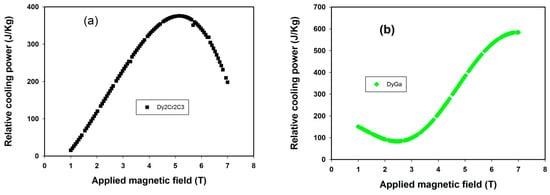
Figure 4.
Magnetic field dependence of relative cooling power in (a) Dy2Cr2C3 and (b) DyGa dysprosium-based magnetocaloric compound.
The response of the DyGa dysprosium-based magnetocaloric compound to the applied magnetic field is presented in Figure 4b. The value of the relative cooling power decreases with the increase in the applied magnetic field up to a field of 2 T, after which an increase in the applied magnetic field increases the value of relative power. The experimental value of the relative cooling power for the DyGa [49] magnetocaloric compound at 5 T aligns with the predicted value of the SN-SIL-IR model. The developed model can be adequately employed for the exploration of the potentials of dysprosium-based magnetocaloric compounds for practical implementation in addressing the energy crisis.
4. Conclusions
The relative cooling power of dysprosium-based magnetocaloric compounds is modeled using a single hidden layer extreme learning machine intelligent method with ionic radii and maximum magnetic entropy change descriptors. For the testing samples of dysprosium-based magnetocaloric compounds, the developed SN-SIL-IR model (with sine activation function and ionic radii-based descriptors) outperforms the SG-SIL-IR model with improvements of 140.32%, 71.86%, and 69.54% using CC, MAE, and RMSE metrics, respectively. The developed SN-SIL-IR further performs better than the SN-SIL-EC model when validated on testing samples of dysprosium-based magnetocaloric compounds with performance improvements of 11.50% (for the CC metric), 45.74 (for the MAE metric), and 55.13 (for the RMSE metric). Superior performance was also recorded for the SN-SIL-IR model over the SG-SIL-EC model with improvements of 1.56% (for the CC metric), 24.79% (for the MAE metric), and 49.40% (for the RMSE metric) using the same set of validation magnetocaloric samples. The estimated values of relative cooling power predicted by the SN-SIL-IR model for the majority of the investigated dysprosium-based magnetocaloric compounds agree exactly with the measured values. The dependence of the relative cooling power of dysprosium-based magnetocaloric compounds on the applied magnetic field was investigated by the developed model. The limitation of the developed models is that they are only applicable to dysprosium-based magnetocaloric compounds.
Funding
This research received no external funding.
Institutional Review Board Statement
Not applicable.
Informed Consent Statement
Not applicable.
Data Availability Statement
Data samples utilized for modeling and validation are extracted from the literature cited in Section 2.2.
Acknowledgments
Support received from Imam Abdulrahman Bin Faisal University, Dammam, Saudi Arabia is acknowledged.
Conflicts of Interest
The author declares no conflicts of interest.
Appendix A
w1 = input weights associated with applied field descriptor, w2 = input weight associated with descriptor, w3 = input weight associated with X descriptor, w4 = input weight associated with descriptor, w5 = input weights associated with N descriptor and w6 = input weights associated with descriptor.
Table A1.
Extracted relative cooling power weights from trained ELM algorithm.
Table A1.
Extracted relative cooling power weights from trained ELM algorithm.
| Neurons | Bias | Output Weights | w1 | w2 | w3 | w4 | w5 | w6 |
|---|---|---|---|---|---|---|---|---|
| 1 | 0.757181 | 128.2458 | −0.16493 | 0.695291 | −0.17544 | 0.113209 | −0.32193 | 0.287777 |
| 2 | 0.254413 | −18.0158 | 0.256964 | 0.354654 | 0.912705 | −0.88545 | 0.120015 | 0.7595 |
| 3 | 0.7565 | −18.8439 | 0.52911 | −0.47277 | −0.40498 | 0.756622 | 0.433355 | −0.0761 |
| 4 | 0.12596 | 46.28244 | −0.87858 | −0.31718 | −0.95613 | −0.46264 | −0.98309 | −0.38935 |
| 5 | 0.551863 | 72.4424 | 0.609363 | 0.031509 | 0.365358 | −0.51213 | −0.48596 | 0.506072 |
| 6 | 0.734348 | −2.59825 | −0.47962 | −0.57209 | 0.159656 | 0.212693 | 0.947727 | 0.428756 |
| 7 | 0.039559 | −121.187 | 0.099609 | 0.157542 | −0.97197 | −0.71664 | −0.70449 | −0.38671 |
| 8 | 0.766949 | 88.66311 | −0.74206 | 0.271027 | 0.193201 | −0.31831 | 0.942171 | 0.892488 |
| 9 | 0.833686 | −2.94049 | −0.64063 | −0.86198 | 0.095341 | −0.93218 | −0.80109 | −0.79227 |
| 10 | 0.818937 | 17.17658 | −0.58174 | 0.805919 | −0.1371 | −0.41221 | −0.06569 | −0.98353 |
| 11 | 0.187952 | 18.47104 | 0.464076 | 0.438822 | 0.383073 | −0.61799 | −0.29508 | 0.342357 |
| 12 | 0.110709 | −45.0899 | −0.60316 | 0.914291 | −0.07335 | 0.275059 | −0.29043 | −0.47259 |
| 13 | 0.790708 | −27.845 | −0.54205 | −0.50858 | 0.971945 | 0.07347 | −0.70121 | 0.338864 |
| 14 | 0.472941 | −57.577 | 0.267616 | 0.969685 | −0.72949 | −0.80213 | −0.60818 | 0.029065 |
| 15 | 0.955869 | −44.2371 | −0.2662 | −0.75876 | 0.382456 | 0.87892 | −0.27545 | 0.908242 |
| 16 | 0.588844 | −19.4382 | 0.567712 | −0.95428 | −0.41099 | −0.5135 | −0.62566 | −0.94882 |
| 17 | 0.76975 | −13.8187 | 0.574955 | −0.33591 | −0.40983 | 0.068854 | −0.58327 | 0.727784 |
| 18 | 0.063367 | 20.73787 | −0.39591 | 0.945048 | 0.951148 | −0.84853 | 0.720347 | −0.4638 |
| 19 | 0.334498 | 12.58699 | −0.20633 | 0.892836 | −0.78421 | −0.26015 | −0.21726 | 0.445344 |
| 20 | 0.165463 | 13.86607 | −0.12433 | 0.318932 | −0.42171 | −0.88005 | 0.135062 | −0.41877 |
| 21 | 0.639229 | −63.8947 | −0.51689 | 0.984195 | 0.142215 | 0.271523 | −0.03481 | 0.926624 |
| 22 | 0.892102 | −16.7939 | 0.115723 | −0.90036 | −0.37931 | −0.31543 | 0.182217 | −0.41853 |
| 23 | 0.97675 | 36.65272 | −0.32071 | −0.3863 | −0.76575 | −0.35807 | 0.702848 | 0.131054 |
| 24 | 0.626383 | −1.73003 | −0.06111 | 0.844673 | −0.34758 | 0.438454 | 0.00022 | −0.92174 |
| 25 | 0.402965 | −0.43486 | −0.47579 | −0.93534 | −0.77009 | 0.762693 | 0.288409 | 0.872028 |
| 26 | 0.035423 | 68.70198 | 0.000342 | 0.854612 | 0.300132 | −0.00723 | −0.14797 | −0.12105 |
| 27 | 0.773491 | 10.66352 | −0.99151 | −0.44852 | −0.51161 | 0.296741 | −0.15117 | 0.194415 |
| 28 | 0.13155 | −21.7048 | 0.361741 | −0.57198 | −0.7777 | −0.175 | −0.97306 | −0.0773 |
| 29 | 0.578453 | −40.5552 | −0.1498 | −0.70488 | −0.26117 | −0.36916 | −0.07911 | −0.41858 |
| 30 | 0.61448 | 60.73166 | 0.641317 | −0.77747 | 0.068603 | −0.06531 | −0.20881 | 0.979156 |
| 31 | 0.111074 | 55.23363 | −0.17458 | 0.347785 | 0.944794 | 0.822454 | −0.36487 | −0.97344 |
| 32 | 0.241796 | 4.314754 | −0.46734 | −0.97322 | −0.41564 | 0.878562 | 0.975984 | −0.41827 |
| 33 | 0.341398 | 38.2008 | −0.34715 | −0.07136 | −0.84944 | −0.33775 | −0.15481 | 0.770238 |
| 34 | 0.931541 | −37.4286 | 0.721814 | 0.867327 | −0.59949 | −0.63958 | −0.18003 | −0.32494 |
| 35 | 0.343571 | −13.8027 | 0.047931 | −0.10164 | 0.076833 | −0.30037 | −0.93726 | 0.807957 |
| 36 | 0.187824 | 22.47431 | −0.94042 | 0.939279 | −0.51151 | 0.583405 | 0.439725 | 0.232178 |
| 37 | 0.973886 | 3.216715 | 0.986206 | 0.624026 | 0.337507 | −0.30946 | 0.641796 | −0.97233 |
| 38 | 0.019801 | −45.7969 | 0.770473 | −0.76243 | −0.58962 | 0.483171 | 0.179495 | 0.720441 |
| 39 | 0.825272 | −1.63246 | 0.663461 | −0.78818 | 0.717693 | −0.09312 | −0.55951 | 0.190357 |
| 40 | 0.328464 | −3.05205 | 0.05458 | −0.94343 | 0.976704 | 0.224472 | −0.46727 | 0.02983 |
| 41 | 0.834862 | −95.2086 | −0.50052 | 0.666703 | 0.526723 | −0.17133 | −0.78287 | −0.01307 |
| 42 | 0.030859 | −41.2233 | −0.82203 | −0.11623 | −0.84447 | −0.01358 | 0.360187 | −0.19387 |
| 43 | 0.296034 | −8.23742 | −0.11192 | −0.62554 | −0.65277 | 0.326463 | 0.685103 | 0.168403 |
| 44 | 0.581883 | −3.4383 | −0.40135 | 0.315852 | −0.8899 | −0.66191 | −0.96063 | −0.55526 |
| 45 | 0.333208 | 43.88146 | −0.20796 | −0.29725 | −0.67873 | 0.708568 | 0.851812 | 0.355068 |
| 46 | 0.238346 | 6.376941 | −0.7567 | 0.187897 | −0.68952 | −0.18341 | 0.980256 | −0.70285 |
| 47 | 0.912175 | 73.38841 | −0.9312 | 0.841231 | 0.34777 | −0.2211 | 0.58207 | −0.02211 |
| 48 | 0.369068 | −34.8207 | 0.301109 | 0.090756 | 0.29972 | −0.37819 | −0.52517 | 0.072262 |
| 49 | 0.212528 | 64.88342 | −0.4139 | −0.04791 | 0.465531 | 0.111519 | −0.86112 | −0.1498 |
| 50 | 0.160148 | −85.423 | 0.534641 | −0.04989 | −0.4893 | 0.74095 | −0.22189 | −0.8834 |
| 51 | 0.749057 | −49.1328 | −0.74339 | −0.17481 | −0.23705 | 0.732668 | −0.4575 | 0.826164 |
| 52 | 0.255044 | 17.32208 | 0.543016 | −0.97461 | 0.323313 | −0.3001 | 0.116816 | −0.22997 |
| 53 | 0.1745 | 68.21819 | −0.98904 | 0.435347 | 0.645522 | −0.73373 | 0.337656 | −0.48331 |
| 54 | 0.470656 | 52.17694 | −0.59815 | −0.71091 | 0.729187 | 0.864254 | 0.273147 | −0.6341 |
| 55 | 0.310409 | 37.14708 | −0.7853 | 0.073549 | −0.49912 | −0.73244 | 0.63285 | −0.52455 |
| 56 | 0.827468 | 56.95808 | −0.3496 | −0.39255 | −0.059 | 0.038534 | −0.68299 | −0.6413 |
| 57 | 0.464294 | −80.1819 | −0.81514 | −0.28034 | 0.130441 | −0.57586 | 0.727999 | −0.15987 |
| 58 | 0.132706 | −94.8056 | −0.7903 | −0.23918 | 0.520924 | 0.780662 | 0.580469 | −0.3904 |
| 59 | 0.509294 | −75.8862 | 0.066942 | 0.027455 | −0.74082 | −0.8264 | −0.45206 | −0.96349 |
| 60 | 0.94982 | 11.5699 | 0.184452 | 0.846016 | 0.537693 | −0.90233 | 0.393911 | 0.79364 |
| 61 | 0.565004 | 5.365117 | 0.936008 | −0.56605 | 0.318884 | 0.109174 | 0.136153 | −0.07432 |
| 62 | 0.9545 | 13.88012 | 0.666869 | −0.27204 | 0.021294 | 0.297903 | 0.02863 | 0.750471 |
| 63 | 0.834355 | 0.299659 | 0.104097 | 0.934179 | −0.01158 | 0.250085 | −0.86356 | −0.15217 |
| 64 | 0.256887 | −97.9072 | −0.30896 | 0.810768 | 0.497421 | −0.67714 | −0.48598 | −0.01496 |
References
- Xiao, G.; He, W.; Chen, P.; Wu, X. Effect of Nd-substitution on the structural, magnetic and magnetocaloric properties of La0.67-xNdxCa0.13Ba0.2MnO3 manganites. J. Magn. Magn. Mater. 2019, 491, 133–142. [Google Scholar] [CrossRef]
- Bahhar, S.; Lemziouka, H.; Boutahar, A.; Bioud, H.; Lassri, H.; Hlil, E.K. Influence of La3+ site substitution on the structural, magnetic and magnetocaloric properties of ZnFe2−xLaxO4 (× = 0.00, 0.001, 0.005 and 0.01) spinel zinc ferrites. Chem. Phys. Lett. 2019, 716, 186–191. [Google Scholar] [CrossRef]
- Xie, H.; Su, W.; Lu, H.; Mo, Z.; Wang, D.; Sun, H.; Tian, L.; Gao, X.; Li, Z.; Shen, J. Enhanced low-field magnetocaloric effect in Nb and Al co-substituted EuTiO3 compounds. J. Mater. Sci. Technol. 2022, 118, 128–135. [Google Scholar] [CrossRef]
- Ayaş, A.O.; Çetin, S.K.; Akça, G.; Akyol, M.; Ekicibil, A. Magnetic refrigeration: Current progress in magnetocaloric properties of perovskite manganite materials. Mater. Today Commun. 2023, 35, 105988. [Google Scholar] [CrossRef]
- Ayadi, F.; Ammar, S.; Nowak, S.; Cheikhrouhou-Koubaa, W.; Regaieg, Y.; Koubaa, M.; Monnier, J.; Sicard, L. Importance of the synthesis and sintering methods on the properties of manganite ceramics: The example of La0.7Ca0.3MnO3. J. Alloys Compd. 2018, 759, 52–59. [Google Scholar] [CrossRef]
- Wang, G.F.; Zhao, Z.R.; Li, L.R.; Zhang, X.F. Effect of non-stoichiometry on the structural, magnetic and magnetocaloric properties of La0.67Ca0.33Mn1 + δO3 manganites. J. Magn. Magn. Mater. 2016, 397, 198–204. [Google Scholar] [CrossRef]
- Zhang, Y.; Xu, P.; Zhu, J.; Yan, S.; Zhang, J.; Li, L. The emergence of considerable room temperature magnetocaloric performances in the transition metal high-entropy alloys. Mater. Today Phys. 2023, 32, 101031. [Google Scholar] [CrossRef]
- Zhang, Y.; Ying, J.; Gao, X.; Mo, Z.; Shen, J.; Li, L. Exploration of the rare-earth cobalt nickel-based magnetocaloric materials for hydrogen liquefaction. J. Mater. Sci. Technol. 2023, 159, 163–169. [Google Scholar] [CrossRef]
- Alqahtani, A.; Saliu, S.; Owolabi, T.O.; Aldhafferi, N.; Almurayh, A.; Oyeneyin, O.E. Modeling the magnetic cooling efficiency of spinel ferrite magnetocaloric compounds for magnetic refrigeration application using hybrid intelligent computational methods. Mater. Today Commun. 2022, 33, 104310. [Google Scholar] [CrossRef]
- Sadaqat, A.; Almessiere, M.; Slimani, Y.; Guner, S.; Sertkol, M.; Albetran, H.; Baykal, A.; Shirsath, S.E.; Ozcelik, B.; Ercan, I. Structural, optical and magnetic properties of Tb3 + substituted Co nanoferrites prepared via sonochemical approach. Ceram. Int. 2019, 45, 22538–22546. [Google Scholar] [CrossRef]
- Rathi, P.L.; Deepa, S. Structural, magnetic, thermal and optical properties of Sn2+ cation doped magnetite nanoparticles. Ceram. Int. 2020, 46, 2969–2978. [Google Scholar] [CrossRef]
- Christopher, B.; Rao, A.; Nagaraja, B.S.; Prasad, K.S.; Okram, G.S.; Sanjeev, G.; Petwal, V.C.; Verma, V.P.; Dwivedi, J.; Poornesh, P. Correlation between structural and transport properties of electron beam irradiated PrMnO3 compounds. Solid State Commun. 2018, 270, 30–37. [Google Scholar] [CrossRef]
- Zhang, Y. Review of the structural, magnetic and magnetocaloric properties in ternary rare earth RE2T2X type intermetallic compounds. J. Alloys Compd. 2019, 787, 1173–1186. [Google Scholar] [CrossRef]
- Sarlar, K.; Tekgül, A.; Kucuk, I. Magnetocaloric properties in a FeNiGaMnSi high entropy alloy. Curr. Appl. Phys. 2020, 20, 18–22. [Google Scholar] [CrossRef]
- Pashchenko, G.G.L.A.V.; Liedienov, N.A.; Pashchenko, V.P.; Prokopenko, V.K.; Burhovetskii, V.V.; Voznyak, A.V.; Fesych, I.V.; Tatarchuk, D.D.; Didenko, Y.V.; Gudymenko, A.I.; et al. Modification of multifunctional properties of the magneto-resistive La0.6Sr0.15Bi0.15Mn1.1−xBxO3−Δ ceramics when replacing manganese with 3d-Ions of Cr, Fe, Co, Ni. J. Alloys Compd. 2018, 767, 1117–1125. [Google Scholar] [CrossRef]
- Zheng, Z.G.; Chen, X.L.; Wang, H.Y.; Da, S.; Wang, G.; Qiu, Z.G.; Zeng, D.C.; Xia, Q.B. Giant magnetocaloric effects of MnNiSi-based high-entropy alloys near room temperature. J. Alloys Compd. 2023, 966, 171483. [Google Scholar] [CrossRef]
- Uporov, S.A.; Estemirova, S.K.; Sterkhov, E.V.; Balyakin, I.A.; Rempel, A.A. Intermetallics Magnetocaloric effect in ScGdTbDyHo high-entropy alloy: Impact of synthesis route. Intermetallics 2022, 151, 107678. [Google Scholar] [CrossRef]
- Wang, X.; Ma, Y.; Zhang, Z. Magnetic properties and magnetocaloric effect (MCE) in the rare-earths (RE) based RE Cu2Si2 (RE = Nd and Pr) compounds. Solid State Commun. 2022, 345, 114696. [Google Scholar] [CrossRef]
- Yang, Y.; Zhang, Y.; Xu, X.; Geng, S.; Hou, L.; Li, X. Magnetic and magnetocaloric properties of the ternary cadmium based intermetallic compounds of Gd2Cu2Cd and Er2Cu2Cd. J. Alloys Compd. 2017, 692, 665–669. [Google Scholar] [CrossRef]
- Yuan, Y.; Wu, Y.; Tong, X.; Zhang, H.; Wang, H.; Liu, X.; Ma, L.; Suo, H.; Lu, Z. Rare-earth high-entropy alloys with giant magnetocaloric effect. Acta Mater. 2017, 125, 481–489. [Google Scholar] [CrossRef]
- Zhang, Y.; Li, H.; Guo, D.; Ren, Z.; Wilde, G. Cryogenic magnetic properties in the pyrochlore RE2TiMnO7 (RE = Dy and Ho) compounds. Ceram. Int. 2018, 44, 15681–15685. [Google Scholar] [CrossRef]
- Huang, G.B.; Chen, L. Convex incremental extreme learning machine. Neurocomputing 2007, 70, 3056–3062. [Google Scholar] [CrossRef]
- Huang, G.B.; Zhu, Q.Y.; Siew, C.K. Extreme learning machine: Theory and applications. Neurocomputing 2006, 70, 489–501. [Google Scholar] [CrossRef]
- Oyeneyin, O.E.; Obadawo, B.S.; Olanrewaju, A.A.; Owolabi, T.O.; Gbadamosi, F.A.; Ipinloju, N.; Modamori, H.O. Predicting the bioactivity of 2- alkoxycarbonylallyl esters as potential antiproliferative agents against pancreatic cancer (MiaPaCa-2) cell lines: GFA-based QSAR and ELM-based models with molecular docking. J. Genet. Eng. Biotechnol. 2021, 19, 1–15. [Google Scholar] [CrossRef]
- Sulaiman, S.M.; Jeyanthy, P.A.; Devaraj, D.; Shihabudheen, K.V. A novel hybrid short-term electricity forecasting technique for residential loads using Empirical Mode Decomposition and Extreme Learning Machines. Comput. Electr. Eng. 2022, 98, 107663. [Google Scholar] [CrossRef]
- Owolabi, T.O.; Gondal, M.A. Development of hybrid extreme learning machine based chemo-metrics for precise quantitative analysis of LIBS spectra using internal reference pre-processing method. Anal. Chim. Acta 2018, 1030, 33–41. [Google Scholar] [CrossRef]
- Pi, P.; Lima, D. International Journal of Cognitive Computing in Engineering Gray level co-occurrence matrix and extreme learning machine for COVID-19 diagnosis. Int. J. Cogn. Comput. Eng. 2021, 2, 93–103. [Google Scholar]
- Owolabi, T.O. Extreme learning machine and swarm- based support vector regression methods for predicting crystal lattice parameters of pseudo-cubic/cubic perovskites Extreme learning machine and swarm-based support vector regression methods for predicting crystal lat. J. Appl. Phys. 2020, 127, 245107. [Google Scholar] [CrossRef]
- Chen, H.; Tan, C.; Lin, Z. Spectrochimica Acta Part A: Molecular and Biomolecular Spectroscopy Ensemble of extreme learning machines for multivariate calibration of near-infrared spectroscopy. Spectrochim. Acta Part A Mol. Biomol. Spectrosc. 2020, 229, 117982. [Google Scholar] [CrossRef] [PubMed]
- Metibemu, D.S.; Oyeneyin, O.E.; Omotoyinbo, D.E.; Adeniran, O.Y.; Metibemu, A.O.; Oyewale, M.B. Molecular Docking and Quantitative Structure Activity Relationship for the Identification of Novel Phyto-inhibitors of Matrix Metalloproteinase-2. Sci. Lett. 2020, 8, 61–68. [Google Scholar]
- Obadawo, T.O.O.B.S.; Oyeneyin, O.E.; Metibemu, H.O.D.S.; Ipinloju, N.; Fagbohungbe, K.H.; Olatoye, V.O. Investigation of the Anticancer Potential of 2-alkoxycarbonylallyl Esters Against Metastatic Murine Breast Cancer Line 4T1 Targeting the EGFR: A Combined Molecular Docking, QSAR, and Machine Learning Approach. Lett. Drug Des. Discov. 2022, 28, 1–31. [Google Scholar] [CrossRef]
- Owolabi, T.O. Modeling the magnetocaloric effect of manganite using hybrid genetic and support vector regression algorithms. Phys. Lett. A 2019, 383, 1782–1790. [Google Scholar] [CrossRef]
- Owolabi, T.O.; Akande, K.O.; Olatunji, S.O.; Aldhafferi, N.; Alqahtani, A. Support Vector Regression Ensemble for Effective Modeling of Magnetic Ordering Temperature of Doped Manganite in Magnetic Refrigeration. J. Low Temp. Phys. 2019, 195, 179–201. [Google Scholar] [CrossRef]
- Owolabi, T.O.; Akande, K.O.; Olatunji, S.O.; Aldhafferi, N.; Alqahtani, A. Ensemble-Based Support Vector Regression with Gravitational Search Algorithm Optimization for Estimating Magnetic Relative Cooling Power of Manganite Refrigerant in Magnetic Refrigeration Application. J. Supercond. Nov. Magn. 2019, 32, 2107–2118. [Google Scholar] [CrossRef]
- Owolabi, T.O.; Akande, K.O.; Olatunji, S.O.; Alqahtani, A.; Aldhafferi, N. Incorporation of GSA in SBLLM-based neural network for enhanced estimation of magnetic ordering temperature of manganite. J. Intell. Fuzzy Syst. 2017, 33, 1225–1233. [Google Scholar] [CrossRef]
- Owolabi, T.O. Modeling magnetocaloric effect of doped EuTiO3 perovskite for cooling technology using swarm intelligent based support vector regression computational method. Mater. Today Commun. 2023, 36, 106688. [Google Scholar] [CrossRef]
- Agbi, J.I.; Owolabi, T.O.; Abajiigin, D.D. Exploration and quantification of magnetocaloric effect in EuTiO3 perovskite using extreme learning machine intelligent computational method. Mater. Today Commun. 2023, 37, 107297. [Google Scholar] [CrossRef]
- Huérfano-Maldonado, Y.; Mora, M.; Vilches, K.; Hernández-García, R.; Gutiérrez, R.; Vera, M. A comprehensive review of extreme learning machine on medical imaging. Neurocomputing 2023, 556, 126618. [Google Scholar] [CrossRef]
- Darwish, A.A.A.; Hanafy, T.A.; Attia, A.A.; Habashy, D.M. Optoelectronic performance and artificial neural networks (ANNs) modeling of n-InSe/p-Si solar cell. Superlattices Microstruct. 2015, 83, 299–309. [Google Scholar] [CrossRef]
- Owolabi, T.O.; Amiruddin, M.; Rahman, A. Prediction of Band Gap Energy of Doped Graphitic Carbon Nitride Using Genetic Algorithm-Based Support Vector Regression and Extreme Learning Machine. Symmetry 2021, 13, 411. [Google Scholar] [CrossRef]
- Souiyah, M.; Owolabi, T.O.; Saliu, S.; Qahtan, T.F.; Aldha, N.; Alqahtani, A. Specific Surface Area Characterization of Spinel Ferrite Nanostructure Based Compounds for Photocatalysis and Other Applications Using Extreme Learning Machine Method. Math. Probl. Eng. 2022, 2022, 1259131. [Google Scholar] [CrossRef]
- Liu, Z.F.; Li, L.L.; Tseng, M.L.; Lim, M.K. Prediction short-term photovoltaic power using improved chicken swarm optimizer—Extreme learning machine model. J. Clean. Prod. 2020, 248, 119272. [Google Scholar] [CrossRef]
- Hua, L.; Zhang, C.; Peng, T.; Ji, C.; Shahzad, M. Integrated framework of extreme learning machine (ELM) based on improved atom search optimization for short-term wind speed prediction. Energy Convers. Manag. 2022, 252, 2021. [Google Scholar] [CrossRef]
- Oke, W.A.; Aldhafferi, N.; Saliu, S.; Owolabi, T.O.; Alqahtani, A.; Almurayh, A.; Qahtan, T.F. Modeling the magnetocaloric effect of spinel ferrites for magnetic refrigeration technology using extreme learning machine and genetically hybridized support vector regression computational methods. Cogent Eng. 2023, 10, 2257955. [Google Scholar] [CrossRef]
- Weise, B.; Krautz, M.; Mikhailova, A.; Kolchugina, N. Magnetocaloric prospects of mutual substitutions of rare-earth elements in pseudobinary Tb1−xHoxNi2 compositions (× = 0.25–0.75). J. Alloys Compd. 2021, 886, 161295. [Google Scholar]
- Jin, F.; Pang, C.M.; Wang, X.M.; Yuan, C.C. The role of rare earth elements in tailorable thermal and magnetocaloric properties of RE-Co-Al (RE = Gd, Tb, and Dy) metallic glasses. J. Non-Cryst. Solids 2023, 600, 121992. [Google Scholar] [CrossRef]
- Lu, S.F.; Wang, J.; Du, Y.S.; Li, L.; Zhao, J.T.; Rao, G.H. Effect of confguration entropy on magnetocaloric effect of rare earth high-entropy alloy. J. Alloys Compd. 2021, 874, 159918. [Google Scholar] [CrossRef]
- Gu, Y.; Wang, X.; Li, S.; Ying, J.; Zhang, Y. Direct and inverse magnetocaloric effects in the antiferromagnetic rare earth (RE) rich RE6Ni2.25Al0.75 (RE = Dy, Ho and Er) compounds. J. Alloys Compd. 2023, 960, 170918. [Google Scholar] [CrossRef]
- Synoradzki, K. Low-temperature magnetic and magnetocaloric properties of orthorhombic DyNiSn. Phys. B Condens. Matter. 2023, 669, 415300. [Google Scholar] [CrossRef]


Disclaimer/Publisher’s Note: The statements, opinions and data contained in all publications are solely those of the individual author(s) and contributor(s) and not of MDPI and/or the editor(s). MDPI and/or the editor(s) disclaim responsibility for any injury to people or property resulting from any ideas, methods, instructions or products referred to in the content. |
© 2024 by the author. Licensee MDPI, Basel, Switzerland. This article is an open access article distributed under the terms and conditions of the Creative Commons Attribution (CC BY) license (https://creativecommons.org/licenses/by/4.0/).