


Abstract
Circular economy principles applied at the city scale represent an opportunity, both in environmental and sociocultural terms, to pursue sustainable urban development. While the circular economy approach has gained huge attention and become the basic framework to boost innovation in many research fields, its application to the urban scale is still fragmented. Therefore, a more holistic and spatial-related approach is necessary. Following a systematic literature review, this paper first proposes four guiding principles that should inspire policymakers in drafting circular urban plans. By following the Strategic Environmental Assessment phases, and considering the instrument as a methodology for the drafting of plans and not an ex post evaluation of their effects, the different plan creation steps are analyzed and enriched with circular-related considerations, suggestions, and proposals. In particular, a list of 35 strategic objectives for strategic municipal spatial plans is presented. A list of indicators for the monitoring of urban transformations is also developed. The results could contribute to integrating circularity into the different phases of plan creation, moving towards circular-inclusive spatial plans.
1. Introduction
The circular economy (CE) is increasingly recognized as a comprehensive model capable of addressing the limitations of the traditional linear economy, which is characterized by the consumption of new raw materials, the production of goods, and the generation of waste [1,2,3,4]. Central to the CE is the idea of keeping negative externalities within the system and transforming what was previously considered waste into a resource, thus having the potential to mitigate the overconsumption of the Earth’s finite resources [1]. The transition from a take–make–dispose model to a CE one is expected to reduce material consumption, drive the redesign of products towards less resource-intensive processes, and reintegrate waste into production cycles for new goods or materials [3,4]. Although the CE’s rise to prominence is relatively recent, it has been acknowledged by the Intergovernmental Panel on Climate Change (IPCC) as a key component in advancing climate policies aimed at mitigating climate change [5], as recognized by many scholars as well [2,6,7].
Initially, the CE concept inspired policies across China, followed by Europe in the 2010s, largely thanks to the groundbreaking work of the Ellen MacArthur Foundation, which highlighted the global impact of the circular transition [3]. The CE has also become a focal point of the United Nations’ sustainable development strategy, prominently featured in the 17 Sustainable Development Goals. However, the Circularity Gap Report indicates that the global economy remains far from circular [1]. Each year, the percentage of materials reintroduced into the cycle after their initial use declines, while the extraction rates remain high, meaning that the global economy continues to rely heavily on virgin materials. From the formation of the Paris Agreement in 2016 to COP26 in 2022, over half a trillion tons of virgin materials were consumed, far exceeding the planetary environmental limits and underscoring the unsustainable nature of current practices [1].
While the CE model was originally conceived for industrial sectors, researchers and policymakers are increasingly recognizing its potential benefits at larger scales, including in cities and regions [8]. This is particularly important given that 66% of the global population is projected to live in urban areas by 2050 [9]. Although many challenges in adapting the CE model at the city scale have been highlighted [10,11,12,13,14], the concept of the “circular city” has progressively emerged as a holistic and systemic approach to addressing contemporary challenges [15,16].
However, much like the CE, the circular city paradigm suffers from definitional ambiguity. Indeed, the CE has been defined in numerous ways, often with conflicting interpretations. In particular, some definitions emphasize economic prosperity without adequately addressing the social aspects [8]. As a result, it remains an evolving concept, with no universally accepted definition likely to emerge [17].
Conversely, the flexibility in interpreting the CE has enabled many initiatives to flourish across various fields of application, as the CE often carries different meanings for different policymakers and stakeholders [18]. This diversity is evident in the range of strategies and drivers employed by the so-called circular cities. Moreover, many pathways prioritize the development of CE businesses, rather than fostering a more holistic urban transition [12]. Because of the absence of a comprehensive framework guiding policymakers in designing more circular urban environments, the translation of the circular city paradigm into practice remains fragmented [19,20,21,22]. In addition, Papageorgiou et. al. [23] argue that no holistic framework exists to measure the progress, impacts, and opportunities of CE strategies in cities. Indeed, discussions around circularity in cities often focus on waste management and closing material loops. Therefore, a new approach to the CE that goes beyond these aspects is essential [24].
While policymakers are still struggling with the implementation of circular cities, lacking the tools to translate theory into spatial transformation [13], the critical role of spatial planning in advancing circular cities is starting to be widely acknowledged [14,25,26,27,28]. Indeed, urban planning tools are essential in embedding circular processes and synergies into the physical spaces of cities. In this context, spatial planning can act as an enabler of the transition towards circular cities by organizing urban areas in ways that align with CE principles [26,27,28]. In fact, for circular processes and synergies to be implemented in the city’s space, they must be integrated into urban planning tools, which are the instruments used to change a city’s organization. In this specific case, they can serve as enablers to facilitate the transformation of the city towards circularity from a holistic perspective. As also acknowledged in [28], strategic urban planning can be transformative in creating circular systems and can influence the design of the built environment, encouraging circular practices. In addition, land use planning can allocate space for circular experiments and encourage the co-location of industries to enable circular practices to emerge. Spatial planning can also play a key role in protecting and enhancing ecosystem services, as well as providing a mechanism for adaptation (ibid.).
Nevertheless, despite numerous attempts by the scientific community to provide a holistic perspective on circular cities, spatial planning is rarely placed at the forefront, and a comprehensive framework to support decision-makers in integrating the CE into urban planning is still absent.
This research aims to address this gap by investigating how CE principles can be effectively integrated into urban planning tools to promote circular urban development, thus allowing cities to thrive without compromising the planet’s regenerative capacity.
By considering all of the above, this article aims at answering the following research questions: (i) How can circular economy principles be effectively integrated into urban planning tools to promote sustainable urban development? (ii) What are the key challenges and barriers in implementing circular economy principles at the urban scale, and how can they be overcome? To answer these questions, it is necessary to first frame the concept of the circular city, particularly from an urban planning perspective, as this is crucial for its practical implementation. Given the interdisciplinary nature of the CE, this research also seeks to demonstrate how spatial planning can integrate challenges and approaches from various fields, enhancing urban quality and livability.
2. Materials and Methods
The term “spatial planning” does not have a universal understanding in Europe. It is used for national and transnational planning, regional policies and planning, and detailed land use planning [29]. Spatial planning instruments in European countries can be classified into national policies and perspectives; strategic tools and spatial strategies at the regional, provincial, or functional urban levels; masterplans and spatial framework plans at the municipal level; and, finally, regulatory tools [29,30]. The type of instrument that appears to be the most suitable to integrate circular-inclusive considerations is the spatial framework plan, due to both its local scale and its strategic nature. Indeed, the local scale is considered the most effective in managing the complexity of transformations, as it is small enough to facilitate implementation and governance yet large enough to exert a significant impact [31]. In this context, the local scale refers to the lowest level of governance, typically responsible for city planning through instruments such as masterplans and regulatory tools. In all European Member States, this governance level corresponds to municipalities or associations of municipalities that are responsible for planning at the local level.
The methodology proposed in this paper aims to have an impact on the strategic dimension of municipal spatial framework plans by integrating circularity in the definition of a strategy to guide the physical transformation of cities. Instead of developing a new tool, which could be considered to further intensify the planning process, this research focuses on the existing instruments that are able to influence the strategic spatial planning sphere given their binding nature [32]. Among these, a clear impact on spatial planning is identified within the Strategic Environmental Assessment (SEA) Directive and the Environmental Impact Assessment (EIA) Directive [33], which demonstrate the necessity of subordinating urban transformations to certain environmental sustainability conditions and of mitigating the eventual environmental impacts of programs, plans, and projects. Urban planning strategies are therefore conditioned by environmental components, whose sustainability must be guaranteed. Although other regulations and directives also influence spatial planning [32], SEA and EIA also propose a common binding procedure to be implemented by Member States.
In particular, SEA appears to be the most promising tool for the integration of CE principles into urban planning policies. It is particularly effective when applied at the local scale of strategic planning as it can adapt to local needs and has the potential to address diverse challenges, thereby influencing strategic pathways [34]. Moreover, when well structured and applied, SEA is considered a process that supports the drafting of plans and programs, instead of assessing them ex post, thus facilitating the integration of environmental considerations and sustainability into decision making [35,36,37]. Although SEA has not always been able to effectively support decision making [36,38,39,40], some recent and promising examples exist [35,41,42]. This tool has already been demonstrated to be flexible and can be included in the assessment of other emerging challenges, like climate change mitigation and adaptation or the tackling of biodiversity loss [43]. Furthermore, academics and practitioners have highlighted the need to interpret SEA in a broader and strategic manner in order to tackle long-term sustainability challenges such as social issues, climate change, and overpopulation [34,44].
Acknowledging the need to support policymakers without imposing new procedures, the proposed methodology aims at adapting the SEA steps to introduce themes, objectives, and procedures that are relevant in terms of circularity and that, if followed, will lead to a circular-inclusive spatial framework plan.
Although the SEA process can be variable, the European Union has identified the following steps: scoping; preparing an environmental report taking into consideration planning alternatives; public consultation and participation; decision making; and monitoring [45,46,47]. In particular, three stages are considered essential for the initial drafting of circular-inclusive spatial framework plans: the scoping phase and the preparation of the environmental report, which correspond to the initial phases of plan creation. Moreover, even if the monitoring phase starts when the plan is implemented, the needed indicators are identified in the environmental report’s preparation; therefore, this aspect is also considered in the proposed methodology. Regarding consultation and the adoption of the plan, these stages are not included in the proposal since they are procedural steps that have to be undertaken by public authorities once the draft plan has been made public by the municipality (ibid.).
Despite the fact that the SEA Directive lists the essential elements and actions required for the scoping and the preparation of the environmental report (Art. 5 and Annex I of the Directive), fundamental aspects that support the integration of circularity approaches into spatial framework plans are not explicitly acknowledged, with attention mainly focused on the identification of the environmental impacts of the plan’s forecasts. In this regard, it is also worth noting that the SEA Directive was formulated in the 2000s, during which the main focus was on the environmental dimension and well before the spread of the CE concept in Europe. Building upon the increased awareness of the importance of taking into consideration different spheres of sustainability, the proposed methodology aims at enlarging the original environmental scope of the SEA towards a broader assessment of strategic planning tools that also embeds other dimensions of sustainability: economic, social, cultural, and institutional ones.
To develop a “circular-inclusive SEA”, guiding principles are necessary to orient spatial planning by supporting municipalities in incorporating the specific aspects of circularity into their local governance and strategic planning tools [48]. In particular, these guiding principles should permeate the different stages of the SEA process to provide a vision that allows city leaders to imagine a “circular” state that represents both the lens through which the territory should be analyzed to build the baseline and the trajectories followed to develop the strategic backbone of the urban plan.
Methodology for the Identification of the Guiding Principles
To identify the guiding principles of circularity that should permeate strategic spatial framework plans, a structured literature review was conducted in [49], analyzing future research trends for circular cities in urban planning. The results highlight that most studies have a sectorial approach, focusing on just one or a few aspects of circularity. However, even if the means by which to achieve holistic circular transformation are still not clear [19], scholars agree that more comprehensive approaches are necessary [19,20,21], seeking to bring about more integrated and multi-dimensional circular thinking. This would address the totality of the sectors, services, activities, and lifestyles present in the city, as well as methodologies to foster integration between its scales and sectors [19].
Through the above-mentioned scoping review (see [49] for the detailed results), a total of 29 publications were selected for their proposed methodologies to assess circularity in cities. However, not all these methodologies could be considered holistic, and only 4 approaches proved to be also attainable in practice. Additionally, a fifth model from a grey literature review was included, since it was developed by ICLEI in collaboration with the Ellen MacArthur Foundation, specifically targeting local authorities. The complete list of analyzed publications, along with a summary and the reasons for exclusion, is available in the Supplementary Materials. The 5 selected holistic proposals are reported in the following:
- Williams J. proposes a methodology based on three fundamental actions (loop, regenerate, adapt) that cities must interpret to achieve circular urban development, conceptualizing the city as a complex socioeconomic system and recognizing the role of social actors and stakeholders [12].
- The systemic perspective offered by Fusco Girard L. and Nocca F. [25] is formulated starting from a review of existing indicators, both in the literature and in action plans adopted by cities. In addition, other important aspects are added, such as the role of cultural heritage, urban planning, and health and wellbeing in terms of circularity.
- A socioecological and sociotechnical interpretation of the integration of CE principles into urban planning is proposed by van der Leer J. et al. [14]. The proposal considers both horizontal integration—between domains and departments of the city—and vertical integration—between different scales and different actors. Bottom-up and top-down approaches are considered critical to achieve successful integration.
- A bottom-up interpretation is described by Petit-Boix A. and Leipold S. [50], who, through an inductive approach, collect 21 local circularity strategies, which are classified into four urban dimensions: infrastructure, social consumption, industries and businesses, and urban planning.
- The Circular City Action Framework is proposed by ICLEI, Circle Economy, Metabolic, and the Ellen MacArthur Foundation [51]. and consists of 5 strategies corresponding to numerous actions to foster circular urban development at the local level
In terms of attainability, three out of five models are action-oriented or proposed based on the actions of local governments (e.g., [12,50,51] mainly highlight the need to integrate CE principles between scales and actors, providing important reflections on the implementation of the CE at the city scale [14]). The study of different cases is also recurrent among these frameworks, although different approaches have been used. For example, in Williams’ approach, the four case studies helped in understanding the complexity and the possibility of different local contexts to interpret circularity, while Petit-Boix and Leipold’s work and ICLEI’s model are based on actions that cities are undertaking. The latter appear as a collection of existing good practices that inspired the proposed methodologies and by which cities can, in turn, be inspired. Case studies also support the definition of the methodology in Girard and Nocca’s conceptualization. As far as the urban domain is concerned, the top-down conceptualization of the circular city refers to the interpretation of the city as a complex social–ecological–technical system. When the methodology starts from the bottom (e.g., [50]), a more detailed analysis is carried out—for example, the technological domain has been assessed as infrastructure (including green infrastructure), industries, and businesses. The proposal of indicators is included in only one of the five analyzed models.
These five frameworks represent the state of the art in theoretically interpreting the circular city in a way that considers all of the city’s dimensions; however, not all of the proposals are easy to understand and to implement by policymakers. Indeed, to our knowledge, none of the reviewed models has been applied in practice by a municipality to integrate CE principles into urban planning. Table 1 includes a detailed analysis of the five models, and it shows that Williams’ socioecological conceptualization [12] and ICLEI’s R-strategies diagram [51] are the two most promising models in terms of the identification of principles to inspire a vision of the circular city. Meanwhile, both [14] and [50] do not define clear strategies to achieve circularity but mainly focus on assessment tools and suggestions for the integration of the CE at different scales. Conversely, [25] mainly focuses on tools available to assess the efficiency of circular cities through a wide selection of indicators, while strategies to achieve circularity in cities are less explicitly mentioned.

Table 1.
Summary of selected models to theoretically interpret the circular city in a holistic way.
In the two following tables (Table 2 and Table 3), the first two methods are further analyzed by highlighting the spatial planning perspectives of the identified principles.
Table 2.
Williams’ framework analyzed through the spatial planning perspective.
Table 3.
ICLEI’s framework analyzed through the spatial planning perspective.
Despite the differences in the two approaches, certain commonalities have been identified. Building on these, a new set of four guiding principles has been developed, which are more tailored to the local strategic scale of planning than the existing methods and therefore more effective in facilitating the development of circular and inclusive local urban plans. The guiding principles are presented in the following Section 3.1. Finally, the results for the circular-inclusive SEA are reported in Section 3.2.
3. Results
3.1. Guiding Principles
As mentioned above, two models have been selected and analyzed in terms of the inspiring principles included therein. From their analysis, as summarized in Table 2 and Table 3, it emerges that there are strong similarities between the two proposals, such as the “Regenerate” principle when contextualized within urban planning practices (green arrow in Figure 1). It mainly focuses on the protection and restoration of the natural capital of the city, the development of green and blue infrastructure, and the integration of nature-based solutions in urban areas. Another similarity is identified between Williams’ “Adapt” and ICLEI’s “Rethink” strategies (orange arrow in Figure 1). The need to prepare the ground for a profound change in lifestyle and consumer behaviour guides the transition towards circularity, offering a vision of an adaptive community that is aware of the current global challenges and able to adapt to change. Flexibility in planning, with the temporary use of spaces, multi-functional urban areas, the co-design of solutions for climate change adaptation, reuse practices, and temporary experimentation, is part of this vision, which is thus achieved through participation and citizen engagement. Regarding the “Loop” strategy in Williams’ framework, it has similarities with ICLEI’s strategies of “Rethink”, “Reuse”, and “Reduce”. Like looping actions, “Rethink” partially covers the topics of closed metabolism and building refurbishment, as well as considering the urban form, supporting the operation and expansion of eco-cycles across the city (e.g., high-density, mixed-use development; efficient public transport networks; and district heating networks). In this sense, the “Reuse” and “Reduce” principles are also interlinked, with the first fostering the reuse of spaces and supporting accessibility to public transport, while the second aims at improving water- and energy-saving infrastructure to optimize some of the urban flows and cycles. Lastly, ICLEI’s “Recover” principle, interpreted according to a spatial planning perspective, is reduced to the identification of spaces for the collection of waste. Thus, it can be included within the “looping” strategies, although it is of less relevance compared to the other identified linkages. “Recover” and “Reduce” support the vision of closing the cycle, as the identification of spaces for waste collection and infrastructure for water and energy saving is inherent in the closure of loops at the city or regional level. Figure 1 summarizes the described linkages among the different concepts in the two considered proposals.
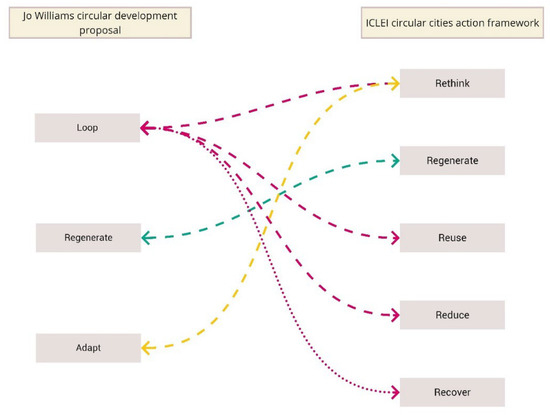
Figure 1.
Similarities between Williams and ICLEI’s proposals for circular urban development.
Consequently, the present work proposes four principles that summarize and reconfigure the eight described above, clarifying them for policymakers in order to guide the circular transformation of the city and supporting urban planners in interpreting circularity. The four derived principles are as follows:
- Build nothing and reuse infrastructure and soils, fostering the zero waste ideal;
- Regenerate nature and work with nature in urban areas;
- Do better with less, reducing resource exploitation and optimizing the use of spaces;
- Adapt to change, fostering flexibility, resilience, and inclusiveness.
As far as the first principle is concerned, reducing the consumption of natural resources, as well as eliminating the concept of waste, is the main priority in achieving a CE. Applying these concepts at the city level means giving importance to and prioritizing the exploitation of “urban resources” that are already available in the city. Policies should foster the reuse of un(der)used buildings, areas, and infrastructure prior to the construction of new ones or the development of agricultural land. This is strongly connected to the necessity of assessing and fostering accessibility to existing services and goods, also through adaptive reuse practices. GHG emissions, air and water pollution, land and soil degradation, and traffic congestion are negative externalities that the implementation of CE can tackle by optimizing the conditions of and access to the existing services of the city. Land decontamination practices should be fostered. Reuse, recycling, and recovery are actions that apply in this context, where the focus is mainly on the existing assets of the city. Under this perspective, the circular city will appear as an equitable, dense, inclusive, rational, and recovered city.
Concerning the “regenerate nature and work with nature in urban areas” principle, ecosystem services are essential for the sustenance of urban systems, given their capacity for microclimate regulation and their numerous benefits for populations’ health and wellbeing. Urban densification is causing the loss of green and blue infrastructure, thus hampering the provision of ecosystem services and leading to increasingly polluted cities in which the effects of climate change, like urban floods, global heating, loss of biodiversity, and soil degradation, are exacerbated. The principle of regenerating nature aims to address the need to restore the ecological components of cities, regenerating the urban ecosystem and ecosystem services [52]. The adoption of nature-based solutions and the creation or improvement of green and blue infrastructure (e.g., “regenerating with nature”) allows the operationalization of this principle, through which nature can be reintroduced into cities. From this perspective, the circular city will be a regenerative, healthy, and green city.
The third principle is related to optimization practices, i.e., making the most of existing spaces and infrastructure. Doing better with less involves using them for longer and more often, thus extending and intensifying their lifetimes. At the city scale, this principle is translated into reducing material consumption and the reliance on scarce resources, enabling a digital transition and fostering multi-functionality to allow multi-actor cooperation. This principle also echoes the need to support a paradigmatic change in lifestyles and community behaviors towards sharing instead of owning. Moreover, urban farming practices can support the transition towards more self-sufficient urban areas, reducing the dependence on scarce resources, although, in this regard, the link between urban and rural areas will play an important role in the achievement of an appropriate balance. Under this perspective, the circular city will be an optimized, efficient, and self-sustainable city.
Finally, the fourth principle is “adapt to change, fostering flexibility, resilience, and inclusiveness”. From this perspective, cities are complex systems that change along with practices and needs, and they have to be designed in order to be able to cope with increasingly frequent stress. To achieve higher sustainability levels, cities must reach a stable status that is different from their starting point. This is one of the most accepted definitions of resilience, and urban institutions, communities, and networks can share knowledge to build it. In terms of planning, there is the need to cope with the uncertain conditions that cities are currently facing, plan for change, and create a flexible environment to enable the adaptation of urban forms and infrastructure [53]. Planning for temporary uses fosters flexibility and pop-up initiatives, enhancing the role of cultural heritage, and its adapted reuse has to be pursued. In addition, community engagement in decision making and co-creation practices with citizens contribute to the creation of an adaptive and resilient community that is more aware of the challenges and able to better cope with uncertainty. Inclusion and participation are key to ensure that those involved in planning decisions that will transform the territory are shared and endorsed by stakeholders and citizens. Under this perspective, the circular city will be an inclusive, creative, adaptive, and resilient one.
3.2. Integrating Circularity into Urban Plans Through the SEA Process
The four guiding principles represent the foundations on which the following results are built. In detail, Figure 2 shows how the SEA steps [46,47] can be enriched to integrate the circularity discourse and support informed decision making (as highlighted in light blue).
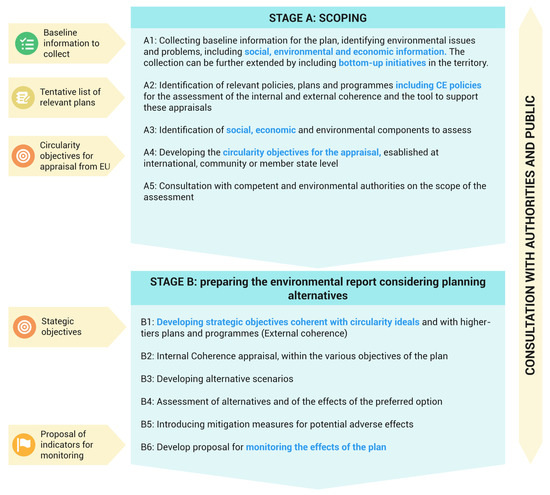
Figure 2.
SEA stages enriched with circular considerations. In light blue, we highlight the steps for which proposals have been developed and presented in this paper.
3.2.1. Collecting Baseline Information (Stage A1)
First, to integrate circular objectives into strategic local plans, it is necessary to investigate specific situations and build a baseline framework for the territory that is oriented towards supporting and informing circularity strategies (Stage A1). In this regard, it is necessary to identify the city’s domains in order to ensure that the guiding principles are as operative as possible. The well-established interpretation of the city as a complex social–ecological–technical (SET) system is acknowledged here. Using the SET principle allows us to both take into consideration the different domains of the city and to understand the complexity of urban challenges (e.g., urban resilience [54,55,56], urban justice [57], and ecosystem services [58]) thanks to the possibility of acknowledging and revealing both the opportunities and problems emerging from social–technological (S-T), social–ecological (S-E), and ecological–technological (E-T) coupling [59]. Indeed, in the definitions of both the CE and circular cities, the necessity of considering the complexity of these systems is highlighted [11,12]. Starting from the four principles, a list of city characteristics to be analyzed to support a circular approach to urban areas is drafted.
By considering the social domain, the first key circularity principle is fostering the reuse of existing infrastructure and soils, meaning that their existing quality and quantities must be checked and maintained, as well as their levels of accessibility. The ideal is to make optimal use of what already exists before designing new infrastructure. In this regard, and according to this circular reuse approach, the proximity of the population to existing public spaces, green areas, and public facilities has to be mapped, with particular regard to vulnerable and fragile groups (e.g., older adults and children). This analysis aims at identifying where access to public facilities is ensured without using a car. A qualitative analysis of public services, including social housing, is also important, as well as their sufficiency, since the users’ experience is influenced by these characteristics. In terms of fostering reuse practices towards more sustainable lifestyles, it is important to enable the allocation of land to facilitate the exchange of second-hand products and materials. It is thus necessary to identify whether existing economic activities that are already related to circularity (if any) are present in the city, where they are located, whether they are easily accessible by the population, and whether they are well distributed in the city. Economic activities related to circularity include repair shops, leasing activities, and second-hand markets. As an example, some of the commercial services considered as circular businesses are charity shops; electrical equipment repair shops; vehicle hire and rental services; second-hand vehicle selling; clothes and shoe repair services; clothing alterations and tailoring; clothing hire; household goods repair; the leasing of personal goods; farm shops with pick-up services; linen hire and washroom services; and restoration and preservation in construction. Their presence and spatial patterns are among the most important drivers of circularity, being able to influence consumers’ behaviors. According to the principle of “regeneration of nature and working with nature”, the social dimension is related to the benefits for human health and wellbeing provided by cultural ecosystem services [52]. In order to foster circularity, policymakers should assess the accessibility of the green and blue areas of their cities, aiming at understanding where there is the need to improve the service. In fact, to enable cultural ecosystem services, access to green and blue areas has to be guaranteed. Moreover, the type of cultural activity that is present in green and blue areas of the city has to be understood, as well as the role that cultural associations play in this context. “Doing better with less” is a relevant principle for the social dimension, since the optimization of resources and the use of spaces highly depends on citizens’ behavior and lifestyles. In a circular vision, adequate infrastructure and the promotion of shared low-carbon solutions is to be fostered. In order to develop coherent strategies, it is important that the effectiveness of sharing practices is mapped (e.g., car sharing and bike sharing services), both in terms of accessibility to these kinds of services and the quality of the infrastructure dedicated to low-carbon mobility. The efficacy of public transport is also important in this perspective, seeking to optimize solutions for this type of shared mobility. In a circular approach, the optimization of spaces in crucial, meaning that the city has to be interpreted also in terms of its “timing”. This knowledge has to be deepened in order to understand the state of the art and propose solutions for the more flexible and optimized use of spaces and infrastructure when they are un(der)used. Finally, according to the principle of “adapting to change, fostering inclusiveness, flexibility, and resilience”, for the social dimension, it is necessary to foster pop-up initiatives, temporary uses, and the inclusion of citizens in the planning processes to shape “circular” communities. This analysis highlights strong collaboration with citizens and the development of initiatives to encourage their participation in civic life and in the care of public spaces. In this regard, the existing bottom-up initiatives for the administration of urban commons can be mapped, assessing where they are taking place, their impacts at the city level, and the main circularity principles that are addressed.
As far as the ecological domain is concerned, the “build nothing and reuse” principle focuses on the avoidance of the use of new virgin soil, thus promoting land decontamination practices for brownfield regeneration. They represent an important resource for the city in terms of circular urban development. In fact, these areas are often located in urban areas with high levels of accessibility. The greatest barrier to their reuse is the potential pollution of the soil as a consequence of the former industrial activities conducted there. A framework regarding the status of the quality of these areas is strongly encouraged, as well as an indication of their potential for transformation in terms of circular activities that might be implemented there. The “regenerate nature and work with nature” principle has the greatest influence regarding the ecological dimension. In fact, the SEA Directive already focuses on the status of the climate, soil degradation, biodiversity (flora and fauna), water and air quality, and natural habitats. To strengthen the importance of the interrelation between the social and ecological components of the city, we suggest not only to map the consistency and health of the above-mentioned ecosystems but also to analyze their benefits for the social sphere, thus directing policymaking towards strategies that promote both the quality of ecosystems and people’s health and wellbeing [52]. Among the various assessment methodologies available to appraise ecosystem services, an analysis in terms of demand and offer seems particularly suitable to inform and assess urban policies [60,61]. Indeed, an analysis of the mismatch between the demand and the offer of ecosystem services provides important information with which to tailor urban policies and define strategies to reduce the gap in those areas where the demand is much higher than the offer. In addition, urban planning strategies have an impact on both the demand and offer aspects of ecosystem services, since the offer depends on the availability, location, and quality of the ecosystem, while the demand depends on the density of the population, the public spaces available, and their functions [62]. Various approaches exist for the interpretation of these concepts, which assume different meanings depending on which ecosystem service is studied; therefore, the methodologies for their analysis have to be tailored to the specific ecosystem service analyzed and the data availability [60]. Local decision-makers and their transdisciplinary teams are suggested to identify which ecosystem services are most relevant for the area targeted in the plan and link their urban policies to the results of this appraisal. According to the “regenerate nature and work with nature” principle, regulative ecosystem services have to be prioritized in the assessment of the state of the art, especially in terms of carbon storage sequestration and other pollutants captured by vegetation. Regarding the “doing better with less” approach, the focus is to optimize the offer of provisioning ecosystem services, with a specific focus on urban and peri-urban farming activities, which must be identified and mapped in cities. Regarding “adaptation to change, fostering flexibility and resilience”, policymakers should aim at fostering the diffusion of nature-based solutions (NBS) and infrastructure in urban areas to manage extreme events that are the consequences of climate change. The cooling capacity of ecosystems can be mapped in order to verify the capacity of the city to tackle the urban heat island effect and orient transformation in those areas that suffer the most or where fragile users of the city are settled. Air quality regulation can also be relevant for urban areas that suffer from high levels of air pollution. In addition to ecosystem services, the production of risk maps is also encouraged (e.g., flood analysis, seismic risk analysis), with a specific focus on the three components of the risk: exposure, vulnerability, and hazard. This tryptic is useful to orient planning strategies and intervene, especially regarding the reduction of exposure through land use prescriptions and incentives for the reduction of the vulnerability of the built environment.
Finally, the technological domain is related to buildings and grey infrastructure, such as water and transport infrastructure, industrial systems, and energy systems. The analysis, therefore, usually includes the structural assets of the territory. Assessing the technological component according to the “build nothing and reuse” circular principle means to highlight the potential for the reuse of spaces and infrastructure and the potential synergies between sectors, where the aim is to achieve the zero waste ideal. An analysis of the urban metabolism offers a starting point but is not sufficient per se, since it does not have spatial implications. The “zero waste” ideal is here interpreted in both physical and functional terms. Firstly, municipalities have to map the abandoned infrastructure of the territory to have an overview of the unexploited potential of their area. Secondly, renovation interventions are required to subordinate the construction of new infrastructure to the reuse and maintenance of the existing facilities. Consequently, the consistency of the built environment in terms of quality, esthetics, energy, and seismic performance has to be mapped. Mapping the material stock of the built environment is also important to draft plans for the disassembly of existing public infrastructure in order to reuse materials and components in the realization of new infrastructure. In this sense, to eliminate waste as much as possible, urban mining combined with spatial analysis can support the identification of locations for the temporary deposit of materials or the creation of new places for recycling and remanufacturing, in turn optimizing the transport demand. An expeditious assessment of the material stock in cities is possible, as suggested by scientific studies. This assessment is built on information already available in municipalities, namely the typologies and dimensions of buildings. Based on this, it is possible to estimate the amounts of materials (kg/useful floor area) that could be potentially available at their end of life [63]. In addition, when possible and relevant, existing infrastructure that might influence new developments in aiming at the zero waste ideal should be identified and localized within the territory. Existing communities for energy sharing, waste treatment plants, centers for the reuse of goods, and sustainable drainage systems that are already in place serve to minimize the negative externalities of new developments, although the material cycle cannot be entirely closed when considering the municipal scale only. Regarding the principle of “regenerate nature and work with nature”, the latter part mainly addresses the technological dimension, necessitating regeneration through NBS and sustainable drainage systems. Given the multi-functionality of NBS in urban areas, the mapping exercise is reconducted according to what has already been mentioned under the ecological dimension. Regarding the “do better with less” principle, optimization is the key objective for the technological dimension. For the better use of spaces, mixed uses and variety have to be guaranteed; therefore, there is the necessity to understand to what extent the city already offers a mix of uses and a variety of services accessible by walking or biking. In addition, where relevant, existing industrial symbiosis processes have to be identified. Optimization also means promoting the digital transition; therefore, if relevant for the municipality, the population’s broadband access should be mapped, as well as the smart working rate in public administrations. Finally, according to the adaptability principle in the technological domain, it is necessary to ensure the flexibility of the built environment, especially in functional terms. Therefore, the analysis should be oriented towards the identification of spaces for the creation of urban hubs that are able to host distinct functions according to changing needs and can satisfy more than one purpose (e.g., social inclusion and climate adaptation needs). Culture is a driver of innovation and stimulates the reuse of spaces, as well as enabling citizens’ participation and the appropriation of spaces towards the creation of a sense of place (i.e., in line with the experience of the Amsterdam city carried out at De Ceuvel). Experimentation can also be carried out in the governance of these kinds of spaces, aiming at achieving collaborative and participatory management options. Mapping cultural initiatives in the open spaces of the city also allows us to understand which areas are more active in terms of social life and those where it is necessary to incentivize such practices. These analyses are also linked to the recognition of cultural ecosystem services if natural and semi-natural areas are taken into consideration.
Table 4 summarizes the results for each SET domain, clustered according to the four guiding principles.
Table 4.
Information to be mapped in support of a circular approach to developing a more comprehensive baseline framework.
3.2.2. Identification of Relevant Policies, Plans, and Programs Including CE Policies for the Assessment of Internal and External Coherence (Stage A2)
Once the baseline framework is completed, the fine-tuning of the strategies of the plan takes place by including modifications and additions derived from the analysis of the coherence of the objectives of the plan with those valid at a national, European, and international level. This implies the application of the SEA in an endo-procedural way, being applied alongside the drafting of the plan from the beginning. This methodology foresees the identification of relevant policies and targets concerning the CE, aiming to build a list of objectives resulting from higher-tier plans that can be used for the external coherence appraisal (Stage A2). At the EU level, indications included in the New CE Action Plan are highly relevant [65], as well as additional targets that might be identified at the national or regional levels by each Member State. At the global and European levels, Agenda 2030 and the SDGs provide the reference context [66], together with the European Green Deal [67] and the European Biodiversity Strategy [68]. These plans and policies influence the majority of national strategies towards sustainable development; therefore, they are considered essential and a starting point for the integration of circularity into urban policies and plans. These need to be integrated with policies adopted at the national and regional levels by identifying other plans and programs that may influence the definition of sustainability and circularity objectives in the specific case.
3.2.3. Identification of Social, Economic, and Environmental Components to Assess and Circularity Objectives for Appraisal (Stages A3 and A4)
In order to include social and economic dimensions in the assessment, the methodology proposes again to interpret the city according to the SET model (Stage A3). By analyzing the strategic documents in force at the global and EU levels, a first draft of objectives for the appraisal is proposed, as shown in Table 5, considering the three city domains previously described as components to be assessed (i.e., the social, ecological, and technological ones) (Stage A4). As can be seen in Table 5, for the social domain, the reference document is mainly Agenda 2030 with the SDGs, while the new CE Action Plan provides strategic objectives especially for the technological domain, mainly dealing with energy and resource efficiency strategies. Agenda 2030 also offers objectives for the ecological domain, together with the EU Biodiversity strategy.
Table 5.
Objectives for the development of a circularity appraisal.
3.2.4. Developing Strategic Objectives Coherent with Circularity Ideals and with Higher-Tier Plans and Programs (Stage B1)
Once the strategies included in the higher-tier policies are identified, the fine-tuning of the strategic objectives of the plan takes place by verifying them as coherent with the circularity objectives in Table 5 (e.g., the external coherence assessment, Stage B1).
Strategic planning objectives formulated according to the SET model are hereby proposed. As a result, 35 objectives are identified for the social, ecological, and technological components and are clustered according to each principle, as synthesized in the following Figure 3 and presented in detail in Table 6. Within the social domain, aspects related to social inclusion are integrated into the formulation of objectives, as well as the participation of local stakeholders in the planning and co-design of decisions. In the ecological domain, the objectives address the preservation of natural systems, and the connection between social and ecological aspects in terms of benefits and health is reflected in the criteria adopted. In the technological domain, the objectives concern improvements in knowledge about the existing built environment, a transition towards flexible use, and a reduction in negative externalities to prevent harm to ecological systems.
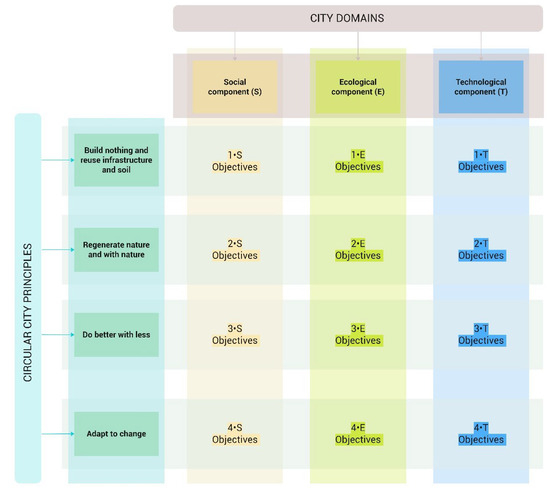
Figure 3.
Definition of objectives for each principle and for each city domain.
Table 6.
The proposal of objectives by bridging circularity principles and SET domains.
These objectives have been identified based on the outcomes of the literature review, which allowed us to first draft the four guiding principles (Section 3.1). Indeed, the strategic objectives aim to operationalize these four principles into more concrete and actionable targets for policymakers when drafting urban plans. The solutions proposed in the literature for the city domains (e.g., a circular built environment, the circular use of natural resources) have been transformed into potential strategic objectives for spatial plans.
The list of objectives offers a vision that can be adapted to various local contexts to strengthen their physical, cultural, and environmental values; for this reason, some of the objectives might not be relevant to all local situations, but they mainly depend on the characteristics of the municipality. Being tailored to urban plans, these objectives already target the scope of spatial planning. However, some of them could be more coherent and of primary importance depending on the local context of the plan and the policies adopted at higher levels.
This set of principles and objectives is the result of a validation process conducted through an anonymous questionnaire that was shared among policymakers, academics, and experts in the CE field. A total of 37 responses were collected, the vast majority of which were in the Italian language (34 out of 37). The respondents mainly worked in municipalities and universities, and, from their job profiles, it was found that the majority of the respondents were civil servants working in urban planning departments and dealing with the preparation of new plans or the implementation of the existing ones for their municipalities. The guiding principles and objectives presented in this section are the outcomes of the fine-tuning work conducted after the analysis of the respondents’ answers. They were asked to score, from 1 to 5, the relevance of the proposed objectives to the interpretation of the circular city. In addition, there was the possibility for the participants to provide comments or add important aspects that were missing or not sufficiently outlined in the proposed objectives. As a result of the scoring procedure for the validation of the objectives, average scores were calculated. Since all of the proposed objectives received a score higher than three, all items were maintained in the list. In some cases, they were rephrased or slightly modified according to the received suggestions.
3.2.5. Developing a Proposal to Monitor the Effects of the Plan (Stage B6)
By following the above-mentioned list of objectives, external and internal coherence are already guaranteed with respect to the global and European targets (Stage B1). Stage B6 involves developing a proposal for the monitoring strategy, which must be included in the SEA environmental report; indeed, although the monitoring of the plan starts after its adoption, it is essential to define the monitoring process at this stage to assess the performance of the plan. According to [35], for each indicator, the following information should be identified:
- The unit of measure;
- The source for the data used in the calculation;
- The baseline value;
- The benchmark, namely the target to achieve.
In this case, since, as mentioned above, the circularity objectives have to be tailored to the local context, only the information related to the unit of measure and the source of the listed indicators is provided. In fact, the baseline and the benchmark strongly depend on the context to which they are applied. However, to support policymakers, we provide an overview of the possible ways to measure the proposed objectives. The full list of indicators is presented in Appendix A. These indicators are also able to orient the assessment of the proposals for the implementation of the plan, being more specific and applicable also at a smaller scale. In this case, the indicators are highlighted in blue. The indicators are divided into three tables (Table A1, Table A2 and Table A3 of the Appendix A) for each SET item and were mainly formulated through the outcomes of the literature review mentioned in Section 2.
4. Discussion
The proposed framework is based upon principles intended to inspire policymakers in drafting a vision of the city from a circular perspective, thus highlighting how spatial planning can effectively influence the city’s journey towards circularity. This specific perspective is what differentiates the proposed model from the existing ones. In this new interpretation, reuse does not involve reusing products and materials but primarily reusing un(der)used public spaces and infrastructure, thus aligning with the principle of not consuming new virgin soil. Reuse is also the most powerful strategy for city planners to achieve zero waste, where the concept of “waste” also includes the degraded areas of the city. The closure of the urban metabolism is also important, but the city scale is not often the most appropriate to achieve this. Conversely, cities can be planned to reduce their consumption of land, energy, and water as much as possible. Regarding the regeneration of nature and working with nature in urban areas, attention is paid to those practices that aim at introducing more green areas in cities, which are able to provide ecosystem services, in order to improve people’s health and wellbeing. This principle goes beyond the regeneration of areas to close the biological cycle, paying attention to the often-overlooked dimension of health in cities. Adapting to change and fostering adaptation, resilience, and inclusiveness represents a paradigm shift in terms of social values, beliefs, and lifestyles and highlights the need to cope with uncertainty, including through the multi-use of spaces. In this regard, culture is strengthened as a driver of urban regeneration and innovation to strengthen the local identity and community engagement. The active role of citizens and their participation in the planning process is thus emphasized. The principle of doing better with less emphasizes some aspects that are missing in existing models, such as enabling the digital transition and the promotion of shared services (from mobility solutions to housing and working spaces) to optimize the knowledge and the usage of the city. Due to this, it strongly permeates the other three principles, being an enabler of practices that support the achievement of all other strategies.
It is worth noting that the outcome of this process reflects an interpretation of the circular city paradigm that simultaneously embraces the concepts of resilience, ecological regeneration, and smartness, in order for the city to be sustainable and future-proof. In this respect, the authors acknowledge that many of the identified objectives are not new, and they have been aligned with different paradigms that currently exist in order to operationalize them (e.g., compact development, mixed use, low-carbon mobility). However, the proposed framework is innovative in the fact that it includes some of the crucial aspects that are now firmly established in EU policies and directives and combines them, resulting in a circular city that is resilient, adaptive, and eco-efficient. By referring to this framework, local policymakers can plan not only for a city composed of closed resource flows but also for social relations and new means of using public spaces. Reducing resource consumption, optimizing the existing infrastructure, aiming at the zero waste ideal in urban transformation, and fostering the role of culture and community engagement and adaptation in the CE transition represent the key pathways to address resource scarcity. They also enable us to tackle other key challenges, like the climate change mitigation and adaptation, thus increasing our resilience under natural hazards. An advantage of embracing all of these aspects is that the proposed framework remains valid despite the momentum of the CE and beyond the circular city paradigm, aiming at improving citizens’ quality of life.
Regarding the guidance offered to policymakers, the goal of the methodology is to provide an innovative interpretation of the SEA steps in order to include the circular economy in the wider sustainability assessment. Adapting an existing binding framework such as SEA, which has already been in place for several years, offers significant advantages over the introduction of an entirely new instrument. This approach facilitates a more time-efficient adoption process and reduces the burden on practitioners, who are already familiar with the existing procedures and possess the necessary competencies. Moreover, it avoids additional human and financial costs for municipalities, as it does not require the establishment of new implementation mechanisms or administrative structures. With the integration of circularity in SEA, the overall aim is to facilitate a multi-disciplinary approach to the assessment of spatial framework plans, paying attention to the multi-dimensional nature of sustainability by including social, economic, environmental, and cultural aspects. The proposed circular-inclusive SEA offers a strategic and qualitative level of appraisal, considering significant circularity aspects linked to spatial plans. Regarding what is included in the SEA Directive, the present research aimed at enriching it by proposing integrative objectives, alternative means to achieve them, or different implementation pathways. Moreover, the adapted SEA also proposes, within its steps, an indication of how to monitor the effects of the plan, encompassing the last stage of the proposed methodology. A “no-one-size-fits-all” approach is followed, since the proposed objectives and the proposal for monitoring have a strategic nature and can be tailored to the local context.
Stakeholder Engagement and Identified Challenges
As far as stakeholders’ involvement is concerned, it is already firmly established by the SEA Directive that environmental and public authorities have to be included in the consultation about the scope of the plan. However, given the interpretation of SEA as a decision-making process, public participation is essential also in the definition of the strategies of the plan. In line with the circularity principle of adaptation, the formation of circular communities has to be encouraged; these are groups of citizens with a keen sense of place, aware of the challenges of the territory and informed about the importance of embracing the change towards circularity. To this aim, the involvement of the third sector and citizens in the co-design of strategies is essential. Their participation in the design phase of the plan plays a crucial role in the implementation of innovative models of governance—for example, active citizens can manage urban commons through collaboration agreements with the public administration. Participation is thus intended in its broader sense, where the real cooperation between the two actors lies in co-programming and co-designing projects and initiatives for the care and regeneration of urban commons. The importance of including citizens in decision making from the very beginning is also reflected into the implementation phase of the actions of the plan. As an example, civic crowdfunding is being increasingly considered as an innovative tool to finance projects that are of important value for the local community, who believes in the initiative strongly enough to finance part of it [69]. By proposing projects that are shared with stakeholders and citizens, one can enhance the efficacy of this tool and contribute to the economic feasibility of the plan. In this context, innovative and digital tools represent an opportunity, enabling easier access to information and an easier way to collaborate and facilitating the creation of citizens’ awareness about the value of circularity and how to enhance it.
Moreover, as seen in the previous paragraphs, to obtain a comprehensive overview and orient the baseline framework in order to include circularity information, some specific analyses are recommended. For example, it is necessary to involve specialists with competencies in different fields, such as environmental analysts, sociologists, and health professionals. A multi-disciplinary approach must be fostered in order to reflect the complexity and richness of the state of the art in a more inclusive and multi-purpose strategy for the city. Baseline information can be both quantitative and qualitative. If quantitative, these data would probably be in the possession of the local authorities, derived from monitoring frameworks that are already in place or collaborations with research centers, universities, territorial entities, environmental authorities and institutes, or national statistical departments. As for qualitative information, cooperation with local actors like associations from the third sector and citizens is crucial to obtain a realistic picture of the state of the art of the territory. The criteria followed to determine the qualitative assessment have to be clear, easy to understand, and transparent in order to be replicable.
Information can also come from other legislations and higher-tier strategies and tools that include indications that are useful in setting out the context for the plan and through collaboration with consultation bodies, including environmental ones.
This circular-specific analysis has a spatial resolution and must be combined with statistical information about the population, e.g., their economic statuses, demographic trends, health situations, levels of education, employment rates, and crime rates. Building a baseline framework for spatial plans implies the use of maps in order to visualize such information in a useful way to build a strategy. Geographical information systems (GIS) are particularly useful in this context, since the overlapping of different layers of information allows one to elaborate on interesting considerations arising from the interrelation of different datasets. Physical phenomena can be linked to socioeconomic dynamics in order to relate certain trends with specific locations. When possible, the collection of data over time has to be fostered, since it is important to examine historical tendencies in order to build predictions for the near future. This information may support the definition of scenarios like “do nothing” and “business as usual” ones. This type of analysis has the advantage of identifying and potentially foreseeing existing and future social, environmental, and economic issues.
5. Conclusions
By bringing the CE into the urban planning discourse, this study aims to support the effective integration of CE principles into spatial planning practice, since, at present, the translation of CE policies into practice appears fragmented, reflecting the lack of a comprehensive framework for the interpretation of the CE concept at the city scale. The present contribution, on the one hand, aims at providing a spatial planning-oriented vision of the circular city that is easy to understand by policymakers; on the other hand, it proposes a methodology that can guide urban strategies for cities’ regeneration and transformation. Identifying clear circularity principles is the first fundamental step to guide spatial planning strategies and ensure that circular cities are implemented in a systematic and holistic way. Four guiding principles are therefore suggested, around which spatial plans should base their development and urban regeneration trajectories. By applying these principles to the social–ecological–technological domains of the city (as defined in [54]), a series of 35 objectives, derived from a literature review of spatial planning research, have been identified and tailored for policymakers. This resulting approach to the circular city is integrated within the various phases of the SEA process, providing a methodology that accompanies the plan from its conceptualization and supports its definition and implementation. The proposed approach gives an interpretation of this instrument that goes beyond its original scope of assessing the environmental impacts of policies and plans, extending it to a more holistic approach comprising the CE principles. Finally, the proposed guidance should encourage policymakers to acknowledge the importance of the CE for the sustainable development of the city and provide an intuitive process to follow in order to adopt circular-inclusive urban plans.
In terms of research limitations and future development pathways, the present methodology is strongly supported by the systematic literature review presented by Marzani and Tondelli [49]. The authors analyzed papers with the full text available, with the possibility of having missed relevant publications. In the future, an enriched approach to the interpretation of the circular city according to an urban planning perspective can be further explored, thus refining the research results. Moreover, the validation of the guiding principles and related objectives through the online survey can be further expanded by collecting more responses and enlarging the sample. This would allow us to better refine the objectives and their formulation in order to assess whether the proposed methodology can be easily adapted and replicated in other European countries but also beyond. Finally, as shown, the methodology consists of the integration of circularity principles into the SEA procedure. It has not been possible to test the methodology in a real case, since SEA is a means of drafting new spatial plans. This could be the subject of future work in collaboration with public administrations, which could lead to the refinement of the methodology based on the results. The proposal is intended for application in Europe, where urban planning is the responsibility of the local government. A comparison between its application in the Italian context and that in other European Member States would bring interesting insights. In addition, the applicability of the methodology can be tested in cities of varied sizes (i.e., small, medium, and large) to verify its effectiveness and the eventual need for further tailoring to respond to the diversity of needs (e.g., data availability to build the baseline framework). The integration of rural areas into the analysis could also offer new points of reflection regarding the possibility to foster a sustainable rural development pathway through circularity.
Supplementary Materials
The following supporting information can be downloaded at: https://www.mdpi.com/article/10.3390/su17125534/s1 Table S1: list of publications selected for their proposed methodologies to assess circularity in cities, including the reasoning for not further analyzing them according to the manuscript scope [10,12,14,25,26,50,70,71,72,73,74,75,76,77,78,79,80,81,82,83,84,85].
Author Contributions
Conceptualization, G.M. and S.T.; methodology, G.M. and S.T.; formal analysis, G.M. and S.T.; investigation, G.M.; resources, G.M.; data curation, G.M.; writing—original draft preparation, G.M.; writing—review and editing, G.M. and S.T.; visualization, G.M.; supervision, S.T. All authors have read and agreed to the published version of the manuscript.
Funding
This research was funded by the XXXVI cycle PhD programme co-funded by the Italian Ministry of the Instruction, University and Research and the Department of Architecture of Alma Mater Studiorum, University of Bologna, under the initiative “Excellence Department”.
Institutional Review Board Statement
Not applicable.
Informed Consent Statement
Not applicable.
Data Availability Statement
No new data were created or analyzed in this study. Data sharing is not applicable to this article.
Conflicts of Interest
The authors declare no conflicts of interest.
Appendix A
Table A1.
Indicators for the technological domain. The indicators highlighted in blue text are also able to orient the assessment of the proposals for the implementation of the plan, being more specific and applicable also at a smaller scale.
Table A1.
Indicators for the technological domain. The indicators highlighted in blue text are also able to orient the assessment of the proposals for the implementation of the plan, being more specific and applicable also at a smaller scale.
| Technological Domain—Objectives | Indicators | References | |
|---|---|---|---|
| Build nothing and reuse infrastructure and soils, fostering zero waste ideal | Reuse of abandoned infrastructure | sqm of reused buildings/sqm abandoned buildings when the plan is adopted | adapted from [25,70,71,86,87] |
| Number of private retrofitted buildings | [25,70,71,86,87,88] | ||
| sqm of new buildings/sqm of abandoned buildings | |||
| Adoption of a plan for disassembly at end of life and/or conversion of existing public infrastructure | Presence of a plan for public buildings and infrastructure | adapted from [71] | |
| % of recycled materials for the construction of new buildings | adapted from [86] | ||
| % of reused materials for repurposing in new buildings | adapted from [71,86,87] | ||
| Public building renovation | Energy production/waste generation ratio for public buildings | [25] | |
| Green public procurement criteria adopted | [87,89,90] | ||
| Energy produced with renewable resources in public buildings [kWh/smq] | adapted from [86,91] | ||
| Design zero-waste infrastructure: | |||
| Energy | Energy production/waste generation ratio | [25] | |
| Energy consumption (kWh/ab per year) | [86,87] | ||
| Electricity consumption in residential and non-residential buildings | [87] | ||
| Share of renewable energy | [70,86,87,89,92] | ||
| Share of renewable energy in city heating [% of the total residential buildings] | [86,87] | ||
| Energy labeling in buildings [number of labelled buildings/total] | [88] | ||
| Water | Water efficiency OR dispersion from municipal water supply [%] | [70,87] | |
| Water consumption in industries [l/year] | |||
| Households’ water use [h/day] | [86,87] | ||
| Quantity of grey water reused | [93] | ||
| Waste | Landfilled waste [%] | [25,70,90,93] | |
| % waste per capita or per household | [87,90] | ||
| % waste per industry | [90] | ||
| % of recycled waste | [70,86] | ||
| % of reused waste | [87,92] | ||
| Generation of food waste per household | [90] | ||
| Loop strategies | Number of projects developed (with public or between private properties) to close resource cycles | adapted from [70] | |
| Number of companies that reuse waste | [71] | ||
| Identification of areas for the temporary deposit of materials to be reused | Number of new temporary deposits | ||
| Regenerate nature and work with nature in urban areas | Improve the diffusion of NBS for urban regeneration (e.g., green walls, green roofs, new urban green areas, new trees, sustainable urban drainage systems) | sqm of new green urban areas coming from de-sealing practices | [71,94] |
| sqm of green roofs and green walls | [70,71] | ||
| km of SuDS developed in the city | |||
| Do better with less, reducing resource exploitation and optimizing the use of spaces | Monitor the whole life cycle of the new infrastructure and urban interventions | Number of infrastructures and buildings undergoing life cycle assessment studies | Adapted from [90] |
| Reduce material consumption (material input reduction) for new infrastructure | Material input—raw material demand for new infrastructure | [25,86,92] | |
| Reduce reliance on scarce resources | % of scarce resources substituted with other materials | ||
| Number of projects adopting bio-based materials [tons/project] | Adapted from [25] | ||
| Foster the transition to renewable energy through the creation of energy communities around public spaces | Number of energy communities established in the city | ||
| Self-consumed over the total energy produced over a set period in each energy community | [94] | ||
| Shared energy over total energy consumption of the community over a set period in each energy community | [94] | ||
| Ratio between energy fed to the grid and energy withdrawn from the grid over a set period | [94] | ||
| Ratio between the sum of self-consumed and shared energy over the total energy consumption of the energy community over a set period | [94] | ||
| Enable and promote the digital transition | % of population with access to a broadband connection (>30 Mb/s) | [88] | |
| Accessibility to smartphones | [70] | ||
| % public spaces covered by public Wi-Fi | |||
| Use of digital tools to create community life | [88] | ||
| Number of digital twins developed for public buildings | |||
| Number of smart buildings | [89] | ||
| Fostering mixed uses and compact city development | Density of mixed uses | ||
| Volume of the built environment/sqm of public space | adapted from [88] | ||
| Foster the constitution of industrial symbiosis (IS) processes | Number of IS networks | [86] | |
| Number of companies participating in IS networks | [86] | ||
| Adapt to change, fostering flexibility, resilience, and inclusiveness | Availability of flexible last-mile solutions through shared cars, bikes, buses, trams, and trains | Modal share [%] | |
| Foster the development of multi-functional spaces | sqm of multi-functional area per capita | adapted from [88,93] | |
| Public space density: Pedestrian areas, squares, and green spaces per capita | [87] | ||
Table A2.
Indicators for the ecological domain. The indicators highlighted in blue text are also able to orient the assessment of the proposals for the implementation of the plan, being more specific and applicable also at a smaller scale.
Table A2.
Indicators for the ecological domain. The indicators highlighted in blue text are also able to orient the assessment of the proposals for the implementation of the plan, being more specific and applicable also at a smaller scale.
| Ecological Domain—Objectives | Indicators | References | |
|---|---|---|---|
| Build nothing and reuse infrastructure and soils, fostering zero waste ideal | Achieve the objective of no net land take by 2050 | % of virgin soil sealed | |
| % de-sealed soil | adapted from [93] | ||
| ha of areas redeveloped or recovered if abandoned | [25,71,88] | ||
| % of virgin material extraction | [25,86,92] | ||
| Promotion of land decontamination practices for brownfield regeneration to foster innovative CE projects | sqm of brownfields | adapted from [93] | |
| sqm of contaminated land restored/total contaminated land | |||
| CO2 avoided | [71,87] | ||
| Regenerate nature and work with nature in urban areas | Promote reforestation practices in urban areas to tackle air pollution and support carbon sequestration | Number of new planted trees | adapted from [93] |
| Restore and protect biodiversity | % of sites protected/total | [88] | |
| Consistency and threat level of vegetal and animal species | Protected areas report | ||
| Improve the offer of regulative ecosystem services | Carbon storage and sequestration in vegetation and soil/year [g/(sqm/year)] | [25,93] | |
| Particulate matter captured by vegetation/year | adapted from [25,93] | ||
| Noise reduction | [93] | ||
| Annual average air quality (particulate matter < 10) | adapted from [25,93] | ||
| Increase in the potential water retention from SuDS [mm] | [86] | ||
| Create synergies between green and blue infrastructure and spaces for social relations, particularly in relation to the ecological network outside urban areas | Accessibility of GBI | [93] | |
| Number of meeting places within GBI | [93] | ||
| Do better with less, reducing resource exploitation and optimizing the use of spaces | Optimize the offer of provisioning ecosystem services | sqm of land use dedicated to peri-urban and urban farming | adapted from [25] |
| Fresh water supplied by ecosystem | |||
| Adapt to change, fostering flexibility, resilience, and inclusiveness | Foster the diffusion of green areas in urban environments to manage extreme events like floods and the urban heat island effect | Sqm of NBS | adapted from [25] |
| Investment in green infrastructure/climate mitigation funding [€/year] | [88] | ||
| Temperature reduction in urban areas [°C] | [25,94] | ||
| sqm with reduced risk of flash flooding | [93] |
Table A3.
Indicators for the social domain. The indicators highlighted in blue text are also able to orient the assessment of the proposals for the implementation of the plan, being more specific and applicable also at a smaller scale.
Table A3.
Indicators for the social domain. The indicators highlighted in blue text are also able to orient the assessment of the proposals for the implementation of the plan, being more specific and applicable also at a smaller scale.
| Social Domain—Objectives | Indicators | References | |
|---|---|---|---|
| Build nothing and reuse infrastructure and soils, fostering zero waste ideal | Identification of areas for exchange of second-hand products or to host reuse initiatives (e.g., repair cafés) | sqm of repair shops | adapted from [93] |
| sqm of areas dedicated to the exchange of second-hand products | |||
| Number of companies related to CE | [86,89] | ||
| Number of CE-related start-ups | [25,86,89] | ||
| Increase quality and accessibility of existing public spaces and facilities | Proximity of population to public facilities | adapted from [25] | |
| Adaptive reuse practices, including of cultural heritage, through participation and pilot projects | Number of bottom-up initiatives for reuse of cultural heritage | [88,93] | |
| Number of cultural assets identified as “urban commons”/total of cultural assets [%] | [88] | ||
| Regenerate nature and work with nature in urban areas | Improve the offer of cultural ecosystem services, especially in deprived areas | % of green areas with sociocultural activities/total | adapted from [93] |
| % of green areas with sports facilities/total | adapted from [93] | ||
| Urban green area quality (e.g., depending on the dimension) | |||
| Foster the value of nature by improving accessibility to green areas and blue infrastructure, contributing to health and wellbeing in the city | ha green areas per 100,000 population (ISO 37120) [95] | adapted from [25,71,94] | |
| Accessibility to green areas (<300 m) | adapted from [93] | ||
| Healthcare spending on diseases caused by air pollution among the total health expenditure [%/year] | [25] | ||
| Attraction of investments in environmental and circular projects (public’s willingness to pay to avoid health problems) | [25] | ||
| Accessibility of blue infrastructure | |||
| Do better with less, reducing resource exploitation and optimizing the use of spaces | Promotion of solutions for shared and low-carbon mobility | % of population using car sharing | |
| % of population using bike sharing | |||
| % of population using public transport | [70,86,87] | ||
| Accessibility of public transport stops | adapted from [25] | ||
| % of private transport and types of cars | [86,89] | ||
| kM of roads dedicated to public transport/tot kM | [87] | ||
| kM of roads with safe sidewalks or bike lanes/tot kM | [25] | ||
| Promotion of solutions for co-housing and shared working spaces | Number of incentives for sharing private properties | ||
| sqm of co-housing/population +18 | |||
| sqm of co-working/working population (18–65) | |||
| sqm of housing/population | |||
| sqm of offices/working population (18–65) | |||
| Foster multi-actor and multi-functional collaboration in the use of spaces (e.g., reuse of the same space at different times) | sqm of un(der)used spaces | ||
| sqm shared urban land/total [%] | [88] | ||
| % of population with access to shared and multi-functional spaces | adapted from [88] | ||
| Temporary use of spaces supporting pop-up initiatives for the regeneration of public spaces through flexibility and adaptive solutions | sqm dedicated to temporary uses and/or agreements for pop-up initiatives | [93] | |
| Adapt to change, fostering flexibility, resilience, and inclusiveness | Co-design of solutions to enable adaptive and “circular” communities | New forms of cooperative economy and solidarity | [88] |
| % persons affected by climate change, cyber attacks, pandemic disasters (n. persons affected/total population) | [86] | ||
| % population with middle or higher education | [86,89] | ||
| Number of initiatives for CE carried out with citizens’ participation | |||
| Fostering the adoption of cooperation agreements for urban commons | Number of cooperation agreements for urban commons |
References
- Circle Economy. Circularity Gap Report; Circle Economy: Amsterdam, Netherlands, 2023. [Google Scholar]
- Ellen MacArthur Foundation. How the Circular Economy Tackles Climate Change; Ellen MacArthur Foundation: Isle of Wight, UK, 2019. [Google Scholar]
- Ellen MacArthur Foundation. Towards the Circular Economy Vol. 1: An Economic and Business Rationale for an Accelerated Transition; Ellen MacArthur Foundation: Isle of Wight, UK, 2013. [Google Scholar]
- Ellen MacArthur Foundation. Growth Within: A Circular Economy Vision for a Competitive Europe; Ellen MacArthur Foundation: Isle of Wight, UK, 2015. [Google Scholar]
- IPCC. Climate Change 2022: Mitigation of Climate Change. In Working Group III Contribution to the Sixth Assessment Report of the Intergovernmental Panel on Climate Change; IPCC: Geneva, Switzerland, 2022; ISBN 9789291691609. [Google Scholar]
- Yang, M.; Chen, L.; Wang, J.; Msigwa, G.; Osman, A.I.; Fawzy, S.; Rooney, D.W.; Yap, P.-S. Circular Economy Strategies for Combating Climate Change and Other Environmental Issues. Environ. Chem. Lett. 2023, 21, 55–80. [Google Scholar] [CrossRef]
- Hoogzaad, J.; Lembachar, Y.; Bąkowska, O.; Pascual, J.; Verstraeten-Jochemsen, J.; de Wit, M.; Morgenroth, N.; Leonard, S.; Moscuzza, A.; Whaley, C.; et al. Climate Change Mitigation Through the Circular Economy—A Report for the Scientific and Technical Advisory Panel (STAP), to the Global Environment Facility (GEF); Circle Economy: Amsterdam, Netherlands, 2020. [Google Scholar]
- Kirchherr, J.; Reike, D.; Hekkert, M. Conceptualizing the Circular Economy: An Analysis of 114 Definitions. Resour. Conserv. Recycl. 2017, 127, 221–232. [Google Scholar] [CrossRef]
- UN DESA. World Urbanization Prospects: The 2018 Revision (ST/ESA/SER.A/420); UN DESA: New York, NY, USA, 2019. [Google Scholar]
- Prendeville, S.; Cherim, E.; Bocken, N. Circular Cities: Mapping Six Cities in Transition. Environ. Innov. Soc. Transit. 2018, 26, 171–194. [Google Scholar] [CrossRef]
- Williams, J. Circular Cities. Urban Stud. 2019, 56, 2746–2762. [Google Scholar] [CrossRef]
- Williams, J. Circular Cities: A Revolution in Urban Sustainability; Routledge: London, UK, 2021; ISBN 9780429490613. [Google Scholar] [CrossRef]
- Williams, J. Challenges to Implementing Circular Development–Lessons from London. Int. J. Urban Sustain. Dev. 2022, 14, 287–303. [Google Scholar] [CrossRef]
- Van der Leer, J.; van Timmeren, A.; Wandl, A. Social-Ecological-Technical Systems in Urban Planning for a Circular Economy: An Opportunity for Horizontal Integration. Archit. Sci. Rev. 2018, 61, 298–304. [Google Scholar] [CrossRef]
- Ellen MacArthur Foundation. Cities in the Circular Economy: An Initial Exploration; Ellen MacArthur Foundation: Isle of Wight, UK, 2017. [Google Scholar]
- Krysovatyy, A.; Zvarych, I.; Zvarych, R. Circular Economy in the Context of Alterglobalization. J. Int. Stud. 2018, 11, 185–200. [Google Scholar] [CrossRef]
- Kirchherr, J.; Yang, N.-H.N.; Schulze-Spüntrup, F.; Heerink, M.J.; Hartley, K. Conceptualizing the Circular Economy (Revisited): An Analysis of 221 Definitions. Resour. Conserv. Recycl. 2023, 194, 107001. [Google Scholar] [CrossRef]
- Rapoport, E. Utopian Visions and Real Estate Dreams: The Eco-City Past, Present and Future. Geogr. Compass 2014, 8, 137–149. [Google Scholar] [CrossRef]
- Marjanović, M.; Wuyts, W.; Marin, J.; Williams, J. Uncovering the Holistic Pathways to Circular Cities—The Case of Alberta, Canada. Highlights Sustain. 2022, 1, 65–87. [Google Scholar] [CrossRef]
- Millar, N.; McLaughlin, E.; Börger, T. The Circular Economy: Swings and Roundabouts? Ecol. Econ. 2019, 158, 11–19. [Google Scholar] [CrossRef]
- Moreau, V.; Sahakian, M.; van Griethuysen, P.; Vuille, F. Coming Full Circle: Why Social and Institutional Dimensions Matter for the Circular Economy. J. Ind. Ecol. 2017, 21, 497–506. [Google Scholar] [CrossRef]
- Sánchez Levoso, A.; Gasol, C.M.; Martínez-Blanco, J.; Durany, X.G.; Lehmann, M.; Gaya, R.F. Methodological Framework for the Implementation of Circular Economy in Urban Systems. J. Clean. Prod. 2020, 248, 119227. [Google Scholar] [CrossRef]
- Papageorgiou, A.; Henrysson, M.; Nuur, C.; Sinha, R.; Sundberg, C.; Vanhuyse, F. Mapping and Assessing Indicator-Based Frameworks for Monitoring Circular Economy Development at the City-Level. Sustain. Cities Soc. 2021, 75, 103378. [Google Scholar] [CrossRef]
- Zoboli, R.; Barbieri, N.; Marin, G.; Paleari, S.; Ghisetti, C.; Pareglio, S. Towards an Innovation-Intensive Circular Economy. Integrating Research, Industry, and Policies; Fondazione Eni Enrico Mattei: Milan, Italy, 2019. [Google Scholar]
- Girard, L.F.; Nocca, F. Moving towards the Circular Economy/City Model: Which Tools for Operationalizing This Model? Sustainability 2019, 11, 6253. [Google Scholar] [CrossRef]
- Turcu, C.; Gillie, H. Governing the Circular Economy in the City: Local Planning Practice in London. Plan. Pract. Res. 2020, 35, 62–85. [Google Scholar] [CrossRef]
- Williams, J. The Role of Spatial Planning in Transitioning to Circular Urban Development. Urban Geogr. 2020, 41, 915–919. [Google Scholar] [CrossRef]
- Williams, J. Circular Cities: Planning for Circular Development in European Cities. Eur. Plan. Stud. 2023, 31, 14–35. [Google Scholar] [CrossRef]
- European Commission-DR for Regional Policy and Cohesion. The EU Compendium of Spatial Planning Systems and Policies; European Union Regional Policy: Brussels, Belgium, 1997. [Google Scholar]
- United Nations Economic Commission for Europe. Spatial Planning: Key Instrument for Development and Effective Governance with Special Reference to Countries in Transition; EN ECE: New York, NY, USA; Geneva, Switzerland, 2008. [Google Scholar]
- Resourceful Cities Network. A Compendium of Small Scale Actions to Promote the Circular Transition in Cities; European Commission: Brussels, Belgium, 2022. [Google Scholar]
- European Committee of the Regions; Dallhammer, E.; Gaugitsch, R.; Neugebauer, W.; Böhme, K. Spatial Planning and Governance within EU Policies and Legislation and Their Relevance to the New Urban Agenda; Comitato Europeo delle Regioni: Brussels, Belgium, 2018. [Google Scholar]
- ESPON COMPASS. Comparative Analysis of Territorial Governance and Spatial Planning Systems in Europe; ESPON COMPASS: Stockholm, Sweden, 2018. [Google Scholar]
- European Commission. Evaluation of the Directive 2001/42/EC on the Assessment of the Effects of Certain Plans and Programmes on the Environment; Commission Staff Working Document; European Commission: Brussels, Belgium, 2019. [Google Scholar]
- Floris, M.; Isola, F.; Lai, S.; Leccis, F.; Leone, F.; Marras, M.; Zoppi, C. Valutazione Ambientale Strategica, Piani Urbanistici Comunali e Piani Dei Parchi-Un Quadro Operativo per l’Integrazione Della Strategia Regionale per Lo Sviluppo Sostenibile Della Sardegna; UNICApress: Cagliari, Italy, 2023; ISBN 978-88-3312-103-1. [Google Scholar]
- Cerreta, M.; Russo, M. Planning-Evaluation. In Le Valutazioni Nel Processo Di Pianificazione e Progettazione, Proceedings of the La valutazione come parte del Processo Pianificatorio e Progettuale, Atti della XXIV Conferenza Nazionale SIU Dare valore ai valori in urbanistica; Brescia, Italy, 23–24 June 2022, Planum Publisher e Società Italiana degli Urbanisti: Roma, Milano, Italy, 2023; Volume 9. [Google Scholar]
- Fischer, T.B. The Theory and Practice of Strategic Environmental Assessment: Towards a More Systematic Approach; Routledge: London, UK, 2010. [Google Scholar]
- Tondelli, S. L’esperienza Della VAS in Emilia-Romagna. IN BO Ric. Progett. Per Territ. Città L’architettura 2013, 4, 245–254. [Google Scholar] [CrossRef]
- Lodrini, S.; Anghinelli, S.; Ronchi, S. L’efficacia Delle Valutazioni Ambientali a Vent’anni Dalla Direttiva 2001/42/UE. In Proceedings of the La Valutazione come parte del Processo Pianificatorio e Progettuale, Atti della XXIV Conferenza Nazionale SIU Dare valore ai Valori in urbanistica, Brescia, Italy, 23–24 June 2022; Cerreta, M., Russo, M., Eds.; Planum Publisher e Società Italiana degli Urbanisti: Roma, Milano, Italy, 2023; Volume 9. [Google Scholar]
- Mazzeo, G. Superare la Divisione tra Valutazione e Piano. In Criticità Ed Evidenze da Due Casi Studio, Proceedings of the La valutazione come parte del processo pianificatorio e progettuale, Atti della XXIV Conferenza Nazionale SIU Dare valore ai valori in urbanistica, Brescia, Italy, 23–24 June 2022; Cerreta, M., Russo, M., Eds.; Planum Publisher e Società Italiana degli Urbanisti: Roma-Milano, Italy, 2023; Volume 9. [Google Scholar]
- Sugoni, G.; Assumma, V.; Bottero, M.C.; Mondini, G. Development of a Decision-Making Model to Support the Strategic Environmental Assessment for the Revision of the Municipal Plan of Turin (Italy). Land 2023, 12, 609. [Google Scholar] [CrossRef]
- European Union. Guidance on Integrating Climate Change and Biodiversity into Strategic Environmental Assessment; European Union: Brussels, Belgium, 2013. [Google Scholar]
- European Commission, Directorate-General for Environment. Guidance on Integrating Climate Change and Biodiversity into Strategic Environmental Assessment; Publications Office: Luxembourg, 2013. [Google Scholar]
- Office of the Deputy Prime Minister. The SEA Directive: Guidance for Planning Authorities. In Practical Guidance on Applying European Directive 2001/42/EC “on the Assessment of the Effects of Certain Plans and Programmes on the Environment” to Land Use and Spatial Plans in England; Office of the Deputy Prime Minister: London, UK, 2003. [Google Scholar]
- European Commission webpage. Overview of the Strategic Environmental Assessment Directive. Available online: https://environment.ec.europa.eu/law-and-governance/environmental-assessments/strategic-environmental-assessment_en (accessed on 22 April 2025).
- European Union. Directive 2001/42/EC of the European Parliament and of the Council of 27 June 2001 on the Assessment of the Effects of Certain Plans and Programmes on the Environment; European Union: Luxembourg, 2001. [Google Scholar]
- Ioppolo, G.; Cucurachi, S.; Salomone, R.; Shi, L.; Yigitcanlar, T. Integrating Strategic Environmental Assessment and Material Flow Accounting: A Novel Approach for Moving towards Sustainable Urban Futures. Int. J. Life Cycle Assess. 2019, 24, 1269–1284. [Google Scholar] [CrossRef]
- Vogel, C.; Stamer, A.; Heckathorn, A. GuStAF: A Guide for the Strategic Analysis of Frameworks for Municipal Sustainability Planning. Master’s Thesis, Blekinge Institute of Technology, Karlskrona, Sweden, 2019. [Google Scholar]
- Marzani, G.; Tondelli, S. Highlighting Circular Cities Trends in Urban Planning. A Review in Support of Future Research Tendencies. TeMA J. Land Use Mobil. Environ. 2024, 17, 231–247. [Google Scholar] [CrossRef]
- Petit-Boix, A.; Leipold, S. Circular Economy in Cities: Reviewing How Environmental Research Aligns with Local Practices. J. Clean. Prod. 2018, 195, 1270–1281. [Google Scholar] [CrossRef]
- ICLEI–Local Governments for Sustainability; Circle Economy; Metabolic; Ellen MacArthur Foundation. Circular City Actions Framework—Bringing the Circular Economy to Every City; ICLEI—Local Governments for Sustainability e.V: Bonn, Germany, 2021. [Google Scholar]
- Millennium Ecosystem Assessment. Ecosystems and Human Well-Being: Synthesis; Island Press: Washington, DC, USA, 2005. [Google Scholar]
- Williams, J. Circular Cities: What Are the Benefits of Circular Development? Sustainability 2021, 13, 5725. [Google Scholar] [CrossRef]
- Markolf, S.A.; Chester, M.V.; Eisenberg, D.A.; Iwaniec, D.M.; Davidson, C.I.; Zimmerman, R.; Miller, T.R.; Ruddell, B.L.; Chang, H. Interdependent Infrastructure as Linked Social, Ecological, and Technological Systems (SETSs) to Address Lock-in and Enhance Resilience. Earths Future 2018, 6, 1638–1659. [Google Scholar] [CrossRef]
- Smith, A.; Stirling, A. Synthesis, Part of a Special Feature on Transitions, Resilience and Governance: Linking Technological, Ecological and Political Systems. The Politics of Social-Ecological Resilience and Sustainable Socio-Technical Transitions. Ecol. Soc. 2010, 15, 11. [Google Scholar] [CrossRef]
- Olazabal, M.; Chelleri, L.; Waters, J.J.; Kunath, A. Urban Resilience: Towards an Integrated Approach. In Proceedings of the 1st International Conference on Urban Sustainability & Resilience, London, UK, 5–7 November 2012. [Google Scholar]
- Pineda-Pinto, M.; Herreros-Cantis, P.; McPhearson, T.; Frantzeskaki, N.; Wang, J.; Zhou, W. Examining Ecological Justice within the Social-Ecological-Technological System of New York City, USA. Landsc. Urban Plan. 2021, 215, 104228. [Google Scholar] [CrossRef]
- McPhearson, T.; Cook, E.M.; Berbés-Blázquez, M.; Cheng, C.; Grimm, N.B.; Andersson, E.; Barbosa, O.; Chandler, D.G.; Chang, H.; Chester, M.V.; et al. A Social-Ecological-Technological Systems Framework for Urban Ecosystem Services. One Earth 2022, 5, 505–518. [Google Scholar] [CrossRef]
- McPhearson, T.M.; Raymond, C.; Gulsrud, N.; Albert, C.; Coles, N.; Fagerholm, N.; Nagatsu, M.; Olafsson, A.S.; Soininen, N.; Vierikko, K. Radical Changes Are Needed for Transformations to a Good Anthropocene. Npj Urban Sustain. 2021, 1, 5. [Google Scholar] [CrossRef]
- Wolff, S.; Schulp, C.J.E.; Verburg, P.H. Mapping Ecosystem Services Demand: A Review of Current Research and Future Perspectives. Ecol. Indic. 2015, 55, 159–171. [Google Scholar] [CrossRef]
- De Luca, C.; Martin, J.; Tondelli, S. Ecosystem Services Integration into Local Policies and Strategies in the City of Bologna: Analysis of the State of the Art and Recommendations for Future Development. In Ecosystem Services and Green Infrastructure-Perspectives from Spatial Planning in Italy; Arcidiacono, A., Ronchi, S., Eds.; Spinger: Cham, Switzerland, 2021; pp. 127–139. [Google Scholar]
- Geneletti, D.; Cortinovis, C.; Zardo, L.; Adem Esmail, B. Planning for Ecosystem Services in Cities; Springer: Berlin/Heidelberg, Germany, 2019; ISBN 978-3-030-20023-7. [Google Scholar]
- Marinova, S.; Deetman, S.; van der Voet, E.; Daioglou, V. Global Construction Materials Database and Stock Analysis of Residential Buildings between 1970–2050. J. Clean. Prod. 2020, 247, 119146. [Google Scholar] [CrossRef]
- Deetman, S.; Marinova, S.; van der Voet, E.; van Vuuren, D.P.; Edelenbosch, O.; Heijungs, R. Modelling Global Material Stocks and Flows for Residential and Service Sector Buildings towards 2050. J. Clean. Prod. 2020, 245, 118658. [Google Scholar] [CrossRef]
- European Commission (Directorate-General for Communication). Circular Economy Action Plan—For a Cleaner and More Competitive Europe; Publications Office of the European Union: Brussels, Belgium, 2020. [Google Scholar]
- United Nations. Transforming Our World: The 2030 Agenda for Sustainable Development; United Nations: Nairobi, Kenya, 2015. [Google Scholar]
- European Commission (Directorate-General for Communication). European Green Deal—Delivering on Our Targets; Publications Office of the European Union: Brussels, Belgium, 2021. [Google Scholar]
- European Commission (Directorate-General for Environment). EU Biodiversity Strategy for 2030—Bringing Nature Back into Our Lives; Publications Office of the European Union: Brussels, Belgium, 2021; Available online: https://data.europa.eu/doi/10.2779/677548 (accessed on 22 April 2025).
- Lee, C.H.; Zhao, J.L.; Hassna, G. Government-Incentivized Crowdfunding for One-Belt, One-Road Enterprises: Design and Research Issues. Financ. Innov. 2016, 2, 2. [Google Scholar] [CrossRef]
- De Ferreira, A.C.; Fuso-Nerini, F. A Framework for Implementing and Tracking Circular Economy in Cities: The Case of Porto. Sustainability 2019, 11, 1813. [Google Scholar] [CrossRef]
- Gravagnuolo, A.; Angrisano, M.; Girard, L.F. Circular Economy Strategies in Eight Historic Port Cities: Criteria and Indicators towards a Circular City Assessment Framework. Sustainability 2019, 11, 3512. [Google Scholar] [CrossRef]
- Marin, J.; De Meulder, B. Interpreting Circularity. Circular City Representations Concealing Transition Drivers. Sustainability 2018, 10, 1310. [Google Scholar] [CrossRef]
- Boeri, A.; Gaspari, J.; Gianfrate, V.; Longo, D.; Boulanger, S.O.M. Circular City: A Methodological Approach for Sustainable Districts and Communities; Syngellakis, S., Ed.; WITPress: Southampton, UK, 2019; Volume 183, pp. 73–82. [Google Scholar]
- Campbell-Johnston, K.; ten Cate, J.; Elfering-Petrovic, M.; Gupta, J. City Level Circular Transitions: Barriers and Limits in Amsterdam, Utrecht and The Hague. J Clean Prod 2019, 235, 1232–1239. [Google Scholar] [CrossRef]
- Paiho, S.; Maki, E.; Wessberg, N.; Paavola, M.; Tuominen, P.; Antikainen, M.; Heikkila, J.; Rozado, C.A.; Jung, N. Towards Circular Cities-Conceptualizing Core Aspects. Sustain. Cities Soc. 2020, 59, 102143. [Google Scholar] [CrossRef]
- Turrado Domínguez, E.; Hernández López, R.; Fernández López, M.A. Circular Economy and Urbanism: A Sustainable Approach to the Growth of Cities. In Circular Economy and Sustainability: Management and Policy; Elsevier: Amsterdam, The Netherlands, 2021; Volume 1, pp. 347–367. ISBN 9780128198179. [Google Scholar]
- Lakatos, E.S.; Yong, G.; Szilagyi, A.; Clinci, D.S.; Georgescu, L.; Iticescu, C.; Cioca, L.I. Conceptualizing Core Aspects on Circular Economy in Cities. Sustainability 2021, 13, 7549. [Google Scholar] [CrossRef]
- Bosone, M.; De Toro, P.; Girard, L.F.; Gravagnuolo, A.; Iodice, S. Indicators for Ex-Post Evaluation of Cultural Heritage Adaptive Reuse Impacts in the Perspective of the Circular Economy. Sustainability 2021, 13, 4759. [Google Scholar] [CrossRef]
- Vanhuyse, F.; Fejzić, E.; Ddiba, D.; Henrysson, M. The Lack of Social Impact Considerations in Transitioning towards Urban Circular Economies: A Scoping Review. Sustain. Cities Soc. 2021, 75, 103394. [Google Scholar] [CrossRef]
- Sala Benites, H.; Osmond, P.; Prasad, D. A Neighbourhood-Scale Conceptual Model towards Regenerative Circularity for the Built Environment. Sustain. Dev. 2022, 31, 1748–1767. [Google Scholar] [CrossRef]
- Russo, M.; van Timmeren, A. Dimensions of Circularity for Healthy Metabolisms and Spaces; Springer Science and Business Media B.V.: Dordrecht, The Netherlands, 2022; Volume 128, ISBN 09245499. [Google Scholar]
- Eleftheriadou, D.; Neale, W.; Gkiaouri, N.; Halmos, A.; Liogkas, V. Redefining Circular Cities: Regulation, Governance, Infrastructure, and Technology. Computer 2022, 55, 42–53. [Google Scholar] [CrossRef]
- Verga, G.C.; Khan, A.Z. Space Matters: Barriers and Enablers for Embedding Urban Circularity Practices in the Brussels Capital Region. Front. Built Environ. 2022, 8, 810049. [Google Scholar] [CrossRef]
- Mazzarella, C.; Amenta, L. The Circular Metabolic Urban Landscape; Springer Science and Business Media B.V.: Dordrecht, The Netherlands, 2022; Volume 128, ISBN 09245499. [Google Scholar]
- Cottino, P.; Domante, D.; Franchina, A. Urban Regeneration: An “Incremental Circularity” Perspective; Springer Science and Business Media B.V.: Dordrecht, The Netherlands, 2022; Volume 128, ISBN 09245499. [Google Scholar]
- Feiferytė-Skirienė, A.; Stasiškienė, Ž. Seeking Circularity: Circular Urban Metabolism in the Context of Industrial Symbiosis. Sustainability 2021, 13, 9094. [Google Scholar] [CrossRef]
- Paoli, F.; Pirlone, F.; Spadaro, I. Indicators for the Circular City: A Review and a Proposal. Sustainability 2022, 14, 11848. [Google Scholar] [CrossRef]
- Bosone, M.; Ciampa, F. Human-Centred Indicators (HCI) to Regenerate Vulnerable Cultural Heritage and Landscape towards a Circular City: From the Bronx (NY) to Ercolano (IT). Sustainability 2021, 13, 5505. [Google Scholar] [CrossRef]
- Birgovan, A.L.; Lakatos, E.S.; Szilagyi, A.; Cioca, L.I.; Pacurariu, R.L.; Ciobanu, G.; Rada, E.C. How Should We Measure? A Review of Circular Cities Indicators. Int. J. Environ. Res. Public Health 2022, 19, 5177. [Google Scholar] [CrossRef]
- United Nations. New Urban Agenda; UN-Habitat: Nairobi, Kenya, 2017. [Google Scholar]
- Chen, C.W. Clarifying Rebound Effects of the Circular Economy in the Context of Sustainable Cities. Sustain. Cities. Soc. 2021, 66, 102622. [Google Scholar] [CrossRef]
- Domenech, T.; Borrion, A. Embedding Circular Economy Principles into Urban Regeneration and Waste Management: Framework and Metrics. Sustainability 2022, 14, 1293. [Google Scholar] [CrossRef]
- Williams, J. The Circular Regeneration of a Seaport. Sustainability 2019, 11, 3424. [Google Scholar] [CrossRef]
- Balletto, G.; Ladu, M.; Camerin, F.; Ghiani, E.; Torriti, J. More Circular City in the Energy and Ecological Transition: A Methodological Approach to Sustainable Urban Regeneration. Sustainability 2022, 14, 14995. [Google Scholar] [CrossRef]
- ISO 37120:2018; Sustainable Cities and Communities—Indicators for City Services and Quality of Life. International Organization for Standardization: Genève, Switzerland, 2018.
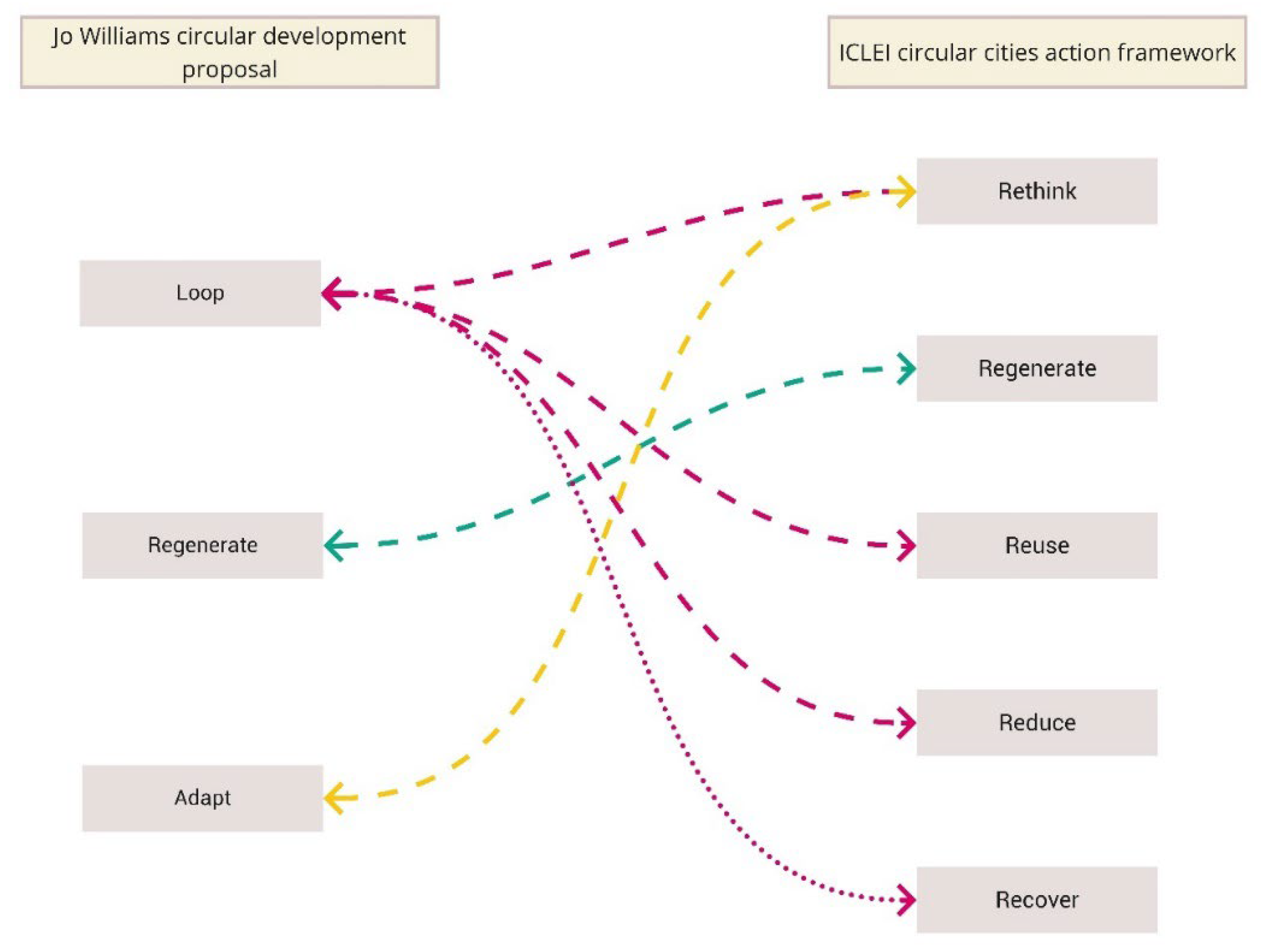
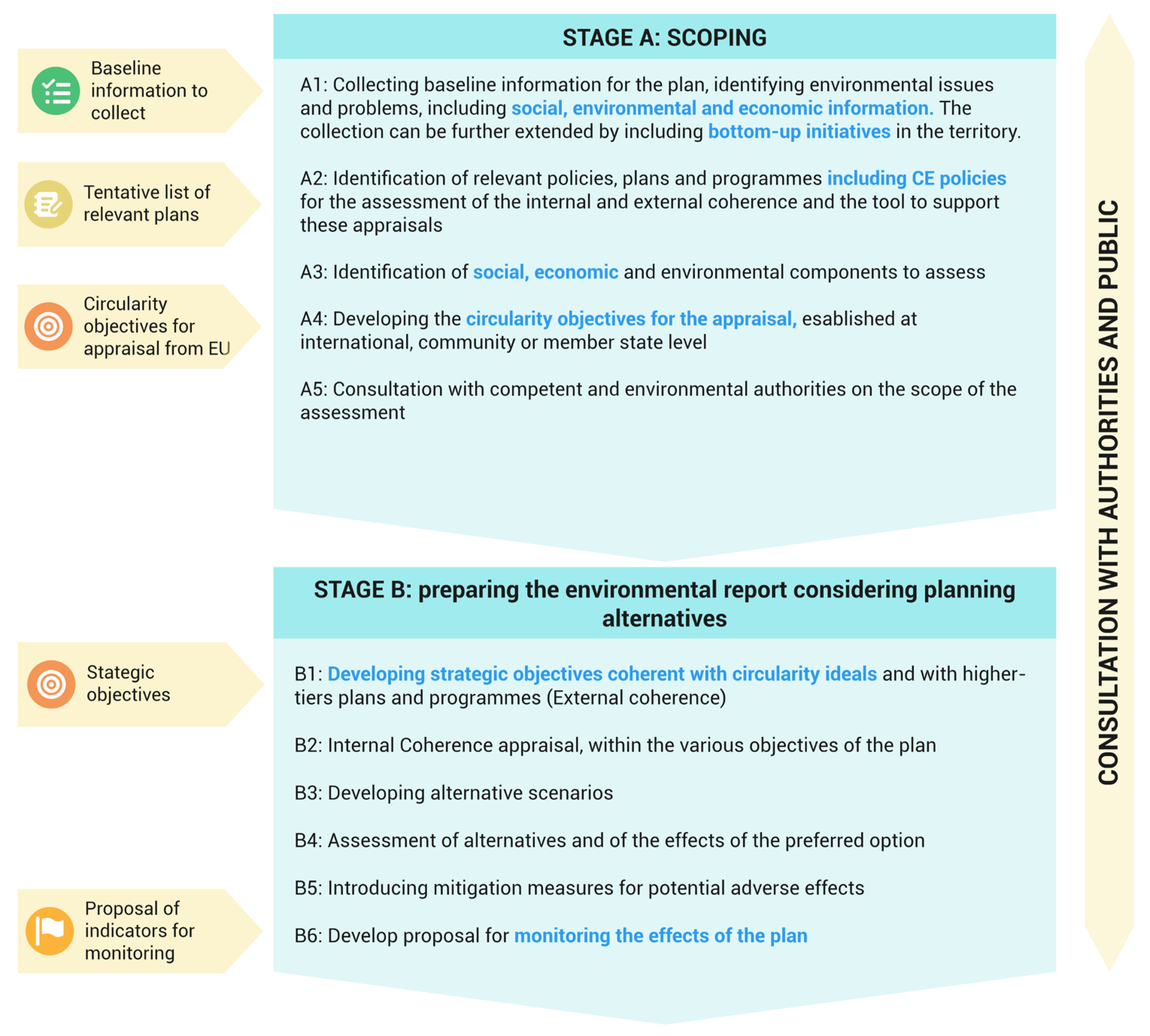
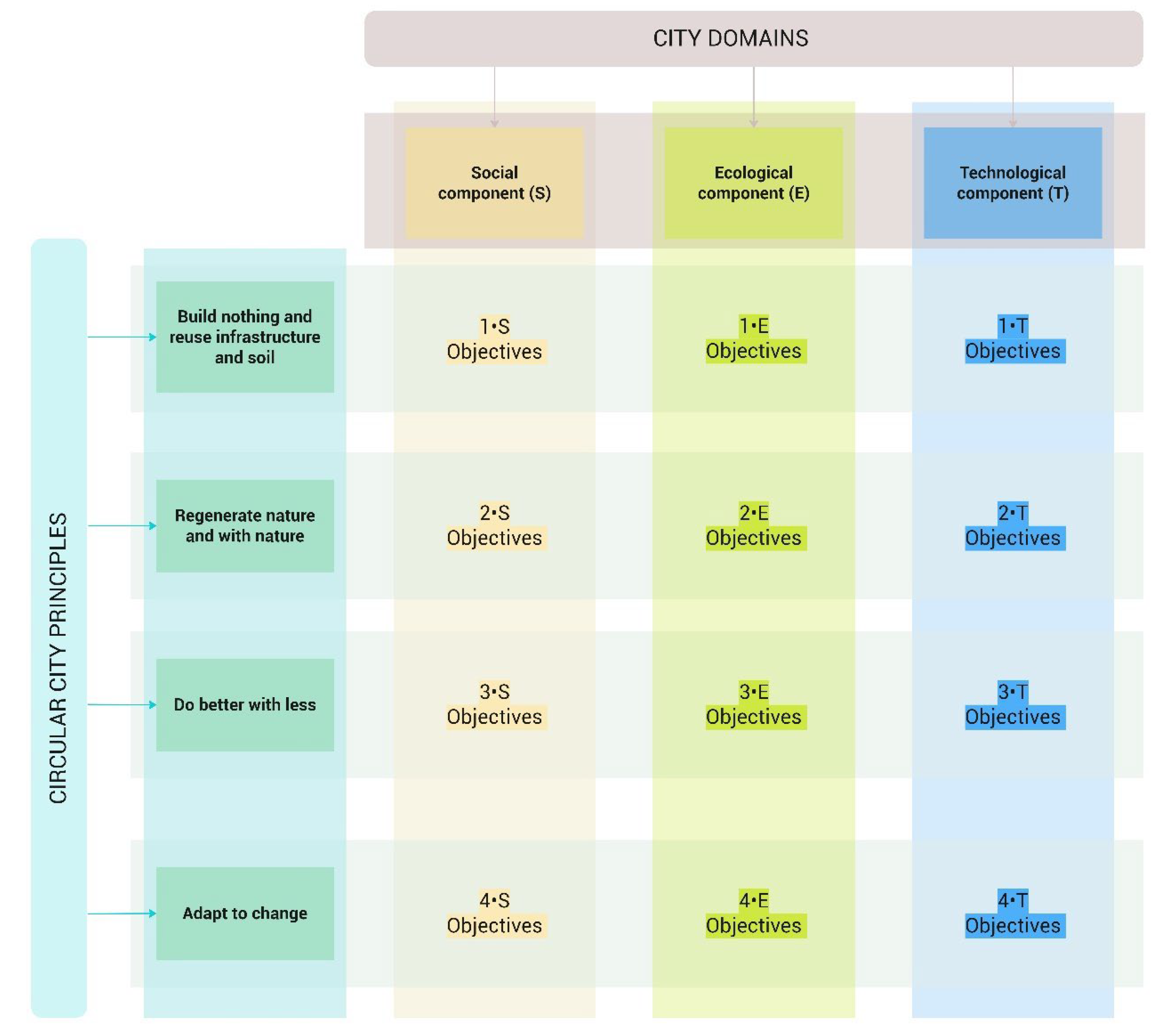
Disclaimer/Publisher’s Note: The statements, opinions and data contained in all publications are solely those of the individual author(s) and contributor(s) and not of MDPI and/or the editor(s). MDPI and/or the editor(s) disclaim responsibility for any injury to people or property resulting from any ideas, methods, instructions or products referred to in the content. |
© 2025 by the authors. Licensee MDPI, Basel, Switzerland. This article is an open access article distributed under the terms and conditions of the Creative Commons Attribution (CC BY) license (https://creativecommons.org/licenses/by/4.0/).