


Abstract
Wastewater from agricultural, industrial, and pharmaceutical activities contains diverse contaminants requiring efficient remediation. Conventional coagulation is hindered by toxic sludge production and severe pH shifts. While natural coagulants are sustainable alternatives, the existing literature lacks a framework that bridges molecular mechanisms and industrial scaling. This review systematically synthesizes research from 1995 to 2026 across plant, animal, and microorganism matrices. Unlike previous reviews, this work uniquely links deep mechanistic analysis to techno-economic scalability and circular-economy integration. Quantitative synthesis demonstrates that animal and plant matrices achieve peak turbidity and suspended solids removals of 80–99.8%, while modified tannins and mucilages achieve up to 100% decolorization. Concurrently, microbial strains remove 64% to 93% of Chemical Oxygen Demand. Beyond bench-scale efficiencies, we evaluate a wide range of operating conditions (pH 2.58–9.1; dosages 2 mg/L to 5 g/L). Critical technological bottlenecks are explicitly addressed, detailing how to resolve the organic carbon paradox—where residual dissolved carbon risks microbial regrowth—through advanced spray-drying and hybrid dosing designs. Ultimately, this review delivers a data-driven framework to support the standardization and large-scale deployment of sustainable natural coagulation technologies globally.
1. Introduction
Wastewater originates from a wide range of activities, including household, agricultural, pharmaceutical, and industrial activities, accounting for approximately a global wastewater production of 359.4 × 10⁹ m3 per year, of which 63% is collected and 52% is treated [1,2]. These effluents typically contain organic matter, nitrogenous compounds, inorganic substances, suspended and dissolved solids, and toxic contaminants such as heavy metals and metalloids [1,3,4]. The accumulation of these pollutants may result in severe environmental impacts, altering and degrading aquatic ecosystems [4,5]. Poorly treated wastewater may also contain pathogens, heavy metals, pesticides, and pharmaceutical compounds, posing risks to human health, including gastrointestinal infections, lung irritation, skin disorders, liver and kidney damage [6]. Although wastewater treatment is widely recognized worldwide as a major factor in water quality, the UN Environment Program estimates that in developing countries, 90% of wastewater is discharged untreated into water bodies, and that a total of 48% of all generated wastewater is discharged into water bodies without treatment, contributing to overall water pollution [7,8]. The rise in emerging contaminants, such as microplastics and pharmaceuticals, also contributes to water pollution, as most wastewater treatment plants are not equipped to degrade them [9]. Hence, an efficient wastewater treatment plan plays an important role in wastewater purification and reclamation [10].
Among available treatment technologies, coagulation–flocculation is among the most widely applied due to its effectiveness and relatively low operational cost. This process involves adding a coagulant to destabilize dissolved and suspended particles, primarily through charge neutralization, promoting floc formation, and subsequent removal by sedimentation [11,12]. Mattson et al. [13] 1928 demonstrated that the hydrolyzed forms of aluminum and iron salts were shown to play a decisive role in coagulation, aluminum sulfate and ferric chloride have become the most widely used coagulants, providing high removal of turbidity, total suspended solids, and organic matter [12,13,14,15]. Nevertheless, these traditional coagulants also present disadvantages, including the generation of toxic, non-biodegradable sludge, effects on the pH of treated water, a limited pH operating range, and potential risks to human health, such as the association of aluminum with neurodegenerative diseases, thereby increasing overall wastewater treatment costs [12,16,17]. These limitations have driven increasing interest in natural, eco-friendly coagulants. Given the global importance of coagulation–flocculation processes, valued at USD 6.01 billion in 2022 [18], the development of sustainable alternatives is relevant. These alternatives have been gaining attention in recent years, including natural coagulants derived from animals, microorganisms, and plants. Recent research focuses heavily on extraction optimization protocols, describing the molecular mechanisms that make the material effective in the coagulation process, and testing the effectiveness of these coagulants in real wastewater. Among the several studies that are going to be analyzed during this review, it is important to emphasize articles such as Gassenschmidt et al. [19] and Muyibi and Evison [20] that first described in 1995 the potential of Moringa oleifera seeds in wastewater treatment and characterization and isolation techniques. These studies became the building blocks for the articles developed over the years, focusing on the potential, characterization, and extraction of natural-based coagulants, including the exploration of M. oleifera seeds for this purpose. One of the modern research studies that explored the potential of tannin-based coagulants was Beltrán-Heredia et al. [21,22,23,24], revolutionizing the application of this type of coagulant, optimizing their production and applying them to industrial textile dyes, demonstrating near-complete color removal efficiencies.
Therefore, this review intends to address a critical gap in the literature by providing a comprehensive, structured analysis of natural coagulants derived from animal, microbial, and plant sources, which are further classified into protein-, starch-, mucilage-, and tannin-based materials. By consolidating extraction methods, physicochemical properties, coagulation mechanisms, and treatment performance, this work enables systematic comparisons across coagulant types and identifies key research needs to advance the use of natural coagulants in large-scale wastewater treatment applications.
2. Literature Search Strategy and Selection Criteria
This systematic review was conducted and reported in strict accordance with the PRISMA 2020 (Preferred Reporting Items for Systematic Reviews and Meta-Analyses) guidelines. A comprehensive literature search was executed across the Scopus, Web of Science, ScienceDirect, SpringerLink, and Google Scholar databases to identify relevant peer-reviewed studies published between 1995 and 2026. The search syntax combined Boolean operators (AND, OR) with specific keywords, taxonomic vocabulary, and wildcards targeting three core concepts: natural coagulant types (“natural coagulant*”, “biocoagulant*”, “plant-based coagulant*”, “chitosan”, “tannin*”, “Moringa”, “Moringa oleifera”, “bio-flocculant*”, “microbial coagulant*”), intersected with treatment applications (“water treatment”, “wastewater”, “effluent*”, “sewage”, “coagulation-flocculation”).
Studies were considered eligible if they met the following explicit inclusion criteria: (i) empirical, original research articles published in peer-reviewed scientific journals; (ii) written in the English language; (iii) primary experimental studies evaluating the performance, mechanisms, or operational optimization of animal-, microorganism-, or plant-based natural coagulants in water or wastewater purification; and (iv) published within the 1995–2026 timeframe.
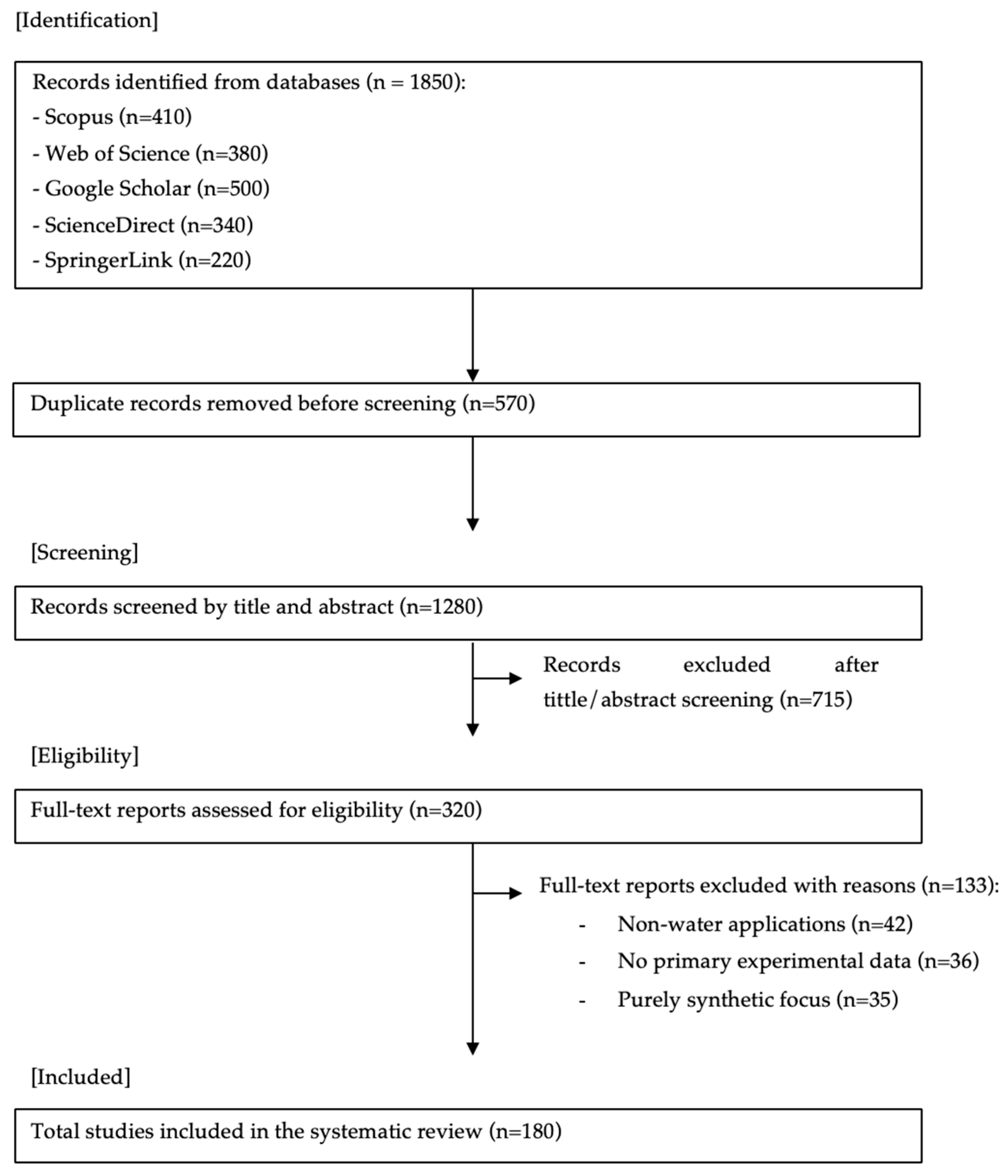
Records were excluded if they: (i) focused on non-water treatment applications; (ii) evaluated purely synthetic or conventional chemical coagulants (e.g., alum, ferric chloride) without a natural baseline or comparison; (iii) lacked original experimental data (such as editorial letters, conference abstracts, non-systematic reviews, or gray literature); or (iv) were duplicate entries. The systematic screening workflow is visually mapped in Figure A1, which is present in Appendix A, and a summary of the selected articles is presented in Table 1. Following electronic deduplication, abstract screening, and rigorous full-text evaluation against the eligibility criteria, 180 publications were retained for final qualitative synthesis and critical assessment.
Table 1.
Summary of the selected articles, including publication year, geography, wastewater type, and coagulant category.
3. Production of Natural Coagulants
Natural coagulants are derived from natural resources and offer advantages such as biodegradability, low toxicity, and reduced sludge volume [18,25,26]. Natural coagulants can be produced from different sources, including animals, microorganisms, and plants [26]. Broadly speaking, natural coagulants can be categorized into two groups based on the main compound that presents the coagulating property: polysaccharides and proteins [18,25].
3.1. Animal-Based Coagulants
Animal-based coagulants include those derived from gelatins (such as collagen and isinglass), egg albumin, casein, and chitin, with chitin and its derivative, chitosan, among the most studied. Chitin is a natural copolymer found mainly in crustacean shells and is industrially extracted by acid treatment to dissolve calcium carbonate, followed by alkaline extraction to remove soluble proteins, and a discoloration step to eliminate residual pigments, yielding a colorless product [27]. Nouj et al. [28] described a representative extraction procedure, where crab shells were washed with deionized water, then dried at 220 °C for 25 min, and ground to produce a raw powder. In addition, Nouj et al. [28] described the protonation process required to render chitin suitable for application as a coagulant in wastewater treatment. This protonation step involved mixing the raw powder with a sodium hydroxide solution for 2 h under stirring, followed by filtration, with the filtrate bleached with 5% sodium hypochlorite solution. A derived polymer obtained by deacetylation of chitin is chitosan [29]. It is composed of D-glucosamine monomers, and the protonation of their amine groups can form cationic chitosan suspensions, enabling it to destabilize negatively charged colloids [30]. Due to the presence of diverse functional groups, including hydroxyl, acetyl, and amino groups, chitosan can function as an effective flocculant/coagulant [29]. Its availability, high compatibility, and ease of chemical modification make it the most studied animal-based coagulant, with applications in various wastewater streams, including olive mill and soybean whey processes [31,32,33]. Since chitosan is insoluble in water or organic solvents, it is commonly diluted in organic acids, such as acetic acid and inorganic acids, except sulphuric acid, which protonates the amino groups, increases charge density, and enhances electrostatic interactions with negatively charged contaminants [27,34].
Gelatin is a heterogeneous mixture of proteins derived from collagen in animal hides and bones, primarily composed of glycine, proline, hydroxyproline, and glutamic acid [35]. Due to this amino acid composition, gelatin contains positively charged functional groups that enable it to attract and bind negatively charged pollutants, such as colloids, dyes, and certain metal oxides, present in wastewater [36,37]. Gelatin-based coagulants are produced by subjecting collagen from connective tissues, skin, or bones to acidic or alkaline hydrolysis, which breaks down the collagen’s triple helical structure into smaller gelatin molecules [38].
Isinglass is widely used as a commercial alcohol beverage clarifying agent, derived from the swim bladders of tropical fish by solubilization in organic acids, and consists mainly of collagen [39]. Although collagen from isinglass is often found in literature as an adsorbent instead of a coagulant [39,40,41], isinglass itself is obtained by carefully drying and, in some cases, mildly extracting specific fish tissues [42]. The obtained mild extract can be used directly as a coagulant for wastewater treatment [42].
Egg albumin is naturally rich in protein, accounting for 54% of its total composition [43]. It is easily extracted from the egg by separating the egg whites, then purified by filtration or drying, without the need for chemical modification for use in wastewater [44]. Similarly, casein proteins obtained from milk are surface-active and can adsorb onto colloidal particles; they can reduce particle stability, thereby enabling coagulation and subsequent enhancement of separation [44]. Casein is obtained by precipitating the milk protein by lowering the pH to the isoelectric point or going through an enzymatic treatment; after the precipitated casein is washed and dried to obtain casein powder or micellar casein, which can be dissolved in water for use as a coagulant [44,45].
3.2. Microorganism-Based Coagulants
Microorganism-based coagulants have gained attention as a substitute for the traditional coagulants due to their biodegradability, lack of toxicity, and no secondary pollution risks [46]. Secondary metabolites produced during the growth phase of the microorganisms can act as bio-coagulants, with the extracellular polymeric substance secreted (EPS), for example, glycoproteins, proteins, polysaccharides, lipids, and glycolipids, able to reduce wastewater turbidity [46,47]. A variety of microorganisms naturally synthesize and secrete EPS into the surrounding medium, where these biopolymers accumulate in the cell-free supernatant and can be recovered in a simple, cost-effective manner without the need for harsh or environmentally damaging cell-disruption techniques [48]. Bacterial EPS, in particular, benefits from rapid production cycles and simple cultivation requirements [49]. When grown under well-controlled batch or continuous fermentation conditions, these microorganisms can generate EPS with reproducible quality, defined functional properties, and tunable characteristics [48,49,50]. Among the various applications of EPS, wastewater treatment has been one of the most extensively studied, particularly for the textile, paper, and tannery industries. Together, these industries account for more than 20% of global water pollution, releasing large amounts of dye-contaminating alkaline waste effluents [48,50]. Research shows that EPS from bacteria can react to the cationic dyes present in wastewater due to the presence of amine, carboxyl, and hydroxyl groups [46,47,51,52]. These interactions occur primarily through the adsorption of EPS onto the surfaces of negatively charged particles, where, according to the patch model, localized electrostatic attractions partially neutralize the surface charge. As a result, the electrostatic repulsion between particles is reduced, increasing the likelihood of particle collision and aggregation into larger flocs [52,53]. In addition, long polymer chains within EPS can form interparticle bridges, further enhancing flocculation efficiency [53]. Several studies have reported that proteins from Bacillus mucilaginous, secondary metabolites produced by Bacillus salmalaya strain 139SI, and glycoproteins derived from Bacillus spp. can function as bioflocculants in water treatment applications [51,54]. EPS extraction is widely reported in the literature; however, different methods present different yields [55]. Comte et al. [56] reported that the most used methods to extract EPS from microorganisms are: (i) chemical, using reagents such as EDTA, glutaraldehyde, or formaldehyde with sodium hydroxide; (ii) physical, such as sonication, cationic resin, sonication associated with cationic resin, heating, and centrifugation. After its extraction, EPS can be used directly as a liquid or dried for storage by spray-drying or lyophilization, and then re-dissolved in water before dosing [57].
3.3. Plant-Based Coagulants
Natural plant-based materials have been employed for centuries in the cleaning and clarification of water, with plant-based coagulants typically consisting of water-soluble organic polymers that may possess positive, negative, multiple, or neutral charges and span a wide range of molecular weights [58]. These polymers are derived from various plant parts, including seeds, leaves, bark or shells, sap, roots, and fruit extracts, and, in particle-free water, their chains generally adopt flexible and irregular conformations [59,60]. Upon contact with suspended colloidal particles, specific segments of the polymer chains, such as loops and tails, adsorb onto particle surfaces, facilitating inter-particle interactions and promoting aggregation and clarification [58,59]. One early example is Strychnos potatorum, which served as a natural coagulant as far back as the 14th–15th century BC. According to Schulz et al. [61] and later Sanghia et al. [62], seeds from the Nirmali tree (S. potatorum) were used in India, roughly 4000 years ago, to treat cloudy river water. In Peru, certain cactus species provided a mucilaginous sap from tuna leaves (edible pads of the prickly pear cactus) that was traditionally mixed into water to help it settle and clear [60]. Sailors in the 16th and 17th centuries similarly relied on Zea mays (maize) as a natural settling agent [60].
Plant-based coagulants can be provided from a wide variety of sources, such as agricultural and agroforestry residues, promoting the circular economy [63]. They operate through several physicochemical pathways that promote particle destabilization and aggregation [64]. Plant-based coagulants can be divided into different groups: (i) protein-based coagulants; (ii) Starch-based; (iii) mucilage-based; and (iv) tannin-based coagulants.
3.3.1. Protein-Based Coagulants
Proteins have been identified to have coagulant properties and can be extracted from many fruit and vegetable pulps, leaves and seeds to be used in coagulants for wastewater treatment, including jackfruit, tamarind, papaya, orange, watermelon, pineapple, cucumber, green gam, peas, black gram, cluster bean rice, maize, chili, cabbage, mustard, cauliflower, beetroot and carrot [65].
The most widely used and the most studied protein-based coagulant is the ground Moringa oleifera seeds [66], a tree commonly known as a “miracle tree” since it is used for different applications, such as pharmaceuticals, cosmetics, and food (mainly as a producer of vegetable oils) [26,67]. This plant is usually harvested in the Caribbean region, and it presents the capability to mitigate pollution in the surrounding ecosystems, facilitating local production [68]. The species grows rapidly at low altitudes throughout the tropical belt and can thrive even in arid locations [69] with the estimated cultivation cost for producing 1 kg of M. oleifera being approximately US$ 2 [70]. The seeds are globular, with an average weight between 3 and 4 g, 1 and 1.4 cm long, and 1 to 1.7 cm wide [70]. Chemically, the seeds are characterized by a high protein content, accounting for approximately 31% of the total seed composition, whereas lipids account for about 28.8% [71]. The proteins have molecular weights of 6.5–30 kDa and high isoelectric points (pI 10–11) [72]. Gassenschmidt, Jany, Tauscher and Niebergall [19] revealed that glutamine, arginine, and proline are the predominant residues, together comprising 60 amino acids in the plant’s protein structure. When used as a coagulant in wastewater treatment, it is likely that the main destabilization mechanisms are adsorption and charge neutralization, as the presence of positively charged proteins leads to the formation of small flocs [66]. Besides pollutant removal from wastewater, M. oleifera seeds offer other advantages, such as lower sludge production than traditional coagulants [73,74].
The extraction method for protein-based coagulants varies depending on the protein source. For fruit and vegetable seeds, Bodlund, Sabarigrisan, Chelliah, Sankaran and Rajarao [65] a demonstrated extraction approach that begins with grinding the seeds into a fine powder, followed by solid–liquid extraction using ethanol, n-hexane, or methanol. The solid obtained from the extraction is subsequently mixed with water and sodium chloride to solubilize the active components. Insoluble materials are then removed by filtration through muslin cloth, followed by centrifugation. The resulting supernatant is collected and used as the crude protein extract, which can be directly introduced into the wastewater [65]. A similar strategy was Ibrahim et al. [75] to extract the protein from M. oleifera seeds: the seeds were dried, then mixed with distilled water and blended; the mixture was filtered, and the filtered sample was used as the coagulant [75]. For oak leaves, Benalia et al. [76] used another extraction technique: the leaves were dried, ground, and sieved through a 0.35 nm pore sieve to obtain the coagulant powder.
3.3.2. Starch-Based Coagulants
Starch-based coagulants are other plant-based alternatives for wastewater treatment. These natural organic polymeric coagulants have attracted increasing attention because, when used in combination with coagulation aids, such as poly(silicic acid) (PSA), they can effectively remove polystyrene (PE) particles with sizes ranging from 500 nm to 0.5 μm, due to their similar structural characteristics [77,78]. These starch-based coagulants possess numerous functional groups, including hydroxyl and carboxyl groups attached to their saccharide rings [79], facilitating easier modification compared to other natural materials used in wastewater treatment [79]. Several studies evaluate the use of rice [80], corn [81], and sago starch [82] in wastewater treatment as coagulants. Starch is present in the form of water-soluble granules consisting of a mixture of two polymers: amylose, which is a linear chain molecule, and amylopectin, a branched polymer of glucose [82]. Native starch generally requires modification before it can be used as a coagulant in wastewater treatment, due to the starch backbone [83]. This modification can be achieved through chemical, physical, or enzymatic methods, producing various types of starch-grafted polymers, mainly cationic, anionic, and amphoteric [83,84]. Chemical modification is the most common, as it can be controlled and is better understood than the other previously mentioned methods [83,85]. This alteration commonly involves graft copolymerization, in which synthetic polymers, such as acrylamide, are combined with starch to enhance the molecular weight of the polymer [84,86,87]. The grafting of these extrinsic long chains onto the rigid starch backbone can increase its fractal dimension, as the incorporation of anionic linear branched chains generates a large hydrodynamic volume in water and enhances the polymer’s bridging effect [88]. This is important for catching and aggregating particles into larger-sized flocs that rapidly settle when used for wastewater treatment purposes [87,88]. Other chemical modification routes include acid hydrolysis, which alters the internal structure of starch granules, leading to changes in their functional properties, whereas hydroxypropylation using propylene oxide limits paste and gel retrogradation without substantially compromising the native functionality of starch [89]. Physical modification of starch by moisture, heat, high pressure, or radiation is gaining attention since there are no by-products of chemical reagents [85]. Enzymatic reactions, on the other hand, can alter the molecular mass, branched-chain-length distribution, and amylose-to-amylopectin ratio of starch when enzymes interact with its gelatinized form, allowing precise tailoring of its structural and functional properties [90].
3.3.3. Mucilage-Based Coagulants
Mucilage is a term used to refer to substances that produce slimy or tacky aqueous dispersions, properties manifested by various types of water-soluble plants, animals, or microbial polysaccharides [91]. Different types of mucilage extracted from different plants have been used as coagulants or flocculants in wastewater treatment. Flaxseed (Linum usitatissimum L.) is an ancient crop cultivated globally due to its fiber and oil content [92,93]. The mucilage extracted from the outermost layer of the flaxseed hulls has great potential to be used as coagulants and flocculants [92]. It contains two major fractions: rhamnogalacturonan-I, an acidic fraction, and arabinoxylans, a neutral fraction [92]. Cactus cladodes are also recognized for the production of hydrocolloids, better known as mucilage [94]. Their mucilage is composed of carbohydrates with molecular weights ranging from 2.3 to [95]. Okra (Abelmoschus esculentus L.), a member of the Malvaceae family [96], yields mucilage that is extracted by mixing plant-derived gums with distilled water or extraction solutions such as sodium chloride, potassium chloride, or sodium nitrate [96]. Then, the mucilage and fibers need to be filtered and separated [96,97]. The filtered solution can be used directly as a coagulant in wastewater, with no need for chemical modification [96].
3.3.4. Tannin-Based Coagulants
Tannins are excretory products and may be present in any or all plant parts; they are most present in woody, lignified tissues [98]. They are polyphenolic compounds with a molecular weight between 300 and 3000 Da [98]. Tannins are the fourth most abundant forest by-products after cellulose, lignin, and hemicellulose [99], and can be categorized into two groups: hydrolysable and condensed tannins [100]. Hydrolysable tannins possess a central polyhydric alcohol whose hydroxyl groups are partially or completely esterified with gallic acid or hexahydroxydiphenic acid [101]. Examples of plants rich in hydrolysable tannins include Quercus infectoria, Caesalpinia spinosa, Hamamelis virginiana, and Castanea sativa [100,101]. In contrast, condensed tannins are oligomeric structures composed primarily of polymers of flavan-3-ols and flavan-3,4-diols [101]. Due to their higher polyphenolic content and high reactivity towards aldehydes and other reagents, there is greater interest in their use as raw materials for coagulants [22,102].
There are tannin-based coagulants already available in the market to be used in wastewater treatment, such as: (i) Tanfloc, produced by the TANAC company in Brazil, obtained from Acacia mearnsii, and modified using the Mannich reaction; (ii) Acquapol and Polyacqua flocculants, by the SETA company, also derived from A. mearnsii tannins; (iii) Ecotan commercialized by Servyeco in Spain; (iv) SilvaFLOC, a tannin-based coagulant from Schinopsis balansae; (v) Organo-Floc commercialized by WaterChem Pte Ltd. from Singapore.
According to Tomasi et al. [103] and Hoyos-Martínez et al. [104], the most common extraction procedures to extract tannins from the different plants are: (i) solid–liquid extraction, which is the most conventional method, in which compounds are dissolved from a solid matrix into a liquid medium [103,105]; (ii) pressurized liquid extraction, which employs solvent extraction at high temperatures and pressures, just below their critical points [106]; (iii) supercritical fluid extraction, consisting of two steps: the extraction of the soluble substances from the solid substratum by the supercritical fluid solvent, and separation of the compounds from the supercritical solvent after the expansion [107]; (iv) microwave-assisted extraction, which is based on the selective heating of polar molecules by microwave energy [108]; (v) ultrasound-assisted extraction, which is a process that is a very efficient extraction, since it saves energy and uses moderate temperatures, beneficial to heat-sensitive compounds [109].
Because tannins are predominantly anionic in aqueous media, like most particles present in water and wastewater [16], they must undergo cationization before functioning effectively as coagulants. For that, the most used method is the Mannich reaction that occurs between the tannins, an aldehyde, and an amine, often ammonium chloride [16,103,110]. Formaldehyde is the most used aldehyde in this procedure due to its high reactivity and strong crosslinking capability [103,111]. Under acidic conditions, the amine and the aldehyde sources first react to form an iminium ion, which then electrophilically attacks the activated phenolic ring of the tannin, introducing positively charged groups to the tannin structure, thereby converting it into an effective cationic coagulant suitable for water and wastewater treatment applications [110,112].
Table 2 presents a summary of the different extraction methods and the respective solvents, process complexity, price, and environmental impact of the different biocoagulants described in this Section 3.
Table 2.
Comparative summary table covering extraction methods, required chemicals, process complexity, cost, and environmental impact for each coagulant category.
4. Coagulation Mechanisms
Coagulation occurs when a coagulant releases positively charged ions into water, neutralizing the negatively charged colloidal particles in wastewater [18]. From an electrostatic perspective, coagulation decreases the electric potential between the liquid medium and the particle surfaces (i.e., the zeta potential) by introducing ions that neutralize their charges [18].
Three main mechanisms are involved in coagulation: sweep flocculation, charge neutralization, and interparticle bridging [113]. Sweep flocculation typically prioritizes the sedimentation of voluminous, amorphous hydroxide precipitates that involve suspended particles and enhances their removal by sedimentation [113,114]. Charge neutralization is considered the most complex mechanism and involves processes such as the adsorption of soluble polymeric metal–hydroxide [115,116]. This mechanism is most effective at relatively low coagulant dosages and is favored under acidic conditions, where electrostatic interactions between oppositely charged species dominate particle destabilization [117]. One example of this mechanism is the coagulant activity of M. oleifera, which is primarily attributed to its water-soluble proteins that act as cationic polyelectrolytes and can be applied in both drinking water clarification and wastewater treatment [115,116]. Adsorption and charge neutralization are particularly effective in direct filtration processes, as they operate efficiently at lower pH values and with reduced coagulant doses, resulting in compact microflocs that improve filtration performance [64,113]. These two mechanisms are related to tannin-based coagulants. Interparticle bridging occurs when long-chain polymers or polyelectrolytes adsorb onto multiple particles simultaneously, forming thread-like structures that physically link colloids together [11,118,119]. This mechanism is especially relevant for polymers with high molecular weight and relatively low cationic charge density, which rely primarily on bridging rather than charge neutralization to induce aggregation, such as for native starch and mucilage-based coagulants [11]. Another important pathway contributing to coagulation is double-layer compression. In this mechanism, increasing electrolyte concentration reduces the thickness of the electrical double layer surrounding colloidal particles, allowing them to approach one another more closely and aggregate more readily [64,120].
In order to determine the efficiency of the coagulation process, several parameters must be assessed, including the initial pH of the wastewater, coagulant dosage, particle size, temperature, stirring rate, and reaction time [18,121]. Parameters such as zeta potential may elucidate which coagulation mechanism the biocoagulant presents, since it reflects the surface charge of suspended particles and their respective electrostatic interactions [122]. Typically, natural colloids present negative zeta potential values (between −20 mV and −40 mV), and the addition of coagulant increases the overall water zeta potential, close to neutrality, indicating that charge neutralization is the predominant coagulation mechanism, whereas high removal efficiencies combined with minor zeta potential changes suggest that adsorption and polymer bridging are the dominant mechanisms [122]. In the case of tannin-based coagulants, for example, the tannin extract exhibits a low zeta potential, whereas after cationization, the zeta potential can reach up to 40 mV [123,124]. Therefore, zeta potential measurements, combined with complementary techniques such as FTIR, provide valuable insights into the interactions between bio-based coagulants and suspended particles, enabling a more accurate interpretation of the underlying coagulation mechanisms [125]. Typical adsorption bands correspond to hydroxyl, amino, carboxyl, carbonyl, and phenolic groups, which play a key role in charge neutralization, hydrogen bonding, complexation, and adsorption [125,126].
5. Application of Natural Coagulants in Water and Wastewater Treatment
5.1. Animal-Based Coagulants
Gelatin-based coagulants were proven to be effective in removing 94% of the initial turbidity from river water. Similarly, egg albumin biocoagulants were tested in a high-temperature corn stalk hydrolysate and kaolin water, achieving colloidal removals exceeding 91%. Notably, milk casein coagulant exhibited superior performance in municipal water at pH 5–6, with turbidity removal reaching 98%. In a study performed by Dotto et al., chitin combined with a traditional coagulant was used to treat wastewater from the chitin extraction process. The treatment achieved an 85% reduction in turbidity but removed only approximately 20% of the total suspended solids in the wastewater. Chitosan showed more promising results in a range of wastewaters, including synthetic wastewater containing suspended solids, olive mill wastewater, dyeing wastewater, and soybean whey wastewater. These studies were performed over a pH range of 4 to 6. The results from total suspended solid removal ranged from 81% to 96%. Color and protein removal results were 85% and 61.21%, respectively. Comparative analysis indicates that at lower pH levels, both milk casein and chitosan reach their optimal coagulation efficiency against colloidal particles. While proteins from milk and gelatin are highly efficient at simple turbidity removal in relatively clean municipal or river water, on the other hand, chitosan stands out as the most robust and high-performing animal-based coagulant for complex industrial streams due to its capacity to remove color, protein fractions, and suspended solids.
The studies mentioned are summarized in Table 3, which presents those that used animal-based coagulants to treat various types of wastewater.
Table 3.
Animal-based coagulants studies to treat different wastewaters, with their optimal conditions and removal efficiencies.
5.2. Microorganism-Based Coagulants
The use of microorganisms as coagulants is less well documented than that of other biocoagulant types discussed in this review. Nevertheless, emerging studies have confirmed that bacterial bioflocculants offer efficient wastewater treatment capabilities, serving either as promising substitutes for traditional coagulants or as complementary agents that reduce the required dosages of conventional chemicals.
Several applications demonstrate this potential. EPS from Pseudoalteromonas sp., when combined with iron ions, achieved 90% color removal from dyed wastewater. Fungal coagulants have shown even stronger performance, removing 97% of turbidity from kaolin wastewater. Comparable results were observed with Stenotrophomonas maltophilia ZZC-06, which removed 95.29% of kaolin from wastewater. Furthermore, the Bacillus salmalaya strain 139SI demonstrated robust coagulating properties in industrial wastewater treatment, achieving approximately 93% Chemical Oxygen Demand (COD) and 92% Biochemical Oxygen Demand (BOD) removal.
The performance of microorganism-based coagulants depends highly on pH, dosage, and wastewater type, since EPS functional groups are strictly pH dependent, as extreme pH levels alter carboxyl and hydroxyl ionization, disrupting the polymer’s structural binding capacity [132]. The microorganism coagulants achieve high parameter removals, but the frequent need for metal cofactors limits industrial scaling.
Table 4 summarizes the studies mentioned in this chapter that use microorganisms as coagulants in wastewater treatment.
Table 4.
Microorganism-based coagulants studies to treat different wastewaters, with their optimal conditions and removal efficiencies.
5.3. Plant-Based Coagulants
5.3.1. Protein-Based Coagulants
Protein-based coagulants extracted from mustard, cauliflower, and cabbage seeds were applied to synthetic kaolin suspensions at dosages ranging from 10 to 25 µL, resulting in turbidity removal efficiencies of approximately 80–90%. In addition, a lentil-derived coagulant tested on agricultural wastewater at an optimal dose of 88.46 mg/L and pH 4 achieved removals exceeding 99% for turbidity and 80% for COD.
M. oleifera seed–based coagulants have been applied to a wide variety of water and wastewater types. Their use has been reported for drinking water, surface and river waters, domestic wastewater, industrial effluents, wastewater treatment plant effluents, and synthetic wastewaters designed to simulate turbidity, hardness, or organic matter.
The optimal conditions for M. oleifera coagulants vary considerably across studies, ranging from 10 mg/L to 950 mg/L, with turbidity removal efficiencies of 60% to 98%. Color removal, however, exhibits greater variability, with reported efficiencies between 53% and 71%. In contrast, cellular removal efficiencies are consistently above 95% across most studies.
The performance variations demonstrated highlight the critical influence of pH, dosage, and wastewater type on protein-based coagulants. M. oleifera coagulants exhibit the highest application versatility, successfully treating different types of water and wastewater, although their performance is volatile since efficiencies may range from 60% to 99%.
The following Table 5 presents articles that use M. oleifera-based coagulants/flocculants for wastewater treatment.
Table 5.
M. oleifera coagulants studies to treat different wastewaters, with their optimal conditions and removal efficiencies.
5.3.2. Starch-Based Coagulants
A wide range of starch types has been investigated in the literature, including etherified starch, native sago trunk starch, corn starch, and unmodified starch. These starch-derived coagulants have been applied to diverse water and wastewater matrices, ranging from tap water, deionized water, and rainwater to landfill leachate and agro-industrial wastewaters. Operating conditions reported across studies vary considerably, with coagulant dosages ranging from 2 to 740 mg/L and effective performance over a broad pH range (2.58–9.1). Under these conditions, turbidity removal efficiencies ranged from 71% to 98.9%, while nanoparticle and suspended solids removal efficiencies typically exceeded 90%. Table 6 presents results from the use of starch-based coagulants/flocculants for wastewater treatment.
Table 6.
Starch-based coagulants studies to treat different wastewaters, with their optimal conditions and removal efficiencies.
The performance trends of these carbohydrate matrices are strongly governed by operational thresholds, with required dosages varying widely from 2 mg/L to 740 mg/L depending on the initial pollutant load. Starch biopolymers display a remarkably resilient performance across a wide pH range of 2.58 to 9.1, comfortably surpassing the narrow pH limitations observed in most animal and microbial proteins.
5.3.3. Mucilage-Based Coagulants
Mucilage extracted from natural sources such as flaxseed, cactus, and okra has been studied for the treatment of various wastewaters, including arsenic-contaminated water, laundry and textile effluents, and landfill leachate. Optimal operating conditions generally occur at pH values between 5 and 6, with coagulant dosages ranging from 2.6 to 5000 mg/L. These coagulants demonstrated high treatment efficiency, achieving turbidity removals greater than 91%. Additionally, color removal efficiencies ranged from 85% to 99.84%, while COD removal ranged from 64% to 88.76%.
The performance of these matrices is largely dictated by narrow chemical constraints, with optimal operating conditions strictly at acidic pH, a regime governed by the polymer’s conformational stability [144]. Conversely, the required dosages range from 2.6 mg/L to 5000 mg/L, indicating that mucilage efficiency is highly dependent on the initial pollutant concentration and the specific wastewater type being treated [144].
Table 7 presents some articles that use mucilage-based coagulants/flocculants for wastewater treatment.
Table 7.
Mucilage-based coagulants studies to treat different wastewaters, with their optimal conditions and removal efficiencies.
5.3.4. Tannin-Based Coagulants
Tannin-based coagulants, including chestnut shell extracts, commercial products such as Tanfloc, and modified tannin formulations, have demonstrated high versatility and effectiveness across a wide range of effluent types, including textile, aquaculture, industrial, agricultural, and food-processing wastewaters. These coagulants were tested under diverse operational conditions, with dosages ranging from 10 mg/L to 3.5 g/L, depending on effluent complexity and contaminant load. pH values fell within the acidic range (pH 4–6). Turbidity removals frequently exceeded 90%, reaching up to 99.8%. Color removal efficiencies ranged from moderate (31–50%) in some textile effluents to complete (100%) in optimized synthetic dye systems. Organic matter removal showed greater variability: while DOC and COD removal were modest in some cases (12–23%), high reductions were achieved in complex industrial effluents such as palm oil refinery wastewater, with COD and BOD removals approaching 90%.
These matrices perform best within a strict pH 4 to 6 range, where chemical boundaries are closely regulated. This specific window depends on the polymer’s mechanisms, as acidic conditions enhance the protonation of grafted amine groups or hydroxyl networks, leading to better charge neutralization. The required dosages vary widely from 10 mg/L to 3.5 g/L, highlighting the high sensitivity of tannin requirements to the wastewater type and contaminant levels. Controlling the chemical conditions and aligning wastewater composition are key challenges in scaling tannin applications.
The following Table 8 presents some articles that use tannin-based coagulants/flocculants for wastewater treatment.
Table 8.
Tannin-based coagulants studies to treat different wastewaters, with their optimal conditions and removal efficiencies.
6. Final Remarks
There is increasing pressure to improve water and wastewater quality with minimal environmental and health impacts. Therefore, the application of natural coagulants has increased as a sustainable alternative to the traditional coagulants used in wastewater treatment plants nowadays. The literature reviewed in this article presents a diverse and extensive body of research on natural coagulants derived from animals, microorganisms, and plants, highlighting their ability to remove turbidity, color, organic matter, nutrients, pathogens, and emerging contaminants.
Animal-based coagulants, including gelatins, isinglass, egg albumin, casein, chitin, and chitosan, demonstrated effective coagulation and flocculation properties in controlled systems. However, their application in wastewater treatment is limited, and few studies have addressed their performance under complex effluent conditions. Among these, chitosan is the most extensively studied, while the coagulating potential of other animal-based coagulants has been explored in only a limited number of investigations.
Microorganism-based coagulants, particularly bacterial EPS and bioflocculants produced by bacteria, fungi, and microalgae, have emerged and shown promising results in removing turbidity and impurities. However, few studies that use microorganisms as coagulants have been reported in the literature.
Among plant-based coagulants, proteins extracted from M. oleifera seeds are the most extensively studied, with strong evidence of their effectiveness across different types of wastewater. Starch-based coagulants have attracted attention for their high PE removal efficiency when used in combination with coagulation aids. Similarly, mucilage-based coagulants extracted from Opuntia ficus-indica and okra have shown promising results in turbidity and color removal. Tannin-based coagulants are among the most mature and versatile classes of natural coagulants, with successful applications in industrial, agricultural, and municipal wastewater treatment, achieving high removal efficiencies for turbidity, color, and organic matter.
Natural coagulants are also important for their sustainability, as they are often derived from agricultural, forestry, or industrial residues that would otherwise be disposed of as waste. In addition, animal-based coagulants, many of which originate in the food industry, have alimentary value, except for chitin and chitosan, raising important ethical, sustainability, and resource-allocation considerations.
7. Future Prospects
Despite growing interest in natural coagulants as sustainable alternatives for wastewater treatment, several key gaps hinder their widespread adoption and industrial implementation. Plant-based coagulants, particularly M. oleifera and tannins, appear to be the most economically promising, as they are obtained from abundant, renewable feedstocks via simple extraction and biocoagulant preparation, in contrast to microorganism- and chitosan-based coagulants, which require more complex chemical processes, thereby increasing overall coagulant production costs. Despite this information, direct economic comparisons remain difficult because studies in the literature report laboratory-scale performance without comprehensive techno-economic analyses or manufacturing cost estimates. Future research should focus on process scale-up, standardization, and comparability assessments; pilot-scale studies; life-cycle and sustainability assessments; sludge characterization; and a better understanding of coagulation mechanisms in complex effluents. Unlike sludge from traditional coagulant treatment, which is toxic, non-biodegradable, and incurs heavy hazardous disposal costs. Biodegradable sludge provided from biocoagulant treatment simplifies sludge management, allowing options such as composting, anaerobic digestion for biogas production, or direct land application. However, systematic comparisons regarding dewatering rates and volume reduction must be prioritized in future pilot trials to validate these circular economy benefits.
Author Contributions
I.S.M. wrote the main manuscript text and contributed to data curation, conceptualization, investigation, and methodology. I.T.T. helped with conceptualization and provided supervision. R.A.R.B. and C.M.S.B. provided funding acquisition, project administration, resources, supervision, and conceptualization. R.M.F. helped with conceptualization, data curation, formal analysis, investigation, methodology, visualization, validation, and supervision. All authors have read and agreed to the published version of the manuscript.
Funding
This work was financially supported by the project CAMP&Valor–Integrated optimization of industrial processes for waste recovery (Project No. 20045, Operation Code COMPETE2030-FEDER-01418000, Call MPr-2023-7–SIID–Business R&D–Co-promotion–Other Territories), funded by COMPETE 2030, Portugal 2030, and the European Union. European Funds Closer to You. This work was also financially supported by: UID/50020 of LSRE-LCM–Laboratory of Separation and Reaction Processes–Laboratory of Catalysis and Materials–funded by Fundação para a Ciência e a Tecnologia, I.P./MCTES through national funds; and ALiCE, LA/P/0045/2020 (DOI: 10.54499/LA/P/0045/2020). I.T.T. acknowledges the doctoral scholarship BD/11977/2022 (DOI: https://doi.org/10.54499/2022.11977.BD) awarded by the Portuguese Science and Technology Foundation (FCT).
Data Availability Statement
The data analyzed during the current study are available in Scopus (https://www.scopus.com), Web of Science (https://webofscience.zendesk.com/hc/en-us), ScienceDirect (https://www.sciencedirect.com), SpringerLink (https://link.springer.com), and Google Scholar (https://scholar.google.com).
Conflicts of Interest
The authors declare no conflicts of interest.
Abbreviations
The following abbreviations are used in this manuscript:
| BOD | Biochemical Oxygen Demand |
| COD | Chemical Oxygen Demand |
| EPS | Extracellular Polymeric Substance Secreted |
| NSTS | Native Sago Trunk Starch |
| PE | Polystyrene |
| PSA | Poly(silic Acid) |
| TOC | Total Organic Content |
Appendix A
Figure A1.
PRISMA 2020 flow diagram illustrating the selection process for articles evaluating natural coagulants in water and wastewater treatment (1995–2020).
References
- Obaideen, K.; Shehata, N.; Sayed, E.T.; Abdelkareem, M.A.; Mahmoud, M.S.; Olabi, A. The role of wastewater treatment in achieving sustainable development goals (SDGs) and sustainability guideline. Energy Nexus 2022, 7, 100112. [Google Scholar] [CrossRef] [Scilit]
- Jones, E.R.; van Vliet, M.T.H.; Qadir, M.; Bierkens, M.F.P. Country-level and gridded estimates of wastewater production, collection, treatment and reuse. Earth Syst. Sci. Data 2021, 13, 237–254. [Google Scholar] [CrossRef] [Scilit]
- Oladimeji, T.E.; Oyedemi, M.; Emetere, M.E.; Agboola, O.; Adeoye, J.B.; Odunlami, O.A. Review on the impact of heavy metals from industrial wastewater effluent and removal technologies. Heliyon 2024, 10, e40370. [Google Scholar] [CrossRef] [Scilit] [PubMed]
- Ullah, A.; Hussain, A.; Qamar, S.; Ali, M.M.; Rehman, S.U. Green Materials and Methods for Wastewater Treatment and Remediation. In Encyclopedia of Green Materials; Springer Nature: London, UK, 2024; pp. 1–10. [Google Scholar] [CrossRef] [Scilit]
- Mishra, S.; Sundaram, B. A review of the photocatalysis process used for wastewater treatment. Mater. Today Proc. 2024, 102, 393–409. [Google Scholar] [CrossRef] [Scilit]
- Kesari, K.K.; Soni, R.; Jamal, Q.M.S.; Tripathi, P.; Lal, J.A.; Jha, N.K.; Siddiqui, M.H.; Kumar, P.; Tripathi, V.; Ruokolainen, J. Wastewater Treatment and Reuse: A Review of its Applications and Health Implications. Water Air Soil Pollut. 2021, 232, 208. [Google Scholar] [CrossRef] [Scilit]
- Malik, O.A.; Hsu, A.; Johnson, L.A.; de Sherbinin, A. A global indicator of wastewater treatment to inform the Sustainable Development Goals (SDGs). Environ. Sci. Policy 2015, 48, 172–185. [Google Scholar] [CrossRef] [Scilit]
- United States Environmental Protection Agency. Primer for Municipal Wastewater Treatment Systems; Office of Wastewater Management: Washington, DC, USA, 2004. [Google Scholar]
- Esperanço, P.; Leal, T.; Almeida, A.; Duarte, A.C.; Cruz-Lopes, L.; Gonçalves, J.M.; Oliveira, M. Emerging Contaminants in Water Resources: Monitoring Gaps, Treatment Limitations and Governance Challenges with Insights from Portugal. Sustainability 2026, 18, 5086. [Google Scholar] [CrossRef] [Scilit]
- Wang, D.; Guo, F.; Wu, Y.; Li, Z.; Wu, G. Technical, economic and environmental assessment of coagulation/filtration tertiary treatment processes in full-scale wastewater treatment plants. J. Clean. Prod. 2018, 170, 1185–1194. [Google Scholar] [CrossRef] [Scilit]
- Ali, S.K.; Abdou, M.M.; Emara, M.M.; Farag, R.S.; Mubarak, M.F. Eco-friendly solutions: A comprehensive review of natural coagulants for sustainable water treatment. Environ. Geochem. Health 2025, 47, 535. [Google Scholar] [CrossRef] [Scilit] [PubMed]
- Dotto, J.; Fagundes-Klen, M.R.; Veit, M.T.; Palácio, S.M.; Bergamasco, R. Performance of different coagulants in the coagulation/flocculation process of textile wastewater. J. Clean. Prod. 2019, 208, 656–665. [Google Scholar] [CrossRef] [Scilit]
- Mattson, S. Cataphoresis and the Electrical Neutralization of Colloidal Material. J. Phys. Chem. 1928, 32, 1532–1552. [Google Scholar] [CrossRef] [Scilit]
- Diver, D.; Nhapi, I.; Ruziwa, W.R. The potential and constraints of replacing conventional chemical coagulants with natural plant extracts in water and wastewater treatment. Environ. Adv. 2023, 13, 100421. [Google Scholar] [CrossRef] [Scilit]
- Jiang, J.-Q. The role of coagulation in water treatment. Curr. Opin. Chem. Eng. 2015, 8, 36–44. [Google Scholar] [CrossRef] [Scilit]
- Tomasi, I.T.; Boaventura, R.A.R.; Botelho, C.M.S. Comparative study of natural and chemical coagulants for continuous-flow treatment of textile wastewater. Chem. Eng. Sci. 2026, 320, 122476. [Google Scholar] [CrossRef] [Scilit]
- Bello, A.; Virtanen, V.; Salminen, J.-P.; Leiviskä, T. Aminomethylation of spruce tannins and their application as coagulants for water clarification. Sep. Purif. Technol. 2020, 242, 116765. [Google Scholar] [CrossRef] [Scilit]
- Balbinoti, J.R.; Junior, R.E.d.S.; de Sousa, L.B.F.; Bassetti, F.d.J.; Balbinoti, T.C.V.; Jorge, L.M.d.M.; Jorge, R.M.M. Plant-based coagulants for food industry wastewater treatment. J. Water Process Eng. 2023, 52, 103525. [Google Scholar] [CrossRef] [Scilit]
- Gassenschmidt, U.; Jany, K.D.; Tauscher, B.; Niebergall, H. Isolation and characterization of a flocculating protein from Moringa oleifera Lam. Biochim. Biophys. Acta—Gen. Subj. 1995, 1243, 477–481. [Google Scholar] [CrossRef] [Scilit] [PubMed]
- Muyibi, S.A.; Evison, L.M. Moringa oleifera seeds for softening hardwater. Water Res. 1995, 29, 1099–1104. [Google Scholar] [CrossRef] [Scilit]
- Beltrán-Heredia, J.; Sánchez-Martín, J.; Dávila-Acedo, M.A. Optimization of the synthesis of a new coagulant from a tannin extract. J. Hazard. Mater. 2011, 186, 1704–1712. [Google Scholar] [CrossRef] [Scilit] [PubMed]
- Beltrán-Heredia, J.; Sánchez-Martín, J.; Gómez-Muñoz, M.C. New coagulant agents from tannin extracts: Preliminary optimisation studies. Chem. Eng. J. 2010, 162, 1019–1025. [Google Scholar] [CrossRef] [Scilit]
- Sánchez-Martín, J.; Beltrán-Heredia, J.; Peres, J.A. Improvement of the flocculation process in water treatment by using moringa oleifera seeds extract. Braz. J. Chem. Eng. 2012, 29, 495–502. [Google Scholar] [CrossRef] [Scilit]
- Sánchez-Martín, J.; Beltrán-Heredia, J.; Solera-Hernández, C. Surface water and wastewater treatment using a new tannin-based coagulant. Pilot Plant Trials. J. Environ. Manag. 2010, 91, 2051–2058. [Google Scholar] [CrossRef] [Scilit] [PubMed]
- Kristianto, H.; Prasetyo, S.; Sugih, A.K. Alginate as A Natural Coagulant-Aid: Advances, Challenges, and Applications. J. Multidiscip. Appl. Nat. Sci. 2025, 5, 850–868. [Google Scholar] [CrossRef] [Scilit]
- Vieira, A.M.S.; Vieira, M.F.; Silva, G.F.; Araújo, Á.A.; Fagundes-Klen, M.R.; Veit, M.T.; Bergamasco, R. Use of Moringa oleifera Seed as a Natural Adsorbent for Wastewater Treatment. Water Air Soil Pollut. 2010, 206, 273–281. [Google Scholar] [CrossRef] [Scilit]
- Rinaudo, M. Chitin and chitosan: Properties and applications. Prog. Polym. Sci. 2006, 31, 603–632. [Google Scholar] [CrossRef] [Scilit]
- Nouj, N.; Majbar, Z.; Abelouah, M.R.; Hamou, A.B.; Chaoui, A.; Hafid, N.; Benafqir, M.; Alem, N.E.; Jada, A.; Ouachtak, H.; et al. Eco-friendly wastewater treatment using a crab shell-based liquid bio-coagulant: Multi-criteria decision analysis related to different pollutants separation. J. Environ. Chem. Eng. 2024, 12, 112318. [Google Scholar] [CrossRef] [Scilit]
- Zhang, S.; Yi, X.; He, D.; Tang, X.; Chen, Y.; Zheng, H. Recent progress and perspectives of typical renewable bio-based flocculants: Characteristics and application in wastewater treatment. Environ. Sci. Pollut. Res. 2024, 31, 46877–46897. [Google Scholar] [CrossRef] [Scilit] [PubMed]
- Coleman, C.K.; Oza, H.H.; Bailey, E.S.; Sobsey, M.D. A Review of Chitosan as a Coagulant of Health-Related Microorganisms in Water and Wastewater. Environments 2024, 11, 211. [Google Scholar] [CrossRef] [Scilit]
- Chik, C.E.N.C.E.; Kamaruzzan, A.S.; Rahim, A.I.A.; Lananan, F.; Endut, A.; Aslamyah, S.; Kasan, N.A. Extraction and Characterization of Litopenaeus vannamei’s Shell as Potential Sources of Chitosan Biopolymers. J. Renew. Mater. 2023, 11, 1181–1197. [Google Scholar] [CrossRef] [Scilit]
- Rizzo, L.; Lofrano, G.; Grassi, M.; Belgiorno, V. Pre-treatment of olive mill wastewater by chitosan coagulation and advanced oxidation processes. Sep. Purif. Technol. 2008, 63, 648–653. [Google Scholar] [CrossRef] [Scilit]
- Cheng, J.; Xie, S.; Wang, S.; Xue, Y.; Jiang, L.; Liu, L. Optimization of Protein Removal from Soybean Whey Wastewater Using Chitosan Ultrafiltration. J. Food Process Eng. 2016, 40, e12370. [Google Scholar] [CrossRef] [Scilit]
- Renault, F.; Sancey, B.; Badot, P.-M.; Crini, G. Chitosan for coagulation/flocculation processes—An eco-friendly approach. Eur. Polym. J. 2009, 45, 1337–1348. [Google Scholar] [CrossRef] [Scilit]
- Arturi, T.S.; Seijas, C.J.; Bianchi, G.L. A comparative study on the treatment of gelatin production plant wastewater using electrocoagulation and chemical coagulation. Heliyon 2019, 5, e01738. [Google Scholar] [CrossRef] [Scilit] [PubMed]
- Badawi, A.K.; Salama, R.S.; Mostafa, M.M.M. Natural-based coagulants/flocculants as sustainable market-valued products for industrial wastewater treatment: A review of recent developments. RSC Adv. 2023, 13, 19335–19355. [Google Scholar] [CrossRef] [Scilit] [PubMed]
- Lucas, M.S.; Teixeira, A.R.; Jorge, N.; Peres, J.A. Industrial Wastewater Treatment by Coagulation–Flocculation and Advanced Oxidation Processes: A Review. Water 2025, 17, 1934. [Google Scholar] [CrossRef] [Scilit]
- Braga, A.; Cosme, F.; Ricardo-da-Silva, J.; Laureano, O. Gelatine, casein and potassium caseinate as distinct wine fining agents: Different effects on color, phenolic compounds and sensory characteristics. Int. J. Vine Wine Sci. Ences 2007, 41, 203–214. [Google Scholar] [CrossRef] [Scilit]
- Hickman, D.; Sims, T.J.; Miles, C.A.; Bailey, A.J.; de Mari, M.; Koopmans, M. Isinglass/collagen: Denaturation and functionality. J. Biotechnol. 2000, 79, 245–257. [Google Scholar] [CrossRef] [Scilit] [PubMed]
- Mollahosseini, A.; Mostafaei, F.; Khadir, A.; Javanshir, S.; Pourian, E. Effective Adsorption and Separation of Lysozyme with Magnetite/Isinglass Composite Nanoparticles: Investigation of the Operational Parameters. Arch. Food Sci. Technol. 2020, 1, 1003. [Google Scholar]
- Dancila, A.M.; Bosomoiu, M. Exploring the Possibilities of Using Recovered Collagen for Contaminants Removal—A Sustainable Approach for Wastewater Treatment. Polymers 2024, 16, 2923. [Google Scholar] [CrossRef] [Scilit] [PubMed]
- Bongiorno, D.; Avellone, G.; Napoli, A.; Mazzotti, F.; Piazzese, D.; Censi, V.; Indelicato, S. Determination of trace levels of organic fining agents in wines: Latest and relevant findings. Front. Chem. 2022, 10, 944021. [Google Scholar] [CrossRef] [Scilit] [PubMed]
- Kaarmukhilnilavan, R.-S.; Selvam, A.; Wong, J.W.; Murugesan, K. Ca2+ dependent occulation e ciency of avian egg protein revealed unique surface speci c interaction with kaolin particles: A new perception in bio occulant research. Colloids Surf. A 2020, 603, 125177. [Google Scholar] [CrossRef] [Scilit]
- Suzuki, Y.; Maruyama, T. Removal of suspended solids by coagulation and foam separation using surface-active protein. Water Res. 2002, 36, 2195–2204. [Google Scholar] [CrossRef] [Scilit] [PubMed]
- World Health Organization; Food and Agriculture Organization of the United Nations. Codex Alimentarius—Originally Produced Foods; FAO: Rome, Italy, 2006. [Google Scholar]
- Yang, M.; Liang, Y.; Dou, Y.; Jia, X.; Che, H. Isolation and identification of a bioflocculant-producing strain and optimisation of cultural conditions via a response surface model. Chem. Ecol. 2015, 31, 650–660. [Google Scholar] [CrossRef] [Scilit]
- Jebun, N.; Alam, M.Z.; Mamun, A.A.; Raus, R.A. Novel Myco-Coagulant Produced by Lentinus squarrosulus for Removal of Water Turbidity: Fungal Identification and Flocculant Characterization. J. Fungi 2022, 8, 192. [Google Scholar] [CrossRef] [Scilit] [PubMed]
- Banerjee, A.; Sarkar, S.; Govil, T.; González-Faune, P.; Cabrera-Barjas, G.; Bandopadhyay, R.; Salem, D.R.; Sani, R.K. Extremophilic Exopolysaccharides: Biotechnologies and Wastewater Remediation. Front. Microbiol. 2021, 12, 721365. [Google Scholar] [CrossRef] [Scilit] [PubMed]
- Pereira, S.B.; Sousa, A.; Santos, M.; Araújo, M.; Serôdio, F.; Granja, P.; Tamagnini, P. Strategies to Obtain Designer Polymers Based on Cyanobacterial Extracellular Polymeric Substances (EPS). Int. J. Mol. Sci. 2019, 20, 5693. [Google Scholar] [CrossRef] [Scilit] [PubMed]
- Schmid, J.; Sieber, V.; Rehm, B. Bacterial exopolysaccharides: Biosynthesis pathways and engineering strategies. Front. Microbiol. 2015, 6, 496. [Google Scholar] [CrossRef] [Scilit] [PubMed]
- Lian, B.; Chen, Y.; Zhao, J.; Teng, H.H.; Zhu, L.; Yuan, S. Microbial flocculation by Bacillus mucilaginosus: Applications and mechanisms. Bioresour. Technol. 2008, 99, 4825–4831. [Google Scholar] [CrossRef] [Scilit] [PubMed]
- Hasan, H.A.; Rahim, N.F.M.; Alias, J.; Ahmad, J.; Said, N.S.M.; Ramli, N.N.; Buhari, J.; Abdullah, S.R.S.; Othman, A.R.; Jusoh, H.H.W. A Review on the Roles of Extracellular Polymeric Substances (EPSs) in Wastewater Treatment: Source, Mechanism Study, Bioproducts, Limitations, and Future Challenges. Water 2024, 16, 2812. [Google Scholar] [CrossRef] [Scilit]
- Alnawajha, M.M.; Kurniawan, S.B.; Imron, M.F.; Abdullah, S.R.S.; Hasan, H.A.; Othman, A.R. Plant-based coagulants/flocculants: Characteristics, mechanisms, and possible utilization in treating aquaculture effluent and benefiting from the recovered nutrients. Environ. Sci. Pollut. Res. 2022, 29, 58430–58453. [Google Scholar] [CrossRef] [Scilit] [PubMed]
- Tawila, Z.M.A.; Ismail, S.; Dadrasnia, A.; Usman, M.M. Production and Characterization of a Bioflocculant Produced by Bacillus salmalaya 139SI-7 and Its Applications in Wastewater Treatment. Molecules 2018, 23, 2689. [Google Scholar] [CrossRef] [Scilit] [PubMed]
- Liu, Y.; Fang, H.H.P. Influences of Extracellular Polymeric Substances (EPS) on Flocculation, Setling, and Dewatering of Activated Sludge. Crit. Rev. Environ. Sci. Nutr. 2003, 33, 237–273. [Google Scholar] [CrossRef] [Scilit]
- Comte, S.; Guibaud, G.; Baudu, M. Relations between extraction protocols for activated sludge extracellular polymeric substances (EPS) and complexation properties of Pb and Cd with EPS: Part II. Consequences of EPS extraction methods on Pb2+ and Cd2+ complexation. Enzym. Microb. Technol. 2006, 38, 246–252. [Google Scholar] [CrossRef] [Scilit]
- Salehizadeh, H.; Shojaosadati, S.A. Extracellular biopolymeric flocculants: Recent trends and biotechnological importance. Biotechnol. Adv. 2001, 19, 371–385. [Google Scholar] [CrossRef] [Scilit] [PubMed]
- Diaz, A.; Rincon, N.; Escorihuela, A.; Fernandez, N.; Chacin, E.; Forster, C.F. A preliminary evaluation of turbidity removal by natural coagulants indigenous to Venezuela. Process Biochem. 1999, 35, 391–395. [Google Scholar] [CrossRef] [Scilit]
- Saleem, M.; Bachmann, R.T. A contemporary review on plant-based coagulants for applications in water treatment. J. Ind. Eng. Chem. 2019, 72, 281–297. [Google Scholar] [CrossRef] [Scilit]
- Pritchard, M.; Mkandawire, T.; Edmondson, A.; O’Neill, J.G.; Kululanga, G. Potential of using plant extracts for purification of shallow well water in Malawi. Phys. Chem. Earth 2009, 34, 799–805. [Google Scholar] [CrossRef] [Scilit]
- Schulz, C.R.; Okun, D.A.; Donaldson, D.; Austin, J. Surface Water Treatment for Communities in Developing Countries; Intermediate Technology Publications: Rome, Italy; Food and Agriculture Organization of the United Nations: Rome, Italy, 1992. [Google Scholar]
- Sanghia, R.; Bhattacharya, B.; Dixita, A.; Singh, V. Ipomoea dasysperma seed gum: An effective natural coagulant for the decolorization of textile dye solutions. J. Environ. Manag. 2006, 81, 36–41. [Google Scholar] [CrossRef] [Scilit] [PubMed]
- Tomasi, I.T.; Santos, S.C.R.; Ribeiro, A.; Homem, V.; Boaventura, R.A.R.; Botelho, C.M.S. Coagulants from chestnut shell tannins—Synthesis, characterization and performance on water treatment. J. Water Process Eng. 2025, 69, 106818. [Google Scholar] [CrossRef] [Scilit]
- Yin, C.-Y. Emerging usage of plant-based coagulants for water and wastewater treatment. Process Biochem. 2010, 45, 1437–1444. [Google Scholar] [CrossRef] [Scilit]
- Bodlund, I.; Sabarigrisan, K.; Chelliah, R.; Sankaran, K.; Rajarao, G.K. Screening of coagulant proteins from plant material in southern India. Water Supply 2013, 13, 1478–1485. [Google Scholar] [CrossRef] [Scilit]
- Baptista, A.T.A.; Silva, M.O.; Gomes, R.G.; Bergamasco, R.; Vieira, M.F.; Vieira, A.M.S. Protein fractionation of seeds of Moringa oleifera lam and its application in superficial water treatment. Sep. Purif. Technol. 2017, 180, 114–124. [Google Scholar] [CrossRef] [Scilit]
- Landázuria, A.C.; Villarreala, J.S.; Núñeza, E.R.; Picoa, M.M.; Lagosa, A.S.; Caviedes, M.; Espinosa, E. Experimental evaluation of crushed Moringa oleifera Lam. seeds and powder waste during coagulation-flocculation processes. J. Environ. Chem. Eng. 2018, 6, 5443–5451. [Google Scholar] [CrossRef] [Scilit]
- Herrera, J.C.G.; Ovallos, C.A.M.; Agudelo-Castañeda, D.M.; Paternina-Arboleda, C.D. Exploring Moringa oleifera: Green Solutions for Sustainable Wastewater Treatment and Agricultural Advancement. Sustainability 2024, 16, 9433. [Google Scholar] [CrossRef] [Scilit]
- Ali, E.N.; Muyibi, S.A.; Salleh, H.M.; Salleh, M.R.M.; Alam, M.Z. Moringa Oleifera Seeds as Natural Coagulant for Water Treatment. In Proceedings of the Thirteenth International Water Technology Conference, Hurghada, Egypt, 12–15 March 2009; pp. 163–168. [Google Scholar]
- Katayona, S.; Noor, M.J.M.M.; Asmaa, M.; Ghania, L.A.A.; Thamer, A.M.; Aznia, I.; Ahmad, J.; Khorc, B.C.; Suleyman, A.M. Effects of storage conditions of Moringa oleifera seeds on its performance in coagulation. Bioresour. Technol. 2005, 97, 1455–1460. [Google Scholar] [CrossRef] [Scilit] [PubMed]
- Salama, M.A.E.B.; Owon, M.; Osman, M.; Ibrahim, A.; Matthäus, B. Effect of germination and roasting on oil profile of Moringa oleifera and Moringa peregrina seeds. J. Food Meas. Charact. 2020, 14, 2220–2229. [Google Scholar] [CrossRef] [Scilit]
- da Silveira, M.K.; Puchalski, B.S.; Leite, A.R.B.; Matias, W.G.; Pizzolatti, B.S. Investigation of polyurethane sponges in intermittent slow sand filtration: Moringa oleifera, water quality and toxicity. Process Saf. Environ. Prot. 2025, 204, 108116. [Google Scholar] [CrossRef] [Scilit]
- Ferreira, R.S.; Napoleão, T.H.; Santos, A.F.S.; Sá, R.A.; Carneiro-da-Cunha, M.G.; Morais, M.M.C.; Silva-Lucca, R.A.; Oliva, M.L.V.; Coelho, L.C.B.B.; Paiva, P.M.G. Coagulant and antibacterial activities of the water-soluble seed lectin from Moringa oleifera. Lett. Appl. Microbiol. 2011, 53, 186–193. [Google Scholar] [CrossRef] [Scilit] [PubMed]
- Ghebremichael, K.A.; Gunaratna, K.R.; Henriksson, H.; Brumer, H.; Dalhammar, G. A simple purification and activity assay of the coagulant protein from Moringa oleifera seed. Water Res. 2005, 39, 2338–2344. [Google Scholar] [CrossRef] [Scilit] [PubMed]
- Ibrahim, M.; Ismail, N.; Chua, B.; Adnan, A. Drying and Extraction of Moringa Oleifera and Its Application in Wastewater Treatment. J. Physiccs Conf. Ser. 2021, 2120, 012002. [Google Scholar] [CrossRef] [Scilit]
- Benalia, A.; Chaibraa, W.; Djeghar, S.; Derbal, K.; Khalfaoui, A.; Mahfouf, A.; Bouchareb, R.; Panico, A.; Pizzi, A. Use of Extracted Proteins from Oak Leaves as Bio-Coagulant for Water and Wastewater Treatment: Optimization by a Fractional Factorial Design. Water 2023, 15, 1984. [Google Scholar] [CrossRef] [Scilit]
- Hu, P.; Sun, Y.; Li, P.; Ren, W.; Ren, J.; Su, K.; Cai, J.; El-Sayed, M.M.H.; Shoeib, T.; Yang, H. Evaluation of the nanoplastics removal by using starch-based coagulants: Roles of the chain architecture and hydrophobicity of the coagulant. Sep. Purif. Technol. 2023, 319, 124045. [Google Scholar] [CrossRef] [Scilit]
- Hu, P.; Su, K.; Sun, Y.; Li, P.; Cai, J.; Yang, H. Efficient removal of nano- and micro- sized plastics using a starch-based coagulant in conjunction with polysilicic acid. Sci. Total Environ. 2022, 850, 157829. [Google Scholar] [CrossRef] [Scilit] [PubMed]
- Noor, M.H.M.; Othman, Q.A.; Ngadi, N.; Anas, M.A.A. Bibliometric survey of starch-based flocculant research for wastewater treatment. Int. J. Biol. Macromol. 2025, 322, 146746. [Google Scholar] [CrossRef] [Scilit] [PubMed]
- Teh, C.Y.; Wu, T.Y.; Juan, J.C. Optimization of agro-industrial wastewater treatment using unmodified rice starch as a natural coagulant. Ind. Crops Prod. 2014, 56, 17–26. [Google Scholar] [CrossRef] [Scilit]
- Nakada, L.Y.K.; Moruzzi, R.B. Corn starch-based treatment improves rainwater quality. Water Supply 2015, 15, 1326–1333. [Google Scholar] [CrossRef] [Scilit]
- Aziz, H.A.; Sobri, N.I.M. Extraction and application of starch-based coagulants from sago trunk for semi-aerobic landfill leachate treatment. Environ. Sci. Pollut. Res. 2015, 22, 16943–16950. [Google Scholar] [CrossRef] [Scilit] [PubMed]
- Li, L.; Hong, Y.; Gu, Z.; Cheng, L.; Li, Z.; Li, C. Effect of a dual modification by hydroxypropylation and acid hydrolysis on the structure and rheological properties of potato starch. Food Hydrocoll. 2018, 77, 825–833. [Google Scholar] [CrossRef] [Scilit]
- Choy, S.Y.; Prasad, K.N.; Wu, T.Y.; Raghunandan, M.E.; Ramanan, R.N. Performance of conventional starches as natural coagulants for turbidity removal. Ecol. Eng. 2016, 94, 352–364. [Google Scholar] [CrossRef] [Scilit]
- Wang, S.; Copeland, L. Effect of Acid Hydrolisis on Starch Structure and Functionality: A Review. Crit. Rev. Food Sci. Nutr. 2015, 55, 1081–1097. [Google Scholar] [CrossRef] [Scilit] [PubMed]
- Willett, J.L. Starch in Polymer Compositions. In Starch, 3rd ed.; BeMiller, J., Whistler, R., Eds.; Food Science and Technology; Academic Press: Cambridge, MA, USA, 2009; pp. 715–743. [Google Scholar]
- Zhou, L.; Zhou, H.; Yang, X. Preparation and performance of a novel starch-based inorganic/organic composite coagulant for textile wastewater treatment. Sep. Purif. Technol. 2019, 210, 93–99. [Google Scholar] [CrossRef] [Scilit]
- Du, Q.; Wang, Y.; Li, A.; Yang, H. Scale-inhibition and flocculation dual-functionality of poly(acrylic acid) grafted starch. J. Environ. Manag. 2018, 210, 273–279. [Google Scholar] [CrossRef] [Scilit] [PubMed]
- Fu, Z.; Zhang, L.; Ren, M.-H.; BeMiller, J.N. Developments in Hydroxypropylation of Starch: A Review. Starch-Stärke 2018, 71, 1800167. [Google Scholar] [CrossRef] [Scilit]
- Bangar, S.P.; Ashogbon, A.O.; Singh, A.; Chaudhary, V.; Whiteside, W.S. Enzymatic modification of starch: A green approach for starch applications. Carbohydr. Polym. 2022, 287, 119265. [Google Scholar] [CrossRef] [Scilit] [PubMed]
- Cano-Barrita, P.F.d.J.; León-Martínez, F.M. 11—Biopolymers with viscosity-enhancing properties for concrete. In Biopolymers and Biotech Admixtures for Eco-Efficient Construction Materials; Woodhead Publishing: Cambridge, UK, 2016; pp. 221–252. [Google Scholar]
- Venegas-García, D.J.; Wilson, L.D. Utilization of Bioflocculants from Flaxseed Gum and Fenugreek Gum for the Removal of Arsenicals from Water. Materials 2022, 15, 8691. [Google Scholar] [CrossRef] [Scilit] [PubMed]
- Hu, Y.; Shim, Y.Y.; Reaney, M.J.T. Flaxseed Gum Solution Functional Properties. Foods 2020, 9, 681. [Google Scholar] [CrossRef] [Scilit] [PubMed]
- Martínez-Cruz, A.; Valencia, M.N.R.; Araiza-Aguilar, J.A.; Najera-Aguilar, H.A.; Gutierrez-Hernandez, R.F. Leachate treatment: Comparison of a bio-coagulant (Opuntia ficus mucilage) and conventional coagulants using multi-criteria decision analysis. Heliyon 2021, 7, e07510. [Google Scholar] [CrossRef] [Scilit] [PubMed]
- Othmani, B.; Rasteiro, M.G.; Khadhraoui, M. Toward green technology: A review on some efficient model plant-based coagulants/flocculants for freshwater and wastewater remediation. Clean Technol. Environ. Policy 2020, 22, 1025–1040. [Google Scholar] [CrossRef] [Scilit]
- Freitas, T.K.F.S.; Oliveira, V.M.; de Souza, M.T.F.; Geraldino, H.C.L.; Almeida, V.C.; Fávaro, S.L.; Garcia, J.C. Optimization of coagulation-flocculation process for treatment of industrial textile wastewater using okra (A. esculentus) mucilage as natural coagulant. Ind. Crops Prod. 2015, 76, 538–544. [Google Scholar] [CrossRef] [Scilit]
- Okuda, T.; Baes, A.U.; Nishijima, W.; Okada, M. Improvment of extraction method of coagulation active components from Moringa oleifera seed. Water Res. 1999, 33, 3373–3378. [Google Scholar] [CrossRef] [Scilit]
- Bernays, E.A.; Driver, G.C.; Bilgener, M. Herbivores and Plant Tannins. Adv. Ecol. Res. 1989, 19, 263–302. [Google Scholar] [CrossRef] [Scilit]
- Hou, J.; Yang, Z.; Wang, P.; Wang, C.; Yang, Y.; Wang, X. Changes in Microcystis aeruginosa cell integrity and variation in microcystin-LR and proteins during Tanfloc flocculation and floc storage. Sci. Total Environ. 2018, 626, 264–273. [Google Scholar] [CrossRef] [Scilit] [PubMed]
- Özacar, M.; Şengil, İ.A. Evaluation of tannin biopolymer as a coagulant aid for coagulation of colloidal particles. Colloids Surf. A Physicochem. Eng. Asp. 2003, 229, 85–96. [Google Scholar] [CrossRef] [Scilit]
- Chung, K.-T.; Wong, T.Y.; Wei, C.-I.; Huang, Y.-W.; Lin, Y. Tannins and Human Health: A Review. Crit. Rev. Food Sci. Nutr. 1998, 38, 421–464. [Google Scholar] [CrossRef] [Scilit] [PubMed]
- Pizzi, A. Tannins: Major Sources, Properties and Applications. In Monomers, Polymers and Composites from Renewable Resources; Balgacem, M.N., Gandini, A., Eds.; Elsevier Science: Amsterdam, The Netherlands, 2008; pp. 179–199. [Google Scholar]
- Tomasi, I.T.; Machado, C.A.; Boaventura, R.A.R.; Botelho, C.M.S.; Santos, S.C.R. Tannin-based coagulants: Current development and prospects on synthesis and uses. Sci. Total Environ. 2022, 822, 153454. [Google Scholar] [CrossRef] [Scilit] [PubMed]
- de Hoyos-Martínez, P.L.; Merle, J.; Labidi, J.; Bouhtoury, F.C.E. Tannins extraction: A key point for their valorization and cleaner production. J. Clean. Prod. 2019, 206, 1138–1155. [Google Scholar] [CrossRef] [Scilit]
- Chanioti, S.; Liadakis, G.; Tzia, C. Solid-Liquid Extraction. In Food Engineering Handbook: Food Process Engineering; Varzakas, T., Tzia, C., Sun, D.-W., Eds.; Contemporary Food Engineering Series; CRC Press: Boca Raton, FL, USA, 2014; pp. 254–283. [Google Scholar]
- Alvarez-Rivera, G.; Bueno, M.; Ballesteros-Vivas, D.; Mendiola, J.A.; Ibañez, E. Chapter 13—Pressurized Liquid Extraction. In Liquid-Phase Extraction; Poole, C.F., Ed.; Handbooks in Separation Science; Elsevier: Amsterdam, The Netherlands, 2020; pp. 375–398. [Google Scholar]
- Pereira, C.G.; Angela, M.; Meireles, A. Supercritical Fluid Extraction of Bioactive Compounds: Fundamentals, Applications and Economic Perspectives. Food Bioprocess Technol. 2010, 3, 340–372. [Google Scholar] [CrossRef] [Scilit]
- Destandau, E.; Michel, T. Chapter 4: Microwave-assisted Extraction. In Natural Product Extraction Principles and Applications, 2nd ed.; Prado, J., Rostagno, M., Eds.; The Royal Society of Chemistry: London, UK, 2022; pp. 144–201. [Google Scholar]
- Esclapez, M.D.; García-Pérez, J.V.; Mulet, A.; Cárcel, J.A. Ultrasound-Assisted Extraction of Natural Products. Food Eng. Rev. 2011, 3, 108–120. [Google Scholar] [CrossRef] [Scilit]
- Sánchez-Martín, J.; Beltrán-Heredia, J.; Dávila-Acedo, M.A.; Gómez-Muñoz, M.C. Optimisation studies on tannin-based coagulants. In Tannins: Types, Foods Containing, and Nutrition; Nova Science Publishers, Inc.: New York, NY, USA, 2011; pp. 187–216. [Google Scholar]
- Solt, P.; Konnerth, J.; Gindl-Altmutter, E.; Kantner, W.; Moser, J.; Mitter, R.; van Herwijnen, H.W.G. Technological performance of formaldehyde-free adhesive alternatives for particlesboard industry. Int. J. Adhes. Adhes. 2019, 94, 99–131. [Google Scholar] [CrossRef] [Scilit]
- Zhang, M.; Hou, J.; Yang, Z.; Wu, M.; Wu, J.; Miao, L. A new efficient tannin-based flocculant made by a new modification idea: Multiple rounds of Mannich reaction with aminated tannins as ammonia chloride. Environ. Sci. Pollut. Res. 2023, 30, 34996–35008. [Google Scholar] [CrossRef] [Scilit] [PubMed]
- Cruz, D.; Pimentel, M.; Russo, A.; Cabral, W. Charge Neutralization Mechanism Efficiency in Water with High Color Turbidity Ratio Using Aluminium Sulfate and Flocculation Index. Water 2020, 12, 572. [Google Scholar] [CrossRef] [Scilit]
- Ghernaout, D.; Ghernaout, B. Sweep flocculation as a second form of charge neutralisation—A review. Desalin. Waster Treat. 2012, 44, 15–28. [Google Scholar] [CrossRef] [Scilit]
- Camacho, F.P.; Sousa, V.S.; Bergamasco, R.; Teixeira, M.R. The use of Moringa oleifera as a natural coagulant in surface water treatment. Chem. Eng. J. 2017, 313, 226–237. [Google Scholar] [CrossRef] [Scilit]
- Beghetto, C.L.; Ramos, R.M.B.; Monteiro, P.I.; Bassetti, F.d.J.; Coral, L.A.d.A. Moringa oleifera and Polyaluminum Chloride: Coagulant Combinations for Cyanobacteria Removal in Drinking Water. ACS Omega 2025, 10, 39712–39723. [Google Scholar] [CrossRef] [Scilit] [PubMed]
- Wei, N.; Zhang, Z.; Liu, D.; Wu, Y.; Wang, J.; Wang, Q. Coagulation behavior of polyaluminum chloride: Effects of pH and coagulant dosage. Chin. J. Chem. Eng. 2015, 23, 1041–1046. [Google Scholar] [CrossRef] [Scilit]
- Lapointe, M.; Barbeau, B. Understanding the roles and characterizing the intrinsic properties of synthetic vs. natural polymers to improve clarification through interparticle Bridging: A review. Sep. Purif. Technol. 2020, 231, 115893. [Google Scholar] [CrossRef] [Scilit]
- Mohd-Salleh, S.N.A.; Mohd-Zin, N.S.; Othman, N. A Review of Wastewater Treatment using Natural Material and Its Potential as Aid and Composite Coagulant. Sains Malays. 2019, 48, 155–164. [Google Scholar] [CrossRef] [Scilit]
- Hughes, M.A. 4—Coagulation and flocculation: Part I. Solid-Liquid Separation (Fourth Edition); Butterworth-Heinemann: Oxford, UK, 2001; pp. 104–129. [Google Scholar] [CrossRef] [Scilit]
- Altenor, S.; Gaspard, S. CHAPTER 1: Biomass for Water Treatment: Biosorbent, Coagulants and Flocculants. In Biomass for Water Treatment: Biosorbent, Coagulants and Flocculants; Gaspard, S., Ncibi, M.C., Eds.; RSC Publishing: Cambridge, UK, 2013; pp. 1–45. [Google Scholar]
- Benalia, A.; Derbal, K.; Amrouci, Z.; Baatache, O.; Khalfaoui, A.; Pizzi, A. Application of Plant-Based Coagulants and Their Mechanisms in Water Treatment: A Review. J. Renew. Mater. 2024, 12, 667–698. [Google Scholar] [CrossRef] [Scilit]
- Grahama, N.; Gang, F.; Fowlera, G.; Watts, M. Characterisation and coagulation performance of a tannin-based cationic polymer: A preliminary assessment. Colloids Surf. A Physicochem. Eng. Asp. 2008, 327, 9–16. [Google Scholar] [CrossRef] [Scilit]
- Tomasi, I.T.; Ferreira, R.M.; Boaventura, R.A.R.; Botelho, C.M.S. Natural coagulants from chestnut shells: A sustainable approach for textile wastewater treatment. Chemosphere 2025, 376, 144286. [Google Scholar] [CrossRef] [Scilit] [PubMed]
- Maćczak, P.; Kaczmarek, H.; Ziegler-Borowska, M. Recent Achievements in Polymer Bio-Based Flocculants for Water Treatment. Materials 2020, 13, 3951. [Google Scholar] [CrossRef] [Scilit] [PubMed]
- Tomasi, I.T.; Moreira, I.S.; Boaventura, R.A.R.; Botelho, C.M.S. Glyoxal-modified chestnut tannins as sustainable coagulants for textile wastewater treatment. J. Water Process Eng. 2026, 82, 109523. [Google Scholar] [CrossRef] [Scilit]
- Yao, L.; Chi, T.; Huang, A.; Wang, L. Design and application of a polyacrylamide-grafted gelatin/biochar/Fe3O4 magnetic coagulant for microcystin-LR and turbidity co-removal: A case study with Yangtze River water. Int. J. Biol. Macromol. 2025, 311, 143349. [Google Scholar] [CrossRef] [Scilit] [PubMed]
- Yang, Y.; Chen, Y.; Lv, P.; Sun, Y.; Chen, Y.; Liu, C.; Zhu, Y.; Li, M.; Pei, P.; Mao, Y.; et al. Use of thermal coagulation of egg white protein for lignin removal from high-temperature hydrolysate to promote proliferation of Bifidobacterium adolescentis. Int. J. Biol. Macromol. 2025, 321, 146284. [Google Scholar] [CrossRef] [Scilit] [PubMed]
- Dotto, G.L.; Rosa, G.S.; Moraes, M.A.; Weska, R.F.; Pinto, L.A.A. Treatment of chitin effluents by coagulation–flocculation with chitin and aluminum sulfate. J. Environ. Chem. Eng. 2013, 1, 50–55. [Google Scholar] [CrossRef] [Scilit]
- Labastida-Núñez, I.; Velasco-Pérez, M.; Pablo-Reyes, E.P.; González-Aragón, A.; Beltrán-Villavicencio, M. Evaluation of Wastewater Coagulation/Flocculation with Chitosan from Shrimp Exoskeletons Waste and Aluminum Sulfate. Terra Latinoam. 2023, 41, 1–10. [Google Scholar] [CrossRef] [Scilit]
- Wang, W.; Yue, Q.; Li, R.; Song, W.; Gao, B.; Shen, X. Investigating coagulation behavior of chitosan with different Al species dual-coagulants in dye wastewater treatment. J. Taiwan Inst. Chem. Eng. 2017, 78, 423–430. [Google Scholar] [CrossRef] [Scilit]
- Kurniawan, S.B.; Abdullah, S.R.S.; Imron, M.F.; Said, N.S.M.; Ismail, N.I.; Hasan, H.A.; Othman, A.R.; Purwanti, I.F. Challenges and Opportunities of Biocoagulant/Bioflocculant Application for Drinking Water and Wastewater Treatment and Its Potential for Sludge Recovery. Environ. Reseacrh Public Health 2020, 17, 9312. [Google Scholar] [CrossRef] [Scilit] [PubMed]
- Zhou, W.; Shen, B.; Meng, F.; Liu, S.; Zhang, Y. Coagulation enhancement of exopolysaccharide secreted by an Antarctic sea-ice bacterium on dye wastewater. Sep. Purif. Technol. 2010, 76, 215–221. [Google Scholar] [CrossRef] [Scilit]
- Chena, H.; Zhong, C.; Berkhouse, H.; Zhang, Y.; Lv, Y.; Lu, W.; Yange, Y.; Zhou, J. Removal of cadmium by bio occulant produced by Stenotrophomonas maltophilia using phenol-containing wastewater. Chemosphere 2016, 155, 163–169. [Google Scholar] [CrossRef] [Scilit] [PubMed]
- Chua, S.-C.; Show, P.L.; Chong, F.-K.; Ho, Y.-C. Lentil waste as novel natural coagulant for agricultural wastewater treatment. Water Sci. Technol. 2020, 82, 1833–1847. [Google Scholar] [CrossRef] [Scilit] [PubMed]
- de Paula, H.M.; Ilha, M.S.d.O.; Andrade, L.S. Concrete plant wastewater treatment process by coagulation combining aluminum sulfate and Moringa oleifera powder. J. Clean. Prod. 2014, 76, 125–130. [Google Scholar] [CrossRef] [Scilit]
- Nkurunziza, T.; Nduwayezu, J.B.; Banadda, E.N.; Nhapi, I. The effect of turbidity levels and Moringa oleifera concentration on the effectiveness of coagulation in water treatment. Water Sci. Technol. 2009, 59, 1551–1558. [Google Scholar] [CrossRef] [Scilit] [PubMed]
- Delelegn, A.; Sahile, S.; Husen, A. Water purification and antibacterial efficacy of Moringa oleifera Lam. Agric. Food Secur. 2018, 7, 25. [Google Scholar] [CrossRef] [Scilit]
- Andrade, P.V.; Palanca, C.F.; de Oliveira, M.A.C.; Ito, C.Y.K.; dos Reis, A.G. Use of Moringa oleifera seed as a natural coagulant in domestic wastewater tertiary treatment: Physicochemical, cytotoxicity and bacterial load evaluation. J. Water Process Eng. 2021, 40, 101859. [Google Scholar] [CrossRef] [Scilit]
- Shah, A.; Manning, G.; Zakharova, J.; Arjunan, A.; Batool, M.; Hawkins, A.J. Particle size effect of Moringa oleifera Lam. seeds on the turbidity removal and antibacterial activity for drinking water treatment. Environ. Chem. Ecotoxicol. 2024, 6, 370–379. [Google Scholar] [CrossRef] [Scilit]
- Mateus, G.A.P.; Formentini-Schmitt, D.M.; Nishi, L.; Fagundes-Klen, M.R.; Bergamasco, R.G.G.R. Coagulation/Flocculation with Moringa oleifera and Membrane Filtration for Dairy Wastewater Treatment. Water Air Soil Pollut. 2017, 228, 342. [Google Scholar] [CrossRef] [Scilit]
- Kasmuri, N.; Shokree, N.S.A.; Zaini, N.; Ismail, N.; Miskon, M.F.; Ramli, N.H.; Nayono, S.E. Treatment of Wastewater by Moringa Oleifera and Maize Seeds as Plant-Based Coagulant. In Proceedings of the World Sustainable Construction Conference Series, Seattle, WA, USA, 11–12 May 2023. [Google Scholar]
- Righetto, I.; Al-Juboori, R.A.; Kaljunen, J.U.; Mikola, A. Wastewater treatment with starch-based coagulants for nutrient recovery purposes: Testing on lab and pilot scales. J. Environ. Manag. 2021, 284, 112021. [Google Scholar] [CrossRef] [Scilit] [PubMed]
- Klimonda, A.; Kowalska, I. From Environmental Threat to Control: A Review of Technologies for Removal of Quaternary Ammonium Compounds from Wastewater. Membranes 2025, 16, 1. [Google Scholar] [CrossRef] [Scilit] [PubMed]
- de Souza, M.T.F.; Ambrosio, E.; de Almeida, C.A.; Freitas, T.K.F.d.S.; Santos, L.B.; Almeida, V.d.C.; Garcia, J.C. The use of a natural coagulant (Opuntia ficus-indica) in the removal for organic materials of textile effluents. Environ. Monit. Assess. 2014, 186, 5261–5271. [Google Scholar] [CrossRef] [Scilit] [PubMed]
- Bouatay, F.; Mhenni, F. Use of the Cactus Cladodes Mucilage (Opuntia ficus indica) as an Eco-Friendly Flocculants: Process Development and Optimization using Stastical Analysis. Int. J. Environ. Res. 2014, 8, 1295–1308. [Google Scholar] [CrossRef] [Scilit]
- Tomasi, I.T.; Santos, I.; Gozubuyuk, E.; Santos, O.; Boaventura, R.A.R.; Botelho, C.M.S. A sustainable solution for aquaculture wastewater treatment: Evaluation of tannin-based and conventional coagulants. Chemosphere 2025, 377, 144320. [Google Scholar] [CrossRef] [Scilit] [PubMed]
- Vargas, L.B.; Primo, T.A.R.d.C.; Alves, R.D.; Neves, F.d.F.; Trevisan, V.; Skoronski, E. Application of a tannin-based coagulant for harvesting Parachlorella kessleri microalgae cultivated in chicken meat thermal processing wastewater. Aquac. Int. 2024, 32, 461–476. [Google Scholar] [CrossRef] [Scilit]
- Paixão, G.C.; Simões, K.C.D.; de Amaral, A.G.; Boina, R.F.; Roveri, M.C.B.; Rigon, U.M.M.; Schneider, R.M. Clarification of Swine Wastewater Using Natural Coagulant. Int. J. Environ. Res. 2025, 19, 200. [Google Scholar] [CrossRef] [Scilit]
- Lopes, E.C.; Santos, S.C.R.; Pintor, A.M.A.; Boaventura, R.A.R.; Botelho, C.M.S. Evaluation of a tannin-based coagulant on the decolorization of synthetic effluents. J. Environ. Chem. Eng. 2019, 7, 103125. [Google Scholar] [CrossRef] [Scilit]
- Ferrari, A.M.; Marques, R.G.; de Souza, R.P.; Gimenes, M.L.; Fernandes, N.R.C. Treatment of wastewater from a gas station by tannin-based coagulant and the sludge characteristics. Desalin. Water Treat. 2020, 203, 112–118. [Google Scholar] [CrossRef] [Scilit]
- Yasin, N.M.F.M.; Hossain, M.S.; HPS, A.K.; Zulkifli, M.; Al-Gheethi, A.; Asis, A.J.; Yahaya, A.N.A. Treatment of Palm Oil Refinery Effluent Using Tannin as a Polymeric Coagulant: Isotherm, Kinetics, and Thermodynamics Analyses. Polymers 2020, 12, 2353. [Google Scholar] [CrossRef] [Scilit] [PubMed]
- Uez, D.E.; Hansen, E.; Osório, D.M.; de Aquim, P.M. Reducing the pollution load of tannery wastewater and the atmospheric emission of hydrogen sulfide using modified tannin. Water Sci. Technol. 2023, 87, 1542–1551. [Google Scholar] [CrossRef] [Scilit] [PubMed]
- João, J.J.; Júnior, W.S. Utilization of the pinus bark for tannin extraction to apply with as coagulant in the treatment of industrial effluents. Rev. Virtual Quím. 2019, 11, 1044–1053. [Google Scholar] [CrossRef] [Scilit]

Disclaimer/Publisher’s Note: The statements, opinions and data contained in all publications are solely those of the individual author(s) and contributor(s) and not of MDPI and/or the editor(s). MDPI and/or the editor(s) disclaim responsibility for any injury to people or property resulting from any ideas, methods, instructions or products referred to in the content. |
© 2026 by the authors. Licensee MDPI, Basel, Switzerland. This article is an open access article distributed under the terms and conditions of the Creative Commons Attribution (CC BY) license.