


Abstract
Contemporary societies are facing converging crises, including environmental degradation, worsening social inequalities, aging populations, and increasingly costly healthcare systems, prompting sustainable health to be proposed as an integrative conceptual perspective for rethinking health, its determinants, and collective action. This narrative review aims to trace the historical evolution of the concept, clarify the vision it offers for public health, and identify its implications for research, policy, and intervention. A literature search (May 2025) was conducted in PubMed, Google Scholar, and Google, with no restrictions on language, time period, or document type. Of 40 relevant documents, 21 were selected for in-depth analysis by two independent reviewers, with duplicate data extraction. The results show that sustainable health broadens the World Health Organisation (WHO) definition of health by incorporating sustainability, intergenerational justice, ecological limits, and social equity. Close to, but distinct from Planetary Health, One Health, and EcoHealth, sustainable health is based on ecological, social and ethical, economic, behavioral, intergenerational, and systemic/intersectoral dimensions. Sustainable health thus emerges as a systemic and transdisciplinary conceptual approach for transforming health systems, living environments, and public policy, requiring further conceptual clarification, robust interdisciplinary research programs, and intersectoral initiatives involving communities.
1. Introduction
Our societies are facing major challenges that directly impact the health of individuals and communities: the ecological crisis and pressure on ecosystems call for urgent action, both locally and internationally [1,2]; healthcare systems are utilizing more resources without always achieving the desired outcomes on population health [3]; social inequalities are widening, with substantial impacts on the health of the most vulnerable [4]; aging populations require a redesign of living environments and healthcare services to promote healthy aging [5]. In this context, the concept of sustainable health appears to offer a promising framework for rethinking health and its determinants, reorienting health services, and mobilizing social actors around a project that promotes the health and well-being of communities [6,7].
While the concept of sustainability is well-established in the fields of environment and development, its application to health is still relatively recent and insufficiently consolidated in theoretical terms. The existing literature offers a variety of definitions and approaches to the concept of sustainable health, often driven by different disciplines, contexts, or political agendas. Recent integrative work at the intersection of One Health and sustainability has begun to consolidate definitions and analytical frameworks across human, animal and environmental health, proposing an integrated definition of sustainability and a meta-conceptual framework to guide multisectoral health initiatives [8]. This diversity, while fruitful, can also generate confusion regarding the actual scope of the concept, its constituent dimensions, and its implications for action.
With this in mind, we have initiated a narrative review with the objective of clarifying and structuring the concept of sustainable health as it emerges in scientific literature, institutional frameworks, and recent normative proposals. Specifically, this synthesis has three objectives: (1) To describe the evolution of the concept of sustainable health over time; (2) To provide the elements necessary to develop a vision; (3) To identify the main dimensions that emerge from this vision and their articulation in the fields of research, public policy, and health interventions.
By highlighting the genesis, contours, and components of sustainable health, this article seeks to lay the groundwork for a robust conceptual basis that can support reflection, planning, and action in public health from an ecological and social transition perspective.
A narrative and conceptual review is particularly relevant for examining sustainable health, as this remains an emerging, interdisciplinary, and still insufficiently stabilized concept. By bringing into dialog scientific publications and gray literature, this review helps provide an integrated reading of a fragmented conceptual landscape. It also contributes to clarifying the relationships between sustainable health and related frameworks, while identifying the main dimensions that can support future research, policy development, and practice.
This reflection is part of the scientific program of VITAM—Centre de recherche en santé durable, which aims to operationalize these principles by developing, with and for communities, knowledge that is useful for transforming living environments, the organization of services, and public policy.
2. Materials and Methods
The research strategy was developed and launched in May 2025 to identify and analyze scientific publications on the concept of sustainable health and its constituent dimensions. The concepts explored included: the definition and origins of sustainable health, its dimensions, its differentiation from other related approaches (such as One Health, Planetary Health, and EcoHealth), as well as its added value and relevance in the field of public health. The targeted databases were PubMed and Google Scholar. Additional research was also conducted using the Google search engine. PubMed was selected for its broad coverage of biomedical and public health research, including conceptual and framework-oriented articles relevant to sustainable health. Google Scholar and the Google search engine were used complementarily to capture gray literature and interdisciplinary or emerging work that may not yet be fully indexed. Together, these sources were considered appropriate to identify both established and evolving reflections on the concept of sustainable health.
For the Google search, we screened the first 10 pages of results (10 hits per page), for a total of 100 Google hits examined.
Specific queries were constructed, for example: (“sustainable health” OR “health sustainability”) AND (definition* OR concept* OR “conceptual framework”) to identify existing definitions, or (“sustainable health”) AND (“One Health” OR “Global Health” OR “environmental health”) to explore comparisons with other concepts.
No restrictions were applied in terms of publication period, language, or document type: all relevant publications were included.
A total of 40 relevant documents were identified. The selection of these references was carried out in two stages by two independent evaluators: an initial selection based on titles and abstracts, followed by a second selection after reading the full text. The text had to address at least one of the following elements in a substantive manner (i.e., as a central focus rather than a brief mention): (1) the definition or historical evolution of the concept of sustainable health; (2) its constituent dimensions; or (3) its differentiation from other concepts such as One Health, Planetary Health, Global Health, and Environmental Health. Documents that mentioned sustainable health only tangentially, without developing these aspects, were excluded. At the end of this process, 21 references were selected for in-depth analysis.
The characteristics of the included documents (author, year, document type, database, geographic scope and main theme of sustainable health) are summarized in Supplementary Table S1.
Data extraction was also performed in duplicate, ensuring the reliability and consistency of the process. The results are presented in the form of a narrative summary, highlighting the historical evolution, key dimensions, and conceptual scope of sustainable health.
3. Results
3.1. From Definition to Construction of the Concept of Sustainable Health
Sustainable health is an emerging concept that broadens and updates the classic definition of health formulated by the World Health Organization (WHO) in 1946 [9]. This definition, which conceives of health as “a state of complete physical, mental, and social well-being and not merely the absence of disease or infirmity” [9], has been a long-standing benchmark in public health policy. While it was innovative at the time, it has gradually proven insufficient to apprehend contemporary issues related to environmental crises, social inequalities, demographic changes, and intergenerational imperatives.
The introduction of the concept of sustainability in the 1980s, notably through the Brundtland Report, marked a turning point in global thinking on human development. Sustainable development is defined as “development that meets the needs of the present without compromising the ability of future generations to meet their own needs” [10]. While this definition did not explicitly address health, it nevertheless provided a conceptual framework conducive to a reinterpretation of the foundations of public health.
In this context, Maurice King published an article in The Lancet in 1990 proposing an explicit reformulation of the WHO definition with a focus on sustainability. He proposed that health be conceived as “a sustainable state of complete physical, mental, and social well-being […]” [11], rather than merely as a present or individual state. For King, sustainability encompasses two key dimensions: on the one hand, enabling each individual to live their full life expectancy, and on the other hand, ensuring that the means implemented to achieve this state of health do not compromise the health of future communities. He thus introduced the dimensions of time, intergenerational responsibility, and ecological sustainability into the very heart of the definition of health.
From this perspective, sustainable health goes beyond the biomedical view focused on disease to become a systemic and evolving condition, dependent as much on individual behaviors as on social and environmental structures. King also emphasized that health should be grounded in a sustainable relationship with the environment: healthy living entails an ecologically responsible lifestyle characterized by energy efficiency, sustainable food consumption, and the reduction in unnecessary consumption [11]. This perspective foreshadows current integrated approaches such as One Health and Planetary Health [2].
In 1991, Molyneux reinforced this view, arguing that community health is unsustainable if it cannot be maintained over time [12]. He further identified demographics as a key determinant of sustainability: uncontrolled population growth and environmental degradation undermine sanitary conditions and exceed ecosystems’ carrying capacity.
In 1992, the Rio Declaration on Environment and Development helped establish an integrated vision of health and sustainability. Its first principle states that “Human beings are at the center of concerns for sustainable development. They are entitled to a healthy and productive life in harmony with nature” [13]. By explicitly connecting human well-being and ecological balance, this paved the way for later developments in the concept of sustainable health.
During the 2000s, the concept of sustainable health became increasingly prominent in political and scientific discourse. In 2002, the WHO formally introduced the theme of Health and Sustainable Development at the Johannesburg Summit, recognizing the importance of the environment and lifestyles in the prevention of chronic diseases [14]. Subsequently, the Kyoto Protocol [15], adopted in 1997 and entered into force in 2005, and the Paris Agreement [16], adopted in 2015 at the Paris Conference (COP21), consolidated this perspective by establishing explicit links between pollution, climate change, and human health.
This evolution is also driven by criticism of the overly narrow approach to sustainability in global health. Yang et al. emphasized that sustainability in international health policies has long been understood as simply the organizational continuity of programs, to the detriment of genuine sustainability in health outcomes [17]. They called for refocusing the concept on the capacity of interventions to produce lasting and equitable effects on populations, considering infrastructure, social determinants, and environmental resources. From this perspective, sustainability primarily targets health services themselves—their organization, continuity, and effectiveness—rather than health as a state to be preserved, or the social and environmental conditions that make it possible.
During the 2010s and 2020s, new operational definitions of sustainable health emerged in scientific literature. The Centre intersectoriel en santé durable (CISD) at the Université du Québec à Chicoutimi offers a structured definition: “A state of physical, psychological and social well-being, maintained throughout life, which evolves in environments enriched with quality human and material resources, by ensuring social and gender fairness for all populations, including the one in vulnerable situation, and for future generations” [18]. This definition illustrates the integrative approach to sustainable health, which considers the continuity of well-being throughout the life cycle, the quality of human and material resources, social and gender equity, the inclusion of marginalized populations, and environmental preservation.
Other authors, including Chardon, Byk, and Burton-Jeangros and Gagnon contributed to further broadening the spectrum of sustainable health. Chardon emphasized prevention, interprofessional coordination, and equitable access to quality resources [19]. Byk introduced an ethical reflection on governance, in relation to epigenetics and intergenerational justice [20]. Burton-Jeangros and Gagnon conceived of sustainable health as a collective and political endeavor that mobilizes the entire population and institutions in a structural transformation of living conditions and healthcare systems [21].
Sustainable health is now recognized as a systemic, evolving, and transdisciplinary concept, the result of decades of reflection and reformulation [7]. It rests on a redefinition of health as a common good to be preserved, considering ecological limits, social justice, health inequalities, and the long-term shifts in our societies. In Canada, the structuring of this field has accelerated with the establishment of VITAM—Centre de recherche en santé durable and the Research Chair in Sustainable Health, hosted at VITAM and the CISD, which have contributed to disseminating and clarifying the concept in research, training, and public debate.
In this context, it is relevant to examine related or complementary concepts which, while sharing certain aims, shed different light on the links between health, environment, and society.
3.2. Related Concepts
The emergence of sustainable health as an integrative framework is part of a rich and rapidly evolving conceptual landscape, marked by the development of converging notions that seek, each in its own way, to articulate human health challenges with those of the environment, equity, and sustainability. Among these related concepts, three have gained increasing recognition in scientific and institutional circles: Planetary Health, One Health, and EcoHealth. Other complementary concepts, such as the science of sustainable health and the sustainability of health systems, also enrich this evolving theoretical field.
In this regard, recent work in education sciences also underscores the importance of viewing these concepts in an integrated and cross-cutting manner, to train actors capable of understanding the complexity of the interactions between health, the environment, and sustainable development [22].
Planetary Health is defined as “the achievement of the highest attainable standard of health, well-being, and equity worldwide through judicious attention to the human systems—political, economic, and social—that shape the future of humanity and the Earth’s natural systems that define the safe environmental limits within which humanity can flourish” [23]. This concept expands the traditional framework of health by explicitly integrating planetary boundaries and emphasizing the interdependence between human health, global ecological dynamics, and the socioeconomic structures that organize contemporary societies. Planetary Health employs a systemic approach that acknowledges the repercussions of climate change, biodiversity loss, soil degradation, and environmental inequalities on the well-being of current and future populations. In this regard, it aligns with the educational perspective that underscores the importance of connecting health concerns to the significant challenges outlined in the 2030 Agenda for Sustainable Development [22].
The One Health concept emphasizes the interconnectedness between human, animal, and ecosystem health. Historically, it emerged from approaches designed to control zoonoses and other emerging infectious diseases [2]. It promotes close intersectoral collaboration between the human, veterinary, and environmental health sectors [2]. Research associated with this concept has advanced considerably around issues such as COVID-19, antimicrobial resistance, and interspecies transmission [24]. Although focused primarily on the health of living beings and the dynamics of pathogens, the One Health concept shares with sustainable health a strong sensitivity to the interdisciplinary approach and the recognition of ecological systems as key supports for health.
The EcoHealth concept emphasizes the complex interactions between ecological, social, and economic dynamics that influence health [25]. It is distinguished by a greater focus on participatory processes, transdisciplinary research, and community involvement in the construction of knowledge and interventions. Although EcoHealth historically emerged in the contexts of the Global South, it shares with sustainable health a common desire for systemic transformation based on the co-construction of solutions and social justice. In the field of education, EcoHealth provides a useful framework for developing a situated and contextual understanding of the links between environment and health, fostering community engagement and social justice [22].
A recent comparative analysis by Talukder et al. highlights that Planetary Health, One Health, and Ecohealth overlap in several areas: recognition of socio-ecological systems, consideration of human, animal, and environmental health, and the need for intersectoral collaboration [25]. However, their disciplinary foundations, thematic priorities, and political uses may differ. While the concept of Planetary Health adopts a resolutely global and normative stance, the concept of One Health is often used to address specific health emergencies, whereas EcoHealth favors contextual and participatory approaches. These differences do not make them competing concepts; rather, they are complementary, with each providing useful analytical tools for understanding the determinants of health in a world in transition. As Heuckmann and Zeyer point out, the articulation of these concepts with sustainable development paves the way for a systemic approach to health education, in which human health is understood as interdependent with animal health, ecosystem health, and planetary health, all within a sustainability and intergenerational justice framework [22].
Beyond these broad conceptual families, other trends have contributed to define the contours of a sustainable approach to health. The science of sustainable health, as formulated by Mori and Todaka, emphasizes three key principles: focusing on future generations, applying the precautionary principle, and promoting interdisciplinarity between the medical, environmental, social, and technical sciences [26]. This approach aims to build an integrated scientific basis for preventing the long-term health impacts linked to environmental degradation.
Finally, the sustainability of health systems themselves is becoming an emerging area of application for sustainable health, currently under development in contemporary thinking. According to the WHO, an environmentally sustainable health system is capable of improving, maintaining, or restoring health while minimizing its ecological footprint [27]. It must also seize opportunities to regenerate living environments. This involves concrete actions, such as reducing greenhouse gas emissions, managing resources and waste responsibly, prioritizing preventive care, and promoting integrated management approaches.
In summary, concepts related to sustainable health form a dynamic and complementary intellectual ecosystem. Their diversity reflects a growing recognition of the links between health, the environment, social justice, and governance. Their articulation provides fertile ground to rethink the foundations of public health and build transformation trajectories that are consistent with the challenges of the 21st century.
3.3. The Constituent Dimensions of Sustainable Health
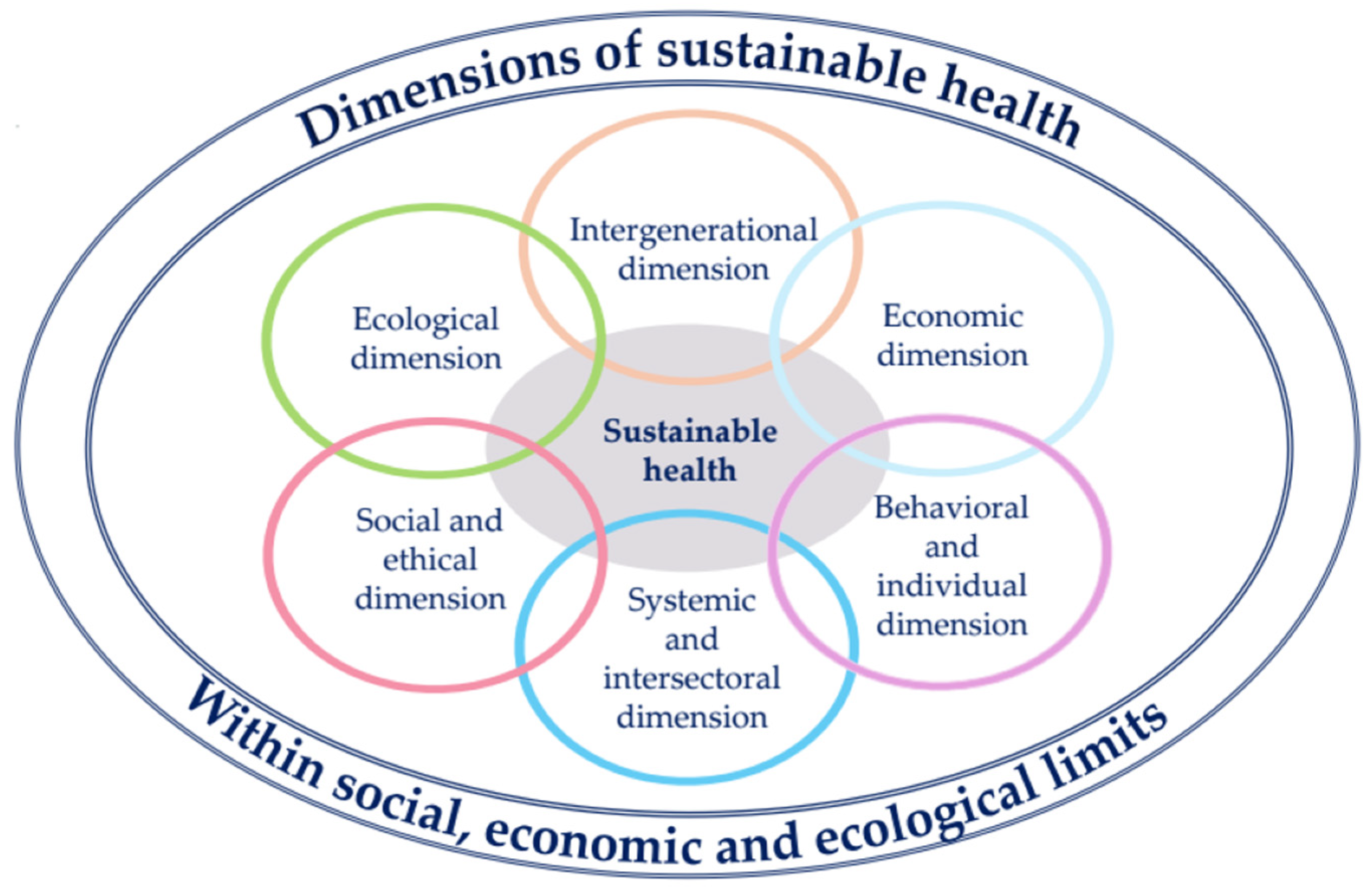
The concept of sustainable health, as it has been solidified over recent decades, is founded on an integrative vision of health that transcends traditional biomedical approaches, encompassing a series of interconnected dimensions. These dimensions reflect the ambition to conceive of health as a state of complete physical, mental and social well-being, anchored in healthy and equitable living environments, and supported by individual and collective choices that remain within the carrying capacities of social, economic and ecological systems across generations (see Figure 1).
Figure 1.
Conceptual dimensions of sustainable health (proposed by the authors).
3.3.1. The Ecological Dimension
The ecological dimension of sustainable health is undoubtedly the most structuring and pressing in the context of current environmental upheavals [2]. It rests on the idea that human health is closely tied to the quality of ecosystems and that environmental degradation, loss of biodiversity, air and water pollution, and climate change directly compromise human living conditions. King emphasizes that sustainability implies “the maintenance of the capacity of the ecosystem to support life in quantity and variety” [11], that is, to sustain both the number of living beings and the diversity of species through the provision of life-support functions and environmental goods such as water, food and other natural resources, thus placing planetary boundaries at the heart of health issues. This perspective is widely reflected in contemporary frameworks, such as the Doughnut model developed by Kate Raworth, which combines the issues of environmental integrity and social justice [28] or the model adopted by the Center of Excellence for Sustainable Health, which advocates an integrated approach to health and the environment and develops practical tools to accelerate the transition to sustainable health, in collaboration with academic, government, and civil society partners [29].
3.3.2. The Social and Ethical Dimension
Sustainable health is also contingent on fundamental principles of equity, social justice, and inclusion. It requires reducing social inequalities in health, recognizing marginalized groups, and addressing the needs of the most vulnerable populations. Burton-Jeangros and Gagnon point out that sustainable health should be a collective endeavor, mobilizing the entire population, not only to ensure equitable access to care and resources, but also to transform living environments [21]. Citizen engagement and shared responsibility are central to this dimension, which is also grounded in an intergenerational ethic, as advocated by King [11] and Byk [20]. From this perspective it is morally imperative to act today in order to safeguard the health of future generations. These participatory and socially responsible approaches also involve conducting research in collaboration with citizens and communities to strengthen collective empowerment.
From an ethical standpoint, this dimension raises issues of justice and responsibility: decisions about resource allocation, priority setting and environmental protection directly affect the most vulnerable populations and must be guided by principles of equity, solidarity and non-maleficence, including in crisis and humanitarian contexts.
3.3.3. The Economic Dimension
The economic aspect of sustainable health extends beyond healthcare costs. It encompasses the economic determinants of well-being (income, employment, economic security), the efficiency of healthcare systems, and the need to invest in prevention and healthcare infrastructure in a sustainable manner. According to Ritmak et al., this dimension includes indicators such as employment, poverty reduction, household debt, and local economic growth [30]. Byk also emphasizes the need to integrate costs and accessibility into strategic thinking about health services [20]. This involves not only ensuring the financial sustainability of systems but also promoting economic development that is consistent with health and sustainability goals.
3.3.4. The Behavioral and Individual Dimension
Sustainable health also involves individual health-related behaviors and lifestyles, understood here as everyday choices and habits (e.g., diet, physical activity, transportation) that affect both personal and collective health. For King, a healthy life cannot be separated from a sustainable lifestyle: reducing overconsumption, adopting an environmentally friendly diet, using public or active transportation, and limiting waste [11]. This perspective prompts reflection on individual responsibility in maintaining collective health, while highlighting the structural conditions necessary to enable such choices. Laprise points out that such behaviors can only be expected in favorable living contexts, placing lifestyle habits within a broader social and environmental ecosystem [18]. In Canada, the Research Chair in Sustainable Health focuses on promoting healthy lifestyles and supportive environments by integrating individual, community, and structural interventions [31].
3.3.5. The Intergenerational Dimension
Concern for the future is a central tenet of the concept of sustainable health. It involves ensuring the health of current populations as well as future generations. This dimension, initially outlined in the Brundtland Report [10] and further elaborated by King [11], underscores the notion that decisions made today, regardless of their context—be it environmental, economic, or health policy—will inevitably carry consequences for human health in the long term. This perspective calls for preventive, prudent, and equitable governance that systematically considers the long-term health impacts of today’s choices as part of an explicit ethic of intergenerational responsibility.
3.3.6. The Systemic and Intersectoral Dimension
Finally, sustainable health cannot be conceived without a cross-cutting approach, mobilizing several sectors: health, urban planning, environment, economy, education, transportation, and agriculture. These sectors are interconnected in the production of health and must be coordinated. This systemic dimension is central to contemporary approaches such as One Health, Planetary Health, and the model developed by the CISD. It involves integrated public policies, interprofessional collaboration, co-construction of solutions with the population, and a capacity for innovation and adaptation, which in turn presuppose political will, transparent governance and accountability mechanisms that prioritize health equity and environmental sustainability. As Wanyenze et al. point out, sustainable health relies on equitable partnerships, agile governance structures, and an interdisciplinary vision [29]. It is essential to foster collaboration among the scientific community, clinical teams, managers, and the population around intersectoral projects aimed at transforming health systems and living environments with a view to sustainable health [31].
4. Discussion
This review aimed to clarify and structure the concept of sustainable health. To this end, it examined the concept’s origins, applications, and connections with related frameworks, with the ultimate goal of proposing a conceptual foundation to guide research, public policy, and action in the field of health. Drawing on scientific and gray literature, the review shows that sustainable health is gradually emerging as a way to reconsider health in relation to ecological, social, economic, and intergenerational issues. It is not simply an extension of the traditional definition of health or a sector-specific version of sustainable development. The results highlight the unique position of sustainable health within the existing rich conceptual landscape, which includes Planetary Health, One Health, and EcoHealth. The results also demonstrate the potential to characterize this concept through a set of interdependent dimensions that clarify its scope without diminishing its ambition.
Taken together, the results suggest that the main contribution of sustainable health is not to introduce another concept to an ever-expanding vocabulary, but rather to provide an integrative conceptual approach to health in a world characterized by significant change [7]. Sustainable health emerges as a framework that considers several dimensions together, which are often treated separately: the health and well-being of individuals and communities; the sustainability of living environments; the organization and footprint of health systems; social inequalities; and the impact of current decisions on future generations. This integrative reading is consistent with broader One Health perspectives in the context of climate change [2]. In this sense, the concept shifts the center of gravity of public health from a logic primarily focused on specific problems, individual behaviors, and short-term horizons to a consideration of health trajectories involving living environments in a long-term vision.
Articulating sustainable health alongside related concepts reinforces this interpretation. While Planetary Health emphasizes planetary boundaries and global interdependencies between human and natural systems, One Health and EcoHealth prioritize socio-ecological dynamics and intersectoral approaches at the local level [2]. Work on the sustainability of health systems focuses on organizational and community transformation and their use of resources. Recent umbrella systematic review on One Health–sustainability intersections also highlights sustainability as a multidimensional and multisectoral construct, emphasizing equity, systems thinking and long-term viability across human, animal and ecosystem health [8]. Sustainable health, however, offers a perspective that encompasses both the definition of health and the eco-social conditions that enable it, echoing earlier socio-ecological models of health [32]. Therefore, it can be considered a coherent framework for linking initiatives that would otherwise remain separate, such as programs to reduce the carbon footprint of institutions, health-promoting urban policies, lifestyle interventions, strategies to combat inequalities, and intersectoral governance mechanisms.
Structuring the concept around ecological, social, ethical, economic, behavioral, individual, intergenerational, systemic, and intersectoral dimensions also requires a more analytical approach, building on earlier socio-ecological understandings of health [32]. This set of dimensions is intended to demonstrate that sustainable health cannot be confined to a single area; it is not merely an environmental policy applied to health, an expanded social policy, or a healthcare system reform. Rather, it highlights the need for consistency between these dimensions within a constrained context, in line with socio-ecological understandings of health that recognize the dependence of human health on broader environmental conditions [32], where improving health sustainably cannot be achieved at the expense of ecosystem degradation. Likewise, the environmental footprint of healthcare systems cannot be reduced by exacerbating inequalities or compromising the quality of care. In this sense, the various dimensions act as safeguards. forcing us to problematize trade-offs and spell out compromises rather than obscuring them. They also bring to the forefront ethical and political questions about who bears responsibility for acting, how trade-offs are negotiated, and whose interests are prioritized when decisions affect both present and future populations.
Finally, the emphasis placed on the intergenerational dimension lends particular significance to sustainable health in terms of governance. By extending health and development decisions beyond the current generation, this concept challenges traditional planning approaches that often focus on short-term political or budgetary cycles. It invites us to question how health policies, infrastructure choices, production and consumption models, and land use patterns affect not only current health, but also future health. This long-term focus makes sustainable health a potential tool for reconsidering issues of responsibility, precaution, and intergenerational justice in the health sector. In the Canadian context, this orientation is consistent with recent public health developments, notably the 2025 Chief Public Health Officer’s report, which also calls for rethinking public health priorities by addressing structural and environmental determinants and promoting intersectoral collaboration to improve well-being and health equity [33].
4.1. Strengths
This review has several strengths that reinforce the credibility of its interpretations. Firstly, it deliberately adopts a narrative and conceptual approach to address an unstable and interdisciplinary concept. This approach brings together contributions from different fields, establishes a dialog between different types of texts (e.g., scientific articles, reports and institutional frameworks), and identifies key themes that would not be apparent in a systematic review focused exclusively on empirical studies. This methodological flexibility is particularly relevant in a field where the boundaries between research, public action, and institutional discourse are permeable, and where the concept of sustainable health is constructed in academic and political arenas.
A second strength lies in the ability of this review to provide an integrated reading of a fragmented conceptual landscape. By clarifying the links between sustainable health, Planetary Health, One Health, EcoHealth, and the sustainability of health systems, the text highlights continuities and differences that are rarely discussed systematically. This perspective avoids the tendency to both oppose and conflate frameworks, offering researchers and practitioners a reference point in a field undergoing reconfiguration.
A third strength is the ambition to move beyond simple terminological clarification and propose constitutive dimensions. By identifying the ecological, social, economic, behavioral, intergenerational and systemic components of sustainable health, the review establishes a foundation for developing conceptual models, analytical tools, and evaluation frameworks that can be tested and refined in future studies.
This contribution is particularly important given that many texts call for “greening” health systems or integrating health into sustainability agendas without explaining what this means in concrete terms, such as criteria, indicators and structural transformations.
4.2. Limitations
However, these findings must be interpreted in light of several limitations. Methodologically, the review is based on a corpus whose composition depends on the databases consulted, the keywords selected, and the languages of publication. Certain schools of thought, particularly those from disciplines that are less represented in biomedical databases or from regions underrepresented in international literature, may not have been adequately included. Furthermore, the variety of formats (e.g., articles, reports, and position papers) prevents a systematic comparison of the uses and effects of the concept of sustainable health, thereby limiting the scope of conclusions that can be drawn at an empirical level.
Conceptually, sustainable health remains a developing and highly normative concept. Much of the literature identifies desirable principles, such as integrating ecological and social dimensions, reducing inequalities, co-constructing with communities, and taking responsibility towards future generations, rather than presenting fully developed and evaluated models. This situation poses a twofold risk. Firstly, there is a risk of discursive inflation, whereby “sustainable” becomes an omnipresent but ineffective qualifier applied to a wide variety of initiatives without explicit criteria. Secondly, the ideal may become so demanding that few concrete policies or programs could truly claim to be sustainable health. While this review does not claim to resolve these tensions, it highlights their existence and suggests that further work is needed to clarify the conditions for using the concept of sustainable health and prevent it from becoming meaningless.
4.3. Prospects for Future Research
The results of this review open several avenues for future research. The first concerns studying how different stakeholders adopt the concept of sustainable health. Qualitative and comparative studies could shed light on how decision-makers, professionals, researchers, community organizations, and citizens adopt, interpret, or challenge the concept in their respective contexts and the influence these appropriations have on the design of policies, interventions, and governance mechanisms. This would allow us to distinguish between rhetorical uses of sustainable health and those accompanied by substantial changes in priorities, decision-making processes, and resource allocation.
A second avenue of research involves developing and testing analytical frameworks and evaluation tools based on the highlighted dimensions. This would involve designing mechanisms to document the effects of policies and interventions on population health, social inequalities, environmental footprint and long-term economic sustainability in an integrated manner, while considering relevant time horizons and scales. Rather than reducing complexity to a single indicator, these tools should provide a basis for discussion and decision-making that highlights the trade-offs and synergies between dimensions.
A third area concerns implementing action research programs and territorial experiments explicitly inspired by sustainable health. Intersectoral projects co-constructed with communities and involving sectors such as health, urban planning, the environment, housing, transportation, and food could serve as laboratories to test the concept’s ability to guide concrete transformations in living environments and systems.
Systematically evaluating their results and processes would provide an opportunity to compare the conceptual framework with the realities of implementation, identify the conditions for success and the obstacles, and revise the proposed dimensions and relationships accordingly. Through this ongoing dialog between theoretical development and empirical experimentation, the concept of sustainable health can gradually evolve from a normative ideal to an operational framework for thinking about and organizing health in a changing world.
5. Conclusions
Sustainable health has emerged as a central concept in the transformation of healthcare systems, public policies, and lifestyles. By integrating ecological, social, ethical, economic, behavioral, intergenerational, and systemic dimensions, it offers a conceptual basis for analysis and action commensurate with contemporary challenges. This approach necessitates a rethinking of public health priorities, incorporating structural and environmental determinants, reinforcing the ethical imperative to protect the most vulnerable, and acknowledging our collective responsibility towards future generations through appropriate governance and public policy choices.
By clarifying the origins, definitions, and related concepts of sustainable health, as well as identifying its fundamental dimensions, this synthesis helps lay the foundations for a renewed, more resilient, equitable, and sustainable public health system. It also paves the way for future research on the modalities for operationalizing the concept, its indicators, and the levers for its implementation in different local and global contexts.
There is still considerable work to be done. First, the concept of sustainable health requires further clarification and exploration. Second, it calls for the establishment of a broad research program based on interdisciplinary collaboration. Finally, it also calls for the mobilization of various local stakeholders and promotes intersectoral collaboration (e.g., health, transportation, housing) around projects that transform living environments and lifestyles.
Supplementary Materials
The following supporting information can be downloaded at: https://www.mdpi.com/article/10.3390/su18073586/s1, Table S1. Characteristics of included references.
Author Contributions
S.A., J.-A.M. and É.G. contributed to the conception and design of the review; S.A. developed the search strategy; S.A. and J.-A.M. contributed to the screening of papers; and S.A. synthesized the results and wrote the first draft of the review. All authors have read and agreed to the published version of the manuscript.
Funding
This project did not receive any funding.
Institutional Review Board Statement
Not applicable.
Informed Consent Statement
Not applicable.
Data Availability Statement
No new data were created or analyzed in this study.
Conflicts of Interest
The authors declare no competing interests.
Abbreviations
The following abbreviations are used in this manuscript:
| CISD | Centre intersectoriel en santé durable |
| WHO | World Health Organization |
References
- Abbasi, K.; Ali, P.; Barbour, V.; Benfield, T.; Bibbins-Domingo, K.; Hancocks, S.; Horton, R.; Laybourn-Langton, L.; Mash, R.; Sahni, P.; et al. Time to Treat the Climate and Nature Crisis as One Indivisible Global Health Emergency. J. Am. Med. Assoc. 2023, 330, 1958–1960. [Google Scholar] [CrossRef] [Scilit]
- Black, P.F.; Butler, C.D. One Health in a world with climate change. Rev. Sci. Tech. 2014, 33, 465–473. [Google Scholar] [CrossRef] [Scilit]
- Kittipittayakorn, C. Association between healthcare resources, healthcare systems, and population health in European countries. BMC Health Serv. Res. 2025, 25, 720. [Google Scholar] [CrossRef] [Scilit]
- Dopelt, K. Health Disparities: The Emerging Trends and Pressing Challenges. Eur. J. Investig. Health Psychol. Educ. 2025, 15, 7. [Google Scholar]
- Lim, W.S.; Wong, S.F.; Leong, I.; Choo, P.; Pang, W.S. Forging a Frailty-Ready Healthcare System to Meet Population Ageing. Int. J. Environ. Res. Public Health 2017, 14, 1448. [Google Scholar] [CrossRef] [Scilit]
- Sul, S.I.R.; Nogueira, P.J.S.; Costa, A. Reframing Sustainable and Planetary Health Through the Fundamentals of Care: A Conceptual Nursing Perspective. Nurs. Inq. 2026, 33, e70095. [Google Scholar] [CrossRef] [Scilit]
- Malqvist, M.; Powell, N. Health, sustainability and transformation: A new narrative for global health. BMJ Global Health 2022, 7, e010969. [Google Scholar] [CrossRef] [Scilit] [PubMed]
- Dar, O.A.; Akhbari, M.; Akhbari, A.; Zahid, H.; Claron, M.; Spicer, N.; Nacer, H.; Khan, M. One health–sustainability intersections: An umbrella systematic review with a new integrated definition of sustainability and a meta-conceptual framework. One Health Outlook 2025, 8, 2. [Google Scholar] [CrossRef] [Scilit] [PubMed]
- World Health Organization. Preamble to the constitution of the World Health Organization. In Official Records of the World Health Organization; World Health Organization: New York, NY, USA, 1946; Volume 2, p. 100. [Google Scholar]
- Brundtland, G.H. Our Common Future: Report of the World Commission on Environment and Development; UN-Dokument A/42/427; United Nations: Geneva, Switzerland, 1987. [Google Scholar]
- King, M. Health is a sustainable state. Lancet 1990, 336, 664–667. [Google Scholar] [CrossRef] [Scilit]
- Molyneux, M.E. Sustainable Health. Trop. Dr. 1991, 21, 2. [Google Scholar] [CrossRef] [Scilit] [PubMed]
- United Nations. Rio Declaration on Environment and Development. In The Report of the United Nations Conference on Environment and Development; UN Doc. A/CONF.151/26; United Nations: Rio de Janeiro, Brazil, 1992; Volume 1. [Google Scholar]
- United Nations. Report of the World Summit on Sustainable Development; UN Doc. A/CONF.199/20; United Nations: Johannesburg, South Africa, 2002; Volume 26, p. 9. [Google Scholar]
- United Nations. Kyoto Protocol to the United Nations Framework Convention on Climate Change; UN Doc. FCCC/CP/1997/7/Add.1; United Nations: Kyoto, Japan, 1998. [Google Scholar]
- United Nations. The Paris Agreement to the United Nations Framework Convention on Climate Change; UN Doc. FCCC/CP/2015/10/Add.1; United Nations: Paris, France, 2015. [Google Scholar]
- Yang, A.; Farmer, P.E.; McGahan, A.M. ‘Sustainability’in global health. Glob. Public Health 2010, 5, 129–135. [Google Scholar] [CrossRef] [Scilit]
- Laprise, C. It’s time to take a sustainable approach to health care in the face of the challenges of the 21st century. One Health 2023, 16, 100510. [Google Scholar] [CrossRef] [Scilit]
- Chardon, D. La Santé Durable: Une orientation incontournable pour l’avenir de la santé. Hegel 2017, 1, 67–69. [Google Scholar] [CrossRef] [Scilit]
- Byk, C. Chapitre 5. L’épigénétique: De la santé durable aux droits fondamentaux durables. J. Int. Bioéthique d’Éthique Sci. 2021, 32, 59–67. [Google Scholar] [CrossRef] [Scilit]
- Burton-Jeangros, C.; Gagnon, É. La santé durable: Changer notre perspective. Rev. Med. Suisse 2024, 20, 1632. [Google Scholar] [CrossRef] [Scilit] [PubMed]
- Heuckmann, B.; Zeyer, A. Science|environment|health, one health, planetary health, sustainability, and education for sustainable development: How do they connect in health teaching? Sustainability 2022, 14, 12447. [Google Scholar] [CrossRef] [Scilit]
- Whitmee, S.; Haines, A.; Beyrer, C.; Boltz, F.; Capon, A.G.; de Souza Dias, B.F.; Ezeh, A.; Frumkin, H.; Gong, P.; Head, P.; et al. Safeguarding human health in the Anthropocene epoch: Report of The Rockefeller Foundation–Lancet Commission on planetary health. Lancet 2015, 386, 1973–2028. [Google Scholar] [CrossRef] [Scilit] [PubMed]
- de Castañeda, R.; Villers, J.; Guzmán, C.A.F.; Eslanloo, T.; de Paula, N.; Machalaba, C.; Zinsstag, J.; Utzinger, J.; Flahault, A.; Bolon, I. One Health and planetary health research: Leveraging differences to grow together. Lancet Planet. Health 2023, 7, e109–e111. [Google Scholar] [CrossRef] [Scilit]
- Talukder, B.; Ganguli, N.; Choi, E.; Tofighi, M.; vanloon, G.W.; Orbinski, J. Exploring the nexus: Comparing and aligning Planetary Health, One Health, and EcoHealth. Glob. Transit. 2024, 6, 66–75. [Google Scholar] [CrossRef] [Scilit]
- Mori, C.; Todaka, E. Establishment of sustainable health science for future generations: From a hundred years ago to a hundred years in the future. Environ. Health Prev. Med. 2009, 14, 1–6. [Google Scholar] [CrossRef] [Scilit]
- World Health Organization. Environmentally Sustainable Health Systems: A Strategic Document; WHO/EURO:2017-2241-41996-57723; World Health Organization, Regional Office for Europe: Copenhagen, Denmark, 2017. [Google Scholar]
- Raworth, K. Doughnut Economics: Seven Ways to Think Like a 21st Century Economist; Chelsea Green Publishing: White River Junction, VT, USA, 2018. [Google Scholar]
- Wanyenze, R.K.; Alfvén, T.; Ndejjo, R.; Viberg, N.; Båge, K.; Batte, C.; Helldén, D.; Lindgren, H.; Mayega, R.W.; Ndeezi, G.; et al. Sustainable health—A call to action. BMC Glob. Public Health 2023, 1, 3. [Google Scholar] [CrossRef] [Scilit] [PubMed]
- Ritmak, N.; Rattanawong, W.; Vongmanee, V. A new dimension of health sustainability model after pandemic crisis using structural equation model. Sustainability 2023, 15, 1616. [Google Scholar] [CrossRef] [Scilit]
- Després, J. La Révolution Active: De la Gestion de la Maladie à la Promotion de la Santé; Les Éditions du Journal: Montréal, QC, Canada, 2023. [Google Scholar]
- Hancock, T. The mandala of health: A model of the human ecosystem. Fam. Community Health 1985, 8, 1–10. [Google Scholar] [CrossRef] [Scilit] [PubMed]
- Public Health Agency of Canada. Chief Public Health Officer of Canada’s Report on the State of Public Health in Canada 2025: Working Together to Thrive: Well-Being and Public Health; Public Health Agency of Canada: Ottawa, ON, Canada, 2025. [Google Scholar]
Disclaimer/Publisher’s Note: The statements, opinions and data contained in all publications are solely those of the individual author(s) and contributor(s) and not of MDPI and/or the editor(s). MDPI and/or the editor(s) disclaim responsibility for any injury to people or property resulting from any ideas, methods, instructions or products referred to in the content. |
© 2026 by the authors. Licensee MDPI, Basel, Switzerland. This article is an open access article distributed under the terms and conditions of the Creative Commons Attribution (CC BY) license.