Article

CGWT-DETR: Context-Guided Wavelet Transform DETR for Small Object Detection in Aerial RGB and Thermal Infrared Imagery

1
School of Computer Science and Artificial Intelligence, Zhengzhou University, Zhengzhou 450001, China
2
School of Electrical and Information Engineering, Zhengzhou University, Zhengzhou 450001, China
3
Engineering Research Center of Intelligent Swarm Systems, Ministry of Education, Zhengzhou 450001, China
4
National Supercomputing Center in Zhengzhou, Zhengzhou 450001, China
5
School of Computer Science and Technology, Xinjiang University, Urumqi 830017, China
6
School of Computer and Communication Engineering, University of Science and Technology Beijing, Beijing 100083, China
7
Department of Electronic Engineering, Tsinghua University, Beijing 100084, China
*
Author to whom correspondence should be addressed.
Remote Sens. 2026, 18(16), 2715; https://doi.org/10.3390/rs18162715
Submission received: 22 May 2026 / Revised: 3 July 2026 / Accepted: 7 July 2026 / Published: 12 August 2026
(This article belongs to the Special Issue Temporal and Spatial Analysis of Multi-Source Remote Sensing Images)

Highlights

What are the main findings?
  • We propose CGWT-DETR, an enhanced RT-DETR framework that improves small object detection in aerial RGB and thermal infrared imagery by integrating Wavelet Transform Fusion (WTF) and Context-Guided Downsampling (CGD) into the efficient hybrid encoder.
  • The WTF preserves both high-frequency structural details and low-frequency semantic information, while CGD effectively retains local, surrounding, and global contextual features during feature downsampling, thereby improving small object representation.
What are the implications of the main findings?
  • The architecture reduces the computational complexity, making CGWT-DETR suitable for real-time deployment on resource-constrained UAV and embedded vision platforms.

Abstract

Small object detection (SOD) is a crucial research area in the field of computer vision. It poses significant challenges due to variations in scale, dense objects, limited target resolution, and a complex background. To achieve real-time detection, existing methods typically focus on local feature extraction and employ downsampling to reduce computation. However, this approach lowers the feature map resolution and loses the fine-grained details during downsampling. Meanwhile, frequency, global, and surrounding information play a significant role in small object detection. To address multi-scale dense targets in RGB and thermal infrared imagery with limited spatial, contextual, and frequency information, we propose a novel architecture that leverages Wavelet Transform Fusion (WTF) and Context-Guided Downsampling (CGD) in the real-time detection transformer (RT-DETR) for small object detection. WTF performs multi-frequency feature decomposition and fusion to preserve both high-frequency details and low-frequency semantic information, thereby improving the representation of small targets while reducing computational complexity. CGD incorporates local, surrounding, and global contextual information during downsampling to mitigate spatial information loss and strengthen feature representation for precise object localization. CGD is a downsampling technique that efficiently captures and preserves the contextual spatial information of local and global features using a local feature extractor and a joint feature extractor. It takes into account the surrounding information of the object, thereby reducing the loss of spatial details during downsampling. This spatial information helps in the precise detection of small objects in RGB and thermal infrared aerial images. Our proposed model is evaluated independently on the RGB aerial dataset NWPU-VHR-10 and the thermal infrared dataset HIT-UAV. Evaluations on the NWPU-VHR-10 and HIT-UAV datasets demonstrate that CGWT-DETR improves the mAP@0.50 to 89.9% and 86.5%, respectively, while boosting the strict localization metric mAP@0.50:0.95 to 60.3% and 58.8%. Furthermore, these accuracy gains are achieved alongside a 14.29% reduction in model parameters and a 29.8% decrease in GFLOPs. Experimental results demonstrate that CGWT-DETR outperforms the RT-DETR baseline in both detection accuracy and computational efficiency.

1. Introduction

Small object detection (SOD) is a fundamental yet challenging task in computer vision and plays a critical role in numerous real-world applications, including unmanned aerial vehicles (UAVs), defense surveillance, agriculture, urban planning, environmental monitoring, transportation systems, and industrial inspection [1,2]. The convolutional neural network (CNN)-based models have become the dominant approach for object detection. It consists of one-stage models, such as the YOLO series models [3,4,5,6,7,8] and SSD [9], two-stage detectors, such as Fast R-CNN [10] and Faster R-CNN [11], and end-to-end transformer-based models, such as DETR [12] and RT-DETR [13]. Among these, the most widely used models are the YOLO series, but recently, transformer-based models like RT-DETR are changing this landscape. Transformer-based detectors, such as DETR [12] and Deformable-DETR [14], offer strong performance on natural scene images but are generally unsuitable for real-time deployment due to high computational demands and slow convergence.
The standard benchmark datasets, such as MS-COCO [15] and ImageNet [16], are captured from ground-level perspectives. While aerial datasets such as VisDrone [17], NWPU-VHR-10 [18], DOTA [19], and HIT-UAV [20] are captured from a top-down view. Although aerial platforms provide a large coverage area at relatively low operational cost, they introduce several challenges for object detection. Objects are typically much smaller, exhibit significant scale variation, and arbitrary orientations. They are often affected by cluttered backgrounds, occlusion, illumination variation, and adverse environmental conditions. These characteristics substantially reduce the availability of discriminative visual information and make accurate small object detection considerably more difficult [21,22,23,24,25]. To mitigate the above complexities of detection, YOLO models [3,4,5,6,7,8] have been applied to aerial datasets for small object detection by using the FPN [26] and transformer-based approaches to improve efficiency and focus on global features, such as TPH-YOLOV5 [21], which applied the transformer prediction head and an attention mechanism. Patel et al. [27] improved spatial feature extraction using transformers to understand global context for SOD. STF-YOLO [28] leveraged the Swin Transformer alongside CNNs to improve feature extraction and localization accuracy. PVswin-YOLOv8s [29] integrated the Swin Transformer for global feature extraction, CBAM for enhanced feature flow, and Soft-NMS for improved occlusion handling. SF-YOLOv9 [30] enhances YOLOv9c by improving the backbone through the integration of a novel PGI-Aware Swin Fusion Block (Transformer-GELAN) and Dual-Path Spatial and Channel Attention Module (DSCAM) into the main detection head and the reversible auxiliary branches of the head of PGI for small object detection. Recently, attention has shifted toward real-time transformer-based detectors from one-stage models with the invention of RT-DETR [13]. Lv and Wang et al. [31,32] introduced variants of RT-DETR, which outperformed the YOLO series in real-time detection on natural scene datasets.
RT-DETR is developed as an end-to-end transformer-based detector, which has gained significant attention in academic research due to its streamlined architecture and the elimination of handcrafted components. It is developed to achieve better performance in terms of inference speed and accuracy, which was previously limited in transformer-based models due to the high computational costs. RT-DETR leverages the power of end-to-end transformer architectures to eliminate the reliance on non-maximum suppression (NMS) and streamline the detection pipeline. Its efficient hybrid encoder enables fast multi-scale processing, which is ideal for capturing fine details for objects. Therefore, RT-DETR provides an ideal baseline to address the challenges of small object detection. It simultaneously focuses on global and local information, unlike traditional convolutional neural networks (CNNs). Additionally, the model supports flexible speed tuning and scalability, making it highly adaptable for diverse real-time scenarios.
On the foundation of RT-DETR, several RT-DETR variants have emerged for aerial-based SOD, such as UAV-DETR [33], which enhances multi-scale feature fusion and rethinks downsampling strategies to preserve fine details of small targets. Muzammil et al. [34] integrate the slicing aided hyper inference (SAHI) technique into RT-DETR to improve the detection of small objects through localized inference. Zheng et al. [35] redesign the backbone for better multi-resolution representation and introduce an Omni Kernel Module to fuse features across scales, coupled with a W-ShapeIoU loss for more precise bounding box regression. DCM-DETR [36] incorporates a dynamic convolution fusion module alongside frequency-spatial attention to capture both spectral and spatial information. ESO-DETR [37] focuses on strengthening the local feature extraction and adopts an enhanced multi-scale multi-head self-attention mechanism to improve contextual relationships. EMSD-DETR [38] increases network depth with additional convolutional layers and introduces Focaler-Shape-IoU to address localization bias in dense scenes. RTS-DETR [39] improves the scale handling problem through intra-scale interaction and multi-scale fusion, optimized with an NWD-IoU loss that is more robust to object scale disparity. RT-DETR-UAVs [40] redesign the feature fusion pipeline using bi-level routing attention to dynamically allocate computational resources based on object complexity. Finally, Drone-DETR [23] proposes a dual-path feature fusion strategy in the neck and adds an auxiliary P2 detection head to boost sensitivity to very small objects in early feature maps.
Consequently, these RT-DETR variants have achieved promising performance improvements through dataset-specific augmentations, alternative backbones, diverse feature fusion redesign, attention enhancement, additional heads, modified loss functions, and different downsampling. Despite recent progress, existing approaches frequently rely on aggressive downsampling and attention-based feature extraction to improve efficiency. While effective for reducing computational cost, these operations often suppress high-frequency details, such as object boundaries, textures, and edge information, which are essential for small object detection. At the same time, the reduction in feature map resolution may weaken local and surrounding contextual information that assists in distinguishing targets from complex backgrounds. Therefore, preserving both frequency-domain representations and contextual information in a real-time transformer detector is critical for improving small object detection performance in aerial imagery.
To address these challenges, we propose Context-Guided Wavelet Transform DETR (CGWT-DETR) for small object detection in aerial RGB and thermal infrared imagery. Our approach introduces two complementary modules: Wavelet Transform Fusion (WTF) and Context-Guided Downsampling (CGD) in RT-DETR. Our Wavelet Transform Fusion (WTF) module balances low and high-frequency information with contextual guidance by decomposing features into high-frequency and low-frequency components to preserve fine-grained details and semantic information simultaneously. High-frequency components contain object boundaries, textures, and local contrast information that are essential for small targets, whereas low-frequency components provide global semantic and contextual information. In addition, Context-Guided Downsampling (CGD) mitigates spatial information loss during downsampling by jointly modeling local, surrounding, and global contextual representations through a local feature extractor and a joint feature extractor. Through this, our approach empowers the network to capture both fine and coarse details and integrates advanced feature representation mechanisms to enhance detection accuracy and reduce computational complexity simultaneously. Experimental results on RGB and thermal infrared datasets NWPU-VHR-10 and HIT-UAV validate the effectiveness of our approach independently. It achieves a mAP@0.50 of 0.899 and 0.865. Meanwhile, a more strict localization metric, mAP@0.50:0.95, achieved 0.603 and 0.588, respectively, over the baseline RT-DETR. These gains are achieved with improved computational efficiency: the number of parameters is reduced from 42 M to 36 M, and GFLOPs from 130.5 M to 92 M, highlighting the lightweight and scalable nature of our design. The primary contributions of this study are summarized as follows:
  • We introduced a Wavelet Transform Fusion (WTF) module for RT-DETR that explicitly decomposes feature representations into low-frequency semantic information and high-frequency detail information. Through adaptive frequency fusion, WTF preserves object boundaries, textures, and fine-grained details while maintaining global semantic awareness, thereby improving feature discriminability for small object detection in aerial imagery.
  • We introduce a lightweight Context-Guided Downsampling (CGD) module to mitigate the loss of spatial and contextual information during feature downsampling. By jointly modeling local, surrounding, and global contextual representations through local and joint feature extractors, CGD preserves critical spatial details and enhances the localization capability of small objects under complex backgrounds.
The remainder of this paper is organized as follows. Section 2 reviews the related literature. Section 3 presents the proposed CGWT-DETR architecture and its key components. Section 4 describes the datasets, implementation details, and experimental settings. Section 5 reports the experimental results and ablation studies. Section 6 discusses the findings, limitations, and future research directions. Finally, Section 7 concludes this paper.

2. Related Work

2.1. Real-Time Transformer in Object Detection

Following the success of the transformer models in language applications, transformer-based models have gradually attracted researchers in the field of computer vision. The vision transformer (ViT) [41] is applied to image processing by decomposing the image into multiple patches. The performance of the vision transformer model in image recognition is comparable to state-of-the-art CNN-based models. Building on this foundation, DETR [12] emerged as a groundbreaking attempt to directly integrate a transformer into object detection, utilizing the CNN backbone for feature extraction to capture the global dependencies. After this, Zhou et al. [13] address the real-time challenges of DETR by introducing RT-DETR, a novel end-to-end object detector that outperforms state-of-the-art YOLO models in accuracy. This advanced detector utilizes an efficient hybrid encoder architecture, effectively managing multi-scale feature processing by decoupling intra-scale interactions and facilitating cross-scale fusion. Additionally, an IoU-aware query selection mechanism was introduced to refine the quality of initial object queries supplied to the decoder. RT-DETR also offers flexible speed tuning by allowing adjustments to decoder layers without the need for retraining, which notably enhances its detection accuracy. Lv et al. [32] improved the flexibility and practicality within the DETR model with variant RT-DETRv2 in real-time detection transformer. It introduced scale-adaptive sampling for selective multi-scale feature extraction and replaced the gridsample operator with an optional discrete sampling operator to ease deployment constraints. The training strategy is also optimized with dynamic data augmentation and scale-adaptive hyperparameters to enhance performance without compromising speed. Wang et al. [31] improved RT-DETRv2 with an updated variant, RT-DETRv3, by adopting the hierarchical dense positive supervision method. This model introduces a CNN-based auxiliary branch that enhances encoder feature representation through dense supervision, while a self-attention perturbation strategy improves decoder training by diversifying label assignments. A shared-weight decoder branch also ensures high-quality query matching and refines the detection accuracy. All these variants of improvements are for general objects, and Zhao et al. [13] highlight the limitation of RT-DETR, which is that its performance on scalable objects, such as small objects, is still inferior to that of strong real-time detectors.

2.2. Transformer-Based Object Detection in Aerial Imagery

Object detection in aerial imagery presents unique challenges, especially in identifying small objects and managing occlusion. Small object detection in real-time applications through the vision transformer model is a popular research area. Kong et al. [23] proposed Drone-DETR, a real-time detection transformer model based on RT-DETR, for small object detection. It optimized the model through an effective small object detection network (ESDNet) and multi-scale feature fusion through the enhanced dual-path feature fusion attention module (EDF-FAM). Ren et al. [42] proposed the AF-DETR, which introduces an assemble-and-fusion mechanism and adaptive context broadcasting to enhance feature extraction and contextual modeling for small objects. Zhang et al. [33] strengthen the efficiency of RT-DETR by proposing the UAV-DETR. This detector enhances UAV-OD by leveraging multi-scale feature fusion and frequency-domain information. Wei et al. [43] proposed the DV-DETR, which utilizes ResNet18 for improved feature extraction, recalibration, and deformable attention for multi-scale fusion, as well as Focaler-IoU loss for addressing scale imbalance. Yang et al. [44] proposed the Hybrid-DETR for small object detection, utilizing a hybrid backbone comprising RCSPELAN and HTCF modules for efficient feature extraction. Further, an EIFI module was introduced to enhance small object detection, along with Focaler-Shape-IoU for better bounding box regression. DCM-DETR [36] incorporates a dynamic convolution fusion module alongside frequency-spatial attention to capture both spectral and spatial information critical for small objects. ESO-DETR [37] focuses on strengthening local feature extraction and adopts an enhanced multi-scale multi-head self-attention mechanism to better model contextual relationships. PLViT [45] optimizes decision boundaries of targets by fusing global and local discriminative representations via context-aware patch selection and angular-space optimization. EMSD-DETR [38] increases network depth with additional convolutional layers and introduces Focaler-Shape-IoU to address localization bias in dense scenes. FECI-RTDETR [46] integrates the RFConv-Block, EA-AIFI attention, CHS-FPN fusion, and Inner-GIoU loss to boost small target detection in RT-DETR. GA-DETR [47] proposed the cross-stage gated feature extraction module, a cascaded group attention mechanism, and a composite FMPIoU loss to enhance small target perception and localization in SOD. FP-RTDETR [48] integrated the multi-scale feature fusion (via FFPN and MPAS), for lightweight design (Star_block, AIFI-RepBN), and refined localization with inner-EIoU. PHSI-RTDETR [49] employs a lightweight RPConv-Block backbone, AIFI-HiLo attention module, slimneck fusion with GSConv/VoVGSCSP, and Inner-GIoU loss to boost accuracy. ISTD-DETR [50] incorporates the EDSR-based super-resolution preprocessing to RT-DETR with EMSA with a space model to grasp fine details and long-range context. Further, a dedicated shallow feature layer (S2) and a specialized detection head were applied, and a SPD-EMA module was applied during fusion to preserve critical small-scale information. Nie et al. [51] introduced a CNN-Transformer-based cross-modal feature fusion interaction to detect IR small objects. Wu et al. [52] introduced STASPPNet, which uses the Swin Transformer as a backbone and a multi-scale atrous spatial pyramid pooling network for complex backgrounds, paired with a multi-scale feature detection head. Lee et al. [53] proposed HMAMFU-net, a hybrid encoder–decoder U-Net architecture that integrates convolution-based multi-scale local features and hierarchical multipatch global features with attention mechanisms for accurate infrared small target detection.

2.3. Limitation of RT-DETR for SOD

RT-DETR struggles with small object detection in aerial images because its downsampling process discards crucial spatial details needed to identify small targets. It fails to retain contextual information about objects, making detection unreliable in complex, cluttered scenes, such as dense urban areas or natural landscapes. This is due to not focusing on contextual, spatial, global–local, multi-frequency, surrounding information, and guidance across scale transitions. Despite improvements in DETR variants, this core limitation persists as they often add complexity without fully balancing detail preservation and computational efficiency. Consequently, RT-DETR still underperforms compared to specialized detectors on aerial datasets, where every pixel matters for spotting small objects like vehicles or infrastructure.

3. Methods

3.1. RT-DETR Baseline Model

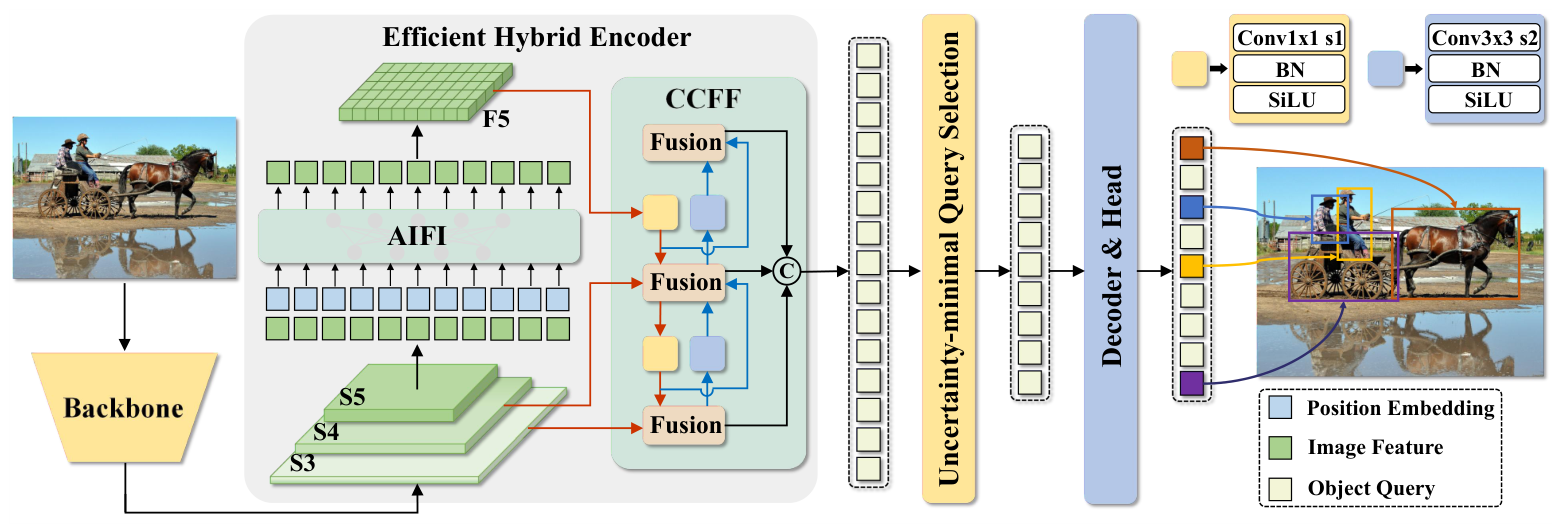
RT-DETR [13] is an innovative real-time end-to-end object detection framework that leverages the transformer architecture to effectively address the challenges of multi-scale feature processing. Its detailed network design is illustrated in Figure 1. The RT-DETR model consists of a ResNet backbone network, an efficient hybrid encoder consisting of Attention-based Intra-scale Feature Interaction (AIFI), CNN-based Cross-scale Feature Fusion (CCFF), and a decoder with an auxiliary prediction head. ResNet implements preliminary feature extraction through the convolutional layer and the BasicBlock module, whose details are fed as input to S3, S4, and S5 in a hybrid encoder, providing rich multi-level information. The AIFI module in the hybrid encoder focuses on processing high-level image features. It uses the self-attention mechanism to interact with the internal scale on the S5 feature map to improve the performance of the model in object detection and recognition. The CCFF module uses the bottom-up and top-down dual-path fusion strategy to effectively integrate the multi-scale features of the S3, S4, and F5 feature maps through upsampling and downsampling. The decoder part comprises the IoU-aware query and the decoder head module, in which the IoU-aware query module outputs the top K prediction boxes based on their classification scores. The IoU-aware query selection can provide more encoder features, resulting in accurate classification (high classification score) and precise location (high IoU score) for object queries, thereby improving the accuracy of the detector. Then, through an iterative optimization process, the decoder gradually generates accurate bounding box predictions and corresponding confidence scores, completing an efficient and precise detection task.

3.2. CGWT-DETR

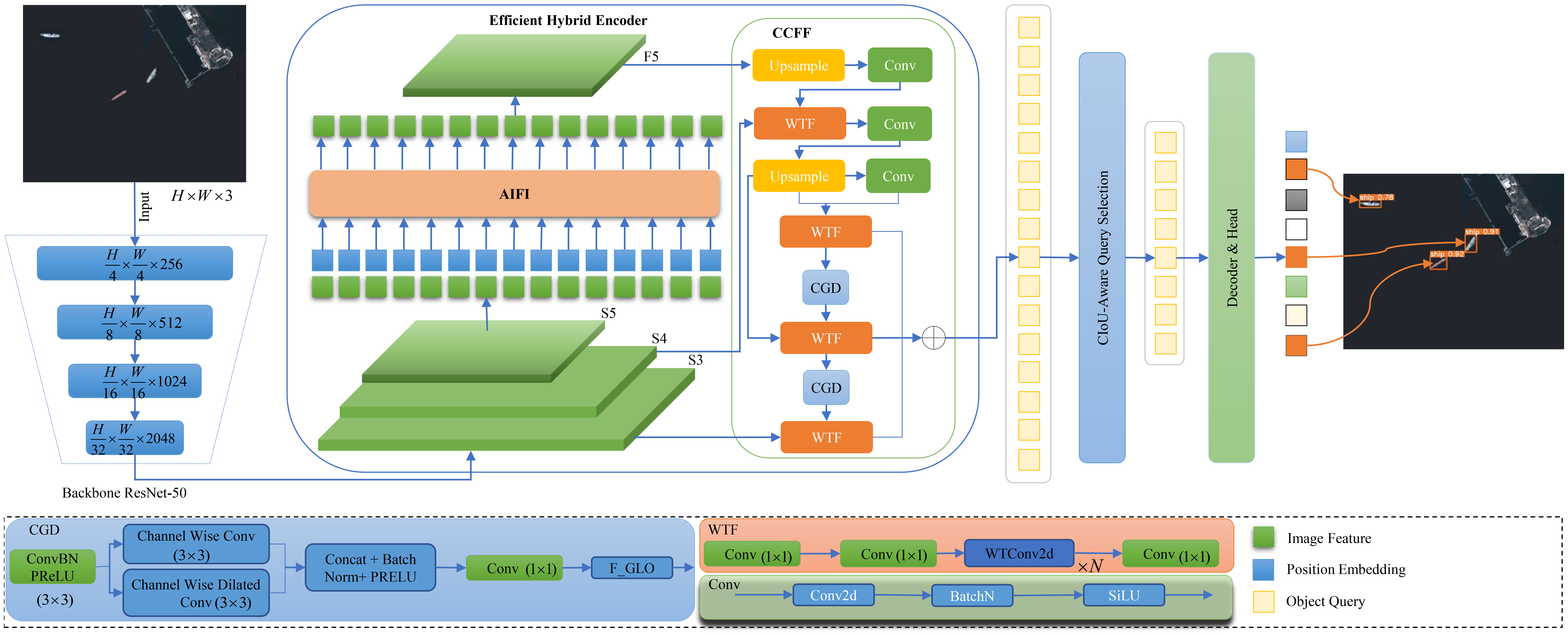
In this study, we propose CGWT-DETR, an enhanced RT-DETR model for small object detection in aerial RGB and thermal infrared imagery, as illustrated in Figure 2. Existing RT-DETR variants primarily focus on attention enhancement, feature fusion redesign, or additional detection heads, whereas CGWT-DETR aims to preserve both frequency-domain and contextual information during feature fusion and downsampling. Small objects in aerial imagery often occupy only a few pixels, making the high-frequency details, spatial context, and surrounding information critical for accurate localization and classification. To address these challenges, two complementary modules are introduced by optimizing the efficient hybrid encoder for modality-specific shared challenges of RGB and thermal infrared independently. We improved the CCFF encoder part by introducing the Wavelet Transform Fusion (WTF) by following wavelet transform convolution [54], to enhance frequency-aware feature representation by preserving both low-frequency semantic information and high-frequency details, such as edges, textures, and object boundaries. It decomposes features into high-frequency and low-frequency components to preserve fine-grained details and semantic information simultaneously. Furthermore, we introduced Context-Guided Downsampling (CGD) to mitigate the loss of spatial and contextual information during feature downsampling. It captures and preserves the spatial information of local and global spatial information using a local feature extractor and a joint feature extractor that takes into account the surrounding information of the object. Through this, the fine details of the local and spatial channels in the CCFF module are enhanced. The backbone initially extracts multi-scale features using ResNet-50, which are then refined through WTF and CGD within the CCFF module to improve small object representation while maintaining computational efficiency.

3.2.1. Wavelet Transform Fusion

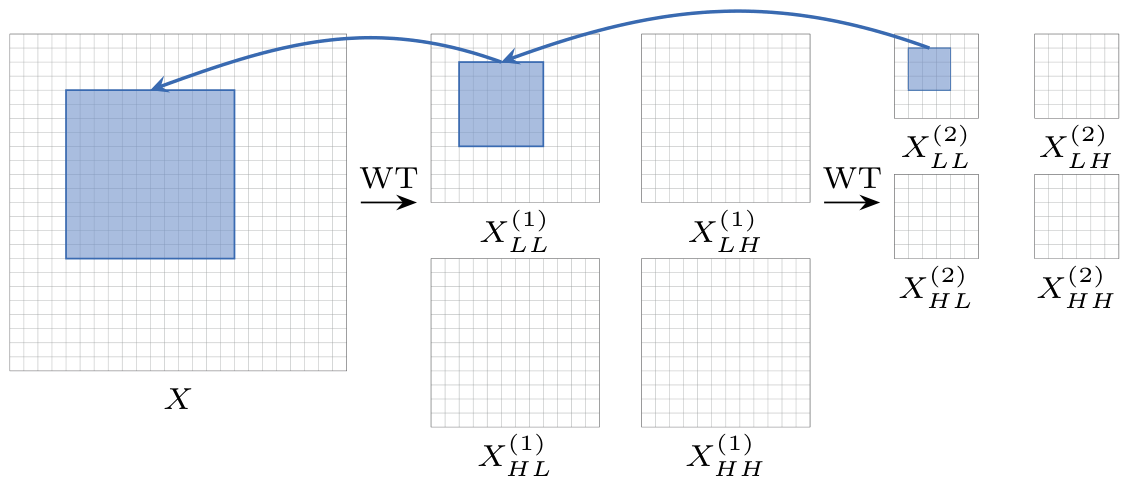
The Wavelet Transform Fusion (WTF) module is introduced by following the wavelet transform convolution (WTConv) [54] and is adapted for frequency-aware feature learning within the RT-DETR architecture as a fusion module. Unlike RT-DETR variants that primarily enhance spatial-domain representations, WTF explicitly introduces frequency-domain modeling to preserve discriminative information that is often weakened during feature aggregation and downsampling. This frequency-aware design enables more effective learning of small object features while maintaining computational efficiency. In WTConv, wavelet transform conventional convolution layers operate with a wavelet transform that gradually loses fine-grained information through repeated downsampling. In WTF, we updated the conventional convolutional layer with a lightweight fusion-based convolutional layer that utilizes the wavelet transform to increase the receptive field of CNNs, thereby achieving a near-global receptive field, as illustrated in Figure 3. It is used as a substitute for deep convolution in CNN architectures to effectively capture low and high-frequency information across different frequency bands, thereby resolving the multi-scale problem associated with small targets. WTF expands the receptive field and multi-frequency response by decomposing the signal into different high and low-frequency components, allowing WTF to capture both low-frequency and high-frequency information. High-frequency components, such as edges, textures, fine details, and contrast differences relative to their surroundings, are more important than low-frequency components, such as global structure and smooth regions. In traditional CNN architectures, repeated downsampling and pooling operations tend to attenuate high-frequency information, making it harder to detect small targets. In contrast, our WTF explicitly preserves and processes different frequency bands separately to target small objects efficiently. In the WTF, the Haar Wavelet Transform was employed as a wavelet type due to its simplicity and computational efficiency. The Haar Wavelet Transform is implemented using depth-wise convolutions followed by downsampling. By inputting the image X, at level one, Haar Wavelet Transform (WT) is applied along with one spatial dimension (width or height) using two convolution kernels: [ 1 , 1 ] / 2 (low-pass filter) and [ 1 , 1 ] / 2 (high-pass filter). These kernels are applied to the image, followed by downsampling by a factor of two, resulting in a depth-wise convolution with a stride of 2 using four filters:
f L L = 1 2 1 1 1 1 , f L H = 1 2 1 1 1 1 , f H L = 1 2 1 1 1 1 , f H H = 1 2 1 1 1 1 .
Here, f L L is the low-pass filter, while f L H , f H L , and f H H are high-pass filters capturing horizontal, vertical, and diagonal details, respectively. The output of this convolution is a set of 4 feature maps:
[ X L L , X L H , X H L , X H H ] = Conv ( [ f L L , f L H , f H L , f H H ] , X ) ,
where, X L L represents the low-frequency component, and X L H , X H L , and X H H represent the high-frequency components. The inverse wavelet transform (IWT) is achieved by applying the transposed convolution:
X = Conv-tran ( [ f L L , f L H , f H L , f H H ] , [ X L L , X L H , X H L , X H H ] ) .
The process begins by applying the wavelet to the input image X, decomposing it into low-frequency ( X L L ) and high-frequency ( X L H , X H L , X H H ) components. Small-kernel depth-wise convolutions are then applied to each of these frequency bands. The output is subsequently reconstructed through the inverse wavelet transform. This can be mathematically expressed as:
Y = IWT ( Conv ( W , WT ( X ) ) ) ,
where, W is the weight tensor of a k × k depth-wise kernel. This operation allows a small kernel to operate on a larger receptive field in the original input space. A 3 × 3 convolution in the second-level wavelet domain X L L ( 2 ) corresponds to a 12 × 12 receptive field in the input X. The cascade of wavelet decompositions and convolutions is described by:
X L L ( i ) , X H ( i ) = WT ( X L L ( i 1 ) ) ,
Y L L ( i ) , Y H ( i ) = Conv ( W ( i ) , ( X L L ( i ) , X H ( i ) ) ) ,
where, X H ( i ) represents the high-frequency components at level i. The outputs from different levels are combined using the linearity of the wavelet transform:
Z ( i ) = IWT ( Y L L ( i ) + Z ( i + 1 ) , Y H ( i ) ) .
This approach allows the receptive field to grow exponentially with the number of decomposition levels (), while the number of trainable parameters grows only linearly ( · 4 · c · k 2 ).

3.2.2. Context-Guided Downsampling

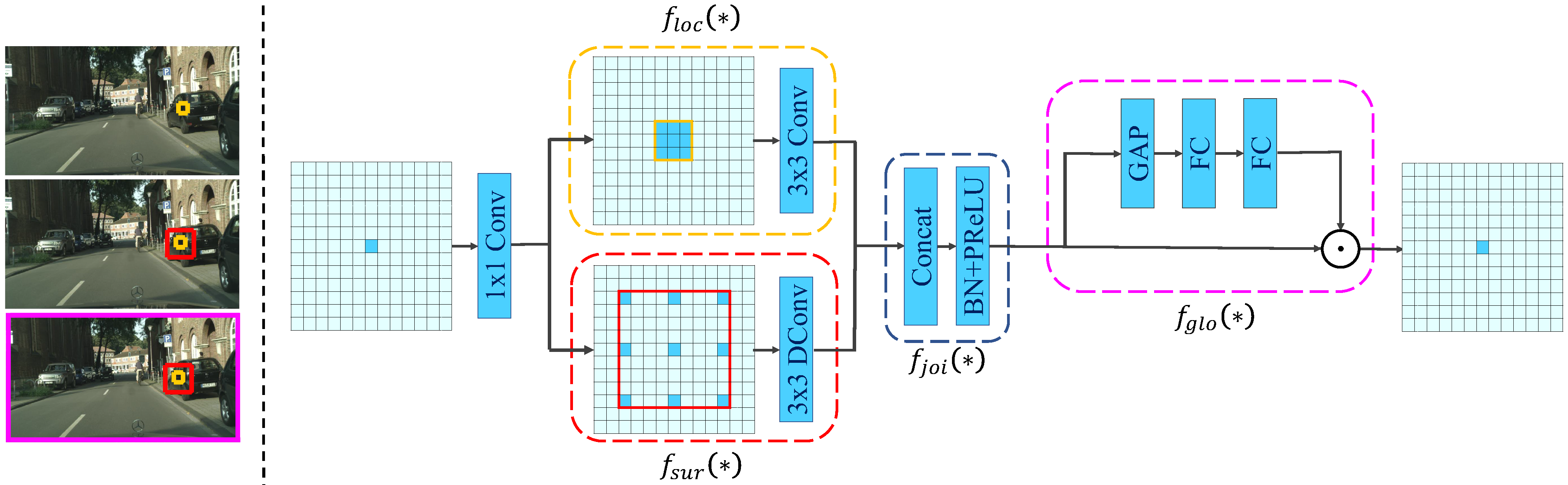
The Context-Guided Downsampling (CGD) is introduced by following the Context-Guided Network (CGNet) [55] in a real-time transformer. It is a lightweight neural network designed for semantic segmentation. However, its techniques are applied here as downsampling for small object detection. The primary objective of CGD is to preserve spatial and contextual information during feature resolution reduction, thereby mitigating the loss of discriminative details that commonly occurs during downsampling. The core component of CGD is the Context-Guided (CG) block, used as “deep and thin,” with two downsampling stages to preserve spatial information in CGWT-DETR. This block learns joint features from local and surrounding contexts, as illustrated in Figure 4.
It consists of four main components: a local feature extractor ( F loc ), a surrounding context extractor ( F sur ), a joint feature extractor ( F joi ), and a global context extractor ( F glo ). The local feature extractor captures details from the immediate neighborhood, while the surrounding context extractor employs dilated convolutions to capture a broader context. The joint feature extractor combines these features, and the global context extractor refines the joint features using Global Average Pooling and a multilayer perceptron (MLP).
Joint Feature Extractor:
f j o i ( X ) = BN ( PReLU ( Concat ( f l o c ( X ) , f s u r ( X ) ) ) ) .
Here, Concat denotes channel-wise concatenation of ( F loc ) and ( F sur ). Then, the PReLU activation function is introduced for non-linearity, and BN stabilizes the training by normalizing feature distributions in ( F joi ).
Global Context Extractor:
f glo ( X ) = MLP ( GAP ( X ) ) .
Here, the global context extractor ( F glo ) applies Global Average Pooling (GAP) to compress each feature channel (FC) of the input into a scalar, which is then processed by a multilayer perceptron (MLP). This operation learns global-level channel-wise attention that refines the importance of features extracted in previous stages.
Final Output:
The final output of the CG block is obtained by combining the global attention weights with the joint local-surrounding features through element-wise multiplication:
Y = f glo ( X ) f joi ( X ) .
Here, ⊙ denotes element-wise multiplication, which enables the model to enhance feature channels based on the learned global context. This fusion enriches the feature representation and boosts small object detection by preserving both spatial precision and semantic context.

4. Experimental Configurations and Parameters

The experimental setup runs on Windows 10, using Python 3.11 and the PyTorch 2.12 framework. The hardware configuration consists of an Intel (R) Core (TM) i7-8700 CPU@3.20 GHz processor paired with a NVIDIA TITAN Xp Graphics Card featuring 12 GB of video memory. The system runs CUDA 12.1 to leverage GPU acceleration. For comparison with other models in a comparative study, the RT-DETR model was trained over 200 epochs with identical training configuration settings, as explained in Table 1. All results are produced on the datasets NWPU-VHR-10 and HIT-UAV to evaluate performance by applying the standard object detection metrics: precision, recall, mean average precision (mAP), inference speed, computational complexity in GFLOPs, and model size in the number of parameters, following COCO-style [56]. After analyzing the model, we concluded that the RT-DETR model is significantly larger and more complex. RT-DETR is sensitive to parameters, and its performance fluctuates across different parameter settings. Due to this factor, its convergence and accuracy are poor on small datasets when using the default parameters. It requires large datasets for better convergence and accuracy, normally. The advantage of our model is that it can be trained on a small dataset from scratch with customized parameters.

4.1. Dataset

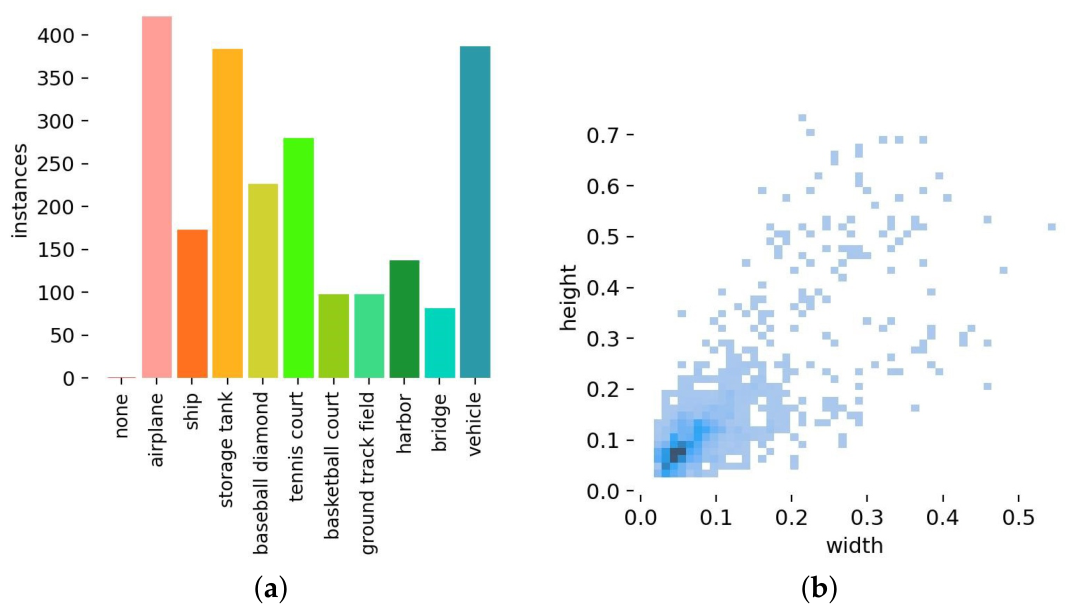
The real-world high-resolution geospatial aerial objects dataset NWPU-VHR-10 [18] was released by Northwestern Polytechnical University (NWPU). The dataset contains a 650-positive set of color images collected from Google Earth, with spatial resolutions ranging from 0.5 m to 2 m. Moreover, it contains 85 full-resolution color infrared (CIR) images from the Vaihingen dataset, with a spatial resolution of 0.08 m. The German Society provides the Vaihingen data for Photogrammetry, remote sensing, and Geoinformation. It consists of 10 geospatial classes: airplane, ship, storage tank, baseball diamond, tennis court, basketball court, ground track field, harbor, bridge, and vehicle. It has large-scale variation and complex backgrounds, and poses significant challenges for small object detection in remote sensing aerial imagery. We use the standard split: 390 training, 130 validation, and 130 test images for all experiments with ratios of 60%, 20%, and 20%, respectively. As shown in Figure 5a, the class categories and instance labels describe the statistics. Figure 5b presents the size of objects reflecting the diversity of target scales encountered in aerial views. For aerial vision systems, NWPU-VHR-10 provides a robust, challenging, and practical benchmark to assess whether a model can truly perform in the field.
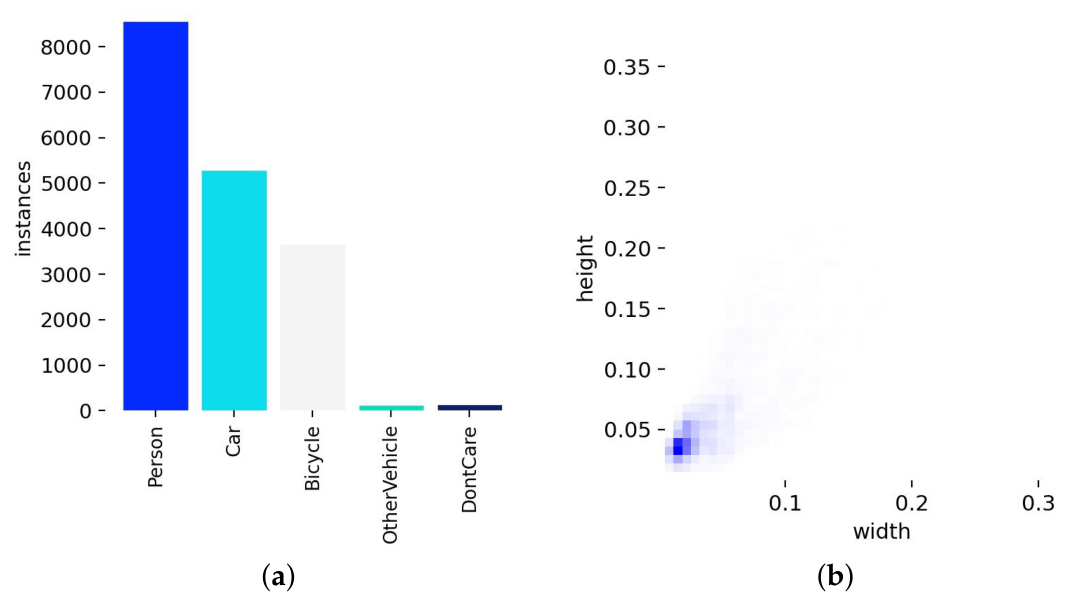
HIT-UAV is a thermal infrared small object detection dataset. It was introduced by Wang et al. [20], designed for thermal infrared target detection in UAV-captured imagery. A major advantage of the HIT-UAV dataset is its inclusion of targets observed at different altitudes and viewing angles, which introduces substantial variation in scale and spatial layout. This diversity supports the development of robust detection models capable of handling real-world aerial surveillance challenges. HIT-UAV consists of 2898 thermal images, each with a resolution of 640 × 512 pixels. It was collected at high altitudes under diverse environmental and weather conditions. Objects are annotated in five classes: Person, Car, Bicycle, OtherVehicle and DontCare. The dataset provides 24,791 labels for small targets, as illustrated in Table 2.
The sizes of the 17,158 targets are below 32 × 32 pixels for small objects, 7249 targets are below 96 × 96 pixels, and 384 are more than 96 × 96 pixels for large targets. The smallest detectable objects occupy only 0.01% of the total image area, underscoring the extreme difficulty of detecting the lowest thermal signatures. This stratified label distribution and the size of objects are depicted in Figure 6 for assessment. The dataset was systematically divided into training, validation, and testing subsets in a 7:1:2 proportion, as illustrated in Table 2.

4.2. Evaluation Metrics

In this study, the model’s performance was evaluated using comprehensive evaluation metrics explained in remote sensing and aerial imagery [56,57,58,59,60], including precision, recall, mean average precision (mAP), and the number of parameters (Params) and GFLOPs. These metrics were adopted for their ability to provide a comprehensive assessment of detection accuracy and model efficiency. The definitions and calculations of these metrics are as follows.

4.2.1. Precision

Precision measured the proportion of correctly detected targets (True Positives, TP) out of all instances predicted as positive (True Positives + false positives, FP). It was calculated by following [61,62,63,64,65]
P = T P T P + F P .
Here, TP represented the number of correctly identified targets, while FP denoted the number of incorrectly detected targets.

4.2.2. Recall

Recall evaluated the model’s ability to detect all relevant targets. It was defined as the ratio of correctly detected targets (TP) to the total number of actual targets (TP + FN) as [66,67]
R = T P T P + F N .
FN represents the number of targets that the model failed to detect.

4.2.3. Average Precision (AP) and Mean Average Precision (mAP)

Average precision (AP) was used to assess the detection accuracy for a single class. It is calculated as the area under the precision–recall (P-R) curve, which plots precision against recall at various confidence thresholds. Mean average precision (mAP) extends this concept by averaging the AP values across all object categories, offering a comprehensive evaluation of model performance. For instance, mAP@0.50 represents the average AP when the Intersection over Union (IoU) threshold is fixed at 0.50. In contrast, mAP@0.50:0.95 calculates the average AP across a range of IoU thresholds, specifically from 0.50 to 0.95, with an increment of 0.05. This multi-threshold approach ensures a more robust assessment of the model’s detection capabilities under varying conditions [67,68].
The formulas for AP and mAP are given by:
A P = k = 1 N P ( k ) Δ R ( k ) ,
m A P = 1 C k = 1 N P ( k ) Δ R ( k ) ,
where C is the number of object categories, P ( k ) and R ( k ) are the precision and recall at a given IoU threshold, and Δ R ( k ) is the difference in recall between successive points.

4.2.4. Computational Complexity

To measure computational complexity, we evaluate performance through GFLOPs and parameters. GFLOPs represents the number of operations a model performs, which indicates the speed and efficiency of neural networks. Additionally, parameters reflect the weights of the model that processes input data and generates predictions.

5. Results and Analysis

5.1. Performance Evaluation on the NWPU-VHR-10

5.1.1. Ablation Experiments

In this study, we conducted meticulous ablation experiments using the RT-DETR-R50 as a baseline model to detect small objects, as illustrated in Table 3. Our proposed model, CGWT-DETR, employs the ResNet-50 backbone and an efficient encoder–decoder architecture to detect small objects. The ablation results indicate that WTF and CGD contribute complementary information.
Replacing the original feature fusion strategy with the WTF module improves the mAP@0.50 to 0.883 while substantially reducing the computational cost from 130.5 GFLOPs to 91.1 GFLOPs and the number of parameters from 42 M to 36 M. The lightweight frequency-aware design enables the network to preserve high-frequency details, such as edges and textures, while maintaining low-frequency semantic information, resulting in a more computationally efficient detector. Although recall decreases from 0.970 to 0.808, the improved mAP indicates that WTF generates more discriminative feature representations and suppresses ambiguous detections, leading to higher localization precision. The second CGD module alone improves the baseline mAP@0.50 from 0.869 to 0.881 and mAP@0.50:0.95 from 0.587 to 0.592 while maintaining nearly the same computational complexity (130.8 GFLOPs and 42 M parameters). This improvement demonstrates that preserving local, surrounding, and global contextual information during downsampling enhances feature representation and improves the localization of small objects without increasing model complexity. The WTF and CGD jointly achieve competent performance, improving mAP@0.50 from 0.869 to 0.899 (+3.45%) and mAP@0.50:0.95 from 0.587 to 0.603 (+2.72%), while simultaneously reducing the model parameters by 14.28% (42 M to 36 M) and GFLOPs by 29.8% (130.5 to 91.6). It exhibits that the recall is slightly lower than compared with the baseline; this reflects a trade-off between detection sensitivity and localization precision. By reducing ambiguous predictions and false positives, the detector produces more reliable confidence scores and more accurate bounding box localization, which ultimately leads to higher average precision despite the modest decrease in recall. Consequently, their combination effectively balances localization accuracy, semantic representation, and computational efficiency, resulting in a lightweight yet more accurate detector for dense background aerial objects.

5.1.2. Comparison Between RT-DETR and CGWT-DETR

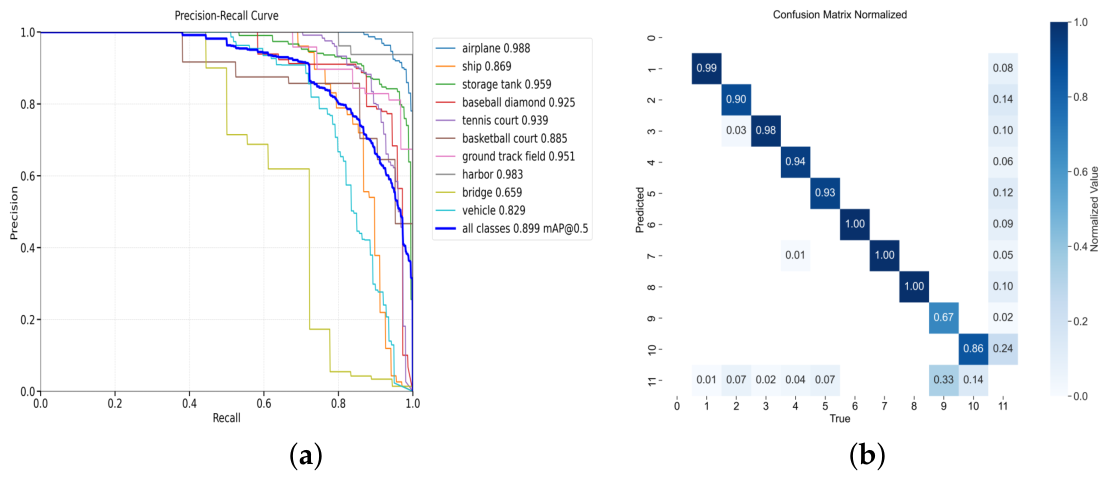
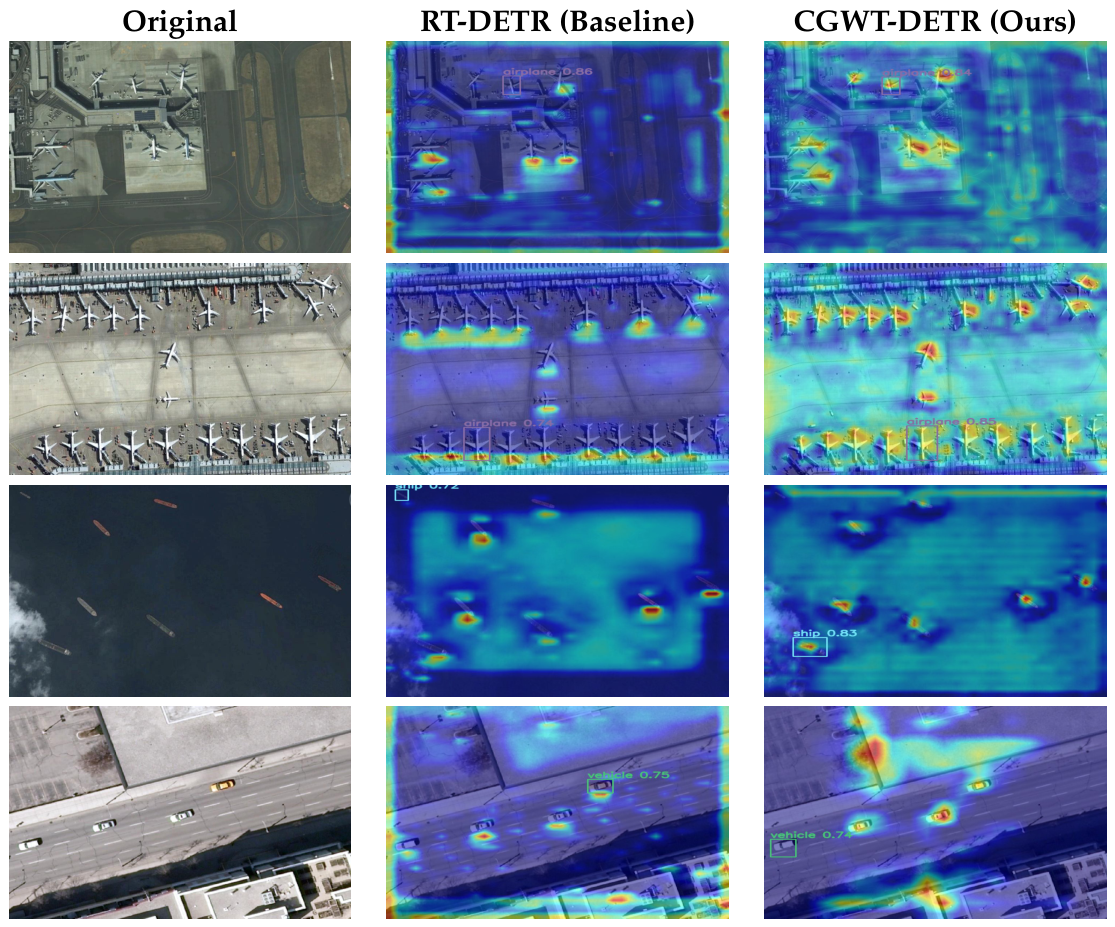
The efficacy of CGWT-DETR compared to the baseline RT-DETR-R50 in aerial image object detection is analyzed using PR curves and a confusion matrix in Figure 7, and heatmap visualizations in Figure 8. The PR curve shows that CGWT-DETR outperforms RT-DETR-R50, with a larger area under the curve, corresponding to an improved mAP@0.50 of 0.899 from 0.869. The x-axis represents recall, while the y-axis shows precision, highlighting detection performance. GradCAM++ is used to generate heatmaps that visualize the models’ feature focus from layer 19 onward, with a confidence threshold of 0.5. As depicted in Figure 8, CGWT-DETR exhibits dense feature points concentrated on detection targets compared to the base model. This indicates that CGWT-DETR responds more effectively to small targets in complex scenes, reducing missed detections and false positives while suppressing background clutter. Overall, the results demonstrate that CGWT-DETR outperforms RT-DETR-R50 in terms of accuracy and robustness, making it more valuable for practical applications.

5.1.3. Comparative Analysis on NWPU-VHR-10

Our study demonstrates the effectiveness of DETR in small object detection with comparisons to SOTA models. We reproduce all the results in the same setting, as explained in the experimental settings. The evaluation was conducted on the NWPU-VHR-10 dataset using mAP@0.50 and mAP@0.50:0.95 metrics. Comparative analysis with state-of-the-art models like YOLOv5, YOLOv9, and RT-DETR, presented in Table 4, underlines the strong performance of CGWT-DETR. The proposed model achieves mAP@0.50 to 0.899 and mAP@0.50:0.95 to 0.603 across 10 categories: airplanes, ships, oil tanks, baseball diamonds, tennis courts, basketball courts, ground track fields, harbors, bridges, and vehicles, by outperforming the baseline model.
As shown in Table 4, the largest improvements are observed for airplanes, tennis courts, basketball courts, and harbors, which generally contain richer geometric structures and clearer boundary information. Conversely, categories such as ship, storage tanks, and baseball diamonds exhibit slight decreases because their appearance is dominated by smooth low-frequency regions with relatively limited edge information. These observations suggest that the proposed frequency-aware representation is particularly advantageous for structurally complex small objects.
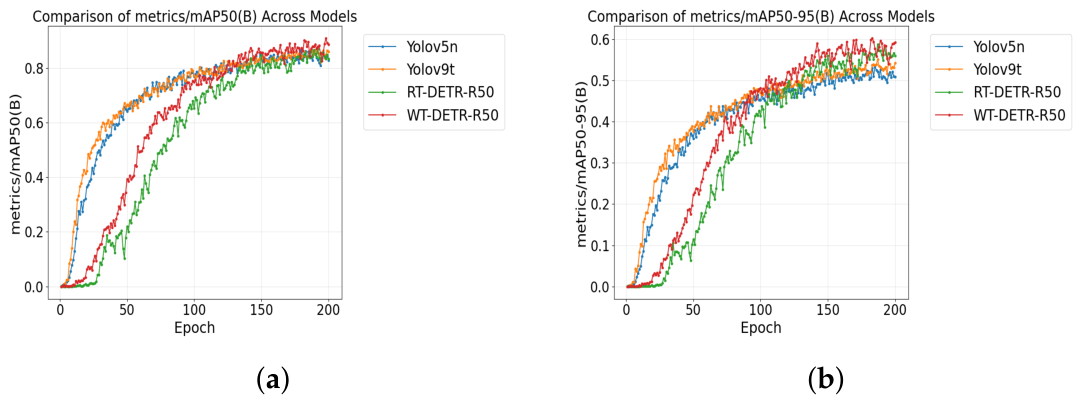
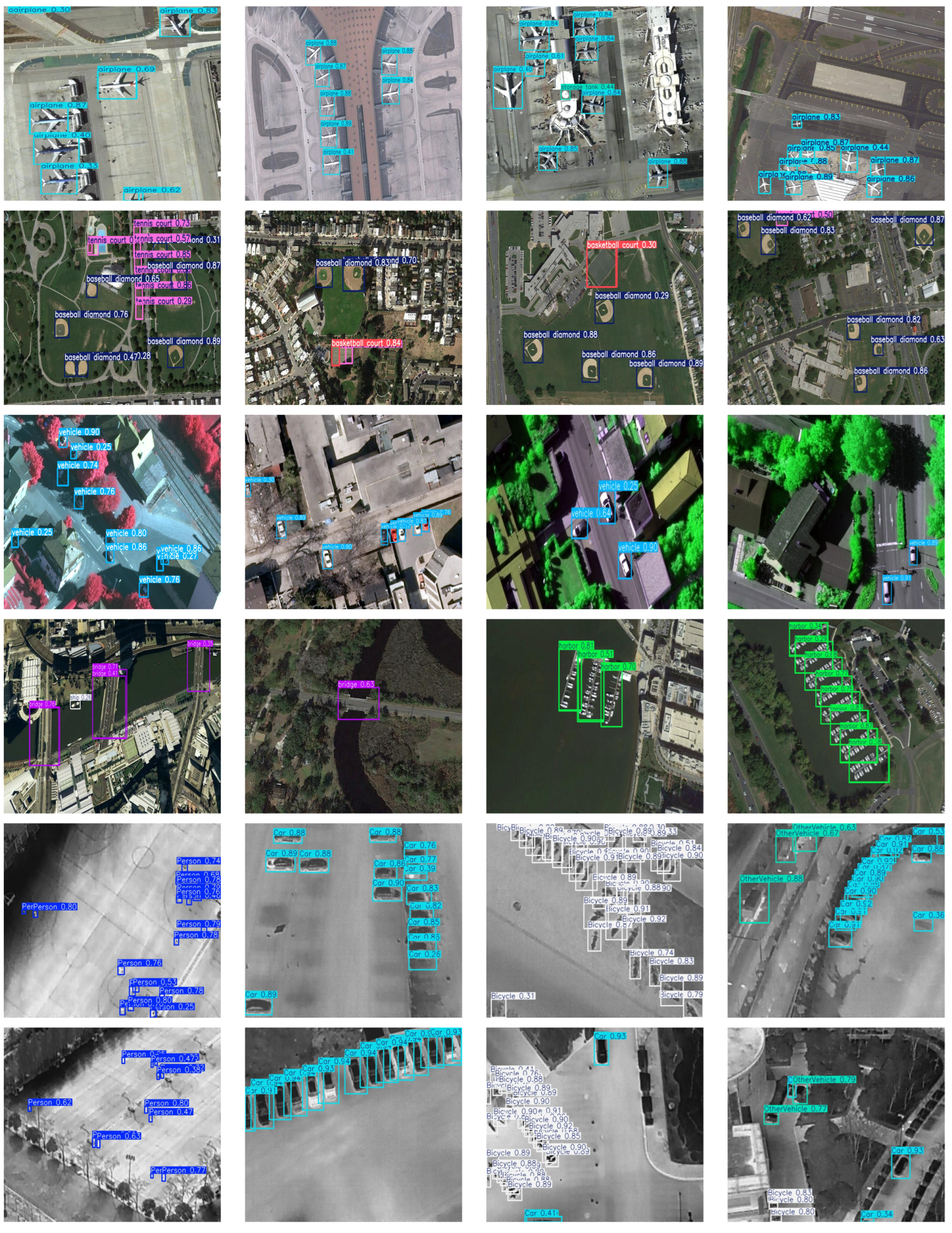
In comparative analysis, YOLO models exhibit faster learning on smaller datasets, such as on NWPU-VHR-10, while CGWT-DETR and RT-DETR demonstrate slow and stable learning trends, as illustrated in Figure 9. Additionally, graphical detection results, shown in Figure 10, further substantiate the superior detection capabilities of CGWT-DETR for small object detection.

5.2. Performance Evaluation on the HIT-UAV

5.2.1. Ablation Study

To evaluate the efficacy of our proposed model, CGWT-DETR, we performed a comprehensive ablation study on the HIT-UAV dataset, as detailed in Table 5. The baseline RT-DETR achieves solid metrics (mAP@0.50 to 0.868; mAP@0.50:0.95 to 0.581), at a substantial complexity of (42.77M params; 130.5 GFLOPs). The augmentation of Wavelet Transform Fusion (WTF) yields a mAP@0.50 and mAP@0.50:0.95 by balancing to 0.868 and 0.580, alongside 15.4% and 29.6% reductions in parameters and GFLOPs, underscoring WTF’s ability to harmonize frequency bands for streamlined multi-scale fusion and discriminative embeddings while reducing computational load. The CGD module alone improves the baseline mAP@0.50 from 0.868 to 0.889 and mAP@0.50:0.95 from 0.581 to 0.583 while maintaining nearly the same computational complexity (42 M parameters and 130.8 GFLOPs). It demonstrates the preservation of local, surrounding, and global contextual information during downsampling to enhance feature representation and improve the localization of small objects.
Further, both WTF and CGD boost mAP@0.50:0.95 to 0.588 (+1.2% over the baseline), with precision rising to 0.928 and inference latency at 42.9 ms, despite a slight dip in recall to 0.827 and mAP@0.50 to 0.865. This demonstrates the more selective detection strategy by suppressing ambiguous predictions and reducing false-positive detections. Consequently, both modules have complementary benefits of frequency-domain representation and contextual feature preservation, resulting in the highest detection accuracy and the lowest computational complexity.

5.2.2. Comparison Between RT-DETR and CGWT-DETR on HIT-UAV

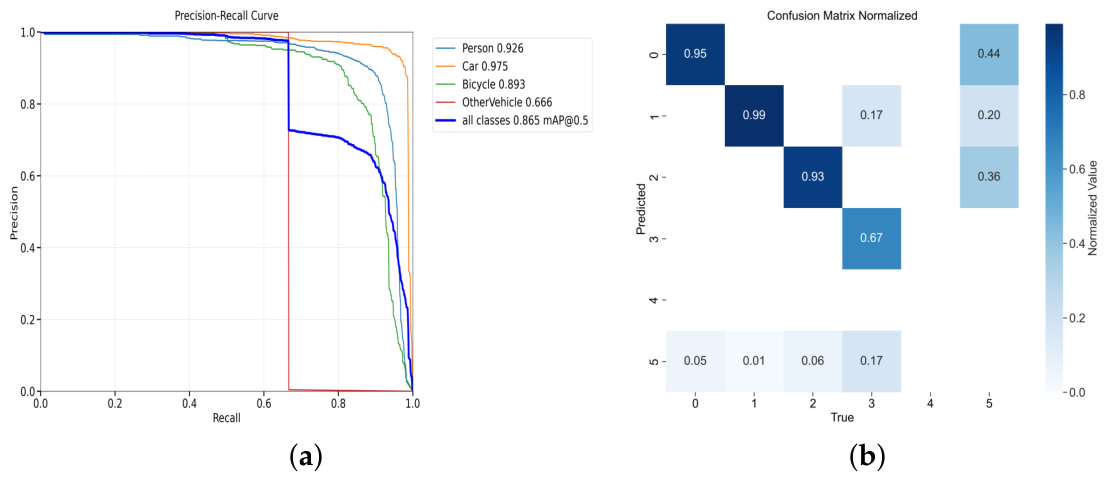
The comparative evaluation of the proposed CGWT-DETR and the baseline RT-DETR-R50 on the HIT-UAV dataset is illustrated through precision–recall (PR) curves and a confusion matrix in Figure 11. The PR curve of CGWT-DETR consistently surpasses RT-DETR-R50. The increase in precision demonstrates that the proposed architecture effectively enhances the discriminability of small targets under complex conditions. The confusion matrix, as shown in Figure 11b, further provides intuitive visual evidence of the model’s attention behavior. Graphical detection results, as displayed in Figure 10, substantiate the superior detection capabilities. So, CGWT-DETR is capable of extracting more discriminative contextual cues, leading to improved target localization while suppressing background noise and clutter in the form of bounding boxes. Overall, these results confirm that CGWT-DETR delivers better feature representation and robust detection capability for small objects in aerial thermal infrared imagery. Its enhanced precision, balance, and reduced false detections highlight its potential for reliable UAV-based surveillance and other real-time applications.

5.2.3. Comparative Analysis on HIT-UAV

To rigorously evaluate the generalization capability of the proposed CGWT-DETR, we evaluated it on the challenging thermal infrared HIT-UAV aerial dataset, which presents unique difficulties, including low-contrast grayscale imagery, extreme scale variations, and complex backgrounds across diverse categories, such as pedestrians, vehicles, and bicycles. For a fair comparison, we reproduced the results for baseline models (including YOLOv8n, YOLOv9, YOLOv10, YOLO11n, RT-DETR-18, and RT-DETR-50) under identical experimental settings, while the results for other recent state-of-the-art (SOTA) specialized models were sourced directly from their respective publications, as summarized in Table 6. CGWT-DETR achieves robust performance with a precision of 92.8%, a recall of 82.7%, mAP@0.50 of 86.5%, and mAP@0.50:0.95 of 58.8%.
The proposed method demonstrates significant improvements over traditional and foundational detectors, surpassing SSD, Faster R-CNN, Deformable-DETR, and DINO by substantial margins. When compared to modern CNN-based architectures, CGWT-DETR consistently outperforms the YOLO series (from YOLOv8n to YOLO11n), achieving higher mAP@0.50 despite the typically faster convergence rates of CNNs. Furthermore, it establishes a strong benchmark among specialized DETR variants, outperforming PHSI-RTDETR (82.6%), FECI-RTDETR (84.2%), GA-DETR (83.3%), and CFPM-DETR (85.7%). While the top-performing MDSF-YOLO achieves a slightly higher mAP@0.50 (88.8%), CGWT-DETR remains highly competitive and notably excels in precision (92.8% vs. 89.6%), indicating a superior ability to minimize false positives. Compared to the heavier RT-DETR-R50 baseline (86.8% mAP@0.50), our method achieves comparable overall accuracy but with significantly higher precision and a better strict localization metric (mAP@0.50:0.95 of 58.8% vs. 58.1%). The distinct advantage of CGWT-DETR is particularly evident in its detection of small-scale objects within cluttered thermal scenes. While CNN-based models rely on local receptive fields, the transformer-based architecture of CGWT-DETR excels at modeling long-range contextual dependencies. This global perspective is critical for distinguishing faint, small objects from complex, noisy thermal backgrounds. The qualitative visual results illustrated in Figure 10 corroborate these quantitative findings, showing precise bounding box localization even under conditions of low resolution and high occlusion. Ultimately, this combination of high precision, robust small object detection, and architectural efficiency underscores the practical utility of CGWT-DETR for real-world, all-weather, and round-the-clock aerial surveillance operations.

6. Discussion

This study introduces CGWT-DETR, an enhanced RT-DETR model for small object detection in aerial RGB and thermal infrared imagery. It improves the hybrid encoder by jointly introducing frequency-aware feature learning through the Wavelet Transform Fusion (WTF) module and preserving the contextual information through the Context-Guided Downsampling (CGD) module, which enables the model to better capture fine-grained details often lost in traditional convolutional operations and improves computational efficiency. The WTF module explicitly decouples feature maps into low-frequency and high-frequency sub-bands in detail. This separation enables the network to retain sharp edges, textures, and object boundaries that are typically smoothed out by repeated standard fusion. Because aerial small objects frequently occupy only a limited number of pixels, preserving these discriminative high-frequency features is essential for accurate boundary localization. Complementing this, the CGD module utilizes a dual-branch mechanism to preserve local spatial information and global semantic dependencies during downsampling. By preventing the collapse of contextual information, the WTF and CGD allow the architecture to balance semantic representation with spatial precision, significantly enhancing feature discriminability against complex, cluttered, noisy aerial backgrounds by reducing false positives and improving overall precision.
Experimental results on the NWPU-VHR-10 and HIT-UAV datasets validate the effectiveness of our approach. CGWT-DETR achieves a mAP@0.50 of 0.899 and 0.865 and a mAP@0.50:0.95 of 0.603 and 0.588, respectively, over the baseline RT-DETR. The number of parameters is reduced from 42 M to 36 M, and GFLOPs are reduced from 130.5 M to 91.6 M, highlighting the lightweight and scalable nature of our design. Importantly, this balance between detection accuracy and model efficiency makes CGWT-DETR well suited for real-time deployment on resource-constrained platforms, such as UAVs and embedded systems. Unlike many prior approaches that rely on heavy architectures or multi-stage refinements, our CGWT-DETR maintains an end-to-end design that simplifies training and inference while delivering competitive performance.
Despite these advantages, the current implementation has some limitations. First, although WTF reduces overall computational complexity, the wavelet decomposition and reconstruction operations introduce additional feature transformations that slightly increase inference latency compared to the original RT-DETR. Second, the current WTF module relies on fixed mathematical wavelet bases rather than fully learnable wavelet functions, which may limit optimal adaptation to highly specific texture distributions. Third, transformer-based detectors generally exhibit slower convergence than lightweight CNN-based YOLO detectors, particularly on smaller datasets. Finally, the current evaluation is limited to benchmark datasets rather than real UAV deployment, where environmental factors, such as motion blur, atmospheric interference, and strict onboard computational constraints, may influence performance.
Future work will investigate extending CGWT-DETR toward true multimodal RGB–thermal infrared multi-modality object detection through cross-modal feature interaction and frequency-aware attention mechanisms. Additional research will focus on incorporating learnable wavelet bases to better adapt to diverse texture distributions, improving robustness under adverse weather through knowledge distillation, and validating the framework on larger aerial benchmarks, such as Dronevehicle, as well as embedded UAV platforms for real-time, edge-computing deployment.

7. Conclusions

This study introduces CGWT-DETR, an enhanced model for detecting small targets in aerial imagery that addresses the challenges of multi-scale small targets. The proposed enhancements focus on a model-efficient hybrid encoder that integrates a Wavelet Transform Fusion (WTF) and a Context-Guided Downsampling (CGD) module into RT-DETR. Specifically, the RepC3 module in the baseline RT-DETR model is replaced with the WTF module, which effectively captures low and high-frequency details across different frequency bands to resolve multi-scale issues while minimizing computational complexity. Additionally, contextual and spatial information preservation is achieved through CGD by replacing traditional downsampling layers, thereby maintaining joint features from local, global, and surrounding contexts of objects. Experimental results highlight CGWT-DETR’s performance improvements on metrics precision, mAP@0.50, and mAP@0.50:0.95. Moreover, parameters and GFLOPs are reduced by 29.8% and 14.28%, respectively, without compromising accuracy. This makes CGWT-DETR well suited for real-time UAV aerial image processing, advancing detection accuracy and computational efficiency for small target detection.

Author Contributions

Conceptualization, S.H., I.M., Z.J. and C.W.; methodology, S.H., I.M. and Z.J.; software, S.H., I.M. and C.W.; validation, C.W., U.A., M.L., X.Z. and L.L.; formal analysis, S.H., I.M. and U.A.; investigation, L.L. and M.L.; resources, C.W. and L.L.; data curation, S.H., I.M. and C.W.; writing—original draft preparation, S.H., I.M. and H.M.; writing—review and editing, X.Z., C.W. and L.L.; visualization, C.W.; funding acquisition, C.W. All authors have read and agreed to the published version of the manuscript.

Funding

This work was supported in part by the Program for Science and Technology in Henan Province (252102210145); the Natural Science Foundation of Henan (22100020); the National Natural Science Foundation of China under Grant Nos. 62261053 and 62401062; the Tianshan Talent Training Project–Xinjiang Science and Technology Innovation Team Program (2023TSYCTD0012); and the Research Project of the Xinjiang Sky-Ground Integrated Intelligent Computing Technology Laboratory under Grant No. 2025A05-1.

Data Availability Statement

The remote-sensing datasets used in this study (NWPU-VHR-10 and HIT-UAV) are publicly available and cited in this manuscript. The NWPU-VHR-10 dataset can be accessed via https://github.com/Gaoshuaikun/NWPU-VHR-10, (accessed on 10 August 2025) and the HIT-UAV dataset is available at the official GitHub repository: https://github.com/suojiashun/HIT-UAV-Infrared-Thermal-Dataset, (accessed on 12 August 2025). During peer review, these materials can be made available to the editors and reviewers upon reasonable request.

Conflicts of Interest

The authors declare no conflicts of interest.

References

  1. Zou, Z.; Chen, K.; Shi, Z.; Guo, Y.; Ye, J. Object Detection in 20 Years: A Survey. Proc. IEEE 2023, 111, 257–276. [Google Scholar] [CrossRef] [Scilit]
  2. Li, C.; Zhou, S.; Yu, H.; Guo, T.; Guo, Y.; Gao, J. An efficient method for detecting dense and small objects in uav images. IEEE J. Sel. Top. Appl. Earth Obs. Remote Sens. 2024, 17, 6601–6615. [Google Scholar] [CrossRef] [Scilit]
  3. Wang, C.Y.; Yeh, I.H.; Mark Liao, H.Y. Yolov9: Learning what you want to learn using programmable gradient information. In Proceedings of the European Conference on Computer Vision; Springer: Berlin/Heidelberg, Germany, 2024; pp. 1–21. [Google Scholar]
  4. Wang, C.Y.; Bochkovskiy, A.; Liao, H.Y.M. YOLOv7: Trainable bag-of-freebies sets new state-of-the-art for real-time object detectors. In Proceedings of the IEEE/CVF Conference on Computer Vision and Pattern Recognition; IEEE: Piscataway, NJ, USA, 2023; pp. 7464–7475. [Google Scholar]
  5. Jocher, G. Ultralytics, YOLOv5. 2020. Available online: https://github.com/ultralytics/yolov5 (accessed on 20 September 2025).
  6. Jocher, G.; Chaurasia, A.; Qiu, J. Ultralytics YOLOv8. 2023. Available online: https://github.com/ultralytics/ultralytics/tree/main/ultralytics/cfg/models/v8 (accessed on 20 September 2025).
  7. Wang, A.; Chen, H.; Liu, L.; Chen, K.; Lin, Z.; Han, J.; Ding, G. Yolov10: Real-time end-to-end object detection. Adv. Neural Inf. Process. Syst. 2024, 37, 107984–108011. [Google Scholar] [CrossRef] [Scilit]
  8. QJocher, G.; Qiu, J. Ultralytics YOLO11. 2024. Available online: https://github.com/ultralytics/ultralytics/tree/main/ultralytics/cfg/models/11 (accessed on 20 September 2025).
  9. Liu, W.; Anguelov, D.; Erhan, D.; Szegedy, C.; Reed, S.; Fu, C.Y.; Berg, A.C. Ssd: Single shot multibox detector. In Proceedings of the European Conference on Computer Vision; Springer: Berlin/Heidelberg, Germany, 2016; pp. 21–37. [Google Scholar]
  10. Girshick, R. Fast R-CNN. In Proceedings of the IEEE International Conference on Computer Vision (ICCV); IEEE: Piscataway, NJ, USA, 2015; pp. 1440–1448. [Google Scholar]
  11. Ren, S.; He, K.; Girshick, R.; Sun, J. Faster R-CNN: Towards real-time object detection with region proposal networks. IEEE Trans. Pattern Anal. Mach. Intell. 2016, 39, 1137–1149. [Google Scholar] [PubMed]
  12. Carion, N.; Massa, F.; Synnaeve, G.; Usunier, N.; Kirillov, A.; Zagoruyko, S. End-to-end object detection with transformers. In Proceedings of the European Conference on Computer Vision; Springer: Berlin/Heidelberg, Germany, 2020; pp. 213–229. [Google Scholar]
  13. Zhao, Y.; Lv, W.; Xu, S.; Wei, J.; Wang, G.; Dang, Q.; Liu, Y.; Chen, J. Detrs beat yolos on real-time object detection. In Proceedings of the IEEE/CVF Conference on Computer Vision and Pattern Recognition; IEEE: Piscataway, NJ, USA, 2024; pp. 16965–16974. [Google Scholar]
  14. Zhu, X.; Su, W.; Lu, L.; Li, B.; Wang, X.; Dai, J. Deformable detr: Deformable transformers for end-to-end object detection. arXiv 2020, arXiv:2010.04159. [Google Scholar]
  15. Lin, T.Y.; Maire, M.; Belongie, S.; Hays, J.; Perona, P.; Ramanan, D.; Dollár, P.; Zitnick, C.L. Microsoft coco: Common objects in context. In Proceedings of the European Conference on Computer Vision; Springer: Berlin/Heidelberg, Germany, 2014; pp. 740–755. [Google Scholar]
  16. Deng, J.; Dong, W.; Socher, R.; Li, L.J.; Li, K.; Li, F.-F. Imagenet: A large-scale hierarchical image database. In Proceedings of the 2009 IEEE Conference on Computer Vision and Pattern Recognition; IEEE: Piscataway, NJ, USA, 2009; pp. 248–255. [Google Scholar]
  17. Cao, Y.; He, Z.; Wang, L.; Wang, W.; Yuan, Y.; Zhang, D.; Zhang, J.; Zhu, P.; Van Gool, L.; Han, J.; et al. VisDrone-DET2021: The vision meets drone object detection challenge results. In Proceedings of the IEEE/CVF International Conference on Computer Vision; IEEE: Piscataway, NJ, USA, 2021; pp. 2847–2854. [Google Scholar]
  18. Cheng, G.; Han, J.; Zhou, P.; Guo, L. Multi-class geospatial object detection and geographic image classification based on collection of part detectors. ISPRS J. Photogramm. Remote Sens. 2014, 98, 119–132. [Google Scholar] [CrossRef] [Scilit]
  19. Ding, J.; Xue, N.; Long, Y.; Xia, G.S.; Lu, Q. Learning RoI Transformer for Detecting Oriented Objects in Aerial Images. In Proceedings of the IEEE/CVF Conference on Computer Vision and Pattern Recognition (CVPR); IEEE: Piscataway, NJ, USA, 2019. [Google Scholar]
  20. Suo, J.; Wang, T.; Zhang, X.; Chen, H.; Zhou, W.; Shi, W. HIT-UAV: A high-altitude infrared thermal dataset for Unmanned Aerial Vehicle-based object detection. Sci. Data 2023, 10, 227. [Google Scholar] [CrossRef] [Scilit] [PubMed]
  21. Zhu, X.; Lyu, S.; Wang, X.; Zhao, Q. TPH-YOLOv5: Improved YOLOv5 based on transformer prediction head for object detection on drone-captured scenarios. In Proceedings of the IEEE/CVF International Conference on Computer Vision; IEEE: Piscataway, NJ, USA, 2021; pp. 2778–2788. [Google Scholar]
  22. Yi, H.; Liu, B.; Zhao, B.; Liu, E. Small object detection algorithm based on improved YOLOv8 for remote sensing. IEEE J. Sel. Top. Appl. Earth Obs. Remote Sens. 2023, 17, 1734–1747. [Google Scholar] [CrossRef] [Scilit]
  23. Kong, Y.; Shang, X.; Jia, S. Drone-DETR: Efficient small object detection for remote sensing image using enhanced RT-DETR model. Sensors 2024, 24, 5496. [Google Scholar] [CrossRef] [Scilit] [PubMed]
  24. Fu, Y.; Lyu, J.; Ma, P.; Liu, Z.; Ng, M. A Unified SAM-Guided Self-Prompt Learning Framework for Infrared Small Target Detection. IEEE Trans. Geosci. Remote Sens. 2025, 63, 5008014. [Google Scholar] [CrossRef] [Scilit]
  25. Liu, Y.; Che, S.; Ai, L.; Song, C.; Zhang, Z.; Zhou, Y.; Yang, X.; Xian, C. Camouflage detection: Optimization-based computer vision for alligator sinensis with low detectability in complex wild environments. Ecol. Inform. 2024, 83, 102802. [Google Scholar] [CrossRef] [Scilit]
  26. Lin, T.Y.; Dollár, P.; Girshick, R.; He, K.; Hariharan, B.; Belongie, S. Feature pyramid networks for object detection. In Proceedings of the IEEE Conference on Computer Vision and Pattern Recognition; IEEE: Piscataway, NJ, USA, 2017; pp. 2117–2125. [Google Scholar]
  27. Patel, S. Hybrid CNN-Transformer for Aerial Object Detection: A Novel Architecture for Enhanced Detection Accuracy. In Proceedings of the 2025 International Conference on Machine Learning and Autonomous Systems (ICMLAS), Prawet, Thailand, 10–12 March 2025; pp. 693–698. [Google Scholar]
  28. Hui, Y.; Wang, J.; Li, B. STF-YOLO: A small target detection algorithm for UAV remote sensing images based on improved SwinTransformer and class weighted classification decoupling head. Measurement 2024, 224, 113936. [Google Scholar] [CrossRef] [Scilit]
  29. Tahir, N.U.A.; Long, Z.; Zhang, Z.; Asim, M.; ELAffendi, M. PVswin-YOLOv8s: UAV-based pedestrian and vehicle detection for traffic management in smart cities using improved YOLOv8. Drones 2024, 8, 84. [Google Scholar] [CrossRef] [Scilit]
  30. Hussain, S.; Mumtaz, I.; Wang, C.; Lv, P. SF-YOLOv9: PGI Based Hybrid Backbone with Dual-Path Attention for Small Object Detection in Aerial Imagery. Egypt. Inform. J. 2026, 33, 100888. [Google Scholar] [CrossRef] [Scilit]
  31. Wang, S.; Xia, C.; Lv, F.; Shi, Y. RT-DETRv3: Real-time end-to-end object detection with hierarchical dense positive supervision. In Proceedings of the 2025 IEEE/CVF Winter Conference on Applications of Computer Vision (WACV); IEEE: Piscataway, NJ, USA, 2025; pp. 1628–1636. [Google Scholar]
  32. Lv, W.; Zhao, Y.; Chang, Q.; Huang, K.; Wang, G.; Liu, Y. Rt-detrv2: Improved baseline with bag-of-freebies for real-time detection transformer. arXiv 2024, arXiv:2407.17140. [Google Scholar]
  33. Zhang, H.; Liu, K.; Gan, Z.; Zhu, G.N. UAV-DETR: Efficient end-to-end object detection for unmanned aerial vehicle imagery. arXiv 2025, arXiv:2501.01855. [Google Scholar]
  34. Muzammul, M.; Algarni, A.; Ghadi, Y.Y.; Assam, M. Enhancing UAV aerial image analysis: Integrating advanced SAHI techniques with real-time detection models on the VisDrone dataset. IEEE Access 2024, 12, 21621–21633. [Google Scholar] [CrossRef] [Scilit]
  35. Zheng, Z.; Jia, Y. An Improved RT-DETR Algorithm for Small Object Detection in Aerial Images. In Proceedings of the 2024 17th International Congress on Image and Signal Processing, BioMedical Engineering and Informatics (CISP-BMEI); IEEE: Piscataway, NJ, USA, 2024; pp. 1–6. [Google Scholar]
  36. Zheng, Z.; Zhao, J.; Fan, J. A DCM-DETR object detector for drone images in harsh environments. AIP Adv. 2025, 15, 075243. [Google Scholar] [CrossRef] [Scilit]
  37. Liu, Y.; He, M.; Hui, B. ESO-DETR: An Improved Real-Time Detection Transformer Model for Enhanced Small Object Detection in UAV Imagery. Drones 2025, 9, 143. [Google Scholar] [CrossRef] [Scilit]
  38. Zhang, C.; Yang, J. Emsd-detr: Efficient small object detection for UAV aerial images based on enhanced RT-DETR model. J. Supercomput. 2025, 81, 1052. [Google Scholar] [CrossRef] [Scilit]
  39. Li, W.; Li, A.; Li, Z.; Kong, X.; Zhang, Y. RTS-DETR: Efficient Real-Time DETR for Small Object Detection. In Proceedings of the 2024 IEEE International Conference on Systems, Man, and Cybernetics (SMC); IEEE: Piscataway, NJ, USA, 2024; pp. 1211–1216. [Google Scholar]
  40. Tan, L.; Liu, Z.; Liu, H.; Li, D.; Zhang, C. A real-time unmanned aerial vehicle (UAV) aerial image object detection model. In Proceedings of the 2024 International Joint Conference on Neural Networks (IJCNN); IEEE: Piscataway, NJ, USA, 2024; pp. 1–7. [Google Scholar]
  41. Dosovitskiy, A. An image is worth 16 × 16 words: Transformers for image recognition at scale. arXiv 2020, arXiv:2010.11929. [Google Scholar]
  42. Ren, L.; Lei, H.; Li, Z.; Yang, W. AF-DETR: Efficient UAV small object detector via Assemble-and-Fusion mechanism. Pattern Anal. Appl. 2024, 27, 135. [Google Scholar] [CrossRef] [Scilit]
  43. Wei, X.; Yin, L.; Zhang, L.; Wu, F. DV-DETR: Improved UAV aerial small target detection algorithm based on RT-DETR. Sensors 2024, 24, 7376. [Google Scholar] [CrossRef] [Scilit] [PubMed]
  44. Yang, M.; Xu, R.; Yang, C.; Wu, H.; Wang, A. Hybrid-DETR: A Differentiated Module-Based Model for Object Detection in Remote Sensing Images. Electronics 2024, 13, 5014. [Google Scholar] [CrossRef] [Scilit]
  45. Fu, Y.; Liu, Z.; Zhang, Z. Progressive Learning Vision Transformer for Open Set Recognition of Fine-Grained Objects in Remote Sensing Images. IEEE Trans. Geosci. Remote Sens. 2023, 61, 5215113. [Google Scholar] [CrossRef] [Scilit]
  46. Xue, R.; Hua, S.; Xu, H. FECI-RTDETR A lightweight unmanned aerial vehicle infrared small target detector Algorithm based on RT-DETR. IEEE Access 2025, 13, 9578–9591. [Google Scholar] [CrossRef] [Scilit]
  47. Wu, P.; Yao, T.; He, W.; Zhang, L. GA-DETR: A lightweight and efficient infrared target detection method for UAVs. J. Supercomput. 2025, 81, 888. [Google Scholar] [CrossRef] [Scilit]
  48. Chen, X.; Wang, G. FP-RTDETR: Enhancing infrared ship detection with multi-scale feature fusion and lightweight design. J. Supercomput. 2025, 81, 984. [Google Scholar] [CrossRef] [Scilit]
  49. Wang, S.; Jiang, H.; Li, Z.; Yang, J.; Ma, X.; Chen, J.; Tang, X. PHSI-RTDETR: A lightweight infrared small target detection algorithm based on UAV aerial photography. Drones 2024, 8, 240. [Google Scholar] [CrossRef] [Scilit]
  50. Yang, H.; Wang, J.; Bo, Y.; Wang, J. ISTD-DETR: A deep learning algorithm based on DETR and Super-resolution for infrared small target detection. Neurocomputing 2025, 621, 129289. [Google Scholar] [CrossRef] [Scilit]
  51. Nie, J.; Sun, H.; Sun, X.; Ni, L.; Gao, L. Cross-modal feature fusion and interaction strategy for CNN-transformer-based object detection in visual and infrared remote sensing imagery. IEEE Geosci. Remote Sens. Lett. 2023, 21, 5000405. [Google Scholar]
  52. Wu, H.; Huang, X.; He, C.; Xiao, H.; Luo, S. Infrared small target detection with Swin Transformer-based multi-scale atrous spatial pyramid pooling network. IEEE Trans. Instrum. Meas. 2024, 74, 5003914. [Google Scholar]
  53. Lee, I.H.; Park, C.G. Hybrid Network Based on Hierarchical Multipatch Feature Encoder for Infrared Small Target Detection. IEEE Geosci. Remote Sens. Lett. 2024, 21, 7001605. [Google Scholar] [CrossRef] [Scilit]
  54. Finder, S.E.; Amoyal, R.; Treister, E.; Freifeld, O. Wavelet convolutions for large receptive fields. In Proceedings of the European Conference on Computer Vision; Springer: Berlin/Heidelberg, Germany, 2024; pp. 363–380. [Google Scholar]
  55. Wu, T.; Tang, S.; Zhang, R.; Cao, J.; Zhang, Y. CGNet: A light-weight context guided network for semantic segmentation. IEEE Trans. Image Process. 2020, 30, 1169–1179. [Google Scholar] [CrossRef] [Scilit] [PubMed]
  56. Padilla, R.; Netto, S.L.; Da Silva, E.A. A survey on performance metrics for object-detection algorithms. In Proceedings of the 2020 International Conference on Systems, Signals and Image Processing (IWSSIP); IEEE: Piscataway, NJ, USA, 2020; pp. 237–242. [Google Scholar]
  57. Sun, Y.; Lei, L.; Guan, D.; Kuang, G.; Li, Z.; Liu, L. Locality preservation for unsupervised multimodal change detection in remote sensing imagery. IEEE Trans. Neural Netw. Learn. Syst. 2024, 36, 6955–6969. [Google Scholar] [CrossRef] [Scilit]
  58. Guo, F.; Ma, H.; Li, L.; Lv, M.; Jia, Z. Multi-attention pyramid context network for infrared small ship detection. J. Mar. Sci. Eng. 2024, 12, 345. [Google Scholar] [CrossRef] [Scilit]
  59. Liu, J.; Li, L.; Zhao, X.; Lv, M.; Jia, Z.; Zhang, X.; Vivone, G.; Ma, H. CMNet: Global–local feature fusion CNN-Mamba network for remote sensing object detection. Remote Sens. 2026, 18, 591. [Google Scholar] [CrossRef] [Scilit]
  60. Guo, F.; Ma, H.; Li, L.; Lv, M.; Jia, Z. FCNet: Flexible convolution network for infrared small ship detection. Remote Sens. 2024, 16, 2218. [Google Scholar] [CrossRef] [Scilit]
  61. Sun, Y.; Wu, J.; Zhang, H.; Li, Z.; Lei, L.; Kuang, G. Iterative global mapping-local searching for heterogeneous change detection with unregistered images. Int. J. Comput. Vis. 2026, 134, 143. [Google Scholar] [CrossRef] [Scilit]
  62. Sun, Y.; Lei, L.; Li, Z.; Kuang, G. Similarity and dissimilarity relationships based graphs for multimodal change detection. ISPRS J. Photogramm. Remote Sens. 2024, 208, 70–88. [Google Scholar] [CrossRef] [Scilit]
  63. Sun, Y.; Lei, L.; Liu, L.; Kuang, G. Structural regression fusion for unsupervised multimodal change detection. IEEE Trans. Geosci. Remote Sens. 2023, 61, 4504018. [Google Scholar] [CrossRef] [Scilit]
  64. Li, L.; Ma, H.; Zhang, X.; Zhao, X.; Lv, M.; Jia, Z. Synthetic Aperture Radar Image Change Detection Based on Principal Component Analysis and Two-Level Clustering. Remote Sens. 2024, 16, 1861. [Google Scholar] [CrossRef] [Scilit]
  65. Li, L.; Ma, H.; Jia, Z. Change Detection from SAR Images Based on Convolutional Neural Networks Guided by Saliency Enhancement. Remote Sens. 2021, 13, 3697. [Google Scholar] [CrossRef] [Scilit]
  66. Li, L.; Shi, Y.; Lv, M.; Jia, Z.; Liu, M.; Zhao, X.; Zhang, X.; Ma, H. Infrared and Visible Image Fusion via Sparse Representation and Guided Filtering in Laplacian Pyramid Domain. Remote Sens. 2024, 16, 3804. [Google Scholar] [CrossRef] [Scilit]
  67. Li, L.; Ma, H.; Jia, Z. Multiscale Geometric Analysis Fusion-Based Unsupervised Change Detection in Remote Sensing Images via FLICM Model. Entropy 2022, 24, 291. [Google Scholar] [CrossRef] [Scilit] [PubMed]
  68. Sun, Y.; Lei, L.; Li, Z.; Kuang, G.; Yu, Q. Detecting changes without comparing images: Rules induced change detection in heterogeneous remote sensing images. ISPRS J. Photogramm. Remote Sens. 2025, 230, 241–257. [Google Scholar] [CrossRef] [Scilit]
  69. Caron, M.; Touvron, H.; Misra, I.; Jégou, H.; Mairal, J.; Bojanowski, P.; Joulin, A. Emerging Properties in Self-Supervised Vision Transformers. In Proceedings of the IEEE/CVF International Conference on Computer Vision (ICCV); IEEE: Piscataway, NJ, USA, 2021; pp. 9650–9660. [Google Scholar]
  70. Cao, L.; Wang, Q.; Luo, Y.; Hou, Y.; Cao, J.; Zheng, W. YOLO-TSL: A Lightweight Target Detection Algorithm for UAV Infrared Images Based on Triplet Attention and Slim-Neck. Infrared Phys. Technol. 2024, 141, 105487. [Google Scholar] [CrossRef] [Scilit]
  71. Duan, S.; Wang, T.; Li, T.; Yang, W. B-YOLOv8: An Improved Algorithm for Infrared Target Detection Based on UAV Aerial Images. Eng. Res. Express 2025, 7, 035205. [Google Scholar] [CrossRef] [Scilit]
  72. Luo, X.; Zhu, X. YOLO-SMUG: An Efficient and Lightweight Infrared Object Detection Model for Unmanned Aerial Vehicles. Drones 2025, 9, 245. [Google Scholar] [CrossRef] [Scilit]
  73. Liu, B.; Han, Y.; Liu, P.; Luo, S.; Li, J.; Zhang, T.; Cui, W. YOLO-MARS for Infrared Target Detection: Towards Near Space. Sensors 2025, 25, 5538. [Google Scholar] [CrossRef] [Scilit] [PubMed]
  74. Gu, Y.; Guo, Y.; Xie, W.; Wu, Z.; Dong, S.; Xie, G.; Xu, W. MDSF: A plug-and-play block for boosting infrared small target detection in YOLO-based networks. IEEE Trans. Geosci. Remote Sens. 2025, 63, 5003614. [Google Scholar] [CrossRef] [Scilit]
  75. Nan, S.; Bin, S.; Sun, G. CFPM-DETR: A lightweight model for UAV infrared small target detection. Signal Image Video Process. 2026, 20, 68. [Google Scholar] [CrossRef] [Scilit]
Figure 1. Baseline architecture of RT-DETR [13].
Remotesensing 18 02715 g001
Figure 2. CGWT-DETR: optimized architecture of the real-time detection transformer. We enhance the RT-DETR encoder by introducing Wavelet Transform Fusion (WTF) to capture multi-frequency features and Context-Guided Downsampling (CGD) to preserve spatial-contextual information during resolution reduction. The efficient hybrid encoder transforms multi-scale features through WTF and CGD in CCFF.
Remotesensing 18 02715 g002
Figure 3. The wavelet decomposition and reconstruction process employed in the proposed WTF module, adapted from the wavelet transform convolution framework. The architecture of a 3 × 3 frequency convolution is applied to the low-frequency band of the second-level wavelet domain X L L ( 2 ) , which corresponds to the lower frequencies of a 12 × 12 input X [54].
Remotesensing 18 02715 g003
Figure 4. CGD architecture for local, global, and neighborhood feature context information preservation [55].
Remotesensing 18 02715 g004
Figure 5. Statistics of NWPU-VHR-10 dataset: (a) Instance distribution of NWPU-VHR-10. (b) Size distribution of NWPU-VHR-10 objects.
Remotesensing 18 02715 g005
Figure 6. Statistics of HIT-UAV dataset: (a) Labels and instance distribution of HIT-UAV. (b) Size distribution of HIT-UAV objects.
Remotesensing 18 02715 g006
Figure 7. (a) Precision–recall of RT-DETR on NWPU-VHR-10. (b) Confusion matrix of CGWT-DETR on NWPU-VHR-10.
Remotesensing 18 02715 g007
Figure 8. The visualization of the original, RT-DETR, and CGWT-DETR heatmaps on NWPU-VHR-10.
Remotesensing 18 02715 g008
Figure 9. (a) Progress of training analysis of mAP@0.50 till 200 epochs. (b) Progress of training analysis of mAP@0.50:0.95 till 200 epochs on NWPU-VHR-10.
Remotesensing 18 02715 g009
Figure 10. Visualization performance of CGWT-DETR on NWPU-VHR-10 and HIT-UAV with bounding boxes.
Remotesensing 18 02715 g010
Figure 11. (a) Precision–recall curve of CGWT-DETR on HIT-UAV. (b) Confusion matrix of CGWT-DETR on HIT-UAV.
Remotesensing 18 02715 g011
Table 1. Hyperparameters for training of CGWT-DETR model.
ParameterValue
Initial learning rate (lr0)0.0001
Final learning rate (lrf)1.0
Momentum0.9
OptimizerAdamW
Weight decay0.0001
Warmup epochs2000
Batch size2
Image size640 × 640
Table 2. Statistics of the HIT-UAV dataset.
SplitImagesPersonCarBicycleOtherVehicleDontCare
Train2029847352473618102110
Val2901152719554127
Test579260213387923431
Total289812,22773044964148148
Table 3. Ablation study evaluating the individual and combined contributions of the proposed WTF and CGD modules on the NWPU-VHR-10 dataset.
RT-DETRWTFCGDEpochsBatch SizePrecisionRecallmAP@0.50mAP@0.50:0.95GFLOPs (M)Parameters (M)
--20020.8910.9700.8690.587130.542
-20020.8900.8080.8830.58591.136
-20020.8800.8720.8810.592130.842
20020.8910.7890.8990.60391.636
Table 4. Detection performance comparison of various models on the NWPU-VHR-10 dataset.
ModelAirplaneShipStorage
Tank
Baseball
Diamond
Tennis
Court
Basketball
Court
Ground
Track Field
HarborBridgeVehicleAll Classes
(mAP@0.50)
All Classes
(mAP@0.50:0.95)
YOLOv5n [5]0.9870.9260.9930.9960.8510.6340.9740.980.6410.6180.8570.533
YOLOv9t [3]0.980.860.9930.9640.8740.690.9830.970.6290.7330.8680.551
RT-DETR-L [13]0.970.810.9750.9440.860.7920.9150.9290.6810.80.8680.575
RT-DETR-ResNet50 [13]0.9730.8610.9650.9630.8770.7870.9470.8990.5980.8230.8690.587
CGWT-DETR (Ours)0.9880.8690.9590.9250.9390.8850.9510.9830.6590.8290.8990.603
Table 5. Ablation study of CGWT-DETR on HIT-UAV dataset.
RT-DETRWTFCGDEpochsBatchGPUPrecisionRecallmAP@0.50mAP@0.50:0.95LayersParametersGradientGFLOPsInference (ms)
--20022.880.8920.8480.8680.58159242.77 M42.77 M130.531.6
-20022.860.9030.8440.8680.58056836.18 M35.29 M91.838.3
-20022.880.8980.8470.8690.58359442.82 M42.84 M130.835.2
20022.850.9280.8270.8650.58860236.47 M35.59 M92.442.9
Table 6. Performance comparison of object detection models on HIT-UAV dataset.
ModelP (%)R (%)mAP@0.50 (%)mAP@0.50:0.95 (%)
SSD [9]70.436.5
Faster-RCNN [11]91.659.370.844.6
Deformable-DETR [14]69.769.771.941.9
DINO [69]82.276.381.952.8
YOLOv8n [6]83.073.780.353.0
YOLOv9 [3]84.070.577.652.5
YOLOv10 [7]83.173.881.653.9
YOLO11n [8]82.374.882.452.5
RT-DETR-18 [13]86.576.980.050.8
RT-DETR-R50 [13]89.284.886.858.1
YOLO-TSL [70]90.375.281.2
B-YOLOv8 [71]75.584.255.0
YOLO-SMUG [72]83.777.482.554.6
YOLO-MARS [73]90.778.885.255.4
MDSF-YOLO [74]89.682.788.859.8
FECI-RTDETR [46]86.580.384.253.7
PHSI-RTDETR [49]89.9376.1482.651.6
GA-DETR [47]88.679.383.354.2
FP-RTDETR [48]89.181.082.453.8
CFPM-DETR [75]89.181.385.755.6
CGWT-DETR (Ours)92.882.786.558.8
Disclaimer/Publisher’s Note: The statements, opinions and data contained in all publications are solely those of the individual author(s) and contributor(s) and not of MDPI and/or the editor(s). MDPI and/or the editor(s) disclaim responsibility for any injury to people or property resulting from any ideas, methods, instructions or products referred to in the content.