


Highlights
What are the main findings?
- CDF-DETR combines cross-stage attention with dual-scale feature calibration to enhance small-object detection in UAV remote sensing imagery.
- Experiments on VisDrone, UAVDT, and HIT-UAV show improved detection accuracy over the RT-DETR baseline while reducing the parameter count.
What are the implications of the main findings?
- The proposed design improves the representation of dense, multi-scale, and weakly visible objects in complex UAV scenes.
- CDF-DETR improves UAV object detection accuracy with a compact parameter footprint, while the compressed CDF-DETR-Lite variant supports computation-oriented edge deployment.
Abstract
Small-object detection in unmanned aerial vehicle (UAV) remote sensing imagery is challenged by dense target distributions, substantial scale variation, complex ground backgrounds, and limited edge-computing resources. To address these challenges, we propose CDF-DETR, an end-to-end detector derived from the Real-Time Detection Transformer (RT-DETR). First, a Cross-Stage Partial Single-Head Attention Transformer (CSP-SHAT) backbone combines efficient local feature extraction with partial-channel global interaction to improve multi-scale representation while reducing the parameter count of the backbone. Second, a dual-scale feature calibration (DSFC) module sequentially performs contextual aggregation and deformable spatial alignment, thereby improving the consistency of shallow localization features and deep semantic features. Third, Focaler-MPDIoU integrates coordinate-sensitive regression with IoU-quality-based sample reweighting for dense small-object localization. Experiments on the VisDrone-2019 test set and the UAVDT and HIT-UAV validation sets demonstrate improvements of 3.1, 1.4, and 3.0 percentage points, respectively, over the RT-DETR-R18 baseline. On the VisDrone-2019 validation set, CDF-DETR improves from 26.20% to 28.52%, corresponding to a gain of 2.32 percentage points, while reducing the parameter count by 25.7%. A compressed INT8 variant achieves 20.84 FPS for an offline image-level pipeline on an NVIDIA Jetson Orin Nano using ONNX and TensorRT. These results demonstrate improved detection accuracy with a reduced parameter footprint for UAV remote sensing image analysis.
1. Introduction
Integrating computer vision with unmanned aerial vehicle (UAV) platforms has advanced the interpretation of aerial remote sensing imagery [1]. UAV-based object detection supports a wide range of applications, including military reconnaissance [2], precision agriculture [3], disaster monitoring [4], and intelligent transportation [5]. Compared with satellite remote sensing platforms, UAVs offer greater flexibility in viewing angle and can acquire high-resolution imagery. However, low-altitude and oblique imaging introduce substantial scale variation, densely distributed targets, and complex background clutter.
Recent studies have improved UAV small-object detection by preserving fine spatial details in shallow layers, strengthening cross-scale feature interaction, and incorporating global or context-aware feature modeling [6,7,8,9,10]. These advances indicate that detection performance depends not only on effective backbone representation but also on cross-scale feature fusion and accurate localization. However, many existing methods focus primarily on a single stage of the detector or incur additional computational overhead. These limitations call for a coordinated design that jointly addresses backbone representation, multi-scale feature calibration, and localization optimization under constrained computational resources.
In this context, RT-DETR provides an attractive real-time baseline through its efficient Transformer encoder; however, UAV remote sensing imagery still poses challenges for small-object representation and multi-scale feature fusion. After repeated downsampling, a small object may occupy only a few spatial locations in deep feature maps, making its fine-grained spatial details difficult to preserve. Moreover, shallow features tend to retain richer localization cues, whereas deeper features provide stronger semantic information. During cross-scale fusion, inadequate spatial alignment and insufficient contextual calibration may weaken small-object responses or introduce additional background interference. These limitations motivate the lightweight feature representation, dual-scale feature calibration, and localization-aware regression optimization adopted in this study.
To address these limitations, we develop CDF-DETR, an RT-DETR-based detector tailored to UAV remote sensing imagery. CDF-DETR improves the baseline in three aspects directly related to UAV small-object detection: lightweight backbone representation, dual-scale feature calibration, and localization-oriented regression optimization. Specifically, CSP-SHAT preserves local details while introducing partial-channel global interaction; DSFC improves the alignment between contextual semantic features and spatial details; and Focaler-MPDIoU improves bounding-box regression for densely distributed small objects.
The main contributions of this work are summarized as follows:
- A CSP-SHAT backbone adapts cross-stage feature partitioning and partial-channel single-head attention to the RT-DETR feature hierarchy, enhancing local and global feature representation while reducing the parameter count.
- A DSFC neck reorganizes contextual and spatial calibration within the RT-DETR hybrid encoder, sequentially calibrating deep semantic responses and aligning them with shallow localization details.
- A Focaler-MPDIoU regression loss combines corner-distance constraints with IoU-quality-based sample reweighting to improve dense small-object localization.
2. Related Work
2.1. Object Detection in UAV Imagery
UAV remote sensing imagery frequently contains small, densely distributed objects, substantial scale variation, occlusion, and complex background clutter [11]. Early deep learning-based detectors can be broadly divided into two-stage and one-stage approaches. Two-stage R-CNN variants [12,13,14] use region proposals and feature refinement to achieve accurate localization, but their computational cost limits real-time deployment. In contrast, one-stage detectors represented by the YOLO family [15,16,17] directly predict class labels and bounding boxes in a single stage and have therefore been widely used in UAV detection tasks.
Recent YOLO variants developed for UAV scenarios have focused on preserving small-object features while improving computational efficiency. For example, GCL-YOLO [6] incorporates GhostConv and an additional detection head for small objects. SEMA-YOLO [7] combines shallow-feature enhancement with global-context-guided adaptive fusion, whereas DCS-YOLOv8 [8] employs dynamic context modeling and efficient downsampling. Ni et al. [9] combine parallel dilated and deformable convolutions with a scale-compensating feature pyramid, while DCEF2-YOLO [10] similarly adopts deformable convolution and efficient feature fusion to improve real-time aerial small-object detection. These methods show that preserving shallow information and strengthening multi-scale representations can improve UAV small-object detection, although dense prediction and repeated downsampling may still weaken small-object responses.
Transformer-based detectors provide an alternative approach by modeling global dependencies. DETR [18] formulates object detection as a set prediction task, whereas RT-DETR [19] improves real-time performance through an efficient hybrid encoder and IoU-aware query selection. Building on RT-DETR, Drone-DETR [20] adds a shallow P2 feature level, AMFEF-DETR [21] performs adaptive multi-scale feature extraction and fusion, and MCG-RTDETR [22] employs cascaded group attention. PHSI-RTDETR [23] is designed for lightweight infrared small-target detection, whereas SF-DETR [24] adopts a scale–frequency architecture for drone-view imagery. Other methods, including VMC-DETR [25], AUHF-DETR [26], and HSF-DETR [27], further investigate high-frequency enhancement, wavelet convolution, spatial attention, and hierarchical feature fusion. DETR-ORD [28] extends DETR-based detection to oriented objects in remote sensing imagery through feature reconstruction and dynamic queries. Recent studies have also addressed object detection under complex image degradation. Shi et al. [29] introduced DACE-Det for object detection in anisotropically degraded remote sensing imagery; the method uses degradation-aware representation learning and dynamically fuses restoration and detection feature streams to enhance target cues weakened by image degradation. Collectively, these studies indicate that feature enhancement and fusion can improve remote sensing object detection under challenging conditions. However, balancing global modeling, small-object representation, and model complexity remains challenging for UAV applications.
2.2. Lightweight Feature Extraction and Attention
Convolutional networks are effective at capturing local structures, whereas self-attention is designed to model long-range dependencies. Hybrid CNN–Transformer architectures combine the complementary strengths of these two operations. CSPNet [30] partitions feature propagation across stages to reduce redundant gradient information and computational overhead. SHViT [31] applies convolution in the early stages and single-head self-attention in the later stages, suggesting that efficient visual representation may not require multi-head attention in every stage.
Attention mechanisms have also been incorporated into UAV detectors to improve feature selection in the presence of background clutter. MCG-RTDETR [22] employs cascaded group attention to strengthen contextual modeling; AUHF-DETR [26] combines spatial attention with wavelet convolution; and HSF-DETR [27] performs feature interaction across hierarchical levels and frequency domains. Although these designs improve global or cross-domain representation, applying attention to high-resolution feature maps or a large number of channels may increase memory access and computational cost. Lightweight attention backbones therefore require a careful balance between local convolutional processing and global feature interaction.
2.3. Multi-Scale Feature Enhancement and Localization
Multi-scale feature fusion is commonly used to compensate for the limited visual information available from small objects. Shallow features tend to preserve fine spatial details, whereas deep features provide stronger semantic cues. Accordingly, UAV-oriented detectors employ a range of techniques, including shallow detection layers [6,7,20], scale-compensating feature pyramids [9], deformable multi-level fusion [10], dynamic context modeling [8], and context-aware feature aggregation [25]. However, straightforward operations such as addition, concatenation, and interpolation may not adequately resolve the semantic gaps and spatial misalignment between features from different levels.
Context and Spatial Feature Calibration [32] combines multi-scale contextual aggregation with deformable spatial alignment for dense prediction tasks. Contextual calibration enhances relevant semantic responses, whereas spatial calibration adjusts the sampling positions to reduce feature misalignment. Both mechanisms are relevant to UAV imagery, where shallow localization details and deep semantic responses must be effectively integrated under substantial scale and viewpoint variation.
Bounding-box regression is also important for dense small-object detection. Conventional overlap-based loss functions may provide limited geometric discrimination when the predicted and ground-truth boxes have similar aspect ratios or differ substantially in scale. MPDIoU [33] addresses this limitation by measuring the distances between corresponding corner points, thereby providing more explicit geometric supervision. Focaler-IoU [34], in contrast, remaps IoU scores within a selected interval to reweight the contributions of different regression samples, while dynamic focusing has also been applied to UAV object detection [9]. These studies indicate that explicit geometric constraints and sample-level reweighting can improve localization accuracy.
From an information-preservation perspective, UAV small-object detection is affected by weak object responses and feature maps dominated by background information. In high-resolution remote sensing imagery, small or weak targets often contain limited discriminative information and may be suppressed by downsampling, background clutter, and multi-scale feature fusion [35]. In attention-based detectors, foreground tokens typically occupy only a small proportion of the spatial feature map. Applying global attention to all spatial locations may therefore introduce redundant interactions among background features. Deformable DETR addresses a related issue by attending to a sparse set of sampling points rather than all spatial positions [36]. Although Deformable DETR performs selective interaction in the spatial domain, its general principle of avoiding dense global interaction also motivates the exploration of partial-channel attention together with calibrated multi-scale feature fusion for UAV small-object detection.
Overall, existing research has advanced UAV object detection through lightweight architectures, attention mechanisms, multi-scale fusion, spatial alignment, and regression optimization. CDF-DETR integrates these directions within the RT-DETR framework by introducing a partial-channel attention backbone, dual-scale feature calibration, and a coordinate-sensitive regression loss with IoU-dependent sample reweighting.
3. Materials and Methods
3.1. Overall Architecture
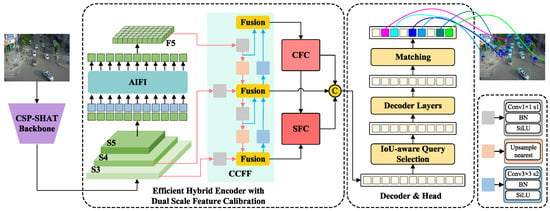
As Figure 1 shows that CDF-DETR is a compact end-to-end detector built for UAV remote sensing imagery. To start with, the CSP-SHAT backbone captures multi-scale features from the input image. Inside the hybrid encoder, the fused deep features go through the CFC module, which takes care of contextual calibration; after that, the calibrated output is combined with shallow features and sent to the SFC module for spatial calibration. On top of that, the detector adopts Focaler-MPDIoU, a loss that merges MPDIoU [33] and Focaler-IoU [34] to jointly handle geometric localization refinement and IoU-quality-based sample reweighting, both of which are essential for dense small-object detection.
Figure 1.
Architecture of the CDF-DETR model.
These three components sit at different stages of the detector. Specifically, the CSP-SHAT backbone strengthens representation by fusing convolutional local feature extraction with partial-channel self-attention; the DSFC module, placed in the neck, calibrates contextual semantic responses and spatially sensitive shallow features ahead of multi-scale fusion; and the Focaler-MPDIoU loss, applied only during training, supplies localization supervision by means of corner-distance constraints and IoU-quality-based sample reweighting. Taken together, this setup ties feature extraction, feature calibration, and bounding-box optimization together inside the RT-DETR detection pipeline.
3.2. CSP-SHAT Backbone Network
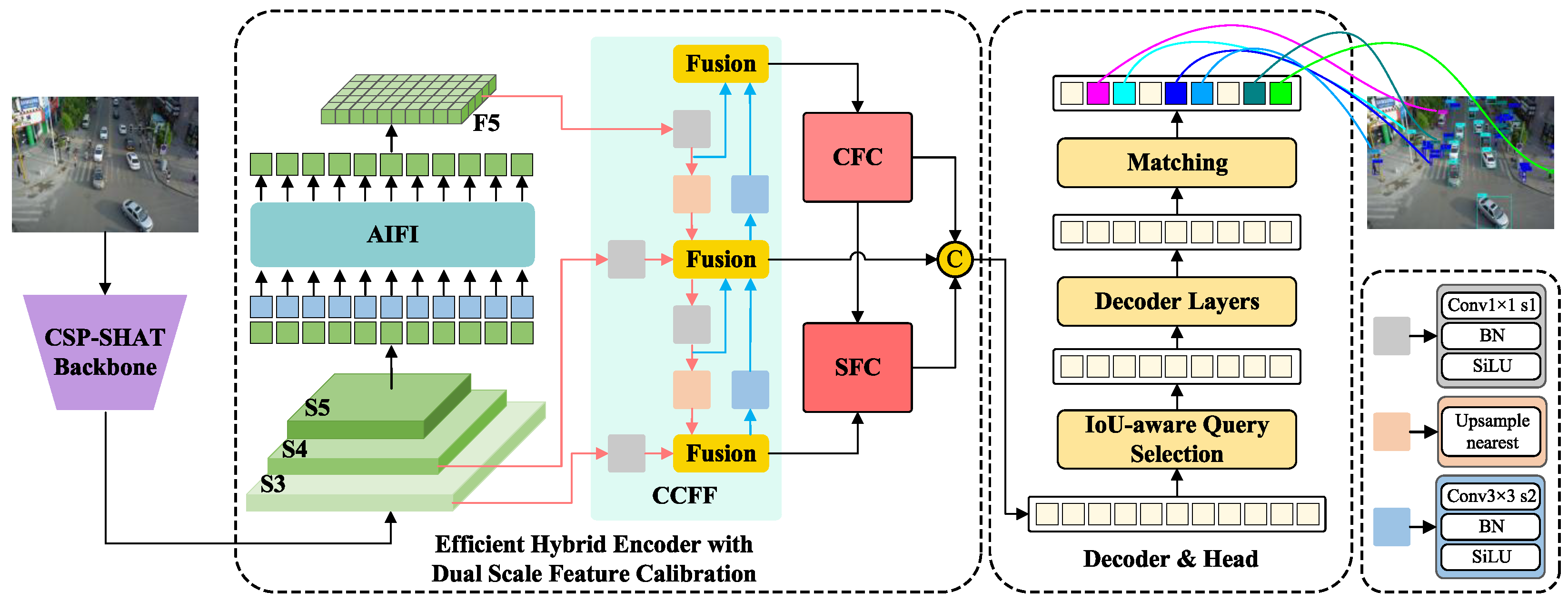
As illustrated in Figure 2, this study introduces a hybrid CNN–Transformer backbone called CSP-SHAT, which integrates the Cross-Stage Partial (CSP) [30] concept. The backbone is built to pull out features from UAV remote sensing imagery in an efficient manner while keeping computational cost and parameter complexity down. It is made up of a convolutional stem and four stages that follow, and a convolutional downsampling layer sits right before each of these stages.
Figure 2.
Architecture of the CSP-SHAT backbone network.
CSP-SHAT draws on the cross-stage feature-partitioning principle of CSPNet [30] and the efficient local-to-global design of SHViT [31], but it is not a direct reproduction of either architecture. In CSP-SHAT, these principles are reorganized according to the multi-level feature hierarchy required by RT-DETR. Specifically, the original ResNet-18 backbone is replaced with a four-stage architecture in which Stages 1–2 employ CSP-based convolutional blocks to preserve high-resolution local details, whereas Stages 3–4 incorporate partial-channel single-head attention into the transformed CSP branch for selective global interaction. In addition, the conventional channel-mixing operation is replaced with ECGLU, which introduces a dilated convolution into the gating branch to enhance local spatial interaction. The attended-channel ratio is set to based on the detection-specific analysis in Section 4.3. Therefore, the contribution of CSP-SHAT lies in the stage-wise restructuring and coordinated use of cross-stage propagation, selective global attention, and gated local interaction for the RT-DETR detection backbone, rather than in proposing the individual CSP or single-head-attention operations.
The original RT-DETR-R18 backbone [19] stacks three ConvNormLayers and then applies max pooling, a setup that brings extra computational and memory costs and can throw away fine-grained spatial information. The proposed convolutional stem, by contrast, is made up of two stacked convolutional blocks (stride 2), each followed by normalization and a SiLU activation. Keeping the layer count low, this simpler design still carries out normalized nonlinear feature extraction while cutting down the associated computational and memory requirements.
Previous work [31] suggests that convolution can take the place of attention in early network stages and that using multiple attention heads may turn out to be redundant later on. With these observations in mind, the CSP-SHAT block adopts a Cross-Stage Partial (CSP) structure: the input feature map is split into two branches, one that extracts features and another that simply skips the transformation, after which the two branches are concatenated. This arrangement trims computation and memory usage while keeping cross-stage information flowing. Stages 1–2 rely on CSP-based convolutional blocks to pull out local features, whereas Stages 3–4 switch to SHAT blocks, where single-head self-attention operates on only a subset of the channels and the rest of the channels are kept unchanged.
Processing only a portion of the channels reduces the computation and memory access tied to multi-head attention, and at the same time the unprocessed channels still carry forward their information. This design fits the nature of UAV imagery, where small foreground objects often sit within large background regions. Limiting self-attention to a channel subset helps curb redundant background interactions, while the convolutional branch continues to hold onto the local details needed for small-object representation. In the later backbone stages, CSP-SHAT therefore strikes a balance between contextual modeling and model compactness.
3.3. SHA Transformer Block
As shown in Figure 2, the SHA transformer block includes a depthwise convolution (DWConv) layer for local feature aggregation and conditional positional embedding, a partial single-head self-attention (PSHA) layer for global context modeling, and an enhanced convolutional gated linear unit (ECGLU) for channel interaction. DWConv and PSHA capture local and global dependencies, respectively, whereas ECGLU mixes information across channels. Residual connections are used for both the DWConv and PSHA layers.
3.3.1. PSHA Module
The PSHA module, shown in the lower-right portion of Figure 2, applies single-head attention to a subset of the input channels () for spatial feature aggregation, while the remaining channels bypass the attention operation and remain unchanged. The experiments in Section 4 show that is the preferred setting. PSHA is formulated as follows:
where , , , and denote the projection weights, and denotes the query and key dimension, which is set to 16 by default. denotes concatenation along the channel dimension. The first channels are selected for attention processing to preserve contiguous memory access. The final projection in PSHA is applied to all channels, allowing the attention-enhanced features to interact with the residual channels.
3.3.2. ECGLU Module
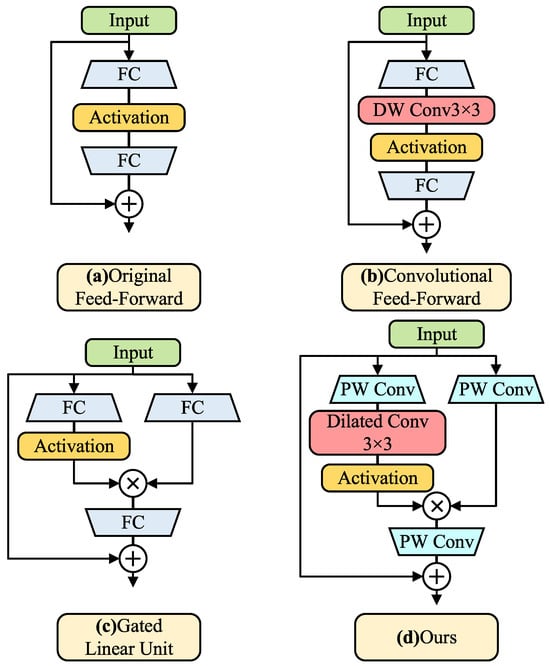
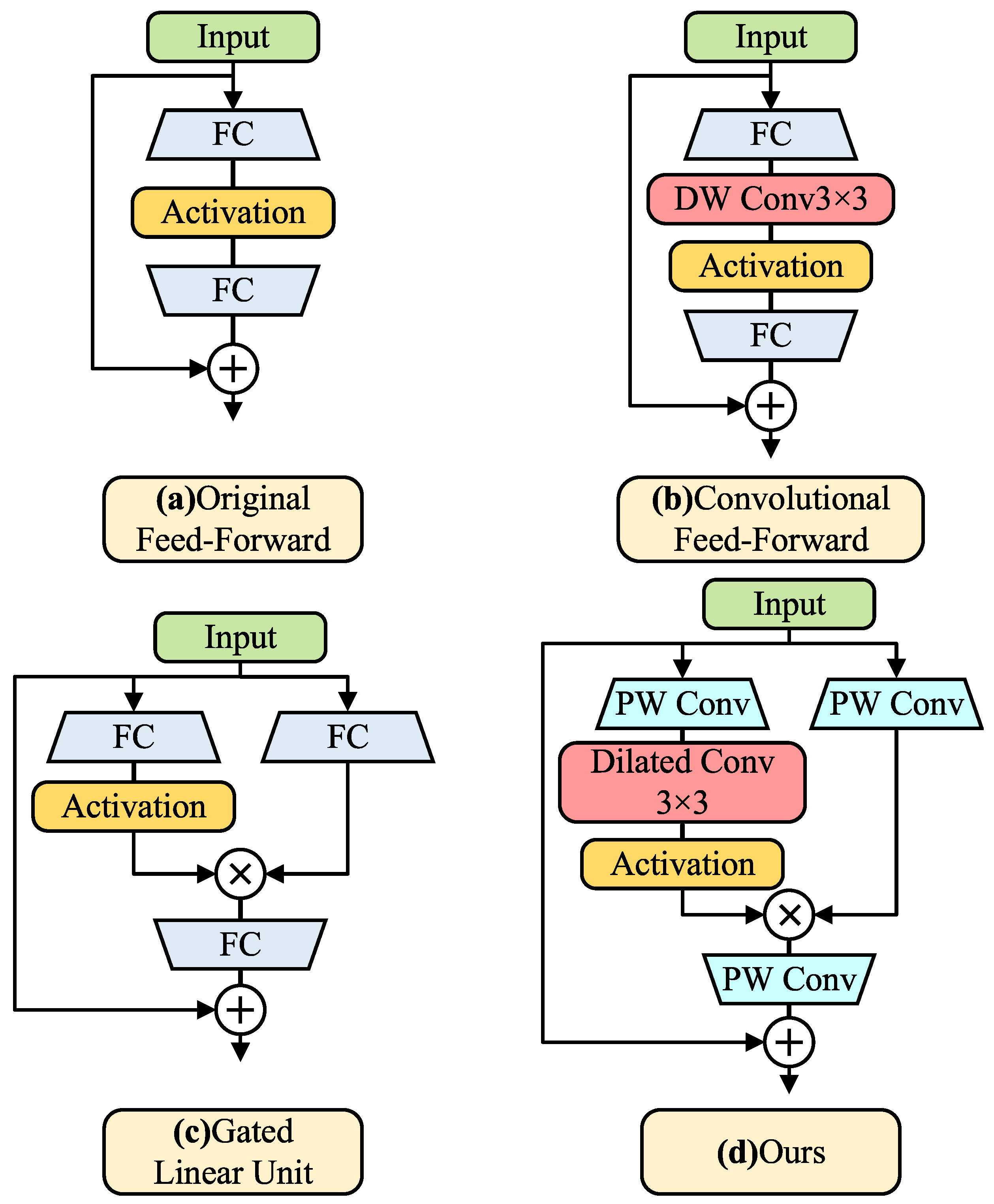
As shown in Figure 3, a conventional feedforward network (FFN) uses two fully connected layers and nonlinear activation functions for channel-wise interaction but does not explicitly capture local spatial relationships. ECGLU is therefore developed based on the gated linear unit (GLU) [37]. It replaces the fully connected layers with pointwise convolutions (PW Convs) for channel projection and interaction while preserving spatial resolution, and inserts a dilated convolution before the activation function in the gating branch. This configuration preserves spatial information and enlarges the receptive field while keeping the parameter count under control.
Figure 3.
Different channel mixer designs and the ECGLU module. PW Conv denotes a pointwise convolution.
3.4. DSFC Neck
Based on the feature calibration strategy used in dense prediction [32], the DSFC neck is designed to refine multi-scale features for UAV object detection. Here, calibration refers to feature-level calibration within the detector rather than radiometric or geometric calibration between sensors or images. DSFC comprises a Contextual Feature Calibration (CFC) module and a Spatial Feature Calibration (SFC) module. CFC performs contextual aggregation and feature refinement, whereas SFC predicts spatial offsets and adaptively fuses multi-level features to improve spatial alignment.
DSFC adapts the Context and Spatial Feature Calibration principles originally developed for semantic segmentation in CSFCN [32] to the RT-DETR detection pipeline. The underlying calibration operations are retained, but their feature inputs, pooling organization, and integration position are modified according to the RT-DETR feature hierarchy. Specifically, CFC processes the fused deep feature using parallel aspect-ratio-adaptive pyramid pooling, contextual attention, and local spatial refinement. The resulting context-calibrated feature is then paired with the corresponding shallow localization feature in SFC, where separate offsets and adaptive fusion weights are predicted before grouped deformable resampling and fusion. Compared with the original segmentation-oriented design, DSFC replaces cascaded context pooling with parallel aspect-ratio-adaptive pooling and embeds the calibration pathway before cross-level fusion in the RT-DETR hybrid encoder. Thus, its methodological contribution lies in adapting the calibration inputs and feature flow to shallow–deep feature alignment for UAV small-object detection, rather than in claiming the underlying calibration operators as entirely new.
3.4.1. CFC Module
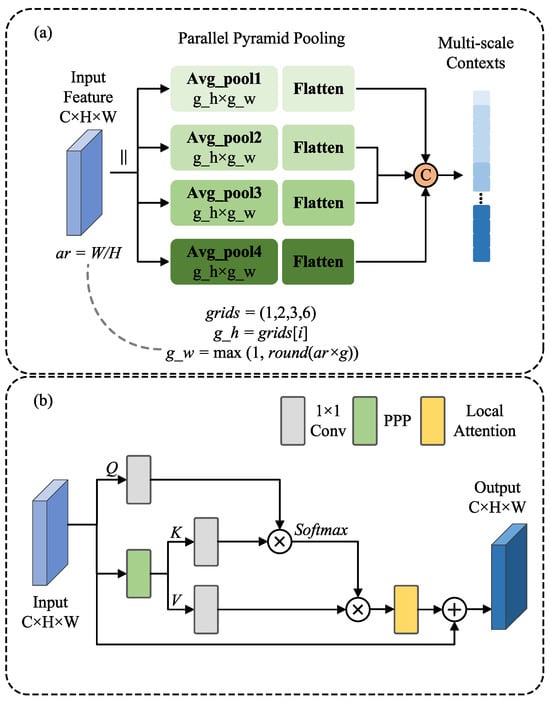
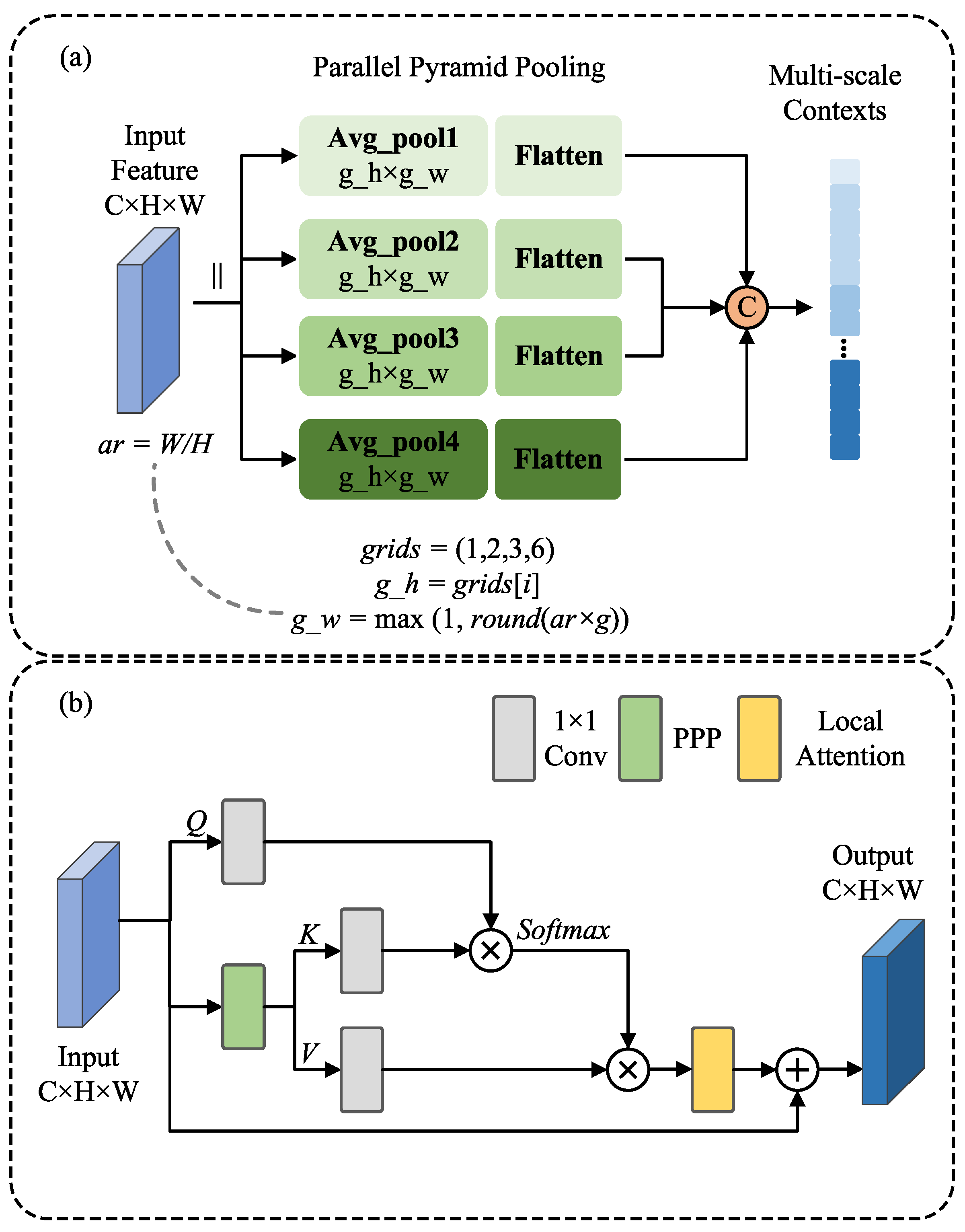
As shown in Figure 4, the CFC module uses a global–local collaborative feature calibration mechanism consisting of (a) a multi-scale context extraction layer, (b) a dynamic attention fusion layer, and a local spatial refinement layer.
Figure 4.
CFC module: (a) parallel multi-scale pyramid pooling; (b) contextual attention and local feature refinement.
As shown in Figure 4a, the multi-scale context extraction layer uses an improved parallel pyramid pooling module (PPPModule) to capture cross-scale contextual information. This module supports configurable grid partition settings, with default values of 1, 2, 3, and 6, and determines the adaptive pooling windows according to the aspect ratio of the input feature map. Given an input feature map , the module uses the following parallel aspect-ratio-adaptive pooling strategy:
where denotes the predefined grid sizes . The multi-scale pooled features are concatenated along the spatial dimension to form the context representation , which retains global semantic information at multiple scales.
The dynamic attention fusion layer uses cross-attention to perform context-adaptive feature fusion. It consists of dual-path projections followed by scaled dot-product attention. The attention operation is given by Equation (3), and the dual-path projections are defined as follows:
The Local Spatial Refinement Layer improves detail preservation through the Local Attention Module (LocalAttenModule), which generates an attention mask using a two-stage convolutional process: (1) a convolution reduces the channel dimension while preserving spatial relationships, followed by (2) a depthwise convolution that forms local receptive fields. The resulting spatial attention weights are then transformed using a tanh activation, as follows:
where denotes a convolution, denotes the SiLU activation function, and denotes the input feature map. The features are then enhanced through a residual connection:
3.4.2. SFC Module
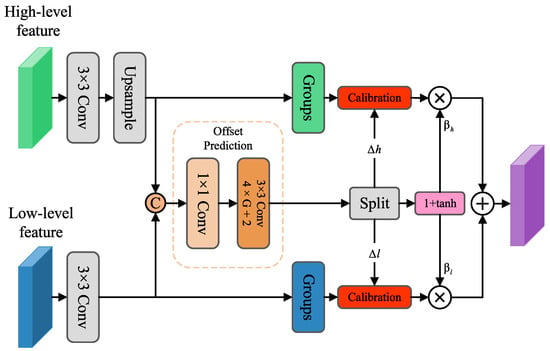
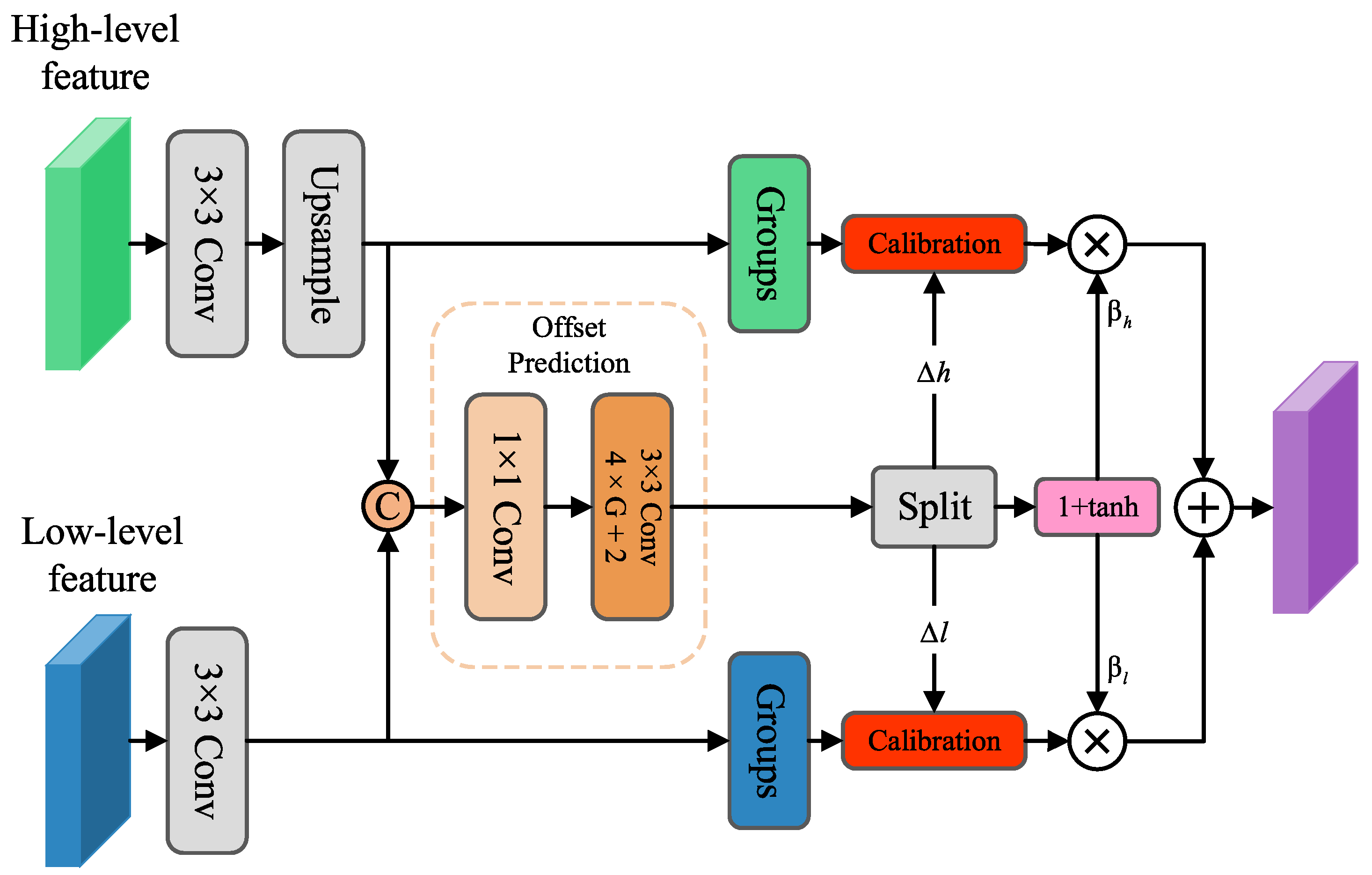
As shown in Figure 5, the SFC module uses a deformable alignment strategy to correct feature-space misalignment through geometric deformation. Here, calibration refers to feature-level refinement among multi-level feature maps extracted from the same input image, rather than calibration across different images or sensor outputs. Specifically, the high-level semantic feature is first resized to match the spatial resolution of the low-level feature. The two features are then concatenated to predict separate spatial offsets for the two feature levels, together with adaptive fusion weights. Finally, grouped deformable resampling is used to align the features, after which they are combined through adaptive weighted fusion.
Figure 5.
The details of the Spatial Feature Calibration module.
A dual-branch convolutional structure first processes the input features from the two scales separately. The high-level semantic features are compressed using a convolution and then upsampled by bilinear interpolation to match the spatial resolution of the low-level features. In the other branch, a convolution refines the low-level features while retaining their spatial details. The two branch operations are expressed as follows:
A cascaded convolutional network then predicts the spatial transformation parameters. Depthwise separable convolutions first process the concatenated features, followed by a convolution with output channels that predicts the dynamic offsets and fusion weights:
Here, G denotes the number of groups. The first channels encode and , which represent the x- and y-axis offsets for the low-level and high-level features, respectively. The final two channels, denoted by , are used to compute the attention weights. Xavier normal initialization is used, with the weights of the offset convolutional layers drawn from a zero-mean distribution.
The introduction of the grouped deformable convolution mechanism divides the features into G decoupled subspaces. A normalized grid coordinate system is used to generate the base sampling grid, and the predicted offset parameters are superimposed to construct the deformed sampling points. Bilinear interpolation is employed to perform feature map resampling. The mathematical expression is as follows:
where and denote the bilinear interpolation kernels, and denotes the sampling neighborhoods.
The aligned features are then fused using two attention weights. The transformed weights are constrained to the interval using the hyperbolic tangent function, and the fusion operation is defined as follows:
3.5. Loss Function
The original framework uses the Generalized Intersection over Union (GIoU) loss for bounding-box regression. GIoU extends IoU by considering both the overlap between the predicted and ground-truth boxes and their smallest enclosing box [38]. However, overlap-based losses may provide limited geometric discrimination when the predicted and ground-truth boxes have similar overlap values but differ in corner positions or scale. To provide more explicit geometric supervision, the minimum-point-distance-based IoU metric (MPDIoU) incorporates the distances between corresponding corner points. MPDIoU is formulated as follows:
where A and B denote the predicted and ground-truth bounding boxes, respectively; and are the Euclidean distances between the corresponding top-left and bottom-right corner points of the two boxes; and w and h denote the width and height of the input image. The corresponding MPDIoU loss is
To reweight regression samples according to their IoU quality, Focaler-IoU employs a linear interval mapping. The formulation is
The term is governed by modulation parameters satisfying . Following the default setting in the official Focaler-IoU implementation, and are used in all experiments. The derivative of the Focaler-IoU mapping with respect to IoU is
At the two breakpoints, and , the mapping is not differentiable; in practical implementation, the branch selected by the piecewise function provides the corresponding subgradient. Within the active interval, the Focaler mapping has a slope of with respect to IoU. With and , this coefficient is approximately , whereas the mapped IoU component becomes saturated above u.
It should be emphasized that this mapping-level derivative characterizes only the local sensitivity of the mapped IoU component. It does not directly determine the gradient magnitude of the complete bounding-box regression objective with respect to the predicted box coordinates, because the complete regression objective also contains the term and the geometric terms introduced by the overlap loss. Therefore, the coordinate-level gradient behavior of the complete regression objective is further examined in Section 4.2.4. The corresponding Focaler-IoU loss is defined as follows:
MPDIoU and Focaler-IoU serve different roles in this study. MPDIoU introduces corner-distance constraints to provide explicit geometric supervision for bounding-box regression, whereas Focaler-IoU modulates the contribution of regression samples according to their IoU values. In Focaler-MPDIoU, the point-distance penalty from MPDIoU is retained, while the original IoU term is replaced with its interval-mapped counterpart. The resulting regression objective therefore combines coordinate-sensitive geometric supervision with IoU-dependent gradient modulation.
The complete training objective retains the RT-DETR classification, bounding-box, and decoder auxiliary losses, while replacing the original GIoU term with Focaler-MPDIoU:
The matching strategy and loss coefficients are kept consistent with the RT-DETR-R18 baseline configuration to isolate the effect of the proposed regression term. Because the Focaler mapping modifies only one component of the complete regression objective, its effect on coordinate-level optimization cannot be inferred from the mapping derivative alone. The gradient behavior of the complete bounding-box regression objective is therefore evaluated experimentally in Section 4.2.4.
Focaler-MPDIoU combines MPDIoU with Focaler-IoU. It is designed to reduce localization instability associated with densely distributed small objects, occlusion, and background interference through coordinate-sensitive optimization and IoU-dependent sample reweighting. The Focaler-MPDIoU procedure is summarized in Algorithm 1.
| Algorithm 1 Focaler-MPDIoU as Bounding Box Loss |
|
4. Experiments and Results
4.1. Experimental Setup
4.1.1. Datasets
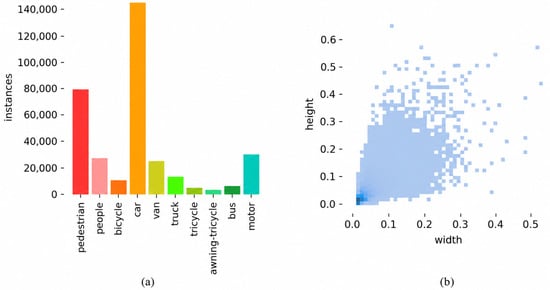
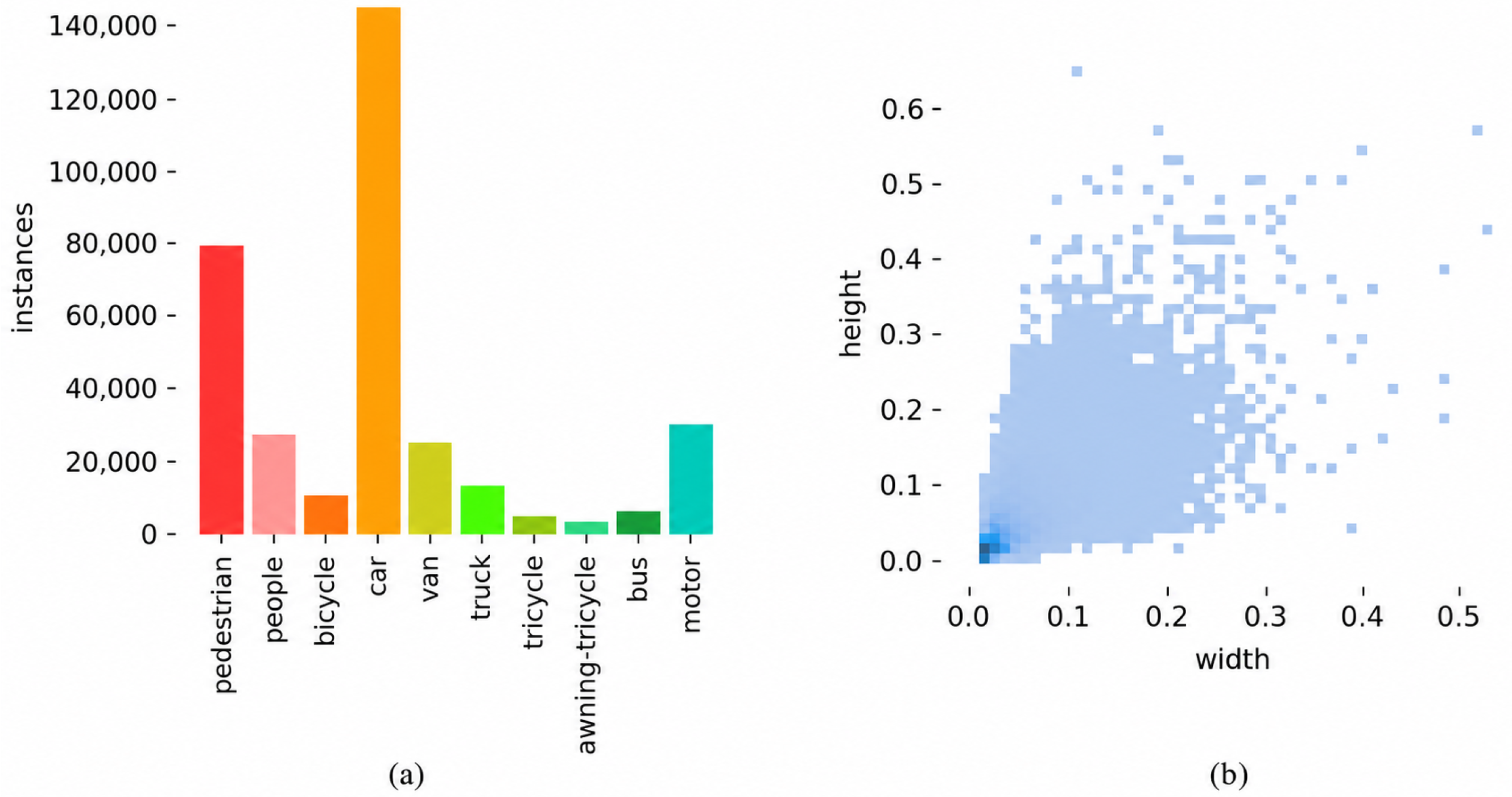
VisDrone-2019 Dataset. The VisDrone-2019 benchmark [39], developed by the AISKYEYE research group at Tianjin University, contains 288 temporally annotated video sequences, 261,908 sampled frames, and 10,209 high-resolution images. The UAV imagery was collected across 14 cities in China and covers urban and rural environments, multiple object categories, and different crowd densities. More than 50% of the annotated objects occupy fewer than 1024 pixels, corresponding to an area smaller than pixels, which makes small-object detection a major challenge on this dataset. The dataset also contains considerable variation in object scale, viewing angle, and degree of occlusion. Figure 6 shows the distributions of object categories and sizes in the dataset.
Figure 6.
Distribution of objects in VisDrone-2019. (a) Distribution of dataset categories. (b) Distribution of object sizes in the dataset.
The official dataset split includes 6471 training images, 548 validation images, and 1610 test images. The training set is used for model optimization, the validation set for hyperparameter selection, and the test set for final performance evaluation.
UAVDT Dataset. The Unmanned Aerial Vehicle Detection and Tracking (UAVDT) dataset [40], jointly developed by The Chinese University of Hong Kong and SenseTime, is a large-scale benchmark for UAV-based visual perception. It contains 80,000 frames from continuous video sequences captured along urban roads, highways, and densely built-up areas under different illumination and weather conditions. The annotations include three object categories: cars, trucks, and buses.
To reduce temporal redundancy between adjacent video frames, one frame is retained every 20 frames, following the sampling protocol in Ref. [41]. Sampling is performed within each official sequence split to preserve the original sequence assignments. The resulting temporally subsampled UAVDT subset contains 1414 training images, 404 validation images, and 202 test images.
HIT-UAV Dataset. HIT-UAV [42] is a high-altitude infrared thermal imaging dataset for UAV-based object detection. It contains 2898 images extracted from 43,470 video frames captured over schools, parking lots, roads, and playgrounds. The dataset annotates five categories of densely distributed small objects, including people, vehicles, and bicycles. The dataset also supports evaluation in low-light scenarios, including nighttime traffic monitoring. The official dataset split is used, with 2029 training images, 290 validation images, and 579 test images.
4.1.2. Implementation Details
All experiments were conducted using the hardware and software configuration listed in Table 1. The models were implemented using Ultralytics 8.0.201 and PyTorch 2.1.0 on Windows 10 and trained on an NVIDIA RTX A6000 GPU with CUDA 11.8. Adam [43] was used with an initial learning rate of , , and a weight decay of . Input images were resized to pixels, the batch size was set to 8, and the models were trained for up to 300 epochs with early stopping if no improvement was observed for 20 consecutive epochs. Unless otherwise specified, the RT-DETR-R18 settings for data processing, assignment, and loss coefficients were kept unchanged so that each ablation experiment differed only in the component being evaluated. The end-to-end prediction process of RT-DETR was retained without non-maximum suppression, and the models were selected based on validation-set mAP.
Table 1.
Experimental system environment.
4.1.3. Evaluation Metrics
To evaluate model performance, we followed the evaluation protocol established by PASCAL VOC [44]. The main evaluation metrics are precision (P), recall (R), average precision (AP), and mean average precision (mAP). Precision and recall are defined based on the confusion matrix, which incorporates false positives (FP), true positives (TP), false negatives (FN), and true negatives (TN), as described below:
where TP denotes correctly detected objects, FP denotes predicted detections that do not correspond to a ground-truth object of the predicted class, and FN denotes ground-truth objects that are not correctly detected. Precision–recall curves are generated from the resulting precision and recall values, and average precision is calculated as the area under each precision–recall curve. Mean average precision is the mean of the AP values across all object classes. The formulas for AP and mAP are:
where denotes the number of object classes. Specifically, mAP@0.5 is calculated at an intersection-over-union (IoU) threshold of 0.5, whereas mAP@0.5:0.95 is averaged over IoU thresholds ranging from 0.5 to 0.95 in increments of 0.05.
In addition to detection performance, computational cost is evaluated in terms of the number of learnable parameters and FLOPs. The parameter count is reported in millions (M), while FLOPs estimate the computational workload of a single forward pass at the specified input resolution.
4.2. Ablation Studies
4.2.1. Component Ablation
Ablation experiments were conducted on the VisDrone-2019 validation set using RT-DETR-R18 as the baseline and a consistent evaluation protocol to assess the contributions of CSP-SHAT, DSFC, and Focaler-MPDIoU. Both detection performance and computational cost were considered. The results are reported in Table 2.
Table 2.
Component ablation results on the VisDrone-2019 validation set under the unified local protocol.
Replacing ResNet-18 with CSP-SHAT increases mAP@0.5:0.95 from 26.20% to 27.55% and APS from 18.40% to 19.66%, while reducing the parameter count from 19.88 M to 13.54 M and FLOPs from 56.98 G to 49.98 G. These results suggest that convolutional processing in the early stages and partial-channel single-head attention in the later stages support multi-scale feature representation without applying global attention to every channel. Using DSFC alone also increases mAP@0.5:0.95 and APS to 27.05% and 19.09%, respectively, suggesting that feature calibration benefits small-object representation. Combining CSP-SHAT and DSFC further increases mAP@0.5:0.95 to 27.82%. Among the evaluated configurations, the complete CDF-DETR model achieves the highest detection performance, with mAP@0.5:0.95, mAP@0.5, and APS reaching 28.52%, 47.14%, and 20.34%, respectively. Compared with RT-DETR-R18, the complete model improves mAP@0.5:0.95 by 2.32 percentage points and APS by 1.93 percentage points, while reducing the parameter count by 25.7%. Its FLOPs, however, increase slightly from 56.98 G to 58.49 G. This suggests that the main efficiency gain of CDF-DETR lies in its lower parameter count rather than reduced FLOPs or faster inference in an unoptimized PyTorch environment. The ablation results support the complementary roles of feature extraction, feature calibration, and localization optimization in UAV small-object detection.
4.2.2. Analysis of Dual-Scale Feature Calibration
To further examine the internal structure of DSFC, the CFC and SFC modules were evaluated separately and in combination using RT-DETR-R18 as the baseline. As shown in Table 3, CFC and SFC have different effects on detection performance. Using CFC alone slightly increases mAP@0.5:0.95 from 26.20% to 26.39%. This result suggests that contextual aggregation provides useful semantic information, although its effect on small-object localization is limited when used alone. Using SFC alone produces a larger increase, raising mAP@0.5:0.95 to 26.79%. This result suggests that spatial offset prediction and dynamic multi-level fusion are more closely associated with localization-sensitive feature refinement. Combining CFC and SFC further increases mAP@0.5:0.95 to 27.05% and APS to 19.09%. These results suggest that jointly calibrating contextual semantics and spatial details is more effective than using either calibration module alone for UAV small-object detection.
Table 3.
Ablation results of the CFC and SFC branches in DSFC on the VisDrone-2019 validation set.
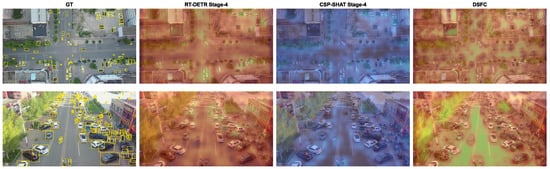
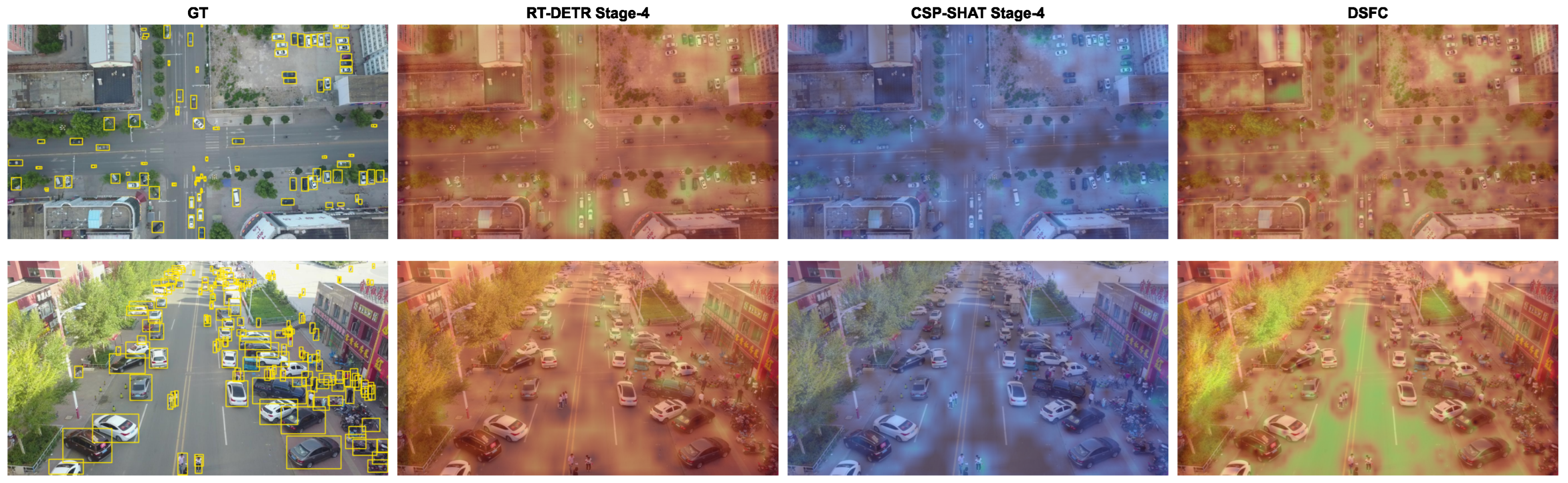
To complement the quantitative ablation results, Figure 7 presents representative module-level feature-response maps on VisDrone scenes. The ground-truth annotations are included to facilitate comparison between the feature-response regions and actual object locations. Compared with the Stage-4 response of RT-DETR-R18, CSP-SHAT exhibits a less diffuse response distribution over large background regions while retaining responses around target-related areas. This qualitative observation is consistent with the component ablation results in Table 2, where CSP-SHAT improves mAP@0.5:0.95 from 26.20% to 27.55% and APS from 18.40% to 19.66%.
Figure 7.
Representative feature-response maps of RT-DETR-R18, CSP-SHAT, and DSFC on VisDrone scenes. Yellow boxes denote ground-truth bounding boxes.
The DSFC response maps further show the feature distribution obtained after contextual and spatial calibration. Consistent with the ablation results in Table 3, combining CFC and SFC provides better overall performance than using either branch alone, indicating the complementary roles of contextual aggregation and spatial alignment in multi-level feature refinement.
4.2.3. Effect of Localization Loss
The localization losses were evaluated using CSP-SHAT+DSFC as the fixed detector architecture. As shown in Table 4, replacing GIoU with MPDIoU increases mAP@0.5:0.95 from 27.82% to 28.02%, whereas Focaler-IoU raises it to 28.21%. Among the compared losses, Focaler-MPDIoU achieves the highest mAP@0.5:0.95, mAP@0.5, , and . These results suggest that the corner-distance constraints and IoU-dependent regression weighting provide complementary benefits for localization optimization. MPDIoU, however, achieves a slightly higher APS than Focaler-MPDIoU. This result suggests that the gains from the proposed loss are not uniform across object scales, despite its stronger overall performance.
Table 4.
Ablation results of different localization losses on the VisDrone-2019 validation set.
4.2.4. Coordinate-Level Gradient Analysis of Localization Loss
To further examine the optimization behavior of the localization losses, we analyze the gradient of the complete bounding-box regression objective rather than the derivative of the IoU mapping alone. Consistent with the training configuration, the regression objective is defined as
where is instantiated as GIoU, MPDIoU, Focaler-IoU, or Focaler-MPDIoU. The term and the corresponding loss coefficients are kept identical for all four variants, such that only the overlap-based regression term is changed.
For each perturbed predicted bounding box , the coordinate-level gradient magnitude is calculated as
where denotes the predicted bounding-box parameters, with representing the box center and w and h denoting its width and height.
Two reference bounding-box sizes, and pixels, are considered to examine the influence of target scale. Predicted boxes are generated using center-position, scale, and aspect-ratio perturbations and are subsequently grouped into five IoU intervals according to their overlap with the corresponding ground-truth box. A total of 9608 perturbed bounding boxes are evaluated. To prevent differences in the number of samples for individual perturbation types from dominating the statistics, the gradient norms for the three perturbation types are first averaged separately and then equally macro-averaged within each IoU interval.
As shown in Table 5, Focaler-MPDIoU does not uniformly produce larger coordinate-gradient norms than GIoU for low-IoU samples. Instead, its gradient behavior changes with localization quality. For both object sizes, GIoU produces larger gradient norms in the low-IoU intervals, while the difference between GIoU and Focaler-MPDIoU gradually decreases as IoU increases within the active Focaler interval. In the – interval, Focaler-MPDIoU produces a slightly larger gradient norm than GIoU for both object sizes.
Table 5.
Coordinate-level gradient norms of different complete regression objectives across IoU ranges.
The comparison between MPDIoU and Focaler-MPDIoU further illustrates the effect of the interval mapping on the complete regression gradient. Within the active Focaler interval, Focaler-MPDIoU generally produces moderately larger coordinate-gradient norms than MPDIoU. For example, for objects in the – interval, the gradient norm increases from with MPDIoU to with Focaler-MPDIoU. This difference is consistent with the moderate rescaling introduced by the Focaler mapping within its active interval.
Once IoU exceeds the upper threshold , the mapped IoU component becomes saturated and no longer contributes an overlap-related gradient. Consequently, the gradient norms of Focaler-IoU and Focaler-MPDIoU decrease substantially in the – interval. Because the analysis is based on the complete regression objective rather than the overlap loss alone, the gradient does not become zero after saturation. The remaining optimization signal is mainly contributed by the common term and, for Focaler-MPDIoU, the retained corner-distance constraint.
These results indicate that Focaler-MPDIoU should not be interpreted as a general hard-sample gradient-amplification mechanism. Instead, it changes the distribution of the regression gradient according to localization quality while retaining explicit coordinate-sensitive geometric supervision. It should also be noted that a larger gradient norm does not necessarily indicate a better regression objective; the gradient analysis is intended to characterize how optimization signals are distributed across different localization-quality ranges. Together with the localization-loss ablation results in Table 4, these observations suggest that the IoU-dependent modulation introduced by Focaler-IoU and the corner-distance constraints introduced by MPDIoU provide complementary supervision for bounding-box regression.
4.3. Partial-Ratio Analysis of the SHAT Block
The PSHA module applies single-head attention to only a subset of the input channels (), while the remaining channels bypass the attention operation and remain unchanged. To determine an appropriate partial-channel ratio, the ResNet-18 backbone in RT-DETR-R18 was replaced with CSP-SHAT, and four ratio settings were evaluated on the VisDrone-2019 validation set using the same protocol. As shown in Table 6, the 1/6 setting achieves the highest mAP@0.5:0.95 and APS, while retaining a relatively low parameter count and computational cost. Although the 1/4 setting achieves a slightly higher mAP@0.5, the 1/6 setting offers a more favorable trade-off among overall detection accuracy, small-object detection performance, and model complexity. The partial-channel ratio of PSHA is therefore set to 1/6 in the final model.
Table 6.
Partial-ratio analysis of PSHA on the VisDrone-2019 validation set.
4.4. Comparison with State-of-the-Art Methods
The preceding ablation studies evaluated the contribution of each component on the VisDrone-2019 validation set using the consistent experimental protocol described in Section 4.1.2. To place CDF-DETR in the context of representative object detection methods evaluated on the VisDrone-2019 test set, Table 7 presents the comparison results. RT-DETR-R18 and CDF-DETR were trained and evaluated using the same software and hardware configuration, input size, optimizer, training schedule, data-processing strategy, and model-selection criterion. The results for the other methods were taken from previous publications or other publicly available sources. These methods may therefore differ in their training platforms, implementation frameworks, input resolutions, optimization settings, data-augmentation strategies, testing conditions, post-processing procedures, and evaluation details. For this reason, the literature-reported results are included for contextual comparison rather than treated as a strictly controlled benchmark.
Table 7.
Comparison with representative object detection methods on the VisDrone-2019 test set.
As shown in Table 7, CDF-DETR achieves 40.4% mAP@0.5 with 14.78 M parameters and 58.5 G FLOPs. Under the same experimental setting, CDF-DETR increases mAP@0.5 from 37.3% to 40.4% relative to RT-DETR-R18, while reducing the parameter count from 19.88 M to 14.78 M. Relative to the reported results for Faster R-CNN, Cascade R-CNN, RetinaNet, TOOD, and GFL, CDF-DETR shows higher mAP@0.5 with lower parameter counts and FLOPs. Compared with the listed YOLO-series methods, CDF-DETR reports higher mAP@0.5, although several lightweight YOLO variants have lower parameter counts and FLOPs. Drone-DETR and AMFEF-DETR report higher mAP@0.5 than CDF-DETR, but their reported FLOPs are substantially higher. These results show that CDF-DETR improves upon the directly controlled RT-DETR-R18 baseline under the same experimental setting and offers a competitive accuracy–complexity trade-off among the representative methods reported on the VisDrone-2019 test set.
To further examine class-level performance, Table 8 compares RT-DETR-R18 and CDF-DETR across the ten object categories in VisDrone-2019. Compared with RT-DETR-R18, CDF-DETR improves mAP@0.5 by 3.6, 2.2, 4.5, 2.8, 2.9, 1.5, 5.2, 1.1, 3.3, and 4.0 percentage points for the pedestrian, people, bicycle, car, van, truck, tricycle, awning-tricycle, bus, and motor categories, respectively.
Table 8.
Per-category detection performance on the VisDrone-2019 test set in terms of mAP@0.5 (%).
4.5. Qualitative Analysis
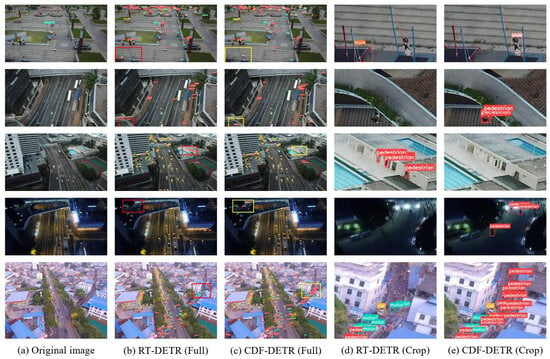
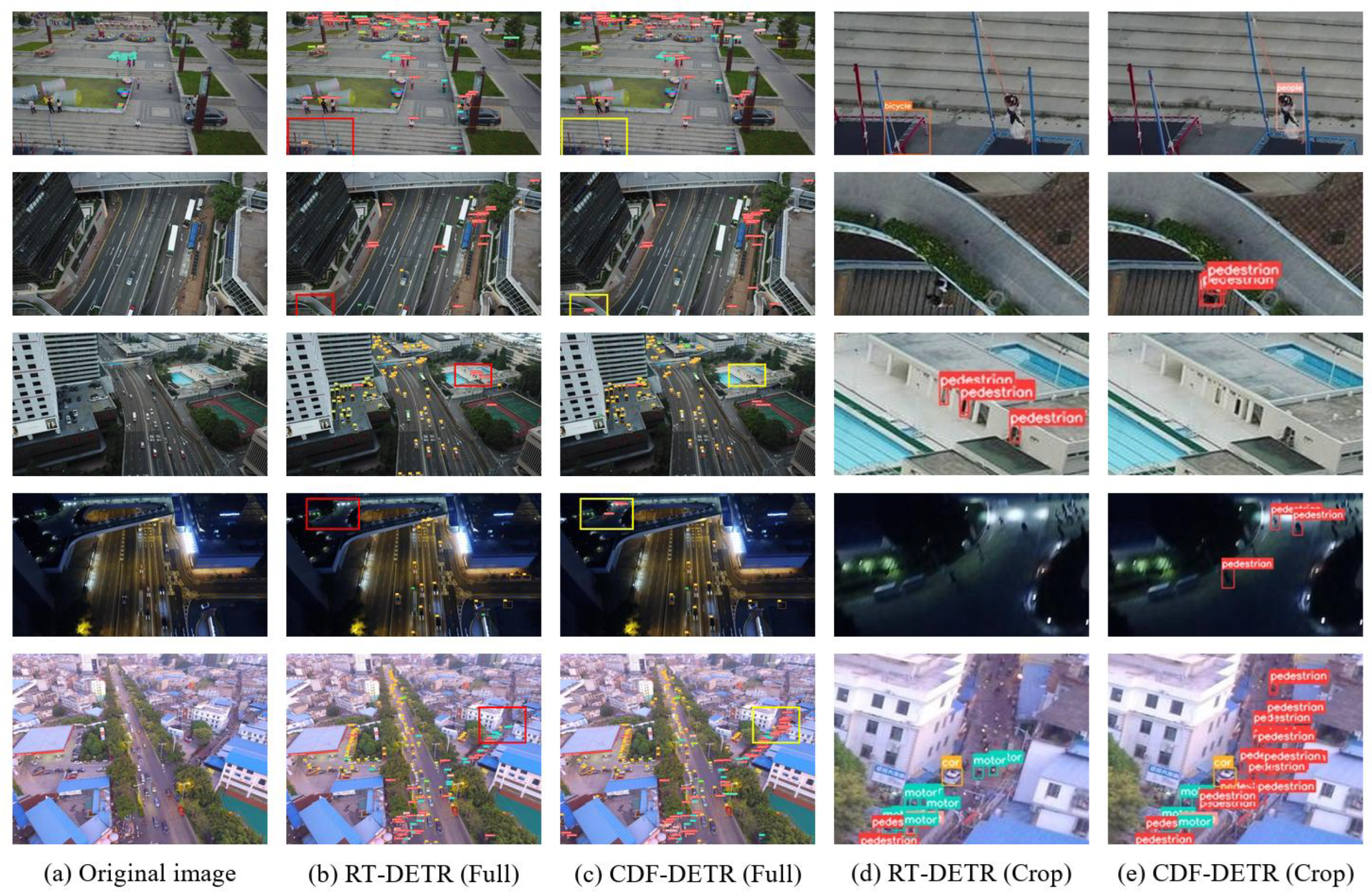
The qualitative results on the VisDrone-2019 dataset are shown in Figure 8. To make local detection differences easier to identify, each row presents the original image and the full-image detection results of RT-DETR-R18 and CDF-DETR, together with the corresponding enlarged regions. For brevity, RT-DETR-R18 is referred to as RT-DETR in this section. The red and yellow rectangles mark the regions enlarged for RT-DETR and CDF-DETR, respectively. For each scene, the two cropped regions correspond to the same image location and use the same aspect ratio, allowing a direct visual comparison between RT-DETR and CDF-DETR.
Figure 8.
Visual comparison of detection results on the VisDrone dataset with enlarged local regions.
As shown in Figure 8, RT-DETR tends to produce inaccurate or incomplete detections in regions containing densely distributed targets, distant small objects, or background textures similar to the objects. These detection errors are particularly visible at traffic intersections, on residential roads and bridges, and in nighttime urban scenes. CDF-DETR, by comparison, detects more small and densely distributed objects in the highlighted regions and produces fewer false responses from background interference. These observations are in line with the design motivations of CSP-SHAT and DSFC. CSP-SHAT combines convolutional processing with partial-channel attention to model local and global dependencies, while DSFC uses contextual and spatial calibration to reduce ambiguous background responses and combine shallow localization details with deeper semantic features.
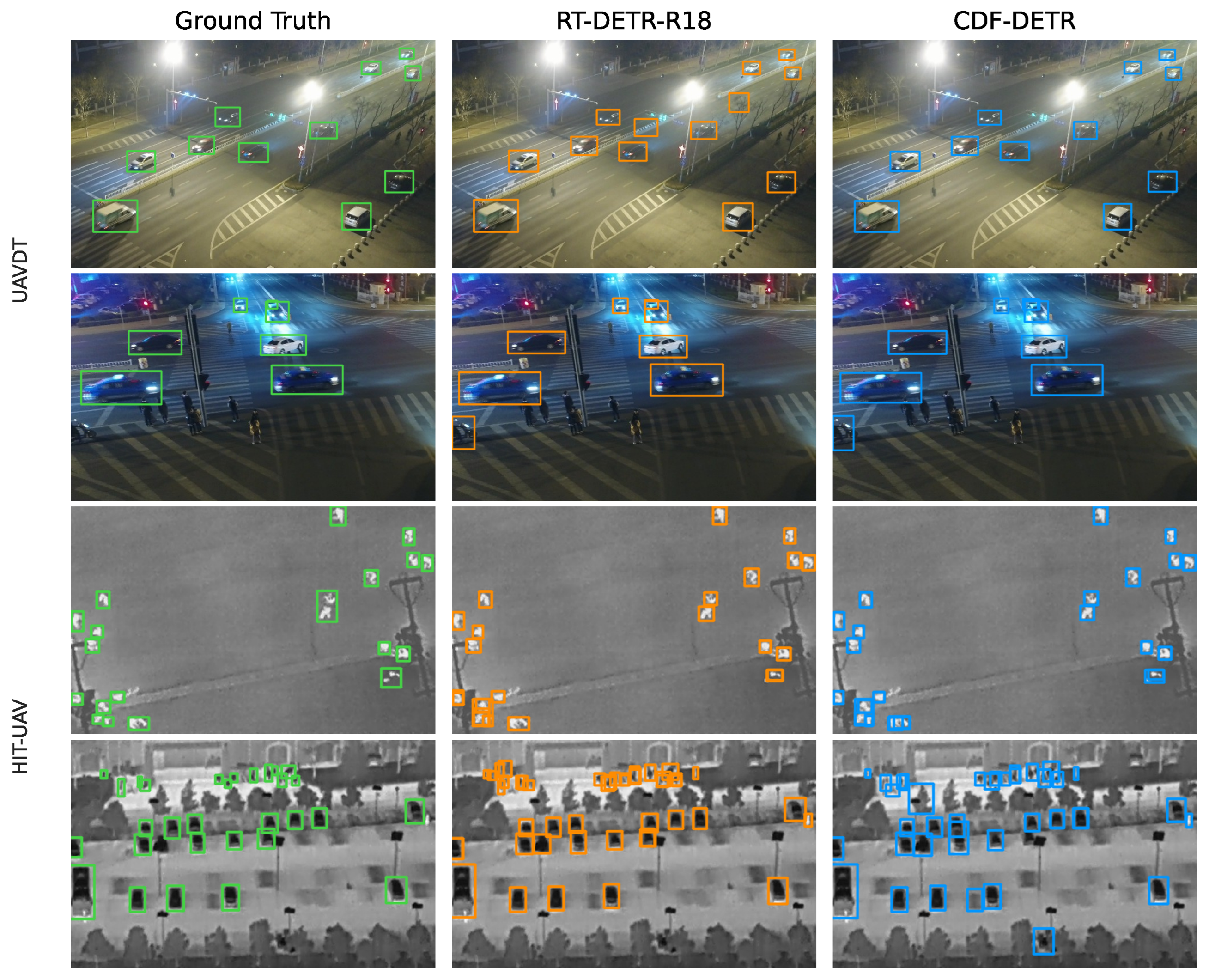
Figure 9 presents qualitative comparisons on the UAVDT and HIT-UAV datasets. The first and third rows show representative successful cases, whereas the second and fourth rows present challenging cases. In the successful UAVDT case, both RT-DETR and CDF-DETR correctly detect 11 targets, while CDF-DETR reduces the number of false positives from 2 to 0. In the successful HIT-UAV case, CDF-DETR increases the number of correct detections from 17 to 19 and reduces the number of false positives from 10 to 6.
Figure 9.
Qualitative comparison of RT-DETR-R18 and CDF-DETR on UAVDT and HIT-UAV. The examples include both successful cases and representative challenging cases involving nighttime illumination, motion blur, low contrast, dense small targets, and partial occlusion.
The challenging cases also illustrate the limitations of the proposed method. In the challenging UAVDT case, CDF-DETR correctly detects six targets with three false positives, whereas RT-DETR correctly detects seven targets with one false positive. In the challenging HIT-UAV case, CDF-DETR correctly detects 19 targets with 20 false positives, whereas RT-DETR correctly detects 26 targets with 21 false positives. These examples suggest that extremely small targets, low contrast, motion blur, and cluttered backgrounds remain challenging for both methods. CDF-DETR may still produce missed detections in such difficult scenes.
Taken together, the qualitative examples suggest that CDF-DETR can improve detection completeness and reduce some background-related false positives in selected UAV and infrared scenes. The challenging cases nevertheless show that missed detections may still occur under severe low-contrast, blurred, or densely cluttered conditions.
4.6. Multi-Dataset Validation
To further evaluate the applicability of CDF-DETR across different UAV-related detection scenarios, additional experiments were conducted on the UAVDT and HIT-UAV datasets. The models were trained and evaluated independently on each dataset. These experiments are therefore treated as multi-dataset validation rather than an evaluation of cross-dataset or cross-domain generalization.
As shown in Table 9, CDF-DETR achieves higher detection performance than RT-DETR-R18 under the respective training and evaluation settings of both datasets. On UAVDT, CDF-DETR increases from 96.9% to 98.3% and from 72.5% to 74.7%. On HIT-UAV, CDF-DETR increases from 80.2% to 83.2% and from 51.0% to 54.2%. These results suggest that the proposed detector provides consistent improvements over RT-DETR-R18 in both visible-light UAV traffic scenes and infrared UAV detection scenes.
Table 9.
Multi-dataset validation results on UAVDT and HIT-UAV.
4.7. Edge Deployment Evaluation
Edge inference was evaluated on an NVIDIA Jetson Orin Nano to assess the deployment efficiency of the proposed detector and its lightweight variant. The Jetson Orin Nano was operated in 15 W power mode. CDF-DETR-Lite was obtained through LAMP-based structured pruning with a target speedup ratio of 2.0, followed by training-only multi-decoder prediction-logic distillation using a frozen CDF-DETR-Large teacher model. This procedure reduced the model from 14.78 M parameters and 58.5 GFLOPs to 8.29 M parameters and 28.4 GFLOPs without introducing additional operations during inference.
The RT-DETR-based models and YOLOv8s were exported as static ONNX graphs with an input shape of and compiled using TensorRT 10 with a batch size of 1. FP32 TensorRT engines were used for RT-DETR-R18, CDF-DETR, CDF-DETR-Lite, and YOLOv8s so that the numerical precision was consistent across the FP32 comparison. The INT8 engine of CDF-DETR-Lite used entropy calibration with representative target-domain images, while precision-sensitive operators were allowed to remain at higher precision.
For a consistent edge-device evaluation, all models were tested on the same fixed subset containing the first 500 images of the official VisDrone2019-DET test-dev set when ordered by filename. The benchmarking protocol used an input resolution of , a batch size of 1, resize-based preprocessing, RGB input, and a confidence threshold of 0.25. Each TensorRT engine was executed for 50 warm-up runs before measurement, followed by three timed runs per image. CUDA events were used to measure TensorRT inference latency. Preprocessing, TensorRT execution, post-processing, and total latency were measured using the same timing boundaries for all models, and FPS was calculated from the average total per-image latency. The same evaluation implementation was used to calculate mAP@0.5 and mAP@0.5:0.95.
The unified benchmarking pipeline for all evaluated models included image preprocessing, TensorRT engine execution, architecture-specific output decoding, confidence filtering, bounding-box restoration, and latency measurement. TensorRT inference latency was measured using CUDA events, whereas total latency additionally included preprocessing and post-processing. The same timing boundaries were used for all models. As shown in Table 10, the full CDF-DETR model achieves the highest detection performance among the evaluated RT-DETR-based models on the fixed 500-image subset. Compared with RT-DETR-R18 on the same Jetson platform, it increases from 45.87% to 49.09% and from 26.75% to 30.74%. The higher detection performance is accompanied by increased latency. The full model is therefore used mainly to evaluate the proposed detection architecture rather than to maximize edge inference speed.
Table 10.
Edge-device deployment comparison on a fixed 500-image subset of the VisDrone2019-DET test-dev set.
After structured pruning and training-only distillation, CDF-DETR-Lite reduces the total latency from 64.66 to 58.98 ms while maintaining 47.46% mAP@0.5 and 29.72% mAP@0.5:0.95. With INT8 quantization, the total latency is further reduced to 47.99 ms, corresponding to 20.84 FPS, with only a moderate accuracy decrease. Under the unified TensorRT benchmarking protocol, YOLOv8s FP32 achieves a total latency of 34.00 ms, corresponding to 29.41 FPS. CDF-DETR-Lite INT8 achieves 20.84 FPS with higher detection accuracy on the same evaluation subset. Although the preprocessing, numerical precision for the FP32 comparison, TensorRT execution, and timing boundaries were standardized, the two detector families retain architecture-specific post-processing procedures: YOLOv8s requires NMS, whereas the RT-DETR-based models perform end-to-end prediction without NMS. The results are therefore interpreted as an edge-deployment comparison under a substantially more consistent benchmarking protocol rather than as evidence that the two model families have identical inference graphs. Under the tested setting, the deployment results suggest that the proposed lightweight variant offers an accuracy-oriented option for edge deployment.
5. Discussion
5.1. Interpretation of the Component Contributions
The ablation results show that CSP-SHAT and DSFC provide larger performance gains than Focaler-MPDIoU. CSP-SHAT yields the largest individual gain while reducing both the parameter count and FLOPs relative to the ResNet-18 backbone. In CSP-SHAT, convolutional processing is retained in the early stages, while partial-channel single-head attention is applied only in the later stages. Early-stage convolutions perform local feature extraction at relatively low computational cost, whereas attention over selected high-level channels models long-range dependencies without operating on the full feature tensor. The partial-ratio experiment shows that increasing the attended-channel ratio does not consistently improve detection performance: among the tested settings, achieves the highest mAP@0.5:0.95 and APS, although achieves a slightly higher mAP@0.5.
The internal DSFC ablation in Table 3 shows different performance changes for CFC and SFC. Compared with the baseline, CFC increases mAP@0.5:0.95 from 26.20% to 26.39%, whereas SFC increases it to 26.79%. The combined CFC+SFC setting achieves the highest mAP@0.5:0.95 and APS among the DSFC variants, exceeding either module used alone. Although DSFC increases the parameter count and FLOPs, the complete model still has fewer parameters than the baseline because the reduction from CSP-SHAT is larger than the increase introduced by DSFC. The complete model has 58.49 G FLOPs, compared with 56.98 G for the baseline.
Focaler-MPDIoU increases mAP@0.5:0.95 from 27.82% to 28.52%, a smaller gain than those obtained from CSP-SHAT and DSFC. MPDIoU adds corner-distance constraints to overlap-based regression, whereas Focaler-IoU modulates sample contributions according to their IoU values. The coordinate-level gradient analysis further shows that Focaler-MPDIoU does not uniformly amplify the gradients of low-IoU samples. Instead, it redistributes the regression gradient according to localization quality. Slightly larger gradients than GIoU are observed in the – interval, whereas the overlap-related gradient contribution is substantially reduced after the Focaler mapping reaches its upper threshold. This behavior is therefore more appropriately interpreted as localization-quality-dependent gradient modulation rather than general hard-sample gradient amplification. Because Focaler-MPDIoU changes only the training loss, it adds no operations to the inference graph. Its smaller gain indicates that Focaler-MPDIoU complements the improvements from CSP-SHAT and DSFC rather than accounting for most of the overall performance increase.
5.2. Multi-Dataset Validation and Efficiency
Under separate dataset-specific training and evaluation settings, CDF-DETR also outperforms RT-DETR-R18 on the UAVDT subset and HIT-UAV. The UAVDT subset primarily contains vehicle targets sampled from video sequences, whereas HIT-UAV contains infrared images with limited color and texture cues. Compared with RT-DETR-R18, CDF-DETR increases mAP@0.5 from 96.9% to 98.3% on UAVDT and from 80.2% to 83.2% on HIT-UAV. The mAP@0.5 gain is larger on HIT-UAV than on UAVDT, at 3.0 and 1.4 percentage points, respectively, although the current experiments do not isolate the contribution of contextual calibration to this difference. The absolute scores across the three datasets should not be compared directly because the datasets differ in object categories, target densities, annotation protocols, and evaluation splits.
In the literature-based comparison in Table 7, CDF-DETR reports 40.4% mAP@0.5 with 14.78 M parameters and 58.5 G FLOPs on the VisDrone-2019 test set. Drone-DETR and AMFEF-DETR report mAP@0.5 values of 42.4% and 41.36%, respectively, with 128.3 G and 142 G FLOPs, compared with 40.4% mAP@0.5 and 58.5 G FLOPs for CDF-DETR. Because these results were obtained under different experimental settings, the comparison provides a literature-based reference rather than a strictly controlled evaluation of the accuracy–complexity trade-off. The Jetson Orin Nano experiments evaluate CDF-DETR-Lite, obtained through structured pruning and training-only knowledge distillation, using FP32 and INT8 TensorRT inference. Compared with CDF-DETR FP32, CDF-DETR-Lite FP32 reduces total latency from 64.66 to 58.98 ms while decreasing mAP@0.5:0.95 from 30.74% to 29.72%; INT8 inference further reduces total latency to 47.99 ms, corresponding to 20.84 FPS, with an mAP@0.5:0.95 of 29.29%.
5.3. Limitations and Future Work
Although CDF-DETR improves the detection of dense and small objects, the qualitative results show that missed detections still occur for targets with extremely weak visual cues or severe inter-object occlusion in complex backgrounds. Limited appearance and boundary cues in these cases can lead to missed detections. Future work will investigate fine-detail preservation and adaptive feature enhancement for low-contrast and heavily occluded targets, and evaluate model robustness under motion blur and adverse weather conditions.
The current multi-dataset validation includes visible-light and infrared UAV imagery, with separate training and evaluation conducted for each dataset. Future work will evaluate CDF-DETR on UAV remote-sensing datasets covering a wider range of sensors, flight altitudes, and environmental conditions. The Jetson Orin Nano experiment evaluates the compressed model only under the current offline image-level inference setting. Future work will extend the deployment evaluation to continuous UAV video and optimize the model-conversion and inference pipelines, focusing on end-to-end latency and detection stability.
6. Conclusions
This paper presented CDF-DETR, an RT-DETR-based detector designed for dense and small objects in UAV remote-sensing imagery. The CSP-SHAT backbone combines Cross-Stage Partial connections with partial-channel single-head attention, DSFC performs Context and Spatial Feature Calibration, and Focaler-MPDIoU combines corner-distance-aware bounding-box regression with IoU-dependent sample reweighting.
On the VisDrone-2019 test set, CDF-DETR improves by 3.1 percentage points over the RT-DETR-R18 baseline while reducing the parameter count by 25.7%. CDF-DETR also improves by 1.4 and 3.0 percentage points on UAVDT and HIT-UAV, respectively. The INT8 CDF-DETR-Lite model achieves 20.84 FPS for the complete offline inference pipeline on an NVIDIA Jetson Orin Nano. These results show that CDF-DETR improves the detection of dense and small objects, while CDF-DETR-Lite provides a relatively compact option for resource-constrained UAV remote-sensing applications.
Author Contributions
Conceptualization, R.Z. and B.C.; methodology and software, R.Z.; validation, R.Z., J.G., J.L., K.C. and Y.D.; writing—original draft preparation, R.Z.; writing—review and editing, all authors; supervision, B.C. All authors have read and agreed to the published version of the manuscript.
Funding
This research received no external funding.
Data Availability Statement
The VisDrone-2019 dataset is publicly available at https://github.com/VisDrone/VisDrone-Dataset (accessed on 14 June 2025); the UAVDT dataset is publicly available at https://sites.google.com/view/daweidu/projects/uavdt (accessed on 7 October 2025); and the HIT-UAV dataset is publicly available at https://github.com/suojiashun/HIT-UAV-Infrared-Thermal-Dataset (accessed on 21 September 2025). The UAVDT sampling lists, source code, configuration files, and trained model weights are available from the corresponding author upon reasonable request.
Acknowledgments
During the preparation of this manuscript, the authors used OpenAI ChatGPT 5.5 for the purposes of language polishing and readability improvement. The authors have reviewed and edited the output and take full responsibility for the content of this publication.
Conflicts of Interest
The authors declare no conflicts of interest.
References
- Han, Y.; Liu, H.; Wang, Y.; Liu, C. A Comprehensive Review for Typical Applications Based upon Unmanned Aerial Vehicle Platform. IEEE J. Sel. Top. Appl. Earth Obs. Remote Sens. 2022, 15, 9654–9666. [Google Scholar] [CrossRef] [Scilit]
- Alexandre, C.; Devillers, R.; Mouillot, D.; Seguin, R.; Catry, T. Ship Detection with SAR C-Band Satellite Images: A Systematic Review. IEEE J. Sel. Top. Appl. Earth Obs. Remote Sens. 2024, 17, 14353–14367. [Google Scholar] [CrossRef] [Scilit]
- Zheng, J.; Yuan, S.; Li, W.; Fu, H.; Yu, L.; Huang, J. A Review of Individual Tree Crown Detection and Delineation from Optical Remote Sensing Images: Current Progress and Future. IEEE Geosci. Remote Sens. Mag. 2025, 13, 209–236. [Google Scholar] [CrossRef] [Scilit]
- Zhu, S.; Song, Y.; Zhang, Y.; Zhang, Y. ECFNet: A Siamese Network with Fewer FPs and Fewer FNs for Change Detection of Remote-Sensing Images. IEEE Geosci. Remote Sens. Lett. 2023, 20, 6001005. [Google Scholar] [CrossRef] [Scilit]
- Fang, X.; Hu, F.; Yang, M.; Zhu, T. Small Object Detection in Remote Sensing Images Based on Super-Resolution. Pattern Recognit. Lett. 2022, 153, 107–112. [Google Scholar] [CrossRef] [Scilit]
- Chen, Q.; Pan, J.; Chen, Q.; Wang, W. GCL-YOLO: A GhostConv-Based Lightweight YOLO Network for UAV Small Object Detection. Remote Sens. 2023, 15, 4932. [Google Scholar] [CrossRef] [Scilit]
- Fu, C.; Ding, J.; Ni, S.; Cai, J. SEMA-YOLO: An Efficient UAV Small Object Detection Network Based on Shallow-Layer Enhancement and Multi-Scale Adaptive Fusion. Remote Sens. 2025, 17, 1917. [Google Scholar] [CrossRef] [Scilit]
- Zhao, X.; Yang, Z.; Zhao, H. DCS-YOLOv8: A UAV Small-Object-Detection Network Based on Dynamic Context and Efficient Downsampling. Remote Sens. 2025, 17, 2989. [Google Scholar] [CrossRef] [Scilit]
- Ni, S.; Li, Z.; Liu, C.; Cai, J.; Ding, J. Small Object Detection in UAV Aerial Images Based on Dilation- and Deformation-Aware Learning. Remote Sens. 2024, 16, 4265. [Google Scholar] [CrossRef] [Scilit]
- Shin, Y.; Yu, C.; Ju, J.G.; Lee, Y.H. DCEF2-YOLO: Efficient Deformable Convolution-Based Feature Fusion for Small Object Detection in UAV Aerial Imagery. Remote Sens. 2024, 16, 1071. [Google Scholar] [CrossRef] [Scilit]
- Tang, G.; Ni, S.; Zhao, H.; Guo, Y.; Tan, W.L. A Survey of Object Detection for UAVs Based on Deep Learning. Remote Sens. 2024, 16, 149. [Google Scholar] [CrossRef] [Scilit]
- He, K.; Gkioxari, G.; Dollár, P.; Girshick, R. Mask R-CNN. In Proceedings of the IEEE International Conference on Computer Vision, Venice, Italy, 22–29 October 2017; pp. 2980–2988. [Google Scholar] [CrossRef] [Scilit]
- Girshick, R. Fast R-CNN. In Proceedings of the IEEE International Conference on Computer Vision, Santiago, Chile, 7–13 December 2015; pp. 1440–1448. [Google Scholar] [CrossRef] [Scilit]
- Cai, Z.; Vasconcelos, N. Cascade R-CNN: Delving into High Quality Object Detection. In Proceedings of the IEEE/CVF Conference on Computer Vision and Pattern Recognition, Salt Lake City, UT, USA, 18–23 June 2018; pp. 6154–6162. [Google Scholar]
- Redmon, J.; Divvala, S.; Girshick, R.; Farhadi, A. You Only Look Once: Unified, Real-Time Object Detection. In Proceedings of the IEEE Conference on Computer Vision and Pattern Recognition, Las Vegas, NV, USA, 27–30 June 2016; pp. 779–788. [Google Scholar] [CrossRef] [Scilit]
- Ultralytics. Ultralytics YOLO. Available online: https://github.com/ultralytics/ultralytics (accessed on 22 June 2026).
- Tian, Y.; Ye, Q.; Doermann, D. YOLOv12: Attention-Centric Real-Time Object Detectors. arXiv 2025, arXiv:2502.12524. [Google Scholar]
- Carion, N.; Massa, F.; Synnaeve, G.; Usunier, N.; Kirillov, A.; Zagoruyko, S. End-to-End Object Detection with Transformers. In Computer Vision–ECCV 2020; Springer: Cham, Switzerland, 2020; pp. 213–229. [Google Scholar] [CrossRef] [Scilit]
- Zhao, Y.; Lv, W.; Xu, S.; Wei, J.; Wang, G.; Dang, Q.; Liu, Y.; Chen, J. DETRs Beat YOLOs on Real-Time Object Detection. In Proceedings of the IEEE/CVF Conference on Computer Vision and Pattern Recognition, Seattle, WA, USA, 16–22 June 2024; pp. 16965–16974. [Google Scholar]
- Kong, Y.; Shang, X.; Jia, S. Drone-DETR: Efficient Small Object Detection for Remote Sensing Image Using Enhanced RT-DETR Model. Sensors 2024, 24, 5496. [Google Scholar] [CrossRef] [Scilit] [PubMed]
- Wang, S.; Jiang, H.; Yang, J.; Ma, X.; Chen, J. AMFEF-DETR: An End-to-End Adaptive Multi-Scale Feature Extraction and Fusion Object Detection Network Based on UAV Aerial Images. Drones 2024, 8, 523. [Google Scholar] [CrossRef] [Scilit]
- Yu, C.; Shin, Y. MCG-RTDETR: Multi-Convolution and Context-Guided Network with Cascaded Group Attention for Object Detection in Unmanned Aerial Vehicle Imagery. Remote Sens. 2024, 16, 3169. [Google Scholar] [CrossRef] [Scilit]
- Wang, S.; Jiang, H.; Yang, J.; Ma, X.; Chen, J. PHSI-RTDETR: A Lightweight Infrared Small Target Detection Algorithm Based on UAV Aerial Photography. Drones 2024, 8, 240. [Google Scholar] [CrossRef] [Scilit]
- Wang, H.; Gao, J. SF-DETR: A Scale-Frequency Detection Transformer for Drone-View Object Detection. Sensors 2025, 25, 2190. [Google Scholar] [CrossRef] [Scilit] [PubMed]
- Li, R.; Zheng, Z.; Huang, Y.; Chen, C.; Huang, M.; Tian, F. VMC-DETR: A Real-Time Small Object Detection Method for Aerial Images Based on High-Frequency Feature Enhancement and Context-Aware Multi-Scale Feature Fusion. Remote Sens. 2025, 17, 1994. [Google Scholar] [CrossRef] [Scilit]
- Guo, Y.; Wu, J.; Wang, S. AUHF-DETR: A Lightweight UAV Detection Model Based on Wavelet Convolution and Spatial Attention Mechanism. Remote Sens. 2025, 17, 1920. [Google Scholar] [CrossRef] [Scilit]
- Mao, Y.; Zhang, H.; Li, C.; Zhu, S.; Sun, C.; Ji, X. HSF-DETR: A Hierarchical and Multi-Domain Feature Fusion-Based Small Object Detection Method in UAV Imagery. Remote Sens. 2025, 17, 1997. [Google Scholar] [CrossRef] [Scilit]
- Yang, B.; Wang, Y.; Chen, K.; Yang, Y.; Hu, J. DETR-ORD: Oriented Object Detection in Remote Sensing Images with Feature Reconstruction and Dynamic Queries. Remote Sens. 2024, 16, 3516. [Google Scholar] [CrossRef] [Scilit]
- Shi, T.; Gong, J.; Jiang, S.; Sun, Y.; Bao, G.; Zhang, P.; Lu, H.; Zhi, X.; Zhang, W. DACE-Det: A Synergistic Fusion Framework of Multi-Task Streams for Object Detection in Anisotropically Degraded Imagery. Inf. Fusion 2026, 134, 104382. [Google Scholar] [CrossRef] [Scilit]
- Wang, C.-Y.; Liao, H.-Y.M.; Wu, Y.-H.; Chen, P.-Y.; Hsieh, J.-W.; Yeh, I.-H. CSPNet: A New Backbone That Can Enhance Learning Capability of CNN. In Proceedings of the IEEE/CVF Conference on Computer Vision and Pattern Recognition Workshops, Seattle, WA, USA, 14–19 June 2020; pp. 1571–1580. [Google Scholar]
- Yun, S.; Ro, Y. SHViT: Single-Head Vision Transformer with Memory Efficient Macro Design. In Proceedings of the IEEE/CVF Conference on Computer Vision and Pattern Recognition, Seattle, WA, USA, 16–22 June 2024; pp. 5756–5767. [Google Scholar]
- Li, K.; Geng, Q.; Wan, M.; Cao, X.; Zhou, Z. Context and Spatial Feature Calibration for Real-Time Semantic Segmentation. IEEE Trans. Image Process. 2023, 32, 5465–5477. [Google Scholar] [CrossRef] [Scilit] [PubMed]
- Ma, S.; Xu, Y. MPDIoU: A Loss for Efficient and Accurate Bounding Box Regression. arXiv 2023, arXiv:2307.07662. [Google Scholar]
- Zhang, H.; Zhang, S. Focaler-IoU: More Focused Intersection over Union Loss. arXiv 2024, arXiv:2401.10525. [Google Scholar]
- Han, W.; Chen, J.; Wang, L.; Feng, R.; Li, F.; Wu, T.; Yan, J. Methods for Small, Weak Object Detection in Optical High-Resolution Remote Sensing Images: A Survey of Advances and Challenges. IEEE Geosci. Remote Sens. Mag. 2021, 9, 8–34. [Google Scholar] [CrossRef] [Scilit]
- Zhu, X.; Su, W.; Lu, L.; Li, B.; Wang, X.; Dai, J. Deformable DETR: Deformable Transformers for End-to-End Object Detection. In Proceedings of the International Conference on Learning Representations, Virtual Event, 3–7 May 2021. [Google Scholar]
- Shazeer, N. GLU Variants Improve Transformer. arXiv 2020, arXiv:2002.05202. [Google Scholar]
- Rezatofighi, H.; Tsoi, N.; Gwak, J.Y.; Sadeghian, A.; Reid, I.; Savarese, S. Generalized Intersection over Union: A Metric and a Loss for Bounding Box Regression. In Proceedings of the IEEE/CVF Conference on Computer Vision and Pattern Recognition, Long Beach, CA, USA, 15–20 June 2019; pp. 658–666. [Google Scholar]
- Zhu, P.; Wen, L.; Du, D.; Bian, X.; Fan, H.; Hu, Q.; Ling, H. Detection and Tracking Meet Drones Challenge. IEEE Trans. Pattern Anal. Mach. Intell. 2022, 44, 7380–7399. [Google Scholar] [CrossRef] [Scilit] [PubMed]
- Du, D.; Qi, Y.; Yu, H.; Yang, Y.; Duan, K.; Li, G.; Zhang, W.; Huang, Q.; Tian, Q. The Unmanned Aerial Vehicle Benchmark: Object Detection and Tracking. In Computer Vision–ECCV 2018; Springer: Cham, Switzerland, 2018; pp. 375–391. [Google Scholar] [CrossRef] [Scilit]
- Lu, W.; Ma, Y.; Zhang, Y.; Lu, B.; Ren, M. A CNN–Transformer Hybrid Model Based on CSWin Transformer for UAV Image Object Detection. IEEE J. Sel. Top. Appl. Earth Obs. Remote Sens. 2023, 16, 1211–1231. [Google Scholar] [CrossRef] [Scilit]
- Suo, J.; Wang, T.; Zhang, X.; Chen, H.; Zhou, W.; Shi, W. HIT-UAV: A High-Altitude Infrared Thermal Dataset for Unmanned Aerial Vehicle-Based Object Detection. Sci. Data 2023, 10, 227. [Google Scholar] [CrossRef] [Scilit] [PubMed]
- Kingma, D.P.; Ba, J. Adam: A Method for Stochastic Optimization. arXiv 2014, arXiv:1412.6980. [Google Scholar]
- Everingham, M.; Van Gool, L.; Williams, C.K.I.; Winn, J.; Zisserman, A. The Pascal Visual Object Classes (VOC) Challenge. Int. J. Comput. Vis. 2010, 88, 303–338. [Google Scholar] [CrossRef] [Scilit]
- Ren, S.; He, K.; Girshick, R.; Sun, J. Faster R-CNN: Towards Real-Time Object Detection with Region Proposal Networks. IEEE Trans. Pattern Anal. Mach. Intell. 2017, 39, 1137–1149. [Google Scholar] [CrossRef] [Scilit] [PubMed]
- Lin, T.-Y.; Goyal, P.; Girshick, R.; He, K.; Dollár, P. Focal Loss for Dense Object Detection. IEEE Trans. Pattern Anal. Mach. Intell. 2020, 42, 318–327. [Google Scholar] [CrossRef] [Scilit] [PubMed]
- Feng, C.; Zhong, Y.; Gao, Y.; Scott, M.R.; Huang, W. TOOD: Task-Aligned One-Stage Object Detection. In Proceedings of the IEEE/CVF International Conference on Computer Vision, Montreal, QC, Canada, 10–17 October 2021; pp. 3490–3499. [Google Scholar]
- Li, X.; Wang, W.; Wu, L.; Chen, S.; Hu, X.; Li, J.; Tang, J.; Yang, J. Generalized Focal Loss: Learning Qualified and Distributed Bounding Boxes for Dense Object Detection. In Advances in Neural Information Processing Systems; Curran Associates, Inc.: Red Hook, NY, USA, 2020; Volume 33, pp. 21002–21012. [Google Scholar]
- Ge, Z.; Liu, S.; Wang, F.; Li, Z.; Sun, J. YOLOX: Exceeding YOLO Series in 2021. arXiv 2021, arXiv:2107.08430. [Google Scholar]

Disclaimer/Publisher’s Note: The statements, opinions and data contained in all publications are solely those of the individual author(s) and contributor(s) and not of MDPI and/or the editor(s). MDPI and/or the editor(s) disclaim responsibility for any injury to people or property resulting from any ideas, methods, instructions or products referred to in the content. |
© 2026 by the authors. Licensee MDPI, Basel, Switzerland. This article is an open access article distributed under the terms and conditions of the Creative Commons Attribution (CC BY) license.