Article

FBR-DETR: An Efficient End-to-End Network for Real-Time Small-Object Detection in UAV Imagery

1
School of Marine Technology and Geomatics, Jiangsu Ocean University, Lianyungang 222000, China
2
Langfang General Survey of Natural Resources Center, China Geological Survey, Langfang 065000, China
3
Key Laboratory of Geological Safety of Coastal Urban Underground Space, Ministry of Natural Resource, Qingdao 266101, China
4
School of Geodesy and Geomatics, Wuhan University, Wuhan 430079, China
*
Author to whom correspondence should be addressed.
Remote Sens. 2026, 18(17), 2900; https://doi.org/10.3390/rs18172900
Submission received: 21 July 2026 / Revised: 25 August 2026 / Accepted: 25 August 2026 / Published: 27 August 2026

Highlights

What are the main findings?
  • FBR-DETR integrates frequency-domain inverse convolution, binary attention, and re-parameterized cross-scale fusion to enhance real-time small-object detection in UAV imagery.
  • Experiments on VisDrone2019-DET and HIT-UAV show that FBR-DETR outperforms the RT-DETR baseline in detection accuracy while reducing the parameter count by 30.8% and boosting inference speed.
What are the implications of the main findings?
  • The three-stage collaborative optimization framework effectively strengthens the feature representation of dense, weak-texture small objects in complex aerial backgrounds.
  • FBR-DETR achieves a favorable accuracy–efficiency trade-off with a lightweight architecture, which is suitable for real-time deployment on resource-constrained UAV-embedded platforms.

Abstract

Identifying and localizing small objects in UAV imagery is a highly challenging task. Existing detection models are prone to missed detections, false detections, and inaccurate localization, while improvements in detection accuracy and real-time performance are often accompanied by an increase in the number of model parameters. To address these issues, this paper proposes an efficient end-to-end network for real-time small-object detection in UAV imagery, termed FBR-DETR. Through coordinated design across three stages, namely feature extraction, efficient encoding, and cross-scale fusion, the proposed network achieves higher detection accuracy and real-time performance for small objects with fewer parameters. FBR-DETR incorporates three core innovations. First, to address the tendency of small objects to be overwhelmed by background textures in deep features, we design a frequency-domain inverse-convolution-enhanced feature extraction network (FICE-Net), which introduces frequency-domain inverse convolution into the backbone feature extraction process to enhance the joint perception of global spectral structures and fine-grained spatial features at the source. Second, to reduce the inference overhead introduced by full-precision attention computation in AIFI, we construct a binary attention-based intra-scale feature interaction module (Binary-AIFI), which binarizes the query and key matrices while preserving global contextual representation with controlled additional computational cost. Third, to alleviate the dilution of small-object information during cross-scale fusion, we propose a re-parameterized cross-scale feature fusion module (RCFF), which enhances feature representation during training through a multi-branch re-parameterized structure and is equivalently merged into a single convolution during inference, thereby balancing fusion capability and real-time inference efficiency. On the VisDrone2019-DET and HIT-UAV datasets, the proposed method achieves mAP0.5 values of 51.2% and 83.4%, respectively. Compared with the baseline model, our method improves mAP0.5 by 5.3% and 5.9%, reduces the number of parameters by 30.8%, and improves the average precision for small objects (APs) by 2.4% and 4.9%, respectively.

1. Introduction

Unmanned aerial vehicles (UAVs) have been widely applied in various fields [1,2,3]. However, UAV image object detection still faces substantial challenges owing to several inherent difficulties [4,5,6]. Specifically, (1) UAV images are typically captured from an overhead perspective, so targets occupy only a small number of pixels. Vehicles, pedestrians, and other objects often appear as weak-texture, small-scale, and low-resolution regions, which leads to a gradual loss of detail during deep feature extraction. (2) Aerial scenes usually contain complex backgrounds, and regions such as buildings, roads, trees, and shadows often exhibit strong visual similarity to the target objects, thereby causing background interference and false detections. (3) Objects in UAV imagery undergo drastic scale variation and are often densely distributed, while conventional detection models remain insufficient in multi-scale feature representation and dense-object discrimination [7]. These issues make small-object detection in UAV imagery more difficult than object detection in conventional natural scenes.
The task of object detection is to identify, classify, and localize objects in images using bounding boxes and confidence scores [8,9,10]. The emergence of AlexNet marked the beginning of the deep learning revolution in object detection. At present, object detection methods are mainly based on deep learning architectures and are generally divided into two-stage and one-stage methods. Two-stage detectors, such as Cascade R-CNN [11], Mask R-CNN [12], and Faster R-CNN [13], generate candidate regions through a region proposal network (RPN) and then perform refined classification and localization. Although these methods usually achieve high accuracy, their multi-stage architectures introduce substantial computational overhead and therefore struggle to meet the inference requirements of real-time UAV applications. In contrast, one-stage detectors, such as SSD [14], EfficientDet [15], and the YOLO series [16], directly predict object classes and bounding boxes from the input image without generating region proposals [17], offering faster inference and simpler pipelines that are better suited to real-time processing. However, one-stage methods still struggle to address the unique challenges of small-object detection in UAV imagery [18]. In particular, many existing methods are limited in their ability to capture long-range dependencies. Although stacking more convolutional layers can enlarge the receptive field to some extent, this often makes the model more complex and makes it difficult to achieve a good balance between lightweight design and detection accuracy.
To overcome this limitation, transformer-based object detection frameworks, originally developed for natural language processing, have shown unique advantages [19]. By capturing long-range dependencies through attention mechanisms, they exhibit strong potential for complex scene understanding. Subsequently, researchers introduced transformers into visual classification and developed the Vision Transformer (ViT) [20], which became a milestone in the application of transformers to computer vision. DETR, proposed by Carion et al. [21], was the first end-to-end object detector based on the transformer. It reformulated object detection as a direct set-prediction task and overcame the dependence of CNN-based methods on manually designed components [22]. However, the global attention mechanism in DETR incurs high computational cost, and its one-to-one matching strategy leads to slow convergence, which limits real-time detection capability and hinders broader application.
To address these challenges, researchers have proposed various DETR variants for further optimization and improvement. For example, Zhao et al. [23] proposed RT-DETR, which surpasses existing YOLO-series models in both accuracy and inference speed. Zhang et al. [24] developed UAV-DETR, which introduces frequency enhancement and semantic calibration into multi-scale fusion to adapt to scale variation in UAV imagery. Hu et al. [25] developed CSFPR-RTDETR, which improves dense small-object detection through cross-spatial–frequency feature extraction and position relation modelling. Xia et al. [26] developed EFSI-DETR, showing that frequency-domain semantic information can provide effective complementary cues for UAV small-object detection, especially in scenarios with weak object textures and high background similarity. Ma et al. [27] proposed OWRT-DETR, which introduces a cross-scale feature pyramid interaction module (CFPIM), improving object detection performance in open-water UAV images.
Because RT-DETR achieves a good balance between accuracy and speed through its efficient hybrid encoder and end-to-end detection mechanism, it provides an effective foundation for real-time object detection. In this study, RT-DETR is adopted as the baseline model and improved to address the limitations of small-object detection in complex UAV scenes. Directly applying RT-DETR to UAV small-object detection still presents three shortcomings: (1) the original backbone mainly relies on spatial-domain convolution and therefore cannot fully capture the global frequency structure of small aerial objects; (2) the full-precision attention in the AIFI encoder still incurs non-negligible computational overhead, which is unfavourable for resource-constrained platforms; and (3) the standard convolutions in the feature fusion path have limited representational capacity and may dilute fine-grained small-object information during cross-scale aggregation. AIFI refers to the attention-based intra-scale feature interaction module originally used in the RT-DETR baseline [23]. The proposed Binary-AIFI is a binarized variant of this module, designed to reduce the computational and memory cost of intra-scale attention interaction.
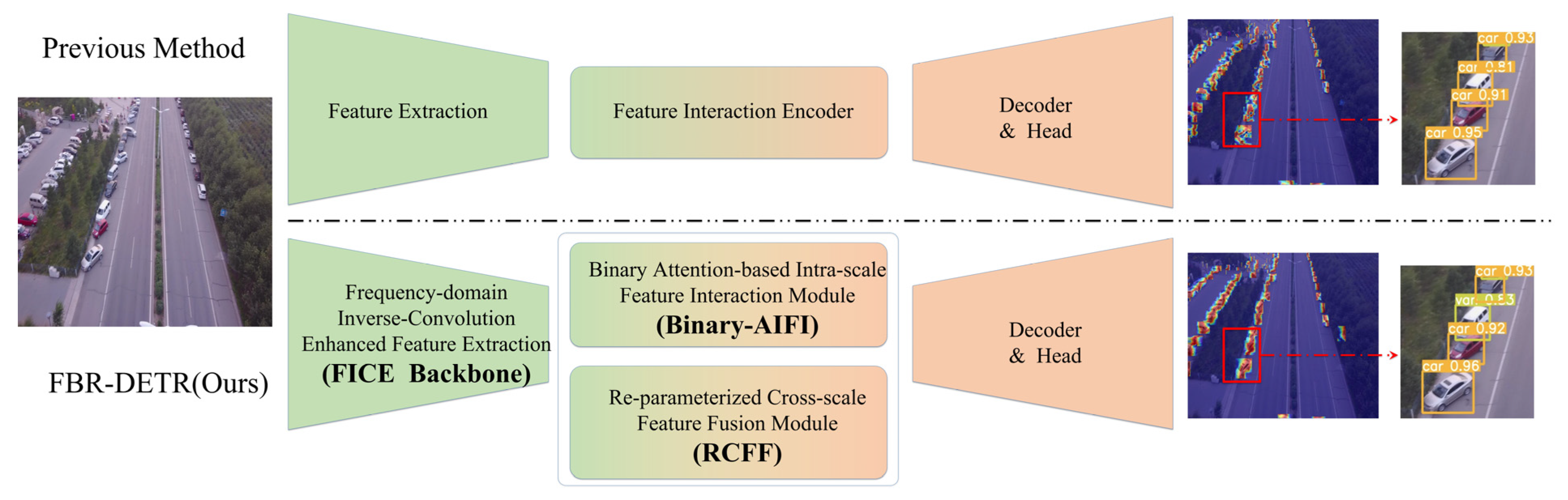
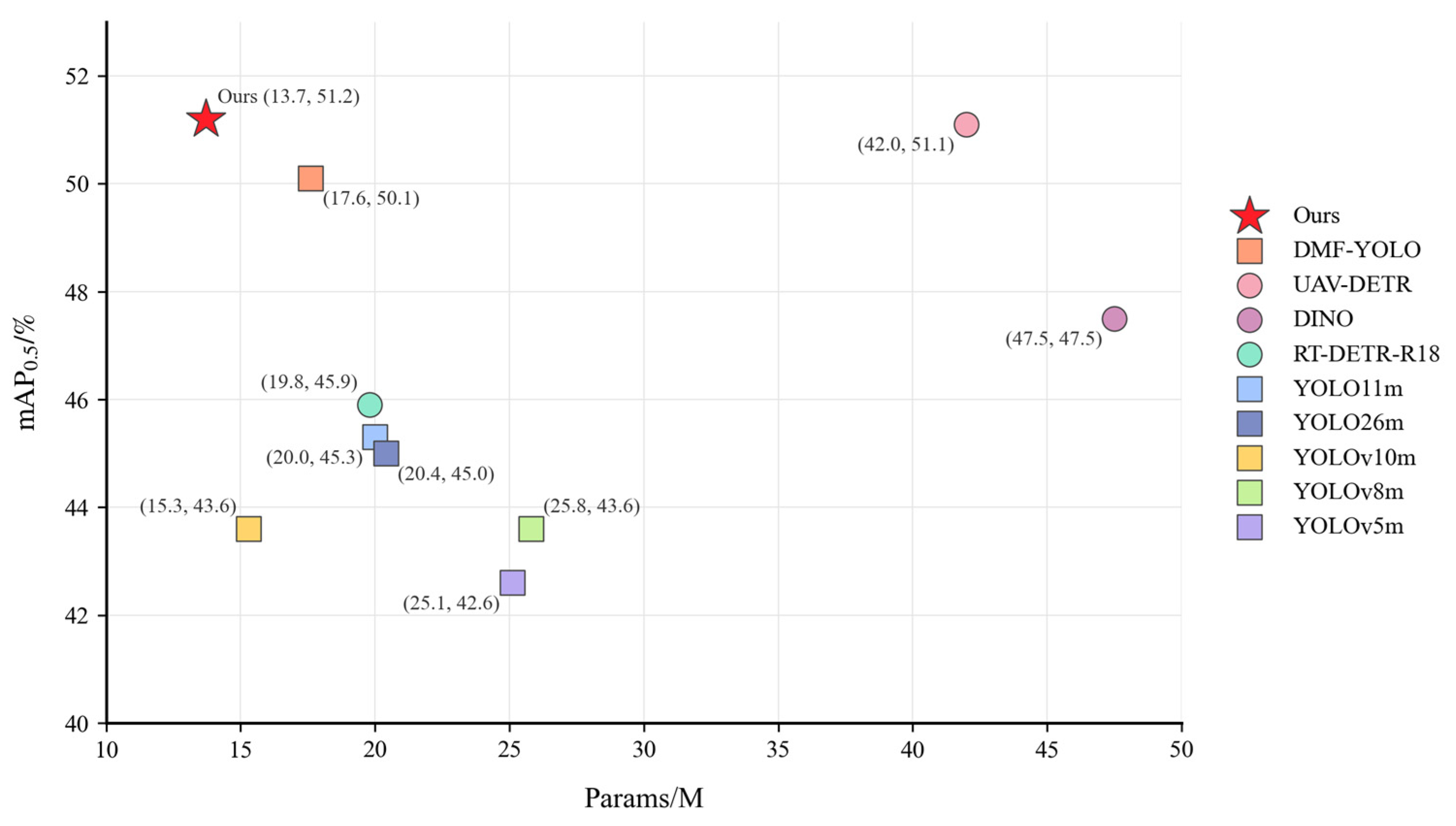
To address these issues, this paper proposes FBR-DETR, a collaboratively improved framework built across three consecutive stages: feature extraction, efficient encoding, and cross-scale fusion. The core idea is that the performance limitations of UAV small-object detection do not arise from a single stage but rather from the combined effects of detail loss during feature extraction, the overhead of global interaction during encoding, and cross-scale information attenuation during fusion. As shown in Figure 1, FICE-Net enhances the frequency domain and spatial discriminability of the input features, Binary-AIFI models long-range intra-scale dependencies while controlling additional computational cost, and RCFF improves the quality of multi-scale feature fusion. Figure 2 presents a comparison of accuracy and parameter count for different detection methods on the VisDrone2019-DET dataset.
The main contributions of this paper are as follows:
  • We propose a frequency-domain inverse-convolution-enhanced feature extraction network (FICE-Net), which introduces Converse2D frequency-domain inverse convolution into the backbone through the FICE Block, thereby enhancing the model’s perception of global spectral structures and fine-grained spatial features and improving small-object feature representation at the source.
  • We develop a binary attention-based intra-scale feature interaction module (Binary-AIFI), which binarizes the query and key matrices in the attention mechanism to preserve global contextual modelling capability while controlling additional computational cost.
  • We introduce a re-parameterized cross-scale feature fusion module (RCFF), which incorporates GCConv into the multi-scale fusion path, enhances cross-scale feature alignment and representation during training, and maintains efficient inference through structural re-parameterization, thereby balancing detection performance and real-time capability.
In addition, to verify the effectiveness of FBR-DETR, we conduct comprehensive evaluations on two challenging UAV benchmark datasets, VisDrone2019-DET [28] and HIT-UAV [29]. Compared with the baseline model, mAP0.5 is improved by 5.3% and 5.9%, the number of network parameters is reduced by 30.8%, and the average precision for small objects (APs) is improved by 2.4% and 4.9%, demonstrating the detection performance and practical application potential of the proposed method in UAV scenarios.
The rest of this paper is organized as follows: Section 2 reviews related work; Section 3 introduces the overall structure of the proposed FBR-DETR and the composition and working mechanism of the core modules FICE-Net, Binary-AIFI and RCFF; Section 4 and Section 5 present the experimental results and conduct comprehensive analysis; Section 6 gives the conclusion.

2. Related Work

2.1. Feature Extraction Methods

Targets in UAV images are typically characterized by small scale, low resolution, weak texture, and strong background interference. Therefore, the representational ability of the feature extraction network directly affects the perceptual performance of the detection model for small objects. Traditional convolutional neural networks extract image textures, edges, and semantic information through local convolution kernels and exhibit high computational efficiency in object detection tasks [30]. However, the receptive field of conventional convolutions is limited by kernel size and mainly focuses on local spatial neighbourhoods, making it difficult to fully model the global structural differences between small objects and complex backgrounds in UAV imagery. When objects occupy only a few pixels, deep downsampling may also cause the loss of fine-grained spatial information, thereby increasing the risk of missed detections.
To address these issues, existing studies have improved feature extraction mainly by enhancing multi-scale features and suppressing background interference. For example, the Faster-CGSU model proposed by Wang et al. [31] enhances multi-scale feature extraction through a residual structure and a convolutional gated selection mechanism, while preserving the fine-grained features required by small objects and improving inference speed. Cheng et al. [32] proposed a feature enhancement network, FENet, which introduces a context feature enhancement (CFE) module to improve object detection performance in remote sensing imagery. Gao et al. [33] proposed the partial pointwise convolution extraction block P2CEM, which combines channel and spatial transformations to effectively extract features for small objects in remote sensing images. Li et al. [34] proposed the scale-aware attention backbone SAA Backbone, which integrates dynamic scale awareness and directional channel attention to adaptively fuse multi-scale features and thus extract finer multi-scale representations, enhancing UAV remote sensing small-object detection. Zhang et al. [35] proposed a visible-light-to-hyperspectral cross-domain detection network (VHCDN), which achieves high-precision object detection in hyperspectral remote sensing images through a residual extracting module (REM) and a spectral saliency head (SSH). Wang et al. [36] proposed DirectNet, which enhances the discriminability between targets and the background by suppressing anomaly interference in background reconstruction. Li et al. [37] proposed ELNet, an efficient and lightweight UAV object detection model, which introduces optimized downsampling modules, a lightweight detection head, feature enhancement structures, and achieves substantial reductions in parameter count and computational cost.
Although existing feature extraction methods have made progress in lightweight design and feature enhancement, two shortcomings remain. Specifically, many methods still rely primarily on the spatial domain [38], while frequency-domain information is usually introduced only as an auxiliary branch or a subsequent enhancement module, making it difficult to establish global spectral perception at the source of backbone feature extraction [39,40]. In addition, some frequency-domain methods may introduce information distortion or extra computational cost while enhancing global responses, which is unfavourable for real-time UAV applications. To address this issue, we propose FICE-Net, a frequency-domain inverse-convolution-enhanced feature extraction network introduced at the backbone stage. By embedding Converse2D frequency-domain inverse convolution into the feature extraction process through the FICE Block, the network can capture both global frequency structures and fine-grained spatial features at an early stage, thereby providing a more suitable feature basis for subsequent encoding and fusion in small-object detection.

2.2. Attention Mechanism

Attention mechanisms can model dependencies among different regions in an image and have been widely used in computer vision tasks. Compared with convolutional operations, self-attention has stronger global contextual modelling capability and can capture relationships between distant targets and background regions, which is important for distinguishing dense targets and performing semantic discrimination in complex UAV scenes.
In object detection, attention mechanisms are commonly used to enhance target-region responses, suppress complex background interference, or improve global semantic modelling. In practical applications, multiple forms of attention mechanisms have been developed. For example, Hu et al. [41] introduced the SE block into the backbone to prioritize low-level small objects. Woo et al. [42] proposed the Convolutional Block Attention Module (CBAM), which sequentially combines channel attention and spatial attention and significantly improves the performance of visual tasks such as image classification and object detection. Classical multi-head self-attention (MHSA) [19] captures long-range dependencies through interactions among queries, keys, and values, but its computational complexity increases with sequence length. Li et al. [34] proposed the EfficientAIFI module, an intra-scale feature interaction module based on efficient attention, which replaces conventional MHSA with efficient additive attention (EAA). By retaining only query–key relations, it structurally simplifies the attention computation while improving detection accuracy and preserving contextual modelling capability. Wang et al. [31] proposed the CGA-AIFI module, which introduces cascaded grouped attention (CGA) into AIFI and performs deep interaction on P5-level feature maps based on a transformer to mine high-level semantic information, thereby compensating for insufficient global attention in early feature extraction. Li et al. [43] proposed multi-scale edge-aware attention (MSEA), which extracts multi-scale context through densely connected dilated convolutions and combines it with edge-focused integrated attention (EFIA) to embed edge features into spatial attention maps and improve boundary detection accuracy.
However, standard self-attention usually has high computational complexity when calculating the dot product between the query and key matrices [44]. Although RT-DETR is more efficient than conventional transformer detectors, its full-precision attention computation in AIFI still introduces inference overhead. For UAV platforms with limited onboard computational resources, retaining such a high-cost attention module may constrain the application of the model in real-time tasks. In addition, small-object detection requires not only global contextual modelling, but also the avoidance of excessive semantic smoothing in deep layers that may weaken small-object details. Therefore, we propose the Binary-AIFI module, which binarizes the query and key matrices in attention on top of the original AIFI global modelling structure, thereby enabling intra-scale feature interaction at a lower computational cost. This design retains the global receptive field while being better suited to the requirements of real-time UAV small-object detection.

2.3. Multi-Scale Feature Fusion

Multi-scale feature fusion is one of the key techniques in small-object detection. The pixel area of a small object is usually smaller than 32 × 32 pixels [45,46]. Because objects in UAV imagery vary markedly in scale, single-scale features cannot simultaneously preserve small-object details and large-object semantic information [47]. Feature pyramid networks (FPNs) [48] effectively improve multi-scale object detection by fusing shallow spatial details with deep semantic information through a top-down pathway. Subsequently, many improved methods have been proposed, including the path aggregation network (PANet) [49] and the bidirectional feature pyramid network (BiFPN) [15]. In addition, Liu et al. [50] proposed the denoising feature pyramid network (DN-FPN), which effectively suppresses feature noise at each level while maintaining inference efficiency. Bai et al. [51] proposed the redundancy-suppressed feature pyramid network (RFS-FPN), which amplifies key target features and suppresses background redundancy through two submodules, namely progressive shuffle upsampling (PSU) and dynamic feature fusion (DFF), thereby achieving efficient fusion. These improved feature fusion structures further strengthen information flow across different scales and enable detection models to better adapt to scenes with complex scale variation.
Although existing fusion methods can improve multi-scale representation, they still have certain limitations. First, many fusion modules rely on complex branches, dynamic weights, or additional attention structures. Although these designs enhance feature representation, they also increase inference latency and model complexity [52]. Second, standard downsampling convolutions usually adopt a single-branch structure, so the feature transformation forms used during training are relatively limited, making it difficult to fully enhance cross-scale feature alignment. For real-time UAV detection tasks, an ideal fusion module should improve representational capability during training while introducing as little additional inference burden as possible. To address these issues, we propose the re-parameterized cross-scale feature fusion module (RCFF), which introduces GCConv into the feature fusion path. During training, this module uses a multi-branch convolutional structure to enhance cross-scale feature representation, whereas during inference it is equivalently merged into a single convolution through structural re-parameterization, thereby improving multi-scale small-object fusion capability without increasing inference complexity.

3. Methodology

3.1. Overall Framework of FBR-DETR

To address small-object detection in UAV remote sensing imagery, this paper proposes FBR-DETR, an end-to-end transformer detector improved from the RT-DETR-R18 architecture. The overall model follows a three-stage optimization strategy for small objects, namely feature extraction, efficient encoding, and cross-scale fusion, so as to improve small-object detection performance in complex aerial scenes while ensuring real-time inference efficiency.
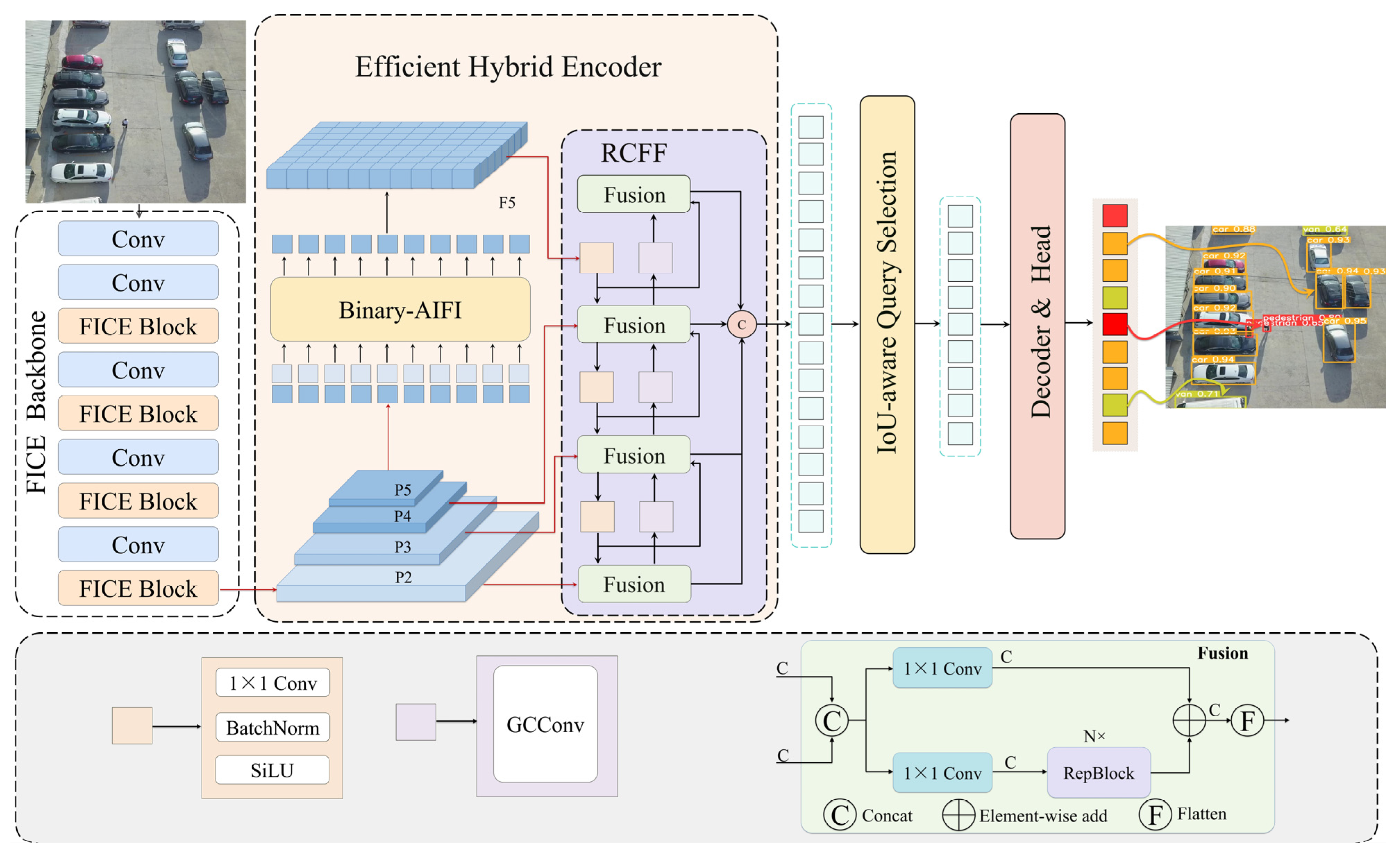
The overall architecture of FBR-DETR is shown in Figure 3. First, the input image is processed by the FICE backbone to extract multi-scale features. This backbone is formed by alternately stacking multiple convolutional layers and FICE Blocks, and it outputs four feature maps, P2–P5, through hierarchical downsampling. Among them, shallow features preserve fine-grained spatial details, whereas deep features capture high-level semantic information, which is suitable for the dense distribution and large-scale variation in small objects in remote sensing imagery and provides multi-granularity basic features for subsequent cross-scale fusion. The features are then fed into an efficient hybrid encoder for intra-scale attention interaction and cross-scale feature fusion. This encoder is collaboratively composed of Binary-AIFI and RCFF. Binary-AIFI performs feature interaction on the input feature P5 to establish long-range dependencies within a single scale, strengthen the semantic features of small objects, and suppress background noise in UAV imagery, thus producing the enhanced high-level feature F5. RCFF adopts a bidirectional fusion structure composed of multi-level fusion units. It receives the original multi-scale features P2–P4 from the backbone, together with the attention-enhanced feature F5 produced by Binary-AIFI, and outputs a unified image feature sequence after stepwise top-down semantic propagation and bottom-up detail supplementation followed by concatenation, thereby alleviating the loss of small-object features during cross-scale transmission while controlling computational cost. In the decoder stage, an IoU-aware query mechanism provides high-quality query inputs for the position relation decoder, which then iteratively refines the object queries based on positional relationships and finally outputs the predicted classes, bounding boxes, and confidence scores.

3.2. Frequency-Domain Inverse-Convolution-Enhanced Feature Extraction Network (FICE-Net)

Objects in UAV images usually occupy only a small number of pixels and are easily affected by complex ground backgrounds, viewpoint changes, and scale variation. Traditional transformers face several key challenges during feature extraction: (1) the backbone mainly relies on spatial-domain convolution for feature extraction. Although this is computationally efficient, the receptive field of the convolution kernel is limited, making it difficult to capture the global frequency–structure differences between small aerial objects and the background. (2) During deep feature extraction, the edges, textures, and local structural information of small objects are gradually weakened, which may lead to missed detections or inaccurate localization. (3) As network depth increases, the computational complexity and the number of parameters also increase, which severely constrains computational efficiency and real-time capability on edge devices.
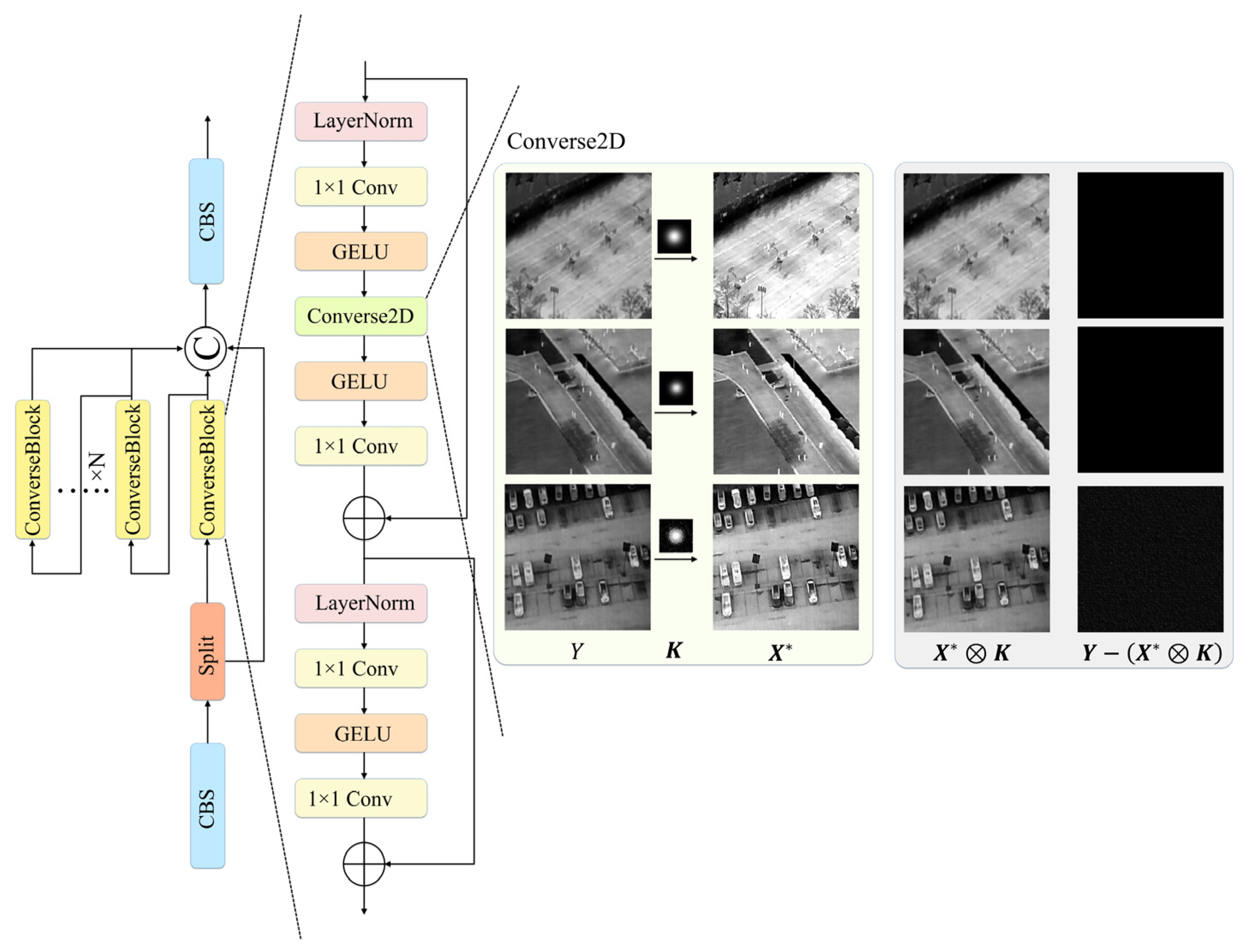
To enhance the ability of the backbone to represent small objects in UAV imagery, we propose FICE-Net and introduce the FICE Block into it, as illustrated in Figure 4. This module embeds the Converse2D frequency-domain inverse-convolution operator into the C2f structure, extending feature extraction from purely local spatial-domain convolution to frequency-domain modelling. Unlike conventional convolutions, which directly use convolution kernels in the spatial domain to extract local neighbourhood information, Converse2D models features from the perspective of the frequency domain and can enhance the network’s perception of global spectral responses, thereby more effectively distinguishing small objects from background regions when they exhibit similar textures but different frequency responses.
Structurally, the core unit of the FICE Block is the ConverseBlock. Each ConverseBlock consists of two cascaded sub-blocks and a residual connection. For the input feature X i n , the two sub-blocks successively perform LayerNorm, pointwise channel-expansion convolution, GELU activation, Converse2D frequency-domain inverse convolution, GELU activation, and pointwise channel-compression convolution, followed by LayerNorm, pointwise channel-expansion convolution, GELU activation, and pointwise channel-compression convolution. The result is finally added residually to the input feature to obtain the output feature X o u t . This process can be expressed by Equations (1) and (2).
X 1 = X i n + Conv 1 × 1 down GELU Converse2D GELU Conv 1 × 1 up LN X
X o u t = X 1 + Conv 1 × 1 down GELU Conv 1 × 1 up LN X 1
Here, LN (   ) denotes LayerNorm; the two pointwise convolutions Conv 1 × 1 up and Conv 1 × 1 down denote channel expansion and channel compression, respectively; and Converse2D denotes frequency-domain inverse convolution.
Converse2D is the key innovation of this module. Its core idea is to transform convolution into the solution of an inverse problem in the frequency domain. Specifically, standard depthwise convolution directly applies a learnable kernel K to the input feature X , whereas Converse2D solves the corresponding inverse problem: given the output Y = ( X K ) s , it recovers the input feature X through a regularized least-squares objective function, as shown in Equation (3).
X = arg m i n X   Y X K F 2 + λ X X 0 F 2
Here, λ > 0 denotes a learnable regularization parameter, and the initial estimate X 0 = Interp ( Y , s ) is obtained by interpolation. Physical Interpretation of Converse2D: Standard spatial convolutions inherently act as low-pass spatial filters during repeated downsampling, causing high-frequency edge details and subtle spatial textures of small objects to be progressively attenuated. To address this fundamental limitation, Converse2D reformulates feature extraction as solving a regularized inverse problem in the Fourier domain, as derived in Equation (4):
X = F 1 F K F Y + λ F X 0 | F K | 2 + λ
Here, the two operators F ( ) and F 1 ( ) denote the two-dimensional fast Fourier transform and its inverse transform, respectively; the convolution kernel spectrum F K denotes the complex conjugate; and the last term F K 2 = F K F K denotes element-wise squared magnitude. By explicitly estimating the frequency-domain kernel spectrum F K , Converse2D performs a closed-form spectral deconvolution that explicitly amplifies high-frequency spectral components. Consequently, it compensates for the spatial resolution loss induced by deep downsampling, recovering weak small-object boundaries and fine-grained visual structures that are typically overwhelmed by complex background semantics in standard spatial convolutions. The parameterization of the regularization parameter λ is given in Equation (5).
λ = Sigmoid b 9.0 + ϵ
The parameterization of λ = Sigmoid b 9.0 + ϵ in Equation (5) is physically motivated by two considerations. First, initializing b = 0 yields an initial regularization strength of λ ≈ 1.23 × 10⁻⁴, a small positive scalar. During the early stages of training, a minimal λ enforces strict data fidelity, encouraging the network to aggressively reconstruct missing high-frequency target details without premature spatial smoothing. Second, the positive offset ϵ = 10−5 prevents division-by-zero numerical instability in the denominator | F K | 2 + λ of Equation (4). As training progresses, the learnable parameter b adaptively tunes the regularization strength channel-by-channel, establishing an optimal balance between high-frequency noise suppression and fine texture restoration.
By embedding the above frequency-domain inverse convolution into the backbone, FICE-Net enhances global frequency–structure modelling at the source of feature extraction while preserving fine-grained spatial information through the C2f structure. This design is particularly suitable for detecting objects with weak texture, small scale, and high background similarity in UAV scenes, and it provides more discriminative basic features for the subsequent Binary-AIFI encoding interaction and RCFF fusion.

3.3. Binary Attention-Based Intra-Scale Feature Interaction Module (Binary-AIFI)

In the intra-scale feature interaction module, AIFI is mainly used to perform global contextual modelling on the deepest feature map, P5. Through the self-attention mechanism, AIFI can capture long-range dependencies among different spatial positions and thereby enhance deep semantic representation. However, standard self-attention incurs high computational complexity when calculating the dot product between the query matrix Q and the key matrix K . For real-time UAV detection, this computational burden O ( N 2 ) affects model efficiency on resource-constrained platforms.
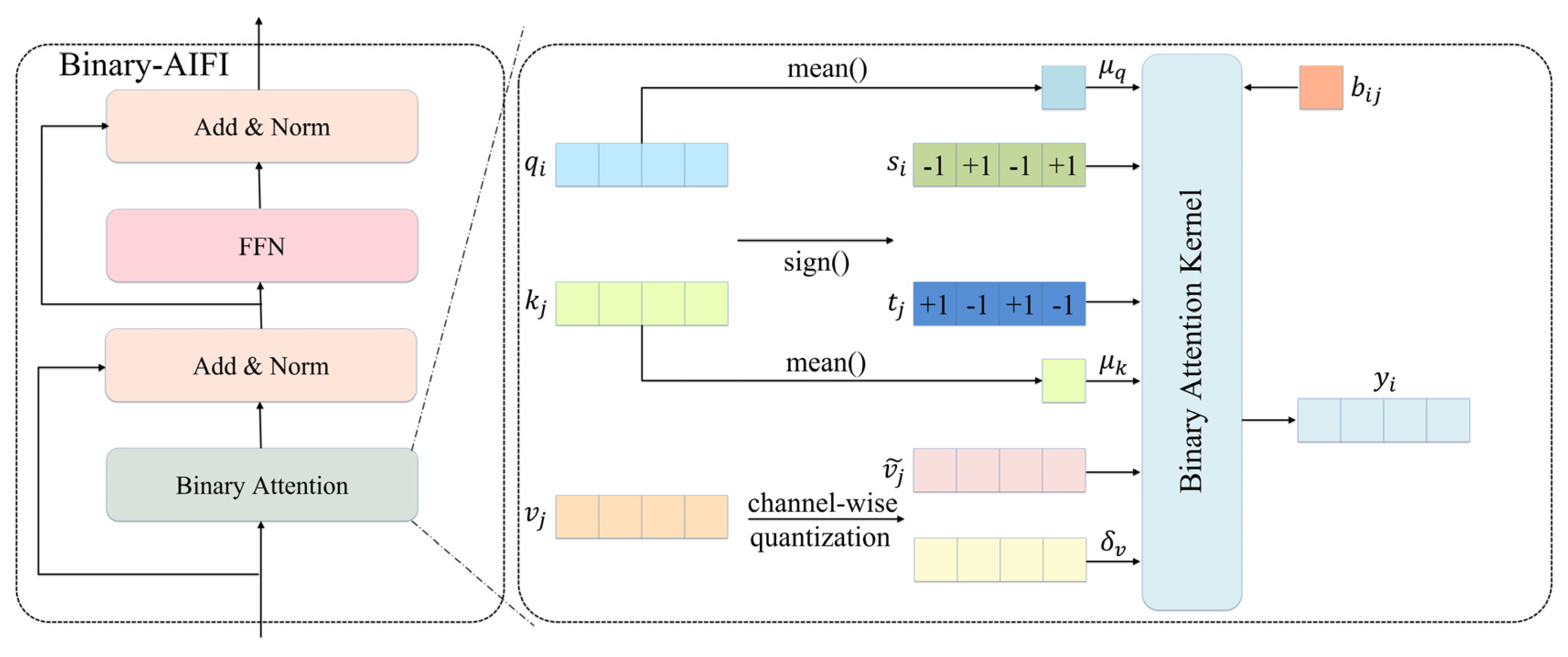
To reduce the computational burden of the global encoding-interaction stage, we propose Binary-AIFI, which replaces the standard AIFI with a binary attention transformer encoder. The structure of Binary-AIFI is illustrated in Figure 5. Binary-AIFI follows the same overall structure as a standard transformer encoder layer, including a self-attention module, a feed-forward network (FFN), residual connections, and LayerNorm. Its key modification is the binarization of the query Q and key K matrices in multi-head self-attention, thereby enabling intra-scale feature interaction at lower computational cost.
For the input feature X R B × C × H × W , it is first flattened into a token sequence, and linear projections are then used to obtain the query Q , key K , and value V matrices. Subsequently, the query Q and key K matrices are processed by scaled binarization, as defined in Equation (6).
Q ^ = μ q sign Q , K ^ = μ k sign K
Here, the two terms μ q = 1 N C h Q 1 and μ k = 1 N C h K 1 denote the absolute-mean scaling factors of the query Q and key K matrices along the token and channel dimensions, respectively; the next term N denotes the number of tokens; and the last term C h denotes the dimension of each attention head. Based on the binarized query and key matrices, the attention computation can be expressed as Equation (7).
Attn Q ^ , K ^ , V = Softmax Q ^ K ^ d V
Because both matrices are quantized into binary values of [−1, +1], the matrix product Q ^ K ^ becomes equivalent to a Hamming-distance-based measure and can be implemented efficiently through μ q μ k sign multiplication with scaling coefficients, thereby substantially reducing the floating-point computation in the attention operation. As the sign function is non-differentiable, a straight-through estimator (STE) is used during training for approximate gradient propagation, as shown in Equation (8).
L Q = L Q ^ 1 Q 1
This strategy allows gradients to pass directly within the range [−1, +1], while gradients outside this range are set to zero, thereby ensuring stable convergence during training. Q and K are quantized into [−1, +1] floating-point tensors. This design eliminates full-precision multiplication between high-dimensional token pairs, acts as a structured information bottleneck, and reduces the redundancy of attention representation.
The advantage of Binary-AIFI is that it does not disrupt the original global modelling structure of AIFI but only replaces the core attention computation with a lightweight binarized alternative. Therefore, the module can reduce the complexity of attention interaction while preserving global contextual modelling capability. For UAV small-object detection, Binary-AIFI can use global context to help distinguish dense targets from complex backgrounds while alleviating the inference bottleneck caused by full-precision attention, thereby better satisfying the requirements of real-time detection.

3.4. Re-Parameterized Cross-Scale Feature Fusion Module (RCFF)

Multi-scale feature fusion is crucial for UAV small-object detection. Shallow features contain more spatial details and are therefore beneficial for localizing small objects, whereas deep features contain stronger semantic information and are therefore beneficial for object classification and background suppression. Existing methods perform feature fusion through the PAN path, but the standard downsampling convolution used in that path usually adopts a single-branch structure, resulting in relatively limited feature transformation forms and insufficient cross-scale feature alignment. In complex aerial scenes, this fusion strategy may cause small-object details to be diluted by semantic information during multi-scale aggregation, thereby affecting detection accuracy.
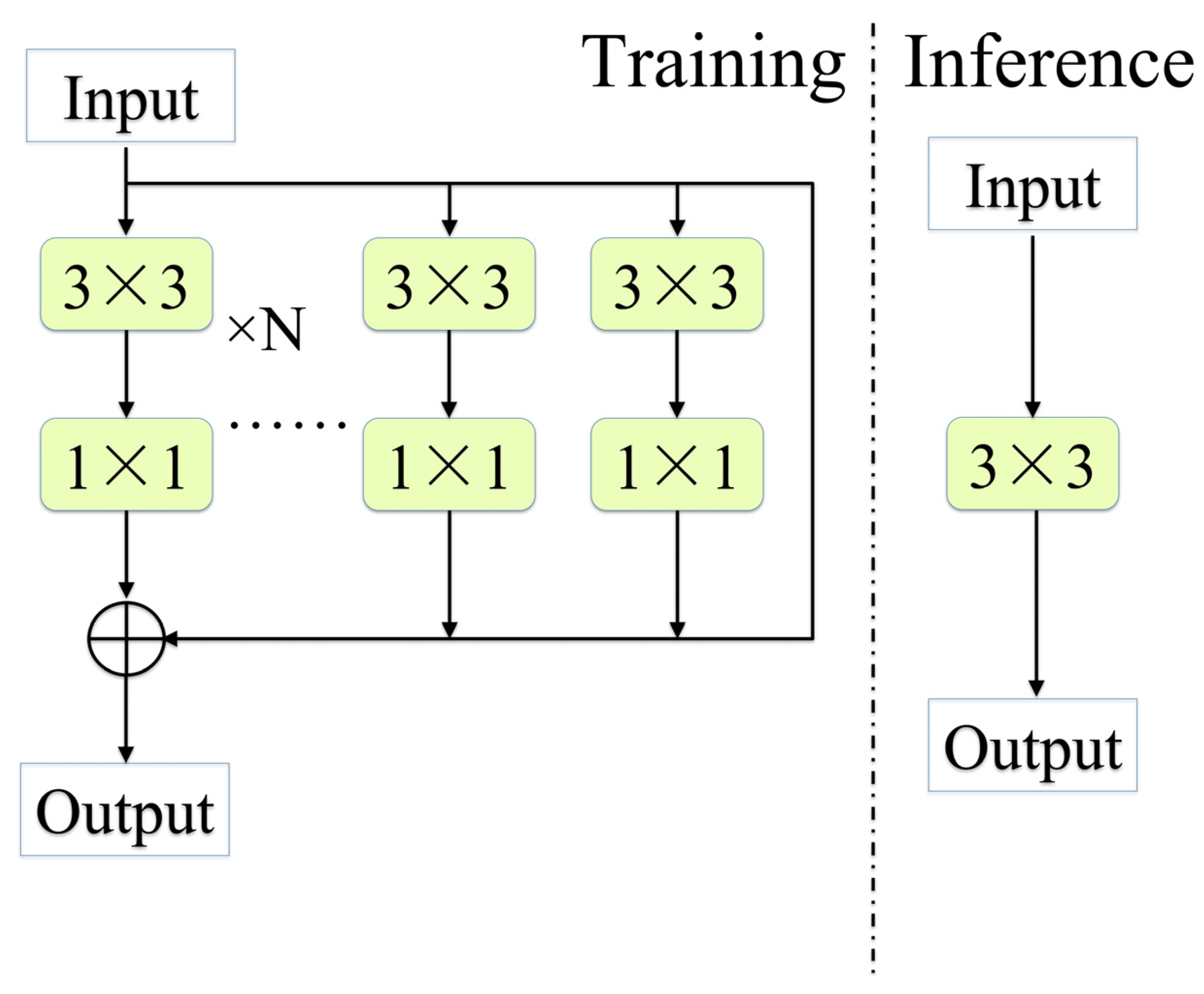
To improve representational ability during the multi-scale fusion stage while avoiding additional inference burden, we propose RCFF, which fuses the various information contained in feature maps P2, P3, P4, and F5 and introduces GCConv into the PAN feature fusion path. The core idea of RCFF is to enrich feature transformation paths with a multi-branch convolutional structure during training, and then equivalently merge these branches into a single convolution during inference through structural re-parameterization. GCConv denotes Golden Cudgel Convolution, which is derived from the lightweight convolutional design of Golden Cudgel Network [52]. In RCFF, GCConv is adopted as an efficient local feature transformation unit to strengthen cross-scale feature fusion with limited computational overhead. As illustrated in Figure 6, this design improves feature representation during training while maintaining computational efficiency comparable to that of standard convolution during inference.
For the input feature X R B × C i n × H × W , GCConv contains multiple parallel branches during training, and its output can be expressed as Equation (9).
Y = SiLU Path 3 × 3 1 X + Path 3 × 3 2 X + Path 1 × 1 X + Path i d X
Here, the first two terms Path 3 × 3 ( 1 ) and Path 3 × 3 ( 2 ) denote parameter-independent branches in which a 3 × 3 convolution is followed by a 1 × 1 convolution; the next term Path 1 × 1 denotes the channel interaction branch; and the last term Path i d denotes the identity residual branch containing only BatchNorm, which exists only when the channel dimensions are equal C i n = C o u t and the stride is 1.
During inference, RCFF merges the multi-branch structure into a single convolution through structural re-parameterization. First, the Conv-BatchNorm structures in each branch are fused to obtain equivalent convolution kernels and biases. Subsequently, the cascaded 3 × 3 and 1 × 1 convolutions in each path are merged through kernel matrix multiplication W 3 × 3 = W 1 × 1 W 3 × 3 . After zero-padding the equivalent kernels of the 1 × 1 branch and the identity branch to a 3 × 3 size, the equivalent kernels of the four branches are directly summed, as shown in Equations (10) and (11).
W = γ σ + ϵ W , B = β μ γ σ + ϵ
W f i n a l = W 3 × 3 1 + W 3 × 3 2 + W 1 × 1 pad + W i d pad
By introducing GCConv into the multi-scale fusion path, RCFF enhances alignment and interaction among features at different scales during training while maintaining efficient deployment characteristics during inference. This module complements FICE-Net and Binary-AIFI: FICE-Net provides more discriminative frequency-enhanced basic features, Binary-AIFI performs global contextual interaction encoding at low cost, and RCFF further improves the quality of cross-scale feature aggregation. Through the synergy of these three modules, the improved model becomes better suited to real-time UAV small-object detection.

4. Experiments

To verify the effectiveness of the proposed method in complex UAV scenes and in resource-constrained real-time detection tasks, we conduct experiments on two representative UAV object detection datasets, VisDrone2019-DET and HIT-UAV. These two datasets cover visible-light aerial scenes and infrared thermal aerial scenes, respectively, and therefore allow the small-object detection capability and generalization performance of FBR-DETR to be evaluated under different imaging conditions, object scales, and background complexities.

4.1. Datasets

VisDrone2019-DET [27] is a large-scale UAV visual object detection dataset constructed by the AISKYEYE team at Tianjin University. Its images were collected by different UAV platforms across multiple urban and traffic scenes, and the dataset is characterized by large variation in capture altitude, diverse viewpoints, dense targets, severe occlusion, and complex backgrounds. The dataset contains 10 common traffic object categories: pedestrian (PT), people (PE), bicycle (BC), car (CA), van (VA), truck (TK), tricycle (TC), awning–tricycle (AT), bus (BU), and motor (MO). The detection task in VisDrone2019-DET is usually divided into a training set, a validation set, and a test set, containing 6471, 548, and 3190 images, respectively. Because the dataset contains a large number of small-scale and densely distributed targets, and because the targets are often affected by occlusion and complex backgrounds, it is well suited for evaluating the ability of detection algorithms to recognize small objects in complex visible-light UAV scenes.
HIT-UAV [28] is a dataset for high-altitude infrared thermal object detection using UAVs. It contains 2898 infrared thermal images covering a variety of typical scenes, including schools, parking lots, roads, and playgrounds. HIT-UAV includes five categories, namely person (PE), car (CA), other vehicle (OT), bicycle (BI), and don’t care (DO). DO annotations participate in training and evaluation as an independent category in our main experiments. The objects are generally small in scale, and the texture information in infrared images is relatively limited, making the dataset suitable for further evaluating the robustness of the proposed method under weak-texture conditions, small-object settings, and different imaging modalities. The dataset contains 2029 training images, 290 validation images, and 579 test images.
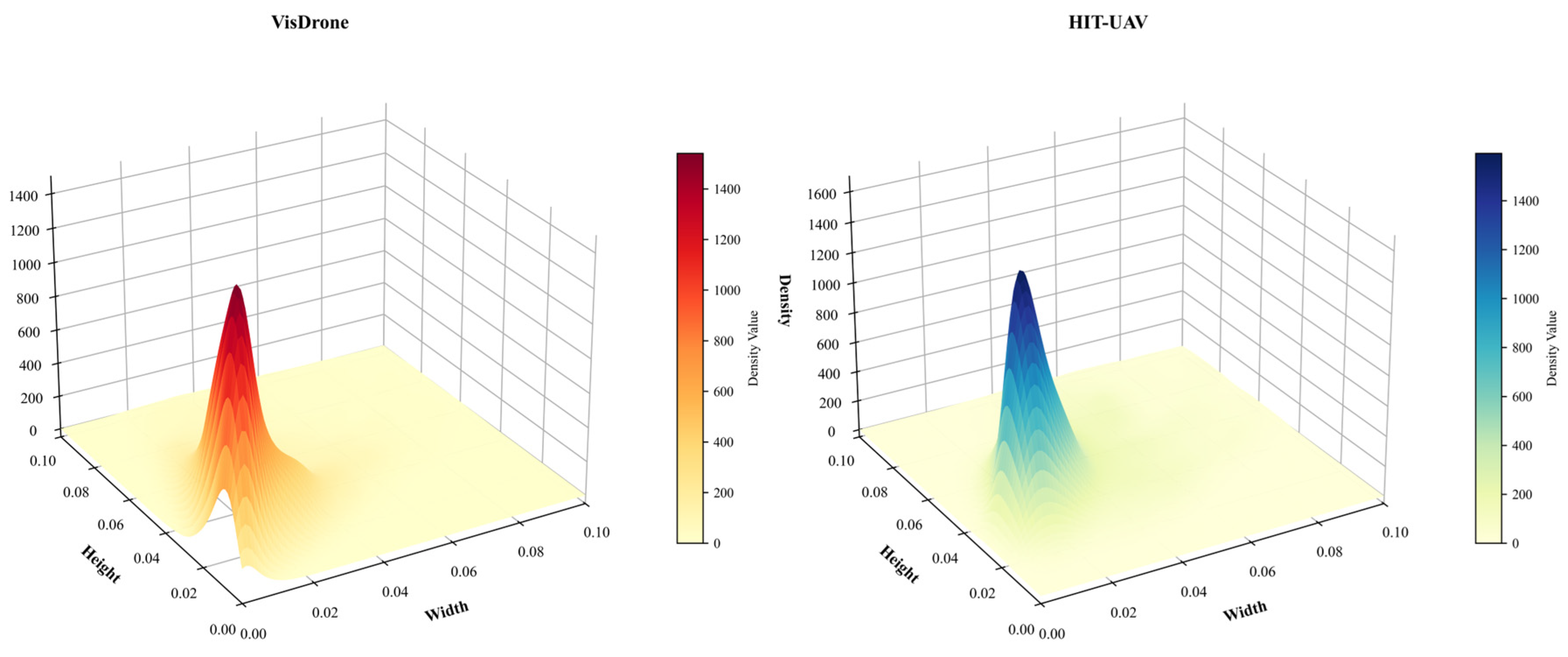
The above two datasets are highly complementary. VisDrone2019-DET focuses on complex urban visible-light aerial scenes, with more object categories and stronger background interference, whereas HIT-UAV focuses on infrared thermal scenarios with weak object textures and special imaging conditions. Experiments on both datasets therefore provide a more comprehensive evaluation of the effectiveness of FICE-Net, Binary-AIFI, and RCFF for UAV small-object detection. The object size density distributions in the two datasets are shown in Figure 7.

4.2. Experimental Details and Evaluation Metrics

All experiments in this paper were conducted under a unified hardware and software environment, and no pre-trained weights were used in the training process of any model in either the ablation or comparison experiments. To reduce the influence of randomness from a single training run, the main experimental results are reported as the average of repeated experiments. The experimental settings are as follows: NVIDIA GeForce RTX 4090 GPU, CUDA 11.8, Python 3.10.19, and PyTorch 2.1.0. The batch size was set to 16, the momentum was set to 0.9, and the input image size was set to 640 × 640 pixels. AdamW was used as the optimizer, the training ran for 300 epochs, the initial learning rate was set to 1 × 10⁻⁴, and the weight decay coefficient was set to 5 × 10⁻⁴. RT-DETR-R18 was used as the baseline model, and FICE-Net, Binary-AIFI, and RCFF were introduced successively to verify the effectiveness of each module and of the overall framework. To ensure the reliability of the statistical results and eliminate the influence of random initialization fluctuations, all quantitative detection metrics reported in this paper are the mean values of five independent experiments, all conducted with a fixed base random seed of 0. Across all evaluated models and ablation variants, the standard deviations of mAP0.5 and mAP0.5:0.95 remain strictly within a very small range of ±0.1% to ±0.3%.
To comprehensively evaluate model performance, this paper uses precision (P), recall (R), mean average precision (mAP), number of parameters (Params), giga floating-point operations per second (GFLOPs), and inference speed (FPS) as evaluation metrics commonly adopted in object detection. Precision measures the proportion of correctly detected targets among all predicted targets, whereas recall measures the proportion of true targets that are successfully detected. Their definitions are as follows:
P r e c i s i o n = T P T P + F P
R e c a l l = T P T P + F N
Here, TP denotes the number of correctly detected targets, FP denotes the number of false detections, and FN denotes the number of missed detections.
Average precision (AP) is calculated from the precision–recall curve and is used to measure the overall detection performance of a single category under different confidence thresholds. mAP denotes the average AP over all categories and is defined as follows:
m A P = 1 N i = 1 N   A P i
Here, N denotes the number of categories in the dataset, and A P i denotes the average precision of the i-th category.
This paper mainly uses mAP0.5, mAP0.75, and mAP0.5:0.95 as detection accuracy metrics. Specifically, mAP0.5 denotes the average precision at an IoU threshold of 0.5 and reflects the model’s basic detection capability. mAP0.75 denotes the average precision at an IoU threshold of 0.75 and requires a higher overlap between the predicted box and the ground-truth box; it can therefore be used to evaluate detection performance under stricter matching conditions and reflects the model’s fine localization ability. mAP0.5:0.95 denotes the average AP over IoU thresholds from 0.5 to 0.95 with a step size of 0.05, providing a stricter evaluation of localization accuracy and overall detection quality. In addition, to highlight the characteristics of UAV small-object detection, this paper also focuses on APs, which is used to evaluate the detection capability of the model for small-scale targets.
In addition to detection accuracy, this paper also reports the number of parameters (Params), computational cost (GFLOPs), and inference speed (FPS). Params measures the storage overhead of the model, GFLOPs measures computational complexity, and FPS measures the number of images that can be processed per unit time. Because UAV platforms are typically constrained by onboard computational power, storage space, and power consumption, improving detection accuracy alone is insufficient to satisfy practical requirements. Therefore, this paper jointly compares detection accuracy, model complexity, and inference speed to verify the practical value of the proposed method for real-time UAV small-object detection.

5. Results and Analysis

5.1. Ablation Experiments

5.1.1. Ablation Study on the Effectiveness of the Proposed Modules

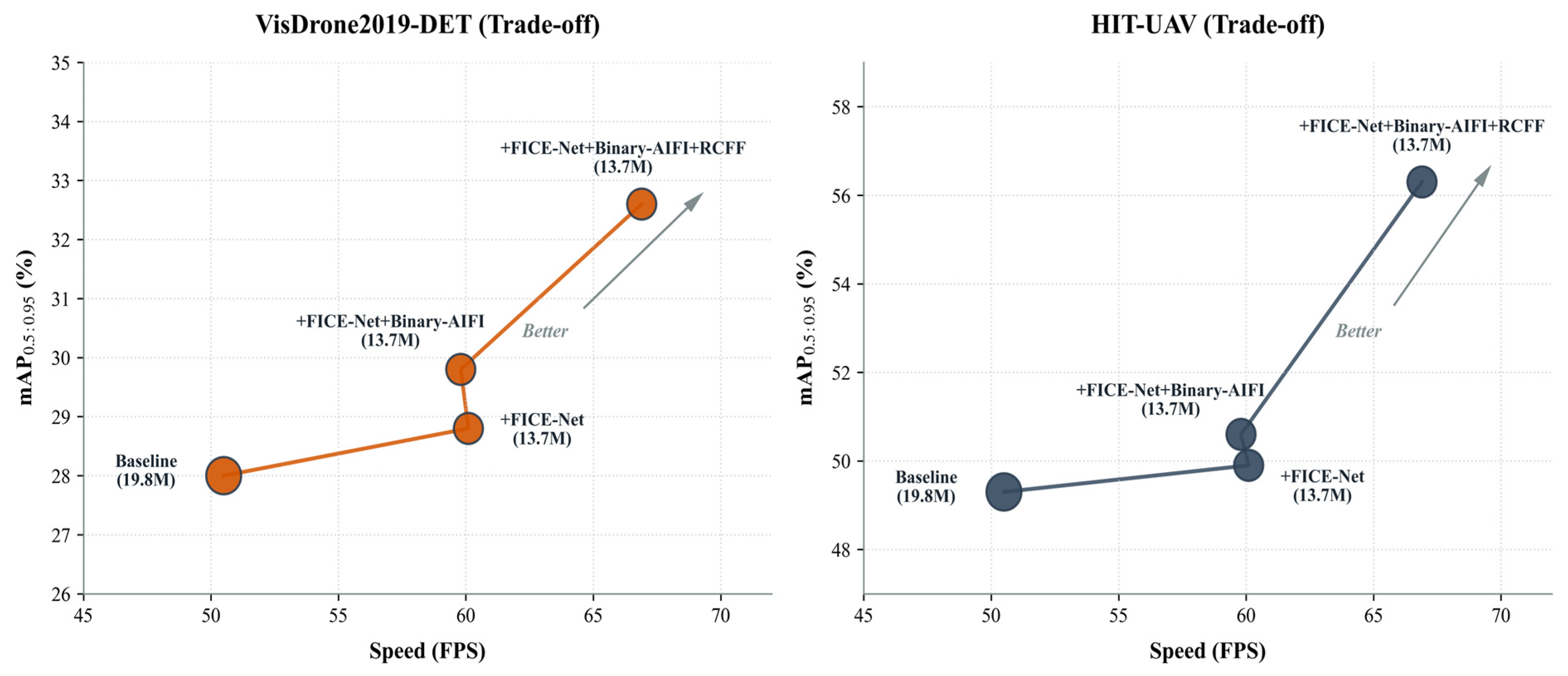
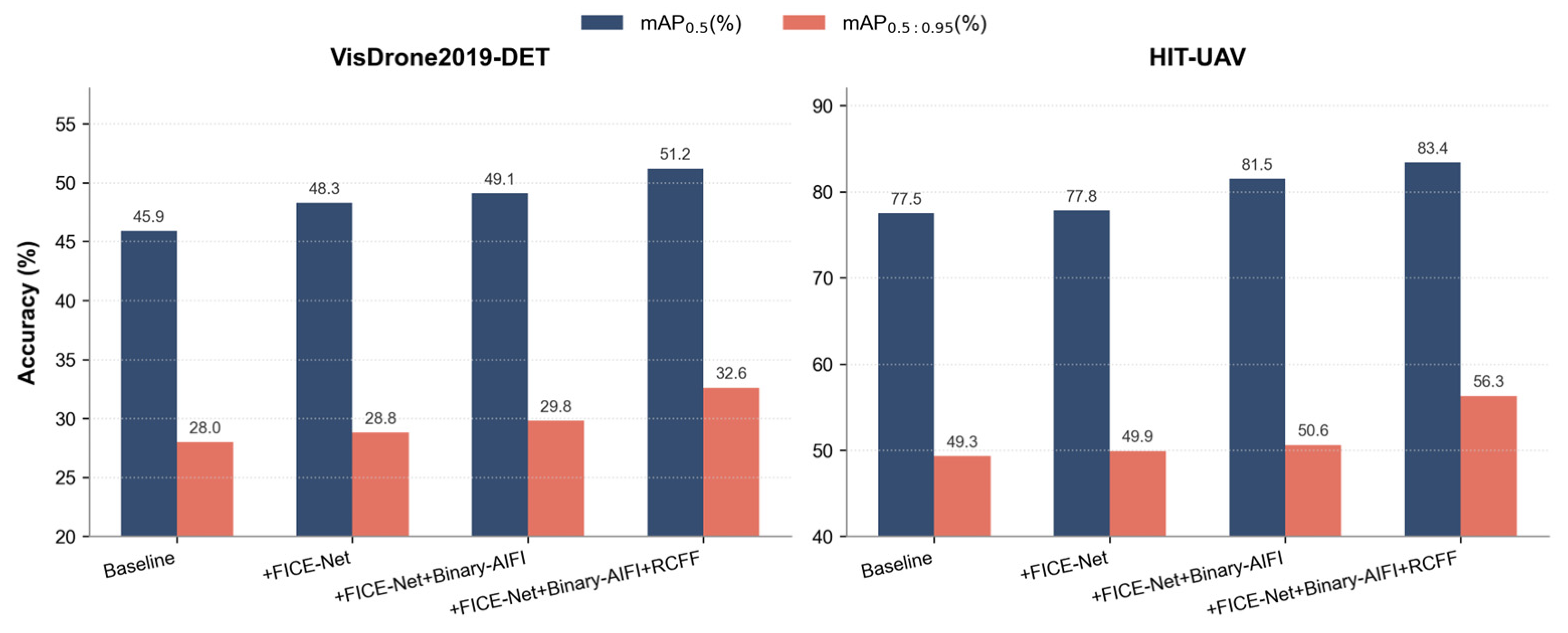
To verify the effectiveness of the proposed modules, ablation experiments were conducted on the VisDrone2019-DET and HIT-UAV datasets. RT-DETR-R18 was used as the baseline model, and FICE-Net, Binary-AIFI, and RCFF were introduced successively. Under the same experimental conditions, Table 1 reports the comparison of detection accuracy, model complexity, and inference speed for different module combinations. The visualized results for different module combinations are shown in Figure 8 and Figure 9.
The results on VisDrone2019-DET show that the baseline model achieves 45.9% mAP0.5, 28.0% mAP0.5:0.95, and 21.1% APs. After introducing FICE-Net, mAP0.5 increases to 48.3% and APs increases to 22.0%, indicating that stronger basic feature representation helps alleviate the attenuation of small-object information in deep networks and effectively improves the basic feature representation of small objects in visible-light UAV imagery. After further introducing Binary-AIFI, mAP0.5 rises to 49.1% and mAP0.5:0.95 rises to 29.8%, indicating that global semantic interaction helps reduce missed detections and improve localization quality. After finally adding RCFF, the complete model reaches 51.2% mAP0.5, 32.6% mAP0.5:0.95, and 23.5% APs, representing improvements of 5.3%, 4.6%, and 2.4% over the baseline, respectively. Meanwhile, the parameter count decreases from 19.8 M to 13.7 M, GFLOPs decrease from 57.0 to 46.5, and FPS increases from 50.5 to 66.9, indicating that the proposed method not only improves detection accuracy but also reduces model complexity and increases inference speed.
On the HIT-UAV dataset, the baseline model achieves 77.5% mAP0.5, 49.3% mAP0.5:0.95, and 37.5% APs. After introducing FICE-Net, mAP0.5 and APs increase to 77.8% and 38.1%, respectively, indicating that this module can still provide a certain degree of small-object feature enhancement in infrared weak-texture scenarios. After introducing Binary-AIFI, the model’s recall increases from 72.9% to 79.2%, mAP0.5 increases to 81.5%, and APs increases to 41.5%, demonstrating that global contextual modelling plays a clear role in improving target recall in infrared UAV imagery. The complete model further increases mAP0.5 to 83.4%, mAP0.5:0.95 to 56.3%, and APs to 42.4%, which are improvements of 5.9%, 7.0%, and 4.9% over the baseline, respectively. Meanwhile, the complete model maintains 13.7 M parameters and 46.5 GFLOPs while achieving 66.9 FPS, which verifies the accuracy and efficiency advantages of the proposed method in infrared UAV detection scenarios.

5.1.2. Ablation Study on the Influence of the Proposed Modules on Different Object Categories

To further analyze the influence of different modules in FBR-DETR on different object categories, AP was computed for each category on the VisDrone2019-DET and HIT-UAV datasets. The results are shown in Table 2 and Table 3, where √ indicates that the corresponding module is enabled and × indicates that the corresponding module is disabled.
The category-wise results in Table 2 for VisDrone2019-DET show that the complete model performs well on most categories. For example, the accuracy improvements are particularly large for pedestrian (PT), van (VA), truck (TK), and bus (BU), with AP gains of 5.6%, 5.1%, 7.9%, and 10.8%, respectively. These results indicate that, for categories such as truck and bus that undergo obvious scale variation and are easily affected by occlusion, the complete model provides more pronounced accuracy gains and improves the detection stability of targets at different scales.
The category-wise results in Table 3 for HIT-UAV further verify the effectiveness of the modules in infrared scenarios. The complete model achieves 83.4% mAP0.5, and high AP is obtained for pedestrian (PE), car (CA), other vehicle (OT), and bicycle (BI). Compared with the baseline model, AP for other vehicle (OT) increases from 79.3% to 96.9%, AP for bicycle (BI) increases from 91.2% to 93.4%, and AP for car (CA) increases from 98.5% to 99.1%. These results show that the proposed method can improve target discrimination in infrared images with limited texture information through the synergy of frequency-domain enhancement, global encoding, and cross-scale fusion. It should be noted that the AP of some categories, such as DO, does not reach the highest value among all combinations in the complete model, which may be related to the limited number of samples in that category or unstable category boundaries under infrared imaging. Nevertheless, the accuracy of DO still improves by 7.5% over the baseline, and the complete model achieves the best overall mAP, indicating that the three modules provide complementary gains in overall detection performance.
In summary, the ablation experiments show that FICE-Net mainly improves the basic feature representation of small objects, Binary-AIFI enhances intra-scale global interaction at relatively low computational cost, and RCFF further improves cross-scale feature alignment and fusion. Through the synergy of these three modules, the model achieves the best overall performance on both the VisDrone2019-DET and HIT-UAV datasets, while reducing computational complexity and increasing inference speed in addition to improving detection accuracy, thereby validating the effectiveness of the proposed collaborative improvement strategy involving feature extraction, efficient encoding, and cross-scale fusion.

5.2. Comparison Experiments

5.2.1. Comparison with Different Network Models

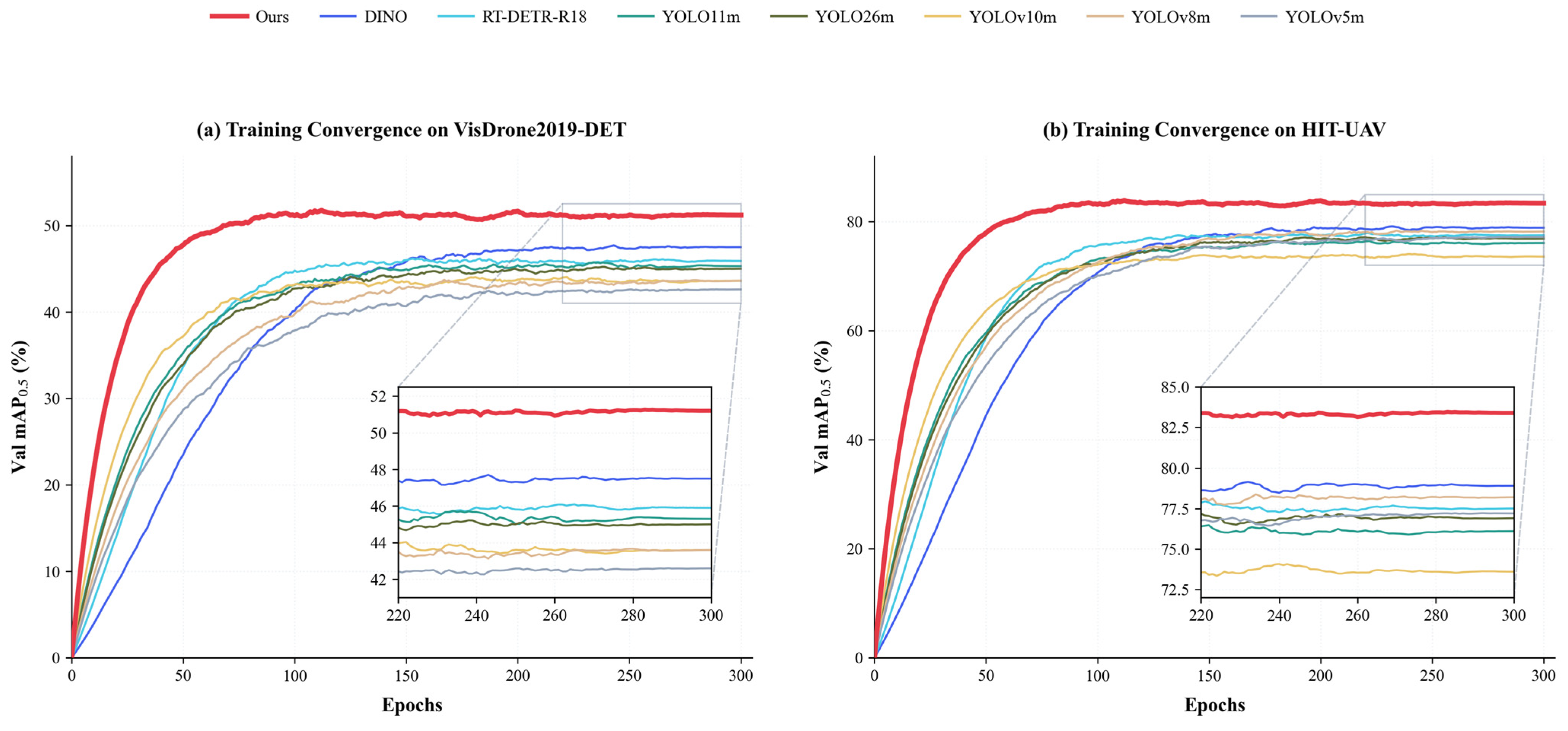
To further verify the effectiveness of the proposed method, we compare it with a variety of representative object detection models on the VisDrone2019-DET and HIT-UAV datasets, including YOLOv5m, YOLOv8m, YOLOv10m, YOLO11m, YOLO26m, Faster R-CNN, DETR, DINO, the RT-DETR series, and more recent models designed for UAV object detection, such as DMF-YOLO, UAV-DETR, and CSFPR-RTDETR. The results are shown in Table 4. The visual comparison of convergence curves is presented in Figure 10.
The results on VisDrone2019-DET show that the traditional two-stage detector Faster R-CNN achieves only 41.4% mAP0.5 and 21.9% mAP0.5:0.95, indicating that it is difficult for this model to simultaneously satisfy detection accuracy and real-time requirements in complex UAV small-object detection scenarios. DETR achieves 41.3% mAP0.5, which is also lower than that of most lightweight one-stage detectors, indicating that the standard transformer detector still suffers from slow convergence and insufficient feature representation in densely distributed small-object scenarios. DINO achieves 47.5% mAP0.5 and performs better than standard DETR, but it contains 47.5 M parameters and has relatively high model complexity, which is unfavourable for UAV deployment.
Compared with the YOLO-series methods, the proposed method achieves higher detection accuracy while maintaining a lower parameter count. The mAP0.5 values of YOLOv5 m, YOLOv8m, YOLOv10m, YOLO11m, and YOLO26m are 42.6%, 43.6%, 43.6%, 45.3%, and 45.0%, respectively, all of which are lower than the 51.2% achieved by our method. At the same time, our method contains only 13.7 M parameters, fewer than YOLOv5m (25.1 M), YOLOv8m (25.8 M), YOLO11m (20.0 M), and YOLO26m (20.4 M). Compared with the baseline RT-DETR-R18, the proposed method improves mAP0.5 on VisDrone2019-DET from 45.9% to 51.2% and improves mAP0.5:0.95 from 28.0% to 32.6%, demonstrating that FICE-Net, Binary-AIFI, and RCFF effectively enhance the adaptability of the baseline model to UAV small-object detection.
On the HIT-UAV dataset, the proposed method also achieves the best overall performance. Specifically, it reaches 83.4% mAP0.5 and 56.3% mAP0.5:0.95, which are higher than the 77.5% and 49.3% of RT-DETR-R18. The mAP0.5 of our method is also slightly higher than that of CSFPR-RTDETR. These results indicate that the proposed method is applicable not only to visible-light UAV images but also exhibits strong generalization capability in infrared weak-texture scenarios.
Overall, the results on the two datasets indicate that the proposed method outperforms most comparison models in detection accuracy while maintaining a relatively low parameter count, thereby demonstrating a favourable balance between accuracy and complexity.
To further analyze the detection capability of different models for different object categories, AP was computed for each category on the VisDrone2019-DET and HIT-UAV datasets. As shown in Table 5, the category-wise results on VisDrone2019-DET indicate that the proposed method achieves the best performance on multiple categories, including pedestrian (PT), people (PE), van (VA), truck (TK), bus (BU), and motor (MO). In particular, the AP values for pedestrian (PT), people (PE), and bus (BU) reach 60.0%, 50.1%, and 70.4%, respectively, all of which are higher than those of RT-DETR-R18 and most YOLO-series models. For categories such as truck (TK) and van (VA), which show obvious scale variation and are easily confused with the background, the proposed method also attains AP values of 43.5% and 53.3%, respectively, indicating that frequency-domain feature enhancement, global contextual encoding, and cross-scale fusion can improve target discrimination in complex scenes.
On the HIT-UAV dataset, the results in Table 6 show that the proposed method achieves the highest accuracy on categories such as person (PE), car (CA), other vehicle (OT), and bicycle (BI). Specifically, the AP values for person (PE), car (CA), other vehicle (OT), and bicycle (BI) reach 94.6%, 99.1%, 96.9%, and 93.4%, respectively. In particular, the proposed method performs markedly better than most comparison models on the other vehicle (OT) category, indicating that it can distinguish different types of vehicle targets more effectively when texture information is limited in infrared images. Although the AP of the DO category is not the highest, which may be related to the limited number of samples, large variation in object shape, and unstable category boundaries in infrared imaging, the proposed method still achieves the best overall mAP, indicating more stable overall detection performance.

5.2.2. Comparison of Different Lightweight Backbone Convolutions

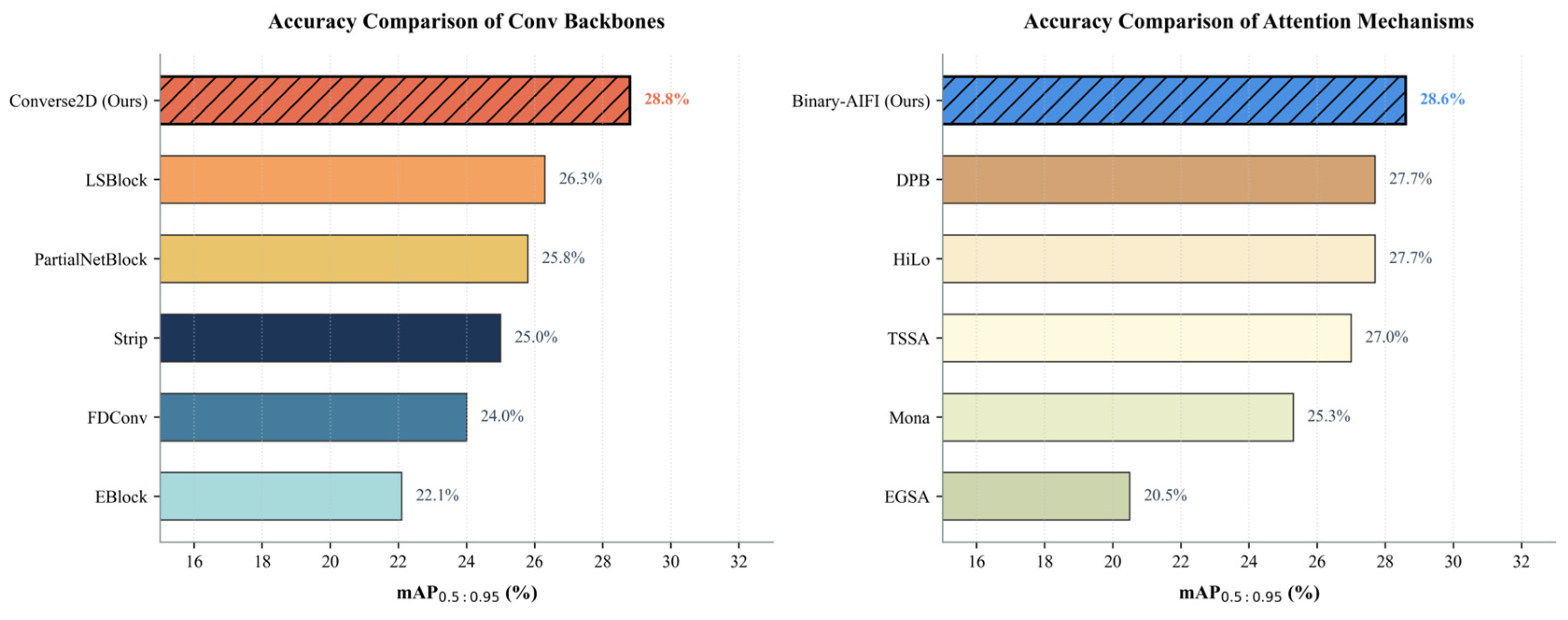
To verify the effectiveness of the Converse2D frequency-domain inverse-convolution structure in FICE-Net, we further compare the performance of different lightweight backbone convolution structures on the VisDrone2019-DET dataset, including EBlock, FDConv, LSBlock, PartialNetBlock, and Strip. All methods are tested under the same experimental settings. The results are shown in Table 7, and the visual comparison is shown in Figure 11.
The results show that different lightweight convolution structures exhibit relatively small differences in parameter count and computational cost, but their detection performance differs markedly. EBlock contains 13.7 M parameters and 44.6 GFLOPs, yet its mAP0.5 is only 40.4%, indicating that although it has a certain lightweight advantage, it is insufficient in representing UAV small objects. FDConv and LSBlock achieve mAP0.5 values of 40.9% and 43.7%, respectively, which are improvements over EBlock, but their overall detection accuracy remains unsatisfactory. PartialNetBlock has the lowest parameter count, 12.9 M, but its mAP0.5 is only 43.2%, indicating that simply reducing the number of parameters cannot guarantee strong small-object detection performance.
In contrast, FICE-Net with Converse2D achieves the best detection results. With Converse2D, mAP0.5 reaches 48.3%, mAP0.75 reaches 29.2%, and mAP0.5:0.95 reaches 28.8%, all of which are higher than those of the other lightweight convolution structures. Meanwhile, precision and recall reach 61.5% and 47.5%, respectively, and FPS reaches 60.1, indicating a good balance between detection accuracy and inference speed. Compared with Strip, Converse2D achieves lower GFLOPs while improving mAP0.5 by 6.2 percentage points; compared with PartialNetBlock, Converse2D has only a slightly higher parameter count but improves mAP0.5 by 5.1 percentage points.
These results indicate that Converse2D does not merely reduce model complexity through a lightweight structure but instead enhances the backbone’s ability to model global spectral structures and fine-grained small-object features through frequency-domain inverse convolution. Therefore, introducing Converse2D into FICE-Net enables the detector to better adapt to the characteristics of UAV imagery, including small object scale, complex backgrounds, and weak textures.

5.2.3. Comparison of Different Attention Mechanisms

To verify the effectiveness of Binary-AIFI, we compare it with multiple attention mechanisms on the VisDrone2019-DET dataset, including HiLo, EGSA, Mona, DPB, and TSSA. The results are shown in Table 8, and the visual comparison is shown in Figure 11.
The results indicate clear differences among attention mechanisms in the trade-off between accuracy and speed. EGSA achieves 90.3 FPS and thus provides high inference speed, but its mAP0.5 and mAP0.5:0.95 are only 35.5% and 20.5%, indicating that an excessive pursuit of lightweight design may weaken the model’s ability to represent complex UAV small objects. HiLo and TSSA achieve mAP0.5 values of 45.7% and 45.5%, respectively, and provide relatively fast inference, but their detection accuracy remains lower than that of the proposed method. DPB achieves 46.0% mAP0.5 and performs relatively well among the comparison attention mechanisms, but its mAP0.5:0.95 is 27.7%, which is still lower than that of Binary-AIFI.
The Binary-AIFI adopted in this paper achieves the best detection accuracy, with mAP0.5, mAP0.75, and mAP0.5:0.95 values of 47.5%, 29.3%, and 28.6%, respectively, all of which are the highest among the compared attention mechanisms. In addition, Binary-AIFI achieves precision and recall values of 60.7% and 44.9%, respectively, indicating that it not only improves prediction accuracy but also maintains good target recall. Although the FPS of Binary-AIFI is 54.4, which is lower than that of lightweight attention mechanisms such as EGSA, HiLo, and TSSA, it still satisfies the requirements of real-time detection and exhibits clear accuracy advantages.
These results show that, for UAV small-object detection, attention mechanisms should not pursue inference speed alone but must also preserve sufficient global contextual modelling capability. By binarizing the query and key matrices in AIFI, Binary-AIFI retains intra-scale global interaction capability while controlling additional computational cost and is therefore better suited to real-time UAV small-object detection within the RT-DETR framework.
Table 9 compares the runtime efficiency of standard AIFI and Binary-AIFI on different hardware platforms. Binary-AIFI reduces the peak memory usage of the module from 86.50 MB to 40.14 MB, making it compatible with the limited memory resources of embedded platforms. In the PyTorch environment on a desktop GPU (RTX 4090), the inference latency of the module is reduced from 1.15 ms to 0.28 ms. On the Jetson Orin Nano embedded platform with TensorRT FP16 precision, Binary-AIFI cuts the inference latency from 0.58 ms to 0.32 ms and lowers the operating power consumption from 14.8 W to 11.4 W, which balances the real-time performance and endurance requirements in edge scenarios.

5.2.4. Supplementary Comparative Verification of Core Modules

Table 10 compares the performance and efficiency of the Converse2D module with different kernel sizes, aiming to verify the influence of the frequency-domain inverse convolution kernel’s receptive field on small-object feature reconstruction.
In terms of efficiency metrics, as the kernel size increases from 1 × 1 to 7 × 7, the number of model parameters only slightly rises from 13.74 M to 13.84 M, indicating that the kernel size has a very limited impact on the overall computational cost of the module. In terms of detection accuracy, the model achieves the best performance with a 3 × 3 kernel configuration, with mAP0.5 and mAP0.5:0.95 reaching 51.2% and 32.6%, respectively. When the kernel size is 1 × 1, limited by the excessively small receptive field, frequency-domain reconstruction cannot obtain sufficient spatial context information, resulting in insufficient recovery of high-frequency textures of small objects and a significant drop in accuracy. When the kernel size increases to 5 × 5 and 7 × 7, the overly large receptive field introduces redundant background noise, which weakens the feature enhancement effect on dim and small objects, and the accuracy shows a gradual downward trend.
In conclusion, the 3 × 3 kernel achieves the optimal balance between spectral recovery and noise suppression and is thus selected as the default configuration of Converse2D.
Table 11 analyzes the influence of the regularization offset parameter b (initial damping strength λ0) on model performance to verify the rationality of the regularization strength design in frequency-domain inverse convolution.
Since the offset b is a learnable scalar and does not change the network structure of the module, the parameters and GFLOPs of the four groups of experiments are completely consistent. The experimental results show an obvious unimodal trend: when b = −9.0, the model achieves the optimal detection accuracy, with mAP0.5 and mAP0.5:0.95 of 51.2% and 32.6%, respectively. When the value of b is too large, the damping is excessive, high-frequency fine-grained textures are over-smoothed, the boundary response of dim and small objects is weak, and the detection accuracy decreases. When the value of b is too small, the noise suppression ability of frequency-domain inverse convolution is insufficient, and the gradient oscillates slightly and is easily disturbed by noise.
This result verifies that the initial setting of b = −9.0 can achieve the optimal balance between data fidelity and high-frequency noise suppression, providing experimental support for the parameter design of the regularization coefficient.
To justify the architectural configuration of Binary-AIFI, we tested four quantization precision schemes, and the results are shown in Table 12.
Compared with the full-precision baseline (86.50 MB memory, 3.033 ms latency), after binarizing the query and key representations to [−1, +1], the peak GPU memory usage is reduced by 53.6% (down to 40.14 MB), the inference latency is shortened to 0.709 ms, and the inference speed is increased by 4.28 times. Notably, Binary-AIFI achieves the best detection accuracy, with mAP0.5 reaching 51.2%, which is 3.2 percentage points higher than full-precision attention. This experimental result indicates that 1-bit projection can suppress continuous semantic noise and act as an information bottleneck in deep feature maps.
Further applying extremely low-bit quantization to the value matrix V can only slightly reduce memory usage (36.80 MB) but leads to a decline in detection accuracy (mAP0.5 is 49.5%) due to the truncation of fine-grained spatial representations. Therefore, binarizing the Q and K matrices while maintaining full precision for the V matrix can achieve the optimal trade-off between deployment efficiency and detection accuracy.

5.3. Visualization Analysis

5.3.1. Visual Analysis on the VisDrone2019-DET Dataset

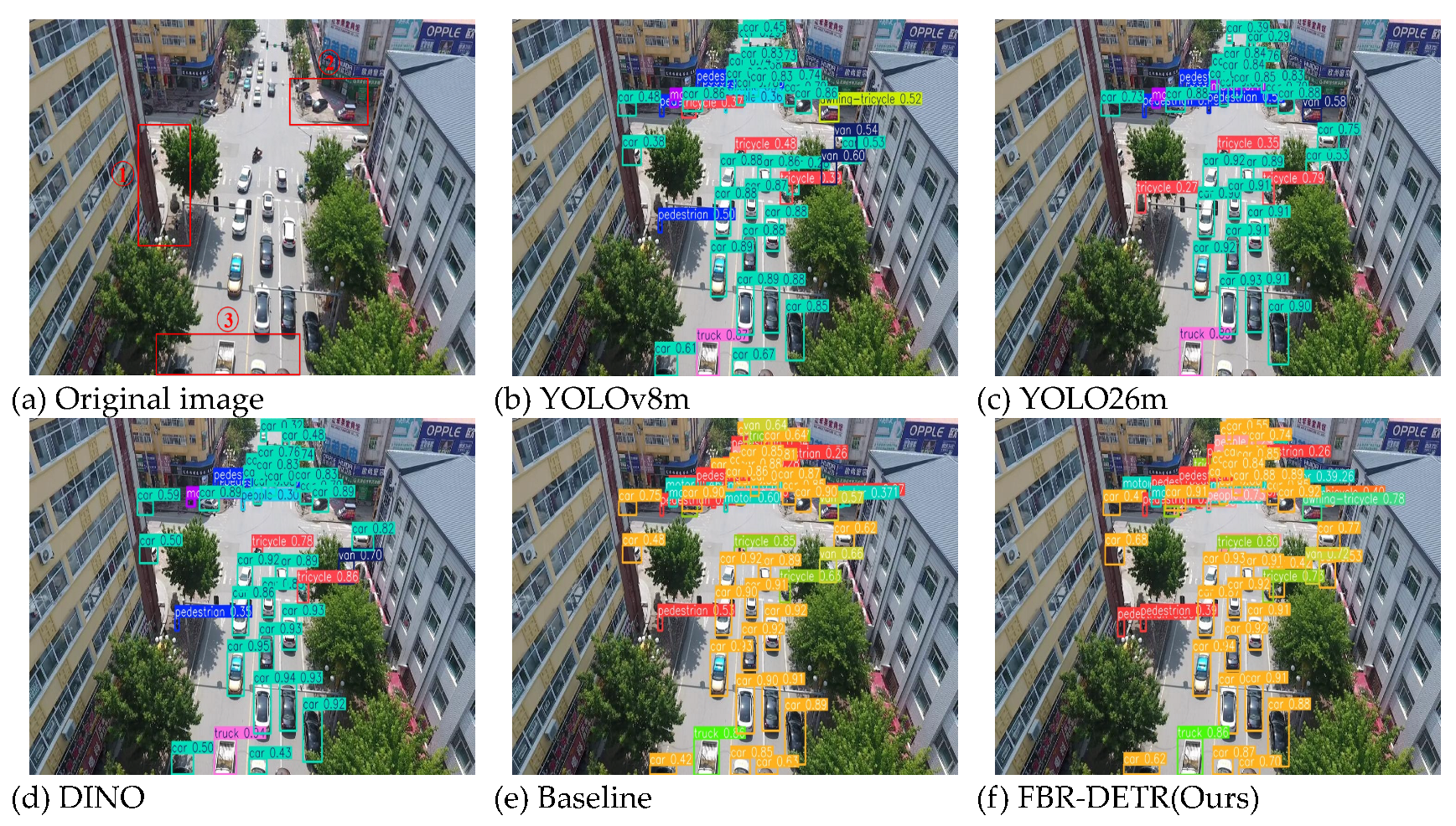
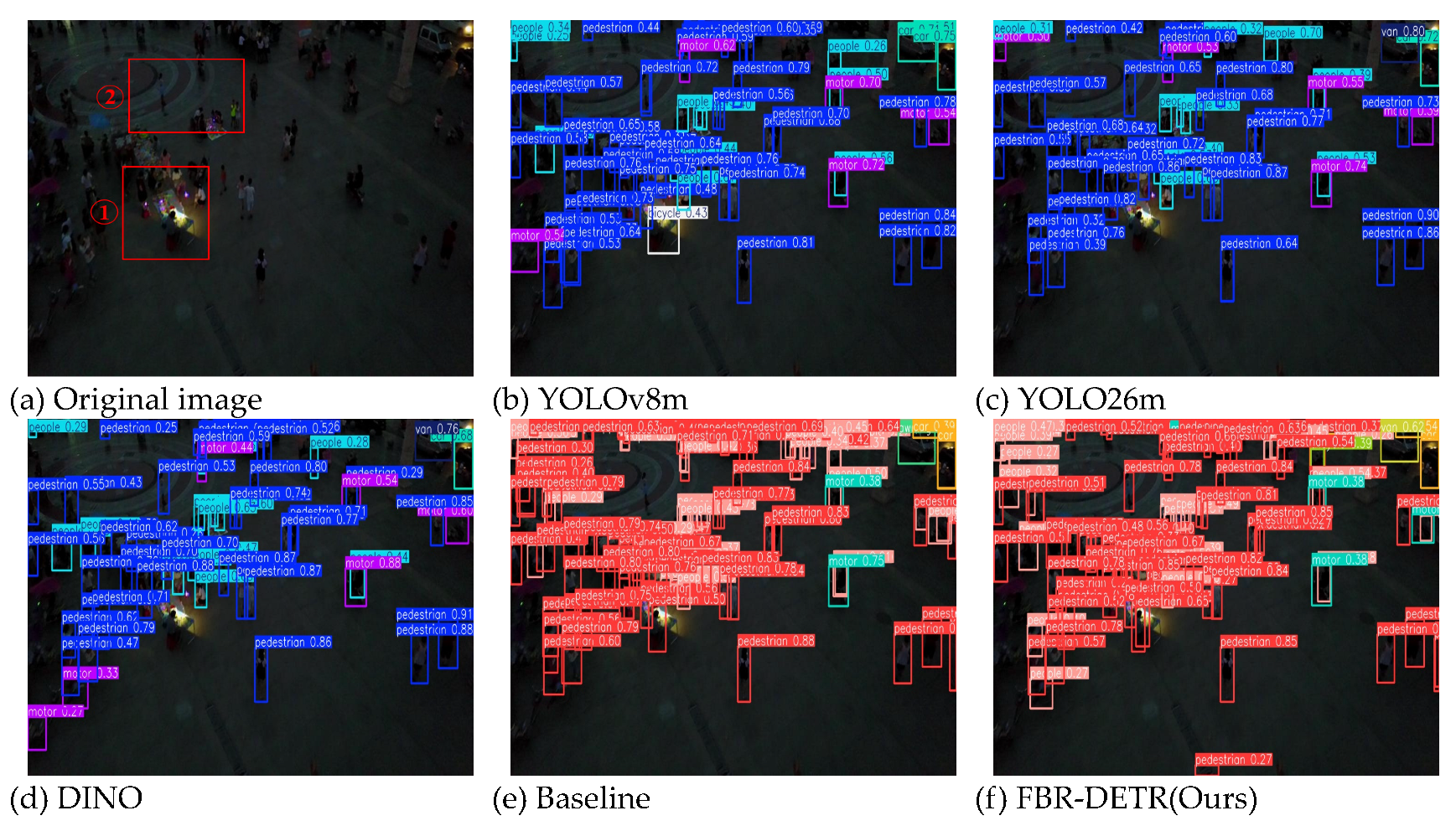
To further verify the effectiveness of the proposed model relative to current mainstream object detection models, we conduct a visual comparison using two challenging UAV scenarios: a daytime urban road scene with densely distributed small objects and a nighttime low-visibility scene with easily confusable small objects. The comparison methods include YOLOv8m, YOLO26m, DINO, the baseline model RT-DETR-R18, and the proposed method. Figure 12 and Figure 13 show the detection results of different models in these two representative scenarios, where the red marked regions indicate difficult target areas that require particular attention.
Figure 12 presents the detection results in a daytime urban road scene. This scene is characterized by a large number of targets, obvious scale variation among vehicles, dense object distribution, and strong interference from occlusion by trees and buildings. Three key regions are marked in the original image: Region 1 is located along the left edge of the road, where the targets are affected by building shadows and tree occlusion and exhibit local textures similar to the background; Region 2 is located in the upper-right part of the image, where the targets are small and close to a complex building background; and Region 3 is located in the middle of the road and near the image boundary, where vehicles are densely arranged and prone to target adhesion and boundary-localization deviation.
In Region 1, which contains two cars and two pedestrians, the proposed method maintains a relatively complete target response and successfully detects all objects in the target area, whereas the other comparison models all exhibit missed detections and false detections. In Region 2, which contains multiple vehicles, the proposed model shows better performance and yields higher confidence scores. For the densely arranged vehicle targets in Region 3, the proposed method can better distinguish adjacent object boundaries, and the distribution of detection boxes is more continuous and complete.
The comparison results show that YOLOv8m and YOLO26m can detect most of the obvious vehicles in the scene, but they still suffer from missed detections and unstable localization in densely distributed small-object regions. In particular, in Regions 2 and 3, where the objects are small and the distances between adjacent targets are short, YOLO-series models tend to produce overlapping detection boxes, unstable class confidence, and omissions of some small targets. Although DINO has strong global modelling capability by virtue of its transformer structure, it still exhibits insufficient response to some small targets in this high-density aerial scene, indicating that relying solely on global attention is insufficient to fully address the lack of fine-grained small-object representation.
Figure 13 presents the detection results in a nighttime low-visibility scene. This scene suffers from insufficient illumination, interference from locally bright regions, weak object textures, and blurred boundaries between pedestrians and the background. Two key regions are marked in the original image: Region 1 is located in the lower-left part of the image, where the targets are simultaneously affected by strong illumination and a low-visibility background, making category confusion or boundary deviation more likely; Region 2 is located in the upper part of the image, where the targets resemble the ground texture and shadow regions and thus represent a typical weak-texture small-object detection challenge.
In Region 1 of the nighttime scene, which contains pedestrians in various poses, the comparison models YOLOv8m, YOLO26m, and DINO all suffer from varying degrees of missed detections and false detections because of illumination interference. In contrast, the proposed method can localize the targets more accurately and reduce false detections caused by locally bright backgrounds. For the weak-texture small targets in Region 2 that resemble the ground texture, even the baseline RT-DETR-R18, which performs relatively well in Region 1, exhibits missed detections. The proposed method still maintains a good detection response, indicating stronger discriminative capability for easily confusable small objects.
The visualization results show that although YOLOv8m, YOLO26m, and DINO can detect some pedestrian targets in nighttime scenes, their detection results still contain a certain number of missed detections and false detections. Because the object boundaries in nighttime images are unclear, local lighting can alter the brightness distribution in the target region and cause some background regions to exhibit target-like visual characteristics, making it easy for the models to misclassify bright background regions or shadows as targets. The baseline RT-DETR-R18 produces a relatively large number of detections boxes but also exhibits redundant detections and unstable boundaries in complex low-illumination backgrounds, indicating that the original RT-DETR still has limited discriminative ability for nighttime weak-texture targets.

5.3.2. Visual Analysis on the HIT-UAV Dataset

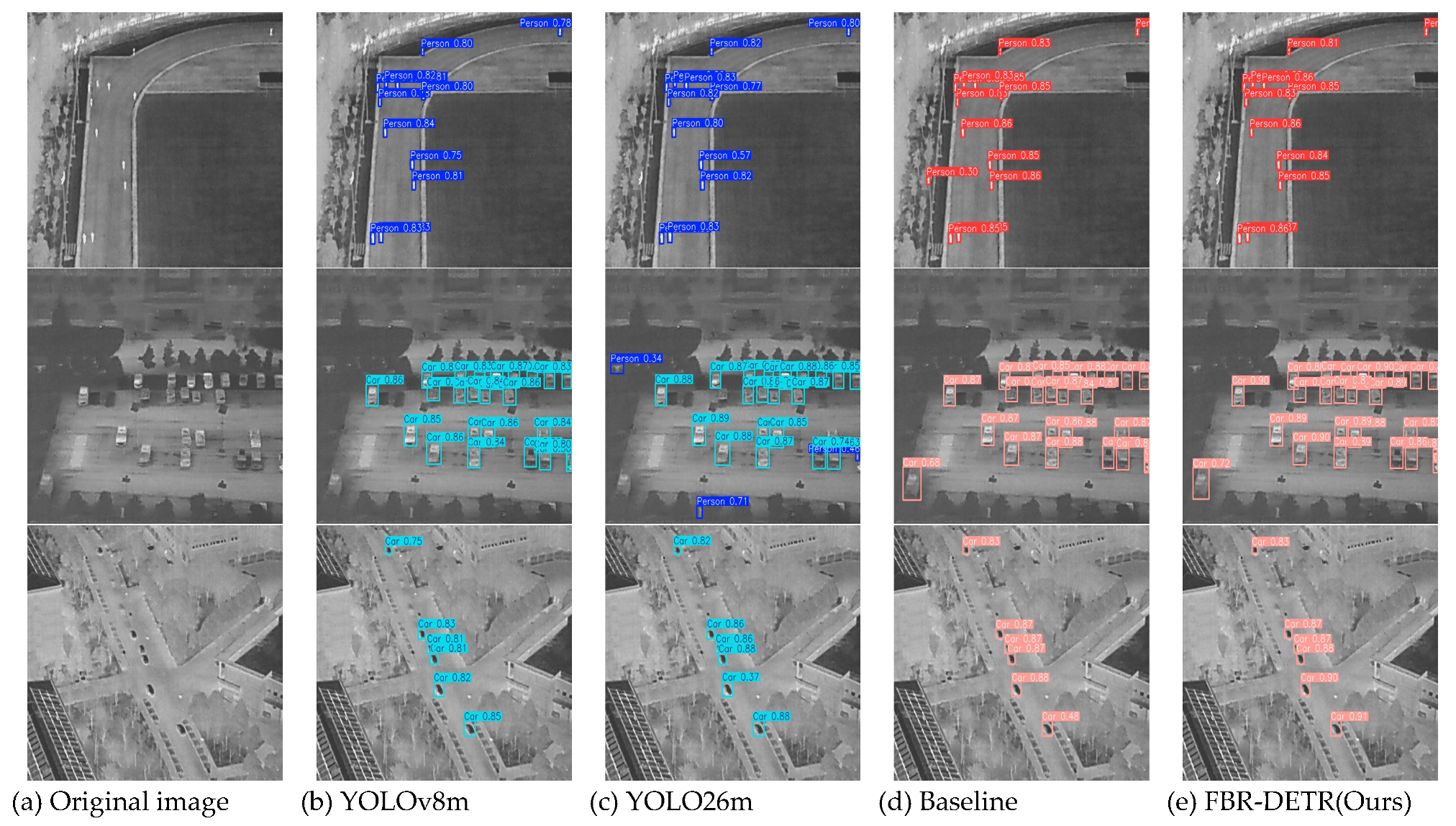
Figure 14 shows the visual detection results on HIT-UAV infrared UAV imagery. Compared with visible-light images, infrared images contain weaker texture information, the boundaries between targets and background are less clear, and targets such as pedestrians and vehicles are usually smaller in scale; therefore, missed detections and localization shifts are more likely to occur.
The first-row pedestrian detection scene shows that YOLOv8m, YOLO26m, and the baseline model can detect some pedestrians, but they still exhibit overlapping detection boxes and local missed detections in dense pedestrian regions. By contrast, the proposed method can more completely detect small pedestrians along the road edge while maintaining high confidence, indicating more stable recognition capability for weak-texture pedestrian targets in infrared imagery.
The second and third rows show vehicle detection scenes in a parking lot and on elevated roads, respectively. Because the vehicles are small, densely arranged, and in some cases have low contrast with the ground background, the comparison models tend to miss distant vehicles or produce insufficient confidence. The proposed method can detect more small-scale vehicles and maintains more stable localization results in both dense parking areas and long-distance road scenes. Overall, the proposed method handles the weak textures, small object scales, and low background contrast in HIT-UAV infrared images more effectively.

5.3.3. Heatmap Visual Analysis

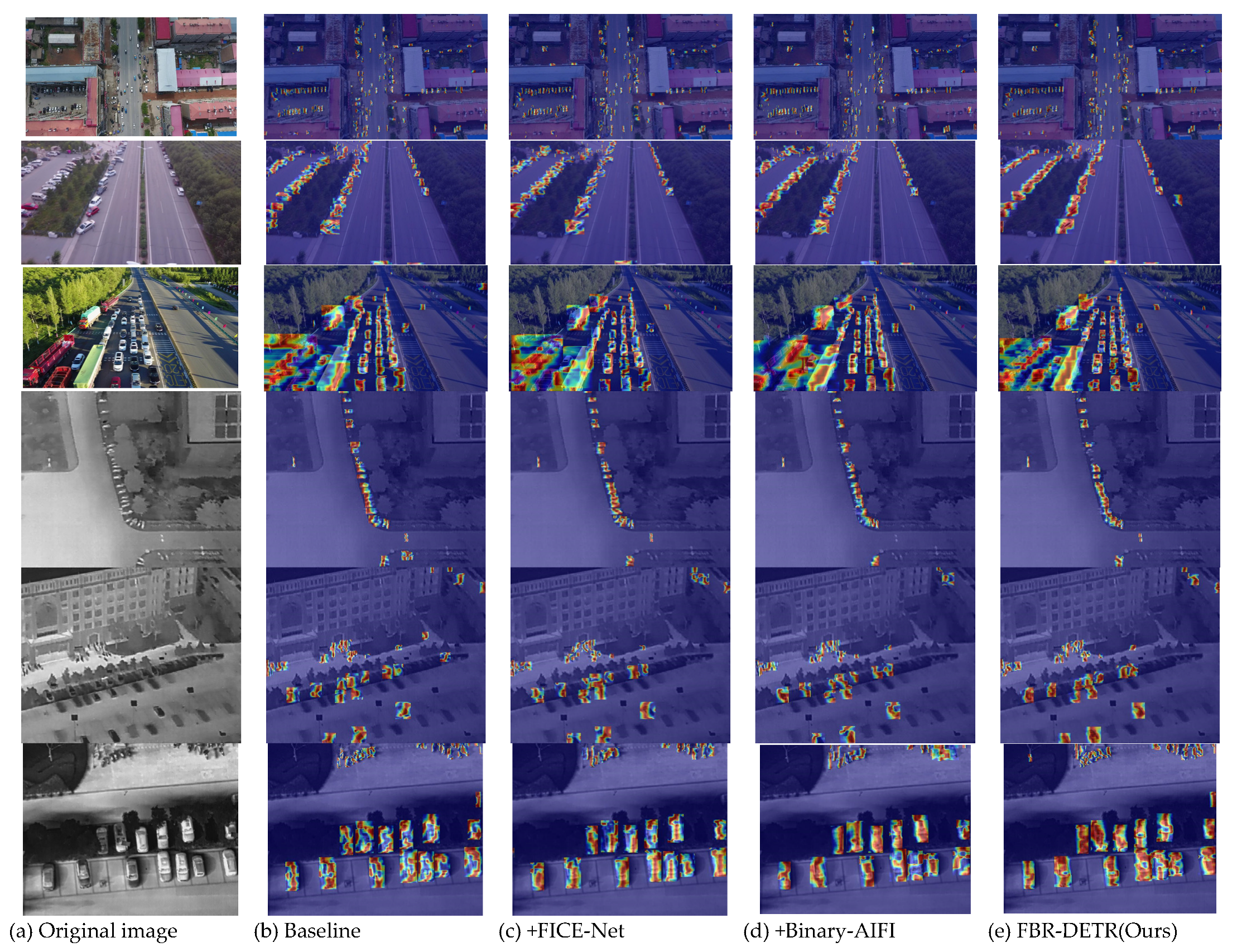
Figure 15 presents feature heatmaps for different module combinations visualized using Grad-CAM. Warmer heatmap colours indicate that the model pays greater attention to the target region.
The overall results show that, although the baseline can respond to some salient targets, its attention distribution is relatively scattered and is easily disturbed by background textures such as roads, building edges, trees, and parking lines. In scenes with dense vehicles, distant small targets, and weak infrared textures, the highly responsive regions of the baseline do not always accurately cover the target centres, indicating that the original RT-DETR-R18 is still insufficient in perceiving small-object features under complex backgrounds.
After adding FICE-Net, the model response to target regions is clearly enhanced. In particular, in scenes with densely arranged vehicles and infrared small objects, the heatmaps focus more clearly on the target contours. This indicates that frequency-domain inverse-convolution-based feature extraction can enhance the structural differences between small objects and the background and improve the quality of basic feature representation. After Binary-AIFI is further introduced, target responses in the heatmaps become more concentrated, and ineffective activation in background regions is reduced, indicating that binary attention encoding can suppress interfering regions by exploiting global contextual relationships and can enhance semantic consistency within target regions.
The heatmaps of the complete model are the most stable, and the target regions exhibit more continuous and more concentrated high-intensity responses. In visible-light scenes with densely distributed vehicles, the complete model can distinguish adjacent vehicles more accurately; in infrared weak-texture scenes, it also maintains stable attention to small pedestrians and vehicles. These results indicate that FICE-Net, Binary-AIFI, and RCFF play complementary roles: FICE-Net enhances target structural features, Binary-AIFI improves global contextual modelling, and RCFF further optimizes multi-scale feature fusion. As the three modules are gradually integrated, the model’s target-perception ability and feature discriminability continue to improve, thereby validating the effectiveness of the proposed collaborative improvement strategy involving feature extraction, efficient encoding, and cross-scale fusion.

5.4. Cross-Scene Visual Case Analysis

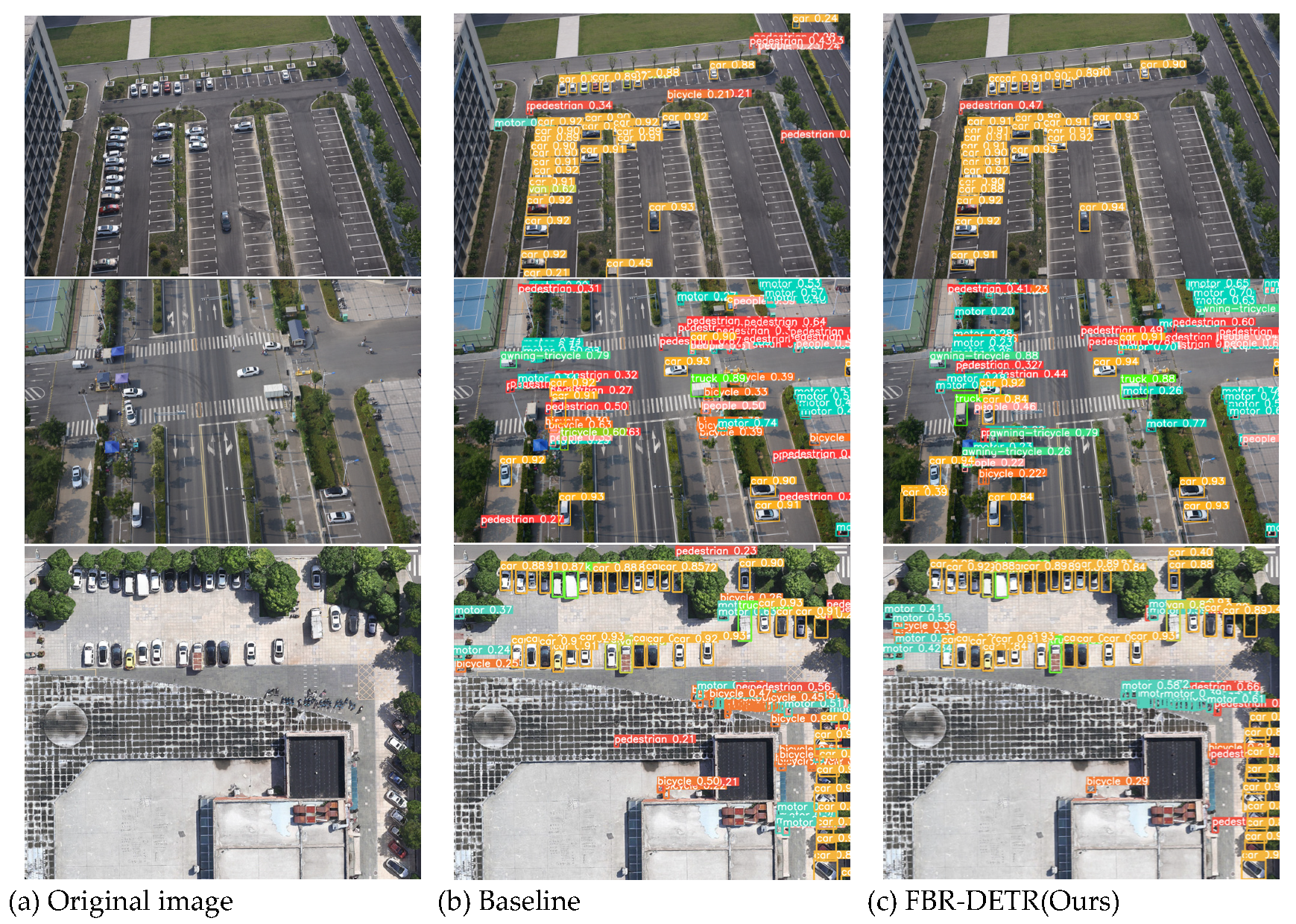
To visually examine the feature robustness of the proposed method under unannotated real-world conditions, this paper conducts a qualitative visual case study using UAV images captured in campus environments. These images are not involved in the model training process and serve as an intuitive visual test for out-of-distribution scene adaptability.
As shown in Figure 16, the baseline can detect some vehicle and pedestrian targets in the campus scenes, but its detection results are relatively unstable. On the one hand, in parking lot scenes with densely arranged vehicles, the baseline tends to produce missed detections, duplicate detections, and fluctuating confidence. On the other hand, in complex areas such as road intersections and campus squares, the baseline has insufficient ability to distinguish pedestrians, non-motor vehicles, and background textures, resulting in many low-confidence false detections. This indicates that relying solely on the original RT-DETR-R18 feature extraction and fusion structure still leads to insufficient cross-scene generalization on real captured data.
In contrast, the proposed method exhibits more stable detection performance in all three campus scenes. In the parking lot scene, it can detect densely arranged vehicles more completely while maintaining high confidence. In the road intersection scene, it has stronger discrimination among vehicles, pedestrians, and non-motor vehicles, thereby reducing false detections caused by complex road markings, tree shadows, and building edges. In the campus square scene, it still maintains relatively continuous detection responses for objects of different scales, indicating strong cross-scene adaptability.
This generalization capability mainly arises from the synergy of the three modules proposed in this paper. FICE-Net enhances target structural features through frequency-domain inverse convolution, enabling the model to avoid relying solely on local textures when facing new campus backgrounds. Binary-AIFI uses global contextual relationships to improve discrimination between targets and complex backgrounds. RCFF enhances multi-scale feature fusion, allowing the model to adapt simultaneously to nearby large objects and distant small objects. Overall, the visual detection results in campus environments serve as an intuitive qualitative case study, demonstrating that FBR-DETR maintains consistent feature responses and reduces false detections under unseen aerial backgrounds. Combined with the embedded deployment metrics reported in Section 5.2.3, such as the 0.32 ms latency under TensorRT FP16 precision on NVIDIA Jetson Orin Nano, these visual examples verify the practical feature stability of the proposed model in real-world UAV applications.

5.5. Edge Deployment and Real-Time Performance Analysis

To evaluate the deployment efficiency of the FBR-DETR model in actual edge scenarios, we first export the PyTorch-trained model to ONNX format, then use TensorRT to build an inference engine optimized for the Jetson GPU architecture and select FP16 precision during the construction process according to hardware characteristics to balance computational speed and numerical stability. The performance comparison of different detectors is shown in Table 13.
For the actual deployment performance test, we conducted comparative experiments on the NVIDIA Jetson Orin Nano device with a 15 W power mode, TensorRT FP16 precision, 640 × 640 input resolution, and batch size of 1, comparing YOLOv8m, RT-DETR-R18, and the proposed FBR-DETR model. The results show that YOLOv8m has 25.80 M parameters, 21.8 ms inference latency, and 45.8 FPS; compared with the RT-DETR-R18 baseline, FBR-DETR improves the inference frame rate by 53.2%, while reducing latency by 34.7% and parameters by 30.5%, achieving the best performance among all compared models. The above experiments fully verify the significant advantages of FBR-DETR in lightweight design and edge real-time inference, which can meet the actual deployment requirements on embedded platforms with limited resources.

6. Conclusions

This paper proposes FBR-DETR, an efficient end-to-end network for real-time small-object detection in UAV imagery. Through targeted improvements in feature extraction, intra-scale encoding, and cross-scale fusion, FBR-DETR achieves excellent detection performance while preserving the advantages of end-to-end detection. In quantitative experiments, FBR-DETR improves mAP0.5, mAP0.5:0.95, and APs on the VisDrone2019-DET dataset by 5.3%, 4.6%, and 2.4%, respectively, and improves these metrics on the HIT-UAV dataset by 5.9%, 7.0%, and 4.9%, respectively. Meanwhile, the model reduces the parameter count to 13.7 M, which is a reduction of 30.8%, while maintaining an inference speed of 66.9 FPS. In qualitative experiments, visual detection results and heatmap analysis show that FBR-DETR can focus more accurately on densely distributed small-object regions and effectively reduce invalid responses in complex backgrounds, weak-texture regions, and nighttime low-visibility scenes.
Although FBR-DETR achieves a good accuracy–speed trade-off in UAV small target detection tasks, in scenarios such as extremely small-pixel targets, severe occlusion, low signal-to-noise ratio infrared images, and nearly fully dark night aerial photography, the target texture and boundary information may still be insufficient, leading to decreased effectiveness of frequency domain recovery and attention modelling. In addition, in extremely dense target scenarios, too small target spacing may also cause missed detection or positioning offset. To address these issues, we propose more specific directions in future work, including exploring frequency-domain fusion of visible–infrared–multispectral to enhance complementary perception of weak texture targets; introducing lightweight long-range modelling structures such as Mamba to reduce the computational overhead of transformer attention; and conducting more systematic cross-scene deployment tests combined with real UAV airborne platforms.

Author Contributions

Conceptualization, S.L. and X.W.; methodology, S.L. and R.W.; validation, R.W. and X.W.; formal analysis, S.L. and A.W.; investigation, X.W. and J.S.; resources, R.W. and A.W.; data curation, H.L. and J.S.; writing—original draft preparation, S.L.; writing—review and editing, X.W. and S.L.; visualization, S.L. All authors have read and agreed to the published version of the manuscript.

Funding

This research was funded by Jiangsu Provincial Frontier Technology Research and Development Program under Grant KK251092024; the National Natural Science Young Foundation of China under Grant 42404100; the Marine Science and Technology Innovation Project of Jiangsu Province under Grant JSZRKJ202421; Key Laboratory of Geological Safety of Coastal Urban Underground Space, Ministry of Natural Resource under Grant BHKF2023Z09.

Data Availability Statement

The original contributions presented in the study are included in the article, further inquiries can be directed to the corresponding author.

Acknowledgments

The authors would like to thank the editors and anonymous reviewers for their valuable comments that greatly improved our manuscript.

Conflicts of Interest

The authors declare no conflicts of interest.

References

  1. Wang, B.; Sui, H.; Ma, G.; Zhou, Y.; Zhou, M. GMODet: A Real-Time Detector for Ground-Moving Objects in Optical Remote Sensing Images with Regional Awareness and Semantic–Spatial Progressive Interaction. IEEE Trans. Geosci. Remote Sens. 2025, 63, 5605623. [Google Scholar] [CrossRef] [Scilit]
  2. Xiao, Y.; Wang, J.; Zhao, Z.; Jiang, B.; Li, C.; Tang, J. UAV Video Vehicle Detection: Benchmark and Baseline. IEEE Trans. Geosci. Remote Sens. 2025, 63, 5609814. [Google Scholar] [CrossRef] [Scilit]
  3. Liu, Z.; Zhao, D.; Yuan, B.; Jiang, Z. RescueADI: Adaptive disaster interpretation in remote sensing images with autonomous agents. IEEE Trans. Geosci. Remote Sens. 2025, 63, 5611814. [Google Scholar] [CrossRef] [Scilit]
  4. Chen, L.; Liu, C.; Li, W.; Xu, Q.; Deng, H. DTSSNet: Dynamic training sample selection network for UAV object detection. IEEE Trans. Geosci. Remote Sens. 2024, 62, 5902516. [Google Scholar] [CrossRef] [Scilit]
  5. Wu, X.; Li, W.; Hong, D.; Tao, R.; Du, Q. Deep learning for unmanned aerial vehicle-based object detection and tracking: A survey. IEEE Geosci. Remote Sens. Mag. 2021, 10, 91–124. [Google Scholar] [CrossRef] [Scilit]
  6. Ma, W.; Wang, X.; Zhu, H.; Yang, X.; Yi, X.; Jiao, L. Significant feature elimination and sample assessment for remote sensing small objects’ detection. IEEE Trans. Geosci. Remote Sens. 2024, 62, 5615115. [Google Scholar] [CrossRef] [Scilit]
  7. Zhang, T.; Zhang, X.; Zhu, X.; Wang, G.; Han, X.; Tang, X.; Jiao, L. Multistage enhancement network for tiny object detection in remote sensing images. IEEE Trans. Geosci. Remote Sens. 2024, 62, 5611512. [Google Scholar] [CrossRef] [Scilit]
  8. Shen, F.; Jiang, X.; He, X.; Ye, H.; Wang, C.; Du, X.; Li, Z.; Tang, J. Imagdressing-v1: Customizable virtual dressing. In Proceedings of the AAAI Conference on Artificial Intelligence; The Association for the Advancement of Artificial Intelligence: Washington, DC, USA, 2025; pp. 6795–6804. [Google Scholar]
  9. Xin, C.; Hartel, A.; Kasneci, E. Dart: An automated end-to-end object detection pipeline with data diversification, open-vocabulary bounding box annotation, pseudo-label review, and model training. Expert Syst. Appl. 2024, 258, 125124. [Google Scholar] [CrossRef] [Scilit]
  10. Hong, D.; Gao, L.; Hang, R.; Zhang, B.; Chanussot, J. Deep encoder–decoder networks for classification of hyperspectral and LiDAR data. IEEE Geosci. Remote Sens. Lett. 2020, 19, 5500205. [Google Scholar] [CrossRef] [Scilit]
  11. Cai, Z.; Vasconcelos, N. Cascade r-cnn: Delving into high quality object detection. In Proceedings of the 2018 IEEE/CVF Conference on Computer Vision and Pattern Recognition (CVPR); IEEE: New York, NY, USA, 2018; pp. 6154–6162. [Google Scholar]
  12. He, K.; Gkioxari, G.; Dollár, P.; Girshick, R. Mask R-CNN. In Proceedings of the 2017 IEEE International Conference on Computer Vision (ICCV); IEEE: New York, NY, USA, 2017; pp. 2961–2969. [Google Scholar]
  13. Ren, S.; He, K.; Girshick, R.; Sun, J. Faster R-CNN: Towards real-time object detection with region proposal networks. IEEE Trans. Pattern Anal. Mach. Intell. 2016, 39, 1137–1149. [Google Scholar] [CrossRef] [Scilit] [PubMed]
  14. Liu, W.; Anguelov, D.; Erhan, D.; Szegedy, C.; Reed, S.; Fu, C.-Y.; Berg, A.C. Ssd: Single shot multibox detector. In Proceedings of the European Conference on Computer Vision; Springer: Cham, Switzerland, 2016; pp. 21–37. [Google Scholar]
  15. Tan, M.; Pang, R.; Le, Q.V. Efficientdet: Scalable and efficient object detection. In Proceedings of the 2020 IEEE/CVF Conference on Computer Vision and Pattern Recognition (CVPR); IEEE: New York, NY, USA, 2020; pp. 10781–10790. [Google Scholar]
  16. Redmon, J.; Divvala, S.; Girshick, R.; Farhadi, A. You only look once: Unified, real-time object detection. In Proceedings of the 2016 IEEE Conference on Computer Vision and Pattern Recognition (CVPR); IEEE: New York, NY, USA, 2016; pp. 779–788. [Google Scholar]
  17. Wang, H.; Shi, J.; Karimian, H.; Liu, F.; Wang, F. YOLOSAR-Lite: A lightweight framework for real-time ship detection in SAR imagery. Int. J. Digit. Earth 2024, 17, 2405525. [Google Scholar] [CrossRef] [Scilit]
  18. Liang, S.; Wang, X.; Sun, J.; Liu, H.; Yang, H. EDM-Net: A Multi-Scale Network for Object Detection in Remote Sensing Images. Sensors 2026, 26, 3927. [Google Scholar] [CrossRef] [Scilit] [PubMed]
  19. Vaswani, A.; Shazeer, N.; Parmar, N.; Uszkoreit, J.; Jones, L.; Gomez, A.N.; Kaiser, Ł.; Polosukhin, I. Attention is all you need. Adv. Neural Inf. Process. Syst. 2017, 30. [Google Scholar] [CrossRef] [Scilit]
  20. Dosovitskiy, A.; Beyer, L.; Kolesnikov, A.; Weissenborn, D.; Zhai, X.; Unterthiner, T.; Dehghani, M.; Minderer, M.; Heigold, G.; Gelly, S. An image is worth 16x16 words: Transformers for image recognition at scale. arXiv 2020, arXiv:2010.11929. [Google Scholar]
  21. Carion, N.; Massa, F.; Synnaeve, G.; Usunier, N.; Kirillov, A.; Zagoruyko, S. End-to-end object detection with transformers. In Proceedings of the European Conference on Computer Vision; Springer: Cham, Switzerland, 2020; pp. 213–229. [Google Scholar]
  22. Wang, H.; Shi, J.; Karimian, H.; Wang, F.; Javed, F.; Liu, B.; Shi, S.; Li, Z.; Tao, Y. CitrusNet: A vision transformer-CNN approach for citrus detection from multi-source imagery with multi-scale feature integration. Comput. Electron. Agric. 2026, 241, 111260. [Google Scholar] [CrossRef] [Scilit]
  23. Zhao, Y.; Lv, W.; Xu, S.; Wei, J.; Wang, G.; Dang, Q.; Liu, Y.; Chen, J. Detrs beat yolos on real-time object detection. In Proceedings of the 2024 IEEE/CVF Conference On Computer Vision and Pattern Recognition (CVPR); IEEE: New York, NY, USA, 2024; pp. 16965–16974. [Google Scholar]
  24. Zhang, H.; Zhang, H.; Liu, K.; Gan, Z.; Zhu, G.-N. UAV-DETR: Efficient end-to-end object detection for unmanned aerial vehicle imagery. In Proceedings of the 2025 IEEE/RSJ International Conference on Intelligent Robots and Systems (IROS); IEEE: New York, NY, USA, 2025; pp. 15143–15149. [Google Scholar]
  25. Hu, L.; Yuan, J.; Cheng, B.; Xu, Q. CSFPR-RTDETR: Real-Time Small Object Detection Network for UAV Images Based on Cross Spatial Frequency Domain and Position Relation. IEEE Trans. Geosci. Remote Sens. 2025, 63, 5638219. [Google Scholar] [CrossRef] [Scilit]
  26. Xia, Y.; Liu, C.; Xiang, T.; Tu, Z. EFSI-DETR: Efficient Frequency-Semantic Integration for Real-Time Small Object Detection in UAV Imagery. arXiv 2026, arXiv:2601.18597. [Google Scholar]
  27. Ma, S.; Zhang, Y.; Peng, L.; Sun, C.; Ding, B.; Zhu, Y. OWRT-DETR: A novel real-time transformer network for small-object detection in open-water search and rescue from UAV aerial imagery. IEEE Trans. Geosci. Remote Sens. 2025, 63, 4205313. [Google Scholar] [CrossRef] [Scilit]
  28. Du, D.; Zhu, P.; Wen, L.; Bian, X.; Lin, H.; Hu, Q.; Peng, T.; Zheng, J.; Wang, X.; Zhang, Y. VisDrone-DET2019: The vision meets drone object detection in image challenge results. In Proceedings of the 2019 IEEE/CVF International Conference on Computer Vision Workshops (ICCVW); IEEE: New York, NY, USA, 2019; pp. 213–226. [Google Scholar]
  29. Suo, J.; Wang, T.; Zhang, X.; Chen, H.; Zhou, W.; Shi, W. HIT-UAV: A high-altitude infrared thermal dataset for Unmanned Aerial Vehicle-based object detection. Sci. Data 2023, 10, 227. [Google Scholar] [CrossRef] [Scilit] [PubMed]
  30. Zhao, Z.; Zhang, Y.; Zhou, J.; Li, D.; Cai, H.; Wang, N.; Zhang, J.; Xue, Y.; Jiang, H.; Lv, X. UIT-GAN: A cross-modal generative model for ultrasonic infrared thermography detection of impact damage in composites. Compos. Part B Eng. 2026, 313, 113389. [Google Scholar] [CrossRef] [Scilit]
  31. Wang, X.; Chen, H. HPS-DETR: Enhancing small object detection with lightweight feature extraction and transformer integration. IEEE Trans. Geosci. Remote Sens. 2025, 63, 5937420. [Google Scholar] [CrossRef] [Scilit]
  32. Cheng, G.; Lang, C.; Wu, M.; Xie, X.; Yao, X.; Han, J. Feature enhancement network for object detection in optical remote sensing images. J. Remote Sens. 2021, 2021, 9805389. [Google Scholar] [CrossRef] [Scilit]
  33. Gao, T.; Xia, S.; Liu, M.; Zhang, J.; Chen, T.; Li, Z. Msnet: Multi-scale network for object detection in remote sensing images. Pattern Recognit. 2025, 158, 110983. [Google Scholar] [CrossRef] [Scilit]
  34. Li, J.; Shi, Y.; Hong, Q.; Jia, Y. A Scale-Aware Multi-Domain DETR for Small Object Detection in UAV Remote Sensing Imagery. IEEE Trans. Geosci. Remote Sens. 2025, 63, 4421520. [Google Scholar] [CrossRef] [Scilit]
  35. Zhang, H.; Sun, H.; Gao, H.; Gao, L.; Zhang, B. Hyperspectral Remote Sensing Object Detection via Cross Domain Learning from Visible Images. IEEE Trans. Geosci. Remote Sens. 2026, 63, 5510518. [Google Scholar] [CrossRef] [Scilit]
  36. Wang, D.; Zhuang, L.; Gao, L.; Sun, X.; Zhao, X.; Plaza, A. Sliding dual-window-inspired reconstruction network for hyperspectral anomaly detection. IEEE Trans. Geosci. Remote Sens. 2024, 62, 5504115. [Google Scholar] [CrossRef] [Scilit]
  37. Li, H.; Ma, J.; Zhang, J. Elnet: An efficient and lightweight network for small object detection in UAV imagery. Remote Sens. 2025, 17, 2096. [Google Scholar] [CrossRef] [Scilit]
  38. Huang, X.; Liu, S.; Zhang, K.; Tai, Y.; Yang, J.; Zeng, H.; Zhang, L. Reverse Convolution and Its Applications to Image Restoration. In Proceedings of the 2025 IEEE/CVF International Conference on Computer Vision (ICCV); IEEE: New York, NY, USA, 2025; pp. 10507–10516. [Google Scholar]
  39. Li, F.; Wang, X.; Wang, H.; Karimian, H.; Shi, J.; Zha, G. LMVMamba: A Hybrid U-Shape Mamba for Remote Sensing Segmentation with Adaptation Fine-Tuning. Remote Sens. 2025, 17, 3367. [Google Scholar] [CrossRef] [Scilit]
  40. Cai, Z.; Quan, S.; Wang, J.; Xing, S.; Su, X.; Li, Y.; Liu, L. MaOutCNN: A physical mechanism coupled MambaOut-CNN detection network with maiden-released interference polarized ship detection dataset. ISPRS J. Photogramm. Remote Sens. 2026, 236, 500–527. [Google Scholar] [CrossRef] [Scilit]
  41. Hu, J.; Shen, L.; Sun, G. Squeeze-and-excitation networks. In Proceedings of the 2018 IEEE Conference on Computer Vision and Pattern Recognition (CVPR); IEEE: New York, NY, USA, 2018; pp. 7132–7141. [Google Scholar]
  42. Woo, S.; Park, J.; Lee, J.-Y.; Kweon, I.S. Cbam: Convolutional block attention module. In Proceedings of the 2018 European Conference on Computer Vision (ECCV); IEEE: New York, NY, USA, 2018; pp. 3–19. [Google Scholar]
  43. Li, M.; Gao, Y.; Guo, X.; Chen, Z.; Deng, L.; Dong, M.; Zhu, L. Edge-Semantic Synergy Network with Edge-Aware Attention for Infrared Small Target Detection. IEEE Trans. Geosci. Remote Sens. 2025, 64, 5000417. [Google Scholar] [CrossRef] [Scilit]
  44. Xiao, C.; Zhang, Z.; Zhang, L. BinaryAttention: One-bit QK-attention for vision and diffusion transformers. In Proceedings of the 2026 IEEE/CVF Conference on Computer Vision and Pattern Recognition (CVPR); IEEE: New York, NY, USA, 2026; pp. 12106–12117. [Google Scholar]
  45. Lin, T.-Y.; Maire, M.; Belongie, S.; Hays, J.; Perona, P.; Ramanan, D.; Dollár, P.; Zitnick, C.L. Microsoft coco: Common objects in context. In Proceedings of the European Conference on Computer Vision; Springer: Cham, Switzerland, 2014; pp. 740–755. [Google Scholar]
  46. Wang, J.; Yang, W.; Guo, H.; Zhang, R.; Xia, G.-S. Tiny object detection in aerial images. In Proceedings of the 2020 25th International Conference on Pattern Recognition (ICPR); IEEE: New York, NY, USA, 2021; pp. 3791–3798. [Google Scholar]
  47. Huang, J.; Zhang, F.; Zhu, H.; Yan, T. FSDETR: Frequency-Spatial Feature Enhancement for Small Object Detection. arXiv 2026, arXiv:2604.14884. [Google Scholar]
  48. Lin, T.-Y.; Dollár, P.; Girshick, R.; He, K.; Hariharan, B.; Belongie, S. Feature pyramid networks for object detection. In Proceedings of the 2017 IEEE Conference on Computer Vision and Pattern Recognition (CVPR); IEEE: New York, NY, USA, 2017; pp. 2117–2125. [Google Scholar]
  49. Liu, S.; Qi, L.; Qin, H.; Shi, J.; Jia, J. Path aggregation network for instance segmentation. In Proceedings of the 2018 IEEE Conference on Computer Vision and Pattern Recognition (CVPR); IEEE: New York, NY, USA, 2018; pp. 8759–8768. [Google Scholar]
  50. Liu, H.-I.; Tseng, Y.-W.; Chang, K.-C.; Wang, P.-J.; Shuai, H.-H.; Cheng, W.-H. A denoising fpn with transformer r-cnn for tiny object detection. IEEE Trans. Geosci. Remote Sens. 2024, 62, 4704415. [Google Scholar] [CrossRef] [Scilit]
  51. Bai, Y.; Song, C.; Wang, Y.; Li, P. Efficient object detection in remote sensing images based on feature weaving and redundancy suppression. IEEE Trans. Geosci. Remote Sens. 2026, 64, 5607016. [Google Scholar] [CrossRef] [Scilit]
  52. Yang, G.; Wang, Y.; Shi, D.; Wang, Y. Golden cudgel network for real-time semantic segmentation. In Proceedings of the 2025 IEEE/CVF Conference on Computer Vision and Pattern Recognition (CVPR); IEEE: New York, NY, USA, 2025; pp. 25367–25376. [Google Scholar]
  53. Jocher, G.; Chaurasia, A.; Stoken, A.; Borovec, J.; Kwon, Y.; Michael, K.; Fang, J.; Yifu, Z.; Wong, C.; Montes, D. Ultralytics/Yolov5: V7. 0-Yolov5 Sota Realtime Instance Segmentation. Zenodo 2022. Available online: https://zenodo.org/records/7347926 (accessed on 24 August 2026).
  54. Varghese, R.; Sambath, M. Yolov8: A novel object detection algorithm with enhanced performance and robustness. In Proceedings of the 2024 International Conference on Advances in Data Engineering and Intelligent Computing Systems (ADICS); IEEE: New York, NY, USA, 2024; pp. 1–6. [Google Scholar]
  55. Wang, A.; Chen, H.; Liu, L.; Chen, K.; Lin, Z.; Han, J.; Ding, G. Yolov10: Real-time end-to-end object detection. Adv. Neural Inf. Process. Syst. 2024, 37, 107984–108011. [Google Scholar] [CrossRef] [Scilit]
  56. Khanam, R.; Hussain, M. Yolov11: An overview of the key architectural enhancements. arXiv 2024, arXiv:2410.17725. [Google Scholar]
  57. Sapkota, R.; Cheppally, R.H.; Sharda, A.; Karkee, M. YOLO26: Key architectural enhancements and performance benchmarking for real-time object detection. arXiv 2025, arXiv:2509.25164. [Google Scholar]
  58. Zhang, H.; Li, F.; Liu, S.; Zhang, L.; Su, H.; Zhu, J.; Ni, L.M.; Shum, H.-Y. Dino: Detr with improved denoising anchor boxes for end-to-end object detection. arXiv 2022, arXiv:2203.03605. [Google Scholar]
  59. Yan, X.; Sun, S.; Zhu, H.; Hu, Q.; Ying, W.; Li, Y. DMF-YOLO: Dynamic multi-scale feature fusion network-driven small target detection in UAV aerial images. Remote Sens. 2025, 17, 2385. [Google Scholar] [CrossRef] [Scilit]
  60. Feijoo, D.; Benito, J.C.; Garcia, A.; Conde, M.V. Darkir: Robust low-light image restoration. In Proceedings of the 2025 Computer Vision and Pattern Recognition Conference (CVPR); IEEE: New York, NY, USA, 2025; pp. 10879–10889. [Google Scholar]
  61. Chen, L.; Gu, L.; Li, L.; Yan, C.; Fu, Y. Frequency dynamic convolution for dense image prediction. In Proceedings of the 2025 Computer Vision and Pattern Recognition Conference (CVPR); IEEE: New York, NY, USA, 2025; pp. 30178–30188. [Google Scholar]
  62. Wang, A.; Chen, H.; Lin, Z.; Han, J.; Ding, G. Lsnet: See large, focus small. In Proceedings of the 2025 Computer Vision and Pattern Recognition Conference (CVPR); IEEE: New York, NY, USA, 2025; pp. 9718–9729. [Google Scholar]
  63. Huang, H.; Xia, T.; Ren, P. Partial channel network: Compute fewer, perform better. arXiv 2025, arXiv:2502.01303. [Google Scholar]
  64. Yuan, X.; Zheng, Z.; Li, Y.; Liu, X.; Liu, L.; Li, X.; Hou, Q.; Cheng, M.-M. Strip R-CNN: Large strip convolution for remote sensing object detection. In Proceedings of the AAAI Conference on Artificial Intelligence; The Association for the Advancement of Artificial Intelligence: Washington, DC, USA, 2026; pp. 12259–12267. [Google Scholar]
  65. Pan, Z.; Cai, J.; Zhuang, B. Fast vision transformers with hilo attention. Adv. Neural Inf. Process. Syst. 2022, 35, 14541–14554. [Google Scholar] [CrossRef] [Scilit]
  66. Xu, L.; Zhang, D.; Song, Z. Pushing Trade-Off Boundaries: Compact yet Effective Remote Sensing Change Detection. In Proceedings of the 33rd ACM International Conference on Multimedia; Association for Computing Machinery: New York, NY, USA; IEEE: New York, NY, USA, 2025; pp. 641–649. [Google Scholar]
  67. Yin, D.; Hu, L.; Li, B.; Zhang, Y.; Yang, X. 5% > 100%: Breaking performance shackles of full fine-tuning on visual recognition tasks. In Proceedings of the 2025 Computer Vision and Pattern Recognition Conference (CVPR); IEEE: New York, NY, USA, 2025; pp. 20071–20081. [Google Scholar]
  68. Wang, W.; Chen, W.; Qiu, Q.; Chen, L.; Wu, B.; Lin, B.; He, X.; Liu, W. Crossformer++: A versatile vision transformer hinging on cross-scale attention. IEEE Trans. Pattern Anal. Mach. Intell. 2023, 46, 3123–3136. [Google Scholar] [CrossRef] [Scilit] [PubMed]
  69. Wu, Z.; Ding, T.; Lu, Y.; Pai, D.; Zhang, J.; Wang, W.; Yu, Y.; Ma, Y.; Haeffele, B. Token statistics transformer: Linear-time attention via variational rate reduction. In Proceedings of the International Conference on Learning Representations; Curran Associates, Inc.: Red Hook, NY, USA, 2025; pp. 38536–38560. [Google Scholar]
Figure 1. Compared with previous methods, FBR-DETR enhances the feature response capability for UAV small objects through a collaborative framework of frequency-domain feature enhancement, binary-quantized attention encoding, and re-parameterized cross-scale fusion.
Remotesensing 18 02900 g001
Figure 2. Comparison of accuracy and parameter count among different detection methods on the VisDrone2019-DET dataset. The horizontal axis represents the number of model parameters, and the vertical axis represents mAP0.5. The red star denotes the proposed FBR-DETR, which achieves the highest detection accuracy while using fewer parameters than the compared methods.
Remotesensing 18 02900 g002
Figure 3. Overall architecture of the proposed FBR-DETR. The model consists of three main parts: (1) the FICE backbone, which extracts P2–P5 multi-scale features by introducing FICE Blocks; (2) the efficient hybrid encoder, in which Binary-AIFI enhances intra-scale global contextual interaction and RCFF performs re-parameterized cross-scale feature fusion; and (3) the decoder and prediction head, where IoU-aware query selection is used to initialize object queries, and the decoder and detection head output object categories, bounding boxes, and confidence scores.
Remotesensing 18 02900 g003
Figure 4. Structural diagram of the FICE Block. The core unit is ConverseBlock. ConverseBlock contains two residual sub-branches, of which the first introduces the Converse2D operator to perform frequency-domain inverse-convolution modelling on the input features. Specifically, Converse2D performs inverse-convolution estimation between the input features Y and the learnable frequency-domain kernel K to obtain enhanced features X ; it then X K reconstructs the input features and uses the error term Y X K to constrain the feature recovery process.
Remotesensing 18 02900 g004
Figure 5. Structural diagram of the Binary-AIFI module. This module introduces a binary-quantized attention mechanism into the AIFI encoding structure. By binarizing the query Q and key K matrices, it simplifies intra-scale feature interaction and enhances global contextual representation.
Remotesensing 18 02900 g005
Figure 6. Re-parameterized structural diagram of the RCFF module. During training, this module uses multiple 3 × 3 and 1 × 1 convolutional branches to enhance feature representation and aggregates multi-branch information through residual connections. During inference, the multi-branch structure is equivalently merged into a single 3 × 3 convolution, thereby reducing inference complexity while preserving feature extraction capability.
Remotesensing 18 02900 g006
Figure 7. Object size density distributions of the VisDrone2019-DET and HIT-UAV datasets. The horizontal and vertical axes represent the normalized object width and height, respectively, while the colour and peak height indicate the object distribution density. In both UAV image datasets, objects are concentrated in regions with small width and height, indicating a high proportion of small objects.
Remotesensing 18 02900 g007
Figure 8. Accuracy–speed trade-off of different modules on the VisDrone2019-DET and HIT-UAV datasets. The horizontal axis represents inference speed (FPS), the vertical axis represents mAP0.5:0.95, and the size of each circle indicates the number of model parameters. With the gradual addition of FICE-Net, Binary-AIFI, and RCFF, the model achieves overall improvements in detection accuracy and inference speed on both datasets.
Remotesensing 18 02900 g008
Figure 9. Changes in detection accuracy on the VisDrone2019-DET and HIT-UAV datasets after the modules are gradually added. The blue bars represent mAP0.5, and the red bars represent mAP0.5:0.95. As FICE-Net, Binary-AIFI, and RCFF are introduced successively, the detection accuracy of the model continues to improve on both datasets.
Remotesensing 18 02900 g009
Figure 10. Training convergence curves of different detection models on the VisDrone2019-DET and HIT-UAV datasets. The horizontal axis represents training epochs, and the vertical axis represents validation-set mAP0.5. FBR-DETR (red curve) shows faster convergence and higher final accuracy on both datasets. The enlarged local views further show the accuracy differences among models after convergence.
Remotesensing 18 02900 g010
Figure 11. Accuracy comparison of different backbone convolutions and attention mechanisms on the VisDrone2019-DET dataset. The left panel shows the mAP0.5:0.95 results of different lightweight backbone convolutions, where Converse2D achieves the highest accuracy, indicating that frequency-domain inverse convolution can more effectively enhance small-object feature representation. The right panel shows the comparison of different attention mechanisms, where Binary-AIFI obtains the highest detection accuracy, indicating that binary attention encoding can improve intra-scale contextual modelling.
Remotesensing 18 02900 g011
Figure 12. Comparison of detection performance among different models in a daytime urban road scene with densely distributed small objects from the VisDrone2019-DET dataset. The red marked regions indicate difficult target areas that require particular attention.
Remotesensing 18 02900 g012
Figure 13. Comparison of detection performance among different models in a nighttime low-visibility scene with easily confusable small objects from the VisDrone2019-DET dataset. The red marked regions indicate difficult target areas that require particular attention.
Remotesensing 18 02900 g013
Figure 14. Visualized detection results of different models on HIT-UAV infrared UAV images.
Remotesensing 18 02900 g014
Figure 15. Visualized feature heatmaps under different module combinations on the VisDrone2019-DET and HIT-UAV datasets. From left to right: Original image, Baseline, +FICE-Net, +Binary-AIFI, and FBR-DETR. The results show that as the modules are gradually added, the model’s feature representation and perception of targets progressively improve.
Remotesensing 18 02900 g015
Figure 16. Visualized test results on real UAV-captured images from inside the campus.
Remotesensing 18 02900 g016
Table 1. Quantitative evaluation of the performance of the FBR-DETR modules on the VisDrone2019-DET and HIT-UAV datasets. The best results are shown in bold.
MethodParams/MVisDrone2019-DET
P/%R/%mAP0.5/%mAP0.5:0.95/%APs/%FPSGFLOPs
Baseline19.859.744.745.928.021.150.557.0
+FICE-Net13.761.547.548.328.822.060.146.3
+FICE-Net + Binary-AIFI13.764.947.749.129.822.659.846.5
+FICE-Net + Binary-AIFI + RCFF13.766.050.151.232.623.566.946.5
MethodParams/MHIT-UAV
P/%R/%mAP0.5/%mAP0.5:0.95/%APs/%FPSGFLOPs
Baseline19.885.175.677.549.337.550.557.0
+FICE-Net13.784.372.977.849.938.160.146.3
+FICE-Net + Binary-AIFI13.778.379.281.550.641.559.846.5
+FICE-Net + Binary-AIFI + RCFF13.785.380.083.456.342.466.946.5
Table 2. Accuracy evaluation of FBR-DETR with different modules for different target categories on the VisDrone2019-DET dataset. The best results are shown in bold.
FICE-NetBinary-AIFIRCFFmAP
/%
AP/%
PTPEBCCAVATKTCATBUMO
×××45.954.446.821.284.848.235.632.117.259.658.6
××48.356.748.721.885.548.441.034.819.766.260.6
××47.556.049.421.286.051.137.134.718.759.860.4
××48.056.548.522.085.651.039.333.617.466.159.6
×49.156.349.625.077.948.341.140.727.363.860.9
×49.357.251.724.178.849.140.840.225.463.362.2
×48.254.949.623.678.249.739.239.025.861.860.1
51.260.050.122.885.753.343.540.424.970.460.9
Table 3. Accuracy evaluation of FBR-DETR with different modules for different target categories on the HIT-UAV dataset. The best results are shown in bold.
FICE-NetBinary-AIFIRCFFmAP
/%
AP/%
PECAOTBIDO
×××77.593.098.579.391.225.6
××77.892.898.680.891.925.1
××79.593.698.766.893.245.3
××78.194.098.758.892.047.3
×81.592.698.787.992.036.0
×81.694.398.986.092.336.3
×80.993.798.866.191.154.6
83.494.699.196.993.433.1
Table 4. Quantitative comparison of different network models on the VisDrone2019-DET and HIT-UAV datasets. The best results are shown in bold. “*” indicates that the result is directly taken from the original paper, and “—” indicates that the result was not reported.
MethodParams/MVisDrone2019-DETHIT-UAV
mAP0.5/%mAP0.5:0.95/%mAP0.5/%mAP0.5:0.95/%
YOLOv5m [53]25.142.625.577.247.5
YOLOv8m [54]25.843.626.278.251.4
YOLOv10m [55]15.343.626.273.645.9
YOLO11m [56]20.045.327.876.148.9
YOLO26m [57]20.445.027.476.948.0
Faster R-CNN [13]41.341.421.956.227.6
DETR [21]41.341.323.171.441.4
DINO [58]47.547.528.478.948.4
RT-DETR-L [23]32.041.124.275.548.4
RT-DETR-R50 [23]41.942.825.577.548.9
RT-DETR-R18 [23]19.845.928.077.549.3
DMF-YOLO * [59]17.650.129.781.452.8
UAV-DETR * [24]42.051.131.574.9
CSFPR-RTDETR * [25]14.0942.324.983.1
Ours (FBR-DETR)13.751.232.683.456.3
Table 5. Quantitative comparison of category-wise detection accuracy of different network models on the VisDrone2019-DET dataset. The best results are shown in bold. “*” indicates that the result is directly taken from the original paper.
MethodmAP/%AP/%
PTPEBCCAVATKTCATBUMO
YOLOv5m [53]42.647.836.515.182.247.739.729.618.359.649.5
YOLOv8m [54]43.649.838.215.882.848.239.832.417.260.750.7
YOLOv10m [55]43.649.938.518.082.545.940.032.015.762.551.3
YOLO11m [56]45.350.837.518.282.650.744.535.119.962.151.4
YOLO26m [57]45.053.440.419.383.447.539.333.018.462.353.1
DETR [21]41.338.532.417.479.542.534.229.417.271.550.4
DINO [58]47.554.437.821.284.649.440.534.619.876.456.3
RT-DETR-L [23]41.140.340.812.079.542.639.231.324.151.449.4
RT-DETR-R50 [23]42.842.440.913.579.745.140.337.024.154.151.2
RT-DETR-R18 [23]45.954.446.821.284.848.235.632.117.259.658.6
DMF-YOLO * [59]50.156.647.424.687.553.141.739.825.465.959.7
Ours (FBR-DETR)51.260.050.122.885.753.343.540.424.970.460.9
Table 6. Quantitative comparison of category-wise detection accuracy of different network models on the HIT-UAV dataset. The best results are shown in bold. “*” indicates that the result is directly taken from the original paper.
MethodmAP
/%
AP/%
PECAOTBIDO
YOLOv5m [53]77.287.398.267.386.946.1
YOLOv8m [54]78.289.596.965.490.249.0
YOLOv10m [55]73.686.497.668.085.230.6
YOLO11m [56]76.187.098.070.088.037.8
YOLO26m [57]76.987.397.284.387.028.6
DETR [21]71.491.696.286.143.140.0
DINO [58]78.992.496.488.557.359.9
RT-DETR-L [23]75.593.998.373.991.719.5
RT-DETR-R50 [23]77.593.598.874.791.029.3
RT-DETR-R18 [23]77.593.098.579.391.225.6
CSFPR-RTDETR * [25]83.194.496.263.491.070.6
Ours (FBR-DETR)83.494.699.196.993.433.1
Table 7. Quantitative comparison of different lightweight backbone convolutions on the VisDrone2019-DET dataset. The best results are shown in bold.
Backbone ConvParams/MGFLOPsP/%R/%mAP0.5/%mAP0.75/%mAP0.5:0.95/%FPS
EBlock [60]13.744.655.139.740.421.122.148.1
FDConv [61]14.141.656.440.740.923.624.025.8
LSBlock [62]13.344.958.642.543.726.426.338.2
PartialNetBlock [63]12.942.559.041.543.226.125.843.2
Strip [64]14.347.758.740.842.125.125.054.1
Converse2D13.746.361.547.548.329.228.860.1
Table 8. Quantitative comparison of different attention mechanisms on the VisDrone2019-DET dataset. The best results are shown in bold.
AttentionParams/MGFLOPsP/%R/%mAP0.5/%mAP0.75/%mAP0.5:0.95/%FPS
HiLo [65]19.857.159.745.045.728.127.785.1
EGSA [66]19.657.053.234.735.520.020.590.3
Mona [67]19.957.058.441.542.825.325.349.9
DPB [68]19.857.260.944.446.028.227.781.4
TSSA [69]19.757.159.843.945.527.227.089.3
Binary-AIFI19.857.260.744.947.529.328.654.4
Table 9. Comparison between standard AIFI and Binary-AIFI.
Module NamePeak Memory/MBPyTorch Latency/msTensorRT FP16 Latency/msOperating Power/W
AIFI86.501.150.5814.8
Binary-AIFI40.140.280.3211.4
Table 10. Hyperparameter sensitivity ablation study of Converse2D kernel size k on the VisDrone2019-DET dataset. The best results are shown in bold.
Kernel
Size k
Params/MGFLOPsmAP0.5/%mAP0.5:0.95/%
k = 1 × 113.7446.347.129.6
k = 3 × 313.7646.351.232.6
k = 5 × 513.7946.350.732.1
k = 7 × 713.8446.450.131.7
Table 11. Hyperparameter sensitivity ablation study of regularization offset parameter b in Converse2D on the VisDrone2019-DET dataset. The best results are shown in bold.
Offset bInitial λ0Params/MGFLOPsmAP0.5/%mAP0.5:0.95/%
b = −5.0≈6.70 × 10−313.7646.349.631.2
b = −7.0≈9.21 × 10−413.7646.350.532.0
b = −9.0≈1.23 × 10−413.7646.351.232.6
b = −11.0≈2.67 × 10−513.7646.349.831.5
Table 12. Sensitivity ablation study of quantization schemes in Binary-AlFl on the VisDrone2019-DET dataset. The best results are shown in bold.
Quantization SchemeQ/K
Precision
V
Precision
Peak
Memory/MB
GPU Latency
/ms
mAP0.5/%mAP0.5:0.95/%
Full PrecisionFP32FP3286.503.03348.030.1
Uniform 4-bitINT4FP3254.201.25050.331.8
Binary-AIFI1-bit ([−1, +1])FP3240.140.70951.232.6
Extreme Low-bit1-bit ([−1, +1])INT836.800.68549.531.0
Table 13. Real-time deployment performance comparison of different detectors on the NVIDIA Jetson Orin Nano platform with the VisDrone2019-DET dataset.
ModelModeParams/MLatency/msFPS
YOLOv8mFP1625.8021.845.8
RT-DETR-R18FP1619.8124.540.8
FBR-DETR (Ours)FP1613.7616.062.5
Disclaimer/Publisher’s Note: The statements, opinions and data contained in all publications are solely those of the individual author(s) and contributor(s) and not of MDPI and/or the editor(s). MDPI and/or the editor(s) disclaim responsibility for any injury to people or property resulting from any ideas, methods, instructions or products referred to in the content.