Artificial Intelligence in Endurance Sports: Metabolic, Recovery, and Nutritional Perspectives



Highlights
- Artificial intelligence (AI) is transforming endurance sports through real-time monitoring, predictive analytics, and adaptive training strategies.
- AI-driven systems may enable more precise assessment of metabolic responses, fatigue, and recovery in endurance athletes.
- Integration of wearable technologies with AI facilitates individualized nutritional and hydration strategies.
- The findings highlight the potential of AI to optimize endurance performance through personalized, data-driven decision-making.
- AI-based approaches may improve long-term athlete health, recovery efficiency, and training periodization.
- The integration of physiological, behavioral, and environmental data represents a new paradigm in endurance sports science.
Abstract
1. Introduction
2. Background
2.1. What Is Artificial Intelligence (AI)
2.2. How AI Is Used in Endurance Sports
2.3. Data Sources and Modalities for AI in Endurance Sports
3. Methods
4. Implications for Metabolic Health, Recovery, and Nutrition
4.1. AI and Metabolic Health
4.2. AI in Recovery Monitoring and Readiness Assessment
4.3. AI in Nutritional Supplementation and Metabolic Optimization
4.4. AI-Powered Nutritional Personalization
5. Ethical Considerations in Endurance Sports AI
5.1. Data Privacy and Informed Consent
5.2. Algorithmic Transparency and Bias
5.3. Commercialization and Conflicts of Interest
5.4. Accessibility and the Digital Divide
6. Future Directions and Recommendations
6.1. Enhancing Model Performance and External Validity (Generalizability)
6.2. Multimodal Machine Learning for Integrating Physiological, Biomechanical, Metabolic, and Context Data
6.3. Personalization Beyond the Elite Athlete
6.4. Human–AI Collaboration in Coaching
6.5. Research Gaps and Policy Considerations
6.6. Actionable Recommendations for Practice and Research
- Report and validate transparently.
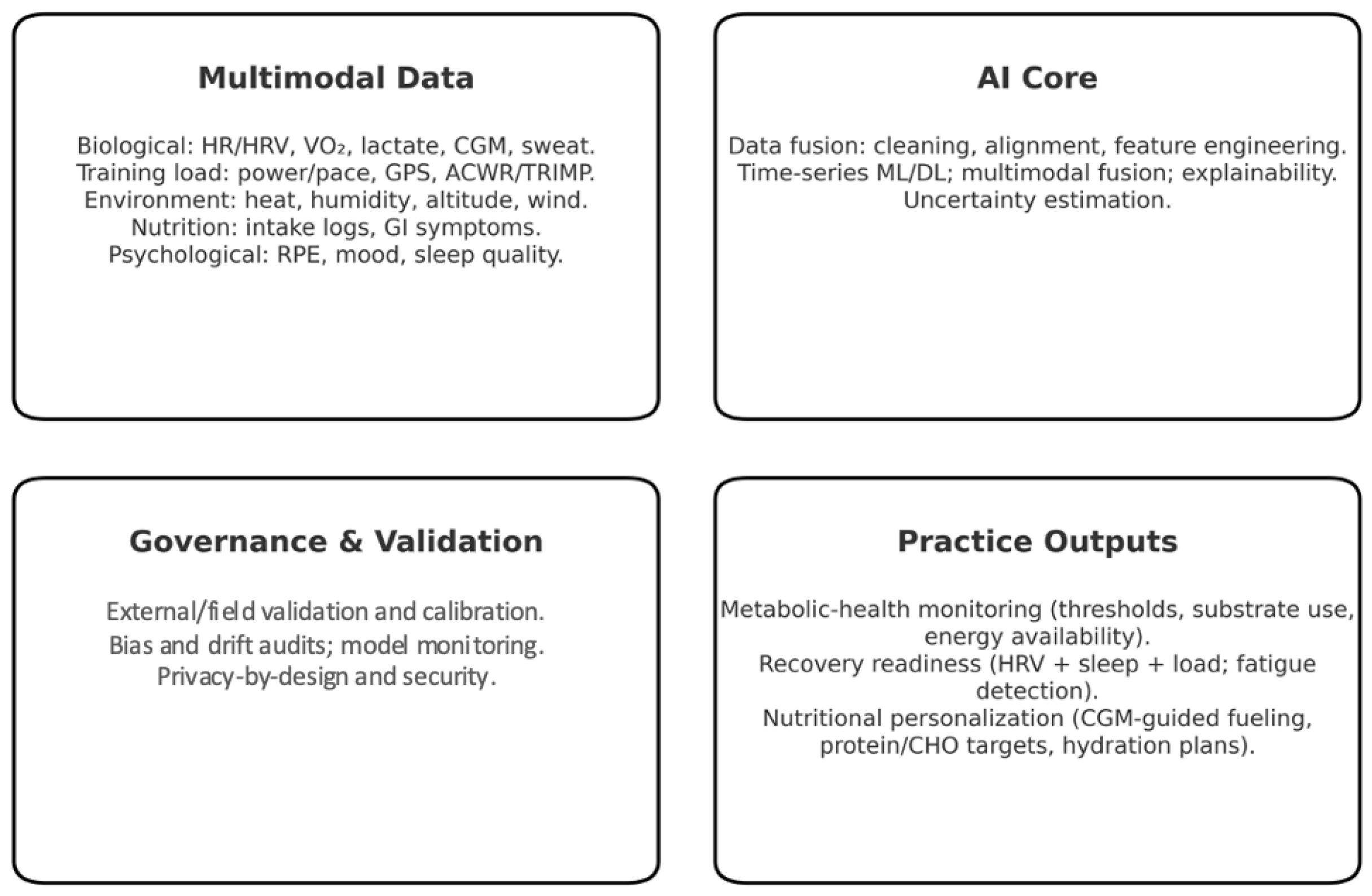
- Demonstrate external/field validity before deployment. Test across independent cohorts, devices, environments (heat/altitude), and time windows; include leave-one-device/site-out designs.
- Quantify and communicate uncertainty. Use calibrated probabilities, prediction intervals, and clear user-facing messaging so coaches/athletes interpret outputs safely.
- Be device-aware. Validate per modality (e.g., wrist-PPG vs. ECG; IMU-to-GRF) and harmonize cross-device signals; surface limits-of-agreement in dashboards.
- Use multimodal ML/deep learning robustly. Prefer intermediate fusion (attention/gating) with modality-dropout, cross-modal imputation, and temporal models (Transformers/RNNs) for asynchronous streams.
- Broaden inclusivity. Recruit diverse athletes (sex, age, level, skin tone, geography) and report stratified performance; avoid training only on elite, homogeneous datasets.
- Human-in-the-loop by design. Preserve coach override, log overrides to improve models, and provide explainability (e.g., feature attributions) for high-stakes outputs.
- Minimize data and protect privacy. Apply data-minimization, local/edge processing where possible, and privacy-preserving learning (federated/secure aggregation, differential privacy).
- Ensure interoperability. Use open schemas/APIs (e.g., HL7 FHIR, IEEE 11073) and shared data dictionaries to enable reproducible, cross-platform workflows.
- Disclose interests and test independence. Declare vendor ties, enable independent benchmarking, and avoid tying recommendations to commercial incentives.
- Nutrition-specific caution. Pair CGM with intake/training context; report device error/lag; avoid single-signal prescriptions for fueling.
- Recovery-specific caution. Combine HRV with sleep, load, and symptoms; avoid single-metric decisions; schedule periodic model recalibration.
7. Synthesis: Benefits, Challenges, and Practice Implications
8. Limitations and Interpretive Considerations
9. Conclusions
Author Contributions
Funding
Institutional Review Board Statement
Informed Consent Statement
Data Availability Statement
Conflicts of Interest
References
- Amawi, A.; AlKasasbeh, W.; Jaradat, M.; Almasri, A.; Alobaidi, S.; Hammad, A.A.; Bishtawi, T.; Fataftah, B.; Turk, N.; Saoud, H.A.; et al. Athletes’ Nutritional Demands: A Narrative Review of Nutritional Requirements. Front. Nutr. 2024, 10, 1331854. [Google Scholar] [CrossRef]
- Cossich, V.R.A.; Carlgren, D.; Holash, R.J.; Katz, L. Technological Breakthroughs in Sport: Current Practice and Future Potential of Artificial Intelligence, Virtual Reality, Augmented Reality, and Modern Data Visualization in Performance Analysis. Appl. Sci. 2023, 13, 12965. [Google Scholar] [CrossRef]
- Zhou, D.; Keogh, J.W.L.; Ma, Y.; Tong, R.K.Y.; Khan, A.R.; Jennings, N.R. Artificial Intelligence in Sport: A Narrative Review of Applications, Challenges and Future Trends. J. Sports Sci. 2025. [Google Scholar] [CrossRef] [PubMed]
- Menges, T. Advancing Endurance Sports with Artificial Intelligence: Application-Focused Perspectives. In Artificial Intelligence in Sports, Movement, and Health; Dindorf, C., Bartaguiz, E., Gassmann, F., Fröhlich, M., Eds.; Springer Nature: Cham, Switzerland, 2024; pp. 31–48. ISBN 978-3-031-67256-9. [Google Scholar]
- Lerebourg, L.; Saboul, D.; Clémençon, M.; Coquart, J.B. Prediction of Marathon Performance Using Artificial Intelligence. Int. J. Sports Med. 2023, 44, 352–360. [Google Scholar] [CrossRef] [PubMed]
- Rothschild, J.A.; Stewart, T.; Kilding, A.E.; Plews, D.J. Predicting Daily Recovery during Long-Term Endurance Training Using Machine Learning Analysis. Eur. J. Appl. Physiol. 2024, 124, 3279–3290. [Google Scholar] [CrossRef]
- Smaranda, A.M.; Drăgoiu, T.S.; Caramoci, A.; Afetelor, A.A.; Ionescu, A.M.; Bădărău, I.A. Artificial Intelligence in Sports Medicine: Reshaping Electrocardiogram Analysis for Athlete Safety—A Narrative Review. Sports 2024, 12, 144. [Google Scholar] [CrossRef]
- Nasb, M.; Zhang, Y.; Chen, N. The Role of Artificial Intelligence in Precision Exercise Nutrition: A Shift from Data to Diets. Food Sci. Hum. Wellness 2025. [Google Scholar] [CrossRef]
- Wu, X.; Oniani, D.; Shao, Z.; Arciero, P.; Sivarajkumar, S.; Hilsman, J.; Mohr, A.E.; Ibe, S.; Moharir, M.; Li, L.-J.; et al. A Scoping Review of Artificial Intelligence for Precision Nutrition. Adv. Nutr. 2025, 16, 100398. [Google Scholar] [CrossRef]
- Flockhart, M.; Larsen, F.J. Continuous Glucose Monitoring in Endurance Athletes: Interpretation and Relevance of Measurements for Improving Performance and Health. Sports Med. 2024, 54, 247–255. [Google Scholar] [CrossRef]
- Zeng, Z.; Liu, Y.; Hu, X.; Tang, M.; Wang, L. Validity and Reliability of Inertial Measurement Units on Lower Extremity Kinematics During Running: A Systematic Review and Meta-Analysis. Sports Med. Open 2022, 8, 86. [Google Scholar] [CrossRef]
- Nelson, B.W.; Low, C.A.; Jacobson, N.; Areán, P.; Torous, J.; Allen, N.B. Guidelines for Wrist-Worn Consumer Wearable Assessment of Heart Rate in Biobehavioral Research. NPJ Digit. Med. 2020, 3, 90. [Google Scholar] [CrossRef]
- Collins, G.S.; Reitsma, J.B.; Altman, D.G.; Moons, K.G.M. Transparent Reporting of a Multivariable Prediction Model for Individual Prognosis or Diagnosis (TRIPOD): The TRIPOD Statement. BMJ 2015, 350, g7594. [Google Scholar] [CrossRef]
- Liu, X.; Cruz Rivera, S.; Moher, D.; Calvert, M.J.; Denniston, A.K.; Ashrafian, H.; Beam, A.L.; Chan, A.-W.; Collins, G.S.; Darzi, A.; et al. Reporting Guidelines for Clinical Trial Reports for Interventions Involving Artificial Intelligence: The CONSORT-AI Extension. BMJ 2020, 370, m3164. [Google Scholar] [CrossRef]
- Cruz Rivera, S.; Liu, X.; Chan, A.-W.; Denniston, A.K.; Calvert, M.J. Guidelines for Clinical Trial Protocols for Interventions Involving Artificial Intelligence: The SPIRIT-AI Extension. BMJ 2020, 370, m3210. [Google Scholar] [CrossRef]
- Jordan, M.I.; Mitchell, T.M. Machine Learning: Trends, Perspectives, and Prospects. Science 2015, 349, 255–260. [Google Scholar] [CrossRef] [PubMed]
- Murphy, K.P. Machine Learning-A Probabilistic Perspective; Adaptive Computation and Machine Learning; MIT Press: Cambridge, UK, 2014; ISBN 978-0-262-01802-9. [Google Scholar]
- Camacho, D.M.; Collins, K.M.; Powers, R.K.; Costello, J.C.; Collins, J.J. Next-Generation Machine Learning for Biological Networks. Cell 2018, 173, 1581–1592. [Google Scholar] [CrossRef] [PubMed]
- LeCun, Y.; Bengio, Y.; Hinton, G. Deep Learning. Nature 2015, 521, 436–444. [Google Scholar] [CrossRef]
- Russell, S.; Norvig, P. Artificial Intelligence: A Modern Approach; Pearson: Hoboken, NJ, USA, 2021; ISBN 978-0-13-461099-3. [Google Scholar]
- Baltrusaitis, T.; Ahuja, C.; Morency, L.-P. Multimodal Machine Learning: A Survey and Taxonomy. IEEE Trans. Pattern Anal. Mach. Intell. 2019, 41, 423–443. [Google Scholar] [CrossRef] [PubMed]
- Hammes, F.; Hagg, A.; Asteroth, A.; Link, D. Artificial Intelligence in Elite Sports-A Narrative Review of Success Stories and Challenges. Front. Sports Act. Living 2022, 4, 861466. [Google Scholar] [CrossRef]
- Ali, S.; Abuhmed, T.; El-Sappagh, S.; Muhammad, K.; Alonso-Moral, J.M.; Confalonieri, R.; Guidotti, R.; Del Ser, J.; Díaz-Rodríguez, N.; Herrera, F. Explainable Artificial Intelligence (XAI): What We Know and What Is Left to Attain Trustworthy Artificial Intelligence. Inf. Fusion 2023, 99, 101805. [Google Scholar] [CrossRef]
- Samek, W.; Wiegand, T.; Müller, K.-R. Explainable Artificial Intelligence: Understanding, Visualizing and Interpreting Deep Learning Models. arXiv 2017, arXiv:1708.08296. [Google Scholar] [CrossRef]
- Thuany, M.; Valero, D.; Villiger, E.; Forte, P.; Weiss, K.; Nikolaidis, P.T.; Andrade, M.S.; Cuk, I.; Sousa, C.V.; Knechtle, B. A Machine Learning Approach to Finding the Fastest Race Course for Professional Athletes Competing in Ironman® 70.3 Races between 2004 and 2020. Int. J. Environ. Res. Public Health 2023, 20, 3619. [Google Scholar] [CrossRef]
- Wang, S.; Lafaye, C.; Saubade, M.; Besson, C.; Margarit-Taule, J.M.; Gremeaux, V.; Liu, S.-C. Predicting Hydration Status Using Machine Learning Models from Physiological and Sweat Biomarkers During Endurance Exercise: A Single Case Study. IEEE J. Biomed. Health Inform. 2022, 26, 4725–4732. [Google Scholar] [CrossRef]
- Zeevi, D.; Korem, T.; Zmora, N.; Israeli, D.; Rothschild, D.; Weinberger, A.; Ben-Yacov, O.; Lador, D.; Avnit-Sagi, T.; Lotan-Pompan, M.; et al. Personalized Nutrition by Prediction of Glycemic Responses. Cell 2015, 163, 1079–1094. [Google Scholar] [CrossRef]
- Mendes-Soares, H.; Raveh-Sadka, T.; Azulay, S.; Edens, K.; Ben-Shlomo, Y.; Cohen, Y.; Ofek, T.; Bachrach, D.; Stevens, J.; Colibaseanu, D.; et al. Assessment of a Personalized Approach to Predicting Postprandial Glycemic Responses to Food Among Individuals Without Diabetes. JAMA Netw. Open 2019, 2, e188102. [Google Scholar] [CrossRef]
- Bach, A.F.; Alexandersen, J.; Lundgaard, C.B. A Numerical Design Methodology for Optimal Pacing Strategy in the Individual Time Trial Discipline of Cycling. Sports Eng. 2025, 28, 12. [Google Scholar] [CrossRef]
- Zignoli, A.; Biral, F. Prediction of Pacing and Cornering Strategies during Cycling Individual Time Trials with Optimal Control. Sports Eng. 2020, 23, 13. [Google Scholar] [CrossRef]
- El Dandachi, M.-M.; Billat, V.; Palacin, F.; Vigneron, V. Early Detection of the Marathon Wall to Improve Pacing Strategies in Recreational Marathoners. AI 2025, 6, 130. [Google Scholar] [CrossRef]
- Mason, R.; Pearson, L.T.; Barry, G.; Young, F.; Lennon, O.; Godfrey, A.; Stuart, S. Wearables for Running Gait Analysis: A Systematic Review. Sports Med. 2023, 53, 241–268. [Google Scholar] [CrossRef] [PubMed]
- Dimmick, H.L.; van Rassel, C.R.; MacInnis, M.J.; Ferber, R. Use of Subject-Specific Models to Detect Fatigue-Related Changes in Running Biomechanics: A Random Forest Approach. Front. Sports Act. Living 2023, 5, 1283316. [Google Scholar] [CrossRef] [PubMed]
- Johnson, W.R.; Mian, A.; Robinson, M.A.; Verheul, J.; Lloyd, D.G.; Alderson, J. Multidimensional Ground Reaction Forces and Moments from Wearable Sensor Accelerations via Deep Learning. IEEE Trans. Biomed. Eng. 2021, 68, 289–297. [Google Scholar] [CrossRef]
- Cosoli, G.; Antognoli, L.; Veroli, V.; Scalise, L. Accuracy and Precision of Wearable Devices for Real-Time Monitoring of Swimming Athletes. Sensors 2022, 22, 4726. [Google Scholar] [CrossRef] [PubMed]
- Duan, C.; Shu, Z.; Zhang, J.; Xue, F. Real-Time Prediction for Athletes’ Psychological States Using BERT-XGBoost: Enhancing Human-Computer Interaction. arXiv 2024, arXiv:2412.05816. [Google Scholar]
- Zhang, X.; Lin, Z.; Gu, S. A Machine Learning Model the Prediction of Athlete Engagement Based on Cohesion, Passion and Mental Toughness. Sci. Rep. 2025, 15, 3220. [Google Scholar] [CrossRef] [PubMed]
- Plews, D.J.; Laursen, P.B.; Stanley, J.; Kilding, A.E.; Buchheit, M. Training Adaptation and Heart Rate Variability in Elite Endurance Athletes: Opening the Door to Effective Monitoring. Sports Med. 2013, 43, 773–781. [Google Scholar] [CrossRef]
- Passfield, L.; Hopker, J.G.; Jobson, S.; Friel, D.; Zabala, M. Knowledge Is Power: Issues of Measuring Training and Performance in Cycling. J. Sports Sci. 2017, 35, 1426–1434. [Google Scholar] [CrossRef]
- Racinais, S.; Alonso, J.M.; Coutts, A.J.; Flouris, A.D.; Girard, O.; González-Alonso, J.; Hausswirth, C.; Jay, O.; Lee, J.K.W.; Mitchell, N.; et al. Consensus Recommendations on Training and Competing in the Heat. Br. J. Sports Med. 2015, 49, 1164–1173. [Google Scholar] [CrossRef]
- Nybo, L.; Rasmussen, P.; Sawka, M.N. Performance in the Heat-Physiological Factors of Importance for Hyperthermia-Induced Fatigue. Compr. Physiol. 2014, 4, 657–689. [Google Scholar] [CrossRef]
- Mantzios, K.; Ioannou, L.G.; Panagiotaki, Z.; Ziaka, S.; Périard, J.D.; Racinais, S.; Nybo, L.; Flouris, A.D. Effects of Weather Parameters on Endurance Running Performance: Discipline-Specific Analysis of 1258 Races. Med. Sci. Sports Exerc. 2022, 54, 153–161. [Google Scholar] [CrossRef]
- Berry, S.E.; Valdes, A.M.; Drew, D.A.; Asnicar, F.; Mazidi, M.; Wolf, J.; Capdevila, J.; Hadjigeorgiou, G.; Davies, R.; Al Khatib, H.; et al. Human Postprandial Responses to Food and Potential for Precision Nutrition. Nat. Med. 2020, 26, 964–973. [Google Scholar] [CrossRef]
- Bermingham, K.M.; Linenberg, I.; Polidori, L.; Asnicar, F.; Arrè, A.; Wolf, J.; Badri, F.; Bernard, H.; Capdevila, J.; Bulsiewicz, W.J.; et al. Effects of a Personalized Nutrition Program on Cardiometabolic Health: A Randomized Controlled Trial. Nat. Med. 2024, 30, 1888–1897. [Google Scholar] [CrossRef]
- Dash, S. Win Your Race Goal: A Generalized Approach to Prediction of Running Performance. Sports Med. Int. Open 2024, 8, a24016234. [Google Scholar] [CrossRef] [PubMed]
- Davidson, P.; Düking, P.; Zinner, C.; Sperlich, B.; Hotho, A. Smartwatch-Derived Data and Machine Learning Algorithms Estimate Classes of Ratings of Perceived Exertion in Runners: A Pilot Study. Sensors 2020, 20, 2637. [Google Scholar] [CrossRef] [PubMed]
- Pirscoveanu, C.-I.; Oliveira, A.S. Prediction of Instantaneous Perceived Effort during Outdoor Running Using Accelerometry and Machine Learning. Eur. J. Appl. Physiol. 2024, 124, 963–973. [Google Scholar] [CrossRef]
- Barsumyan, A.; Shyla, R.; Saukkonen, A.; Soost, C.; Graw, J.A.; Burchard, R. Quantifying Training Response in Cycling Based on Cardiovascular Drift Using Machine Learning. Front. Artif. Intell. 2025, 8, 1623384. [Google Scholar] [CrossRef]
- Wang, G.; Mao, X.; Zhang, Q.; Lu, A. Fatigue Detection in Running with Inertial Measurement Unit and Machine Learning. In Proceedings of the 2022 10th International Conference on Bioinformatics and Computational Biology (ICBCB), Hangzhou, China, 13 May 2022; pp. 85–90. [Google Scholar]
- Chang, P.; Wang, C.; Chen, Y.; Wang, G.; Lu, A. Identification of Runner Fatigue Stages Based on Inertial Sensors and Deep Learning. Front. Bioeng. Biotechnol. 2023, 11, 1302911. [Google Scholar] [CrossRef]
- Radtke, T.; Crook, S.; Kaltsakas, G.; Louvaris, Z.; Berton, D.; Urquhart, D.S.; Kampouras, A.; Rabinovich, R.A.; Verges, S.; Kontopidis, D.; et al. ERS Statement on Standardisation of Cardiopulmonary Exercise Testing in Chronic Lung Diseases. Eur. Respir. Rev. 2019, 28, 180101. [Google Scholar] [CrossRef] [PubMed]
- Bowler, A.-L.M.; Whitfield, J.; Marshall, L.; Coffey, V.G.; Burke, L.M.; Cox, G.R. The Use of Continuous Glucose Monitors in Sport: Possible Applications and Considerations. Int. J. Sport Nutr. Exerc. Metab. 2022, 33, 121–132. [Google Scholar] [CrossRef]
- American Thoracic Society; American College of Chest Physicians. ATS/ACCP Statement on Cardiopulmonary Exercise Testing. Am. J. Respir. Crit. Care Med. 2003, 167, 211–277. [Google Scholar] [CrossRef]
- Cadmus-Bertram, L.; Gangnon, R.; Wirkus, E.J.; Thraen-Borowski, K.M.; Gorzelitz-Liebhauser, J. Accuracy of Heart Rate Monitoring by Some Wrist-Worn Activity Trackers. Ann. Intern. Med. 2017, 167, 607–608. [Google Scholar] [CrossRef]
- Boudreaux, B.D.; Hebert, E.P.; Hollander, D.B.; Williams, B.M.; Cormier, C.L.; Naquin, M.R.; Gillan, W.W.; Gusew, E.E.; Kraemer, R.R. Validity of Wearable Activity Monitors during Cycling and Resistance Exercise. Med. Sci. Sports Exerc. 2018, 50, 624–633. [Google Scholar] [CrossRef]
- Alberti, K.G.M.M.; Eckel, R.H.; Grundy, S.M.; Zimmet, P.Z.; Cleeman, J.I.; Donato, K.A.; Fruchart, J.-C.; James, W.P.T.; Loria, C.M.; Smith, S.C.; et al. Harmonizing the Metabolic Syndrome: A Joint Interim Statement of the International Diabetes Federation Task Force on Epidemiology and Prevention; National Heart, Lung, and Blood Institute; American Heart Association; World Heart Federation; International Atherosclerosis Society; and International Association for the Study of Obesity. Circulation 2009, 120, 1640–1645. [Google Scholar] [CrossRef]
- Zignoli, A.; Fornasiero, A.; Stella, F.; Pellegrini, B.; Schena, F.; Biral, F.; Laursen, P.B. Expert-Level Classification of Ventilatory Thresholds from Cardiopulmonary Exercising Test Data with Recurrent Neural Networks. Eur. J. Sport Sci. 2019, 19, 1221–1229. [Google Scholar] [CrossRef]
- Zignoli, A.; Fornasiero, A.; Rota, P.; Muollo, V.; Peyré-Tartaruga, L.A.; Low, D.A.; Fontana, F.Y.; Besson, D.; Pühringer, M.; Ring-Dimitriou, S.; et al. Oxynet: A Collective Intelligence That Detects Ventilatory Thresholds in Cardiopulmonary Exercise Tests. Eur. J. Sport Sci. 2022, 22, 425–435. [Google Scholar] [CrossRef]
- Moser, O.; Riddell, M.C.; Eckstein, M.L.; Adolfsson, P.; Rabasa-Lhoret, R.; van den Boom, L.; Gillard, P.; Nørgaard, K.; Oliver, N.S.; Zaharieva, D.P.; et al. Glucose Management for Exercise Using Continuous Glucose Monitoring (CGM) and Intermittently Scanned CGM (isCGM) Systems in Type 1 Diabetes: Position Statement of the European Association for the Study of Diabetes (EASD) and of the International Society for Pediatric and Adolescent Diabetes (ISPAD) Endorsed by JDRF and Supported by the American Diabetes Association (ADA). Pediatr. Diabetes 2020, 21, 1375–1393. [Google Scholar] [CrossRef]
- Sheridan, D.; Jaspers, A.; Viet Cuong, D.; Op De Beéck, T.; Moyna, N.M.; de Beukelaar, T.T.; Roantree, M. Estimating Oxygen Uptake in Simulated Team Sports Using Machine Learning Models and Wearable Sensor Data: A Pilot Study. PLoS ONE 2025, 20, e0319760. [Google Scholar] [CrossRef] [PubMed]
- Hsiao, C.-T.; Tong, C.; Coté, G.L. Machine Learning-Based VO2 Estimation Using a Wearable Multiwavelength Photoplethysmography Device. Biosensors 2025, 15, 208. [Google Scholar] [CrossRef] [PubMed]
- Meeusen, R.; Duclos, M.; Foster, C.; Fry, A.; Gleeson, M.; Nieman, D.; Raglin, J.; Rietjens, G.; Steinacker, J.; Urhausen, A.; et al. Prevention, Diagnosis, and Treatment of the Overtraining Syndrome: Joint Consensus Statement of the European College of Sport Science and the American College of Sports Medicine. Med. Sci. Sports Exerc. 2013, 45, 186–205. [Google Scholar] [CrossRef]
- Marotta, L.; Buurke, J.H.; van Beijnum, B.-J.F.; Reenalda, J. Towards Machine Learning-Based Detection of Running-Induced Fatigue in Real-World Scenarios: Evaluation of IMU Sensor Configurations to Reduce Intrusiveness. Sensors 2021, 21, 3451. [Google Scholar] [CrossRef] [PubMed]
- Miller, D.J.; Lastella, M.; Scanlan, A.T.; Bellenger, C.; Halson, S.L.; Roach, G.D.; Sargent, C. A Validation Study of the WHOOP Strap against Polysomnography to Assess Sleep. J. Sports Sci. 2020, 38, 2631–2636. [Google Scholar] [CrossRef]
- Bent, B.; Goldstein, B.A.; Kibbe, W.A.; Dunn, J.P. Investigating Sources of Inaccuracy in Wearable Optical Heart Rate Sensors. NPJ Digit. Med. 2020, 3, 18. [Google Scholar] [CrossRef]
- Soligard, T.; Schwellnus, M.; Alonso, J.-M.; Bahr, R.; Clarsen, B.; Dijkstra, H.P.; Gabbett, T.; Gleeson, M.; Hägglund, M.; Hutchinson, M.R.; et al. How Much Is Too Much? (Part 1) International Olympic Committee Consensus Statement on Load in Sport and Risk of Injury. Br. J. Sports Med. 2016, 50, 1030–1041. [Google Scholar] [CrossRef]
- Sutehall, S.; Pitsiladis, Y. Personalized Nutrition for the Enhancement of Elite Athletic Performance. Scand. J. Med. Sci. Sports 2025, 35, e70044. [Google Scholar] [CrossRef]
- Jäger, R.; Kerksick, C.M.; Campbell, B.I.; Cribb, P.J.; Wells, S.D.; Skwiat, T.M.; Purpura, M.; Ziegenfuss, T.N.; Ferrando, A.A.; Arent, S.M.; et al. International Society of Sports Nutrition Position Stand: Protein and Exercise. J. Int. Soc. Sports Nutr. 2017, 14, 20. [Google Scholar] [CrossRef]
- Peake, J.M.; Neubauer, O.; Della Gatta, P.A.; Nosaka, K. Muscle Damage and Inflammation during Recovery from Exercise. J. Appl. Physiol. 2017, 122, 559–570. [Google Scholar] [CrossRef] [PubMed]
- Burke, L.M.; Sharma, A.P.; Heikura, I.A.; Forbes, S.F.; Holloway, M.; McKay, A.K.A.; Bone, J.L.; Leckey, J.J.; Welvaert, M.; Ross, M.L. Crisis of Confidence Averted: Impairment of Exercise Economy and Performance in Elite Race Walkers by Ketogenic Low Carbohydrate, High Fat (LCHF) Diet Is Reproducible. PLoS ONE 2020, 15, e0234027. [Google Scholar] [CrossRef]
- Holzer, R.; Bloch, W.; Brinkmann, C. Continuous Glucose Monitoring in Healthy Adults-Possible Applications in Health Care, Wellness, and Sports. Sensors 2022, 22, 2030. [Google Scholar] [CrossRef]
- Ishihara, K.; Uchiyama, N.; Kizaki, S.; Mori, E.; Nonaka, T.; Oneda, H. Application of Continuous Glucose Monitoring for Assessment of Individual Carbohydrate Requirement during Ultramarathon Race. Nutrients 2020, 12, 1121. [Google Scholar] [CrossRef] [PubMed]
- Liu, C.; Cao, Y.; Luo, Y.; Chen, G.; Vokkarane, V.; Ma, Y. DeepFood: Deep Learning-Based Food Image Recognition for Computer-Aided Dietary Assessment. arXiv 2016, arXiv:1606.05675. [Google Scholar]
- Nogueira-Rio, N.; Varela Vazquez, L.; Lopez-Santamarina, A.; Mondragon-Portocarrero, A.; Karav, S.; Miranda, J.M. Mobile Applications and Artificial Intelligence for Nutrition Education: A Narrative Review. Dietetics 2024, 3, 483–503. [Google Scholar] [CrossRef]
- Pfeiffer, B.; Stellingwerff, T.; Hodgson, A.B.; Randell, R.; Pöttgen, K.; Res, P.; Jeukendrup, A.E. Nutritional Intake and Gastrointestinal Problems during Competitive Endurance Events. Med. Sci. Sports Exerc. 2012, 44, 344–351. [Google Scholar] [CrossRef]
- de Oliveira, E.P.; Burini, R.C.; Jeukendrup, A. Gastrointestinal Complaints During Exercise: Prevalence, Etiology, and Nutritional Recommendations. Sports Med. 2014, 44, 79–85. [Google Scholar] [CrossRef] [PubMed]
- Farhud, D.D.; Zokaei, S. Ethical Issues of Artificial Intelligence in Medicine and Healthcare. Iran. J. Public Health 2021, 50, i–v. [Google Scholar] [CrossRef] [PubMed]
- Nebeker, C.; Torous, J.; Bartlett Ellis, R.J. Building the Case for Actionable Ethics in Digital Health Research Supported by Artificial Intelligence. BMC Med. 2019, 17, 137. [Google Scholar] [CrossRef]
- Sharon, T. When Digital Health Meets Digital Capitalism, How Many Common Goods Are at Stake? Big Data Soc. 2018, 5, 2053951718819032. [Google Scholar] [CrossRef]
- Canali, S.; Schiaffonati, V.; Aliverti, A. Challenges and Recommendations for Wearable Devices in Digital Health: Data Quality, Interoperability, Health Equity, Fairness. PLoS Digit. Health 2022, 1, e0000104. [Google Scholar] [CrossRef] [PubMed]
- Rudin, C. Stop Explaining Black Box Machine Learning Models for High Stakes Decisions and Use Interpretable Models Instead. Nat. Mach. Intell. 2019, 1, 206–215. [Google Scholar] [CrossRef]
- Gunning, D.; Aha, D. DARPA’s Explainable Artificial Intelligence (XAI) Program. AI Mag. 2019, 40, 44–58. [Google Scholar] [CrossRef]
- McCradden, M.D.; Stephenson, E.A.; Anderson, J.A. Clinical Research Underlies Ethical Integration of Healthcare Artificial Intelligence. Nat. Med. 2020, 26, 1325–1326. [Google Scholar] [CrossRef]
- Tropol, E. Deep Medicine: How Artificial Intelligence Can Make Healthcare Human Again; Basic Books: New York, NY, USA, 2019; ISBN 978-1-5416-4463-2. [Google Scholar]
- Sjoding, M.W.; Dickson, R.P.; Iwashyna, T.J.; Gay, S.E.; Valley, T.S. Racial Bias in Pulse Oximetry Measurement. N. Engl. J. Med. 2020, 383, 2477–2478. [Google Scholar] [CrossRef]
- Gebru, T.; Morgenstern, J.; Vecchione, B.; Vaughan, J.W.; Wallach, H.; Daumé, H., III; Crawford, K. Datasheets for Datasets. arXiv 2021, arXiv:1803.09010. [Google Scholar] [CrossRef]
- Dastin, J. Amazon Scraps Secret AI Recruiting Tool That Showed Bias against Women. In Ethics of Data and Analytics; Auerbach Publications: Boca Raton, FL, USA, 2022; ISBN 978-1-003-27829-0. [Google Scholar]
- Seçkin, A.Ç.; Ateş, B.; Seçkin, M. Review on Wearable Technology in Sports: Concepts, Challenges and Opportunities. Appl. Sci. 2023, 13, 10399. [Google Scholar] [CrossRef]
- Toner, J. Wearable Technology in Elite Sport: A Critical Examination; Routledge: London, UK, 2024; ISBN 978-1-000-92584-5. [Google Scholar]
- Prainsack, B. Logged out: Ownership, Exclusion and Public Value in the Digital Data and Information Commons. Big Data Soc. 2019, 6, 2053951719829773. [Google Scholar] [CrossRef]
- Zuboff, S. The Age of Surveillance Capitalism: The Fight for a Human Future at the New Frontier of Power; PublicAffairs: New York, NY, USA, 2019; ISBN 978-1-61039-569-4. [Google Scholar]
- Sujan, M.; Furniss, D.; Grundy, K.; Grundy, H.; Nelson, D.; Elliott, M.; White, S.; Habli, I.; Reynolds, N. Human Factors Challenges for the Safe Use of Artificial Intelligence in Patient Care. BMJ Health Care Inform. 2019, 26, e100081. [Google Scholar] [CrossRef]
- van der Sommen, F.; de Groof, J. Risks and Rewards of AI Democratization. United Eur. Gastroenterol. J. 2024, 12, 427–428. [Google Scholar] [CrossRef]
- Obermeyer, Z.; Powers, B.; Vogeli, C.; Mullainathan, S. Dissecting Racial Bias in an Algorithm Used to Manage the Health of Populations. Science 2019, 366, 447–453. [Google Scholar] [CrossRef]
- Zallio, M.; Ike, C.B.; Chivăran, C. Designing Artificial Intelligence: Exploring Inclusion, Diversity, Equity, Accessibility, and Safety in Human-Centric Emerging Technologies. AI 2025, 6, 143. [Google Scholar] [CrossRef]
- Floridi, L.; Cowls, J.; Beltrametti, M.; Chatila, R.; Chazerand, P.; Dignum, V.; Luetge, C.; Madelin, R.; Pagallo, U.; Rossi, F.; et al. AI4People-An Ethical Framework for a Good AI Society: Opportunities, Risks, Principles, and Recommendations. Minds Mach. 2018, 28, 689–707. [Google Scholar] [CrossRef] [PubMed]
- Sheller, M.J.; Edwards, B.; Reina, G.A.; Martin, J.; Pati, S.; Kotrotsou, A.; Milchenko, M.; Xu, W.; Marcus, D.; Colen, R.R.; et al. Federated Learning in Medicine: Facilitating Multi-Institutional Collaborations without Sharing Patient Data. Sci. Rep. 2020, 10, 12598. [Google Scholar] [CrossRef]
- Vaswani, A.; Shazeer, N.; Parmar, N.; Uszkoreit, J.; Jones, L.; Gomez, A.N.; Kaiser, L.; Polosukhin, I. Attention Is All You Need. arXiv 2023, arXiv:1706.03762. [Google Scholar] [PubMed]
- Pan, S.J.; Yang, Q. A Survey on Transfer Learning. IEEE Trans. Knowl. Data Eng. 2010, 22, 1345–1359. [Google Scholar] [CrossRef]
- Kairouz, P.; McMahan, H.B.; Avent, B.; Bellet, A.; Bennis, M.; Bhagoji, A.N.; Bonawitz, K.; Charles, Z.; Cormode, G.; Cummings, R.; et al. Advances and Open Problems in Federated Learning. arXiv 2021, arXiv:1912.04977. [Google Scholar] [CrossRef]
- Zerveas, G.; Jayaraman, S.; Patel, D.; Bhamidipaty, A.; Eickhoff, C. A Transformer-Based Framework for Multivariate Time Series Representation Learning. arXiv 2020, arXiv:2010.02803. [Google Scholar] [CrossRef]
- Collins, G.S.; Moons, K.G.M.; Dhiman, P.; Riley, R.D.; Beam, A.L.; Calster, B.V.; Ghassemi, M.; Liu, X.; Reitsma, J.B.; van Smeden, M.; et al. TRIPOD+AI Statement: Updated Guidance for Reporting Clinical Prediction Models That Use Regression or Machine Learning Methods. BMJ 2024, 385, e078378. [Google Scholar] [CrossRef]
- Tsai, Y.-H.H.; Bai, S.; Liang, P.P.; Kolter, J.Z.; Morency, L.-P.; Salakhutdinov, R. Multimodal Transformer for Unaligned Multimodal Language Sequences. arXiv 2019, arXiv:1906.00295. [Google Scholar] [CrossRef]
- Liang, P.P.; Zadeh, A.; Morency, L.-P. Foundations & Trends in Multimodal Machine Learning: Principles, Challenges, and Open Questions. ACM Comput. Surv. 2024, 56, 264. [Google Scholar] [CrossRef]
- Lim, B.; Arık, S.Ö.; Loeff, N.; Pfister, T. Temporal Fusion Transformers for Interpretable Multi-Horizon Time Series Forecasting. Int. J. Forecast. 2021, 37, 1748–1764. [Google Scholar] [CrossRef]
- Bonawitz, K.; Eichner, H.; Grieskamp, W.; Huba, D.; Ingerman, A.; Ivanov, V.; Kiddon, C.; Konečný, J.; Mazzocchi, S.; McMahan, H.B.; et al. Towards Federated Learning at Scale: System Design. arXiv 2019, arXiv:1902.01046. [Google Scholar] [CrossRef]
- McMahan, H.B.; Moore, E.; Ramage, D.; Hampson, S.; Agüera y Arcas, B. Communication-Efficient Learning of Deep Networks from Decentralized Data. arXiv 2023, arXiv:1602.05629. [Google Scholar] [CrossRef]
- Abadi, M.; Chu, A.; Goodfellow, I.; McMahan, H.B.; Mironov, I.; Talwar, K.; Zhang, L. Deep Learning with Differential Privacy. In Proceedings of the 2016 ACM SIGSAC Conference on Computer and Communications Security, Vienna, Austria, 24–28 October 2016; pp. 308–318. [Google Scholar]
- Halilaj, E.; Rajagopal, A.; Fiterau, M.; Hicks, J.L.; Hastie, T.J.; Delp, S.L. Machine Learning in Human Movement Biomechanics: Best Practices, Common Pitfalls, and New Opportunities. J. Biomech. 2018, 81, 1–11. [Google Scholar] [CrossRef] [PubMed]
- Seshadri, D.R.; Li, R.T.; Voos, J.E.; Rowbottom, J.R.; Alfes, C.M.; Zorman, C.A.; Drummond, C.K. Wearable Sensors for Monitoring the Internal and External Workload of the Athlete. NPJ Digit. Med. 2019, 2, 71. [Google Scholar] [CrossRef] [PubMed]
- Bate, G.L.; Kirk, C.; Rehman, R.Z.U.; Guan, Y.; Yarnall, A.J.; Del Din, S.; Lawson, R.A. The Role of Wearable Sensors to Monitor Physical Activity and Sleep Patterns in Older Adult Inpatients: A Structured Review. Sensors 2023, 23, 4881. [Google Scholar] [CrossRef]
- Gedi, A.A.; Khalif, A.A.; Doon, M.A.S.; Mohamed, A.A.; Ali, I.A.; Ahmed, B.A. Personalized Gym Recommendation System Using Machine Learning. Int. J. Eng. Trends Technol. 2025, 73, 249–257. [Google Scholar] [CrossRef]
- Bucher, A.; Chaudhry, B.M.; Davis, J.W.; Lawrence, K.; Panza, E.; Baqer, M.; Feinstein, R.T.; Fields, S.A.; Huberty, J.; Kaplan, D.M.; et al. How to Design Equitable Digital Health Tools: A Narrative Review of Design Tactics, Case Studies, and Opportunities. PLoS Digit. Health 2024, 3, e0000591. [Google Scholar] [CrossRef]
- Wu, X.; Xiao, L.; Sun, Y.; Zhang, J.; Ma, T.; He, L. A Survey of Human-in-the-Loop for Machine Learning. Future Gener. Comput. Syst. 2022, 135, 364–381. [Google Scholar] [CrossRef]
- Claudino, J.G.; de Oliveira Capanema, D.; de Souza, T.V.; Serrão, J.C.; Machado Pereira, A.C.; Nassis, G.P. Current Approaches to the Use of Artificial Intelligence for Injury Risk Assessment and Performance Prediction in Team Sports: A Systematic Review. Sports Med. Open 2019, 5, 28. [Google Scholar] [CrossRef]
- Haase, J. Augmenting Coaching with GenAI: Insights into Use, Effectiveness, and Future Potential. arXiv 2025, arXiv:2502.14632. [Google Scholar] [CrossRef]
- Lindsay, R.; Spittle, M. The Adaptable Coach-a Critical Review of the Practical Implications for Traditional and Constraints-Led Approaches in Sport Coaching. Int. J. Sports Sci. Coach. 2024, 19, 1240–1254. [Google Scholar] [CrossRef]
- Gabbett, T.J. The Training-Injury Prevention Paradox: Should Athletes Be Training Smarter and Harder? Br. J. Sports Med. 2016, 50, 273–280. [Google Scholar] [CrossRef]
- Mittelstadt, B. Ethics of the Health-Related Internet of Things: A Narrative Review. Ethics Inf. Technol. 2017, 19, 157–175. [Google Scholar] [CrossRef]
- Ashtiani, F.; Sreedhara, V.S.M.; Vahidi, A.; Hutchison, R.; Mocko, G. Optimal Pacing of a Cyclist in a Time Trial Based on Individualized Models of Fatigue and Recovery. arXiv 2021, arXiv:2007.11393. [Google Scholar] [CrossRef]
- Jianjun, Q.; Isleem, H.F.; Almoghayer, W.J.K.; Khishe, M. Predictive Athlete Performance Modeling with Machine Learning and Biometric Data Integration. Sci. Rep. 2025, 15, 16365. [Google Scholar] [CrossRef]
- Pietraszewski, P.; Terbalyan, A.; Roczniok, R.; Maszczyk, A.; Ornowski, K.; Manilewska, D.; Kuliś, S.; Zając, A.; Gołaś, A. The Role of Artificial Intelligence in Sports Analytics: A Systematic Review and Meta-Analysis of Performance Trends. Appl. Sci. 2025, 15, 7254. [Google Scholar] [CrossRef]
- An, R. Artificial Intelligence in Health and Sport Sciences: Promise, Progress, and Prudence. J. Sport Health Sci. 2025, 14, 101054. [Google Scholar] [CrossRef] [PubMed]
- Božić, V. Artifical Intelligence as the Reason and the Solution of Digital Divide. Lang. Educ. Technol. 2023, 3, 96–109. [Google Scholar]
- Guo, X.; Li, X.; Guo, M. Diversifying Configurational Paths for Athlete Data Protection. Sci. Rep. 2024, 14, 32053. [Google Scholar] [CrossRef]


| Application Domain | AI Tools/Technologies | Key Benefits | Example Applications | Representative References |
|---|---|---|---|---|
| Training optimization | ML; predictive modeling | Personalized training plans; load management; injury-risk reduction | Athlete-monitoring platforms; decision-support tools | [6,33] |
| Metabolic health | Wearables with metabolic analytics; CGM-integrated modeling | Real-time glucose trends; energy-availability estimation; personalized dietary targets | CGM dashboards; metabolic analytics | [10,27,28] |
| Recovery monitoring | HRV analysis; sleep-tracking algorithms | Fatigue detection; optimized recovery cycles | AI-derived recovery scores; HRV/sleep monitors | [6] |
| Nutritional personalization | Microbiome-informed ML; CGM-based models; AI diet apps | Individualized fueling; macro-/micronutrient optimization | Dietary apps; microbiome nutrition services | [27,28] |
| Pacing and race strategy | Simulation-based optimization (optimal control/dynamic programming); real-time decision-support | Optimal pacing; terrain/weather adaptation | Race-pacing tools; virtual coaches | [29,30,31] |
| Behavioral insights | NLP; sentiment analysis; AI coaching assistants | Mental readiness monitoring; motivation tracking | AI chatbots; mental-coaching tools | [36,37] |
| Nutrition Area | AI Technologies/Tools | Functionality | Potential Benefits | Representative References |
|---|---|---|---|---|
| Macronutrient Personalization | ML, diet-tracking algorithms | Optimizes carbohydrate/protein/fat intake based on training demands | Improved energy availability, performance, and recovery | [9,27,28] |
| Micronutrient Profiling | AI-enhanced dietary analysis platforms | Identifies deficiencies based on intake patterns and biomarkers | Early detection of deficiencies, optimized immune and metabolic health | [9] |
| Gut Microbiome Integration | AI + microbiome sequencing tools | Links gut data with individualized nutrition recommendations | Supports gastrointestinal health, metabolic flexibility | [9,27,28] |
| Energy Expenditure Estimation | Wearables with metabolic modeling | Estimates caloric needs in real-time based on activity and physiology | Reduces risk of RED-S, enhances fueling strategies | [6] |
| Hydration and Electrolyte Balance | Smart bottles, sweat sensors + AI | Tracks sweat rate and electrolyte loss, suggests rehydration protocols | Maintains fluid balance, reduces cramping and heat strain | [26] |
| Behavioral Nutrition Coaching | Conversational AI, digital assistants | Offers motivation, habit tracking, and behavior modification | Improves adherence, educates athletes, supports long-term health | [9,36,37] |
| Domain | Conventional Approach | AI-Based Approach | Key Advantage of AI | Representative References |
|---|---|---|---|---|
| Training Load | Coach estimation, RPE logs | Predictive algorithms, real-time data modeling | Data-driven personalization | [6] |
| Nutrition | Static meal plans | Dynamic, bio-individual diet via app/microbiome AI | Precision and adaptability | [9,27,28] |
| Recovery | Subjective feedback, HR monitoring | HRV, sleep analysis, strain scores (e.g., WHOOP) | Early fatigue detection, proactive adjustment | [6,12,54,55] |
Disclaimer/Publisher’s Note: The statements, opinions and data contained in all publications are solely those of the individual author(s) and contributor(s) and not of MDPI and/or the editor(s). MDPI and/or the editor(s) disclaim responsibility for any injury to people or property resulting from any ideas, methods, instructions or products referred to in the content. |
© 2025 by the authors. Licensee MDPI, Basel, Switzerland. This article is an open access article distributed under the terms and conditions of the Creative Commons Attribution (CC BY) license (https://creativecommons.org/licenses/by/4.0/).
Share and Cite
Grivas, G.V.; Safari, K. Artificial Intelligence in Endurance Sports: Metabolic, Recovery, and Nutritional Perspectives. Nutrients 2025, 17, 3209. https://doi.org/10.3390/nu17203209
Grivas GV, Safari K. Artificial Intelligence in Endurance Sports: Metabolic, Recovery, and Nutritional Perspectives. Nutrients. 2025; 17(20):3209. https://doi.org/10.3390/nu17203209
Chicago/Turabian StyleGrivas, Gerasimos V., and Kousar Safari. 2025. "Artificial Intelligence in Endurance Sports: Metabolic, Recovery, and Nutritional Perspectives" Nutrients 17, no. 20: 3209. https://doi.org/10.3390/nu17203209
APA StyleGrivas, G. V., & Safari, K. (2025). Artificial Intelligence in Endurance Sports: Metabolic, Recovery, and Nutritional Perspectives. Nutrients, 17(20), 3209. https://doi.org/10.3390/nu17203209