Skip Content
You are currently on the new version of our website. Access the old version .

Cancers, Volume 10, Issue 2

2018 February - 31 articles

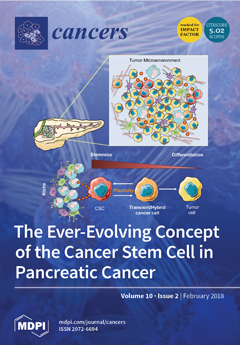
Cover Story: Pancreatic ductal adenocarcinoma (PDAC) is characterized by a very dense and highly organized tumor microenvironment (TME) consisting of extracellular matrix (ECM) proteins, cancer-associated fibroblasts (CAFs), pancreatic stellate cells (PSCs), and immune cells. At the epicenter of this dynamic and complex TME lies the cancer stem cell (CSC), which is believed to be the root of the tumor and the cell responsible for chemoresistance and disease relapse. We revisit the concept of the pancreatic CSC and discuss new advances in our understanding of its biology, properties and plasticity and address the concept of whether the CSC is a “state” or “entity”. View this paper
  • Issues are regarded as officially published after their release is announced to the table of contents alert mailing list .
  • You may sign up for email alerts to receive table of contents of newly released issues.
  • PDF is the official format for papers published in both, html and pdf forms. To view the papers in pdf format, click on the "PDF Full-text" link, and use the free Adobe Reader to open them.

Articles (31)

  • Review
  • Open Access
29 Citations
6,407 Views
11 Pages

21 February 2018

Current ovarian cancer screening guidelines in high-risk women vary according to different organizations. Risk reducing surgery remains the gold standard for definitive treatment in BRCA mutation carriers, but research advancements have created more...

  • Feature Paper
  • Article
  • Open Access
19 Citations
4,824 Views
11 Pages

Respiratory-Gated Proton Beam Therapy for Hepatocellular Carcinoma Adjacent to the Gastrointestinal Tract without Fiducial Markers

  • Miu Mizuhata,
  • Shigeyuki Takamatsu,
  • Satoshi Shibata,
  • Sayuri Bou,
  • Yoshitaka Sato,
  • Mariko Kawamura,
  • Satoko Asahi,
  • Yuji Tameshige,
  • Yoshikazu Maeda and
  • Toshifumi Gabata
  • + 5 authors

21 February 2018

The efficacy of proton beam therapy (PBT) for hepatocellular carcinoma (HCC) has been reported, but insertion of fiducial markers in the liver is usually required. We evaluated the efficacy and toxicity of respiratory-gated PBT without fiducial marke...

  • Review
  • Open Access
39 Citations
6,835 Views
17 Pages

20 February 2018

Tumor mass is constituted by a heterogeneous group of cells, among which a key role is played by the cancer stem cells (CSCs), possessing high regenerative properties. CSCs directly metastasize to bone, since bone microenvironment represents a fertil...

  • Feature Paper
  • Article
  • Open Access
8 Citations
5,890 Views
16 Pages

Towards a Clinical Decision Support System for External Beam Radiation Oncology Prostate Cancer Patients: Proton vs. Photon Radiotherapy? A Radiobiological Study of Robustness and Stability

  • Seán Walsh,
  • Erik Roelofs,
  • Peter Kuess,
  • Yvonka Van Wijk,
  • Ben Vanneste,
  • Andre Dekker,
  • Philippe Lambin,
  • Bleddyn Jones,
  • Dietmar Georg and
  • Frank Verhaegen

18 February 2018

We present a methodology which can be utilized to select proton or photon radiotherapy in prostate cancer patients. Four state-of-the-art competing treatment modalities were compared (by way of an in silico trial) for a cohort of 25 prostate cancer p...

  • Article
  • Open Access
18 Citations
5,421 Views
12 Pages

17 February 2018

Epigenetic events and genetic alterations under the control of the tumor microenvironment potentially mediate tumor induced angiogenesis involved in soft tissue sarcoma (STS) metastasis. Addition of antiangiogenic agent, such as bevacizumab, to stand...

  • Review
  • Open Access
15 Citations
5,463 Views
16 Pages

17 February 2018

Pancreas cancer is a lethal cancer as the majority patients are diagnosed at an advanced incurable stage. Despite improvements in diagnostic modalities and management strategies, including surgery and chemotherapies, the outcome of pancreas cancer re...

  • Review
  • Open Access
26 Citations
7,292 Views
19 Pages

Next Generation Immunotherapy for Pancreatic Cancer: DNA Vaccination is Seeking New Combo Partners

  • Paola Cappello,
  • Claudia Curcio,
  • Giorgia Mandili,
  • Cecilia Roux,
  • Sara Bulfamante and
  • Francesco Novelli

16 February 2018

Pancreatic Ductal Adenocarcinoma (PDA) is an almost incurable radio- and chemo-resistant tumor, and its microenvironment is characterized by a strong desmoplastic reaction associated with a significant infiltration of T regulatory lymphocytes and mye...

  • Review
  • Open Access
22 Citations
10,195 Views
17 Pages

Alleviating Pancreatic Cancer-Associated Pain Using Endoscopic Ultrasound-Guided Neurolysis

  • Kosuke Minaga,
  • Mamoru Takenaka,
  • Ken Kamata,
  • Tomoe Yoshikawa,
  • Atsushi Nakai,
  • Shunsuke Omoto,
  • Takeshi Miyata,
  • Kentaro Yamao,
  • Hajime Imai and
  • Masatoshi Kudo
  • + 2 authors

15 February 2018

The most common symptom in patients with advanced pancreatic cancer is abdominal pain. This has traditionally been treated with nonsteroidal anti-inflammatory drugs and opioid analgesics. However, these treatments result in inadequate pain control or...

  • Review
  • Open Access
65 Citations
8,216 Views
9 Pages

Early Diagnosis to Improve the Poor Prognosis of Pancreatic Cancer

  • Masataka Kikuyama,
  • Terumi Kamisawa,
  • Sawako Kuruma,
  • Kazuro Chiba,
  • Shinya Kawaguchi,
  • Shuzo Terada and
  • Tatsunori Satoh

11 February 2018

Pancreatic cancer (PC) has a poor prognosis due to delayed diagnosis. Early diagnosis is the most important factor for improving prognosis. For early diagnosis of PC, patients with clinical manifestations suggestive of PC and high risk for developing...

  • Review
  • Open Access
37 Citations
11,626 Views
36 Pages

Beyond Brooding on Oncometabolic Havoc in IDH-Mutant Gliomas and AML: Current and Future Therapeutic Strategies

  • Hanumantha Rao Madala,
  • Surendra R. Punganuru,
  • Viswanath Arutla,
  • Subhasis Misra,
  • T. J. Thomas and
  • Kalkunte S. Srivenugopal

11 February 2018

Isocitrate dehydrogenases 1 and 2 (IDH1,2), the key Krebs cycle enzymes that generate NADPH reducing equivalents, undergo heterozygous mutations in >70% of low- to mid-grade gliomas and ~20% of acute myeloid leukemias (AMLs) and gain an unusual ne...

  • Feature Paper
  • Review
  • Open Access
96 Citations
11,322 Views
18 Pages

Bioapplications of Cell-SELEX-Generated Aptamers in Cancer Diagnostics, Therapeutics, Theranostics and Biomarker Discovery: A Comprehensive Review

  • Xuehui Pang,
  • Cheng Cui,
  • Shuo Wan,
  • Ying Jiang,
  • Liangliang Zhang,
  • Lian Xia,
  • Long Li,
  • Xiaowei Li and
  • Weihong Tan

9 February 2018

Currently, functional single-stranded oligonucleotide probes, termed aptamers, generated by an iterative technology, Systematic Evolution of Ligands by Exponential Enrichment (SELEX), are utilized to selectively target molecules or cells with high af...

  • Feature Paper
  • Review
  • Open Access
29 Citations
5,685 Views
16 Pages

9 February 2018

Hepatocellular carcinoma is one of the main important causes of cancer-related death and its mortality is increasingly worldwide. In Europe, alcohol abuse accounts for approximately half of all liver cancer cases and it will become the leading cause...

  • Review
  • Open Access
51 Citations
7,864 Views
11 Pages

Integrin Inhibitors in Prostate Cancer

  • Maylein C. Juan-Rivera and
  • Magaly Martínez-Ferrer

6 February 2018

Prostate cancer (PCa) is the most frequently diagnosed cancer and the third highest cause of cancer-related deaths in men in the U.S. The development of chemotherapeutic agents that can bind PCa tumor cells with high specificity is critical in order...

  • Review
  • Open Access
52 Citations
11,456 Views
20 Pages

6 February 2018

In addition to the structural and scaffolding role, the extracellular matrix (ECM) is emerging as a hub for biomechanical signal transduction that is frequently relayed to intracellular sensors to regulate diverse cellular processes. At a macroscopic...

  • Article
  • Open Access
84 Citations
9,037 Views
11 Pages

Elevated Polyamines in Saliva of Pancreatic Cancer

  • Yasutsugu Asai,
  • Takao Itoi,
  • Masahiro Sugimoto,
  • Atsushi Sofuni,
  • Takayoshi Tsuchiya,
  • Reina Tanaka,
  • Ryosuke Tonozuka,
  • Mitsuyoshi Honjo,
  • Shuntaro Mukai and
  • Makoto Sunamura
  • + 11 authors

5 February 2018

Detection of pancreatic cancer (PC) at a resectable stage is still difficult because of the lack of accurate detection tests. The development of accurate biomarkers in low or non-invasive biofluids is essential to enable frequent tests, which would h...

  • Article
  • Open Access
12 Citations
5,052 Views
14 Pages

Phosphorylation of Sox2 at Threonine 116 is a Potential Marker to Identify a Subset of Breast Cancer Cells with High Tumorigenecity and Stem-Like Features

  • Nidhi Gupta,
  • Keshav Gopal,
  • Chengsheng Wu,
  • Abdulraheem Alshareef,
  • Alexandra Chow,
  • Fang Wu,
  • Peng Wang,
  • Xiaoxia Ye,
  • Gilbert Bigras and
  • Raymond Lai

3 February 2018

We have previously identified a novel phenotypic dichotomy in breast cancer (BC) based on the response to a SRR2 (Sox2 regulatory region 2) reporter, with reporter responsive (RR) cells being more tumorigenic/stem-like than reporter unresponsive (RU)...

  • Article
  • Open Access
28 Citations
6,163 Views
15 Pages

3 February 2018

The α6 integrin subunit (ITGA6) pre-mRNA undergoes alternative splicing to form two splicing variants, named ITGA6A and ITGA6B. In primary human colorectal cancer cells, the levels of both ITGA6 and β4 integrin subunit (ITGB4) subunits of the α6β4 in...

  • Article
  • Open Access
31 Citations
7,256 Views
19 Pages

Regulation of Cancer Stem Cell Metabolism by Secreted Frizzled-Related Protein 4 (sFRP4)

  • Abhijeet Deshmukh,
  • Frank Arfuso,
  • Philip Newsholme and
  • Arun Dharmarajan

31 January 2018

Tumours contain a small number of treatment-resistant cancer stem cells (CSCs), and it is through these that tumour regrowth originates at secondary sites, thus rendering CSCs an attractive target for treatment. Cancer cells adapt cellular metabolism...

  • Feature Paper
  • Review
  • Open Access
150 Citations
20,944 Views

Colorectal Cancer and Alcohol Consumption—Populations to Molecules

  • Marco Rossi,
  • Muhammad Jahanzaib Anwar,
  • Ahmad Usman,
  • Ali Keshavarzian and
  • Faraz Bishehsari

30 January 2018

Colorectal cancer (CRC) is a major cause of morbidity and mortality, being the third most common cancer diagnosed in both men and women in the world. Several environmental and habitual factors have been associated with the CRC risk. Alcohol intake, a...

  • Review
  • Open Access
47 Citations
10,630 Views
15 Pages

30 January 2018

Pancreatic cancer, most commonly referring to pancreatic ductal adenocarcinoma (PDAC), remains one of the most deadly diseases, with very few effective therapies available. Emerging as a new modality of modern cancer treatments, immunotherapy has sho...

  • Feature Paper
  • Review
  • Open Access
65 Citations
9,509 Views
14 Pages

Targeted Therapies for Pancreatic Cancer

  • Idoroenyi Amanam and
  • Vincent Chung

29 January 2018

Pancreatic cancer is the third leading cause of cancer related death and by 2030, it will be second only to lung cancer. We have seen tremendous advances in therapies for lung cancer as well as other solid tumors using a molecular targeted approach b...

  • Article
  • Open Access
27 Citations
5,216 Views
14 Pages

Electrotransfer of Different Control Plasmids Elicits Different Antitumor Effectiveness in B16.F10 Melanoma

  • Masa Bosnjak,
  • Tanja Jesenko,
  • Urska Kamensek,
  • Gregor Sersa,
  • Jaka Lavrencak,
  • Loree Heller and
  • Maja Cemazar

29 January 2018

Several studies have shown that different control plasmids may cause antitumor action in different murine tumor models after gene electrotransfer (GET). Due to the differences in GET protocols, plasmid vectors, and experimental models, the observed a...

  • Review
  • Open Access
47 Citations
7,252 Views
26 Pages

Extracellular Influences: Molecular Subclasses and the Microenvironment in Pancreatic Cancer

  • Veronique L. Veenstra,
  • Andrea Garcia-Garijo,
  • Hanneke W. Van Laarhoven and
  • Maarten F. Bijlsma

27 January 2018

Pancreatic ductal adenocarcinoma (PDAC) is the most prevalent form of pancreatic cancer and carries the worst prognosis of all common cancers. Five-year survival rates have not surpassed 6% for some decades and this lack of improvement in outcome urg...

  • Review
  • Open Access
21 Citations
5,676 Views
15 Pages

Reviewing the Utility of EUS FNA to Advance Precision Medicine in Pancreatic Cancer

  • William Berry,
  • Joanne Lundy,
  • Daniel Croagh and
  • Brendan J. Jenkins

27 January 2018

Advanced pancreatic cancer (PC) is an aggressive malignancy with few effective therapeutic options. While the evolution of precision medicine in recent decades has changed the treatment landscape in many cancers, at present no targeted therapies are...

  • Review
  • Open Access
92 Citations
13,894 Views
26 Pages

The Ever-Evolving Concept of the Cancer Stem Cell in Pancreatic Cancer

  • Sandra Valle,
  • Laura Martin-Hijano,
  • Sonia Alcalá,
  • Marta Alonso-Nocelo and
  • Bruno Sainz Jr.

26 January 2018

Pancreatic ductal adenocarcinoma (PDAC), the most common type of pancreatic cancer, is the 4th most frequent cause of cancer-related death worldwide, primarily due to the inherent chemoresistant nature and metastatic capacity of this tumor. The latte...

  • Article
  • Open Access
12 Citations
5,566 Views
16 Pages

Cell-Penetrating CaCO3 Nanocrystals for Improved Transport of NVP-BEZ235 across Membrane Barrier in T-Cell Lymphoma

  • Viviana Vergaro,
  • Monica Civallero,
  • Cinzia Citti,
  • Maria Cosenza,
  • Francesca Baldassarre,
  • Giuseppe Cannazza,
  • Samantha Pozzi,
  • Stefano Sacchi,
  • Francesco Paolo Fanizzi and
  • Giuseppe Ciccarella

25 January 2018

Owing to their nano-sized porous structure, CaCO3 nanocrystals (CaCO3NCs) hold the promise to be utilized as desired materials for encapsulating molecules which demonstrate wide promise in drug delivery. We evaluate the possibility to encapsulate and...

  • Review
  • Open Access
59 Citations
16,313 Views
17 Pages

25 January 2018

Cancer therapy has been constantly evolving with the hope of finding the most effective agents with the least toxic effects to eradicate tumors. Cancer immunotherapy is currently among the most promising options, fulfilling this hope in a wide range...

  • Review
  • Open Access
3 Citations
5,052 Views
26 Pages

Volumetric Modulated Arc (Radio) Therapy in Pets Treatment: The “La Cittadina Fondazione” Experience

  • Mario Dolera,
  • Luca Malfassi,
  • Nancy Carrara,
  • Sara Finesso,
  • Silvia Marcarini,
  • Giovanni Mazza,
  • Simone Pavesi,
  • Massimo Sala and
  • Gaetano Urso

24 January 2018

Volumetric Modulated Arc Therapy (VMAT) is a modern technique, widely used in human radiotherapy, which allows a high dose to be delivered to tumor volumes and low doses to the surrounding organs at risk (OAR). Veterinary clinics takes advantage of t...

  • Feature Paper
  • Article
  • Open Access
9 Citations
5,018 Views
11 Pages

23 January 2018

Oncolytic herpes simplex virus type 1 (HSV-1) strain RH2 induced immunogenic cell death (ICD) with the release and surface exposure of damage-associated molecular patterns (DAMPs) in squamous cell carcinoma (SCC) SCCVII cells. The supernatants of RH2...

  • Review
  • Open Access
26 Citations
11,161 Views
15 Pages

Estrogen and Androgen Blockade for Advanced Prostate Cancer in the Era of Precision Medicine

  • Tetsuya Fujimura,
  • Kenichi Takayama,
  • Satoru Takahashi and
  • Satoshi Inoue

23 January 2018

Androgen deprivation therapy (ADT) has been widely prescribed for patients with advanced prostate cancer (PC) to control key signaling pathways via androgen receptor (AR) and AR-collaborative transcriptional factors; however, PC gradually acquires a...

Get Alerted

Add your email address to receive forthcoming issues of this journal.

XFacebookLinkedIn
Cancers - ISSN 2072-6694