1. Introduction
Contests are a common phenomenon within a multitude of economic contexts. These scenarios involve agents investing sunk effort to appropriate a contestable rent, such as political rent seeking, litigation, and violent conflict, to name but a few. Due to the frequency of such activities, attention has focused on understanding the incentives to engage in contests as well as the associated costs and impacts. One fundamental concept within the study of contests is the notion of rent dissipation, which measures the total costs of rent seeking in relation to the size of the contested rent. Explaining the extent of rent dissipation can help us to estimate and anticipate the severity of possible social losses from such activities, or how a rent holder can maximize effort in their favor. Consequently, rent dissipation has been central to the discussion of contests since the first formal analysis was introduced [
1].
Contest theory has been developed and extended to provide a tractable explanation of the drivers of rent-seeking activity, and the associated rent dissipation. Within this analysis, there have been two separate focal points of interest: the (i) under-dissipation; and (ii) over-dissipation of rents. Under-dissipation—also known as the so-called ‘
Tullock paradox’—is where the costs of rent seeking are far lower than the value of what is being contested. Since [
2], it has been questioned why real-world situations (e.g., lobbying) often involve very limited expenditures in contesting highly valuable rents. Scholars have also sought to explain over-dissipation in contests following observation of this in experimental settings (see, for instance, [
3]).
The theoretical literature investigating dissipation patterns has focused on winner-take-all contests in which the rent is indivisible and a single contestant is awarded the entire rent with all other contestants receiving nothing. Contestants’ risk preferences have been studied as a source of explanation: risk aversion leads to under-dissipation of rents [
4,
5,
6,
7,
8]
1, while in order to explain over-dissipation contestants must be risk loving [
10]. Other sources of explanation for under-dissipation include heterogeneity in valuations [
11], uncertain number of contestants [
12,
13,
14,
15], and group rent seeking [
16]
2. Further explanations of over-dissipation have appealed to behavioral aspects such as non-monetary utility from winning, systematic mistakes by contestants, and impulsivity [
3,
17], or to mixed-strategy equilibria whereby the realization of players’ expenditures may exceed the expected equilibrium expenditures [
18].
Share contests, in which the rent is perfectly divisible and each contestant receives a share of the rent, are arguably more appropriate for modeling rent seeking over the divisions of public funds [
19,
20], government policy [
21,
22,
23] and numerous other contexts such as remuneration rewards [
24] and the distribution of pollution allowances [
25]
3. There is a growing literature on the analysis of share contests (e.g., [
26,
27,
28]). Ref. [
28] experimentally investigate share contests and find effort levels tend to be larger than what is theoretically predicted (but smaller than effort levels in winner-take-all contests). Ref. [
27] focus on share contests when agents have more general preferences and analyze the comparative statics of changing the size of the contested rent, but do not provide a full analysis of rent dissipation.
In this article, we consider observed rent dissipation—the ratio of the total costs of rent seeking to the monetary value of the rent—in both winner-take-all and share contests in a setting where contestants derive utility from the contest outcome in-and-of itself, rather than evaluating the net outcome once the cost of effort has been accounted for (which is typically studied in the literature). We find that if contestants’ evaluation of the contest outcome is sufficiently concave both share and winner-take-all contests can exhibit observed over-dissipation of small rents and under-dissipation of large rents. As such, if an observer measures dissipation as the ratio of the total costs of rent seeking to the monetary value of the rent the pattern of dissipation referred to above can be easily explained if contestants’ preferences actually exhibit sufficient concavity in the contest outcome.
Under- and over-dissipation naturally emerge at equilibrium under both sharing and winner-take-all contests: if contestants’ valuation of the rent is sufficiently larger (smaller) than the actual value of the rent, at equilibrium they will expend significantly more (less) effort than if they valued the rent at its real value, thus resulting in observed over- (under-) dissipation. Yet, beyond this straightforward observation, the potential concavity of the contestants’ utility function is also shown to play a crucial role in explaining the dissipation ratio. The intuition that with sufficiently strong diminishing marginal utility we may observe both under- and over-dissipation of rents is as follows. In share contests, when the contested rent is small diminishing marginal utility means contestants are highly sensitive to changes in the spoils they are awarded from the contest and therefore they are relatively effortful in contesting the rent, resulting in the monetary cost of rent seeking exceeding the monetary value of the rent, leading to over-dissipation. By contrast, if the rent is large and contestants are less sensitive to changes in their allocation of the rent they will be relatively less effortful leading to under-dissipation. In winner-take-all contests, sufficient concavity of the utility function implies that for small rents the contestants’ valuation of the rent is larger than the real value, hence incentivizing them to invest high effort at equilibrium and to generate over-dissipation. For high rents, the opposite will hold, thereby resulting in under-dissipation.
By accounting for concave evaluation of the contest outcome we can then elegantly, and very intuitively, reconcile the Tullock paradox, where the monetary cost of rent seeking falls short of the monetary value of the rent, and observations, for example in experimental settings, of over-dissipation where the monetary cost of rent seeking exceeds the monetary value of the rent.
4 Moreover, our results reveal that depending on players’ preferences we may observe over-dissipation in share contests and under-dissipation in winner-take-all contests, or the opposite. Our article therefore reconciles seemingly contradictory findings of experimental comparisons of share contests and winner-take-all contests [
28,
29] and underlines that future research should carefully evaluate contestants’ preferences prior to undertaking such comparisons.
The remainder of the article is organized as follows. In
Section 2, the model is outlined, and rent dissipation in share contests and winner-take-all contests is studied, respectively, in
Section 3 and
Section 4.
Section 5 provides some concluding remarks.
2. The Model
Consider a contest in which a set of agents
expend effort to obtain a share of a perfectly divisible rent
Z. Later in the article we consider the more often studied case of a winner-take-all contest in which the rent is indivisible and a single participant is awarded the entire rent. In a
share contest, agent
selects their effort
in order to capture a share of the rent which is determined according to a ‘simple’ Tullock contest success function
where
is the vector of other players’ effort choices. The rent apportioned to contestant
i is then given by
.
We consider that contestants are symmetric and have an additively separable utility function given by
where
captures the evaluation of the rent, and
captures the cost of effort in contesting that rent, measured on the same scale. We assume that the cost function satisfies:
;
;
; and
for all
with
so its elasticity is finite for all choices of effort.
Concerning the evaluation of the rent, we assume that
,
and
, allowing us to capture that contestants have diminishing marginal utility over the contest outcome. In the literature on share contests it is typically assumed that
, so contestants care about the net outcome from the contest
(or indeed some monotonic transformation of this)
5. This assumes that the outcome of the contest and the cost of effort exerted in the contest are perfectly fungible, an assumption that we deviate from.
Our main motivation for considering that contestants evaluate the outcome of the contest and the effort that is put in to contesting it separately comes from considering the analogy between contests and labor markets. The effort choice of contestants in a contest setting is akin to the labor decisions of a worker in a labor market setting: both the contestant and the worker have some disutility associated with the choice (of foregone uses of effort), and both receive some benefit: the contest outcome for the contestant, and consumption possibilities for the worker that comes from the income they receive. Both settings therefore feature two ‘goods’: the residual of effort (leisure, captured by a cost of effort), and the spoils of the activity. In standard labor market models, individuals are rarely assumed to have linear preferences over the two goods under consideration: in the basic Mirrlees model utility over consumption and labor is assumed to be strictly concave [
32], and models that consider separable utility impose diminishing marginal utility over consumption (see, for instance, [
33,
34]). Likewise, in a contest we believe it is appropriate to go beyond linear evaluation of the contest outcome, and the simplest formulation is to use a non-linear but separable payoff function as in (
2) that allows us to capture diminishing marginal utility over the contest outcome itself.
Further motivation for considering that the contest outcome and the cost of effort should be evaluated separately is as follows. First, the contestant may be working within an organization but has concerns that go beyond profit (the net outcome of the contest); for example, the individual’s desire to gain status or prestige, which could be captured by evaluating the contest outcome separately [
35]. Second, a contest may exhibit a delayed outcome in which case a contestant would exert effort and only after some time enjoy the contest outcome, so while the cost of effort will be accounted for, this and the contest outcome will be evaluated separately (in addition to any time preference concerns captured by discounting). Third, our setup could account for contestants gaining a utility from winning, which is relatively large when the contest outcome is modest and relatively small when the contest outcome is large.
This suggests considering a more general payoff function in contests, and when we do so we believe incorporating diminishing marginal utility in the analysis of share contests is important. For instance, in a contest over public funds it is intuitive to consider that agents may experience large marginal utility gains for initially redirected public funds but the gains to utility reduce as their captured public funds increase. Equally, for a rent-seeking game over the determination of a government policy, large gains in utility may exist when government policy moves in an agent’s favorable direction, but these marginal gains will reduce as the policy is more distant to the agent’s most desirable policy, that is, when the contested policy space is larger (e.g., [
36]). As we have become accustomed in microeconomic analysis, incremental gains that improve one’s lot from a relatively poor position are worth more than those that improve it from a relatively good position. Clearly, allowing for contestants’ evaluation of the contest outcome to be different from the standard approach will lead to different behavior, and it is this—and its consequences in terms of observed dissipation—that we want to investigate.
Contestants simultaneously choose their effort to maximize their utility in a game of complete but imperfect information, and we look for a Nash equilibrium in pure strategies. Since
, each contestant can be seen as solving the problem
taking the effort choices of others as given. Our assumptions on value and cost functions imply this optimization problem is globally concave and so the first-order condition is both necessary and sufficient for identifying the contestant’s best response. Letting
, we denote this best response
, where
is the solution to
Since players are symmetric, we focus on symmetric Nash equilibria in which
for all
, and therefore
for all
. Note that the results in this article are easily extended to incorporate asymmetric contests—using the tools of aggregate games—but are omitted for the sake of brevity and because the underlying mechanisms are neatly captured in a symmetric setup. Equilibrium effort in an interior symmetric Nash equilibrium satisfies
Given strict global concavity of the objective function (along with the fact that the payoff with zero effort is zero), the symmetric pure-strategy Nash equilibrium will be unique. To ensure the existence of a symmetric pure-strategy Nash equilibrium with strictly positive effort levels, we require . Were this not to be true, individual players would face an incentive to reduce their effort to zero (given the actions of others) meaning no such equilibrium would exist.
3. Rent Dissipation in Share Contests
We want to investigate the nature of the observed dissipation ratio, measuring the total rent-seeking outlays in relation to the monetary value of the contested rent,
Z. Recalling that
is the elasticity of the cost function, we can use (
3) to express observed equilibrium dissipation as
For the purposes of our study, in what follows we define over-dissipation as and under-dissipation as .
3.1. Constant Marginal Costs
To illustrate ideas, we consider in the first part of our analysis that marginal costs are constant:
. In this case there is an explicit solution for equilibrium contest effort given by
We also have an explicit expression for the equilibrium dissipation ratio given by
since for a linear cost function
for all
. From this expression it is transparent that both under- and over-dissipation can emerge in equilibrium depending on whether
is less than, or exceeds
.
With a linear payoff function with ; whether the contest exhibits under- or over-dissipation depends on the magnitude of , and is the same regardless of the size of the contested rent.
Proposition 1. Suppose with and with . Then the contest will exhibit under-dissipation if while it will exhibit over-dissipation if .
This is, of course, entirely unsurprising: if is large then contestants place a large value on their anticipated share of the rent, and are therefore relatively effortful in contesting it leading to observed over-dissipation. While not surprising, this is important to document as it is one potential explanation of the dissipation ‘puzzle’ that has interested the contest literature for decades.
When we consider that contestants exhibit diminishing marginal utility over the contested rent there is a more interesting pattern of observed rent dissipation. In particular, if is strictly concave (implying is decreasing in Z) then whether under- or over-dissipation will occur will depend not only on marginal utility but also on the size of the rent being contested, as the following proposition illustrates.
Proposition 2. Assume as . If then there exists a such that , so the contest exhibits observed over-dissipation for and observed under-dissipation for . By contrast, if the contest never exhibits observed over-dissipation.
Proof. Suppose . Then and concavity of implies for all . By contrast, if then since as the intermediate value theorem implies there is a such that . Concavity of then implies . □
Thus, if preferences are ‘sufficiently concave’—here measured by being larger than (which is a measure of concavity since we assume as ))—there will be over-dissipation in contests in which the rent is relatively small, while there will be under-dissipation in contests with large rents.
We illustrate this with a worked example.
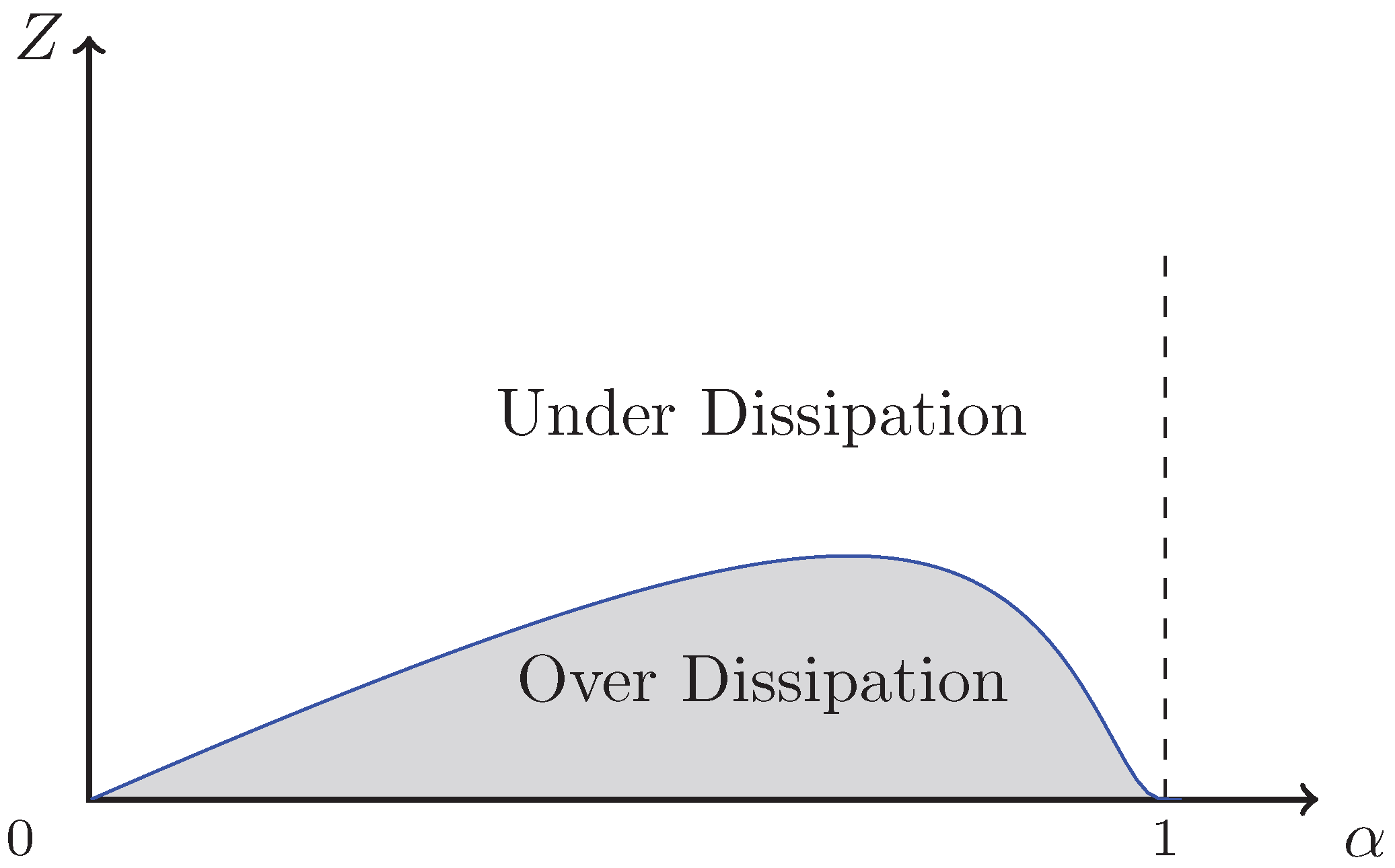
Example 1. Consider a contest in which there are n contestants each with where , , and with . Then effort in the symmetric Nash equilibrium is given byand the dissipation ratio takes the formIt follows that where . In this example which is illustrated on
Figure 1, when preferences are sufficiently concave (i.e.,
is small enough) the contest equilibrium exhibits over-dissipation if the contested rent is small enough, and in the limit where the contested rent becomes infinitesimally small,
. Consider a particular value for
and consider reducing the contested rent in a contest. Then as the contested rent reduces, the effort of each contestant reduces (as in this example equilibrium effort is monotonically increasing in
Z), but the reduction becomes smaller relative to the reduction in the rent, so as the rent gets sufficiently small (i.e., below
) the dissipation ratio exceeds 1. Because of the concavity of the utility function contestants increasingly care about further reductions in their allocation of the rent and so become
relatively more effortful in contesting it. By contrast, when the contested rent is relatively large the contest exhibits under-dissipation, and inspection of the expression for
reveals
as
.
3.2. More General Costs
Having studied the constant marginal cost case, we now return to the general cost case where the analysis is somewhat more nuanced as contest effort is only implicitly defined by (
3).
In the linear evaluation case where
with
equilibrium effort is defined by
and observed dissipation is given by
. While (in the case of linear evaluation of the rent) it is well-known that equilibrium effort is monotonically increasing in the contested rent, it would be atypical to make any assumptions concerning the monotonicity of the elasticity of the cost function with respect to effort. As such, this precludes us identifying a threshold rent around which the outcome of the contest switches from observed under dissipation to over dissipation.
6 Rather, much like the case of constant marginal costs, we can conclude the following.
Proposition 3. Suppose with . Then if any contest will exhibit observed under-dissipation, while if any contest will exhibit observed over-dissipation.
Turning next to the non-linear evaluation case, we can appeal to reasonable restrictions on the shape of the payoff function to demonstrate that there are threshold levels of the rent that allow us to understand when observed over- and under-dissipation will occur.
Proposition 4. Assume preferences are such that and they satisfy the Inada conditions and . Then
- 1.
as , implying there is a such that in a contest with under-dissipation occurs; and
- 2.
as , implying there is a such that in a contest with over-dissipation occurs.
Proof. Recall that
Since we assume
is finite for all
x, the Inada conditions imposed on
imply that as
,
and so
, and as
,
and so
. It follows that there will exist thresholds of
Z as indicated such that for
we will have
and for
we will have
. □
This proposition tells us that when preferences are ‘sufficiently concave’ (which in this general case means satisfies the Inada conditions), there will be contests, in which the rent is small enough, that exhibit over-dissipation: the fact that preferences exhibit high marginal utility over small allocations from the contest means that when contestants are fighting over small allocations they fight for them relatively hard, and the monetary cost of rent seeking outweighs the monetary value of the prize being contested. This is not universally true for all contests; however, when the contest involves a rent that is large enough we get the usual result of under-dissipation.
Our model with non-constant marginal costs and non-linear evaluation of the contested rent therefore helps us to reconcile the so-called Tullock paradox—that rent-seeking efforts are relatively small in situations where large rents are being contested—with more recent findings of over-dissipation. Our extension to the theory, which accounts for diminishing marginal utility over the allocation of the contested rent, allows for the incentives to engage in rent seeking to differ depending on the size of the rent being contested. When the rent is large the marginal incentives to further increase rent-seeking effort are low and so the monetary cost of effort is low relative to the value of the rent; by contrast, when the rent is small the marginal incentive to engage in rent seeking, to improve one’s allocation of the spoils from a low level, is large leading contestants to be relatively effortful and implying the monetary cost of effort is large relative to the value of the contested rent, leading to over-dissipation.
4. Rent Dissipation in Winner-Take-All Contests
We now turn to consider the more frequently-studied
winner-take-all contest in which a single contestant is awarded the entire rent, the probability of which is given by the contest success function. In this case the expected payoff takes the form
7:
where
is the contest success function given in (
1).
If is linear, this payoff function exactly coincides with that in a share contest implying the two types of contest are strategically equivalent. As such, the results presented above for share contests carry over mutatis mutandis to winner-take-all contests.
With non-linear evaluation of the contest outcome, however, the two types of contest command separate study. In a winner-take-all contest each contestant can be seen as solving the problem
The first-order condition is both necessary and sufficient for identifying the best response function, which is given by
where
is the solution to
Imposing symmetry allows us to deduce that in the symmetric Nash equilibrium,
and therefore the equilibrium observed dissipation is
4.1. Constant Marginal Costs
In the case of constant marginal costs, the explicit solution for equilibrium effort is and equilibrium observed dissipation is . As in the case of share contests, it is clear that the contest outcome can exhibit both under- and over-dissipation depending on the size of the contested rent.
Proposition 5. Assume as and as , consistent with assuming the Inada conditions apply to . Then there exists a given by such that .
Proof. Concavity of implies is strictly decreasing in Z (since ). This, combined with the assumptions stated, means the intermediate value theorem can be applied to conclude the existence of , and that for all and for all . □
It is interesting to note that in a share contest with constant marginal costs observed dissipation is while in a winner-take-all contest it is . So there is no clear ranking in terms of the threshold rent where the respective contests switch from exhibiting under-dissipation to over-dissipation; this will depend on the concavity of the payoff function as well as the number of contestants.
In our specific example, however, there is a clear pattern.
Example 2. Consider a winner-take-all contest in which there are n contestants each with where , , and with . Then effort in the symmetric Nash equilibrium is given byand the dissipation ratio takes the formIt follows that where . As such, . If then for the contest would exhibit under-dissipation if it was contested as a share contest, while it would exhibit over-dissipation if it was contested as a winner-take all contest (and vice-versa if ).
4.2. More General Costs
In a winner-take-all contest in which costs are more general, the equilibrium observed dissipation takes the form . This allows us to deduce the following.
Proposition 6. Assume preferences are such that as and as . Then:
- 1.
as , implying there is a such that in a contest with under-dissipation occurs; and
- 2.
as , implying there is a such that in a contest with over-dissipation occurs.
Proof. Straightforward given the definition of observed dissipation and the assumptions imposed on . □
5. Concluding Remarks
In this article, we have reconciled the real-world under-dissipation of rents, i.e., the Tullock paradox, and the observed over-dissipation of rents, for example, in experimental settings. Arguments in the literature so far used to rationalize the former are inconsistent with the latter, explanations of which have mostly appealed to behavioral ideas. Our approach, which consists of considering more general contestants’ utility functions, uncovers two important features of contests. First, if players’ valuation of the rent is larger (lower) than its monetary value, then their efforts will be larger (lower) than if they valued the rent at its monetary value, thus potentially leading to observed over- (under-) dissipation at equilibrium. Second, the concavity of the contestants’ utility function plays a crucial role in explaining under- and over-dissipation in a unified framework since when contestants have diminishing marginal utility over the contest outcome and this is sufficiently strong, then we can explain both over-dissipation of rents when they are small (as they arguably are in experimental settings) and under-dissipation of rents when they are large (as is arguably the case in Tullock’s observations).
The intuition is simple in both share contests and winner-take-all contests. In share contests, with sufficiently strong diminishing marginal utility, when the contested rent is small contestants are highly sensitive to changes in the spoils they are awarded from the contest and so they are relatively effortful in contesting the rent, resulting in the monetary cost of rent seeking exceeding the monetary value of the rent leading to over-dissipation; by contrast, if the rent is large the contestants are less sensitive to changes in their allocation of the rent, and they will be relatively less effortful leading to under-dissipation. In winner-take-all contests, sufficient concavity of the utility function implies that for small rents the contestants’ valuation of the rent is larger than the monetary value, thereby incentivizing them to invest high effort at equilibrium generating over-dissipation. For large rents, the opposite will hold, thereby resulting in under-dissipation.
We contribute to the literature on rent seeking by providing a rational explanation for observed phenomena, and one that relies on the backbone of microeconomic theory, namely diminishing marginal utility. Yet, upon closer observation, there is an apparent weakness of using the standard measure of dissipation—the ratio of the total costs of contesting the rent to its monetary value—when contestants value the rent, or their share of it, in a way that deviates from the simple monetary value. Further consideration, therefore, is required in future research to adequately capture rent dissipation in a way that reflects the preferences of contestants that are driving their behavior. This will add to a literature that considers measuring dissipation with endogenous rents [
37] and when contestants have asymmetric valuations [
38].