


Abstract
Approximately 50% of global plastic wastes are produced from plastic packaging, a substantial amount of which is disposed of within a few minutes of its use. Although many plastic types are designed for single use, they are not always disposable. It is now widely acknowledged that the production and disposal of plastics have led to a plethora of negative consequences, including the contamination of both groundwater and soil resources and the deterioration of human health. The undeniable impact of excessive plastic manufacturing and waste generation on the global plastic pollution crisis has been well documented. Therefore, degradable polymers are a crucial solution to the problem of the non-degradation of plastic wastes. The disadvantage of degradable polymers is their high cost, so blending them with natural polymers will reduce the cost of final products and maximize their degradation rate, making degradable polymers competitive with industrial polymers that are currently in use daily. In this work, we will delineate various degradable polymers, including polycaprolactone, starch, and cellulose. Furthermore, we will elucidate several aspects of polyvinyl alcohol (PVA) and its blends with natural polymers to show the effects of adding natural polymers on PVA properties. This paper will study cost-effective and ecologically acceptable polymers by combining inexpensive natural polymers with readily accessible biodegradable polymers such as polyvinyl alcohol (PVA).
1. Introduction
A single-use plastic product is defined as a product that is made entirely or partially of plastic and is not intended, designed, or marketed to fulfill many trips or rotational motions during its lifespan by being sent back to the manufacturer for refilling or repurposing for the original purpose. Plastic trash can have significant worldwide effects on both the environment and human health. Reusable plastic products have a lower likelihood of ending up in the ocean than single-use products. Single-use plastic products that are most frequently seen on beaches in Europe, coupled with fishing gear, account for 70% of all marine trash in the EU [1]. According to Plastics Europe, a member of the European Trade Association, the amount of plastic generated globally has increased significantly annually. Two million tons was generated in 1950, and in 2021 almost 390 million tons was generated [2].
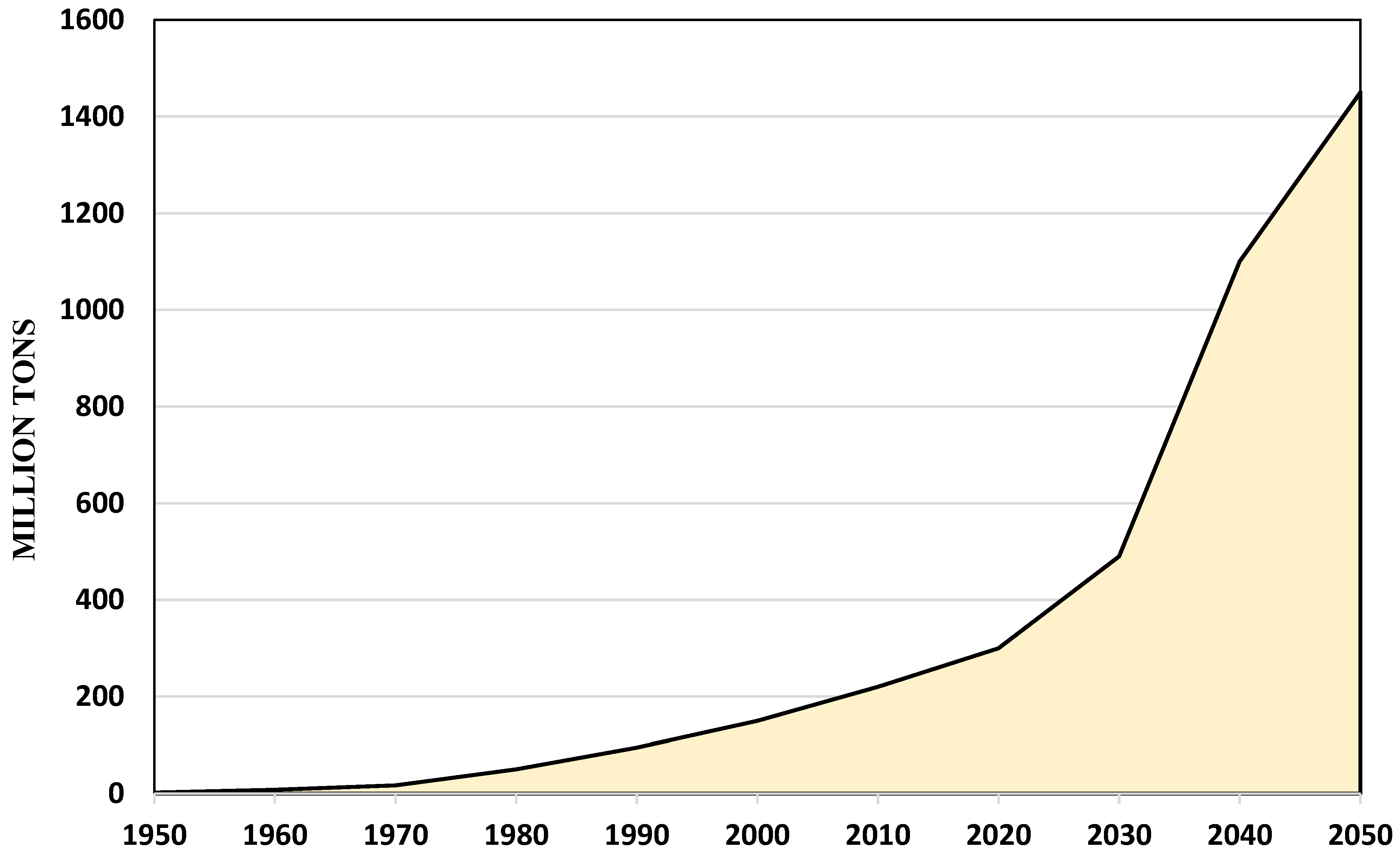
After 2000, more than half of the entire amount of manufactured plastic was introduced into the market. It is anticipated that by 2050, production will increase to approximately 1480 million tons, a fourfold increase from the 2019 values. This is nearly three times the weight of all the people on the planet [3]. Figure 1 shows the expected global quantity of plastic produced per decade from 1950 to 2050 [3].
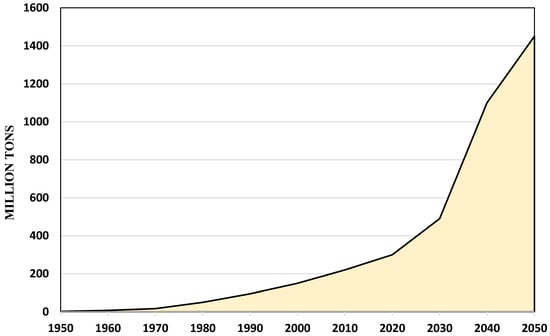
Figure 1.
The expected quantity of plastic production per decade from 1950 to 2050.
Despite the widespread usage of plastic consumer goods, especially single-use plastics, their current manufacturing and use are unsustainable [2,3,4,5]. To determine whether a material has a high consumption rate and the composition of the materials that are used in single-use plastic applications, it is crucial to identify the primary plastic raw materials utilized in these applications. The three primary materials used in single-use plastic products are polyethylene (PE), polyethylene terephthalate (PET), polystyrene (PS), and polypropylene (PP). PE is mostly utilized in plastic bags and agricultural items, whereas PET is a common material in bottles and PP is used in food/kitchen and cosmetic/detergent packaging products. Compared to PP, PS is utilized in comparatively tiny volumes in food and kitchen packaging items [6].
Plastic production began to boom in the 1940s and 1950s owing to the rapid rise in industrialization, and by 2020, it was predicted that global annual production would reach a total of 367 million metric tons. However, compared to the prior year, plastic manufacturing fell by roughly 0.3% because of the coronavirus (COVID-19) pandemic [7]. The amount of plastic produced worldwide in 2019 was the equivalent of 368 million metric tons (Mt) [8]; however, this figure is anticipated to double in 20 years [9]. Since plastics have a life cycle that now threatens planetary boundaries, pollution from plastics may surpass a predetermined threshold and become extremely critical, having a permanent worldwide influence on the atmosphere, ecosystems, and biodiversity levels [10]. It has been found that most of the plastic waste that enters the oceans contains hazardous bacteria, viruses, and microbial species that easily transmit toxic substances that eventually alter genetic diversity and affect ecosystems [10].
In 2016, aquatic habitats around the world received 19–23 million tons (Mt) of plastic waste; by 2030, that figure is anticipated to increase to 53 Mt annually [2]. By 2040, there is a chance that the amount of plastic waste in the ocean could increase to an estimated 30 million tons per year if prevention or damage-control efforts are not implemented, which would worsen the environmental impact [11]. By 2050, it is anticipated that practically all seabird species on earth could begin eating plastic garbage [12]. Approximately 14 million tons of plastic enter the ocean each year, primarily from Asian coastal regions. Over time, the lethal effects of plastic pollution have an influence on an estimated 700 species of aquatic life [13].
Mismanaged plastic wastes may plug drainages and rivers, causing flooding, mosquito breeding grounds, and the growth of disease-carrying flies and pests [14]. Heavy metals, plasticizers, and other manufacturing-related additives, as well as compounds that adsorb plastic from the environment, such as heavy metals, might all be effective delivery methods for harmful contaminants [15]. There is evidence that some microplastics have elements that are known to be mutagens, carcinogens, and reproductive poisons [16].
The effects of plastic on food webs are not yet fully known, although these compounds may be consumed at numerous trophic levels and bioaccumulate up the food chain [17]. Humans eat between 39,000 and 52,000 microplastic particles annually only from food and drink [18]. Plastics carry germs or parasites that may be on the plastics as well as additives from the production process and chemicals that have been adsorbed to the plastics as they reach the human food chain [19]. The demand for reasonably priced, long-lasting materials that provide convenience and improved usefulness is what is causing the tremendous rise in plastic manufacturing worldwide. Modern cultures are heavily reliant on plastic, and it is frequently utilized to create numerous everyday objects, including clothing, car interiors, and food and product packaging [20]. Despite its advantages, plastic packaging quickly produces plastic trash and, if handled improperly, can leak into the environment, harming both humans and ecosystems. According to research, plastics harm marine ecosystems like coral reefs by blocking light, entangling branching corals, seeping dangerous chemicals, and introducing alien biota [21].
Waste treatment systems have had a difficult time keeping up with the annual increase in the volume of plastic waste [8]. Many nations have been unable to consistently recycle significant amounts of plastic garbage due to a shortage of facilities for recycling and high purity criteria for reuse [22]. Globally, only 9% of plastic garbage has so far been recycled, 12% has been burned, and 79% of the remainder has been built up in ecosystems [23]. Most plastic waste is recycled, dumped in landfills, burned, or exported [24].
Recycling plastic waste can be used to make useful items like toys and bags [25]. The overall state of the environment has degraded in part due to plastics. To avoid the pollution’s adverse advertising effects, it is crucial to implement circular economy policies through recycling domestic waste [26]. When waste is polluted with green waste particles, mechanical recycling might only grow to be challenging and complex [27]. In a traditional mechanical recycling process, trash is collected, separated, cleaned, crushed, and pelletized for necessary conversion and reprocessing, which leads to the development of new goods without changing the chemical makeup of the material [28].
Polymers can be obtained from biomass wastes, such as wastes from plants, forests, biological industrial processes, municipal solid trash, algae, and animals. Pyrolysis is a mature and promising method for converting biomass-derived polymers into useful biochars. These products can be widely used in various fields, including carbon sequestration, power generation, environmental remediation, and energy storage. With an abundance of sources, affordability, and unique qualities, biochar made from biological polymeric materials shows much promise as a substitute electrode material for high-performance supercapacitors. A major challenge will be producing high-quality biochar to increase the application’s scope [29].
The process of gasification involves melting plastics in oxygen at 1200–1500 °C to create usable energy from waste. Pyrolysis is a process that includes heating plastics in an oxygen-free environment until the plastic waste disintegrates into gas and oil. All plastic polymers are broken down into very little molecules through this process.
Another method for getting rid of plastic waste is open landfilling, which is more of an environmental threat than carbon dioxide by around 23 times, and an estimated 150 million metric tons of plastic bottles ultimately end their cycle in landfills. More than half of greenhouse gas emissions have been estimated to come from gases produced in landfills. However, landfilling continues to be the approach to solid waste management that is most widely used worldwide. A plastic bottle can break down into microplastics in the ocean, where they can last for more than 500 years, and they have an expected lifespan of 500 years before they totally degrade in any landfill [30].
Some have suggested burning plastic to get rid of it, but burning it leads to the release of inhaled pollutants that have negative effects on the skin, eyes, human body, and cardiovascular health and cause headaches and nausea that may harm the nervous and female reproductive systems [11]. When plastics are burned in an open flame, most of the compounds that give them their distinctive characteristics, such as hardness, durability, malleability, color, and plasticity, are released into the atmosphere. These include several airborne toxins that have negative effects on human health, as previously stated [31]. Using incineration to manage plastic garbage has negative consequences on the environment since it releases highly hazardous compounds that eventually contaminate the air [32]. Table 1 summarizes the different types of plastic waste elimination processes.

Table 1.
The different types of plastic waste elimination processes.
Table 1 proves that the different types of processes used to eliminate plastic wastes are not the most efficient way to decrease plastic wastes due to their disadvantages. Therefore, the optimum solution for managing plastic wastes is using degradable polymers which decompose naturally by bacterial activities after serving their purpose to produce natural byproducts, such as gases (CO2 and N2), water, biomass, and inorganic salts.
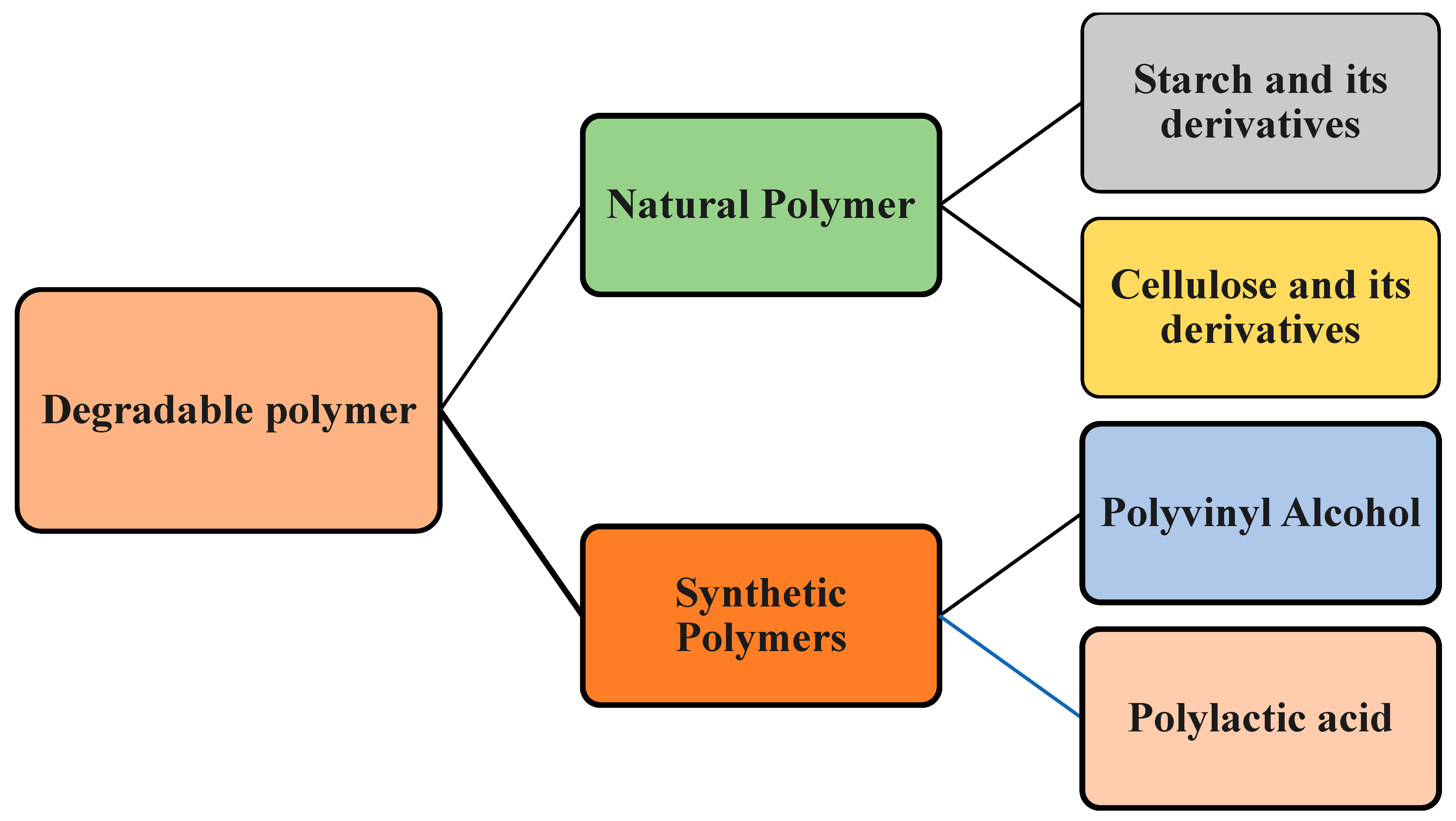
In this paper, we are going to show the differences between biopolymers and degradable polymers and summarize different types of degradable polymers, focusing on polyvinyl alcohol (PVA), its application, blends, and biodegradability. We also investigate the blending of different natural polymers, such as starch and cellulose, with PVA and their effect on the mechanical and structural properties of PVA. Also, we show the improvement in biodegradation properties that results from the addition of natural polymers to PVA. Figure 2 shows the different types of degradable polymers and blends that will be discussed in this paper. Natural polymers are polymers made from natural resources, while synthetic types are polymers made from industrial processes.
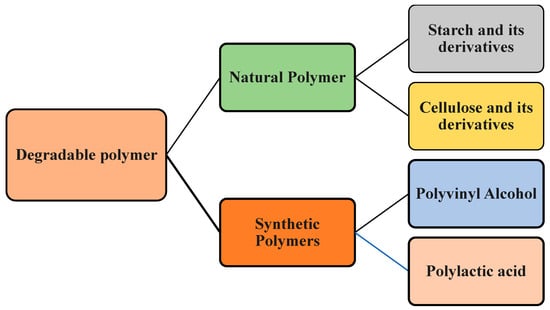
Figure 2.
Different types of degradable polymer.
2. Biodegradable Polymers and Biopolymers
Although biodegradable and biopolymers are two separate kinds of polymers, there is still confusion about the distinction between the two. Table 2 summarizes the differences between them.
Table 2.
The differences between biodegradable polymers and biopolymers.
After revealing the differences between biopolymers and degradable polymers, we will give examples of a few different kinds of biodegradable polymers and how they mix with other polymers.
3. Polylactic Acid
One of the most well-known thermoplastic polyester biopolymers, PLA, has the properties of being biocompatible, biodegradable, and resorbable. PLA is a member of the aliphatic polyester family and is typically produced using hydroxy acid [41]. Using a vacuum-sealed heating method and lactic acid (LA), PLA was first created in 1932. Low-molecular-weight PLA is produced using this technique. Scientists have paid a lot of attention to PLA because of its many applications and non-toxic makeup [42].
PLA is also reasonably priced, and several industries have taken notice of its exceptional qualities. However, it is crucial to be aware of its structural restrictions, including its fragility, alterations, and functional changes [43]. There are two main ways to make PLA, a type of thermoplastic polyester with the chemical formula (C3H4O2)n: directly poly-condensing lactic acid and ring-opening polymerizing lactides [44,45]. At room temperature, PLA is insoluble in water and has unsubstituted hydrocarbons, but at higher temperatures, it immediately transforms into lactic acid in water-based solutions [45,46,47]. The capacity of PLA to distribute itself through carrier fluids depends on its density. Commercial PLA particles typically have a specific gravity of 1.24 to 1.25 [48]. The transition temperature of glass (Tg) and the melting temperature (Tm) are frequently used as indicators of the thermophysical characteristics of PLA. The usual range for the glass temperature of the transition Tg of PLA is 323–353 K [48]. The melting temperature (Tm) of PLA is typically between 393 and 453 K; however, it occasionally reaches 483 K [44,45]. According to reports, semicrystalline PLA possesses tensile strengths between 50 and 70 MPa, tensile moduli of 3 GPa, flexural strengths between 100 MPa and 5 GPa, and a length increase at the break of around 4% [49,50,51]. Depending on the application, PLA diverters can have a wide range of shapes and geometries. Powders, beads, flakes, particles (with varying roundness and sphericity), and fibers are some examples [48].
4. Polyvinyl Alcohol
PVA is an organic substance that is frequently found in tasteless and odorless powders or particles. It has great biocompatibility and hydrophilicity and stable chemical characteristics. PVA is primarily made by hydrolyzing polyvinyl acetate and substituting the hydroxyl group for an acetate group. PVA, with various levels of hydrolysis, can be manufactured by managing the hydrolysis stage [52,53]. PVA is produced commercially by hydrolyzing hydrophobic polyvinyl acetate since vinyl alcohol cannot be directly radically polymerized due to the unstable nature of the monomer [54].
It is important to note that the long-term storage of the solution, even at room temperature, may result in the formation of visible strands and slight turbidity, which are indicative of crystallization and the beginning of gelation. This is because PVA has a strong tendency to crystallize in a solution state, particularly when the degree of hydrolysis and concentration are high. As a result, storing concentrated solutions for an extended period (>15 wt%) can produce weak gels that do not meet the requirements of many applications. As a result, it is advised that a solution be incubated at a high temperature (>60 °C) for a few hours after long-term storage to disturb weak crystalline regions and restore the uniformity of the solution [55].
Due to PVA films’ very high cost and slow rate of biodegradation, researchers have concentrated more on enhancing their qualities over the past ten years by combining them with other environmentally acceptable biopolymers of various types and in various amounts. All the polymers and biopolymers employed were considered; however, chitosan, carboxymethyl cellulose (CMC), and starch were given more consideration for combining with PVA films due to the structure of their molecules and the presence of -OH functional groups [56].
There have been numerous efforts to replace synthetic polymers with cost-effective, biodegradable, renewable, and sustainable materials. These materials primarily consist of synthetic biopolymers produced chemically, such as polyvinyl alcohol (PVA), polycaprolactone, and polybutylene succinate; synthetic biopolymers produced by microorganisms, such as polyhydroxy-butyrate (PHB) and polyhydroxy-valerate; and naturally occurring biopolymers, such as starch, cellulose, chitosan, agar, gelatin, and alginate, among others; as well as mixtures [57].
5. Starch
The semi-crystalline polymer known as starch has a hydrophilic character. Due to its low cost, lack of toxicity, high biodegradability, and ease of availability, it is one of the biopolymers that has received the most research for use in food packaging. In terms of structure, starch is a complicated branched polymer in which the branch points and D-glucose units are connected by (1–4) links [58].
Regarding the molar mass, amylose makes up 10–20% of starch, while amylopectin makes up 80–90%. However, depending on the source of the starch, different amounts of amylopectin and amylose are present. An increase in elongation and strength occurs as the amount of amylose in the starch rises. Under heat, starch is not stable. At 150 °C, its glucoside linkages start to break down, and above 250 °C, the starch granules collapse. Its usage in the food packaging sector is constrained by weak mechanical qualities, low thermal processability, and particularly poor resistance to moisture [58,59].
Starch is one of the many natural resources that could be used to create biodegradable polymers because it is biodegradable, renewable, and readily accessible. Using the right plasticizer, starch can be heated up to create thermoplastic starch. However, because of their stiffness, brittleness, and poor mechanical and thermal properties, films made entirely of starch are not appropriate for packing purposes [60].
6. Cellulose
In terms of structure, cellulose is a linear polymer made up of glucose, and the glucose units are connected by β(1→4) glycosidic connections, which enable the cellulose chains to form strong interchain hydrogen bonds [6,61]. Even though cellulose has a number of benefits, including a high thermal resistance, UV barrier capacity, and FDA-acquired GRAS status, its hydrophilic nature, poor vaporized water barrier properties, and limited long-term stability, along with its poor mechanical properties due to its sensitivity to moisture, limit its use in food packaging at the industrial level [62].
Insoluble microfibrils, crystalline, and amorphous structural areas are produced by the abundant hydrogen bonding in cellulose, giving it good tensile strength and endurance [63]. Every component of a plant contains cellulose. Bacterial cellulose (BC) is cellulose that is formed from bacteria, algae, and tunicates. BC is more crystalline than plant cellulose, has a higher degree of polymerization, and can absorb more water than plant cellulose (60–90% higher crystallinity) [63,64,65]. As cellulose contains reactive functional groups, it can be chemically altered to yield a variety of cellulose derivatives by processes including carboxymethylation, etherification, hydroxypropylation, etc. Due to its flexibility, toughness, and water resistance, cellulose derivatives such as cellulose acetate, carboxymethylcellulose, and hydroxymethylcellulose are regarded as significant sources of biomaterial-based food packaging. However, they are costly when used in large quantities [61]. By being transformed into nanocrystals, cellulose can potentially be used as a reinforcement in nanocomposite films [61], microfibrils [66], and nanofibrils [67]. Cellulose reinforcements have superior mechanical qualities that are on par with those of glass and carbon nanofibers.
7. Hydroxypropyl Methylcellulose
The term “hydroxypropyl methylcellulose” (HPMC) refers to a class of cellulose ethers in which one or more of the three hydroxyl groups found in the cellulose ring have been substituted. HPMC is a hydrophilic (water-soluble), biodegradable, and biocompatible polymer with numerous uses in drug delivery, skin care products, adhesives, glue coatings, agriculture, and textiles [68,69]. Both aqueous and non-aqueous solvents can be used with HPMC because it is soluble in polar organic solvents as well. It has special qualities that make it soluble in both warm and cold organic solvents. Compared to its rivals made of methylcellulose, HPMC has higher organo-solubility and thermo-plasticity. When heated, it turns into a gel at temperatures between 75 and 90 °C.
The temperature at which glasses transition to HPMC can be lowered to 40 °C by decreasing the molar substitution of the hydroxyl propyl group. From an aqueous solution, HPMC creates translucent and flexible films. Due to their resistance to oil migration, HPMC films, which are typically odorless and tasteless, can be used to reduce the absorption of oil from fried foods like French fries. HPMC is widely employed as a stabilizer, an emulsifier, a protective colloid, and a thickening agent in the food sector. HPMC is utilized as an initial ingredient for coatings that have a moderate degree of elasticity, transparency, resistance to grease and fat, and moderate moisture and oxygen barrier qualities. Additionally, it serves as a tablet matrix for prolonged release as a tablet binder. Due to HPMC’s outstanding biocompatibility and low toxicity, its prospective use in the biomedical area has garnered the interest of both scientists and academics [69].
8. Blending of PVA with Natural Polymers
To improve characteristics, streamline processes, or cut costs, polymer blending is becoming more and more crucial in packaging applications. A few of the qualities that can be obtained by blending include tailoring surface parameters such as the coefficient of friction, adding color, enhancing adhesion, increasing production, improving stability, and gaining easy-opening features. The process of blending is cost-effective, somewhat easy to understand, and uses easily accessible processing technologies. Polymer-based films typically have altered physicochemical characteristics in comparison to their individual constituents. However, combining materials presents a significant compatibility difficulty. Compatibility has a significant impact on characteristics, including crystallinity, morphology, melting point, and glass transition temperature. Rigidity, processability, degradation behavior, and barrier qualities are, in turn, determined by these properties. The solubility parameter can be used to forecast how well two polymers will blend. Theoretically, two polymers are mutually soluble if their solubility parameter values are equal. Immiscible polymers can, however, be made more compatible by adding reactive functional groups or ester groups or by chemical alterations [70]. Blending polymers is a useful approach for removing flaws. It has the potential to create biodegradable film composites with better qualities at a reasonable price [71,72].
8.1. Polyvinyl Alcohol and Starch
Table 3 describes the effects of different starch ratios and different additives on the properties of PVA-blended films.
Table 3.
The effects of different starch ratios and different additives on the properties of PVA-blended films.
Table 3 shows that the addition of starch to PVA improves the degradation in soil and influences the thermal properties such that they become better than those of neat PVA. On the other hand, it decreases the mechanical properties because the intermolecular structure of starch is weak and highly amorphous. These findings show that this blend has a limitation in applications of high strength.
8.2. Polyvinyl Alcohol and Cellulose Derivatives
There are several types of PVA and cellulose blends, such as carboxy methyl cellulose and hydroxypropyl methylcellulose.
8.2.1. Polyvinyl Alcohol and Carboxy Methyl Cellulose
Table 4 describes the effects of different CMC ratios and different additives on the properties of PVA-blended films.
Table 4.
The effects of different CMC ratios and different additives on the properties of PVA-blended films.
Table 4 shows that the addition of CMC to PVA improves biodegradation and water solubility, but it decreases the thermal properties of neat PVA. The addition of CMC also decreases the mechanical properties because the intermolecular structure of CMC is weaker than that of PVA.
8.2.2. Polyvinyl Alcohol and Hydroxypropyl Methylcellulose
Table 5 describes the effects of different HPMC ratios and different additives on the properties of PVA-blended films.
Table 5.
The effects of different HPMC ratios and different additives on the properties of PVA-blended films.
Table 5 shows that the addition of HPMC to PVA increases the tensile strength and the antioxidant and antibacterial activity, which supports using this blend in high-strength applications.
8.3. Biodegradation of Polyvinyl Alcohol
Table 6 describes the impact of the soil burial test on the biodegradability of different types of biopolymer/polyvinyl alcohol-blended films.
Table 6.
The impact of the soil burial test on the biodegradability of different types of biopolymer/polyvinyl alcohol-blended films.
The addition of starch, cellulose, or cellulose derivatives to PVA enhances the water solubility and degradation in the soil of PVA because of the highly hydrophilic nature of cellulose, increasing rapid bacterial diffusion and leading to an increased biodegradability rate. However, the mechanical properties of some blends have decreased below those of pure PVA because of the high degree of amorphous and weak intermolecular forces.
Any chemical, physical, or biological reaction that breaks covalent bonds in a polymer backbone and causes changes in its chemical structure and molecular weight is referred to as polymer degradation. The breakdown process of a polymeric artifact is propagated by reactive species or free radicals, which are created when the primary chemical bonds in the main or side chain break. Abiotic elements, such as heat, light, radiation, humidity, medium pH, mechanical stress, and chemical attack, initiate the polymer degradation process for these types of initiations to disrupt the chemical connections inside the polymer, an activation energy is required, when the localized energy of a chemical bond exceeds the overall energy of the bond, the bond breaks, a process known as chain scission. Polymer degradation results from the breaking of a more unstable bond positioned inside groups or short branches. This bond breakage might cause the side group to be lost or modified by the insertion of additional atoms such as oxygen [34].
Local variations in biodiversity and the presence of microorganisms are examples of extrinsic circumstances that influence a polymer’s degradation process, in addition to its intrinsic qualities. Consequently, the breakdown of materials can be broadly categorized as either biotic or abiotic (algae, bacteria, fungi, and radiation). Organic matter can break down in the natural world owing to a combination of biotic and abiotic factors. This is because certain microorganisms release extracellular enzymes that directly affect polymers; hence, prior fragmentation and molar mass reduction of the material are not required to make the microorganisms available [114]. Table 7 outlines the enzyme types that break down natural polymers, such as starch and cellulose.
Table 7.
Types of enzymes/bacteria that break down natural polymers (starch and cellulose) [114].
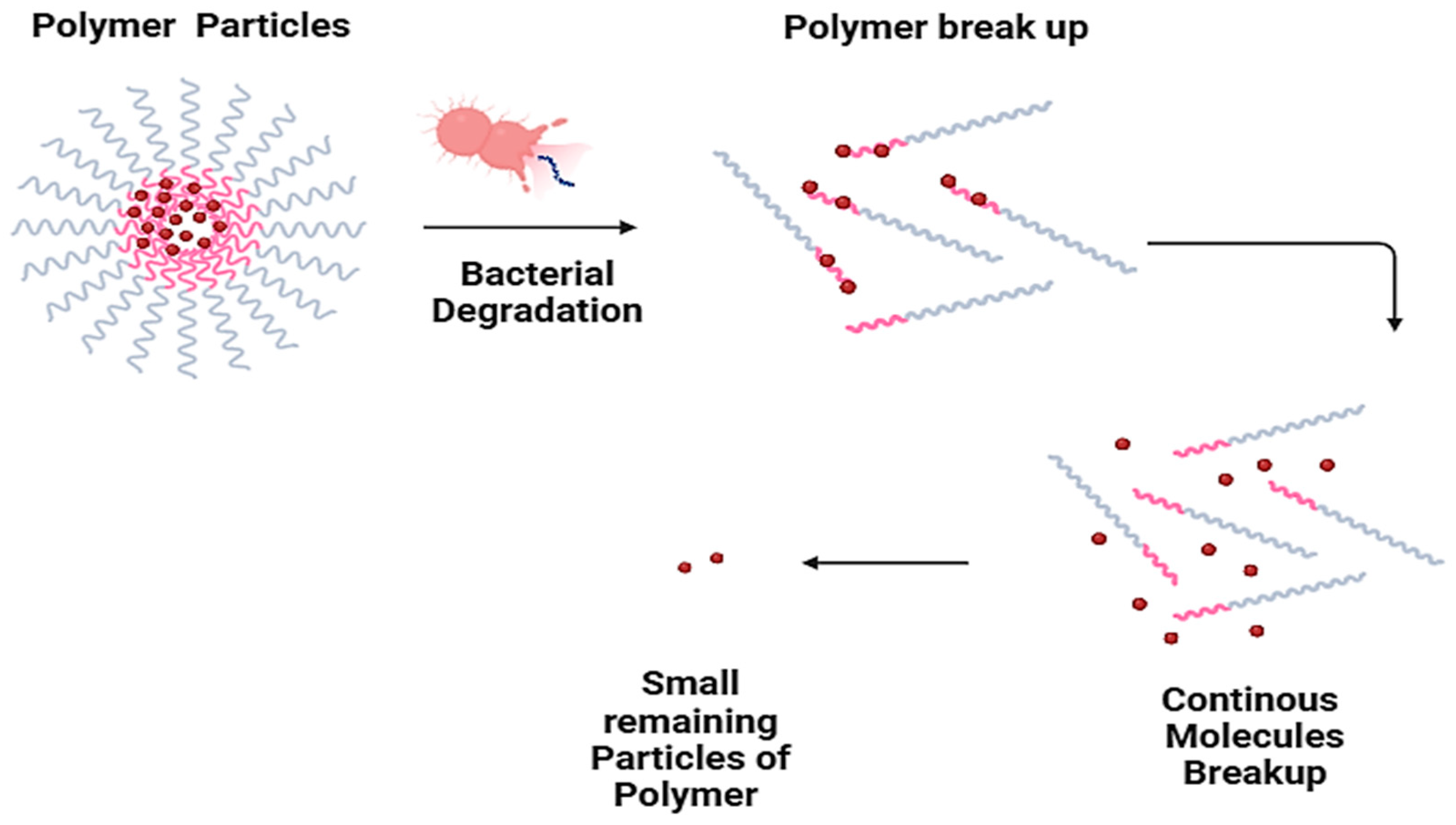
As shown in Figure 3, the main biodegradation mechanism involves microorganisms adhering to the polymer surface and then colonizing the exposed surface. Following colonization, the polymer is hydrolytically broken down by enzymes released by bacteria, resulting in low-molecular-weight molecules until the final mineralization in CO2 and H2O [115].
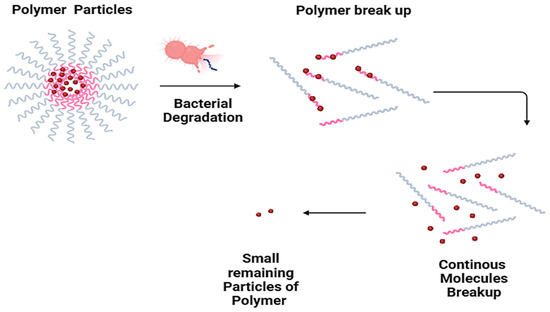
Figure 3.
Polymer degradation mechanism.
9. Applications
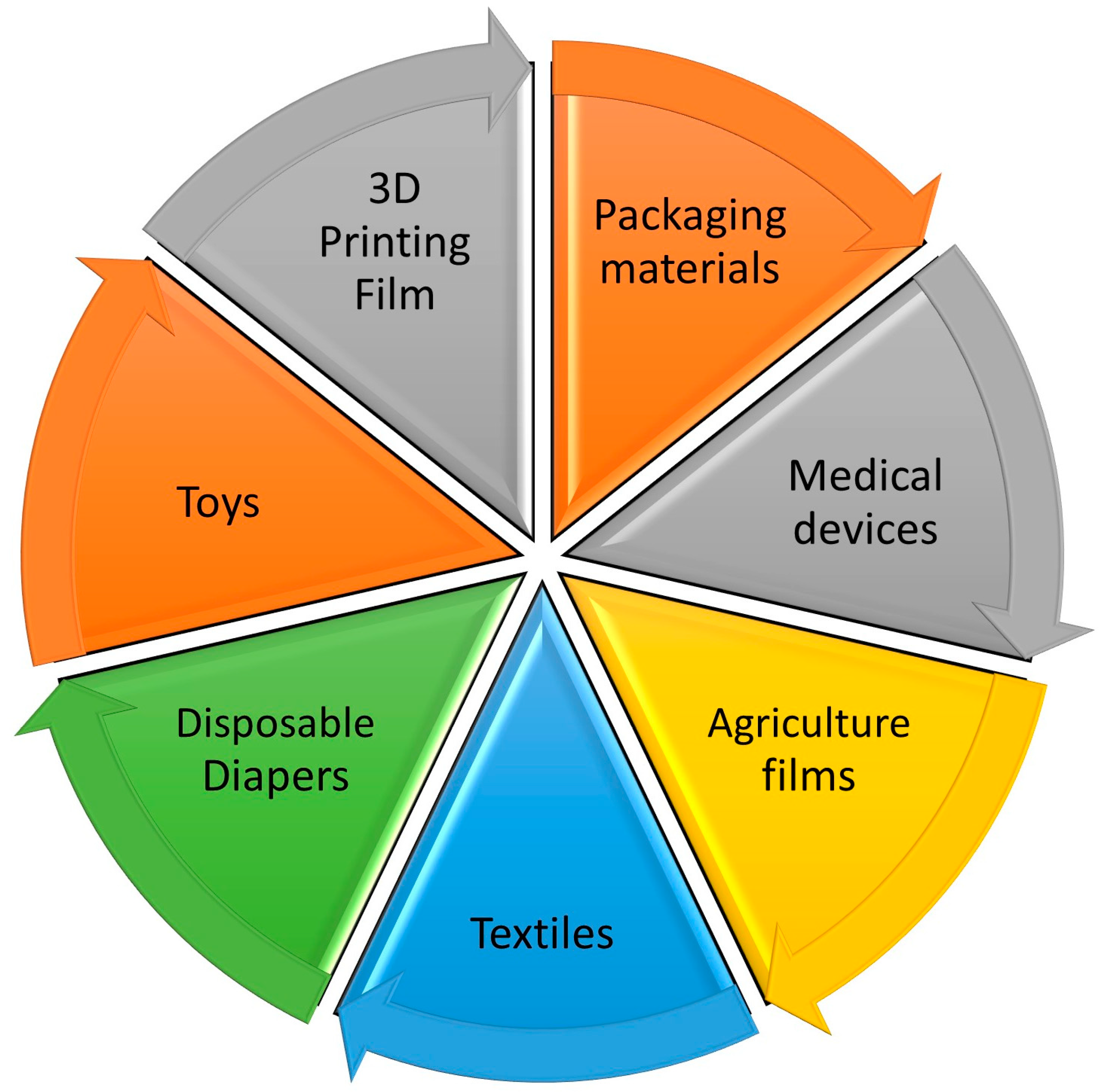
The goal of this research is to reveal the different applications of degradable polymers which are inexpensive and natural. Some applications of the films produced are listed in Figure 4.
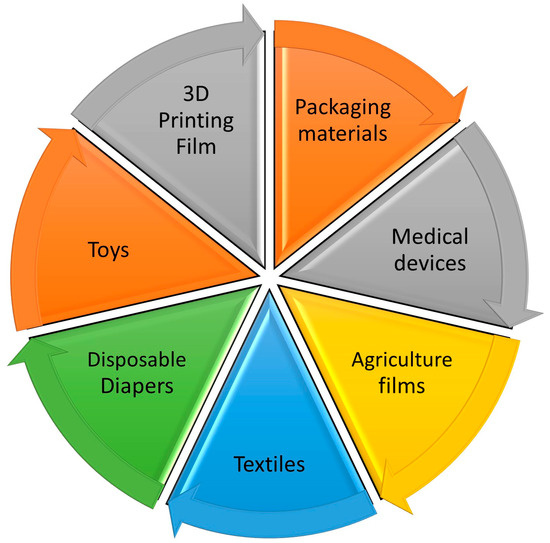
Figure 4.
Different applications for PVA and natural polymer blends.
A starch/PVA blend can be used as a biodegradable film in packaging to lessen its impact on the environment. PVA/starch or PVA/HPMC blend sheets can be used as burial films in agriculture. These coatings aid in controlling temperature and retaining soil moisture. They do not need to be removed after their function is fulfilled since they can naturally deteriorate. The textile industry may employ starch/PVA mixed films to make items like non-woven textiles and throwaway apparel. These products can be made to decompose organically once they have been used.
Certain disposable diapers can be made of biodegradable materials, such as the PVA/HPMC blend, which lessens the harm that regular disposable diapers do to the environment.
10. Conclusions
Plastic trash disposal is currently a significant environmental issue. Plastics are used more frequently and in diverse ways in our daily lives, which influences on the environment. Due to the carbon dioxide emissions caused by the burning of typical non-biodegradable polymers, such as polyethylene, polypropylene, and polyvinyl chloride, there is an increasing concern regarding global warming. The best way to manage non-biodegradable plastic waste is to switch to biodegradable polymers because they are more cost-effective for recycling or reuse than non-biodegradable materials. Many different types of degradable polymers, such as polylactic acid, polycaprolactone, and polyvinyl alcohol, with natural polymers, such as starch and cellulose, have competitive specifications compared to non-degradable polymers. There is great interest in biodegradable polymers for short-term use in fields such as surgery, pharmacology, agriculture, and the environment.
Our findings prove that using inexpensive natural polymers with a commercially available biodegradable polymer such as PVA to generate ecologically acceptable, cost-effective films would make the polymers more affordable while simultaneously improving their thermal characteristics and rates of deterioration, giving them a serious competitive advantage over industrial polymers that are widely used today.
Funding
This research received no external funding.
Data Availability Statement
The data used to support the findings of this study are included within the article.
Conflicts of Interest
Author Abdallah S. Elgharbawy was employed by the Egyptian Ethylene and Derivatives Company (Ethydco). The remaining authors declare that the research was conducted in the absence of any commercial or financial relationships that could be construed as potential conflicts of interest.
References
- Kasznik, D.; Łapniewska, Z. The end of plastic? The EU’s directive on single-use plastics and its implementation in Poland. Environ. Sci. Policy 2023, 145, 151–163. [Google Scholar] [CrossRef]
- Borrelle, S.B.; Ringma, J.; Law, K.L.; Monnahan, C.C.; Lebreton, L.; McGivern, A.; Murphy, E.; Jambeck, J.; Leonard, G.H.; Hilleary, M.A.; et al. Predicted growth in plastic waste exceeds efforts to mitigate plastic pollution. Science 2020, 369, 1515–1518. [Google Scholar] [CrossRef] [PubMed]
- Lau, W.W.Y.; Shiran, Y.; Bailey, R.M.; Cok, E.; Stuchtey, M.R.; Koskella, J.; Velis, C.A.; Godfrey, L.; Boucher, J.; Murphy, M.B.; et al. Evaluating scenarios toward zero plastic pollution. Science 2020, 369, 1455–1461. [Google Scholar] [CrossRef] [PubMed]
- Simantiris, N. Single-Use Plastic or Paper Products? A Dilemma That Requires Societal Change. Clean. Waste Syst. 2024, 7, 100128. [Google Scholar] [CrossRef]
- Kitz, R.; Walker, T.; Charlebois, S.; Music, J. Food packaging during the COVID-19 pandemic: Consumer perceptions. Int. J. Consum. Stud. 2021, 46, 434–448. [Google Scholar] [CrossRef] [PubMed]
- Kumar, R.; Verma, A.; Shome, A.; Sinha, R.; Sinha, S.; Jha, P.K.; Kumar, R.; Kumar, P.; Shubham; Das, S.; et al. Impacts of Plastic Pollution on Ecosystem Services, Sustainable Development Goals, and Need to Focus on Circular Economy and Policy Interventions. Sustainability 2021, 13, 9963. [Google Scholar] [CrossRef]
- Dimassi, S.N.; Hahladakis, J.N.; Yahia, M.N.D.; Ahmad, M.I.; Sayadi, S.; Al-Ghouti, M.A. Degradation-Fragmentation of Marine Plastic Waste and Their Environmental Implications: A Critical Review. Arab. J. Chem. 2022, 15, 104262. [Google Scholar] [CrossRef]
- Brooks, A.L.; Wang, S.; Jambeck, J.R. The Chinese Import Ban and Its Impact on Global Plastic Waste Trade. Sci. Adv. 2018, 4, eaat0131. [Google Scholar] [CrossRef] [PubMed]
- Le Breton, M.; Baillet, L.; Larose, E.; Rey, E.; Benech, P.; Jongmans, D.; Guyoton, F.; Jaboyedoff, M. Passive radio-frequency identification ranging, a dense and weather-robust technique for landslide displacement monitoring. Eng. Geol. 2019, 250, 1–10. [Google Scholar] [CrossRef]
- Villarrubia-Gómez, P.; Cornell, S.E.; Fabres, J. Marine plastic pollution as a planetary boundary threat—The drifting piece in the sustainability puzzle. Mar. Policy 2018, 96, 213–220. [Google Scholar] [CrossRef]
- Babaremu, K.O.; Okoya, S.A.; Hughes, E.; Tijani, B.; Teidi, D.; Akpan, A.; Igwe, J.; Karera, S.; Oyinlola, M.; Akinlabi, E.T. Sustainable Plastic Waste Management in a Circular Economy. Heliyon 2022, 8, e09984. [Google Scholar] [CrossRef]
- Kurtela, A.; Antolović, N. The problem of plastic waste and microplastics in the seas and oceans: Impact on marine organisms. Croat. J. Fish. 2019, 77, 51–56. [Google Scholar] [CrossRef]
- Schmaltz, E.; Melvin, E.C.; Diana, Z.; Gunady, E.F.; Rittschof, D.; Somarelli, J.A.; Virdin, J.; Dunphy-Daly, M.M. Plastic pollution solutions: Emerging technologies to prevent and collect marine plastic pollution. Environ. Int. 2020, 144, 106067. [Google Scholar] [CrossRef] [PubMed]
- Kehinde, O.; Ramonu, O.J.; Babaremu, K.O.; Justin, L.D. Plastic wastes: Environmental hazard and instrument for wealth creation in Nigeria. Heliyon 2020, 6, e05131. [Google Scholar] [CrossRef] [PubMed]
- Gallo, F.; Fossi, C.; Weber, R.; Santillo, D.; Sousa, J.; Ingram, I.; Nadal, A.; Romano, D. Marine litter plastics and microplastics and their toxic chemicals components: The need for urgent preventive measures. In Analysis of Nanoplastics and Microplastics in Food; CRC Press: Boca Raton, FL, USA, 2020; pp. 159–179. [Google Scholar]
- Ghosh, S.; Sinha, J.K.; Ghosh, S.; Vashisth, K.; Han, S.; Bhaskar, R. Microplastics as an Emerging Threat to the Global Environment and Human Health. Sustainability 2023, 15, 10821. [Google Scholar] [CrossRef]
- Carbery, M.; O’Connor, W.; Palanisami, T. Trophic transfer of microplastics and mixed contaminants in the marine food web and implications for human health. Environ. Int. 2018, 115, 400–409. [Google Scholar] [CrossRef] [PubMed]
- Cordier, M.; Uehara, T. How much innovation is needed to protect the ocean from plastic contamination? Sci. Total Environ. 2019, 670, 789–799. [Google Scholar] [CrossRef] [PubMed]
- Barboza, L.G.A.; Vethaak, A.D.; Lavorante, B.R.B.O.; Lundebye, A.-K.; Guilhermino, L. Marine microplastic debris: An emerging issue for food security, food safety and human health. Mar. Pollut. Bull. 2018, 133, 336–348. [Google Scholar] [CrossRef] [PubMed]
- Benson, N.U.; Bassey, D.E.; Palanisami, T. COVID pollution: Impact of COVID-19 pandemic on global plastic waste footprint. Heliyon 2021, 7, e06343. [Google Scholar] [CrossRef]
- Pawar, P.R.; Shirgaonkar, S.S.; Patil, R.B. Plastic marine debris: Sources, distribution and impacts on coastal and ocean biodiversity. PENCIL Publ. Biol. Sci. 2016, 3, 40–54. [Google Scholar]
- Hahladakis, J.N.; Velis, C.A.; Weber, R.; Iacovidou, E.; Purnell, P. An overview of chemical additives present in plastics: Migration, release, fate and environmental impact during their use, disposal and recycling. J. Hazard. Mater. 2018, 344, 179–199. [Google Scholar] [CrossRef] [PubMed]
- Geyer, R.; Jambeck, J.R.; Law, K.L. Production, use, and fate of all plastics ever made. Sci. Adv. 2017, 3, e1700782. [Google Scholar] [CrossRef] [PubMed]
- Huysman, S.; De Schaepmeester, J.; Ragaert, K.; Dewulf, J.; De Meester, S. Performance indicators for a circular economy: A case study on post-industrial plastic waste. Resour. Conserv. Recycl. 2017, 120, 46–54. [Google Scholar] [CrossRef]
- Ángeles-Hurtado, L.A.; Rodríguez-Reséndiz, J.; Salazar-Colores, S.; Torres-Salinas, H.; Sevilla-Camacho, P.Y. Viable disposal of post-consumer polymers in Mexico: A review. Front. Environ. Sci. 2021, 9, 749775. [Google Scholar] [CrossRef]
- Kibria, M.G.; Masuk, N.I.; Safayet, R.; Nguyen, H.Q.; Mourshed, M. Plastic Waste: Challenges and Opportunities to Mitigate Pollution and Effective Management. Int. J. Environ. Res. 2023, 17, 20. [Google Scholar] [CrossRef] [PubMed]
- Babaremu, K.; Adediji, A.; Olumba, N.; Okoya, S.; Akinlabi, E.; Oyinlola, M. Technological Advances in Mechanical Recycling Innovations and Corresponding Impacts on the Circular Economy of Plastics. Environments 2024, 11, 38. [Google Scholar] [CrossRef]
- Santos, G.; Esmizadeh, E.; Riahinezhad, M. Recycling Construction, Renovation, and Demolition Plastic Waste: Review of the Status Quo, Challenges and Opportunities. J. Polym. Environ. 2024, 32, 479–509. [Google Scholar] [CrossRef]
- Yang, C.; Wu, H.; Cai, M.; Zhou, Y.; Guo, C.; Han, Y.; Zhang, L. Valorization of Biomass-Derived Polymers to Functional Biochar Materials for Supercapacitor Applications via Pyrolysis: Advances and Perspectives. Polymers 2023, 15, 2741. [Google Scholar] [CrossRef] [PubMed]
- Ragaert, K.; Delva, L.; Van Geem, K. Mechanical and chemical recycling of solid plastic waste. Waste Manag. 2017, 69, 24–58. [Google Scholar] [CrossRef] [PubMed]
- Verma, R.; Vinoda, K.S.; Papireddy, M.; Gowda, A.N.S. Toxic Pollutants from Plastic Waste—A Review. Procedia Environ. Sci. 2016, 35, 701–708. [Google Scholar] [CrossRef]
- Jeswani, H.; Krüger, C.; Russ, M.; Horlacher, M.; Antony, F.; Hann, S.; Azapagic, A. Life cycle environmental impacts of chemical recycling via pyrolysis of mixed plastic waste in comparison with mechanical recycling and energy recovery. Sci. Total Environ. 2021, 769, 144483. [Google Scholar] [CrossRef]
- EN 13432:2000; Packaging. Requirements for Packaging Recoverable through Composting and Biodegradation. Test Scheme and Evaluation Criteria for the Final Acceptance of Packaging. British Standards Institution: London, UK, 2000.
- Silva, R.R.A.; Marques, C.S.; Arruda, T.R.; Teixeira, S.C.; de Oliveira, T.V. Biodegradation of Polymers: Stages, Measurement, Standards and Prospects. Macromol 2023, 3, 371–399. [Google Scholar] [CrossRef]
- Samir, A.; Ashour, F.H.; Hakim, A.A.A.; Bassyouni, M. Recent Advances in Biodegradable Polymers for Sustainable Applications. npj Mater. Degrad. 2022, 6, 68. [Google Scholar] [CrossRef]
- Silva, A.C.Q.; Silvestre, A.J.D.; Vilela, C.; Freire, C.S.R. Natural Polymers-Based Materials: A Contribution to a Greener Future. Molecules 2021, 27, 94. [Google Scholar] [CrossRef] [PubMed]
- Rosenboom, J.-G.; Langer, R.; Traverso, G. Bioplastics for a Circular Economy. Nat. Rev. Mater. 2022, 7, 117–137. [Google Scholar] [CrossRef]
- Joseph, T.M.; Unni, A.B.; Joshy, K.S.; Kar Mahapatra, D.; Haponiuk, J.; Thomas, S. Emerging Bio-Based Polymers from Lab to Market: Current Strategies, Market Dynamics and Research Trends. C 2023, 9, 30. [Google Scholar] [CrossRef]
- Syed, M.H.; Qutaba, S.; Zahari, M.A.; Abdullah, N.; Shoaib, M.; Bashir, H.F.; Ali, M.Q.; Ali, R.; Iqbal, A.; Ali, W. Eco-friendly antimicrobial finishing of cotton fabrics using bioactive agents from novel Melia azedarachayan berries extract and their performance after subsequent washings. Egypt. J. Chem. 2023, 66, 255–268. [Google Scholar]
- Mukherjee, C.; Varghese, D.; Krishna, J.S.; Boominathan, T.; Rakeshkumar, R.; Dineshkumar, S.; Rao, C.V.S.B.; Sivaramakrishna, A. Recent Advances in Biodegradable Polymers–Properties, Applications and Future Prospects. Eur. Polym. J. 2023, 192, 112068. [Google Scholar] [CrossRef]
- Bishai, M.; De, S.; Adhikari, B.; Banerjee, R. A comprehensive study on enhanced characteristics of modified polylactic acid based versatile biopolymer. Eur. Polym. J. 2014, 54, 52–61. [Google Scholar] [CrossRef]
- Vatanpour, V.; Dehqan, A.; Paziresh, S.; Zinadini, S.; Zinatizadeh, A.A.; Koyuncu, I. Polylactic acid in the fabrication of separation membranes: A review. Sep. Purif. Technol. 2022, 296, 121433. [Google Scholar] [CrossRef]
- Castro-Aguirre, E.; Iniguez-Franco, F.; Samsudin, H.; Fang, X.; Auras, R. Poly (lactic acid)—Mass production, processing, industrial applications, and end of life. Adv. Drug Deliv. Rev. 2016, 107, 333–366. [Google Scholar] [CrossRef]
- Taib, N.-A.A.B.; Rahman, M.R.; Huda, D.; Kuok, K.K.; Hamdan, S.; Bin Bakri, M.K.; Bin Julaihi, M.R.M.; Khan, A. A Review on Poly Lactic Acid (PLA) as a Biodegradable Polymer. Polym. Bull. 2023, 80, 1179–1213. [Google Scholar] [CrossRef]
- Sangeetha, V.H.; Deka, H.; Varghese, T.O.; Nayak, S.K. State of the art and future prospectives of poly(lactic acid) based blends and composites. Polym. Compos. 2016, 39, 81–101. [Google Scholar] [CrossRef]
- Baran, E.H.; Erbil, H.Y. Surface Modification of 3D Printed PLA Objects by Fused Deposition Modeling: A Review. Colloids Interfaces 2019, 3, 43. [Google Scholar] [CrossRef]
- Casalini, T.; Rossi, F.; Castrovinci, A.; Perale, G. A perspective on polylactic acid-based polymers use for nanoparticles synthesis and applications. Front. Bioeng. Biotechnol. 2019, 7, 259. [Google Scholar] [CrossRef]
- Shah, M.; Shah, S.N. A novel method to evaluate performance of chemical particulates for fluid diversion during hydraulic fracturing treatment. J. Nat. Gas. Sci. Eng. 2021, 95, 104178. [Google Scholar] [CrossRef]
- Chen, X.; Lu, Y. A perspective review on degradable polylactic acid diverters for well stimulations. Fuel 2023, 348, 128557. [Google Scholar] [CrossRef]
- Pyda, M.; Czerniecka-Kubicka, A. Thermal Properties and Thermodynamics of Poly (L-Lactic Acid). In Synthesis, Structure and Properties of Poly (Lactic Acid); Springer: Cham, Switzerland, 2018; pp. 153–193. [Google Scholar]
- DeStefano, V.; Khan, S.; Tabada, A. Applications of PLA in Modern Medicine. Eng. Regen. 2020, 1, 76–87. [Google Scholar] [CrossRef]
- Li, H.; Wu, C.; Yu, X.; Zhang, W. Recent Advances of PVA-Based Hydrogels in Cartilage Repair Application. J. Mater. Res. Technol. 2023, 24, 2279–2298. [Google Scholar] [CrossRef]
- Thong, C.C.; Teo, D.C.L.; Ng, C.K. Application of Polyvinyl Alcohol (PVA) in Cement-Based Composite Materials: A Review of Its Engineering Properties and Microstructure Behavior. Constr. Build. Mater. 2016, 107, 172–180. [Google Scholar] [CrossRef]
- Couți, N.; Porfire, A.; Iovanov, R.; Crișan, A.G.; Iurian, S.; Casian, T.; Tomuță, I. Polyvinyl Alcohol, a Versatile Excipient for Pharmaceutical 3D Printing. Polymers 2024, 16, 517. [Google Scholar] [CrossRef] [PubMed]
- Kamoun, E.A.; Chen, X.; Eldin, M.S.M.; Kenawy, E.-R.S. Crosslinked poly (vinyl alcohol) hydrogels for wound dressing applications: A review of remarkably blended polymers. Arab. J. Chem. 2015, 8, 1–14. [Google Scholar] [CrossRef]
- Abdullah, Z.W.; Dong, Y.; Davies, I.J.; Barbhuiya, S. PVA, PVA blends, and their nanocomposites for biodegradable packaging application. Polym. Plast. Technol. Eng. 2017, 56, 1307–1344. [Google Scholar] [CrossRef]
- Sarwar, M.S.; Niazi, M.B.K.; Jahan, Z.; Ahmad, T.; Hussain, A. Preparation and characterization of PVA/nanocellulose/Ag nanocomposite films for antimicrobial food packaging. Carbohydr. Polym. 2018, 184, 453–464. [Google Scholar] [CrossRef] [PubMed]
- Compart, J.; Singh, A.; Fettke, J.; Apriyanto, A. Customizing Starch Properties: A Review of Starch Modifications and Their Applications. Polymers 2023, 15, 3491. [Google Scholar] [CrossRef] [PubMed]
- Jha, P.; Dharmalingam, K.; Nishizu, T.; Katsuno, N.; Anandalakshmi, R. Effect of Amylose–Amylopectin Ratios on Physical, Mechanical, and Thermal Properties of Starch-based Bionanocomposite Films Incorporated with CMC and Nanoclay. Starch-Stärke 2020, 72, 1900121. [Google Scholar] [CrossRef]
- Guarás, M.P.; Ludueña, L.N.; Alvarez, V.A. Recent Advances in Thermoplastic Starch Biodegradable Nanocomposites. In Handbook of Nanomaterials and Nanocomposites for Energy and Environmental Applications; Springer: Cham, Switzerland, 2020; pp. 1–24. [Google Scholar]
- Katayama, M.; Mitsuno, D.; Ueda, K. Clinical Application to Improve the “Depth Perception Problem” by Combining Augmented Reality and a 3D Printing Model. Plast. Reconstr. Surg. Glob. Open 2023, 11, e5071. [Google Scholar] [CrossRef]
- Kumari, S.V.G.; Pakshirajan, K.; Pugazhenthi, G. Recent Advances and Future Prospects of Cellulose, Starch, Chitosan, Polylactic Acid and Polyhydroxyalkanoates for Sustainable Food Packaging Applications. Int. J. Biol. Macromol. 2022, 221, 163–182. [Google Scholar] [CrossRef]
- Dong, J.; Zeng, J.; Li, P.; Li, J.; Wang, B.; Xu, J.; Gao, W.; Chen, K. Mechanically Strong Nanopapers Based on Lignin Containing Cellulose Micro-and Nano-Hybrid Fibrils: Lignin Content-Fibrils Morphology-Strengthening Mechanism. Carbohydr. Polym. 2023, 311, 120753. [Google Scholar] [CrossRef]
- Jebel, F.S.; Almasi, H. Morphological, physical, antimicrobial and release properties of ZnO nanoparticles-loaded bacterial cellulose films. Carbohydr. Polym. 2016, 149, 8–19. [Google Scholar] [CrossRef]
- Salari, M.; Khiabani, M.S.; Mokarram, R.R.; Ghanbarzadeh, B.; Kafil, H.S. Development and evaluation of chitosan based active nanocomposite films containing bacterial cellulose nanocrystals and silver nanoparticles. Food Hydrocoll. 2018, 84, 414–423. [Google Scholar] [CrossRef]
- Syafri, E.; Kasim, A.; Asben, A.; Senthamaraikannan, P.; Sanjay, M.R. Studies on Ramie cellulose microfibrils reinforced cassava starch composite: Influence of microfibrils loading. J. Nat. Fibers 2018, 17, 122–131. [Google Scholar] [CrossRef]
- Yu, Z.; Wang, W.; Kong, F.; Lin, M.; Mustapha, A. Cellulose nanofibril/silver nanoparticle composite as an active food packaging system and its toxicity to human colon cells. Int. J. Biol. Macromol. 2019, 129, 887–894. [Google Scholar] [CrossRef] [PubMed]
- Seddiqi, H.; Oliaei, E.; Honarkar, H.; Jin, J.; Geonzon, L.C.; Bacabac, R.G.; Klein-Nulend, J. Cellulose and Its Derivatives: Towards Biomedical Applications. Cellulose 2021, 28, 1893–1931. [Google Scholar] [CrossRef]
- Silva, P.M.; Prieto, C.; Lagarón, J.M.; Pastrana, L.M.; Coimbra, M.A.; Vicente, A.A.; Cerqueira, M.A. Food-Grade Hydroxypropyl Methylcellulose-Based Formulations for Electrohydrodynamic Processing: Part I–Role of Solution Parameters on Fibre and Particle Production. Food Hydrocoll. 2021, 118, 106761. [Google Scholar] [CrossRef]
- Drago, E.; Campardelli, R.; Lagazzo, A.; Firpo, G.; Perego, P. Improvement of Natural Polymeric Films Properties by Blend Formulation for Sustainable Active Food Packaging. Polymers 2023, 15, 2231. [Google Scholar] [CrossRef] [PubMed]
- Zhou, W.; Zha, D.; Zhang, X.; Xu, J.; Guo, B.; Huang, Y. Ordered long polyvinyl alcohol fiber-reinforced thermoplastic starch composite having comparable mechanical properties with polyethylene and polypropylene. Carbohydr. Polym. 2020, 250, 116913. [Google Scholar] [CrossRef] [PubMed]
- Guo, B.; Zha, D.; Li, B.; Yin, P.; Li, P. Polyvinyl Alcohol Microspheres Reinforced Thermoplastic Starch Composites. Materials 2018, 11, 640. [Google Scholar] [CrossRef] [PubMed]
- Vineeth, S.K.; Gadhave, R.V. Corn Starch Blended Polyvinyl Alcohol Adhesive Chemically Modified by Crosslinking and Its Applicability as Polyvinyl Acetate Wood Adhesive. Polym. Bull. 2024, 81, 811–825. [Google Scholar] [CrossRef]
- Kochkina, N.E.; Lukin, N.D. Structure and properties of biodegradable maize starch/chitosan composite films as affected by PVA additions. Int. J. Biol. Macromol. 2020, 157, 377–384. [Google Scholar] [CrossRef]
- Gómez-Aldapa, C.A.; Velazquez, G.; Gutierrez, M.C.; Rangel-Vargas, E.; Castro-Rosas, J.; Aguirre-Loredo, R.Y. Effect of polyvinyl alcohol on the physicochemical properties of biodegradable starch films. Mater. Chem. Phys. 2019, 239, 122027. [Google Scholar] [CrossRef]
- Phattarateera, S.; Sangthongdee, M.; Subsomboon, T.; Threepopnatkul, P. Assessing Antibacterial Properties of Polyvinyl Alcohol/Pregelatinized Starch Films for Outbreak Prevention. Ind. Crops Prod. 2024, 211, 118214. [Google Scholar] [CrossRef]
- Zhang, K.; Huang, T.-S.; Yan, H.; Hu, X.; Ren, T. Novel pH-sensitive films based on starch/polyvinyl alcohol and food anthocyanins as a visual indicator of shrimp deterioration. Int. J. Biol. Macromol. 2020, 145, 768–776. [Google Scholar] [CrossRef] [PubMed]
- Song, J.; Lin, X.; Wu, H.; Huang, Z.; Gan, T.; Hu, H.; Qin, Y.; Zhang, Y. Fabrication of Biodegradable and Cold-Water-Soluble Starch/Polyvinyl Alcohol Films as Inner Packaging Materials of Pesticides: Enhanced Emulsification, Dispersibility, and Efficacy. Carbohydr. Polym. 2024, 328, 121713. [Google Scholar] [CrossRef] [PubMed]
- Wu, Z.; Huang, Y.; Xiao, L.; Lin, D.; Yang, Y.; Wang, H.; Yang, Y.; Wu, D.; Chen, H.; Zhang, Q.; et al. Physical properties and structural characterization of starch/polyvinyl alcohol/graphene oxide composite films. Int. J. Biol. Macromol. 2018, 123, 569–575. [Google Scholar] [CrossRef] [PubMed]
- Usman, A.; Hussain, Z.; Riaz, A.; Khan, A.N. Enhanced mechanical, thermal and antimicrobial properties of poly (vinyl alcohol)/graphene oxide/starch/silver nanocomposites films. Carbohydr. Polym. 2016, 153, 592–599. [Google Scholar] [CrossRef] [PubMed]
- Wei, X.; Tao, H.; Tan, C.; Xie, J.; Yuan, F.; Guo, L.; Cui, B.; Zou, F.; Gao, W.; Liu, P.; et al. Intermolecular Interactions between Starch and Polyvinyl Alcohol for Improving Mechanical Properties of Starch-Based Straws. Int. J. Biol. Macromol. 2023, 239, 124211. [Google Scholar] [CrossRef] [PubMed]
- Zheng, J.; Hu, Y.; Su, C.; Liang, W.; Liu, X.; Zhao, W.; Sun, Z.; Zhang, X.; Lu, Y.; Shen, H.; et al. Structural, Physicochemical and Biodegradable Properties of Composite Plastics Prepared with Polyvinyl Alcohol (PVA), OSA Potato Starch and Gliadin. J. Food Eng. 2023, 339, 111278. [Google Scholar] [CrossRef]
- Varghese, S.A.; Pulikkalparambil, H.; Rangappa, S.M.; Parameswaranpillai, J.; Siengchin, S. Antimicrobial Active Packaging Based on PVA/Starch Films Incorporating Basil Leaf Extracts. Mater. Today Proc. 2023, 72, 3056–3062. [Google Scholar] [CrossRef]
- Liu, D.; Dang, S.; Zhang, L.; Munsop, K.; Li, X. Corn starch/polyvinyl alcohol based films incorporated with curcumin-loaded Pickering emulsion for application in intelligent packaging. Int. J. Biol. Macromol. 2021, 188, 974–982. [Google Scholar] [CrossRef]
- Terzioğlu, P.; Parin, F.N. Polyvinyl alcohol-corn starch-lemon peel biocomposite films as potential food packaging. Celal Bayar Univ. J. Sci. 2020, 16, 373–378. [Google Scholar]
- Kumar, P.; Tanwar, R.; Gupta, V.; Upadhyay, A.; Kumar, A.; Gaikwad, K.K. Pineapple peel extract incorporated poly (vinyl alcohol)-corn starch film for active food packaging: Preparation, characterization and antioxidant activity. Int. J. Biol. Macromol. 2021, 187, 223–231. [Google Scholar] [CrossRef] [PubMed]
- Qin, Y.; Xu, F.; Yuan, L.; Hu, H.; Yao, X.; Liu, J. Comparison of the physical and functional properties of starch/polyvinyl alcohol films containing anthocyanins and/or betacyanins. Int. J. Biol. Macromol. 2020, 163, 898–909. [Google Scholar] [CrossRef]
- Yurong, G.; Dapeng, L. Preparation and characterization of corn starch/PVA/glycerol composite films incorporated with ε-polylysine as a novel antimicrobial packaging material. e-Polymers 2020, 20, 154–161. [Google Scholar] [CrossRef]
- Ali, M.A.S.S.; Jimat, D.N.; Nawawi, W.M.F.W.; Sulaiman, S. Antibacterial, Mechanical and Thermal Properties of PVA/Starch Composite Film Reinforced with Cellulose Nanofiber of Sugarcane Bagasse. Arab. J. Sci. Eng. 2022, 47, 5747–5754. [Google Scholar] [CrossRef]
- Kan, J.; Liu, J.; Xu, F.; Yun, D.; Yong, H.; Liu, J. Development of pork and shrimp freshness monitoring labels based on starch/polyvinyl alcohol matrices and anthocyanins from 14 plants: A comparative study. Food Hydrocoll. 2022, 124, 107293. [Google Scholar] [CrossRef]
- Mathew, S.; Jayakumar, A.; Kumar, V.P.; Mathew, J.; Radhakrishnan, E.K. One-step synthesis of eco-friendly boiled rice starch blended polyvinyl alcohol bionanocomposite films decorated with in situ generated silver nanoparticles for food packaging purpose. Int. J. Biol. Macromol. 2019, 139, 475–485. [Google Scholar] [CrossRef] [PubMed]
- Phattarateera, S.; Xin, L.; Amphong, C.; Limsamran, V.; Threepopnatkul, P. Comparative studies of starch blends on the properties of PVA films. Carbohydr. Polym. Technol. Appl. 2023, 6, 100340. [Google Scholar] [CrossRef]
- Patil, S.; Bharimalla, A.K.; Mahapatra, A.; Dhakane-Lad, J.; Arputharaj, A.; Kumar, M.; Raja, A.; Kambli, N. Effect of polymer blending on mechanical and barrier properties of starch-polyvinyl alcohol based biodegradable composite films. Food Biosci. 2021, 44, 101352. [Google Scholar] [CrossRef]
- Hu, D.; Qiang, T.; Wang, L. Quaternized chitosan/polyvinyl alcohol/sodium carboxymethylcellulose blend film for potential wound dressing application. Wound Med. 2017, 16, 15–21. [Google Scholar] [CrossRef]
- Saadiah, M.A.; Zhang, D.; Nagao, Y.; Muzakir, S.K.; Samsudin, A.S. Reducing crystallinity on thin film based CMC/PVA hybrid polymer for application as a host in polymer electrolytes. J. Non-Cryst. Solids 2019, 511, 201–211. [Google Scholar] [CrossRef]
- Youssef, A.M.; Assem, F.M.; El-Sayed, H.S.; El-Sayed, S.M.; Elaaser, M.; El-Salam, M.H.A. Synthesis and evaluation of eco-friendly carboxymethyl cellulose/polyvinyl alcohol/CuO bionanocomposites and their use in coating processed cheese. RSC Adv. 2020, 10, 37857–37870. [Google Scholar] [CrossRef] [PubMed]
- Muppalla, S.R.; Kanatt, S.R.; Chawla, S.P.; Sharma, A. Carboxymethyl cellulose–polyvinyl alcohol films with clove oil for active packaging of ground chicken meat. Food Packag. Shelf Life 2014, 2, 51–58. [Google Scholar] [CrossRef]
- Fasihi, H.; Fazilati, M.; Hashemi, M.; Noshirvani, N. Novel carboxymethyl cellulose-polyvinyl alcohol blend films stabilized by Pickering emulsion incorporation method. Carbohydr. Polym. 2017, 167, 79–89. [Google Scholar] [CrossRef] [PubMed]
- Fasihi, H.; Noshirvani, N.; Hashemi, M.; Fazilati, M.; Salavati, H.; Coma, V. Antioxidant and antimicrobial properties of carbohydrate-based films enriched with cinnamon essential oil by Pickering emulsion method. Food Packag. Shelf Life 2019, 19, 147–154. [Google Scholar] [CrossRef]
- Cazón, P.; Vázquez, M.; Velazquez, G. Cellulose-glycerol-polyvinyl alcohol composite films for food packaging: Evaluation of water adsorption, mechanical properties, light-barrier properties and transparency. Carbohydr. Polym. 2018, 195, 432–443. [Google Scholar] [CrossRef]
- Huang, J.; Liu, J.; Chen, M.; Yao, Q.; Hu, Y. Immobilization of roselle anthocyanins into polyvinyl alcohol/hydroxypropyl methylcellulose film matrix: Study on the interaction behavior and mechanism for better shrimp freshness monitoring. Int. J. Biol. Macromol. 2021, 184, 666–677. [Google Scholar] [CrossRef] [PubMed]
- Huang, J.; Chen, M.; Zhou, Y.; Li, Y.; Hu, Y. Functional characteristics improvement by structural modification of hydroxypropyl methylcellulose modified polyvinyl alcohol films incorporating roselle anthocyanins for shrimp freshness monitoring. Int. J. Biol. Macromol. 2020, 162, 1250–1261. [Google Scholar] [CrossRef] [PubMed]
- Laoasoke, W.; Choipang, C.; Chaiarwut, S.; Suwantong, O.; Chuysinuan, P.; Techasakul, S.; Sangsanoh, P.; Supaphol, P. Preparation and Characterization of Hydroxypropyl Methylcellulose/Polyvinyl Alcohol Mucoadhesive Buccal Film of Cannabidiol. J. Polym. Environ. 2024, 1–10. [Google Scholar] [CrossRef]
- Chen, J.; Su, X.; Zheng, M.; Lin, J.; Tan, K.B. Enhanced properties of chitosan/hydroxypropyl methylcellulose/polyvinyl alcohol green bacteriostatic film composited with bamboo fiber and silane-modified bamboo fiber. Polym. Compos. 2022, 43, 2440–2449. [Google Scholar] [CrossRef]
- Kida, D.; Gładysz, O.; Szulc, M.; Zborowski, J.; Junka, A.; Janeczek, M.; Lipińska, A.; Skalec, A.; Karolewicz, B. Development and Evaluation of a Polyvinylalcohol-Cellulose Derivative-Based Film with Povidone-Iodine Predicted for Wound Treatment. Polymers 2020, 12, 1271. [Google Scholar] [CrossRef] [PubMed]
- Olechno, K.; Basa, A.; Winnicka, K. “Success Depends on Your Backbone”—About the Use of Polymers as Essential Materials Forming Orodispersible Films. Materials 2021, 14, 4872. [Google Scholar] [CrossRef] [PubMed]
- Ayyubi, S.N.; Purbasari, A. The effect of composition on mechanical properties of biodegradable plastic based on chitosan/cassava starch/PVA/crude glycerol: Optimization of the composition using Box Behnken Design. Mater. Today Proc. 2022, 63, S78–S83. [Google Scholar] [CrossRef]
- Chokboribal, J.; Nantachai, T.; Jongnimitphaiboon, K.; Chumprasert, S.; Suchaiya, V. Tapioca starch/PVA plastic films with water hyacinth powder: Enhanced stability in direct contact with moisture. Mater. Today Proc. 2022, 65, 2380–2388. [Google Scholar] [CrossRef]
- Negim, E.S.M.; Rakhmetullayeva, R.K.; Yeligbayeva, G.Z.; Urkimbaeva, P.I.; Primzharova, S.T.; Kaldybekov, D.B.; Khatib, J.M.; Mun, G.A.; Craig, W. Improving biodegradability of polyvinyl alcohol/starch blend films for packaging applications. Int. J. Basic. Appl. Sci. 2014, 3, 263. [Google Scholar] [CrossRef]
- Mittal, A.; Garg, S.; Bajpai, S. Fabrication and characteristics of poly (vinyl alcohol)-starch-cellulosic material based biodegradable composite film for packaging application. Mater. Today Proc. 2019, 21, 1577–1582. [Google Scholar] [CrossRef]
- Chai, W.-L.; Chow, J.-D.; Chen, C.-C.; Chuang, F.-S.; Lu, W.-C. Evaluation of the biodegradability of polyvinyl alcohol/starch blends: A methodological comparison of environmentally friendly materials. J. Polym. Environ. 2009, 17, 71–82. [Google Scholar] [CrossRef]
- Abdullah, Z.W.; Dong, Y. Biodegradable and water resistant poly (vinyl) alcohol (PVA)/starch (ST)/glycerol (GL)/halloysite nanotube (HNT) nanocomposite films for sustainable food packaging. Front. Mater. 2019, 6, 58. [Google Scholar] [CrossRef]
- Priya, B.; Gupta, V.K.; Pathania, D.; Singha, A.S. Synthesis, characterization and antibacterial activity of biodegradable starch/PVA composite films reinforced with cellulosic fibre. Carbohydr. Polym. 2014, 109, 171–179. [Google Scholar] [CrossRef]
- Ghatge, S.; Yang, Y.; Ahn, J.-H.; Hur, H.-G. Biodegradation of Polyethylene: A Brief Review. Appl. Biol. Chem. 2020, 63, 27. [Google Scholar] [CrossRef]
- Oliveira, J.; Belchior, A.; da Silva, V.D.; Rotter, A.; Petrovski, Ž.; Almeida, P.L.; Lourenço, N.D.; Gaudêncio, S.P. Marine Environmental Plastic Pollution: Mitigation by Microorganism Degradation and Recycling Valorization. Front. Mar. Sci. 2020, 7, 567126. [Google Scholar] [CrossRef]
Disclaimer/Publisher’s Note: The statements, opinions and data contained in all publications are solely those of the individual author(s) and contributor(s) and not of MDPI and/or the editor(s). MDPI and/or the editor(s) disclaim responsibility for any injury to people or property resulting from any ideas, methods, instructions or products referred to in the content. |
© 2024 by the authors. Licensee MDPI, Basel, Switzerland. This article is an open access article distributed under the terms and conditions of the Creative Commons Attribution (CC BY) license (https://creativecommons.org/licenses/by/4.0/).