


Abstract
Cotton mechanized harvesting is the development direction of cotton production. The rapid development of mechanized cotton harvesting in Xinjiang has significantly increased the efficiency of cotton harvesting and reduced the harvesting cost. However, in the rapid development of mechanized cotton harvesting, there are also the problems of net yield, recovery rate and poor harvesting quality, which lead to the poor quality competitiveness of mechanized cotton harvesting. In order to solve the problem of mechanized cotton loss, the key is to reduce the problem of cotton miscellaneous, and breed cotton varieties suitable for mechanized harvesting. The purpose of this study was to clarify the key trait correlation of defoliation through the establishment and association analysis of foliation and deciduous phenotype indicators in cotton. In this study, the phenotypic indexes of defoliation and deciduous traits were established through the comprehensive analysis of the defoliation rate of 273 cotton germplasm resources and other 11 related phenotypic traits in the field, in order to provide guidance for the breeding and production of cotton varieties collected by breeders. In addition to peeling rate, an analysis of the association between 11 agronomic parameters and peeling rate and hanging rate revealed that the number of effective branches, chlorophyll SPAD value, fruit branch angle, and hanging rate have substantial correlation in 3 years. Hence The hanging rate, fruit branch angle, effective branch number, and chlorophyll SPAD value can be used as the evaluation indicators of varieties for peeling ability trait index.
1. Introduction
China is a large cotton consumer, but it is also a mega cotton producer. Cotton is a labor-intensive field cash crop, with various field production processes, from planting to the collection of more than 20 workers per. The situation of high cost, low efficiency and poor quality makes China’s cotton production facing severe challenges, and it is urgent and significant to accelerate the realization of the full mechanization of cotton production. Cotton harvesting through mechanization is a systematic engineering process based mainly on the combination of agricultural machinery and agronomy, research of cotton varieties breeding, planting, plant protection, chemical control, top leaf ripening, and mechanical harvest. The second major technology has been clear for the mechanised cotton planting mode, to raise the level of cotton production and mechanisation. In recent years, due to the transfer of rural labor force, the sharp rise of labor prices and the requirement for high-quality of cotton, the cotton planting in Xinjiang has encountered many difficulties. At the same time, the CPC (Communist Party of China) Central Committee and the government of the autonomous region have actively guided new technologies, new models and new methods in Xinjiang for production practice and exploration, and strive to break through the existing bottlenecks and realize the full mechanization, high efficiency, standardization and green cotton production in Xinjiang. At present, mechanical cotton mining has been widely promoted in the cotton area of Xinjiang, China. By 2020, the area of Xinjiang cotton machine mining had increased to 28.176 million mu, while the area of northern Xinjiang machine mining had reached to 15 million mu, representing a 60% increase. However, there are two main problems restricting the promotion progress of mechanized cotton mining. First, China has not introduced any technical measures such as peeling and ripening for the mutual application of cotton varieties [1]. Second, although blind introduction leads to high yield, the germplasm resources themselves are not sensitive to defoliation agent, with low defoliation rate, poor quality, high miscellaneous rate and low net recovery rate, and the number of ginning cleaning process also increases greatly, which damages the fiber quality of cotton and greatly reduces the grade and quality of cotton [2]. Mechanical harvesting may reduce the fiber density [3]. Due to its unique ecological and climatic conditions, high large-scale planting and high-level mechanization operation, Xinjiang is by far the most suitable agricultural production area to promote and implement remote sensing technology and precision agriculture in China [4]. Lv Xin [5]. It is proposed that the GIS decision support system can provide fertilization decision and consultation for cotton, and can better cooperate with mechanized production. With Chen Xuegeng [6], the promotion of the proposed precision planting technology in Xinjiang cotton planting level to a new level, will bring greater economic and social benefits, and will solve the key problems in the cotton precision engineering system.
The influence of cotton varieties on the effect of mechanical cotton picking and removing leaves is mainly manifested in three aspects. The advantage of the short reproductive period variety is its early maturity, high spitting rate, good leaf effect, good boll weight, yield, and maturity despite having a minor impact is beneficial to machines. The varieties with long fertility period, thick leaf blade mature late and the leaf effect is poor, while the boll weight, yield, quality, and maturity influences are not machine friendly. On the other hand, mechanized cotton picking demands compact cotton plant type, short fruit branches, “fried sticks” fewer with concentrated bolls, middle and lower leaves suitable for dosing, strong peeling effect, and ultimately this plant type is ideal for peeling agent spraying and mechanical harvesting operations. The third factor is the sensitivity of cotton varieties. Cotton cultivars that are defoliation sensitive grow quickly, have a high cotton boll spitting rate, a good defoliation effect resulting a high net production rate, and suffer minimal cotton quality loss throughout the mechanical cotton picking process. Many factors determining the effect of defoliation have been discovered by domestic and international researchers in recent years. For example, Wang Xiaojing et al. found that the defoliation agent interfered with the balance of hormones in the plant to achieve the purpose of defoliation [7]. Similarly, Hu Junxia sprayed the cotton and she found that the peeling rate of cotton was significantly improved, and the yield was slightly increased [8]. Song Min and Qu Yanying analyzed the correlation between the machine-picked cotton plant type and the defoliation rate, and found that when the fruit branches were decreased significantly, but the effect of the leaves on the defoliation effect was not obvious [9]. Zhang Qiang, Zhao Bingmei and others evaluated the mechanical cotton varieties with good defoliation effect through cluster analysis [10]. In the field research results, Zhu Yijie and the Hong-xia Zhao team discovered that after leaf rate effect difference is significantly different in different crop varieties. Leaf soluble sugar concentration and soluble protein content levels change dramatically between varieties, and there is a significant negative association between leaf rate and soluble sugar content in each variety [11]. Zhou Tingting et al. found that leaves of some cotton varieties withered after the spraying of foliation agent, but did not fall, resulting in high mixed rate [12]. Defoliation agent is absorbed through cotton leaves, and it can finally act on the petiole off the layer, affecting the hormone balance, soluble sugar content and a series of physiological reactions to achieve the purpose of defoliation. The density of fruit branches will affect the absorption and utilization efficiency of defoliation agent in cotton [13].
Different cotton varieties have different sensitivity to cotton foliage agent, and the indicators to measure the sensitivity of mechanized cotton varieties are unclear. In this study, we comprehensively analyzed the defoliation rate, pruning rate and agronomic traits of 273 Gossypium hirsutum varieties around the world, and evaluated the key traits of defoliation and foliation, and selected the cotton varieties with good defoliation traits and suitable for mechanical picking; and provided material basis and theoretical reference for the genetic improvement and breeding of new varieties (Appendix A).
2. Materials and Methods
2.1. Experimental Materials
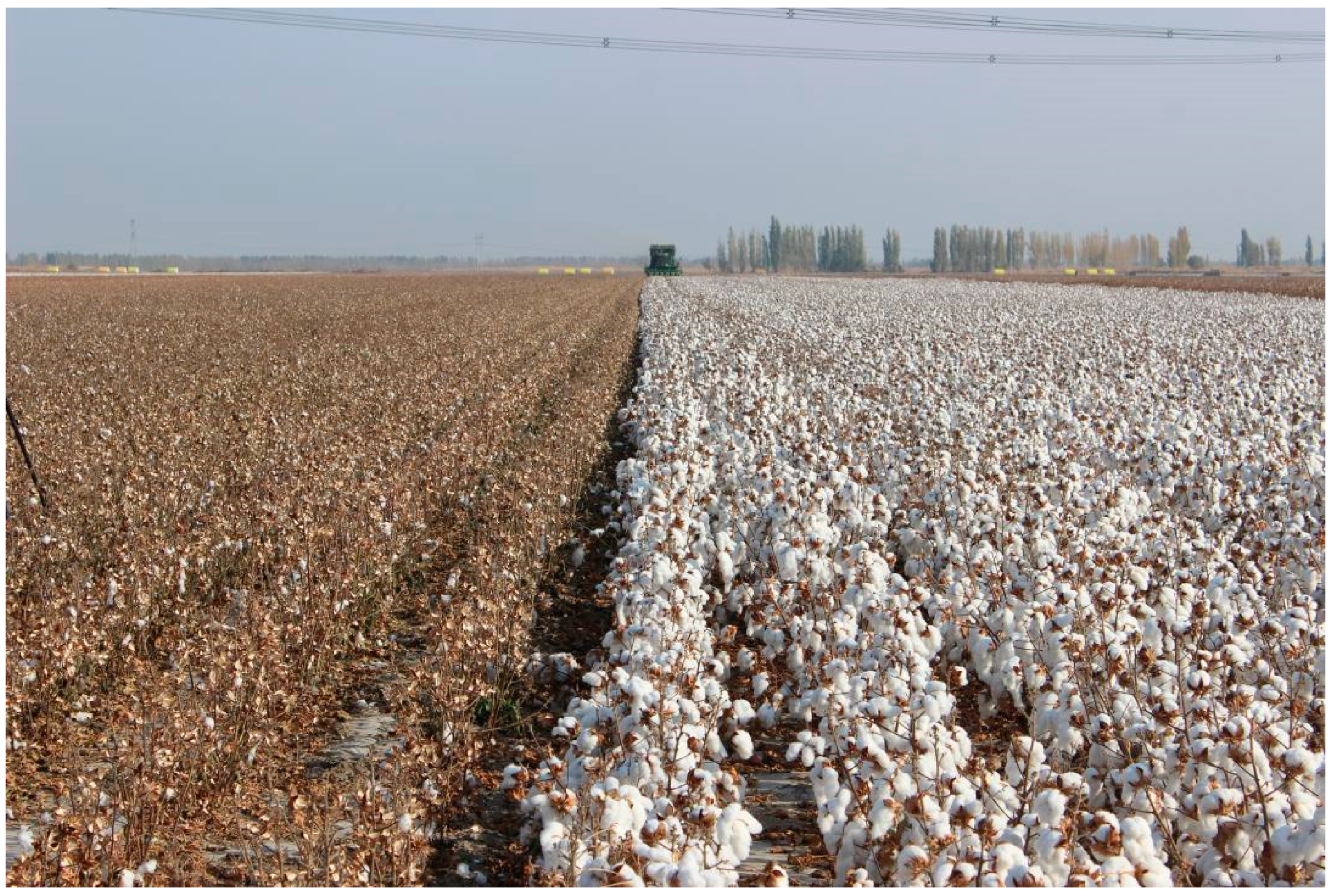
The experiment was carried out in 2019–2021 in the sixth group of Xinjiang Academy of Agricultural Sciences (80°50′31″ E, 40°30′13″ N, for 2021), and the experimental varieties were provided by the Cash Crops Research Institute of Xinjiang University of Agricultural Science and Technology. There are 273 Gossypium hirsutum varieties evaluated comprising both local and foreign germplasm (Figure 1). Mechanical cotton mining with submembrane drip irrigation was employed to plant all 273 accessions of Gossypium hirsutum materials used in the test study in 6 rows with plot design (66 cm length × 10 cm width). Each variety was sown in triplicate, with random areas of, 3 m long, and comprising of 150,000 plants/mu as per theoretical basis. The field management was the same as the field production. The formulation of leaf agent provided by China Agricultural University, is thiabene-ethylene oxide (50% total active ingredients, 10%, 40%), 150 mL/667 m2, and was sprayed through the UAV spray injection, so that each blade is attached to the drug liquid. A total of two injections were applied through Specific time in 11 September and 21 September.
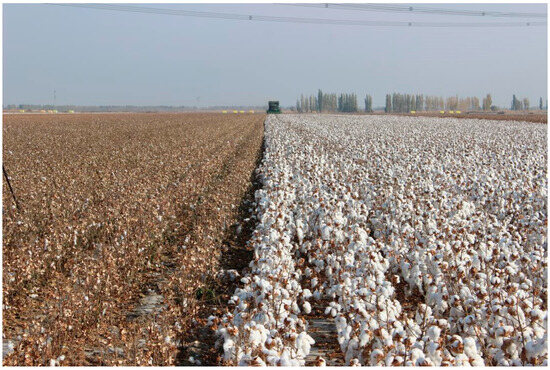
Figure 1.
Defoliant spraying effect. Harvest map after spraying deciduous leaves.
2.2. Investigation of Traits and Methods
According to the cotton DUS test index, 10 consecutive evenly balanced cotton plants were selected in each replicate to collect the agronomic trait data, and the average value of the three replicates was finally calculated as the phenotypic value of the trait. The specific survey traits and survey methods used in the present study were i.e.
Fertility period (BD): growth period includes seedling stage, bud stage, flowering stage and batting stage. Growth period The date when the index of each period of the survey reached 50%.
Plant height (PH): On 8 September, the distance between the cotyledon node of the cotton plant and the top of the main stem (after topping) was measured using a tape measure.
Number of effective branches (EFB): On 8 September, after topping, the number of all effective fruit branches on a cotton plant is liquidated.
Number of fruit knots (FN): On 8 September, the distance between the cotyledon node of the cotton plant and the tip of the main stem (after topping) was measured using a tape measure.
Total leaf number (NB): The total number of main stem leaves and fruit branches of cotton plant was calculated before defoliating agent was applied on 10 September.
Determination of chlorophyll SPAD value (Chl): On 8 September, SpAD-502 chlorophyll meter (Minolta, JPN) was used to determine the SPAD value of chlorophyll content in functional leaves of cotton (measured two leaves of the main stem after topping). The SPAD value was measured once in the main vein and on both sides of the leaves, and the average value was taken three times.
Leaf area (LA): On 8 September, LA-S leaf area measuring instrument was used to measure the leaf area of upper, middle and lower leaves respectively.
Number of beginning nodes (HFNFB): On 8 September, from the number of cotyledon nodes (cotyledon nodes count 0) to the first fruit branch, between the number of nodes is the number of beginning nodes.
Initial node height (HFNFH): On 8 September, the distance between the cotyledon node and the first fruit branch was measured with a tape measure.
Fruit branch Angle (FBA): On 8 September, the Angle between the first fruit node and the main stem of the upper four branches was measured with a protractor.
Leaf inclination (LIA): On 8 September, a protractor was used to measure the included Angle between the normal direction and the Z-axis direction of the leaf surface, that is, the included Angle between the leaf (main stem inverted 4 functional leaves) and the main stem.
Number of leaves remaining after first application (NFS): Number of leaves remaining investigated on 15 September.
Number of remaining leaves after second application (NSS): Number of remaining leaves investigated on 25 September.
Total number of hanging branches and leaves: The number of “dead but not falling” ground leaves and the number of “falling and hanging” leaves of cotton plants were investigated on 25 September.
2.3. Data Statistics and Analysis
For data summary and statistical calculation, the data including maximum, minimum, mean, standard deviation, skewness, kurtosis, coefficient of variation and gray correlation were analyzed using SPSS26.0 and Excel 2010, in reference to Tan Hehe and others [14], Niu Yisong et al. [15], Yin Guangting et al. [16] Methods. Correlations of the phenotypic traits were analyzed using the SAS 9.3 statistical software, and the generalized heritability was analyzed according to the ANOVA results by formula
was calculated where genetic variance, error variance, and gene-environment interaction variance. The calculation formula of defoliation rate and hanging rate is as follows:
3. Results and Analysis
3.1. Statistical Analysis of Phenotypic Traits
The findings of a statistical analysis using Excel 2010 and SPSS 26.0 for 273 accessions and three years of phenotypic data are reported in Table 1. In 2019, the yearly mean difference, the overall coefficient of variation is less than 15%, and the overall kurtosis and deviation of 3-year phenotypic features fit the normal distribution, compared to the previous two years.

Table 1.
Descriptive statistics of phenotypic traits in 273 materials.
3.2. Generalized Heritability Analysis
Comprehensive analysis of generalized heritability of different traits in consective three years is shown in Table 2. The mean generalized heritability of the 13 traits was 55.95%. EFB has the highest generalized heritability (66.6%) followed by NB (64.9%), BD (64.8%), FBA (59.3%), and LIA (58.9%) respectively. Lowest generalized heritability value was observed for FN (44.6%). It indicates that the number of effective branches, the total number of leaves and the reproductive period have great genetic effect. Lowest generalized heritability values were noted for FN (44.6%), HFNFB (45.4%), and HFNFH (49.1%) respectively. It shows that the genetic effect of fruit node number, beginning number and initial height is relatively small, mainly affected by the environment while other traits are in the middle. Hence, both the genetic and environmental influences are comparable.
Table 2.
Generalized heritability assessment of 3-year phenotypic traits in 273 materials.
3.3. Analysis of Foliation Rate, Hanging Rate and Agronomic Traits in 2019
After differential analysis of defoliation and pruning rates of 273 materials in 2019 the significance p-value of one-variate ANOVA test was less than 0.05 indicating a significant difference in defoliation and pruning rates of the 273 varieties in 2019 (Table 3).
Table 3.
One-factor ANOVA test.
Correlation analysis between reproductive period, fruit branch angle and leaf inclination angle, branch hanging rate, defoliation rate and plant height, number of effective branches, beginning number, initial height, total leaf number, leaf area, number of fruit nodes, and chlorophyll SPAD value was carried out in data collected during 2019. The results showed that the effective branch number, total leaf number, reproductive period and defoliation rate were significantly negatively correlated. There was a very significant negative correlation between chlorophyll SPAD value, hanging rate, fruit branch angle and defoliation rate. The largest correlation coefficient with the defoliation rate is the pruning rate. The second is the reproductive period, the chlorophyll SPAD value (Chl), the number of effective branches (EFB), the total number of leaves (NB), and the fruit branch angle (FBA). Start height had the lowest correlation (HFNFH) with defoliation rate. There was a very significant negative correlation between leaf removal rate and hanging rate, and between leaf inclination angle and hanging rate, and a significant positive correlation between the number of effective branches, chlorophyll SPAD value, fruit branch angle and branch angle and hanging rate. The rate of defoliation and hanging branches were significantly correlated with the number of effective branches, the total number of leaves, chlorophyll SPAD value, and fruit branch angle (Table 4).
Table 4.
Correlation analysis of leaf shedding rate, branch hanging rate and agronomic traits in 2019.
3.4. Analysis of Foliation Rate, Hanging Rate and Agronomic Traits in 2020
Differential analysis of the defoliation and pruning rates of the 273 accessions in 2020 showed that the significance p-value of the one-factor ANOVA test was less than 0.05, indicating a significant difference in the defoliation and pruning rates of the 273 accessions in 2020 (Table 5).
Table 5.
Univariate ANOVA test.
Through the 2020 branch hanging rate, defoliate rate and plant height, number of effective branches, beginning number, initial height, total leaf number, leaf area, number of fruit nodes, and chlorophyll SPAD value, Correlation analysis between reproductive period, fruit branch angle and leaf inclination angle, The results show that the total leaf number and foliation rate, There was a significant positive correlation between leaf area and defoliation rate, There was a very significant negative correlation between the number of effective branches, the chlorophyll SPAD value, the branch hanging rate, the fruit branch sandwich angle and the defoliation rate, The largest correlation coefficient with the defoliation rate is the pruning rate, Secondly, the number of effective branches, chlorophyll SPAD value, fruit branch Angle; The beginning number had the lowest correlation with defoliation rate. There was a very significant negative correlation between leaf removal rate and hanging rate, and between leaf inclination angle and hanging rate, and a significant positive correlation between leaf area, number of effective branches, chlorophyll SPAD value, and fruit branch angle and hanging rate. Leaves removal rate and branch hanging rate were significantly correlated with the number of effective branches, chlorophyll SPAD value, fruit branch clip angle, and leaf area (Table 6).
Table 6.
Correlation analysis of leaf shedding rate, branch hanging rate and agronomic traits in 2020.
3.5. Analysis of Foliation Rate, Hanging Rate and Agronomic Traits in 2021
Differential analysis of defoliation and pruning rates of 273 samples in 2021 and the significance p-value of one-factor ANOVA test was less than 0.05, indicating significant differences in defoliation and pruning rates of 273 samples in 2020 (Table 7).
Table 7.
Univariate ANOVA test.
Through the analysis of the correlation between the incidence, defoliate rate and the plant height, the effect number, the incidence number, the total leaf number, the incidence, the incidence and the defoliate rate are significantly negative correlation, the chlorophyll SPAD value, the incidence rate, the incidence and the incidence are the lowest. There was a very significant negative correlation between leaf removal rate and hanging rate, and between leaf inclination angle and hanging rate, and a significant positive correlation between the number of effective branches, chlorophyll SPAD value, fruit branch angle and branch angle and hanging rate. The rate of defoliation and hanging branches were significantly correlated with the number of effective branches, the total number of leaves, the chlorophyll SPAD value, and the Angle of fruit branches (Table 8).
Table 8.
Correlation analysis of leaf shedding rate, branch hanging rate and agronomic traits in 2021.
3.6. Correlation Analysis of Foliation Rate, Hanging Rate and Number of Leaves during Application
This study also found a significant positive correlation between the number of fol leaves after the first application during the application, and a significant negative correlation with the hanging rate. There was a very significant negative correlation with the peeling rate after the second application, and with the branch hanging rate. There was a significant negative correlation between the number of detached leaves after the first application and that after the second application (Table 9).
Table 9.
Correlation analysis of foliation and hanging rate and number of leaves after application.
3.7. Establishment of Phenotypic Indicators for Defoliating and Deciduous Traits
Based on the correlation of defoliation and pruning rates from 3 years data since 2019 to 2021 with other agronomic traits, observed the number of effective branches. The Chlorophyll SPAD values, Fruit branch angles both significantly correlated with defoliation and hanging rates over 3 years. ANOVA was done for these parameters. The results showed that 273 varieties had defoliation, hanging and effective branches in different years. The Chlorophyll SPAD values were found Non significant (Table 10). The number of effect branches is available, The Chlorophyll SPAD values, The Angle of fruit branches can be used as a reference index for evaluating the leaves and leaves of mechanized cotton varieties. Defoliation and hanging rates can be stable indicators for screening of deciduous cotton varieties. According to the requirements of machine mining cotton picking standard, refer to the “Technical Specification for evaluation of main agronomic traits of machine cotton picking by machine mining”, the defoliation rate is above 95%, and the hanging rate is below 8%. Combined 3-year field phenotypic traits were selected from 273 varieties for C6524, New Luzhong 62, Xiangcotton 11, Hubei-resistant cotton 33, E-Cotton 6, Dongting 1, Dai 45A, Cloth # # 3,363, Sparse catkins, H10, Source Cotton 11, China cotton 41 and other 11 varieties. Its chlorophyll SPAD values range from 49.2 to 62.9. The number of effective branches ranges from 6.4 to 8.3. The angle of fruit branches ranges from 43.5° to 61.2°. According to the actual demand for cotton production, the SPAD value of chlorophyll is 50 to 65, the number of effective branches is 7 to 8.5, and the angle of fruit branches is 45° to 60°, which can be used as a technical parameter to evaluate the characteristics of defoliation and defoliation of cotton. The results show that most of the materials are relatively general or poor, and the varieties need to be improved.
Table 10.
Inter-annual univariate ANOVA test.
The gray correlation analysis of leaf shedding rate and other agronomic traits (hanging percentage, number of effective fruit branches, chlorophyll SPAD value, and Angle between fruit branches) showed that the correlation coefficient between leaf shedding rate and hanging percentage was the highest of 0.997, and the correlation degree between leaf shedding rate and Angle between fruit branches was the lowest of 0.947. The results showed that the hanging rate of branches had the greatest effect on the defoliation rate, while the Angle of branches had little effect (Table 11).
Table 11.
Grey correlation degree of dew rate with other significantly related agronomic traits.
4. Discussion
Cotton leaves are mainly determined by the hormone level in the crop body, after the use of peeling agent which can quickly enhance the plant synthesis of ethylene and abscisic acid, and produce high content of ripening hormone ethylene and abscisic acid, and inhibit prohormone auxin. GA, cytokinin transport in the plant, promote plant nutrition from “source” to “library”, and ultimately accelerate the process of plant aging and maturity. The relevant research results show that spraying the defoliation agent can promote the generation of cotton leaf abscisic acid and ethylene, which promote the formation of cotton petiole obilayer, and resulted in falling off the cotton leaves and finally achieve the effect of defoliation and ripening [17,18]. The factors affecting cotton defoliation are more complex. Du Gangfeng et al. found that the peeling rate of chemical jacking cotton at 8 d after spraying agent was more than 90%, and could improve the quality of peeling and reduce the hanging rate [19]. Zhang Wen et al. found that the peeling rate of 20 d after spraying the different peeling agent reached more than 70%, and the peeling effect of spraying the peeling agent twice was slightly better than that of one spraying [20]. Du et al. found that Champion element (COR), as a non-host-specific phytotoxin, causes defoliation and fruit shedding, and induced cotton defoliation through ethylene signaling and regulation of hydrolase activity [21]. Fan qinglu’s study found that the effect of defoliation was significantly different in the defoliation rate due to different varieties [22]. This may be due to differences in susceptibility to folispecies or the presence of agronomic traits unfavorable to plant absorption of the agent. The defoliation effect of 273 terrestrial cotton germplasm resources selected in this experiment was also significantly different under the action of the same defoliation agent, which was consistent with Fan Qingfu’s study. Li Jianwei, Wu Penghao and others found that the dense number of effective branches would lead to uneven spraying of foliation agent and poor medicinal effect of the leaves, resulting in the reduction of foliation rate and the increase of branch hanging rate [23]. Zhu Xiefei and others found a significant positive correlation between the number of effective branches and the yield. However, this study found that there was a significant negative correlation between the size of the number of effective branches and the defoliation rate. Too many effective branches may be too dense, and the defoliation agent could not be evenly sprayed in the middle and lower parts of the plant, resulting in a decrease in the defoliation rate. But reducing the number of effective branches can also affect the yield. It is speculated that the number of effective branches of cotton varieties should be moderate, and too many effective branches will affect the defoliation rate, and too few effective branches will affect the yield [24]. Song Min analyzed from the fertility period that the rate of defoliation in different periods showed a negative relationship with the fertility period of the varieties. The longer the variety growth period, the weaker the sensitivity to the defoliation agent, and the variety selection must be controlled within a reasonable reproductive period range [25], This is consistent with the results of the present study, where fertility period is significantly negatively associated with defoliation rate, and cultivar ripening will be an important measure of the sensitivity of cotton varieties to foliation agents.
Gao Lili et al. found that leaf senescence by reducing the rate of photosynthesis, thus increasing the rate of defoliation [7]. Courban, Xia Dong et al. found that by appropriately adjusting the frequency of drip irrigation to adjust the water content of soil 20–40 cm underground, the fluorescence parameters of chlorophyll can finally achieve better defoliation effect [26]. Wang Xiaojing, Li Sijia et al. found that the net photosynthetic rate of the medicated leaves and the net photosynthetic rate of the adjacent unmedicated leaves were also decreased, and the net photosynthetic rate of the adjacent leaves recovered quickly after the medicated leaves fall off [12]. In this study, chlorophyll value has a very significant negative correlation with defoliation rate, and a significant positive correlation with hanging rate, probably because high chlorophyll SPAD value and high photosynthetic rate will affect the process of peeling agent reducing the photosynthetic rate, delay leaf senescence, thus reducing the peeling rate and increasing hanging rate [8]. Therefore, this study believes that the frequency of drip irrigation should be appropriately adjusted before spraying the defoliation agent, so that the reduction of chlorophyll in the plant leaves can effectively improve the comprehensive defoliation effect. In addition, machine cotton requires compact cotton strains, short fruit branches, “fried dough sticks” less, bell concentration. This kind of strain type is convenient for defoliation agent spraying and mechanical harvesting operation, the strain type is more compact, good ventilation and light transmission, is conducive to agent spraying and cotton leaf medicine, play the effect of defoliation agent.
Zhu Jijie et al. found that different varieties had different speed and effect after spraying the same concentration and amount of foliation agent [27]. In this study, the defoliation rate found a significant correlation with the number of defoliation after application, and a very significant positive correlation with the number after the first application and the number after the second application. In this study, the result may be related to the sensitivity of the plant to the peeling agent. After the first application, the varieties with high peeling rate are high and low. After the second application, the varieties with less sensitive to the peeling agent began, but the final peeling rate could not reach a good level.
The defoliation ability of varieties is influenced by a combination of multiple agronomic traits, and it is difficult to assess its direct contribution to defoliation and pruning rates because these variables are difficult to control. However, varieties with high defoliation rates often have more favorable traits, and varieties with low rates are often influenced by other inferior trait factors [12,22]. That is, varieties with high defoliation rate and low hanging rate must have many advantageous traits, but some advantageous traits may not obtain high peeling rate and low hanging rate or high yield and high quality, which is a sufficient and unnecessary condition. For example, research has also found that the. Too high plant (for example, 17N10 plant high 93 cm) or too low plant high (for example, kk-351 plant high 47 cm) can lead to low peeling rate and high hanging rate, which indicates that some traits are too extreme can also affect the peeling rate and hanging rate.
Because of the selection of this experiment has certain limitations, and defoliation rate to a certain extent is also affected by climate temperature, spray time, so the experimental results need further verification, and defoliation traits should be further combined with yield traits, quality traits, screening defoliation, high yield, good quality varieties, lay a foundation for cotton varieties breeding.
5. Conclusions
Scientific and reasonable spraying technology of cotton defoliation ripening agent can improve the quality of cotton defoliation and reduce the impurities of broken leaves in seed cotton, which is of great significance to solve the quality problem of cotton. However, in the actual production, the application of defoliating ripening agent is often affected by many factors, among which the application equipment and application technology play an important role. From the earliest manual spraying, to the spray rod spraying machine, and then to the rapid development of plant protection drone spraying in recent years, the application efficiency of cotton defoliation ripening agent is constantly improving, which plays an important role in the high yield and stable yield of cotton. In this study, through the analysis of defoliation rate, hanging rate and 11 correlation traits of germplasm resources, C6524, 62 in Xinzhong 62, Xiangcotton 11, Hubei cotton 33, Hubei cotton 6, Dongting 1, Dai 45A, cloth 3363, sparse wool H10, source cotton 11, medium cotton 11 and 41; field peeling rate of 95.1–100%, the hanging rate is 0~4.1%, can be used as mechanical cotton breeding materials. And through the analysis of the correlation between 11 agronomic traits and leaf rate and branch rate, found that effective number, chlorophyll SPAD value, fruit branch angle and leaf rate and branch rate in 3 years, have significant correlation, the correlation analysis results showed that besides leaf rate, fruit branches, effect number, chlorophyll SPAD value can be used as an index of leaf ability.
Author Contributions
Z.Z. is the executor of this study’s experimental design and experimental research; Z.Z. and N.Z. completed the data analysis and paper writing; J.W. (Junduo Wang), Y.L., A.D., Z.G., Z.S. and J.W. (Junhao Wang) participated in experimental design, experimental data collection, and test results analysis; X.L. and J.Z. are the project’s architect and director, guiding experimental design, data analysis, paper writing, and modification. All authors have read and agreed to the published version of the manuscript.
Funding
This work was supported by Key projects for crop traits formation and cutting-edge technologies in biological breeding (xjnkywdzc-2022001-2), The State Key Laboratory of Genetic Improvement and Germplasm Innovation of Crop Resistance in Arid Desert Regions, Xinjiang Key Laboratory of Crop Biotechnology, Major Science and Technology Project of Xinjiang (2022YFD1200304-4) and Doctoral Program of Cash Crops Research Institute of Xinjiang Academy of Agricultural Science (JZRC2019B02).
Data Availability Statement
Not applicable.
Conflicts of Interest
The authors declare no conflict of interest.
Abbreviations
| BD | Fertility period |
| PH | Plant height |
| EFB | Number of effective branches |
| FN | Number of fruit knots |
| NB | Total leaf number |
| Chl | Determination of chlorophyll SPAD value |
| LA | Leaf area |
| HFNFB | Number of beginning nodes |
| HFNFH | Initial node height |
| FBA | Fruit branch Angle |
| LIA | Leaf inclination |
| NFS | Number of leaves remaining after first application |
| NSS | Number of remaining leaves after second application |
| HBR | Percentage of hanging branches |
| LR | Defoliation rate |
| UAV | Unmanned Aerial Vehicle |
Appendix A. 273 Cotton Materials
| Numbering | Variety Name | Origin | Numbering | Variety Name | Origin | Numbering | Variety Name | Origin |
| 1 | Xinlu early 1 | Inland Northwest | 92 | Jin Cotton 6 | Yellow River Basin | 183 | Su Mian 12 | Yangtze River Basin |
| 2 | Xinlu Morning 2 | Inland Northwest | 93 | Shaanxi Cotton No. 9 | Yellow River Basin | 184 | Su Mian 15 | Yangtze River Basin |
| 3 | Xinlu early 3 | Inland Northwest | 94 | Shaanxi Cotton No. 6 | Yellow River Basin | 185 | Xuzhou 514 | Yangtze River Basin |
| 4 | Xinlu Morning 4 | Inland Northwest | 95 | Shaan 63-1 | Yellow River Basin | 186 | Ganmian 10 | Yangtze River Basin |
| 5 | Xinlu Morning 5 | Inland Northwest | 96 | Shaan 5245 | Yellow River Basin | 187 | Ganmian 17 | Yangtze River Basin |
| 6 | Xinlu early 7 | Inland Northwest | 97 | Shaan 401 | Yellow River Basin | 188 | Chuan 169-6 | Yangtze River Basin |
| 7 | Xinlu Morning 8 | Inland Northwest | 98 | Shaan 2812 | Yellow River Basin | 189 | Chuan 73-27 | Yangtze River Basin |
| 8 | Xinlu Morning 9 | Inland Northwest | 99 | Shaanxi 2754 | Yellow River Basin | 190 | Sichuan cotton 65 | Yangtze River Basin |
| 9 | New Land 10 a.m | Inland Northwest | 100 | Sprinkle cotton No. 2 | Inland Northwest | 191 | Yu cotton 1 | Yangtze River Basin |
| 10 | New Land 11 a.m | Inland Northwest | 101 | Cotton No. 1 | Yellow River Basin | 192 | Liao cotton No. 1 | Special precocious cotton area |
| 11 | New Land 12 early | Inland Northwest | 102 | Dun cotton 2 | Inland Northwest | 193 | Liao cotton No. 9 | Special precocious cotton area |
| 12 | New Land 13 early | Inland Northwest | 103 | Dunhuang 77-126-8 | Inland Northwest | 194 | Liao cotton 16 | Special precocious cotton area |
| 13 | New Land 14 | Inland Northwest | 104 | Dunhuang 77-166 | Inland Northwest | 195 | Liao no 1201 | Special precocious cotton area |
| 14 | New Land 16 | Inland Northwest | 105 | Tashkent 2 | Central Asia | 196 | Liao 632-124 | Special precocious cotton area |
| 15 | Xinluzao 17 | Inland Northwest | 106 | 108 husbands | Central Asia | 197 | Liao 7334-7728 | Special precocious cotton area |
| 16 | Xinluzao 18 | Inland Northwest | 107 | KK-351 | Central Asia | 198 | Nylon 1 | Special precocious cotton area |
| 17 | Xinlu early 19 | Inland Northwest | 108 | KK-1543 | Central Asia | 199 | Nylon 6 | Special precocious cotton area |
| 18 | Xinluzao 21 | Inland Northwest | 109 | KK-1047 | Central Asia | 200 | Big boll cotton | Yellow River Basin |
| 19 | Xinluzao 22 | Inland Northwest | 110 | Coker310 | Central Asia | 201 | Dai 4554 | United States |
| 20 | Xinluzao 23 | Inland Northwest | 111 | C6524 | Central Asia | 202 | Dai 45A | United States |
| 21 | Xinlu morning 24 | Inland Northwest | 112 | C-4744 | Central Asia | 203 | Dai-80 | United States |
| 22 | Xinlu Zao 25 | Inland Northwest | 113 | C464 | Central Asia | 204 | Dai word cotton 15 | United States |
| 23 | New Land 27 | Inland Northwest | 114 | C460 | Central Asia | 205 | Guan Nong 1 | Special precocious cotton area |
| 24 | New Land 29 early | Inland Northwest | 115 | C-405-555 | Central Asia | 206 | Montenegrin Cotton 1 | Special precocious cotton area |
| 25 | New Land 30 morning | Inland Northwest | 116 | C-3174 | Central Asia | 207 | Tess cotton | Yellow River Basin |
| 26 | New Land 31 | Inland Northwest | 117 | Bazhou 6501 | Inland Northwest | 208 | McNair 210 | United States |
| 27 | New Land 32 early | Inland Northwest | 118 | Library T94-4 | Inland Northwest | 209 | Coyuan 1 | Yellow River Basin |
| 28 | New Land 33 | Inland Northwest | 119 | 8024 anti- | Inland Northwest | 210 | Cloth 3363 | United States |
| 29 | New Land 34 | Inland Northwest | 120 | 65-201 | Inland Northwest | 211 | Chad 3 | Africa |
| 30 | New Land 35 | Inland Northwest | 121 | Car 61-72 | Inland Northwest | 212 | Turkmen land cotton | Central Asia |
| 31 | New Land 36 | Inland Northwest | 122 | Sacar cotton | Inland Northwest | 213 | U.S.B-35 | United States |
| 32 | New Land 37 | Inland Northwest | 123 | Farming 5 | Inland Northwest | 214 | African cotton E-40 | Africa |
| 33 | New Land 38 | Inland Northwest | 124 | Moyu 11 | Inland Northwest | 215 | Australia V21-757 | Australia |
| 34 | New Land is 39 early | Inland Northwest | 125 | New Land 202 | Inland Northwest | 216 | Miscot7803-52 | United States |
| 35 | New Land 40 morning | Inland Northwest | 126 | New Land 201 | Inland Northwest | 217 | T-word cotton 16 | United States |
| 36 | New Land 41 | Inland Northwest | 127 | New Land 71 | Inland Northwest | 218 | Aussie Siv2 | Australia |
| 37 | New Land 42 | Inland Northwest | 128 | Xinluzhong 70 | Inland Northwest | 219 | Division 6524 | Central Asia |
| 38 | Xinluzao 45 | Inland Northwest | 129 | Xinluzhong 69 | Inland Northwest | 220 | Thin floc H10 | United States |
| 39 | Xinluzao 47 | Inland Northwest | 130 | Xinluzhong 65 | Inland Northwest | 221 | Yinmian 1 | Yellow River Basin |
| 40 | Xinluzao 48 | Inland Northwest | 131 | Xinluzhong 64 | Inland Northwest | 222 | Us 28114-313 | United States |
| 41 | Xinluzao 49 | Inland Northwest | 132 | Xinluzhong 63 | Inland Northwest | 223 | Filgan 175 | Central Asia |
| 42 | Xinluzao 51 | Inland Northwest | 133 | Xinluzhong 62 | Inland Northwest | 224 | Xinluzao 44 | Inland Northwest |
| 43 | Xinluzao 52 | Inland Northwest | 134 | Xinluzhong 61 | Inland Northwest | 225 | Jizhong cotton 315 | Yellow River Basin |
| 44 | Xinluzao 53 | Inland Northwest | 135 | Xinluzhong 60 | Inland Northwest | 226 | Xinluzao 43 | Inland Northwest |
| 45 | Xinluzao 57 | Inland Northwest | 136 | Xinluzhong 59 | Inland Northwest | 227 | J206-5 | Inland Northwest |
| 46 | Xinluzao 58 | Inland Northwest | 137 | Xinluzhong 58 | Inland Northwest | 228 | Xinluzhong 82 | Inland Northwest |
| 47 | Xinlu early 60 | Inland Northwest | 138 | Xinluzhong 54 | Inland Northwest | 229 | Xinluzao 82 | Inland Northwest |
| 48 | Xinluzao 61 | Inland Northwest | 139 | Xinluzhong 52 | Inland Northwest | 230 | Xinlu early 80 | Inland Northwest |
| 49 | Xinluzao 62 | Inland Northwest | 140 | Xinluzhong 50 | Inland Northwest | 231 | Xinluzao 77 | Inland Northwest |
| 50 | Xinluzao 63 | Inland Northwest | 141 | Xinluzhong 48 | Inland Northwest | 232 | Xinluzao 73 | Inland Northwest |
| 51 | Xinluzhong 2 | Inland Northwest | 142 | Xinluzhong 47 | Inland Northwest | 233 | Xinluzao 65 | Inland Northwest |
| 52 | Xinluzhong 4 | Inland Northwest | 143 | Xinluzhong 46 | Inland Northwest | 234 | Xinluzao 55 | Inland Northwest |
| 53 | Xinluzhong 5 | Inland Northwest | 144 | Xinluzhong 45 | Inland Northwest | 235 | Luyan cotton 27 | Inland Northwest |
| 54 | Xinluzhong 6 | Inland Northwest | 145 | Xinluzhong 42 | Inland Northwest | 236 | 17N11 | Inland Northwest |
| 55 | Xinluzhong 8 | Inland Northwest | 146 | Xinluzhong 40 | Inland Northwest | 237 | 17N10 | Inland Northwest |
| 56 | Xinluzhong 9 | Inland Northwest | 147 | Xinluzhong 39 | Inland Northwest | 238 | 17N9 | Inland Northwest |
| 57 | Xinluzhong 10 | Inland Northwest | 148 | Xinluzhong 38 | Inland Northwest | 239 | 17N8 | Inland Northwest |
| 58 | Xinluzhong 14 | Inland Northwest | 149 | Xinluzhong 36 | Inland Northwest | 240 | 17N7 | Inland Northwest |
| 59 | Xinluzhong 15 | Inland Northwest | 150 | Lu 34 | Yellow River Basin | 241 | 17N6 | Inland Northwest |
| 60 | Xinluzhong 17 | Inland Northwest | 151 | Lu Mianyan 36 | Yellow River Basin | 242 | 17N5 | Inland Northwest |
| 61 | Xinluzhong 18 | Inland Northwest | 152 | Lu Mianyan 37 | Yellow River Basin | 243 | 17N3 | Inland Northwest |
| 62 | Xinluzhong 20 | Inland Northwest | 153 | Yumian 11 | Yellow River Basin | 244 | 17N2 | Inland Northwest |
| 63 | Xinluzhong 22 | Inland Northwest | 154 | Yumian 15 | Yellow River Basin | 245 | 17N1 | Inland Northwest |
| 64 | Xinluzhong 23 | Inland Northwest | 155 | Yumian 17 | Yellow River Basin | 246 | Xuzhou 142 | Yellow River Basin |
| 65 | Xinluzhong 25 | Inland Northwest | 156 | Yumian 19 | Yellow River Basin | 247 | Soviet 8911 | Central Asia |
| 66 | Xinluzhong 28 | Inland Northwest | 157 | Zhongzhi Cotton 372 | Yellow River Basin | 248 | Kexin 001 | Yellow River Basin |
| 67 | Xinluzhong 29 | Inland Northwest | 158 | China Cotton Institute 12 | Yellow River Basin | 249 | 150030 | Central Asia |
| 68 | Xinluzhong 32 | Inland Northwest | 159 | Middle cotton 16 | Yellow River Basin | 250 | 150028 | Central Asia |
| 69 | Xinluzhong 33 | Inland Northwest | 160 | China Cotton Institute 17 | Yellow River Basin | 251 | 150022 | Central Asia |
| 70 | Xinluzhong 34 | Inland Northwest | 161 | Cotton 19 | Yellow River Basin | 252 | 150021 | Central Asia |
| 71 | Xinluzhong 35 | Inland Northwest | 162 | Medium cotton 35 | Yellow River Basin | 253 | 150019 | Central Asia |
| 72 | Lu 25 | Yellow River Basin | 163 | Cotton 41 | Yellow River Basin | 254 | 17N13 | Inland Northwest |
| 73 | Lu 24 | Yellow River Basin | 164 | China Cotton Institute 43 | Yellow River Basin | 255 | 17N12 | Inland Northwest |
| 74 | Lu Mianyan 21 | Yellow River Basin | 165 | China Cotton Institute 60 | Yellow River Basin | 256 | Miscott 8711 | United States |
| 75 | Lu 9 | Yellow River Basin | 166 | Hunan Cotton 11 | Yangtze River Basin | 257 | coker139 | United States |
| 76 | Lu 28 | Yellow River Basin | 167 | Ekang cotton 8 | Yangtze River Basin | 258 | Darmian 20 | Yangtze River Basin |
| 77 | Lumian 17 | Yellow River Basin | 168 | Ekang cotton 10 | Yangtze River Basin | 259 | 19(Taihu) | Yangtze River Basin |
| 78 | Lumian 11 | Yellow River Basin | 169 | Ekang cotton 9 | Yangtze River Basin | 260 | Silver cotton 2 | Yellow River Basin |
| 79 | Shi Yuan 321 | Yellow River Basin | 170 | Ekang cotton 33 | Yangtze River Basin | 261 | Liaomian 17 | Special precocious cotton area |
| 80 | Ji Mian 12 | Yellow River Basin | 171 | Emian 6 | Yangtze River Basin | 262 | Hunan Cotton 10 | Yangtze River Basin |
| 81 | Ji Mian 11 | Yellow River Basin | 172 | Emian 10 | Yangtze River Basin | 263 | Zhong93001 | Yellow River Basin |
| 82 | Ji Mian 10 | Yellow River Basin | 173 | Emian 14 | Yangtze River Basin | 264 | Tashkent 6 | Central Asia |
| 83 | Ji Mian 8 | Yellow River Basin | 174 | Emian 21 | Yangtze River Basin | 265 | Jinmian 29 | Yellow River Basin |
| 84 | Ji 168 | Yellow River Basin | 175 | Dongting 1 | Yangtze River Basin | 266 | China Cotton Institute 41 | Yellow River Basin |
| 85 | Ji 169 | Yellow River Basin | 176 | Wanmian 8407 | Yangtze River Basin | 267 | Medium 1132 | Yellow River Basin |
| 86 | Yun 93 Anti 354 | Yellow River Basin | 177 | Simian 2 | Yangtze River Basin | 268 | Huamian No. 1 | Inland Northwest |
| 87 | Taiyuan 4 | Yellow River Basin | 178 | Simian 3 | Yangtze River Basin | 269 | Lumian 28 | Yellow River Basin |
| 88 | Jin Cotton 31 | Yellow River Basin | 179 | Su Mian No. 1 | Yangtze River Basin | 270 | Lu Mianyan 27 | Yellow River Basin |
| 89 | Jin Cotton 19 | Yellow River Basin | 180 | Su Cotton 5(12) | Yangtze River Basin | 271 | Ji Mian 938 | Inland Northwest |
| 90 | Jin Cotton 12 | Yellow River Basin | 181 | Su Mian 8 | Yangtze River Basin | 272 | 18N3 | Inland Northwest |
| 91 | Jin 11 | Yellow River Basin | 182 | Su Mian 9 | Yangtze River Basin | 273 | 18N4 | Inland Northwest |
References
- Wang, A.; Gao, M.; Wang, Z.; Zhang, X. Research progress of chemical defoliation technology in cotton. J. Agric. 2015, 5, 20–23. [Google Scholar]
- Tian, J.; Zhang, W. The Factors and Physical Approaches Affecting the Quality of Mechanized Cotton Fiber in Xinjiang; Shihezi University: Shihezi, China, 2018; pp. 3–4. [Google Scholar]
- Bange, M.P.; Long, R.L. Impact of harvest aid timing and machine spindle harvesting on neps in Gossypium hirsutum. Text. Res. J. 2013, 83, 651–658. [Google Scholar] [CrossRef]
- Qi, Y.Q.; Lv, X.; Shao, Y.L.; Feng, B.; Zhang, Z. Study on soil organic matter content prediction based on hyperspectral data. Xinjiang Agric. Sci. 2014, 51, 1300–1305. [Google Scholar]
- Lv, X.; Wei, Y.; Li, S. Research on Soil Fertilizer Information Management and Cotton Fertilizer Recommendation Support Decision System Based on GIS. Chin. Agric. Sci. 2002, 35, 883–887. [Google Scholar]
- Chen, X.; Wen, H.; Li, Y. Current situation and development trend of cotton precision seeding in Xinjiang Production and Construction Corps. China Agric. Mech. 2005, 5, 32–33. [Google Scholar]
- Gao, L.; Li, G.; Kang, Z.; Li, J.; Wang, M.; Ma, Y.; Zhang, J. Effect of foliation agent on kinetic parameters of chlorophyll fluorescence in cotton leaves. Cotton J. 2016, 28, 345–352. [Google Scholar]
- Wang, X.; Li, S.; Liu, R.; Zhang, G.; Yang, C.; Ni, W. Effect of defoliation application on physiological activity of adjacent unmedicated leaves in cotton. Cotton J. 2019, 31, 64–71. [Google Scholar]
- Hu, J. Effect of Use Times of Cotton Foliagent on Foliation Rate and Clearance Rate; Xinjiang Agricultural Reclamation Technology: Shihezi, China, 2013; pp. 34–35. [Google Scholar]
- Song, M.; Qu, Y. Analysis of Main Cotton Variety in Xinjiang. Ph.D. Thesis, Xinjiang Agricultural University, Ürümqi, China, 2015; pp. 34–35. [Google Scholar]
- Zhang, Q.; Zhao, B.; Zhu, X.; Ma, J.; Tian, Y.; Li, H.; Wang, L.; Li, Y. Evaluation of Different Plant Protection Application; Xinjiang Agricultural Reclamation Technology: Shihezi, China, 2020; Volume 43, pp. 29–32. [Google Scholar]
- Zhu, J.; Zhao, H.; Wang, S.; Li, M.; Wang, G. The sensitivity of different cotton varieties. China Cotton 2018, 45, 15–18 + 33. [Google Scholar]
- Zhou, T.; Xiao, Q.; Du, R.; Han, X.; Zhang, G.; Wang, G. Research progress of cotton defoliation and ripening technology in China. Cotton J. 2020, 32, 170–184. [Google Scholar]
- Tan, H.; Wang, G.; Zhao, F.; Bao, F.; Han, H.; Lou, X. Agronomic trait correlation and cluster analysis of 115 waxy maize varieties. Mol. Plant Breed. 2020, 19, 5848–5860. [Google Scholar]
- Niu, Y.; Wang, Z.; Wen, J.; Li, J.; Xu, D.; Huang, H.; Zhang, J.; Ji, X. Correlation and cluster analysis of 36 nodulule agronomic traits. Breed. Res. 2021, 2, 55–59. [Google Scholar]
- Yin, G.; Wang, Y.; Chen, X.; Zhu, L.; Duan, W. Correlation, path and cluster analysis of major traits of exposed germplasm. Hunan Agric. Sci. 2020, 1–5. [Google Scholar]
- Xu, J.; Chen, L.; Sun, H.; Wusiman, N.; Sun, W.; Li, B.; Gao, Y.; Kong, J.; Zhang, D.; Zhang, X.; et al. Crosstalk Between Cytokinin and Ethylene Signaling Pathways Regulates Leaf Abscission in Cotton in Response to Chemical Defoliants. J. Exp. Bot. 2019, 70, 1525–1538. [Google Scholar] [CrossRef] [PubMed]
- Liu, Y. Effects of leaf spray on abscisic acid content in cotton tissue. J. Xinjiang Univ. (Nat. Sci. Ed.) 2003, 20, 158–160. [Google Scholar]
- Du, G.; Yang, C.; Tian, J.; Zhang, W. Effect of chemical jacking on ripening effect of cotton. China Cotton 2019, 46, 19–21 + 32. [Google Scholar]
- Zhang, W.; Lu, T.; Ye, Y.; Liu, S.; Feng, Y. Study on Mixed Effect of Cotton in Kuitun, Xinjiang. Crop Mag. 2018, 3, 103–107. [Google Scholar]
- Du, M.; Li, Y.; Tian, X.; Duan, L.; Zhang, M.; Tan, W.; Xu, D.; Li, Z. The Phytotoxin Coronatine Induces Abscission-Related Gene Expression and Boll Ripening during Defoliation of Cotton. PLoS ONE 2014, 9, e97652. [Google Scholar] [CrossRef] [PubMed]
- Research on Application Technology of Cotton Peeling and Ripening; Northwest A & F University: Xianyang, China, 2008; pp. 23–24.
- Li, J.W.; Xiao, S.W.; Cui, J.P.; Zhang, J.S. Effect of mechanized planting mode on defoliation and fiber quality of different types of cotton. Agric. Res. Arid Areas 2019, 37, 82–88. [Google Scholar]
- Zhu, X.; Si, Z. Analysis of main traits and cotton yield. Cotton Sci. 2017, 39, 24–25. [Google Scholar]
- Song, M. Analysis of Machine Mining Characteristics of Main Cotton Variety in Xinjiang. Ph.D. Thesis, Xinjiang Agricultural University, Ürümqi, China, 2015. [Google Scholar]
- Abduk, K.; Xia, D.; Zhang, J.; Cui, J.; Guo, R.; Lin, T. Study on the mechanism of drip irrigation frequency on yield and quality of chemical foliation cotton. Crop Mag. 2019, 4, 113–119. [Google Scholar]
- Arndt, S.; Turvey, C.; Andreasen, N.C. Correlating and predicting psychiatric symptom ratings: Spearmans r versus Kendalls tau correlation. J. Psychiatr. Res. 1999, 33, 97–104. [Google Scholar] [CrossRef]
Disclaimer/Publisher’s Note: The statements, opinions and data contained in all publications are solely those of the individual author(s) and contributor(s) and not of MDPI and/or the editor(s). MDPI and/or the editor(s) disclaim responsibility for any injury to people or property resulting from any ideas, methods, instructions or products referred to in the content. |
© 2023 by the authors. Licensee MDPI, Basel, Switzerland. This article is an open access article distributed under the terms and conditions of the Creative Commons Attribution (CC BY) license (https://creativecommons.org/licenses/by/4.0/).