


Error in Figure
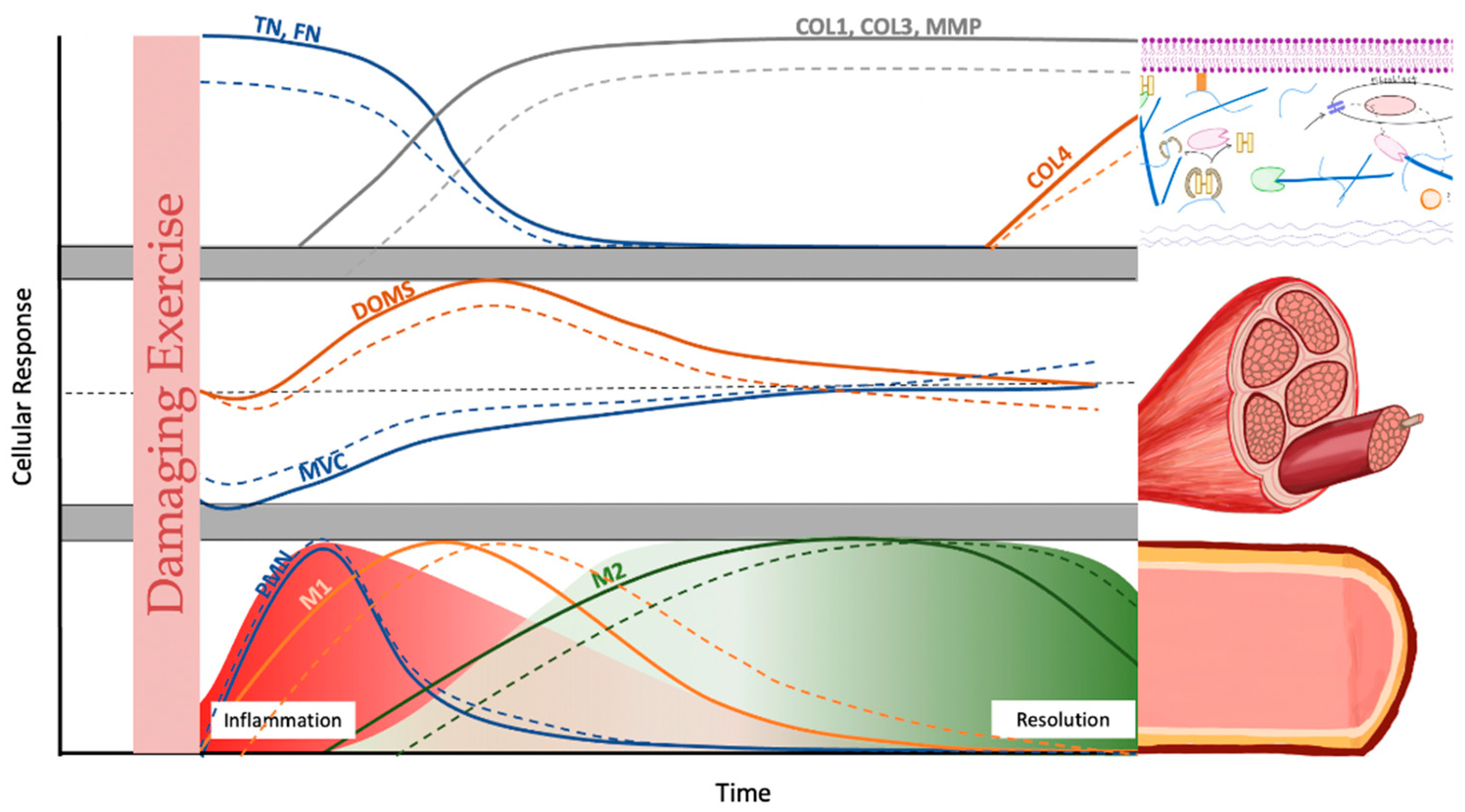
In the original publication [1], there was a mistake in Figure 1 as published. The figure was changed during the revision process. An old figure was uploaded by mistake, which did not indicate the differences between older and younger adults. The corrected version of Figure 1 appears below. The authors state that the scientific conclusions are unaffected. This correction was approved by the Academic Editor. The original publication has also been updated.
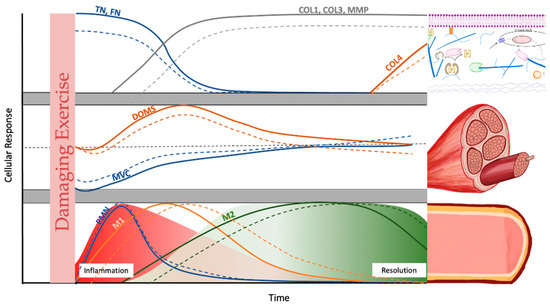
Figure 1.
Schematic comparison of the cellular response kinetics of post damaging exercise in young (line) and old humans (dotted line): extracellular matrix (ECM) changes (upper panel), indirect markers (middle panel), and inflammatory expression (lower panel). Upper panel: Tenascin-C (TN) and fibronectin (FN) are part of the transitional matrix and are thought to direct early satellite cell movement. Subsequently, collagens (COL) 1 and 3 and their matrix metalloproteinases (MMPs) increase for ECM remodeling. COL 4 is, an important component of the basement membrane, is thought to be remodeled during later stages. Middle panel: Decreases in maximal voluntary contraction (MVC) are prevalent immediately following exercise. Delayed onset muscle soreness (DOMS) peaks at around 24 h. Lower panel: Polymorphonuclear leukocytes (PMN) begin infiltrating the muscle immediately after the cessation of exercise. These differentiate into macrophages that ingest debris and apoptotic neutrophils. The production of local pro-inflammatory cytokines triggers the phenotypic switch from M1 macrophages to alternatively activated M2 macrophages. The early stage represents the inflammation phase, while the later stage indicates the beginning of the resolution phase. This figure is in part based on [42,51].
Reference
- Li, D.C.W.; Rudloff, S.; Langer, H.T.; Norman, K.; Herpich, C. Age-Associated Differences in Recovery from Exercise-Induced Muscle Damage. Cells 2024, 13, 255. [Google Scholar] [CrossRef] [PubMed]
Disclaimer/Publisher’s Note: The statements, opinions and data contained in all publications are solely those of the individual author(s) and contributor(s) and not of MDPI and/or the editor(s). MDPI and/or the editor(s) disclaim responsibility for any injury to people or property resulting from any ideas, methods, instructions or products referred to in the content. |
© 2025 by the authors. Licensee MDPI, Basel, Switzerland. This article is an open access article distributed under the terms and conditions of the Creative Commons Attribution (CC BY) license (https://creativecommons.org/licenses/by/4.0/).