


Abstract
Just as in other parts of Spain, the Guadalhorce Valley, Málaga, has a long history of policies based on ‘hydraulic utopianism’ (regenerationist and Franco-ist), bent on ‘reorganizing’ political, geographic, and human nature. Residents of the neighboring sub-basin, the Río Grande valley, have seen how these policies, designed to transfer rural water to modern urban centers, have turned the Guadalhorce hydrosocial territory into a ‘hydraulic dystopia’. In this article, we examine how Río Grande valley residents mobilized to maintain control over the development and use of their resources, livelihoods, and knowledge systems, when modernist-urbanist policies planned to take their water from a major dam on the Río Grande. Interviewing actors at different scales we examined how this anti-dam movement organized massively in a creative, multi-actor, and multi-scale network. Our results also show that this unified, successful fight against the ‘common enemy’, the mega-hydraulic construction, has become more complex, as threats crop up not only from the ‘city over there’ but also from ‘internal’ hydro-territorial transformations. These sprout from policies to modernize traditional irrigation systems, supposedly to ‘save water’, but critical voices assume that it is all about passing on the ‘surplus’ to Málaga city, or using that water to expand agribusiness. We conclude that the challenge lies in critically integrating multiple forms of knowledge, stakeholders, and scales to both defend collective water management and creatively construct anti-hegemonic alternatives.
1. Introduction
Spain’s history of political and geographic re-organization is intimately linked to the ‘hydraulic utopia’ urged by the Regenerationist movement, and paradoxically, implemented during the Franco period [1,2,3,4]. The aim was to technocratically control rivers by establishing interconnected dams, to geographically distribute water more fairly, as hydro-solidarity between the country’s rainy and dry zones, to enhance agricultural production, and to integrate rural economies into the industrial and energy sectors. However, in Andalucía, as in other regions, creating hydraulic utopia has significantly contributed to the environmental degradation of rivers, abandoned croplands, the urbanization of nature, the bureaucratization of traditional autonomous irrigation systems, the flooding and displacement of towns, and the marginalization of farmer knowledge systems regarding local management of water sources [2,3].
The legacy of these historical actions and the emergence of new, modernistic plans threatening to re-organize water flows, territories, and human population groups now meet with a growing response. Civil society alliances have resurrected folk vernacular knowledge, practices, and forms of social organization, to propose alternative ways to manage and use their rivers’ water. One such alliance is the ‘Coordinating Body to Defend the Río Grande’, belonging to the Guadalhorce basin in Málaga Province. Through this case, we will illustrate how social mobilization has shown the capacity to construct social networks with diverse stakeholders, mobilize much of civil society, and challenge dominant modernistic discourses backing dam building and hydrosocial transformation of the sub-basin, also see References [3,5,6,7]. This gave rise to the Río Grande movement (hereafter the ‘Coordinating Body’) seeking to exercise hydro-ecological democracy and impact policy-making, in order to set the Río Grande’s water free.
Despite the social movement’s success in stopping the hydraulic mega-project on the Río Grande in 2001 and 2006, dominant political and economic powers continue to insist on damming the Río Grande, a project revived lately by tourism growth in the city of Málaga [7]. In this arena, stakeholders with diverging interests wield their different strategies, resources, and discourses to get the upper hand. Repercussions include contrasting, legitimizing or de-legitimizing different knowledge systems or repertoires. This article analyzes the different historical phases through which the different knowledge systems face off, mobilizing discourses and counter-discourses, and hefting their power to influence how the Río Grande hydrosocial territory is configured.
The article is structured as follows: The second section shows the methodology, the third one conceptualizes how encounters among the different life-worlds co-constituted confrontations among diverse knowledge systems [8], which also directly impact the constitution of ‘hydrosocial territories’ [9]. The fourth part illustrates and analyzes how, in the course of time, a powerful knowledge system has imposed itself over the others in the Guadalhorce basin. We particularly analyze experts’ (engineering) knowledge versus grassroots knowledge, their respective alliances and powers that are constituted to debunk locally existing truths and thereby transform realities. We will also examine how, as a response, alternative knowledge systems revalue the sub-watershed’s history, ecology, and local socio-economic livelihoods.
In the last part, we explain and conclude how the unified struggle to prevent the Río Grande dam’s construction becomes more complex and fragmented by the subtle penetration of powerful interests tied to less visible threats, in particular the policies of modernizing and upgrading technology in traditional irrigation systems, which—like building the dam—equally aim to transfer rural water to urban centers. While some farmers and communities therefore oppose this modernization of their irrigation systems, others see modernization and investment in their irrigation technologies as a guarantee to conserve their water rights and defend them when confronted with the powerful water interests of the city of Malaga.
2. Methodology
Applying a political ecology approach to water control, the article discusses the findings from various periods of fieldwork (2015–2017). We conducted 68 semi-structured interviews with different groups of actors in the Río Grande sub-watershed. These were selected through snowball sampling and grouped according to their place of action. The first group involved farmers and their irrigators’ organization using the seven community-operated canals (acequias), comprising the Río Grande irrigation system. With this group, including small and middle-class farmers and agribusiness enterprises, we conducted 30 interviews.
The second group refers to the social leaders who formed the ‘Coordinating Body to Defend the Río Grande’, a local societal movement representing the inhabitants of Coín Municipality, who opposed the dam’s construction. With this group we conducted 16 interviews. In the third group, we did 10 interviews with scholars who supported the societal movement. Additionally, the last group (12 interviews) consists of officials of the water-supply company (EMASA Municipal Water Company of Málaga) and entities responsible for coordinating water issues, under the Environment Council for the Province of Málaga. Most officials were in favor of the dam construction. The interview questions, structure and settings were adapted according to the group of actors interviewed. Having this diversity of actors, living and acting in different contexts, our research—involving both academic and action-research—includes a balanced sample of the divergent knowledge frames and values that confront in the Río Grande watershed (see also [10]). The interviews were bolstered by field observations and secondary literature review, which includes newspaper articles, official reports, and historical files. The data were triangulated. During the fieldwork the interviews were recorded, transcribed, and coded, and 14 field reports were elaborated to examine the collected data, reflect on research strategies, enrich the upcoming interviews and compare actors’ narratives.
4. The Utopia of Hydraulic Modernity in the Guadalhorce Watershed: A Dystopian Mirror for Residents of the Río Grande Micro-Watershed
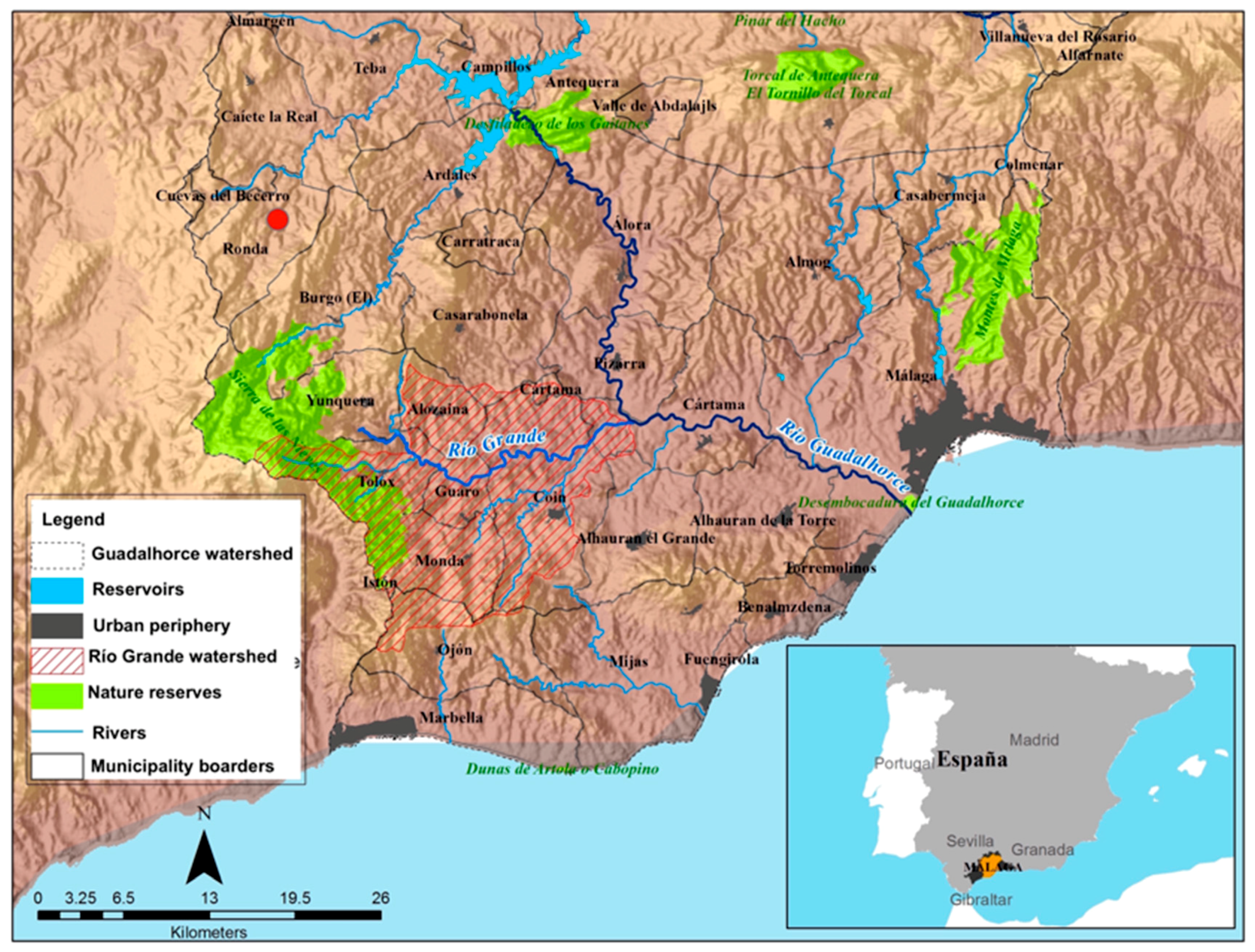
Understanding the knowledge struggle involved in building the Río Grande dam requires illustrating and historically analyzing the political and economic factors impacting the hydro-territorial transformation of the wider Guadalhorce basin, which the Río Grande flows into (see Figure 1). We will analyze how building mega dams and imposing modernistic technical and scientific thinking have driven transformation of the Guadalhorce Valley.
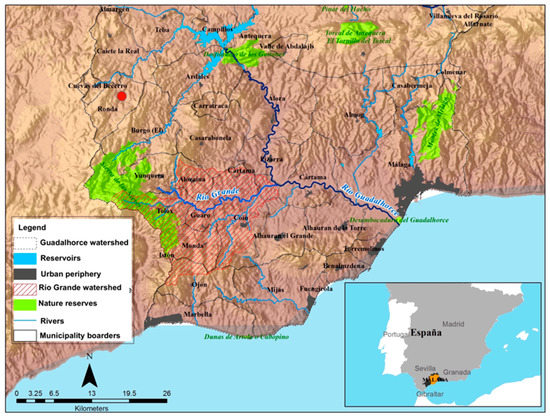
Figure 1.
Guadalhorce and Río Grande Basin Location. Source: Andalucía cartographical base, 2015. Prepared by: Pacheco, 2017 [74].
As was mentioned, the thinking of the intellectual-political ‘Regeneracionismo’ movement and its leader, Joaquín Costa (1875–1911), are fundamental to start with. Costa laid the foundation for Spain’s water policy in the late 19th century. His utopian desire centered on designing an idealized society by engineering its water, to transform both humans and nature. As explained above, at that time, Spain was in an economic and political post-colonial crisis, casting about for a water utopia to emerge: Regenerationist intellectuals proclaimed the need to start colonizing internally to regenerate the country. Among Costa’s proposals, this self-colonization was geared toward recovering the Arabic hydraulic heritage, empowering rural people, eliminating bourgeoisie, and building a new national identity by technically and politically modernizing water [1,14,29,47,73].
As Achterhuis [46] explains, political and historical utopias always come to mind, and once ‘realized’, become dystopias. Spain’s hydraulic utopia, too, when as all utopias do, it defined the need for a total break with the core of the old society, to build a new one. This break has justified violent interventions in and against nature and people cf. [29,47,61].
Following regenerationist ideas, in Spain, the construction of hydraulic projects was driven by modernizing that impoverished society, regenerating culture, land and the whole political-economic system. Constituting irrigation policy, by expanding dams and irrigation systems nationwide, would resolve the country’s water scarcity: Its water inequities would be corrected in terms of geographical distribution, and this would also reinforce electrical generation, especially when cities began growing and agro-industrial development took off. Setting up Spain’s hydraulic modernity would entail reinforcing the state’s role and centralizing political power in the state, as the representative of the whole nation’s general interest. For this purpose, water was nationalized. To manage effectively, Costa proposed to create ‘the new man’ through engineering sciences, so ideological and political alliances between regenerationists and engineers led new 20th century hydro-territorial transformations. The purpose was both to restore the country’s geography and to build a new order [1,2,29].
Even when regenerationist projects failed because of the inherent political and economic conflicts between ‘old’ and ‘new’, the Franquista mission made sure to implement Costa’s hydraulic dream [4]. Socio-spatial power relationships were interwoven between the military, the church, the national industrial bourgeoisie, large landowners, and the state to—among other goals—transform watersheds, which were seen as the integrating backbones of water development and territorial management. Thus, new hydrographic confederations, established in the early 20th century, would connect and integrate plans for the engineering corps’ water projects. This would mean fully tapping and controlling rivers’ water throughout their course; a totalizing system in which confederations were conceived as a river basin governance organizations uniting all people as a single family—laying the foundations to integrate and colonize the nation’s territory after Spain’s civil war. The engineers began materializing the regenerationists’ water policy thinking, so each dam they built became a symbol of modernity, a concrete step forward, and above all, a homage rebuilding the weakened national identity. Engineers pursued a technical, social, and patriotic mission [29]. A key rhetorical idea was to enhance and unify the vernacular wisdom of farmers, to improve their living conditions through constant, controlled deliveries of water [2]. In reality, though, engineers’ knowledge and scientific progress were dominant [30] (p. 7) and it imposed technical-scientific thinking upon rural peoples’ local knowledge.
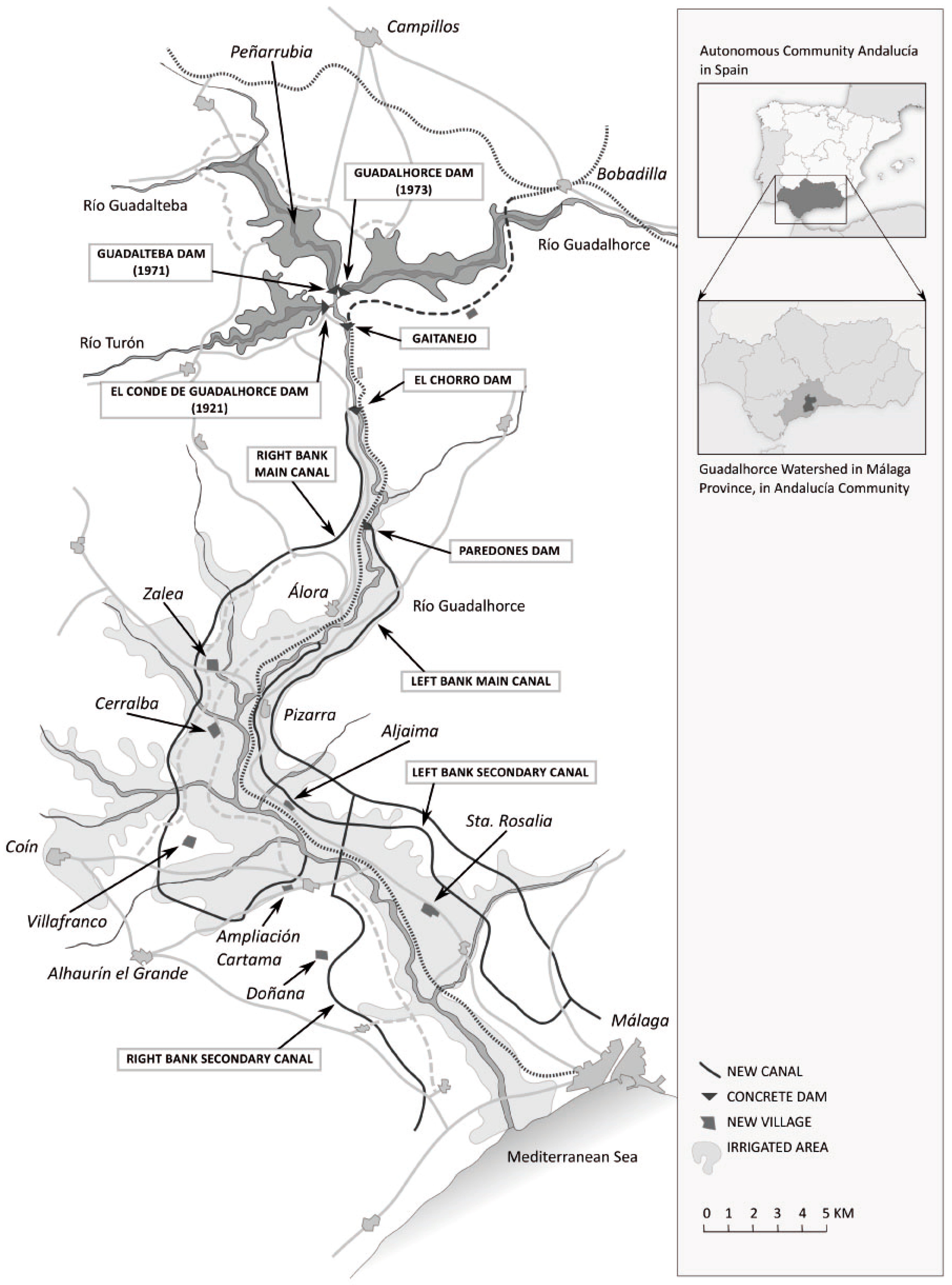
To promote hydraulic policy and thinking in Guadalhorce Valley, engineer Rafael Benjumea, a believer in Joaquín Costa’s hydraulic policy, attempted to fix the problems of Málaga society using water mega-projects. One of the first projects was the ‘Conde del Guadalhorce’ Dam on one of this river’s main tributaries. Building this dam was the first step to develop the ‘Coordinated Guadalhorce Plan’: It centered on capturing, storing, and regulating all the basin’s water sources to foster integrated development of agriculture, the electric power industry, drinking water for Málaga city, and flood control. This plan was implemented once dictator Franco came into power (1939–1975). To close up the basin, upgrade the water regime technology, and keep a single drop from reaching the sea [14], two other major dams were built in the basin, on the Guadalhorce and Guadalteba Rivers, from 1966 to 1973. With 328 hm3 capacity, along with the 86 hm3 already in the ‘Conde del Guadalhorce’ Dam, this would provide enough water to irrigate an area of 20.000 ha. However, the priority was to supply water to Málaga, followed by generating electrical energy [2,3] (for an overview of the Guadalhorce dams and hydraulic infrastructure along the river, see Figure 2).
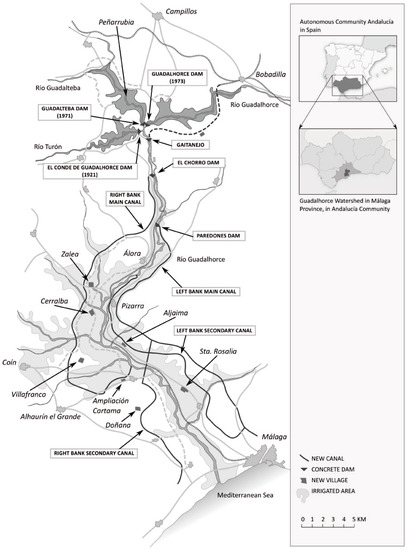
Figure 2.
Guadalhorce dams and hydraulic infrastructure along the river. Source: Boelens and Post Uiterweer [2].
Building these dams entailed dramatically expropriating the affected farms and land. This was enabled by the Forcible Expropriation Law. Franco’s state displaced people ‘for a price it judged fair’. This Law included forming ‘pueblos de colonización’ (‘colonization towns’) and a program of agricultural indoctrination and Franquista discipline. One was the town of Peñarrubia, located at the headwaters of the Guadalhorce River. It was flooded and its inhabitants were displaced to these new towns. Uprooting and de-localizing people was a Franquista strategy to neutralize territories and make them manageable. By pulling up roots, exterminating culture, it was possible to mold a new society [3].
These ‘colonization towns’, located in zones without irrigation, became the buffer zones for migration by rural people whose lands were seized for water projects in Guadalhorce Valley. This hid away the memories, which stayed alive in hiding, of taking away people’s towns and zones to flood them. Stories by people from Peñarrubia, for example, stress how rootlessness is an indelible feeling, closely linked with a refusal to erase the past. For this reason, they continue holding a reunion every year to commemorate the love they felt for their town [3]. The story of Guadalhorce Valley shows how building the Utopia became a violent, horrible dystopia.
At the same time, the history of the Guadalhorce Valley was the historical mirror, enabling neighbors to continue fighting against the zone’s water Utopia, which continued to replicate, now building the Cerro Blanco dam in their sub-watershed, the Río Grande. This work planned to dam the only river still flowing freely to the Guadalhorce, in the mid-basin. The purpose of this dam was to provide water for the tourism industry, concentrated in the city of Málaga. The following sections describe the project’s different phases and the diverse societal contestations emerging to prevent its construction.
5. The Río Grande’s Conquest
5.1. Planning the Cerro Blanco Dam—Phase 1 (2001)
When the dictatorship ended and Spain entered the age of democratization, the Política Hidráulica technocratic model continued to reign over water governance. Since the mid-1980s, it was planned to dam the Río Grande with the Cerro Blanco Dam, already part of the Hydrological Plan for the Southern Basin (PHCS) from 1995. The dam was designed to supply water to Western Málaga city [5,75]. It was also justified to regulate Río Grande’s considerable high flows during winter.
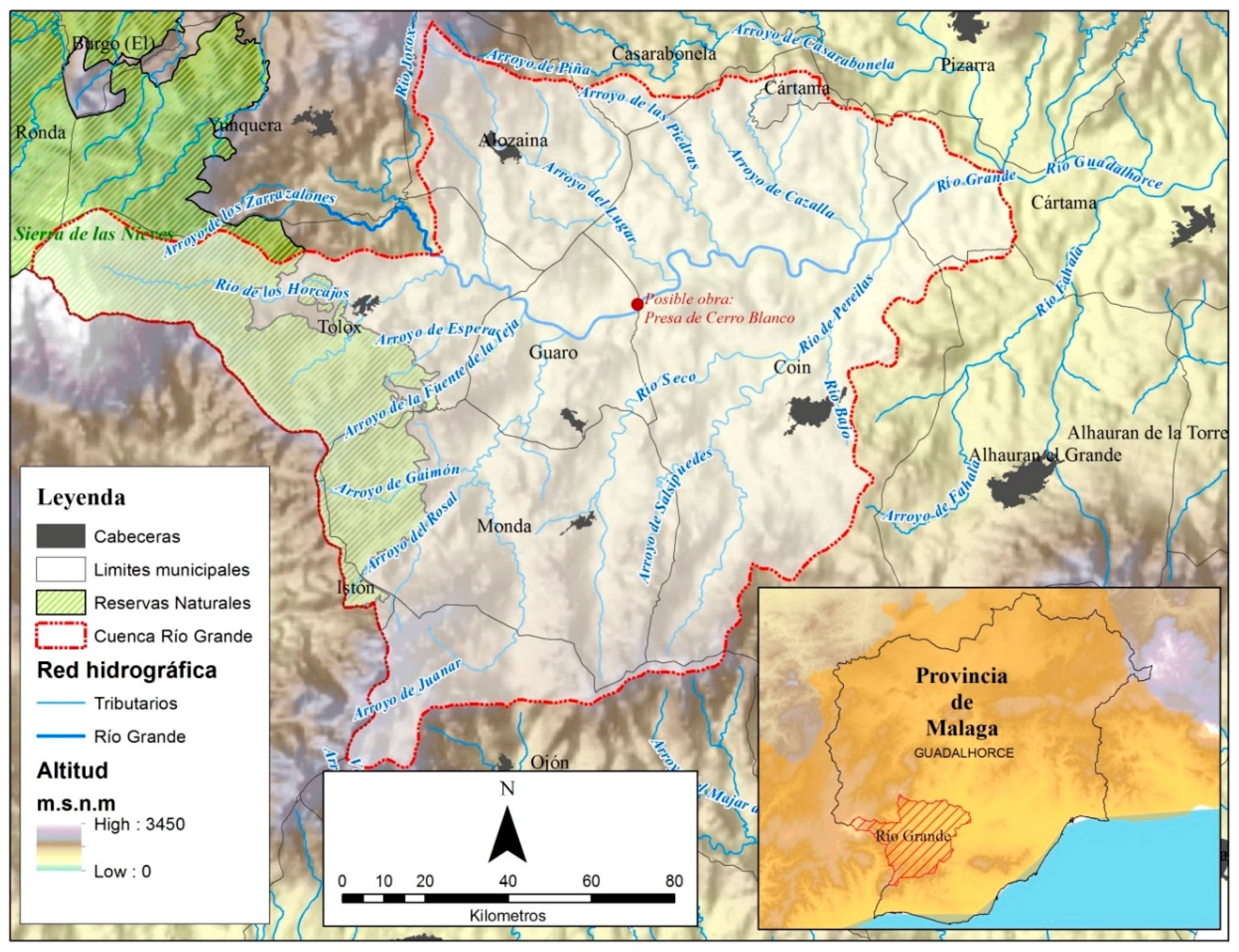
The dam on the Río Grande would be constructed in the municipalities of Guaro and Coín (see Figure 3), its reservoir capacity of 32 hm3 would flooding 240 ha of land, foreseeing a regulation capacity of 25 hm3/year [76]. In 2001, ACUASUR (Sociedad Estatal Aguas de las Cuencas del Sur), a company created by the government, announced ‘The conquest of the Río Grande’. This project was also stipulated in the National Hydrological Plan (2001–2004).
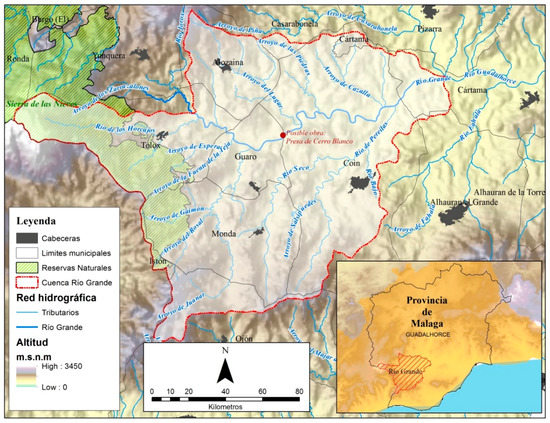
Figure 3.
Río Grande basin and Dam location. Source: Andalucía cartographical base, 2015. Prepared by: Pacheco, 2017 [45].
This drove the creation of the ‘Cerro Blanco Anti-dam Platform’, led by farmers from Guaro, in 2001, supported by environmentalists and activists from Coín, grouped in the ‘Jara Association’. The members of local offshoots of ‘Ecologists in Action’ (a federation of over 300 ecologist groups throughout Spain, unified in 1998) also took part, plus the academic sector, who were active members of the national ‘Nueva Cultura del Agua’ (NCA) movement. (The New Water Culture is a societal movement that emerged in opposition to the inter-basin transfer of the Ebro River and then proposed alternative thinking to change Spain’s water management paradigms—appearing in the mid-1990s). Mobilizing the ‘Cerro Blanco Anti-dam Platform’ was ideologically accompanied and interconnected with the diverse demonstrations opposed to building major hydraulic works contemplated in the National Hydrological Plans of 1992 and 2001. On the national level, the platform joined with the demonstrations against water transfers from the Ebro River valley to the Mediterranean—Platform to Defend the Ebro—and with the Coordinating Body for People Affected by Large Dams and Inter-Watershed Transfers (COAGRET) [56,75,77]. “We also support demonstrations in Catalonia or other parts of the country… People in Catalonia were surprised greatly to see us take part, because they thought that, since Andalucía would receive more water with the National Hydrological Plan, we should agree with it” (interview, local leader in Río Grande, April 2017).
These movements refused to continue bearing the consequences of deterioration in their aquatic ecosystems and social displacements derived from Franquismo-style national hydraulic policy. Their contestations aimed to protect the few ‘living rivers’ remaining in Spain that were threatened by the construction of 120 new dams and inter-basin transfer projects. The Cerro Blanco anti-dam platform successfully mobilized to defend the natural environment, with all its biodiversity, orchards and the Arabic-rooted traditional irrigation culture that remains alive in the Río Grande Valley. Guaro farmers’ rootedness in their fields and traditional acequias, especially by the elder population, has been passed down to younger generations, and is perceived in local official entities, which supported their protests and were able to present their positions in regional political agencies and curb this dam’s construction in 2001 [6,7] (interviews, Río Grande inhabitants, September 2016–September, 2017).
In this phase, we can see how vernacular values and knowledge from the valley’s smallholder farmers emerge and revive, contesting hydro-techno-scientific paradigms that were imposed by modernistic hydraulic designs and utilitarian dogmas seeking ‘the greatest benefit for the majority’. The Cerro Blanco anti-dam movement expresses that alternative notions of territoriality are still alive, and are very vivid and vital. They powerfully sustain mobilization against a very visible threat, and yield the support of other anti-dam national movements that fight for alternative a world and water-views.
5.2. Direct Conduction of the Río Grande’s Water, Building a Diversion Weir rather than a Regular, Higher Dam: Phase 2 (2006)
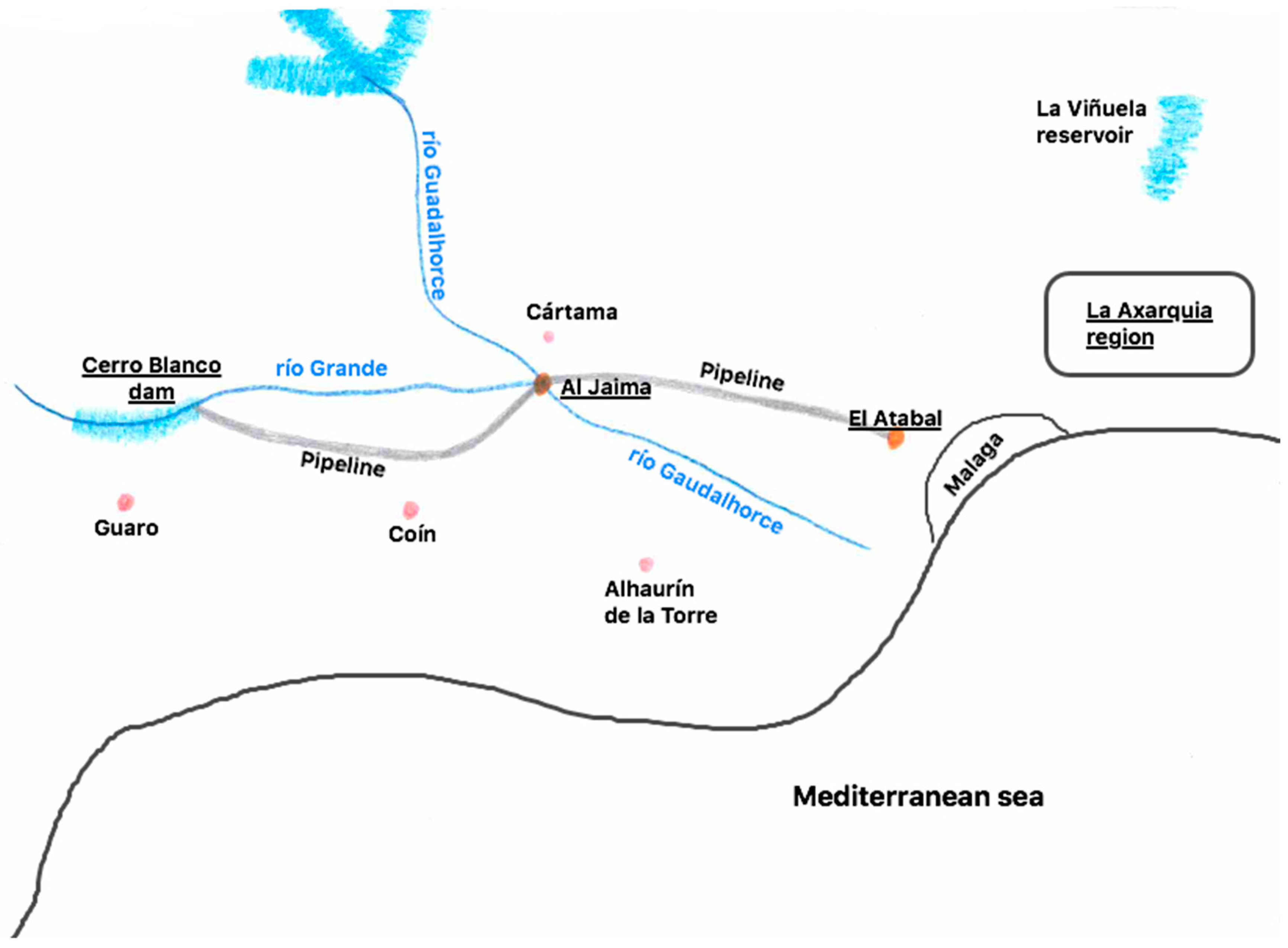
Although dam construction was halted in 2001, in June 2006, a different, but similar, project was approved by the Ministry of Environment. This time, rather than announcing construction of a large dam, they referred to a diversion weir (‘azud’), a smaller dam to reroute water by fixing a permanent water level (it would be 7 m high, to hold 8.4 hm3 of water). This way, rather than flooding 171 hectares, water would be directly transferred to Málaga (see Figure 4). A 38-km conduction canal would be built, with a pipe of 1.60 m in diameter, with the capacity to transport 20 hm3/year, at a flow rate of 4 m3/s, from the river’s high-water flow during winter. Members of the NCA felt the project meant conducting the whole river, because the derivation pipe’s diameter could reach full operating capacity of 126 hm3/year, more than the river’s total flow, calculated to an average of 80 hm3/year [76].
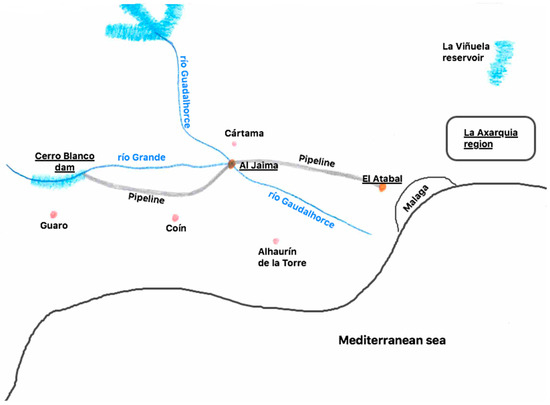
Figure 4.
Hydraulic construction to transfer Río Grande water to Málaga. By Lucas du Pré [7].
In fact, the former director of the Andalusian Water Agency (AAA, Agencia Andaluza del Agua) stated in 2010 [5], to reassure the Southern Basin engineers and technicians, that building the diversion dam was only a first step toward later building of the full dam. Likewise, the project officer in EMASA reiterated this: “I drafted the project…what I did was not the dam, just the conduction, with the diversion dam to carry the water through a pipeline, leaving one area dry, and then be able to make the dam” (interview, project manager EMASA, March 2017).
That same year when the project was approved, 2006, people owning land in Río Grande valley started getting expropriation notices. About 25,000 persons would be affected by the project’s implementation, and more than 2500 ha of irrigated croplands would be lost. Coín and Guaro were all living in fear and uncertainty, so they first turned to the local ecologist groups, ‘The Jara Cultural Association’. They joined forces also with the Cerro Blanco Anti-dam Platform, and they all formed, in September 2006, the ‘Coordinating Body to Defend the Río Grande’. They were also joined by the towns of Pizarra, Cártama, and Alora. “…We united the people to save it, with the analogy, on our movement’s logo, of a heart and the river flowing” (interview, Jara Association president in Río Grande, 22 June 2015).
The first strategy by the Coordinating Body was to connect with other local collectives, activists, and academic entities belonging to the NCA. While forming this coalition, the Coordinating Body began an information campaign for residents of Río Grande valley and neighboring citizens. They analyzed the project documentation with intellectual support from the NCA, to then disclose and diffuse it, promoting alternatives. This was their second strategy to reinforce their control over their water and defend their rights to the river: to master their overall knowledge about the project, associating it with urban-rural relations regarding water supply and demand. Accordingly, they organized the data, conducting studies and drafting legal arguments to show that the dam was not viable but there were alternatives to supply Málaga with water (such as watering gardens in summer with treated water and setting up water purification plants to reuse water). “We gave them data on the dam’s environmental risks, biophysical data that would make it impossible to build. The protest had everyone well-informed. We moved around, receiving help from scholars and from people in Madrid. It was a very successful movement. The people of Málaga were not the ones asking for that water. It was other interests. The politicians started to run out of argument” (interview, Jara Association president in Río Grande, 22 June 2015).
The Coordinating Body’s third strategy consisted of maintaining political independence during their mobilization. They did not receive support from any political party, or allow parties to speak for them during the mobilization, which earned them citizens’ rapport and credibility. During their mobilization, the Coordinating Body realized that the dam building was being pushed by political interests seeking European Union grant money to build projects. “The large building companies wanted to get grants, because it is not profitable to build a dam. Not even the state makes it profitable, much less the farmers” (interview, local leader in Río Grande, 22 June 2015). The Coordinating Body’s independent position and increasing mobilization in 2006 and 2007 got politicians to shift their position, especially since this coincided with the municipal elections in 2007. Candidates had to commit publicly to reject the project to avoid losing votes.
The Coordinating Body’s fourth strategy, with financial backing from the NCA, was to conduct a study to value the ecological status of the Río Grande’s water, to demonstrate its great biodiversity, and the purity of this sub-watershed’s water. The Coordinating Body was working to get this zone declared as a European Union recognized ‘Lugar de Importancia Comunitaria’ (LIC) to legally forestall any new attempts to build the dam (for more details about LIC see [78]). Even so, in 2009 the Ministry of Environment asked them to pay for an independent study, endorsed by a university to lend it more weight. The Coordinating Body turned to the University of Málaga, but could not afford the price it quoted, so the Jara Association was forced to abandon the legal approach to protecting the Río Grande. “Just now, one of the few things they are afraid of is LICs, because they know Europe values them. So LICs are a good safeguard to prevent the dam” (interview, scholar Málaga Universiy, 24 April 2017).
Due to all the pressure mobilized, in May 2007 the construction of the diversion weir on the Río Grande was discarded, and in December an alternative project was announced to replace it. This 21-km conduction would connect the Aljaima diversion dam (on the Guadalhorce River, just below where the Río Grande joins it) to the desalinization plant in Málaga city (this project was completed in August 2012). This alternative had been proposed from the outset by the Coordinating Body, and studied by the Andalusian Water Agency director, Joan Coraminas, a founder of the NCA. The Jara Foundation put it this way: “We offered alternatives, for Málaga to take its water from the downstream part of the river and not the upstream part; there had already been a diversion dam there for a long time…its biodiversity.” He explained—“That project would cause no impact on the river’s course, while achieving the same aims as the large dam” (interview, former Director AAA. 23 March 2017).
In this second phase, expert engineers in alliance with the government continued insisting on transferring water from Río Grande to Málaga. As a response, the social movement showed the capacity to create a diverse social network formed by farmers, scholars, state employees, local inhabitants, youngsters, civil society organizations and platforms, and national/regional/local activists to contest the new project. This multi-stakeholder movement was able to connect different knowledge systems successfully disputing the socio-ecological feasibility of constructing a water offtake dam upstream in the Río Grande. They offered an alternative solution.
In the following section, however, we will describe the new challenges that the social movement has to face when new actors appeared, with new techno-modernist and ‘green’, ‘inclusive’ discourses that, however, keep seeking to transfer the rural waters.
5.3. The Paradoxes of Defending the Río Grande: Modernizing the Traditional Irrigation System and Silently Transferring Water (2009–2017)
The slogan ‘defending the Río Grande as a living river’ generated a unified, strong mobilization to prevent construction of canals and diversion dams to transfer rural water from Coín to Málaga city. Paradoxically, this idealist slogan became the discourse that other ecologist groups, living in other zones, would use to demand changes in the traditional practices of irrigators’ communities using the river, also see Reference [7].
During the summers of 2009–2010, the Río Grande community of irrigators was sued by the Environmental Prosecutor’s Office. The suit was brought by the ‘Association of Fish Conservation and Aquatic Systems of the South’ (ACPES). They argued that building traditional diversion dams that irrigators used to catch the river’s water and get it into their ditches was killing fish, harming the balance of natural systems. ACPES felt the summer drought on the Río Grande was caused by multiple river water extractions, many ‘illegal’ (that is, informal), and therefore the most visible ones had to be brought under control. Consequently, the river guard began ongoing surveillance during the summer in 2009–2010 to prevent irrigators’ communities from deploying the practices they had always used. Irrigators felt such procedures were a legal instrument being used against them to call the attention of the Andalusian Council and de-legitimize their customary water rights.
In addition to this pressure, also motivated by the EU Water Framework Directive that aims for water saving, protection, and river restoration, recent Spanish water policy considers water as a scarce resource [7] and has introduced market laws in which water management must obey economic rules of efficient use [41,57]. Among others, this entailed regulating irrigators’ communities, persuading them to officially register and renew their concessions, according to actual water availability and subject to the new demands. Not all Río Grande irrigators’ organizations abided by this legislative procedure and consequently some lost their legal recognition and water rights. Simultaneously, besides aiming to minimize their existing volumetric water rights, the Department of Water Authorizations and Concessions of the Andalusian Council has restricted the granting of new concessions for irrigation in the Río Grande zone, because the water table has been judged to be lowering and in poor condition. Moreover, the Department of Hydrological Planning and the Andalusian Irrigation Plan (1986) introduced the need to adopt ‘water saving’ measures as strategy to mitigate the impacts of climate change and support sustainable rural development (see: “Plan Nacional de Regadíos, horizonte 2008” (Real Decreto 329/2002) and “Plan de Choque de Regadíos” (Decreto287/2006), [79]).
The main regulatory strategy to prevent water scarcity and optimize water redistribution to the other societal sectors is to promote ‘irrigation modernization’, especially replacing ‘riego a manta’ (blanket watering, traditional surface irrigation) by drip techniques [80]. “They will have to stop surface irrigation, because it squanders water! The Administration will help them with pressurized pipe systems or other modernizing, by granting subsidies” (interview, former Environment Delegate, Andalusian Council, 28 April 2017). Modernization is justified as a way to overcome ‘the shortage of water in the river. In 2010–2011, the first dialogues began with and within the community of irrigators, to start modernizing their irrigation. This technology changeover began with Andalusian Council support, offering grant funding. However, a key issue was that, to receive grants, the irrigators’ community would have to change its concession rights, reducing the volume habitually allocated. In fact, they dropped from 7500 m3/ha/year to 5500 m3/ha/year. In the end, however, bureaucratic procedures made did not get economic benefits, but their water rights were cut, anyway. Nevertheless, a group of Río Grande micro-entrepreneurs and agribusiness producers have subsequently taken the lead in modernization. They have a personal interest in technological modernization, because year-round water access will benefit their agri-business companies. The irrigation system with traditional ‘acequia’ canals works only in summer, but the modernized system would work all year round. With an expert in modern irrigation engineering, they organized and persuaded other members to cover the costs of modernization.
7. Conclusions
This article has analyzed how Spain’s late 19th-century hydraulic-utopian modernity project, increasingly dominated by positivist scientific-technological knowledge, has deeply colored the last century’s efforts to tame and unify rivers, territories, and people, configuring new power relationships that would cram vernacular political-normative and agro-cultural diversities into a single hydraulic-administrative mega system that aligns norms, resources, practices, discourses, and human behaviors. Illustrative is the case of the Guadalhorce Valley, where regenerationist hydro-territorial utopia and disciplinary Franquist dystopia neatly entwine, breaking down traditional irrigation management practices to integrate them into a single, totalizing project. New hydrosocial connections transferred water from the Guadalhorce Valley to Málaga city, weakening and rearranging rural livelihoods, drowning headwater communities and containing populations in colonization towns. Hydraulic modernity for the Guadalhorce basin has expanded at the expense of local, vernacular realities, feeding uncontrolled tourism, and urban growth in Málaga. Consequently, water demand pressures intensify, provoking shortages, paradoxically giving rise to building new modernist water projects.
After the political regime change, in response to this crisis, alternative bodies of knowledge have emerged and/or been revitalized, now joining together to reject technocratic management of rivers, which—far from resolving the water management crisis—worsen it by monopolizing resources, truth claims and power. When construction of the Río Grande dam in the Guadalhorce’s sub-basin was announced in 2001, social contestations emerged, especially from smallholder and elder residents, expressing their rootedness in their fields and traditional irrigation practices, and mobilizing vernacular knowledge and customary organizational norms and forms. They built strength by joining other mobilizations, and were supported by networks of scholars and intellectuals from different universities in Spain. Their counter-studies showed how scientific knowledge may be mobilized, both to defend powerful sectors’ interests and to co-develop, hybridize and grow stronger with rural experiences and the knowledge of anti-dam movements. This way, contestations to dominant knowledge can position new stakeholders to defend their livelihoods and construct socio-environmentally fairer alternatives.
Along with the protagonism by rural people, the article has shown the key importance of associating through multi-stakeholder, multi-scalar networks. The Jara Association joined in the struggle, supporting defense of the Río Grande, making ecological knowledge of the river more visible and highlighting the importance of keeping the river alive and free of dams. Their mobilization connected heterogeneous stakeholders, facilitating extension toward diverse scales and strategically integrating diverse forms of knowledge: Grassroots and scientific know-how. Strategically studying and questioning the technical-scientific knowledge supporting dam construction has materialized their contestations in legal allegations, which—along with communicational strategies and trans-local cooperation with other social networks—managed to stop dam construction. In this way, we have shown how the dynamic knowledge contestations, embedded in changing institutional-political, socio-economic and techno-material networks and coalitions, have constantly reconfigured the hydrosocial territory of Río Grande valley.
We have demonstrated how the movement has had (and continues having) a catalytic effect to unite multiple stakeholders and bodies of knowledge, connected on different scales, when the threat is external and visible (i.e., the mega hydraulic project that extracts water for the benefit of external urban centers elsewhere). However, this becomes more complex when this endeavor is subtly disguised as an internal community project, ‘bottom-up’ and ‘participatory’ (technical-modernistic development of irrigators’ communities for the ‘common benefit’). Paradoxically, the ideology underpinning the social struggle in Río Grande—protecting the river, alive and free—became the strategy that official entities and environmentalist groups used to restrict and alter key societal sectors’ and irrigators communities’ water rights to the Río Grande. Contestations against this phenomenon divide the community and complicate the unified battle against transferring rural water to the city. Some farmers internalize the utopian discourses presented by proposals to modernize irrigation and transform their traditional practices, unconsciously or consciously, to maintain their linkages with the land. Other farmers resist modernization, using their customary rights in order not to lose local, collective water self-management.
In this context, from a political ecology approach, this article has reflected on the challenges that societal movements as in Río Grande’s struggle face. Beyond opposing dam construction to defend the river, we argue that their challenges and efforts must center on standing up for water usage rights and collective water management, and thereby generate collective co-construction of knowledge, norms and practices to defend the river. Strategic, critical-conscious, publicly discussed integration of multiple types of knowledge, multiple stakeholders, and multiple scales fosters the autonomous construction of a deep-rooted hydrosocial territory, to ensure the survival and permanence of their legacy at the same time as ongoing renewal of their cultural practices.
Defending the Río Grande and its whole environment from the construction of any large hydraulic project transferring its water means getting free of that hydraulic utopia that drowned towns and channeled the Guadalhorce River. The fight for the Río Grande poses the challenge of rethinking water management in terms of less universalistic and homogenizing concepts, to yield more diversified collective water management, where economic sectors’ performance matches their territorial capacities and does not compromise other rural zones’ social well-being.
Author Contributions
For this article, B.D.A. (PhD research) and L.d.P. (MSc research) did literature research, research preparation, and fieldwork investigation; B.D.A., R.B. and L.d.P. have organized, conceptualized and written the article.
Funding
This research received no external funding. Bibiana Duarte-Abadía has a Colciencias PhD research fellowship.
Conflicts of Interest
The authors declare no conflict of interest.
References
- Ortí, A. Política hidráulica y cuestión social: Orígenes, etapas y significados del regeneracionismo hidráulico de Joaquín Costa. Agr. y Soc. 1984, 32, 11–107. [Google Scholar]
- Boelens, R.; Post Uiterweer, N.C. Hydraulic Heroes: The Ironies of Utopian Hydraulism and its Politics of Autonomy in the Guadalhorce Valley, Spain. J. Hist. Geogr. 2013, 44, 44–58. [Google Scholar] [CrossRef]
- Duarte-Abadía, B.; Boelens, R. Colonizing Rural Waters: The Politics of Hydro-Territorial Transformation in the Guadalhorce Valley. Water Int. 2019. [Google Scholar] [CrossRef]
- Swyngedouw, E. Technonatural revolutions: The scalar politics of Franco’s hydrosocial dream for Spain, 1939–1975. Trans. Inst. Br. Geogr. 2007, 32, 9–28. [Google Scholar] [CrossRef]
- Jiménez Sánchez, M.; Poma, A. Lógicas en conflicto. Conocimiento experto y política en la movilización social en defensa de río Grande (Málaga). Arxius de Sociología 2011, 25, 59–70. [Google Scholar]
- Poma, A.; Gravante, T. Analyzing Resistance from below: A Proposal of Analysis Based on Three Struggles against Dams in Spain and Mexico. Cap. Nat. Soc. 2015, 26, 59–76. [Google Scholar] [CrossRef]
- Du Pré, L. Río Grande’s Troubled Water: The Struggles between Rural water Users and External Actor Alliances over the Materialization of the Rural Hydrosocial Territory. Master’s Thesis, Wageningen University, Wageningen, The Netherlands, August 2017. [Google Scholar]
- Long, N. Development Sociology: Actor Perspectives; Routledge: London, UK, 2001; pp. 9–92. [Google Scholar]
- Boelens, R.; Hoogesteger, J.; Swyngedouw, E.; Vos, J.; Wester, P. Hydrosocial Territories: A Political Ecology Perspective. Water Int. 2016, 41, 1–14. [Google Scholar] [CrossRef]
- Zikos, D.; Thiel, A. Action research’s potential to foster institutional change for urban water management. Water 2013, 5, 356–378. [Google Scholar] [CrossRef]
- Boelens, R. Water, Power and Identity. The Cultural Politics of Water in the Andes, 1st ed.; Routledge: London, UK; New York, NY, USA, 2015; p. 359. ISBN 978-0-415-71918-6. [Google Scholar]
- Duarte-Abadía, B.; Boelens, R.; Roa-Avendaño, T. Hydropower, encroachment and the repatterning of hydrosocial territory: The case of Hidrosogamoso in Colombia. Hum. Organ. 2015, 74, 243–254. [Google Scholar] [CrossRef]
- Hommes, L.; Boelens, R.; Maat, H. Contested hydro-social territories and disputed water governance: Struggles and competing claims over the Ilisu Dam development in southeastern Turkey. Geoforum 2016, 1, 9–20. [Google Scholar] [CrossRef]
- Swyngedouw, E.; Boelens, R. And not a single injustice remains—Hydro-territorial colonization and techno-political transformation in Spain. In Water Justice; Boelens, R., Perreault, T., Vos, J., Eds.; Cambridge University Press: Cambridge, MA, USA, 2018; pp. 115–134. [Google Scholar]
- Zinzani, A. Development initiatives and transboundary water politics in the Talas waterscape (Kyrgyzstan-Kazakhstan): Towards the Conflicting Borderlands Hydrosocial Cycle. In Water, Technology and the Nation-State; Menga, F., Swyngedouw, S., Eds.; Routledge: London, UK, 2018; pp. 147–166. [Google Scholar]
- Marks, D. Assembling the 2011 Thailand floods: Protecting farmers and inundating high-value industrial estates in a fragmented hydro-social territory. Political Geogr. 2019, 68, 66–76. [Google Scholar] [CrossRef]
- Hoogesteger, J.; Boelens, R.; Baud, M. Territorial pluralism: Water users’ multi-scalar struggles against state ordering in Ecuador’s highlands. Water Int. 2016, 41, 91–106. [Google Scholar] [CrossRef]
- French, A. Webs and Flows: Socionatural Networks and the Matter of Nature at Peru’s Lake Parón. Ann. Am. Ass. Geogr. 2019, 109, 142–160. [Google Scholar] [CrossRef]
- Baletti, B. Ordenamento Territorial: Neo-developmentalism and the struggle for territory in the lower Brazilian Amazon. J. Peasant Stud. 2012, 39, 573–598. [Google Scholar] [CrossRef]
- Linton, J.; Budds, J. The hydro-social cycle: Defining and mobilizing a relational-dialectical approach to water. Geoforum 2014, 57, 170–180. [Google Scholar] [CrossRef]
- Rodríguez-de-Francisco, J.C.; Boelens, R. PES hydrosocial territories: De-territorialization and re-patterning of water control arenas in the Andean highlands. Water Int. 2016, 41, 140–156. [Google Scholar] [CrossRef]
- Del Bene, D.; Scheidel, A.; Temper, L. More dams, more violence? A global analysis on resistances and repression around conflictive dams through co-produced knowledge. Sustain. Sci. 2018. [Google Scholar] [CrossRef]
- Bebbington, A.; Bebbington, D.H.; Bury, J. Federating and defending: Water, territory and extraction in the Andes. In Out of the Mainstream: Water Rights, Politics and Identity; Boelens, R., Getches, D., Guevara-Gill, A., Eds.; Earthscan: London, UK; Washington, DC, USA, 2010; pp. 307–327. [Google Scholar]
- Boelens, R. Water Rights Arenas in the Andes. Upscaling the Defense Networks to Localize Water Control. Water Altern. 2008, 1, 48–65. [Google Scholar]
- Hoogesteger, J.; Verzijl, A. Grassroots scalar politics: Insights from peasant water struggles in the Ecuadorian and Peruvian Andes. Geoforum 2015, 62, 13–23. [Google Scholar] [CrossRef]
- Meehan, K. Disciplining de facto development: Water theft and hydrosocial order in Tijuana. Environ. Plan. D Soc. Space 2013, 31, 319–336. [Google Scholar] [CrossRef]
- Swyngedouw, E. The political economy and political ecology of the hydrosocial cycle. J. Contemp. Water Res. Educ. 2009, 142, 56–60. [Google Scholar] [CrossRef]
- Hommes, L.; Boelens, R. Urbanizing rural waters: Rural-urban water transfers and the reconfiguration of hydrosocial territories in Lima. Political Geogr. 2017, 57, 71–80. [Google Scholar] [CrossRef]
- Swyngedouw, E. Liquid Power: Contested Hydro-Modernities in 20th Century Spain; MIT Press: Cambridge, MA, USA, 2015; p. 320. [Google Scholar]
- Recercat. Historia, Política y Ciencia: El Papel de los Expertos en el Debate Sobre el Agua en España. Available online: http://www.recercat. net/bitstream/2072/4783/1/Recerca+historia+aigua+Espanya.pdf (accessed on 14 September 2015).
- Kaika, M. Dams as symbols of modernization: The urbanization of nature between geographical imagination and materiality. Ann. Assoc. Am. Geogr. 2006, 96, 276–301. [Google Scholar] [CrossRef]
- Illich, I. H2O and the Waters of Forgetfulness; University of California: Marion Boyars, CA, USA, 1985; p. 92. [Google Scholar]
- Kaika, M. Cities of flows. In Modernity, Nature and the City; Routledge: London, UK, 2005; p. 200. [Google Scholar]
- Heynen, N.; Swyngedouw, E. Urban political ecology, justice and the politics of scale. Antipode 2003, 34, 898–918. [Google Scholar]
- Nixon, R. Unimagined communities: Developmental refugees, megadams and monumental modernity. New Form. 2010, 69, 62–80. [Google Scholar] [CrossRef]
- Boelens, R.; Shah, E.; Bruins, B. Contested Knowledges: Large Dams and Mega-Hydraulic Development. Water 2019, 11, 416. [Google Scholar] [CrossRef]
- Hoogendam, P.; Boelens, R. Dams and Damages. Conflicting epistemological frameworks and interests concerning “compensation” for the Misicuni project’s socio-environmental impacts in Cochabamba, Bolivia. Water 2019, 11, 408. [Google Scholar] [CrossRef]
- Hoffmann, C. From small streams to pipe dreams—The hydro-engineering of the Cyprus conflict. Mediterr. Politics 2018, 23, 265–285. [Google Scholar] [CrossRef]
- Zikos, D.; Sorman, A.H.; Lau, M. Beyond water security: Asecuritisation and identity in Cyprus. Int. Environ. Agreem. Politics Law Econom. 2015, 15, 309–326. [Google Scholar] [CrossRef]
- Hidalgo-Bastidas, J.P.; Boelens, R.; Isch, E. Hydroterritorial Configuration and Confrontation: The Daule-Peripa Multipurpose Hydraulic Scheme in Coastal Ecuador. Latin Am. Res. Rev. 2018, 53, 517–534. [Google Scholar] [CrossRef]
- Fox, C.; Sneddon, C. Political Borders, Epistemological Boundaries, and Contested Knowledges: Constructing Dams and Narratives in the Mekong River Basin. Water 2019, 11, 413. [Google Scholar] [CrossRef]
- Espeland, W.N.; Stevens, M.L. Commensuration as a social process. Annu. Rev. Sociol. 1998, 24, 313–343. [Google Scholar] [CrossRef]
- Bacon, F. The New Atlantis; Kessinger Publishing Co: Montana, MT, USA, 2009; Published in 1626 and 1627. [Google Scholar]
- Bentham, J. The Principles of Morals and Legislation; Prometheus Books: Amherst, NY, USA, 1988. First published in 1781. [Google Scholar]
- Bentham, J. Panopticon; or the Inspection-house. In The Panopticon Writings; Bozovic, M., Ed.; Verso: London, UK, 1995; pp. 29–95, Published in 1787–1791. [Google Scholar]
- Achterhuis, H. De erfenis van de utopie [Utopia’s Heritage]; Ambo: Amsterdam, The Netherlands, 1998; p. 444. [Google Scholar]
- Boelens, R. Rivers of Scarcity. Utopian water Regimes and Flows Against the Current; Wageningen University: Wageningen, The Netherlands, 2017. [Google Scholar]
- Costa, J. Política hidráulica: Misión social de los riegos en España; Biblioteca J. Costa: Madrid, Spain, 1911; p. 353. [Google Scholar]
- Estevan, A.E. Herencias y Problemas de la Política Hidráulica Española; Bakeaz: Bilbao, España, 2008; p. 163. ISBN 978-84-88949-95-0. [Google Scholar]
- Fernández Clemente, E. De la Utopía de Joaquín Costa a la Intervención del Estado: Un Siglo de Obras Hidráulicas en España; Universidad de Zaragoza: Zaragoza, Spain, 2000; p. 65. ISBN 84-930255-6-9. [Google Scholar]
- Menga, F.; Swyngedouw, S. Water, Technology and the Nation-State; Routledge: London, UK, 2018. [Google Scholar]
- Gajic, T. Fronteras líquidas: Agua y bio-política de la territorialidad en España. Arizona J. Hispan. Cultur. Stud. 2007, 11, 25–41. [Google Scholar] [CrossRef]
- Swyngedouw, E. Modernity and Hybridity: Nature, Regeneracionismo, and the Production of the Spanish Waterscape, 1890–1930. Ann. Assoc. Am. Geogr. 1999, 89, 443–465. [Google Scholar] [CrossRef]
- Bauman, Z. Liquid Times. Living in an Age of Uncertainty; Polity Press: Cambridge, UK, 2007; p. 111. ISBN 978-07456-3986-4. [Google Scholar]
- Valladares, C.; Boelens, R. Extractivism and the rights of nature: Governmentality,“convenient communities” and epistemic pacts in Ecuador. Environ. Politics 2017, 26, 1015–1034. [Google Scholar] [CrossRef]
- Smith, N. Uneven Development: Nature, Capital and the Production of the SPACE; Blackwell: Oxford, UK, 1984; Volume 3. [Google Scholar]
- Bromley, D.W. The 2016 Veblen-Commons Award Recipient: Daniel W. Bromley: Institutional Economics. J. Econom. Issues 2016, 50, 309–325. [Google Scholar]
- Ibele, B.; Sandri, S.; Zikos, D. Endogenous versus exogenous rules in water management: An experimental cross-country comparison. Mediter. Politics 2017, 22, 504–536. [Google Scholar] [CrossRef]
- McCully, P. Silenced Rivers. In The Ecology and Politics of Large Dams; Zed books: London, UK; New York, NY, USA, 2001; p. 359. [Google Scholar]
- Boelens, R. Cultural Politics and the Hydrosocial Cycle: Water, Power and Identity in the Andean Highlands. Geoforum 2014, 57, 234–247. [Google Scholar] [CrossRef]
- Achterhuis, H.; Boelens, R.; Zwarteveen, M. Water property relations and modern policy regimes: Neoliberal utopia and the disempowerment of collective action. In Out of the Mainstream: Water Rights, Politics and Identity; Boelens, R., Getches, D., Guevara, A., Eds.; Earthscan: London, UK, 2010; pp. 27–56. ISBN 184971455X. [Google Scholar]
- Boelens, R.; Vos, J. The danger of naturalizing water policy concepts. Water productivity and efficiency discourses from field irrigation to virtual water trade. J. Agric. Water Manag. 2012, 108, 16–26. [Google Scholar] [CrossRef]
- Espeland, W. The struggle for water. In Politics, Rationality, and identity in the American Southwest; University of Chicago Press: Chicago, IN, USA; London, UK, 1998; p. 281. ISBN 9780226217932. [Google Scholar]
- Vos, J.; Boelens, R. Sustainability Standards and the Water Question. Dev. Chang. 2014, 45, 205–230. [Google Scholar] [CrossRef]
- Illich, I. Vernacular values. Philosiphica 1980, 26, 2–32. [Google Scholar]
- Stuiver, M.; Leeuwis, C.; van der Ploeg, J.D. The power of experience: farmers’ knowledge and sustainable innovations in agriculture. In Seeds of Transitions; Wiskerke, H., van der Ploeg, J.D., Eds.; Royal Van Gorcum: Assen, The Netherlands, 2004; pp. 93–118. [Google Scholar]
- Arce, A.; Long, N. The dynamics of knowledge interfaces between Mexican agricultural bureaucrats and peasants: A case study from Jalisco. Boletín de Estudios Latinoamericanos y del Caribe 1987, 43, 5–30. [Google Scholar]
- Foucault, M. Power/knowledge. Selected interviews and other writings 1972–1978. In Power/Knowledge: Selected Interviews and Other Writings 1972–1978; Gordon, C., Ed.; Pantheon Books: New York, NY, USA, 1980; p. 282. [Google Scholar]
- Bebbington, A. Movements, modernizations, and markets. In Liberation Ecologies: Environment, Development, Social Movements, 1st ed.; Peet, R., Watts, M., Eds.; Routledge: London, UK; New York, NY, USA, 1996; pp. 86–109. ISBN 0-203-03292-6. [Google Scholar]
- Pfaffenberger, B. Technological dramas. Sci. Technol. Hum. Values 1992, 17, 282–312. [Google Scholar] [CrossRef]
- Sanchis-Ibor, C.; Boelens, R.; García-Mollá, M. Collective irrigation reloaded. Re-collection and re-moralization of water management after privatization in Spain. Geoforum 2017, 87, 38–47. [Google Scholar] [CrossRef]
- Winner, L. Upon opening the black box and finding it empty: Social constructivism and the philosophy of technology. Sci. Technol. Hum. Values 1993, 18, 362–378. [Google Scholar] [CrossRef]
- Maurice, J.; Serrano, C. J. Costa: Crisis de la Restauración y Populismo (1875–1911); Siglo XXI Editores: Madrid, Spain, 1977; p. 245. ISBN 978-84-323-0258-9. [Google Scholar]
- Pacheco, C. Patterns Changes of Land Use/Cover over Time in Río Grande, River Watershed—Spain: Intensification of the Irrigated Agriculture; Research Project; Institute for Biodiversity and Ecosystem Dynamics and CEDLA, University of Amsterdam: Amsterdam, The Netherlands, August 2017. [Google Scholar]
- Gómez Moreno, M.L. El Genal apresado: ¿agua y planificación: Desarrollo sostenible o crecimiento ilimitado? 1st ed.; Bakeaz: Bilbao, Spain, 1998; p. 288. ISBN 9788488949332. [Google Scholar]
- Puche, F. Río Grande: Cuaderno de Trabajo por la Nueva Cultura del Agua; Mesa de Amig@s de los Ríos: Málaga, Spain, 2003; ISBN 84-930029-4-1. [Google Scholar]
- Gorostiza, S.; March, H.; Saurí, D. Piercing the Pyrenees, Connecting Catalonia to Europe: The ascendancy and dismissal of the Rhône Water Transfer Project (1994–2016). In Water, Technology and the Nation-State; Menga, F., Swyngedouw, S., Eds.; Routledge: London, UK, 2018; pp. 34–48. [Google Scholar]
- Gobierno de España, Ministerio Para La Transición Ecológica. Available online: http://www.mapama.gob.es/es/biodiversidad/temas/espacios-protegidos/red-natura-2000/rn_pres_tipos_lugares_LIC.aspx (accessed on 20 January 2019).
- Sampedro, D.; y Del Moral, L. Tres décadas de política de aguas. Cuadernos Geográficos 2014, 53, 36–67. Available online: http://hdl.handle.net/11441/43624 (accessed on 15 January 2017).
- Genovés, J.C.; García Moyà, M.; Sanchis Ibor, C.; Vega Carrero, V.; Avellà Reus, L. Case Studies Synthesis, Spain—Institutional Framework for Local Irrigation Management in Spain: The Case of Upper Genil and Low Jucar Valleys. Available online: http://www.isiimm.agropolis.org/OSIRIS/report/Isiimm-SynthesisSpain_eng.pdf (accessed on 22 October 2018).
© 2019 by the authors. Licensee MDPI, Basel, Switzerland. This article is an open access article distributed under the terms and conditions of the Creative Commons Attribution (CC BY) license (http://creativecommons.org/licenses/by/4.0/).