


Abstract
The COVID-19 pandemic has urged many countries to issue new regulations to assure safety in pool environments. Greece enforced stricter requirements in 2020 and 2021 for hotel pools. However, even though regulations are important, they can only be effective when accepted by the pool managers and users. The aim of this study was to (a) assess the acceptability of the regulations by hotel managers; (b) assess compliance during the summer touristic periods in 2020 and 2021; and (c) identify challenges during the implementation of the regulations that need to be addressed. Several non-compliances from the regulations were identified. Continuous chlorination with an automatic chlorinator was not a regular practice and suggested water circulation rates were poorly met. The microbiological and chemical testing frequency of the pool water and keeping the number of bathers allowed per surface area in the pool were reported as the most difficult requirements to meet. Most pool managers agreed that new measures contribute to the pool users’ safety; however, they reported increased cost as the main impediment for their implementation. The modernization of regulations governing swimming pools’ function, in terms of risk assessment orientation, will contribute to the adoption of an integrated compliance strategy on emerging health issues, such as COVID-19.
1. Introduction
With evolving civilization, human-made water recreational environments are on the rise as they offer health and social benefits accompanied by increased comfort and sophisticated services. However, they can, at times, present health risks of a physical, microbiological, or chemical nature for the users [1]. Most countries in the world have regulations or sanitary decrees in force, in accordance with the World Health Organization (WHO) regulations, to maximize the safety of swimming pools [2].
The coronavirus 2019 (COVID-19) pandemic had a negative global impact, leading to restrictive measures in all areas of human life [3,4,5,6,7]. Thus, in this unprecedented situation, the recommended risk assessments of swimming pools had to be reviewed and occupational first aid services reconfigured [8].
SARS-CoV-2 is mainly transmitted via respiratory droplets and contact with contaminated surfaces, but there is no evidence of fecal–oral transmission, which is the main route of contamination in recreational waters [9]. Water treatment with chlorine and other common disinfectants, such as bromine, ozone, or UV sanitizers, inactivates SARS-CoV-2 in the water [10]. SARS-CoV-2, as an enveloped virus, is likely to be more sensitive and to be inactivated significantly faster by chlorination than non-enveloped human enteric viruses with known waterborne transmission, such as adenoviruses, norovirus, rotavirus, and hepatitis A [11]. Nevertheless, the virus can spread from person to person via respiratory droplets, including aerosols, inside as well as outside the water, as children and adults play and relax in different areas of the facilities [6]. Therefore, public health measures against the COVID-19 pandemic also imposed a shutdown of swimming pools during lockdowns [12].
Consequently, the COVID-19 pandemic led to discussions on safety issues regarding the re-opening of pools and their management during the pandemic, and many countries issued new COVID-19-related safety regulations for pool environments. Regulations regarding the standard cleaning and disinfecting procedures, microbiological and chemical testing, and other requirements were subjected to changes aiming to further reduce the risk of infectious diseases [13,14]. As physical distancing is considered the most important safety measure against the spread of the SARS-CoV-2 virus, new regulations have defined a “water area” dedicated to each swimmer. In the UK, to retain a safe distance between bathers, a minimum of 6 m2 was recommended for each bather, and 9 m2 when training requires more space [15,16]. In Greece, 5 m2 was the recommended safe distance, whilst 6 m2 was recommended in Austria, and 10–12 m2 during training was advised in the Netherlands. In some countries, such as in Austria, the audience in the pool area was drastically restricted to 10 at most [17].
Greece is among the leading touristic destinations in the world, attracting more than 20 million tourists annually, contributing approximately 25% to the nation’s gross domestic product [18]. The safety of travelers has been a priority for public health authorities in the country since the beginning of the pandemic. The general lockdown, mandated to limit the spread of SARS-CoV-2 by the Greek government on 6 March 2020, included all types of hotels [19]. On June 1 2020, hotels were re-opened; however, they were subjected to restrictive measures [20]. Further to the sanitary decree that regulates most public health issues pertaining to swimming pools in the country, in summer 2020, a new regulation was issued regarding pools related to tourism, focusing on their re-opening and appropriate management [20,21]. Indoor swimming pools were not permitted to re-open since there were no data on the risk of virus transmission at an indoor swimming pool. There is still a lack of research evidence correlating swimming-related activities, evaluation of the effectiveness of mitigating interventions applied (e.g., increase in chorine concentration, distances between bathers) [14], and the risk of virus transmission in the context of the COVID-19 pandemic. Termansen et al. (2021) conducted a retrospective cohort study of the prevalence and transmission of SARS-CoV-2 among participants in indoor swimming activities in Denmark and demonstrated that the incidence rate of transmission was 19.5 participants per 100,000 pool activity hours [22].
The aims of this study were to (a) assess the acceptability of the regulations by hotel managers; (b) record compliance during the 2020 and 2021 summer touristic periods; and (c) identify the main challenges during the implementation of the regulations that need to be addressed.
2. Materials and Methods
The obligations set by the national regulations regarding the function of pools in hotel settings during the pandemic were reviewed. The main differences from previous years’ regulations were summarized (Table 1). An online questionnaire was created focusing on adherence to and acceptability of obligations by the hotel managers.

Table 1.
The regulations for hotel pools in Greece and key changes during the COVID-19 pandemic.
The questionnaire was sent via the Hellenic Chamber of Hotels to settlements all over Greece during 2020, after the end of the summer touristic period, in the autumn. An introductory note provided information on the scope of the study and certified confidentiality. The questionnaire was anonymous. The call was repeated using the same questionnaire in 2021, and managers who had answered in the first period were excluded from the second one.
The questionnaire included general information (location, type of use, number/type of pools), as well as information on the source of pool water, and on training of the staff on COVID-19 issues. The obligations included in the legislation were categorized as (a) social distancing obligations, (b) cleaning and disinfection, (c) frequency of testing of the pool water, (d) residual chlorine limits, (e) chlorine and pH measurement, and (f) personal hygiene obligations. Compliance with each of the obligations was recorded.
The acceptability of the legislation was assessed by asking the hotel managers to use a Likert scale to express their beliefs on each obligation. Hotel managers were requested to specify their level of agreement with the above-mentioned obligations with one of five choices: (1) strongly disagree; (2) disagree; (3) neither agree nor disagree; (4) agree; (5) strongly agree.
The answers “agree” and “strongly agree” were considered as high acceptability of the respective obligation. Fisher’s exact test was used to assess the possible association between the level of agreement and the compliance with measures. Fisher’s exact test is used to examine the significance of the association (contingency) between two types of classification [23]. According to the null hypothesis of the test, the level of acceptability of each obligation by hotel managers was not associated with the actual compliance with this obligation at the hotel. For obligations where the p-value of the statistical test performed was <0.05, there was a statistically significant association between acceptability and compliance (null hypothesis was rejected). Analysis was performed separately for 2020 and 2021 and for both years together; however, since there were no statistically significant differences between the two years, the results of the analysis of both years together are presented here. The statistical analysis was conducted using Stata 16 statistical software (StataCorp. 2019. Stata Statistical Software: Release 16. College Station, TX, USA: StataCorp LLC).
3. Results
Overall, 567 responses were received: 432 (76%) for the 2020 summer touristic period and 135 (24%) for the 2021 summer touristic period. Most responses regarded establishments in touristic areas such as Crete (21%), the fashionable islands of the South Aegean (26%), and the Ionian Islands (13%). Overall, 194 (34%) 3-star, 233 (41%) 4-star, and 139 (25%) 5-star hotels were included in the analysis. Of the total sample, 561 of the 567 (99%) hotels had at least one outdoor pool, and 87 (15%) had at least one indoor pool (85%). In 16 (3%) settlements, both indoor and outdoor pools were reported, and in 91 (19%), there was at least one heated pool. Most of the pools were filled in with a mains water system (of public origin) (394; 70%), while others either used water from a borehole (75; 13%), sea water (40; 7%), or water from a private source (58; 10%). According to the answers, the staff underwent training on COVID-19 and safety measures in 545 (96%) of the establishments.
3.1. Managers’ Beliefs on the Applicability of Obligations, Acceptibility, and Main Challenges Affecting Compliance
Almost half of the respondents considered that full implementation of new regulations was not feasible (333; 59%). Of them, 128 (38%) reported increased cost as the main reason for the lack of compliance, and 205 (62%) felt the requirements were unrealistic.
Most pool managers (534; 94%) agreed that the COVID-19 regulations were important for the safety of their clients. However, 523 (92%) noted that the new regulation added a substantial load to their running costs, and 247 (44%) opined that the requirements discouraged many of the clients from using the hotel pool.
Requirements on cleaning and disinfection (464; 82%) and personal hygiene (499; 88%) had the maximum acceptance; frequency of testing (353; 62%) and keeping the number of bathers allowed per surface area in the pool (388; 68%) had the lowest (Figure 1).
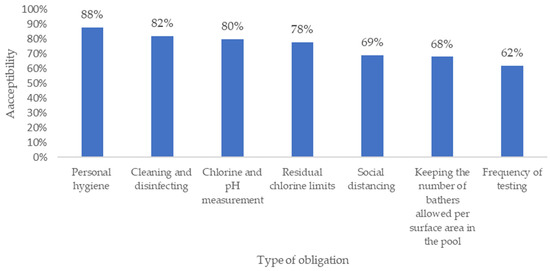
Figure 1.
Acceptability of obligations required by the COVID-19 swimming pool regulations by hotel managers, Greece 2020–2021.
3.2. Compliance with the National Regulations Regarding the Function of the Pools in Hotel Facilities
The compliance of hotels with each of the obligations included in the regulations is summarized in Table 2. Overall, the reported compliance was high. However, 2 (0.35%) and 10 (1.76%) hotel managers, respectively, reported not having standard cleaning and disinfection processes for pool establishments, and 22 (3.9%) reported that the pool is never cleaned or it is cleaned when it is considered necessary without giving further explanations. Continuous chlorination with an automatic chlorinator was reported by 164 (29%) pool managers, and monitoring of the chlorine concentration with an automatic machine by 54 (10%). In 113 (20%) of the facilities, the concentration was less than 1–3 mg/L, set by the current regulation, and in 80 (14%), the measurement of pH was not followed by a respective correction of the chlorine concentration.
Table 2.
Reported compliance of hotels with the COVID-19 obligations of the Greek swimming pool regulations, during the summer touristic periods of 2020 and 2021.
Regarding keeping social distancing obligations, in 114 (20%) facilities, the necessary provision of soap and disinfectants was not a general practice, plexiglass walls for the separation of the showers were not in place in 331 (58%) of the hotels, and the extra requirement regarding foot disinfection was missing from 440 (82%) of the establishments. Overall, 187 (43%) and 181 (42%) hotel managers reported testing of pool water at least once per month for microbiological and chemical parameters, respectively. In 14 (3%) establishments, there were non-compliances in microbiological parameters, and in chemical ones in 21 (5%). The obligation of testing pool waters for Legionella spp. every three months was respected at 427 facilities (75%). In four of them, samples were positive. A total of 16 (3%) managers reported that they had not estimated the maximum permitted number of people in the pool before opening, and 126 (22%) reported that the maximum number was not always kept.
3.3. Managers’ Beliefs and Compliance with Obligations
Overall, higher acceptability of obligations from hotel managers was statistically significantly associated with higher compliance. However, there were specific obligations that, even though they were highly accepted, were not followed in practice, such as the increased testing or the purchase and installment of new equipment. The associations between managers’ beliefs on the applicability of each category of obligations and the reported implementation are summarized in Table 3.
Table 3.
Managers’ beliefs regarding the applicability of the Greek regulations and reported compliance, during the touristic periods of 2020 and 2021, in the COVID-19 era.
4. Discussion
Monitoring of swimming pools to keep users safe has been a concern in most countries in the world, especially in countries such as Greece where tourism is one of the country’s most important economic sectors. During the COVID-19 pandemic, many countries issued stricter regulations and applied additional measures to restrict the spread of the disease [24,25,26].
Greek COVID-19 swimming pool regulations do not substantially differ from the regulations of other countries or the WHO guidelines [10]. For the touristic industry, this is an important issue, since it encourages visitors to spend their holidays in the country where sanitary conditions do not differ from the ones at home. Nevertheless, even though swimming pool regulations are important, they can only be effective when they are feasible, acceptable, and not too complicated for both hotel managers and pool users. Therefore, we studied the acceptability of the new regulations by hotel managers, and the compliance with the new COVID-19 regulations for swimming pools in Greece.
Overall, the new regulations were respected in most swimming pool establishments. Most staff members underwent training regarding the spread of the virus and the importance of the application of the measures before the onset of the touristic period. However, important gaps were recognized. Continuous chlorination with an automatic chlorinator was not a regular practice, and circulation rates were poorly respected. Continuous chlorination has always been a difficult point for compliance in Greek swimming pools, with only one out of three pools equipped with an automatic chlorinator. However, in the majority (86%) of the swimming pools, the pH value and chlorine concentration were balanced to maximize the efficacy of the disinfectant against microorganisms.
In this study, the level of free chlorine in the pool water set by the regulations (1–3 mg/L) was met in 70% of establishments. The international, newly issued regulations target SARS-CoV-2 inactivation in 15–30 s in the pool water, with the level of chlorination and pH values being of primary concern [27,28,29,30]. Most countries increased the levels of chlorination in pool waters, although there are concerns about the possible ecological consequences that may be associated with such a practice and the possible impact on human health [31,32]. The WHO COVID-19 guidelines suggest residual chlorine of 1–3 mg/L in the pool water [10], while the CDC suggests a concentration of 1 mg/L and pH values of 7.2–7.8 [9]. The Italian Istituto Superiore di Sanita recommends a free chlorine concentration of 0.7–1.5 mg/L with a pH value of 6.5–7.5 [12]. As for the free chlorine concentration in the UK, it is set at 1.5–3 mg/L with a pH value of 7.0–7.4 [15,16]. Still, it is noted that adequate contact time and efficient water circulation are also important factors for effective disinfection of the entire pool water volume.
It is positive that distancing in the pool was respected, either because the swimmers expressed their personal responsibility, or because they respected the warnings of the pool supervisors. However, a plexiglass wall between showers was not installed in most establishments, and even though showering before the use of the pools was highly respected, extra foot disinfection was not given the appropriate attention.
Requirements on personal hygiene had the maximum acceptance probably because they were better understood and easier to implement, while the frequency of testing had the lowest acceptance. Keeping the allowed number of bathers in the pool per surface area was also poorly accepted, as it was practically difficult to implement. It is interesting to record that despite their disagreement with some regulated measures, managers realized their obligation to apply them. Concerning some obligations such as distancing in the pool surroundings and the cleaning of the areas, people who applied them assessed them as positive. In other cases such as the level of chlorination, the managers tried to respect the regulations even when they personally disagreed for various reasons.
Based on the results of this study, the final implementation of the new regulations depends strongly on their acceptability by the hotel managers. Still, most managers indicated increased cost as the main impediment for the implementation of the regulations, such as in the case of increased microbiological testing. After a long economic crisis in the country and the economic consequences of the pandemic, the increase in running costs poses a substantial burden on hotel owners and the owners of other facilities, and even on the state in the case of public pools. For this reason, regulated measures should be continuously assessed, and if their effectiveness is not supported by scientific evidence, they should be abandoned. On the contrary, when there is strong evidence that specific measures contribute to the safety of the pool users, their implementation should be strictly monitored by the public health authorities. The main limitation of this study was that the recorded compliance with the regulations was reported by the pool managers. It would be useful if these data could be compared with the results of inspections conducted during the touristic period by public health authorities all over the country.
There is still a lack of evidence on the association of SARS-CoV-2 transmission with swimming-related activities, or on the effectiveness of the required restrictions concerning swimming pool function [14]. Nevertheless, the results of our study demonstrate that establishing stricter regulations does not mean per se that recommendations will be followed and that safety will be reassured. Providing evidence on the above and identifying the main challenges during the implementation of the regulations that need to be addressed are added values of this work.
5. Conclusions
To our knowledge, no similar studies have been published, and thus comparisons are not possible. It would be interesting to compare the responses of the managers and the public in different countries, since although the regulations are quite similar, the level of acceptability and compliance may differ.
The stricter safety regulations applying to swimming pool environments, the higher vigilance and motivation of the pool operators through their training, and the more systematic inspections by the authorities may lead to better public health practices in swimming pool environments. However, for increasing compliance, cost effectiveness analysis for each of the regulations, especially for those with the highest cost, is needed. Managers will comply better if public health authorities help them understand the added value of the measures and the averted risk for their businesses when they are implemented. The modernization of regulations governing swimming pools’ function, in terms of risk assessment orientation, will contribute significantly to the prompt and effective response to emerging health issues, such as COVID-19.
As a follow-up to the current study, we intend to develop questionnaires for the pool users, and also a questionnaire specifically for the inspectors, to better assess the applicability of the guidelines.
Author Contributions
Conceptualization, A.M. (Athena Mavridou); methodology, A.M. (Athena Mavridou) and A.M. (Athina Mplougoura); software, K.M.; validation, K.M. and A.M. (Athina Mplougoura); formal analysis, K.M.; investigation, K.M., A.M. (Athina Mplougoura), A.P. (Anna Psaroulaki), A.P. (Antonios Papadakis), D.C. and G.M.; data curation, K.M.; writing—original draft preparation, A.M. (Athena Mavridou), K.M., G.M. and A.M. (Athina Mplougoura); writing—review and editing, K.M., G.M. and A.M. (Athina Mplougoura); visualization, G.M.; project administration, A.M. (Athena Mavridou). All authors have read and agreed to the published version of the manuscript.
Funding
This research received no external funding.
Institutional Review Board Statement
Not applicable.
Informed Consent Statement
Not applicable.
Data Availability Statement
The data presented in this study are available on request from the corresponding author.
Conflicts of Interest
The authors declare no conflict of interest.
References
- Barna, Z.; Kadar, M. The risk of contracting infectious diseases in public swimming pools. A review. Annali dell’Istituto Superiore di Sanita 2012, 48, 374–386. [Google Scholar] [CrossRef]
- World Health Organization. Guidelines for Safe Recreational-Water Environments Final Draft for Consultation Volume 2: Swimming Pools, Spas and Similar Recreational-Water Environments. Available online: https://apps.who.int/iris/handle/10665/43336 (accessed on 2 February 2022).
- Lim, M.A. Exercise addiction and COVID-19-associated restrictions. J. Ment. Health 2021, 30, 135–137. [Google Scholar] [CrossRef]
- Law, R.C.K.; Lai, J.H.K.; Edwards, D.J.; Hou, H. COVID-19: Research Directions for Non-Clinical Aerosol-Generating Facilities in the Built Environment. Buildings 2021, 11, 282. [Google Scholar] [CrossRef]
- Iulia, J.; Remus, V. Swimming As A Leisure Physical Activity During The 2020-2021 Pandemic COVID-19 In Cluj-Napoca. Studia Ubb Educ. Artis Gymn. 2021, 66, 93–102. [Google Scholar]
- Haddad, M.; Abbes, Z.; Mujika, I.; Chamari, K. Impact of COVID-19 on Swimming Training: Practical Recommendations during Home Confinement/Isolation. Int. J. Environ. Res. Public Health 2021, 18, 4767. [Google Scholar] [CrossRef]
- Franco, I.; Bianco, A.; Bonfiglio, C.; Sorino, P.; Mirizzi, A.; Campanella, A.; Buongiorno, C.; Liuzzi, R.; Osella, A.R. Decreased levels of physical activity: Results from a cross-sectional study in southern Italy during the COVID-19 lockdown. J. Sports Med. Phys. Fit. 2021, 61, 294–300. [Google Scholar] [CrossRef] [PubMed]
- Magnavita, N.; Sacco, A.; Nucera, G.; Chirico, F. First aid during the COVID-19 pandemic. Occup. Med. 2020, 70, 458–460. [Google Scholar] [CrossRef]
- Center for Disease Control and Prevention. Guidance for Public Pools, Hot Tubs, and Water Playgrounds During COVID-19. Available online: https://www.cdc.gov/coronavirus/2019-ncov/community/parks-rec/aquatic-venues.html (accessed on 2 February 2022).
- World Health Organization. Water, Sanitation, Hygiene, and Waste Management for SARS-CoV-2, the Virus that Causes COVID-19, Interim Guidance. Available online: https://www.who.int/publications/i/item/WHO-2019-nCoV-IPC-WASH-2020.4 (accessed on 2 February 2022).
- World Health Organization. Water, Sanitation, Hygiene and Waste Management for COVID-19: Technical Brief. Available online: https://apps.who.int/iris/handle/10665/331305 (accessed on 2 February 2022).
- Romano Spica, V.; Gallè, F.; Baldelli, G.; Valeriani, F.; Di Rosa, E.; Liguori, G.; Brandi, G. Swimming Pool safety and prevention at the time of COVID-19: A consensus document from GSMS-SItI. Ann. Di Ig. Med. Prev. E Di Comunita 2020, 32, 439–448. [Google Scholar] [CrossRef]
- Romano-Bertrand, S.; Aho Glele, L.S.; Grandbastien, B.; Lepelletier, D. Preventing SARS-CoV-2 transmission in rehabilitation pools and therapeutic water environments. J. Hosp. Infect. 2020, 105, 625–627. [Google Scholar] [CrossRef] [PubMed]
- Yaacoub, S.; Khabsa, J.; El-Khoury, R.; El-Harakeh, A.; Lotfi, T.; Saad, Z.; Itani, Z.; Khamis, A.M.; El Mikati, I.; Cuello-Garcia, C.A.; et al. COVID-19 transmission during swimming-related activities: A rapid systematic review. BMC Infect. Dis. 2021, 21, 1112. [Google Scholar] [CrossRef] [PubMed]
- Pool Water Treatment Advisory Group (PWTAG) Swimming Pool Technical Operation after COVID-19 Shutdown (TN46). Available online: https://www.pwtag.org/swimming-pool-technical-operation-after-covid-19-shutdown/ (accessed on 2 February 2022).
- Pool Water Treatment Advisory Group (PWTAG). Covid-Safe Pool Operation—An Update (TN46-B). Available online: https://www.pwtag.org/covid-safe-pool-operation-update-tn46-b/ (accessed on 2 February 2022).
- The Pool Water Treatment Advisory Group (PWTAG). Sharing Experiences and Knowledge in the COVID-19 Era. Virtual Conference 2021. Available online: https://www.pwtag.org/virtual-conference-2021/ (accessed on 2 February 2022).
- Greek Tourism Confederation: Inbound Tourism Statistics. Available online: https://insete.gr/statistika-deltia/ (accessed on 2 February 2022).
- CNN.gr: «Coronavirus: Hotels also Closing». Available online: https://www.cnn.gr/news/ellada/story/211904/koronoios-kleinoyn-kai-ta-xenodoxeia (accessed on 2 February 2022).
- Joint Ministerial Decision. Special Health Protocols For Tourism Businesses against COVID-19, Government Gazette 2084/Β/2020. Available online: https://www.hhf.gr/2020/05/31/%CF%86%CE%B5%CE%BA-2084-%CE%B2-30-5-2020-%CE%BA%CF%85%CE%B1-1881-29-5-2020-%CE%BC%CE%B5-%CF%84%CE%AF%CF%84%CE%BB%CE%BF-%CE%B5%CE%B9%CE%B4%CE%B9%CE%BA%CE%AC-%CF%80%CF%81%CF%89%CF%84%CF%8C%CE%BA%CE%BF/ (accessed on 2 February 2022).
- Hellenic Ministry of Health. Circular “Measures to Protect Public Health in the Context of Preventing the Spread of the Coronavirus SARS-CoV-2 after the reopen of Swimming Pools, which Are Licensed in accordance to Γ1/443/1973”. Available online: https://www.elinyae.gr/ethniki-nomothesia/ya-g14431973-fek-87b-2411973 (accessed on 2 February 2022).
- Termansen, M.B.; Christiansen, A.V.; Frische, S. SARS-CoV-2 prevalence and transmission in swimming activities: Results from a retrospective cohort study. Scand. J. Med. Sci. Sports 2022, 32, 242–254. [Google Scholar] [CrossRef] [PubMed]
- Upton, G.J.G. Fisher’s Exact Test. J. R. Stat. Society. Ser. A (Stat. Soc.) 1992, 155, 395–402. [Google Scholar] [CrossRef]
- Water Environment Federation. The Water Professional’s Guide to COVID-19. Available online: https://www.wef.org/news-hub/wef-news/the-water-professionals-guide-to-the-2019-novel-coronavirus/ (accessed on 2 February 2022).
- Government of United Kingdom. Coronavirus (COVID-19): Guidance and Support. Available online: https://www.gov.uk/guidance/coronavirus-covid-19-grassroots-sports-guidance-for-safe-provision-including-team-sport-contact-combat-sport-and-organised-sport-event (accessed on 2 February 2022).
- England, S. Returning to Pools Guidance Documents. Available online: https://www.swimming.org/swimengland/pool-return-guidance-documents/ (accessed on 2 February 2022).
- Thurston-Enriquez, J.A.; Haas, C.N.; Jacangelo, J.; Gerba, C.P. Chlorine inactivation of adenovirus type 40 and feline calicivirus. Appl. Environ. Microbiol. 2003, 69, 3979–3985. [Google Scholar] [CrossRef] [PubMed] [Green Version]
- Peters, M.; Keuten, M.G.A.; Knezev, A.; van Loosdrecht, M.C.M.; Vrouwenvelder, J.S.; Rietveld, L.C.; de Kreuk, M.K. Characterization of the bacterial community in shower water before and after chlorination. J. Water Health 2018, 16, 233–243. [Google Scholar] [CrossRef] [PubMed]
- García-Ávila, F.; Valdiviezo-Gonzales, L.; Cadme-Galabay, M.; Gutiérrez-Ortega, H.; Altamirano-Cárdenas, L.; Arévalo, C.Z.; Flores del Pino, L. Considerations on water quality and the use of chlorine in times of SARS-CoV-2 (COVID-19) pandemic in the community. Case Stud. Chem. Environ. Eng. 2020, 2, 100049. [Google Scholar] [CrossRef]
- Brown, J.C.; Moshe, M.; Blackwell, A.; Barclay, W.S. Inactivation of SARS-CoV-2 in chlorinated swimming pool water. Water Res. 2021, 205, 117718. [Google Scholar] [CrossRef] [PubMed]
- Dewey, H.M.; Jones, J.M.; Keating, M.R.; Budhathoki-Uprety, J. Increased Use of Disinfectants During the COVID-19 Pandemic and Its Potential Impacts on Health and Safety. ACS Chem. Health Saf. 2021, 29, 27–38. [Google Scholar] [CrossRef]
- El-Nahhal, I.; El-Nahhal, Y. Ecological Consequences of COVID-19 Outbreak. J. Water Sci. Eng. 2020, 1, 1–5. [Google Scholar] [CrossRef]
Publisher’s Note: MDPI stays neutral with regard to jurisdictional claims in published maps and institutional affiliations. |
© 2022 by the authors. Licensee MDPI, Basel, Switzerland. This article is an open access article distributed under the terms and conditions of the Creative Commons Attribution (CC BY) license (https://creativecommons.org/licenses/by/4.0/).