


Abstract
Reactions between nitrogen-containing compounds and free chlorine in swimming pools produce several undesirable by-products, with trichloramine (TCA) being especially problematic due to its odor and hazardous properties, causing respiratory symptoms and skin and eye irritation for swimmers and personnel. To address this issue, this study investigates electrochemical oxidation as a potential technique for reducing TCA concentrations in various pool water environments. Specifically, the results show that electrolysis, using a mixed metal oxide (MMO) electrode as the anode, affects the amount of free chlorine and significantly reduces TCA in synthetic pool water containing urea and sodium hypochlorite. This approach is further validated in large-scale systems with real swimming pool water. In two long-term experiments, TCA released from the pool water falls from a baseline of 1.42 mg/m3 to 0.94 mg/m3 in a 680 m3 pool, a reduction of 34% (), and from 0.77 mg/m3 to 0.35 mg/m3 in an 85 m3 pool, a reduction of 55% (). Water from a third pool was used to map the potential dependence. Importantly, the anode potential is critical for TCA reduction, with 1.8 V vs. RHE identified as optimal and a working window of 1.7–1.9 V. The system operates at approximately 1 A/m2 and 2 W/m2. Overall, this electrolysis process reduces the trichloramine burden of swimming pool water, which is expected to lower airborne trichloramine in swimming halls and thereby improve conditions for users and personnel.
1. Introduction
Swimming pools are popular for both sports training and leisure activities worldwide. To maintain a healthy environment for swimmers, continuous disinfection of the swimming pool water (SPW) is crucial, as swimmers secrete biological matter, such as urine, sweat, hair, skin particles, and cosmetics Beech et al. [1], Powick [2], LaKind et al. [3]. The most widely used method for disinfecting SPW is chlorine dosing, especially using sodium hypochlorite or a saltwater chlorination system [4,5,6]. An important disadvantage of chlorination is the formation of undesired disinfection by-products (DBPs), which leads to an optimization problem for swimming pool maintenance: inadequate disinfection causes retention of bacteria, viruses, and other microbes [7], whereas a higher concentration increases the formation of harmful DBPs [8,9,10,11]. More than 100 DBPs have been identified in SPW [12], and some of the most investigated ones are chloramines, trihalomethanes, haloacetonitriles, haloacetic acids, and nitrosamines [6,13]. Among the possible irritant DBPs, it has been shown that chloramines are the most important and are most often detected in non-negligible concentrations [14,15]. Recent reviews continue to characterize the precursors, formation, occurrence, and health risks of these DBPs, noting that pool water concentrations run one to two orders of magnitude higher than in drinking water [16].
Trichloramine (NCl3) is the main chloramine present in the air surrounding indoor swimming pools, and this volatile compound is easily detected by its penetrating odor [6]. It is of particular concern since several adverse health effects have been reported and assumed to be caused by trichloramine, for example, lung hyperpermeability, asthma, eye irritation, skin irritation, and upper respiratory tract irritation [14,17,18,19,20]. Recent measurements across Swedish indoor pools confirm that trichloramine remains the dominant airborne irritant, with free chlorine in the pool water identified as a determinant of airborne levels [21]. WHO has set a guideline concentration of trichloramine at 0.5 mg/m3 in air, but several countries have legislated lower limits; for example, France has set a limit of 0.3 mg/m3 [22]. The toxicological and epidemiological basis for such limits has been critically reviewed, with asthmatic and atopic individuals identified as more sensitive to chloramine exposure [23]. Field measurements further indicate that gas-phase NCl3 in indoor pool facilities frequently exceeds the WHO guideline value, particularly under heavy use [24].
Urea (H2NCONH2) is the primary nitrogen compound introduced into the SPW by the swimmers and also the most important trichloramine precursor [4,6,25]. In general, the chemical reactions occurring in SPW are complex multistep reactions. The overall reaction mechanism presented by Blatchley [26] for the chlorination of urea is
Reactions (1)–(4) show the sequential chlorination of urea to form CO(NCl2)2, which is the main route of TCA formation (Reaction (5)). Two features of this scheme are central to the present work. First, the initial chlorination in Reaction (1) requires molecular chlorine and is the step that limits progress through the whole sequence [26]. Any process that raises the local concentration of molecular chlorine therefore accelerates the route to trichloramine. Second, trichloramine is an intermediate rather than a terminal product. Reactions (6)–(8) show the formation of the unstable intermediate NOH and its decay to nitrous oxide; Reaction (9) also shows that TCA is unstable, being oxidized further to nitrate by free chlorine. Recent work on the oxidative degradation of urea during chlorination confirms that urea-nitrogen ends as gaseous nitrogen products and nitrate rather than accumulating as trichloramine [27].
Under electrolysis, two further reactions act on this network. Trichloramine can be oxidized directly at the anode,
at a cost of two electrons per trichloramine molecule. The anode also oxidizes chloride, which is abundant in chlorinated pool water,
regenerating active chlorine. The regenerated chlorine drives the urea chlorination sequence of Reactions (1)–(5), whose overall mineralization can be written
Cho and Hoffmann [28] reported N2 and CO2 as the primary gaseous products of urea oxidation by electrogenerated reactive chlorine, with urea-nitrogen recovered as N2 (91%) and (9%), and identified the initial chlorination as the rate-determining step, in agreement with Blatchley [26]. Direct electron transfer from urea to the anode cannot be excluded, but it is inefficient on noble-metal-oxide surfaces at near-neutral pH [29], and the chlorine-mediated route is expected to dominate here. Reaction (10) removes trichloramine that has already formed, whereas Reactions (11)–(13) act on the precursor. Both compete for anodic current with chlorine evolution and oxygen evolution, which is the basis of the potential dependence discussed in Section 3.4.
Free chlorine is defined as the combined concentration of HOCl, OCl−, and Cl2. At neutral pH, typical for SPW, the trichloramine concentration correlates linearly with the free chlorine concentration [30]. However, the trichloramine concentration shows no significant correlation with the combined chlorine parameter, which represents chlorine present in chemical combinations with ammonia or organic nitrogen. Furthermore, trichloramine and dichloramine only contribute to about 15–20% of the total combined chlorine [4,31]. Assuming a constant free chlorine concentration, the trichloramine concentration in the air surrounding the indoor swimming pool is mostly dependent on air ventilation and water splashing from both swimmers and different water attractions [4,24,32,33]. The two obvious solutions to improve water and air quality are to increase the air ventilation rate and freshwater exchange in the treatment cycle; however, both are expensive and environmentally unfriendly.
Existing SPW treatment techniques include, for example, granular activated carbon [34], for which several reports have shown removal of chloramines in SPW [35,36,37], and ultraviolet light, which is effective for microorganisms but has somewhat unclear effects on DBPs [38,39,40,41,42,43]. These techniques have the disadvantage of relatively high running costs; both need to be replaced at intervals of approximately 1 year, and UV lamps operate at high power. Recent modeling of DBP formation and fate in pools further highlights the value of interventions that act on the water phase to control precursor-driven by-product formation [44].
Schmalz et al. [4] reported that the trichloramine mass transfer from water to air is slow compared to a typical treatment cycle, and therefore, removal of trichloramine in the SPW would be an attractive solution for water and air quality. This study presents a method to reduce the trichloramine concentration in SPW using electrolysis. Related electrochemical approaches have recently been applied in situ to swimming pool water to degrade bather-derived pollutants without additional chlorine-based chemicals [45]. Laboratory experiments were performed on synthetic pool water containing urea and sodium hypochlorite, as well as real SPW from various pools. The results showed that it is possible to simultaneously remove trichloramine and regenerate free chlorine, and that the removal of trichloramine is critically dependent on anode potential. Furthermore, the method was shown to reduce trichloramine concentrations in large swimming pools in long-term experiments, creating a healthier environment for swimmers and personnel. These results were obtained without changing parameters that may alter the trichloramine concentrations [24,46], such as water temperature, pH, free chlorine concentration, number of swimmers, and air ventilation.
2. Materials and Methods
2.1. Materials and Reagents
To fabricate synthetic pool water, deionized water at room temperature was first stirred with 0.05 vol% sodium hypochlorite solution (14% Cl2 in aqueous solution, VWR Chemicals, Radnor, PA, USA). Secondly, 10 mM potassium sulfate (MQ100, Merck, Darmstadt, Germany) was added to increase the conductivity, and thereafter, 0.03 vol% of a 5.0 wt% urea (99.0–100.5%, Sigma-Aldrich, St. Louis, MO, USA) aqueous solution was added. The synthetic pool water had a pH of 10.4.
Real pool water samples were collected from three public swimming pools, and laboratory experiments began within 1 h of sample collection. The three public swimming pools were a swimming pool at Gibraltargatan in Göteborg, Oasen in Kungälv, and Åbybadet in Mölndal, all of them located in Västra Götaland County, Sweden. The swimming pool at Gibraltargatan measures 16 × 7 m and has a volume of 85 m3, with a flow of 58 m3/h through the purification system comprising filters and UV light. The water temperature is 30 °C, with a free chlorine setpoint of 0.5 mg/L, a pH of 7.4, and a water exchange rate of 0.5 m3/h, whereby the pool water is replaced with non-chlorinated tap water. The pool in Oasen measures 25 × 20 m with a volume of 680 m3, and has setpoints for free chlorine of 0.8 mg/L, pH of 7.2, and water temperature of 26 °C. The flow through the purification system (sand filters and flocculation) is 130 m3/h, and the water exchange is 0.5 m3/h. Åbybadet measures 25 × 20 m, and the volume is 640 m3. Setpoints are 0.5 mg/L free chlorine, pH of 7.4, and water temperature of 29 °C. The purification system comprises sand filters, UV light, activated carbon filters, and flocculation, and the water flow through the purification system is 200 m3/h with a water exchange of 1.0 m3/h.
Chemical reagents for analysis were a chloride reagent set (Chloride-51 and Chloride-52, Tintometer, Dortmund, Germany) and DPD free/total chlorine (VWR Chemicals). The MMO electrodes were obtained from REGUL ’Electronique (Lorgues, France), Baoji Ruicheng Titanium Industry Co., Ltd. (Baoji, China), and Permascand AB (Ljungaverk, Sweden). Sample cassettes for trichloramine analysis were obtained from Syclope Electronique (Sauvagnon, France). The MMO electrodes consist of a titanium substrate carrying a mixed metal oxide coating based on ruthenium and iridium oxides, of the type used commercially for chlorine evolution. The exact coating composition, the Ir/Ru ratio, and the noble metal loading are proprietary to the suppliers and were not disclosed, and we therefore refrain from quoting nominal values. Since electrodes from all three independent suppliers reproduce the same potential-dependent behavior reported in Section 3.4, the effect is attributed to the general MMO surface chemistry rather than to one specific coating formulation.
2.2. Analytical Methods
The chlorine concentrations were analyzed using the photometric DPD method [47] with the Scuba II instrument from Tintometer (Dortmund, Germany), in which 10 mL of the water sample was used for each analysis.
Measuring trichloramine requires air sampling, which was performed with pumps from SKC (Deluxe 224-PCMTX8, Seoul, Republic of Korea) and Buck (Libra Plus LP-5, Los Angeles, CA, USA). The sampling cassettes were fabricated according to a previous method [18] and comprise a Teflon filter followed by two Na2CO3 + As2O3-soaked quartz fiber filters. The Teflon filter prevents chlorides in airborne water droplets from reaching the soaked quartz fiber filters, which reduces trichloramine to chloride. The trichloramine concentration was determined from the sampling cassette as proposed by Syclope Electronique (Sauvagnon, France). First, the quartz fiber filters were shaken in 10 mL of deionized water for 30 s, and then 2.5 mL of the solution was filtered through a syringe filter (0.2 μm PVDF membrane) for analysis. 200 μL of the reagent Chloride-51 and 150 μL of the reagent Chloride-52 were then added before the solution was shaken for 30 s. Finally, the solution was diluted with 2.5 mL of deionized water and then analyzed in the photometer (Trichloramine, Syclope Electronique).
For electrochemical experiments in a three-electrode configuration, the applied voltage was controlled by a Gamry Reference 600 potentiostat and measured with respect to an Ag/AgCl reference electrode in saturated KCl. The potential was converted to the RHE, according to the equation
where V vs. RHE in saturated KCl at 25 °C [48].
2.3. Experimental Procedures
Synthetic pool water was used to investigate how electrolysis affects the free chlorine and trichloramine concentrations. A 1 L sample of synthetic pool water was prepared, and electrolysis began 20 min after urea was added. The electrolysis was conducted in a two-electrode (4 × 6 cm) configuration in a closed, one-compartment cell with a total volume of 5 L. The current was set to 600 mA, resulting in a cell voltage of 6.7 V. The airflow through the sampling cassette for trichloramine was 2.0 L/min, and the cassettes were replaced every 45 min. New air was added to the closed cell at the same flow rate to maintain constant pressure. Air was added to the water through a plastic tube to stir it and simulate activity in the pool. The cell is sealed, and the only route by which air leaves the vessel is through the trichloramine sampling cassette. Trichloramine that is stripped from the water into the gas phase therefore cannot be lost from the system unmeasured: it either leaves through the cassette, where it is captured and counted, or it remains in the vessel’s gas phase, from which it can still partition through the cassette. Enhanced volatilization would thus raise the measured air-phase concentration, not lower it, so a reduction in the measured trichloramine cannot be an artifact of stripping.
Electrode areas are quoted throughout as the total electrode area, that is, the sum of the anode and cathode areas, and current densities and areal powers are normalized to this total area.
To analyze the long-term effects in a real swimming pool, six electrode packages, each with 480 cm2 of anode area and 480 cm2 of cathode area, were connected to the purification system at Oasen in Kungälv. The total flow of 40 m3/h was evenly divided among the six parallel electrode packages. The system was controlled with a cell potential of 2.15 V, which, after a voltage drop in the cables, was measured at 1.83 V, resulting in a current of around 700 mA. The anode and cathode polarities were reversed every hour for self-cleaning. Another long-term experiment was conducted at the pool on Gibraltargatan. Two electrode packages, each with a surface area of 2500 cm2 for the anode and 2500 cm2 for the cathode, were connected in parallel to the purification system, with a flow rate of 10 m3/h through each electrode cell. An applied voltage of 1.80 V produced a current of approximately 1.0 A, and the anode and cathode polarities were reversed once daily for self-cleaning.
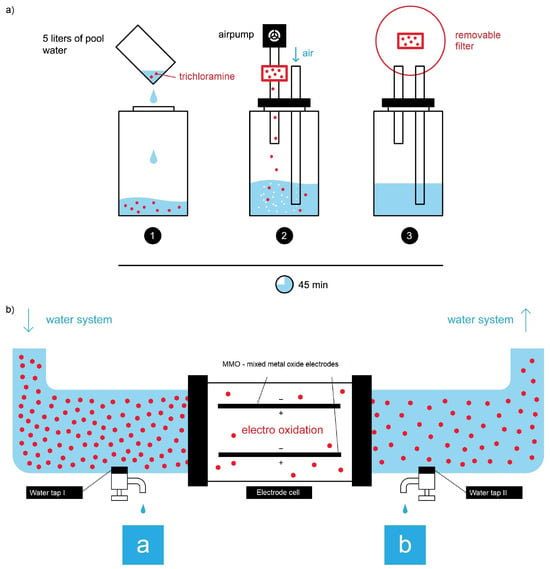
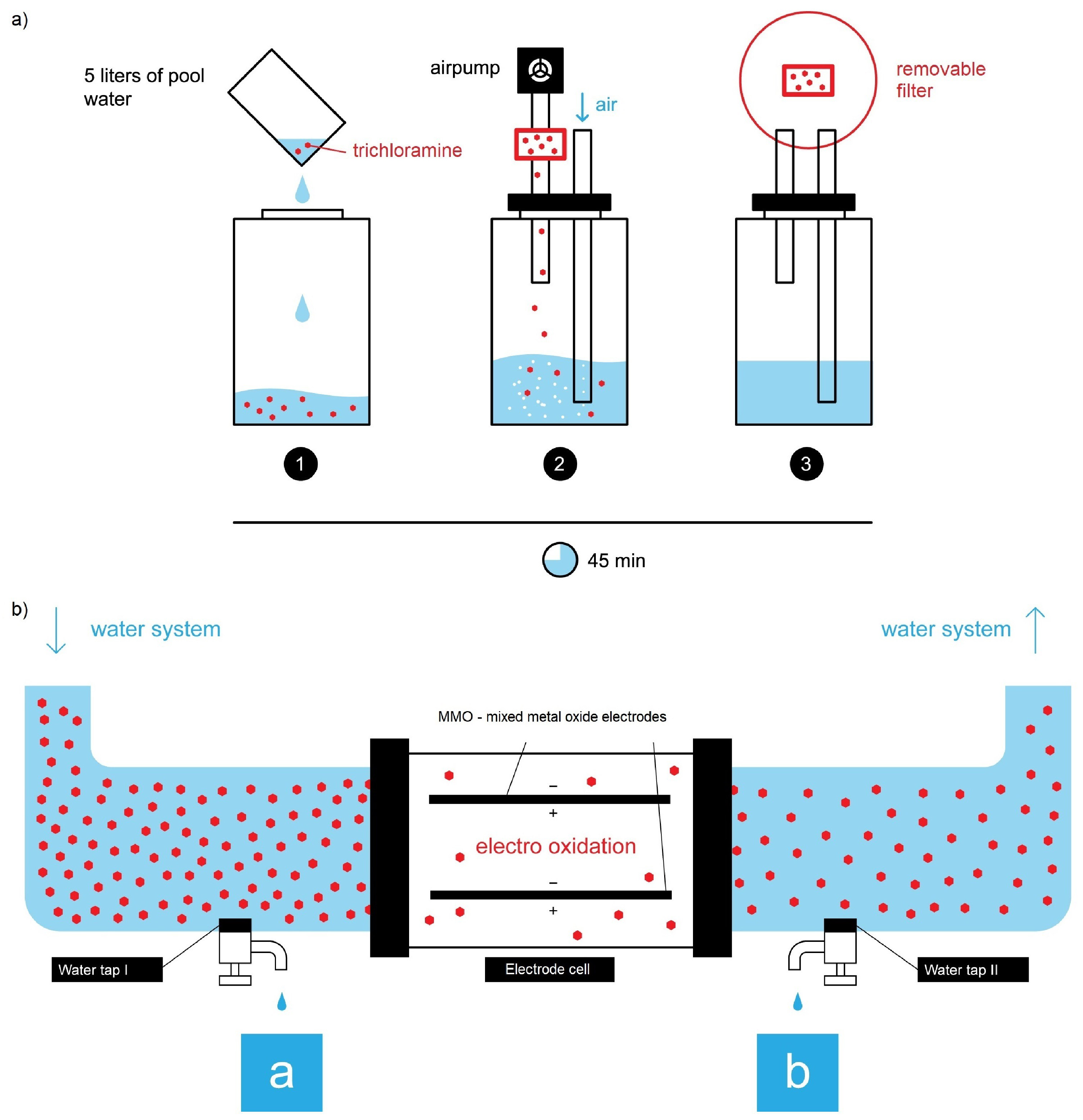
This method, illustrated in Figure 1a, provides a better measurement of the water quality than a poolside measurement, where factors such as ventilation and the number of swimmers affect the trichloramine concentration.
Figure 1.
(a) Schematic illustration of how trichloramine molecules are sampled from swimming pool water in a controlled way. (1) A total of 5 L of pool water is poured into a 50 L sealed plastic container. (2) Air from the container is sampled through the filter at a rate of 1.5 L/min for 45 min. (3) The filter is removed and later analyzed to determine the trichloramine concentration. (b) Illustration of the collection of water samples for the in situ measurements. Water sample a is collected before the electrode cell with water tap I, and water sample b is collected after passage through the electrode cell with water tap II.
Furthermore, two laboratory experimental series with real swimming pool water, one from Gibraltargatan and one from Åbybadet, were performed to investigate trichloramine reduction as a function of the anode potential. A three-electrode configuration was used, with Ag/AgCl as the reference electrode, and anode potentials in the range 1.6–2.0 V vs. RHE were studied. The same analysis method, but with 5 L pool water samples, was applied. In the first series from Gibraltargatan, electrodes with a 20 cm2 area (Baoji Ruicheng Titanium Industry Co., Ltd., Baoji, China) were used, whereas the second series from Åbybadet used larger electrodes of 480 cm2 (REGUL ’Electronique). The air sampling and electrolysis started simultaneously and continued for 90 min, with a filter cassette change after 45 min. A reference container with SPW not affected by electrolysis was measured simultaneously. For each anode potential, two to three sequential trichloramine determinations were made on the electrolyzed water at 45 min, 1.5 h, and 2 h 15 min, and the same number on the paired reference water sampled from the same pool at the same time. The potential series were not repeated as independent campaigns at each potential; the replication in this study is across systems rather than within them, comprising three pool waters of different composition, electrodes from three suppliers and two electrode sizes. A third experimental series, this time with in situ measurements, was performed at Oasen. SPW was sampled before and after the electrode packages for different applied potentials, as illustrated in Figure 1b. The samples before and after the electrodes were measured simultaneously, and the same analysis method, as mentioned previously, was used with an airflow of 1.5 L/min for 45 min.
2.4. Statistical Analysis
Trichloramine concentrations from the long-term studies are reported as the mean with the sample standard deviation and the 95% confidence interval of the mean. Baseline and treated periods were compared using Welch’s two-sample t-test, which does not assume equal variances, and the Mann–Whitney U test was applied as a distribution-free check; the two tests agree in every comparison reported. Stability of the baseline period was assessed by Spearman rank correlation of concentration against measurement order. Treated-period means are reported both for the steady-state period and for the complete record including the settling transient, so that the effect of the exclusion is visible to the reader. The settling period is defined as the interval following a change in electrode configuration during which the pool has not yet reached a new steady state, comprising the first three measurements after the start of electrolysis at Oasen and the first four measurements after the installation of the second electrode cell at Gibraltargatan. Error bars in all figures are estimated from the analytical methods and represent a 95% confidence interval.
3. Results and Discussion
The effect of electrolysis on synthetic pool water, in terms of TCA and free chlorine, was investigated. The indicated TCA reduction was then further evaluated in two long-term experiments; one in a smaller pool of 85 m3 and one in a larger pool of 640 m3. This was followed by a study of TCA reduction as a function of anode potential, evaluated using water from three swimming pools.
3.1. Electrolysis on Synthetic Pool Water
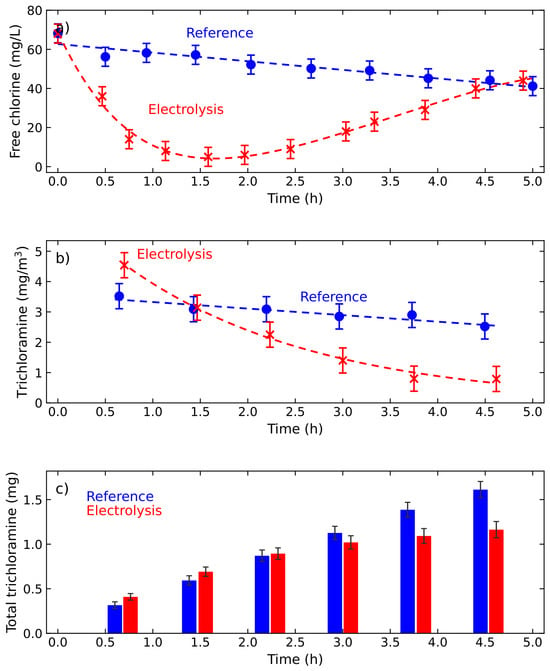
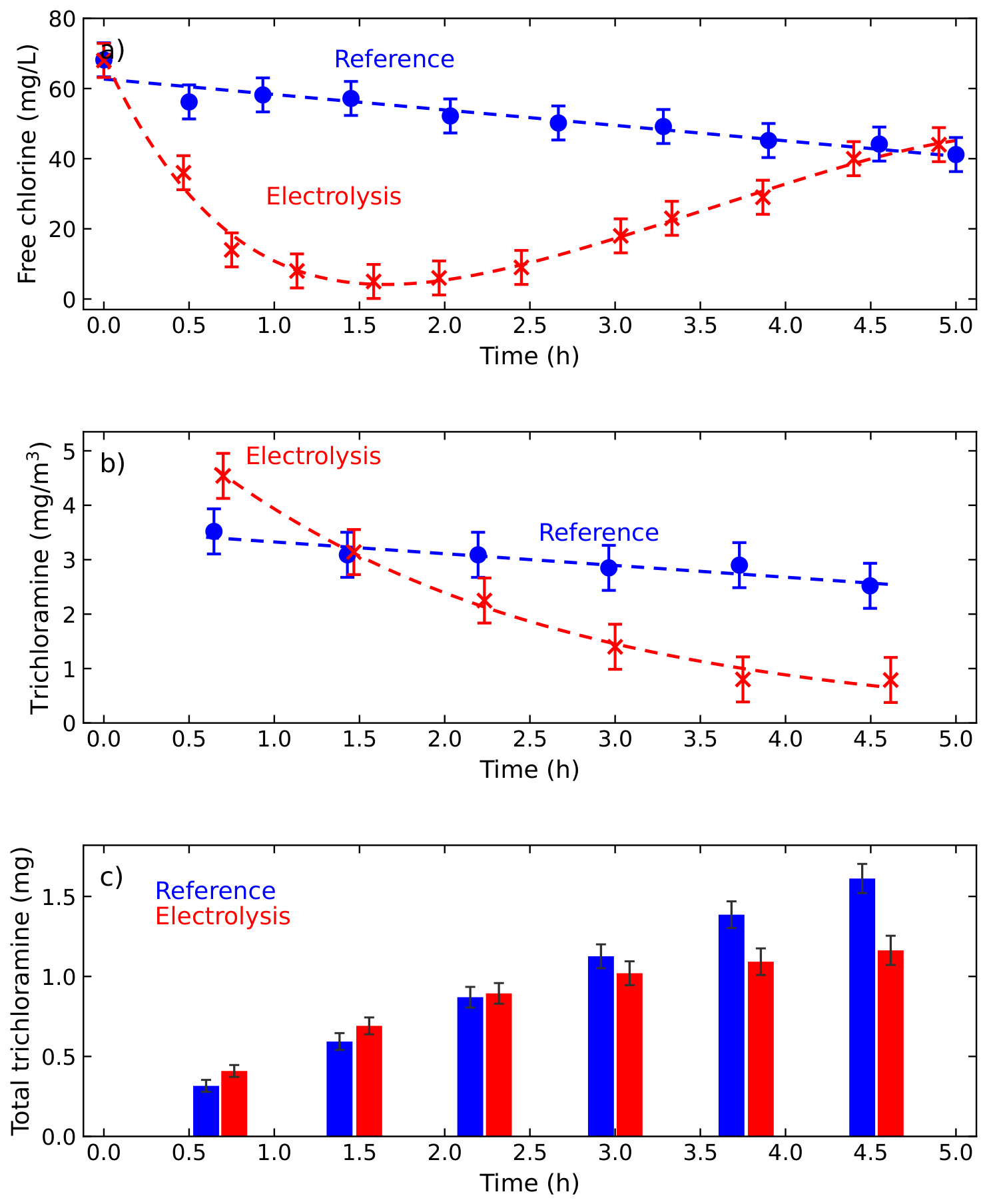
Synthetic pool water with precisely known amounts of chemicals was prepared to enable controlled, reproducible experiments. Concentrations of sodium hypochlorite and urea were selected to ensure a reasonable reaction time between the reactants, resulting in concentrations about 100 times higher than those typically found in swimming pool water. The effect of electrolysis on the free chlorine concentration is shown in Figure 2a. In the reference measurement without any electrolysis, a linear decrease from the initial 68 mg/L down to 42 mg/L of free chlorine is observed during the experimental time of five hours.
Figure 2.
Effect of electrolysis on synthetic pool water. Panel (a) shows free chlorine concentrations, panel (b) shows TCA concentrations, and panel (c) shows the cumulative amount of trichloramine for the same measurement. In (a,b), measurements from the electrochemically treated water are shown as red crosses and the reference water, of the same initial composition but not subjected to electrolysis, as blue dots. The dashed lines are guides for the eye and are not fitted models; no rate law is inferred from them. The values in (c) are sums of the individual determinations in (b) and carry the corresponding analytical uncertainties propagated in quadrature. Error bars are estimated from the analytical methods and represent a 95% confidence interval.
In the case of electrolysis, the free chlorine concentration decreases much faster initially, and almost all free chlorine is consumed after an hour and a half. Then, the free chlorine regenerates, and at the end of the measurement, the free chlorine concentration is slightly higher than that in the reference measurement. A possible explanation for the initially increased consumption of free chlorine follows from the reaction network above. Chlorination of urea is rate-limited by its first step, which requires molecular chlorine [26,28]. By oxidizing chloride at the anode (Reactions (11) and (12)), the electrolysis raises the local concentration of molecular chlorine and thereby accelerates precisely the step that limits progress through Reactions (1)–(5), driving urea and its chlorinated intermediates toward trichloramine faster than in the reference and consuming free chlorine as it does so. The regeneration of free chlorine at later times is similar to the process in a saltwater chlorinator and reflects the re-oxidation of the chloride released by Reactions (1)–(5) and (10). We present this as a working hypothesis consistent with the chlorination sequence rather than as a demonstrated mechanism, since confirming it would require quantification of the chlorinated urea intermediates, which we have not performed.
Two limitations of the synthetic system should be stated explicitly. First, the sodium hypochlorite and urea concentrations are approximately two orders of magnitude above those of real pool water. This was necessary rather than convenient. An early synthetic series prepared at realistic concentrations produced no changes in free chlorine or trichloramine resolvable against the analytical uncertainty over four to five days and was abandoned; that run was treated at the time as a failed pilot rather than as a result; no measurements from it were retained, and it is noted here only as the reason for the concentrations subsequently used. Second, the hypochlorite dose sets the pH of the synthetic water at 10.4. The HOCl in Reactions (2)–(5) and (13) originates from the hypochlorite dose, which establishes the HOCl/OCl− equilibrium in water. Calculated from the dissociation constant, at pH 10.4, well above the dissociation point near 7.5, the free chlorine is present overwhelmingly as OCl−, whereas in real pool water at pH 7.2–7.4 HOCl and OCl− are present in comparable proportion, which is the more reactive regime for the chlorination sequence. Free chlorine was measured as the total of HOCl, OCl− and Cl2; HOCl and OCl− were not determined separately, so the speciation quoted here is calculated rather than measured. The synthetic experiments therefore serve as a controlled proof of concept demonstrating that electrolysis simultaneously consumes and regenerates free chlorine while reducing trichloramine, and the quantitative values obtained from them are not transferred to pool conditions. Validation under operational chemistry rests on the real-pool studies presented in Section 3.2 and Section 3.4, which were performed at native concentrations and at pH 7.2–7.4.
The trichloramine measurements for the same experiments are shown in Figure 2b. A linear decrease from 3.51 mg/m3 down to 2.51 mg/m3 TCA is observed in the reference measurement without any electrolysis. In the electrolysis experiment, an initially increased TCA concentration of 4.54 mg/m3 is observed. However, after a few hours, the TCA concentration is lower than the reference sample. The last data point of 0.79 mg/m3 TCA is 69% lower than the reference sample, even though the two samples have similar free chlorine concentrations. The total amount of trichloramine from the measurement is shown as a cumulative graph in Figure 2c. During this limited experimental time, the electrolysis sample resulted in 28% less TCA, which is expected to decrease even further with longer experimental time.
3.2. Trichloramine Reduction in a Large-Scale Swimming Pool
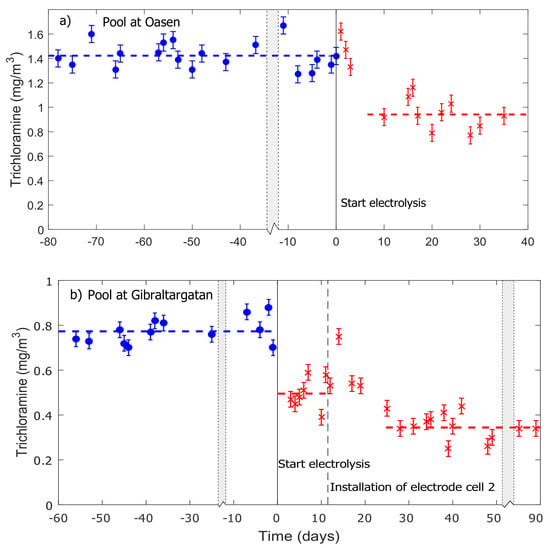
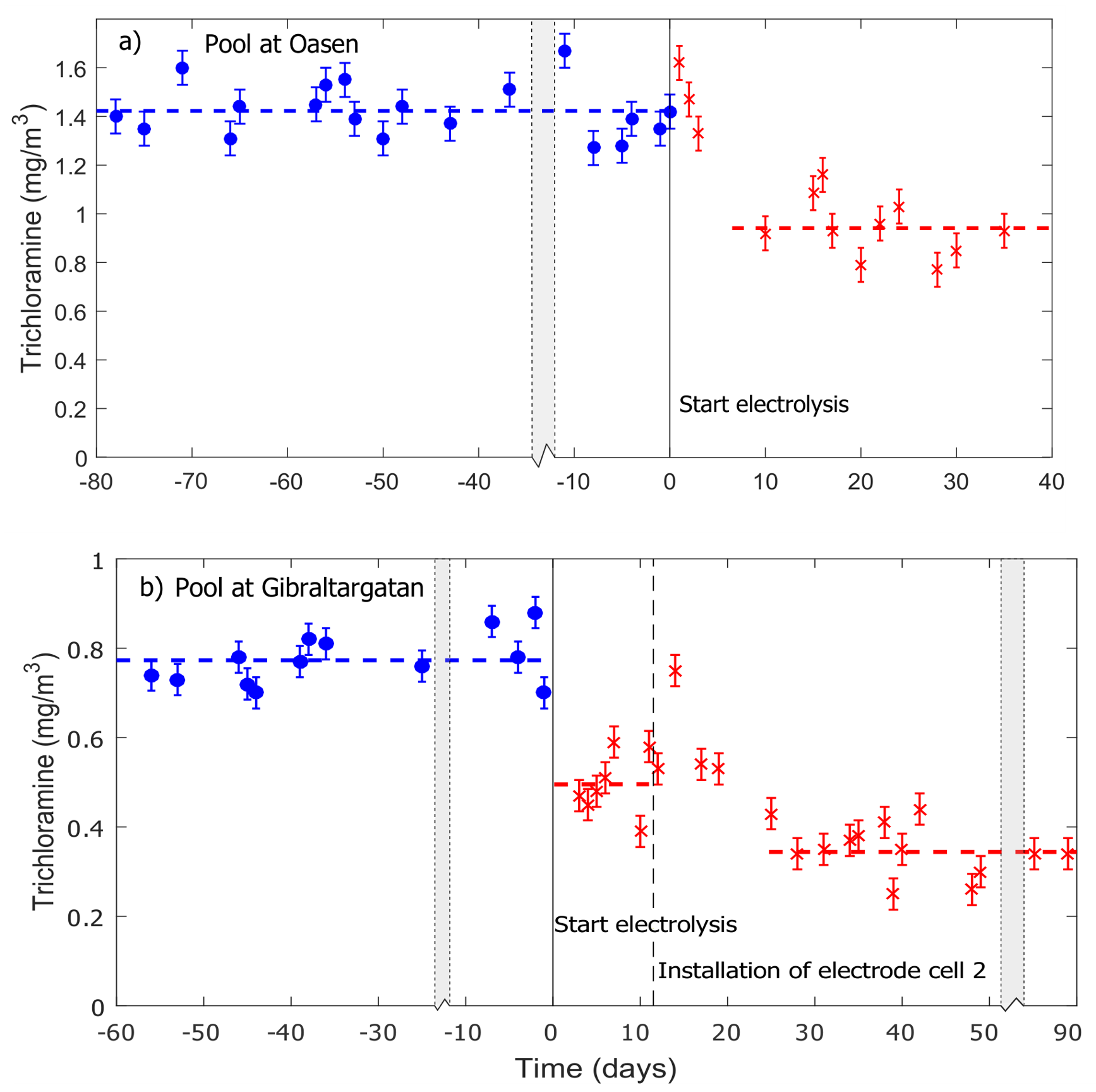
Two long-term experimental series were performed in real swimming pools, one in a smaller pool of 85 m3 and one in a larger pool of 640 m3. In the larger pool at Oasen, an electrode surface area of 0.6 m2 was used, and the electrolysis resulted in a 34% reduction in TCA in the pool water over time. The experiment lasted 113 days, from 21 September 2018 to 22 January 2019, with the first 78 days used to obtain baseline values without the effect of electrolysis. All TCA measurements, performed with the method presented in Section 2.3, are shown in Figure 3a. The swimming pool shows daily variations in TCA concentrations, as expected due to changes in the number of swimmers and free chlorine levels. Temporal and spatial variability of airborne DBPs has been documented across multiple indoor pool facilities [49]. Because of these variations, it is important to collect many measurements and analyze mean values. The mean value from the baseline measurements is 1.42 mg/m3, with all data points within the interval of 1.27–1.67 mg/m3. Over 19 measurements, the baseline standard deviation is 0.11 mg/m3, a coefficient of variation of 7.7%, and there is no significant trend over the collection window (Spearman , ), confirming that the pool was in a stable state before treatment. When the electrolysis is started, relatively high TCA concentrations are measured in the following days, consistent with the start-up transient discussed in Section 3.3. However, after ten days and beyond with electrolysis, significantly lower TCA concentrations are measured with a mean value of 0.94 mg/m3, and all measurements are within the interval 0.77–1.16 mg/m3. The reduction of 34% is significant against the baseline (Welch , ; Mann–Whitney ). Including every measurement without exception, that is, without omitting the start-up transient, the treated mean is 1.07 mg/m3, a reduction of 25% that remains significant at . The exclusion of the settling points therefore changes the magnitude of the reported reduction but not the conclusion. All values are collected in Table 1.
Figure 3.
Long-term TCA reduction in two swimming pools. Panel (a) shows the pool at Oasen from 21 September 2018 to 22 January 2019, and panel (b) the pool at Gibraltargatan from 1 February to 25 June 2019, measured with the method presented in Section 2.3. Blue dots represent baseline values, and red crosses are measurements with ongoing electrolysis. The dashed lines show mean values over the steady-state periods defined in Section 2.4, omitting the first three measurements after the electrolysis start in (a) and the first four measurements after the installation of the second electrode cell in (b). Means including all measurements are given in Table 1. Error bars are estimated from the analytical methods and represent a 95% confidence interval.
Table 1.
Trichloramine released from swimming pool water in the two long-term studies, measured by the sampling method of Section 2.3. Reductions are relative to the baseline mean of the same pool. Steady-state periods exclude the settling transient defined in Section 2.4; the complete record includes every measurement without exception. p-values are from Welch’s two-sample t-test against the baseline; the Mann–Whitney U test gives in every comparison.
The second long-term series in the smaller pool located at Gibraltargatan, shown in Figure 3b, ranged from 1 February to 25 June 2019. The first 56 days were used to obtain baseline values, with a mean value of 0.77 mg/m3 and all data points within the interval 0.70–0.88 mg/m3. This baseline is likewise stable, with a standard deviation of 0.06 mg/m3 over 13 measurements, a coefficient of variation of 7.4%, and no significant trend over the window (Spearman , ). In the first 12 days of electrolysis, a single-electrode cell with a 0.5 m2 area was used at a flow rate of 10 m3/h. This resulted in a 36% reduction in TCA, with a mean of 0.50 mg/m3 and all data points within the interval 0.39–0.59 mg/m3 (). A second electrode cell was then installed in parallel, resulting in a 55% reduction in TCA relative to the initial baseline. After about two weeks of system stabilization, a mean value of 0.35 mg/m3 was achieved, and all data points were within the range of 0.25–0.44 mg/m3 (). Including every measurement of the two-cell period, the mean is 0.41 mg/m3, and the reduction is 47%, still significant at . The step between the one-cell and two-cell periods is itself significant (). This two-step response is important for attribution: a confounding variable would have to coincide with both the start of electrolysis and the later installation of the second cell, and to scale with electrode area, in order to reproduce the observed pattern. No operating setpoints were altered when electrolysis was switched on, and the pool control systems held temperature, pH and free chlorine at the values given in Section 2.1 throughout. Continuous logs of these parameters were not archived, and the attribution above therefore rests on the stability of the baselines, on the two-step dose response, and on the paired in situ measurements of Section 3.4, in which water sampled immediately before and immediately after the electrode cell shares by construction the same swimmer load, ventilation, temperature, pH and free chlorine. This long-term experiment has been ongoing for more than a year, and no wear has been observed on the electrodes, indicating a long lifetime for the electrode cells. Electrodes of the same type returned to the manufacturer after three years of continuous operation were assessed as showing negligible wear. The cells run at fixed cell voltage, so any loss of active surface, whether by coating wear exposing the titanium substrate or by fouling, would appear as a fall in current; no such decline has been observed at any installation. That this measure is sensitive is shown by an early configuration operated without polarity reversal, in which the electrodes became inactive within a week and the fall in current was immediate. Direct surface characterization before and after operation, for example by SEM, EDX or XPS, together with a measured current efficiency, would strengthen the durability claim and is planned for future work.
3.3. The Start-Up Transient
Both the batch experiment of Figure 2b and the pool study of Figure 3a show a transient rise in TCA when electrolysis begins, but on very different time scales, and the two have different origins.
In the closed batch experiment, the rise lasts a few hours and reflects the chemistry described in Section 3.1. Chlorine generated at the anode accelerates the rate-determining first chlorination of urea, driving urea and its chlorinated intermediates through Reactions (1)–(5) to trichloramine faster than Reaction (10) removes it. Once the precursor pool is depleted, oxidation of the accumulated trichloramine overtakes its formation, and the concentration falls below the reference.
In the pool, the elevated period lasts of order ten days, and the time scale is set by the pool rather than by the electrode. The cell treats only the water passing through it, at 40 m3/h against the pool volume, so that the pool as a whole relaxes slowly toward a new steady state. During this relaxation, the pool works through the precursor inventory accumulated before treatment, and the concentration settles once the removal rate through the cell balances the formation rate across the pool. The two transients therefore share a chemical origin in the precursor inventory but are governed by different rate-limiting processes, electrode kinetics in the batch case and pool turnover in the continuous-flow case.
3.4. Potential Optimization of Trichloramine Reduction
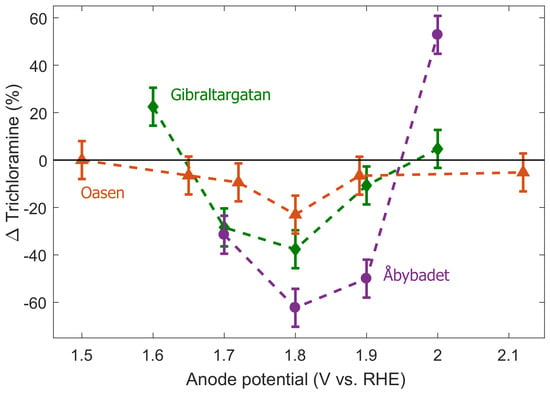
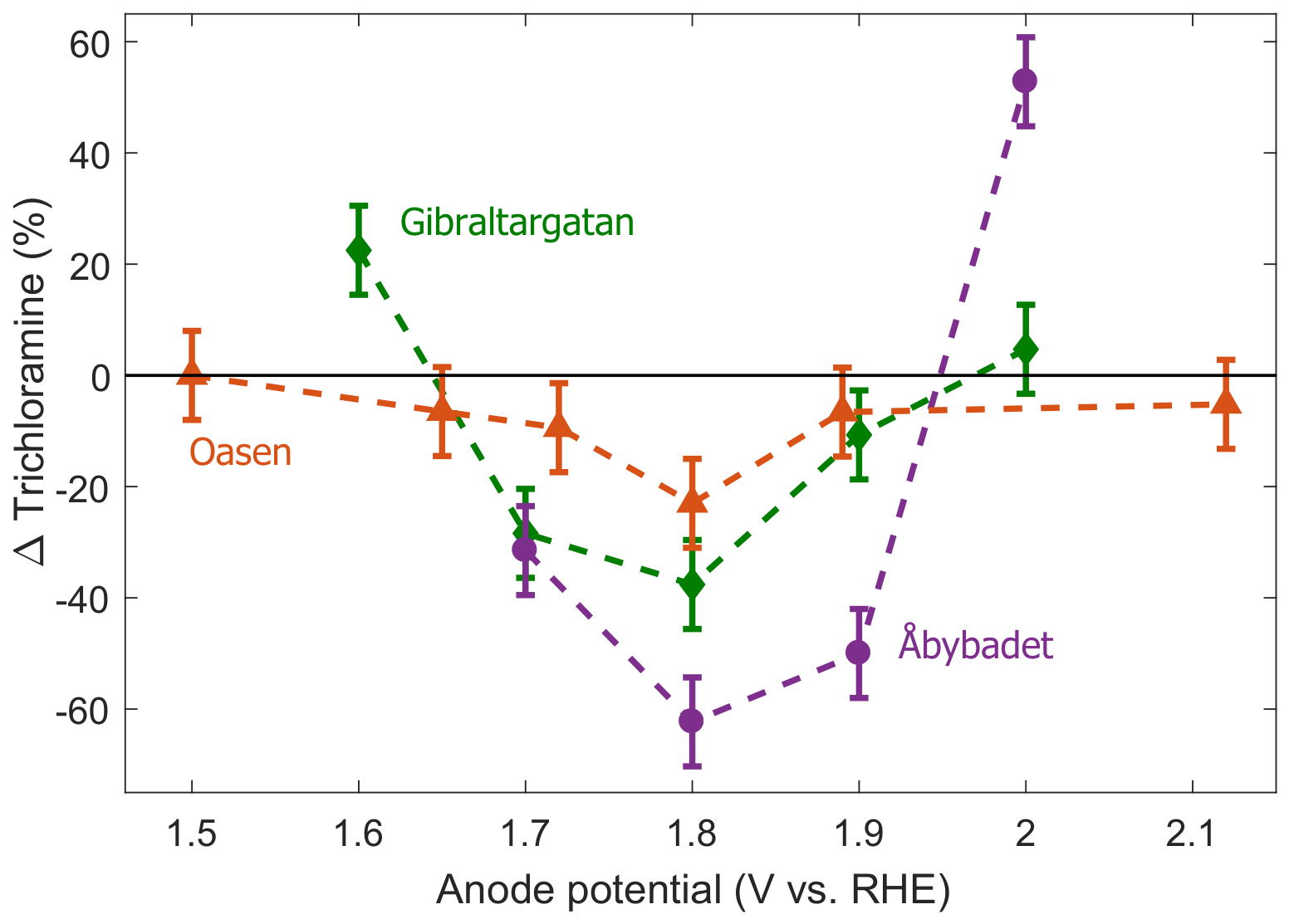
The potential dependence of the electrolysis effect on TCA was investigated using pool water from all three swimming pools. All three experimental series showed an optimal anode potential of 1.80 V vs. RHE, which is illustrated in Figure 4. This anode potential corresponds to a current density of about 1 A/m2; hence, the power consumption of the system is around 2 W/m2. The experimental series at Oasen was performed with the same electrode setup as the long-term experimental series presented in Section 3.2 and showed no effect at a low potential of 1.5 V vs. RHE. The optimal anode potential of 1.80 V vs. RHE yields a 22% reduction in TCA in water as it passes through the electrode cells. An increased anode potential results in a lower effect on TCA reduction. This indicates that TCA reduction with electrolysis has a critical dependence on potential; hence, two laboratory experimental series with less pool water and longer electrolysis times were performed to clarify this dependence. The first series from Gibraltargatan results in a 36% TCA reduction at 1.8 V vs. RHE, while 1.6 V vs. RHE and 2.0 V vs. RHE result in an increase of TCA. To further clarify this effect, larger electrodes were used for the following laboratory series with pool water from Åbybadet, which resulted in a 60% TCA reduction at the optimal 1.8 V vs. RHE, whereas 2.0 V vs. RHE gave a 50% increase of TCA, which further demonstrates the crucial dependence of TCA reduction on the anode potential in swimming pool water.
Figure 4.
Electrochemical effect on TCA at different anode potentials. Trichloramine is the difference between the electrochemically affected pool water and the non-affected water sample collected from the swimming pool at the same time. The series from Oasen consists of measurements before and after the electrodes in the purification system at Oasen. In contrast, the other two series used pool water samples collected from where electrolysis was performed during the TCA measurements. The dashed lines are guides for the eye. Error bars are estimated from the analytical methods and represent a 95% confidence interval.
The range was scanned at roughly 0.1 V spacing in three independent pool waters, using electrodes from three suppliers and two electrode sizes, and all three series converge on an optimum near 1.8 V vs. RHE with a working window of about 1.7–1.9 V. The range was not scanned at 0.05 V steps. Because the effective window spans roughly 0.2 V, practical operation does not depend on reaching 1.8 V precisely, and a finer scan is of interest for the mechanism rather than for application.
The existence of an optimum rather than a monotonic improvement follows from a competition between reactions. Below approximately 1.7 V vs. RHE, the anode does not oxidize trichloramine and its precursors fast enough to overcome ongoing formation, and little net reduction is observed, consistent with the absence of any effect at 1.5 V at Oasen. Near 1.8 V, the potential is sufficient to drive Reaction (10) while chlorine evolution remains moderate, and the net reduction is largest. Above approximately 1.9 V, chlorine evolution through Reaction (11) increasingly dominates the anodic current and raises the local concentration of molecular chlorine, which accelerates the rate-determining first step of the urea chlorination sequence and drives Reactions (1)–(5) toward trichloramine faster than the electrode oxidizes the trichloramine already present. The electrode then acts more as a chlorine generator than as a trichloramine sink, and the balance tips toward net formation, as observed at 2.0 V vs. RHE for both the Gibraltargatan and Åbybadet series. The narrowness of the window is consistent with the charge budget estimated in Section 3.5, where the delivered charge dose is only about twice the stoichiometric requirement of Reaction (10) for the trichloramine present, leaving little margin when current is diverted into chlorine evolution.
This potential dependence also constitutes evidence that the removal is chemical rather than physical. Gas evolution at the electrodes increases monotonically with current, so if trichloramine were being stripped from the water by evolved gas, removal would increase monotonically with potential. The opposite is observed: removal peaks near 1.8 V and reverses above 1.9 V, with net formation at 2.0 V despite higher current and greater gas evolution. A physical stripping process cannot produce an optimum followed by a net increase. Two further observations support this.
The cell is sealed, and the only route by which air leaves the vessel is through the trichloramine sampling cassette. Trichloramine that is stripped from the water into the gas phase therefore cannot be lost from the system unmeasured: it either leaves through the cassette, where it is captured and counted, or it remains in the vessel’s gas phase, from which it can still partition through the cassette. Enhanced volatilization would thus raise the measured air-phase concentration, not lower it, so a reduction in the measured trichloramine cannot be an artifact of stripping. In the in situ pool measurements, the water traverses the flow-through cell in seconds, leaving negligible time for gas stripping, yet trichloramine after the cell is lower than before it.
3.5. Energy Consumption and Charge Efficiency
Table 2 lists the operating parameters of the two long-term installations. Both operate at a current density of about 1 A/m2 and an areal power of about 2 W/m2, and the cells sit within the existing circulation loop, so that they add no measurable pumping load.
Table 2.
Operating parameters and energy consumption of the two long-term installations. Electrode areas are total areas, the sum of the anode and cathode areas. Power refers to the electrochemical cells only.
An estimate of the charge efficiency follows from the charge dose. The sampling protocol draws 0.0675 m3 of air through the filter from a 5 L water sample, so the Oasen baseline reading of 1.42 mg/m3 corresponds to approximately 19 μg/L of trichloramine released from the water. Complete conversion of this quantity by Reaction (10) requires 31 C/m3, against the 54 C/m3 delivered at 0.6 A and 40 m3/h. At the 22% single-pass removal measured in situ at 1.8 V vs. RHE, the charge attributable to trichloramine oxidation is therefore of order 13% of the total, with the balance consumed by chlorine evolution, oxygen evolution, and the oxidation of urea and other organics. This is an order-of-magnitude estimate rather than a measurement. It rests on the assumption that the sampling releases essentially all trichloramine from the sample, which we have not independently verified, and it is a lower bound in two respects, since incomplete release would imply a higher waterborne concentration and any pathway requiring more than two electrons per trichloramine molecule would imply a larger charge requirement.
A quantitative comparison of running costs with granular activated carbon and UV is outside the scope of this study. Cost, maintenance, and operational complexity for those techniques are strongly site-specific, depending on bather load, media and lamp specification, replacement policy, local energy and labor prices, and on whether the unit is sized for microbial control or for by-product removal. The facilities studied here operate carbon and UV within existing treatment trains that were neither instrumented nor varied in this work, so figures quoted for them would derive from the literature or from supplier data rather than from measurement, and a comparison on that basis would carry an unearned precision. The figures in Table 2 are given so that the reader may place them against published values for either alternative. Qualitatively, granular activated carbon and UV both carry recurring consumable costs, with media and lamps typically replaced on an annual cycle, and UV lamps operate at high power, whereas the electrode cells reported here have run for more than a year without replacement or measurable wear. A controlled side-by-side comparison at a single facility is identified as a valuable follow-up study.
4. Conclusions
The electrochemical oxidation of trichloramine in swimming pool water using MMO electrodes was investigated. The results demonstrated that this process significantly reduced TCA, with 34–55% reductions reported in large-scale swimming pools, in both cases with against a stable pre-treatment baseline. The reduction level is probably related to water quality, composition, water volume, pH, free chlorine concentration, electrode area, and flow rate through the electrode cells. Further, the results showed that the effect on TCA reduction strongly depends on the applied anode potential, with 1.7–1.9 V vs. RHE being the optimal potential window, and 1.8 V vs. RHE showing the greatest reduction, a dependence reproduced independently in water from three pools using electrodes from three suppliers. The results also indicated that the electrochemical process regenerates free chlorine, which may reduce the sodium hypochlorite consumption at swimming pools. This electrolysis system is a newly developed method for reducing TCA in the SPW. TCA is a volatile DBP of particular concern due to its adverse health effects. This method provides for—as requested by Schmalz et al. [4]—the removal of TCA in the pool water treatment cycle. The electrolysis system also has desirable properties such as low energy consumption and a long lifetime, resulting in very low running costs.
The mass transfer of trichloramine from water to air is slow relative to a typical treatment cycle [4]. Lowering the trichloramine burden of the water is therefore expected to lower airborne trichloramine in the hall and to improve conditions for swimmers and personnel. We emphasize that this study demonstrates the water-phase reduction and does not measure ambient air in the pool hall or any health endpoint. The measurements reported here quantify trichloramine released from a sampled volume of water under controlled off-gassing, which is not the same quantity as the ambient air concentration to which the WHO guideline of 0.5 mg/m3 and the French limit of 0.3 mg/m3 refer, and the two should not be compared directly even though they share units. The air-quality and health benefits are therefore presented as the expected consequence of the demonstrated reduction rather than as a measured outcome, and confirming them requires ambient air monitoring in the hall.
Several limitations remain. Chlorate, perchlorate, bromate, and halogenated organic by-products were not quantified. The mild operating conditions of approximately 1.8 V vs. RHE and 1 A/m2 lie below the high-potential, high-current-density regime associated with substantial chlorate and perchlorate generation, and this window was selected in part for that reason, but a targeted by-product survey is needed. Nitrate, ammonium, and total nitrogen were not measured, so the nitrogen mass balance is not closed and the mechanistic pathway is presented as consistent with the data rather than as demonstrated by them. Durability rests on operating performance and on the absence of any decline in current at fixed cell voltage rather than on direct surface characterization. Scale-up to larger or differently configured facilities, the influence of seasonal and swimmer-load variation, which drives the scatter in the baseline data, and direct ambient air monitoring in the hall are identified as the appropriate next steps.
Author Contributions
Conceptualization, A.L., A.D., S.B., B.W., and A.H.; methodology, A.L.; validation, A.L., A.D., S.B., B.W., and A.H.; formal analysis, A.L.; investigation, A.L.; resources, A.D., S.B., B.W., and A.H.; data curation, A.L.; writing—original draft preparation, A.L.; writing—review and editing, A.D., S.B., B.W., and A.H.; visualization, A.L.; supervision, S.B., B.W., and A.H.; project administration, A.H.; funding acquisition, A.H. All authors have read and agreed to the published version of the manuscript.
Funding
This research was funded by Formas (Grant number 2014-1478).
Data Availability Statement
The original contributions presented in this study are included in the article. Further inquiries can be directed to the corresponding author.
Conflicts of Interest
Alexander Levinsson, Andreas Darnell and Sven Boethius were employed by SafeWater Scandinavia AB during this work. Andreas Darnell, Björn Wickman, Sven Boethius and Anders Hellman are named inventors on a patent (SE1851328A) covering the trichloramine removal method reported here. The electrode installations at the swimming pools were provided by SafeWater Scandinavia AB. These employment and patent interests give the named authors a financial interest in the outcome of this work. All data supporting the reported conclusions are presented in the manuscript.
References
- Beech, J.A.; Diaz, R.; Ordaz, C.; Palomeque, B. Nitrates, Chlorates and Trihalomethanes in Swimming Pool Water. Am. J. Public Health 1980, 70, 79–82. [Google Scholar] [CrossRef] [Scilit] [PubMed]
- Powick, D.E.J. Swimming Pools—Brief Outline of Water Treatment and Management. Water Sci. Technol. 1989, 21, 151–160. [Google Scholar] [CrossRef] [Scilit]
- LaKind, J.S.; Richardson, S.D.; Blount, B.C. The Good, the Bad, and the Volatile: Can We Have Both Healthy Pools and Healthy People? Environ. Sci. Technol. 2010, 44, 3205–3210. [Google Scholar] [CrossRef] [Scilit] [PubMed]
- Schmalz, C.; Frimmel, F.H.; Zwiener, C. Trichloramine in swimming pools—Formation and mass transfer. Water Res. 2011, 45, 2681–2690. [Google Scholar] [CrossRef] [Scilit] [PubMed]
- Kim, H.; Shim, J.; Lee, S. Formation of disinfection by-products in chlorinated swimming pool water. Chemosphere 2002, 46, 123–130. [Google Scholar] [CrossRef] [Scilit] [PubMed]
- World Health Organization. Guidelines for Safe Recreational Water Environments; World Health Organization: Geneva, Switzerland, 2006; Volume 2.
- Craun, G.F.; Calderon, R.L.; Craun, M.F. Outbreaks associated with recreational water in the United States. Int. J. Environ. Health Res. 2005, 15, 243–262. [Google Scholar] [CrossRef] [Scilit] [PubMed]
- Weisel, C.P.; Richardson, S.D.; Nemery, B.; Aggazzotti, G.; Baraldi, E.; Blatchley, E.R.; Blount, B.C.; Carlsen, K.H.; Eggleston, P.A.; Frimmel, F.H.; et al. Childhood Asthma and Environmental Exposures at Swimming Pools: State of the Science and Research Recommendations. Environ. Health Perspect. 2009, 117, 500–507. [Google Scholar] [CrossRef] [Scilit] [PubMed]
- Simard, S.; Tardif, R.; Rodriguez, M.J. Variability of chlorination by-product occurrence in water of indoor and outdoor swimming pools. Water Res. 2013, 47, 1763–1772. [Google Scholar] [CrossRef] [Scilit] [PubMed]
- Felgueiras, F.; Mourão, Z.; Morais, C.; Santos, H.; Fonseca Gabriel, M.; de Oliveira Fernandes, E. Comprehensive Assessment of the Indoor Air Quality in a Chlorinated Olympic-Size Swimming Pool. Environ. Int. 2020, 136, 105401. [Google Scholar] [CrossRef] [Scilit] [PubMed]
- Peng, F.; Lu, Y.; Dong, X.; Wang, Y.; Li, H.; Yang, Z. Advances and Research Needs for Disinfection Byproducts Control Strategies in Swimming Pools. J. Hazard. Mater. 2023, 454, 131533. [Google Scholar] [CrossRef] [Scilit] [PubMed]
- Richardson, S.D.; DeMarini, D.M.; Kogevinas, M.; Fernandez, P.; Marco, E.; Lourencetti, C.; Ballesté, C.; Heederik, D.; Meliefste, K.; McKague, A.B.; et al. What’s in the Pool? A Comprehensive Identification of Disinfection By-products and Assessment of Mutagenicity of Chlorinated and Brominated Swimming Pool Water. Environ. Health Perspect. 2010, 118, 1523–1530. [Google Scholar] [CrossRef] [Scilit] [PubMed]
- Walse, S.S.; Mitch, W.A. Nitrosamine Carcinogens Also Swim in Chlorinated Pools. Environ. Sci. Technol. 2008, 42, 1032–1037. [Google Scholar] [CrossRef] [Scilit] [PubMed]
- Massin, N.; Bohadana, A.B.; Wild, P.; Héry, M.; Toamain, J.P.; Hubert, G. Respiratory Symptoms and Bronchial Responsiveness in Lifeguards Exposed to Nitrogen Trichloride in Indoor Swimming Pools. Occup. Environ. Med. 1998, 55, 258–263. [Google Scholar] [CrossRef] [Scilit] [PubMed]
- Couto, M.; Bernard, A.; Delgado, L.; Drobnic, F.; Kurowski, M.; Moreira, A.; Rodrigues-Alves, R.; Rukhadze, M.; Seys, S.; Wiszniewska, M.; et al. Health Effects of Exposure to Chlorination By-Products in Swimming Pools. Allergy 2021, 76, 3257–3275. [Google Scholar] [CrossRef] [Scilit] [PubMed]
- Zhang, D.; Craven, C.B.; Shen, Q.; Chu, W.; Li, X.F. Swimming pool disinfection byproducts: Analytical characterization of precursors, formation and occurrence, health risks, and future needs. TrAC Trends Anal. Chem. 2023, 169, 117385. [Google Scholar] [CrossRef] [Scilit]
- Bernard, A.; Carbonnelle, S.; Michel, O.; Higuet, S.; de Burbure, C.; Buchet, J.P.; Hermans, C.; Dumont, X.; Doyle, I. Lung Hyperpermeability and Asthma Prevalence in Schoolchildren: Unexpected Associations with the Attendance at Indoor Chlorinated Swimming Pools. Occup. Environ. Med. 2003, 60, 385–394. [Google Scholar] [CrossRef] [Scilit] [PubMed]
- Hery, M.; Hecht, G.; Gerber, J.; Gendre, J.; Hubert, G.; Rebuffaud, J. Exposure to chloramines in the atmosphere of indoor swimming pools. Ann. Occup. Hyg. 1995, 39, 427–439. [Google Scholar] [CrossRef] [Scilit]
- Lévesque, B.; Duchesne, J.F.; Gingras, S.; Lavoie, R.; Prud’Homme, D.; Bernard, E.; Boulet, L.P.; Ernst, P. The determinants of prevalence of health complaints among young competitive swimmers. Int. Arch. Occup. Environ. Health 2006, 80, 32–39. [Google Scholar] [CrossRef] [Scilit] [PubMed]
- Li, J.-H.; Wang, Z.-H.; Zhu, X.-J.; Deng, Z.-H.; Cai, C.-X.; Qiu, L.-Q.; Chen, W.; Lin, Y.-J. Health Effects from Swimming Training in Chlorinated Pools and the Corresponding Metabolic Stress Pathways. PLoS ONE 2015, 10, e0119241. [Google Scholar] [CrossRef] [Scilit] [PubMed]
- Johannesson, S.; Eriksson, K.; Wastensson, G.; Westerlund, J.; Graff, P. Airborne trichloramine in indoor swimming pools in Sweden. J. Occup. Environ. Hyg. 2024, 21, 805–816. [Google Scholar] [CrossRef] [Scilit] [PubMed]
- Anses. Évaluation des Risques Sanitaires liés aux Piscines. Partie I: Piscines Réglementées; Anses: Maisons-Alfort, France, 2012.
- Wastensson, G.; Eriksson, K. Inorganic chloramines: A critical review of the toxicological and epidemiological evidence as a basis for occupational exposure limit setting. Crit. Rev. Toxicol. 2020, 50, 219–271. [Google Scholar] [CrossRef] [Scilit] [PubMed]
- Lee, L.T.; Wu, T.; Boor, B.E.; Blatchley, E.R., III. Dynamic behavior of gas-phase NCl3 and CO2 in indoor pool facilities. Build. Environ. 2023, 233, 110088. [Google Scholar] [CrossRef] [Scilit]
- Li, J.; Blatchley, E.R. Volatile Disinfection Byproduct Formation Resulting from Chlorination of Organic-Nitrogen Precursors in Swimming Pools. Environ. Sci. Technol. 2007, 41, 6732–6739. [Google Scholar] [CrossRef] [Scilit] [PubMed]
- Blatchley, E.R.; Cheng, M. Reaction Mechanism for Chlorination of Urea. Environ. Sci. Technol. 2010, 44, 8529–8534. [Google Scholar] [CrossRef] [Scilit] [PubMed]
- Lee, J.W.; Lee, D.; Lee, H.J.; Shim, S.; Kim, J.H.; Lee, C. Enhanced oxidation of urea by pH swing during chlorination: pH-dependent reaction mechanism. Water Res. 2023, 242, 120183. [Google Scholar] [CrossRef] [Scilit] [PubMed]
- Cho, K.; Hoffmann, M.R. Urea Degradation by Electrochemically Generated Reactive Chlorine Species: Products and Reaction Pathways. Environ. Sci. Technol. 2014, 48, 11504–11511. [Google Scholar] [CrossRef] [Scilit] [PubMed]
- Hsu, I.W. Electrochemical Oxidation of Chlorination Byproducts in Swimming Pool Applications. Master’s Thesis, Department of Physics, Chalmers University of Technology, Gothenburg, Sweden, 2016. [Google Scholar]
- E, Y.; Bai, H.; Lian, L.; Li, J.; Blatchley, E.R. Effect of chloride on the formation of volatile disinfection byproducts in chlorinated swimming pools. Water Res. 2016, 105, 413–420. [Google Scholar] [CrossRef] [Scilit] [PubMed]
- Weaver, W.A.; Li, J.; Wen, Y.; Johnston, J.; Blatchley, M.R.; Blatchley, E.R. Volatile disinfection by-product analysis from chlorinated indoor swimming pools. Water Res. 2009, 43, 3308–3318. [Google Scholar] [CrossRef] [Scilit] [PubMed]
- Weng, S.C.; Weaver, W.A.; Zare Afifi, M.; Blatchley, T.N.; Cramer, J.S.; Chen, J.; Blatchley, E.R., III. Dynamics of gas-phase trichloramine (NCl3) in chlorinated, indoor swimming pool facilities. Indoor Air 2011, 21, 391–399. [Google Scholar] [CrossRef] [Scilit] [PubMed]
- Wu, T.; Földes, T.; Lee, L.T.; Wagner, D.N.; Jiang, J.; Tasoglou, A.; Boor, B.E.; Blatchley, E.R. Real-Time Measurements of Gas-Phase Trichloramine (NCl3) in an Indoor Aquatic Center. Environ. Sci. Technol. 2021, 55, 8097–8107. [Google Scholar] [CrossRef] [Scilit] [PubMed]
- Chowdhury, Z.; Summers, R.; Westerhoff, G.; Westerhoff, G.; Leto, B.; Nowack, K.; Kirk, C.; Summers, S. Activated Carbon: Solutions for Improving Water Quality; American Water Works Association: Denver, CO, USA, 2011. [Google Scholar]
- Bauer, R.C.; Snoeyink, V.L. Reactions of Chloramines with Active Carbon. J. Water Pollut. Control Fed. 1973, 45, 2290–2301. [Google Scholar]
- Skibinski, B.; Götze, C.; Worch, E.; Uhl, W. Pore diffusion limits removal of monochloramine in treatment of swimming pool water using granular activated carbon. Water Res. 2018, 132, 270–281. [Google Scholar] [CrossRef] [Scilit] [PubMed]
- Sakuma, M.; Matsushita, T.; Matsui, Y.; Aki, T.; Isaka, M.; Shirasaki, N. Mechanisms of trichloramine removal with activated carbon: Stoichiometric analysis with isotopically labeled trichloramine and theoretical analysis with a diffusion-reaction model. Water Res. 2015, 68, 839–848. [Google Scholar] [CrossRef] [Scilit] [PubMed]
- Shammas, N.; Wang, L. 18.4 Disinfection by Ultraviolet Light. In Water Engineering—Hydraulics, Distribution and Treatment, 1st ed.; John Wiley & Sons: Hoboken, NJ, USA, 2016; Chapter 18.4; p. 546. [Google Scholar]
- Cheema, W.A.; Manasfi, T.; Kaarsholm, K.M.; Andersen, H.R.; Boudenne, J.L. Effect of medium-pressure UV-lamp treatment on disinfection by-products in chlorinated seawater swimming pool waters. Sci. Total Environ. 2017, 599–600, 910–917. [Google Scholar] [CrossRef] [Scilit] [PubMed]
- Hansen, K.M.; Zortea, R.; Piketty, A.; Vega, S.R.; Andersen, H.R. Photolytic removal of DBPs by medium pressure UV in swimming pool water. Sci. Total Environ. 2013, 443, 850–856. [Google Scholar] [CrossRef] [Scilit] [PubMed]
- Zare Afifi, M.; Blatchley, E.R. Effects of UV-based treatment on volatile disinfection byproducts in a chlorinated, indoor swimming pool. Water Res. 2016, 105, 167–177. [Google Scholar] [CrossRef] [Scilit] [PubMed]
- Ilyas, H.; Masih, I.; der Hoek, J.V. Disinfection Methods for Swimming Pool Water: Byproduct Formation and Control. Water 2018, 10, 797. [Google Scholar] [CrossRef] [Scilit]
- Patel, K.; Hon, C.Y. Evaluating if airborne chemical levels in indoor swimming pools are influenced by type of water treatment. Environ. Health Rev. 2020, 63, 48–53. [Google Scholar] [CrossRef] [Scilit]
- Chen, S.; Li, Z. Understanding the fate of disinfection by-products in swimming pools: Current empirical and mechanistic modeling insights. J. Environ. Sci. Heal. Part C 2024, 42, 366–401. [Google Scholar] [CrossRef] [Scilit] [PubMed]
- Long, L.; Wang, S.; Gao, Z.; You, S.; Wei, L. Electro-oxidation and UV irradiation coupled method for in-site removing pollutants from human body fluids in swimming pool. J. Hazard. Mater. 2024, 464, 132963. [Google Scholar] [CrossRef] [Scilit] [PubMed]
- Lee, L.T.; Blatchley, E.R. Long-Term Monitoring of Water and Air Quality at an Indoor Pool Facility during Modifications of Water Treatment. Water 2022, 14, 335. [Google Scholar] [CrossRef] [Scilit]
- Rice, E.W.; Bridgewater, L. Standard Methods for the Examination of Water and Wastewater; American Public Health Association: Washington, DC, USA, 2012. [Google Scholar]
- Bard, A.J.; Faulkner, L.R. Electrochemical Methods: Fundamentals and Applications, 2nd ed.; John Wiley & Sons: Hoboken, NJ, USA, 2001. [Google Scholar]
- Ahmadpour, E.; Hallé, S.; Valois, I.; Ryan, P.E.; Haddad, S.; Rodriguez, M.; El Aroussi, B.; Simard, S.; Delpla, I.; Proulx, F.; et al. Temporal and spatial variations in the levels of prominent airborne disinfection by-products at four indoor swimming pools. J. Occup. Environ. Hyg. 2022, 19, 185–196. [Google Scholar] [CrossRef] [Scilit] [PubMed]

Disclaimer/Publisher’s Note: The statements, opinions and data contained in all publications are solely those of the individual author(s) and contributor(s) and not of MDPI and/or the editor(s). MDPI and/or the editor(s) disclaim responsibility for any injury to people or property resulting from any ideas, methods, instructions or products referred to in the content. |
© 2026 by the authors. Licensee MDPI, Basel, Switzerland. This article is an open access article distributed under the terms and conditions of the Creative Commons Attribution (CC BY) license.