


Abstract
A commuting graph is a graph denoted by where G is any group and X, a subset of a group G, is a set of vertices for . Two distinct vertices, , will be connected by an edge if the commutativity property is satisfied or . This study presents results for the connectivity of when G is a symmetric group of degree n, Sym, and X is a conjugacy class of elements of order three in G.
1. Introduction
An element g of the symmetric group of degree n, Sym, can be written as a product of mutually disjoint cycles in the form
Generally, the cycle type of g is defined to be
if in the cycle decomposition of g (Equation (1)), there are cycles of length for . Each and will be positive integers and , an increasing sequence. We note that fixed points as 1-cycles must not be excluded in presenting the cycle type of any permutations of Sym.
Suppose an arbitrary element has cycle type . For some and , we define a graph, denoted by , whose vertex set is and are linked by an edge if and only if . Clearly, the cycle type of the element determines the graph . An edge is called an exact edge if and . A special edge with source i of satisfies and where
for .
Given this notation, it is worth noting the definition of commuting graph and two related results in [1]. These two theorems are extremely useful to prove the connectivity of commuting graphs in symmetric groups for elements of order three described in Section 2.
Definition 1.
Let G be any group and X a subset of a group G. Commuting graph denoted by , is a graph whose set of vertices is X and two distinct vertices, , will be connected by an edge if the commutativity property is satisfied or .
Theorem 1.
[1] Let be of cycle type , and . Then, is connected if and only if , or and .
Theorem 2.
[1] Let , be of cycle type with . Let . Then, is connected if and only if the following hold:
- 1.
- Γ is connected.
- 2.
- gcd.
- 3.
- Γ has at least one edge which is not exact.
- 4.
- The vertex set of Γ is not of the form , with and , such that the following hold:
- (a)
- for all with is an exact edge;
- (b)
- there exists a vertex such that for all is a special edge with source y;
- (c)
- no vertex of E is joined to a vertex of Y\; and
- (d)
- gcd.
For instance, having G as the symmetric group of degree 7, Sym and , the commuting graph is connected with diameter 3. It shows an absolute contrast to the case having G as the symmetric group of degree 6, Sym and , where is disconnected even though both cases deal with the set of elements of cycle type as the vertex set. More specific examples of connected and disconnected commuting graphs can be referred from the results in Table 1 of [2] and Table 1 of [3]. Evidently, there are certain cases where is not connected or disconnected, which further motivate us to categorize them. Consequently, some questions arise when is not connected: How many connected components are there? What is the size or diameter of the connected components?
Commuting graphs have been studied for a large varieties of groups and subset of the groups [2,4]. Woodcock [5] analyzed commuting graphs for symmetric group, Sym and having the set of nontrivial elements of the group as the vertex set. It is proven there that is disconnected for two particular cases, either n or is a prime, where n is the degree for the symmetric group. The multiple connected components are also identified alongside with their diameters. Researchers also give attention to the case where X is a conjugacy class of involutions, the commuting involution graphs [6,7,8]. Indeed, conjugacy classes of non-involution have a great impact in several other area of mathematics, see for instance in subspace arrangements [9], in rational geometry [10] or in algebraic geometry [11,12].
This paper consists of three sections. Section 2 provides three cases where will be disconnected when the vertex set of the graph is the conjugacy class of elements of order three in Sym: (1) when and ; (2) when or and ; and (3) when ; or and , where r is the number of 3-cycles in elements of X. In Section 3, we attempt to give some information about the number of connected components of some specific disconnected graphs of symmetric groups and also the size of each connected components. As a result, we also obtain the isomorphism of every connected component of disconnected with the complete graph of the same order as the size of the component.
Throughout we assume acts on the set in the usual manner. Write, without loss of generality, an element as follows:
Thus, t has order 3 and is of cycle type . Set , the G-conjugacy class of t. Evidently, the centralizer of t in G is
2. Connectedness of the Commuting Graph
By using Theorems 1 and 2 where appropriate, we can now put these to good use to partially prove the following result (note that this observation is based on the results in Table 1 of [2] and Table 1 of [3]):
Theorem 3.
Let and be of cycle type with . Let . Then, is disconnected if and only if one of the following holds:
- 1.
- and ;
- 2.
- or and ; and
- 3.
- ; or and .
Proof of Theorem 3.
The case () is trivial. The latter statement of Theorem 1 shows that is connected for and .
Now, suppose (). This means and is of cycle type . Applying Equation (2) to get where and , we get . Thus, by Theorem 1, is disconnected.
Now, suppose (). This means and hence d is either 1 or 3, since d is a divisor of 3. Thus, . Therefore, and again by Theorem 1, is connected. Hence, for the case , is disconnected if and only if .
We can prove the second part by employing Theorem 2. However, here we can also prove it by using a more direct approach. Note that t is of cycle type , . If , then t leaves only the point fixed. Therefore, any elements of G which belong to the same conjugacy class as t, named X, and satisfy the commutativity property with t also fix . By induction, every element of in the connected component of t will fix . Thus, is disconnected.
If , then t fixes the points and . Thus, by using the same argument as before, any elements in which commutes with t will also fix and . Again, by induction, every element of G which belongs to the same conjugacy class as t and is in the connected component of t fixes and . Thus, is disconnected.
Generally, here we have ; and . We need to show that is only connected for the cases and , and , and, and or otherwise is disconnected.
First, we prove that is connected when ; and . We do this by observing each condition in Theorem 2:
Condition 1.
We claim that is connected. Thus, there exists at least one edge which joins two vertices. The only possible edge is since there exists only and (note that is the same edge as as they both connect the same vertices, (1 and 2). In this case, and . Therefore, we always get this equality:
and hence is an edge. Thus, is connected and Theorem 2 is satisfied.
Condition 2.
We require the formula in Equation (2) to get . In this case, we have where and . Note again that and . Calculations for and are as follows:
Furthermore; gcd gcd gcd . Hence, Theorem 2 is satisfied.
Condition 3.
Note again is the only edge of . Now, by employing the definition given in the Introduction, is an exact edge if and are the only possibility to get the following equality:
Indeed, we can get the equality in (3) with many choices of and (but the minimum is ). Hence, is not an exact edge and Theorem 2 is satisfied.
Condition 4.
To observe this condition, let us first say that the set of vertices of is of the form , provided that there is no intersection between E and Y, and E and Y are not empty sets. Without loss of generality, set the vertex and vertex .
- (a)
- Since there is only one vertex in E, we can join any two vertices neither by an exact edge nor by a non-exact edge.
- (b)
- Note that is the only edge of and it is not a special edge with source 2 since . Thus, Theorem 2 is not satisfied.
This is a contradiction (we still get the contradiction here even if we assume the vertex and vertex since is also not a special edge with source 1 because ). Therefore, this verifies that and, hence, Theorem 2 is satisfied.
Thus, by Theorem 2, is connected when ; and . We can use the same way to prove that is also connected for the cases and , and, and .
Note that is disconnected when ; and since Theorem 2 is not satisfied. This is because as the only edge in is an exact edge.
is also disconnected when ; and because Theorem 2 is not satisfied. This means, without loss of generality by putting the vertex and vertex , the vertex set of can be written as union of E and Y, no intersection between E and Y, and both are not empty sets and it fulfills all four conditions in Theorem 2 . Conditions and are met since there is only one vertex in each E and Y. Condition is satisfied because is a special edge with source 2 whilst Condition is also satisfied since gcd gcd gcd . □
3. Disconnected Commuting Graph and Its Connected Components
In Section 2, there are certain cases where is disconnected. Consequently, when is not connected, we are concerned with the number of connected components and also the size or diameter of the connected components. In this paper, a connected component is denoted by where i ranges from 1 to the number of connected components in some disconnected and r is the number of 3-cycles in an element . Two examples of the calculations are as follows:
Example 1.
Let where . Note that t has cycle type (). Since , then where X is the set of all elements of G with cycle type . Suppose are the connected components of . Then,
Therefore, when and , consists of ten connected components each of size four.
Proposition 1.
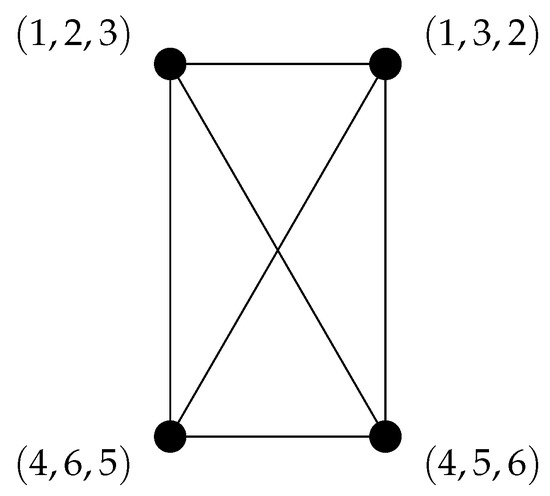
Let and . Then, every connected component of disconnected is isomorphic to the complete graph of order 4, , as shown in Figure 1.
Figure 1.
Connected component of disconnected when and .
Example 2.
Let where . Note that t has cycle type (). Since , where X is the set of all elements of G with cycle type . Suppose are the connected components of . Then,
Therefore, when and , consists of ten connected components each of size four.
Proposition 2.
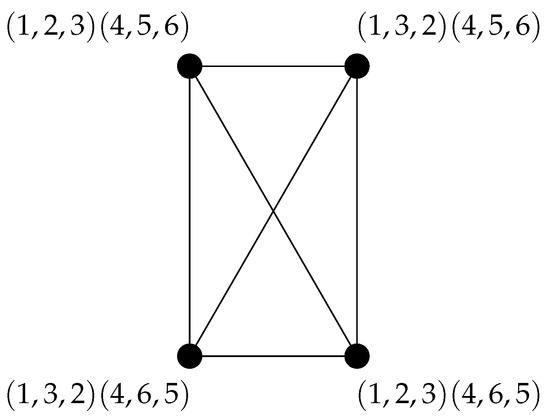
Let and . Then, every connected component of disconnected is isomorphic to the complete graph of order 4, , as shown in Figure 2.
Figure 2.
Connected component of disconnected when and .
Based on the calculations carried out by hand and also with the help of Magma [13], we give a general formula of size and number of connected components for some disconnected .
Theorem 4.
If t has cycle type and or , then the size of each connected components is . Moreover, the number of connected components is .
Proof of Theorem 4.
We need to count the number of permutations in (where G is either or ), which commute with each other and are in the same connected component. For each element in X, we have r 3-cycles and each 3-cycle has only two possibilities, either being inverted or left alone. This gives possible permutations. Consequently, it follows immediately that in this case the number of connected components is . □
In view of Propositions 1 and 2 and Theorem 4, we have the following theorem.
Theorem 5.
Every connected component of disconnected in Theorem 3 is isomorphic to the complete graph of order , .
Proof of Theorem 5.
All elements in each connected component commute with each other and consequently they are of distance 1 from one vertex to another vertex. In other words, one vertex is adjacent to another vertex in this component and this shows that the resulting graph is a complete graph of order since the size of each connected components is . □
Table 1 gives information about the number of connected components of some specific disconnected graphs of symmetric groups and also the size of each connected components.

Table 1.
Number of connected components, and its size of some disconnected .
Clearly, if the commuting graph is disconnected when G is a symmetric group of degree n, Sym, and X is a conjugacy class of elements of order three in G, the connected components have the same order, the same size and even the same edge connectivity, in other words they are isomorphics. The results obtained can be extended to find the adjacency matrices of each connected components of , their eigen values and hence giving the input for the graph energy.
Author Contributions
Conceptualization, A.N.; methodology, A.N.; software, A.N.; validation, A.N., S.K.S.H. and M.R.K.A.; formal analysis, A.N.; investigation, A.N.; resources, A.N.; data curation, A.N.; writing—original draft preparation, A.N.; writing—review and editing, A.N. and S.K.S.H.; visualization, A.N.; supervision, A.N.; project administration, A.N.; and funding acquisition, A.N.
Funding
This research was funded by the Malaysia’s Ministry of Higher Education (MOHE) under the Fundamental Research Grant Scheme (FRGS) 01-01-15-1708FR and Universiti Putra Malaysia under the Putra Grant—Putra Young Initiative (GP-IPM) GP-IPM/2016/9476200.
Acknowledgments
The author wishes to thank the referees for their helpful comments or recommendations on this article.
Conflicts of Interest
The authors declare no conflict of interest. The funders had no role in the design of the study; in the collection, analyses, or interpretation of data; in the writing of the manuscript, or in the decision to publish the results.
Abbreviations
The following abbreviations are used in this manuscript:
| Commuting graph | |
| Centralizer of an element t in group G | |
| i-th connected components | |
| Sym | Symmetric group of degree n |
| lcm | Lowest common multiple |
| gcd | Greatest common divisor |
References
- Bundy, D. The Connectivity of Commuting Graphs. J. Comb. Theory Ser. A 2006, 113, 995–1007. [Google Scholar] [CrossRef][Green Version]
- Bates, C.; Bundy, D.; Hart, S.; Rowley, P. A Note on Commuting Graphs for Symmetric Groups. Elec. J. Comb. 2009, 16, R6. [Google Scholar]
- Nawawi, A.; Rowley, P. On Commuting Graphs for Elements of Order 3 in Symmetric Groups. Elec. J. Comb. 2015, 22, P1.21. [Google Scholar]
- Brauer, R.; Fowler, K.A. On Groups of Even Order. Ann. Math. 1955, 62, 565–583. [Google Scholar] [CrossRef]
- Woodcock, T. The Commuting Graph of the Symmetric Group Sn. Int. J. Contemp. Math. Sci. 2015, 10, 287–309. [Google Scholar] [CrossRef]
- Bates, C.; Bundy, D.; Perkins, S.; Rowley, P. Commuting Involution Graphs for Symmetric Groups. J. Algebra 2003, 266, 133–153. [Google Scholar] [CrossRef]
- Bates, C.; Bundy, D.; Perkins, S.; Rowley, P. Commuting Involution Graphs for Finite Coxeter Groups. J. Group Theory 2003, 6, 461–476. [Google Scholar] [CrossRef]
- Fischer, B. Finite Groups Generated by 3-transpositions. I Invent. Math. 1971, 13, 232–246. [Google Scholar] [CrossRef]
- Martino, I.; Singh, R. Finite Groups Generated in Low Real Codimension. Linear Algebra Appl. 2019, 570, 245–281. [Google Scholar] [CrossRef]
- Totaro, B. The Motive of a Classifying Space. Geom. Topol. 2016, 20, 2079–2133. [Google Scholar] [CrossRef]
- Martino, I. The Ekedahl Invariants for Finite Groups. J. Pure Appl. Algebra 2016, 220, 1294–1309. [Google Scholar] [CrossRef]
- Martino, I. Introduction to the Ekedahl Invariants. Math. Scand. 2017, 120, 211–224. [Google Scholar] [CrossRef]
- Bosma, W.; Cannon, J.J.; Playoust, C. The Magma Algebra System. I. The User Language. J. Symb. Comput. 1997, 24, 235–265. [Google Scholar] [CrossRef]
© 2019 by the authors. Licensee MDPI, Basel, Switzerland. This article is an open access article distributed under the terms and conditions of the Creative Commons Attribution (CC BY) license (http://creativecommons.org/licenses/by/4.0/).