1. Introduction
With the discovery of the Higgs particle at the large hadron collider (LHC), the full success of the standard model (SM) has been crowned. Unfortunately, we still do not see any clear indication of experimental features beyond, so long as phenomenology at the TeV scale is concerned. Theorists are however mostly unsatisfied with the SM, particularly with its Higgs sector and explanation of the origin of the electroweak symmetry breaking. With a negative mass-square at the right scale put in by hand, the Higgs mechanism looks like only a phenomenological description of the ‘true’ theory behind it. Moreover, the other parts of the SM theory have their field content tightly constrained by the gauge symmetry and no parameters with mass dimensions admissible; everything in the Higgs sector looks completely arbitrary in comparison. Another way of looking at the issue would be that the only natural value of any input mass parameter should be like the model cutoff scale. We may need a model with a dynamical mechanism to generate the extra mass scale substantially below the cutoff.
Practically and experimentally accessible physics is really only about effective (field) theories. Taking the SM as an effective field theory, one would admit the higher dimensional operators with couplings suppressed by powers of the model cutoff scale in the Lagrangian. Actually, a dimension six term of four-fermion interaction with strong coupling gives interesting nonperturbative dynamics that can break symmetries and generate masses [
1]. That is the Nobel prize-winning classic Nambu–Jona-Lasinio (NJL) model [
2,
3], to which Higgs physics may correspond to the low energy effective theory, with the Higgs boson being identified as a two-quark composite. This beautiful idea of the top-mode SM [
4,
5,
6,
7,
8,
9] fails to accommodate the too small phenomenological top quark mass [
1]. At this point, it looks like a holomorphic supersymmetric version that gives the (minimal) supersymmetric standard model (SSM) with both Higgs supermultiplets as two-superfield composite maintains phenomenological viability [
10].
The SSM is still the most popular candidate theory beyond the SM. The theoretical beauty of supersymmetry is certainly part of its appeal. While the naive picture of supersymmetry at or below the TeV scale as a solution to the ‘hierarchy problem’ fails, the dynamical electroweak symmetry breaking option of a supersymmetric Nambu–Jona–Lasinio (SNJL) model may work with a higher supersymmetry breaking scale. The first SNJL model was introduced in the early 1980s [
11,
12], generalizing the four-fermion interaction to a four-superfield interaction of the same dimension, in the Kähler potential. A holomorphic version (HSNJL) as an alternative supersymmetrization [
13] with a four-superfield interaction in the superpotential [
10] has been introduced, with different theoretical and phenomenological merits [
10,
14,
15]. However, this kind of supersymmetric NJL-type model discusses only the formation of composite chiral superfields, for modeling the Higgs sector. There are more interesting possibilities in the supersymmetrization of NJL-type models. Here, we focus on a simple one giving a real two-superfield composite from a dimension-six four-chiral-superfield interaction, first reported in our earlier paper [
16]. Following and extending the framework of our earlier analyses [
14,
15,
16], we present, in the article, further interesting nontrivial solutions for the soft mass parameters of the composite, under a more general setting, and the resulting physics. This kind of model may have the chance of dynamically generating the SNJL model with soft supersymmetry breaking masses for the further dynamical electroweak symmetry breaking, though the simple NJL framework is not able to have a firmly conclusive result on the dynamical supersymmetry breaking beyond its nature of a large-N approximation.
In
Section 2, we present the model and the supergraph derivation of the superfield gap equation, elaborating carefully the extension of our framework of analysis [
14,
15] with model parameters and correlation functions taken as superspace parameters, like constant superfields, containing supersymmetric and supersymmetry breaking parts. The superfield gap equation contains components which include wavefunction renormalization factor and two different soft mass parameters. In
Section 3, we discuss the effective theory picture with the composite and the matching effective potential analysis performed at the component field level, further strengthen the result and illustrate the physics involved.
Section 4 is devoted to the analysis of the nontrivial solutions for the soft supersymmetry breaking parameters. In
Section 5, we go further to look at some dynamical features of the composite superfield or its various components at low energy, focusing on the Goldstino mode. Some remarks and conclusions will be presented in the last section. Two appendices are given, the first on some details of the analytical expressions as background for the effective theory analysis and some results for two-point functions of the various components of the composite superfield relevant for their low energy dynamics, and the second on propagator expressions for a (chiral) superfield and components admitting the most general mass parameters. The latter expressions have not been explicitly presented in the literature.
2. The Model and the Superfield Gap Equation
The model has a dimension six four-superfield interaction similar but somewhat different from that of the SNJL model [
11,
12]. We start with the single chiral superfield (multiplet) Lagrangian
where
is the chiral superfield which is a scalar field on the chiral superspace, and
is the Grassmann number which is one coordinate of superspace. We have suppressed any multiplet (color) indices, with basic notation being in line with that of Wess and Bagger [
17]. Note the two supersymmetric mass terms in the superpotential which are absent in our previous study [
16]. We present here a standard NJL gap equation analysis [
11,
14,
15], to check for the dynamical generation of a
composite and the related physics.
Before getting into our analysis, some comments on the symmetry issues are in order. Apart from supersymmetry itself, the model Lagrangian has, independent of the multiplet content of
, a
, symmetry under which
has a unit charge. With vanishing
, it has a full
symmetry under which the multiplet can be considered in the fundamental representation [
16]. With the condition lifted,
may then be considered as an
, instead of
, multiplet. It is important to note that the usual
approximation picture can still be valid. The
-number symmetry is only violated by the mass term, in the Lagrangian. In the naive case of a single superfield, the gap equation analysis here would correspond to the quenched planar approximation of QED by Bardeen et al. [
18,
19,
20], which is commonly believed to give the correct qualitative result in the kind of dynamical symmetry breaking studies. Some more discussion of the issue in a somewhat different setting is available in Reference [
15].
Let us go onto a superfield gap equation analysis following and extending our earlier formulated framework [
14,
15]. We consider a superfield two-point proper vertex
, which can be treated as a constant superfield with components explicitly dependent on
and
. In the full superfield picture,
can be expanded as
It contains different components. The supersymmetric part
gives only a kinetic term, hence contributes to wavefunction renormalization. The part
in itself is like a proper self-energy contribution to the scalar but not the fermion component, hence soft supersymmetry breaking. Note that with
, the four-superfield interaction after the
integration, has the part
. We have also performed the calculation fully in the component field framework for cases of Reference [
16], but prefer to illustrate the superfield calculation here in accordance with the formulation under the perspective discussed in Reference [
14]. The soft supersymmetry breaking mass
as a superfield term is just the
component of the kinetic term, to which
is the quantum correction to the latter. The part
, which is not considered in our earlier study [
16], is somewhat less obvious. It is a proper vertex of
, to be matched to another mass parameter
; the
term gives another kind of soft supersymmetry breaking mass not usually discussed in the literature.
To keep notation simple, we will present our analysis here onwards with the index suppressed, as if we are working on a single superfield. What we have in mind is really a N-multiplet of the or . Retrieving result for a nontrivial N is straightforward. The one-loop contribution such as the one in or will have to be multiplied by the factor N.
It is then easy to appreciate that a consistent superfield treatment of the standard NJL analysis should consider modifying the superfield propagator to incorporate plausible nonperturbative parameter of the generic form given by
where containing supersymmetric as well as supersymmetry breaking parts. We write here
and
instead of
and
, as the parameters are not physical ones yet. The component
y contributes a (supersymmetric) wavefunction renormalization factor which renormalizes all mass parameters accordingly, as shown below explicitly. Particularly, in the former work, [
16]
was assumed for simplicity. However, we do not make such an assumption here to give a more complete picture of the analysis. Notice that a generation of nontrivial
y breaks no symmetry while a generation of
breaks only supersymmetry. Non-vanishing
however breaks the
symmetry together with supersymmetry.
To proceed with the derivation of the superfield gap equation, we add and subtract the term
, as the first step of the self-consistent Hartree approximation, and split the Lagrangian as
where
and
To restore the canonical kinetic term in the presence of a plausibly nonzero
y, we introduce the renormalized superfield
which gives
The mass parameters are of course renormalized ones, to be divided by the wavefunction renormalization parameter
Z; explicitly
, for example. The quantum effective action is
where
is the renormalized four-superfield coupling and
is similarly given by
The superfield gap equation under the NJL framework is then given by
In component form, we have
where, in accordance with the standard NJL analysis, one uses the one-loop contribution to
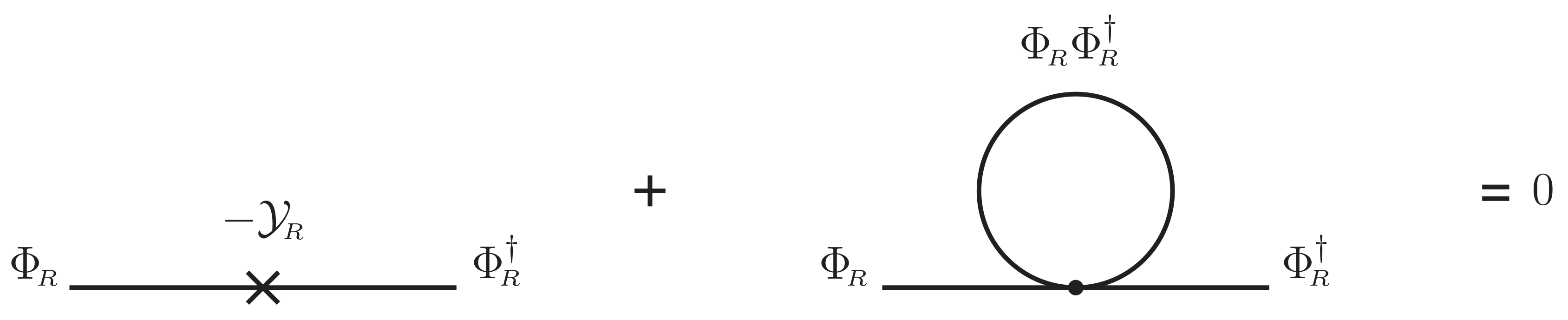
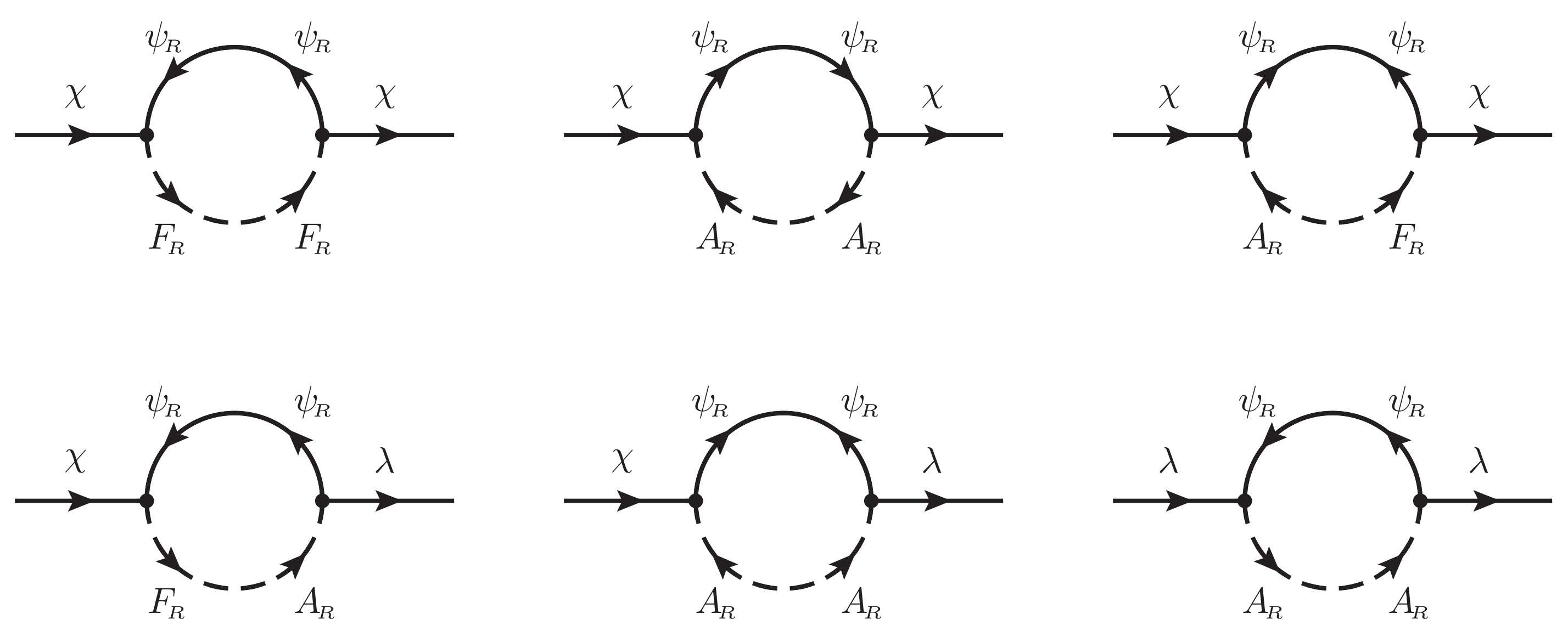
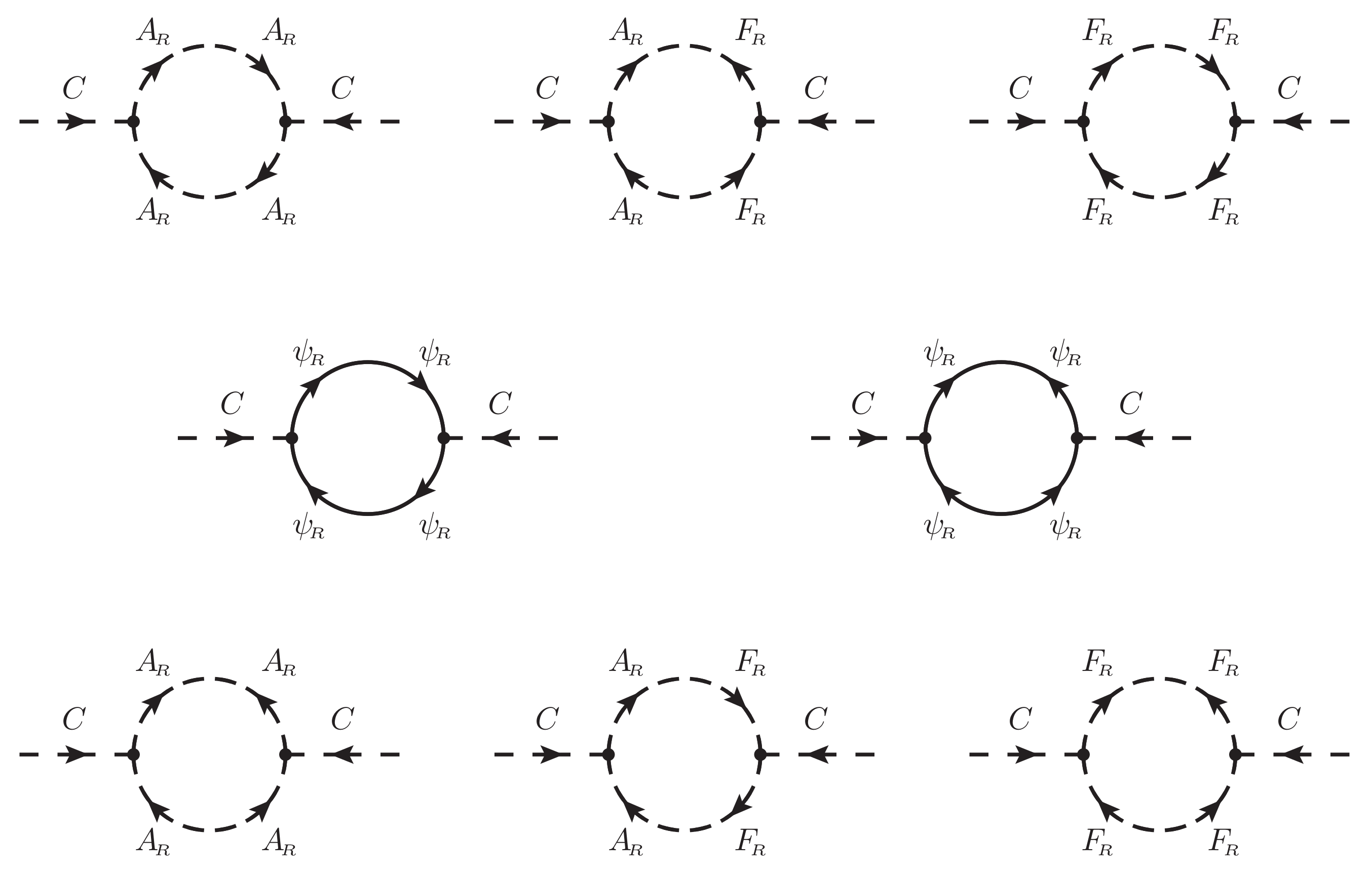
from the four-superfield interaction. The diagrammatic illustration of the renormalized superfield gap equation is given in
Figure 1. Note that results reported in Reference [
16] correspond to assuming
remains zero from the beginning, which will be shown to be a consistent solution. Our interest here is on solutions with nontrivial
.
We perform a supergraph calculation for
directly. The relevant superfield propagator is given by
where
and
. The necessary evaluation of
is much similar to previous cases [
14]. The result is given by
where the
denotes integration over Euclidean four-momentum
k with the measure
and
. Each of the five terms in the above expression comes exactly from the corresponding term in the superfield propagator. The
term vanishes upon integration. The others can be pull together to give the component gap equations as
Non-trivial solutions of the three coupled equations with nonvanishing and/or give supersymmetry breaking solutions, while nontrivial y value gives wavefunction renormalization to , which does not change the qualitative answer to whether supersymmetry breaking solutions with the soft mass generation exist. Our analysis will explicitly demonstrate that. However, we postpone the analysis of the nontrivial solution until after the discussion of the effective theory picture in the next section.
3. The Effective Theory Picture
Following the general effective theory picture of the NJL-type models, we modify the model Lagrangian by adding to it
where
U is an ‘auxiliary’ real superfield and the mass parameter
is taken as real and positive (for
). The equation of motion for
U, from the full Lagrangian
gives
where showing it as a superfield composite of
and
. The condition says the model with
is equivalent to that of
alone. Expanding the term in
, we have a cancellation of the dimension six interaction in the full Lagrangian, giving it as
Obviously, if
develops a vacuum expectation value (VEV), supersymmetry is broken spontaneously and the superfield
gains a soft supersymmetry breaking mass of
. The above looks very much like the standard features of NJL-type model. Notice that while
U does contain a vector component, its couplings differ from that of the usually studied ‘vector superfield’ which is a gauge field supermultiplet. That is in addition to having
as like a supersymmetric mass for
U, which can be compatible only with a broken gauge symmetry. As such, the model with superfield
U is not usually discussed. The superfield can be seen as two parts, as illustrated by the following component expansion,
where the components
C,
, and
N are the first parts which have content like a chiral superfield with, however,
C being real. The
factor is put to set the mass dimensions right. The rest is like the content of a superfield for the usual gauge field supermultiplet, with
D and
real. The effective Lagrangian in component form is given by
Notice that, like N and D have mass dimension two.
Under the symmetry, A and F have charge and . The superfield U is uncharged. However, components N, and carry nontrivial charges , and +1, respectively. For the case, there is an extra -number symmetry with common charge for all components. All components of U are not charged under the latter.
In accordance with the ‘quark-loop’ approximation in the (standard) NJL gap equation analysis and our particular supergraph calculation scheme above, we consider plausible non-trivial vacuum solution with non-zero vacuum expectation values (VEVs) for the composite scalars C, D and N. While N is complex, we can safely take to be real here. At least we can exploit the symmetry to absorb any phase at the expense of having a complex , the phase of which does not show up in the calculation. First note that scalar C couples to kinetic terms of components of ; hence contributes to a supersymmetric wavefunction renormalization of the latter. It is the supersymmetric part of , an unavoidable part of the one-loop supergraph in our gap equation calculation in the previous section. Again, we should go to the renormalized superfield in the following calculations, with renormalized mass m and coupling g. With and , we have and , corresponding to the supersymmetry breaking masses and of . In the former case, it gives a component term. Note that is the only VEV that breaks the symmetry, as C and D carry no charges, though both and break supersymmetry.
With propagators for the components of the renormalized ‘quark’ superfield
, as given in the
Appendix A, one can easily obtain the minimum condition for the effective potential following the Weinberg tadpole method [
21,
22]. Firstly, for
C-tadpoles, we have a
loop or in component form one from each of
,
, and
. Hence, we have up to one loop level
where
Next, the
-tadpole is given by
where
The
D-tadpole is given by
where
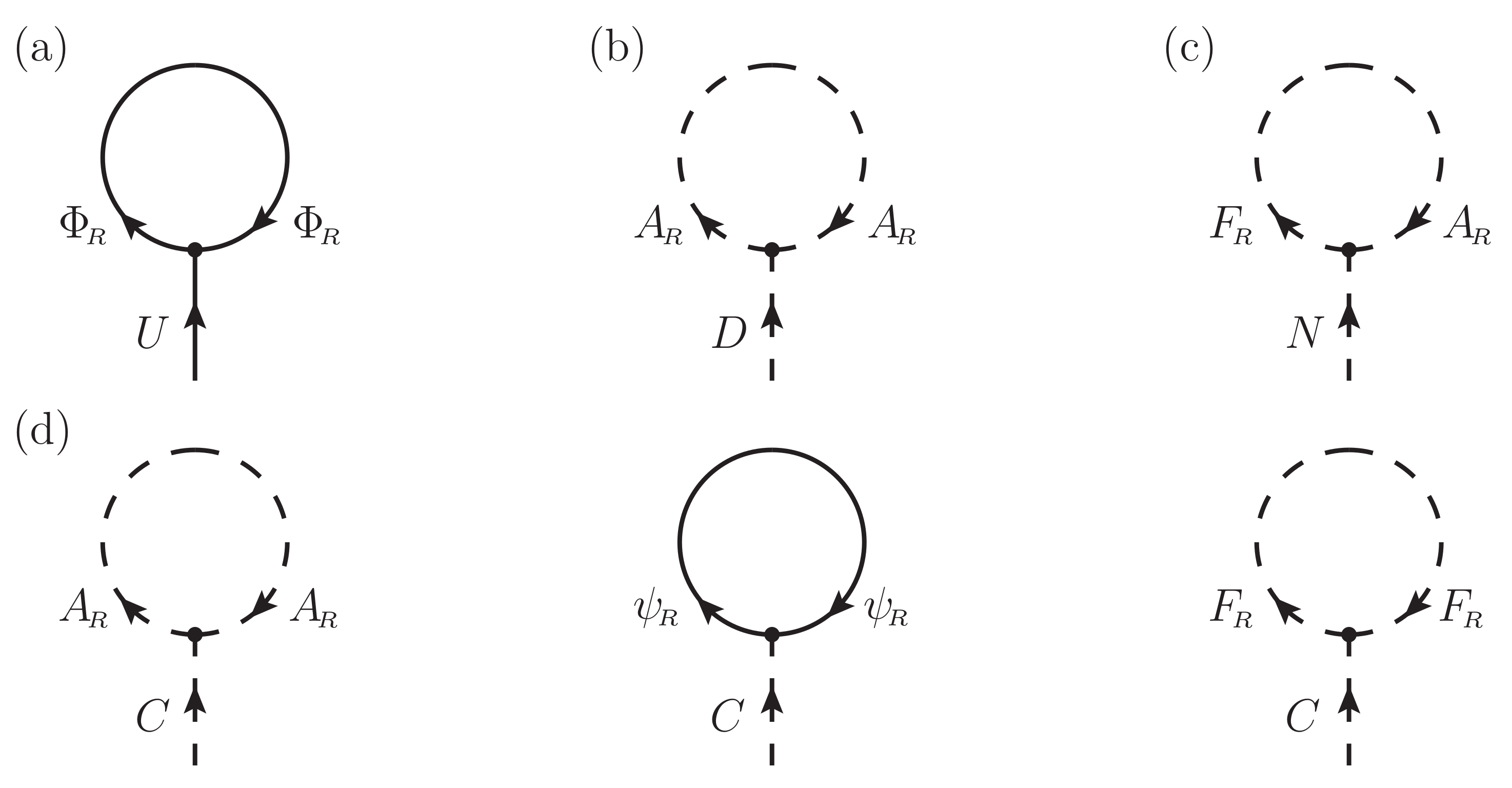
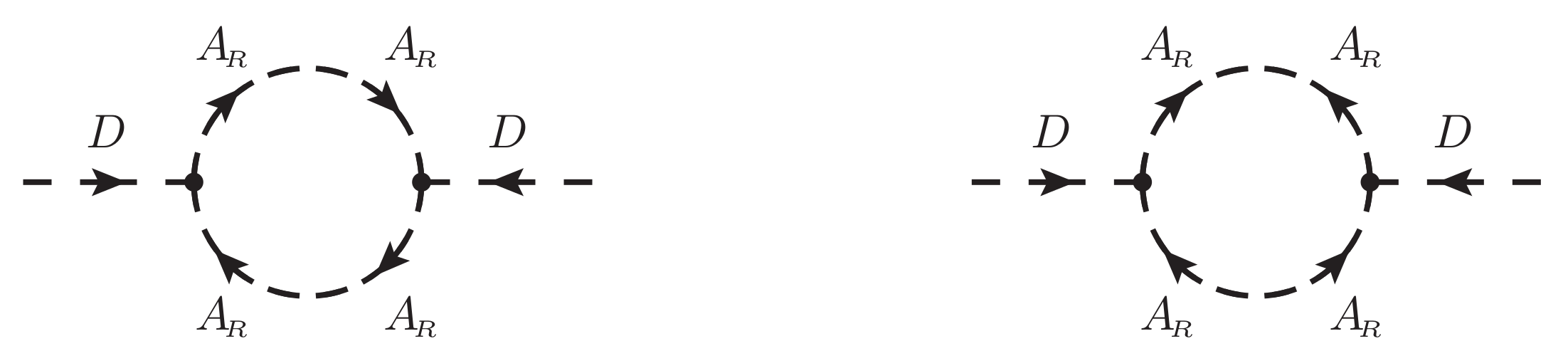
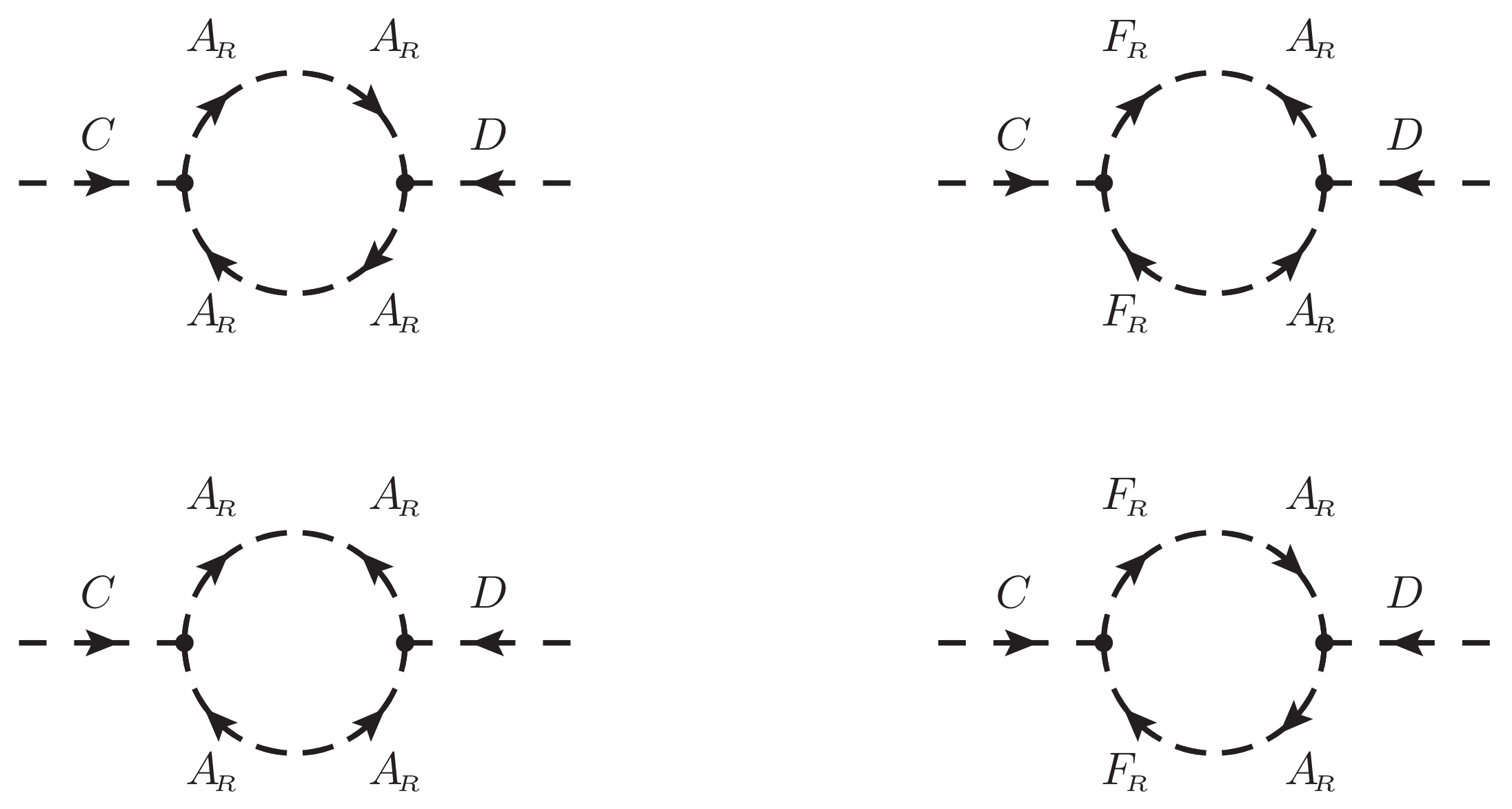
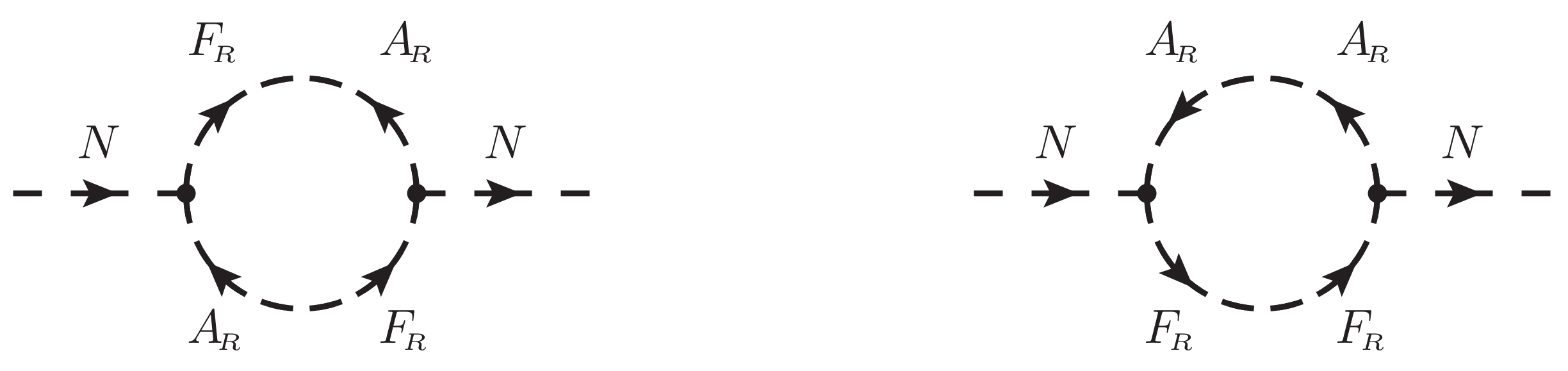
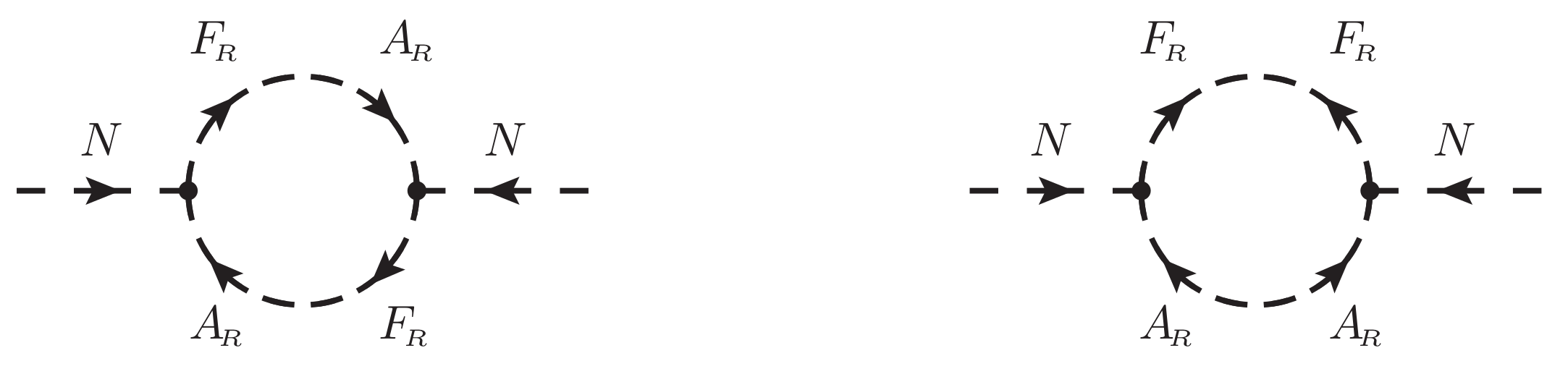
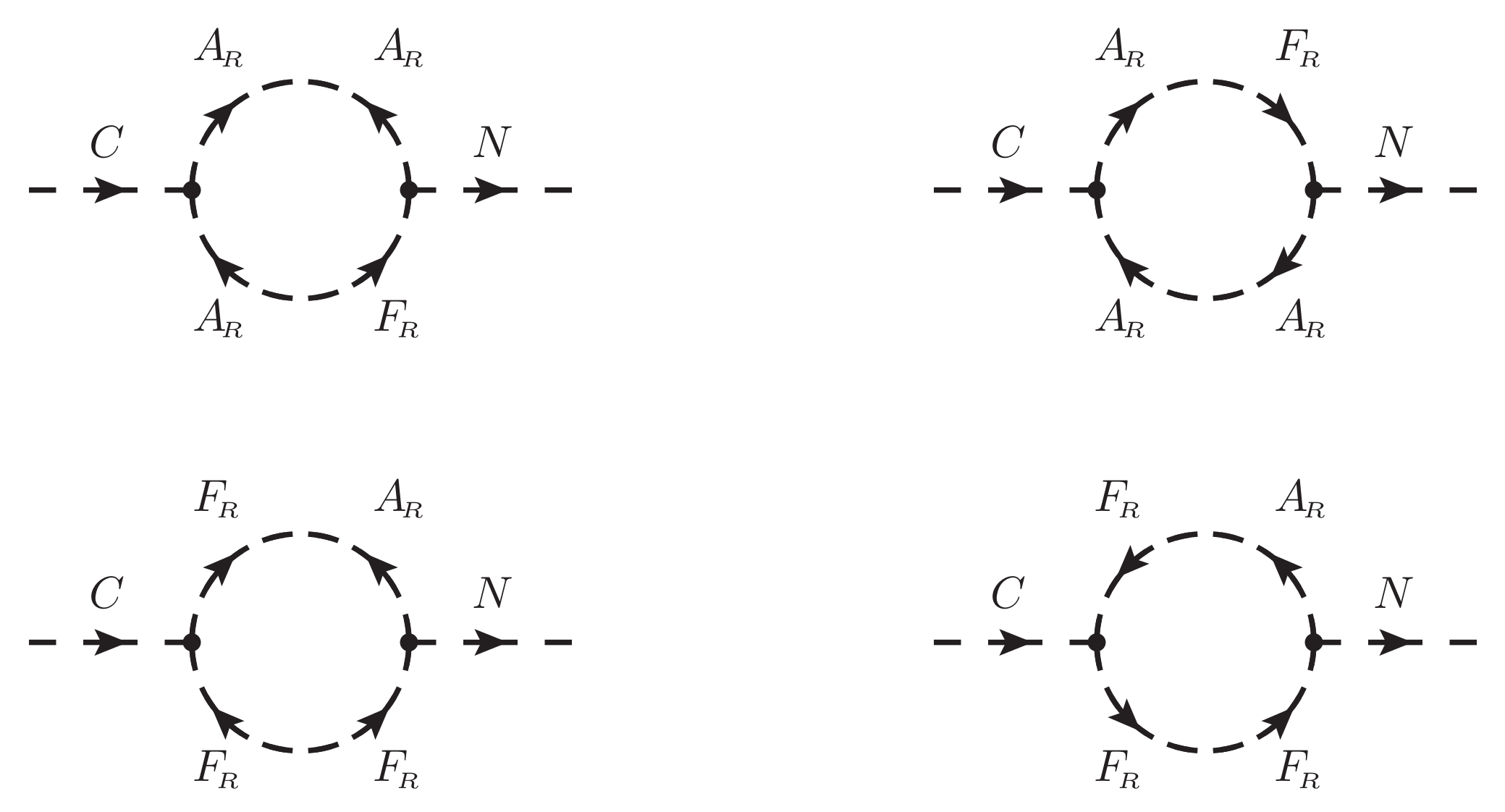
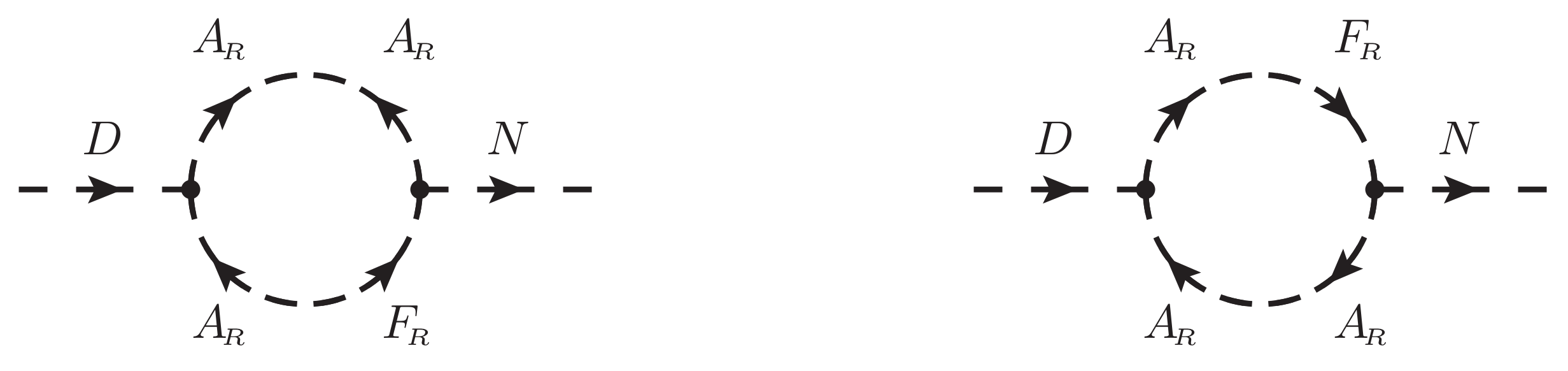
The tadpole diagrams are illustrated in
Figure 2. We look for vacuum solution with
for
. Firstly, note that the vanishing of
-tadpole is equivalent to
with
given by
; vanishing
D-tadpole gives
the vanishing
C-tadpole condition is
To get the physics picture clear, one can identify the soft masses generated for the superfield by and . We will explore nontrivial solutions for the soft masses below.
It is interesting to see that the effective potential analysis for (the components of) the composite superfield
U can be shown directly to be equivalent to the superfield gap equation, which we illustrated explicitly in Reference [
16] and duplicated here. In terms of the superfield, the potential minimum condition is given by
where
is the momentum integral of the
propagator loop (
cf. the first diagram in
Figure 2). Note that from the original Lagrangian with two-superfield composite assumed, we can obtain
, which is equivalent to
. The same loop integral is of course involved in both the gap equation picture and the effective potential analysis. The results here are in direct matching with the corresponding discussion for the NJL case presented in Reference [
12], though for a superfield theory instead. The component field effective potential analysis above really serves as a double-check of the superfield gap equation analysis of the previous section. In terms of component fields, we need the soft mass identifications above as well as
, or
.
4. Nontrivial Solutions
Let us pull together the gap equations in terms of
,
and
. We have
as a set of coupled equations to be solved simultaneously. The integrals are complicated expressions involving the two soft mass parameters. The third equation of
where independently gives the
y value for any solution of
and
. The trivial zero soft masses solution is consistent, as
vanishes in the supersymmetric limit. Note that the
y parameter does not correspond to any physical quantity and hence may be considered of little interest. The point of interest is if the nontrivial solutions of supersymmetry breaking masses
and
exist.
The first equation above gives
for non-trivial
, for the case of which we have
where
has been used to denote integral of the Feynman propagator for field of mass square
S and we have the scalar mass eigenvalues
As seen here, the presence of non-zero product splits the masses of the scalar and pseudoscalar part of A and produces mass mixing between them, giving the mass eigenvalues. The interesting point is that one only needs non-zero to have it; even a real value would do.
If we take
, we would have
and
The second soft mass gap equation becomes
which is not compatible with the first one (
unless
. It remains to be seen if there exist
solutions for some non-zero values of
m. After some algebra, one can rewrite the solution equations in the form
The two equations have the same form only, with the
variable coming in different signs. Moreover, both reduce to the same equation for the
at the
limit, which is the gap equation for the limiting case [
16]. Evaluating the integrals with model cutoff
, with all variables and parameters casted in terms of dimensionless counterparts normalized to
given by
,
, and
, the two equations are equivalent to
for
, respectively. We need simultaneous solutions for
s and
z for reasonable values of model parameters
G and
t. The two equations for positive and negative (but equal) values of
z of course collapse to one at
, which are the vanishing
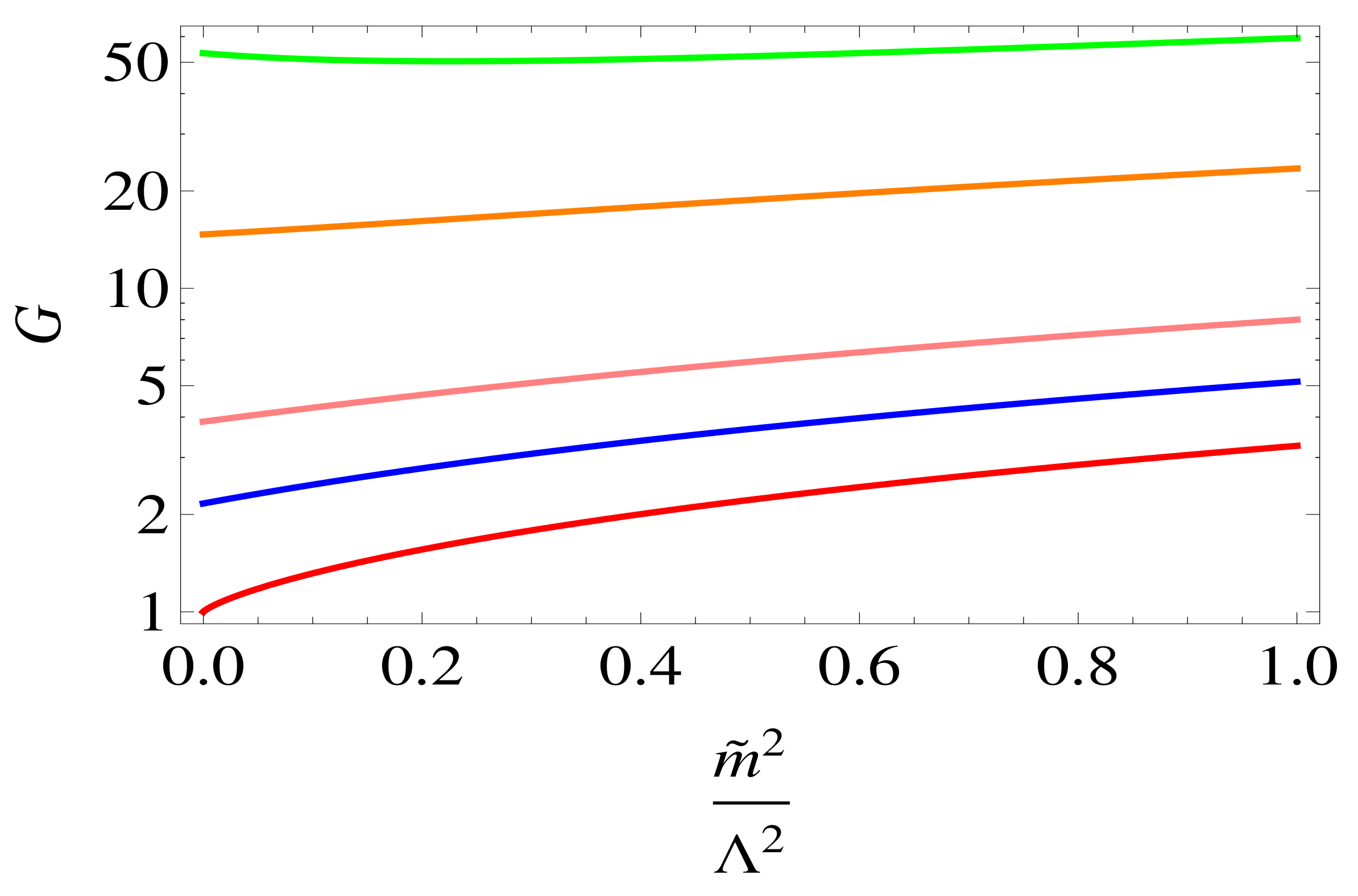
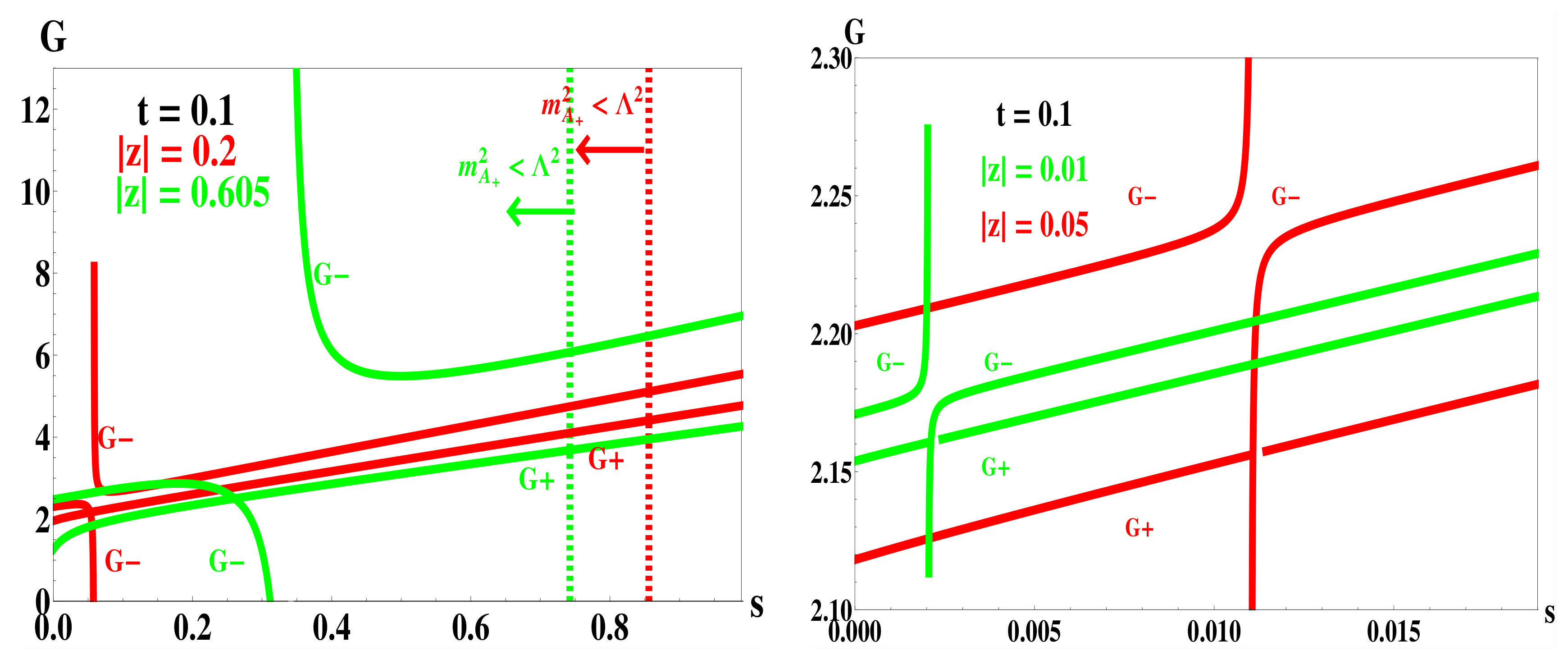
solutions. We present them in
Figure 3 for different values of supersymmetric mass
m, among which the case of
has been illustrated in Reference [
16].
Actually, in the
case, all the above integrals simplify analytically. In particular, we have
and
where (
is irrelevant). The masses in the Feynman propagators correspond to the scalar and fermion masses. It is interesting to note that for
, we have the simple result
, which is the same as the basic NJL model one except with the soft mass
replacing the (Dirac) fermionic mass (see for example Reference [
12]) if we take
as the four-fermion coupling in the model. Moreover, in this case, we have the gap equation for the renormalization factor, which is equivalent to the vanishing
D-tadpole condition
, giving
hence
. The wavefunction renormalization factor is
, of order one but tangible. This is a clear indication of the nonperturbative nature of the results and that there is nothing improper in the analysis. For more details, we see that solutions for nontrivial
for the case are given by the reduced form of Equation (
34) as
obviously giving solution for
for the strong enough coupling
. It can be seen from the numerical plot that the value of the
solution rises fast with increasing
G. However, nonzero
t has a strong limiting effect. It increases the critical coupling needed for a nontrivial solution to
s very substantially. In fact, taking the limit
, the equation becomes
, which gives the critical coupling
as a function of
t. It can be seen then as
t increases from zero,
decreases and reaches vanishing value ( i.e.,
) at a critical
t value of about
, beyond which no coupling
G will be strong enough to break the supersymmetry and generate the soft mass.
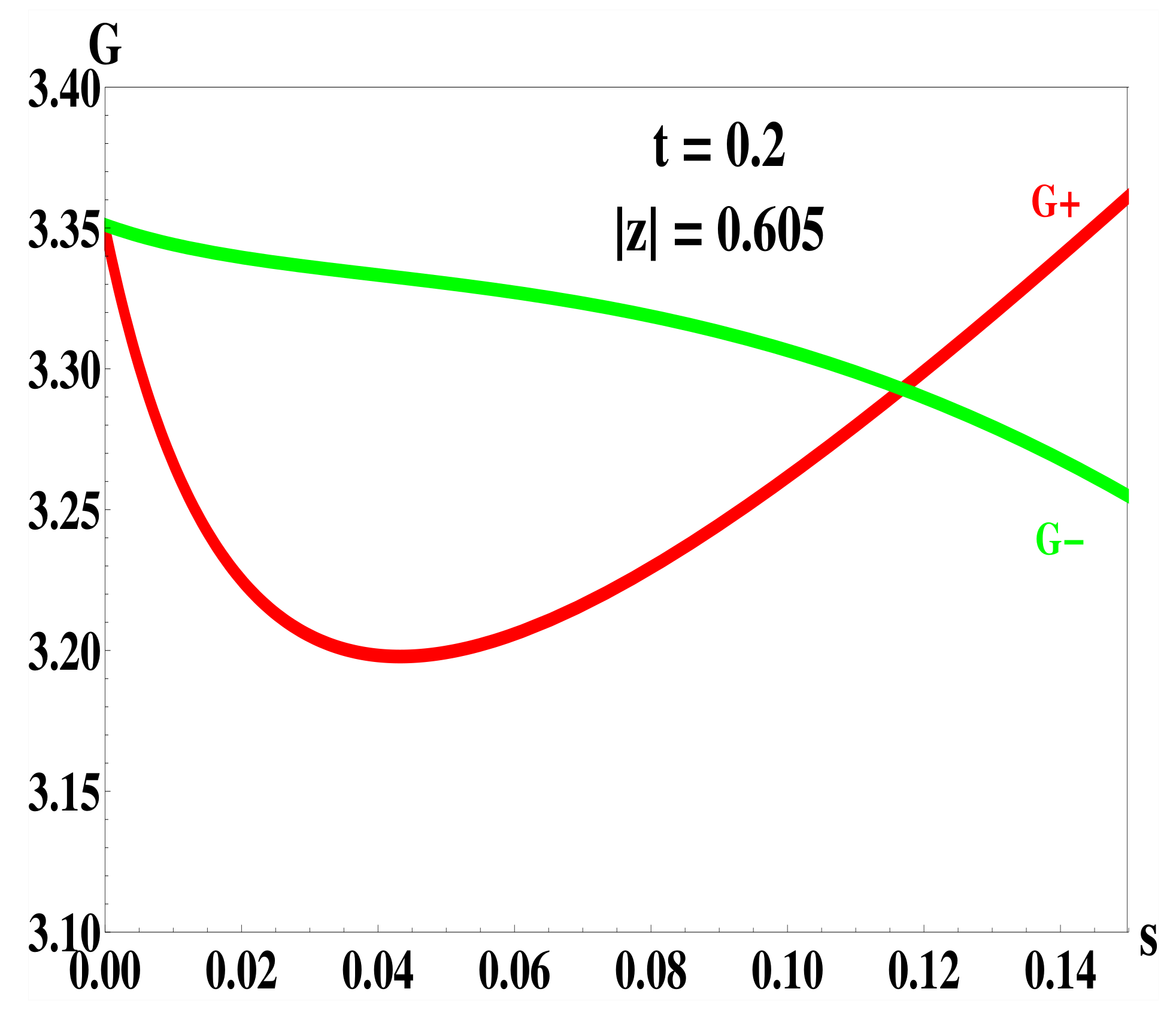
Looking for solutions with nontrivial
is more tricky and requires a very careful analysis scanning the numerical results. Again, we check plots of the effective coupling
G as given in Equation (
34) versus
s simultaneously for positive and negative values of
z of fixed magnitude, at a fixed input
t value. Numerically, within the window of interest, the intersection of the two curves (dubbed
and
, respectively) gives a solution. Only one then has to numerically scan the plots of the
and
curves to see all the solutions. The window of interest is restricted to positive
G value and
plus the extra constraint of both of the mass eigenvalues of the scalar states in
to be within the cutoff
[
cf. Equation (
30)]. This is the generalization of
to the nontrivial
,
case. The constraint is given by
It is strong. For any t value, it first restricts of interest to . Close to the upper limit means s admissible has to be very small. So, the constraint may cut out quite a range, if not all, of the s value of interest. We find that a solution exists in general, though some of the features of the solution locations are not somewhat peculiar and not easy to understand.
We scanned the effective coupling
G versus
s,
, and
t plots to study the behavior of the intersecting point solutions and checked for consistency. The results are as follows: for somewhat large
t, solution exists only at large enough
, for example the minimal
value for solution at
is about 1. Such a solution certainly violates (
35). Actually, solution satisfying the constraint shows up only for
t below about
, which also guarantees the
curve to be smooth, at least within the numerical window of interest. Moreover, the
G versus
plots for any
t and
s essentially always give two solutions for (nonzero)
. The larger value
solution may not even correspond to a larger coupling
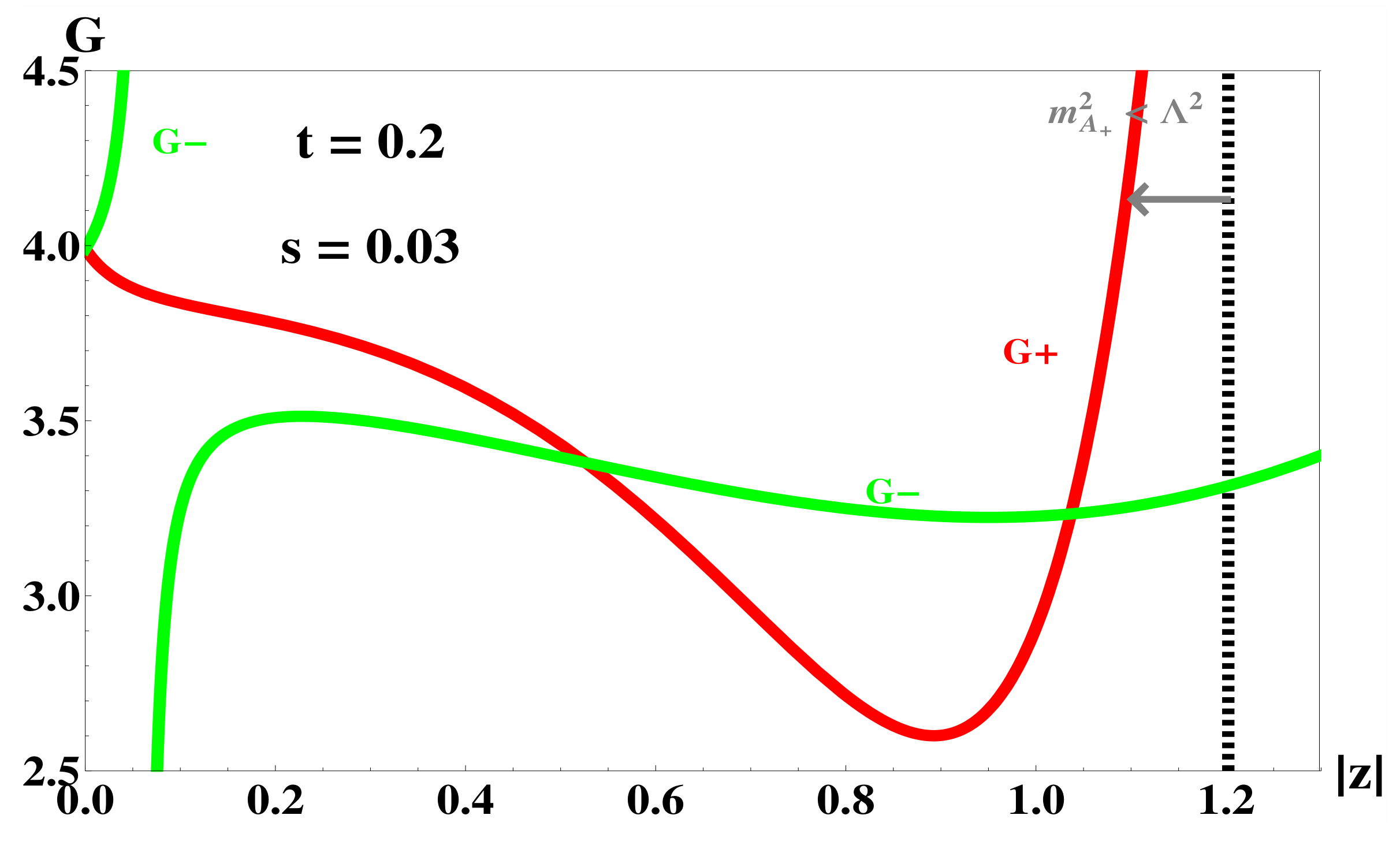
G, as shown in
Figure 4. Furthermore, a
G value smaller than the
solution is typical. Another illustration of the same coupling value issue is given in
Figure 5 in which we show
G versus
s plots with two intersecting points, particularly including one with
. Such non-zero
with
solutions are not available for
t less than about
. For the latter case, the
G versus
s plots give a single intersecting point. In
Figure 6, we show comparisons of the intersecting point solutions at the same
t. We have again a solution with larger values of the parameter,
s and
, for the masses generated corresponding again to smaller coupling
G. Recall the standard, obviously physical sensible, solution features of the NJL-type model which our
solutions shown above bears, is that nontrivial symmetry breaking mass solution exists for large enough coupling beyond a minimal critical value and increases with the coupling. The
‘solutions’ behave, however, in ways difficult to understand. A more careful inspection of the various plots shows that the
curve in particular has strange singularities. In fact, each intersecting point ‘solution’ corresponds to a pair of
s and
values, with the
curve either diverging at a smaller
s or at a smaller
value. It sounds like in order to ‘get’ to that ‘solution’, one has to bring the coupling value all the way to positive or negative infinity and back. However, it should be noted that nonzero
increases the mass of one of the smaller mode but decreases that of the other one [
cf. Equation (
30)]. It is not so trivial to consider if larger
or
should really be considered to be giving a larger supersymmetry breaking effect. Another noteworthy feature is that among solutions of fixed
, a larger
t generally tends to give smaller
s or
, and among solutions of fixed
s, a larger
t generally tends to give larger
; larger
t always tends to increase coupling
G required for a solution. Recall that the
or
t value also suppresses the mass generation in the
case, but
gives certainly no
solution.
5. The Goldstino and Composite (Super) Field Dynamics
Some components of the superfield
U, which are auxiliary as introduced, develop kinetic terms through wavefunction renormalizations in the effective theory below the cutoff
. We trace them here through checking of the relevant loop diagrams, based on the effective Lagrangian in terms of components of
and couplings all having the
wavefunction renormalization from the gap equation result incorporated (cf. equations in
Appendix A). The analysis focuses on results at the supersymmetry breaking vacuum solutions, i.e. non-zero
with zero or nonzero
. We only sketch the key results here, leaving some more details in
Appendix A.
We start with the two-spinors
and
. The chirality conserving part of the self-energy diagrams gives rise to kinetic terms. We can see that all terms are nonzero in the presence of nonvanishing
, while the
-
kinetic mixing vanishes at
. Full results are presented in
Appendix A. To look at the mass values is complicated. One needs first to take a unitary transformation on the hermitian matrix and kinetic terms to diagonalize it. Denote the eigenvalues by
and
, and the diagonalizing matrix by
T. The canonically normalized fermionic modes are given by
Only the mass matrix for the canonical modes can be diagonalized to give the mass eigenvalues. The mass matrix
for
and
is hence given by
where
, the first part being the tree-level mass while the last is the matrix for chirality-flipping pieces of self-energy diagrams. We have
In the case that the matrix of kinetic terms has the full rank, a zero determinant of
or equivalently
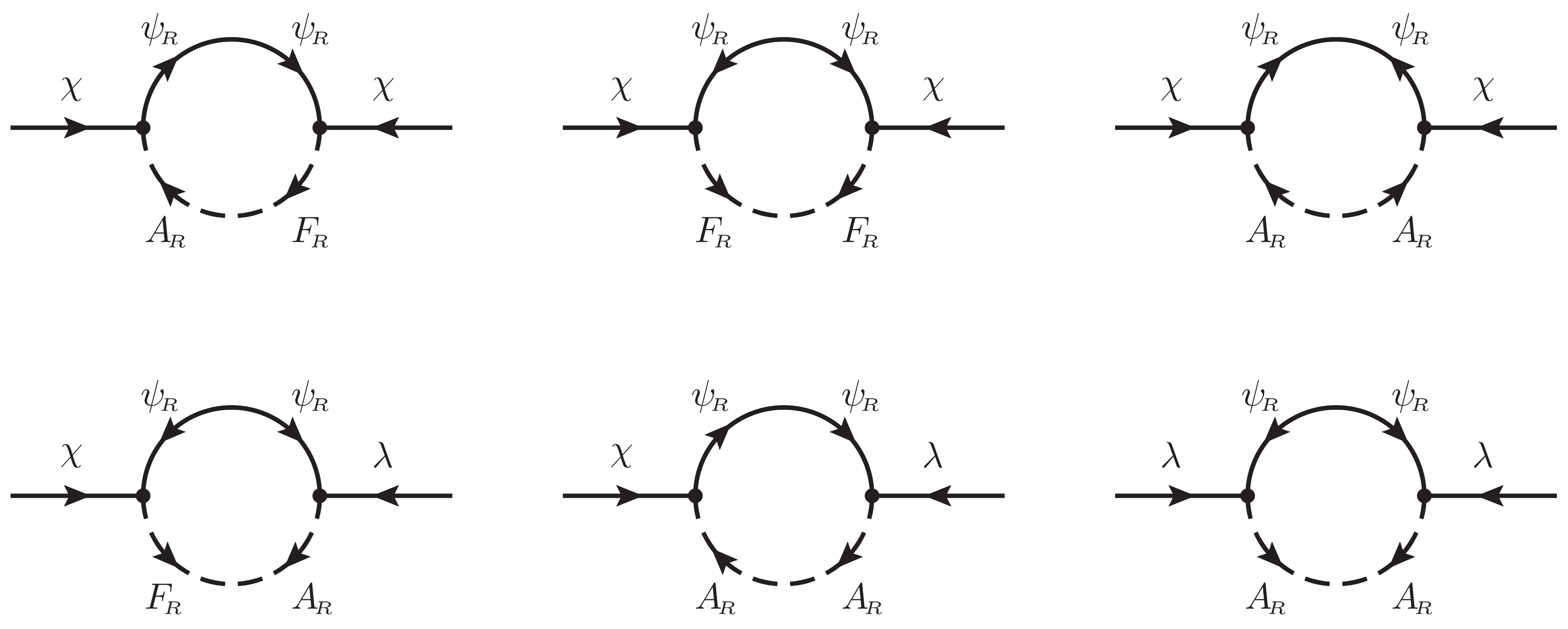
shows the existence of a Goldstino, which is expected as the Nambu–Goldstone fermion corresponding to the supersymmetry breaking. We are mostly interested only in the kind of qualitative questions here, which saves us from having to deal with the diagonalization of the matrix of kinetic terms. For the chirality-flipping diagrams (see
Figure 7), dropping the
p-dependent parts, we have the mass terms
where
is the integral of the product of three Feynman propagators with the mass-squares as specified, and we have expressed the results with the
and
integrals of the gap equations (cf. Equations (
31) and (
29)). Applications of the gap equations kill the term with the then vanishing
factor and has the
term canceling the tree-level term in the mass matrix
, the determinant of which is then exactly zero. Hence, we have established the existence of a Goldstino mode for the supersymmetry breaking solution with
. For the
case, only the off-diagonal terms are nonzero, which is a result one can see even simply from the
symmetry considerations. The latter has been presented in [
16], with the result that the tree-level Dirac mass is exactly canceled by
-matrix upon application of the corresponding gap equation, giving
as the zero matrix. No matter
or not, the qualitative feature does not change. Again, we have the Goldstino. Supersymmetry is really a local/spacetime symmetry. The Goldstino would be eaten up by the gravitino, which would then be massive.
The spin one vector boson
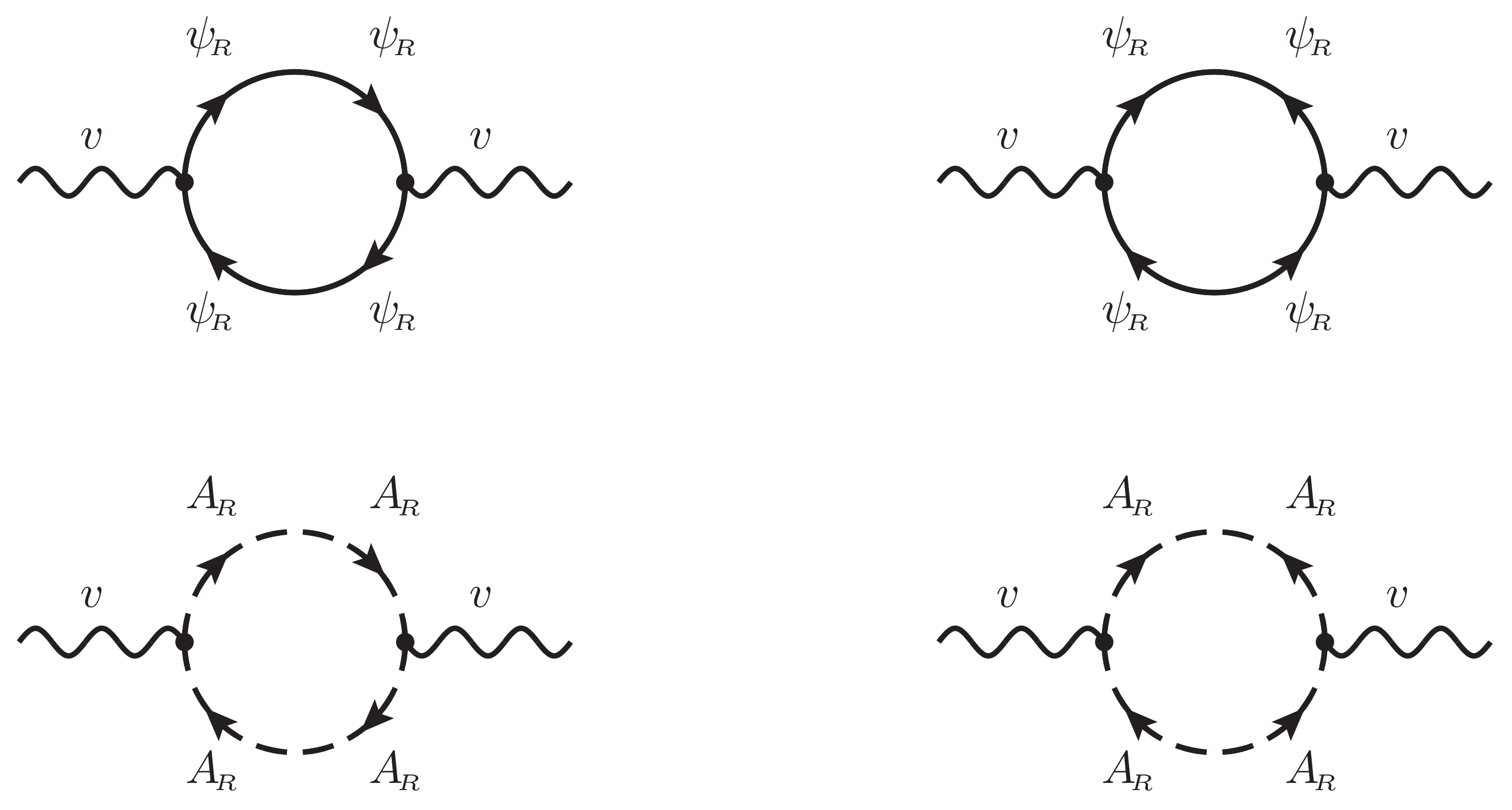
is an important characteristic of the model. The proper self-energy diagrams (see
Figure 8) for the vector mode give the result
with
denoting the integrals with product of
n Feynman propagators. There is also a tree-level mass-squared term of
to be added. It sure indicates that we have properly behaving kinetic and mass terms (note our metric convention).
The other scalar modes also acquire kinetic and mass terms accordingly. Mode mixings, however, make the result a lot less transparent. Details are given in
Appendix A.
6. Conclusions
We have studied the supersymmetric NJL model with a composite real superfield proposed in Reference [
16] in a more general and complete scheme, by admitting a supersymmetric mass term for the chiral superfield while considering the most general form of the VEV for the composite superfield, hence allowing the soft supersymmetry breaking components of
as well as
. Note that admitting the supersymmetric mass term actually reduces the symmetry of the model. The necessary conditions for the soft mass generation, and the basic features of the nontrivial solutions were discussed. We also calculated the contributions of all possible one-loop diagrams of component fields. The most general expressions for the superfield propagator were given in
Appendix B. The analysis is much more technically involved compared to the previous limiting case though the basic approach is the same. However, the full analysis has quite interesting new features, as well as further nontrivial solutions.
The full analysis of all nontrivial vacuum solutions is difficult, and we have mostly to rely on numerical scanning of the multi-dimensional space for the parameters. There are some important general features to note. Firstly, no solutions are possible for . The critical coupling bringing in plausible nontrivial solutions increases substantially with increasing in general. When the latter value gets beyond a certain limit, solutions with nontrivial soft mass solutions no longer exist. For nonzero m within the limit, we find solutions in general, from the numerical scanning. There are indications for an solution to be preferred over the in the sense that assuming fixed m and values, the coupling value for an solution seems to be always lower than the one. For admissible solutions at a fixed coupling, however, the analysis cannot tell which solution would be more preferable.
We also calculated the contributions to the two-point functions for the component fields from all possible one-loop diagrams. All the scalar components become dynamical. The fermion mass matrix, while getting more complicated, clearly gives a zero eigenvalue for a Goldstino state. There is no indication of any problem. Some details and discussions are given in
Appendix A. The results are useful for further analysis of the model and plausible applications. Meanwhile, it is interesting to note that applications of supersymmetric NJL models to condensed matter physics have been studied [
23]. Studies of our model in the direction may also be considered.
Finally, we emphasize that with the modern effective (field) theory perspective, it is the most natural thing to consider any theory as an effective description of nature only within a limited domain/scale. Physics is arguably only about effective theories, as any theory can only be verified experimentally up to a finite scale, and there may always be a cut-off beyond that. Having a cutoff scale with the so-called nonrenormalizable higher dimensional operators is hence in no sense an undesirable feature. Model content not admitting any other parameter with mass dimension in the Lagrangian would be very natural. Here, we have illustrated a model that gives rise to nonzero values for all admissible soft supersymmetry breaking masses for the single superfield, including part, dynamically. Models of the kind may have a chance to be the source for the soft supersymmetry breaking in a supersymmetric standard model.