


Abstract
The aim of this work is to study a scalar-tensor theory where owing to Palatini’s variational method the space-time is endowed with a geometrical structure of Weyl integrable type. The geometrical nature of the scalar field is related to the non-metricity so that the theory is known as geometrical scalar-tensor. On the framework of Weyl transformations, a non-minimally coupled scalar-tensor theory on the Jordan frame corresponds to a minimally coupled Einstein–Hilbert action on the Einstein frame. The scalar potential is selected by the Noether symmetry approach in order to obtain conserved quantities for the FRW cosmological model. Exact solutions are obtained and analyzed in the context of the cosmological scenarios consistent with an expanding universe. A particular case is matched in each frame and the role of scalar field as a dark energy component is discussed.
1. Introduction
Although Einstein’s theory of gravity is constantly being supported by current observational data [1], recent issues such as the accelerated expansion of the Universe and the possible existence of dark matter, can not be fully explained only based on general relativity. In this sense, there have been considerable efforts in the development of alternative theories to Einstein’s theory [2]. In particular, there is a great interest in investigating new possibilities that include changes in the theory of general relativity [3,4].
Scalar-tensor (ST) theories are among the proposed extensions of Einstein’s theory [5,6,7,8]. A geometrical approach to theories with non-minimal coupling is particularly interesting. According to it, by considering the Palatini variational method a not necessarily Riemannian compatibility condition between the metric tensor and the affine connection—initially taken as independent variables—is obtained [9,10]. Furthermore, it was shown that the geometry that naturally appears when a symmetric affine connection is regarded is the so called integrable Weyl geometry, where the scalar field takes part together with the metric tensor in the description of the gravitational field. This brings a geometrical origin for the scalar field present in the theory, which naturally define the known as geometrical scalar-tensor theories [11,12].
The potential term is obtained through the Noether symmetry approach, which allows making a choice that leads to a quantity conserved in the model [13,14,15,16]. Such a conserved quantity will imply the existence of a cyclic variable useful to find exact solutions for the field equation. This approach has already been used in choosing for models of tensor-scalar theories that could describe the dynamics of the expanding universe, as dark energy models [17,18,19,20].
In the organization of this work the action of the model is presented in Section 2. In Section 3 the field equations for a spatially flat Friedmann–Robertson–Walker (FRW) are obtained from a point-like Lagrangian. Noether symmetry approach is considered in the Section 4 to specify the self-interacting potential of the scalar field. In Section 5 the field equations are integrated and the cosmological solutions in each frame are fulfilled in the Section 6. The particular case is seen in Section 7. The paper is closed with the conclusions in Section 8.
We will adopt natural units, such that . Besides that, we will take the metric signature .
2. The Model and the Weyl Transformations
A well-known scalar-tensor theory called dilaton gravity can be expressed through the following action
where represents a scalar field, its self-interacting potential and a dimensionless coupling constant. Furthermore, R is the Ricci scalar, calculated with the affine connection . We have represented to write the Action on the Jordan frame.
When Palatini variation is used in non-minimally coupled scalar-tensor theories, as this one, the affine connection is not the same of the Levi–Civita connection, expressed in terms of the Christoffel symbols. This is the main difference that arises between the Palatini variation method and the said metric variation. Considering the affine connection and the metric tensor as independent variables in the action extremization, the variation with respect to connection yields a relation between affine connection and the metric tensor that can be written as
widely used in the literature that studies the so-called integrable Weyl manifolds, or non-metricity geometries [21,22]. That is, as a consequence of Palatini variation, the geometric structure of space-time, manifested through the affine connection, is given dynamically by the action, instead of being imposed a priori, as in the case of metric variation. So, the theory is called a geometrical scalar-tensor, because the scalar field has a geometric origin, related to the non-metricity of the manifold.
It is easy to see, after some algebraic manipulations of Equation (2) that the affine connection takes the following form
where represent the Christoffel symbols. Both Equations (2) and (3) are invariant by Weyl transformations
where f is a arbitrary scalar function, or a gauge. It is possible choose a f that leads Equation (1) to the Einstein frame
where , because the Ricci tensor is invariant over Weyl transformations, but Ricci scalar is not. We have seen that the action Equation (1) corresponds the well-known action Equation (6) by Weyl transformations. Both theories are extensively studied in the literature, although the relationship between them is not so approached from the geometric point of view. In addition, both the scalar field and the scalar potential are entered by hand. In this work we are using the methods mentioned in the references to justify both the origin of the scalar field and the choice of the scalar potential.
Let us obtain the field equation by performing the variation with respect to
where is the energy-momentum tensor of the scalar field
However, in order to identify the Einstein tensor calculated with the Christoffel symbols and to define an effective energy–momentum tensor gathering the scalar field terms, we need to express Equation (7) as follows
where and are the usual Ricci tensor and Ricci scalar calculated with metric connection, and we have defined the effective energy–momentum tensor
which by using Equation (8) can be expressed simply as follows
Furthermore, by performing the variation of the action with respect to the scalar field , we obtain the following field equation,
3. Pointlike Lagrangian and FRW and Klein-Gordon Equations
We are interested to analyze a homogeneous and isotropic universe described by the spatially flat Friedmann–Robertson–Walker metric
Besides that, in order to not spoil the homogeneity and isotropicity, we require that . Therefore, according to the metric Equation (13) the kinetic term of the scalar field will reduce to
where dot means derivative with respect to coordinate t. In terms of the metric Equation (13) the Ricci scalar will be expressed by
In this way, by using Equations (14) and (15) in Equation (1), and that , we will have
where we have defined as the 3-volume
The Equation (16) can be integrated by parts to separate terms of total derivative. Thus, by running this procedure we will get the following reduced action
Thus, after neglecting surface terms, we obtain the pointlike Lagrangian
From the Euler–Lagrange equation for a applied to Equation (19),
we obtain the acceleration equation
where is the Hubble parameter. By imposing that the energy function associated with Equation (19) vanishes,
we have the Friedmann equation,
In Equations (21) and (23) the energy density and pressure of the scalar field read
in accordance to the energy-momentum tensor in Equation (11). It is useful remember that and when we use a comoving frame and, futhermore, we can remember the identity . Now, from the Euler–Lagrange equation for applied to Equation (19),
we get the Klein–Gordon equation as follows
in accordance to the scalar field equation in Equation (12).
4. Noether Symmetry
In this section we shall apply the Noether symmetry approach in order to constraint the function of the self-interaction potential. We begin by considering the infinitesimal generator of symmetry
Here and depend only on the scale function a and on the scalar field . The condition for the existence of a Noether symmetry for the point-like Lagrangian is
This condition implies a vanishing Lie derivative of the Lagrangian with respect to the vector field [20]. The symmetry condition Equation (29) with respect to the vector field Equation (28) when applied to Equation (19), leads to the system of coupled partial differential equations
Equation (30) can be written as
where we have defined . The differentiation of the left-hand side of the above equation with respect to a leads to the following differential equation
whose solution is
where is arbitrary function. From Equation (31) together with Equation (36) we have
The differentiation of the above equation with respect to a leads to the following differential equation
whose solution is
where is an arbitrary function and n is not specified, it can assumed some value which will depend on the two remaining equations. Inserting Equation (39) into Equation (37) we have that
is a constant. The Equations (32) and (33) admit the solution
only if , this implies that
where is a constant, and Equation (30) reduces to
whose the solution is
where is a constant. Because that, the action Equation (1) could take the following form
while in the Einstein frame the action Equation (6) becomes
By the way, corresponding to the above solution a conserved quantity associated to the Noether symmetry is
In the next section, we shall look for analytical solutions.
5. Solutions of the Field Equations
For the solutions of the field equations we rewrite the point-like Lagrangian Equation (19) in terms of another variables. This is done in order to make easier the integration of the field equations. The knowledge of a Noether symmetry connected to V implies that there exists in the configuration space a coordinate transformation where one coordinate is cyclic. The following system of differential equations is related to the coordinate transformation
where and are the new variables linked to the old ones, a and . In this transformation z is the cyclic coordinate. It is worth to remember that due to Equations (42) and (44), we have
Thus, the system of differential equations above takes the form
whose solutions are given below
It is also useful to have expressions for and ,
By taking into account these transformations, we get the following expression to Equation (19)
where we have defined the parameters
The field equations in the new variables are obtained from the Euler-Lagrange equations associated with the Lagrangian and read
where is the constant of motion Equation (48) rewritten in the new variables. This agrees with the fact that z been a cyclic coordinate, implying that the momentum canonically conjugate to the z is conserved
Therefore,
Another equation follows from the energy function associated with the Lagrangian Equation (54)
It is easy to observe that the above equation is equivalent to the Friedmann equation in the former variables. Note that Equations (56), (57) and (61) compose a system of three differential equations for u and z which are only two dynamical variables. To obtain the solutions of these equations, we shall isolate from Equation (56),
and to substitute in Equation (57),
We can write the equation above in the following canonical form
where we have defined the parameters and as
which we used the definitions in Equation (55). The ODE Equation (64) allows the solution given below
where is arbitrary constant of integration. We shall take . In order to get by integrating Equation (62), we will handle the cases for each sign.
5.1. Case :
This case can be considered if
Therefore, in this case, Equation (67) becomes,
In terms of the original variables and , we have
and,
5.2. Case :
This case can be considered if
Therefore, in this case, Equation (67) becomes,
In terms of the original variables and , we have
and,
In a nutshell, we have this set of solutions,
Besides that, we can write simply how,
6. Cosmological Solutions in Each Frame
In this section we shall give the expressions for the scale factor, Hubble and deceleration parameters in the Jordan and Einstein frames. The solutions for in the Jordan frame give oscillatory behaviors which are not interested in the cosmological sense so that we shall neglect them in this section.
6.1. Jordan Frame
On the basis of the solutions for the scale factor in the Jordan frame below
we can obtain the following Hubble parameter
Furthermore by considering the definition of the deceleration parameter
its expression becomes
6.2. Einstein Frame
In the Einstein frame the scale factor is obtained through the Weyl transformation
which implies
From the knowledge of the scale factor the Hubble and deceleration parameters can be obtained, yielding
Here it is important to remember that the correspondence between the scale factors in both frames are
7. A Particular Case:
We would like to analyze the solutions in the case where , since it is a very common case in the literature, a minimally coupled scalar-tensor theory in the Einstein frame.
To begin with, let us write below the solutions for the scale factor Equation (83), Hubble parameter Equation (84) and deceleration parameter Equation (86) in the Jordan frame, with :
In the Einstein frame the corresponding set of expressions which follows from Equations (88)–(90) for reads
Jordan Frame vs. Einstein Frame
Here we shall analyze the solutions which are compatible with an expanding universe from the expressions given above for the case of . For the Jordan frame only the solution for the scale factor implies an expanding universe. On the other hand, in the Einstein frame both solutions for the scale factor are possible solutions for an expanding universe. We shall analyze here the scale factor in the Einstein frame since it corresponds to the scale factor in the Jordan frame.
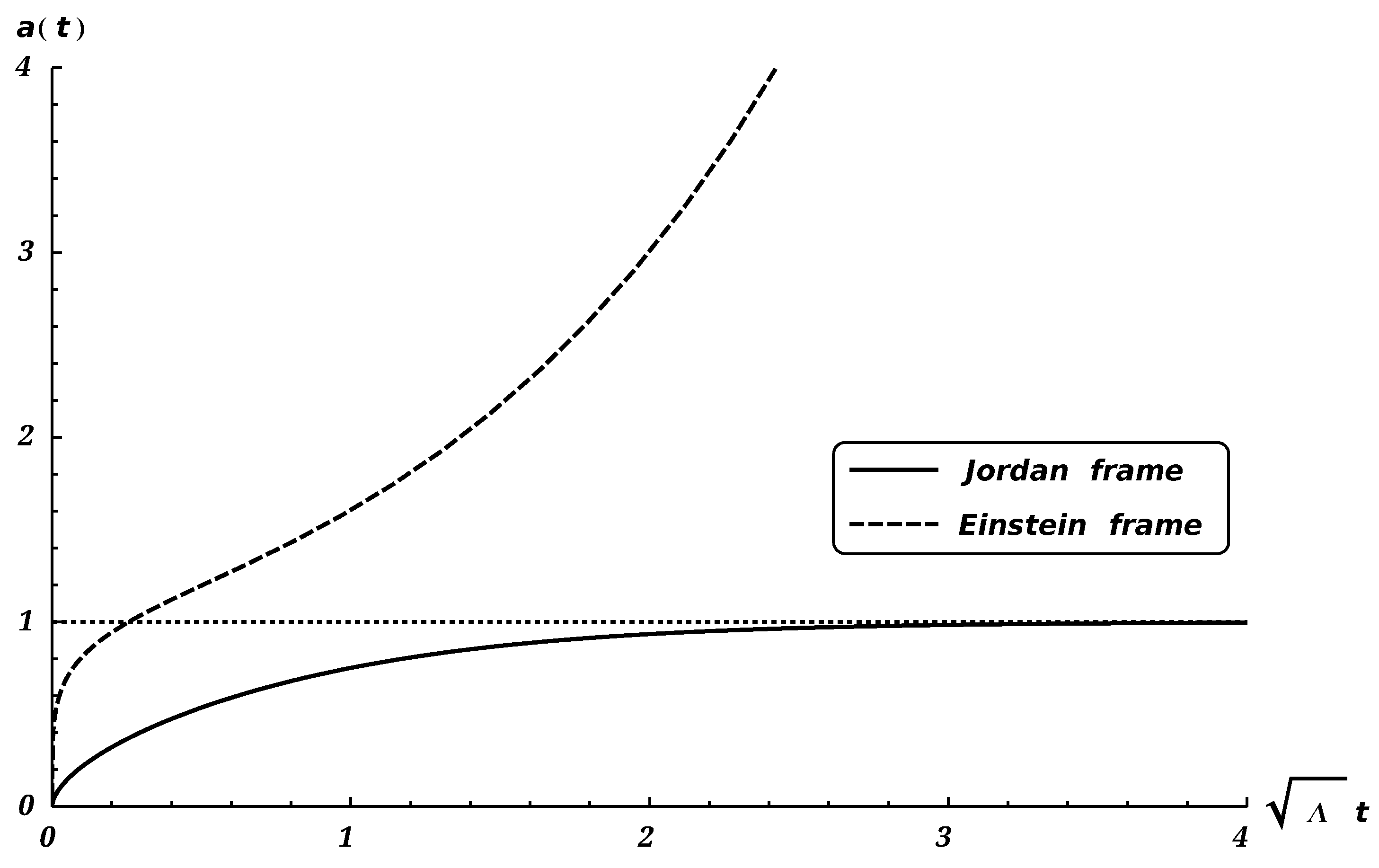
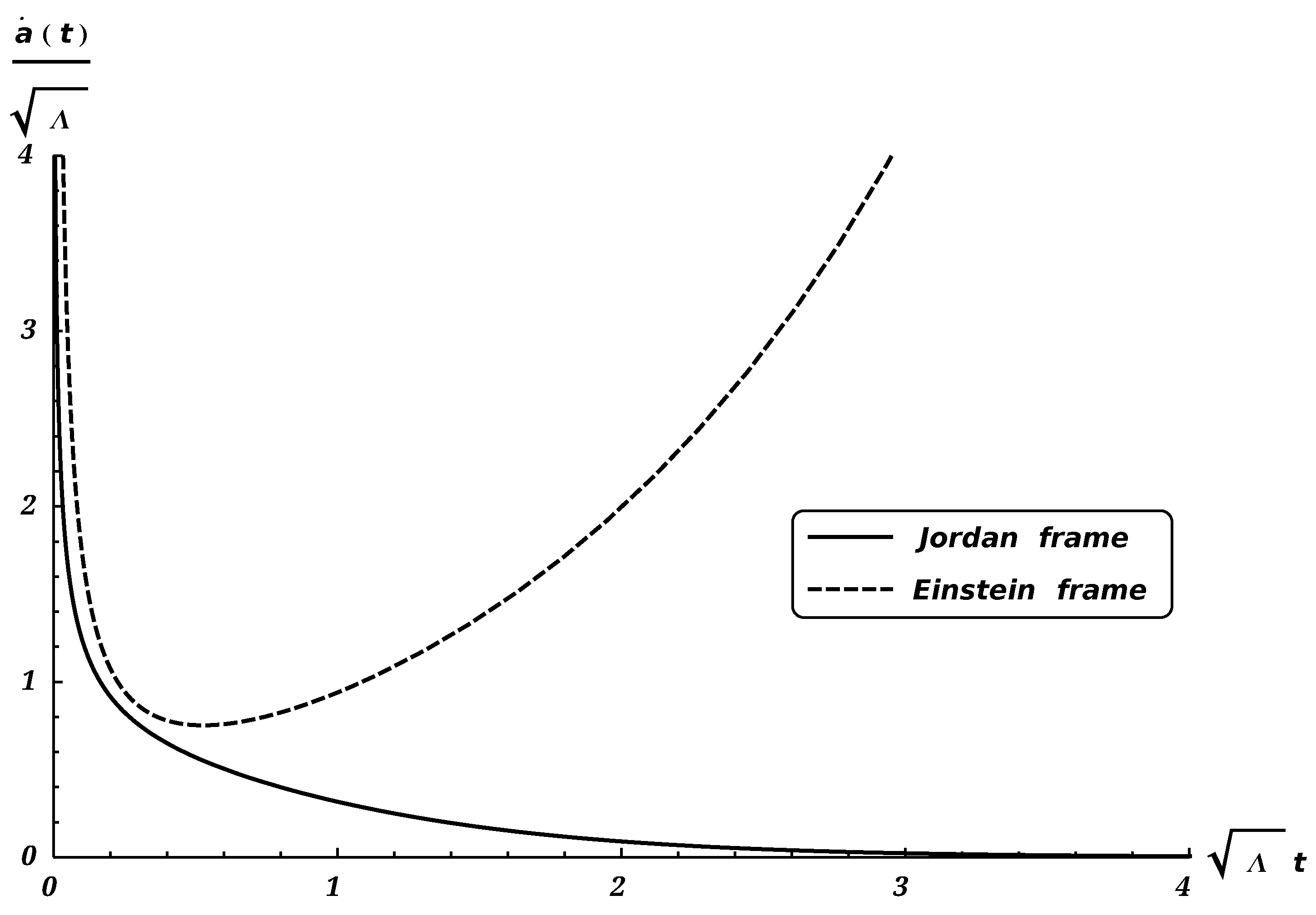
In Figure 1 the scale factors in the Jordan frame and in the Einstein frame are plotted as functions of time . We infer from this figure that in the Einstein frame the scale factor increases with time, while in the Jordan frame it grows but for large time values the scale factor tends to constant value of a stationary universe. This behavior can be understood by analysing the scale factor velocity as function of time in Figure 2. We see that the scale factor velocity in the Jordan frame decreases with time and goes to zero at large time values. The scalar factor velocity in the Einstein frame initially decreases with time but from a certain time further it grows.
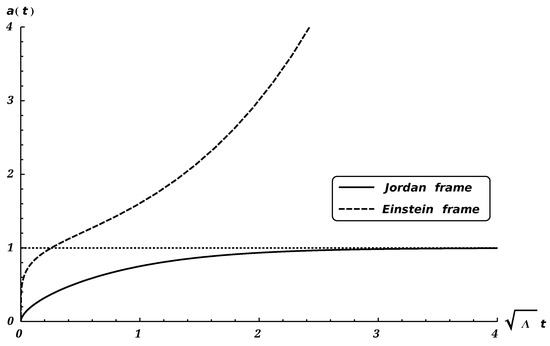
Figure 1.
Scale factors and as functions of time .
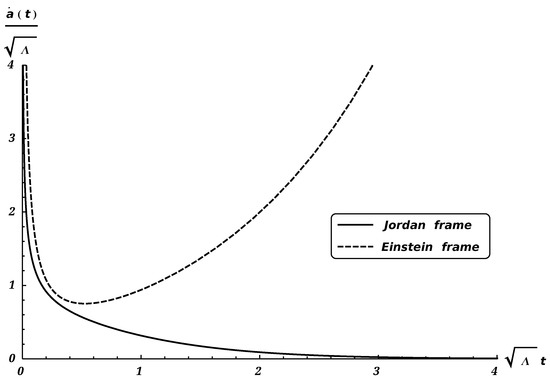
Figure 2.
Scale factor velocities and as functions of time .
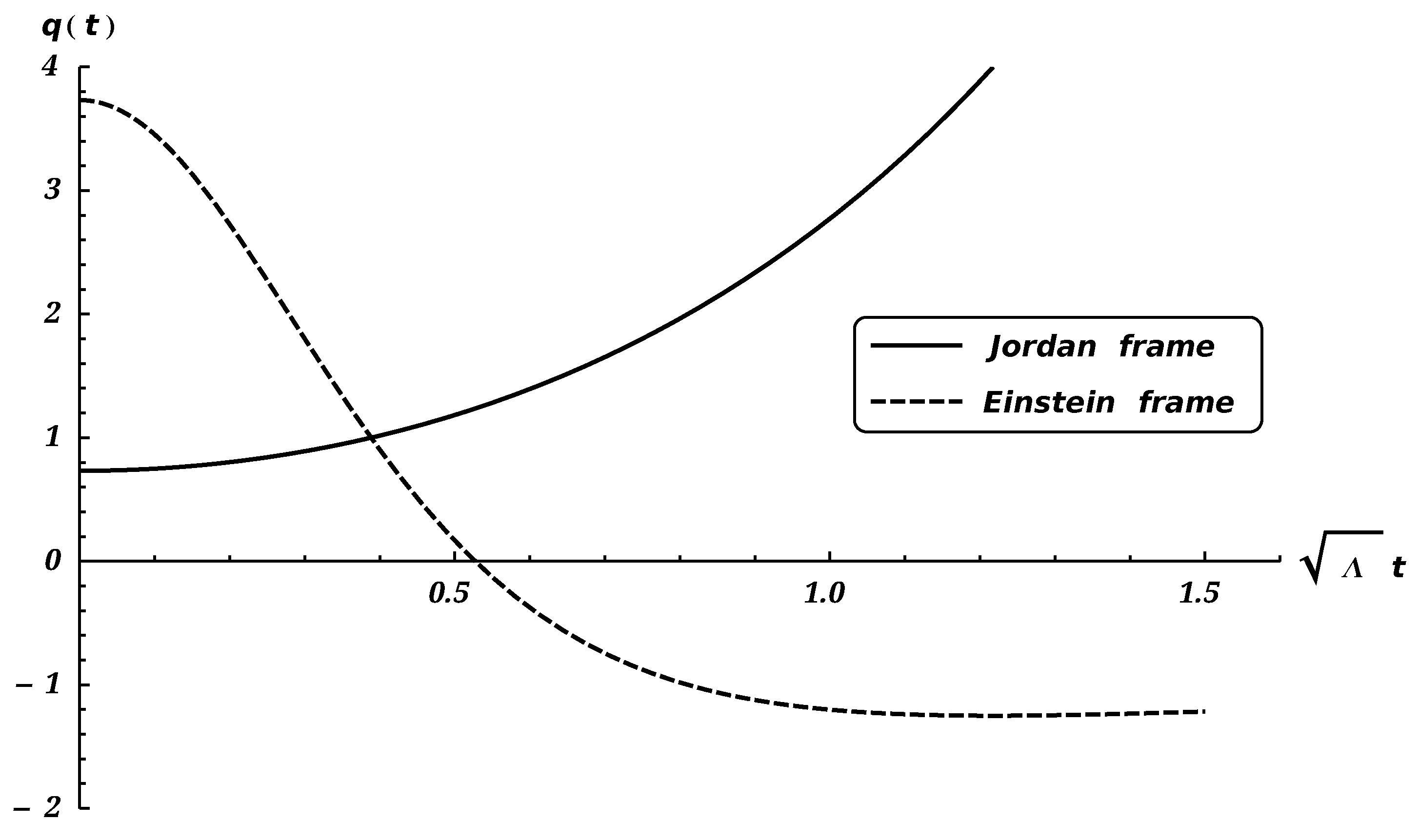
Figure 3 shows the behavior of the deceleration parameter as function of time in both frames. We conclude from this figure that in the Jordan frame the deceleration parameter has a positive sign, which may be interpreted as a matter dominated era. In the Einstein frame the behavior of the deceleration parameter is different from that of the Jordan frame. At the begin the deceleration parameter has positive sign and evolves to a negative sign. Here it may be interpreted to an exit of a matter dominated period to a dark energy era.
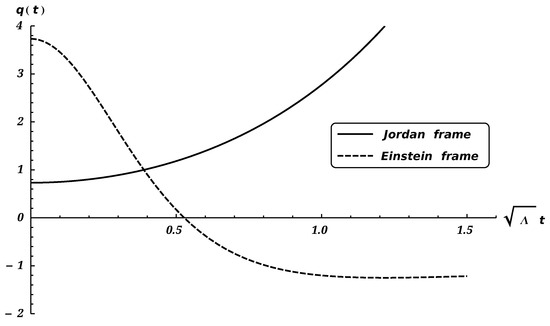
Figure 3.
Deceleration parameters and as functions of time .
It is clear that in this work we introduced only one constituent which is the scalar field. In order to have a better insight of the cosmological behavior one should add a matter constituent. This will be the subject of a next investigation.
8. Conclusions
In this work we analyzed a model with a scalar field minimally coupled to gravity. We started with the action in the Einstein frame and obtained the action in the Jordan frame through the use of the Weyl transformations. The field equations in the Jordan frame were obtained from the Palatini variation method. By restricting to a spatially flat Friedman–Robertson–Walker metric the point-like Lagrangian and the equations of Friedmann acceleration and Klein–Gordon were obtained. The Noether symmetry method was used to determine the self-interaction potential of the scalar field. From the solution of the field equations the scale factor, the Hubble and deceleration parameters were obtained in the Jordan frame and the corresponding ones in the Einstein frame were determined by the use of Weyl transformations. The cosmological solutions were obtained in case where the coupling constant of the scalar field which corresponds to a the case of a minimally coupled scalar field in the Einstein frame. It was show that in the Jordan frame the scalar factor grows with time but tends to a constant value at large times, i.e., evolving into a stationary universe. Furthermore, its deceleration parameter has a positive sign, which may be interpreted as a matter dominated era. In the Einstein frame the scale factor grows with time and the deceleration parameter evolves from a positive sign to a negative one, which may be interpreted as a transition from a matter dominated period to a dark energy era.
Author Contributions
Authors contributed equally to this work. All authors have read and agreed to the published version of the manuscript.
Funding
This work was supported by Conselho Nacional de Desenvolvimento Científico e Tecnológico (CNPq), grants Nos. 152124/2019-5 (A.B.B.) and 304054/2019-4 (G.M.K.).
Acknowledgments
A.B.B. would like to thank M.L. Pucheu and Giancarlo Camilo for helpful discussions.
Conflicts of Interest
The authors declare no conflict of interest.
Abbreviations
The following abbreviations are used in this manuscript:
| FRW | Friedmann-Robertson-Walker |
| ST | Scalar-Tensor |
References
- Will, C.M. The Confrontation between General Relativity and Experiment. Living Rev. Rel. 2014, 17, 4. [Google Scholar] [CrossRef] [PubMed]
- Yunes, N.; Siemens, X. Gravitational-Wave Tests of General Relativity with Ground-Based Detectors and Pulsar Timing-Arrays. Living Rev. Rel. 2013, 16, 9. [Google Scholar] [CrossRef] [PubMed]
- Capozziello, S.; De Laurentis, M. Extended Theories of Gravity. Phys. Rept. 2011, 509, 167–321. [Google Scholar] [CrossRef]
- Capozziello, S.; Lambiase, G.; Sakellariadou, M.; Stabile, A. Constraining models of extended gravity using Gravity Probe B and LARES experiments. Phys. Rev. 2015, D91, 044012. [Google Scholar] [CrossRef]
- Brans, C.; Dicke, R.H. Mach’s principle and a relativistic theory of gravitation. Phys. Rev. 1961, 124, 925–935. [Google Scholar] [CrossRef]
- Sen, D.K.; Dunn, K.A. A Scalar-Tensor Theory of Gravitation in a Modified Riemannian Manifold. J. Math. Phys. 1971, 12, 578–586. [Google Scholar] [CrossRef]
- Dunn, K.A. A scalar-tensor theory of gravitation. J. Math. Phys. 1974, 15, 2229–2231. [Google Scholar] [CrossRef]
- Faraoni, V.; Côté, J.; Giusti, A. Do solar system experiments constrain scalar–tensor gravity? Eur. Phys. J. C 2020, 80, 132. [Google Scholar] [CrossRef]
- Burton, H.; Mann, R.B. Palatini variational principle for an extended Einstein-Hilbert action. Phys. Rev. 1998, D57, 4754–4759. [Google Scholar] [CrossRef]
- Kozak, A.; Borowiec, A. Palatini frames in scalar–tensor theories of gravity. Eur. Phys. J. C 2019, 79, 335. [Google Scholar] [CrossRef]
- Almeida, T.S.; Pucheu, M.L.; Romero, C.; Formiga, J.B. From Brans-Dicke gravity to a geometrical scalar-tensor theory. Phys. Rev. D 2014, 89, 064047. [Google Scholar] [CrossRef]
- Pucheu, M.L.; Alves Junior, F.A.P.; Barreto, A.; Romero, C. Cosmological models in Weyl geometrical scalar-tensor theory. Phys. Rev. D 2016, 94, 064010. [Google Scholar] [CrossRef]
- Capozziello, S.; de Ritis, R.; Marino, A.A. Conformal equivalence and Noether symmetries in cosmology. Class. Quant. Grav. 1998, 14, 3259. [Google Scholar] [CrossRef]
- Paliathanasis, A. Using Noether symmetries to specify f(R) gravity. J. Phys. Conf. Ser. 2013, 453, 012009. [Google Scholar] [CrossRef]
- Terzis, P.A.; Dimakis, N.; Christodoulakis, T. Noether analysis of Scalar-Tensor Cosmology. Phys. Rev. D 2014, 90, 123543. [Google Scholar] [CrossRef]
- Camci, U. F(R,G) Cosmology through Noether Symmetry Approach. Symmetry 2018, 10, 719. [Google Scholar] [CrossRef]
- de Souza, R.C.; Kremer, G.M. Constraining non-minimally coupled tachyon fields by Noether symmetry. Class. Quant. Grav. 2009, 26, 135008. [Google Scholar] [CrossRef]
- de Souza, R.C.; Kremer, G.M. Dark Sector from Interacting Canonical and Non-Canonical Scalar Fields. Class. Quant. Grav. 2010, 27, 175006. [Google Scholar] [CrossRef][Green Version]
- de Souza, R.C.; Kremer, G.M. Cosmic expansion from boson and fermion fields. Class. Quant. Grav. 2011, 28, 125006. [Google Scholar] [CrossRef]
- de Souza, R.C.; Andre, R.; Kremer, G.M. Analysis of the nonminimally coupled scalar field in the Palatini formalism by the Noether symmetry approach. Phys. Rev. D 2013, 87, 083510. [Google Scholar] [CrossRef]
- Romero, C.; Fonseca-Neto, J.B.; Pucheu, M.L. General Relativity and Weyl Geometry. Class. Quant. Grav. 2012, 29, 155015. [Google Scholar] [CrossRef]
- Scholz, E. MOND-like acceleration in integrable Weyl geometric gravity. Found. Phys. 2016, 46, 176. [Google Scholar] [CrossRef]
© 2020 by the authors. Licensee MDPI, Basel, Switzerland. This article is an open access article distributed under the terms and conditions of the Creative Commons Attribution (CC BY) license (http://creativecommons.org/licenses/by/4.0/).