


Abstract
A light charged Higgs boson has been searched for at the Large Hadron Collider (LHC) via top (anti)quark decay, i.e., , if kinematically allowed. In this contribution, we propose new channels for light charged Higgs boson searches via the pair productions and at the LHC in the context of the Two-Higgs Doublet Model (2HDM) Type-I. By focusing on a case where the heavy H state is the Standard Model (SM)-like one already observed, we investigate the production of the aforementioned charged Higgs bosons and their bosonic decay channels, namely, and/or . We demonstrate that such production and decay channels can yield substantial alternative discovery channels for bosons at the LHC. Finally, we propose eight benchmark points (BPs) to motivate the search for such signatures.
1. Introduction
With the discovery of a 125 GeV Higgs boson at the Large Hadron Collider (LHC) [1,2] in 2012, the verification of the Standard Model (SM) of particle physics was completed. However, despite its agreement with the experiment, the SM is certainly not an ultimate theory. Thus, any extension of the SM is well motivated. One of the simplest and most straightforward extensions of the SM, which deserves particular attention, is the Two-Higgs Doublet Model (2HDM). The model contains two Higgs doublet fields that can generate masses for all (massive) fermions and gauge bosons. The scalar sector of 2HDM contains two charge-parity (CP)-even Higgs bosons, h and H (conventionally the mass of h is less than the mass of H, ); one CP-odd Higgs boson, A; and a pair of charged Higgs bosons, (in addition to the fermions and gauge bosons of the SM).
At the LHC, a light boson has been searched for via the decay of a top (anti)quark () if kinematically allowed. Typically, this process can be calculated using the usual method of factorizing the production process of proton–proton collisions, , times the decay one, , in the narrow-width approximation (NWA). However, if the mass of the charged Higgs boson approaches the maximum, this approximation becomes invalid, and thus it is quite appropriate to target the process to search instead [3]. This contribution revisits these two production channels for the upcoming LHC Run 3 and compares them to the pair productions and in the 2HDM Type-I. We show that signatures from such pair productions followed by and/or decays may lead to new discovery channels for light charged Higgs bosons searches at the LHC.
The contribution is organized as follows. First, we briefly describe the 2HDM and its Yukawa scenarios in Section 2. In Section 3, we explain the scan of the parameter space and the applied constraints. We discuss the numerical results and the selected benchmark points (BPs) in Section 4 and Section 5, and we finally conclude in Section 6.
2. The 2HDM
The -conserving 2HDM scalar potential, which is renormalizable and invariant under with a softly broken symmetry, can be written as
where , and are squared mass parameters, and are dimensionless coupling parameters. are the Higgs doublet fields with as their respective vacuum expectation values (VEVs) such that (where v is the SM Higgs VEV). Using the two minimization conditions of the potential, , and can be substituted by , the physical mass eigenstates and , where and are the mixing angles. Thus, we are left with only seven independent parameters:
In the Yukawa sector, though, the flavor changing neutral currents (FCNCs) can be induced at the tree level if both the Higgs doublets of the general 2HDM couple to all fermions. To avoid FCNCs, which would be inconsistent with the experiment, a symmetry can be enforced in such a way that each fermion type () acquires mass from one of the Higgs doublets. Thus, there are four possible types of 2HDM [4]. In 2HDM Type-I, the fermions acquire mass via the interaction with the doublet as in the SM. In 2HDM Type-X (or lepton-specific), the charged leptons acquire mass from while all quarks receive mass from . In 2HDM Type-II, up-type quarks acquire mass through their interactions with , and down-type quarks and charged leptons acquire mass through their interactions with . Finally, in 2HDM Type-Y (or flipped), the up-type quarks and charged leptons receive mass from , and down-type quarks receive mass from . Here, though, we only consider 2HDM Type-I.
The Yukawa Lagrangian, which describes the coupling of the neutral and charged Higgs bosons to quarks and leptons, can be written as [4]:
where () are the masses of the fermions and are the Yukawa couplings, which are given in Table 1 for Type-I. denotes the Cabibbo–Kobayashi–Maskawa (CKM) matrix element, and and are the masses of up and down quarks, respectively. represent the left-handed and right-handed projection operators.

Table 1.
Yukawa couplings of the neutral Higgs bosons h, H and A to quarks and leptons in 2HDM Type-I.
3. Parameter Space Scans
In what follows, we perform a broad scan of the following 2HDM Type-I parameter space, where the H state is assumed to be the observed SM-like Higgs at the LHC in 2012 with mass fixed to 125 GeV:
In the scan, the theoretical and experimental constraints are taken into account. 2HDMC [5] is used to check unitarity, perturbativity, vacuum stability and the electroweak oblique parameters (S, T and U). HiggsBounds-5.9.0 [6] and HiggsSignals-2.6.0 [7] are both used to enforce the exclusion bounds at the 95% confidence level (CL) from Higgs boson searches at LEP, Tevatron and LHC, and to check agreement with SM-like Higgs boson measurements, respectively. Constraints from flavour physics are tested using the public code SuperIso v4.1 [8].
4. Results
In the present contribution, we target the signatures of light charged Higgs bosons from processes involving top quarks and di-Higgs processes, i.e., + c.c. (NWA), + c.c., plus + c.c. taking into account their either or decays, where h and A decay into a pair of bottom quarks. (We are only interested here in the final states; see [9] for the and final states.) Relevant LHC signatures are summarized in Table 2.
Table 2.
Charged Higgs bosons production modes and their final states. denotes the production process of proton–proton collisions, , and BR refers to the branching ratio. Here, () refers to and .
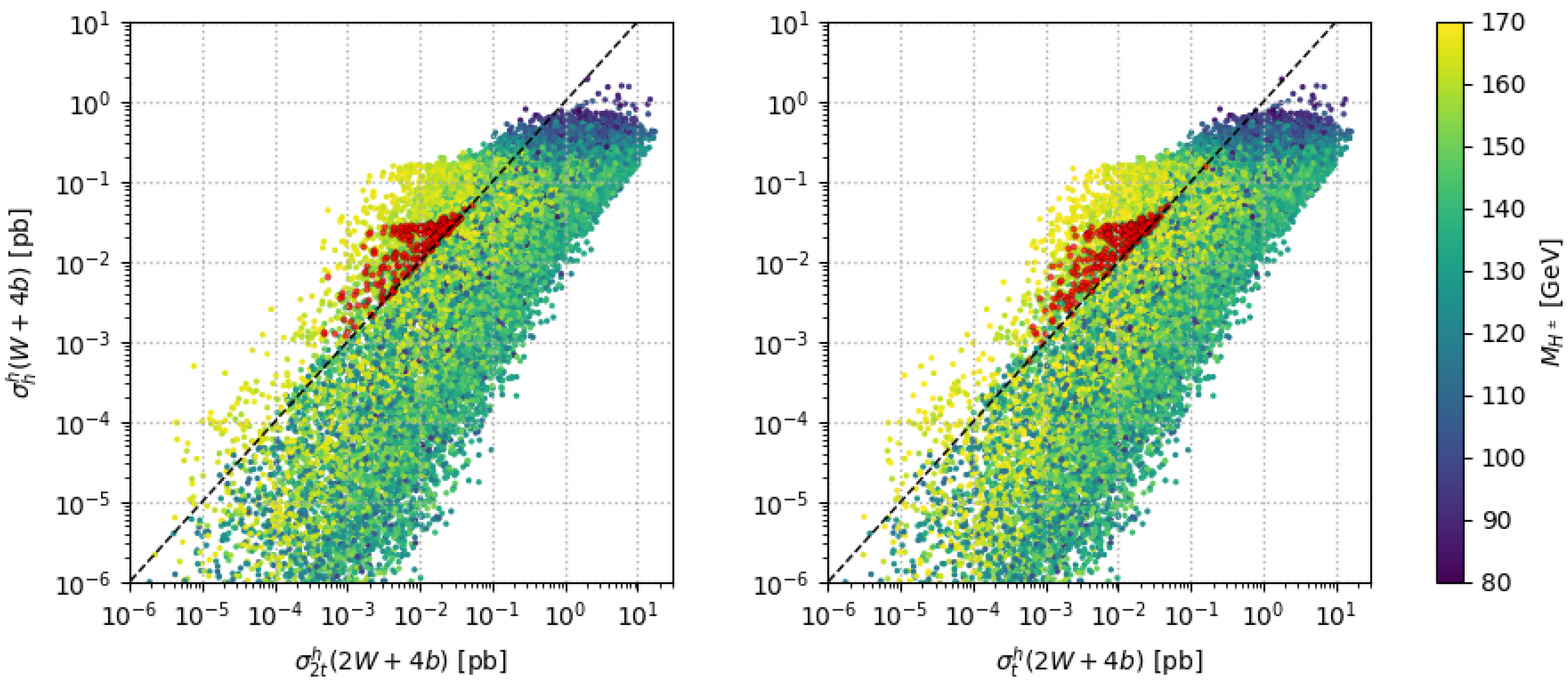
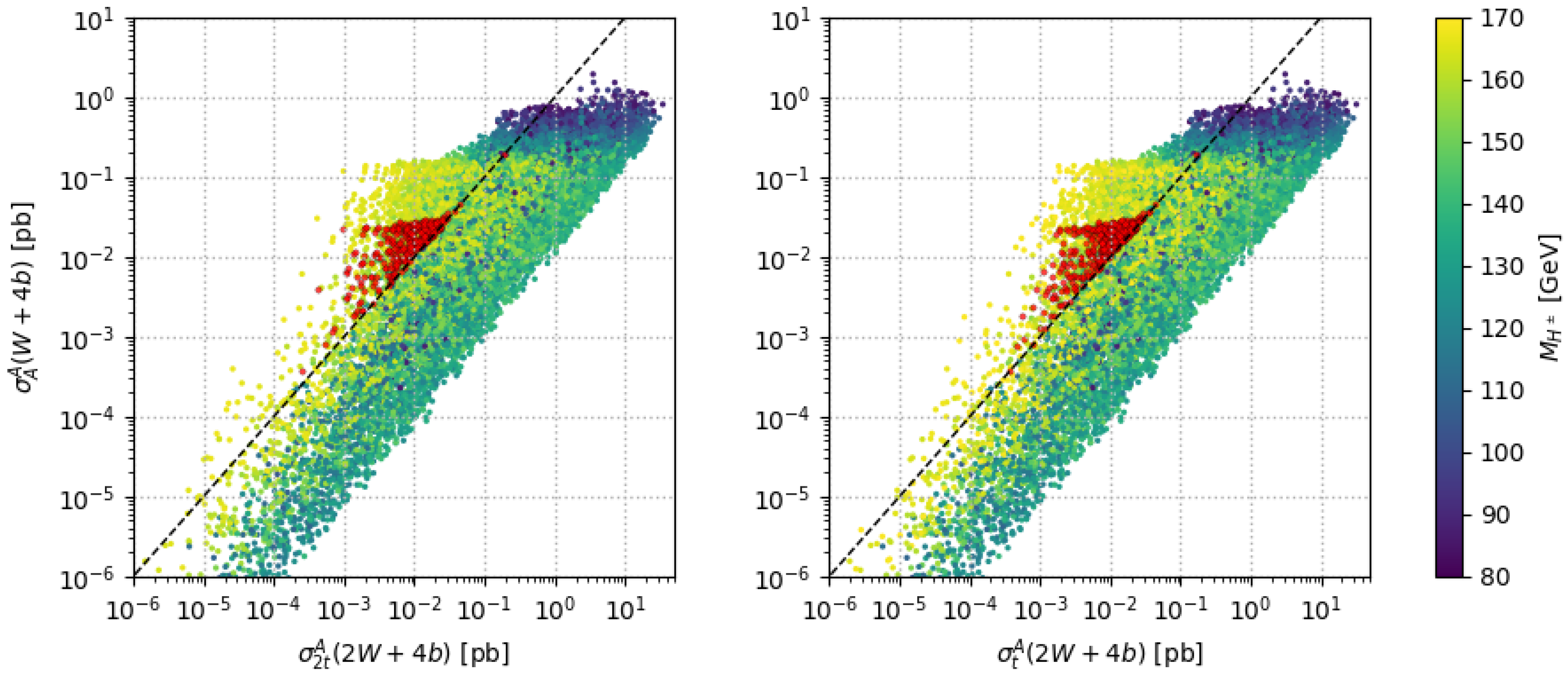
In what follows, we show the production rates of relevant final states from different scenarios. In Figure 1, we compare and signatures from and with (left panel) and (right panel) ones from the two top (anti)quark processes. Analogously to Figure 1, the same signatures from and are compared with those from processes involving the top (anti)quark in Figure 2. From these plots, it is therefore clear that signatures from di-Higgs processes can yield substantial alternative discovery modes for charged Higgs bosons at the LHC in the context of the 2HDM Type I.
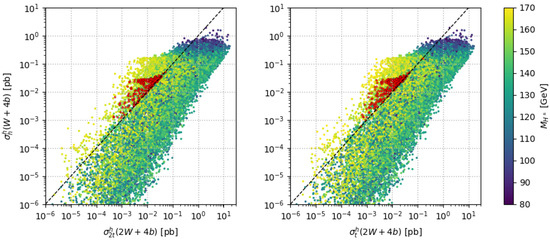
Figure 1.
Total cross-sections are shown against those of 2 (left) and (right). The red points refer to the total cross-sections , which are also large compared to the two top production processes. The mass of the charged Higgs boson, , is indicated by the color map.
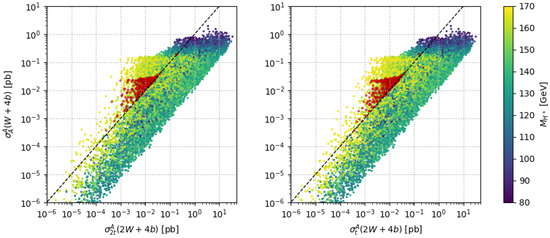
Figure 2.
Total cross-sections of are shown against those of 2 (left) and (right). The red points refer to the total cross-sections which are also large compared to the two top production processes. The mass of the charged Higgs boson, , is indicated by the color map.
5. Benchmark Points
In order to encourage future searches for light charged Higgs boson via such new channels, we propose eight BPs for 2HDM Type-I. These BPs are presented in Table 3. In our selected BPs, notice that we take also into account the case where the mass of the charged Higgs is larger than that of the top one. The total cross-sections of the final states and from both di-Higgs and the two top (anti)quarks are given herein.
Table 3.
Mass spectra (in GeV), mixing angles and cross-sections (in fb) for the selected BPs. (Notice that all these parameters have been discussed above).
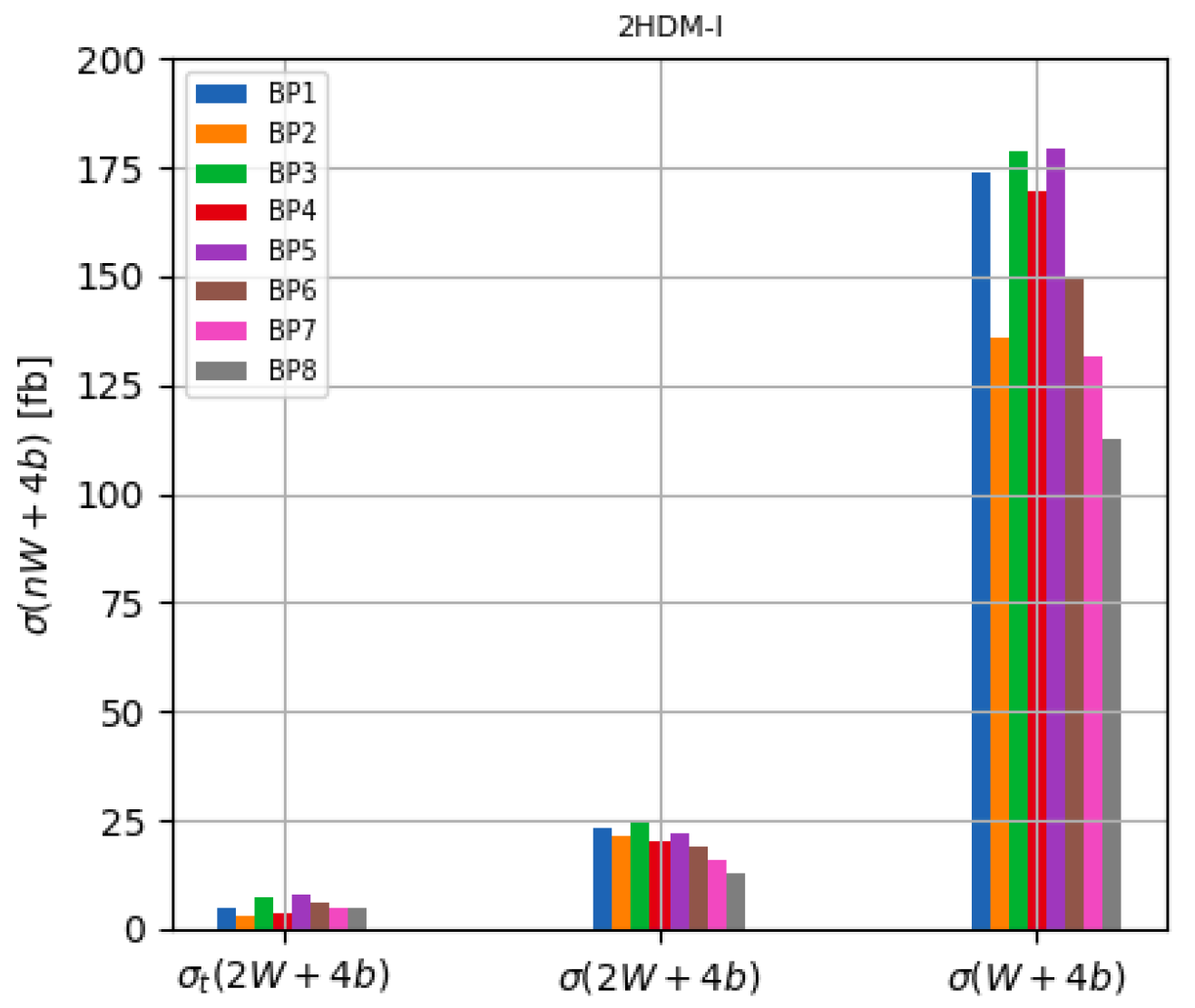
In BP1, for instance, the cross-section rate of the signature from the top (anti)quark processes can only reach 5 fb (we refer here to the + c.c. rates), whereas the cross-section rate of the signature from the pair production of bosons is ≈23.1 fb. Moreover, the cross-section rate from the -associated production can reach values of around 174 fb, which are much larger than the rates of from charged Higgs pair production. This behavior is well illustrated in Figure 3. For other BPs, the cross-section rates of the and signatures from different production processes are also shown in Figure 3.
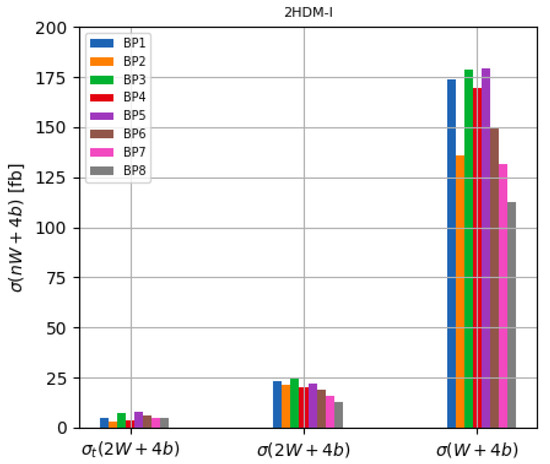
Figure 3.
Cross-section rates of and signatures for the selected BPs.
6. Conclusions
In this contribution, we have investigated the production of charged Higgs bosons through and at the LHC with TeV in 2HDM Type-I, after satisfying all theoretical and experimental constraints. By focusing on decays, we have suggested the and signatures as possible alternative discovery modes. We have demonstrated that such signatures could well be the most promising discovery for light states. Thus, to motivate experimentalists to search for these, we have proposed eight BPs amenable to experimental investigation.
Author Contributions
Conceptualization, A.A., R.B., M.K., B.M., S.M., Y.W. and Q.-S.Y.; data curation, A.A., R.B., M.K., B.M., S.M., Y.W. and Q.-S.Y.; formal analysis, A.A., R.B., M.K., B.M., S.M., Y.W. and Q.-S.Y.; investigation, A.A., R.B., M.K., B.M., S.M., Y.W. and Q.-S.Y.; project administration, A.A., R.B., M.K., B.M., S.M., Y.W. and Q.-S.Y.; software, A.A., R.B., M.K., B.M., S.M., Y.W. and Q.-S.Y.; supervision, A.A., R.B., M.K., B.M., S.M., Y.W. and Q.-S.Y.; validation, A.A., R.B., M.K., B.M., S.M., Y.W. and Q.-S.Y.; visualization, A.A., R.B., M.K., B.M., S.M., Y.W. and Q.-S.Y.; writing—review and editing, A.A., R.B., M.K., B.M., S.M., Y.W. and Q.-S.Y. All authors have contributed in equal parts to all aspects of this research. All authors have read and agreed to the published version of the manuscript.
Funding
The work of A.A., R.B., M.K. and B.M. is supported by the Moroccan Ministry of Higher Education and Scientific Research MESRSFC and CNRST Project PPR/2015/6. The work of S.M. is supported in part through the NExT Institute and the STFC Consolidated Grant ST/L000296/1. Y.W. is supported by the “Scientific Research Funding Project for Introduced High-level Talents” of the Inner Mongolia Normal University, grant number 2019YJRC001. Q.-S.Y.’s work is supported by the Natural Science Foundation of China, grant number 11875260.
Institutional Review Board Statement
Not applicable.
Informed Consent Statement
Not applicable.
Data Availability Statement
Not applicable.
Conflicts of Interest
The authors declare no conflict of interest.
References
- Aad, G.; Abajyan, T.; Abbott, B.; Abdallah, J.; Khalek, S.A.; Abdelalim, A.A.; Aben, R.; Abi, B.; Abolins, M.; AbouZeid, O.S.; et al. Observation of a new particle in the search for the Standard Model Higgs boson with the ATLAS detector at the LHC. Phys. Lett. B 2012, 716, 1–29. [Google Scholar] [CrossRef]
- Chatrchyan, S.; Khachatryan, V.; Sirunyan, A.M.; Tumasyan, A.; Adam, W.; Aguilo, E.; Bergauer, T.; Dragicevic, M.; Erö, J.; Fabjan, C.; et al. Observation of a new boson at a mass of 125 GeV with the CMS experiment at the LHC. Phys. Lett. B 2012, 716, 30–61. [Google Scholar] [CrossRef]
- Guchait, M.; Moretti, S. Improving the discovery potential of charged Higgs bosons at Tevatron run II. JHEP 2002, 1, 1. [Google Scholar] [CrossRef][Green Version]
- Branco, G.C.; Ferreira, P.M.; Lavoura, L.; Rebelo, M.N.; Sher, M.; Silva, J.P. Theory and phenomenology of two-Higgs-doublet models. Phys. Rept. 2012, 516, 1–102. [Google Scholar] [CrossRef]
- Eriksson, D.; Rathsman, J.; Stal, O. 2HDMC: Two-Higgs-doublet model calculator physics and manual. Comput. Phys. Commun. 2010, 181, 189–205. [Google Scholar] [CrossRef]
- Bechtle, P.; Dercks, D.; Heinemeyer, S.; Klingl, T.; Stefaniak, T.; Weiglein, G.; Wittbrodt, J. HiggsBounds-5: Testing Higgs sectors in the LHC 13 TeV era. Eur. Phys. J. C 2020, 80, 1211. [Google Scholar] [CrossRef]
- Bechtle, P.; Heinemeyer, S.; Klingl, T.; Stefaniak, T.; Weiglein, G.; Wittbrodt, J. HiggsSignals-2: Probing new physics with precision Higgs measurements in the LHC 13 TeV era. Eur. Phys. J. C 2021, 81, 145. [Google Scholar] [CrossRef]
- Mahmoudi, F. SuperIso v2.3: A Program for calculating flavor physics observables in Supersymmetry. Comput. Phys. Commun. 2009, 180, 1579–1613. [Google Scholar] [CrossRef]
- Arhrib, A.; Benbrik, R.; Krab, M.; Manaut, B.; Moretti, S.; Wang, Y.; Yan, Q.-S. New discovery modes for a light charged Higgs boson at the LHC. JHEP 2021, 10, 73. [Google Scholar] [CrossRef]
Publisher’s Note: MDPI stays neutral with regard to jurisdictional claims in published maps and institutional affiliations. |
© 2021 by the authors. Licensee MDPI, Basel, Switzerland. This article is an open access article distributed under the terms and conditions of the Creative Commons Attribution (CC BY) license (https://creativecommons.org/licenses/by/4.0/).