


Abstract
We introduce a -implicit contractive condition by an implicit relation on relational quasi partial metric spaces and establish new (unique) fixed point results and periodic point results based on it. We justify the results by two suitable examples and compare with them related work. We discuss sufficient conditions ensuring the existence of a unique positive definite solution of the non-linear matrix equation , where is an Hermitian positive definite matrix, , , … are matrices, and is a non-linear self-mapping of the set of all Hermitian matrices which is continuous in the trace norm. Two examples (with randomly generated matrices and complex matrices, respectively) are given, together with convergence and error analysis, as well as average CPU time analysis and visualization of solution in surface plot.
Keywords:
positive definite matrix; non-linear matrix equation; fixed point; relational metric space; quasi partial metric space; periodic point MSC:
primary 47H10; secondary 54H25; 34A08
1. Introduction
It is well known that Banach Contraction Principle (BCP) from 1922 was a starting point for the development of an important area called metric fixed point theory, which has an enormous field of application. In particular, in recent decades, a number of mathematicians have obtained fixed point results for contraction type mappings in metric spaces equipped with partial order. The first results in this direction were obtained by Turinici in [1,2] who worked on some results of Matkowski [3,4]. Ran and Reurings [5,6], as well as Nieto and Ródríguez-López [7,8] reinvestigated results of this type. Samet and Turinici [9] established fixed point theorems for non-linear contraction under symmetric closure of an arbitrary relation. Recently, Ahmadullah et al. [10,11,12] and Alam and Imdad [13] employed an amorphous relation to prove a relation-theoretic analogue of BCP which in turn unifies a lot of well known relevant order-theoretic fixed point theorems.
The distance notion in the metric fixed point theory has been introduced and generalized in several different ways by many authors. In particular, Matthews [14] introduced the notion of a partial metric space (PMS, for short) and showed that BCP can be generalized to the partial metric context for applications in program verification. Subsequently, several authors studied fixed point theorems in PMSs, as well as ordered PMSs (see, e.g., [15,16,17]). In [18], Karapinar et al. introduced the notion of quasi partial metric space (QPMS) and proved some fixed point theorems. Popa and Patriciu [19] proved a fixed point result in implicit relation setting. Quite recently, Altun et al. [20] worked on relational PMSs and established some (unique) fixed point and property (P) results under F-contractive conditions with some examples.
Motivated by the concepts of quasi partial metric space and binary relation, in Section 3, we introduce a modified implicit relation of [19] with some illustrations. Further, in Section 4, we define the notion of -quasi implicit contractive condition for a self-mapping on a relational quasi partial metric space and prove respective (unique) fixed point results and a property (P) result for -complete space, using -closedness and -continuity of the relation . Several special cases are considered in Section 5, together with suitable examples, illustrating the obtained results. While doing this, the symmetry condition on the space structure and full completeness of space structure are not required. We show by an illustration that there are situations when the related results of Popa and Patriciu [19] cannot be used in order to obtain the desired conclusions. In fact, the Ćirić type contraction condition is not strong enough in complete quasi partial metric spaces. In Section 6, the obtained fixed point results are used in order to obtain a sufficient condition ensuring the existence of a unique positive definite solution of a non-linear matrix equation. This important application is illustrated by two non-trivial examples in the final Section 7. We visualize this procedure through convergence analysis using three different initializations and a solution graph.
2. Preliminaries
In this article, the notations have their usual meanings, and .
2.1. Quasi Partial Metric Spaces
Definition 1.
([14]). Let Ξ be a nonempty set. A partial metric on Ξ is a mapping such that for all :
- (p)
- ,
- (p)
- ,
- (p)
- ,
- (p)
- .
In this case, the pair is called a partial metric space (PMS).
If , then from (p) and (p) it clearly follows that . may not be 0.
Definition 2.
([18]). Let Ξ be a nonempty set. A quasi partial metric on Ξ is a mapping such that for all :
- (q)
- ;
- (q)
- ,
- (q)
- ,
- (q)
- .
In this case, the pair is a quasi partial metric space (QPMS).
Lemma 1.
([18]). Let be a QPMS. Then the following hold:
- (i)
- If , then .
- (ii)
- If , then and .
Lemma 2.
([18]). Let be a QPMS. Then:
- (i)
- The function given by () is a partial metric on Ξ.
- (ii)
- The function given byis a metric on Ξ.
Definition 3.
([18]). Let be a QPMS. Then:
- A sequence in converges to if .
- A sequence in is called a Cauchy sequence if and exist (and are finite).
- The space is said to be complete if every Cauchy sequence in Ξ converges to a point such that .
Lemma 3.
([18]). Let be a QPMS. Then a sequence is a Cauchy sequence in if and only if it is a Cauchy sequence in . In particular, is complete if and only if is complete. Moreover,
2.2. Relational Quasi Partial Metric Spaces
We call the pair a relational set if (i) is a set and (ii) is a binary relation on .
The following are some standard terms used in the theory of relational sets and spaces (see, e.g., [9,13,21,22,23]).
Let be a relational set, be a relational QPMS (RQPMS, for short), and let be a self-mapping on . Then:
- is -related to if .
- The set is said to be complete if for all , where means that or .
- A sequence in is said to be -preserving if , .
- is said to be -closed if .
- is said to be -complete if, given an -preserving Cauchy sequence in , there exists some such that
- is said to be -continuous at if, given an -preserving sequence with , holds as . It is said to be -continuous if it is -continuous at every point of .
- is said to be -self-closed if, given an -preserving sequence with , there exists a subsequence of , such that , for all .
- A subset of is called -directed if for all , there exists such that and . It is called -directed if for all , there exists such that and .
- is said to be regular if the following condition holds:for any sequence in .
- For , a path of length k (where k is a natural number) in from to is a finite sequence satisfying the following conditions:
- (i)
- and ,
- (ii)
- for each i.
Notice that a path of length k involves elements of , although they are not necessarily distinct.
Remark 1.
Every complete RQPMS is -complete but not conversely. On an RQPMS, every continuous mapping is -continuous but not conversely.
We fix the following notation for a relational space and a self-mapping on :
- (i)
- the set of all fixed points of ,
- (ii)
- ,
- (iii)
- the class of all paths in from to , where .
3. Modified Implicit Relation
In this section, we first modify the notion of implicit relation and examples discussed in [19].
Let denote the set of all functions that satisfy the following conditions:
- (i)
- is increasing and ;
- (ii)
- , for all , where is the nth iterate of .
It should be noted that always holds and the family .
Example 1.
Consider the mapping , where . Then we have . Therefore, and hence .
Let be the set of all functions which are continuous and satisfy the following conditions:
- (1)
- is nonincreasing in the fifth variable;
- (2)
- for all , there exists such that implies .
Let be the set of functions such that
- (3)
- for all , there exists such that implies .
Let be the set of functions , such that
- (4)
- for all , there exists such that implies .
Example 2.
Let , where , and .
- (2):
- Let and . Then, , where , .
- (3):
- Let and Then, . Hence, , where , .
- (4):
- Let , . Then, , where , .
Example 3.
, where .
- (2):
- Let and . Then, , where , .
- (3):
- Let and If , then , a contradiction. Hence , where , .
- (4):
- Let , . Then, , where ,
Example 4.
, where , and .
- (2):
- Let and . If , then , a contradiction. Hence, which implies , where , .
- (3):
- Let and Then, Hence, , where , .
- (4):
- Let , . Then, , where ,
Example 5.
, where , and .
- (2):
- Let and , which implies , where , .
- (3):
- Let and Then Hence, , where , .
- (4):
- Let , . Then, , where , .
4. -Implicit Contractive Mappings in Relational Quasi Partial Metric Spaces
First we define -implicit contractive mappings on an RQPMS.
Definition 4.
Let be an RQPMS. A mapping is said to be a -implicit contractive mapping, if there exists , such that for with ,
holds true.
4.1. Fixed Point Results
Theorem 1.
Let be an and . Suppose that the following conditions hold:
- (C1)
- ;
- (C2)
- is -closed;
- (C3)
- Ξ is -complete;
- (C4)
- is a -implicit contractive mapping;
- (C5)
- is -continuous.
Then there exists such that .
Proof.
Let . Define for all . By (), , for all . If there exists such that then and the statement holds true.
Assume that for all so that . As , for all . As is -implicit contractive mapping, we have, for some ,
that is,
From the property ,
Then by , we obtain
It follows from that there is such that
For , using , we obtain
Thus, . Again, since for all , with the same arguments, we can show that . Therefore, by Lemma 3, is a Cauchy sequence, both in and in . Since is -complete, so is and the sequence converges to some in . Now, -continuity of implies that
Hence, . □
Theorem 2.
The conclusion of Theorem 1 remains true for , if the condition is replaced by the following one:
- ()
- is regular.
Proof.
Following the proof of Theorem 1, we obtain that the sequence is a Cauchy sequence, and so there exists a point , such that
As , then for all .
Let consider the following two cases.
- If is finite, then there exists such that for all . In particular, and , and then, for all ,Since is continuous, applying the limit as , we getBy , we haveso thatThen by we obtainIt follows from that there is such thatOn the other hand, by we haveso thatCombining (3) and (4), we get , a contradiction. This implies that , i.e., is a fixed point of .
- If is not finite, then there is a subsequence of such thatAs , therefore .
□
Further, we present a sufficient condition for the uniqueness of fixed point in Theorems 1 and 2.
Theorem 3.
In addition to the assumptions of Theorem 1 (or Theorem 2), let for all and let . Then the fixed point of is unique.
Proof.
Let such that . Since , there exists a path (say of some finite length k in from to (with for all . Then
As , for all , we have
i.e.,
hence,
It follows from that there is such that
Similarly we can get
On combining the above conclusions, we have
a contradiction. Thus, has a unique fixed point. □
4.2. Periodic Point Results
Definition 5.
([24]). A mapping is said to have the property (P) if for every , i.e., has no periodic point.
Theorem 4.
In addition to the assumptions of Theorem 1, if and implies , then has the property (P).
Proof.
Let , i.e., , so by condition (), we have , for all . Define , for all . If there exists such that , then and there is nothing to prove.
Assume that , for all . Then (for all ). Using the condition () for and , we have
i.e.,
Using the properties () and , we get
This yields (from ()) that, for all ,
Following the rest of the proof of Theorem 1, is a Cauchy sequence in and in . Using the -completeness and -continuity of , . Finally, we show that for any . Let, on contrary, and hold for some . Then and ( by assumption ). By condition (), we have for all . From (5), we have
a contradiction as . Therefore, for all □
5. Illustrations and Consequences
Example 6.
Consider the set and define a quasi partial metric by , for all . Define a binary relation by
Then Ξ is -complete. Consider the self-mapping on Ξ given by for all .
It is easy to see that , that is -closed, and that is -continuous.
Considering Example 2, (2) reduces to
We show that satisfies (6) by dividing the proof in two parts.
Take and so . Consider two cases:
It can be easily checked that the above inequalities hold true for (so that ).
Thus, is a -implicit contractive mapping. Therefore, all the conditions of Theorem 1 are satisfied and is the unique fixed point of in Ξ.
Example 7.
Consider the set and define a quasi partial metric by
and a binary relation by . Consider a self-mapping on Ξ given by , , .
It is clear that Ξ is complete and is -closed. In addition, , and as and .
Considering Example 3, (2) reduces to
We show that satisfies (7). We have to check two possible cases when .
Obviously, the above cases hold true for any k with . Thus, is a -implicit contractive mapping.
Let be an -preserving sequence converging to ν as . Then, we must have
implying that . This implies that either or as and clearly, we have for all , where or . This shows that is regular. Thus, all the conditions of Theorem 2 are satisfied; hence, has a fixed point () which is also a periodic point of .
It can be noted that the contraction condition considered in Theorem 3.1 or, in particular, Ćirić type contraction condition taken in Theorem 3.2 of [19], do not hold at as (7) at this point reduces to
for any . Hence, these results from [19] cannot be used for obtaining the desired conclusion.
By choosing particular from Examples 2–5, we have the following consequences.
Corollary 1.
Let all the conditions of Theorems 1–3 be satisfied, except that the assumption of -implicit contractive mapping for is replaced by either of the form
- (I)
- where , , and , or
- (II)
- where , or
- (III)
- where , , and , or
- (IV)
- where , , and .
Then is a singleton.
6. Application
Let denote the set of all matrices over and (resp. , ) denote the set of all Hermitian (resp. positive semi-definite, positive definite) matrices from . For a matrix , we will denote by its trace norm, i.e., the sum of all of its singular values. For , (resp. ) will mean that the matrix belongs to (resp. ).
The following lemmas are needed in the subsequent discussion.
Lemma 4.
([5]). If and are matrices, then
Lemma 5.
([5]). If satisfies , then .
We establish the existence and uniqueness of the solution of non-linear matrix equation (NME)
where , stands for the conjugate transpose of and is an order-preserving continuous mapping such that .
Theorem 5.
Consider the NME (11) and assume the following:
- (H1)
- there exists with ;
- (H2)
- for all , implies .
- (H3)
- there exists such that for all with , the following inequality holds
Then the NME (11) has a unique solution . Moreover, the iteration
where satisfies , converges to in the sense of trace norm .
Proof.
Define a mapping by
and a binary relation
Then a fixed point of the mapping is a solution of the matrix Equation (11). Notice that is well defined, -continuous and is -closed. By the assumption (), we have and hence .
Now, let . Define by
Then is a complete -relational quasi partial metric space.
Consider given by
where is given in () (see Corollary 1.(II)). Then the condition
reduces to
and is fulfilled by the assumption (). Thus, all the hypotheses of Theorem 1 are satisfied, and therefore there exists such that , and hence the matrix Equation (11) has a solution in . Furthermore, due to the existence of least upper bound and greatest lower bound for all , we have . Thus, on using Theorem 3, has a unique fixed point, and hence we conclude that the matrix Equation (11) has a unique solution in , obtained as the limit of iterative sequence (12). □
7. Numerical Experiments
Example 8.

Consider matrices with randomly generated coefficients by
where
and
Take and
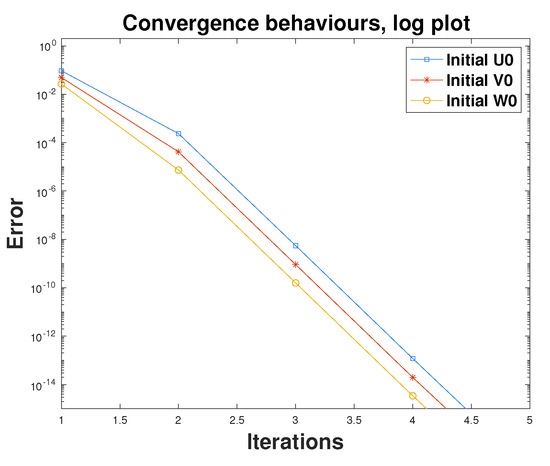
We take , and to test our algorithm. The numerical results are given in Table 1.
Table 1.
Three initialization based analysis.
We use the initial values
where .
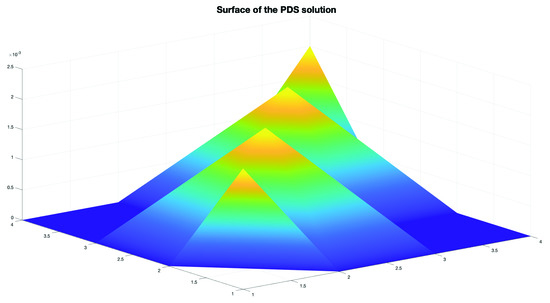
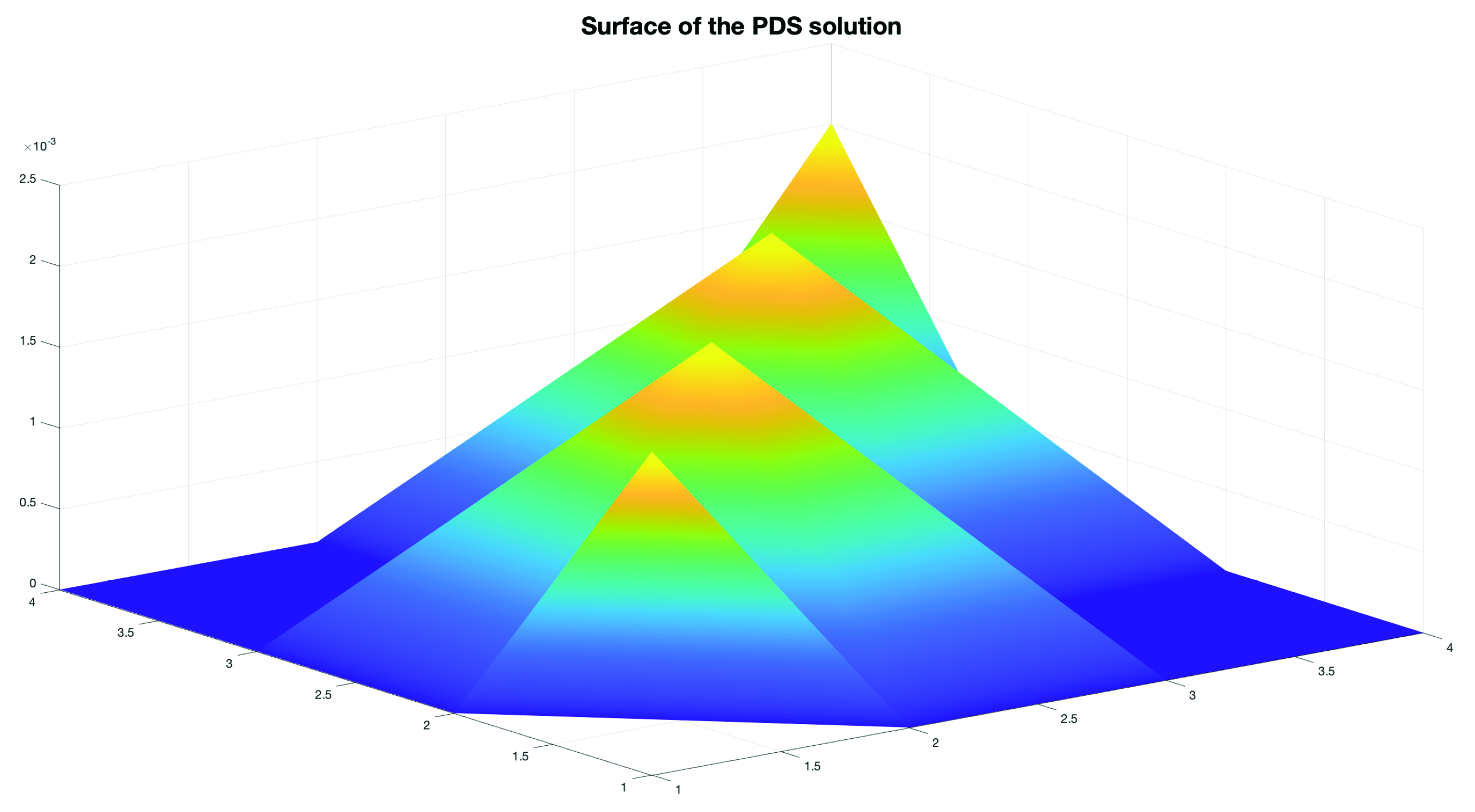
After 6 successive iterations, we obtain the following positive-definite solution
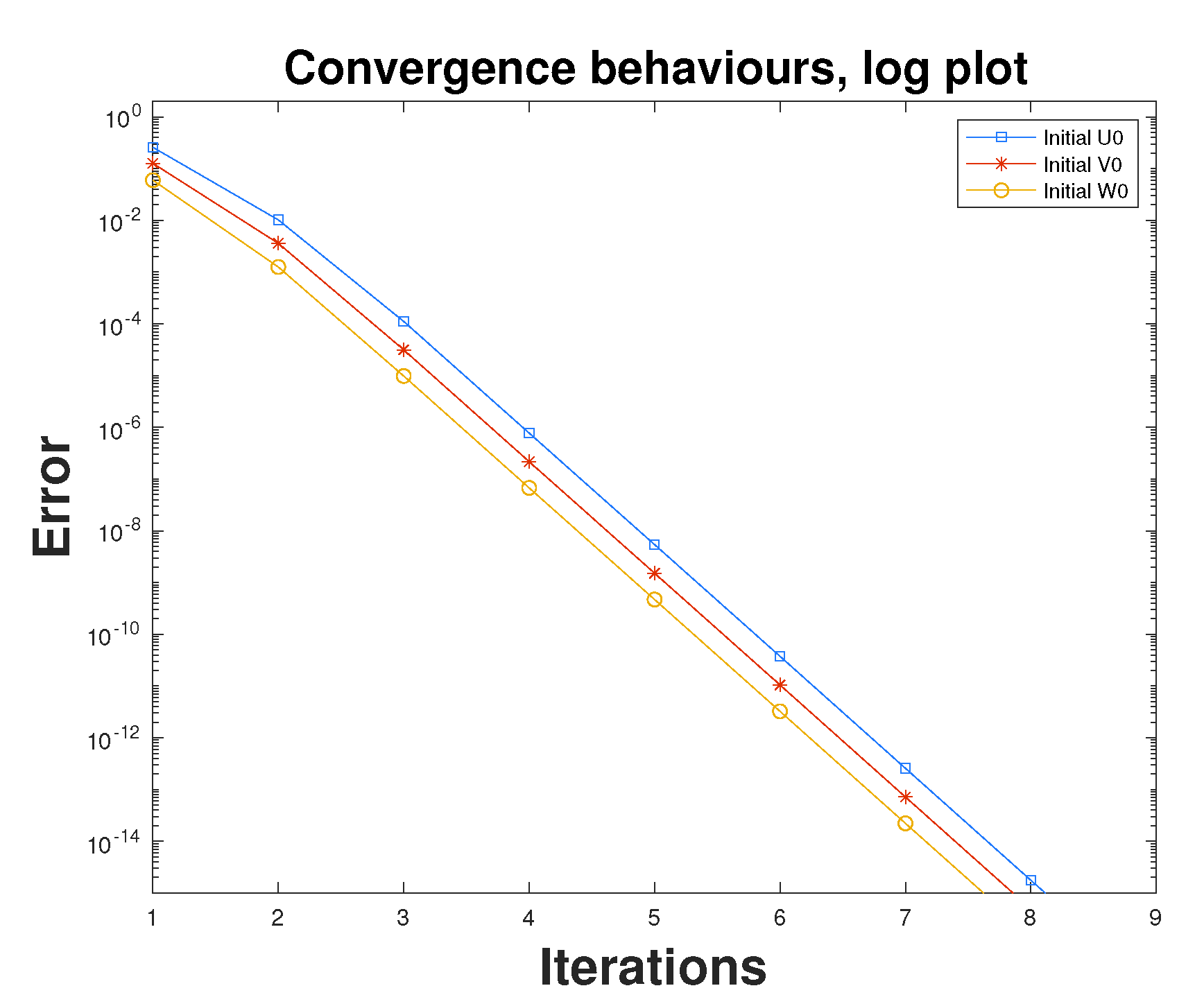
The graphical view of convergence and are shown in Figure 1 and Figure 2 respectively:
Figure 1.
Convergence analysis grpah.
Figure 2.
Solution graph.
Example 9.
Consider the following matrices :
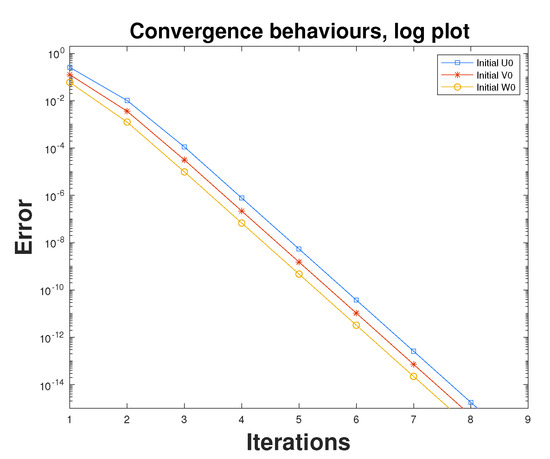
In order to show the convergence of the sequence defined in (12), we start with the following initializations and discuss the CPU time and errors in Table 2:
Table 2.
Three initialization based analysis.
where . We obtain
The positive definite solution is given by
The graphical view of convergence is shown in Figure 3 below:
Figure 3.
Convergence analysis graph.
8. Conclusions
In this paper, investigations of fixed point problems in so-called metric fixed point theory have been broadened to problems formulated in terms of -quasi implicit contractive condition for a self-mapping on a relational quasi partial metric space. In such a way, more general results have been obtained than those existing in literature. It has been shown by explicit examples that these generalizations are proper. The obtained results have been applied to the field of nonlinear matrix equations which is a very important and applicable area by its own.
Author Contributions
Writing, R.J. and H.K.N.; review and editing H.K.N. and Z.K. All authors have read and agreed to the published version of the manuscript.
Funding
The second author is thankful to SERB, INDIA for providing fund under the project-CRG/2018/000615.
Institutional Review Board Statement
Not applicable.
Informed Consent Statement
Not applicable.
Data Availability Statement
Not applicable.
Acknowledgments
We thank the editor for his kind support. We are also grateful to the learned referee for useful suggestions which helped us to improve the text in several places.
Conflicts of Interest
The authors declare no conflict of interest.
References
- Turinici, M. Abstract comparison principles and multivariable Gronwall-Bellman inequalities. J. Math. Anal. Appl. 1986, 117, 100–127. [Google Scholar] [CrossRef]
- Turinici, M. Fixed points for monotone iteratively local contractions. Demonstr. Math. 1986, 19, 171–180. [Google Scholar]
- Matkowski, J. Integrable solutions of functional equations. Diss. Math. 1975, 197, 1–68. [Google Scholar]
- Matkowski, J. Fixed point theorems for mappings with a contractive iterate at a point. Proc. Am. Math. Soc. 1977, 62, 344–348. [Google Scholar] [CrossRef]
- Ran, A.C.M.; Reurings, M.C.B. On the matrix equation X+A*F(X)A=Q: Solutions and perturbation theory. Linear Algebra Appl. 2002, 346, 15–26. [Google Scholar] [CrossRef]
- Ran, A.C.M.; Reurings, M.C.B. A fixed point theorem in partially ordered sets and some applications to matrix equations. Proc. Am. Math. Soc. 2004, 132, 1435–1443. [Google Scholar] [CrossRef]
- Nieto, J.J.; López, R.R. Contractive mapping theorems in partially ordered sets and applications to ordinary differential equations. Order 2005, 22, 223–239. [Google Scholar] [CrossRef]
- Nieto, J.J.; López, R.R. Fixed point theorems in ordered abstract spaces. Proc. Am. Math. Soc. 2007, 135, 2505–2517. [Google Scholar] [CrossRef]
- Samet, B.; Turinici, M. Fixed point theorems on a metric space endowed with an arbitrary binary relation and applications. Commun. Math. Anal. 2012, 13, 82–97. [Google Scholar]
- Ahmadullah, M.; Ali, J.; Imdad, M. Unified relation-theoretic metrical fixed point theorems under an implicit contractive condition with an application. Fixed Point Theory Appl. 2016, 42, 1–15. [Google Scholar] [CrossRef]
- Ahmadullah, M.; Imdad, M. Unified relation-theoretic fixed point results via FR-Suzuki-contractions with an application. Fixed Point Theory 2020, 21, 19–34. [Google Scholar] [CrossRef]
- Ahmadullah, M.; Imdad, M.; Arif, M. Relation-theoretic metrical coincidence and common fixed point theorems under nonlinear contractions. Appl. Gen. Topol. 2018, 19, 65–84. [Google Scholar] [CrossRef]
- Alam, A.; Imdad, M. Relation-theoretic contraction principle. J. Fixed Point Theory Appl. 2015, 17, 693–702. [Google Scholar] [CrossRef]
- Matthews, S.G. Partial metric topology. Ann. N. Y. Acad. Sci. 1994, 728, 183–197. [Google Scholar] [CrossRef]
- Kadelburg, Z.; Nashine, H.K.; Radenović, S. Fixed point results under various contractive conditions in partial metric spaces. RACSAM 2013, 107, 241–256. [Google Scholar] [CrossRef]
- Oltra, S.; Valero, O. Banach’s fixed point theorem for partial metric spaces. Rend. Istit. Math. Univ. Trieste 2004, 36, 17–26. [Google Scholar]
- Altun, I.; Erduran, A. Fixed point theorems for monotone mappings on partial metric spaces. Fixed Point Theory Appl. 2011, 2011, 508730. [Google Scholar] [CrossRef]
- Karapinar, E.; Erhan, M.I.; Öztürk, A. Fixed point theorems on quasi-partial metric spaces. Math. Comput. Model. 2013, 57, 2442–2448. [Google Scholar] [CrossRef]
- Popa, V.; Patriciu, A.M. An unified theorem for mappings in orbitally complete partial metric spaces. Eur. Pure Appl. Math. 2017, 10, 908–915. [Google Scholar]
- Altun, I.; Asim, M.; Imdad, M.; Alfaqih, W.M. Fixed point results for FR-generalized contractive mappings in partial metric spaces. Math. Slovaca 2019, 69, 1413–1424. [Google Scholar] [CrossRef]
- Maddux, R.D. Relation Algebras; Studies in Logic and Foundations of Mathematics, 150; Elsevier: Amsterdam, The Netherlands, 2006. [Google Scholar]
- Kolman, B.; Busby, R.C.; Ross, S. Discrete Mathematical Structures, 3rd ed.; PHI Pvt. Ltd.: New Delhi, India, 2000. [Google Scholar]
- Lipschutz, S. Schaum’s Outlines of Theory and Problems of Set Theory and Related Topics; McGraw-Hill: New York, NY, USA, 1964. [Google Scholar]
- Jeong, G.S.; Rhoades, B.E. Maps for which F(T)=F(Tn). Fixed Point Theory Appl. 2005, 6, 87–131. [Google Scholar]
Publisher’s Note: MDPI stays neutral with regard to jurisdictional claims in published maps and institutional affiliations. |
© 2021 by the authors. Licensee MDPI, Basel, Switzerland. This article is an open access article distributed under the terms and conditions of the Creative Commons Attribution (CC BY) license (https://creativecommons.org/licenses/by/4.0/).