


Abstract
Let be a graph and . A graph can be called G-arc-transitive (GAT) if G acts transitively on its arc set. A regular covering projection is arc-transitive (AT) if an AT subgroup of lifts under p. In this study, by applying a number of concepts in linear algebra such as invariant subspaces (IVs) of matrix groups (MGs), we discuss regular AT elementary abelian covers (R-AT-EA-covers) of the graph.
1. Introduction
All graphs given in this paper are assumed to be finite, connected, and simple. For a graph , we denote a set of vertices, set of edges, set of arcs, and full automorphism group with , , , and , respectively. Suppose that G is a subgroup of . For , is the edge located between a and b in , and denotes the set of vertices adjacent to a in (neighborhood of a).
Suppose that and are two graphs. We say that a graph epimorphism is covering projection if p is a local isomorphism, that is, for each , the restriction p to is a bijection to , where . We say that is the covering graph and is the base graph. A permutation group G on a set is said to be semiregular if the stabilizer of v in G is trivial for each . If G is transitive, and semiregular, it is regular. Let N be a subgroup of such that N is not transitive on . The quotient graph is defined as the graph for which the vertices are the orbits of acting N on , and two vertices are adjacent if, and only if, there exists and such that . The covering graph is regular or N-covering if there is a semiregular subgroup N of the automorphism group Aut() such that graph is isomorphic to the quotient graph . If N is an elementary abelian (EA), then is called an EA covering of . Given a graph and a subgroup G of , is G-vertex-transitive (GVT), G-edge-transitive (GET), or GAT if G is transitive on the , , or , respectively. If then is called a VT, ET or AT graph, respectively. A subspace W of a vector space V is said to be invariant subspace (IV) with respect to a linear transformation T if . A matrix group (MG) is a group G consisting of invertible matrices over a specified field K, with the operation of matrix multiplication.
A powerful and important tool topology and graph theory is covering techniques. Regular covering is an active and interesting topic in algebraic graph theory. Tutte in [1,2] studied finite cubic arc-transitives and showed that every arc-transitive graph of degree 3 has an order of the form , where and a prime number p. Conder and Dobcsnyi [3,4] classified the trivalent s-regular graphs up to order 2048 with MAGMA software [5]. Cheng and Oxley classified the AT graphs of order (see Table 1 in [6]). Talebi and Mehdipoor classified cubic semisymmetric graphs of order in [7]. By using the covering technique, s-regular graphs with order , , , , , , , , , , , , , , , , , , , , , , , and were classified in [8,9,10,11,12,13,14,15,16,17,18,19,20,21,21,22]. Kosari et al. in [23] investigated new results in graphs. The automorphism lifting problem in the context of elementary abelian covers was studied by Malnič, Marušič and Potočnik [24]. Their results have been successfully applied in order to classify elementary abelian covers with specific symmetric properties for a number of small cubic or tetravalent graphs, namely, the complete graph [11], the graph [12] the Heawood graph [24], the Petersen graph [25], the Mbius–Kantor graph [26] and the Octahedron graph [27]. Most recently, Talebi and Mehdipoor investigated semisymmetric -covers of the graph [28]. In this paper, we classify R-AT-EA-covers of the graph, by using concepts of linear algebra.
Graph is an AT tetravalent graph, which was defined in [29]. The order and size of this graph are 13 and 26, respectively. See Figure 1.
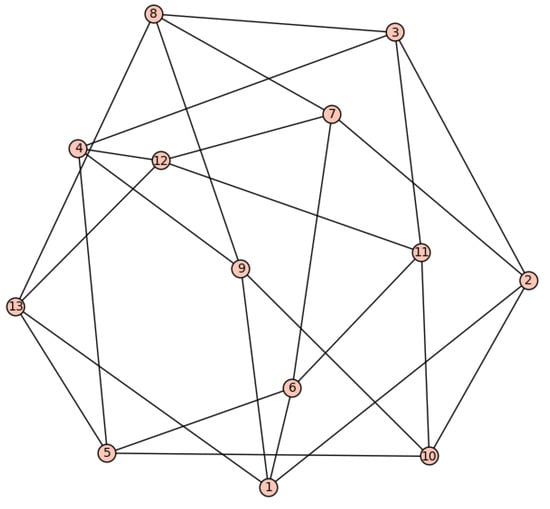
Figure 1.
graph.
The automorphisms of graph are
- ,
Then, . Aut(C13) acts transitively on , and . We will see by using Sage software (S-S) [30] that Aut(C13) has one AT subgroup .
Let T be an ST of the graph with edges
By choosing T, we can consider in this graph a T-reduced VA, that is, the voltage values on the arcs of tree T are the identity. The CT arcs are as follows:
Let be a graph and N be a finite group. We denote the reverse as an arc with . A voltage assignment (VA) of is a function such that for each arc . The voltage is the value of , and N is the voltage group. The graph () obtained from a VA has vertex set and edge set ; then, an edge of joins a vertex to for and , where . By considering the VA arcs, we can create a VA on walks [31], for example the voltage on a walk , is . The derived graph is a covering of . By defining for any and , is an N-covering, for any . The reverse is also true. For a spanning tree (ST) T of the graph , a VA is called T-reduced if the voltages on the tree arcs are the identity. If T is an arbitrary fixed ST, then Gross and Tucker [32] proved that every regular covering of a graph can be obtained from a T-reduced VA of . Assume that is an N-covering of . [33] If and satisfy , where , then is a lift of , and the projection of . A regular covering projection is VT, ET or AT if a VT, ET or AT subgroup of lifts under p.
Let be a graph and be two walks of . We show that the fundamental group of a graph is the set of all reduced walks equipped with the product by . The fundamental group of is called at v. In general, the fundamental group is not a free group. Therefore, by abelianizing , the first homology group is obtained. It is not necessarily a free -module. Suppose that is the minimal number of generators of , where is the number of semiedges and is the number of cotree (CT) loops and links relative to some ST, such that . [24] Observe that
given a connected graph and a subgroup . Let T be a ST of and a set of arcs include precisely one arc from each edge in . Suppose that is the corresponding basis of determined by . Furthermore, denote by the induced action of G on , and let be the matrix representation of with respect to the basis . The dual group including all transposes of matrices in is denoted by .
Proposition 1 was obtained from [24], Proposition 6.3 and Corollary 6.5. This proposition is very important and widely used in the presentation of R-AT-EA-covers of the graph.
Proposition 1.
Let T be an ST of a connected graph Γ, and let the set include precisely one arc from each CT edge. Let be a VA on Γ that is identical on T, and let . Therefore, a group lifts under if and only if the induced subspace is a d-dimensional(d-dime) -IV.
The main purpose for finding all regular EA coverings of a graph is finding all IVs of a MG. Now, we express the following theorem, which is basic for finding all IVs of MG.
Theorem 1
((Maschke’s theorem)). Let V be a representation of the finite group G over a field F in which is invertible. Let W be an invariant subspace of V. Then, there exists an invariant subspace of V such that as representations.
2. R-AT-AE-Covers of the C13 Graph
In this section, we introduce all of the (connected) R-AT-EA-covers of the graph with projection . Notation is the fundamental closed walk, that is, is one cycle of graph containing exactly an arc of CT. Notation is the standard ordered basis of related to the ST T, and the arcs , respectively.
Here, we state Lemma 1.
Lemma 1.
Let A and B be the transposes of the matrices that indicate the linear transformations , and relative to . Therefore
.
Proof.
By considering acting the automorphisms and on , we obtain the rows of these matrices. For instance, the permutation maps the cycle
corresponding to , to the cycle
Since the second cycle is the sum of the base cycles corresponding to and , the first row of matrix A is obtained. This is
Similar to the above, we can obtain the matrices A and B. □
By using S-S, and are the minimal polynomials of A and . Assume that p is a prime. is a primitive 13th root of unity in . The minimal polynomial is decomposed into irreducible factors over . See the following statements:
Now, it is sufficient to see A and H as matrices over the splitting field . To find -IVs over , every IV over is a direct sum of minimal IVs over . By a straightway calculation and applying Lemma 1, we have
where
By the linear transformation A, we calculate the images of , as follows:
Let V be a minimal -IV. Let
and
over the field . Suppose first that . Then . More exactly, . Since and , we have . All one-dime subspaces of are and , where . If , then and hence . Let . Then, . Since , we have .
Now, assume that V intersects nontrivially, such that V must include one of the minimal H-IVs in that are 1-dime subspaces of the spaces , , , , , , , , , , and . We examine the following cases.
- Case I:.
Suppose that . Then, , implying that and hence . Since , we have . By considering , one can see that .
- Case II:.
Suppose that . Then and hence . By noting that , we have . Now by considering , we can see . Therefore, .
- Case III:.
Assume that . Then, , implying that and hence by considering , we have . Finally, by noting that one can see that .
- Case IV:.
Let . Then, . By considering , we have . Finally, by noting that and one can see that .
In the remaining cases, by considering , , we have one of the top IVs.
Now, we use Maschke’s theorem to find all IVs. See the following lemma.
Lemma 2.
All proper nontrivial -IVs on the splitting field are
- ,
- ,
- ,
- ,
- ,
- ,
- ,
- ,
- ,
- ,
- ,
- ,
- ,
- .
Eventually, we delete element from bases for the spaces , . We first show that the subspaces are not -IVs over where . Suppose that for some , , . By considering the coordinates, we see there are not such that . It can be seen by using the same method that the remaining spaces are not -IVs over .
According to the above explanation, the following theorem is obtained.
Theorem 2.

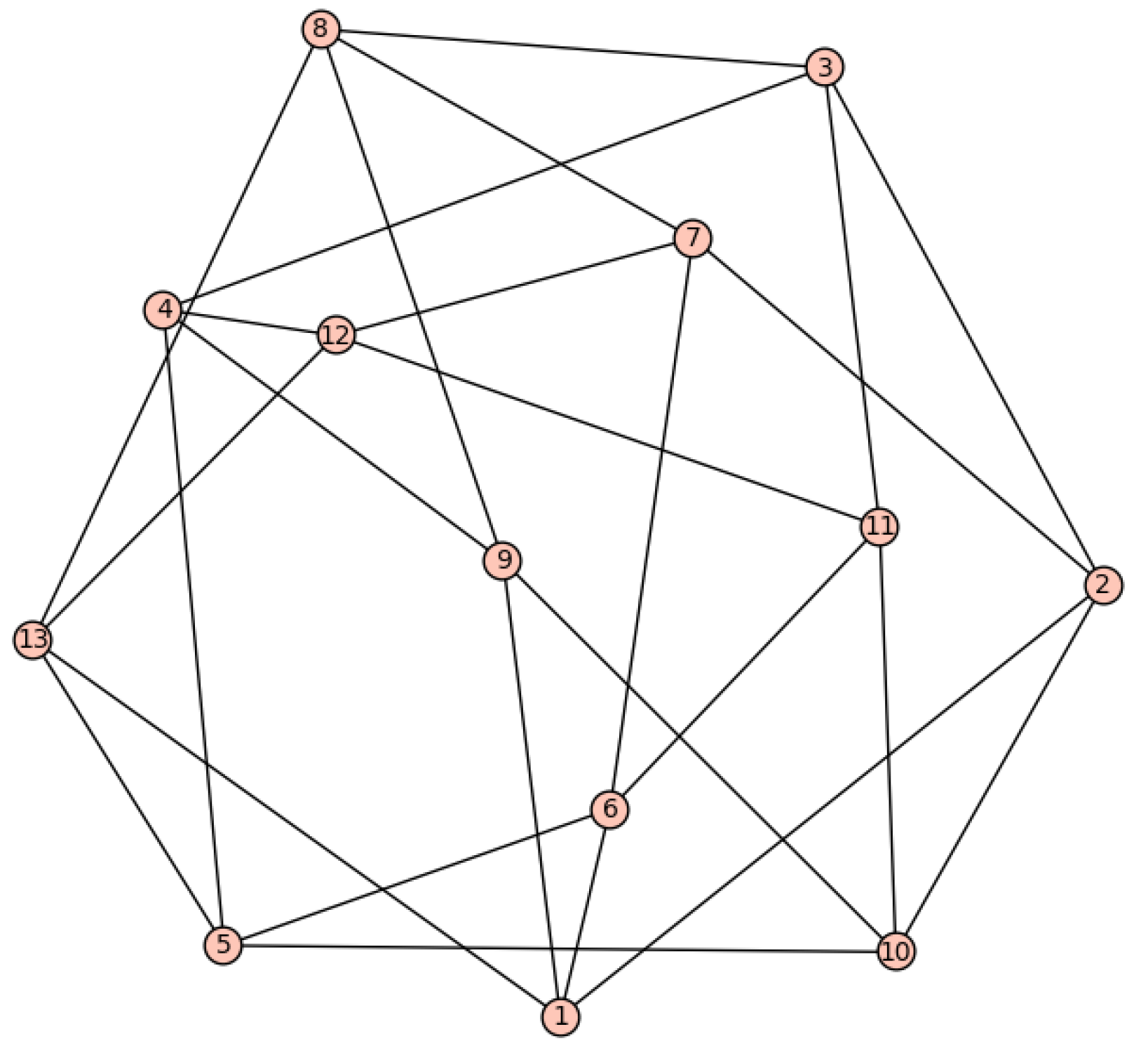
Let p be a prime. Suppose that is an AT cover of the graph, and the group G lifts. In Figure 2, the connected R-AT-EA-p-cover of the graph is introduced:
Figure 2.
R-AT- AE-p-cover of the C13 graph.
We cannot use Maschke’s theorem for because the hypothesis does not hold. Then, we use S-S to complete R-AT-AE-p-covers of the graph.
3. Conclusions
Symmetric graphs are used in computer networks, so studying these graphs is very important. For this reason, researchers in algebraic graph theory have been seriously classifying these graphs and studying their properties since around the year 2000. With a linear representation of automorphisms acting on the first homology group of the graph, the EA covering projections of a graph can be found. Essentially, the main purpose of this method is finding IVs of MGs over prime fields. It should be noted that applying S-S is very effective in presenting the main result. In this paper, we classified R-AT-EA-covers of the graph. In Table 1, this cover, along with the VS on the arcs of CT, was introduced. We plan to study R-AT- AE-covers of quintic graphs in the future. Our next purpose is to investigate ET, semisymmetric and half-arc-transitive coverings of tetravalent graphs.
Author Contributions
Methodology, Q.X., A.K., A.A.T. and N.M.; validation, Q.X. and N.M.; formal analysis, A.A.T. and Q.X.; investigation, A.K. and A.A.T.; data curation, N.M., Q.X., A.K. and A.A.T.; writing—original draft preparation, A.A.T. and N.M.; writing—review and editing, Q.X., A.K., A.A.T. and N.M.; visualization, N.M. and A.K.; supervision, A.K. and Q.X.; project administration, Q.X. and A.A.T.; funding acquisition, Q.X., A.K. and A.A.T. All authors have read and agreed to the published version of the manuscript.
Funding
This research received no external funding.
Institutional Review Board Statement
Not applicable.
Informed Consent Statement
Not applicable.
Data Availability Statement
Not applicable.
Conflicts of Interest
The authors declare no conflict of interest.
References
- Tutte, W.T. A family of cubical graphs. Proc. Camb. Philos. Soc. 1947, 43, 459–474. [Google Scholar] [CrossRef]
- Tutte, W.T. On the symmetry of cubic graphs. Canad. J. Math. 1947, 11, 621–624. [Google Scholar] [CrossRef]
- Conder, M.D.E. Trivalent (Cubic) Symmetric Graphs on Up to 2048 Vertices. 2006. Available online: http://www.math.auckland.ac.nzconder/symmcubic2048list.txt (accessed on 26 January 2022).
- Conder, M.D.E.; Dobcsányi, P. Trivalent symmetric graphs on up to 768 vertices. J. Combin. Math. Combin. Comput. 2002, 40, 41–163. [Google Scholar]
- Bosma, W.; Cannon, J. Handbook of Magma Function; Sydney University Press: Sydney, Australia, 1994. [Google Scholar]
- Cheng, Y.; Oxley, J. On weakly symmetric graphs of order twice a prime. J. Combin. Theory Ser. 1987, B 42, 196–211. [Google Scholar] [CrossRef]
- Talebi, A.A.; Mehdipoor, N. Classifying cubic semisymmetric graphs of order 18pn. J. Graphs Comb. 2014, 30, 1037–1044. [Google Scholar] [CrossRef]
- Feng, Y.Q.; Kwak, J.H. Classifying cubic symmetric graphs of order 10p or 10p2. Sci. China Ser. 2006, A 49, 300–319. [Google Scholar] [CrossRef]
- Feng, Y.Q.; Kwak, J.H. Cubic symmetric graphs of order a small number times a prime or a prime square. J. Combin. Theory Ser. 2006, B 97, 627–646. [Google Scholar] [CrossRef]
- Feng, Y.Q.; Kwak, J.H. Cubic symmetric graphs of order twice an odd prime-power. J. Aust. Math. Soc. 2006, 81, 153–164. [Google Scholar] [CrossRef]
- Feng, Y.Q.; Kwak, J.H. One-regular cubic graphs of order a small number times a prime or a prime square. J. Aust. Math. Soc. 2004, 76, 345–356. [Google Scholar] [CrossRef]
- Feng, Y.Q.; Kwak, J.H.; Wang, K. Classifying cubic symmetric graphs of order 8p or 8p2. Eur. J. Combin. 2005, 26, 1033–1052. [Google Scholar] [CrossRef]
- Feng, Y.Q.; Kwak, J.H.; Xu, M.Y. Cubic s-regular graphs of order 2p3. J. Graph Theory 2006, 52, 341–352. [Google Scholar] [CrossRef]
- Imani, A.; Mehdipoor, N.; Talebi, A.A. On application of linear algebra in classification cubic s-regular graphs of order 28p. Algebra Discret. Math. 2018, 25, 56–72. [Google Scholar]
- Lorimer, P. Vertex-transitive graphs: Symmetric graphs of prime valency. J. Graph Theory 1984, 8, 55–68. [Google Scholar] [CrossRef]
- Oh, J.M. A classification of cubic s-regular graphs of order 14p. Discret. Math. 2009, 309, 2721–2726. [Google Scholar] [CrossRef]
- Oh, J.M. A classification of cubic s-regular graphs of order 16p. Discret. Math. 2009, 309, 3150–3155. [Google Scholar] [CrossRef]
- Oh, J.M. cubic s-regular graphs of orders 12p, 36p, 44p, 52p, 66p, 68p and 76p. J. Appl. Math. Inform. 2013, 31, 651–659. [Google Scholar] [CrossRef]
- Ghasemi, M. A classification of tetravalent one-regular graphs of order 3p2. J. Colloq. Math. 2012, 1, 15–24. [Google Scholar] [CrossRef]
- Ghasemi, M. tetravalent arc-transitive graphs of order 3p2. Discuss. Math. Graph Theory 2014, 34, 567–575. [Google Scholar] [CrossRef]
- Ghasemi, M.; Spiga, P.; Xu, M.Y. 4-valent graphs of order 6p2 admitting a group of automorphisms acting regularly on arcs. J. Ars Math. Contemp. 2015, 9, 1–18. [Google Scholar]
- Talebi, A.A.; Mehdipoor, N. Classifying cubic s-regular graphs of orders 22p, 22p2. J. Algebra Discret. Math. 2013, 16, 293–298. [Google Scholar]
- Qiang, X.; Kosari, S.; Shao, Z.; Sheikholeslami, S.M.; Chellali, M.; Karami, H. A note on the paired-domination subdivision number of trees. J. Math. 2021, 9, 181. [Google Scholar] [CrossRef]
- Malnič, A.; Marušič, D.; Potočnik, P. Elementary abelian covers of graphs. J. Algebr. Combin. 2004, 20, 71–97. [Google Scholar] [CrossRef]
- Malnič, A.; Potočnik, P. Invariant subspaces, duality, and covers of the Petersen graph. Eur. J. Combin. 2006, 27, 971–989. [Google Scholar] [CrossRef][Green Version]
- Malnič, A.; Marušič, D.; Miklavič, S.; Potočnik, P. Semisymmetric elementary abelian covers of the Möbius-Kantor graph. Discret. Math. 2007, 307, 2156–2175. [Google Scholar] [CrossRef]
- Kwak, J.H.; Oh, J.M. Arc transitive elementary abelian covers of the octahedron graph. Linear Algebra Appl. 2008, 429, 2180–2198. [Google Scholar] [CrossRef]
- Talebi, A.A.; Mehdipoor, N. Semisymmetric Zp-covers of the C20 Graph. J. Algebra Discret. Math. 2021, 16, 286–301. [Google Scholar] [CrossRef]
- Potočnik, P.; Wilson, S. A Census of Edge-Transitive Tetravalent Graphs. Available online: http://jan.ucc.nau.edu/~swilson/C4Site/index.html (accessed on 26 January 2022).
- Beezer, R.A. Sage for Linear Algebra. A Supplement to a First Course in Linear Algebra. Sage Web Site. 2011. Available online: http://www.sagemath.org (accessed on 26 January 2022).
- Skoviera, M. A construction to the theory of voltage groups. Discret. Math. 1986, 61, 281–292. [Google Scholar] [CrossRef]
- Gross, J.L.; Tucker, T.W. Generating all graph coverings by permutation voltage assignments. Discret. Math. 1977, 18, 273–283. [Google Scholar]
- Malnic, A. Group actions, covering and lifts of automorphisms. Discret. Math. 1998, 182, 203–218. [Google Scholar] [CrossRef]

Publisher’s Note: MDPI stays neutral with regard to jurisdictional claims in published maps and institutional affiliations. |
© 2022 by the authors. Licensee MDPI, Basel, Switzerland. This article is an open access article distributed under the terms and conditions of the Creative Commons Attribution (CC BY) license (https://creativecommons.org/licenses/by/4.0/).