


Abstract
Chemical structures are mathematically modeled using chemical graphs. The graph invariants including algebraic polynomials and topological indices are related to the topological structure of molecules. Hosoya polynomial is a distance based algebraic polynomial and is a closed form of several distance based topological indices. This article is devoted to compute the Hosoya polynomial of two different atomic configurations ( and ) of Carbon Nanosheets. Carbon nanosheets are the most stable, flexible structure of uniform thickness and admit a vast range of applications. The Hosoya polynomial is used to calculate distance based topological indices including Wiener, hyper Wiener and Tratch–Stankevitch–Zafirov Indices. These indices play their part in determining quantitative structure property relationship (QSPR) and quantitative structure activity relationship (QSAR) of chemical structures. The three dimensional presentation of Hosoya polynomial and related distance based indices leads to the result that though the chemical formula for both the sheets is same, yet they possess different Hosoya Polynomials presenting distinct QSPR and QSAR corresponding to their atomic configuration.
Keywords:
C4C8(R) and C4C8(S) carbon nanosheets; Hosoya polynomial; Wiener index; hyper Wiener index; Tratch–Stankevitch–Zafirov index MSC:
05C12; 05C31; 05C90; 92E10
1. Introduction
Chemical graph theory comes under the umbrella of mathematical modeling of chemical structures. The theory applies and solves molecular problems. A chemical graph exhibits the atoms and the molecular bonds as the vertices and the edges of a graph, respectively. Thus, chemical graph theory finds graph invariants (algebraic polynomials or a topological indices) regarding the topological structure of a molecule [1].
Hosoya polynomial is a significant distance based graph invariant (an algebraic polynomial) [2]. This polynomial admits many chemical applications [3]. Nearly all distance based topological indices can be derived from this polynomial [4,5] which indicates that the Hosoya polynomial is a closed form for many distance based topological indices including Wiener, hyper Wiener, Szeged and Hararay indices [6].
Topological indices are inferred from hydrogen stifled chemical graphs. These are unique numbers expressed by diverse representations including vertex degree or distance between vertices [7,8]. The distance based topological indices are utilized in the improvement of QSAR and QSPR where physiochemical properties of compounds are associated with their molecular graph [9,10]. QSAR models give mathematical relationship between the descriptors and biological activities of ligands [11,12,13]. QSPR models use parameters describing the molecular structure to find an optimum quantitative relationship with the prediction of the properties of compounds [14,15,16]. These models involve physiochemical properties of molecular structures, theoretically determined by topological indices.
The famous distance based topological index is the Wiener index which expresses the boiling points of alkane molecules [17]. This index correlates the critical point, viscosity, density and surface tension of alkane to its liquid transition, and the van der Waals surface area of the molecule which are the QSARs [18,19,20]. The Wiener index is the pioneer for the formation of other distance based topological indices [21]. A hyper Wiener index is an extension of Wiener index [22]. The hyper Wiener index limits the structure of a particle into a number which represents the subatomic stretching and electronic structures. The Tratch–Stankevitch–Zafirov index is also an extension of Wiener index.
Recently, the algebraic polynomials and topological indices regarding nano-stuctures have gained interest [23,24,25,26]. The Hosoya polynomial for bouquets of graphs, circuits of graphs, chains of graphs, and links of graphs have been investigated [27] with the outcomes used to investigate different properties of the chemical structures. The Hosoya polynomial and related topological indices have been computed for cactus chains, one-pentagonal carbon nanocones and concatenated pentagonal rings [28,29,30]. The distance-based topological indices of nanosheets, nanotubes, and nanotori of with potential applications in food, drug and cosmetic industries have also been calculated [31]. The Hosoya polynomials with other distance based polynomials have been calculated for and networks, circumcoronene series of benzenoid and carbon pentachains [32,33,34,35]. Moreover, the distance based topological indices of hexagonal jagged-rectangle are computed with potential applications in medicine, pharmacy and biology [36].
Carbon nanostructures admit their significance in industrial useage due to their minute dimensional length. These admit unique properties such as thermal and electrical conductivity, high mechanical strength and optical properties [37]. Due to their immense useful properties, the carbon nanostructures admit a frequent usage in industry [38,39,40].
Carbon nanosheets (CNSs) are stable and flexible structures with vast applications in sensors, filtration, coatings, batteries, transistors, water filtration, antennas, supercapacitors, solar cells, supercapacitors, oxygen reductions and DNA sequencing [41,42,43]. A novel formation is the development of two-dimensional porous CNSs used in lithium batteries, supercapacitors, and electro-catalytic oxygen reductions [44,45,46].
This study is devoted to compute the Hosoya Polynomial of CNS with two different atomic configurations and . The molecular graphs are made to calculate the Hosoya polynomial and topological indices. The Hosoya polynomial represents symmetries of the chemical graph. A chemical graph exhibits the lattice of a molecule and thus, the crystal symmetries are discussed using Hosoya polynomial. The distance based topological indices including Wiener, hyper Wiener and Tratch–Stankevitch–Zafirov indices for these molecular structures will also be derived using the Software Maple. We will graphically analyze the Hosoya polynomial and related topological indices for the two structures.
2. Methods
For the sake of computing a Hosoya polynomial of a molecule, we consider the chemical graph. The chemical graph exhibit the topology of the chemical structure of molecule. Consider a molecular graph with finite non-empty sets containing vertices and edges, respectively. The distance between any pair of vertices u and v is denoted as To compute the Hosoya polynomial of the graph we have to compute the frequency of pair of vertices at distances , where denotes the maximum distance between any pair of vertices in graph The Hosoya polynomial in variable x is defined as:
where denotes the least distance between any two vertices u and v or the minimum number of edges traversed while going from u to v.
The general expression for a Hosoya polynomial in base variable x is given as follows:
where is the number of pair of vertices at distance The distances between the pair of vertices will be arranged in the matrix form. A general form of the matrix will be derived. The number of vertices with same distance will be calculated leading to the coefficient of the j th term of Hosoya polynomial.
The Hosoya polynomial will be used to calculated the topological indices including Wiener, hyper Wiener and Tratch–Stankevitch–Zafirov indices using calculus. The Wiener index is the first derivative of Hosoya polynomial taking the variable as unity and can be interpreted as [47]:
where represent the first derivative with respect to variable the base variable of the polynomial. It is worthy to mention that the limit leads to the sum of coefficients substituting in the first order derivative of Hosoya polynomial.
The hyper Wiener index can also be deduced from the Hosoya polynomial by multiplying the polynomial with the base variable x and then, taking the double derivative. Mathematically the formula of obtaining a hyper Wiener index from Hosoya polynomial is as follows [47]:
where represent the second derivative with respect to variable the base variable of the polynomial. It is worth mentioning that the limit leads to the sum of coefficients substituting in half of the second order derivative of product of x and the Hosoya polynomial.
The Tratch–Stankevitch–Zafirov index can also be interpreted in terms of Hosoya polynomial under the relation [6]:
where represent the third derivative with respect to variable the base variable of the polynomial. It is well noting that the limit leads to the sum of coefficients substituting in one sixth of the third order derivative of product of and the Hosoya polynomial.
3. Results
This section is devoted to the calculations of Hosoya polynomial and related indices of the two atomic configurations of and of CNS. The results are presented in the form of theorems and corollaries.
3.1. Carbon Nanosheet
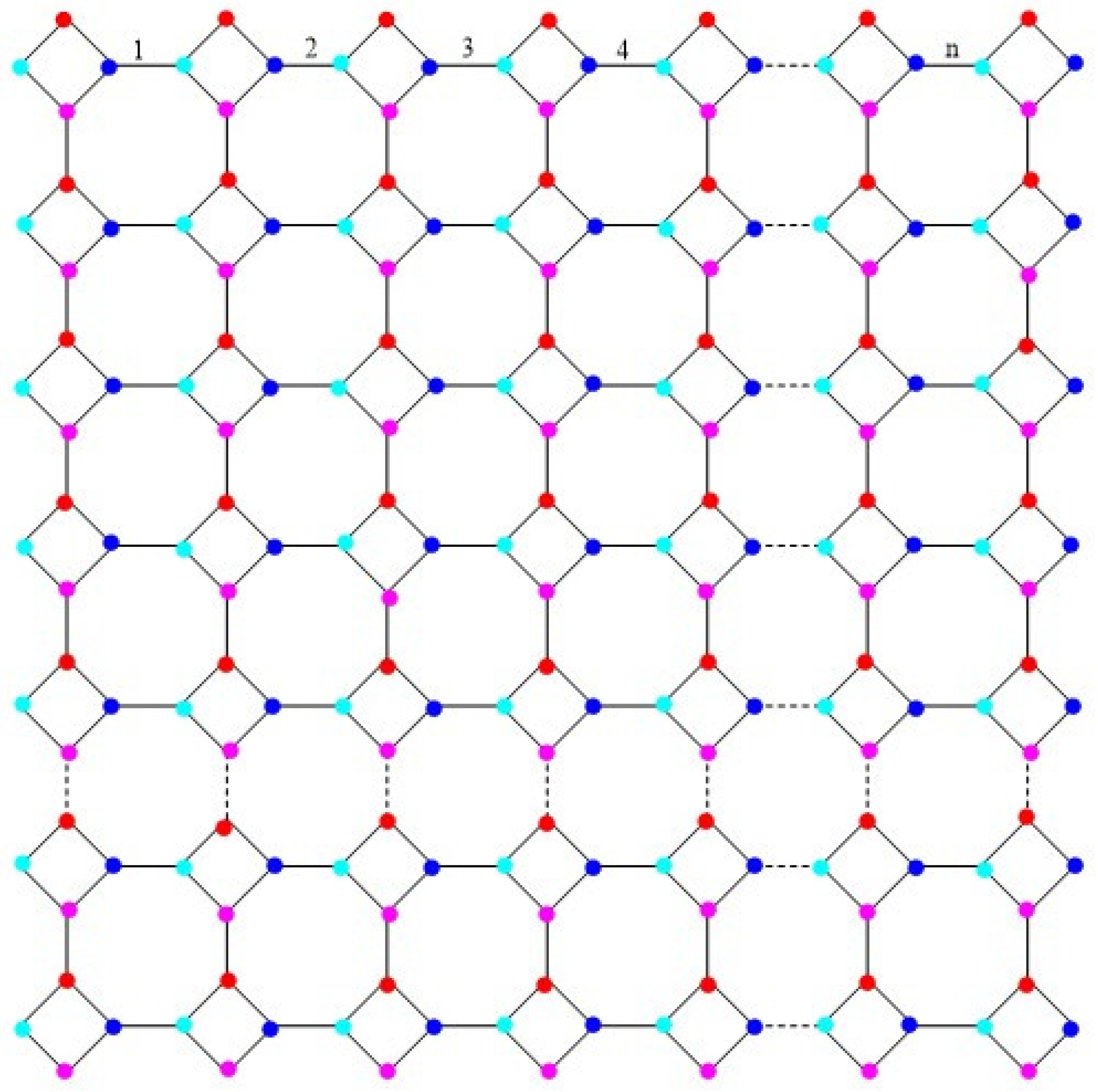
A is a right atomic configuration of CNS Thus, a two dimensional lattice is developed which entertain as rhombus and as octagon. Thus, the same is the graph of the structure shown in Figure 1 presenting the topology of CNS We consider the arrangement as , where n is the length of the sheet.
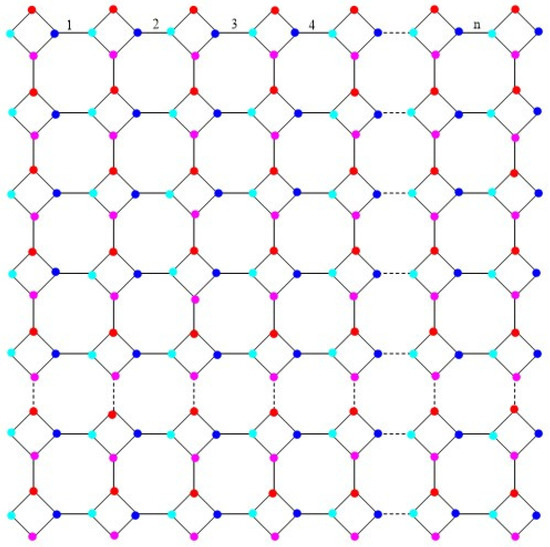
Figure 1.
The graph of right atomic configuration of CNS .
Theorem 1.
For the topology of CNS for , where n is the length of the sheet, the Hosoya polynomial is calculated as:
Proof.
The distance matrix D corresponding to the molecular graph of carbon nanosheet is:
where the sub matrices are of order . These matrices can be expressed as:
and the remaining sub matrices can be obtained from the matrix by substituting ,
Now, we want to compute , where is the number of pair of vertices with distance The method of computing the number of pairs is as follows:
The similar form of other coefficients can be written as:
The above values when substituted into Equation (2), lead to the following form of Hosoya polynomial for CNS as:
Hence proved. □
Corollary 1.
The Wiener, hyper Wiener and Tratch-Stankevitch-Zefirov indices for the topology of CNS can be found using as:
Proof.
The proof follows immediately using Equations (3)–(5) on the Hosoya polynomial obtained in Theorem 1 as under:
The Weiner index for carbon nanosheet is obtained by taking first order derivative of Hosoya polynomial at as in Equation (3) as:
The hyper Wiener index of carbon nanosheet is calculated by multiplying Hosoya polynomial with x and then taking its second derivative at as in Equation (4):
The TSZ index of carbon nanosheet can be inferred by multiplying Hosoya polynomial by and then taking the third derivative at as in Equation (5):
□
3.2. Carbon Nanosheet
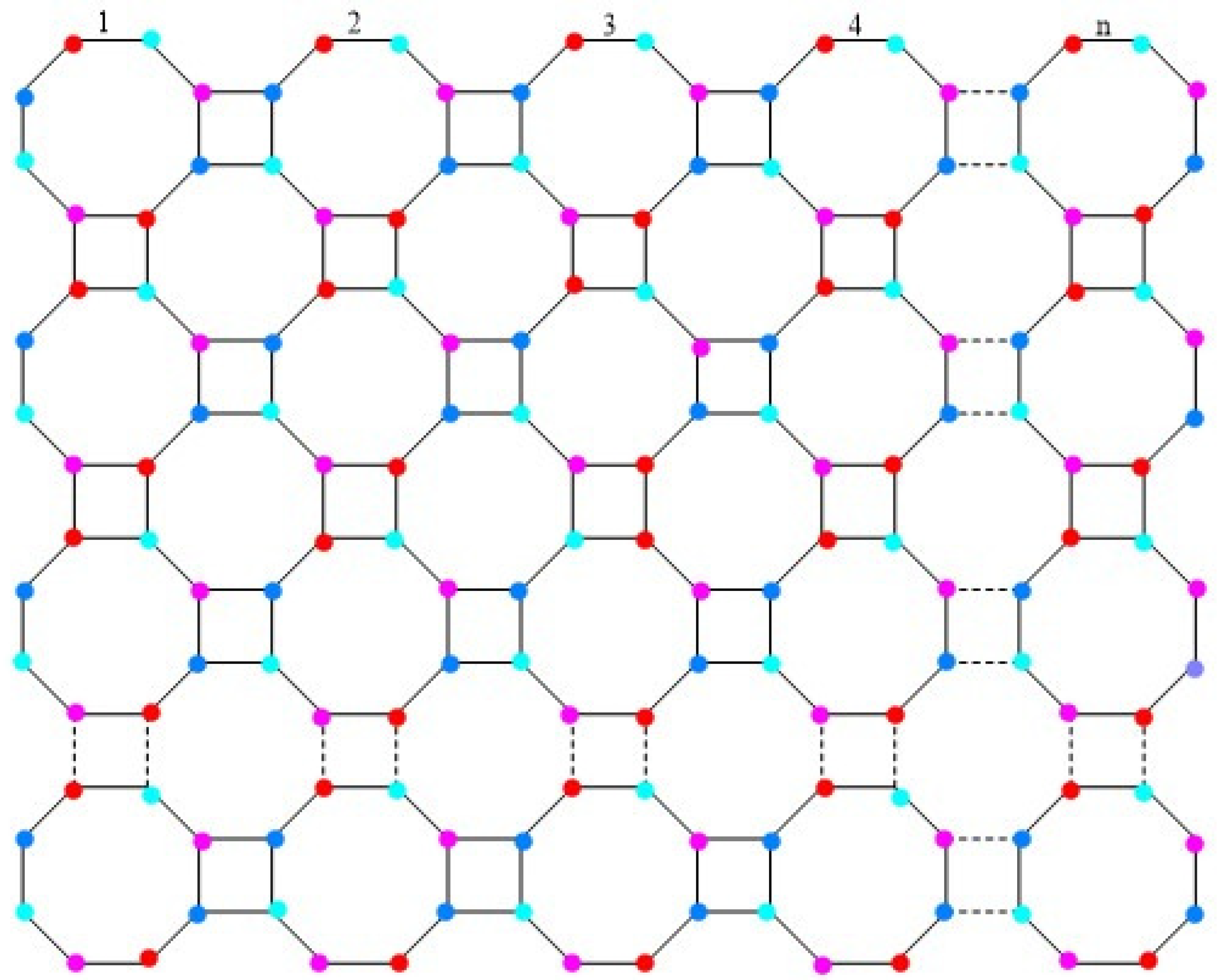
A is a left atomic configuration of CNS Thus, a two dimensional lattice is developed which entertain as squares and as octagon. Thus, the same is the graph of the structure shown in Figure 2 presenting the topology of CNS . We consider the arrangement as , where n is the length of the sheet.
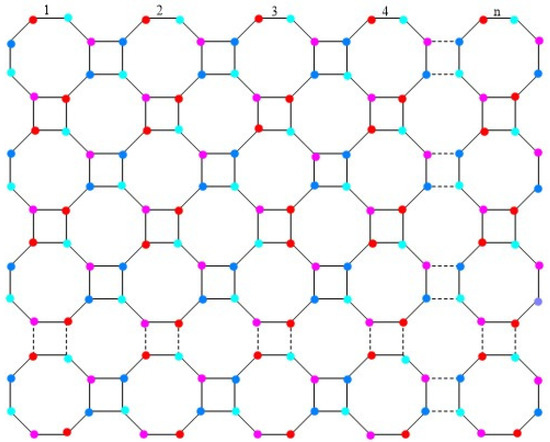
Figure 2.
The graph of left atomic configuration of CNS .
Theorem 2.
For the topology of CNS for , where n is the length of the sheet, the Hosoya polynomial is calculated as:
Proof.
The first step is to compute the , where The distance matrix D corresponding to the molecular graph of carbon nanosheet is:
where the sub matrices have order These matrices are:
and the remaining sub matrices can be obtained from the matrix by substituting ,
Now, we want to compute , where is the number of pair of vertices with distance The method of computing the number of pairs is as follows:
The similar form of other coefficients can be written as:
The above values when substituted into Equation (2), lead to the following form of Hosoya polynomial for CNS as:
Hence proved. □
Corollary 2.
The Wiener, hyper Wiener and Tratch-Stankevitch-Zefirov indices for the topology of CNS can be found using as:
Proof.
The proof follows immediately using Equations (3)–(5) on the Hosoya polynomial obtained in Theorem 2 as under:
The Weiner index for carbon nanosheet is obtained by taking first order derivative of Hosoya polynomial at as in Equation (3) as:
The Hyper Wiener index of carbon nanosheet is calculated by multiplying Hosoya polynomial with x and then taking its second derivative at as in Equation (4):
The TSZ index of carbon nanosheet can be inferred by multiplying Hosoya polynomial by and then taking the third derivative at as in Equation (5):
□
4. Discussion
We considered the topology of the two atomic configurations of CNS, i.e., and and plotted the respective graphs. The mathematical expressions of Hosoya polynomial for both the configurations are calculated. Moreover, the distance based topological indices including Wiener, hyper Wiener and TSZ indices are computed using the derivatives of the Hosoya polynomials.
It is noteworthy that both the atomic configurations and of the same atomic structure nanosheet reached at two different Hosoya polynomials.
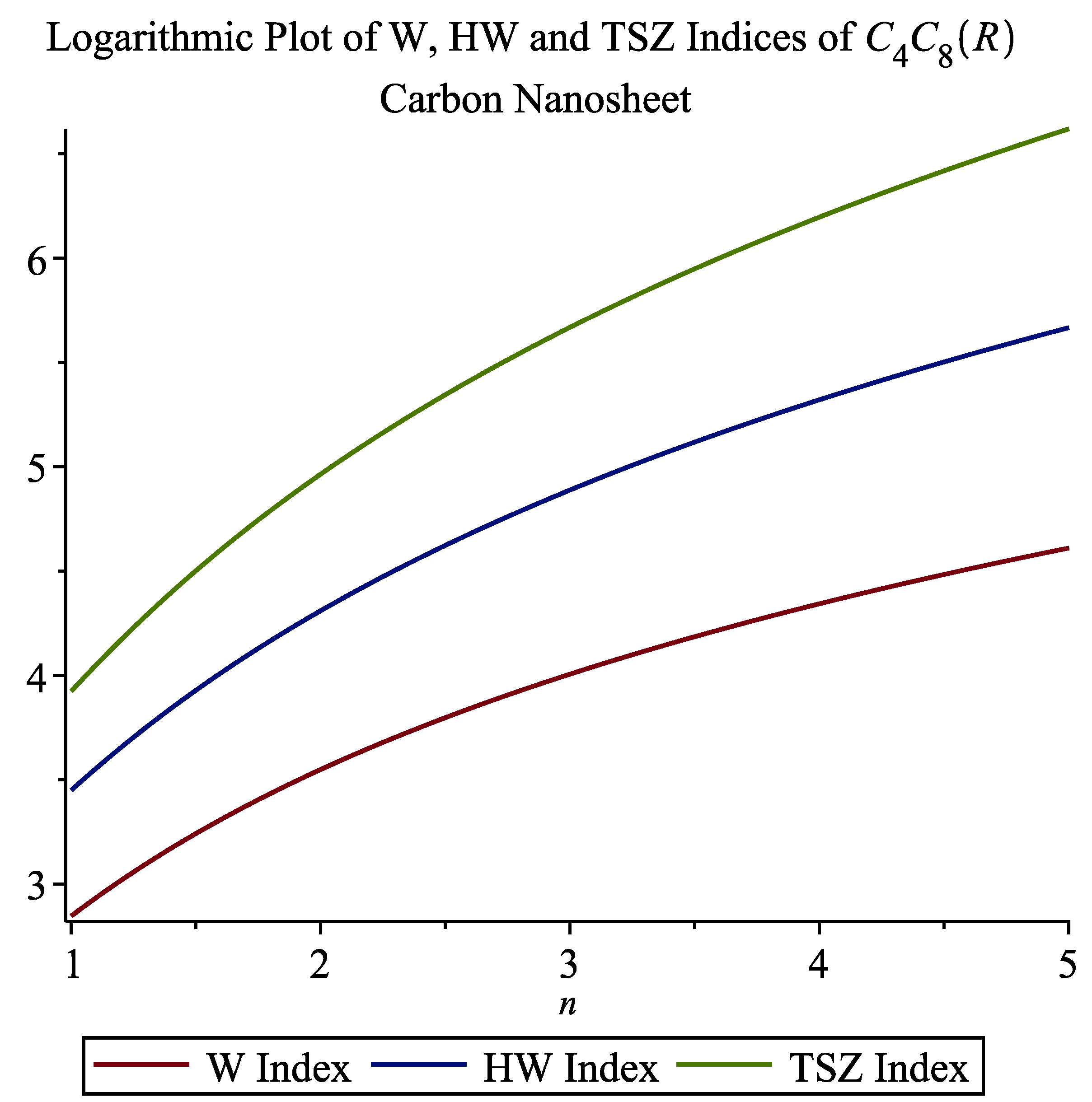
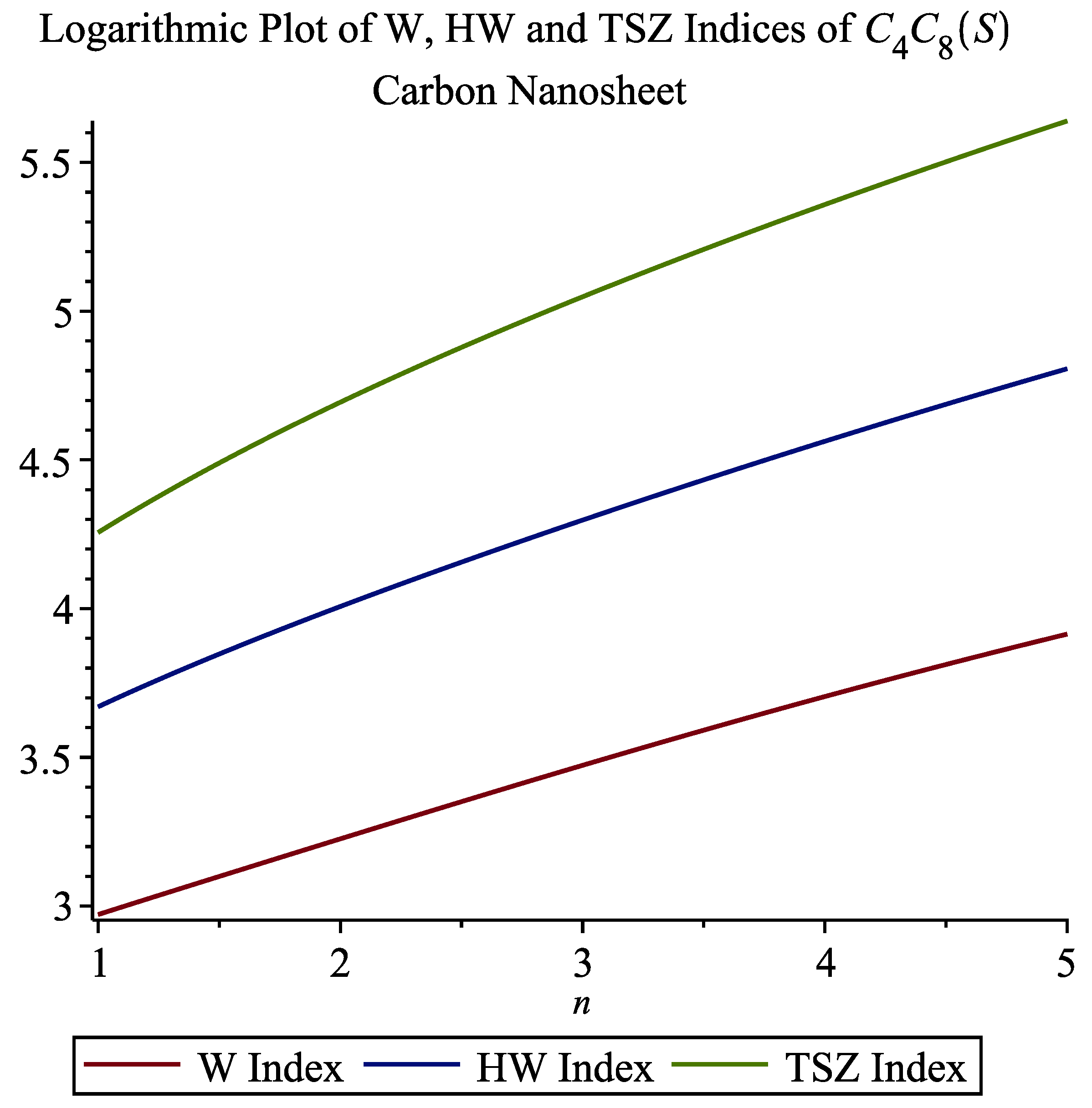
The Figure 3 and Figure 4 exhibit Wiener, hyper Wiener and TSZ indices of and CNS for It is worthy to note that the values at are physical. It is depicted from both the figures that the Wiener index possess low values, the hyper Wiener admits relatively high whereas the TSZ index takes extremely high values for all Moreover, the logarithmic values of the indices for both the nanosheets are different from each other. The nanosheet posess relatively lesser values of the indices as compared to the nanosheet. Thus, for the two atomic configurations, and CNS, all the three indices calculated takes different values and possess different behaviors.
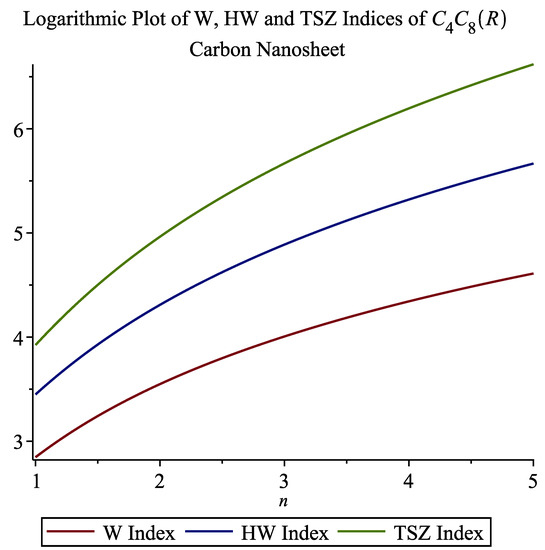
Figure 3.
Wiener, hyper Wiener and Tratch-Stankevitch-Zefirov indices of CNS for .
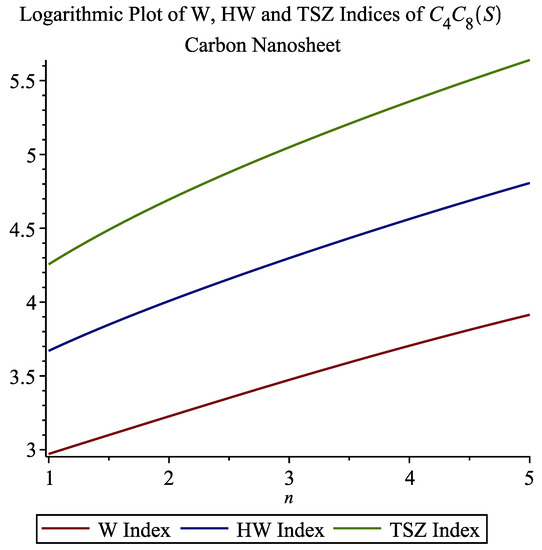
Figure 4.
Wiener, hyper Wiener and Tratch-Stankevitch-Zefirov indices of CNS for .
5. Conclusions
This article is devoted to calculate a generalized expression of Hosoya polynomial concerning the topology of two atomic configurations, and CNS. It is found that the Hosoya polynomial calculated for the structures possess different values, i.e., the values are relatively higher for the CNS as compared to the CNS. We also derived distance based topological indices including Wiener index, hyper Wiener index and TSZ index. These topological indices correlate several pysico-chemical properties of these chemical structure. For example, Wiener index is used to estimate the boiling point. The Hyper Wiener index is used to obtain the surface tension and heat of evaporation. These indices plays their part in determining QSAR of chemical structures.
As a consequence of the different Hosoya polynomial expressions calculated for and CNS, we reached at different values for the related distance based topological indices including Wiener, hyper Wiener and TSZ indices.
This work can be extended to other configurations of carbon nanosheets as well as other carbon based nanostructures. Another extension of the work may be to compute Harary polynomial to carbon nanosheets.
Author Contributions
The individual contributions of each author are provided as follows: conceptualization, R.P.; investigation, U.S., S.R. and C.O.; project administration, C.O.; supervision, R.P. and U.S.; visualization, U.S. and S.R.; writing—review and editing, C.O. and R.P. All authors have read and agreed to the published version of the manuscript.
Funding
The work was partially funded by Slovak Grant Agency for Science VEGA under the grant number VEGA 2/0009/19.
Institutional Review Board Statement
Not applicable.
Informed Consent Statement
Not applicable.
Data Availability Statement
Not applicable.
Acknowledgments
The work was partially funded by Slovak Grant Agency for Science VEGA under the grant number VEGA 2/0009/19. Moreover, the authors acknowledge the support of HEC Pakistan, National Textile University Faisalabad and University of Education, Lahore for their administrative and technical support.
Conflicts of Interest
The authors declare that they have no known competing financial interests or personal relationships that could have appeared to influence the work reported in this manuscript.
References
- Joita, D.M.; Jantschi, L. Extending the characteristic polynomial for characterization of C20 fullerene congeners. Mathematics 2017, 5, 84. [Google Scholar] [CrossRef]
- Hosoya, H. On some counting polynomials in chemistry. Discret. Appl. Math. 1988, 19, 239–257. [Google Scholar] [CrossRef]
- Gutman, I.; Klavžar, S.; Petkovšek, M.; Žigert, P. On Hosoya polynomial of benzenoid graphs. MATCH Commun. Math. Comput. Chem. 2001, 43, 49–66. [Google Scholar]
- Cash, G. Relationship between the Hosoya polynomial and the hyper Wiener index. Appl. Math. Lett. 2002, 15, 893–895. [Google Scholar] [CrossRef]
- Wiener, H. Structural determination of paraffin boiling points. J. Am. Chem. Soc. 1947, 69, 17–20. [Google Scholar] [CrossRef]
- Ahmad, H.; Hussain, M.; Nazeer, W.; Chu, Y.M. Distance-based invariants of zigzag polyhex nanotube. Math. Methods Appl. Sci. 2020. [Google Scholar] [CrossRef]
- Došlić, T. On the number of spanning trees in alternating polycyclic chains. J. Math. Chem. 2018, 56, 2794–2800. [Google Scholar]
- Došlić, T.; Zubac, I. Partition of π-electrons among the faces of polyhedral carbon clusters. J. Math. Chem. 2018, 56, 2512–2524. [Google Scholar]
- Shirakol, S.; Kalyanshetti, M.; Hosamani, S.M. QSPR analysis of certain distance based topological indices. Appl. Math. Nonlinear Sci. 2019, 4, 371–386. [Google Scholar] [CrossRef]
- Hu, M.; Ali, H.; Binyamin, M.A.; Ali, B.; Liu, J.-B.; Fan, C. On Distance-Based Topological Descriptors of Chemical Interconnection Networks. J. Math. 2021, 2021, 5520619. [Google Scholar] [CrossRef]
- Mozafari, Z.; Chamjangali, M.A.; Beglari, M.; Doosti, R. The efficiency of ligand–receptor interaction information alone as new descriptors in QSAR modeling via random forest artificial neural network. Chem. Biol. Drug Des. 2020, 96, 812–824. [Google Scholar] [CrossRef] [PubMed]
- Suay-García, B.; Bueso-Bordils, J.I.; Falcó, A.; Antón-Fos, G.M.; Alemán-López, P.A. Virtual Combinatorial Chemistry and Pharmacological Screening: A Short Guide to Drug Design. Int. J. Mol. Sci. 2022, 23, 1620. [Google Scholar] [CrossRef] [PubMed]
- Alomari, F.Y.; Sharfalddin, A.A.; Abdellattif, M.H.; Domyati, D.; Basaleh, A.S.; Hussien, M.A. QSAR Modeling, Molecular Docking and Cytotoxic Evaluation for Novel Oxidovanadium (IV) Complexes as Colon Anticancer Agents. Molecules 2022, 27, 649. [Google Scholar] [CrossRef] [PubMed]
- Wadhwa, P.; Mittal, A. Quantitative Structure-Property Relationship (QSPR) Modeling Applications in Formulation Development. In Computer Aided Pharmaceutics and Drug Delivery; Springer: Singapore, 2022; pp. 543–560. [Google Scholar]
- Jaganathan, K.; Tayara, H.; Chong, K.T. An Explainable Supervised Machine Learning Model for Predicting Respiratory Toxicity of Chemicals Using Optimal Molecular Descriptors. Pharmaceutics 2022, 14, 832. [Google Scholar] [CrossRef]
- Lotfi, S.; Ahmadi, S.; Kumar, P. A hybrid descriptor based QSPR model to predict the thermal decomposition temperature of imidazolium ionic liquids using Monte Carlo approach. J. Mol. Liq. 2021, 338, 116465. [Google Scholar] [CrossRef]
- Mahboob, A.; Alrowaili, D.; Alam, S.M.; Ali, R.; Rasheed, M.W.; Siddique, I. Topological Attributes of Silicon Carbide SiC4-IIi,j Based on Ve-Degree and Ev-Degree. J. Chem. 2022, 2022, 3188993. [Google Scholar] [CrossRef]
- Adnan, M.; Bokhary, S.A.U.H.; Imran, M. On Wiener Polarity Index and Wiener Index of Certain Triangular Networks. J. Chem. 2021, 2021, 2757925. [Google Scholar] [CrossRef]
- Adnan, M.; Bokhary, S.A.U.H.; Abbas, G.; Iqbal, T. Degree-based topological indices and QSPR analysis of antituberculosis drugs. J. Chem. 2022, 2022, 5748626. [Google Scholar] [CrossRef]
- Gutman, I.; Körtvélyesi, T. Wiener indices and molecular surfaces. Z. Für Nat. A 1995, 50, 669–671. [Google Scholar] [CrossRef][Green Version]
- Devillers, J.; Balaban, A.T. (Eds.) Topological Indices and Related Descriptors in QSAR and QSPR; Gordan and Breach Science Publishing: Philadelphia, PA, USA, 1999. [Google Scholar]
- Wang, G.; Liu, Y.; Wei, J.; Liu, J.B. The Edge-Hyper Wiener Index of Zigzag Single-Walled Nanotubes. Polycycl. Aromat. Compd. 2022, 2030764. [Google Scholar] [CrossRef]
- Chu, Y.M.; Imran, M.; Baig, A.Q.; Akhter, S.; Siddiqui, M.K. On M-polynomial-based topological descriptors of chemical crystal structures and their applications. Eur. Phys. J. Plus. 2020, 135, 874. [Google Scholar] [CrossRef]
- Hayat, S.; Imran, M.; Liu, J.B. An efficient computational technique for degree and distance based topological descriptors with examples. IEEE Access 2019, 7, 32276–32296. [Google Scholar] [CrossRef]
- Shao, Z.; Siddiqui, M.K.; Muhammad, M.H. Computing Zagreb indices and zagreb polynomials for symmetrical nanotubes. Symmetry 2018, 10, 244. [Google Scholar] [CrossRef]
- Deutsch, E.; Klavžar, S. Computing Hosoya polynomials of graphs from primary subgraphs. arXiv 2012, arXiv:1212.3179. [Google Scholar]
- Sadeghieh, A.; Alikhani, S.; Ghanbari, N.; Khalaf, A.J.M. Hosoya polynomial of some cactus chains. Cogent Math. 2017, 4, 1305638. [Google Scholar] [CrossRef]
- Zhang, Q.X.; Xu, S.J.; Chen, H.Y. The Hosoya polynomial of one-pentagonal carbon nanocone. Fuller. Nanotub. Carbon Nanostructure 2014, 22, 866–873. [Google Scholar] [CrossRef]
- Ali, A.A.; Ali, A.M. Hosoya Polynomials of Pentachains. MATCH Commun. Math. Comput. Chem. 2011, 65, 807–819. [Google Scholar]
- Arockiaraj, M.; Klavžar, S.; Mushtaq, S.; Balasubramanian, K. Distance-based topological indices of nanosheets, nanotubes and nanotori of SIO2. J. Math. Chem. 2019, 57, 343–369. [Google Scholar] [CrossRef]
- Chen, L.; Mehboob, A.; Ahmad, H.; Nazeer, W.; Hussain, M.; Farahani, M.R. Harary and Hosoya polynomial of TOX(n), RTOX(n), TSL(n), and RTSL(n). Discret. Dyn. Nat. Soc. 2019, 2019, 8696982. [Google Scholar] [CrossRef]
- Nizami, A.R.; Shabir, K.; Sardar, M.S.; Qasim, M.; Cancan, M.; Ediz, S. Base polynomials for degree and distance based topological invariants of n-bilinear straight pentachain. JIOS 2021, 42, 1479–1495. [Google Scholar] [CrossRef]
- Farahani, M.R. On the Schultz polynomial and Hosoya polynomial of circumcoronene series of benzenoid. J. Appl. Math. Comput. 2013, 31, 595–608. [Google Scholar] [CrossRef]
- Farahani, M.R. Hosoya, Schultz, Modified Schultz Polynomials and Their Topological Indices of Benzene Molecules: First Members of Polycyclic Aromatic Hydrocarbons (PAHs). Int. J. Theo. Chem. 2013, 1, 9–16. [Google Scholar]
- Ali, P.; Kirmani, S.A.K.; Al Rugaie, O.; Azam, F. Degree-based topological indices and polynomials of hyaluronic acid-curcumin conjugates. Saudi Pharm. J. 2020, 28, 1093–1100. [Google Scholar] [CrossRef]
- Mortazavi, B.; Shojaei, F.; Zhuang, X.; Pereira, L.F.C. First-principles investigation of electronic, optical, mechanical and heat transport properties of pentadiamond: A comparison with diamond. Carbon Trends 2021, 3, 100036. [Google Scholar] [CrossRef]
- Khanna, V.; Kumar, V.; Bansal, S.A. Mechanical properties of aluminium-graphene/carbon nanotubes (CNTs) metal matrix composites: Advancement, opportunities and perspective. Mater. Res. Bull. 2021, 138, 111224. [Google Scholar] [CrossRef]
- Wieland, L.; Li, H.; Rust, C.; Chen, J.; Flavel, B.S. Carbon nanotubes for photovoltaics: From lab to industry. Adv. Energy Mater. 2021, 11, 2002880. [Google Scholar] [CrossRef]
- Kanu, N.J.; Bapat, S.; Deodhar, H.; Gupta, E.; Singh, G.K.; Vates, U.K.; Verma, G.C.; Pandey, V. An insight into processing and properties of smart carbon nanotubes reinforced nanocomposites. Smart Sci. 2022, 10, 40–55. [Google Scholar] [CrossRef]
- Guo, J.; Zhang, J.; Jiang, F.; Zhao, S.; Su, Q.; Du, G. Microporous carbon nanosheets derived from corncobs for lithium sulfur batteries. Electrochim. Acta 2015, 176, 853–860. [Google Scholar] [CrossRef]
- Sevilla, M.; Fuertes, A.B. Direct Synthesis of Highly Porous Interconnected Carbon Nanosheets and Their Application as High-Performance Supercapacitors. ACS Nano 2014, 8, 5069–5078. [Google Scholar] [CrossRef]
- Wei, W.; Liang, H.; Parvez, K.; Zhuang, X.; Feng, X.; Mãllen, K. Nitrogen-Doped Carbon Nanosheets with Size-Defined Mesopores as Highly Efficient Metal-Free Catalyst for the Oxygen Reduction Reaction. Angew. Chem. 2014, 126, 1596–1600. [Google Scholar] [CrossRef]
- Mahto, A.; Singh, A.; Aruchamy, K.; Maraddi, A.; Bhadu, G.R.; Kotrappanavar, N.S.; Meena, R. A hyperaccumulation pathway to hierarchically porous carbon nanosheets from halophyte biomass for wastewater remediation. Sustain. Mater. Technol. 2021, 29, e00292. [Google Scholar] [CrossRef]
- Cheng, C.; He, S.; Zhang, C.; Du, C.; Chen, W. High-performance supercapacitor fabricated from 3D free-standing hierarchical carbon foam-supported two dimensional porous thin carbon nanosheets. Electrochim. Acta 2018, 290, 98–108. [Google Scholar] [CrossRef]
- Ali, Z.; Basharat, M.; Wu, Z. A Review on the Morphologically Controlled Synthesis of Polyphosphazenes for Electrochemical Applications. ChemElectroChem 2021, 8, 759–782. [Google Scholar] [CrossRef]
- Sreekumar, K.G.; Manilal, K. Hosoya polynomial and Harary index of SM family of graphs. J. Inf. Optim. Sci. 2018, 39, 581–590. [Google Scholar] [CrossRef]
- Xu, S.-J.; Chen, H.; Zhang, Q.-X.; Tu, L. Hosoya polynomials of twisted toroidal polyhexes. Ars Comb. 2014, 114, 417–425. [Google Scholar]
Publisher’s Note: MDPI stays neutral with regard to jurisdictional claims in published maps and institutional affiliations. |
© 2022 by the authors. Licensee MDPI, Basel, Switzerland. This article is an open access article distributed under the terms and conditions of the Creative Commons Attribution (CC BY) license (https://creativecommons.org/licenses/by/4.0/).