


Abstract
In the present study, we analyze a kind of variation-inequality problem based on symmetric structure, which also incorporates fourth-order parabolic operators with a degenerate type. The penalty method is used to construct the approximate solution of the variation-inequality problem, and then the existence and uniqueness of the generalized solution are studied by a limit approximation method.
1. Introduction
Suppose is a connected bounded region and . We study a kind of variation-inequality problem which can be stated as follows:
with fourth-order parabolic operators, where
and are both constants. represents the second partial derivative of the space variable of u. is a distance function satisfies . The variation-inequality problem (1) is divided into two symmetric parts based on the positional relationship between and . When for any , in , whereas holds.
The variation-inequality problem has a good application in the financial field [1,2,3]. Under the following B-S model, American options and their derivatives can be transformed into a variational inequality model. In addition, the mortgage problem with a default mechanism can also be transformed into a variational inequality problem. Because the variational inequality problem has no analytical results, scholars often use numerical methods or differential equation theory to study it.
In recent years, the research on the existence, uniqueness and the properties of the solutions has attracted more and more attention to the variation-inequality problem with a second order parabolic operator. We refer to the bibliography [1,2,3,4,5,6,7] in which the American option pricing in the financial market can also establish such a variation-inequality model through a series of transformations [8,9]. Starting from the generalized solution of the penalty problem, the generalized solution of the variation-inequality problem is analyzed by the limit approximation method with the following operator
The case that is linear parabolic operator, the existence and uniqueness results are obviously also studied [9]. Later, a two-dimensional variation-inequality system has attracted the attention of scholars [10]. Based on fixed point theorem and combined with a full mapping operator, the unique solvability theorem was analyzed. There are still a lot of literature on the theoretical research of this kind of problem, which will not be discussed here [11].
In order to study the existence, the authors of this paper mainly use comparison theorem and penalty method to construct some differential equations with approximate solutions using a recursive technique. Then, we obtain the existence of solutions to the system (1). Of course, the uniqueness of the generalized solution is also analyzed by the inequality technique.
The first innovation of this paper is to study the existence and uniqueness of solutions to variation-inequality problems under the fourth-order degenerate parabolic operators, which is coupled with a distance function. The second innovation of this paper is that compared with other references, this paper also analyzes the stability of generalized solutions.
2. The Main Results of Generalized Solutions
Inspired by [1,2,3], we use the following maximal monotone operator to depict (1)
This paper try to study the theoretical results of the generalized solution of problem (1). Combined with the idea of [1,2,3], we give the necessary conditions for weak solutions, and define them as follows:
Definition 1.
Function is called a generalized solution of the systems (1), if , ,, , and satisfies
- (a)
- ,
- (b)
- ,
- (c)
- ,
- (d)
- For each , it haswhere .
Let us show our main results as follows. For convenience, we use C to denote a positive constant.
Theorem 1.
Assume that and . Then, (1) admits a unique solution u in the sense of Definition 1.
Theorem 2.
Suppose that is a generalized of (1) with initial values Then, we have
Hereafter, we state the following lemma, which will be used later [12,13].
Lemma 1.
Let , , then ,
Moreover, there exists a constant C independent of M such that
3. A Penalty Problem
Since the operator “min” is not differentiable, we need to study an initial boundary value problem with penalty function
In this way, we first analyze the weak solutions of the above problems. Here, the parabolic operator is
Here, , the penalty mapping satisfies
An important result is that if , , and if , one gets in (1) that plays a similar role in (9). If ,
and if , we have
With a similar method as in [10], problem (9) admits a unique generalized solution satisfies
satisfying the following integral identities
with .
We first prove some estimates of penalty problem (9). For that reason, we give a comparison principle.
Lemma 2.
If in , and on , then in .
Proof.
Assume that and satisfy in , and there exists a positive number , such that holds on a nonempty set
Then, we multiply by w and integrate in to have
where
By virtue of the first inequality of Lemma 2, we have
We drop the nonnegative terms (13) in (12) to arrive at
It follows by on that
This implies , and Lemma 2 is proved by a contradiction. □
Lemma 3.
For any , the following inequalities hold
Proof.
Arguing by contradiction, we first prove . Assume that in . Noting that on , one can easily gets that on . Moreover, we let in (9) to arrive at
Applying Lemma 2 easily obtains
Therefore, we obtain a contradiction.
Second, we focus on . From the definition of , we have for any ,
Using Lemma 2 to (21) and the fact that , we know that
Combining (21) and (22) and using Lemma 2 again, the second part of (16) holds.
Third, we analyze (17) by contradiction. Assume that in . Recall that . Applying the definition of and (9), one gets on . Then, we may conclude that on . It follows by Lemma 2 that
Subtracting two equations, we have
Recall that in . Applying Lemma 2 easily obtains
This leads to a contradiction. □
Lemma 4.
For any , the solution of problem (9) satisfies the estimate
Here, positive constant C is independent of ε.
Proof.
We first prove the right inequality of (23). Choosing as a test function in (11), it follows that
Using Differential transformation technique gives
Then, we substitute (25) into (24) to arrive at
Applying in (10) obtains
Hence, the left inequality of (23) is proved by combining (25), (26) and (27). Since is a bounded domain, the left inequality of (23) is an immediate consequence of the right one. □
Lemma 5.
Assume is the solution of problem (9), such that
Proof.
We first choose as a test function in (11) to find that
where
Now, we pay attention to . Using some differential transforms obtains
Since , then
Next, we focus on . Applying Hölder inequalities again, we have that
Using in (10), we arrive at
Hence, Lemma 5 is proved by submitting (30), (31) and (32) into (29). □
4. Proof of Theorem 1
In this section, we give the proof of theorem 1. By (16), (23) and (28), we know that there are functions
such that for some subsequence of , still denoted by ,
where stands for weak convergence.
Lemma 6.
For any , it has .
Proof.
Let be a test-function in (11). Using instead of , we know that for any ,
By (33), it is easy to know that, as ,
Moreover, Lemma 4 and (34) give , such that
Applying Lemma 1, we find
Combining (38), (39) and (40), we arrive at
Recall that and . Then,
Applying the second part of Lemma 1, one finds
Hence we combine (41), (42) and (43) and use Hölder inequality to arrive at
That is,
Hence Lemma 6 is proved. □
From Lemma 6, we may conclude that subsequence converges to weakly, such that
Lemma 7.
For any , then
Proof.
Using (16), (33) and the definition of , we have
To prove (45), we need to prove that if . Indeed, if , there exist a positive constant and a -neighborhood such that
Then, for any ,
As , one obtains
Hence, (45) follows. □
We know in (9) that if ,
and if , we have
It is worth readers noting that plays a similar role in Definition 1. When , , and when , then we get . This corresponds to (1).
Proof.
Applying (16), (17), and Lemma 7, we may conclude that
thus (a), (b), and (c) of Definition 1.1 hold. The other part of the existence proof can follow the similar way in [8]. We omit the details here. □
Proof.
Let and be two solutions of (1). Subtracting the two equations of (3) for and , and letting , we find
Now, we prove
If , then . Here, we used lLemma 1. From (2) and (45), it is easy to see that . This leads to
On the contrary, if , for any , thus (48) still holds.
Next, we focus on . Using (7), we find
Then, we drop the non-negative term (49) of (46) to arrive at
□
Hence, the prove of uniqueness is complete.
5. Proof of Theorem 2
Proof.
In this section, we use some inequalities to prove Theorem 2. Assume that is a generalized of (1) with initial condition
First, for any , we have
Subtracting the above two equations and choosing as test function,
From Lemma 1, we may obtain the following inequalities:
Following the similar proof of (47), we find the following conclusion
Combining (51), (52) and (54), we remove the non-negative term to obtain
Thus, (4) follows.
Second, using integral by part, we have
Substituting (55) to (51), and drop the nonpositive term (53), we may conclude that
Recall that is a bounded domain, then for any . Using Lemma 1 again, we obtain the following estimate:
Applying Sobolev embedding theorem,
□
Hence the proof of Theorem 2 is completed.
6. Numerical Experiments
In this part, an examples with finite difference numerical solution are provided to observe the application of parabolic variational inequalities (1). More precisely, we consider a American up-and-out option. Before this, let us introduce standard up-and-out options. The standard up-and-out option is a contract in which the option is canceled after the stock price linked to the option rises above the barrier value B. On the contrary, if the risk asset does not set out the cancellation clause, the investor will exercise the option on the executive time T to obtain the income
Here, be the risk asset price at time T. Unlike the standard up-and-out option, American style up-and-out option has the opportunity to exercise the option throughout the duration of the option , so that American style up-and-out option holds its value better than standard one. The American up-and-out option C at time t satisfies the following initial boundary value problem:
where S is the stock price,
Here, volatility of risk assets , return rate of stock price q and the bank interest rate r are positive constants. At the same time, the price of standard up-and-out option c satisfies
Define time step and denote , for . Following a similar way in [1,2,3], the value of American up-and-out options satisfies the explicit difference scheme
where . The space node s representing the risk asset price satisfies:
The value of standard up-and-out options satisfies the explicit difference scheme
Next, we numerically simulate variation-inequality problem (57) and problem (58) by the difference scheme (59) and (60). We test the algorithms for . The results are shown in Figure 1. We found that the value of American style up-and-out options is increasing with the increase of stock price, but the standard one is different. As the stock price approaches the barrier value B, the standard up-and-out option will become invalid and its value will become 0. At this time, the American option described by the variational inequality can choose to exercise the option, so that the American one will not decrease. Thus, the numerical simulation shows that American style up-and-out option hold its value better than the standard one.
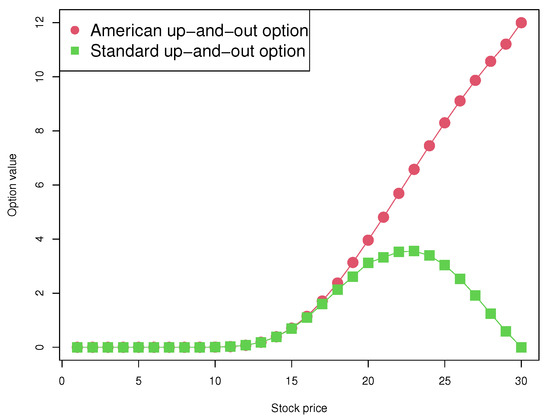
Figure 1.
American up-and-out options and standard up-and-out options with different stock prices (r = 0.1).
7. Discussion
Since the operator is not degenerate, the parameter is introduced here to establish a regular equation. At the same time, the regular equation incorporates a penalty function controlled by to simulate the variation-inequality problem. Based on this regular equation, the existence of weak solutions is analyzed. As for the uniqueness of the solution, the absolute value of the difference between two weak solutions is estimated. It is proved that there is no difference between the two weak solutions by eliminating some non-negative terms.
Analyzing the advantages and disadvantages of this paper, the authors in [4] analyze some theoretical results such as the existence and uniqueness of solution to variation-inequality problems. An advantage of [4] is that it incorporates a nonlinear term behind the degenerate parabolic operator in the form of linear addition. Since the nonlinear term is coupled in a linear way, the author can easily use inequality technique to estimate, and then obtain the relevant results of weak solutions. The variation-inequality problem under degenerate parabolic operators is considered in [6,7]. In [6,7], the authors used second-order degenerate parabolic operators, while this paper used the fourth-order degenerate parabolic operator coupled with a distance function.
8. Conclusions
In the current study, we study an initial boundary value problem variation-inequality
structured by the following 4th-order degenerate parabolic operators,
In this paper, some theoretical results of weak solutions are given, including the existence and uniqueness. This paper also has some shortcomings: when , the result of Lemma 4 cannot be obtained. In addition, if , scholars analyze the existence of weak solutions when they study the initial boundary value problems of parabolic equations. We will try to analyze the variation-inequality problem in this case.
Author Contributions
T.W. and Y.S. inferred the main conclusions and approved the current version of this manuscript. All authors have read and agreed to the published version of the manuscript.
Funding
This work was supported by Guizhou Provincial Education Foundation of Youth Science and Technology Talent Development (No. [2016]168) and Doctoral Project of Guizhou Education University (2021BS037).
Institutional Review Board Statement
Not applicable.
Informed Consent Statement
Not applicable.
Data Availability Statement
Not applicable.
Acknowledgments
The authors sincerely thank the editors and anonymous reviewers for their insightful comments and constructive suggestions, which greatly improved the quality of the paper.
Conflicts of Interest
The authors declare no conflict of interest.
References
- Chen, X.; Yi, F.; Wang, L. American lookback option with fixed strike price 2-D parabolic variational inequality. J. Differ. Equ. 2011, 251, 3063–3089. [Google Scholar] [CrossRef][Green Version]
- Zhou, Y.; Yi, F. A free boundary problem arising from pricing convertible bond. Appl. Anal. 2010, 89, 307–323. [Google Scholar] [CrossRef]
- Chen, X.; Yi, F. Parabolic variational inequality with parameter and gradient constraints. J. Math. Anal. Appl. 2012, 385, 928–946. [Google Scholar] [CrossRef]
- Sun, Y.; Shi, Y.; Gu, X. An integro-differential parabolic variational inequality arising from the valuation of double barrier American option. J. Syst. Sci. Complex. 2014, 27, 276–288. [Google Scholar] [CrossRef]
- Oaxaca-Adams, G.; Villafuerte-Segura, R.; Aguirre-Hernandez, B. On non-fragility of controllers for time delay systems. A numerical approach. J. Franklin Inst. 2021, 358, 4671–4686. [Google Scholar] [CrossRef]
- López-Rentería, J.A.; Aguirre-Hernandez, B.; Fernandez-Anaya, G. A new guardian map and boundary theorems applied to the stabilization of initialized fractional control systems. Math. Method Appl. Sci. 2022, 38, 1–13. [Google Scholar] [CrossRef]
- Ito, K.; Kunisch, K. Parabolic variational inequalities: The Lagrange multiplier approach. J. Math. Pure Appl. 2006, 85, 415–449. [Google Scholar] [CrossRef]
- Karatzas, I.; Shreve, S.E. Methods of Mathematical Finance; Springer: Berlin/Heidelberg, Germany, 1998. [Google Scholar] [CrossRef]
- Ullah, H.; Adil Khan, M.; Saeed, T. Determination of Bounds for the Jensen Gap and Its Applications. Mathematics 2021, 23, 3132. [Google Scholar] [CrossRef]
- Chen, T.; Huang, N.; Li, X.; Zou, Y. A new class of differential nonlinear system involving parabolic variational and history-dependent hemi-variational inequalities arising in contact mechanics. Commun. Nonlinear Sci. Numer. Simulat. 2021, 101, 1–24. [Google Scholar] [CrossRef]
- Dabaghi, J.; Martin, V.; Vohralik, M. A posteriori estimates distinguishing the error components and adaptive stopping criteria for numerical approximations of parabolic variational inequalities. Comput. Method Appl. Mech. 2020, 367, 113105–113137. [Google Scholar] [CrossRef]
- Zhou, W.; Wu, Z. Some results on a class of degenerate parabolic equations not in divergence form. Nonlinear Anal. Theory Methods Appl. 2005, 60, 863–886. [Google Scholar] [CrossRef]
- Guo, B.; Gao, W. Study of weak solutions for parabolic equations with nonstandard growth conditions. J. Math. Anal. Appl. 2011, 374, 374–384. [Google Scholar] [CrossRef]
Publisher’s Note: MDPI stays neutral with regard to jurisdictional claims in published maps and institutional affiliations. |
© 2022 by the authors. Licensee MDPI, Basel, Switzerland. This article is an open access article distributed under the terms and conditions of the Creative Commons Attribution (CC BY) license (https://creativecommons.org/licenses/by/4.0/).