


Abstract
Symmetry widely exists in many complex and real-world networks, with flower networks and sunflower networks being two richly symmetric networks and having many practical applications due to their special structures. The number of subtrees (the subtree number index) is closely related to the reliable network design. Using a generating function, structural analysis techniques, and auxiliary structure introduction, this paper presents the subtree generating functions of flower networks and sunflower networks and, thus, solves the computation of subtree number indices of and . The results provide a fundamental and efficient method for exploring novel features of symmetric complex cyclic networks from the structural subtree number index perspective. For instance, we conclude that under some parameter constraints, the flower networks are more reliable than sunflower networks.
1. Introduction
Local connections between the interacting system components and the dynamics of the underlying physical process can be illustrated effectively in a graph. It can also be used to illustrate the microscale channels in an aporous medium, with the vertices presenting as pores and the edges presenting as channels which connect the pores. The analysis of certain graph parameters is one of the central problems in theoretical computer science because of their extensive implicit applications; see [1,2,3,4]. Over the past few decades, a family of more than 400 topological indices (TIs) has substantially gained significance among the graph parameters. Due to their applications, TIs such as Wiener index [5,6,7], Szeged index [8,9], subtree index [10,11,12,13], and Zagreb index [14,15,16] received particular attention among these parameters. Among these structural TIs, the subtree number index of a graph (the number of all nonempty subtrees of a graph) plays a vital role in measuring the stability of a network [17], especially in the case of both vertex and edge failure. Moreover, it also presents applications in the multiple sequence parsimony alignment of pedigree trees (evolutionary trees) [18], characterizing the physio-chemical and structural characteristics of molecular graphs. According to earlier research, the well-known Wiener index, Randić index, and Harary index [19,20,21] are strongly related to the subtree number index.
It is well known that the problem of enumerating the number of subtrees of a general graph is NP complete. In fact, the problem of counting subtrees of most complex graphs has not been solved yet, except trees [11,12,13], unicyclic and bicyclic graphs [22], and regular chemical molecule [23]. In 2005, Székely et al. [10] comprehensively studied the subtree problems for trees. In 2006, Yan et al. [11] proposed an efficient linear time algorithm to enumerate subtrees of a tree using a generating function. Later, many researchers investigated the extremal problems for subtrees [24,25]. Moreover, through a weight contract and a generating function, Yang et al. [26,27,28] solved the subtree number of spiro- and polyphenyl hexagonal chains, hexagonal chain graphs, phenylene chain graphs, and tricyclic graphs. In 2018, Chin et al. [29], via generating functions, obtained the number of subtrees of complete (complete bipartite) graphs and theta graphs. More recently, in 2020, Dong et al. [17] proposed algorithms for computing the subtrees of the three-cactus network by assigning the two tuple weight to the vertices and using the technique of contracting the circle weight. In 2021, by constructing a new generating function, Yang et al. [12] proposed a new recursive (fast) algorithm to enumerate certain subtrees and BC-subtrees of the tree graph. By introducing a five tuple weight, in 2022, Abolfazl et al. [30] proposed a more efficient algorithm for computing subtrees and BC-subtrees of trees.
Symmetry is one of the core structural features of many complex and real-world networks, and it is closely related to the reliable network design; the study of symmetric complex network structures is attracting more and more attention worldwide [31,32,33]. On the other hand, the wheel graphs, flower networks, and sunflower networks are typical highly symmetric complex networks and have many practical applications due to their special structures. In 2017, Daoud [34] obtained the number of spanning trees and studied the asymptotic spanning tree properties of flower networks and sunflower networks. In 2018, Kaliraj et al. [35] obtained the star edge chromatic number of the corona product of a path with a wheel graph. In 2019, Zahid et al. [36] explored the combinatorial aspects of the spanning simplicial complex of a wheel graph. In 2020, Ali et al. [37] studied three-total edge product cordial labeling of sunflower networks. In 2022, Sathiya et al. [38] solved the equitable edge-coloring problem of wheel graphs. In the same year, Kaabar et al. [39] investigated the upper bounds of the radio number and radial radio number of sunflower-extended networks. However, there are few studies on the TIs of the sunflower networks and flower networks; moreover, it is well known that the subtree number index is closely related to the reliable network design. The key objective of this paper is to solve the subtree enumeration problem for flower networks and sunflower networks.
This paper is structured as follows: Section 2 presents notations, definitions, and lemmas. In Section 3, we started by solving the subtree generating function (SGF) of fan flower networks and went on to solve the SGF problem of the flower networks . In Section 4, through an auxiliary cyclic chain and by computing its corresponding SGF, we solved the SGF problem of sunflower networks . We also briefly discussed the behavior of the subtree numbers in the flower graphs and sunflower graphs in Section 5. Lastly, we conclude our research in Section 6 and identify certain deep problems for upcoming work.
2. Terminologies and Notations
We start the section by briefly recalling the necessary notions and lemmas which will be utilized later. By , we denote a simple graph with a vertex set V (with ) and an edge set E (with ), where f (g) is the vertex (edge) weight function. For a tree , the weight of T is defined as . Furthermore, the generating function of G (contain vertex v) is given by (). With the above notations, we denote ) as all subtrees of G (containing v) in G. Some necessary notions and notations are listed below:
- denotes the graph produced after excluding X from G, where X may be a vertex set or an edge set, or mixed set of vertices and edges).
- denotes the subtree set of G.
- denotes the subtree set containing X in G.
Definition 1.
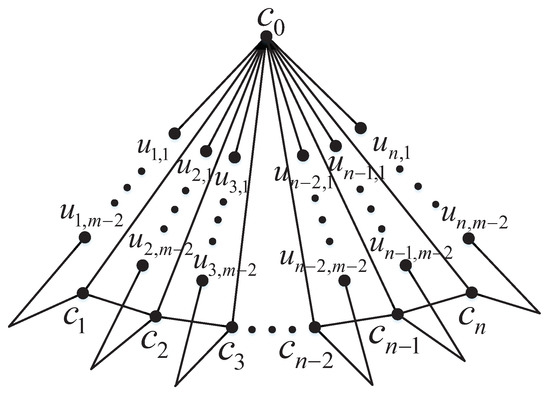
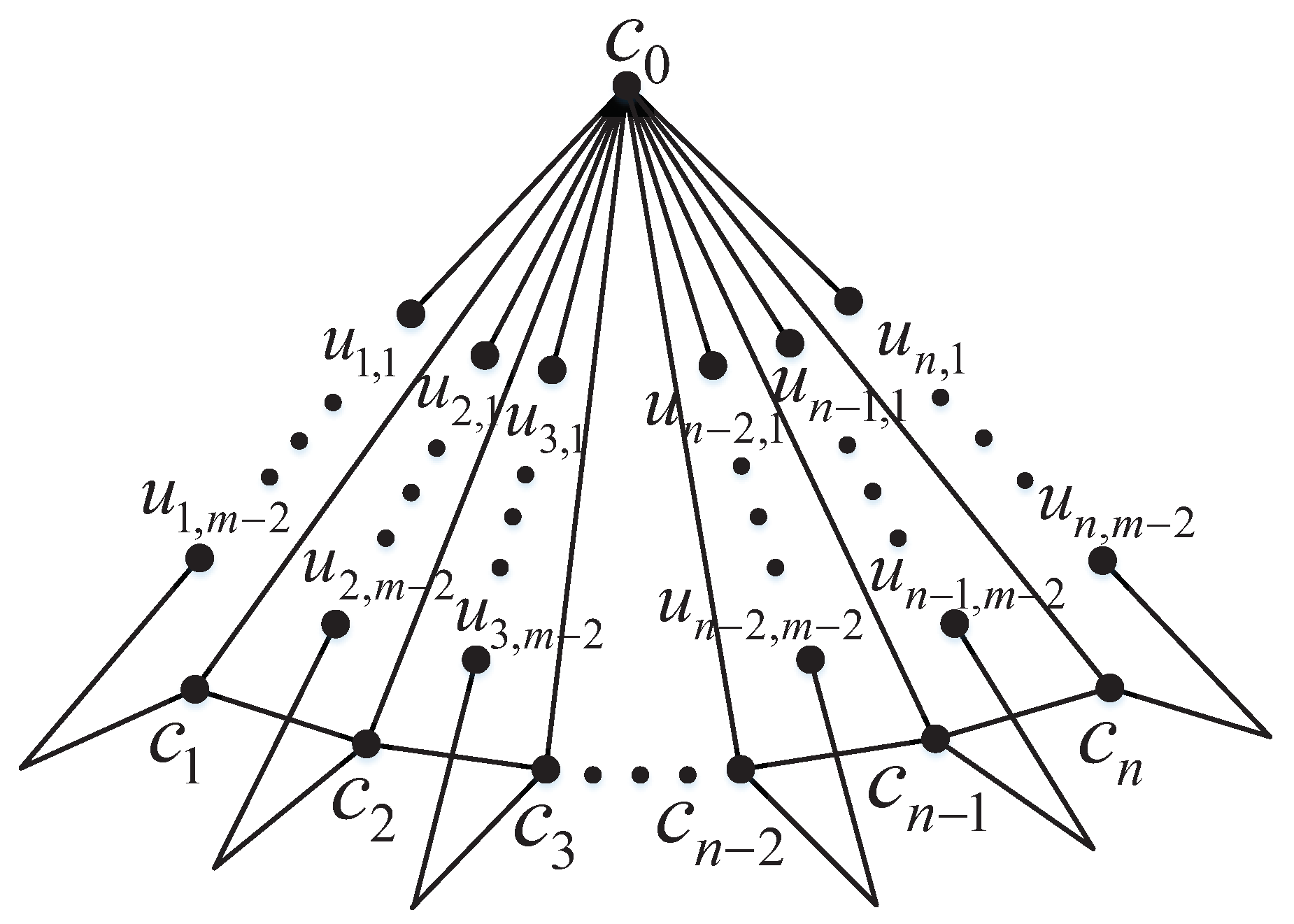
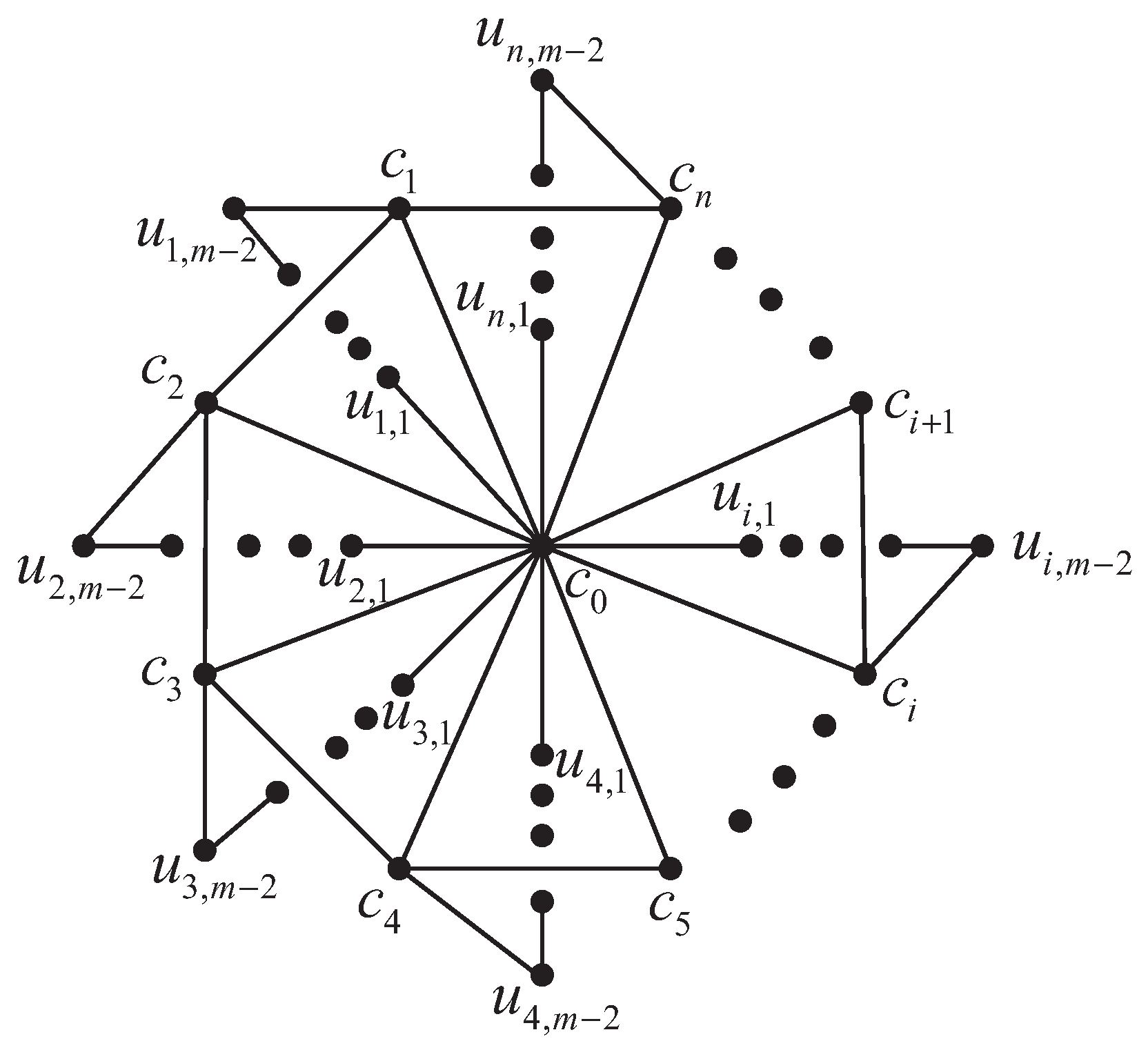
Let be the fan graph that is constructed by connecting each vertex of path with . Moreover, we call the graph constructed from the fan flower graph (see Figure 1), by connecting each vertex pair and with a path of length .
Figure 1.
Fan flower graph .
Definition 2.
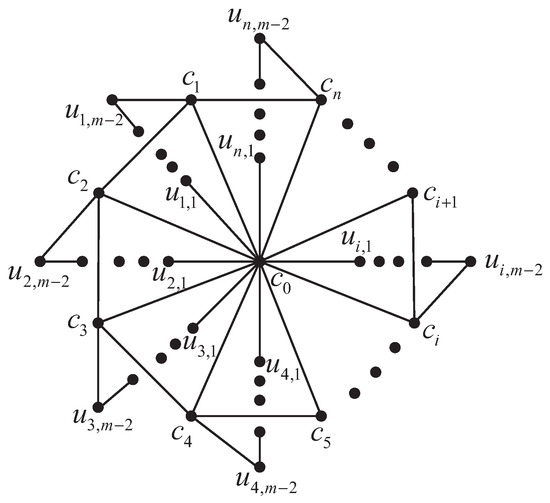
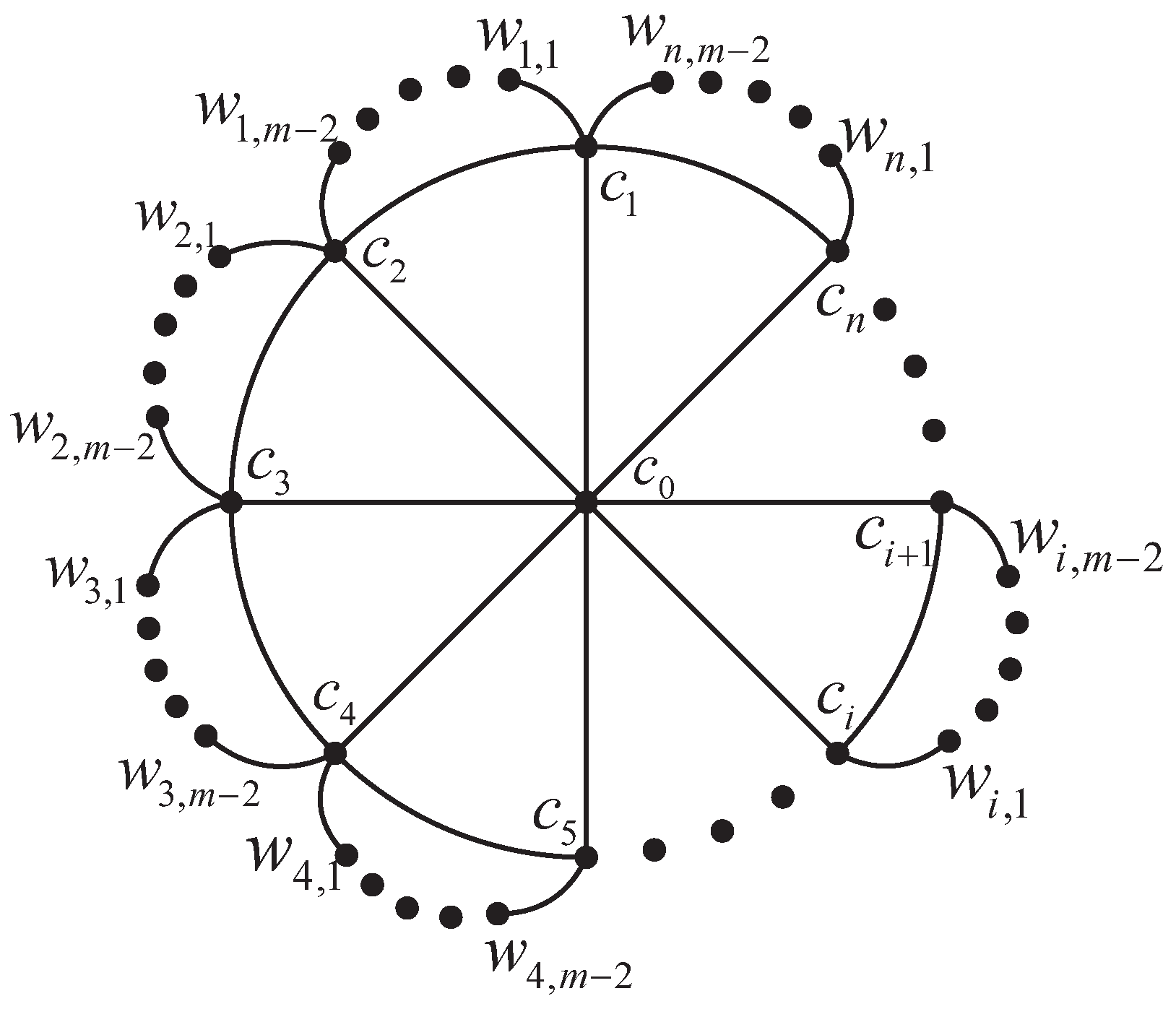
Let be a wheel graph that is constructed by connecting each vertex of the n vertex unicyclic graph with a vertex . Let (see Figure 2) be a flower network constructed by connecting each vertex pair and center vertex of with a path of length . It is easy to see that has edges and vertices.
Figure 2.
Flower network .
Definition 3.
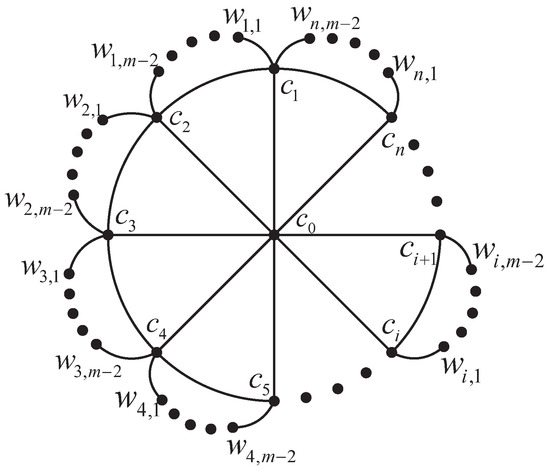
Let (see Figure 3) be a sunflower network that is constructed by connecting each adjacent vertex pair and of wheel graph with a path of length sequentially. Obviously, has edges and vertices.
Figure 3.
Sunflower network .
For the sake of brevity, we introduce some notations in the following Table 1.

Table 1.
Some abbreviated symbols.
Lemma 1.
Let denote a vertex-weighted tree, ; meanwhile, let be a leaf and be the corresponding edge of T. For the weighted tree with vertex set , edge set and
where . Then, we have [11].
Lemma 2.
Let be the weighted path tree, with vertex set , edge set , and , [11], with above notations; then, we have
Let be the weighted unicyclic graph with n vertices and n edges; its vertex and edge weights are , respectively, and the vertices on the cycle are labeled as sequentially. With the definition of SGF and structure analysis, it is easy to obtain the following Lemma.
Lemma 3.
Let be the above weighted unicyclic graph, for any vertex and any continuous k edges [23]; then, we have
Lemma 4.
Let denote a weighted graph, ; let be the graph that contract v along e to u, with , [28]. Then, the vertex weight is
and we have
Lemma 5.
For a weighted graph having vertex set and edge set , where , the vertex and edge generating functions are , respectively [27]; then, we have
With Lemmas 3 and 5 and a structure analysis, we have the following Theorem immediately.
Theorem 1.
For , denote by the weighted component that contains of . It is easy to know that and ; then, we have the following:
Theorem 2.
Let be the weighted fan flower graph, with the notations given in Table 1; for , we have
where , as given in Theorem 2.
Proof.
When , is a unicyclic graph with m vertices, by Lemma 3, we have
When , we divide the subtree set into three cases
- : not containing ;
- : contains but not ;
- : contains , namely, the path connecting and of .
For , by Lemma 5, we can obtain its SGF as
Similarly, the SGF of is
and SGF of is
Lemma 6.
Let be the weighted fan flower graph and let be the path connecting with of , with notations given in Table 1; then, we have
Proof.
Firstly, we divide the subtree set of containing into three cases:
(i) Not containing ;
(ii) Contains but not ;
(iii) Contains .
For case (i), using a structure analysis, and Lemmas 1 and 2, we obtain the SGF of case (i) as
and the SGF of case (ii) as
For case (iii), by using Theorem 1, we obtain its SGF as
3. The Subtree Number of Flower Network
Theorem 3.
Proof.
We characterize the subtrees of into two cases:
(1) Not containing ;
(2) Contains .
For case (1), it is easy to know that is a unicyclic graph; with Lemma 1 and Lemma 3, we can obtain its SGF as
We further divide case (2) into two cases:
- : not containing ;
- : contains but not .
For , with the structure analysis and Theorem 2, we have its SGF as
For , using the structure analysis and Lemma 6, we can obtain its SGF as
4. The Subtree Number of Sunflower Network
Let denote the weighted sunflower network; before solving the problem of enumerating subtrees of sunflower network, we introduce some Lemmas.
Let be a weighted graph, and be the path connecting and of ; we define be the weighted graph that contracts to , , where
for and for .
Lemma 7.
Assume that and , the weighted unicyclic graphs, are defined as above and is the path connecting and of [23]; then,
Let
and
be the two paths connecting and of ; moreover, define the weighted unicyclic graph as the graph contracting the path of to and be the graph contracting the path of to .
Lemma 8.
Assume that , are the unicyclic graphs defined as above and and are two distinct vertices of [23]; then,
Before proving the SGF of sunflower network, we first introduce and solve the subtree number enumeration problems of an auxiliary cyclic chain network that is defined as follows.
Definition 4.
Let be positive integers and , the cyclic chain network , be constructed as follows:
- For , is an unicyclic graph with length n;
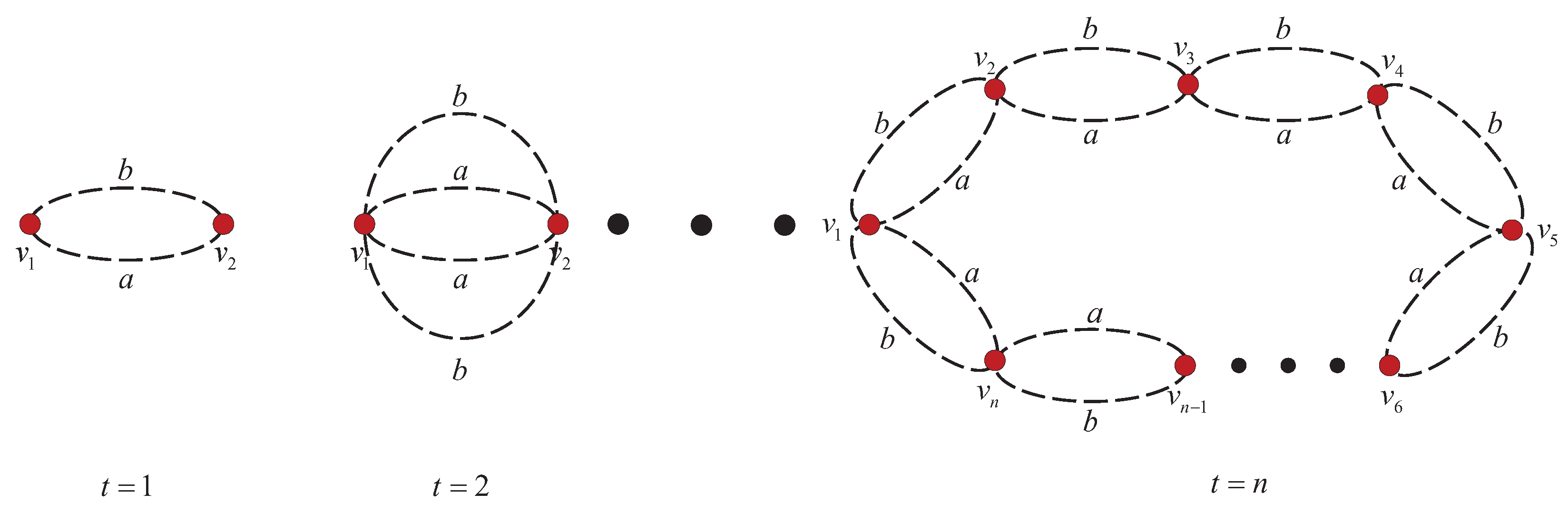
- For , let be an unicyclic graph with length t, the vertex set be , and be derived from by replacing each existing edge in by two parallel paths of length a and b (see Figure 4).
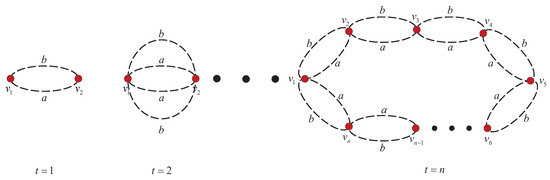 Figure 4. Cyclic chain network .
Lemma 9.
Let (see Figure 4) be the weighted auxiliary cyclic chain network defined above; then,
and
for , where , , , .
Proof.
For the case of , with Lemma 3, we have
When , we divide the subtrees of into four cases:
(1) Not containing any vertex of ;
(2) Contains only one vertex of ;
(3) Contains only consecutive vertices in ;
(4) Contains all vertices of .
For the sake of brevity, we claim that are notations given in Lemma 9.
For case (1), by observing the structure pattern with Lemma 2, we can the SGF of case (1) as
Moreover, by observing the structure patterns with Lemma 1, we can obtain the SGF of case (2) as
With Lemmas 1, 5, 7, and 8, we can obtain the SGF of case (3) as
For case (4), let be the two paths connecting and of graph , where .
- : not containing and ;
- : contains but not and ;
- : contains but not and ;
- : contains but not , .
For , with Lemmas 1, 5, 7, and 8, we have the SGF of as
Similarly, the SGF of is
Similarly, the SGF of is
The SGF of is
□
Lemma 10.
Let (see Figure 4) be the weighted auxiliary cyclic chain network defined above; then,
- for ,where ;
- for ,where , , , , .
Proof.
For , , with Lemma 3, we can obtain the SGF of containing as
For , we divide the subtrees of containing into three cases:
(1) Containing only ;
(2) Containing only consecutive vertices in including ;
(3) Containing all vertices in .
For the sake of brevity, we claim that are the notations given in Lemma 10.
For case (1), with structure analysis and Lemma 1, we can obtain its SGF as
With a structure analysis and Lemmas 1, 5, 7, and 8, we obtain the SGF of case (2) as
For case (3), with a similar analysis of case (3) in Lemma 9, we have its SGF as
The theorem thus follows. □
Next, we solve the subtree enumeration problem of sunflower network.
Theorem 4.
Let be the weighted sunflower network; then, we have its SGF as
where , ,
Proof.
We divide the subtrees of into two cases:
(a) Not containing ;
(b) Containing .
For the sake of brevity, we declare that are the notations given in Theorem 4.
For case (a), with the structure analysis and Lemma 9, we can obtain its SGF as
For case (b), we further divide it into two cases:
(i) Not containing any edge of ;
(ii) Contains at least one edge of .
It is easy to obtain that the SGf of case (i) is
For case (ii), we first consider the case of containing only one edge in ; with the structure analysis and Lemmas 5, 7, 8, and 10, we can obtain the SGF of this case as
With Lemmas 5 and 10, we can obtain the SGF of all n edges in as
For the case containing only edges in , whether is in the s edges or not, we define as the boundary; then, we label the s edges with in a counterclockwise manner. Relabeling the vertex on the cycle adjacent to as , we define the counterclockwise distance between the vertices and on the circle.
Let , where .
Combining Lemmas 3, 5, 7, 8, 10, and the structure analysis, we can obtain the SGF of containing edges in
where
With the subtree generating functions of flower networks and sunflower networks , we can easily obtain their exact subtree number indices by taking and into their subtree generating functions.
5. Results and Discussions
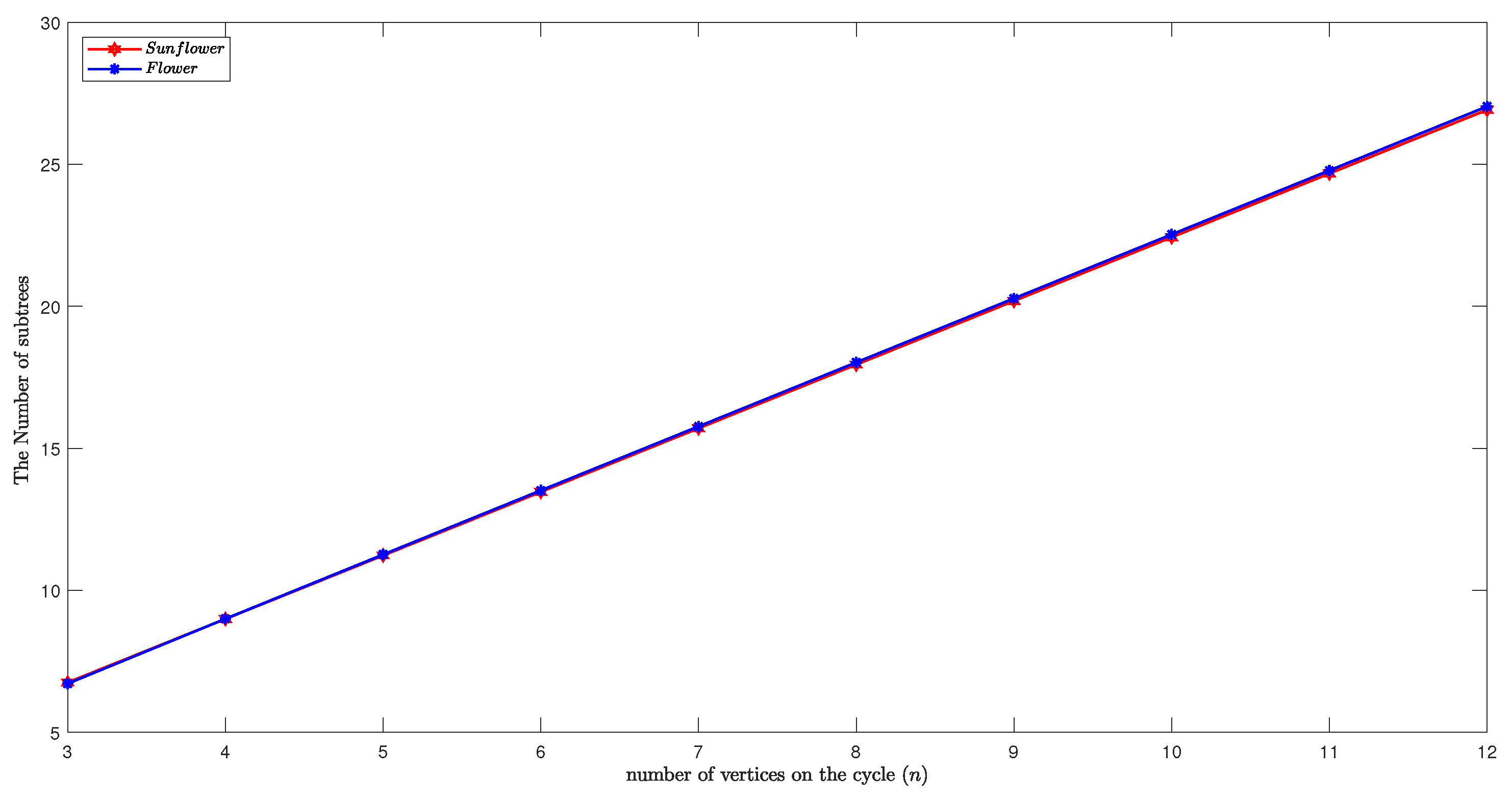
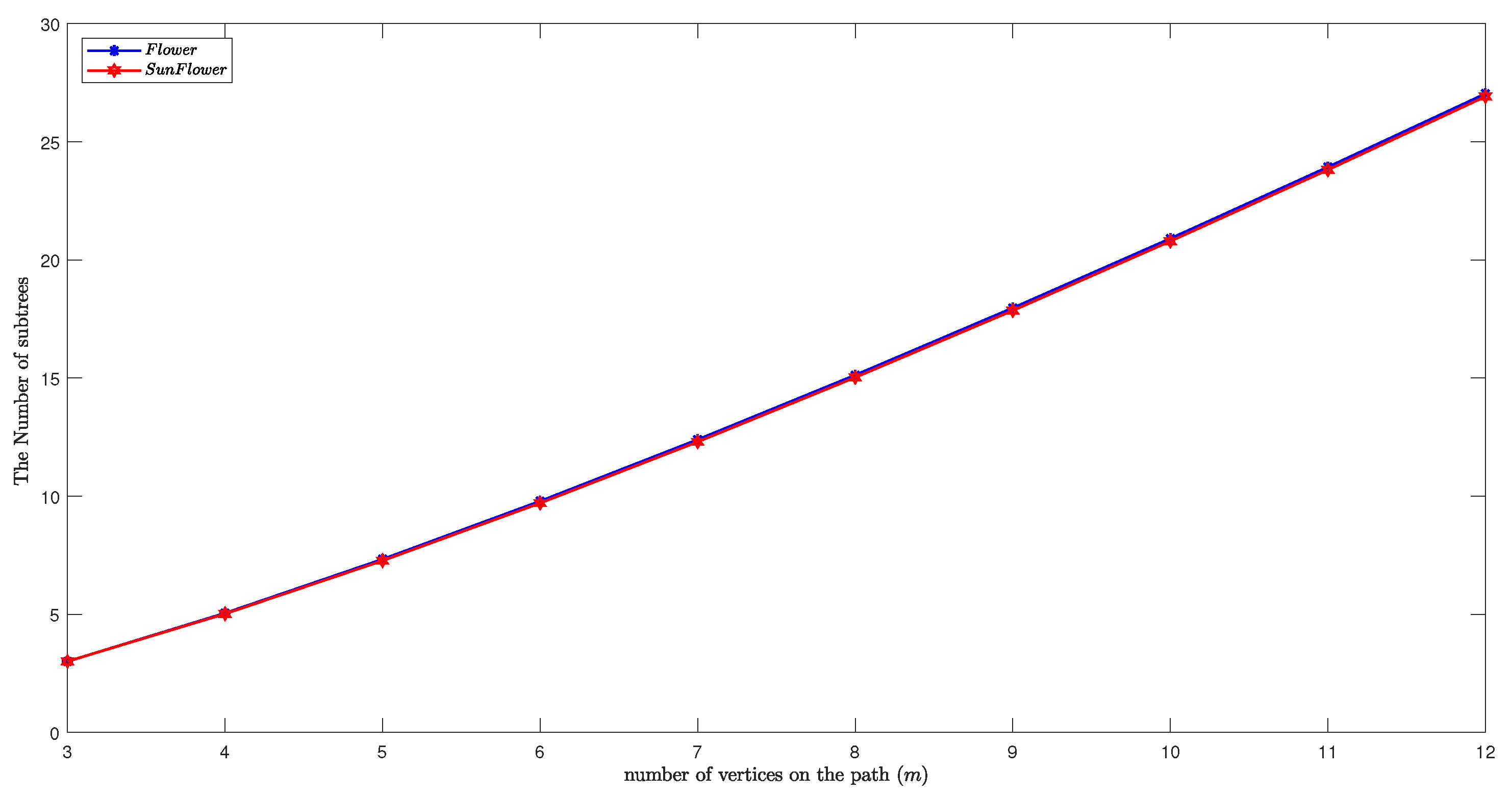
It is well known that the subtree number index is closely related to the reliable network design [17,40], and it is an important parameter to measure the reliability of a network for both vertex and edge failures. Namely, networks with more subtrees are more reliable. As an application, in this section, we briefly study the behavior of the subtree number in the flower networks and sunflower networks and discuss the difference of the subtree numbers between flower networks and sunflower networks with some lower-order n and m. From Equation (7) in Theorem 1, Equation (8) in Theorem 2, and Equation (17) in Theorem 3, we can obtain the subtree numbers of flower networks, as shown in Table 2, Table 3 and Table 4; similarly, with Equations (42) and (43) in Theorem 4, we can obtain the subtree numbers of sunflower networks, as shown in Table 2, Table 3 and Table 4.
Table 2.
The subtree numbers of flower and sunflower networks when .
Table 3.
The subtree numbers of flower and sunflower networks when .
Table 4.
The subtree numbers of flower and sunflower networks when .
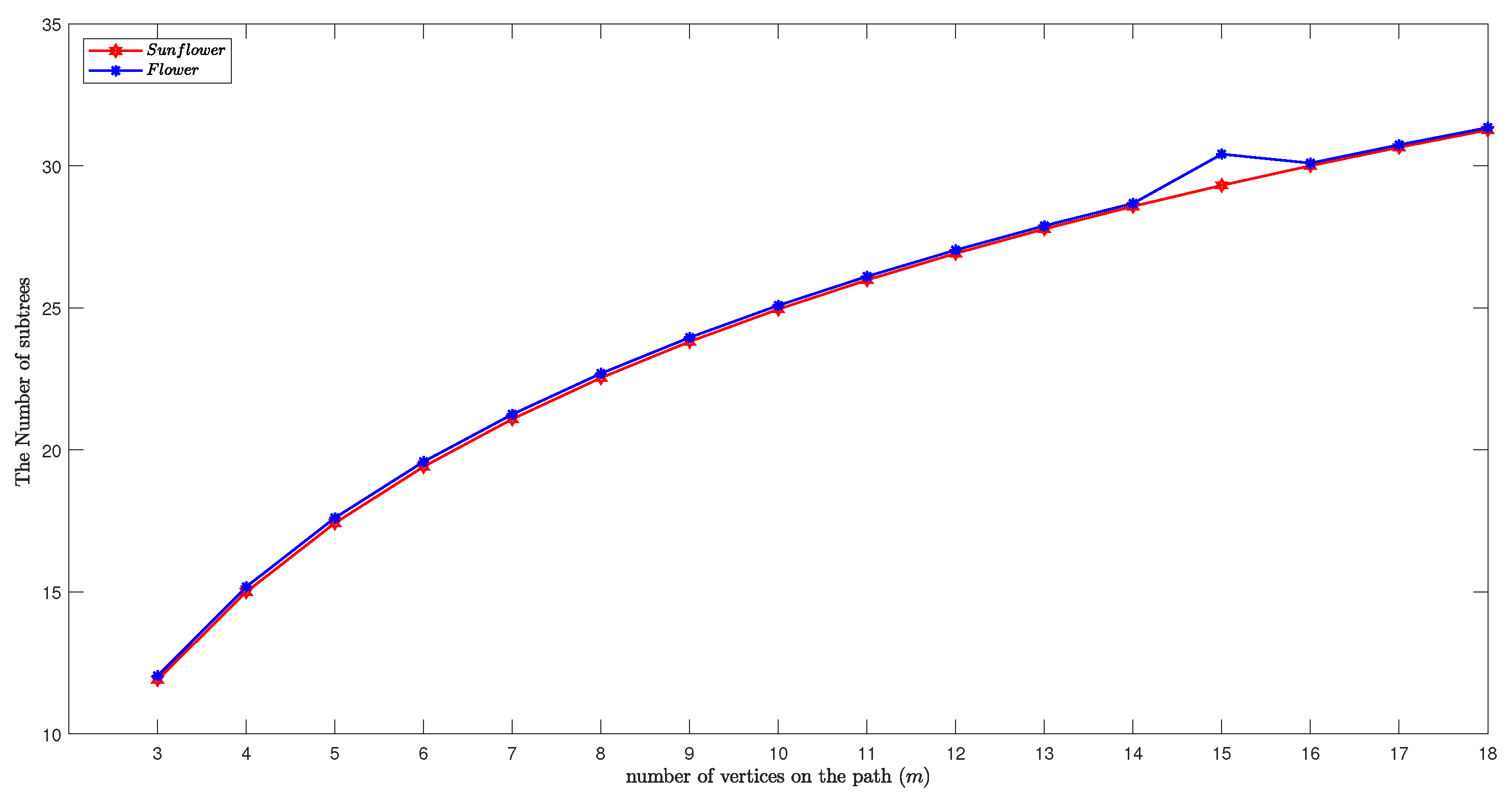
With Table 2, we can obtain Figure 5; with Table 3, we can obtain Figure 6; and with Table 4, we can obtain Figure 7. Observing Table 2, Table 3 and Table 4 and Figure 5, Figure 6 and Figure 7, we find that the subtree numbers of flower networks are always greater than that of sunflower networks. Therefore, the network reliability of flower networks are higher than that of sunflower networks. When designing a more reliable network, the flower network is a better choice in terms of reliability.
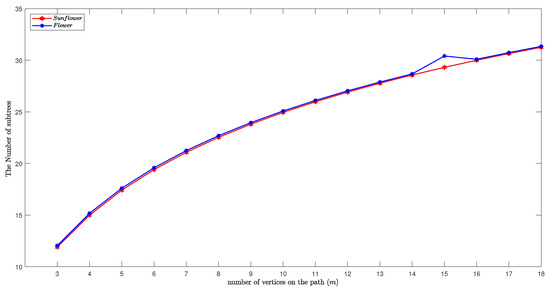
Figure 5.
The subtree number of flower network and sunflower network , in semi-log(Log-Y) coordinates.
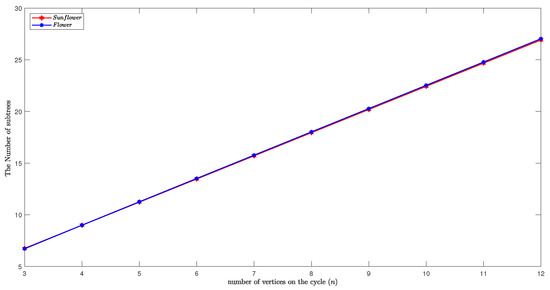
Figure 6.
The subtree number of flower network and sunflower network , in semi-log(Log-Y) coordinates.
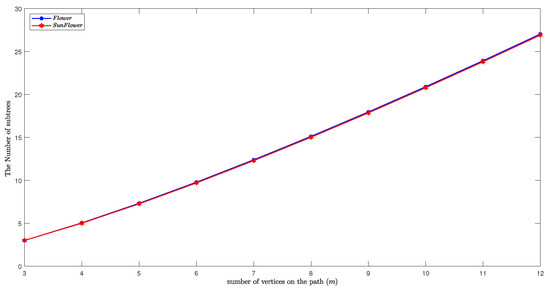
Figure 7.
The subtree number of flower network and sunflower network , in semi-log(Log-Y) coordinates.
6. Concluding Remarks
Using a generating function, structure analysis, and auxiliary structure introduction, we obtained the subtree generating function of flower networks . Moreover, by introducing and solving the subtrees of an auxiliary cyclic chain network, we presented the subtree generating function of sunflower networks . We also briefly discussed the behavior of the subtree numbers in the flower graphs and sunflower graphs. Additionally, we obtain the conclusion that under some parameter constraints, the flower networks are more reliable than sunflower networks. These findings are likely useful in designing reliable networks. Our study provides a theoretical basis for exploring new structural properties of complex networks and chemical molecules. Many important networks are derived from the flower and sunflower networks; for future work, we intend to investigate other topological indices of flower networks, sunflower networks, and their derived networks and analyze the relationships between them.
Author Contributions
Y.Y. conceived of the presented idea. L.L. developed the theory and performed the computations. F.D. and Z.J. verified the analytical methods. H.L., W.Z. and Y.Y. investigated and supervised the findings of this work. All authors discussed the results and contributed to the final manuscript. All authors have read and agreed to the published version of the manuscript.
Funding
This work is partially supported by the National Natural Science Foundation of China (No. 61702291); 2020 International Cultivation Project of Henan Advanced Talents(No. 23); Key Scientific and Technological Project in Henan Province (Calculation of distance and structure type topological indies of two kinds of polycyclic compounds and its application in prediction of carcinogenic activity); Key Scientific Research Project of Colleges and Universities in Henan Province (No. 22A790017), and the 2021-2022 Scientific Research Funds for Selected Outstanding Returnees of Study Abroad Chinese Scholars of Henan Province of China (No. 55).
Institutional Review Board Statement
Not applicable.
Informed Consent Statement
Not applicable.
Data Availability Statement
Not applicable.
Conflicts of Interest
The authors declare no conflict of interest.
References
- Allen, B.; Lippner, G.; Chen, Y.T.; Fotouhi, B.; Momeni, N.; Yau, S.T.; Nowak, M.A. Evolutionary dynamics on any population structure. Nature 2017, 544, 227–230. [Google Scholar] [CrossRef] [PubMed]
- Park, H.J.; Friston, K. Structural and functional brain networks: From connections to cognition. Science 2013, 342, 1238411. [Google Scholar] [CrossRef]
- Débarre, F.; Hauert, C.; Doebeli, M. Social evolution in structured populations. Nat. Commun. 2014, 5, 1–7. [Google Scholar] [CrossRef]
- Wang, Y.; Hafeez, S.; Akhter, S.; Iqbal, Z.; Aslam, A. The Generalized Inverse Sum Indeg Index of Some Graph Operations. Symmetry 2022, 14, 2349. [Google Scholar] [CrossRef]
- Harry, W. Structural determination of paraffin boiling points. J. Am. Chem. Soc. 1947, 69, 17–20. [Google Scholar]
- Dobrynin, A.A.; Entringer, R.; Gutman, I. Wiener index of trees: Theory and applications. Acta Appl. Math. 2001, 66, 211–249. [Google Scholar] [CrossRef]
- Ali, F.; Rather, B.A.; Fatima, N.; Sarfraz, M.; Ullah, A.; Alharbi, K.A.M.; Dad, R. On the Topological Indices of Commuting Graphs for Finite Non-Abelian Groups. Symmetry 2022, 14, 1266. [Google Scholar] [CrossRef]
- Khadikar, P.V.; Deshpande, N.V.; Kale, P.P.; Dobrynin, A.; Gutman, I.; Domotor, G. The Szeged index and an analogy with the Wiener index. J. Chem. Inf. Comput. Sci. 1995, 35, 547–550. [Google Scholar] [CrossRef]
- Al-Fozan, T.; Manuel, P.; Rajasingh, I.; Rajan, R.S. Computing Szeged index of certain nanosheets using partition technique. Match Commun. Math. Comput. Chem. 2014, 72, 339–353. [Google Scholar]
- Székely, L.A.; Wang, H. On subtrees of trees. Adv. Appl. Math. 2005, 34, 138–155. [Google Scholar] [CrossRef]
- Yan, W.; Yeh, Y.N. Enumeration of subtrees of trees. Theor. Comput. Sci. 2006, 369, 256–268. [Google Scholar] [CrossRef]
- Yang, Y.; Li, X.; Jin, M.; Li, L.; Wang, H.; Zhang, X. Enumeration of subtrees and BC-subtrees with maximum degree no more than k in trees. Theor. Comput. Sci. 2021, 892, 258–278. [Google Scholar] [CrossRef]
- Yang, Y.; Liu, H.; Wang, H.; Zhang, X.D.; Chen, C.P. On enumerating algorithms of novel multiple leaf-distance granular regular α-subtrees of trees. Inf. Comput. 2022, 289, 104942. [Google Scholar] [CrossRef]
- Furtula, B.; Graovac, A.; Vukičević, D. Augmented zagreb index. J. Math. Chem. 2010, 48, 370–380. [Google Scholar] [CrossRef]
- Gutman, I. An exceptional property of first Zagreb index. Match Commun. Math. Comput. Chem. 2014, 72, 733–740. [Google Scholar]
- Kazemi, R. Note on the multiplicative Zagreb indices. Discret. Appl. Math. 2016, 198, 147–154. [Google Scholar] [CrossRef]
- Dong, L.; Zhao, H.; Lai, H.J. Entropy and Enumeration of Subtrees in a Cactus Network. Front. Phys. 2020, 8, 575648. [Google Scholar] [CrossRef]
- Knudsen, B. Optimal multiple parsimony alignment with affine gap cost using a phylogenetic tree. In Proceedings of the International Workshop on Algorithms in Bioinformatics, Budapest, Hungary, 15–20 September 2003; pp. 433–446. [Google Scholar]
- Wagner, S.G. Correlation of graph-theoretical indices. SIAM J. Discret. Math. 2007, 21, 33–46. [Google Scholar] [CrossRef]
- Zhang, X.; Zhang, X.; Gray, D.; Wang, H. The number of subtrees of trees with given degree sequence. J. Graph Theory 2013, 73, 280–295. [Google Scholar] [CrossRef]
- Andriantiana, E.O.D.; Wagner, S.; Wang, H. Greedy trees, subtrees and antichains. Electron. J. Comb. 2013, 20, P28. [Google Scholar] [CrossRef]
- Yang, Y.; Liu, H.; Wang, H.; Feng, S. On algorithms for enumerating BC-subtrees of unicyclic and edge-disjoint bicyclic graphs. Discret. Appl. Math. 2016, 203, 184–203. [Google Scholar] [CrossRef]
- Yang, Y.; Sun, X.; Cao, J.; Wang, H.; Zhang, X. The expected subtree number index in random polyphenylene and spiro chains. Discret. Appl. Math. 2020, 285, 483–492. [Google Scholar] [CrossRef]
- Székely, L.A.; Wang, H. Binary trees with the largest number of subtrees. Discret. Appl. Math. 2007, 155, 374–385. [Google Scholar] [CrossRef]
- Zhang, X.; Zhang, X.; Gray, D.; Wang, H. Trees with the most subtrees—An algorithmic approach. J. Comb. 2012, 3, 207–223. [Google Scholar]
- Yang, Y.; Liu, H.; Wang, H.; Fu, H. Subtrees of spiro and polyphenyl hexagonal chains. Appl. Math. Comput. 2015, 268, 547–560. [Google Scholar] [CrossRef]
- Yang, Y.; Liu, H.; Wang, H.; Deng, A.; Magnant, C. On Algorithms for Enumerating Subtrees of Hexagonal and Phenylene Chains. Comput. J. 2017, 60, 690–710. [Google Scholar] [CrossRef]
- Yang, Y.; Chen, B.; Zhang, G.; Li, Y.; Sun, D.; Liu, H. Algorithms based on path contraction carrying weights for enumerating subtrees of tricyclic graphs. Comput. J. 2022, 65, 554–572. [Google Scholar] [CrossRef]
- Chin, A.J.; Gordon, G.; MacPhee, K.J.; Vincent, C. Subtrees of graphs. J. Graph Theory 2018, 89, 413–438. [Google Scholar] [CrossRef]
- Poureidi, A. On computing the number of (BC-) subtrees, eccentric subtree number, and global and local means of trees. Inf. Process. Lett. 2022, 178, 106302. [Google Scholar] [CrossRef]
- Chen, Y.; Zhao, Y.; Han, X. Characterization of Symmetry of Complex Networks. Symmetry 2019, 11, 692. [Google Scholar] [CrossRef]
- MacArthur, B.D.; Sánchez-García, R.J.; Anderson, J.W. Symmetry in complex networks. Discret. Appl. Math. 2008, 156, 3525–3531. [Google Scholar] [CrossRef]
- Xiao, Y.H.; Wu, W.T.; Wang, H.; Xiong, M.; Wang, W. Symmetry-based structure entropy of complex networks. Phys. A Stat. Mech. Its Appl. 2008, 387, 2611–2619. [Google Scholar] [CrossRef]
- Daoud, S. Complexity of graphs generated by wheel graph and their asymptotic limits. J. Egypt. Math. Soc. 2017, 25, 424–433. [Google Scholar] [CrossRef]
- Kaliraj, K.; Sivakami, R.; Vernold, V.J. Star edge coloring of corona product of path and wheel graph families. Proyecciones 2018, 37, 593–601. [Google Scholar] [CrossRef]
- Zahid, A.; Saleem, M.; Kashif, A.; Khan, M.; Meraj, M.; Irfan, R. Spanning Simplicial Complex of Wheel Graph Wn. Algebra Colloq. 2019, 26, 309–320. [Google Scholar] [CrossRef]
- Ali, U.; Ahmad, Y.; Sardar, M.S. On 3-total edge product cordial labeling of tadpole, book and flower graphs. Open J. Math. Sci. 2020, 4, 48–55. [Google Scholar] [CrossRef]
- Sathiya, D.; Senthamilselvi, S. On Equitable Edge Coloring of Wheel Graph Families. J. Algebr. Stat. 2022, 13, 1791–1797. [Google Scholar]
- Kaabar, M.K.; Yenoke, K. Radio and Radial Radio Numbers of Certain Sunflower Extended Graphs. Int. J. Math. Math. Sci. 2022, 2022, 9229409. [Google Scholar] [CrossRef]
- Xiao, Y.; Zhao, H.; Liu, Z.; Mao, Y. Trees with large numbers of subtrees. Int. J. Comput. Math. 2017, 94, 372–385. [Google Scholar] [CrossRef]
Disclaimer/Publisher’s Note: The statements, opinions and data contained in all publications are solely those of the individual author(s) and contributor(s) and not of MDPI and/or the editor(s). MDPI and/or the editor(s) disclaim responsibility for any injury to people or property resulting from any ideas, methods, instructions or products referred to in the content. |
© 2023 by the authors. Licensee MDPI, Basel, Switzerland. This article is an open access article distributed under the terms and conditions of the Creative Commons Attribution (CC BY) license (https://creativecommons.org/licenses/by/4.0/).