


Abstract
We consider a 10-dimensional gravitational model with an SO(6)Yang–Mills field, Gauss–Bonnet term, and term. We study so-called cosmological-type solutions defined on the product manifold , where K is a Calabi–Yau manifold. By setting the gauge field 1-form to coincide with the 1-form spin connection on K, we obtain exact cosmological solutions with exponential dependence of scale factors (upon t-variable) governed by two non-coinciding Hubble-like parameters: and h obeying . We also present static analogs of these cosmological solutions (for , , and ). The islands of stability for both classes of solutions are outlined.
1. Introduction
Here we deal with a so-called Einstein–Gauss–Bonnet–Yang–Mills– gravitational model in dimension . The action of the model contains scalar curvature, a Gauss–Bonnet term, a cosmological term ( term), and a Yang–Mills term with a value in Lie algebra. The model includes a non-zero constant , coupled to the sum of the Yang–Mills and Gauss–Bonnet terms. The equations of motion for this model are of second order (as it takes place in general relativity). The so-called Gauss–Bonnet term has appeared in (super)string theory as a second-order correction in curvature to the effective (super)string effective action [1,2,3] for a heterotic string [4].
At present, Einstein–Gauss–Bonnet (EGB) gravitational models, e.g., with a cosmological term and extra matter fields, and their modifications [5,6,7,8,9,10,11,12,13,14,15,16,17,18,19,20,21,22,23,24,25,26], are under intensive study in astrophysics and cosmology. The main goal in these studies is a solution to the dark energy problem. One can study such models for a possible explanation of the accelerating expansion of the Universe, which was supported by supernovae (type Ia) observational data [27,28].
We note that, at present, there exist several modifications of Einstein and EGB actions which correspond to , , , , theories (e.g., for ), where R is the scalar curvature and is the Gauss–Bonnet term. These modifications are under intensive studying devoted to cosmological, astrophysical, and other applications; see [29,30,31,32,33,34,35] and references therein.
Another point of interest is the search for possible local manifestations of dark energy related to wormholes, black holes, etc. The most important results for black holes in models with Gauss–Bonnet terms are related to the Boulware–Deser–Wheeler solution [36,37] and its generalizations [38,39,40,41]; see also Refs. [42,43,44] and references therein. For certain applications of brane-world models with Gauss–Bonnet term, see Refs. [45,46] and related bibliography. For wormhole solutions in Einstein–Gauss–Bonnet models with certain fields, see Refs. [47,48] and references therein.
In this article, we deal with the so-called cosmological-type solutions with the metric
defined on a product manifold where , is a flat manifold (“our” space) with the metric , and K is a Ricci-flat Calabi–Yau manifold (internal space) of an holonomy group with the metric . The warped product model is governed by two scale factors depending upon one variable . It is the synchronous time variable for the cosmological case : , while it coincides with the space-like variable for : . The presence of a Yang–Mills field makes this ansatz consistent if we choose the Lie algebra for the Yang–Mills field to be equal (at least) to , which contains subalgebra, corresponding to an group of golonomy of the Calabi–Yau manifold. For the Yang–Mills field, we consider the following ansatz: we put here the gauge field 1-form to be equal to the spin connection 1-form on K (see Section 2): . In such an ansatz, the gauge field plays the role of compensator, which “waves out” the terms with non-zero Riemann tensors of the Calabi–Yau metric .
Originally, such an idea of compensation was used by Wu and Wang [49] (see also [50]) in a -dimensional cosmological model based on Yang=-Mills (- and/or -) supergravity theory “upgrated” by additions of Chern–Simons and Gauss–Bonnet terms (of superstring origin). The work of Wu and Wang was influenced greatly by the well-known paper of Candelas et al. [51], devoted to vacuum configurations in ten-dimensional and supergravity and superstring theory that have unbroken supersymmetry in four dimensions.
It should be noted that compactifications of 11-dimensional supergravity on a () Calabi–Yau manifold were considered in Refs. [52,53]. Moreover, and Calabi–Yau manifolds also appeared in partially sypersymmetric solutions of supergravity with M-branes; see Refs. [54,55,56] and and references threin.
In Section 3 we obtain exact cosmological solutions with exponential dependence of scale factors (upon the t-variable) governed by two non-coinciding Hubble-like parameters: and h, corresponding to factor spaces of dimensions 3 and 6, respectively, when the following restriction is used (excluding the solutions with a constant volume factor).
In Section 4, we obtain static solutions () for non-coinciding Hubble parameters , h, which obey . We also study the stability (in a certain restricted sense) of the obtained solutions in the cosmological case for (see Section 3) and in the static case for (see Section 4) by using the results of Ref. [22] (see also the approach of Ref. [19]) and single out the subclasses of stable/non-stable solutions.
2. The 10-Dimensional Model
2.1. The Action and Equations of Motion
We take the action of the model as
where is the 10-dimensional gravitational constant, is a constant, are components of the metric, and are components of the Yang–Mills field strengths corresponding to the 2-form with the value in the Lie algebrs : where is the 1-form with the value in ().
Here, we use the following notation for the covariant gauge derivative: .
2.2. Cosmological Ansatz
Let us consider a ten-dimensional manifold
where K is a Calabi–Yau manifold, i.e., a compact 6-dimensional Kähler Ricci-flat manifold with the metric, which has an holonomy group. For the corresponding Lie algebra, we have .
We start with the cosmological case, i.e., we consider the set of Equations (3) and (4) on the manifold (5) with the following ansatz for fields:
Here, , i.e., we deal with a flat Euclidean metric on , and is the Calabi–Yau metric on K.
By , we denote the spin connection 1-form on K with the value in the Lie algebra (in fact, it belongs to subalgebra ) corresponding to the (local) basis of co-vectors on K, which diagonalizes the metric :
where the covariant derivative corresponds to the metric , and is the “inverse” (dual) basis of vector fields obeying .
The spin connection on K obeys the identity
where . identity (11) is equivalent to the following identity for the Riemann tensor on K:
which is valid for any Kähler–Ricci-flat manifold [57].
Let us denote
where in this section we denote .
Here
and
3. Cosmological Solutions
Here, we consider the case when Hubble-like parameters are constant, i.e.,
For scale factors, we obtain an exponential dependence on t
We obtain a set of polynomial equations
where the polynomials and are defined above.
We set
This relationship is used for a description of an accelerated expansion of the 3-dimensional subspace (which may describe our Universe). The evolution of the 6-dimensional internal factor space is described by the Hubble-like parameter h.
It follows from Refs. [22,24] (for a more general splitting scheme, see the paper by Chirkov, Pavluchenko, and Toporensky [18]) that if we consider Hubble-like parameters H and h obeying the two restrictions imposed,
we reduce the relationships (30)–(32) to the following set of equations:
The relationship (36) is valid only if
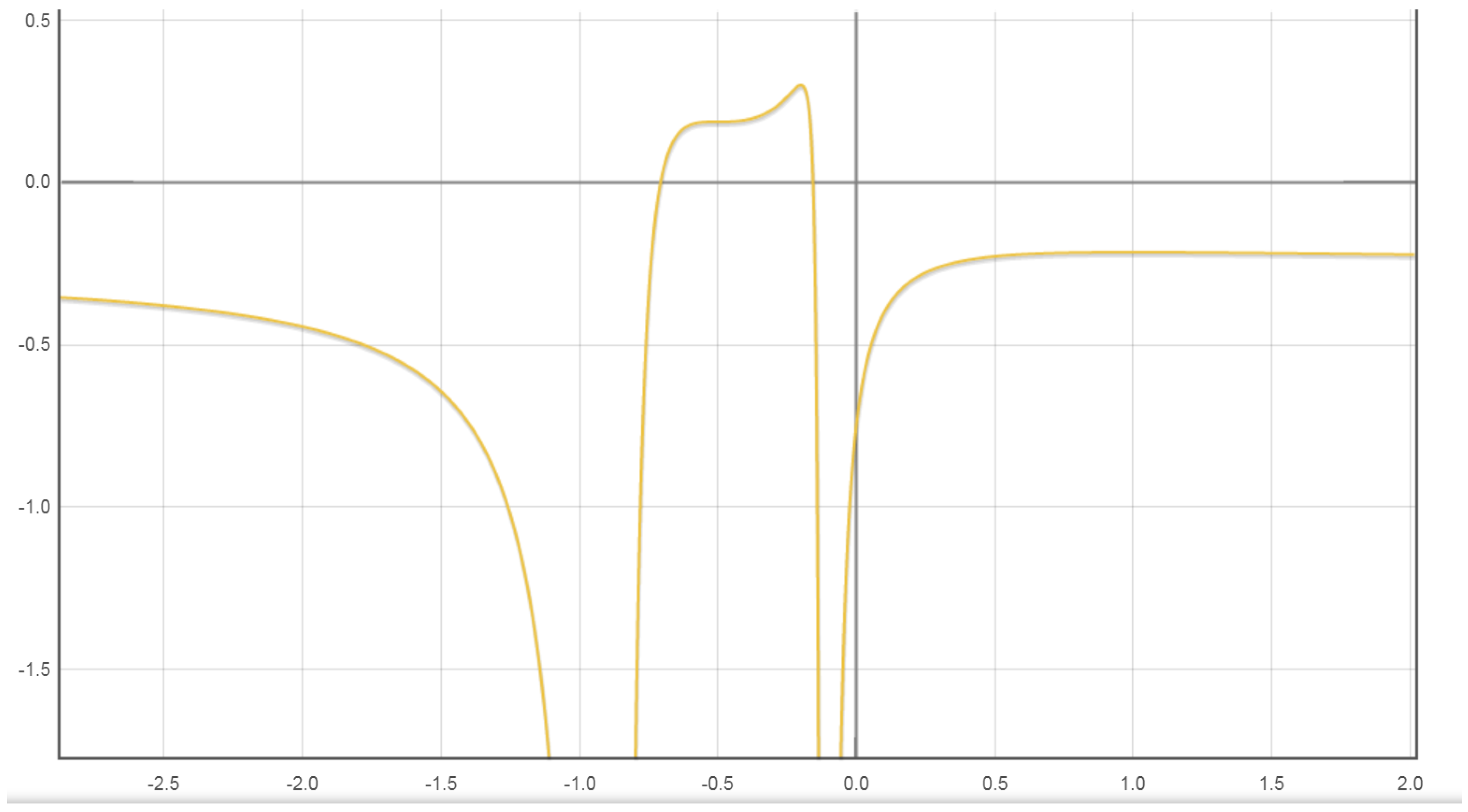
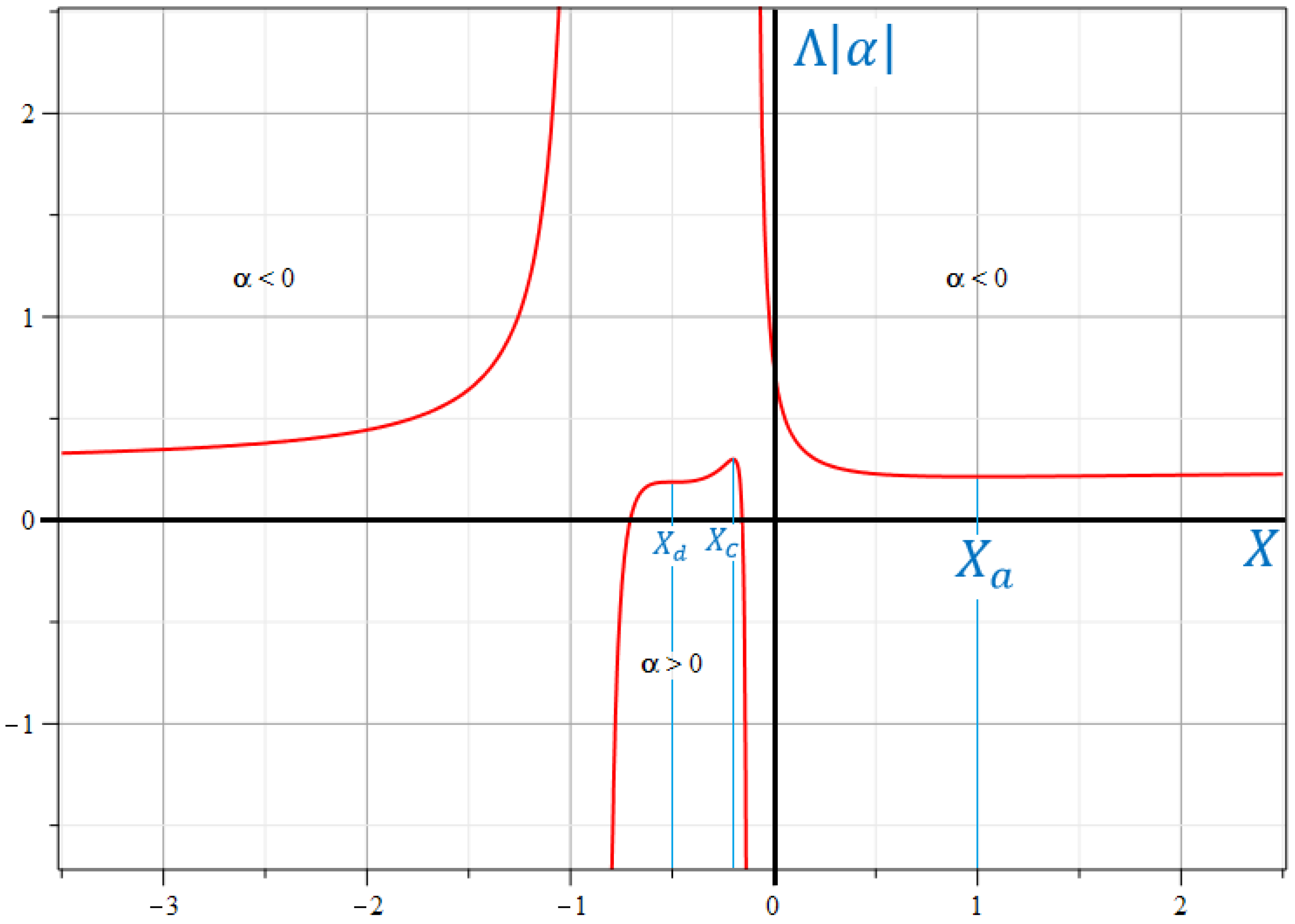
The graphical representation of the function is given in Figure 1.
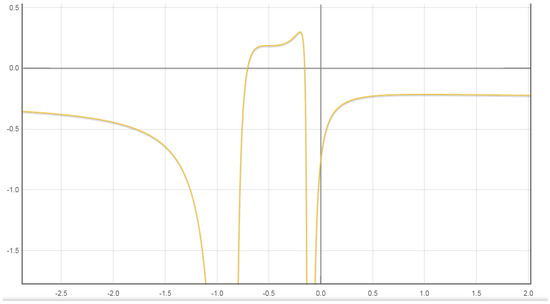
Figure 1.
The graphical representation of moduli function given by relationship (43).
The function obeys
and
It has a maximum at with the value and an inflection point at with the value . It has also a point of local maximum at with the value .
Equation (43) is equivalent to the following master equation:
For
the solution to this (fourth order) master equation reads
where , ,
and
It follows from Figure 1 that for the given parameters and , obeying restrictions and (51), real solutions in formula (52) appear for suitably chosen and if
for and
for .
For example, the relationship (52) gives us if we put and .
, or, numerically
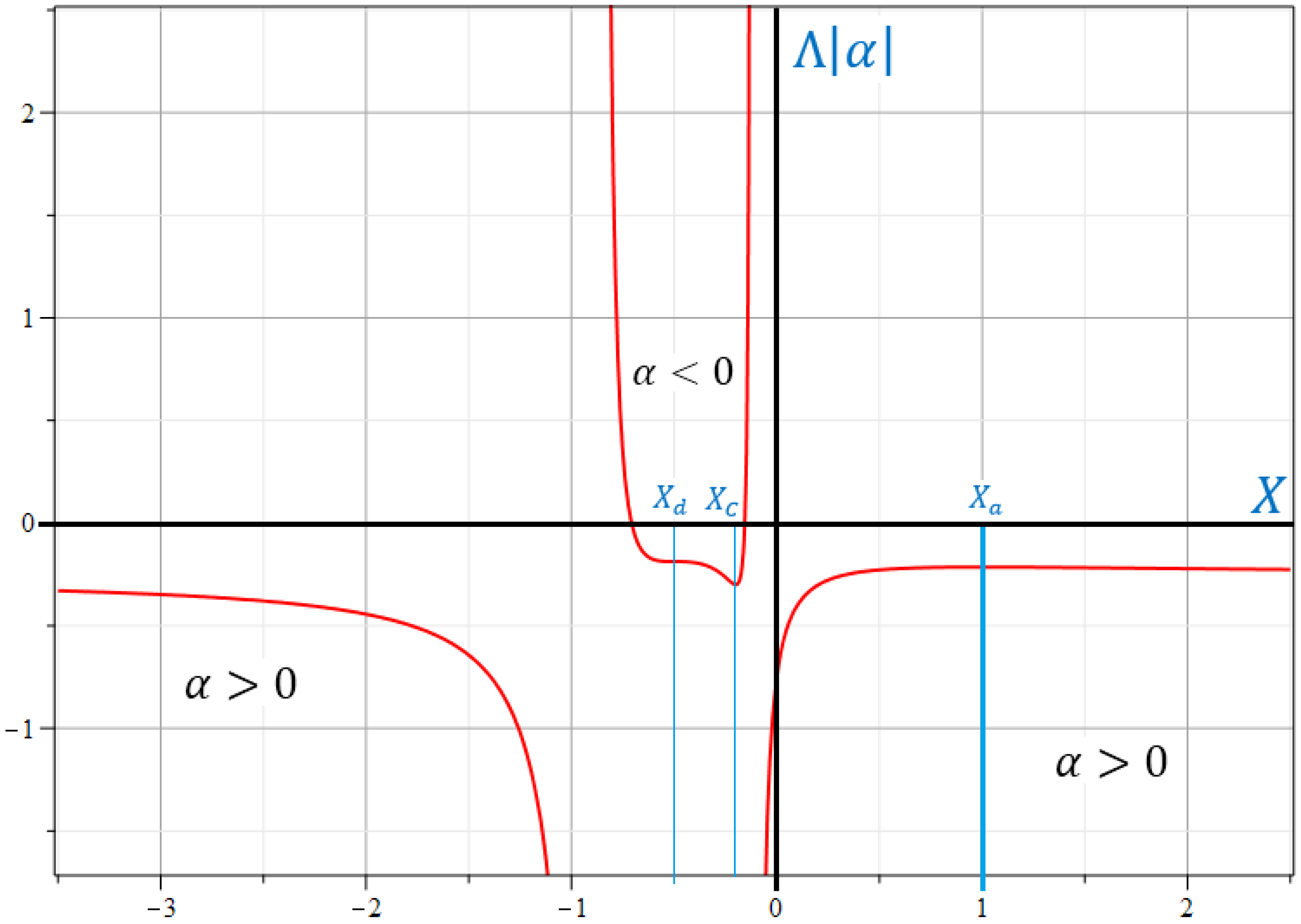
Graphical analysis. The graphical representation upon (in this cosmological case) is presented in Figure 2. In drawing this figure, we use the relationship
in agreement with (38) and (40). It follows from Figure 2 that real solutions take place if
for and
for . (The point is excluded from our consideration.)
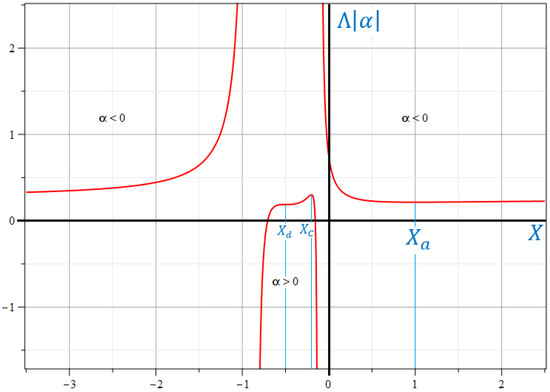
Figure 2.
The dependence of upon in cosmological case. The central branch corresponds to . The left and right branches correspond to .
Stability. Using the results of Refs. [22,24], we obtain that the cosmological solutions under consideration obeying , , where , , , are stable if (i) and unstable if (ii) . (For isotropic cosmological solutions with , see Refs. [17,22] for generic and [14,15] for ).
We note that the the points and are excluded from our consideration due to restrictions (34), while the point of maximum is excluded since the analysis of Ref. [22] was based on the equations for perturbations for , in the linear approximation, which can be resolved when . In the special case , higher-order terms in pertubations should be considered.
Let us denote by the number of non-special stable solutions. By using Figure 2, we find just graphically for
(here ), while for , we obtain
Thus, for and a small enough value of , there exists at least one stable solution with , while for and a big enough value of , there exists at least one stable solution with x obeying . The solutions with are unstable.
In the cosmological case, real solutions corresponding to exist only if . We obtain from (52) for and two solutions:
The first cosmological solution (for ) is unstable, while the second one (for ) is stable in agreement with Ref. [25].
Remark. It should be noted that here as in the Ref. [22] that we are dealing with a restricted stability problem. We do not consider the general setup for perturbations and but only consider the cosmological perturbations of scale factors , in the framework of our ansatz (6), () with fixed and . An analogous remark should be addressed to our analysis of static solutions in the next section.
Zero variation of G. The cosmological solution with , or , takes place if and
We obtain . The scale factor is constant in this case, and we are led to zero variation of the effective gravitational constant (in Jordan frame). This solution is stable. Moreover, we obtain , which implies for the effective 4-dimensional cosmological constant . In the general case, is a nontrivial function of and given by (37) and a generic solution for x from (52) (or from (62) in special cases).
We note that for and for , from (70), there exists another real solution corresponding to certain , which is unstable.
4. Static Analogs of Cosmological Solutions
Now, we deal with the static case by considering the set of Equations (3) and (4) on the manifold (5) with the following ansatz:
where u is a spatial coordinate and is a flat pseudo-Eucleadean metric on . is the Calabi–Yau metric on K, and is the spin connection 1-form on K defined in a previous section.
The Yang–Mills equations are satisfied identically as in the previous case.
Now, we denote
where, in this section, we denote .
Then, Equation (3) in the ansatz (71) and (72) may be written as follows:
where
are defined in (20)–(23), and are defined in (24), (25), respectively.
As we see, the equations of motion for “Hubble-like” parameters (73) in static case may be obtained from cosmological ones (of Section 3) just by replacement
The dimensionless parameter is invariant under this replacement.
Here, we consider the case when “Hubble-like” parameters are constant, i.e.,
or, equivalently,
We obtain a set of polynomial equations
where polynomials and are defined by relationships (77)–(79), respectively.
Here, we consider a slightly more general case.
As in the previous section, we impose the conditions (34) and reduce the relationships (83)–(85) to the set of two equations [26]
Using Equation (88) and restriction (86), we obtain
where , and quadratic polynomial () is defined in (38).
Here, we obtain
instead of (40).
According to Equation (90), we obtain in the static case
and
(The real numbers are defined in (44)).
Thus, for and restrictions (34), (86) imposed, we obtain exact solutions for H and h, which are given by the formulae (52), (89) and (90). For , we should use (62) instead of (52).
Graphical analysis. The graphical representation of upon in the static case is presented at Figure 3. Here, we use the relationship
in agreement with (90). It follows from Figure 3 that real solutions take place if
for and
for .
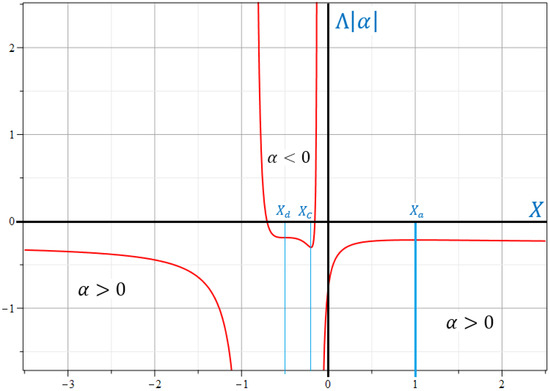
Figure 3.
The dependence of upon in static case. The central branch corresponds to . The left and right branches correspond to .
In the static case, real solutions for exist only if .
Stability. Using the results of Ref. [26], we can analyse the stability of static solutions under consideration obeying , , where , , .
The solutions are stable for and if (i) and unstable if (ii) . For and , they are stable for (i) and unstable if (ii) .
The solutions are stable for and if (i) and unstable if (ii) . For and , they are stable for (i) and unstable if (ii) .
5. Conclusions
Here, we have considered an Einstein–Gauss–Bonnet–Yang–Mills– gravitational model in the dimension with a non-zero constant coupled to a sum of Yang–Mills and Gauss–Bonnet terms.
We have studied so-called cosmological-type solutions with the metrics (1) defined on product manifolds , where , is a flat subspace with the metric , and K is a Ricci-flat Calabi–Yau manifold with the metric . The gauge field 1-form was considered to be coinciding with spin connection 1-form on K: .
For , , we have obtained exact cosmological solutions with exponential dependence of scale factors (upon the t-variable), governed by two non-coinciding Hubble-like parameters, and h, corresponding to factor spaces of dimensions 3 and 6, respectively, when the following restriction: is used (excluding the solutions with a constant volume factor).
Static analogs of cosmological solutions (, ) with exponential dependence of scale factors and non-coinciding “Hubble-like” parameters and h, obeying , are also presented here.
We have also outlined the stability of the solutions in the cosmological case (for , Section 3) and in the static case for (, Section 4) and have singled out “islands” of stable/non-stable solutions.
Some cosmological applications of the model () may be of interest in the context of the dark energy problem and problems of stability/variation of gravitational constant. For the static case (), possible applications of the obtained solutions may be a subject of a further research, aimed at a search of topological black hole solutions (with a flat horizon) or wormhole solutions which are coinciding asymptotically (for ) with our solutions.
Author Contributions
Conceptualization, V.D.I.; Software, A.A.K.; Validation, K.K.E.; Formal analysis, V.D.I., K.K.E. and A.A.K.; Investigation, K.K.E.; Data curation, K.K.E.; Writing—review & editing, V.D.I.; Visualization, A.A.K.; Supervision, V.D.I. All authors have read and agreed to the published version of the manuscript.
Funding
This research was funded by RUDN University, scientific project number FSSF-2023-0003.
Data Availability Statement
Not applicable.
Conflicts of Interest
The authors declare no conflict of interest.
References
- Zwiebach, B. Curvature squared terms and string theories. Phys. Lett. B 1985, 156, 315. [Google Scholar] [CrossRef]
- Fradkin, E.S.; Tseytlin, A.A. Effective action approach to superstring theory. Phys. Lett. B 1985, 160, 69–76. [Google Scholar] [CrossRef]
- Gross, D.; Witten, E. Superstring modifications of Einstein’s equations. Nucl. Phys. B 1986, 277, 1. [Google Scholar] [CrossRef]
- Gross, D.; Harvey, J.; Martinec, E.; Rohm, R. Heterotic String. Phys. Rev. Lett. 1984, 54, 502. [Google Scholar] [CrossRef] [PubMed]
- Ishihara, H. Cosmological solutions of the extended Einstein gravity with the Gauss-Bonnet term. Phys. Lett. B 1986, 179, 217. [Google Scholar] [CrossRef]
- Deruelle, N. On the approach to the cosmological singularity in quadratic theories of gravity: The Kasner regimes. Nucl. Phys. B 1989, 327, 253–266. [Google Scholar] [CrossRef]
- Nojiri, S.; Odintsov, S.D. Introduction to Modified Gravity and Gravitational Alternative for Dark Energy. Int. J. Geom. Meth. Mod. Phys. 2007, 4, 115–146. [Google Scholar] [CrossRef]
- Elizalde, E.; Makarenko, A.; Obukhov, V.; Osetrin, K.; Filippov, A. Stationary vs. singular points in an accelerating FRW cosmology derived from six-dimensional Einstein–Gauss–Bonnet gravity. Phys. Lett. B 2007, 644, 1–6. [Google Scholar] [CrossRef]
- Bamba, K.; Guo, Z.-K.; Ohta, N. Accelerating Cosmologies in the Einstein-Gauss-Bonnet Theory with a Dilaton. Prog. Theor. Phys. 2007, 118, 879–892. [Google Scholar] [CrossRef]
- Toporensky, A.; Tretyakov, P. Power-law anisotropic cosmological solution in 5+1 dimensional Gauss–Bonnet gravity. Grav. Cosmol. 2007, 13, 207–210. [Google Scholar]
- Pavluchenko, S.A.; Toporensky, A.V. A note on differences between (4+1)- and (5+1)-dimensional anisotropic cosmology in the presence of the Gauss-Bonnet term. Mod. Phys. Lett. A 2009, 24, 513–521. [Google Scholar] [CrossRef]
- Pavluchenko, S.A. General features of Bianchi-I cosmological models in Lovelock gravity. Phys. Rev. D 2009, 80, 107501. [Google Scholar] [CrossRef]
- Kirnos, I.; Makarenko, A.; Pavluchenko, S.; Toporensky, A. The nature of singularity in multidimensional anisotropic Gauss-Bonnet cosmology with a perfect fluid. Gen. Rel. Grav. 2010, 42, 2633–2641. [Google Scholar] [CrossRef]
- Ivashchuk, V.D. On anisotropic Gauss-Bonnet cosmologies in (n + 1) dimensions, governed by an n-dimensional Finslerian 4-metric. Grav. Cosmol. 2010, 16, 118–125. [Google Scholar] [CrossRef]
- Ivashchuk, V.D. On cosmological-type solutions in multi-dimensional model with Gauss-Bonnet term. Int. J. Geom. Meth. Mod. Phys. 2010, 7, 797–819. [Google Scholar] [CrossRef]
- Maeda, K.-I.; Ohta, N. Cosmic acceleration with a negative cosmological constant in higher dimensions. J. High Energy Phys. 2014, 2014, 95. [Google Scholar] [CrossRef]
- Chirkov, D.; Pavluchenko, S.; Toporensky, A. Exact exponential solutions in Einstein–Gauss–Bonnet flat anisotropic cosmology. Mod. Phys. Lett. A 2014, 29, 1450093. [Google Scholar] [CrossRef]
- Chirkov, D.; Pavluchenko, S.; Toporensky, A. Non-constant volume exponential solutions in higher-dimensional Lovelock cosmologies. Gen. Rel. Grav. 2015, 47, 137. [Google Scholar] [CrossRef]
- Pavluchenko, S.A. Stability analysis of exponential solutions in Lovelock cosmologies. Phys. Rev. D 2015, 92, 104017. [Google Scholar] [CrossRef]
- Pavluchenko, S.A. Cosmological dynamics of spatially flat Einstein-Gauss-Bonnet models in various dimensions: Low-dimensional Λ-term case. Phys. Rev. D 2016, 94, 084019. [Google Scholar] [CrossRef]
- Canfora, F.; Giacomini, A.; Pavluchenko, S.; Toporensky, A. Friedmann Dynamics Recovered from Compactified Einstein–Gauss–Bonnet Cosmology. Grav. Cosmol. 2018, 24, 28–38. [Google Scholar] [CrossRef]
- Ivashchuk, V.D. On stability of exponential cosmological solutions with non-static volume factor in the Einstein–Gauss–Bonnet model. Eur. Phys. J. C 2016, 76, 431. [Google Scholar] [CrossRef]
- Fomin, I.; Chervon, S. A new approach to exact solutions construction in scalar cosmology with a Gauss–Bonnet term. Mod. Phys. Lett. A 2017, 32, 1750129. [Google Scholar] [CrossRef]
- Ivashchuk, V.D.; Kobtsev, A.A. Stable exponential cosmological solutions with 3- and l-dimensional factor spaces in the Einstein–Gauss–Bonnet model with a Λ-term. Eur. Phys. J. C 2018, 78, 100. [Google Scholar] [CrossRef]
- Ivashchuk, V.D.; Kobtsev, A.A. Exponential cosmological solutions with two factor spaces in EGB model with Λ = 0 revisited. Eur. Phys. J. C 2019, 79, 824. [Google Scholar] [CrossRef]
- Ivashchuk, V.D. On Stability of Exponential Cosmological Type Solutions with Two Factor Spaces in the Einstein–Gauss–Bonnet Model with a Λ-Term. Grav. Cosmol. 2020, 20, 16–21. [Google Scholar] [CrossRef]
- Riess, A.G.; Filippenko, A.V.; Challis, P.; Clocchiatti, A.; Diercks, A.; Garnavich, P.M.; Gilliland, R.L.; Hogan, C.J.; Jha, S.; Kirshner, R.P.; et al. Observational evidence from supernovae for an accelerating universe and a cosmological constant. Astron. J. 1998, 116, 1009–1038. [Google Scholar] [CrossRef]
- Perlmutter, S.; Aldering, G.; Goldhaber, G.; Knop, R.A.; Nugent, P.; Castro, P.G.; Deustua, S.; Fabbro, S.; Goobar, A.; Groom, D.E. Measurements of Ω and Λ from 42 high redshift supernovae. Astrophys. J. 1999, 517, 565–586. [Google Scholar] [CrossRef]
- Nojiri, S.; Odintsov, S.D.; Oikonomou, V.K. Modified Gravity Theories on a Nutshell: Inflation, Bounce and Late-time Evolution. Phys. Rept. 2017, 692, 1–104. [Google Scholar] [CrossRef]
- Abbas, G.; Momeni, D.; Ali, M.A.; Myrzakulov, R.; Qaisar, S. Anisotropic compact stars in f(G) gravity. Astrophys. Space Sci. 2015, 357, 158. [Google Scholar]
- Benetti, M.; da Costa, S.S.; Capozziello, S.; Alcaniz, J.; De Laurentis, M. Various characteristics of transition energy for nearly symmetric colliding nuclei. Int. J. Mod. Phys. 2018, 27, 1850084. [Google Scholar] [CrossRef]
- Nojiri, S.; Odintsov, S.D.; Oikonomou, V.K. Unifying Inflation with Early and Late-time Dark Energy in F(R) Gravity. Phys. Dark Universe 2020, 29, 100602. [Google Scholar] [CrossRef]
- Vasilev, T.B.; Bouhmadi-Lopez, M.; Martin-Moruno, P. Classical and Quantum f(R) Cosmology: The Big Rip, the Little Rip and the Little Sibling of the Big Rip. Universe 2021, 7, 288. [Google Scholar] [CrossRef]
- Vasilev, T.B.; Bouhmadi-Lopez, M.; Martin-Moruno, P. f(G,TαβTαβ) theory and complex cosmological structures. Phys. Dark Universe 2022, 36, 101015. [Google Scholar]
- Fazlollahi, H.R. Energy–momentum squared gravity and late-time Universe. Eur. Phys. J. Plus 2023, 138, 211. [Google Scholar] [CrossRef]
- Boulware, D.G.; Deser, S. String Generated Gravity Models. Phys. Rev. Lett. 1985, 55, 2656. [Google Scholar] [CrossRef] [PubMed]
- Wheeler, J.T. Symmetric Solutions to the Gauss-Bonnet Extended Einstein Equations. Nucl. Phys. B 1986, 268, 737. [Google Scholar] [CrossRef]
- Wheeler, J.T. Symmetric Solutions to the Maximally Gauss-Bonnet Extended Einstein Equations. Nucl. Phys. B 1986, 273, 732. [Google Scholar] [CrossRef]
- Wiltshire, D.L. Spherically Symmetric Solutions of Einstein-maxwell Theory With a Gauss-Bonnet Term. Phys. Lett. B 1986, 169, 36–40. [Google Scholar] [CrossRef]
- Cai, R.-G. Gauss-Bonnet black holes in AdS spaces. Phys. Rev. D 2002, 65, 084014. [Google Scholar] [CrossRef]
- Cvetic, M.; Nojiri, S.; Odintsov, S. Black hole thermodynamics and negative entropy in de Sitter and anti-de Sitter Einstein-Gauss-Bonnet gravity. Nucl. Phys. B 2002, 628, 295. [Google Scholar] [CrossRef]
- Garraffo, C.; Giribet, G. The Lovelock Black Holes. Mod. Phys. Lett. A 2008, 23, 1801. [Google Scholar] [CrossRef]
- Charmousis, C. Higher order gravity theories and their black hole solutions. Lect. Notes Phys. 2009, 769, 299. [Google Scholar]
- Antoniou, G.; Bakopoulos, A.; Kanti, P. Black-Hole Solutions with Scalar Hair in Einstein-Scalar-Gauss-Bonnet Theories. Phys. Rev. D 2018, 97, 084037. [Google Scholar] [CrossRef]
- Bronnikov, K.A.; Kononogov, S.A.; Melnikov, V.N. Brane world corrections to Newton’s law. Gen. Rel. Grav. 2006, 38, 1215–1232. [Google Scholar] [CrossRef]
- Tavakoli, Y.; Ardabili, A.K.; Bouhmadi-Lopez, M.; Moniz, P.V. Role of Gauss-Bonnet corrections in a DGP brane gravitational collapse. Phys. Rev. D 2022, 105, 084050. [Google Scholar] [CrossRef]
- Kanti, P.; Kleihaus, B.; Kunz, J. Wormholes in Dilatonic Einstein-Gauss-Bonnet Theory. Phys. Rev. Lett. 2011, 107, 271101. [Google Scholar] [CrossRef]
- Barton, S.; Kiefer, C.; Kleihaus, B.; Kunz, J. Symmetric wormholes in Einstein-vector–Gauss–Bonnet theory. Eur. Phys. J. C 2022, 82, 802. [Google Scholar] [CrossRef]
- Wu, Y.-S.; Wang, Z. Time variation of Newton’s gravitational constant in superstring theories. Phys. Rev. Lett. B 1986, 57, 1978. [Google Scholar] [CrossRef]
- Ivashchuk, V.D.; Melnikov, V.N. On time variations of gravitational and Yang-Mills constants in a cosmological model of superstring origin. Grav. Cosmol. 2014, 20, 26–29. [Google Scholar] [CrossRef]
- Candelas, P.; Horowitz, G.T.; Strominger, A.; Witten, E. Vacuum configurations for superstrings. Nucl. Phys. B 1985, 256, 46. [Google Scholar] [CrossRef]
- Duff, M. Architecture of Fundamental Interactions at Short Distances; Ramond, P., Stora, R., Eds.; Les Houches Lectures: Les Houches, France, 1985; p. 819. [Google Scholar]
- Cadavid, A.; Ceresole, A.; D’Auria, R.; Ferrara, S. Eleven-dimensional supergravity compactified on Calabi-Yau threefolds. Phys. Lett. B 1995, 357, 76–80. [Google Scholar] [CrossRef]
- Duff, M.J.; Lu, H.; Pope, C.N.; Sezgin, E. Supermembranes with fewer supersymmetries. Phys. Lett. B 1996, 371, 206–214. [Google Scholar] [CrossRef]
- Golubtsova, A.A.; Ivashchuk, V.D. Triple M-brane configurations and preserved supersymmetries. Nucl. Phys. B 2013, 872, 289–312. [Google Scholar] [CrossRef]
- Ivashchuk, V.D. On Supersymmetric M-brane configurations with an /Z2 submanifold. Grav. Cosmol. 2016, 22, 32–35. [Google Scholar] [CrossRef]
- Witten, L.; Witten, E. Large Radius Expansion of Superstring Compactifications. Nucl. Phys. B 1987, 281, 109. [Google Scholar] [CrossRef]
Disclaimer/Publisher’s Note: The statements, opinions and data contained in all publications are solely those of the individual author(s) and contributor(s) and not of MDPI and/or the editor(s). MDPI and/or the editor(s) disclaim responsibility for any injury to people or property resulting from any ideas, methods, instructions or products referred to in the content. |
© 2023 by the authors. Licensee MDPI, Basel, Switzerland. This article is an open access article distributed under the terms and conditions of the Creative Commons Attribution (CC BY) license (https://creativecommons.org/licenses/by/4.0/).