


Abstract
This paper derives the declarations for timelike ruled surfaces with stationary timelike Disteli-axis by the E. Study map. This prepares the ability to determine a set of Lorentzian invariants which explain the local shape of timelike ruled surfaces. As a result, the Hamilton and Mannhiem formulae of surfaces theory are attained at Lorentzian line space and their geometrical explanations are examined. Then, we define and explicate the kinematic geometry of a timelike Plűcker conoid created by the timelike Disteli-axis. Additionally, we provide the relationships through timelike ruled surface and the order of contact with its timelike Disteli-axis.
MSC:
53A04; 53A05; 53A17
1. Introduction
In the context of spatial movements, a ruled surface is a surface that can be created by movable line in space. The significance of the ruled surface lies in the certainty that it is exercised in considerable ranges of manufacturing and engineering, including modeling of apparel and automobile parts. Moreover, it can be utilized to build mathematical models of movable structures, which can be utilized to design and optimize complex engineering systems (see e.g., [1,2,3]). One of the generalization-comfortable methods to heading the locomotion of line space seems to find a link with this space and dual numbers. Via the E. Study map in screw and dual number algebra, the set of all oriented lines in Euclidean 3-space is instantly attached to the set of points on the dual unit sphere in the dual 3-space . Further characteristics on the necessary essential registrations of the E. Study map and one-parameter dual spherical movement can be found in [4,5,6,7,8].
In Minkowski 3-space , the discussion of ruled surface is more distant than the Euclidean case, Lorentzian distance function can be negative, positive, or zero, whereas the Euclidean distance function can only be positive-definite. Then, if we occupy the Minkowski 3-space as an substitutional of the Euclidean 3-space , the E. Study map can be presented as: The set of all timelike (spacelike) oriented lines in Minkowski 3-space is instantly attached to the set of points on the hyperbolic (Lorentzian) dual unit sphere in the Lorentzian Dual 3-space . It shows that a spacelike curve on matching a timelike ruled surface at . Similarly, a spacelike (timelike) curve on matching timelike (spacelike) ruled surface at . By means of its dealings with engineering and physical sciences in Minkowski space, senior geometers and engineers have researched and acquired a lot of ownerships of the ruled surfaces (see [9,10,11,12,13,14]).
This work is an access for establishing timelike ruled surfaces with a stationary (invariable) timelike Disteli-axis by the E. Study map. Then, we specify and treatise the kinematic-geometry of a timelike Plűcker conoid created by the timelike Disteli-axis. As a result, a description for a spacelike line trajectory to be a invariable timelike Disteli-axis is gained and explored. Lastly, we research some conditions which lead to specific timelike ruled surfaces such as the general timelike surface, the timelike helicoidal surface, and the timelike cone.
2. Preliminaries
In this section, we list some connotations, formulae of dual numbers and dual Lorentzian vectors (see, e.g., [1,2,3,4,5,15,16]). A non-null directed line L in Minkowski 3-space can be distinguished with a point and a normalized vector on L, that is, . To hold coordinates for L, one set the moment vector in relation to the origin point in . If is replaced by any point , on L, this detects that is independent of on L. The two non-null vectors and are dependent; they fulfill the following:
The six components of and are named the normalized Plűcker coordinates of L. Therefore, and locate the non-null directed line L.
A dual number is a number , where in , is a dual unit with and . Then, the set
with the Lorentzian scalar product
creates the so-named dual Lorentzian 3-space . Then, a point has dual coordinates . If the norm of is
Then, is named a timelike (spacelike) dual unit vector if (). Consequently, we have
The hyperbolic and Lorentzian (de Sitter space) dual unit spheres with the center , respectively, are:
and
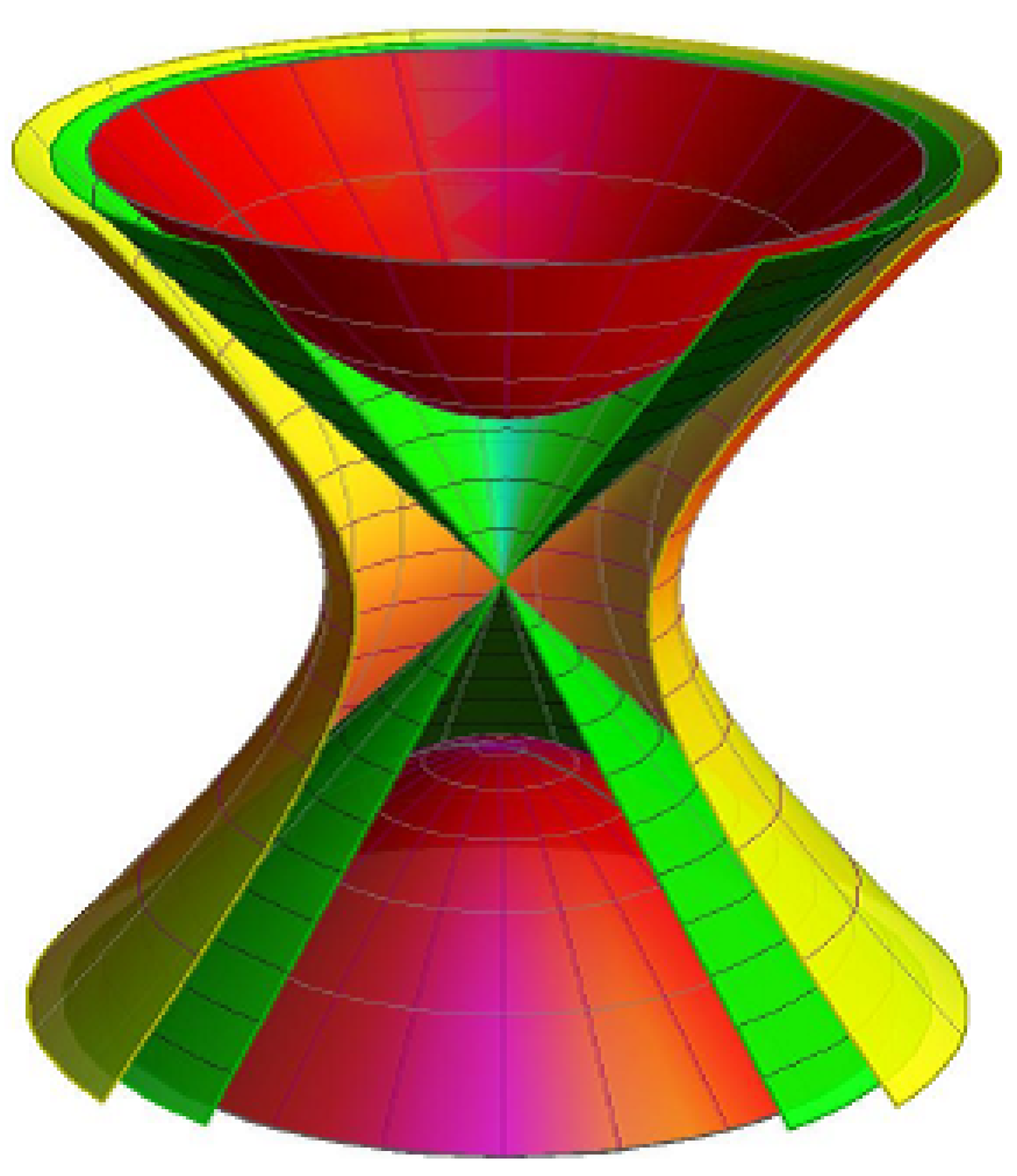
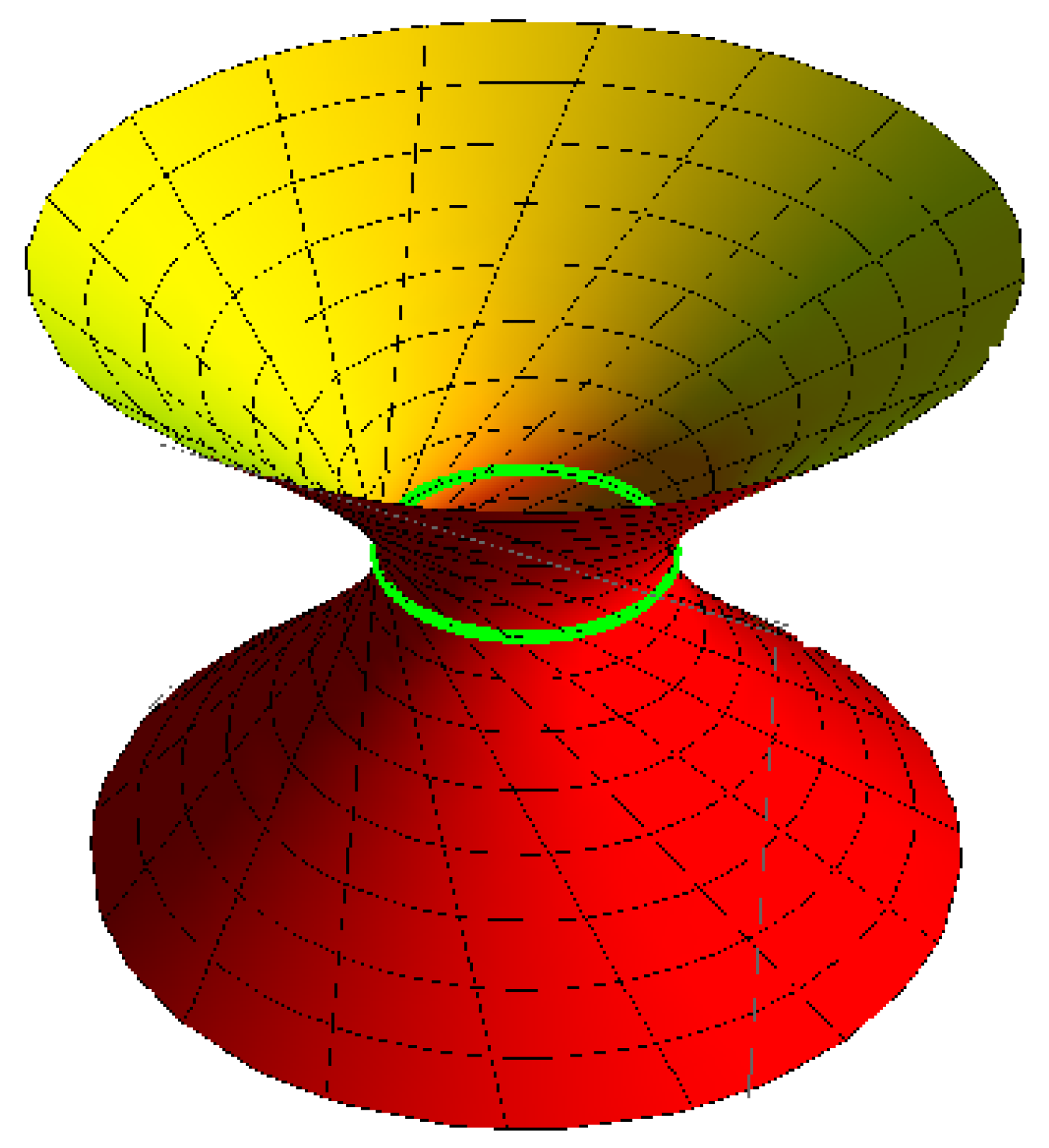
Hence, we have the E. Study map: The ring-shaped hyperboloid represents the set of spacelike lines, the combined asymptotic cone represents the set of null-lines, and the oval-shaped hyperboloid represents the set of timelike lines (see Figure 1). As a consequence, a curve on matches a timelike ruled surface in . Additionally, a curve on matches a spacelike or timelike ruled surface in [8,9,10,11,12,13,14].
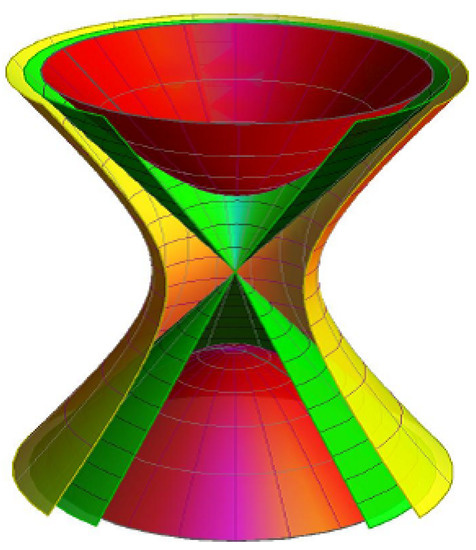
Figure 1.
The dual hyperbolic and dual Lorentzian unit spheres.
Definition 1.
For any two (non-null) dual vectors and in , we have [8,9,10,11,12]: (i) If and are two dual spacelike vectors, then:
- If they span a dual spacelike plane, there is a dual number ; , and such that . This number is the spacelike dual angle amongst and ;
- If they span a dual timelike plane, there is a dual number such that , where or via or , respectively. This number is the central dual angle amongst and ;(ii) If and are two dual timelike vectors, then there is a dual number such that , where or via and have different time-direction or the same time-direction, respectively. This dual number is the Lorentzian timelike dual angle amongst and ;(iii) If is dual spacelike, and is dual timelike, then there is a dual number 0 such that , where or via or . This number is the Lorentzian timelike dual angle amongst and .
Definition 2.
A pencil of non-null oriented lines satisfying
where is named a spacelike (timelike) line complex when . In the special case, C is named a spacelike (timelike) singular line complex if ,and .
A non-null singular line complex is a pencil of all non-null lines intersecting the non-null line . Then, we can have a non-null line congruence by common non-null line complexes. The non-null line congruences include a regular pencil of non-null lines in realized as a non-null ruled surface. Non-null ruled surface (such as cone and cylinder ) include non-null lines in which the tangent plane touches the surface over the non-null ruling. Such non-null lines are named non-null torsal lines.
One-Parameter Lorentzian Dual Spherical Movements
Let and be two Lorentzian dual unit spheres with a joint center in . We choose ;(timelike)}, and ;,,(timelike)} as two orthonormal dual frames related with and , respectively. If we set is stationary, whereas the components of the set are functions of a real parameter (say the time). Then, we say that movements with respect to Such movement is named a one-parameter Lorentzian dual spherical movements, and indicated by . If and matches to the Lorentzian line spaces and , respectively, then matches the one-parameter Lorentzian spatial movements Therefore, is the movable Lorentzian space with respect to the invariable Lorentzian space in . Since each of these orthonormal dual frames has the same direction, one frame is gained by employing second when revolved about . By letting and considering the dual matrix . It then follows that the signature matrix of the inner product is specified by
Hence, the movement can be described as
Thus, the dual matrix has , and . Therefore, we have:
which mean it is an orthogonal matrix. This outcome indicates that when a one-parameter Lorentzian spatial movement is stated in , we can locate a Lorentzian dual orthogonal matrix , where are dual functions of one variable . Similar to the set of real Lorentzian orthogonal matrices, the set of Lorentzian dual orthogonal matrices, indicated by , locate a group with matrix multiplication as the group operation (real Lorentzian orthogonal matrices are subgroup of Lorentzian dual orthogonal matrices). The identity element of is the unit matrix. Since the center of the Lorentzian dual unit sphere in should remain inanimate, the transformation group in (the picture of Lorentzian movements in the Minkowski 3-space ) does not hold any translations. Then, for the Lorentzian movements in , we can state the next theorem:
Theorem 1.
The set of all Lorentzian dual orthogonal matrices in -space is in one-to-one agreement with the set of all one-parameter Lorentzian spatial movements in -space.
To derive an element of the dual Lie algebra of the dual group , we set a Lorentzian dual curve of such dual matrices such that is the identity. By setting the derivative of Equation (1) with respect to t, we attain:
If we set , we see that , that is, the matrix is a skew-adjoint matrix. Thus, via Theorem 1, the Lie algebra of the dual Lorentzian group is the algebra of dual skew-adjoint matrices
Here, “dash” references the derivative with respect to . Then,
where is named the instantaneous dual rotation vector of . and , respectively, are the instantaneous rotational differential velocity vector and the instantaneous translational differential velocity vector of the movement .
3. Timelike Ruled Surfaces with Stationary Disteli-Axis
According to Formula (3), let be a spacelike dual curve on match a timelike ruled surface () in . As customary Blaschke frame for will be specified as
where
The frame is named Blaschke frame. Through the movement the matching lines intersect at the striction point of the ruled surface (). The trajectory of the central points trace the striction curve on (). Therefore, the structural equation of is specified by
where , and
are the Blaschke invariants of the timelike dual curve . The tangent of the striction curve is:
The Lorentzian invariants of () are:
The geometric elucidations of , , and are as follows: is the spherical curvature of the image curve ; is the angle amongst the tangent to the striction curve and the ruling of (); and is its distribution parameter at the ruling. Thus, a timelike ruled surface can be specified as follows:
3.1. Timelike Disteli-Axis
Under the hypothesis that , we specify the timelike Disteli-axis of () in as follows:
Then, Equation (5) can be written as
Therefore, at any instant , we gain
Therefore, the timelike Disteli-axis is the instantaneous screw axis of the the movement .
Proposition 1.
is a non-developable timelike ruled surface .
The pitch of the Blaschke frame along the timelike Disteli-axis is specified by
However, the timelike Disteli-axis can be realized by Equation (9), and we have:
- (1)
- The dual angular speed can be specified as ;
- (2)
- If be a point on , then
If the movement is a pure rotation, that is, , then,
whereas, if , and , then is a timelike line. However, if 0, that is, the movement is pure translational, we let d for arbitrary such that , in other view can be arbitrarily selection, too.
3.2. Timelike Plücker’s Conoid
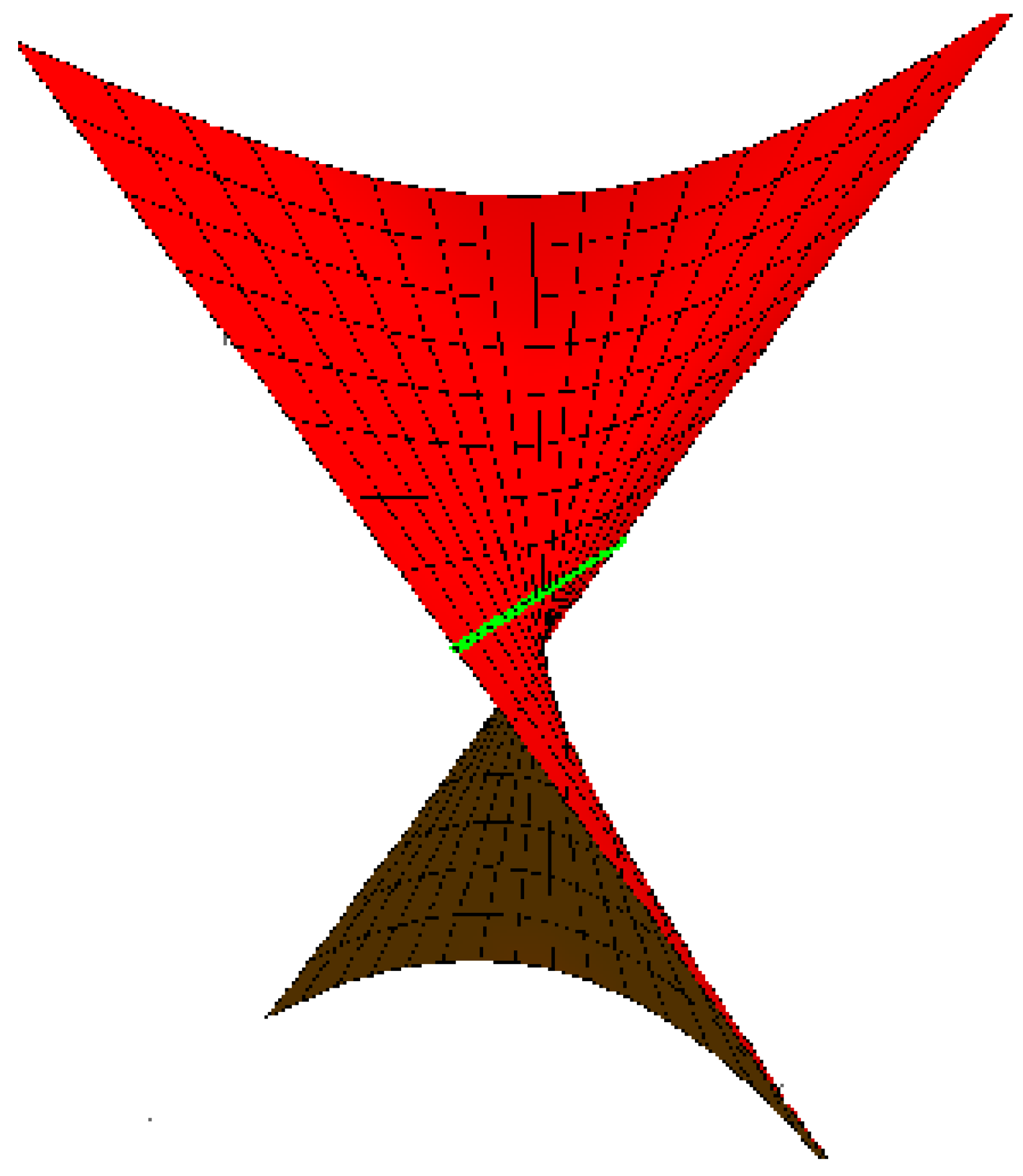
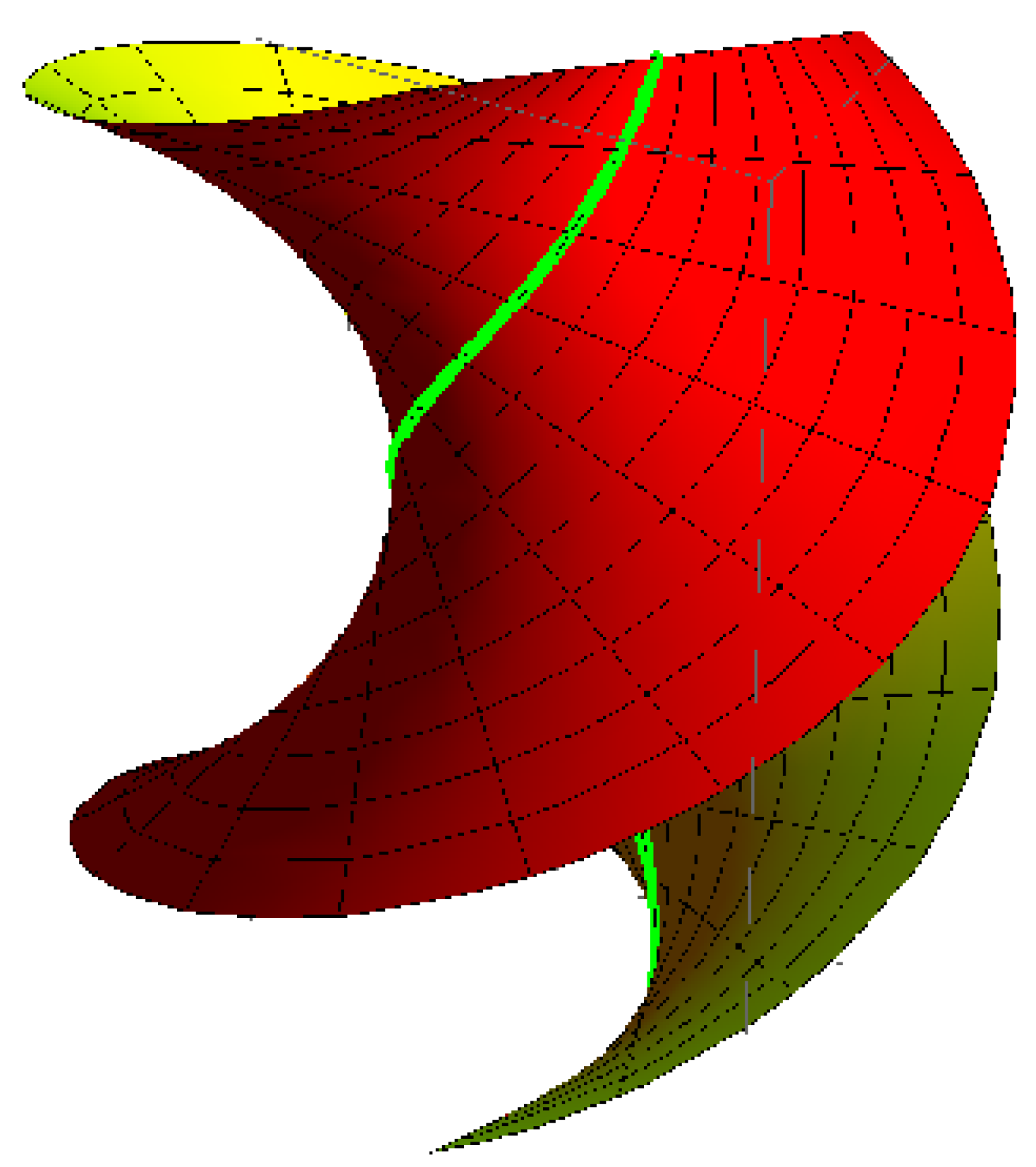
We now explicate and research the geometrical demonstrations of the Hamilton and Mannhiem formulae. The surface defined by is the timelike form of the well-known Plücker’s conoid, or cylindroid. as follows: let and -axis of a stationary Lorentzian frame be coincident and the place of the timelike dual unit vector be specified by angle and distance on the positive orientation of axis. The dual unit vectors and can be chosen over the x and z-axes, respectively. This displays that and together with display the coordinate system of the timelike Plücker’s conoid (Figure 2). Therefore, if should be a point on , then we have:
By an uncomplicated calculation, we gain the algebraic equation
It is clear that Equation (17) depends on the two integral invariants of the first order; , (Figure 3). Further, one can obtain a second-order algebraic equation in as
For the limits of we put . Therefore, the two limits of are as follows
Equation (19) admits two isotropic torsal timelike planes, each of which contains one isotropic torsal timelike line L. Hence, the geometric aspects of the are as follows:
- (i)
- If , then we have two generators through the point ; and for the two limit isotropic torsal timelike planes , the generators and the principal axes and are coincident;
- (ii)
- If then we have two torsal isotropic lines , determined by
Equation (20) offer that the two isotropic torsal lines , and are orthogonal to each other. Therefore, if and are commensurate, then the timelike Plücker’s conoid becomes a pencil of timelike lines in the origin “” in the timelike torsal plane . In this case, and are the principal axes of an elliptic timelike line congruence. However, if and have opposite signs, then and are isotropic and are coincident with the principal axes of a timelike hyperbolic line congruence.
Furthermore, if we convert from polar coordinates to Cartesian, we use the impersonation
into the Hamilton’s formula and we obtain the following conic section
This conic section is a Minkowski version of Dupin’s indicatrix of the surface theory in Euclidean 3-space .
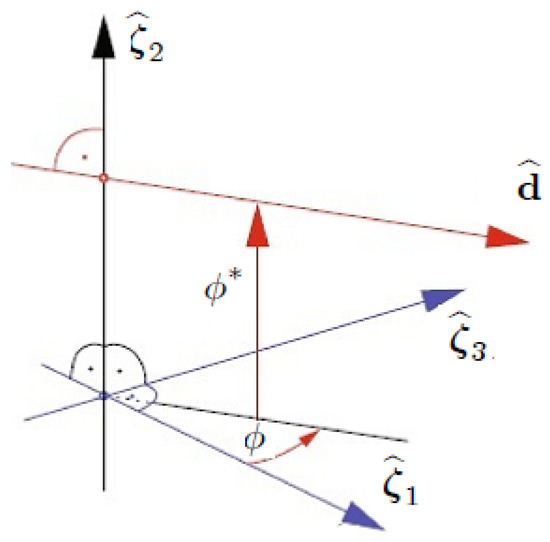
Figure 2.
.
Figure 2.
.
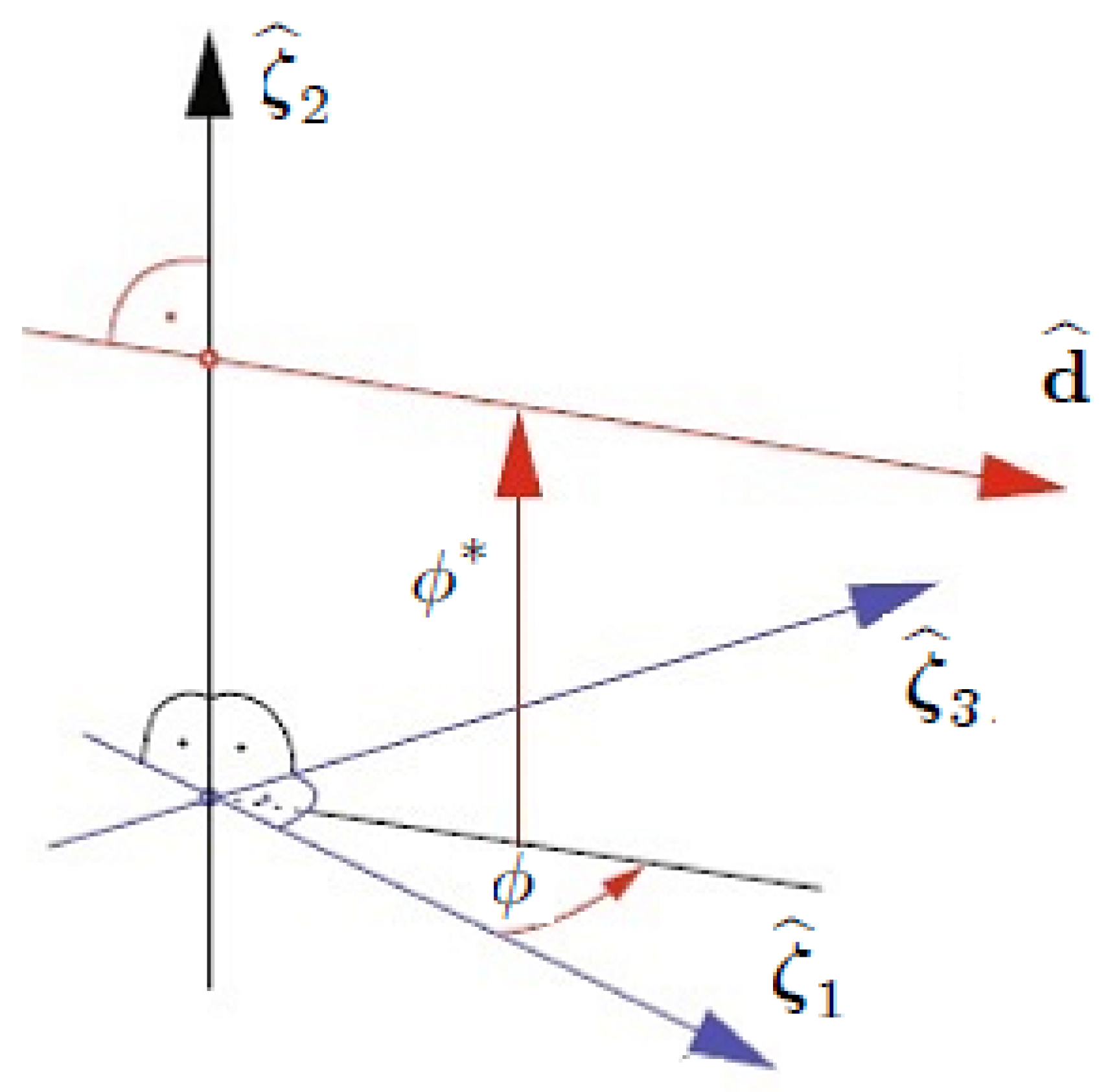
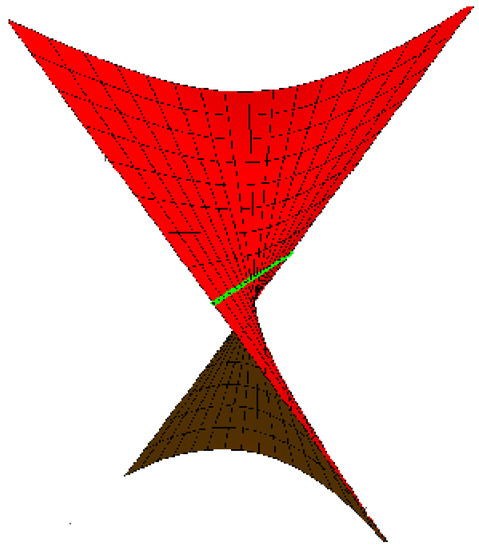
Figure 3.
Timelike Plücker’s conoid.
Figure 3.
Timelike Plücker’s conoid.
Serret–Frenet Frame
In Equation (6): (a) If , then is a tangential timelike developable surface, that is, . In this case, the striction curve is a spacelike edge of regression of , and then D is a pencil of parallel isotropic lines specified by . Let s be an arc-length parameter of and , , is the Serret–Frenet apparatus of . After several algebraic manipulations, it can be gained that:
where
Therefore, the curvature function is the radius of torsion of the spacelike striction curve . Further, we therefore arrive at:
(b) If , the striction curve is timelike tangent to ; it is normal to rule over . In this case, is a binormal timelike ruled surface, and D is a pencil of parallel lines decided by . Similarly, we can also specify that:
Then, the curvature function is the radius of torsion of of the timelike binormal surface . Additionally, we derive
3.3. Stationary Timelike Disteli-Axis
In what follow, when we state that () is a timelike ruled surface with stationary timelike Disteli-axis, we mean that all the rulings of () have a stationary dual angle with respect the Disteli-axis.
Let indicate the dual arc length of Then,
By employing instead of t, from Equations (5) and (21), we have:
where , is the dual spherical curvature of . Therefore, we have the following associations:
where is the dual curvature, and is the dual torsion of the dual curve .
3.3.1. Height Dual Functions
In identification with [17,18], a dual point of will be named a evolute of the dual curve ; for all t such that , , but . Here indicates the t-th derivatives of with respect to the dual arc length . For the first evolute of , we have , and . Therefore, is at least a evolute of .
We are now heading a dual function , by . We call a Lorentzian height dual function on . We use the notation for any stationary point .
Proposition 2.
Under the above notations, the following holds:
- 1.
- will be stationary in the first approximation iff ,, that is,for some dual numbers and ;
- 2.
- will be stationary in the second approximation iff is evolute of , that is,;
- 3.
- will be invariant in the third approximation iff is evolute of , that is,;
- 4.
- will be stationary in the fourth approximation iff is evolute of , that is,
Proof.
For the first derivative of we obtain:
Therefore, we obtain:
for some dual numbers and , the result is clear.
2-Derivative of Equation (24) leads to:
3-Derivative of Equation (26) leads to:
Hence, we have:
4-By the similar arguments, we can also have:
The proof is completed. □
- (a)
- The osculating circle of in is specified bywhich are gained from the condition that the osculating circle must have touch of at least third order at if and only if .
- (b)
- The osculating circle and the curve in have at least fourth order at if and only if , and .
In this direction, by catching into contemplation the evolutes of in , we can gain a sequence of evolutes , , …, . The ownerships and the interrelatedness through these evolutes and their involutes are very interesting problems. For instance, it is not difficult to consider that when , and , is situated at is invariable relative to . In this case, the timelike Disteli-axis is invariable up to second order, and the line moves over it with invariable pitch. Thus, the timelike ruled surface () with invariable timelike Disteli-axis is produced by timelike line existing at a Lorentzian invariable distance and Lorentzian invariable angle with respect to the timelike Disteli-axis . In the case of , then is a spacelike dual great circle on , that is,
In this case, in the Lorentzian sense, all the spacelike rulings of () intersected orthogonally with the timelike Disteli-axis , that is, , and . Thus, we have () is a timelike helicoid of the first kind.
Theorem 2.
A non-developable timelike ruled surface is a stationary timelike Disteli-axis iff = invariable, and =invariable.
However, from the Equation ((22)) we have the ODE . After several algebraic manipulations, the general solution of this equation is:
Here, ; where , and . From the real and the dual parts, we have
Let p be a point on . Since =p× we have the system of linear equations in (i = 1, 2, 3, and are the coordinates of p):
The matrix of coefficients of unknowns is the skew symmetric matrix
and thus its rank is 2 with (k is an integer). The rank of the augmented matrix
is also 2. Then, this system has infinite solutions given by
Since can be arbitrarily, then we may put . In this case, the Equation ((34)) becomes
Thus, the director surface of the timelike congruence is:
Let y be a point on this timelike congruence. Hence, we obtain:
All lines which satisfy the Equation (36) is a timelike congruence. Also, we may write that
where , and . Then is a one-parameter family of Lorentzian spheres. The common of each Lorentzian sphere and the conformable spacelike plane is a one-parameter family of Lorentzian cylinders : . Therefore, the envelope of is the Lorentzian cylinder which is the position for .
3.3.2. Special Timelike Ruled Surfaces
A correlation such as restricts the Equations (36) and (37) to a 1-parameter set of timelike lines, that is, a timelike ruled surface in the line congruence. Therefore, if we set indicating the pitch of the movement and as the movement parameter, then Equations (36) and (37) is a timelike ruled surface in -space. Thus, from the Equations (4) and (31), we immediately find that:
This insist that the timelike Disteli-axis is . Additionally, the director surface of the timelike congruence reduces to the striction curve, that is,
It can be shown that is a spacelike (a timelike) if and only if (). Further, the curvature and torsion can be specified by
Then, is a spacelike or timelike helix. Additionally, the timelike ruled surface with stationary timelike Disteli-axis is:
, and can control the shape of , that is, it can be classified into the following:
- (1)
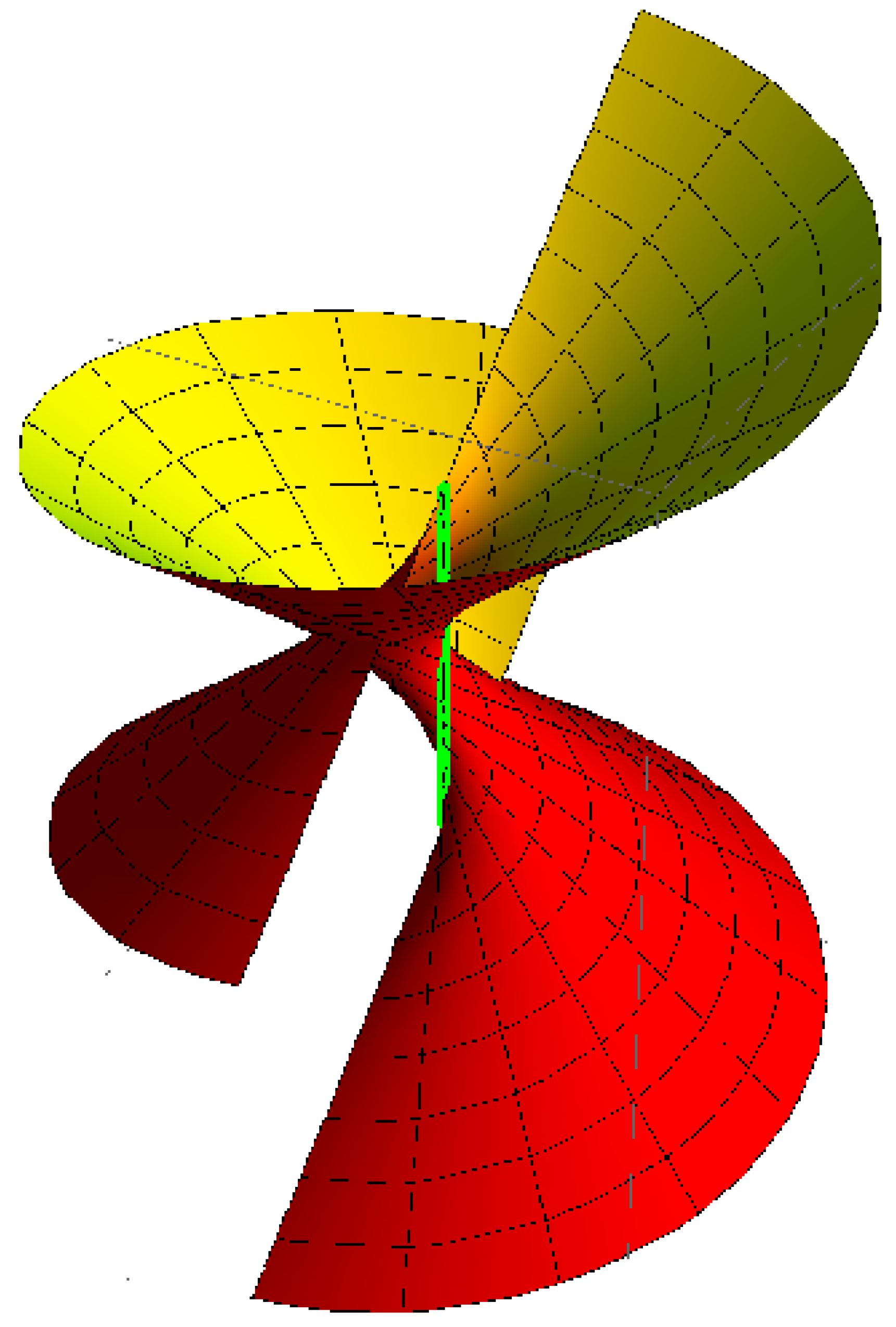
- General timelike helicoidal surface with its striction curve is a timelike cylindrical helix: for , , , and (see Figure 4).
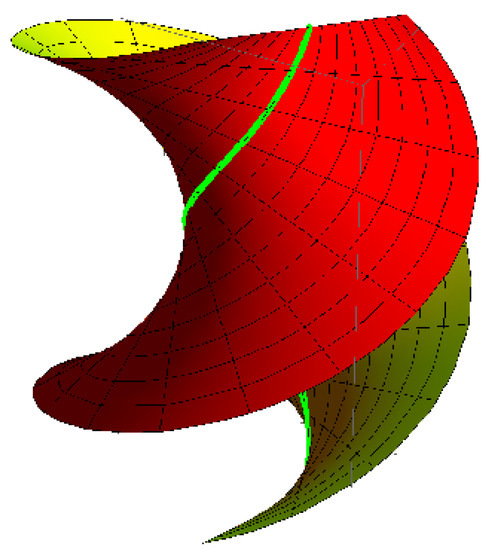 Figure 4. General timelike helicoidal surface.
 - (2)
- Lorentzian sphere with its striction curve is a spacelike circle: for , , , and (see Figure 5).
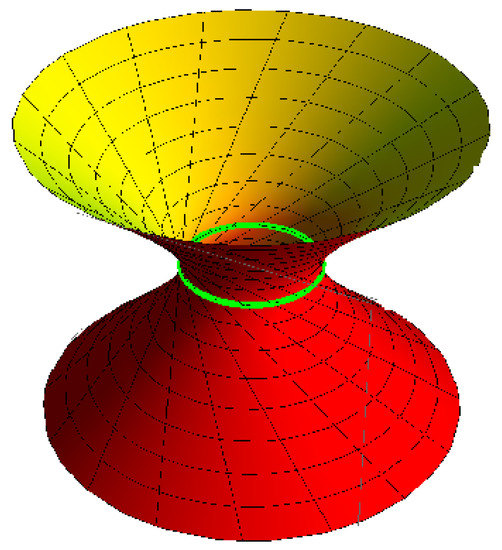 Figure 5. Lorentzian sphere.
 - (3)
- Timelike Archimedes with its striction curve is a timelike line: for , , , , and (see Figure 6).
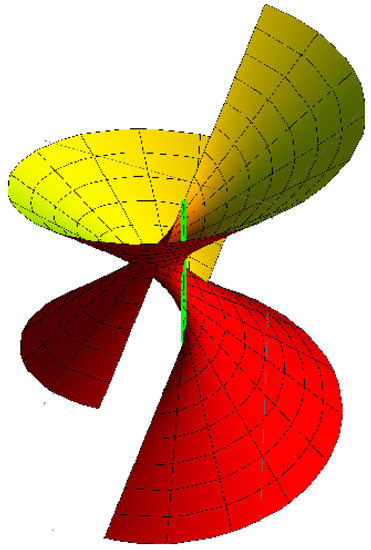 Figure 6. Timelike Archimedes.
 - (4)
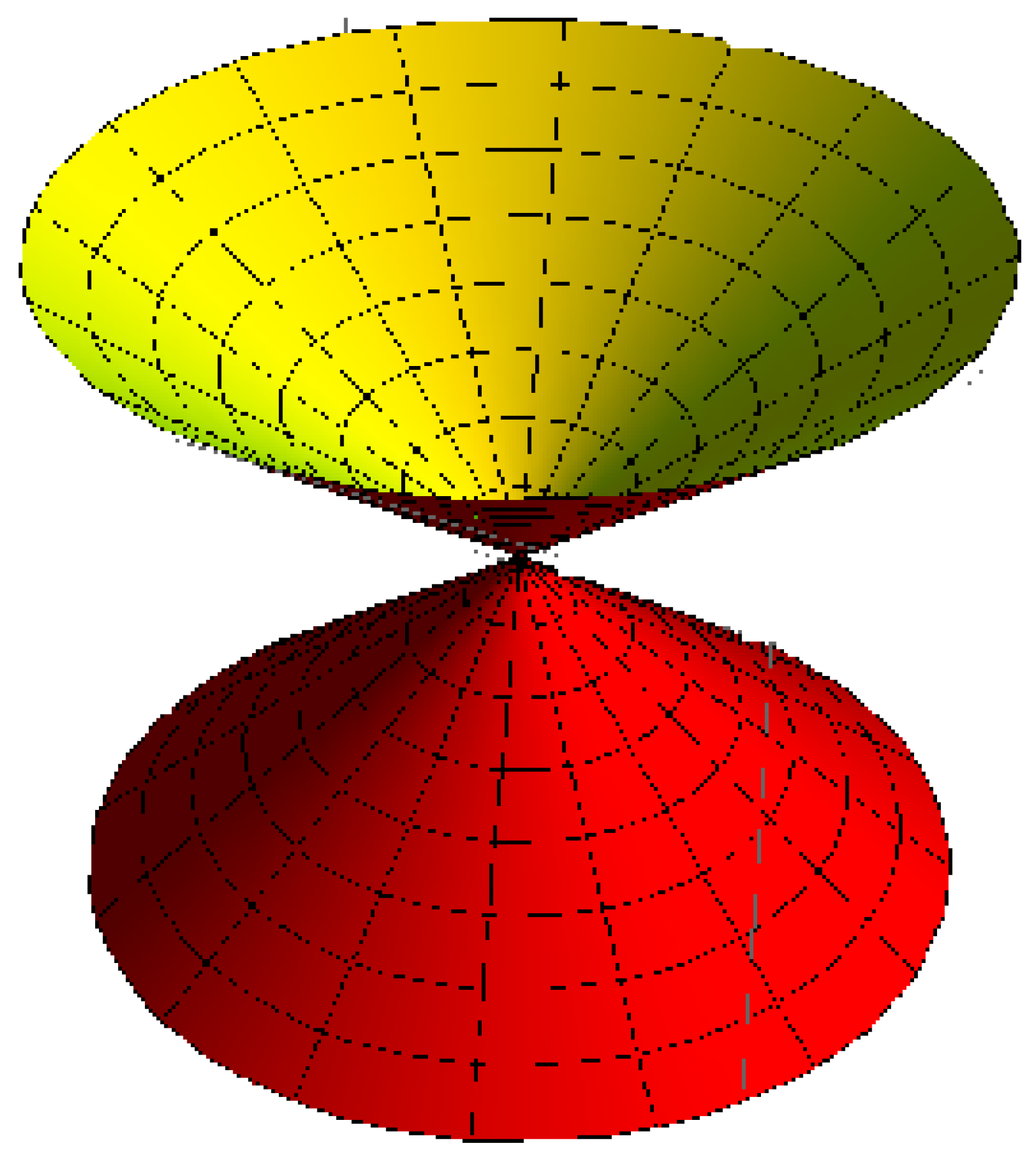
- Timelike circular cone with its striction curve is a fixed point: for , , , and (see Figure 7).
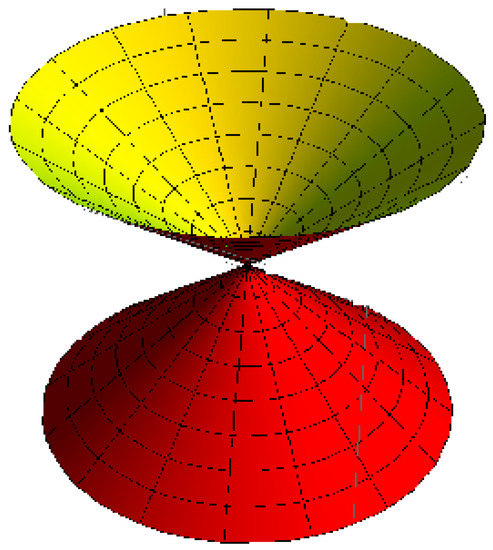 Figure 7. Timelike cone.
 - (5)
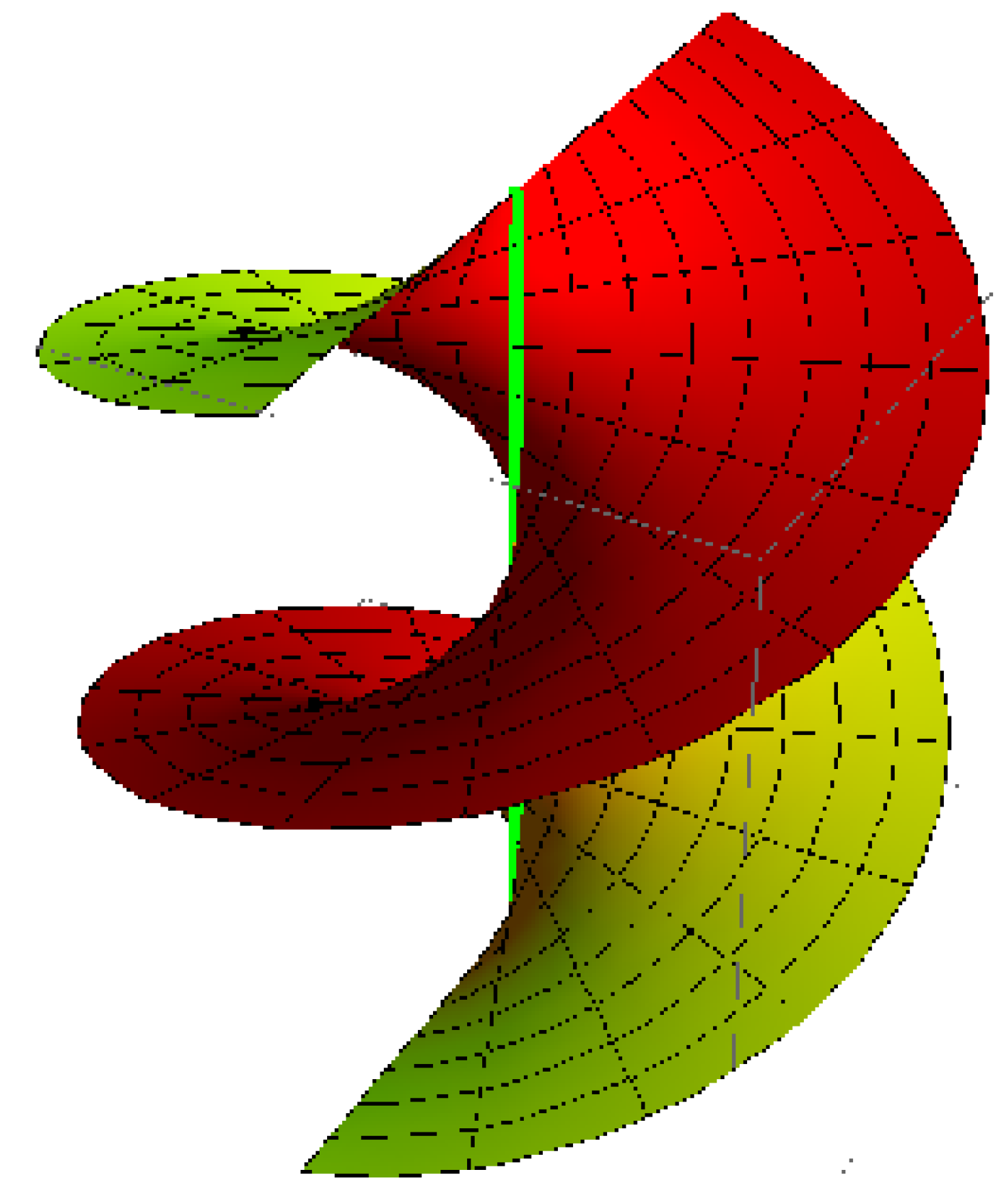
- Timelike helicoid of the 1st kind with its striction curve is a timelike line: for , , , and (see Figure 8).
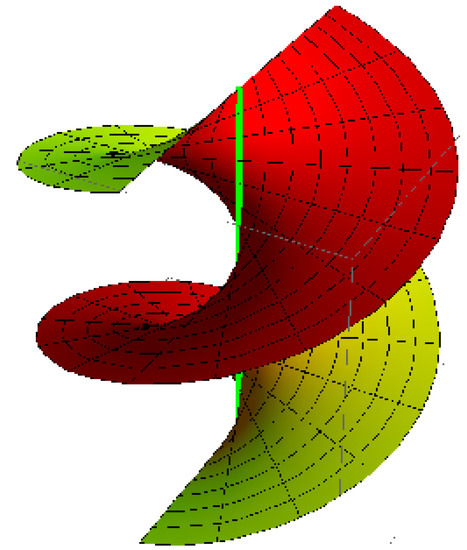 Figure 8. A timelike helicoid of the 1st kind.
4. Conclusions
This work supplies the kinematic geometry for a timelike ruled surface with stationary timelike Disteli-axis by the similarity with Lorentzian dual spherical kinematics. This supplies the ability to derive set of invariants which discover the local shape of timelike ruled surface. Hence, the Lorentzian form of the well-known equation of the Plücker’s conoid has been concluded and its kinematic-geometry are explained in detail. Finally, a description for a timelike line trajectory to be a stationary timelike Disteli-axis is extracted and examined. These results have the potential to expand the use of geometric properties of timelike ruled surfaces created by spacelike lines embedded in spatial mechanisms. Our results in this paper can contribute to the field of spatial kinematics and have practical implementations in mechanical mathematics and engineering. In future work, we plan to proceed to research some implementations of timelike ruled surfaces as tooth flanks for gears with skew timelike axes such that at any instant the contact points are located on a timelike line as in [17,18,19].
Author Contributions
Methodology, A.A.A. and R.A.A.-B.; investigation, R.A.A.-B.; data curation, R.A.A.-B.; writing—original draft preparation, A.A.A.; writing—review and editing, R.A.A.-B. All authors have read and agreed to the published version of the manuscript.
Funding
This research was funded by Princess Nourah bint Abdulrahman University Researchers Supporting Project number (PNURSP2023R337).
Data Availability Statement
Our manuscript has no associate data.
Acknowledgments
The authors would like to acknowledge the Princess Nourah bint Abdulrahman University Researchers Supporting Project number (PNURSP2023R337), Princess Nourah bint Abdulrahman University, Riyadh, Saudi Arabia.
Conflicts of Interest
The authors declare that there is no conflict of interest regarding the publication of this paper.
References
- Bottema, O.; Roth, B. Theoretical Kinematics; North-Holland Press: New York, NY, USA, 1979. [Google Scholar]
- Karger, A.; Novak, J. Space Kinematics and Lie Groups; Gordon and Breach Science Publishers: New York, NY, USA, 1985. [Google Scholar]
- Pottman, H.; Wallner, J. Computational Line Geometry; Springer: Berlin/Heidelberg, Germany, 2001. [Google Scholar]
- Köse, Ö.C.C.; Sarıoglu, B.K.; Karakılıç, I. Kinematic differential geometry of a rigid body in spatial motion using dual vector calculus: Part II. Appl. Math. 2006, 182, 333–358. [Google Scholar] [CrossRef]
- Abdel-Baky, R.A.; Al-Ghefari, R.A. On the one-parameter dual spherical motions. Comp. Aided Geom. Design 2011, 28, 23–37. [Google Scholar] [CrossRef]
- Turhan, T.; Ayyıldız, N. A Study on Geometry of Spatial Kinematics in Lorentzian Space; Süleyman Demirel Üniversitesi Fen Bilimleri Enstitüsü Dergisi: Isparta, Türkiye, 2017; Volume 21, pp. 808–811. [Google Scholar]
- Gilani, S.M.; Abazari, N.; Yayli, Y. Characterizations of dual curves and dual focal curves in dual Lorentzian space . Turk J. Math 2020, 44, 1561–1577. [Google Scholar] [CrossRef]
- Aslan, M.C.; Sekerci, G.A. Dual curves associated with the Bonnet ruled surfaces. Int. J. Geom. Methods Mod. Phys. 2020, 17, 2050204. [Google Scholar] [CrossRef]
- Abdel-Baky, R.A.; Unluturk, Y. A new construction of timelike ruled surfaces with stationarfy Disteli-axis. Honam Math. J. 2020, 42, 551–568. [Google Scholar]
- Makki, R. Some characterizations of non-null rectifying curves in dual Lorentzian 3-space . AIMS Math. 2021, 6, 2114–2131. [Google Scholar] [CrossRef]
- Alluhaibi, N.S.; Abdel-Baky, R.A. Kinematic geometry of timelike ruled surfaces in Minkowski 3-space . Symmetry 2022, 14, 749. [Google Scholar] [CrossRef]
- Mofarreh, F. Timelike ruled and developable surfaces in Minkowski 3-space . Front. Phys. 2022, 10, 148. [Google Scholar] [CrossRef]
- O’Neil, B. Semi-Riemannian Geometry Geometry, with Applications to Relativity; Academic Press: New York, NY, USA, 1983. [Google Scholar]
- Walfare, J. Curves and Surfaces in Minkowski Space. Ph.D. Thesis, Faculty of Science, Leuven, Belgium, 1995. [Google Scholar]
- Bruce, J.W.; Giblin, P.J. Curves and Singularities, 2nd ed.; Cambridge University Press: Cambridge, UK, 1992. [Google Scholar]
- Cipolla, R.; Giblin, P.J. Visual Motion of Curves and Surfaces; Cambridge University Press: Cambridge, UK, 2000. [Google Scholar]
- Alluhaibi, N.A.; Abdel-Baky, R.A. On the kinematic-geometry of one-parameter Lorentzian spatial movement. Int. J. Adv. Manuf. Technol. 2022, 121, 7721–7731. [Google Scholar] [CrossRef]
- Stachel, H. On spatial involute gearing. In Proceedings of the 6th International Conference on Applied Informatics (ICAI), Eger, Hungary, 27–31 January 2004. [Google Scholar]
- Figlioini, G.; Stachel, H.; Angeles, J. The computational fundamentals of spatial cycloidal gearing. In Computational Kinematics: Proceedings of the 5th International Workshop on Computational Kinematics; Kecskemethy, A., Muller, A., Eds.; Springer: Berlin/Heidelberg, Germany, 2009; pp. 375–384. [Google Scholar]
Disclaimer/Publisher’s Note: The statements, opinions and data contained in all publications are solely those of the individual author(s) and contributor(s) and not of MDPI and/or the editor(s). MDPI and/or the editor(s) disclaim responsibility for any injury to people or property resulting from any ideas, methods, instructions or products referred to in the content. |
© 2023 by the authors. Licensee MDPI, Basel, Switzerland. This article is an open access article distributed under the terms and conditions of the Creative Commons Attribution (CC BY) license (https://creativecommons.org/licenses/by/4.0/).