


Abstract
For L a complete co-residuated lattice and R an L-fuzzy relation, an L-fuzzy upper approximation operator based on co-implication adjoint with L is constructed and discussed. It is proved that, when L is regular, the new approximation operator is the dual operator of the Qiao–Hu L-fuzzy lower approximation operator defined in 2018. Then, the new approximation operator is characterized by using an axiom set (in particular, by single axiom). Furthermore, the L-fuzzy upper approximation operators generated by serial, symmetric, reflexive, mediate, transitive, and Euclidean L-fuzzy relations and their compositions are characterize through axiom set (single axiom), respectively.
Keywords:
fuzzy set; fuzzy rough set; co-residuated lattice; co-implication; axiomatic characterization Mathematics Subject Classification:
03E72; 06B23; 06D20
1. Introduction
The theory of rough sets [1,2] is an effective mathematical tool to handle uncertainty. Nowadays, many kinds of generalized rough sets have been developed [3,4,5,6,7,8,9,10,11,12,13,14,15,16,17], and some of them have been successfully applied in many areas including approximate classification, machine learning, conflict analysis, pattern recognition, data mining, and automated knowledge acquisition [2,8,13,14,18,19,20,21,22]. The theoretical core of generalized rough sets is a pair of approximate operators. There are usually two approaches to study these approximate operators: constructive approach and axiomatic approach. The constructive approach is to construct the approximation operators from binary relations, coverings, neighborhoods, and other structures [3,4,5,6,7,9,11,13,14]; the axiomatic approach is to find the axiom (set) for a given operator such that the operator is precisely an approximation operator defined through the constructive approach [10,15,16,17].
Fuzzy rough sets are important generalized rough sets. The constructive and axiomatic approach are also extensively used in the study of fuzzy rough sets (see [20,21,23,24,25,26,27,28,29,30,31,32,33,34,35,36,37,38,39,40,41,42,43,44,45,46,47]). In recent years, complete residuated (respectively, co-residuated) lattice-valued fuzzy rough sets (L-fuzzy rough sets for short) have attracted much attention for their extreme universality and strongly logical background—complete (co-)residuated lattice includes left (right) continuous triangular (co-)norm as a special case and can be regarded as a truth table of generalized multi-valued logic. In the following, we list some work on this regard.
- ⋄
- Let be a complete residuated lattice. Based on L-fuzzy relations, Radzikowska [40] defined an L-fuzzy upper (respectively, lower) approximation operator by using ∗ (respectively, →). Then, She [41] characterized these approximation operators by an axiomatic set. Bao [24] and Wang [42] further characterized them by single axiom. Wang [48] gave a comparative study on variable precision L-fuzzy rough sets. Based on L-fuzzy coverings, Li [49] defined and characterized four L-fuzzy approximation operators. Based on L-fuzzy neighborhood systems, Zhao [45,46,47] proposed a pair of L-fuzzy approximation operators and discussed their axiomatic characterizations and the generated L-fuzzy topology. Song [50] studied the lattice structure induced by the approximation operators.
- ⋄
- Let be a complete co-residuated lattice. Based on L-fuzzy relations, Qiao [38] defined and characterized an L-fuzzy lower approximation operator by using ⊙. He [37] also introduced a granular variable precision L-fuzzy upper approximation operator by using ⊙. Based on distance functions, Oh [51] investigated an L-fuzzy upper approximation operator and discussed the related L-fuzzy topology.
It is well known that fuzzy rough sets based on triangle norm and those based on triangle conorm can be studied dually [32,52,53]. The cases for fuzzy rough sets based on complete (co-)residuated lattice should be similar. As mentioned above, the research on fuzzy rough sets based on complete residuated lattice is much more abundant than that on complete co-residuated lattice. Therefore, fuzzy rough sets based on complete co-residuated lattice should be further studied. Particularly, note that, in the definition of L-fuzzy approximation operators, the co-implication ⇝ is not used. The main aim of this paper is to investigate an L-fuzzy approximation operator based on ⇝ from both constructive and axiomatic approaches.
The contents are arranged as follows. In Section 2, we recall some basic concepts as preliminary. In Section 3, we investigate an L-fuzzy upper approximation operator based on co-implication ⇝ from a constructive approach. We verify that, when L is regular, the proposed L-fuzzy upper approximation operator is the dual operator of the Qiao–Hu L-fuzzy lower approximation operator defined in 2018. We further discuss the L-fuzzy upper approximation operators generated by serial, symmetric, reflexive, mediate, transitive, and Euclidean L-fuzzy relations and their compositions. In Section 4 and Section 5, we characterize the mentioned L-fuzzy upper approximation operators by axiomatic set and single axiom, respectively. In Section 5, we make a conclusion.
2. Preliminaries
A complete co-residuated lattice [38,54] is an algebra that fulfills:
(i) is a complete lattice with the bottom (respectively, top) element 0 (respectively, 1).
(ii) is a commutative monoid with 0 as the unit element.
(iii) ⊙ distributes over arbitrary meets, i.e., , .
The function determined by
is called the co-implication of ⊙.
Complete co-residuated lattice is the extension of right continuous triangle co-norm [55]; for more examples, please see the work of Oh-Kim [51].
Proposition 1.
(Qiao–Hu [37] [Proposition 2.1]) Let L be a complete co-residuated lattice.
(1) .
(2) .
(3) .
(4) , especially .
(5) .
(6) .
(7) .
(8) .
(9) .
(10) .
(11) .
L is said to be regular whenever , .
A function is said to be an involutive negation if it is decreasing and fulfills , . If is an involutive negation, then the following De Morgan laws hold: ,
For a nonempty set U, a function is called an L-fuzzy set on U. All L-fuzzy sets on U are denoted by . For , we also use a to denote the constant value L-fuzzy set values a. For , we use to denote the L-fuzzy set values 1 at A and 0 otherwise; when , we simplify as .
For , and , the L-fuzzy sets are defined pointwise.
Definition 1.
(Qiao–Hu [38]) Let be nonempty sets. An L-fuzzy set is called an L-fuzzy relation from U to V, and the triple is called an L-fuzzy approximation space (L-FAS for short). When , is called an L-fuzzy relation on U and is simplified as .
Definition 2.
(Qiao–Hu [38]) Let be an L-FAS.
(1) is called serial ((SR) for short) if , .
Furthermore, let .
(2) is called symmetric ((SY) for short) provided , .
(3) is called reflexive ((RF) for short) provided , .
Definition 3.
Let be an L-FAS.
(1) is called transitive ((TR) for short) provided , .
(2) is called mediate ((ME) for short) provided , .
(3) is called Euclidean ((EU) for short) provided , .
(4) is called similar provided it is reflexive and symmetric.
(5) is called an L-fuzzy preorder provided it is reflexive and transitive.
(6) is called equivalent provided it is reflexive, symmetric and transitive.
It is not difficult to see that being reflexive implies that is mediate.
Remark 1.
Let .
(1) is transitive iff , , a well-known definition.
(2) is mediate iff , , i.e., is mediate in the sense of Pang [35] ([Definition 3.6]).
(3) is Euclidean iff , , a well-known definition.
In [38], Qiao and Hu defined an L-fuzzy rough lower approximation operator via ⊙.
Let be an L-FAS. Then, the function defined by: ,
is said to be an L-fuzzy lower approximation operator of .
3. -Fuzzy Upper Approximation Operator via ⇝: The Constructive Approach
In this section, we introduce an L-fuzzy upper approximation operator via ⇝, and prove that operator is the dual operator of the Qiao–Hu L-fuzzy lower approximation operator when L is regular. We further study the L-fuzzy upper approximation operators associated with serial, symmetric, reflexive, mediate, transitive, and Euclidean L-fuzzy relations.
Definition 4.
Let be an L-FAS. Then, the function determined by
is said to be an L-fuzzy upper approximation operator of . The pair is said to be L-fuzzy -rough set of A.
At first, we show that our operator and the Qiao–Hu operator satisfy the following dual theorem.
Theorem 1.
Let be an L-FAS. If L is regular and , then ,
Proof.
For any and ,
□
Example 1.
Let L be the complete lattice defined by 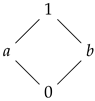 and. It is easily seen thatforms a complete co-residuated lattice and
and. It is easily seen thatforms a complete co-residuated lattice and| ⇝ | 0 | a | b | 1 |
| 0 | 0 | a | b | 1 |
| a | 0 | 0 | b | b |
| b | 0 | a | 0 | a |
| 1 | 0 | 0 | 0 | 0 |
Put , and then is an involutive negation.
Let and be the L-fuzzy relation defined by
Take ; then,
| x | y | |
| x | 1 | a |
| y | 0 | a |
| x | y | |
| 0 | b | |
| a | 0 |
The next proposition collects the basic properties of L-fuzzy upper approximation operator.
Proposition 2.
Let be an L-FAS and .
(1) If , then .
(2) .
(3) , .
(4) , and .
(5) , .
(6) , .
Proof.
(1) It is obvious.
(2) For any ,
(3) For any ,
(4) For any ,
(5) For any ,
(6) For any ,
□
The next proposition shows that L-fuzzy relations and L-fuzzy upper approximation operators are determined uniquely from each other.
Proposition 3.
, iff . Hence, iff .
Proof.
⟹. It is obvious.
⟸. Let . For any , it follows by Proposition 2 (4) that
Taking , we obtain , i.e., , and thus since is involutive. Hence, . □
In the following, we consider the L-fuzzy upper approximation operators generated by serial, symmetric, reflexive, mediate, transitive, and Euclidean L-fuzzy relations, respectively.
Proposition 4.
Let be an L-FAS. Then, is serial iff , .
Proof.
⟹. For any ,
⟸. For any , it follows by that we have
take , then
i.e., , so is serial. □
Proposition 5.
Let be an L-FAS. Then, is symmetric iff .
Proof.
⟹. For any ,
⟸. For any , ,
i.e., is symmetric. □
Proposition 6.
Let be an L-FAS. Then, is reflexive iff , .
Proof.
⟹. For any ,
⟸. For any , ,
it follows by
that we have . Take , we have , i.e., , hence is reflexive. □
Proposition 7.
Let be an L-FAS. Then, is transitive iff , .
Proof.
⟹. For any ,
⟸. For any , ,
It follows that , ,
Putting , we have , i.e., , hence is transitive. □
Proposition 8.
Let be an L-FAS. Then, is mediate iff , .
Proof.
⟹. For any ,
⟸. For any , ,
It follows that , ,
Putting , we have
hence is mediate. □
Proposition 9.
Let be an L-FAS. Then, is Euclidean iff , , where is defined by .
Proof.
⟹. For any ,
⟸. For any , ,
It follows that , ,
Putting , we have , i.e., , hence is Euclidean. □
4. Axiomatic Characterization on -Fuzzy Upper Approximation Operators: By Axiomatic Set
In this section, we characterize the L-fuzzy upper approximation operators generated by serial, symmetric, reflexive, mediate, transitive, and Euclidean L-fuzzy relations and their compositions through axiomatic sets.
Definition 5.
A function is called an L-fuzzy upper approximation operator (L-FUAPO for short) whenever
(U1) for any and any index set J; and
(U2) for any and .
We fix a lemma for later use.
Lemma 1.
Let and the function is a surjective function. Then, for any , there is an s.t. , and .
Proof.
Since is surjective, , for some . It follows that
and thus
□
Remark 2.
There are natural examples satisfy the surjective condition in the above lemma"
(1) When L is regular, , , so is surjective.
(2) When and the co-implication ⇝ is continuous, is surjective.
In the following, we always assume that is a surjective function without further statement.
Theorem 2.
is an L-FUAPO ⟺ there is a unique L-fuzzy relation s.t. .
Proof.
⟸. It is established by Proposition 2 (5),(6).
⟹. Let be defined by
Then,
For any and any ,
Hence, .
The uniqueness of follows by Proposition 3. □
Theorem 3.
Let be an L-FUAPO.
(1) There is a unique serial L-fuzzy relations.t.⟺ Ω fulfills:
(U3) , .
Furthermore, let .
(2) There is a unique symmetric L-fuzzy relations.t.⟺ Ω fulfills:
(U4) .
(3) There is a unique reflexive L-fuzzy relations.t.⟺ Ω fulfills:
(U5) , .
(4) There is a unique transitive L-fuzzy relations.t.⟺ Ω fulfills:
(U6) , .
(5) There is a unique mediate L-fuzzy relations.t.⟺ Ω fulfills:
(U7) , .
Proof.
(1) It is established by Proposition 4 and Theorem 2.
(2) It is established by Proposition 5 and Theorem 2.
(3) It is established by Proposition 6 and Theorem 2.
(4) It is established by Proposition 7 and Theorem 2.
(5) It is established by Proposition 8 and Theorem 2. □
From the above theorem, we easily obtain the characterizations on L-fuzzy upper approximation operator generated by the composition of L-fuzzy relations mentioned early.
Theorem 4.
(The composition of two L-fuzzy relations) Let be an L-FUAPO.
(1) There is a unique similar L-fuzzy relations.t.⟺ Ω fulfills (U4) and (U5).
(2) There is a unique L-fuzzy preorders.t.⟺ Ω fulfills (U5) and (U6). Furthermore, the “≥” in (U6) can be changed as “=”.
(3) There is a unique serial and symmetric L-fuzzy relations.t.⟺ Ω fulfills (U3) and (U4).
(4) There is a unique serial and transitive L-fuzzy relations.t.⟺ Ω fulfills (U3) and (U6).
(5) There is a unique serial and mediate L-fuzzy relations.t.⟺ Ω fulfills (U3) and (U7).
(6) There is a unique symmetric and transitive L-fuzzy relations.t.⟺ Ω fulfills (U4) and (U6).
(7) There is a unique symmetric and mediate L-fuzzy relations.t.⟺ Ω fulfills (U4) and (U7).
(8) There is a unique transitive mediate L-fuzzy relation s.t.⟺ Ω fulfills (U6) and (U7), or, equivalently, , .
Theorem 5.
(The composition of three L-fuzzy relations) Let be an L-FUAPO.
(1) There is a unique equivalent L-fuzzy relation s.t.⟺ Ω fulfills (U4), (U5), and (U6).
(2) There is a unique serial, symmetric, and transitive L-fuzzy relations.t.⟺ Ω fulfills (U3), (U4), and (U6).
(3) There is a unique serial, symmetric, and mediate L-fuzzy relations.t.⟺ Ω fulfills (U3), (U4), and (U7).
(4) There is a unique serial, transitive, and mediate L-fuzzy relations.t.⟺ Ω fulfills (U3), (U6), and (U7).
(5) There is a unique symmetric, transitive, and mediate L-fuzzy relations.t.⟺ Ω fulfills (U4), (U6), and (U7).
5. Axiomatic Characterization on L-Fuzzy Upper Approximation Operators: By Single Axiom
In this section, we characterize the mentioned L-fuzzy upper approximation operators by single axiom.
5.1. The Case of One L-Fuzzy Relation
Theorem 6.
is an L-FUAPO ⟺ that fulfills:
(UG ) For any index set J and any ,
Proof.
We prove (U1) + (U2)⟺ (UG).
⟹. It is obtained by
⟸. Taking in (UG), we have i.e., (U1) holds.
Taking and in (UG), we have i.e., (U2) holds. □
Theorem 7.
Let be an L-FUAPO. Then, there is a unique serial L-fuzzy relations.t.⟺ Ω fulfills:
(USR) For any , any index set J, and any ,
Proof.
We prove (UG) + (U3)⟺ (USR). Note that (UG)⟺ (U1)+(U3).
⟹. It is obtained by
⟸. Taking in (USR), we have
i.e., (U3) holds.
Taking in (USR), we obtain (UG). □
Lemma 2.
For any , .
Proof.
For any , if and otherwise. Then,
Hence, . □
Theorem 8.
Let be an L-FUAPO. Then, there is a unique symmetric L-fuzzy relations.t.⟺ Ω fulfills:
(USY) For any , any , any index set J, and any ,
where means that .
Proof.
We prove (UG) + (U4)⟺ (USY).
⟹. For , note that
it follows by (UG) we get (USY).
⟸. Take and in (USY); then, by for , we have, for any ,
which implies .
For any , . If , then
If , then, taking and in (USY), we have and for any ,
Thus, (U4) holds.
Taking in (USY), followed by , we obtain (UG). □
Theorem 9.
Let be an L-FUAPO. Then, there is a unique reflexive L-fuzzy relations.t.⟺ Ω fulfills:
(URF) For any index set J and any ,
Proof.
We prove (UG) + (U5)⟺ (URF).
⟹. It is established by
⟸. Taking and in (URF), we have
which means , i.e., (U5) holds. Then, by applying (U5) in (URF), we obtain (UG). □
Theorem 10.
Let be an L-FUAPO. Then, there is a unique transitive L-fuzzy relations.t.⟺ Ω fulfills:
(UTR) For any index set J and any ,
Proof.
We prove (UG) + (U6)⟺ (UTR).
⟹. It is established by
⟸. Taking and in (UTR), we have
which means , i.e., (U6) holds. Then, by applying (U6) in (UTR), we obtain (UG). □
Theorem 11.
Let be an L-FUAPO. Then, there is a unique mediate L-fuzzy relations.t.⟺ Ω fulfills:
(UME) For any index set J and any ,
Proof.
We prove (UG) + (U7)⟺ (UME).
⟹. It is established by
⟸. Take and in (UME), we have
which means , i.e., (U7) holds. Then, by applying (U7) in (UME), we obtain (UG). □
5.2. The Case of Composition of Two L-Fuzzy Relations
Theorem 12.
Let be an L-FUAPO. Then, there is a unique similar L-fuzzy relations.t.⟺ Ω fulfills:
(USM) For any , any , any index set J, and any ,
Proof.
We prove (USY) + (U5)⟺ (USM).
⟹. It is obvious.
⟸. Taking and in (USM), we have .
Take in (USM); then, by , we obtain (URF), which means that (U5) holds.
By applying (U5) in (USM), we get (USY). □
Theorem 13.
Let be an L-FUAPO. Then, there is a unique L-fuzzy orders.t.⟺ Ω fulfills:
(UFO) For any index set J and any ,
Proof.
We prove (UTR) + (U5)⟺ (UFO).
⟹. It is obvious.
⟸. Taking and in (UFO), we have , which means that (U5) holds.
By applying (U5) in (UFO), we get (UTR). □
Theorem 14.
Let be an L-FUAPO. Then, there is a unique serial and symmetric L-fuzzy relations.t.⟺ Ω fulfills:
(USR-SY) For any , any , any , any index set J, and any ,
Proof.
We prove (USY) + (U3)⟺ (USR-SY).
⟹. It is obvious.
⟸. Taking and in (USR-SY), we have .
Take , in (USR-SY); then, by , we obtain (U3).
Taking in (USR-SY), we obtain (USY). □
Theorem 15.
Let be an L-FUAPO. Then, there is a unique serial and transitive L-fuzzy relations.t.⟺ Ω fulfills:
(USR-TR) For any , any index set J, and any ,
Proof.
We prove (USR) + (U6)⟺ (USR-TR).
⟹. It is obvious.
⟸. Taking , , and in (USR-TR), we obtain (U6).
By using (U6) in (USR-TR), we obtain (USR). □
Theorem 16.
Let be an L-FUAPO. Then, there is a unique serial and mediate L-fuzzy relations.t.⟺ Ω fulfills:
(USR-ME) For any , any index set J, and any ,
Proof.
We prove (USR) + (U7)⟺ (USR-ME).
⟹. It is obvious.
⟸. Take , , and in (USR-ME), we obtain (U7).
By using (U7) in (USR-ME), we obtain (USR). □
Theorem 17.
Let be an L-FUAPO. Then, there is a unique symmetric and transitive L-fuzzy relations.t.⟺ Ω fulfills:
(USY-TR) For any , any , any index set J, and any ,
Proof.
We prove (USY) + (U6)⟺ (USY-TR).
⟹. It is obvious.
⟸. Taking and in (USY-TR), we have .
Take , , and in (USY-TR); then, by , we obtain (U6).
By applying (U6) in (USY-TR), we get (USY). □
Theorem 18.
Let be an L-FUAPO. Then, there is a unique symmetric and mediate L-fuzzy relations.t.⟺ Ω fulfills:
(USY-ME) For any , any , any index set J, and any ,
Proof.
We prove (USY) + (U7)⟺ (USY-ME).
⟹. It is obvious.
⟸. Taking and in (USY-ME), we have .
Take , and in (USY-ME); then, by , we obtain (U7).
By applying (U7) in (USY-ME), we get (USY). □
Theorem 19.
Let be an L-FUAPO. Then, there is a unique transitive and mediate L-fuzzy relations.t.⟺ Ω fulfills:
(UTR-ME) For any index set J and any ,
Proof.
We prove (UG) + (U6) + (U7)⟺ (UTR-ME).
⟹. It is obvious.
⟸. Taking and in (UTR-ME), we have , which means that (U6) and (U7) hold.
By (U6) + (U7), we have ; then, by applying it in (UTR-ME), we get (UG). □
5.3. The Case of Composition of Three L-Fuzzy Relations
Theorem 20.
Let be an L-FUAPO. Then, there is a unique equivalent L-fuzzy relations.t.⟺ Ω fulfills:
(UEQ) For any , any , any index set J, and any ,
Proof.
We prove (USM) + (U6)⟺ (UEQ).
⟹. It is obvious.
⟸. Taking and in (UEQ), we have .
Take , , and in (UEQ); then, by , we obtain (U6).
By applying (U6) in (UEQ), we obtain (USM). □
Theorem 21.
Let be an L-FUAPO. Then, there is a unique serial, symmetric, and transitive L-fuzzy relations.t.⟺ Ω fulfills:
(USR-SY-TR) For any , any , any , any index set J, and any ,
Proof.
We prove (USR-SY) + (U6)⟺ (USR-SY-TR).
⟹. It is obvious.
⟸. Taking and in (USY-SY-TR), we have .
Take , , , and in (USR-SY-TR); then, by , we obtain (U6).
Applying (U6) in (USR-SY-TR), we obtain (USR-SY). □
Theorem 22.
Let be an L-FUAPO. Then, there is a unique serial, symmetric, and mediate L-fuzzy relations.t.⟺ Ω fulfills:
(USR-SY-ME) For any , any , any , any index set J, and any ,
Proof.
We prove (USR-SY) + (U7)⟺ (USR-SY-ME).
⟹. It is obvious.
⟸. Taking and in (USY-SY-ME), we have .
Take , , , and in (USR-SY-ME); then, by , we obtain (U7).
Applying (U7) in (USR-SY-ME), we obtain (USR-SY). □
Theorem 23.
Let be an L-FUAPO. Then, there is a unique serial, transitive, and mediate L-fuzzy relations.t.⟺ Ω fulfills:
(USR-TR-ME) For any , any index set J, and any ,
Proof.
We prove (UTR-ME) + (U3)⟺ (USR-TR-ME).
⟹. It is obvious.
⟸. Taking in (USR-TR-ME), we obtain (UTR-ME).
Taking in (USR-TR-ME), we obtain (U3). □
Theorem 24.
Let be an L-FUAPO. Then, there is a unique symmetric, transitive, and mediate L-fuzzy relations.t.⟺ Ω fulfills:
(USY-TR-ME) For any , any , any index set J, and any ,
Proof.
We prove (UTR-ME) + (U4)⟺ (USY-TR-ME).
⟹. It is obvious.
⟸. Taking and in (USY-TR-ME), we have .
Take in (USY-TR-ME); then, by , we obtain (UTR-ME).
Taking and in (USY-TR-ME), we obtain (U4). □
Remark 3.
It is easily seen that the results in Section 5 also hold if we assume that is an arbitrary function since each single axiom implies (UG).
6. Concluding Remarks
In this paper, we construct a new L-fuzzy upper approximation operator based on co-implication of a complete co-residuated lattice L. We prove that, when L is regular, the new approximation operator is the dual operator of the Qiao–Hu L-fuzzy lower approximation operator [38]. Then, through axiom sets (single axiom), we characterize the L-fuzzy upper approximation operators generated by serial, symmetric, reflexive, mediate, transitive, and Euclidean L-fuzzy relations and their compositions, respectively.
Notice that the theory of complete co-reisiduated lattice-valued fuzzy rough sets based on L-fuzzy coverings and L-fuzzy neighborhood systems has not been established. In future work, we will do some study on that area.
Author Contributions
All authors contributed to the idea and writing. All authors have read and agreed to the published version of the manuscript.
Funding
The authors thank the reviewer and the editor for their valuable comments and suggestions. This work was supported by National Natural Science Foundation of China (Nos. 11801248 and 11501278), the Natural Science Foundation of Shandong Province (No. ZR2020MA042), and the KeYan Foundation of Liaocheng University (318012030).
Conflicts of Interest
The authors declare no conflict of interest.
References
- Pawlak, Z. Rough Set. Int. J. Comput. Inf. Sci. 1982, 11, 341–356. [Google Scholar] [CrossRef]
- Pawlak, Z. Rough Set: Theoretical Aspects of Reasoning About Data; Kluwer Academic Publishers: Boston, MA, USA, 1991. [Google Scholar]
- Bonikowski, Z.; Bryniarski, E.; Wybraniec-Skardowska, U. Extensions and intentions in the rough set theory. Inf. Sci. 1998, 107, 149–167. [Google Scholar] [CrossRef]
- Dai, J.H.; Gao, S.C.; Zheng, G.J. Generalized rough set models determined by multiple neighborhoods generated from a similarity relation. Soft Comput. 2018, 22, 2081–2094. [Google Scholar] [CrossRef]
- Greco, S.; Matarazzo, B.; Slowinski, R. Rough approximation by dominance relations. Int. J. Intell. Syst. 2002, 17, 153–171. [Google Scholar] [CrossRef]
- Jin, Q.; Li, L.Q.; Ma, Z.M.; Yao, B.X. A note on the relationships between generalized rough sets and topologies. Int. J. Approx. Reason. 2021, 130, 292. [Google Scholar] [CrossRef]
- Kondo, M. On the structure of generalized rough sets. Inf. Sci. 2005, 176, 589–600. [Google Scholar] [CrossRef]
- Lin, T.Y. Neighborhood Systems: A Qualitative Theory for Fuzzy and Rough Sets; University of California: Berkeley, CA, USA, 2007; p. 94720. [Google Scholar]
- Liu, G.L.; Hua, Z.; Zou, J.Y. Relations arising from coverings and their topological structures. Int. J. Approx. Reason. 2017, 80, 348–358. [Google Scholar] [CrossRef]
- Ma, M.H.; Chakraborty, M.K. Covering-based rough sets and modal logics. Part I. Int. J. Approx. Reason. 2016, 77, 55–65. [Google Scholar] [CrossRef]
- Skowron, A.; Stepaniuk, J. Tolerance approximation spaces. Fundam. Inform. 1996, 27, 245–253. [Google Scholar] [CrossRef]
- Syau, Y.R.; Lin, E.B. Neighborhood systems and covering approximate spaces. Knowl-Based Syst. 2014, 66, 61–67. [Google Scholar] [CrossRef]
- Yang, X.B.; Zhang, M.; Dou, H.L.; Yang, J.Y. Neighborhood systems-based rough sets in incomplete information system. Knowl. Based Syst. 2011, 24, 858–867. [Google Scholar] [CrossRef]
- Yao, Y.Y. Neighborhood systems and approximate retrieval. Inf. Sci. 2006, 176, 3431–3452. [Google Scholar] [CrossRef]
- Yao, Y.Y. Constructive and algebraic methods of the theory of rough sets. Inf. Sci. 1998, 109, 21–47. [Google Scholar] [CrossRef]
- Yao, Y.Y.; Yao, B.X. Covering based rough set approximations. Inf. Sci. 2012, 200, 91–107. [Google Scholar] [CrossRef]
- Zhu, W. Relationship between generalized rough sets based on binary relation and covering. Inf. Sci. 2009, 179, 210–225. [Google Scholar] [CrossRef]
- Lang, G.M. A general conflict analysis model based on three-way decision. Int. J. Mach. Learn. Cybern. 2020, 11, 1083–1094. [Google Scholar] [CrossRef]
- Pan, R.; Wang, X.; Yi, C.; Zhang, Z.; Fan, Y.; Bao, W. Multi-objective optimization method for thresholds learning and neighborhood computing in a neighborhood based decision-theoretic rough set model. Neurocomputing 2017, 266, 619–630. [Google Scholar] [CrossRef]
- Shao, S.T.; Zhang, X.H. Multiobjective programming approaches to obtain the priority vectors under uncertain probabilistic dual hesitant fuzzy preference environment. Int. J. Comput. Intell. Syst. 2021, 14, 1189–1207. [Google Scholar] [CrossRef]
- Zhang, K.; Zhan, J.M.; Yao, Y.Y. TOPSIS method based on a fuzzy covering approximation space: An application to biological nano-materials selection. Inf. Sci. 2019, 502, 297–329. [Google Scholar] [CrossRef]
- Zhao, F.F.; Li, L.Q. Axiomatization on generalized neighborhood system-based rough sets. Soft Comput. 2018, 22, 6099–6110. [Google Scholar] [CrossRef]
- Grigorenko, O.; Minana, J.J.; Sostak, A.; Valero, O. On t-Conorm Based Fuzzy (Pseudo)metrics. Axioms 2020, 9, 78. [Google Scholar] [CrossRef]
- Bao, Y.L.; Yang, H.L.; She, Y.H. Using one axiom to characterize L-fuzzy rough approximation operators based on residuated lattices. Fuzzy Sets Syst. 2018, 336, 87–115. [Google Scholar] [CrossRef]
- D’eer, L.; Cornelis, C. A comprehensive study of fuzzy covering-based rough set models: Definitions, properties and interrelationships. Fuzzy Sets Syst. 2018, 336, 1–26. [Google Scholar]
- D’eer, L.; Cornelis, C.; Godo, L. Fuzzy neighborhood operators based on fuzzy coverings. Fuzzy Sets Syst. 2017, 312, 17–35. [Google Scholar]
- Han, S.E.; Kim, I.S.; Šostak, A. On approximate-type systems generated by L-relations. Inf. Sci. 2014, 281, 8–21. [Google Scholar] [CrossRef]
- Li, L.Q.; Jin, Q.; Yao, B.X. A rough set model based on fuzzifying neighborhood systems. Soft Comput. 2020, 24, 6085–6099. [Google Scholar] [CrossRef]
- Li, L.Q.; Yao, B.X.; Zhan, J.M.; Jin, Q. L-fuzzifying approximation operators derived from general L-fuzzifying neighborhood systems. Int. J. Mach. Learn. Cybern. 2021, 12, 1343–1367. [Google Scholar] [CrossRef]
- Li, T.J.; Leung, Y.; Zhang, W.X. Generalized Fuzzy Rough Approximation Operators Based on Fuzzy Coverings. Int. J. Approx. Reason. 2009, 48, 836–856. [Google Scholar] [CrossRef] [Green Version]
- Liu, G.L. Using one axiom to characterize rough set and fuzzy rough set approximations. Int. J. Approx. Reason. 2017, 80, 348–358. [Google Scholar] [CrossRef]
- Mi, J.S.; Leung, Y.; Zhao, H.Y.; Feng, T. Generalized fuzzy rough sets determined by a triangular norm. Inf. Sci. 2008, 178, 3203–3213. [Google Scholar] [CrossRef]
- Močkoř, J. Functors among Relational Variants of Categories Related to L-Fuzzy Partitions, L-Fuzzy Pretopological Spaces and L-Fuzzy Closure Spaces. Axioms 2020, 9, 63. [Google Scholar] [CrossRef]
- Morsi, N.N.; Yakout, M.M. Axiomatics for fuzzy rough sets. Fuzzy Sets Syst. 1998, 100, 327–342. [Google Scholar] [CrossRef]
- Pang, B.; Mi, J.S.; Yao, W. L-fuzzy rough approximation operators via three new types of L-fuzzy relations. Soft Comput. 2019, 23, 11433–11446. [Google Scholar] [CrossRef]
- Pang, B.; Mi, J.S. Using single axioms to characterize L-rough approximate operators with respect to various types of L-relations. Int. J. Mach. Learn. Cybernet. 2020, 11, 1061–1082. [Google Scholar] [CrossRef]
- Qiao, J.S.; Hu, B.Q. Granular variable recision L-fuzzy rough sets based on residuated lattices. Fuzzy Sets Syst. 2018, 336, 148–166. [Google Scholar] [CrossRef]
- Qiao, J.S.; Hu, B.Q. On (⊙, ∗)-fuzzy rough sets based on residuated and co-residuated lattices. Fuzzy Sets Syst. 2018, 336, 54–86. [Google Scholar] [CrossRef]
- Radzikowska, A.M.; Kerre, E.E. A comparative study of fuzzy rough sets. Fuzzy Sets Syst. 2002, 126, 137–155. [Google Scholar] [CrossRef]
- Radzikowska, A.M.; Kerre, E.E. Fuzzy Rough Sets Based on Residuated Lattices, Transactions on Rough Sets II. LNCS 2004, 3135, 278–296. [Google Scholar]
- She, Y.H.; Wang, G.J. An axiomatic approach of fuzzy rough sets based on residuated lattices. Comput. Math. Appl. 2009, 58, 189–201. [Google Scholar] [CrossRef] [Green Version]
- Wang, C.Y.; Zhang, X.G.; Wu, Y.H. New results on single axiom for L-fuzzy rough approximation operators. Fuzzy Sets Syst. 2020, 380, 131–149. [Google Scholar] [CrossRef]
- Wu, W.Z.; Li, T.J.; Gu, S.M. Using one axiom to characterize fuzzy rough approximation operators determined by a fuzzy implication operator. Fundam. Inform. 2015, 142, 87–104. [Google Scholar] [CrossRef]
- Wu, W.Z.; Zhang, W.X. Constructive and axiomatic approaches of fuzzy approximation operators. Inf. Sci. 2004, 159, 233–254. [Google Scholar] [CrossRef]
- Zhao, F.F.; Jin, Q.; Li, L.Q. The axiomatic characterizations on L-generalized fuzzy neighborhood system-based approximation operators. Int. J. Gen. Syst. 2018, 42, 155–173. [Google Scholar] [CrossRef]
- Zhao, F.F.; Li, L.Q.; Sun, S.B.; Jin, Q. Rough approximation operators based on quantale-valued fuzzy generalized neighborhood systems. Iran. J. Fuzzy Syst. 2019, 16, 53–63. [Google Scholar]
- Zhao, F.F.; Shi, F.G. L-fuzzy generalized neighborhood system operator-based L-fuzzy approximation operators. Int. J. Gen. Syst. 2021, 50, 458–484. [Google Scholar] [CrossRef]
- Wang, C.Y. A comparative study of variable precision fuzzy rough sets based on residuated lattices. Fuzzy Sets Syst. 2019, 373, 94–105. [Google Scholar] [CrossRef]
- Li, L.Q.; Jin, Q.; Hu, K.; Zhao, F.F. The axiomatic characterizations on L-fuzzy covering-based approximation operators. Int. J. Gen. Syst. 2017, 46, 332–353. [Google Scholar] [CrossRef]
- Song, Q.L.; Zhao, H.; Zhang, J.J.; Ramadan, A.A.; Zhang, H.Y.; Chen, G.X. The Lattice Structures of Approximation Operators Based on L-Fuzzy Generalized Neighborhood Systems. Complexity 2021. [Google Scholar] [CrossRef]
- Oh, J.M.; Kim, C.Y. Distance functions, upper approximation operators and Alexandrov fuzzy topologies. J. Intell. Fuzzy Syst. 2021. [Google Scholar] [CrossRef]
- Wu, W.Z.; Leung, Y.; Shao, M.W. Generalized fuzzy rough approximation operators determined by fuzzy implicators. Int. J. Approx. Reason. 2013, 54, 1388–1409. [Google Scholar] [CrossRef]
- Fang, B.W.; Hu, B.Q. Granular fuzzy rough sets based on fuzzy implicators and coimplicators. Fuzzy Sets Syst. 2019, 359, 112–139. [Google Scholar] [CrossRef]
- Orłowska, E.; Radzikowska, A.M. Double residuated lattices and their applications. In RelMiCS 2001: Relational Methods in Computer Science, Proceedings of the International Conference on Relational Methods in Computer Science, Rotterdam, The Netherlands, 30 May–3 June 2001; de Swart, H., Ed.; Springer: Berlin/Heidelberg, Germany, 2002; Volume 2561, pp. 171–189. [Google Scholar]
- Baczyński, M.; Jayaram, B. Fuzzy Implications; Springer: Berlin, Germany, 2008. [Google Scholar]
Publisher’s Note: MDPI stays neutral with regard to jurisdictional claims in published maps and institutional affiliations. |
© 2021 by the authors. Licensee MDPI, Basel, Switzerland. This article is an open access article distributed under the terms and conditions of the Creative Commons Attribution (CC BY) license (https://creativecommons.org/licenses/by/4.0/).