


Abstract
The extension of the concept of p-summability for linear operators to the context of Lipschitz operators on metric spaces has been extensively studied in recent years. This research primarily uses the linearization of the metric space M afforded by the associated Arens–Eells space, along with the duality between M and the metric dual space defined by the real-valued Lipschitz functions on However, alternative approaches to measuring distances between sequences of elements of metric spaces (essentially involved in the definition of p-summability) exist. One approach involves considering specific subsets of the unit ball of for computing the distances between sequences, such as the real Lipschitz functions derived from evaluating the difference in the values of the metric from two points to a fixed point. We introduce new notions of summability for Lipschitz operators involving such functions, which are characterized by integral dominations for those operators. To show the applicability of our results, in the last part of this paper, we use the theoretical tools obtained in the first part to analyze metric graphs. In particular, we show new results on the behavior of numerical indices defined on these graphs satisfying certain conditions of summability and symmetry.
MSC:
26A16; 47B10; 05C12
1. Introduction
The triangular inequality that satisfies every metric allows us to write another expression associated with any distance: if is a metric space (see the definition below), consider the expression
Clearly, indeed, by the triangular inequality and for the other inequality, just take However, the situation changes if we compute the supremum on a smaller set perhaps with some extra properties (e.g., compactness). In this case, one can only be sure that the formula
is a semi-norm, since it could happen that while For example, if is the Euclidean real line, and in this case, so cannot be a distance. We will call such an expression an eccentric pseudometric associated to the distance Although this notion can be found in many contexts of the theory of metric spaces, functional analysis and its applications, we have not found any specific notation for it in the literature. We have chosen this name because of the relation to the notion of eccentricity in a bounded metric space. The eccentricity or Koenig number of a point x in the metric space is given by (see [§1.3] of [1]), and the interested reader can find a lot of applications (see, for example, [2,3,4] and the references therein for concrete applications in graph theory). Our definition comes from this notion when we try to use it to define a symmetric metric-like function of two variables, taking into account that it is equal to the original metric when is chosen.
Eccentric pseudometrics as have been used in [5] in the context of Lipschitz map representation to provide new definitions of summability for these maps. Some interesting questions could be raised about their own definition, such as the characterization of the subsets S for which such a pseudometric is a metric, and when it is equivalent to This pseudometry appears in the mathematical literature mainly in two contexts. The first is related to the isometric representation of metric spaces as subspaces of spaces of bounded continuous functions. Indeed, if is a metric space, consider the function given by for all It can easily seen (see Embedding Lemma [§3.5] of [6]) that the map defines an isometry sometimes referred to as Kuratowski mapping, where is the space of bounded uniformly continuous real functions endowed with the usual supremum norm, since
If we change M by any subset we find that our definition satisfies The second context in which similar ideas can be found is that defined by the so-called Hausdorff distance between sets. It is well known that the Hausdorff distance h between non-empty subsets of a metric space can be computed by the formula
where [§3.14] of [6]. Recall that
Thus, if we consider singletons and we find that and so we can consider the local Hausdorff metric formula for
which again gives Applications of the Hausdorff metric for subset hyperspaces can be found in many fields, from set theory to computer science (see, e.g., [7,8,9].)
The definition of eccentric metric can also be used to generate new tools for the study of the summability of Lipschitz operators, both in general metric spaces and in specific cases of special interest. The main idea is that eccentric metrics can be used to define pseudodistances for sequences in metric spaces, providing the notion of weakly p-summable sequence in the non-linear context that allows a similar definition of what are weakly p-summable sequences and strongly p-summable sequences in the setting of Banach spaces. We deal with this type of application in this paper, in which, after showing some new general results on summability of Lipschitz maps, we focus attention on the case of metric graphs.
Let us fix some concepts and notation. All the definitions and results needed on graph theory are elementary; the reader can find information about this in [10]. Throughout this paper, we use standard concepts of Banach spaces, metric spaces and measure theory. Recall that a metric space is a set M endowed with a function satisfying that if and only if and for all and [1]. A pseudometric is defined in the same way, but does not imply A Lipschitz function between metric spaces and is a function that satisfies, for a certain constant , that for all and is the infimum of all such constants K [11,12]. If X is a Banach space, we write for its norm (or if the space is fixed in the context), for its unit ball and for its dual space. For example, if is a regular Borel probability measure on the -algebra of Borel subsets of a metric space we write for the classical Banach lattice of all the p-integrable functions with respect to
Remark 1.
Let us place the pseudometrics defined above in the context of the classical linearization of metric spaces. For this purpose, we will introduce new tools along the lines of the Kuratowski mapping explained earlier in this section, with the ultimate goal of obtaining the linearization of metric spaces and Lipschitz functions as elements of the Banach dual of this linear normed space. Recall that the elementary functions that we use are Lipschitz maps, so we will consider them to define a subset of the space of Lipschitz functions. As we shall see, a summability property associated with such a set of functions by duality will become equivalent to an integral inequality, extending the classical situation of equivalence between summability and integral domination. We will explain below how this turns out concretely.
Although we are working in the general framework of the metric spaces, for the case that we can understand the formula for the computation of d from the classical point of view of duality in Banach spaces. Indeed, if we fix a point in the metric space , we can consider an isometric embedding into the Arens–Eells function space (also called the free space) [13,14]. The space is generated by real functions defined as the difference in characteristic functions . The dual space of this function space can be identified with the Banach space , which consists of all real Lipschitz functions that are zero at z. The reader can find a complete explanation of such spaces in [14]. Now, take the set of all Lipschitz functions as (a slightly different definition from those appearing in the Kuratowski mapping) that are clearly in the unit ball and are 0 in Then, if can be computed by duality as
Indeed, note that it is enough to take to attain the value, and by the triangular inequality, we always have that for every
In other words, the functions are norming for the elements (but not necessarily for all the elements of ). To see a counterexample, just consider the metric space endowed with the discrete metric. Then, a direct computation shows that
while
Let us explain our approach. To do so, let us recall some fundamental issues about summability in Banach spaces. After the introduction of the powerful machinery of so-called operator ideals [15,16], the central notions of summability in Banach spaces are often characterized by means of integral inequalities for operators. For example, the relation between weak convergence and norm convergence of sequences is approached from the point of view of the properties of the operators that transform weakly summable sequences into strongly summable sequences by defining the so-called 1-summing operators [15,16,17]. Recall that, given and a sequence in a Banach space , two sequence norms can be naturally defined for it, which are the so-called strong p-norm and the weak p-norm , and are given by
respectively. So, a sequence is absolutely p-summable (also called strongly p-summable) when its strong p-norm is finite, and weakly p-summable if its weak norm is. A linear operator between Banach spaces is absolutely p-summing if and only if it transforms weakly p-summable sequences into strongly p-summable sequences, which is equivalent to the existence of a constant such that the inequality
holds for every finite sequence in Pietsch’s factorization theorem [Ch.1] of [17] establishes that this is equivalent to the existence of a Borel regular measure on such that the following integral domination
holds for all For example, using the associated factorization properties for these ideal operators, it can be easily shown that a Banach space in which weakly summable sequences and strongly summable sequences coincide is necessarily finite dimensional (see [Ch.1] of [17]). This is the type of integral domination and associated factorization that we also want to obtain for our classes of non-linear operators.
Mimicking (to some extent) the situation in Banach spaces, in this paper, we also face the summability problem based on integral inequalities as above but for the relation between the summability associated with the distance and the summability associated with the eccentric distance, which characterize some relevant properties regarding the summability of Lipschitz functions in general metric spaces. Let us first clarify that the translation of the operator-ideal way of understanding summability from the linear context to the Lipschitz setting has already been studied in depth in recent years [18,19,20,21,22]. This research has even been extended to a broader class of non-linear operators [23]. The main definitions and results have already been adapted to this context, and some relevant theorems have been proven according to this Lipschitz version of ideal operator theory (see, e.g., [18,22,24]). Our purpose in the present paper does not follow this research trend, but the comparison of the sequence summability properties associated with the original d-metric and the associated -metric corresponding to the adapted versions of the strong and weak norms in the new context. Let us now introduce these notions; we have not found similar definitions in the vast literature on metric spaces, so we present them as new.
Fix We say that two sequences and in a metric space are p-absolutely close to each other if
In relation to the action of the elements of the dual space, we say that these two sequences are p-weakly close to each other if
and that they are p-eccentrically close to each other if
Note that the last definition can be directly adapted to the case in which the supremum is computed over a subset we will write in this case. Note also that, after Remark 1, the definition of can also be given by restricting the set in which the supremum in is computed, that is, for every However, we prefer to keep the different notations and for clarity, due to the relevance of the sets defined by functions as the appearing in this remark.
We will analyze the fundamental relations between these three ways of understanding proximity between sequences in the next section, as well as the properties of the following two classes of operators, the study of which will be the main objective of this work.
Extending the definition of the metric summing operator given in [Def.4] of [5], if we fix and a subset we say that a map between metric spaces and is eccentric p-summing if there is a constant such that for every couple of finite sequences and in the metric space , we have
that is, This definition was made in [5] for the case that S is a metric generating system, but it makes sense for any subset The infimum of such constants K is denoted by The reader who is familiar with the ideals of linear operators and their adaptation to the case of Lipschitz maps can easily understand that this definition is inspired by the case of 1-summing operators (see, for example, [Ch.1] of [17]). In fact, as said in [5], all eccentric 1-summing operators are Lipschitz 1-summing in the sense of Farmer and Johnson [22], as can be easily seen taking into account that for any fixed the function is a map belonging to the unit ball of the Banach space of all real Lipschitz functions, following the notation used in [22].
The next definition is inspired to some extend by other classical operator ideals, the one of the -mixing operators (see [Ch.21] of [15]), which has also found its analogue in the case of the Lipschitz operators [25]. Thus, in a similar way, we say that an operator is eccentrically p-approximating if for every couple of finite sequences and in the metric space , we have
that is, The infimum of such constants K is
Both definitions can be directly adapted if we use eccentric metrics defined by subsets S of M and B of N instead of the direct ones, that is, with the supremum in the formulas computed over S and B instead of M and respectively.
2. Absolutely Close and Eccentrically Close Sequences in Metric Spaces
In this section, we show the fundamental relationships between the various definitions of p-summation of sequences in metric spaces that we have introduced above. As we will see in the next section, the operators we define fulfill that they convert pairs of sequences that are similar with respect to one summation method into sequences that are similar with respect to another, stronger summation method. To understand this, we first need to know what the natural order between these sums is, to distinguish between stronger and weaker summation methods.
Given two sequences and in a metric space the definitions of absolutely close and eccentrically close are directly inspired by those of absolutely and weakly summable sequences. However, while the former leads to the corresponding notion in the theory of Banach spaces (just change to in the definition), the concept of eccentrically close sequences does not coincide with the notion of weakly summable sequences. Let us fix the basic relations in the following result, and the relation to the case of Banach space in the following.
Example 1.
Let us show some easy examples of p-eccentrically close sequences.
- Consider the infinite discrete metric space where if and if Then, two infinite sequences and in it are p-eccentrically close if and only if the set is finite. Indeed, note that if , we have that , and if then independently of the fact that or So, if the set N is not finite, we have that the corresponding p-sum is infinite.
- In the case of normed spaces two sequences are p-eccentrically closeConsider the space with the supremum norm and sequence of sequences of elements in where is the unit vector and 1 appears at the i-th position. Take also the null sequence of sequences Then, if we chooseand so Thus, the sequences are not 1-eccentrically close to each other.
- However, note that if we take in the previous example,Thus, the sequences are p-absolutely close to each other, and also p-eccentrically close.
Proposition 1.
Let be a metric space and and consider two sequences and in it. Then, for every
Proof.
The first inequality is obvious. After Remark 1, we know that all the functions of the set defined there belong to the unit ball which makes the inequality in the middle of the expression obvious. The inequality on the right-hand side is just a consequence of the duality of and Indeed, for every and , we have that and so for all
which gives the result. □
After these obvious relations, we show in what follows conditions under which the converse inequalities could hold. This is relevant because we will then determine metric spaces for which the identity map has a certain summing property, which will provide some equivalent integral average formulas for the original metric. Let us first see what happens for the linear case. In what follows, we will assume that p is a fixed parameter
Remark 2.
Let be a Banach space. Recall that a subset is said to be norming if it is enough to compute the norm for all the elements of X by duality. In other words, the formula
holds for every It is well known (in fact, it is a consequence of a direct computation) that for any sequence its weak p-norm can be computed just using a norming subset S instead of all (see, for example, [Ch.2, §3, p. 36] of [17]). This fact has also consequences in the Lipschitz case, since in the computation of the set can be substituted by any norming subset: this is just a consequence of understanding this expression as a dual action between the space and its dual space However, the set of all the functions defined in Remark 1 is in principle not norming for the whole space as shown there, so this argument cannot be used, although of course, it is norming for the functions
In order to facilitate the finding of applications (for example, for finite graphs, see Section 4), we extend the notion of norming to the following: we say that a subset of a Banach space is k-norming for short if there is a constant such that
(Of course, the inequality always holds.)
Proposition 2.
Let be a pointed metric space with distinguished point 0, and consider two sequences and in it. Then, if the set is k-norming for a certain constant we have
Proof.
It is just a consequence of writing the summation expressions in terms of duality. Indeed, note that the first inequality is obvious. For the second one, just write for the extended real number that satisfies , the classical space of sequences of real numbers with finite with the corresponding norm, and notice that
□
3. Factorization of Eccentric -Summing and Eccentrically -Approximating Lipschitz Operators
In this section, we show the main characterizations of the classes of operators that we defined in the introduction, as well as the properties that can be derived from them. As will be seen, the definition of these operators involves the uniform transformation of pairs of sequences that are summable with respect to a method explained in Section 2 to a pair of sequences that are summable with respect to a stronger method of those also appearing in Section 2. The characterizations of the resulting operators are given mainly by integral inequalities, which can be translated into factorization theorems for the Lipschitz operators involved.
The techniques used here are in some sense related to those employed in [26], which analyze suitable formulas to represent metrics as integral averages as the ones involved in the so-called Wasserstein space [§2.1] of [27]. Also, a particular case of eccentric 1-summing operators was studied in [5] (metric summing operators in this reference). For the case of Banach spaces, one of the first questions that was faced in the original paper on Lipschitz p-summing operators [22] was connected to the problem of what happens if the Lipschitz map involved is also linear. It was proven there that in this case, to be Lipschitz p-summing and to be absolutely p-summing were the same [Th.2] of [22]. In this section, we also compare different types of summability for Lipschitz operators, and we show some structural applications for general metric spaces. In the next section, we will analyze the concrete case of infinite metric graphs as an example of application, and also as a proposal of a new tool for studying symmetry notions for graphs. The next theorem, which is the consequence of a classical separation argument that often appears in results on the factorization of operators, is the main result of this section.
Remark 3.
Note that the requirements on the operators that appear in all the results of this section imply that they are in particular Lipschitz. This is the reason why we do not ask in the statements of the propositions that the operators are Lipschitz; we simply write that they are maps. The proofs that they are all Lipschitz are always consequences of direct computations.
Let us now write the main characterization of the domination of Lipschitz functionals in terms of the summability properties that they satisfy. In other words, the class of functionals that are characterized below (eccentric p-summing functionals) carry p-eccentrically close couples of (finite) sequences in a metric space to p-absolutely close couples of sequences in a uniform way, and the uniform constant relating the corresponding summations is the operator eccentric p-summing norm
Let us remark that, to pass from a summability property of a map involving a eccentric p-pseudometric to an integral domination, we need the set used to compute it (the set that we denoted by in the previous sections) to be compact for the metric topology of To underline this fact, in the following results, we use the letter K (which usually denotes compact sets) for
Theorem 1.
Let be a metric space and K a compact subset of M. Let be a mapping and Then, the following statements are equivalent.
- (i)
- For any , ,
- (ii)
- There exists a Borel regular probability measure μ on K such that for any
A real function satisfying (i) or (ii) is Lipschitz with constant Following the general notation introduced before, we call such a function an eccentric p-summing functional.
Proof.
The proof is an application of a classical separation argument that is found in many factorization theorems. Here, we will use Ky Fan’s Lemma instead of the argument based on the Hahn–Banach Theorem that is usual.
First, note that, taking into account that the same elements could appear several times in the inequalities in (i), using rational number approximation, we can see that these inequalities can be extended to a larger class of inequalities that also involve positive constants such as the following, where are general finite sequences of elements of M and
The interested reader can find an explanation of this argument in [22]).
Let us recall Ky Fan’s minimax Lemma (the one used in analysis; there is another famous Ky Fan’s Lemma on labelings of triangulations that generalizes Tucher’s Lemma). In particular, a family of real functions is concave if every (finite) convex combination of elements of the family gives again an element of Ky Fan’s Lemma (see for example [Ch.9] of [17]) states that,
- if W is a compact convex subset of a Hausdorff topological vector space and
- is a concave family of lower semi-continuous, convex, -valued functions on
- and there is satisfying that for every there exists such that
then there exists such that for every
Let us show the proof. Fix f be a real function as the one in the statement of the theorem. Since the set K is compact in we can define the space of continuous functions on it, whose dual space is the space of Borel regular measures Define any subset of as the function is given by
Consider the dual pair and consider the space endowed with its weak* topology. The function is clearly continuous, since for every fixed the function is Lipschitz continuous, so in particular, the p-th power appearing in the function belongs to The integral represents the dual action, so it works by duality and is continuous for the weak* topology of Due to the multiplication by arbitrary scalars that appears in the definition, the family of all these functions is concave, and each of them is also convex.
On the other hand, there is always a measure that satisfies that Indeed, by compactness, the supremum appearing in the corresponding inequality given in Equation (1) is always attained at a certain point so it is enough to consider to achieve this requirement. Now, we apply Ky Fan’s Lemma for to obtain a fixed measure such that
for all the functions of the family. In particular, for every
If there is probability measure as in taking into account that is a probability measure and computing the power p in the inequality, we obtain
so is obtained. □
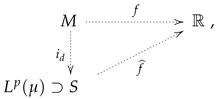
This result can also be written as a commutative factorization for the Lipschitz functional f through a subset of as
where is a Lipschitz map given by S is the set of all the classes of functions as that are equal -a.e. and is also a real-valued Lipschitz functional on S given by Indeed, note that for we have that the difference of the functions and satisfies
and the continuity of is assured by the inequality in Theorem 1 (2). The functions and are Lipschitz.
 |
Example 2.
Consider the space endowed with the -norm, that is and take the following metric metric subspace,
Consider the functional for and for Note that A is a compact set, since it is finite. Take any couple of finite sequences and and note that
Note also that
Therefore, we have that the inequality (i) in Theorem 1 holds for the function for every for the compact set A and for a constant This means that f is eccentric p-summing for all
According to the theorem, there has to exist a probability measure such that the corresponding integral dominates In fact, it can also be easily seen that any suitable convex combination of the Dirac deltas for gives a measure on A for which an integral domination for f can be obtained. We will explain more examples in Section 4.
Remark 4.
It can be easily seen that the same proof of Theorem 1 works for eccentric p-summing operators if the differences are substituted by on the left-hand side of the inequality in the statement of this theorem. Recall that an operator is eccentric p-summing for a compact set if there is a constant such that for every couple of finite sequences and in the metric space , we have
or, if we write it in terms of sequence metrics,
Following the arguments in the proof of Theorem 1, we find that this is equivalent to the integral domination
for all This provides an extension of Theorem 2 in [5] for the p-th power case.
The previous results can also be written when a weak-type metric for sequences is put in the left-hand side of the inequality. For example, if we consider a mapping and f belongs to a certain subset D of Lipschitz functions on the set of compositions gives the following application of Theorem 1. Note that the supremum in the left can also be read as follows: for every the inequality in Theorem 1 works for
Corollary 1.
Let be two metric spaces and K a compact subset of M. Let a mapping and and let The following statements are equivalent.
- 1.
- For any , ,
- 2.
- For every , there exists a Borel regular probability measure on K such that for any ,
That is, if T satisfies any of these statements, then it is eccentrically p-approximating.
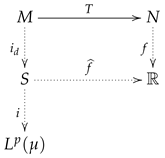
This result can also be written in terms of factorizations. If is a mapping, we can draw the following scheme for a given real functional f:
where i is a inclusion map and is the Lipschitz map given by that was explained in the factorization associated to Theorem 1; also the set S was explained there, as well as It can be easily seen that all the maps in this commutative factorization diagram are Lipschitz.
 |
Remark 5.
In the case that we use the adaptation of this notion for general Lipschitz maps we find the definition of the eccentrically p-approximating operator. Assume that and are metric spaces, and is a map. Let us recall the definition of eccentrically p-approximating operators associated with a pair of compact subsets and Suppose that the following inequalities are satisfied for a constant and every finite sequence of elements and in M
where and are compact subsets.
Note now that for every probability measure the inequality above clearly gives the domination
Using the same argument that proves Theorem 1,writing
instead of shows that there is a probability measure such that
for all This gives the desired characterization for eccentrically p-approximating operators by means of integral inequalities.
4. Applications: Distance Summing Inequalities in Metric Graphs
Having developed the core theoretical framework for eccentric p-summing domination, we now apply these results within the context of metric undirected graphs. All the notions and results that we use on graphs are elementary. The reader can find all the information needed about graphs and distances in graphs in [14] and [1,28], respectively.
Consider a weighted connected undirected graph with a countable set of vertices endowed with the weighted shortest path distance We first need to clarify the type of graphs we will deal with. We will consider the case in which, although there is an infinite set of vertices in the graph, all of them are connected by a finite path. This finiteness of the paths is relevant, since given a certain we can use the usual formula for the p-weighted shortest path distance (positive weights) without the need to consider infinite paths. In other words, given a couple of vertices and in the graphs, there is a finite number of paths connecting them, so the shortest path p-distance can be defined as usual by
where denotes the weight of the edge connecting both vertices.
Example 3.
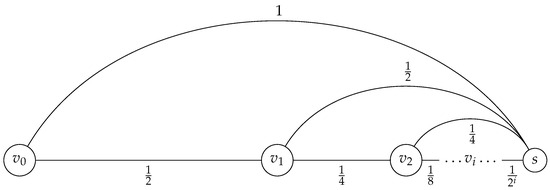
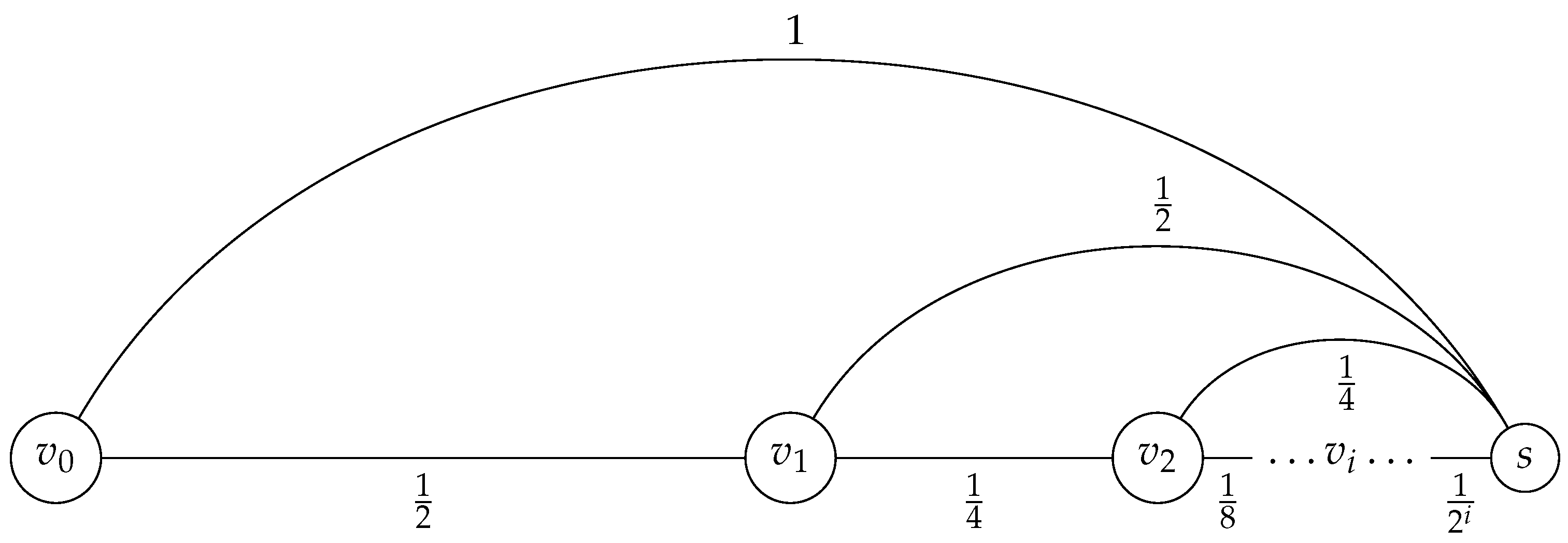
A canonical example of the type of structure we have fixed is a graph composed of vertices that are identified with the elements of an increasing convergent sequence in with its boundary s (which does not belong to the sequence), in which the connectivity is given by the adjacency on the real line and the distance (weight) between consecutive vertices is the size of the segment connecting them. Furthermore, the boundary vertex s is assumed to be connected to all other vertices, and the weights for the distance are again the size of the segment connecting it to the other points in the sequence.
It can be easily seen that the distance of the shortest path between any two vertices is in this case again the size of the segment connecting the two vertices. This (infinite) graph is clearly compact, since it is isomorphic and isometric to the convergent sequence with its limit (Figure 1).
Figure 1.
A canonical example using the sequence with its limit, The vertices represent the element of the convergent sequence, and s represents the boundary vertex, that is, The edge values are weights between the vertices.
4.1. Weighted p-Shortest Path Metrics and Integral p-Averages on Graphs
Following the idea that leads to the definition of general path metrics, we can use the integrals appearing in the characterization theorems explained in Section 3 to introduce a new family of pseudometrics that are closely related to the metric symmetry on graphs. Broadly speaking, we will compute the shortest paths between two vertices in a graph considering the distance between two adjacent vertices given by an integral p-average as the ones appearing in previous section. We will focus the attention on the weighted p-shortest path metrics, which will be used in the next section, although some of the results presented here hold for general metrics on graphs.
Our main motivation is that in metric modeling, indices on graphs are often defined as real Lipschitz functions acting on the set of vertices of a given graph. The interested reader can find many such applications, for example, in subjects as different as chemistry [29] and network analysis in the social sciences [30].
Let us first fix some definitions.
Definition 1.
Two points in a metric space are metrically symmetric with respect to a certain set S if for every
This property will be characterized in what follows in terms of domination by an integral p-average. Let us show first some other metric definitions and the relation between them and some already defined functions.
Let be a(n) (undirected connected) metric graph Recall that we assume that all the vertices of the graph can be connected by a finite path. Let us define below a generalized version of the p-weighted shortest path metric for a graph starting from any distance
Definition 2.
For we define the p-shortest path pseudodistance between two vertices associated with the metric d by
where means that and are connected.
It can be easily seen that, in general, we cannot ensure that for any distance Indeed, consider the (countable infinite) graph in which V is identified with the set of natural numbers, and the adjacent vertices are only the consecutive natural numbers. Consider the discrete distance in it ( whenever ) If we compute the pseudometric between and we have that while Since n is arbitrary, we find that this inequality cannot follow in general.
However, for the case when d is a weighted shortest path metric we always obtain this inequality for the adequate values of We assume that the weights between adjacent vertices of the graph make a metric, and not just a pseudometric.
Lemma 1.
Fix For every graph endowed with a weighted path metric we have
Proof.
Take and a path such that
and note that, since by definition, for adjacent vertices and , we have by the inequality above, we obtain
Thus, taking into account that we obtain
Since this happens for every we obtain the result. □
It can be easily seen that for , we obtain and so the inequality in Lemma 1 becomes an equality.
Let us define below the associated p-average notion of the weighted shortest path distance for a graph starting from any distance Let be a compact subset of vertices of a(n) (undirected connected) metric graph
Definition 3.
For and a probability measure we define the p-shortest path pseudodistance between two vertices by
where means that and are connected.
Lemma 2.
For every metric graph every and every probability measure
Proof.
This is a consequence of a direct calculation. Indeed, note that by the triangular inequality for and taking into account that is a probability measure, we obtain
□
A straightforward consequence of Lemmas 1 and 2 is the following:
Proposition 3.
Let be a compact subset of a weighted undirected connected graph Fix Then, for every probability measure,
4.2. Eccentric p-Summing Domination for Functionals on Graphs and Metric Symmetry
In this section, we show how domination of particular real Lipschitz functions can be used for the characterization of indices of metric symmetry on graphs. Let us motivate this application with two examples.
Example 4.
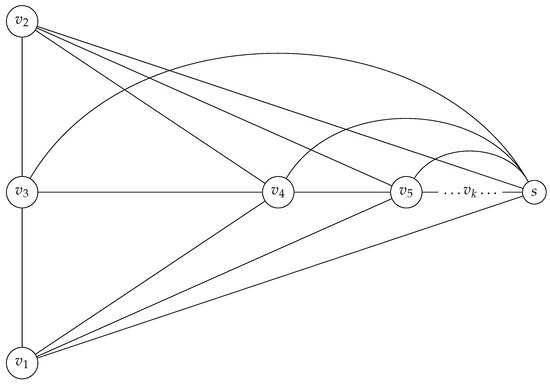
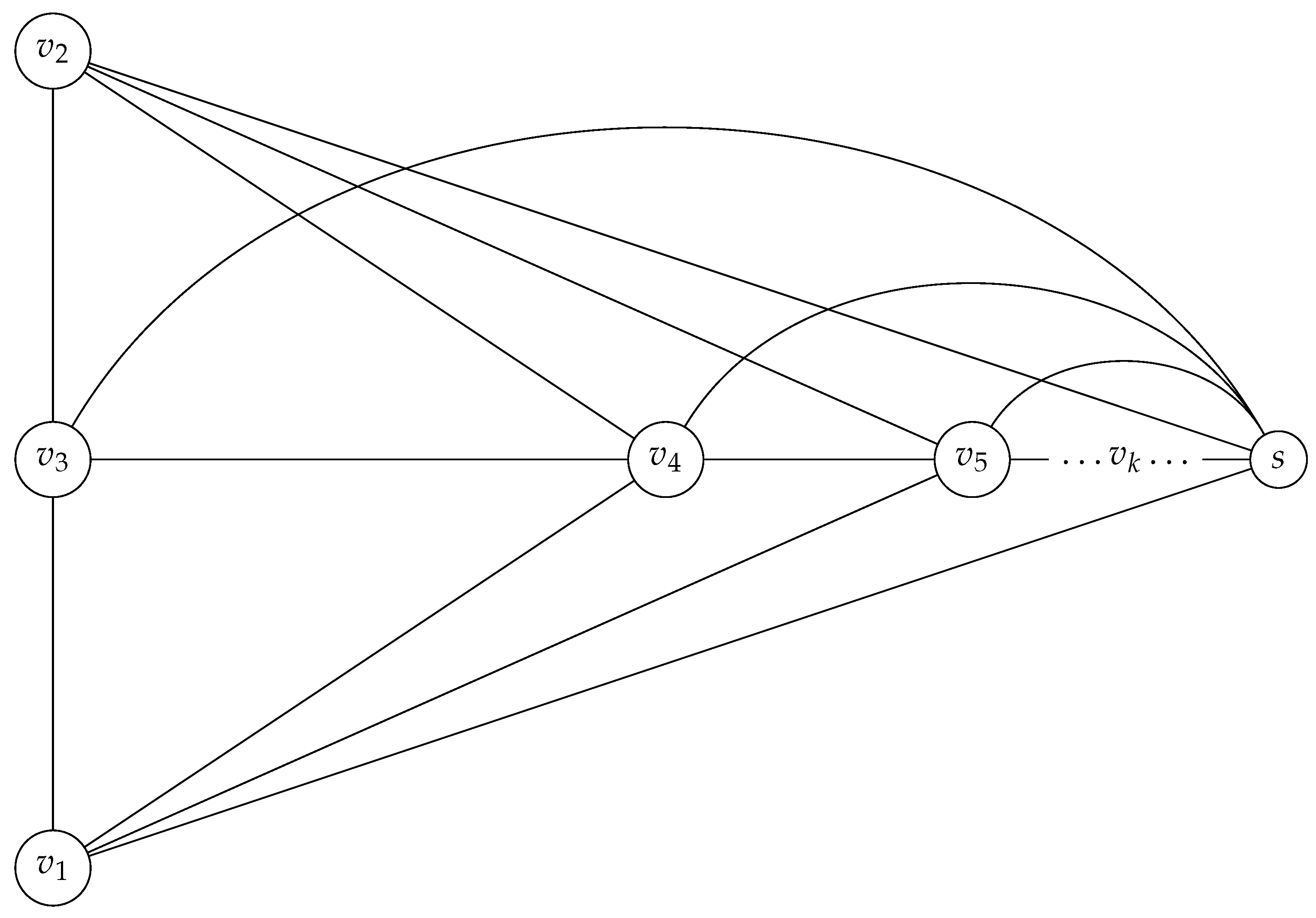
Consider a graph defined by the following points of as vertices. Take and for where is a convergent sequence formed by elements as together with its limit Suppose that the connectivity is given as in Example 3 for the elements of the sequence and its limit, and the elements and are connected to all the elements of the sequence, and with its limit too. The weights for the metric are again the size of the segments connecting every couple of adjacent vertices. It is clearly a compact graph with the weighted shortest path metric (Figure 2).
Figure 2.
As in Figure 1 of Example 3, in this graph, the convergent sequence is formed by the elements together with their limit In this figure, the weights of the graph are not represented.
Take the Borel regular measure μ on the whole set V of vertices of the graph that is written as a series
where is the Dirac measure on the vertex and are non-negative real numbers such that
Suppose that a real-valued Lipschitz function satisfies a domination as
Note that this implies that since by symmetry for all for , and for or but for these points. This means that all Lipschitz functionals dominated by such an integral are symmetric, in the sense that This example can be considered in the context of functions that model transportation costs on both sides of a border between two regions that must be treated equitably. Cities located at the same distance from the border should have the same transportation costs.
Example 5.
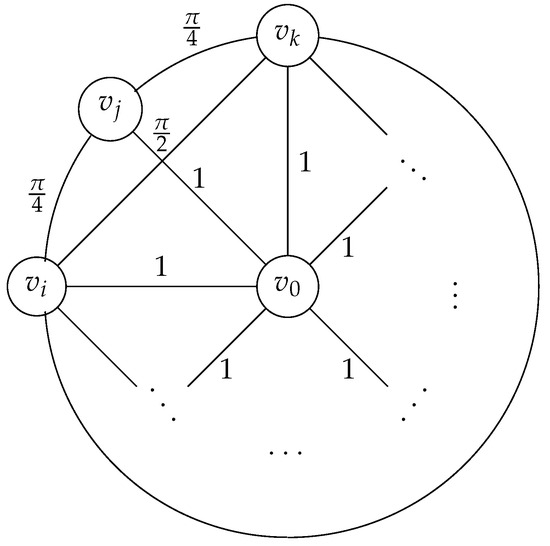
A noncountable graph (Figure 3). Consider all the points of the circle of radius 1 together with its center, which is supposed to be the point as a subset of Suppose that all the points of the circle are connected, and also with the center Consider the sets of weights given by the size of the arc connecting two points of the circle, and for all the points in the circle. This is a metric graph with the shortest path metric for which the distance equals again the size of the arc connecting them if they belong to the circle, and 1 if one of the points involved is
Figure 3.
Graph on the circle with center and arc weights.
Take the measure Then, every Lipschitz functional dominated as
for any satisfies that for all in the unit circle (that is, it takes a constant value Q), and that is, This shows a requirement for the circular symmetry of functions under integral domination: for a dominated real function, all points that are radially symmetric with respect to the center must take the same value. This concept could be applied, for instance, in modeling resource distribution in peripheral areas of a large city.
These examples show that the integral domination gives information about the properties of the functionals on certain paths connecting concrete vertices in a graph. The problem we face in this section is to give conditions under which a Lipschitz functional satisfies that for given two vertices, there is a path connecting them that satisfies that the functional is almost constant, or at least that its p-th variation is controlled.
Let be a weighted graph with weights Given a functional we define its p-best path estimate as
for every
Definition 4.
Let be a weighted graph with weights We say that a functional satisfies a p-th power integral estimate if there is a constant a compact subset and a probability measure such that for every
Using the tools developed in other sections, the next result shows the functionals that satisfy this definition.
Theorem 2.
Let . Let be a weighted graph with weights Let be a Lipschitz map. Then,
- 1
- for all
- 2
- If f is an eccentric p-summing functional, then there is a compact subset S and a probability measure such that f satisfies a p-th power integral estimateThat is, for everywhere is the eccentric p-summing constant of
Proof.
1. Consider a pair and take a path connecting them Then,
and so Since this happens for every path connecting and we obtain the result.
2. Fix Consider a path connecting them Since f is eccentric p-summing, by Theorem 1, we find a set a constant and a measure such that
Writing the p-sum in both sides, we obtain
and so
Now, we only need to consider the infimum on the right-hand side to obtain the desired inequality. □
Let us explicitly explain the application of the above results to graph analysis. Following the standard tool definition for metric graph analysis in applied science, we say that a function that quantitatively represents a certain property of the graph vertices is an index [29]. It is usually assumed to be a Lipschitz function for a certain distance defined in the graph. In the metric modeling of graphs (and in the modeling of metric spaces in general), it is common to use this type of functions to represent relevant properties of the graphs: for example, if one considers the graph of the cities of a region with the road connections between them, an index of interest could be given by the real function that maps the number of inhabitants of each city. Thus, such an index is defined as a Lipschitz functional on
For a given measure let us consider the pseudometric Two vertices and in V are symmetric with respect to if
The meaning of this relation is clear: two vertices and are symmetric with respect to if the associate metric functions and are -almost everywhere equal, that is The term symmetric is explained by the fact that, if this holds, then the vertices and have a similar distribution of distances except in a set of vertices w that is -null.
Recall that, in the context of metric modeling, an index I is a real Lipschitz function The next result gives the formal property that characterizes the existence of I-constant paths for a certain index The proof is a straightforward application of Theorem 2, which proves the existence of a measure and a domination of by
Corollary 2.
Let be an index on a weighted undirected connected graph If I is eccentric p-summing, then there is a compact set S and a probability measure such that if two vertices in V are symmetric with respect to μ, then there is a path connecting and such that for all vertices v in the path.
The approximate version of this result also holds, in the sense that if the vertices and are not symmetric with respect to but satisfy that is small, we obtain that the p-variation is small because
To finish, let us return to the example of the graph of the cities of a region with the road connections between them, and give the weights of the edges by ordering the distances between them (e.g., 1 if the distance is 0 to 5 km, 2 if the distance is 6 to 10, and so on). Let us fix an index I that orders the set of vertices (cities) by thousands of inhabitants: if the city v has from 1 to 1000 inhabitants, if v has from 1001 to 2000 inhabitants, and so on. Suppose I is controlled by an appropriate measure modeled in order to control the routes between two cities to reduce risk by restricting crossing large cities; for example, the support of the measure contains only the largest cities, so distances to small cities is irrelevant. Given that there exists a constant R such that then a small value of for two small cities (populations less than 1000 inhabitants, means that we can find a path connecting and such that is also small (or 0). For instance, if it is it means that there is a path connecting cities and that crosses only towns of less than 1000 inhabitants, since for all vertices that the path crosses,
5. Conclusions
In this paper, we introduce a new type of p-summability for Lipschitz maps between metric spaces, which we call eccentric p-summing. Through its detailed characterization, we explore the general summation properties of metric spaces, introducing some related integral inequalities for real Lipschitz functionals. These inequalities lead to factorization theorems for general Lipschitz operators. We establish some key definitions related to summing metrics for sequences of metric spaces, laying the groundwork for our new notion of operator summability. Using them, we focus on proving the main results concerning summing Lipschitz operators, providing not only the associated factorization theorems but also discussing general cases with concrete examples to illustrate the breadth of applicability. These results extend classical summability concepts, offering new insights into the behavior of Lipschitz operators across diverse settings.
The final section of this paper addresses the application of these summing Lipschitz operators in the context of metric graphs. Given their potential applications in various fields, we show how the integral inequalities that characterize summing properties can be adapted to compact metric graphs. This extension provides a powerful new tool for investigating the concept of metric symmetry in graphs. Furthermore, we present examples and discuss new results regarding the characterization of approximate metric symmetry, utilizing analytic techniques in contrast to the classical algebraic approaches. By shifting the focus to analytic methods, we offer a new perspective on the study of symmetry in metric spaces, with implications for both theoretical research and practical applications in graph theory.
Author Contributions
Validation, R.A. and S.S.; formal analysis, E.A.S.P. and S.S.; conceptualization, R.A. and E.A.S.P.; investigation, R.A., E.A.S.P. and S.S.; writing—review and editing, R.A.; writing—original draft, E.A.S.P. and S.S.; supervision, E.A.S.P.; visualization, S.S. All authors have read and agreed to the published version of the manuscript.
Funding
The first author was supported by a contract of the Programa de Ayudas de Investigación y Desarrollo (PAID-01-21), Universitat Politècnica de València. This research was funded by the Agencia Estatal de Investigación grant number PID2022-138342NB-I00. The research was funded by the European Union’s Horizon Europe research and innovation program under the Grant Agreement No. 101059609 (Re-Livestock).
Data Availability Statement
No original data have been produced.
Conflicts of Interest
The authors declare no conflicts of interest.
References
- Deza, M.M.; Deza, E. Encyclopedia of Distances; Springer: Berlin/Heidelberg, Germany, 2009. [Google Scholar]
- Das, K.C.; Maden, A.D.; Cangül, I.N.; Çevik, A.S. On average eccentricity of graphs. Proc. Natl. Acad. Sci. India Sect. A Phys. Sci. 2017, 87, 23–30. [Google Scholar] [CrossRef]
- Dragan, F.F.; Ducoffe, G. αi-Metric Graphs: Radius, Diameter and all Eccentricities. Algorithmica 2024, 86, 2092–21298. [Google Scholar] [CrossRef]
- Gómez, R.; Gutiérrez, J. Path eccentricity of graphs. Discret. Appl. Math. 2023, 337, 1–13. [Google Scholar] [CrossRef]
- Arnau, R.; Calabuig, J.M.; Sánchez Pérez, E.A. Representation of Lipschitz maps and metric coordinate systems. Mathematics 2022, 10, 3867. [Google Scholar] [CrossRef]
- Aliprantis, C.D.; Border, K.C. Infinite Dimensional Analysis; Springer: New York, NY, USA, 2006. [Google Scholar]
- Aksoy, S.G.; Nowak, K.E.; Purvine, E.; Young, S.J. Relative Hausdorff distance for network analysis. Appl. Netw. Sci. 2019, 4, 80. [Google Scholar] [CrossRef]
- Ali, M.; Hussain, Z.; Yang, M.S. Hausdorff distance and similarity measures for single-valued neutrosophic sets with application in multi-criteria decision making. Electronics 2022, 12, 201. [Google Scholar] [CrossRef]
- Karimi, D.; Salcudean, S.E. Reducing the Hausdorff distance in medical image segmentation with convolutional neural networks. IEEE Trans. Med. Imaging 2019, 39, 499–513. [Google Scholar] [CrossRef] [PubMed]
- Godsil, C.; Royle, G.F. Algebraic Graph Theory; Springer Science & Business Media: Berlin/Heidelberg, Germany, 2001. [Google Scholar]
- Cobzaş, Ş.; Miculescu, R.; Nicolae, A. Lipschitz Functions; Springer International Publishing: Berlin/Heidelberg, Germany, 2019. [Google Scholar]
- Wilson, W. On certain types of continuous transformations of metric spaces. Am. J. Math. 1935, 57, 62–68. [Google Scholar] [CrossRef]
- Arens, R.F.; Eells, J., Jr. On embedding uniform and topological spaces. Pac. J. Math. 1956, 6, 397–403. [Google Scholar] [CrossRef]
- Godefroy, G. A survey on Lipschitz-free Banach spaces. Comment. Math. 2015, 55, 89–118. [Google Scholar] [CrossRef]
- Defant, A.; Floret, K. Tensor Norms and Operator Ideals; Elsevier: Amsterdam, The Netherlands, 1992. [Google Scholar]
- Pietsch, A. Operator Ideals; North-Holland: Amsterdam, The Netherlands, 1980. [Google Scholar]
- Diestel, J.; Jarchow, H.; Tonge, A. Absolutely Summing Operators; Cambridge University Press: Cambridge, UK, 1995. [Google Scholar]
- Achour, D.; Rueda, P.; Yahi, R. (p, σ)-Absolutely Lipschitz operators. Ann. Funct. Anal. 2017, 8, 38–50. [Google Scholar] [CrossRef]
- Achour, D.; Dahia, E.; Turco, P. The Lipschitz injective hull of Lipschitz operator ideals and applications. Banach J. Math. Anal. 2020, 14, 1241–1257. [Google Scholar] [CrossRef]
- Chávez-Domínguez, J.A. Duality for Lipschitz p-summing operators. J. Funct. Anal. 2011, 261, 387–407. [Google Scholar] [CrossRef]
- Chen, D.; Zheng, B. Remarks on Lipschitz p-summing operators. Proc. Am. Math. Soc. 2011, 139, 2891–2898. [Google Scholar] [CrossRef]
- Farmer, J.; Johnson, W. Lipschitz p-summing operators. Proc. Am. Math. Soc. 2009, 137, 2989–2995. [Google Scholar] [CrossRef]
- Angulo-López, J.C.; Fernández-Unzueta, M. Lipschitz p-summing multilinear operators. J. Funct. Anal. 2020, 279, 108572. [Google Scholar] [CrossRef]
- Fernández-Unzueta, M. Lipschitz p-summing multilinear operators correspond to Lipschitz p-summing operators. Proc. Am. Math. Soc. 2023, 151, 215–223. [Google Scholar] [CrossRef]
- Chávez-Domínguez, J.A. Lipschitz (q, p)-mixing operators. Proc. Am. Math. Soc. 2012, 140, 3101–3115. [Google Scholar] [CrossRef]
- Rodríguez-López, J.; Sánchez-Pérez, E.A. Power-aggregation of pseudometrics and the McShane-Whitney extension theorem for Lipschitz p-concave maps. Acta Appl. Math. 2020, 1709, 611–629. [Google Scholar] [CrossRef]
- Panaretos, V.M.; Zemel, Y. An Invitation to Statistics in Wasserstein Space; Springer Nature: Berlin/Heidelberg, Germany, 2020. [Google Scholar]
- Buckley, F.; Harary, F. Distance in Graphs; Addison-Wesley: Boston, MA, USA, 1990. [Google Scholar]
- Das, K.C.; Gutman, I.; Furtula, B. Survey on geometric-arithmetic indices of graphs. MATCH Commun. Math. Comput. Chem. 2011, 65, 595–644. [Google Scholar]
- Brandes, U. Network Analysis: Methodological Foundations; Springer Science & Business Media: Berlin/Heidelberg, Germany, 2005. [Google Scholar]
Disclaimer/Publisher’s Note: The statements, opinions and data contained in all publications are solely those of the individual author(s) and contributor(s) and not of MDPI and/or the editor(s). MDPI and/or the editor(s) disclaim responsibility for any injury to people or property resulting from any ideas, methods, instructions or products referred to in the content. |
© 2024 by the authors. Licensee MDPI, Basel, Switzerland. This article is an open access article distributed under the terms and conditions of the Creative Commons Attribution (CC BY) license (https://creativecommons.org/licenses/by/4.0/).