


Abstract
The study examines the onset of magnetoconvection in a Casson fluid-saturated inclined porous layer. Oberbeck–Boussinesq approximation and Darcy law employed to characterize the fluid motion. The stability of the system is examined using both linear and nonlinear stability theories. A basic solution of the governing equation is determined. The linear instability is studied by employing disturbances to the basic flow. The nonlinear instability is analyzed utilizing the energy method. The solution to the eigenvalue problem is derived using the bvp4c routine in MATLAB R2023a. This study evaluates the influence of nondimensional parameters specifically, the Hartmann number, Casson parameter, and inclination angle on both linear and nonlinear instability. The Casson parameter destabilizes the system, whereas the Hartmann number and inclination angle stabilize it. Transverse rolls exhibit greater stability compared to longitudinal rolls. Changes in the Casson parameter significantly affect the presence or absence of transverse rolls; as its value changes, so does the disappearance of transverse rolls.
MSC:
76A05; 76D05; 76E06; 76E30
1. Introduction
Like many food products, molten chocolate also exhibits non-Newtonian fluid behavior which chocolate is characterized by yield stress [1]. Below the yield point, when stresses increase, chocolate responds elastically, with deformation proportional to the applied stress. Once the yield stress is exceeded, it transitions to a viscous flow regime, behaving like a fluid. From a rheological standpoint, materials with yield stress but capable of flowing under elevated stress exhibit plastic properties. When melted, chocolate exhibits pseudoplastic behavior or shear-thinning, where its resistance to flow decreases with higher shear rates, which is a reversible phenomenon [2,3,4,5,6].
Chocolate is composed of fats, cellulose, minerals, carbohydrates, proteins, and water. Simplified model systems, which include cocoa powder and fat supplemented with sugar or emulsifier, as well as carefully crafted chocolates, have provided valuable insights into the components that affect flow [7]. In practical situations, understanding the rheological properties of chocolate and the factors that influence its flow is crucial for tasks such as pipe sizing, pump design, and utilization in molding or coating applications. Therefore, an accurate understanding of the flow behavior, especially regarding yield phenomena, is essential for effective process and product management.
However, Steiner [8] found that the Bingham equation failed to adequately capture these properties. As a result, Casson [9] proposed a more sophisticated two-parameter model initially developed for dispersions of pigments in castor oil. Initially, the Casson model was applied to analyze data from oil suspensions using a cone. Steiner [10] concluded that the Casson model offered a more accurate fit to the flow data of molten chocolate compared to the Bingham model. Subsequently, Heimann and Fincke [11,12,13] modified the Casson equation to better suit flow data for various types of milk chocolates.
The Casson model has provided satisfactory approximations of the flow characteristics for most chocolates. Endorsed as the official methodology for measuring chocolate viscosity by the Cocoa and Chocolate International Office [14], the OICC protocol is widely utilized in research and throughout the European chocolate industry. Convection problems can lead to complex dynamics, including chaos and hyperchaos [15].
Various researchers have explored the hydrodynamic stability of convection in Casson fluid flow, considering different external influences. For example, Aghighi et al. [16] conducted a numerical investigation into Rayleigh-Bénard convection (RBC) in Casson fluids, emphasizing the impact of yield stress on heat transfer and convective motion. In another study, Aghighi et al. [17] examined RBC in a trapezoidal enclosure, employing Galerkin’s scheme to solve the system of differential equations. Urvashi Gupta et al. [18] discussed the thermosolutal instability of Casson nanofluid under various boundary conditions, providing analytical expressions for the Rayleigh number in all scenarios. Ramesh and Misbah [19] investigated the hydromagnetic flow of Casson fluid, utilizing temporal stability analysis to explore the Poiseuille flow of a Casson fluid. Additionally, Reddy et al. [20] studied the thermosolutal convection of a Casson fluid in a porous medium, discussing both linear and nonlinear analyses and observing that both thresholds coincide.
In recent decades, numerous research papers have investigated the onset of instability in porous layers confined between horizontal parallel planes, as reported by Nield and Bejan [21]. Convection in a tilted porous layer holds significant applications in various fields such as filtration systems, soil erosion control, geotechnical engineering, biomedical engineering, and irrigation systems.
The initial studies on inclined porous layers were conducted by Bories and Combarnous [22], Weber [23], and Caltagirone [24]. Subsequently, numerous researchers have explored this area, with some notable contributions summarized in this paper. Rees and Bassom [25] devised a transformation that converts oblique rolls into transverse rolls, yielding additional insights. They established that transverse rolls occur only when the inclination angle γ exceeds 31.49032° above the horizontal, with a critical Rayleigh number of 104.30. Rees and Barletta [26] investigated a scenario where plane-bounding surfaces experience constant heat flux boundary conditions. They suggested that linear stability is achieved when inclinations exceed 32.544793° relative to the horizontal. Barletta and Storesletten [27] explored thermoconvective instability in a sloped rectangular channel containing a fluid in a porous layer, revealing that transverse rolls become unstable when the Rayleigh number surpasses a critical value.
However, to the best of our knowledge, the influence of a magnetic field on thermal convection in an inclined porous medium saturated with a Casson fluid has not yet been studied. Therefore, in this work, we aim to address this gap. Section 2 outlines the formulation of the physical problem, while Section 3 presents the linear stability analysis. The nonlinear analysis is discussed in Section 4. Section 5 elaborates on the results, and finally, Section 6 concludes the study.
2. Basic Equations
We consider a Casson fluid confined in the space bounded by two parallel plates separated with a distance d of infinite width, inclined at an angle to the horizontal layer. The z-axis points vertically upward, and signifies the vertical temperature difference between the planes. In this scenario, the governing equations are as follows: ([20,28,29])
with
where K, , g, t, p, , , , , and are the permeability, viscosity, gravity, time, dynamic pressure, thermal diffusivity, reference density, electric conductivity, heat capacity ratio, and thermal expansion coefficient, respectively. Below are the dimensionless variables
as well as
where and are the Rayleigh number and Hartmann number. The governing Equations (1)–(3) along with (4) are expressed in non-dimensional form as follows:
with
2.1. Basic Flow
2.2. Linear Stability Analysis
Now, we perturb the basic state for Equations (11) and (12), as follows:
On substituting Equation (13) into Equations (7)–(10),
Pressure elimination is achieved by extracting the third component of the curl of curl Equation (15), resulting in the following:
Now, let us present the normal modes in the following manner:
Where is the wave number, and denotes the angular frequency. By applying Equation (21), Equations (18)–(20) are transformed as follows:
3. Nonlinear Stability Analysis
In order to investigate nonlinear stability, it is necessary to define the energy functional as follows:
Where denotes the coupling parameter. On multiplying Equation (15) by U and Equation (16) by , integrating over periodicity cell , we obtain the following:
Where and are the inner product ands a norm on . Differentiating Equation (25) with respect to ‘t’ and using Equations (26) and (27), which yields,
where,
Therefore,
where H = { at }. The succeeding maximization problem of Equation (28) is as follows:
Equation (29) becomes
By utilizing the Poincaré inequality and Equation (29), one obtains
On integrating with the assumption of ,
Inequality Equation (33) shows the exponential decay of as t tends towards infinity for . In Equation (30), by taking ,
Hence, the Euler–Lagrange equations are as follows:
where is a Lagrange multiplier. By applying curl and curlcurl to Equation (35) and considering the third component,
Where . Now employing the normal modes Equation (21) to Equations (36) and (37) and eliminating the variables U and , the acquired equations are presented as follows:
4. Derivation of the Coupling Parameter
To ensure system stability, we have to optimize the coupling parameters in the generalized energy functional. The ideal values are as follows:
Adjusting temperature and concentration perturbations as
the modified expressions for I and D are
If , then is maximum. The equations of Euler–Lagrange for the maximization problem are in the form of
where
We obtain the expression for coupling parameters by differentiating A,
5. Discussion
This section presents the numerical findings of the study, focusing on the onset of convection in an inclined porous layer saturated with a Casson fluid, incorporating magnetic effects. The eigenvalue problem for analyzing both linear and nonlinear instability is tackled using the bvp4c routine in MATLAB R2023a [29]. It is assumed that the principle of exchange of stabilities holds true. We consider the range of parameters as [29], [20], and [29].
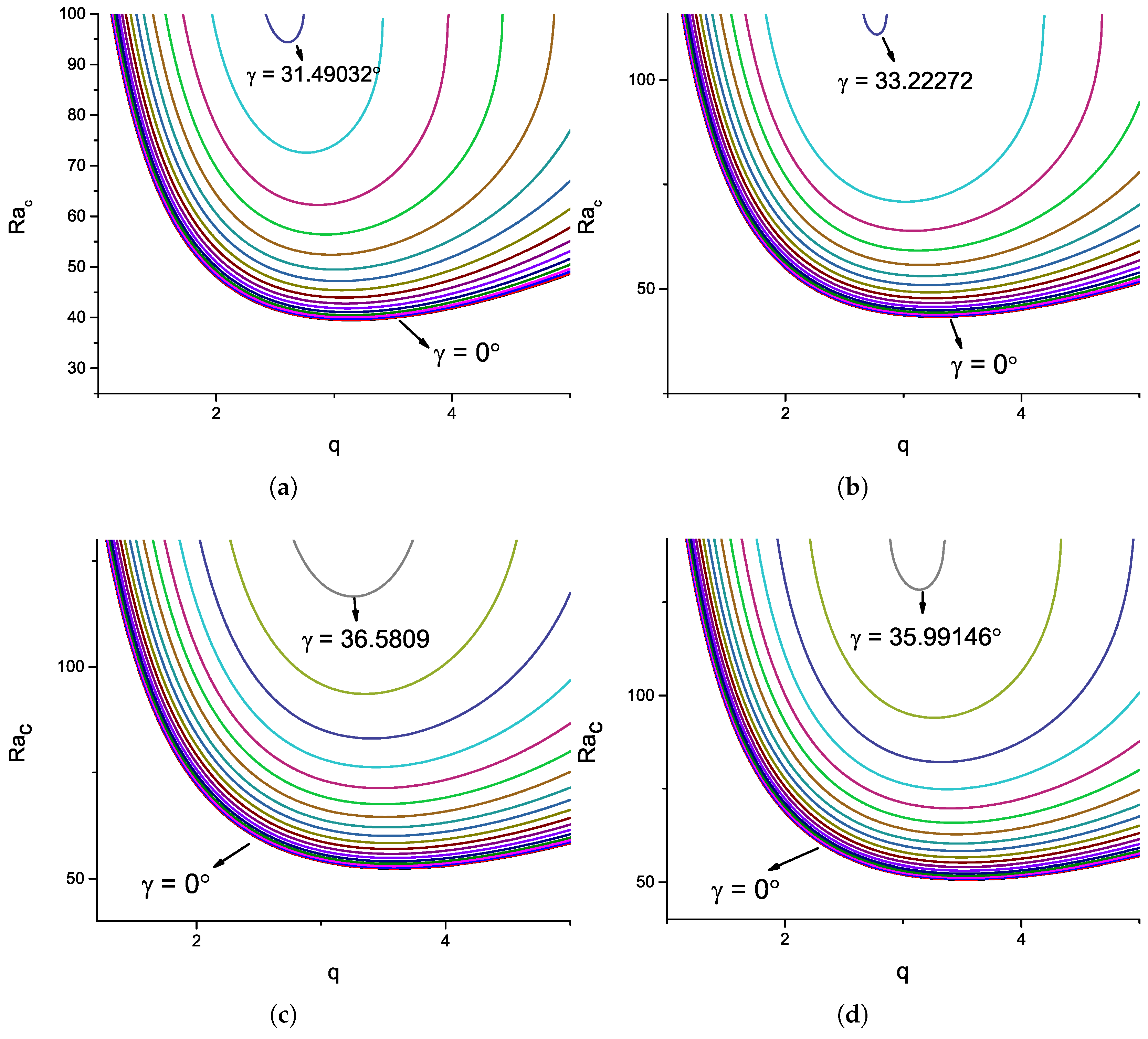
Figure 1 illustrates the neutral curves in the plane for various inclination angles. Specifically, Figure 1a depicts the neutral curves for and . From this figure, it is observed that transverse rolls vanish at γ = 31.49032°, consistent with the findings of Rees and Bassom [25]. Consequently, for a Newtonian fluid in the absence of a magnetic field, no unstable normal modes are observed for γ > 31.49032°. Figure 1b–d demonstrates that the disappearance of transverse rolls occurs at different inclination angles depending on the value. Furthermore, it is noted that the neutral curves shift upward monotonically as increases, indicating a stabilizing effect of the inclination angle.
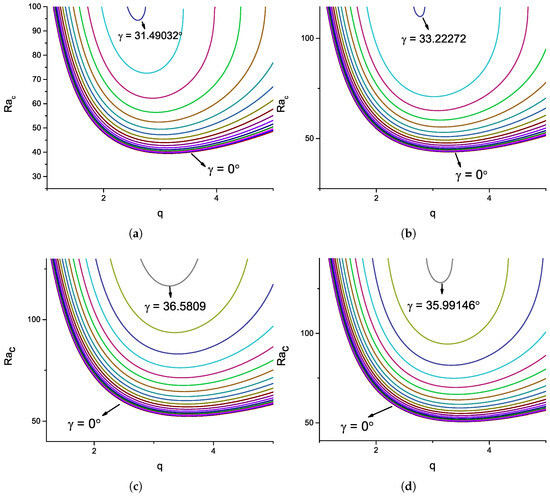
Figure 1.
Neutral curves for the transverse rolls and for the fixed values of , , (a) , (b) , (c) , and (d) .
The change of critical Rayleigh number, with is shown in Table 1 for the fixed values of , and . From this table, it is clear that the critical decreases as increases for both linear and nonlinear analyses indicating the destabilizing nature of on the flow. Furthermore, for both longitudinal and transverse rolls, the subcritical instability region decreases as increases. Moreover, the critical value of for transverse rolls is higher compared to longitudinal rolls. Hence, it can be concluded that the transverse rolls exhibit greater stability than longitudinal rolls.

Table 1.
Change of critical Ra with β for the fixed values of , and .
Table 2 shows the relation between critical and . Here, we fix and . The threshold value of is an increasing function of for both linear and nonlinear analyses. In other words, raising the value of contributes to the system’s stability. Magneto-convection governs heat transfer in a system influenced by a magnetic field. The field generates Lorentz forces, and the nature of the convective flow depends on the relative strength of these forces. When the Lorentz force is weaker than viscous or turbulent pressure forces, convective motions distort and amplify the magnetic field, enhancing turbulence. Conversely, if the Lorentz force dominates, it constrains plasma motion along magnetic field lines and suppresses convective activity. And, an increase in the value of decreases the subcritical region. Furthermore, the threshold value for transverse rolls exceeds that of longitudinal rolls. So, transverse rolls demonstrate superior stability relative to longitudinal rolls.
Table 2.
Change of critical Ra with for longitudinal rolls and for the fixed values of , and .
A stabilizing effect of an inclination angle on the system is shown in Table 3. It is observed that the region of subcritical instability is insignificant for a small inclination angle but it enhances as the inclination angle rises in the cases of both transverse and longitudinal rolls. Transverse rolls exhibit greater stability compared to longitudinal rolls as observed in Table 1 and Table 2.
Table 3.
Change of critical Ra with γ for longitudinal rolls and for the fixed values of and .
6. Conclusions
This study investigates the onset of magneto convection in an inclined porous layer saturated Casson fluid. Linear as well as nonlinear cases are examined. The perturbed linear system is addressed using the normal mode method, while the nonlinear system is tackled through the energy method. The eigenvalue problem for linear and nonlinear instability analyses is addressed using the bvp4c routine in MATLAB R2023a. From the results, it is concluded that the Casson parameter has a destabilizing effect whereas the Hartmann number and inclination angle have a stabilizing effect on the system. Transverse rolls exhibit more stability compared to longitudinal rolls. This result has been demonstrated by Reddy et al. [29] for a Newtonian fluid, and is similar to our results.
Furthermore, for the Newtonian fluid, the lack of a magnetic field, the classical results of Rees and Bassom [25] demonstrated that transverse perturbations remain stable when the inclination angle exceeds 31.490320. In the present study, we proved that the disappear of transverse rolls is depend on Casson parameter. As the value of Casson parameter changes, the disappear of transverse rolls also changes. This constitutes a novel mathematical and physical finding.
Funding
This work was supported by the Deanship of Scientific Research, Vice Presidency for Graduate Studies and Scientific Research, King Faisal University, Saudi Arabia [Grant No. KFU 251871].
Data Availability Statement
Data will be available based on request.
Conflicts of Interest
The author declare that no conflict of interest.
References
- Charm, S.E. The direct determination of shear stress-shear rate behavior of foods in the presence of a yield stress. J. Food Sci. 1963, 28, 107–113. [Google Scholar] [CrossRef]
- Chevalley, J. Rheology of chocolate. J. Texture Stud. 1975, 6, 177–196. [Google Scholar] [CrossRef]
- Majeed, A.; Mahmood, R.; Shahzad, H.; Pasha, A.; Raizah, Z.A.; Hosham, H.; Reddy, D.; Hafeez, M. Heat and mass transfer characteristics in MHD Casson fluid flow over a cylinder in a wavy channel: Higher-order FEM computations. Case Stud. Therm. Eng. 2023, 42, 102730. [Google Scholar] [CrossRef]
- Astarita, G.; Marucci, G. Principles of Non-Newtonian Fluid Mechanics; McGraw-Hill: London, UK; New York, NY, USA, 1974. [Google Scholar]
- Fridtjov, I. Rheology and Non-Newtonian Fluids; Springer: Berlin/Heidelberg, Germany, 2014. [Google Scholar]
- Patel, M.; Timol, M. Non-Newtonian Fluid Models and Boundary Layer Flow; LAP Lambert Academic Publishing: Saarbrucken, Germany, 2020. [Google Scholar]
- Wildemuth, C.R.; Williams, M.C. A new interpretation of viscosity and yield stress in dense slurries: Coal and other irregular particles. Rheol. Acta 1985, 24, 75–91. [Google Scholar] [CrossRef]
- Steiner, E.H. A new rheological relationship to express the flow properties of melted chocolate. Int. Choc. Rev. 1958, 13, 290. [Google Scholar]
- Casson, N. Flow equation for pigment-oil suspensions of the printing ink-type. Rheol. Disperse Syst. 1959, 84–104. [Google Scholar]
- Steiner, E.H. An Investigation into the Validity of the Casson Relationship for Melted Chocolate at Low Rates of Shear and at Various Temperatures. Rev. Intern. Chocolat 1962, 17, 150. [Google Scholar]
- Heimann, W.; Fincke, A. Rheometry of chocolate-the flow equation of Casson and its application to rheometry of chocolate. Z Lebensm. Untersuch. Forsch. 1962, 117, 93. [Google Scholar]
- Heimann, W.; Fincke, A. Measuring the flow limits and their calculation from the Casson equation. Z Lebensm. Untersuch. Forsch. 1962, 117, 225. [Google Scholar] [CrossRef]
- Heimann, W.; Fincke, A. Application of a modified Casson equation to milk chocolates and cocoa pastes. Z Lebensm. Untersuch. Forsch. 1962, 117, 297. [Google Scholar] [CrossRef]
- Office International du Cacao et du Chocolat. Viscosity of chocolate-determination of Casson yield value and Casson plastic viscosity. Rev. Int. Choc. 1973, 28, 223–225. [Google Scholar]
- Chertovskih, R.; Chimanski, E.V.; Rempel, E.L. Route to hyperchaos in Rayleigh-Bénard convection. Europhys. Lett. 2015, 112, 14001. [Google Scholar] [CrossRef]
- Aghighi, M.S.; Ammar, A.; Metivier, C.; Gharagozlu, M. Rayleigh-Bénard convection of Casson fluids. Int. J. Therm. Sci. 2018, 127, 79–90. [Google Scholar] [CrossRef]
- Aghighi, M.S.; Ammar, A.; Masoumi, H.; Lanjabi, A. Rayleigh–Bénard convection of a viscoplastic liquid in a trapezoidal enclosure. Int. J. Mech. Sci. 2020, 180, 105630. [Google Scholar] [CrossRef]
- Gupta, U.; Sharma, J.; Devi, M. Double-diffusive instability of Casson nanofluids with numerical investigations for blood-based fluid. Eur. Phys. J. Spec. Top. 2021, 230, 1435–1445. [Google Scholar] [CrossRef]
- Kudenatti, R.B. The onset of instability in a hydromagnetic channel flow of Casson fluid: The accurate solutions. Appl. Math. Comput. 2023, 436, 127475. [Google Scholar] [CrossRef]
- Reddy, G.; Ragoju, R.; Shekhar, S. Thermohaline convection of a Casson fluid in a porous layer: Linear and non-linear stability analyses. Phys. Fluids 2023, 35, 094101. [Google Scholar] [CrossRef]
- Nield, D.A.; Bejan, A. Convection in Porous Media; Springer: New York, NY, USA, 2006; Volume 3, pp. 629–982. [Google Scholar]
- Bories, S.A.; Combarnous, M.A. Natural convection in a sloping porous layer. J. Fluid Mech. 1973, 57, 63–79. [Google Scholar] [CrossRef]
- Weber, J.E. Thermal convection in a tilted porous layer. Int. J. Heat Mass Transf. 1975, 18, 474–475. [Google Scholar] [CrossRef]
- Caltagirone, J.P.; Bories, S. Solutions and stability criteria of natural convective flow in an inclined porous layer. J. Fluid Mech. 1985, 155, 267–287. [Google Scholar] [CrossRef]
- Rees, D.A.S.; Bassom, A.P. The onset of Darcy-Bénard convection in an inclined layer heated from below. Acta Mech. 2000, 144, 103–118. [Google Scholar] [CrossRef]
- Rees, D.A.S.; Barletta, A. Linear instability of the isoflux Darcy—Bénard problem in an inclined porous layer. Transp. Porous Media 2011, 87, 665–678. [Google Scholar] [CrossRef]
- Barletta, A.; Storesletten, L. Thermoconvective instabilities in an inclined porous channel heated from below. Int. J. Heat Mass Transf. 2011, 54, 2724–2733. [Google Scholar] [CrossRef]
- Ragoju, R. Influence of a magnetic field on double-diffusive convection in an inclined porous layer. Heat Transf. 2024, 53, 2350–2368. [Google Scholar] [CrossRef]
- Reddy, G.S.K.; Ravi, R.; Dey, P. Matta, A. Nonlinear magneto convection in an inclined porous layer with artificial neural network prediction. Math. Methods Appl. Sci. 2022, 48, 7025–7036. [Google Scholar] [CrossRef]
Disclaimer/Publisher’s Note: The statements, opinions and data contained in all publications are solely those of the individual author(s) and contributor(s) and not of MDPI and/or the editor(s). MDPI and/or the editor(s) disclaim responsibility for any injury to people or property resulting from any ideas, methods, instructions or products referred to in the content. |
© 2025 by the author. Licensee MDPI, Basel, Switzerland. This article is an open access article distributed under the terms and conditions of the Creative Commons Attribution (CC BY) license (https://creativecommons.org/licenses/by/4.0/).